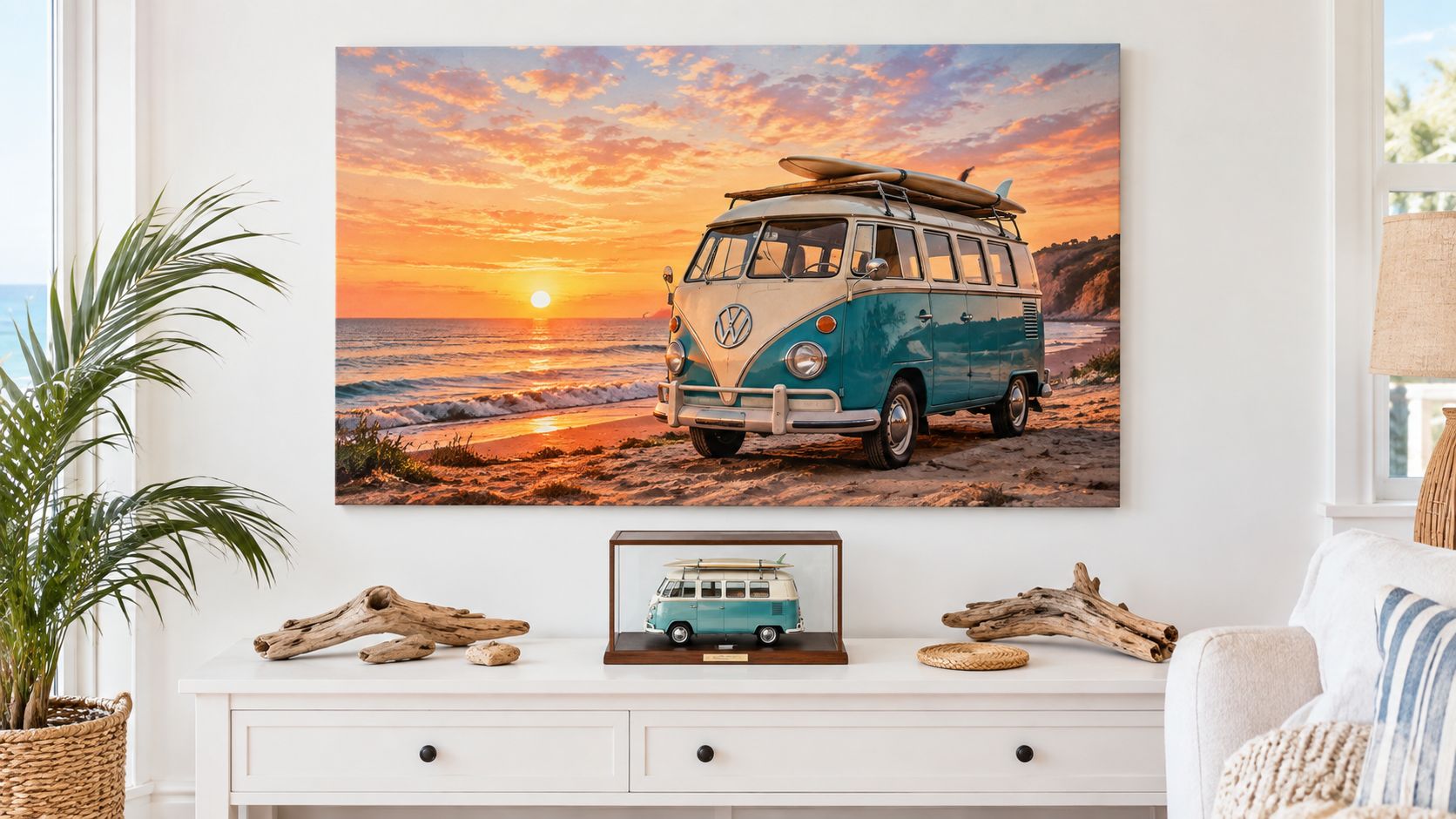
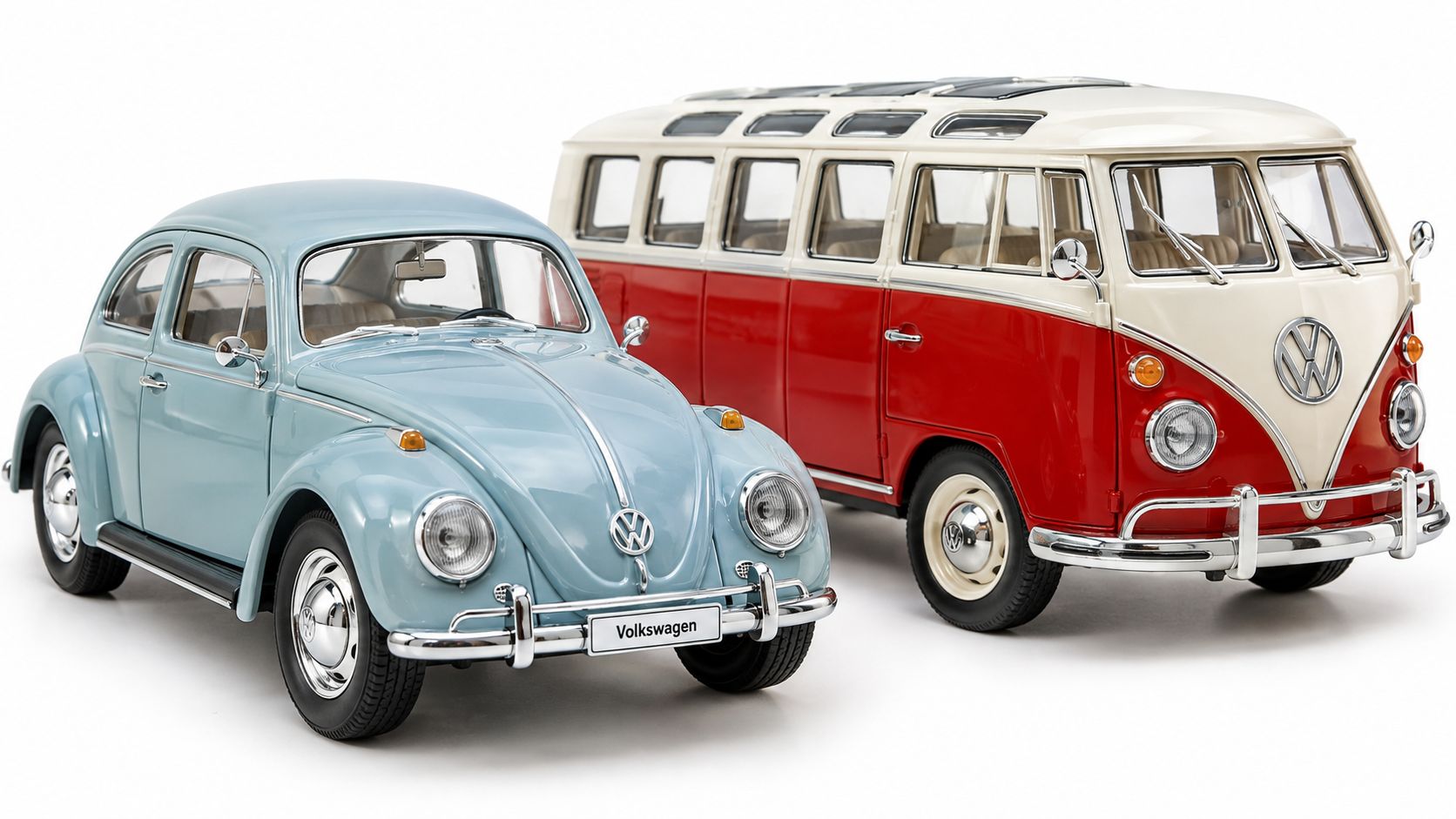
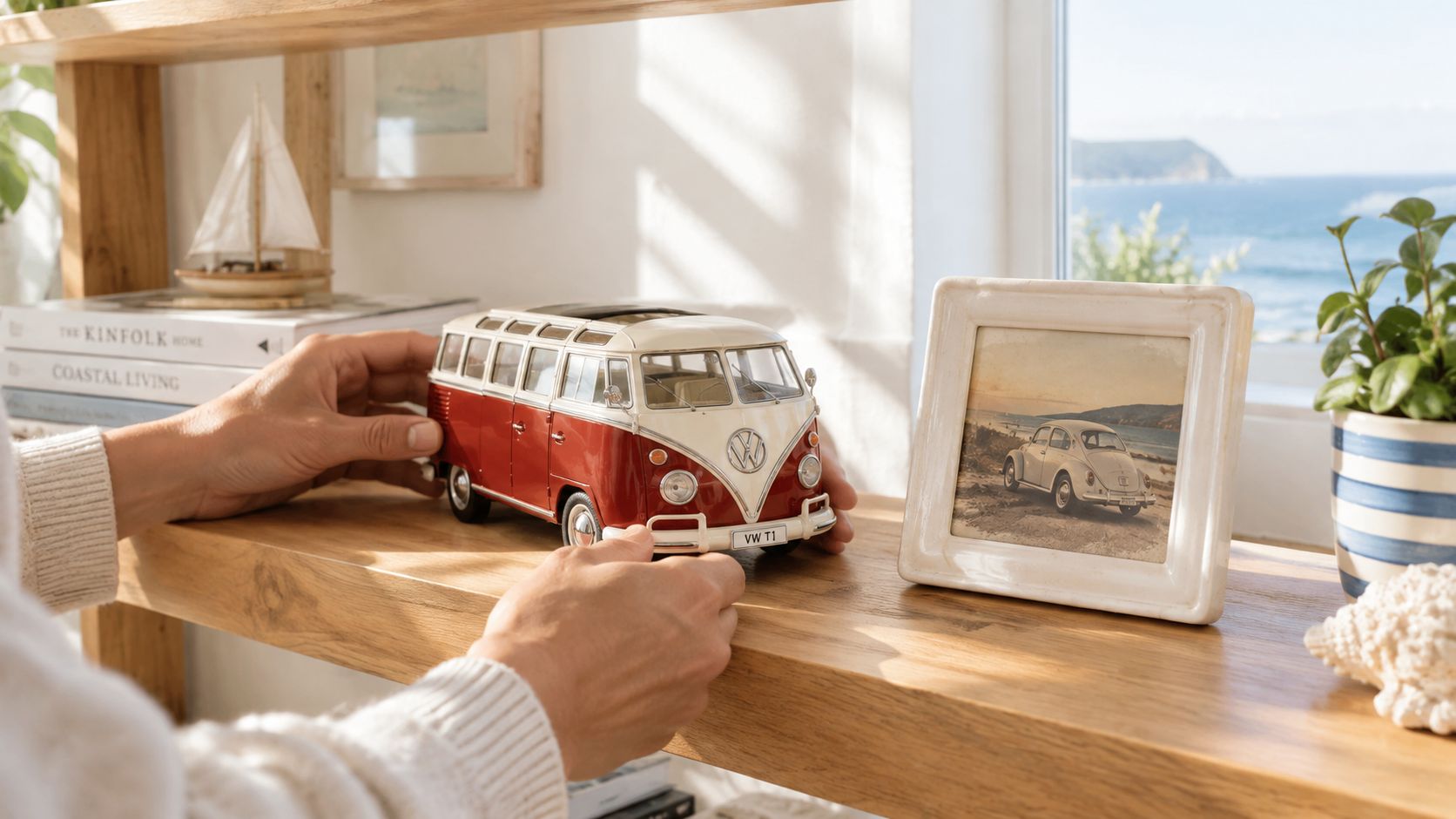
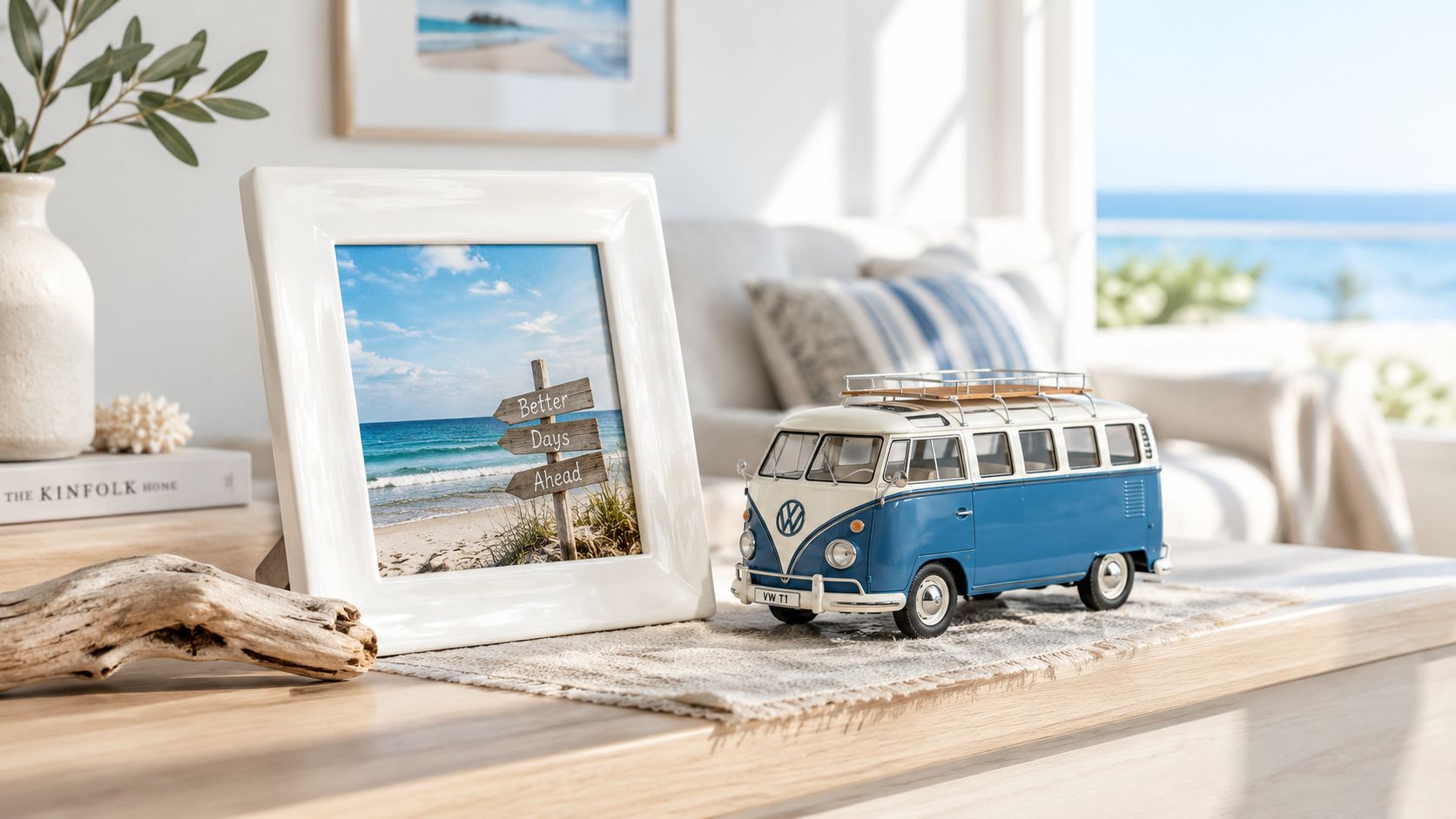
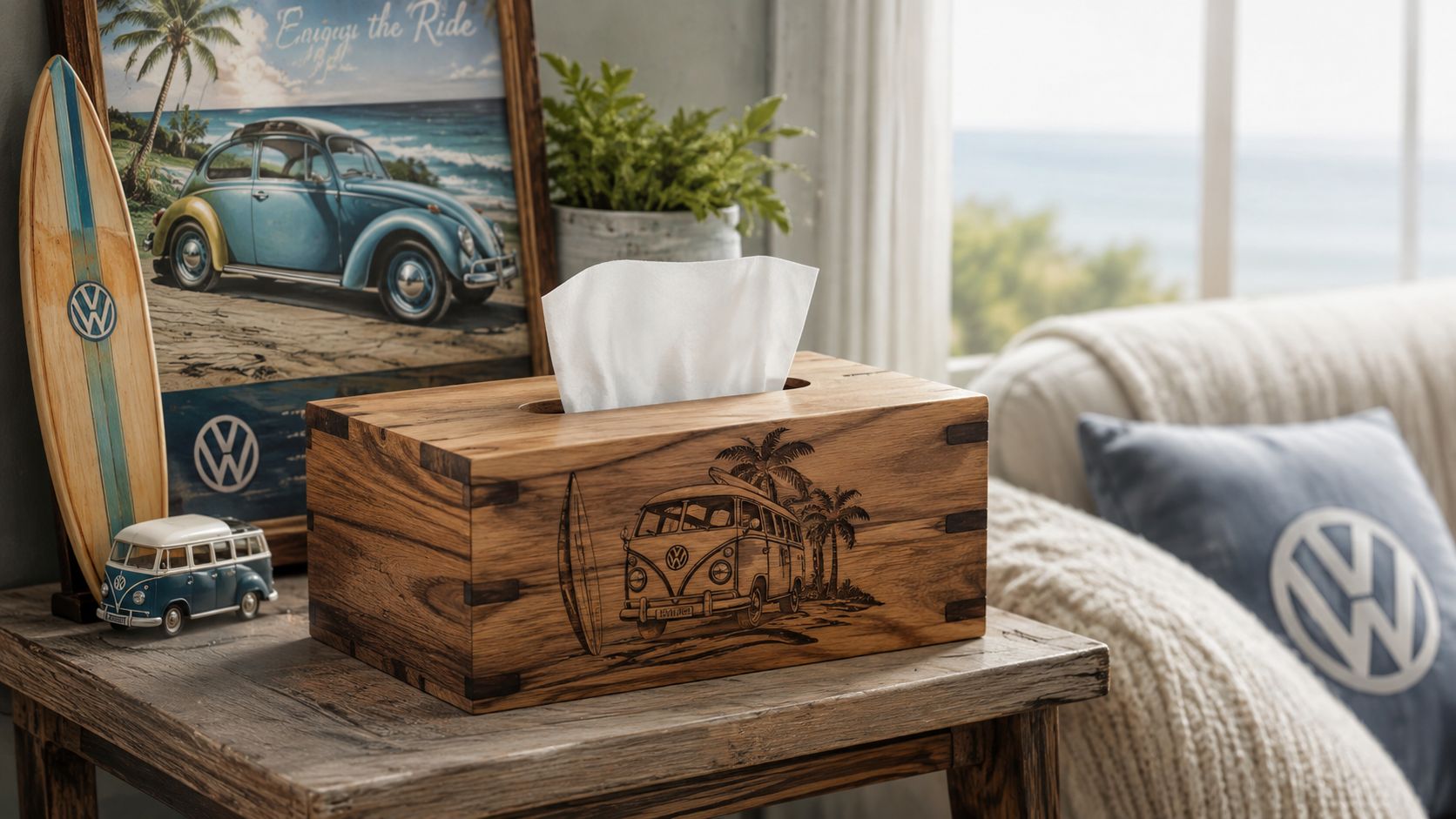
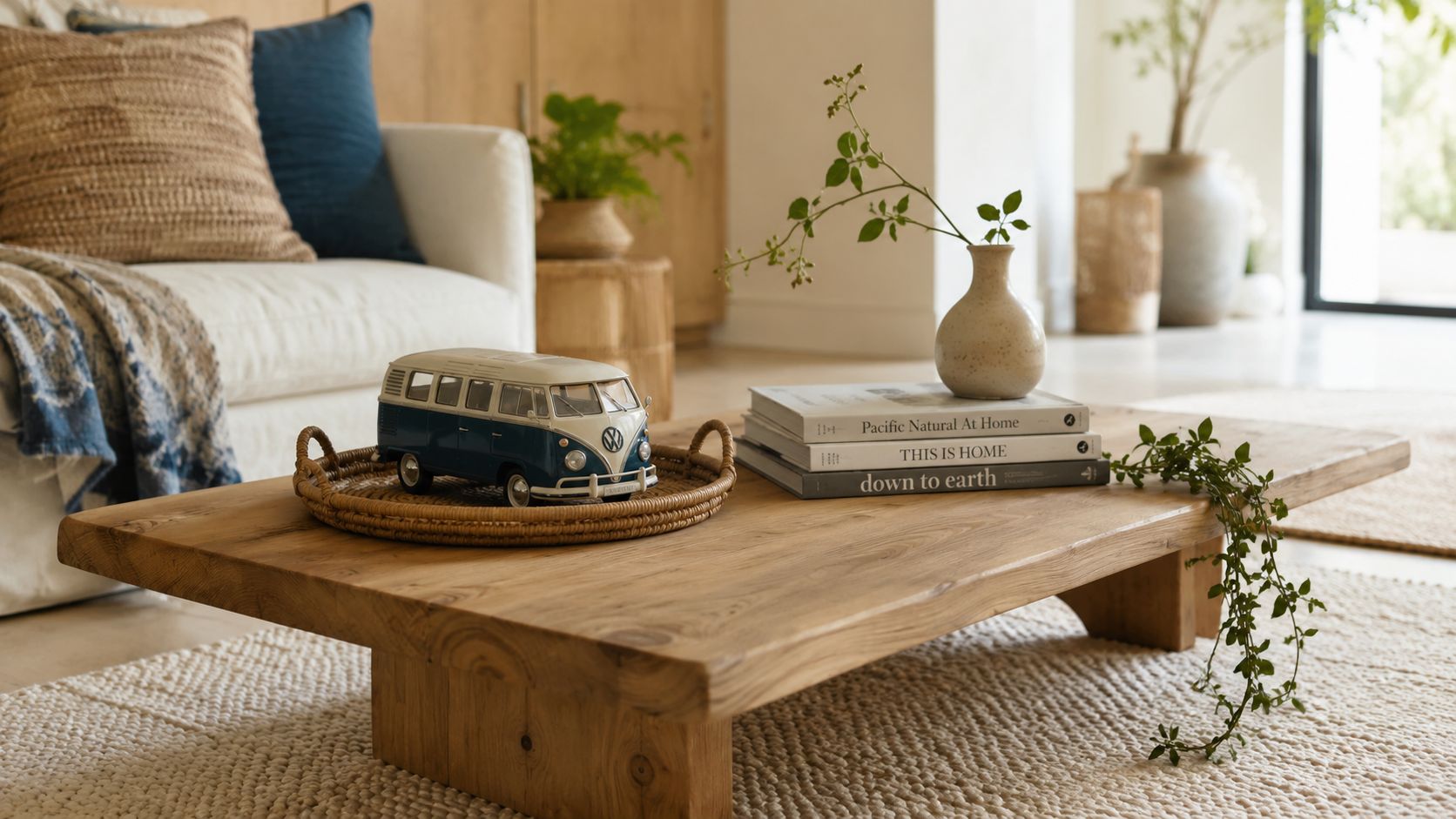
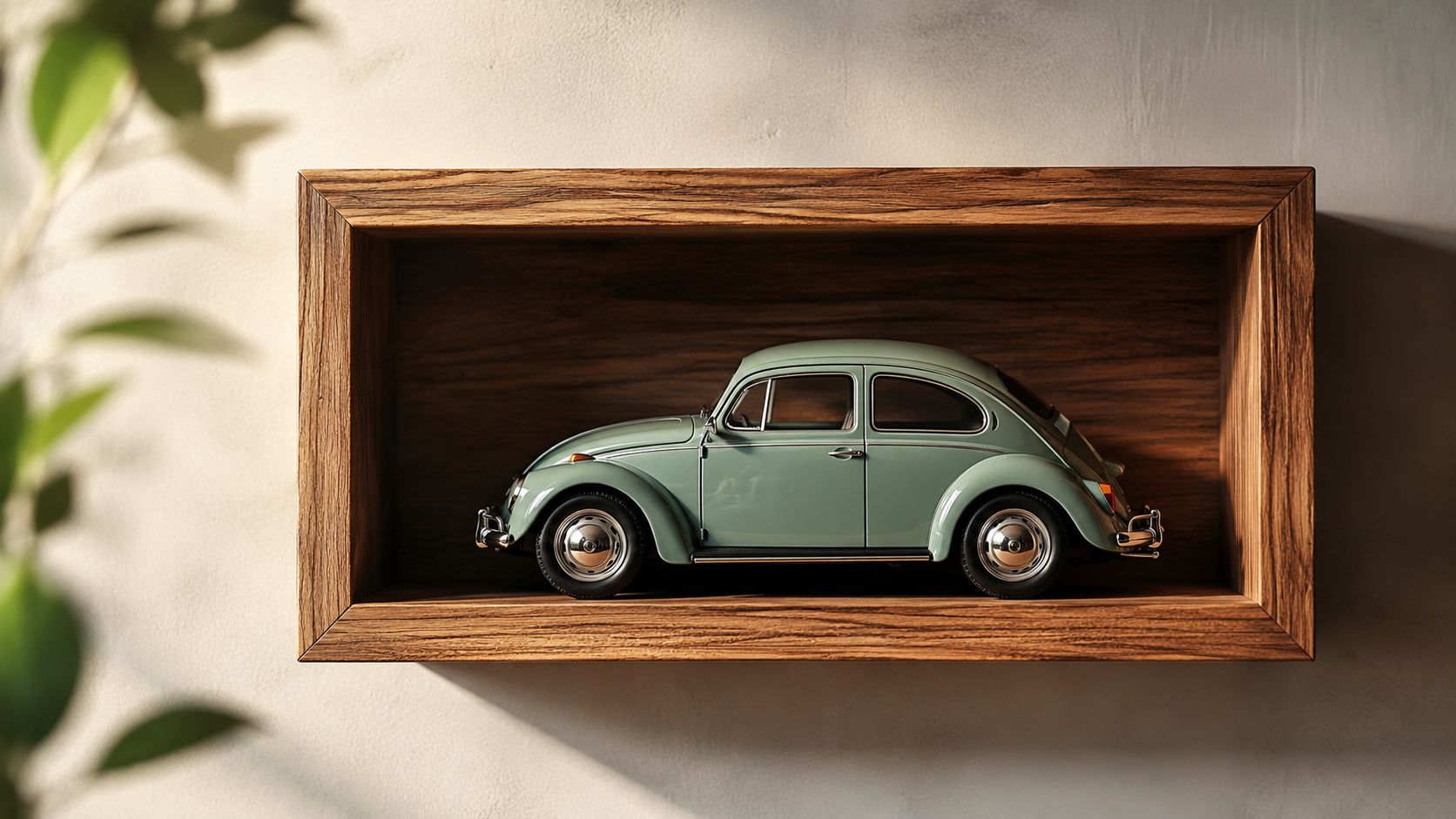
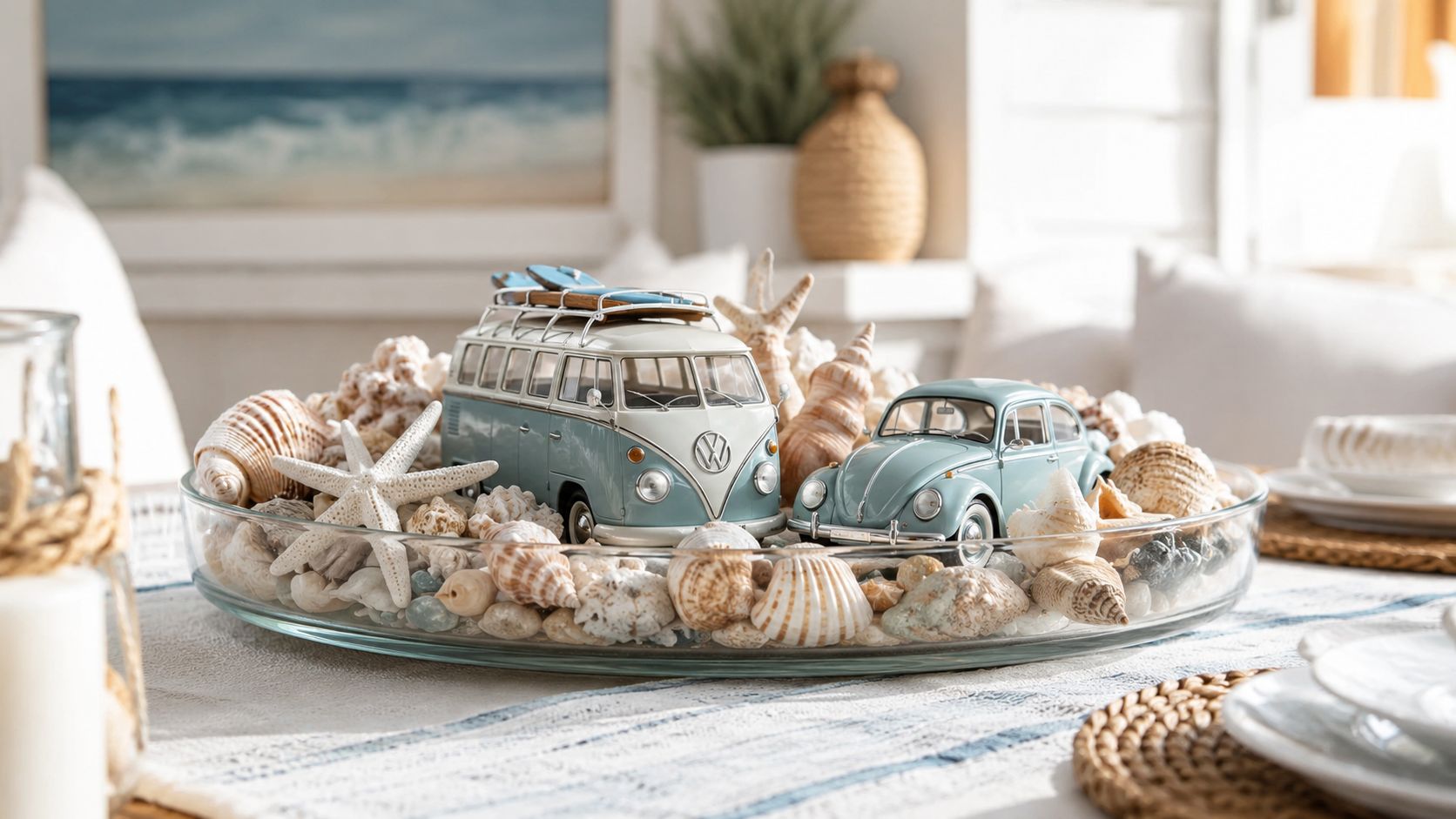
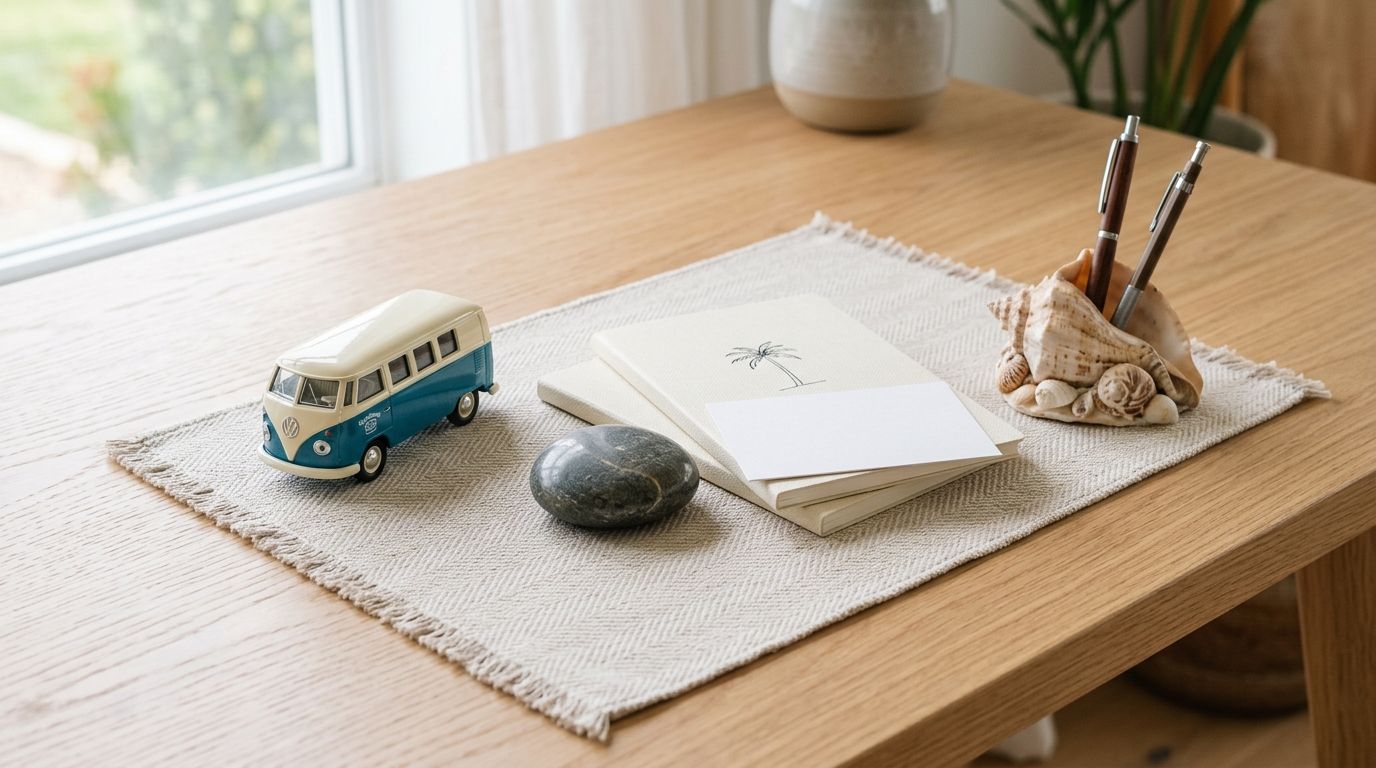
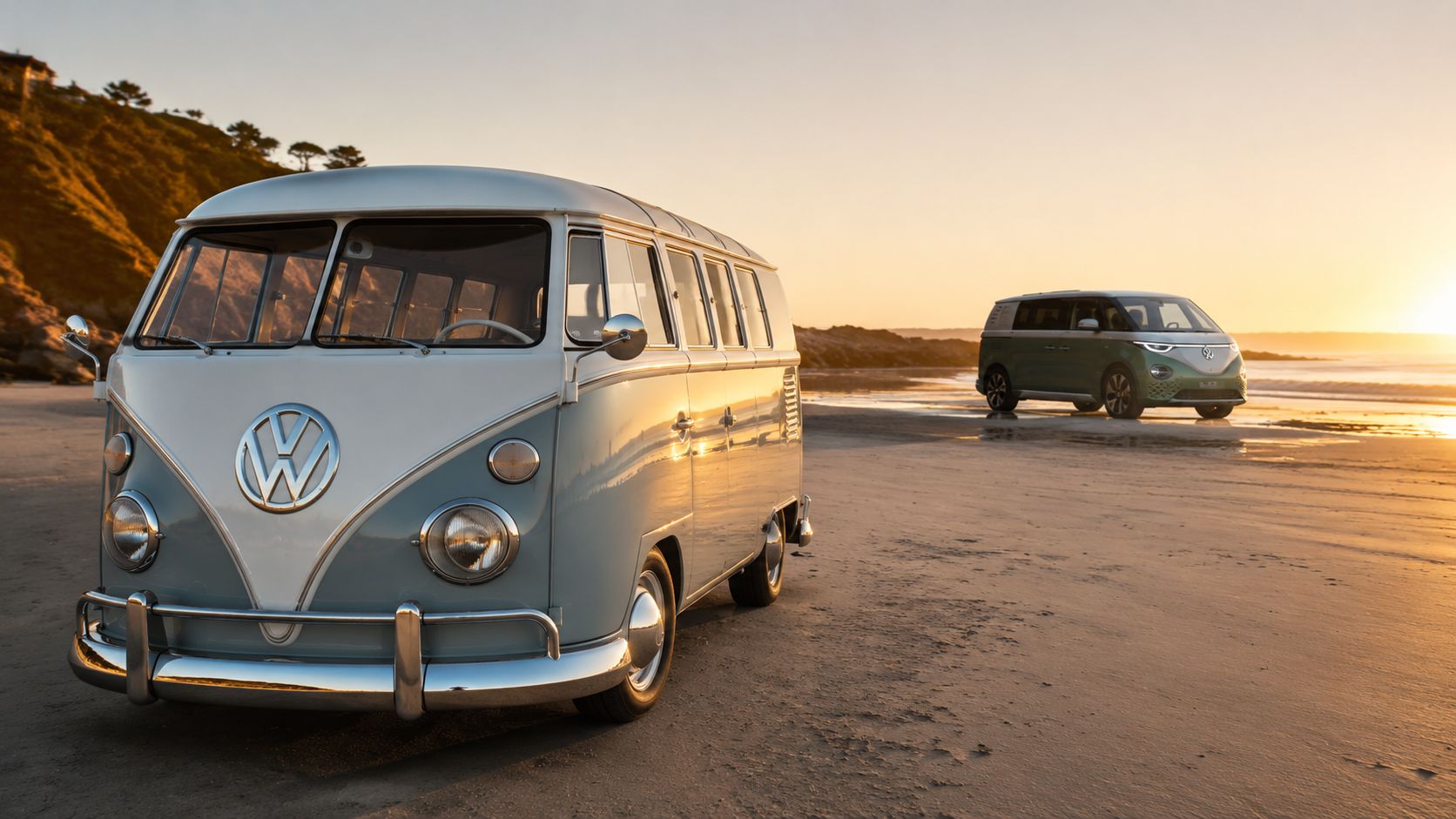
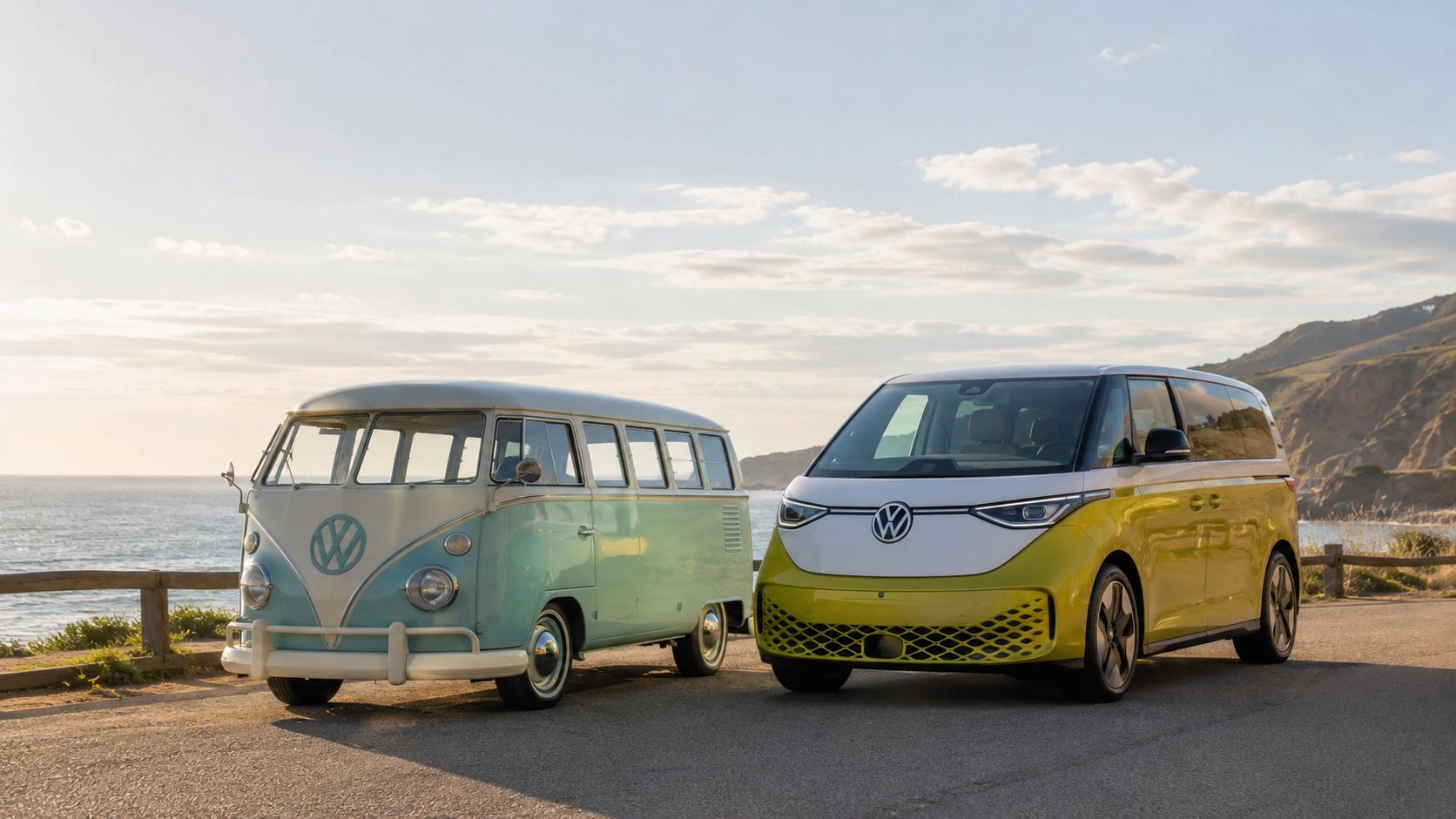
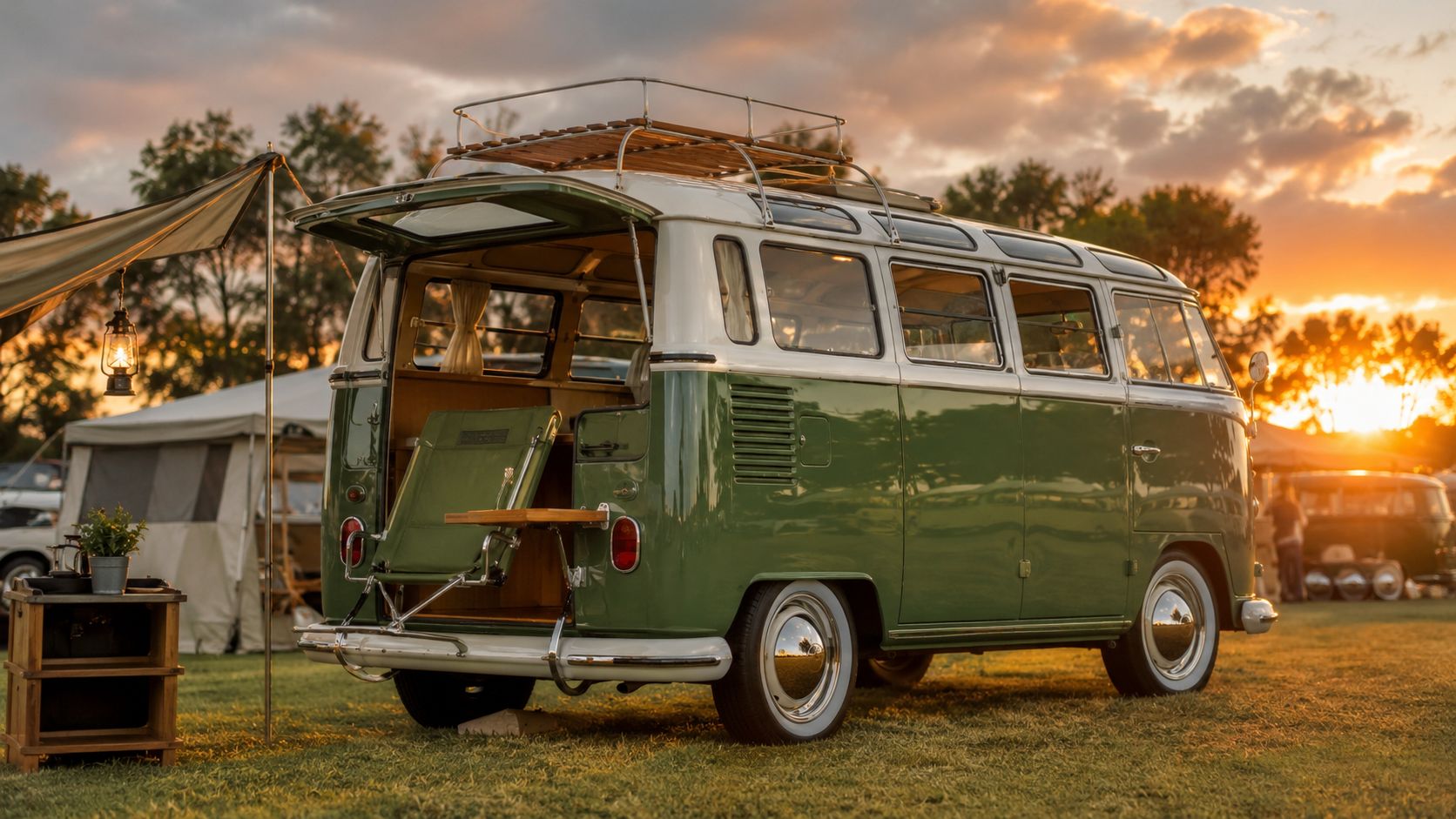
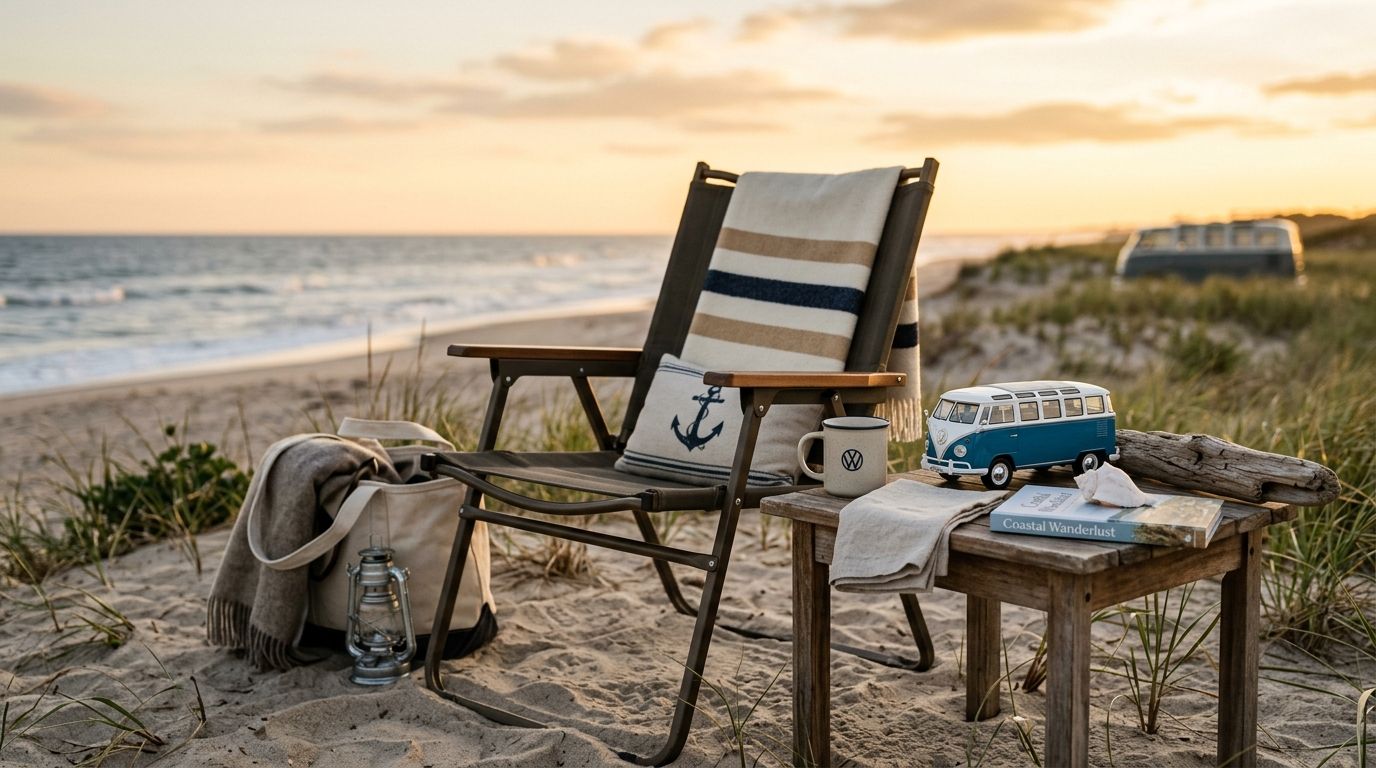
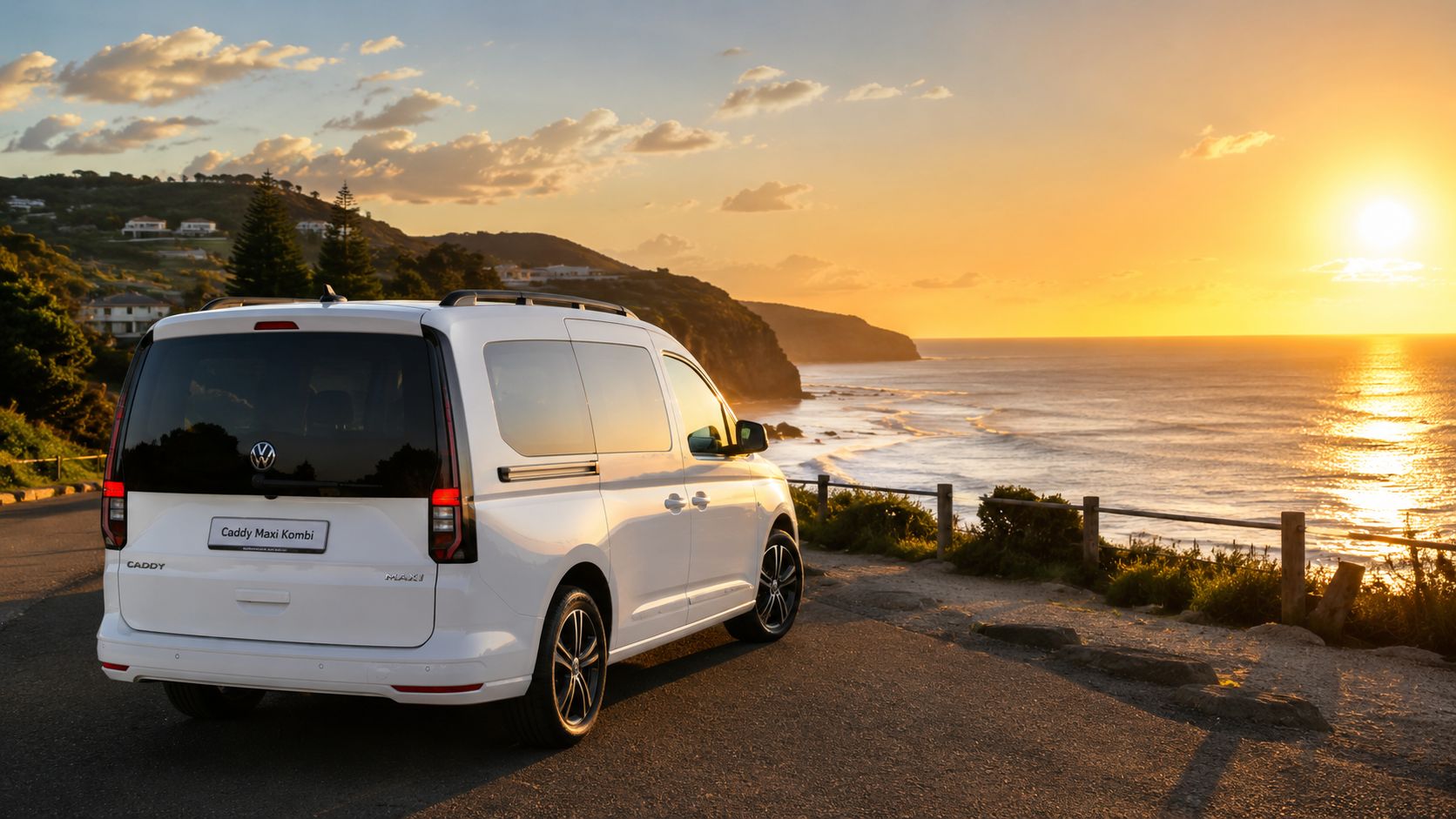
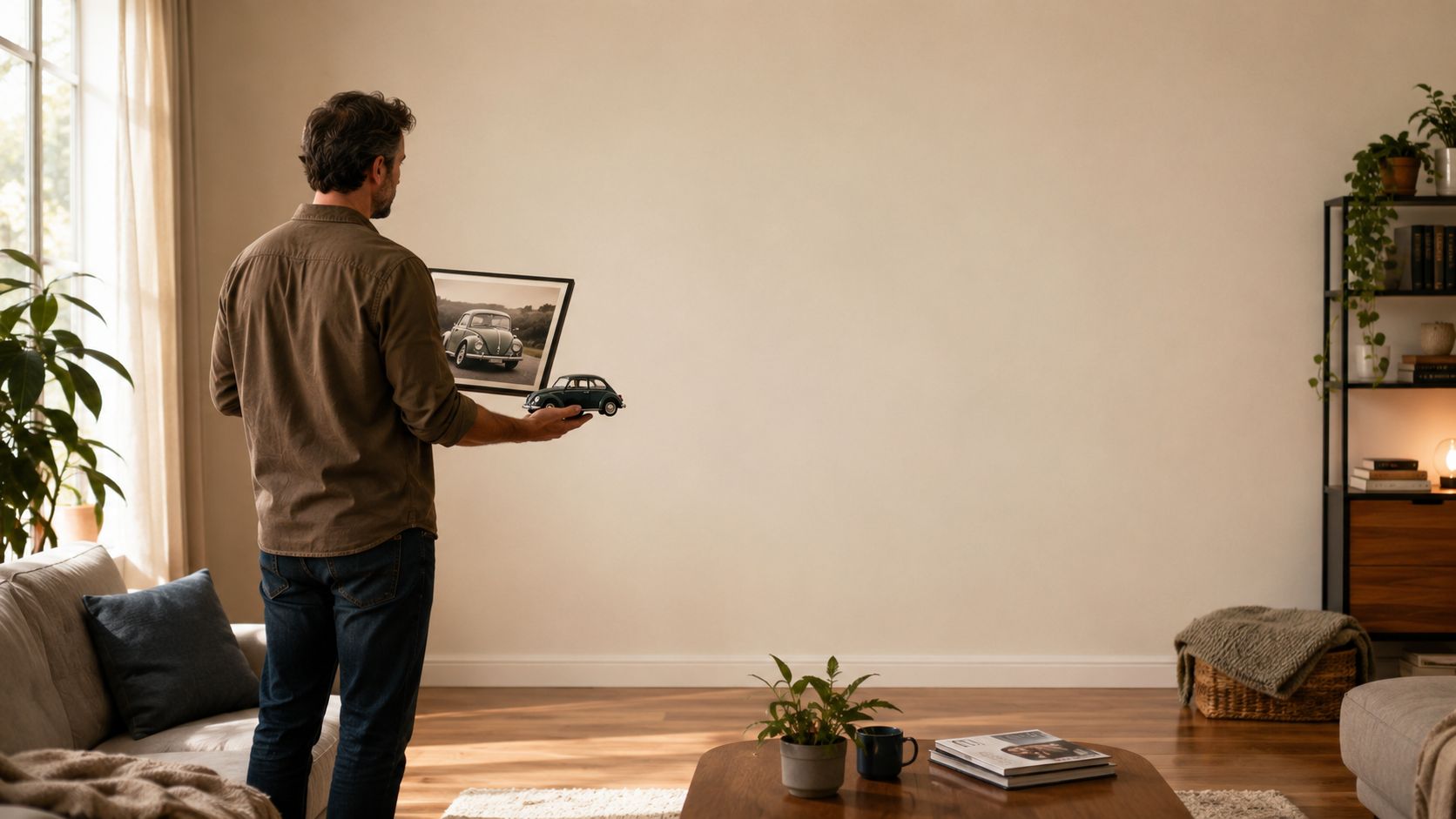
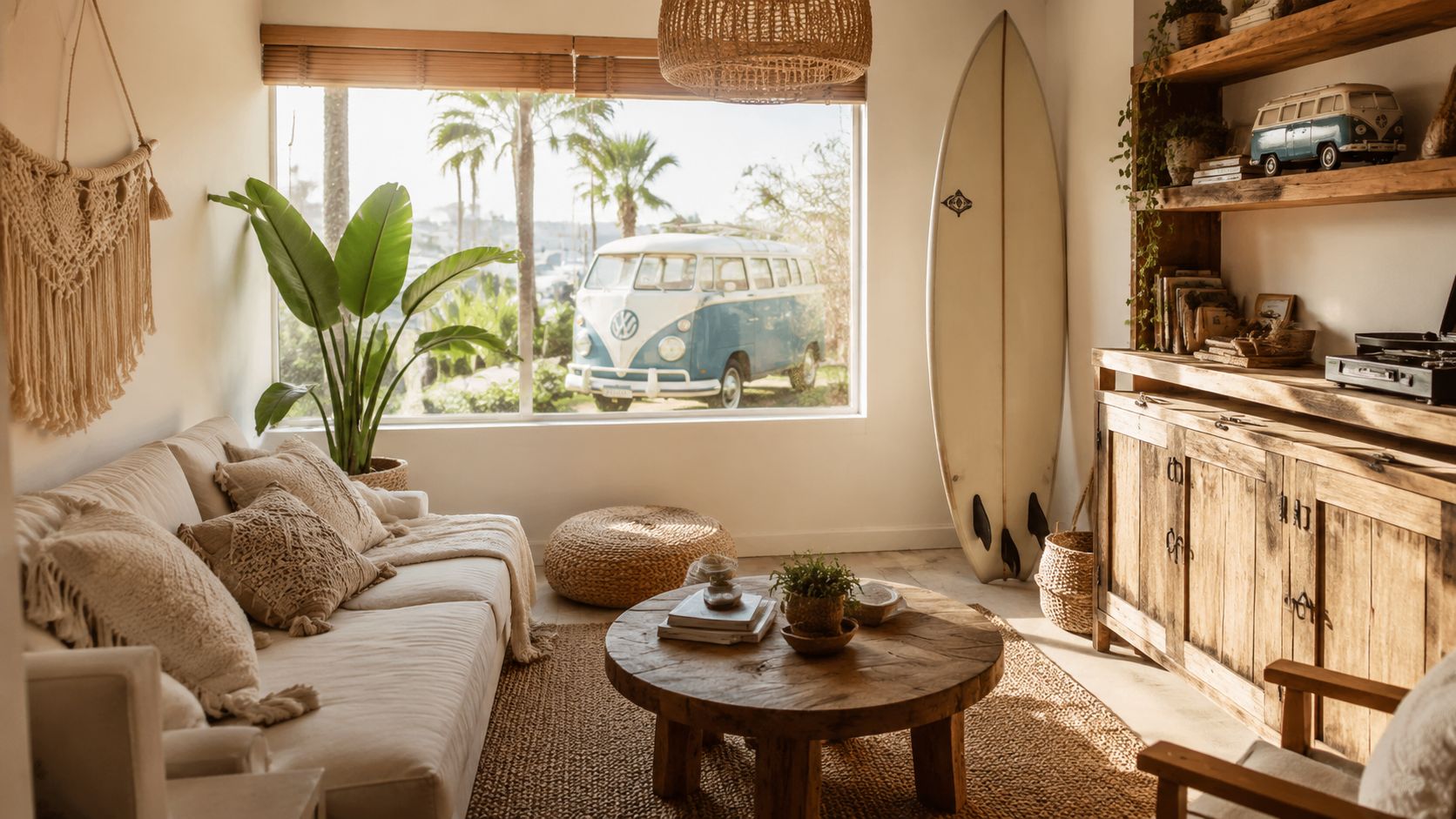
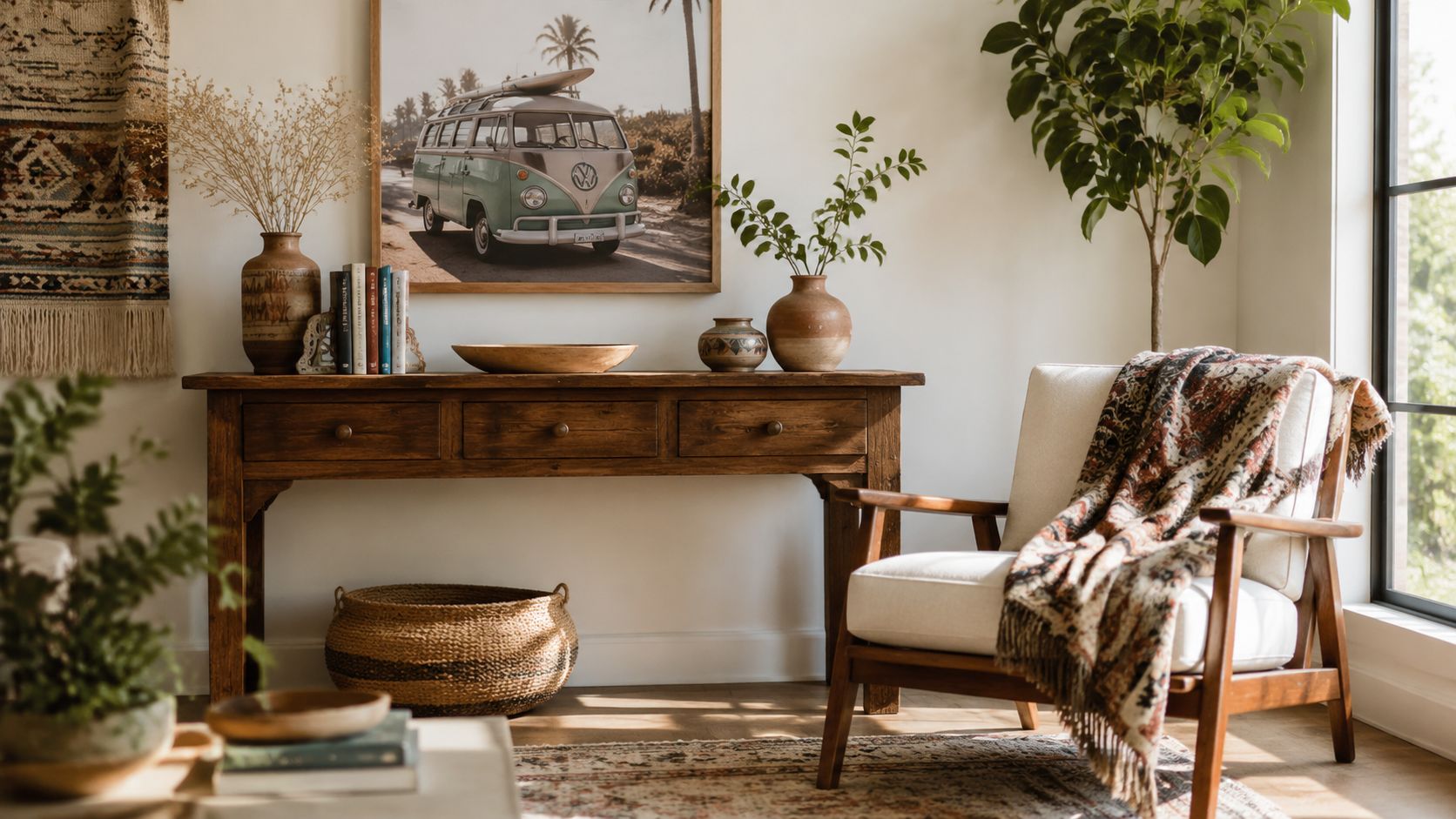
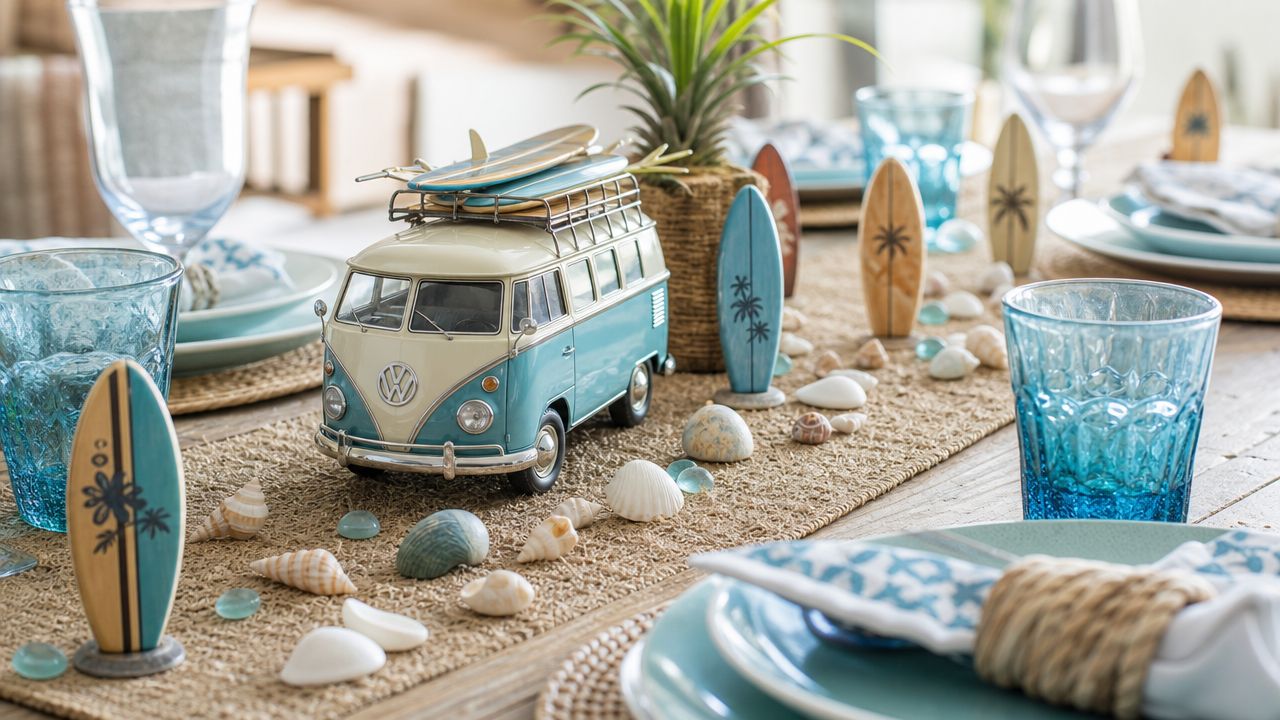
You've got the pale sofa, a bit of rattan, perhaps a weathered timber coffee table, and one stubborn blank wall that still looks like the removalists only left yesterday. A generic shell print might fill it, but it won't say much about you. Beach wall art for a living room can do better when it brings together two proper Australian loves, the coast and classic Volkswagens.
A well-chosen Kombi or Beetle scene adds the relaxed feeling of a coastal drive, a surf check before work, or a sunny car show where everyone has a story about their old VW. The trick is keeping the room breezy rather than turning it into a souvenir shop. Choose one strong memory, give it room to breathe, and let the car carry the personality.
Why Beach-Style VW Art Nails That Coastal Vibe
The strongest coastal rooms don't rely on a pile of obvious nautical symbols. They use light, texture and a sense of escape, then add a few objects with genuine meaning. A faded blue Kombi parked near the sand works because it brings a whole scene with it. You can almost hear the sliding door, smell the salt air and see a board strapped to the roof.
That story matters. A plain ocean horizon creates calm, while a VW in the frame adds movement and nostalgia. The result feels more personal than a mass-produced beach slogan, particularly for owners, collectors and anyone who grew up seeing Beetles and Kombis on Australian roads.
The room should feel lived in
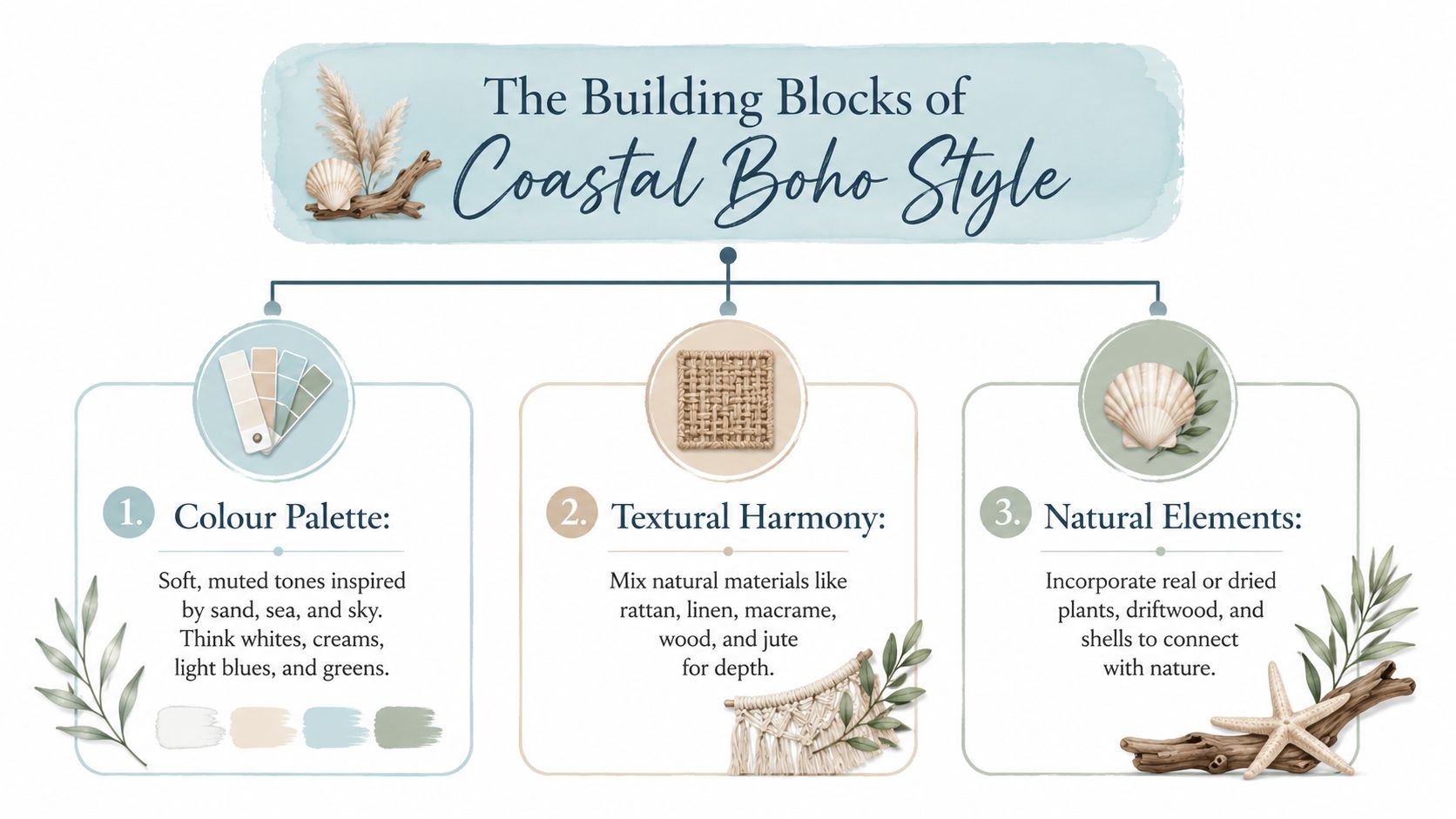
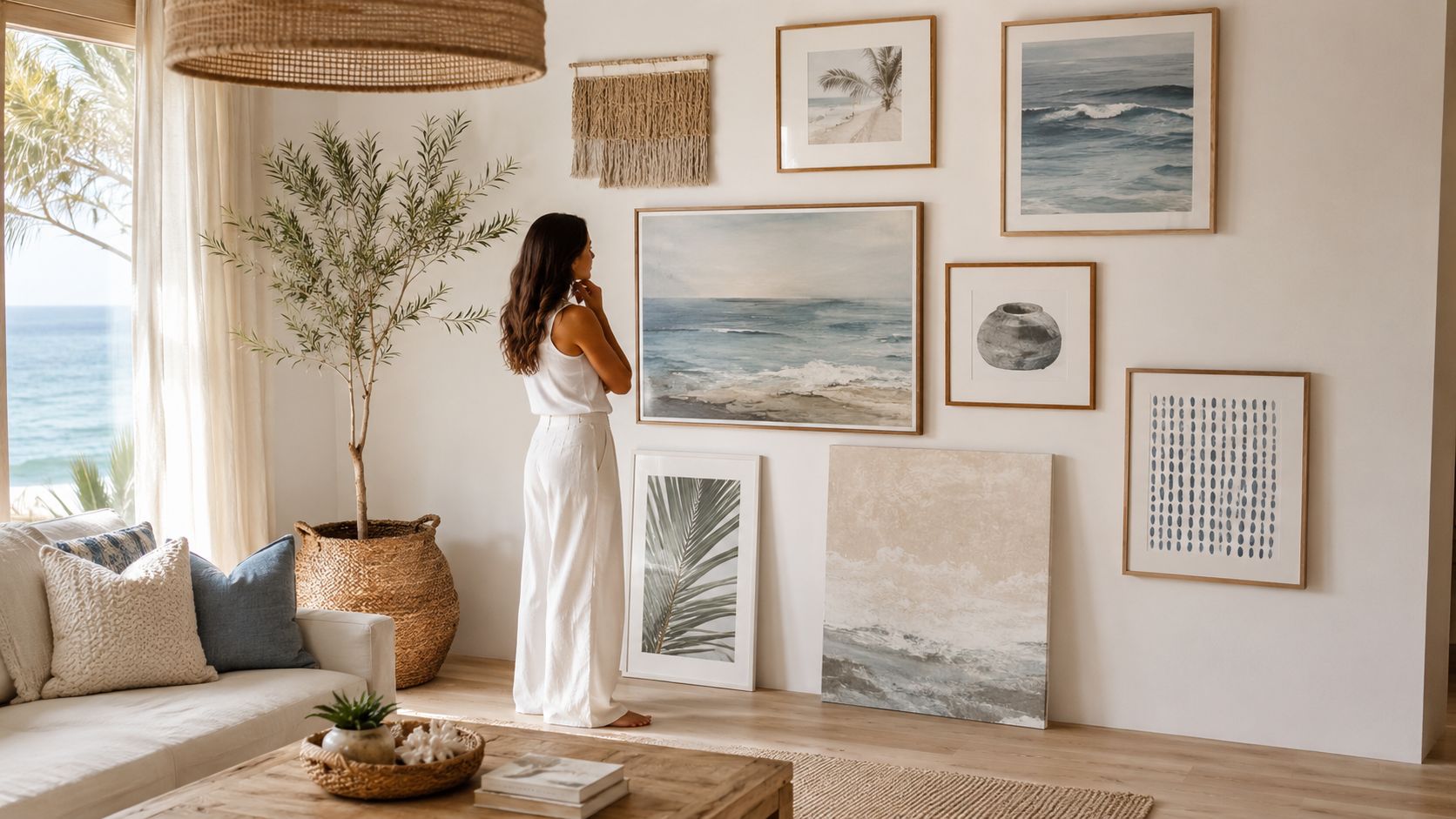
A coastal VW print suits a lounge with natural fibres, white walls, pale timber and ocean blues, but it doesn't need to match every cushion. In fact, matching everything too closely can make the space feel staged. A canvas showing a weathered Kombi can soften a polished modern room, while a crisp illustrated Beetle can bring some fun to a more restrained palette.
Australia's renovation culture gives this style plenty of room to work. One market source describes Australia as having one of the highest renovation rates per capita among OECD countries, with one in three homeowners undertaking significant home-improvement projects annually, and projects the broader home décor market to reach USD 12.29 billion by 2031. The Australia home décor market overview also identifies wall art as the most popular wall décor category and highlights large coastal scene pieces as a recurring demand driver.
The useful test: if the artwork reminds you of a place, a car or a day you'd happily repeat, it will usually outlast a print chosen only because it matches the rug.
For a more personal starting point, browse this guide to coastal living room ideas with VW character. Keep the supporting décor quiet, then let the bus, Beetle or Samba take centre stage.
Picking the Right VW Motif and Scale
Start with the room, not the model catalogue. Look at the wall's available width, the furniture beneath it and the colours already doing the heavy lifting. A pale blue Samba Bus suits soft whites and sandy beige, while a Flower Power Beetle needs a little more visual confidence around it.
Match the motif to the mood
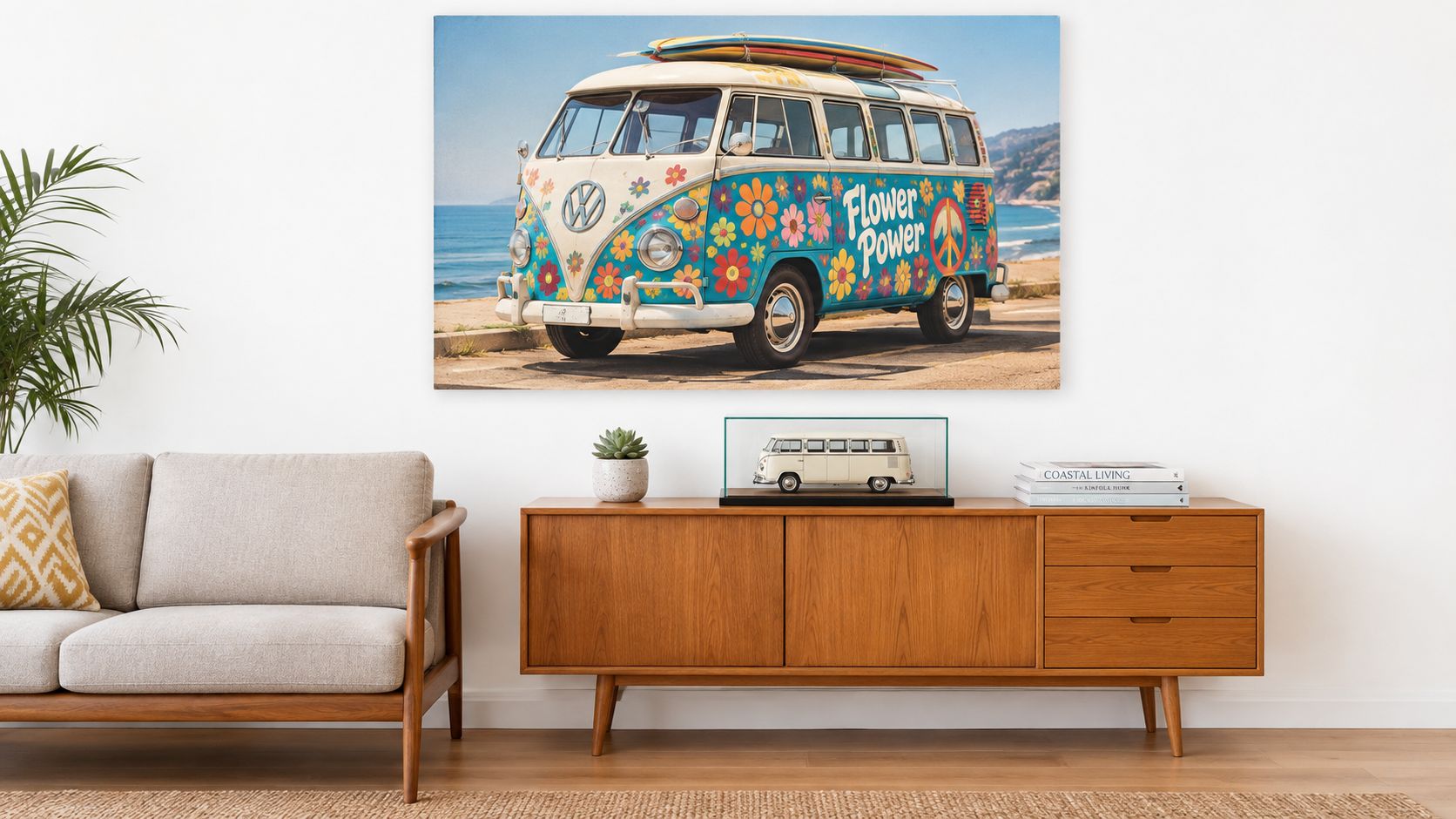
A Samba Bus brings holiday nostalgia and works especially well where the room already has timber, woven baskets or relaxed surf styling. A classic black-top Kombi feels slightly more graphic and can anchor a room with navy cushions or charcoal joinery. A Flower Power Beetle, particularly one shown with a surfboard, adds playful colour and suits a family lounge or collector's corner.
The car's finish matters as much as its colour. A distressed, vintage-looking image belongs with linen and raw timber. A clean, sharply rendered print looks better beside contemporary furniture. Don't place a busy floral Beetle against a wall already crowded with patterned cushions, framed photos and ornaments. The eye needs one obvious place to land.
VW Motif
Best For
Colour Pairing
Pastel Samba Bus
Calm, airy lounges
White, sand and powder blue
Flower Power Beetle
Playful family rooms
Cream, coral, aqua and soft green
Black-top Kombi
More graphic coastal interiors
Navy, charcoal, timber and off-white
Surf-themed Beetle
Collector displays and relaxed beach rooms
Ocean blue, faded yellow and natural wood
Get the scale right
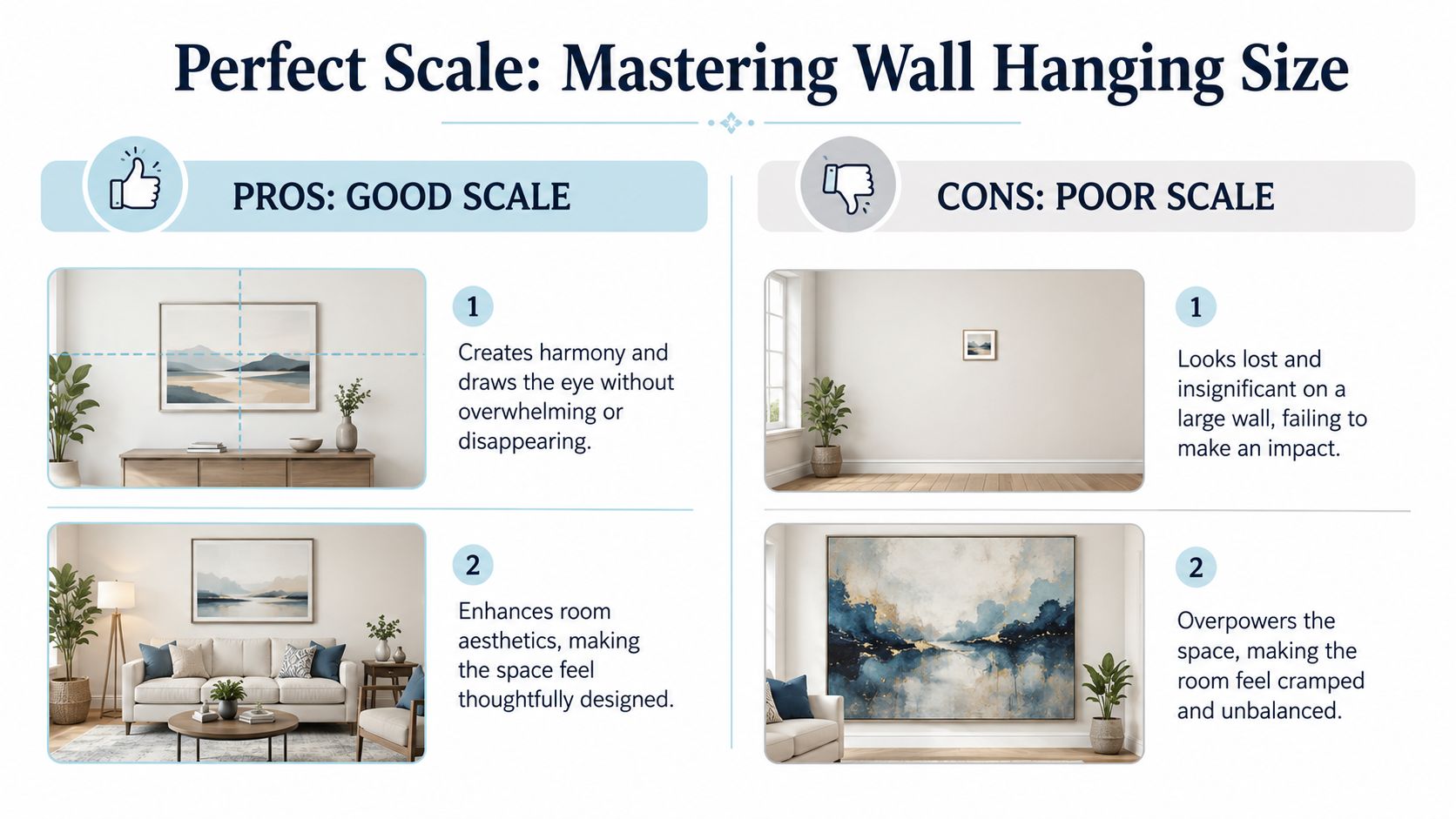
A small print can disappear above a generous sofa, while an oversized piece can dominate a compact lounge. Horizontal artwork normally suits the long line of a sofa or console, especially when the image shows a Kombi travelling along a beach road. Vertical art can work beside a bookcase, doorway or tall cabinet, where it fills height rather than competing with furniture width.
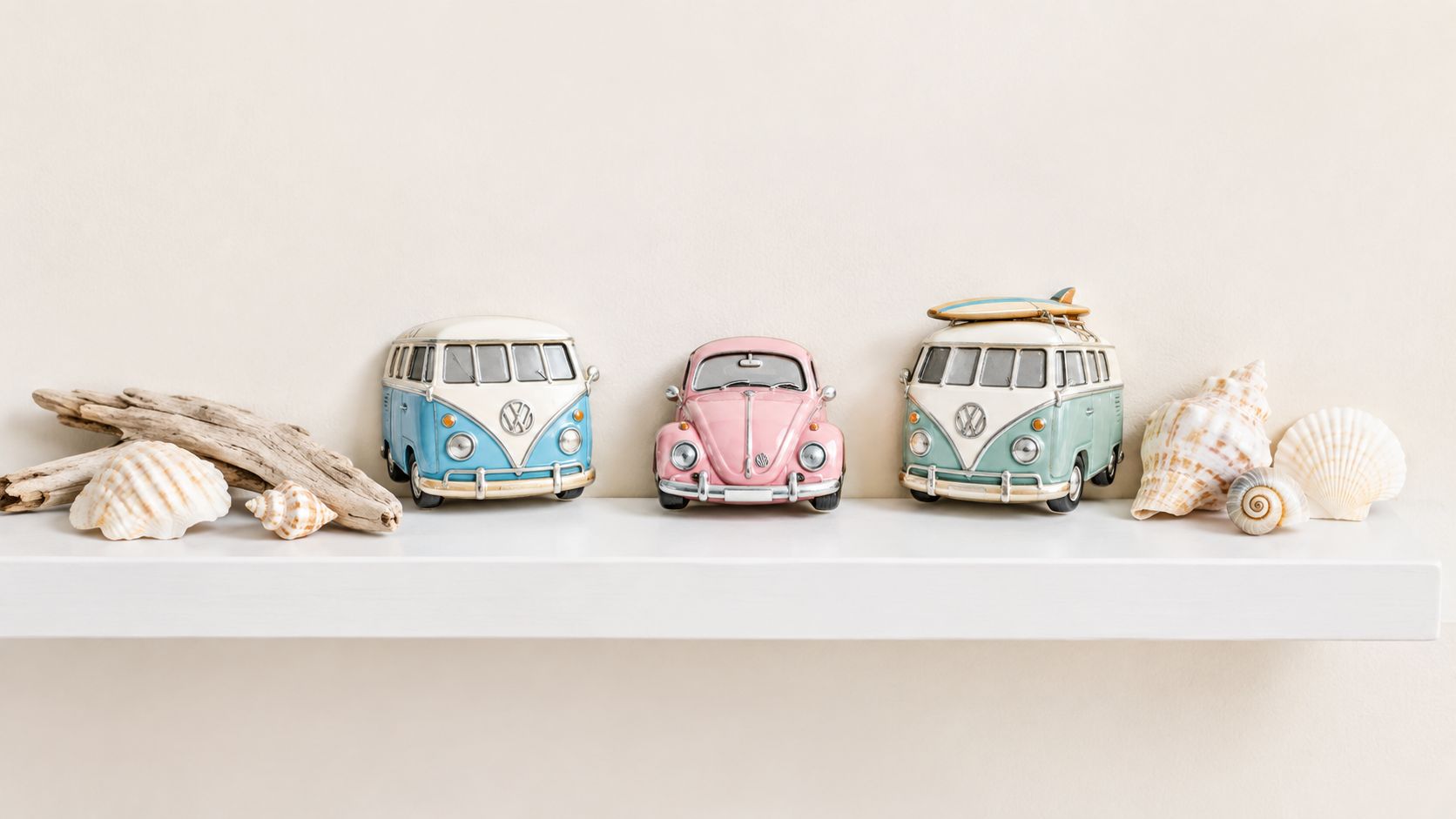
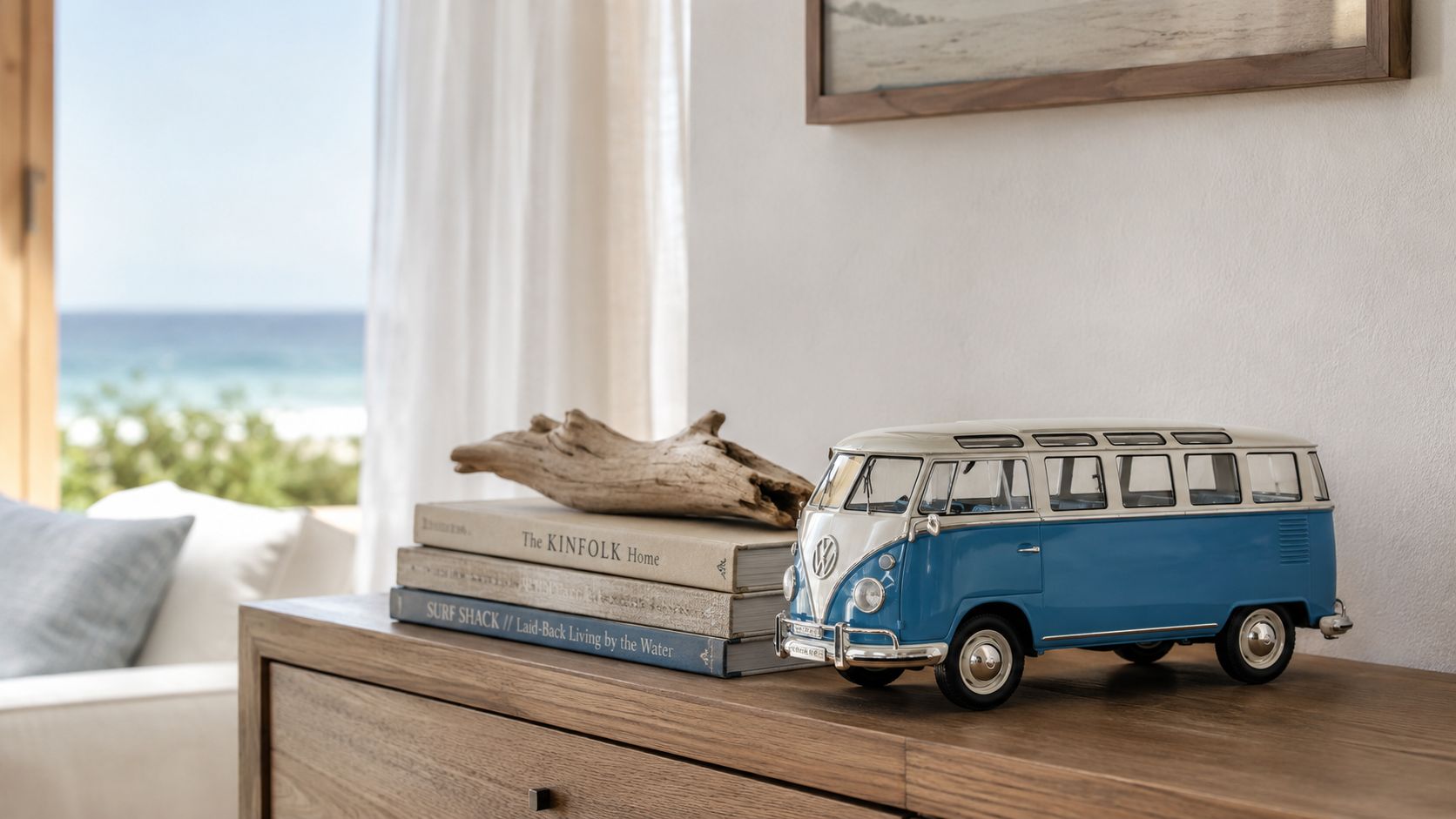
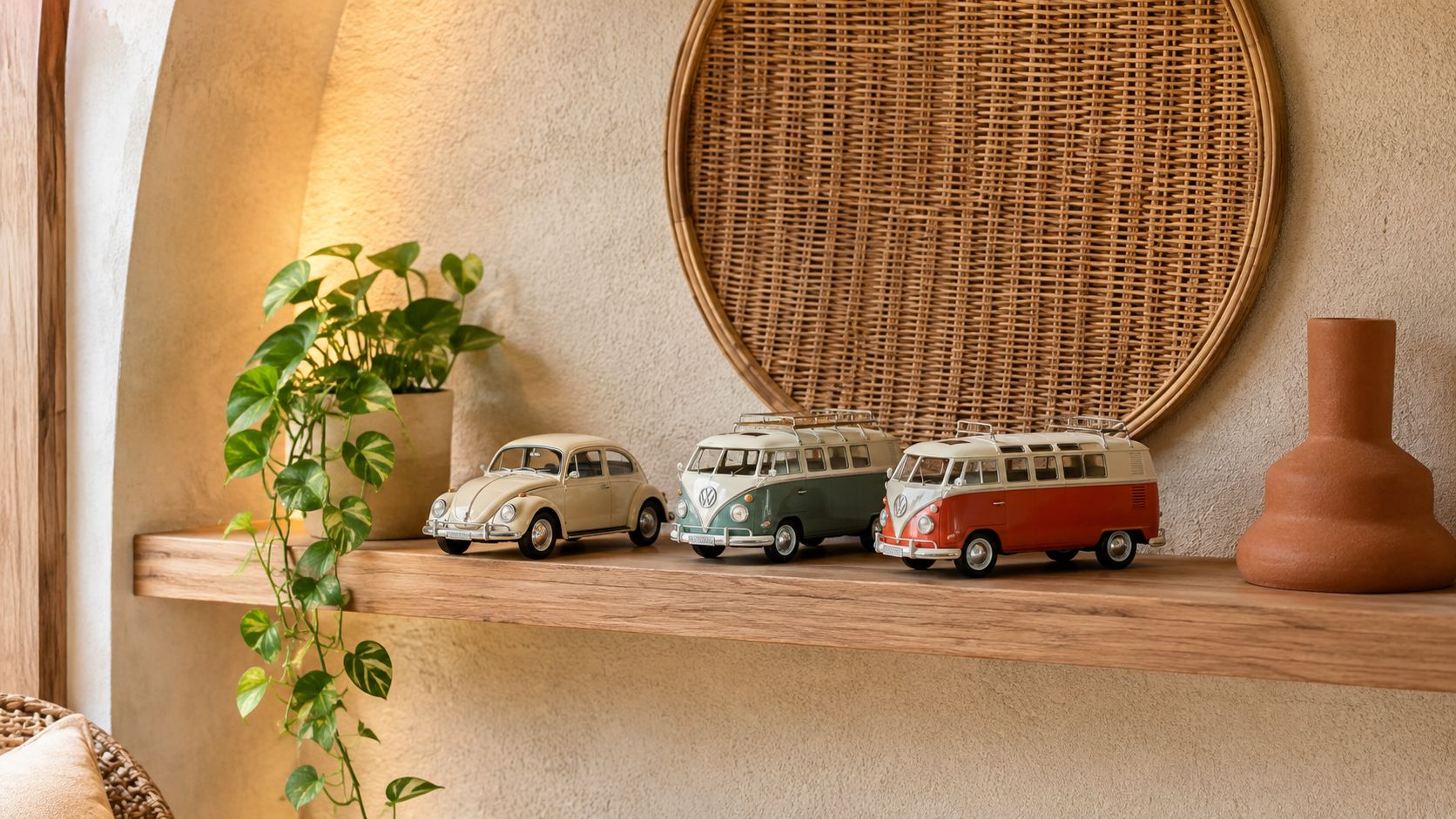
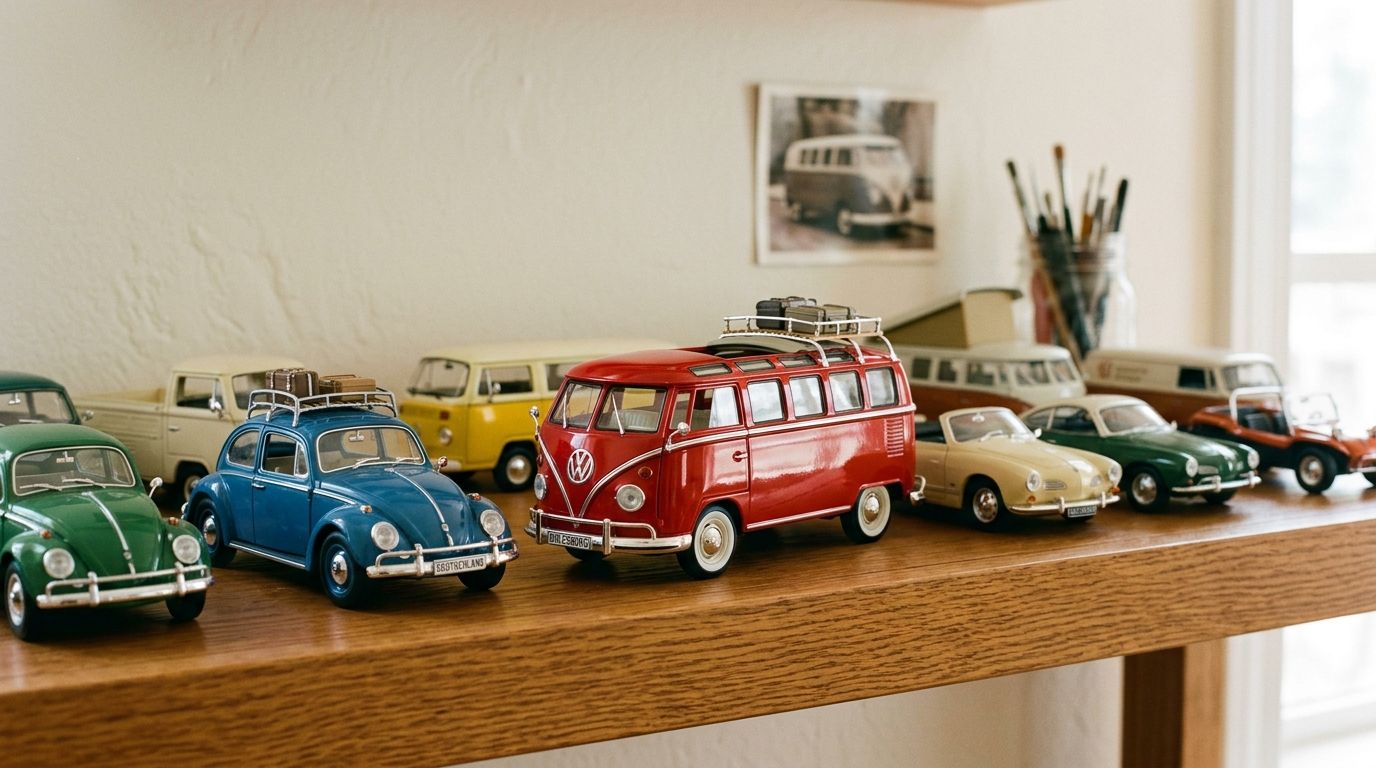
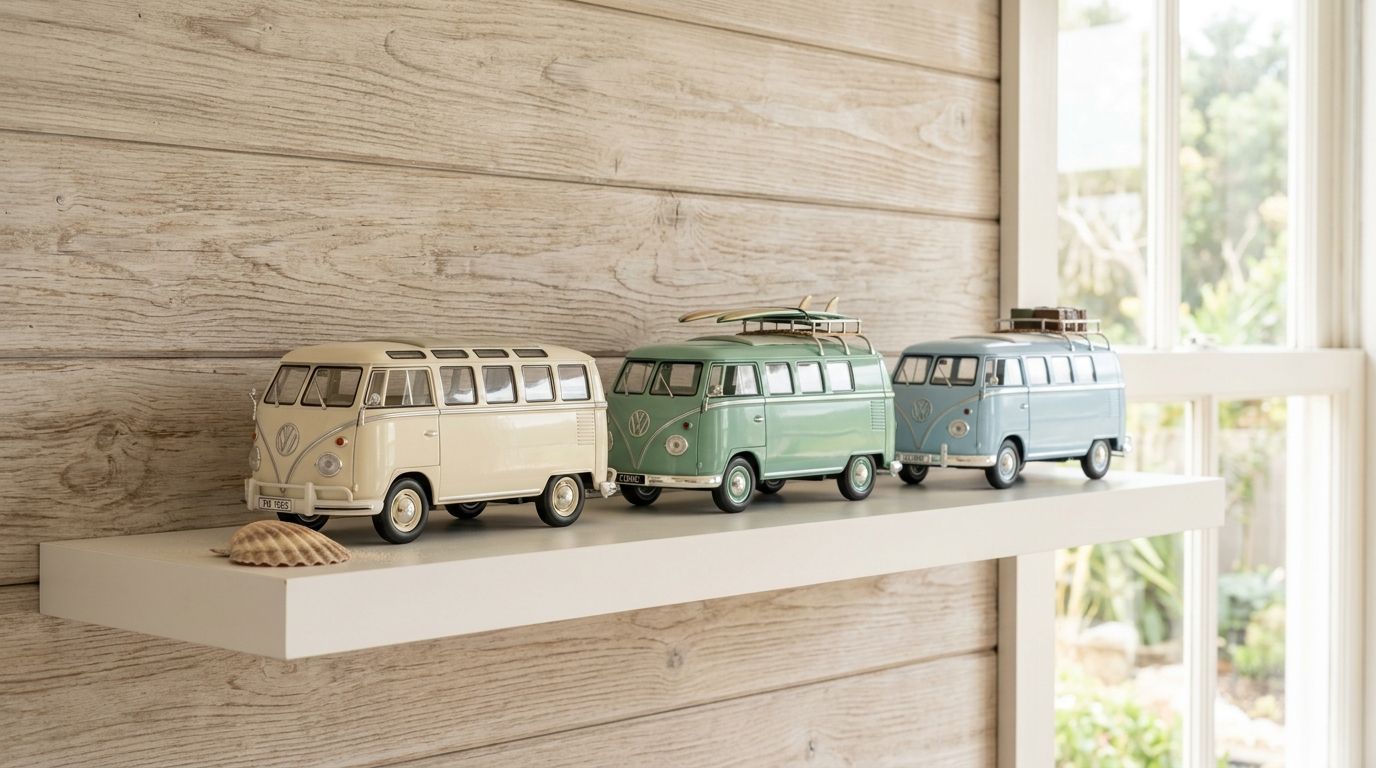
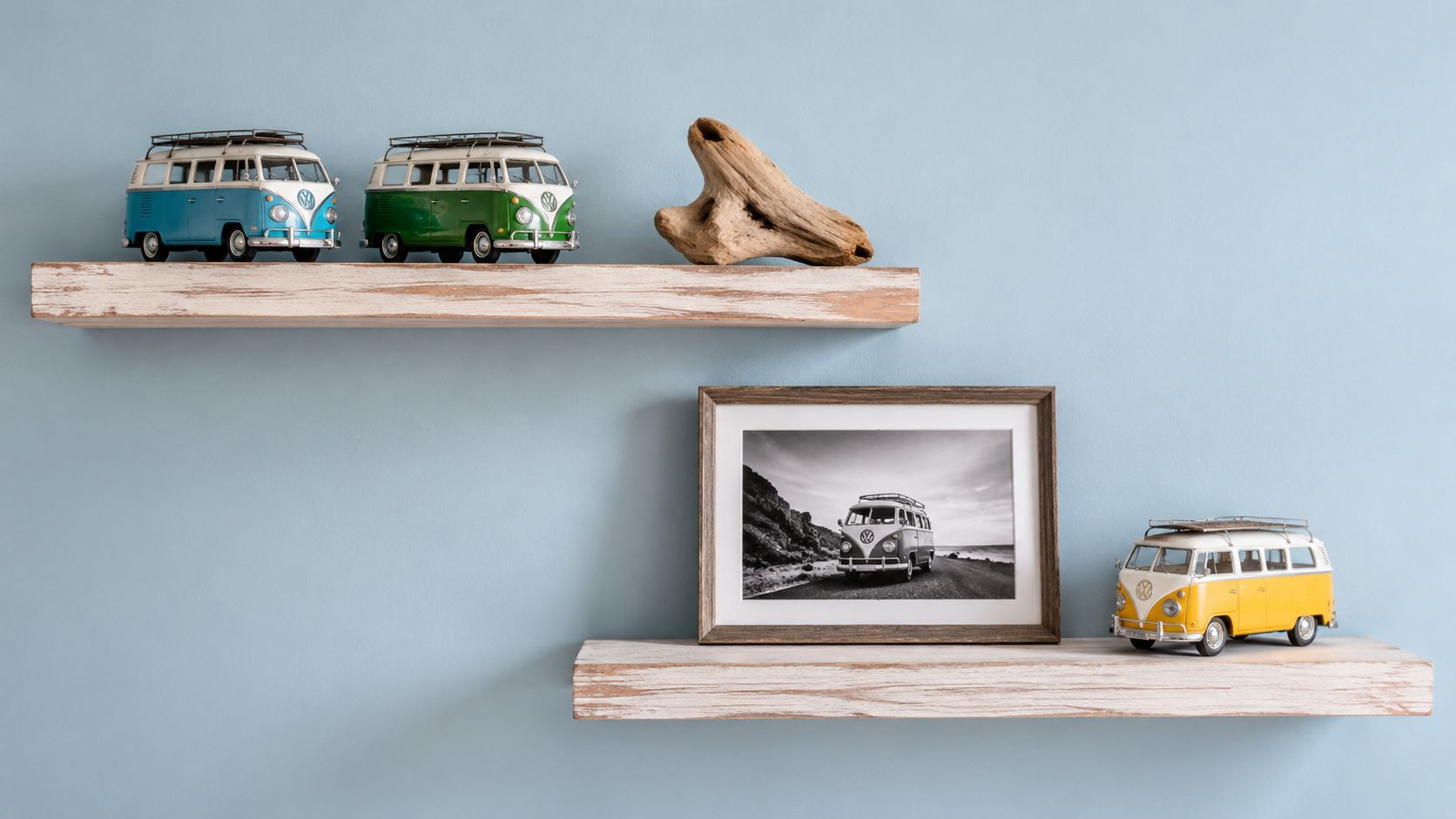
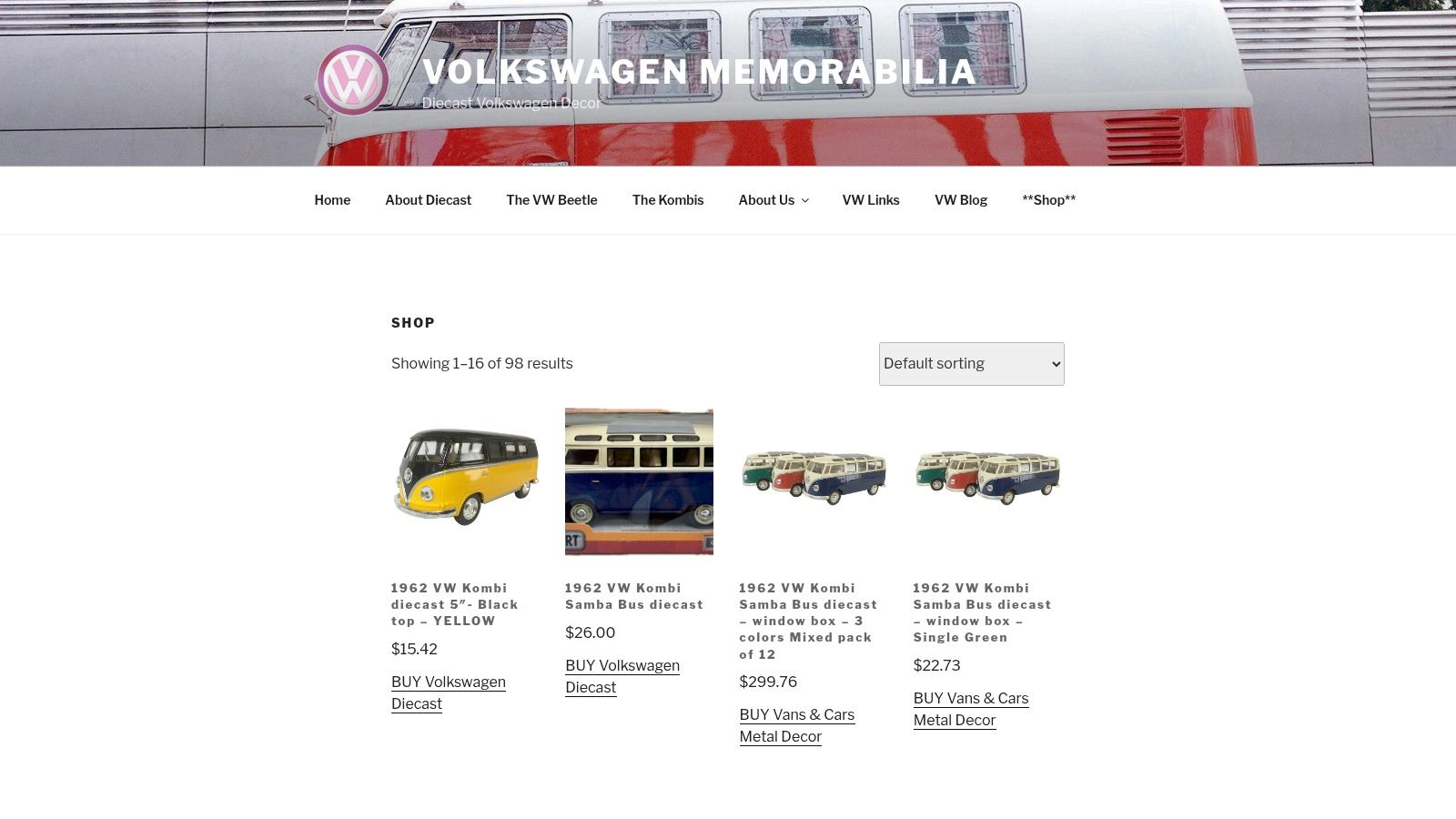
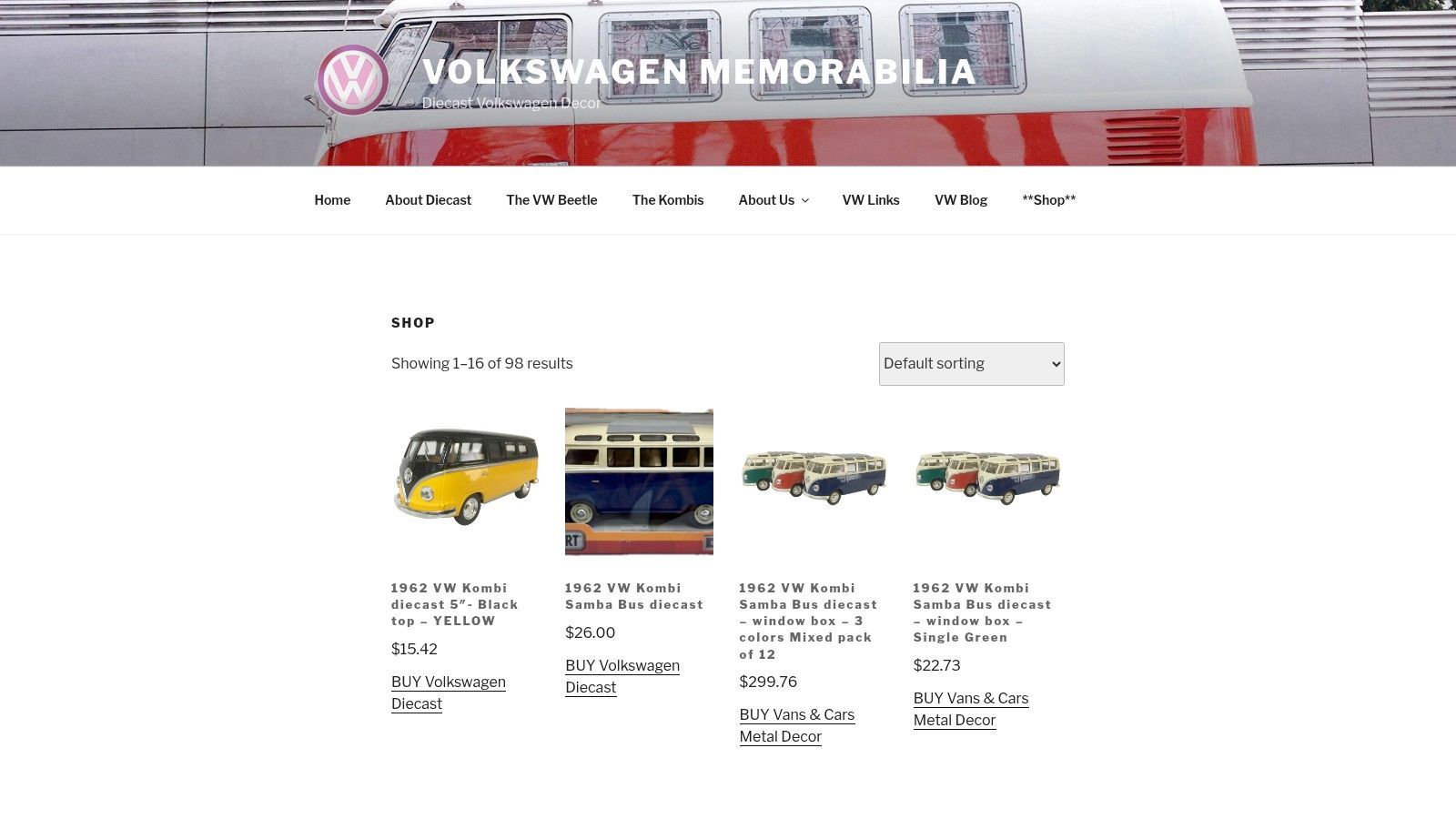
Collectors often make the mistake of treating wall art and diecast models as separate themes. They work better when the wall image establishes the setting and the model provides the detail. A framed beach scene with a Samba Bus can sit above a shelf displaying a matching VW Kombi diecast Australia collectors' piece.
For a Beetle-led room, compare the available VW Beetle wall art with your existing display. A Volkswagen Beetle model on a shelf below the print creates a visual link without making the room feel like a showroom.
Focal Piece or Full Gallery Wall
A single focal piece is the safer option when the living room already has plenty happening. One broad Kombi canvas above a white settee can make the wall feel finished without adding another collection of competing shapes. It also gives the artwork enough space for the beach, sky and vehicle to read as one scene.
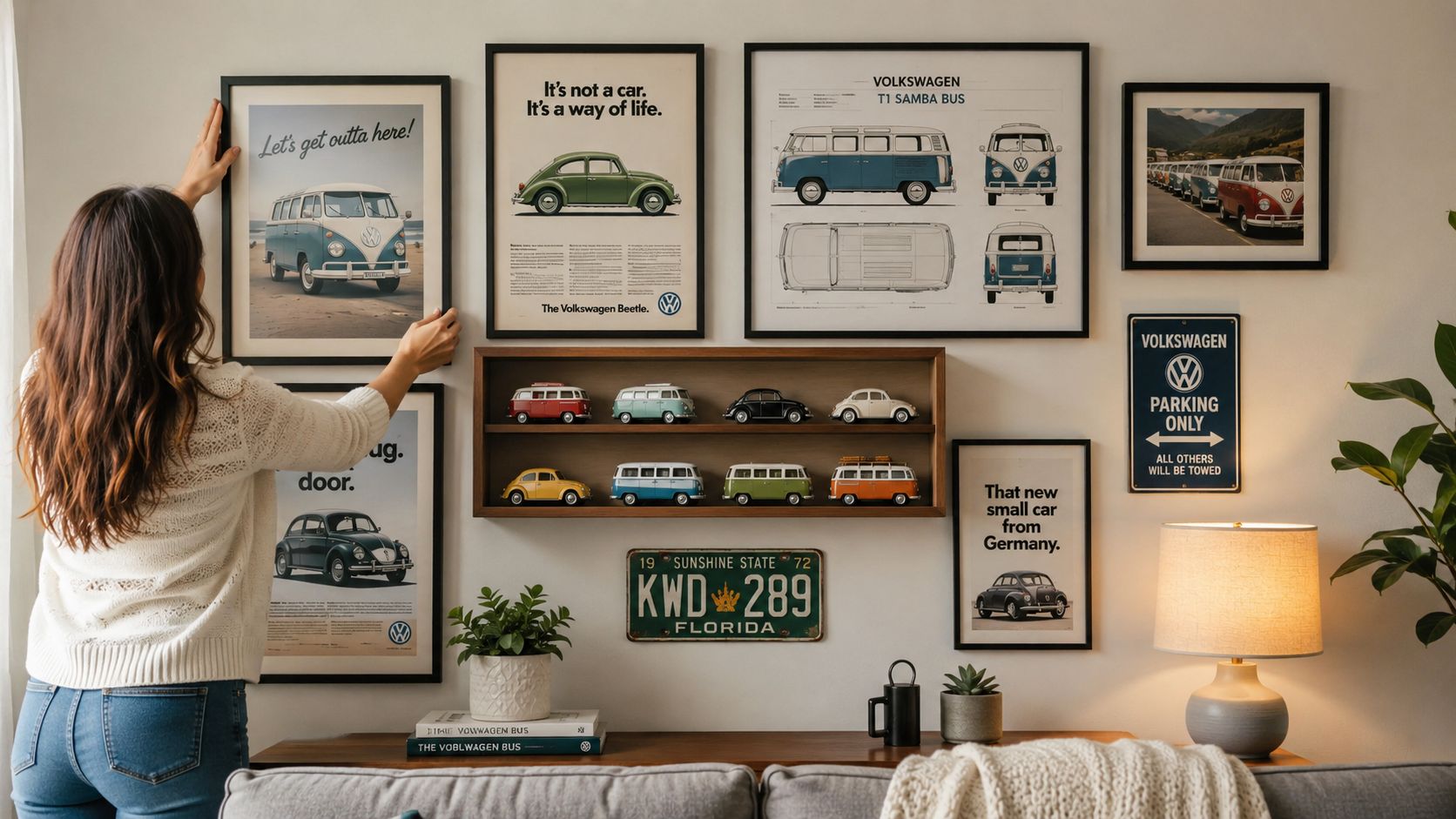
A gallery wall offers more personality, but it demands discipline. Three smaller surf-themed Beetle prints can look excellent when they share a frame style, visual weight or colour family. Mix too many scales, borders and unrelated images, though, and the coastal calm disappears under clutter.
Choose one statement when the room needs calm
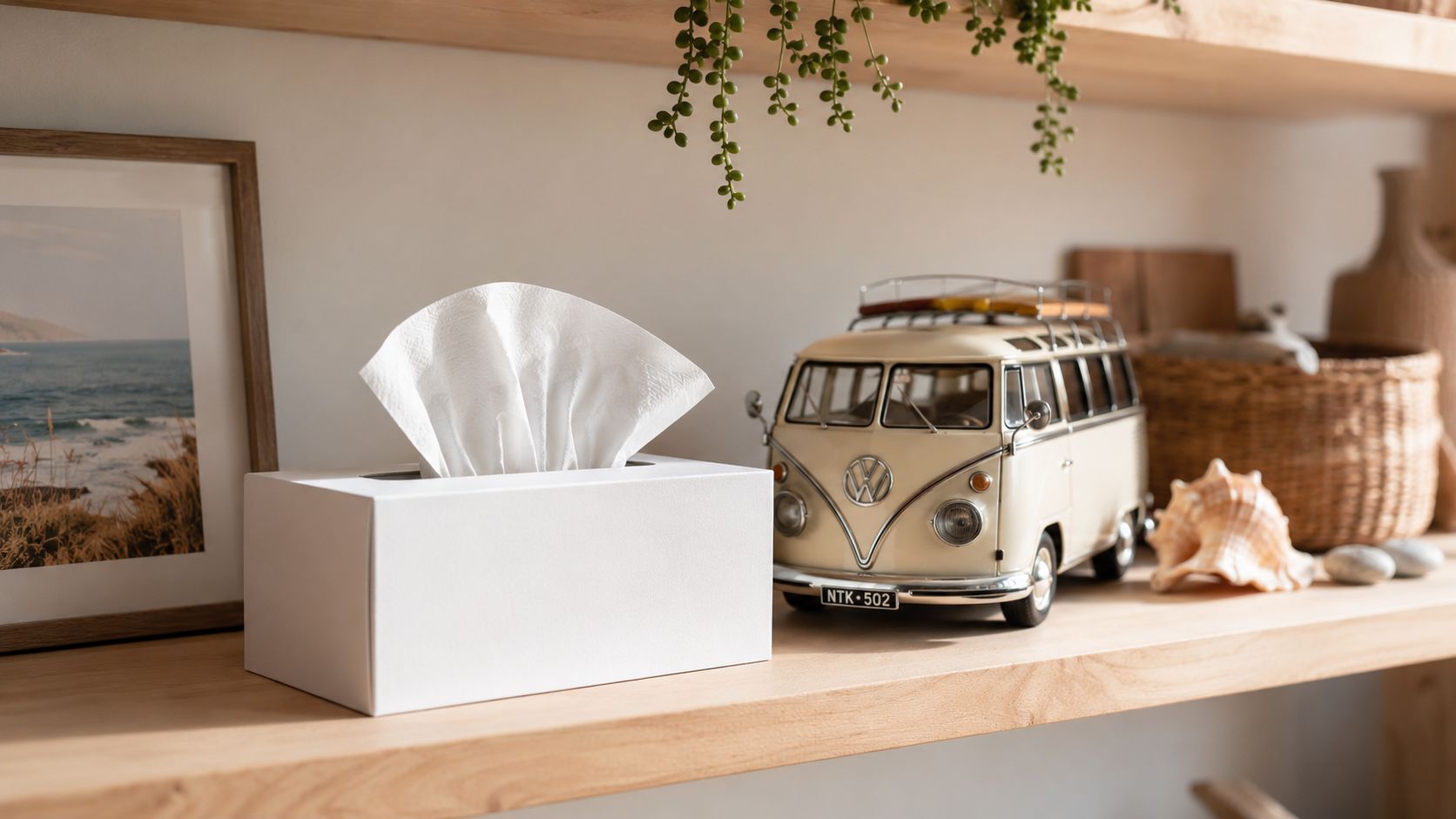
A large Flower Power Samba above a neutral sofa suits an open-plan area where the artwork needs to be seen from across the room. Keep the rest of the wall fairly clear. A low timber console, one ceramic vase and a small model Kombi are enough support.
This approach also works when the art is detailed. A large print gives the viewer time to notice the roof rack, surf gear, faded paint and coastal scenery rather than forcing all those details into a tiny frame.
Build a gallery when the collection has a story
A gallery makes sense when you already own several related pieces or want to show different sides of VW culture. Pair a beach Kombi with a Beetle road scene and a small detail print, but give the group a common thread. That might be a shared blue-and-cream palette, matching frames or a consistent vintage illustration style.
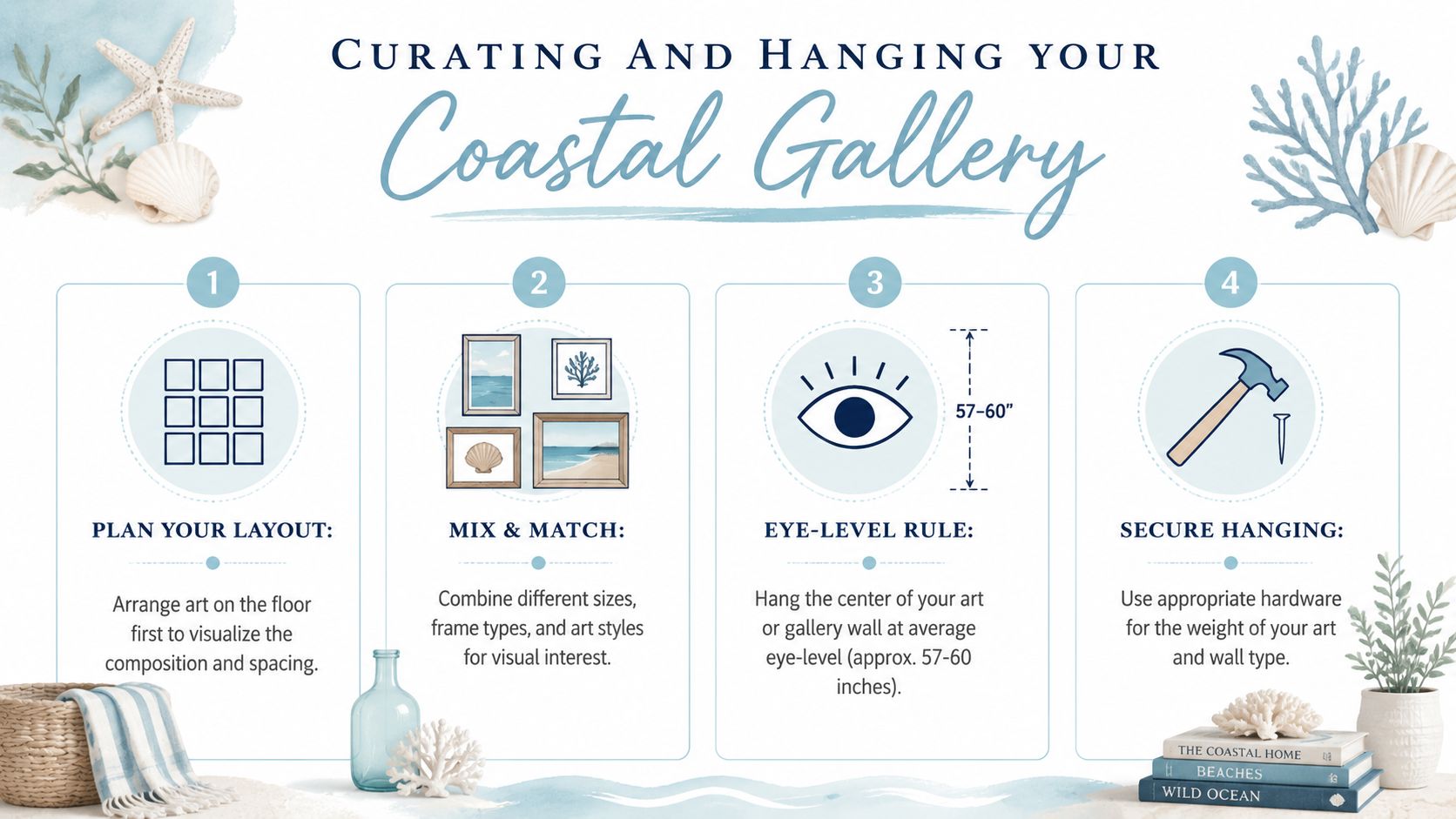
Lay the arrangement out on the floor before touching the wall. This lets you test whether the strongest image sits in the middle, whether the outer edges feel balanced and whether the group relates properly to the sofa below.
A gallery wall should look collected, not accumulated. If one piece only remains because you paid for it, it probably doesn't belong in the final arrangement.
Use living room wall accents to find the supporting shapes, but resist filling every gap. Negative space is what keeps a group of nostalgic images feeling considered.
Hanging Rules that Keep Your Beach Art Aligned
Good artwork can look wrong when it's hung too small, too high or slightly crooked. Coastal interiors depend on visual calm, so uneven spacing stands out quickly. Measure first, mark lightly and use a spirit level before committing to the wall.
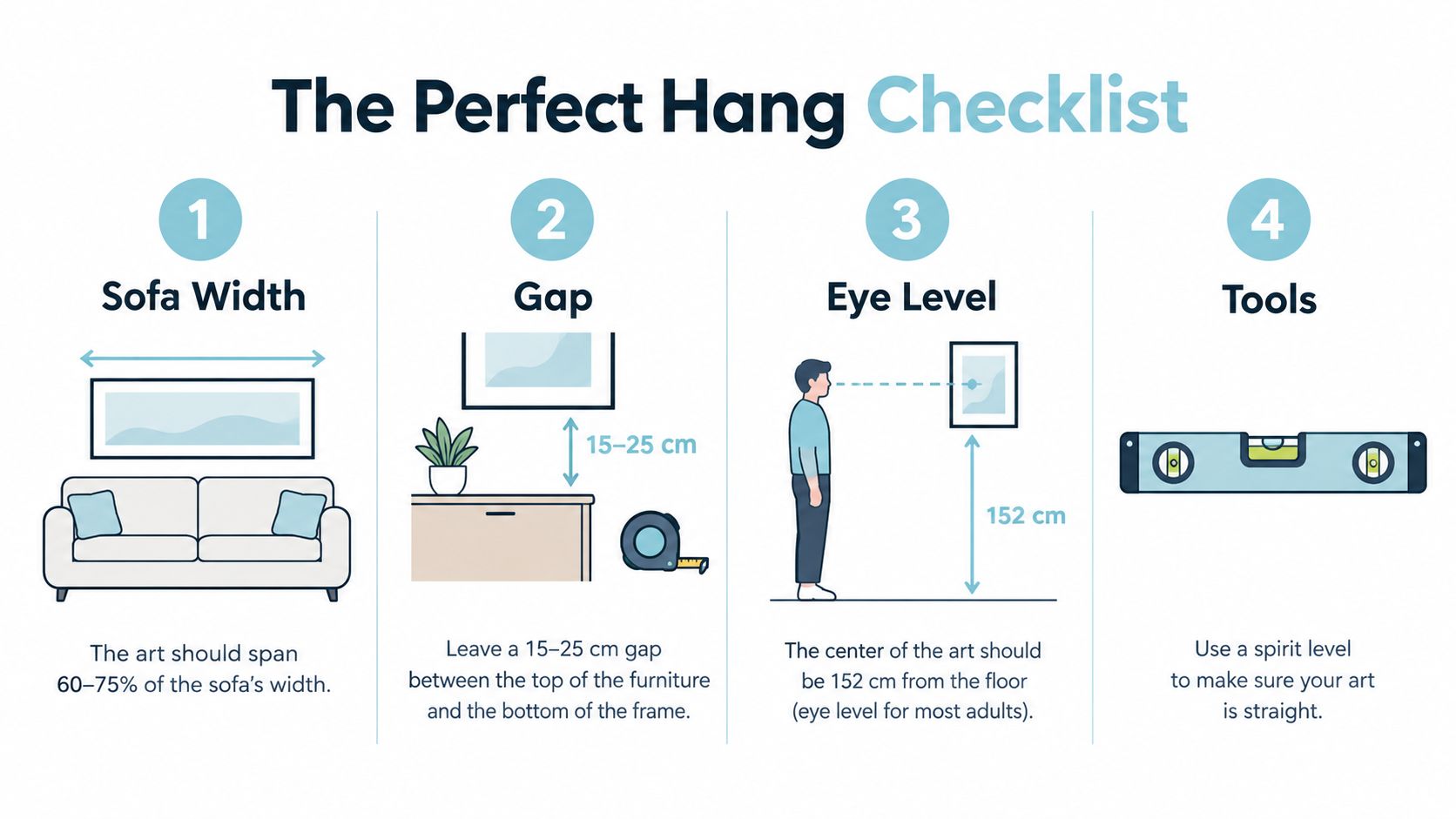
A practical installation method is to size the artwork so it spans 60–75% of the furniture width, leave 15–25 cm between the furniture and the art, and place the artwork centre at roughly 152 cm from the floor. For a triptych, allow 5–8 cm between panels so the image reads as a connected scene rather than three unrelated slices. These measurements come from this Australian wall-art installation guide.
Measure the furniture relationship
Measure the sofa, sideboard or console beneath the artwork, then calculate the useful visual span rather than choosing a frame by guesswork. A very narrow image can float above a wide sofa. A frame that runs nearly wall to wall can make the furniture look undersized.
Use painter's tape to mark the proposed outer edges. Step into the room, sit on the sofa and view the shape from the places you use. The tape outline often reveals a scale problem before you drill a hole.
Treat the wall as part of the installation
Plasterboard needs more care than brick or masonry. Heavier framed beach prints may need a stud fixing or a specialist plasterboard anchor, and pieces above 5 kg should ideally be fixed into a stud or with a load-distributing plasterboard anchor, according to Australian hanging guidance from Emma Street Studio.
Lay a gallery composition on the floor first, then transfer the positions carefully. The same source notes that Australian picture-hanging services quote $30–$50 per frame, with minimum call-out fees of $80–$150, so batching several pieces together can make more sense than arranging a visit for one frame.
Number the backs of panels if you're working with a triptych, check the hanging hardware, and keep the spirit level handy. A beach scene should feel effortless once it's on the wall, not like it survived a rushed Saturday job.
Sourcing Authentic VW Memorabilia Locally
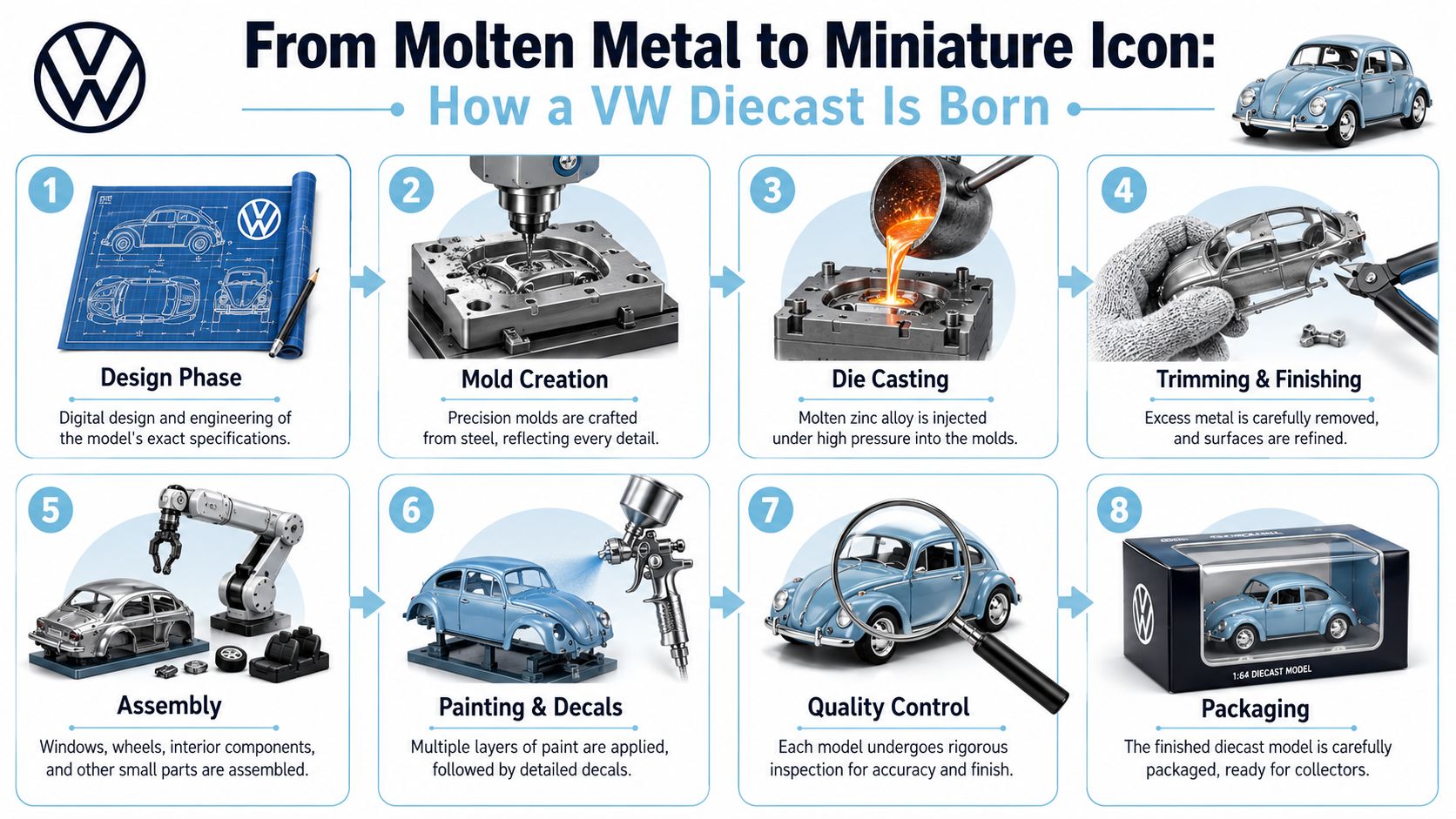
The coastal look works best when the VW element has proper character. Look for officially licensed Volkswagen diecast models, clear model identification and a finish that reflects the vehicle rather than a generic van shape. Collectors usually notice the small things first, including the badge treatment, body proportions, glazing, wheels and paint quality.
Australia's wall décor market is also shaped by imported finished products. One Australian market report estimates that 70–80% of finished modern framed wall art products are sourced from China and Vietnam, while framed canvas prints and multi-panel sets account for 55–65% of unit volume. The report projects market growth at a 4–6% compound annual rate from 2026 to 2035. Its Australia wall décor market analysis helps explain why shoppers see broad choices in ready-to-hang formats, sizes and finishes.
That variety is useful, but provenance still matters. A licensed Kombi Samba Bus diecast has a place beside coastal wall art because it connects the picture's relaxed road-trip mood with a real collector's object. A Flower Power Beetle can bring colour to a shelf, while a restrained beach print keeps the overall room from becoming too loud.
Why local stock makes collecting easier
Buying from an Australian importer or stockist gives you a practical advantage when you're styling a room for a birthday, house move or upcoming show. Local stock and fast shipping reduce the uncertainty that comes with waiting on an overseas parcel, while local support makes it easier to ask about finishes, model variations and availability.
A curated range also helps you build a collection with a proper thread. Start with one wall piece, add a matching Kombi, then look at Beetle models, metal décor or beach accents only when they earn their place. That approach keeps your VW memorabilia collectibles meaningful rather than turning the lounge into a parts bin.
Volkswagen Memorabilia brings together licensed VW diecast models, Kombi Samba Bus and Beetle pieces, plus coastal home décor for collectors and gift buyers. Visit Volkswagen Memorabilia to find a beach-ready wall accent and a diecast companion that give your living room a relaxed Australian VW story.
At a sunny Australian car show, the hard part isn't spotting a gorgeous Beetle or Kombi. It's choosing the miniature version that deserves a place beside your books, tools or treasured VW memorabilia. One collector might reach for a large, highly detailed display piece, while another needs a compact model that fits neatly on a desk. The best diecast models aren't just the biggest or most expensive. They're the ones that match your space, your taste and the Volkswagen story you want to keep close.
Introduction to the Best Diecast Models
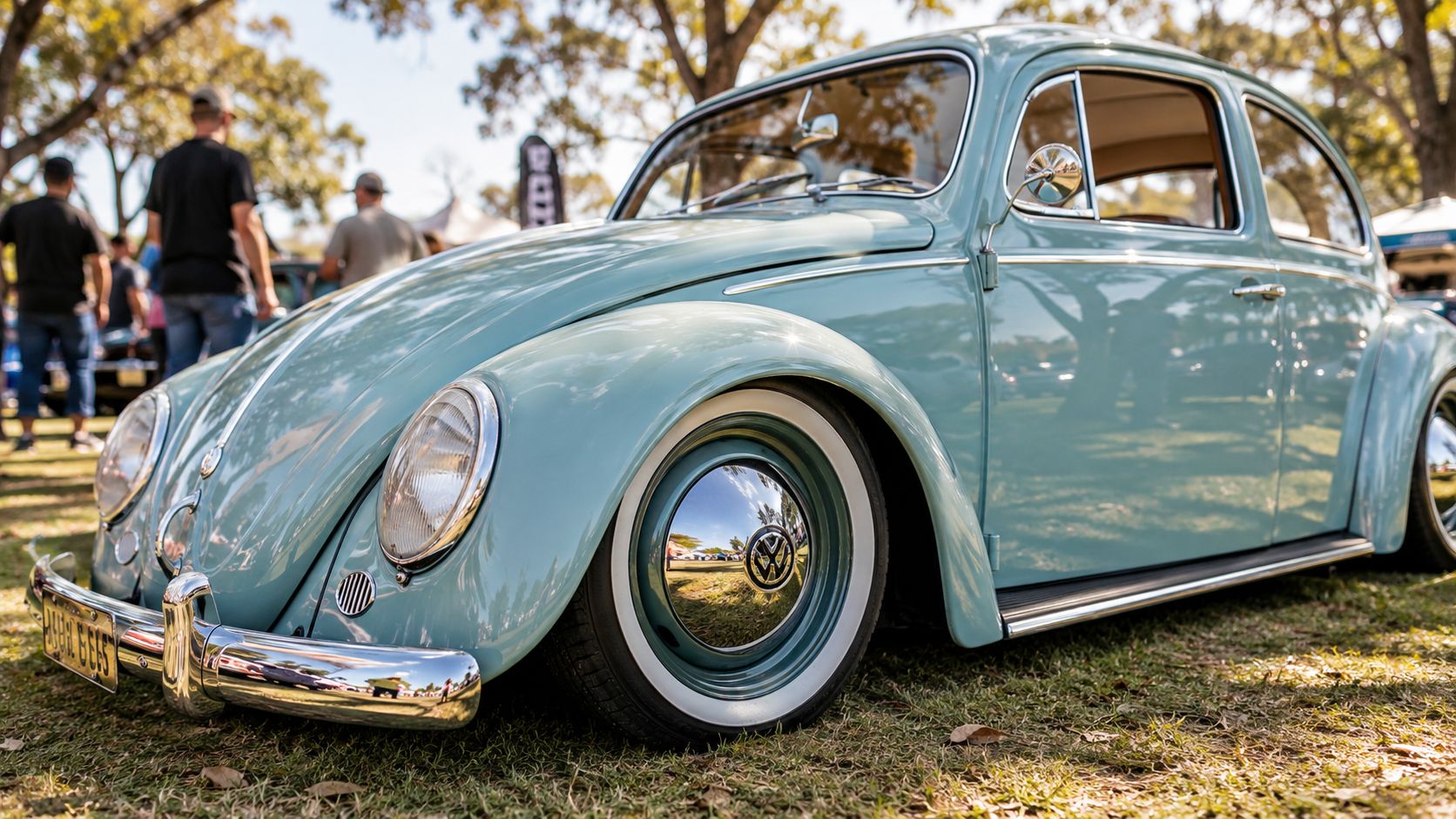
Classic Volkswagens still start conversations. A Beetle's curved roof, a Samba Bus's bright paint and a Kombi's split-window profile bring the character of Volksfest or the VW Nationals to a display shelf.
The appeal has history as well as nostalgia. Diecasting as a manufacturing process emerged in the early 19th century, and toy makers adapted it to miniature cars in the early 20th century. The diecast boom gathered pace during the post-war 1950s and 1960s, before a quieter period through the 1970s and 1980s. The category enjoyed a renaissance in the mid-1990s, helped by major brand relaunches. Diecast Toyz Australia now advertises 3,000+ model race cars, showing how established collecting has become locally.
For Australian VW collectors, licensed replicas carry meaning beyond their badges. A well-made Volkswagen Beetle or Kombi model can recall a family road trip, a surf memory or a real car you still hope to own. It can also suit a particular display: a compact licensed model for a crowded cabinet, or a larger piece where body lines and period details deserve attention.
Choose by scale utility and display value first, then check authenticity, construction and finish. That approach helps separate a handsome shelf piece from a model that will genuinely earn its place.
Choosing the Right Diecast Scale
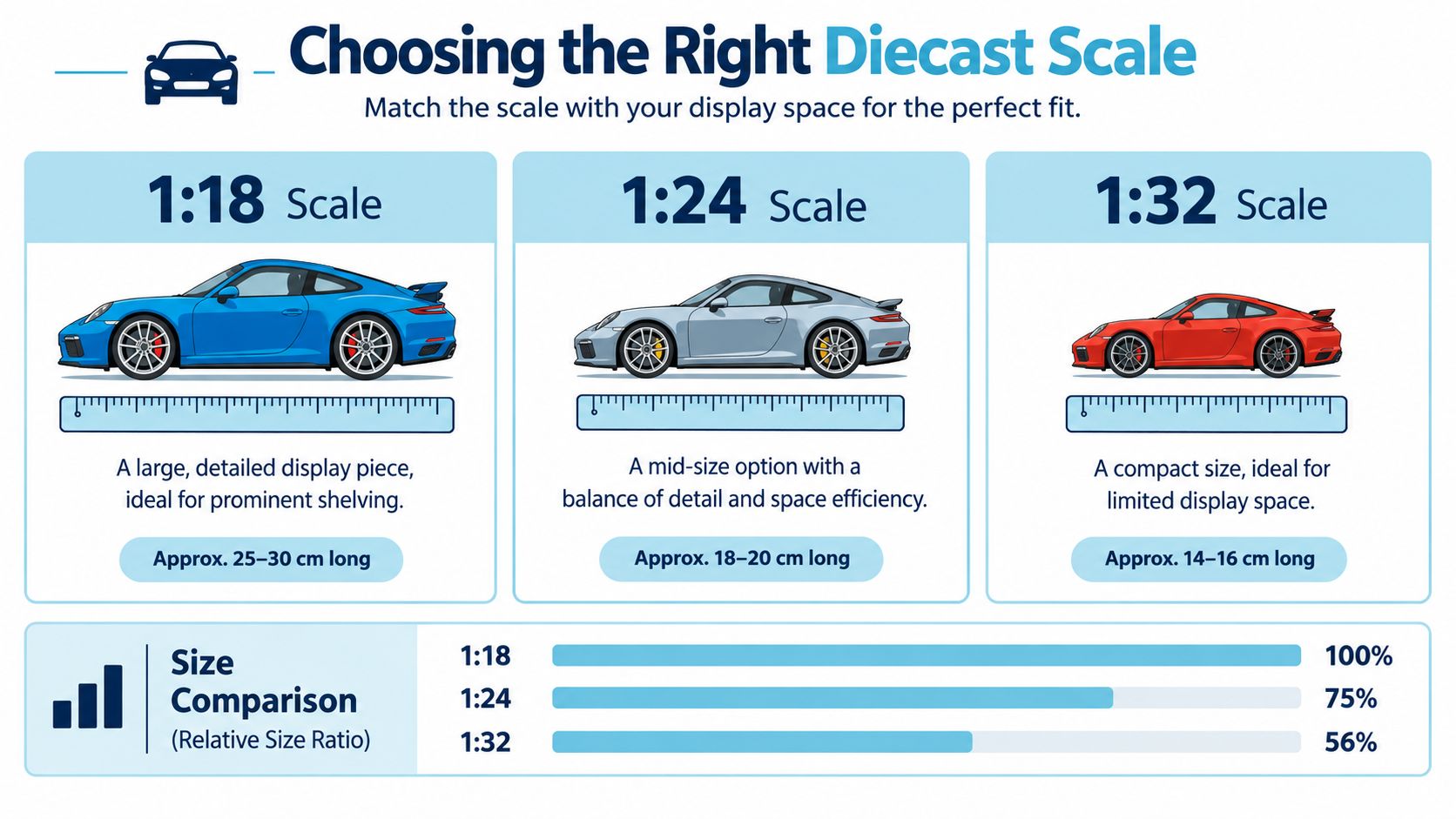
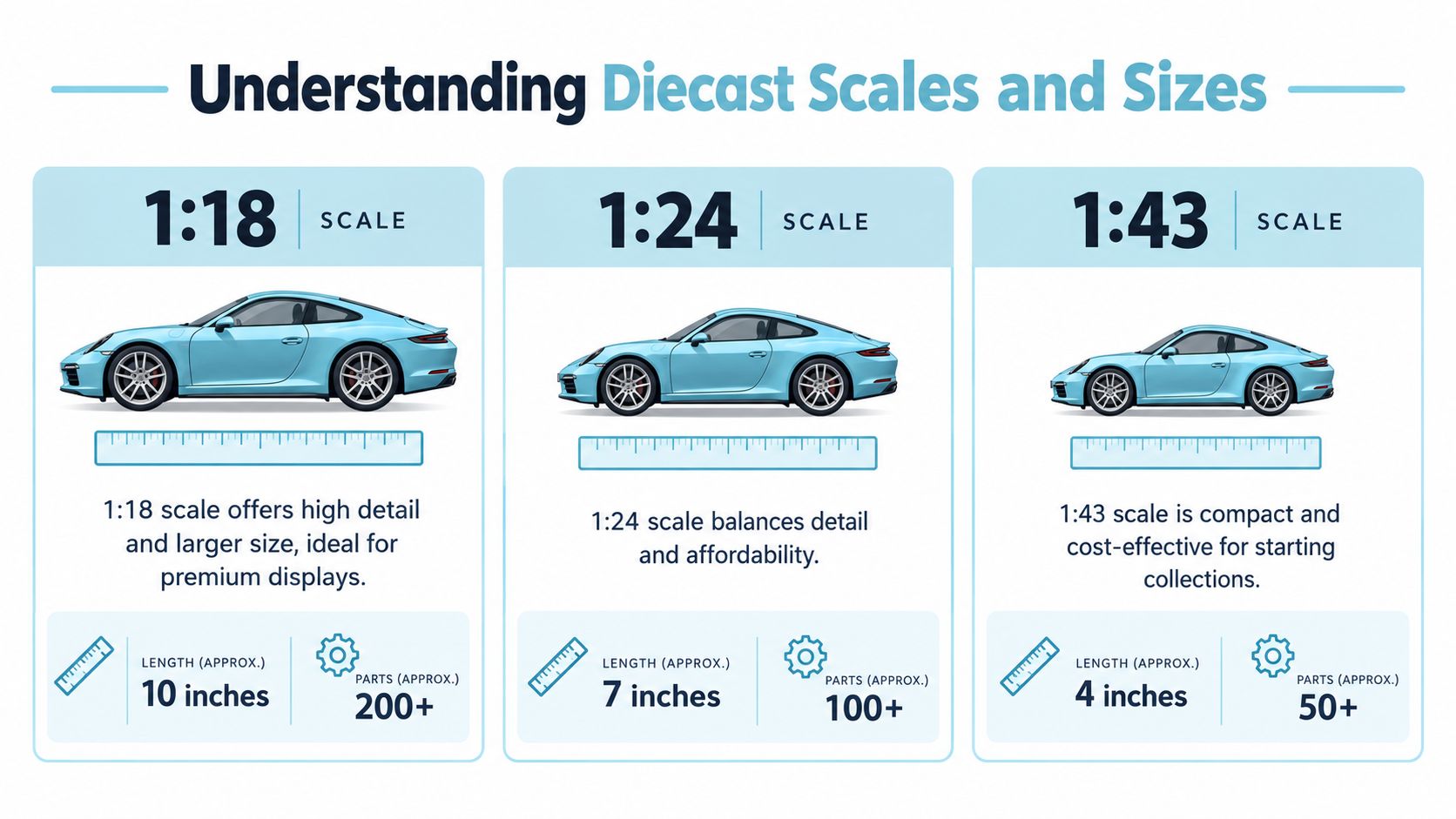
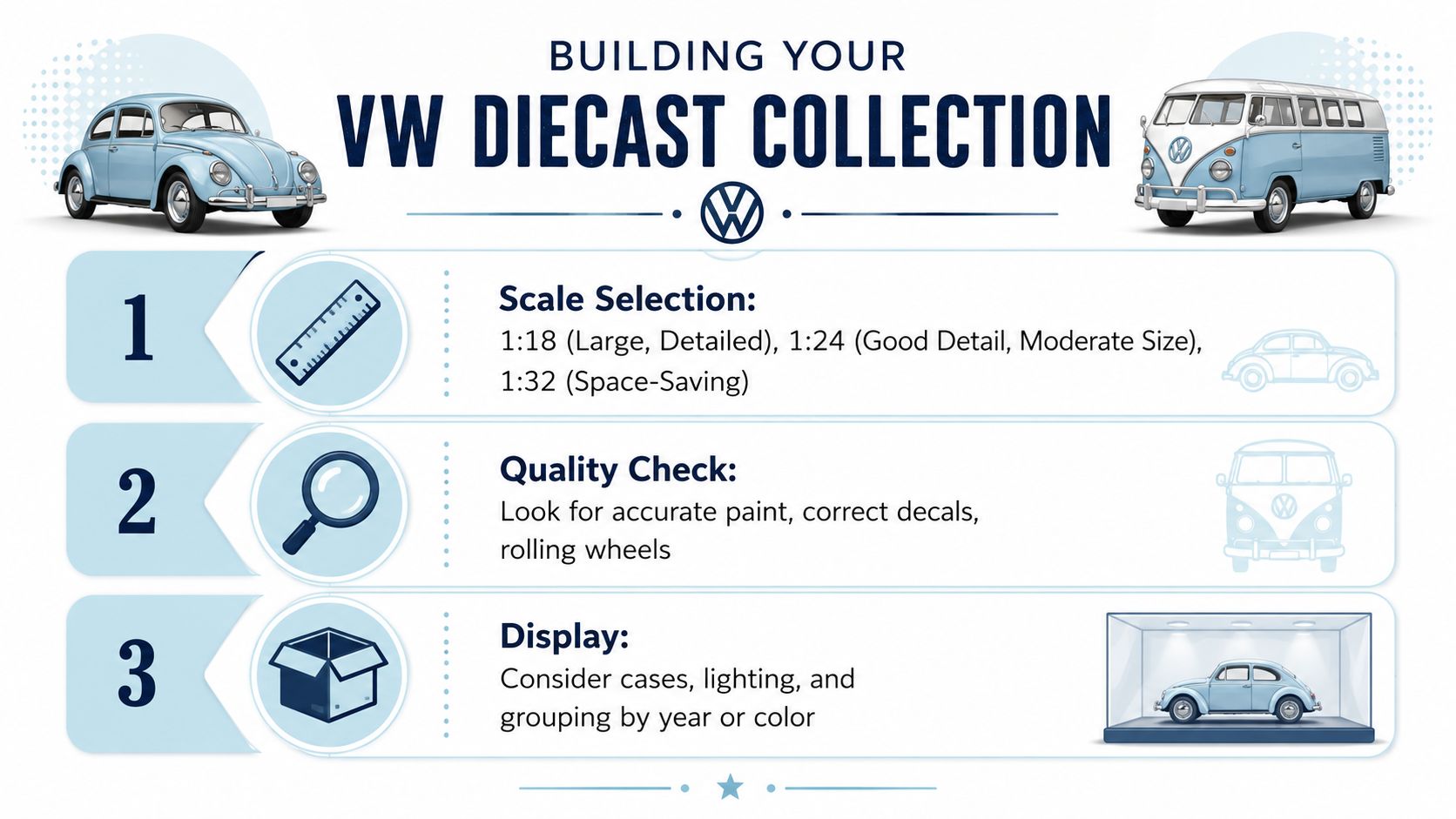
Scale affects nearly everything, from the shelf you'll need to the amount of detail you can enjoy. Australian collector guidance describes 1:43 as a global standard and a popular local choice, while 1:18 and 1:24 suit collectors who prioritise detail and have more display room. 1:64 works well for compact or larger themed collections. Hearn's Hobbies explains the common scale options, including approximate lengths for several formats.
Scale
Approx. Length
Detail Level
Best For
1:18
25–30 cm
Highest display detail
Feature shelving and serious centrepieces
1:24
16–20 cm
Strong detail with manageable size
Balanced collections and gift displays
1:32
Approx. 14–16 cm
Compact, practical detail
Smaller shelves, desks and limited spaces
A 1:18 Kombi gives the bodywork, cabin and graphics more visual presence. Larger models are also more likely to include opening doors, bonnets or other functional features, although the exact specification depends on the manufacturer. The trade-off is straightforward: one large model can occupy the space of several smaller cars.
A 1:24 Volkswagen Beetle model often hits the sweet spot for collectors who want recognisable detail without giving an entire shelf to one car. It's large enough to appreciate the roofline, bumpers and interior treatment, yet easier to combine with another classic VW.
For a tighter display, 1:32 offers a sensible compromise. It won't provide the same feature fidelity as a large collector-grade replica, but it can work beautifully in a themed arrangement with a Beetle, Kombi and Samba Bus. If you're comparing more options, this guide to 1:18 diecast models provides a useful starting point for matching size with your available room.
Practical rule: Choose the largest scale your display can comfortably handle, not the largest model your enthusiasm can justify on the day.
The Allure of VW Kombi and Beetle Models
The Beetle and Kombi have earned their place in miniature because their shapes are instantly recognisable. A sports car can impress with speed and stance, but a classic Volkswagen often carries a more personal story. It suggests family holidays, coastal weekends, flower-power colour schemes and the easy-going freedom associated with the air-cooled VW scene.
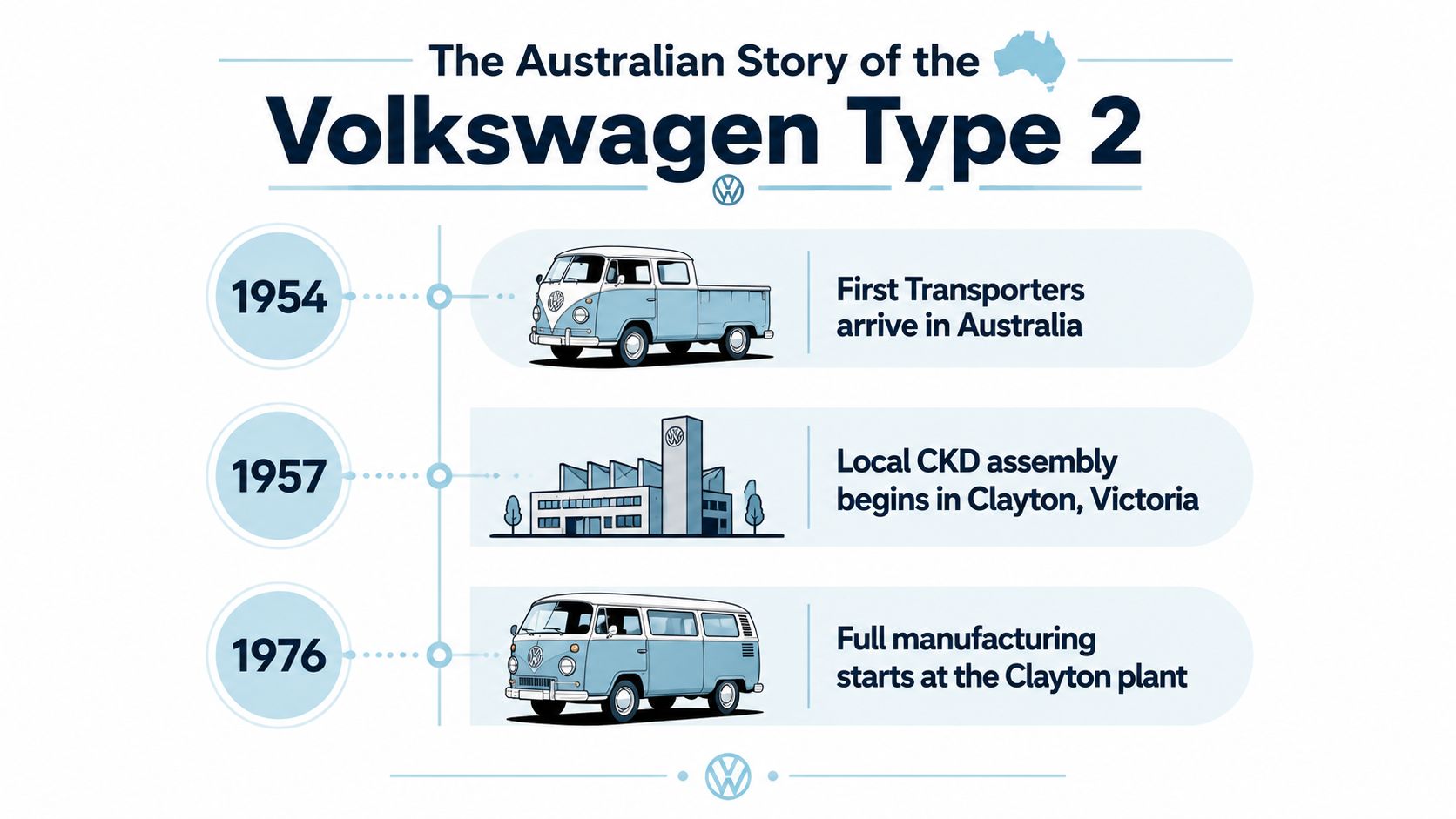
The Kombi's Australian history adds another layer. Volkswagen's first Type 2 vehicles arrived in Australia in 1954 as CKD kits delivered to Martin & King in Clayton South. Local assembly used Australian upholstery, tyres, paint and some mechanical components, and Volkswagen took over local assembly four years later. Retro Rides Australia covers this local history in its Kombi buying guide.
Globally, Volkswagen sold 4.5 million Kombis since 1950, and the first Type 2 pickups were made in September 1952 before sales began in Australia in 1954. Club VeeDub Australia records the Kombi's production and arrival story. Those details help explain why a Kombi diecast Australia collector isn't just buying a colourful van. They're choosing a small representation of a vehicle with genuine local heritage.
Why these shapes work so well in a collection
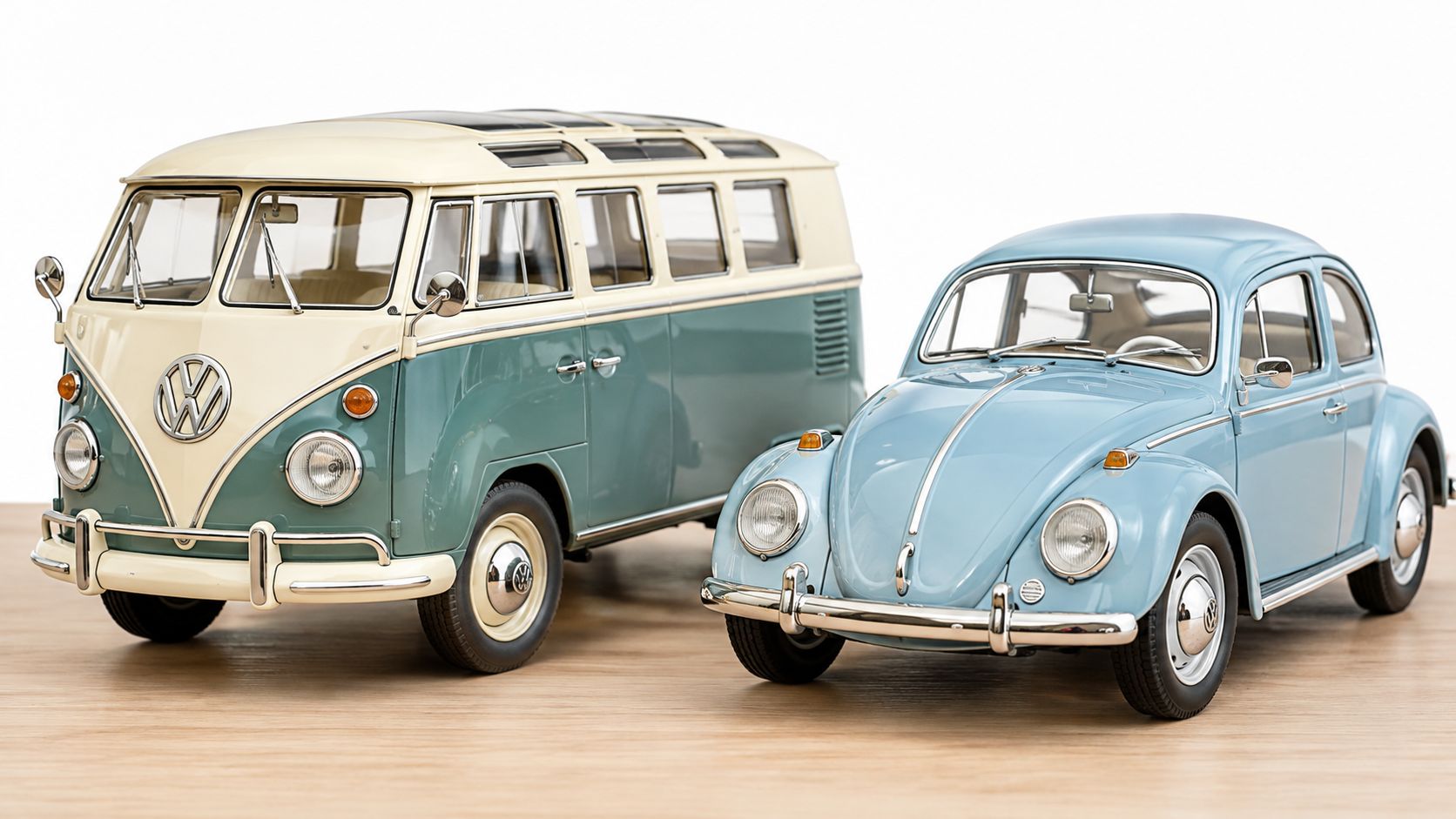
A Beetle makes a strong single display because its silhouette reads clearly from across a room. A Samba Bus adds more visual drama through its split-window styling, roof details and two-tone paint possibilities. Together, the two create an instant period display, especially when the models share a scale and complementary colours.
That's also why these replicas make reliable gifts. You don't need to know every technical detail of the recipient's collection. If they love classic Volkswagens, a carefully licensed Beetle or Kombi usually connects with the memory first and the specification second.
What Makes a Diecast Model Collectible
A collectible model needs more than a familiar badge. Strong buying decisions combine official licensing, transparent construction and accurate proportions. Australian specialist retailers describe collector-grade replicas as authorised by vehicle manufacturers, based on production designs and finished with detailed paint and graphics. Australian Car Collection outlines these qualities in its licensed model range.
Start with authenticity
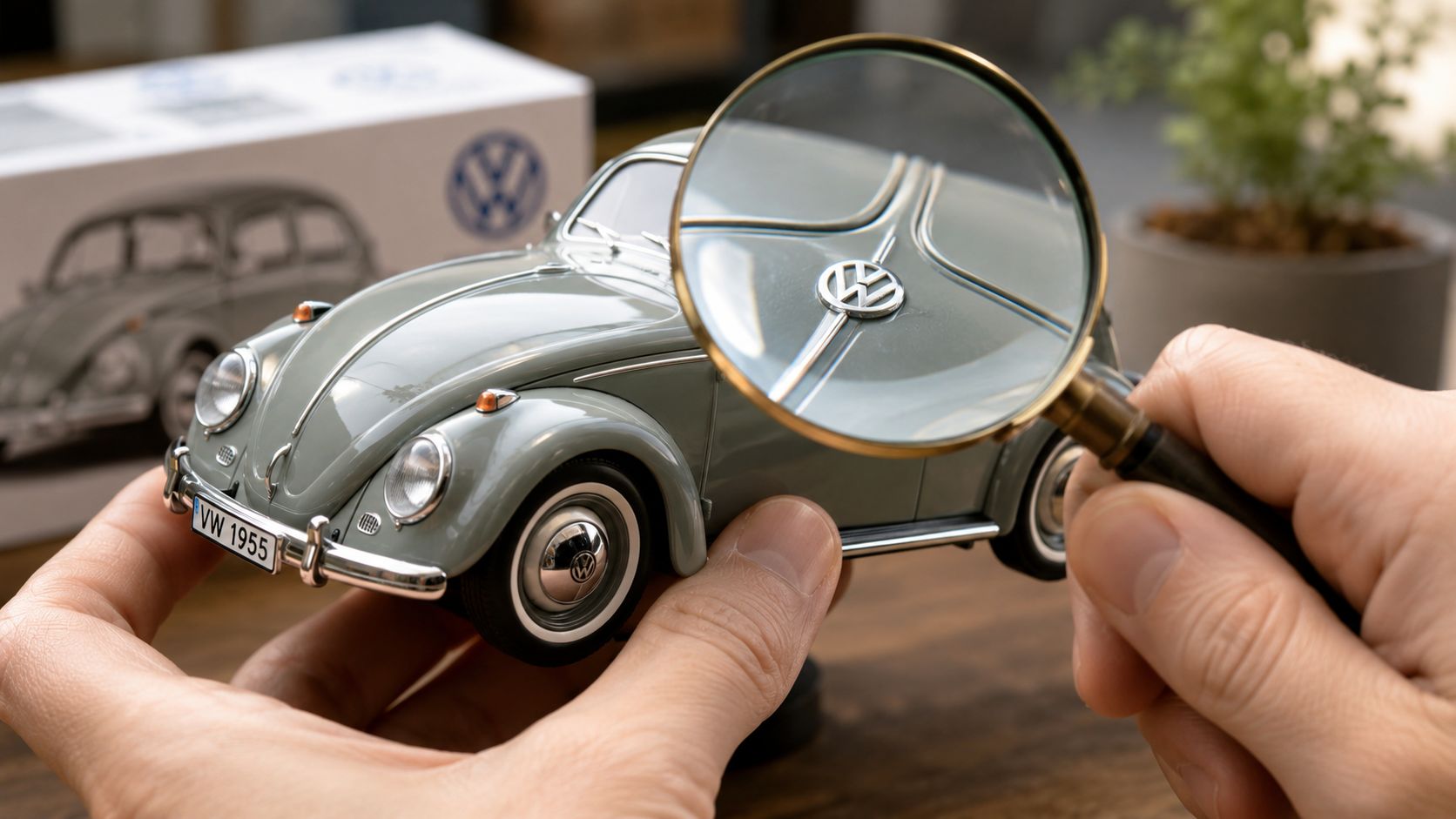
Check that the listing identifies the model as officially licensed. Licensing indicates that the maker has worked from approved design references rather than adding a familiar-looking badge to a generic body. For an Australian Volkswagen collection, inspect the front emblem, body shape, wheel design, trim and graphics. Those details decide whether a Beetle or Kombi feels convincing at its chosen scale.
A cabinet centrepiece deserves closer inspection than a small gift model. Check the paint, graphics, wheel alignment, glazing and packaging. Opening doors or bonnets can add enjoyment, though fixed parts may be the better choice for a tidy, durable display.
Rarity may support resale interest, but it is a poor sole reason to buy. Australian collectables coverage notes that rare diecast pieces can exceed AUD 1,000 on eBay Australia, while die-cast models commonly sit in the AUD 80–150 range, with premium replicas priced considerably higher. Hobbyco discusses Australia's collector market and rare items. Treat those figures as market context, not a promise of future value. Condition, packaging, authenticity and demand still shape what a model is worth.
Display and Storage Tips for Collectors
A beautiful model can lose its impact when dust gathers in the window frames or sunlight fades the paint. Displaying diecast well is mostly about controlling the environment and making the model easy to enjoy without handling it constantly.
Build the display around the car
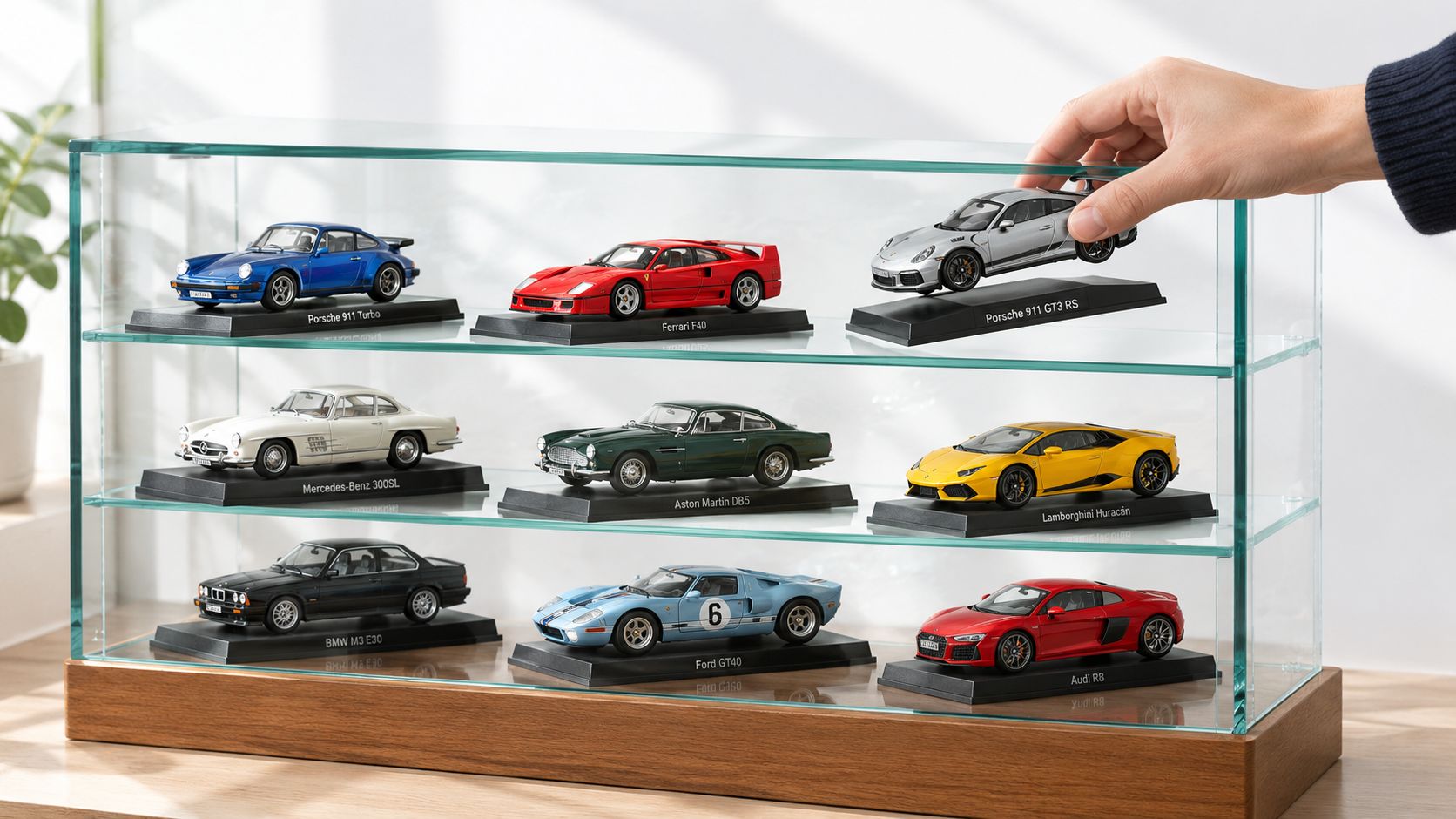
Use a stable shelf or enclosed cabinet, and leave enough room to remove a model without catching its mirrors or aerials. Glass or acrylic protection helps keep dust away, while a simple backing board can make light-coloured Beetles and Kombis stand out.
Protect the finish
Keep models away from direct sunlight. UV exposure can fade paint and affect clear plastic over time. Dust with a soft brush or clean microfibre cloth, and support the model from its base rather than lifting it by a mirror, roof rack or other fine detail.
Organise with intention
A collection looks more considered when you choose a simple organising principle:
By scale: Keep 1:18, 1:24 and smaller models together so the display feels visually consistent.
By story: Pair a Beetle with a Kombi or Samba Bus to create a classic road-trip theme.
By colour: Group pastel, two-tone or Flower Power-inspired finishes for a lively shelf.
By era: Arrange models around the heritage of the actual vehicles rather than only their brand.
For collectors expanding beyond a basic shelf, these display cases for models can help create a cleaner, more protected presentation. Keep original boxes and paperwork in a dry place, even if you prefer displaying the cars outside their packaging.
Where to Buy Quality VW Diecast Models in Australia
At a sunny car show, a small Beetle can attract just as much attention as a larger display model. Buying locally makes that choice easier. Local stock, faster shipping and accessible support let Australian collectors check scale, dimensions and delivery details before committing to an overseas listing with limited information.
Start with a retailer that understands the difference between a novelty car and a licensed collector piece. Check the stated scale, product dimensions, manufacturer, materials and photographs from several angles. A 1:18 Kombi offers stronger shelf presence, while a smaller Beetle may suit a tighter display or a growing collection.
The range should also match the way you collect. A single Samba Bus can work as a nostalgic gift, while a Beetle, Kombi and surf-inspired van create a more personal scene. Mixed packs suit families, small retailers and collectors who enjoy variety. Buyers building a focused display may get more satisfaction from one carefully selected model with the right colour, body style and scale.
Australia also has an active resale market, giving collectors more ways to find older or harder-to-source pieces. Search classified listings for condition, missing parts, original packaging and seller photographs. Ask about postage protection before buying, especially for models with delicate mirrors, aerials or roof accessories. Browse diecast models in Australia to compare licensed Kombi, Samba Bus and Beetle options by scale, finish and intended display location.
That comparison is more useful than a generic brand ranking. The best model is the one that fits your shelf, budget and collecting story, then still makes you smile each time you walk past it.
Volkswagen Memorabilia brings together licensed VW diecast, including classic Kombi and Samba Bus replicas, Beetle models and colourful surf-inspired pieces, with local support for Australian collectors and gift buyers. Visit Volkswagen Memorabilia to find a miniature Volkswagen suited to your collection, display and the memories behind these cars.
You're standing beside a sunny Australian show field, eucalyptus in the air, while a restored Kombi burbles past and collectors compare paintwork, wheels and trim. On a nearby table, a little Samba Bus catches the light. It's small enough to hold in one hand, yet it carries the same sense of travel, freedom and character as the full-size Volkswagen beside it.
That's the appeal of diecast model cars. They're not merely toys. A well-made model preserves the shape, colours and details that make a Beetle, Kombi or Samba Bus memorable, while giving you a practical way to enjoy VW history at home. Whether you're building a display around a real car, choosing a birthday present or starting a collection from scratch, the right model should feel connected to the story behind the vehicle.
Welcome to the World of Diecast Model Cars
A good collection usually starts with a personal memory. Perhaps you rode in a Kombi during family holidays, owned a Beetle, or spent show day admiring a lowered Type 2 with polished trim. The model you take home doesn't need to be rare to matter. It needs to remind you why the vehicle has stayed with you.
Australian collecting has a strong practical side. Display space is rarely unlimited, shipping can become awkward with larger boxes, and imported stock may involve uncertainty around availability, delivery and final cost. That's why scale, construction and licensing deserve attention before colour or packaging.
A useful collecting rule: buy the model you'll enjoy seeing every day, not simply the one that looks impressive in an online listing.
The local scene has depth behind it. Diecast Distributors Australia says it began in 1998 as the Australian distributor for Matchbox Collectibles, added Hot Wheels Elite within 12 months, and later expanded beyond 1,500 individual SKUs. Its DDA Collectibles brand now holds more than 150 tooling sets across scales from 1:64 to 1:18, evidence of a sector that has grown from importing branded products into broad wholesale distribution and local product development. Diecast Distributors Australia's market history puts that progress into perspective.
For a VW enthusiast, the best collection often mixes nostalgia with discipline. Choose a theme such as air-cooled Volkswagens, Australian heritage, surf culture or favourite show colours. Then let each addition earn its place.
Understanding Diecast Scales and Sizes
Scale tells you how large the model is compared with the actual vehicle. A 1:18 model is one-eighteenth the size of the original, while a 1:24 model is one-twenty-fourth. Collector guides generally place 1:18 models at about 9 to 12 inches long and 1:24 models at roughly 6.5 to 8 inches, with the larger format allowing more elaborate interior and engine-bay treatment. This scale guide explains the practical difference between the two formats.
The familiar Australian favourite is 1:43. Local hobby guidance describes it as the country's most popular diecast size, usually around 11 cm long, although the finished length depends on the actual vehicle. A compact 4.2 metre hatchback becomes about 9.8 cm at 1:43, while an 11 metre bus becomes about 25.6 cm. Anthony's Diecasts' model car size guide provides those comparisons and explains why the same scale can create very different shelf footprints.
Choosing the right format
Scale
Best suited to
Main advantage
Main compromise
1:18
A statement display or detailed premium piece
Strong presence and room for fine features
Takes more shelf and storage space
1:24
A balanced display with several larger models
Useful middle ground between detail and footprint
Less expansive than 1:18
1:43
Themed collections, gifts and compact shelving
Efficient storage with convincing detail
Smaller parts need careful handling
A 1:43 Beetle works beautifully on a bookcase, desk or cabinet where you want several vehicles together. A 1:18 Kombi, by contrast, becomes the centrepiece. Before buying, measure the shelf depth, allow room for the packaging and remember that a long-wheelbase vehicle or bus can occupy considerably more space than a small car in the same nominal scale.
For a VW display, consistency matters more than chasing one “best” size. A row of 1:43 Volkswagens feels organised, while a single large Samba Bus can anchor a mixed arrangement. Explore the 1:18 diecast scale range when you want a feature model, and choose smaller formats when the collection itself is the visual story.
Materials and Build Quality in Diecast Models
The alloy beneath the paint affects how a model feels, holds detail and ages. Australian diecast and die-casting sources identify zinc and aluminium as core metal families. Zinc alloys generally produce heavier-feeling body shells with good dimensional stability, while aluminium is often selected where strength-to-weight, corrosion resistance and thermal conductivity are important. The Australian die-casting market overview also reports that aluminium die castings held a 50% share of the local components market in 2025.
Collectors should inspect more than the word “diecast” on the box. A zinc-die-cast body can support crisp grille lines, sturdy panels and a reassuring weight in the hand. Aluminium-based or mixed-material construction may reduce weight, but thin sections and surface finish can behave differently during production.
What to check before buying
Body material: Look for clear information about zinc-die-cast bodywork, lighter alloy construction or mixed materials.
Paint finish: Check whether colour sits evenly around door edges, roof gutters and wheel arches. Uneven coverage is more distracting on a bright Kombi.
Glazing and trim: Clear windows, separate mirrors and cleanly fitted bumpers add realism, especially at 1:43.
Tooling detail: Grilles, hubcaps, headlights and chassis features should look sharp rather than soft or moulded into a single flat surface.
Licensing: Official Volkswagen branding supports authenticity and makes the model a stronger choice for a heritage-focused collection.
The practical takeaway is simple. Scale alone doesn't determine quality. Alloy selection, tooling complexity, paint application and assembly all matter, so compare the actual finish rather than assuming a larger model is automatically better.
The Heart of the Collection, Volkswagen Diecast Models
A VW model earns its place through character. The Beetle's rounded roof and friendly face are instantly recognisable, while the Kombi's upright body, split-window heritage and open-road associations invite a different kind of nostalgia. A Samba Bus adds another layer, with its bright colour schemes and holiday feeling making it a natural centrepiece for a display.
Volkswagen's Australian story gives these shapes extra meaning. Beetle assembly began at Clayton, Victoria, in 1954, using CKD kits, and Australian Beetle kit assembly ended in 1976. This Australian assembly history makes a Volkswagen Beetle model more than a generic classic car souvenir for local collectors. It connects the miniature vehicle to a real production chapter close to home.
The Type 2 entered production in March 1950, and Volkswagen had sold 4.5 million Kombis worldwide by the time the Australian club history was written. Australian assembly began in the 1950s, while Clayton-built Kombis were later produced largely from local parts between 1959 and 1968. Club VeeDub's Type 2 history provides valuable context for collectors drawn to Australian Kombi heritage.
Collecting with VW culture in mind
At Volksfest, VW Nationals or a local Surf Show and Shine, authenticity matters. Enthusiasts notice whether the badge, body line, wheel style and colour belong to the vehicle's era. Officially licensed models are therefore a sensible foundation, particularly when the collection celebrates a specific Volkswagen rather than just a general retro look.
The Kombi also has a distinctly Australian emotional register. Local enthusiasts assembled and used these vehicles for work, holidays and surf trips, helping the Type 2 become part of the country's motoring identity. CarsGuide's look at Australian Kombi culture captures why the model continues to turn heads at community events.
A good display might pair a Volkswagen Beetle model with a Samba Bus, then add a colour or theme that reflects your own car. The result feels curated rather than crowded.
Top Brands and Where to Buy in Australia
Brand reputation helps narrow the field, but inspection still matters. A respected manufacturer may offer different finish levels across its range, while a smaller licensed release can reproduce a particular Volkswagen variant with surprising accuracy. Choose the vehicle and scale first, then compare construction, paint, glazing, wheels and packaging.
Australian collectors benefit from established local distribution. Diecast Distributors Australia began in 1998 and now lists more than 1,500 SKUs alongside over 150 DDA Collectibles tooling sets. Its range covers formats from 1:64 to 1:18, although 1:43 remains a practical choice for many Australian VW displays because it balances detail with shelf space.
Local buying versus imported stock
Buying route
Where it works well
Watch carefully
Australian retailer
Local stock, domestic dispatch and easier support
Popular colours may sell through
Imported listing
Unusual variants and harder-to-find releases
Shipping, packaging damage and final landed cost
Mixed pack
Gifts, starter collections and variety
Less control over every colour or model
Single premium model
Focused displays and special occasions
Higher entry price and greater expectation of finish
Domestic stock usually means quicker delivery, simpler returns and fewer surprises when a parcel arrives. Imported listings can fill gaps in a collection, especially for uncommon Kombi, Beetle or limited-edition variants. Check the seller's measurements, packaging method and total delivered cost before comparing prices. Currency conversion and international postage can change the apparent bargain.
Australian Etsy listings show Volkswagen die-cast items around AU$60.81 to AU$67.76, while rare listings range from roughly AU$22.84 to AU$110.80. The Australian Volkswagen die-cast marketplace demonstrates why condition, licensing, rarity, scale and local availability belong in the same decision.
For a wider comparison of manufacturers and finish levels, consult the best diecast car brands. The strongest purchase has clear provenance, sound packaging and details that still matter after the initial excitement fades.
Caring for and Displaying Your Diecast Collection
Australian conditions can be hard on a display. Strong sunlight may fade paint, humidity can affect metal and plastic components, and temperature swings can stress packaging and adhesives. A model doesn't need elaborate museum treatment, but it does benefit from a stable, clean environment.
Keep the main display away from direct windows, heaters and damp areas. A cabinet with doors reduces dust, while a shallow riser lets rear vehicles remain visible without forcing you to pack the shelf tightly. For open shelving, use a soft detailing brush and a clean microfibre cloth. Don't spray cleaner directly onto the model, especially near glazing, decals or moving parts.
Display habit: rotate the models you handle most, and keep scarce or fragile pieces behind a closed door.
Retain boxes, inserts and any paperwork. Original packaging helps protect mirrors, aerials and delicate trim during a move, and it preserves the model's identity if you later sell or trade it. Store boxed models flat where possible, without placing heavy items on top.
For a more polished setup, consider display cases for models. The best case isn't necessarily the largest. It's the one that gives each Kombi, Beetle or bus enough breathing room to be seen clearly.
Start Your Diecast Journey Today
A meaningful collection doesn't need to begin with a rare release or a full cabinet. Start with the Volkswagen that means something to you, whether that's a Kombi Samba Bus, a classic Beetle or a bright Flower Power variant, then build around its story. Australian collectors can also choose local stock and fast shipping, which makes it easier to buy thoughtfully, find gifts and avoid unnecessary import uncertainty.
Licensed Volkswagen diecast models turn familiar shapes into lasting display pieces. They suit a show enthusiast, a classic car owner, a nostalgic traveller or anyone who still believes a Kombi makes an ordinary day feel like a holiday.
Volkswagen Memorabilia brings together licensed Volkswagen diecast models, Kombi Samba Bus pieces, Beetle designs and VW memorabilia collectibles for displays and thoughtful gifts. Browse the curated range and visit Volkswagen Memorabilia to find the model that belongs on your shelf.
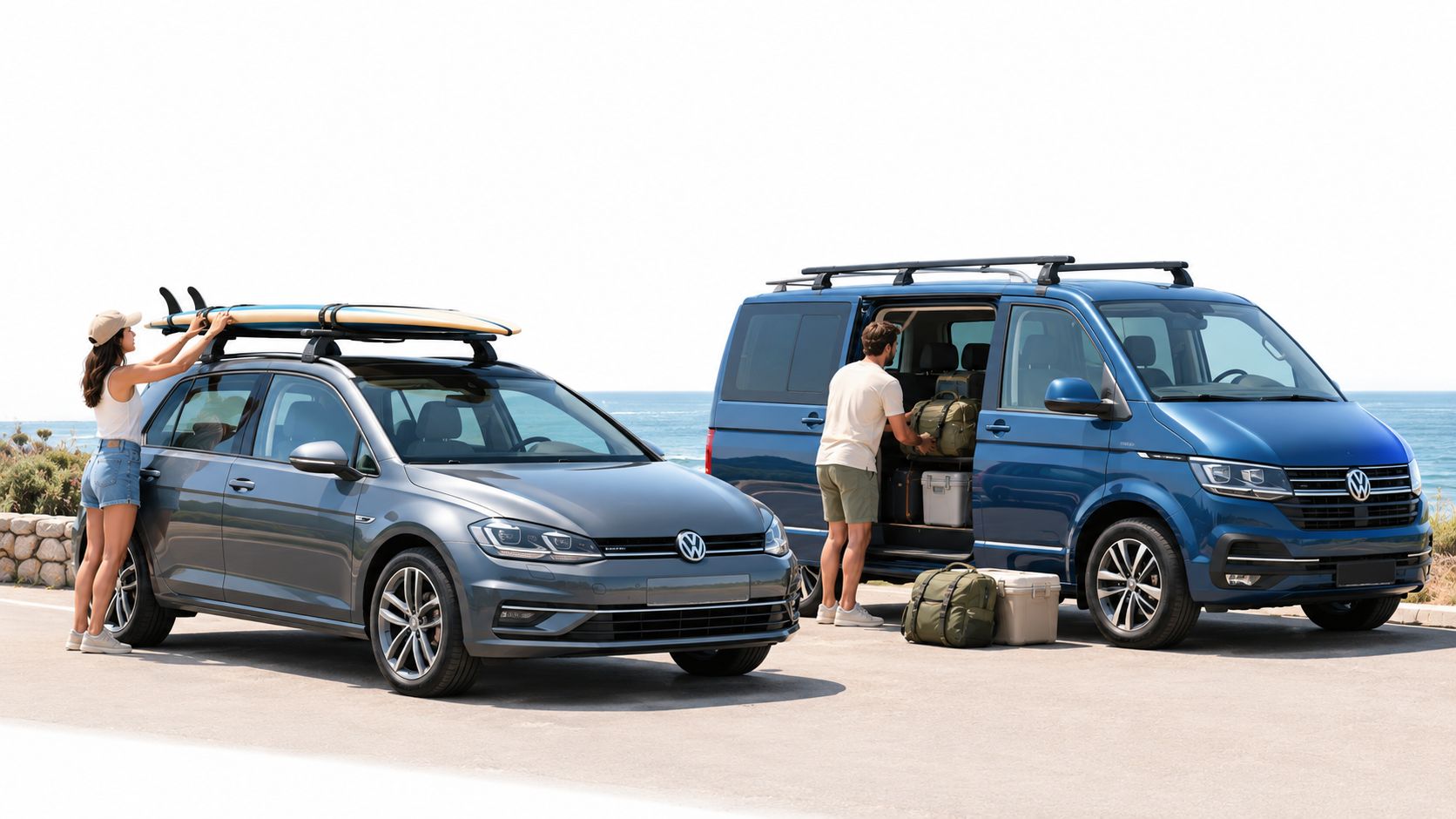
You've packed the boards, bags and camping gear, then opened the boot and realised the holiday still needs more room. That's a familiar moment for Australian VW owners, whether the vehicle is a modern Golf heading down the coast or a much-loved Kombi carrying the relaxed spirit of a surf trip.
Introduction to Volkswagen Roof Bars and Why They Matter
You're at a sunny weekend show, admiring a Beetle and a Kombi, when your own Volkswagen needs room for bikes, boards or holiday luggage. Volkswagen roof bars turn unused roof space into a practical part of the vehicle. They also form the starting point for a wider transport system, supporting a roof box, bicycle holder, or ski and snowboard carrier. Volkswagen Australia describes roof bars as a base for these additional attachments.
The bars are only one part of that system. Fittings, attachments and cargo must suit one another, just as a trailer and towball need matching specifications. A setup designed for a Tiguan with raised rails may not suit a Golf with fixed mounting points or another roof arrangement. Choosing poorly can mean wind noise, extra height, incompatible accessories, or an unsafe load.
This guide helps everyday drivers, touring families, adventurers and VW enthusiasts make a sound choice. It explains the base system, mounting styles, vehicle compatibility, load limits, installation options and safety checks. It also connects practical ownership with Volkswagen heritage. The affection people have for a real Kombi or Beetle often appears in a carefully displayed diecast model, where scale, shape and period details matter. The same eye for authenticity helps when checking fitment on a full-size car.
Your needs should guide the system. A driver carrying bikes each weekend needs different attachments from someone using a roof box for an annual holiday. A classic Volkswagen owner may prioritise period appearance and paint protection, while a modern VW driver may prefer a quiet, low-profile aluminium design.
Work through five checks in order: roof type, exact fitment, approved rating, compatible attachments, then who fits them.
How Volkswagen Roof Bars Work as a Base System
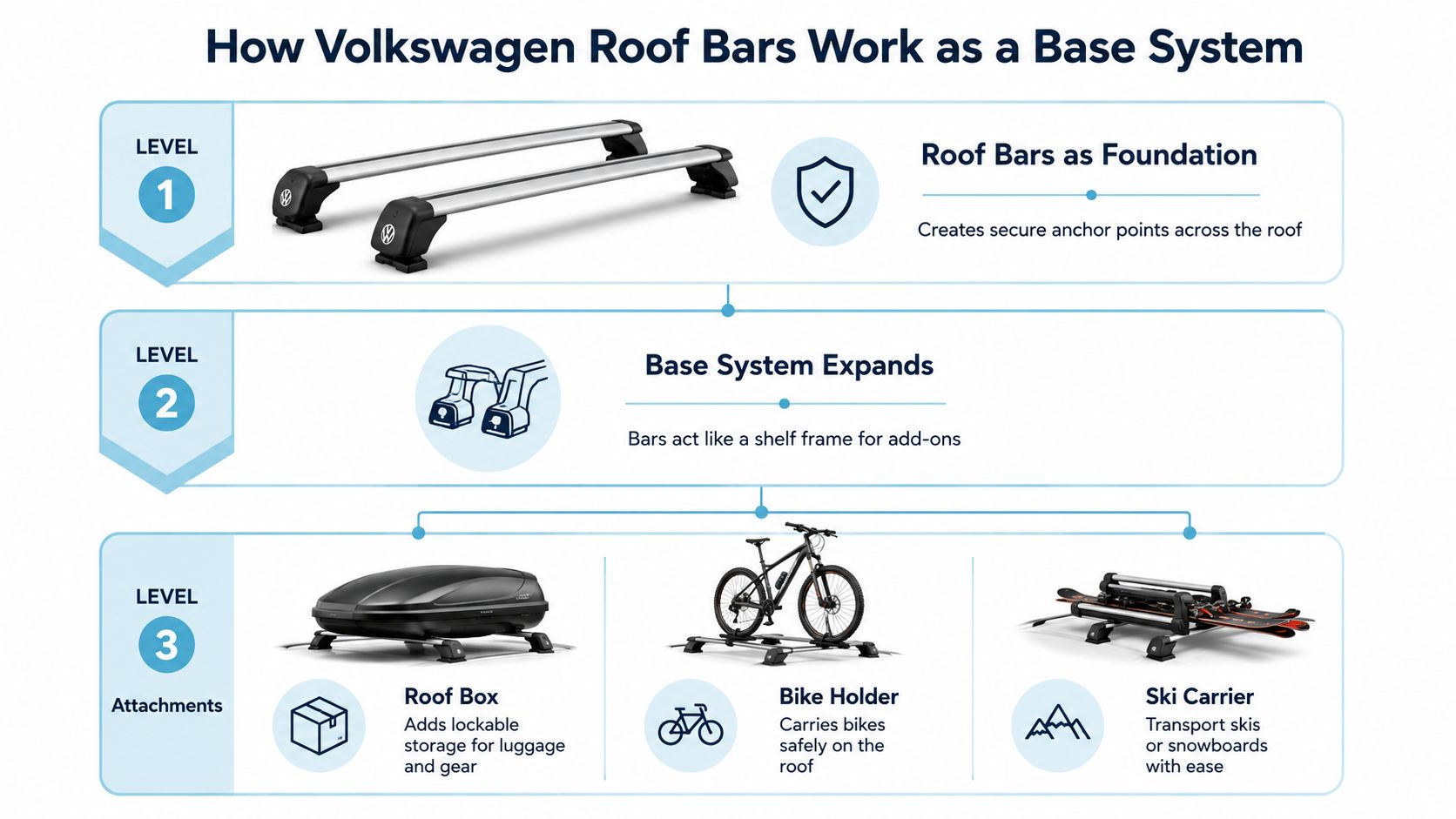
Think of roof bars as a power board for transport accessories. The power board doesn't perform every job itself. It provides organised connection points so different devices can work from one dependable base. Roof bars do something similar across the roof of a Volkswagen.
The basic arrangement has several parts:
Feet or towers connect the system to the vehicle's roof points, rails or gutters.
Cross bars run from side to side and provide the load-bearing platform.
T-slots in some aluminium profiles allow compatible accessories to slide into an enclosed channel.
Attachment hardware joins a roof box, bike holder or other carrier to the bars.
The mounting point determines which feet and fittings you need. A vehicle with fixed points beneath small covers requires a different arrangement from one with raised roof rails. Flush rails also need their own compatible feet because the bar must grip the rail without relying on a visible gap beneath it.
The key idea: roof bars create the foundation, but the vehicle's approved roof load remains the governing limit.
That means you can't judge capacity by looking at the bar alone. The total working load includes the bars, their feet, the attachment and the items being carried. If a roof box is already heavy, the amount left for luggage will be lower than the vehicle's maximum roof rating.
The same principle applies to a bicycle holder. The bar may accept the holder, but the holder must be suitable for the bicycle, and the complete assembly must remain within the vehicle's approved limit. Every connection should be locked, tightened and checked before travel.
Volkswagen Australia positions its genuine cross bars as part of this broader system, with support for roof boxes, bicycle holders and ski or snowboard holders. That gives owners a useful way to think about an upgrade. You're not buying a single-purpose accessory. You're choosing a platform that may need to support different travel, sporting or touring equipment over time.
Types of Volkswagen Roof Bars and Mounting Styles
The roof on your Volkswagen determines the starting point. Once you know whether it has fixed points, raised rails, flush rails or another approved mounting arrangement, you can compare bar profiles and appearance with far less guesswork.
Fixed-point systems attach to designated points in the roof, often beneath small covers. They can give a tidy factory-style appearance when removed, but the feet and spacing must match the vehicle exactly. Raised-rail systems grip the rails that stand above the roof, offering flexible positioning within the manufacturer's limits. Flush-rail systems attach to rails that sit close to the roof and usually require dedicated low-clearance feet.
Mounting Style
Best For
Height and Aero Benefit
Fixed points
Vehicles with dedicated mounting locations
Neat appearance, with height determined by the approved feet and bar profile
Raised rails
Vehicles with visible rails and varied accessory needs
Flexible positioning, though the complete setup may sit higher
Flush rails
Modern vehicles where a close-fitting look matters
Lower visual height and a streamlined installation
Integrated or factory-style rails
Owners seeking a matched appearance
Designed around the vehicle's roof architecture, subject to exact fitment
The bar itself also affects daily use. Aluminium aerodynamic profiles often have shaped surfaces intended to reduce turbulence and present a cleaner finish. Steel bars can offer a traditional, sturdy appearance, while an enclosed T-slot can make accessory fitting less fiddly by accepting compatible sliding hardware.
A low-profile design illustrates why height deserves attention. An Australian retailer lists a Vortex StealthBar system that sits 35 mm above factory raised rails, a detail that helps explain the appeal of close-fitting aerodynamic bars in everyday driving. See the Australian Volkswagen roof-rack listings and the StealthBar detail.
Lower height may help with garage clearance and visual neatness, but it doesn't automatically make a system suitable. You still need enough space for the attachment clamps, the load and the vehicle's roof shape. A roof box can add substantial height even when the bars themselves are compact.
A sleek profile is a useful preference, not a substitute for verified fitment.
If your VW carries specialist equipment, check the attachment before choosing the bars. Some accessories fit around the bar, while others connect through a T-slot. The right combination will be secure, compatible and easy enough to use that you won't avoid fitting it when the next coastal weekend arrives. For owners considering other vehicle-mounted equipment, a practical example of planning around vehicle structure appears in this Fiamma F45 awning installation guide.
Model Compatibility and Load Limits You Must Check
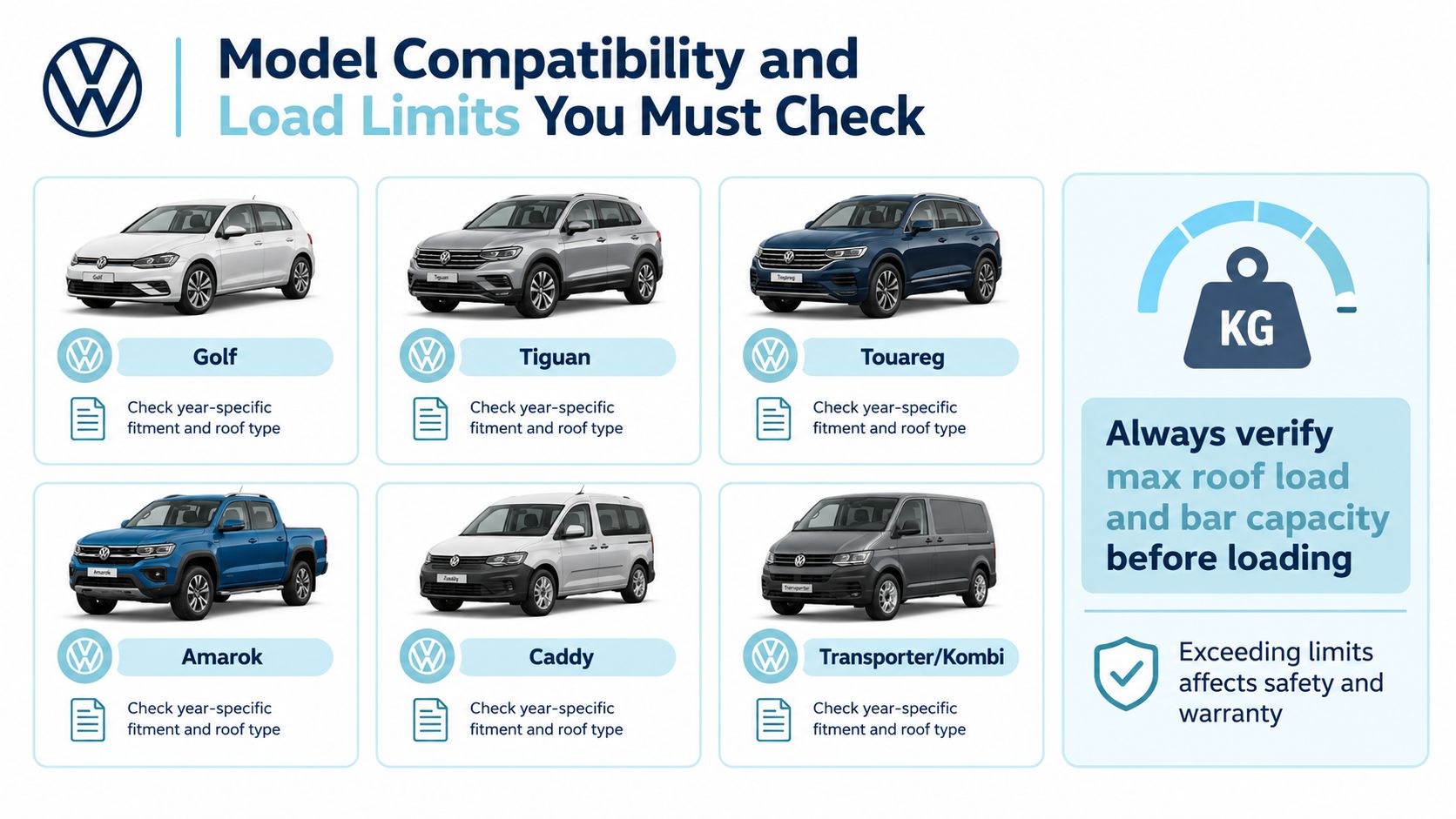
A roof-bar search starts with the exact Volkswagen, not simply the badge on the grille. Confirm the model, year, body style and roof type before comparing products. A Golf, Tiguan, Touareg, Amarok, Caddy or Transporter can require different mounting hardware, spacing and approved limits. The same careful identification helps collectors too: a diecast Kombi may share the family story, but its scale and display accessories tell you nothing about a real vehicle's load rating.
Australian roof-bar listings cover models including Amarok, Caddy, Golf, Tiguan, Touareg, Transporter and Kombi. That broad range reflects Volkswagen's wider transport ecosystem, from family cars and work utes to the vans that carried surfboards, camping gear and show equipment. It does not mean one bar set can move between every model. Australian Volkswagen roof-bar listings show the range of model-specific applications.
Match the system to the vehicle
Begin with the roof architecture. Identify raised rails, flush rails, fixed points or another specified mounting position. Then check the product listing for the exact model and year. A product photograph or a broad description such as “VW roof rack” cannot confirm fitment.
One Australian Genuine Accessories listing describes a T-slot aluminium system with a 1,440 mm overall length, 140 mm width and 245 mm height. It also identifies a city-crash-tested design. Those measurements apply to that specified product, rather than every Volkswagen roof-bar system. Review the Australian Genuine Accessories roof-bar specifications.
Calculate the usable load
The figure printed on a bar or carrier is only one part of the calculation. Start with the vehicle's approved roof rating, then subtract the weight of the bars and attachment before adding luggage.
Usable cargo = approved vehicle roof load minus bars minus attachment
Australian accessory information lists an 80 kg load rating for an Amarok roof-bar set and 95.5 kg for VW supporting rods. These examples show why capacity belongs to a particular accessory and vehicle platform. Do not transfer either figure to another Volkswagen without checking its documentation.
Amarok owners should confirm the vehicle-specific limit with a dealer where the documentation is unclear. The governing rule remains simple: the vehicle's approved roof rating governs the complete arrangement. That includes the bars, carrier, roof box, straps and cargo, rather than the luggage alone.
Before ordering, run through this list:
Vehicle details: Record the exact model, year and body configuration.
Roof structure: Confirm the mounting style and measure only at permitted points.
System specification: Compare bar length, profile, feet, locks and accessory compatibility.
Load calculation: Include the bar set, carrier, roof box, straps and cargo.
Dealer confirmation: Ask a Volkswagen dealer when the roof rating or fitment remains uncertain.
A spacious roof box can encourage extra packing. Keep heavy items low, distribute the load evenly and secure everything against forward, backward and sideways movement. Owners planning a wider touring setup can also review tie-down rail installation as part of a complete load-management approach.
This video provides a visual reference for the fitting process and accessory arrangement:
Professional vs DIY Installation and Safety Tips
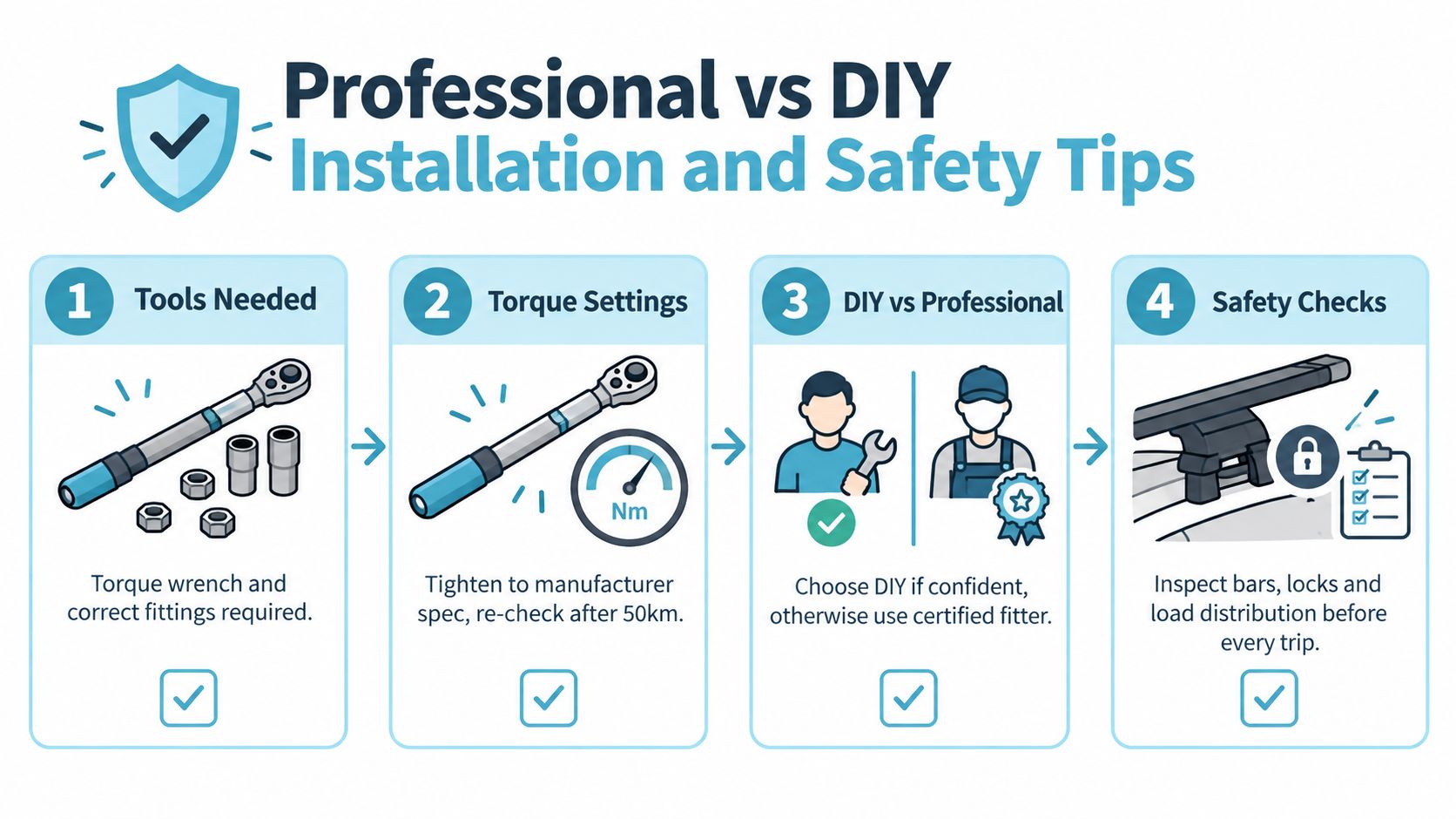
A confident home mechanic may be comfortable fitting roof bars, but confidence should come with the correct tools and a willingness to follow the supplied instructions precisely. A professional fitter makes sense when the roof is unfamiliar, the vehicle has unusual trim, or you'd rather have someone verify alignment and fastening.
Choose the fitting route
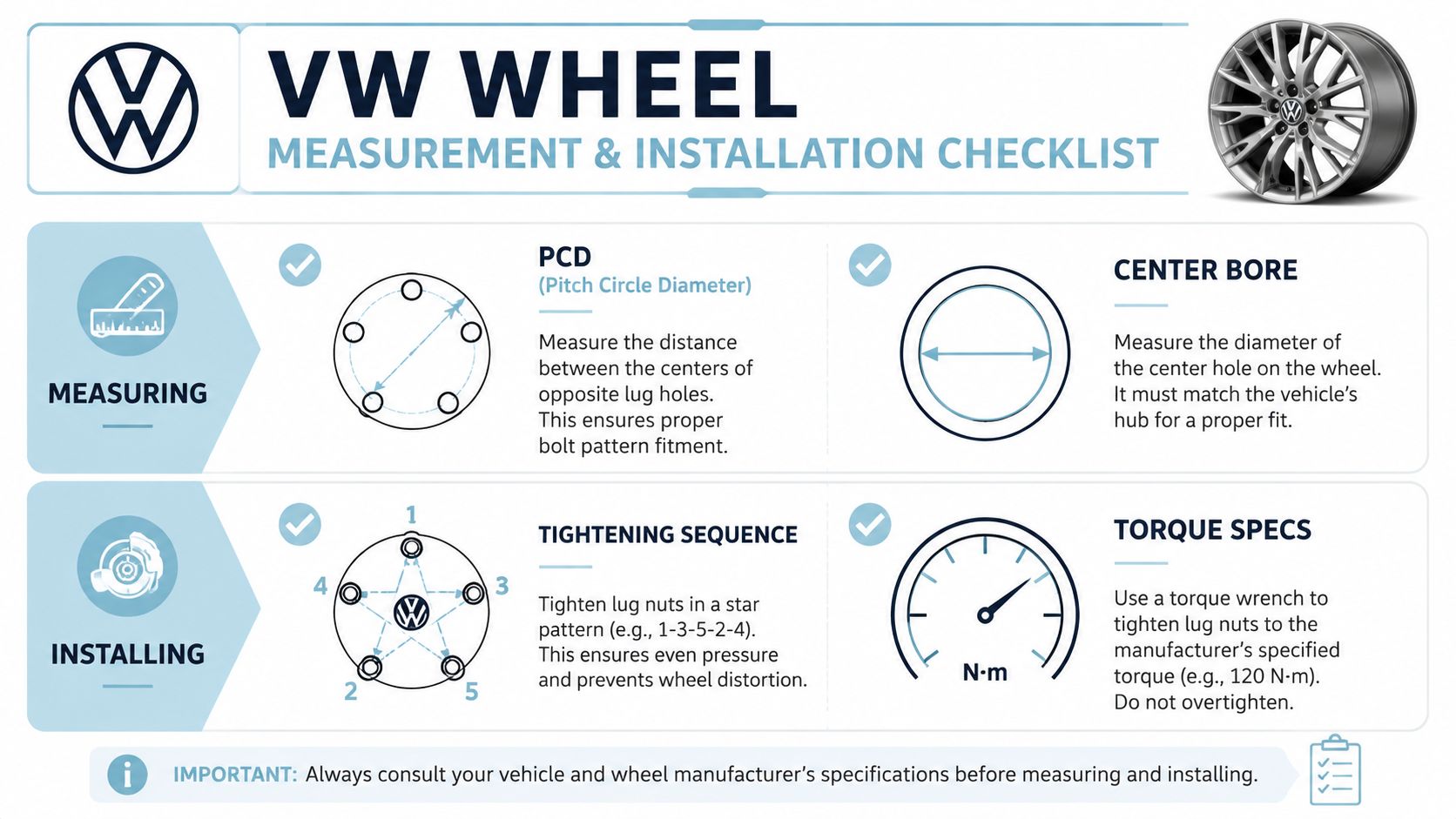
DIY fitting usually requires the correct feet, pads, bolts and covers, along with a suitable torque wrench. The bars need to sit squarely, the feet must contact their intended points and the fasteners must be tightened to the manufacturer's specification. Guessing torque by feel can leave a fitting loose or place excessive pressure on the roof.
Professional installation is the safer choice when the system is complicated, the vehicle has been modified or you're unsure how the roof points are accessed. Ask the fitter to explain the load rating, demonstrate the locks and provide any relevant fitting information for your vehicle.
Volkswagen Australia states that genuine accessories fitted at first delivery are backed by a 5-year, unlimited-kilometre warranty from the delivery date. The Australian accessories pages were updated in 2026, showing that roof bars remain an active part of Volkswagen's local ownership offering. Check Volkswagen Australia's current roof-bar and accessory guidance.
A warranty supports the accessory, but it doesn't remove the need to follow the vehicle's load limit and fitting instructions.
Use a repeatable safety check
Before loading:
Inspect the contact points: Look for dirt, paint damage, corrosion or displaced pads.
Check the locks: Make sure covers and locking mechanisms close properly.
Confirm alignment: View the bars from the front and rear to ensure they sit evenly.
Recheck fasteners: Use the specified torque rather than relying on hand tightness.
Distribute the load: Keep heavier items low and central, then restrain every item.
Measure clearance: Remember the new overall height before entering a garage or car park.
Wind changes the way a roof box, surfboard or bundle of luggage behaves. Loose straps can flap against the paint, while a broad load can shift even when it feels secure at the kerb. Drive conservatively, stop soon after setting off to inspect the arrangement, and repeat the check during longer trips.
Remove the bars when you don't need them if the manufacturer permits removal and refitting. Clean trapped road grime, inspect pads and hardware, and store the components where they won't be bent or misplaced. Owners carrying recovery equipment should also consider the fitting details in this high-lift jack bracket installation guide, because every roof and vehicle-mounted accessory deserves the same careful approach.
Volkswagen Heritage From Real Kombis to Diecast Displays
Roof bars belong to the practical side of Volkswagen ownership, but VW culture has always joined utility with character. In Australia, the Type 2 story carries a distinction that collectors often enjoy discussing at shows. The passenger van was marketed as the VW Kombi, while the utes and commercial carriers were known as the VW Transporter. Type 2 vehicles were also assembled from CKD kits with local content in Melbourne from the 1950s through the late 1970s. Read the Australian history of the Volkswagen Kombi and Transporter.
The original-shape Kombi became a worldwide symbol of open-road travel. One Australian automotive source records more than 2.6 million built during its 18-year lifespan, including 725,000 for export markets, while another notes that Volkswagen sold 4.5 million Kombis worldwide since 1950. Explore the production history of the original Kombi.
The Beetle has its own Australian chapter. Volkswagen introduced it locally in 1953, began assembly at Clayton, Victoria, the following year, established Volkswagen Australia Ltd in 1957, and produced the final Australian-assembled Beetle in July 1976. Review the documented Australian Beetle milestones.
That history translates beautifully into a display cabinet. A 1:18 model measures about 25 to 30 cm, while a 1:24 model measures about 16 to 20 cm. Smaller formats include 1:32 at about 12 to 15 cm, 1:50 at about 10 to 12 cm, 1:64 at about 7 to 8 cm and 1:87 at about 5 to 6 cm. Use this diecast scale guide to plan shelf space.
A 1962 Samba Bus model can anchor a coastal-themed shelf beside surf décor, while a Volkswagen Beetle model suits a smaller desk or bedside display. Matching scale across a scene helps the collection feel intentional, even when each piece recalls a different chapter of VW life.
Choosing Your Volkswagen Roof Bars and Next Steps
A good buying decision follows a clear order.
Identify the roof type. Check for fixed points, raised rails, flush rails or the mounting arrangement specified for your VW.
Confirm model-specific fitment. Use the exact model, year and body details.
Check the vehicle roof rating. Treat the approved vehicle limit as the boundary for the complete system.
Choose the profile. Compare aerodynamic aluminium, steel and low-profile options according to height, appearance and attachment needs.
Select compatible accessories. Make sure the roof box, bike holder or other carrier suits the bar profile.
Decide on installation. Fit it yourself only if you have the right hardware, torque information and confidence, otherwise use a qualified installer.
Avoid the common traps. Don't select bars from a photograph alone, don't assume a bar rating applies to another Volkswagen, and don't load the system without including the weight of the bars and attachment. A neat-looking setup is only a good setup when it fits correctly, stays within the approved limit and can be checked easily before every journey.
Once the practical job is done, the enthusiast side can continue at home. A licensed diecast Kombi Samba Bus or Beetle model captures the same touring spirit in a format that fits a shelf, study or coastal display. It's a lovely way to keep the VW story close between club runs, show days and weekend drives.
Volkswagen Memorabilia offers licensed Volkswagen diecast models, including Kombi Samba Bus and Beetle pieces, alongside VW gifts and relaxed coastal décor. Browse the collection, enjoy local stock and fast Australian shipping, and visit Volkswagen Memorabilia to find a display piece that keeps your own VW adventures rolling.
Exceptional Australian-delivered 23-window Samba buses have sold for around A$202,000, while condition-adjusted Australian market bands typically sit between A$85,000 and A$135,000, and ordinary restored Kombis can start well below A$30,000. That's the shape of the VW Samba Bus price conversation in Australia. Not every split-screen bus with nice paint is a six-figure Samba, and that's exactly where many buyers get tripped up.
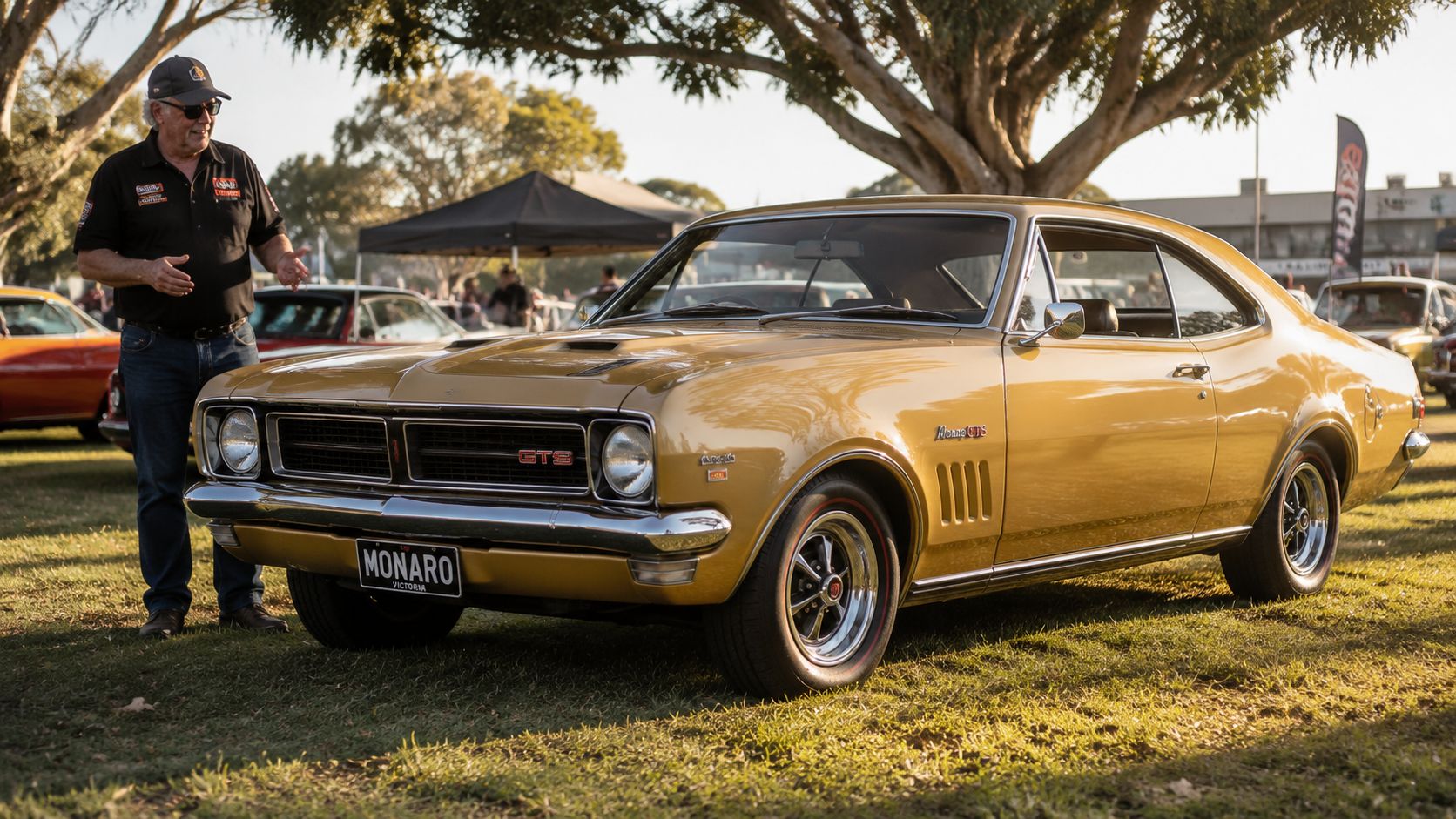
At VW shows around Australia, you'll hear the same thing every few rows. Someone points at a lovely two-tone bus and says, “That'd be worth a fortune.” Sometimes they're right. Often, they're mixing up a standard Kombi, a Microbus, a deluxe conversion, and a genuine 23-window Samba.
That confusion matters, because VW Samba Bus price isn't one number. It's a ladder. Rarity, originality, provenance, and specification all change where a bus lands. The Australian market adds another wrinkle too. Local delivery, right-hand-drive history, and the thin supply of genuine top-tier examples can shift values in ways overseas guides often gloss over.
What a VW Samba Bus Actually Costs in Australia
One Australian Samba sale hit A$202,000 at auction. That figure grabs attention fast, but it can also skew expectations if you treat it as the standard rather than the exception.
For a local buyer, VW Samba Bus price works more like a property market than a fixed price tag. The penthouse sale makes the news. The broader market still runs on condition, paperwork, originality, and how many comparable vehicles are available here in right-hand-drive form. That matters in Australia, where genuine top-spec split-window buses are thin on the ground and overseas asking prices do not always translate neatly to local deals.
A strong reference point for the realistic end of the market comes from Trade Unique Cars, which lists a Kombi Samba (1960-66) at A$85,000 in condition 2 and A$135,000 in condition 1, while a Kombi Microbus (1957-61) sits lower at A$55,000 and A$95,000 respectively (Trade Unique Cars market watch). That gap is the useful bit. It shows why Australian buyers need to separate a genuine Samba from a well-restored non-Samba bus before getting carried away by glossy photos or auction chatter.
A practical Australian pricing guide
Buyer tier
Typical AU position
What to verify before you call it fair value
Tidy non-Samba split bus
Often below true Samba money by a wide margin
Confirm it is not being advertised with loose “Samba-style” language, and check whether the trim, windows, and roof features are factory-correct or later additions
Genuine Samba in the normal collector market
Usually sits in the realistic Australian buying zone for authentic examples
Check chassis and M-code details, restoration receipts, rust repairs, and whether the bus presents as a genuine deluxe model rather than a tribute build
Top-tier Australian-delivered or standout provenance car
Can stretch far beyond the normal band when rarity and story line up
Verify local-delivery history, old registration or ownership records, auction-grade presentation, and whether originality is driving the premium rather than hype
That table is the budgeting shortcut many Australian enthusiasts need. The headline sale tells you how high the ceiling can go. The condition guide helps you work out where the floor and middle of the room are.
What “Samba” should mean in a sale listing
A genuine Samba is the deluxe version buyers chase, not just a split-screen bus in cheerful two-tone paint. If you are standing at a show field and comparing buses row by row, the difference is a bit like comparing a proper factory GT car with a tidy replica. Both can look terrific. Only one carries the full collector premium.
So if a seller says “Samba”, ask for the evidence, not just the vibe.
Practical rule: If the seller cannot clearly show why the bus is a genuine Samba rather than a Samba-style build, treat the price as optimistic until the history and specification stack up.
Why the Samba Bus Stands Apart from Other Kombis
The Samba has always been the show pony of the Type 2 family. Even parked beside a beautiful panel van or a clean Microbus, it has more theatre. More glass. More trim. More of that carefree holiday feel that made generations of VW people smile.
You can spot the appeal straight away. A genuine Samba carries the deluxe visual package enthusiasts chase. Think split safari windscreen, panoramic side windows along the cabin, the big opening sunroof, two-tone paint, and bright trim that gives the whole bus a lighter, more celebratory character than a workaday Kombi.
It isn't just a bus. It's the top-spec story
Collectors pay a premium because a Samba sits at the fancy end of the early VW bus range. Standard Kombis were practical. Sambas were aspirational. They captured the same engineering bones, but wrapped them in a more glamorous body style that was meant to carry families, tourists, and dreamers in style.
That story still matters in Australia. Local VW history helps explain why. Club VW Australia notes that Volkswagen sold 4.5 million Kombis worldwide since 1950, that the Kombi dominated Australia's light-commercial market in the 1960s and 1970s, and that it held over 60% of the one-tonne market in 1975 (Club VW Australia history). The broader Kombi legend is huge here. The Samba sits at the glamorous, scarce tip of that legend.
Australian scarcity changes the mood
Australian-delivered examples carry extra cachet because local buyers know how thin the pool is. That's why the little details matter so much. Delivery history. Factory trim. Right-hand-drive correctness. Old registration records. The difference between “looks like a Samba” and “is a Samba” can be enormous.
For a fun nod to the shape and spirit that made these buses icons, have a look at this green Samba model feature. Even in miniature, the Samba's extra windows and cheerful stance jump out straight away.
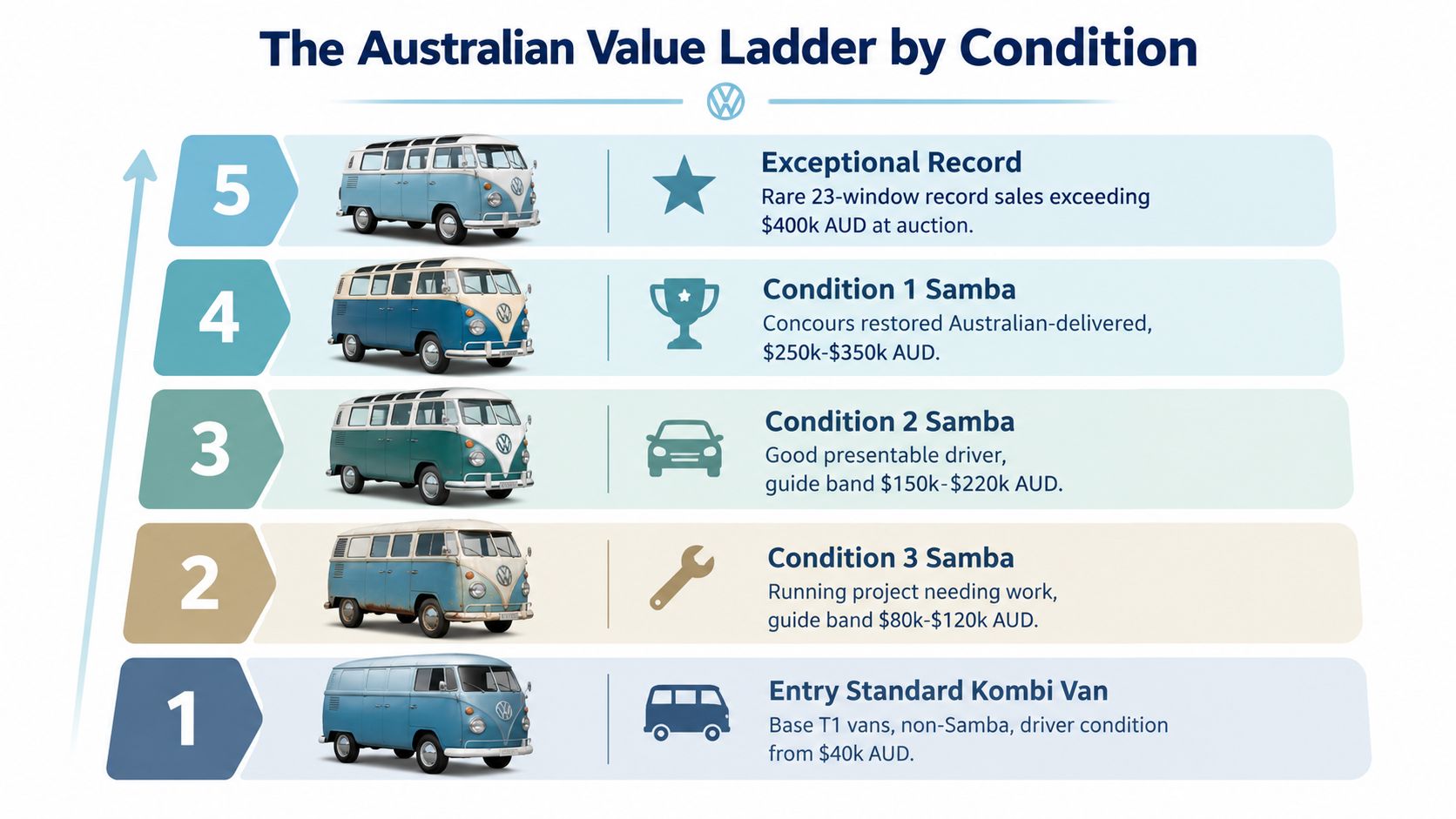
The Australian Value Ladder by Condition
A Samba's value in Australia works more like a staircase than a single sticker price. The guide bands mentioned earlier are useful, but they only make sense once you know what separates a very good bus from a top-shelf one when you are standing beside it at a show or auction.
Entry point versus true Samba money
Plenty of Australian buyers get tripped up. A split-window Kombi can look charming, tidy, and expensive, yet still sit well below genuine Samba territory because the market is paying for more than shape alone. It is paying for the deluxe body, the rarity, and the confidence that the bus is what it claims to be.
That means the question in this section is not the number itself. It is what condition 1 and condition 2 look like in the metal.
A practical reading of the ladder
Condition 2 is the honest sweet spot for many enthusiasts. These buses usually present well from ten paces, drive properly, and have the sort of finish that makes owners happy to park on the grass at a club day without apologising for anything. Panel gaps should look tidy and consistent. Doors should shut cleanly rather than needing a shove. Brightwork should suit the age and style of the bus, even if a concours judge could still find a few things to pick at.
Condition 1 is a different level of scrutiny. The paint, trim, hardware, and fit all need to feel deliberate and correct, not just fresh. Window seals sit neatly. Interior materials look right for the period. The underside does not tell a rougher story than the topside. A bus at this end of the ladder stands up to close inspection from people who know where early Volkswagens usually hide their sins.
A good way to judge the gap is to compare it to buying a coastal weatherboard cottage. From the street, both houses can look lovely. Under the floorboards, one may be solid old timber and careful restoration, while the other is patchwork held together for sale day. Sambas are exactly like that.
Here's what experienced Australian buyers usually check first:
Panel fit and body lines Look along the flanks, around the cargo doors, and across the nose. Wavy reflections, uneven gaps, or thick seams often point to old rust repairs or replacement panels that were made to look better in photos than in person.
Underside honesty Get underneath if you can. Chassis rails, jacking points, outriggers, and floors matter because repairs there are expensive and easy to hide with fresh underbody coating.
Trim correctness Deluxe trim, badges, lights, and interior pieces should make sense for the year and specification. A shiny bus with mixed-era parts can still be enjoyable, but collectors will price in the compromise.
Roof and window details On a Samba, the extra glass and roof structure are part of the appeal. Check the sunroof opening, window fit, seals, and headliner finish carefully. Sloppy work here stands out quickly.
Buy the bus whose details stay convincing after ten minutes of close inspection, not just the one that wins the first glance.
When a bus rises above the guide
Top auction results still matter because they show what happens when condition, rarity, and buyer confidence all line up on the same day. The well-known Shannons example is useful for that reason. Its pre-sale estimate sat at A$120,000 to A$140,000, before bidding pushed beyond expectations (Shannons pre-sale estimate report).
For an Australian buyer or seller, that is the lesson. Headline results set the mood, but condition decides where an actual bus belongs on the ladder. In a small local market, where genuine Sambas are thin on the ground, that judgement can shift the outcome by a very large margin.
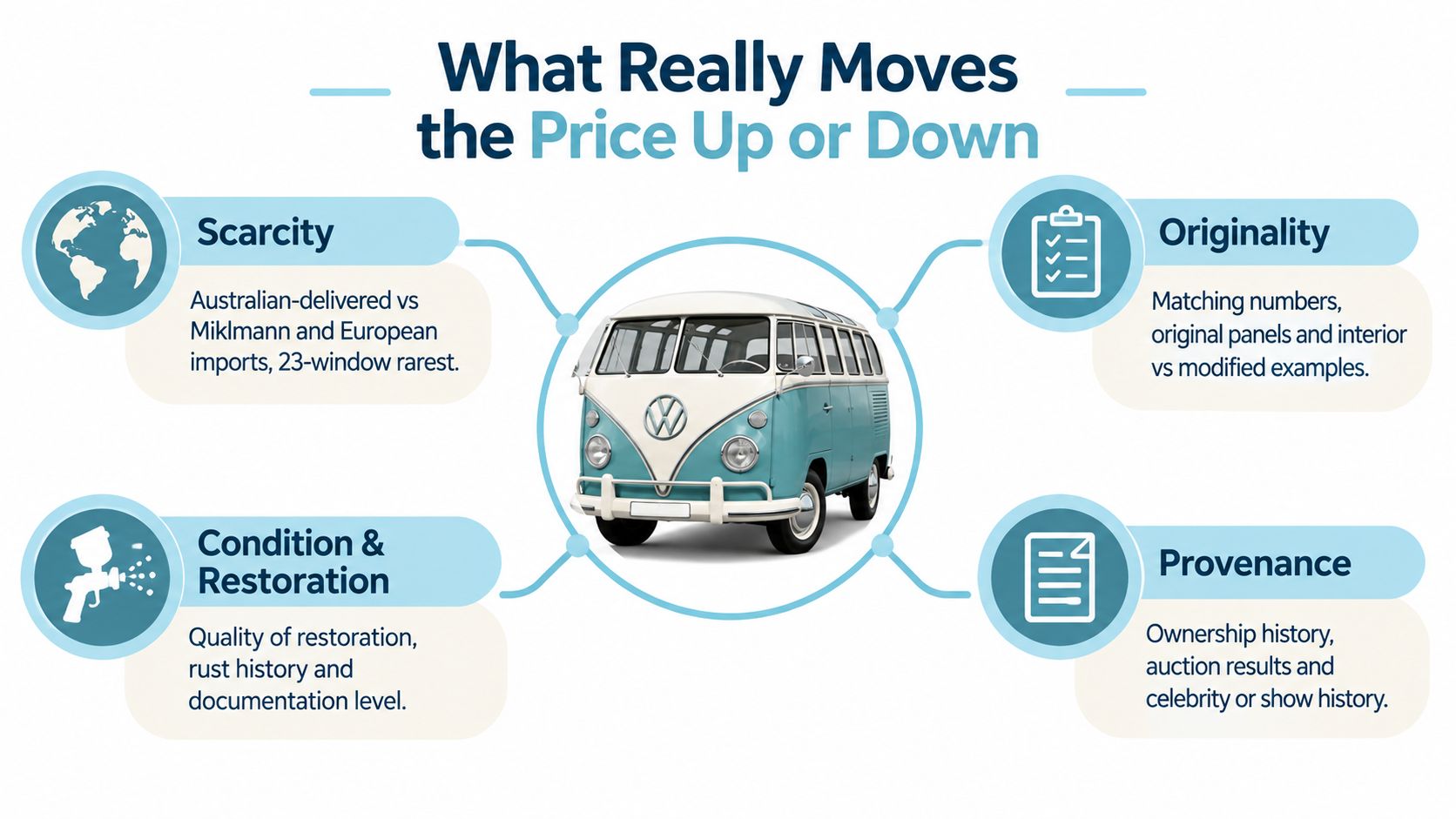
What Really Moves the Price Up or Down
Two buses can look broadly similar in photos and still sit worlds apart in value once you inspect them properly. That's where the VW Samba Bus price puzzle lives.
Four multipliers that matter
Scarcity Australian supply is thin, and that matters. Coverage of rare VW values in this part of the world has highlighted asking prices such as A$140,000 for a 1953 Barndoor 23 Window Deluxe and A$240,000 for a 1954 RHD Barndoor Deluxe, which reinforces how scarce genuine top-end buses remain in this market (Driven Car Guide coverage). Buyers often pay more when the bus has the right local-market story attached.
Originality Original panels, original-style trim, and factory-correct details matter far more than shiny paint alone. A bus can be beautifully restored and still lose enthusiast confidence if too many key pieces have been substituted or modernised.
Condition and restoration quality Rust repairs, panel fit, underside integrity, interior correctness, and finish quality all shape confidence. A neat restoration done with care can support value. A quick cosmetic job often can't.
Provenance Old paperwork, long-term ownership, restoration files, and known auction history help a bus feel “safe” to serious buyers. If someone can show where the vehicle has been and how it's been cared for, the conversation changes immediately.
After the reading, this walkaround video is worth a look because it helps train your eye for the details that make these buses so desirable.
What pushes a bus down
A bus can lose value quickly if the fundamentals aren't right.
Rust and structural issues can turn a charming project into an expensive lesson.
Non-original colour schemes may look fun but won't always please collectors.
Missing or incorrect trim chips away at authenticity.
Unclear identity is a major warning sign, especially with Samba-style conversions.
A genuine Samba with honest flaws usually interests enthusiasts more than a glossy bus with a fuzzy backstory.
Samba Bus Diecast Models Versus the Full-Size Bus
Auction headlines can make a Samba feel distant, but the model-car side of the hobby brings that same roofline, window count, and colour charm onto an ordinary shelf. For plenty of Australian VW fans, that is not a compromise. It is a different way to enjoy the shape without stepping into restoration bills, storage worries, or a thin local market.
The easiest way to understand it is to treat the two categories like two versions of the same song. The full-size bus gives you the whole live performance. A diecast gives you the melody in miniature. Both can be collectible, but the money logic is very different.
Category
Typical AU Price
What collectors usually focus on
Full-size Samba Bus
As noted earlier, values sit in condition-based bands rather than one fixed headline number
Original features, overall presentation, documentation, and how convincingly the bus fits the Australian market
Other classic Kombis
Usually lower than genuine Samba territory
Usability, body condition, presentation, and whether it is a standard bus rather than a top-spec window bus
Licensed diecast Samba
Varies by scale, maker, finish, and packaging
Box condition, detail quality, paint accuracy, and brand reputation
That last row matters more than newcomers often expect.
A diecast Samba does not need to mimic full-size prices to make sense as a collectible. A scarce colour, tidy box, or well-executed licensed release can be the difference between a model you glance at and one you keep picking up for a closer look. It works a bit like judging a real bus from ten paces, then walking closer to inspect the details. Proportions, trim lines, two-tone paint breaks, and window layout all start to matter.
Collectors usually sort diecast pieces using a few simple checks:
Scale Smaller scales suit a row of buses on a study shelf. Larger scales show off the skylight windows, split-screen front, and interior detail more clearly.
Packaging Serious model collectors care about the box because it affects completeness, presentation, and resale appeal.
Brand and licensing Official VW-licensed models often get the shape and badging right, which makes them more satisfying for enthusiasts who know these buses well.
Colour and era feel Period-looking paint combinations and correct brightwork tend to feel more faithful to what makes a Samba special.
If you want a quick feel for what enthusiasts in Australia buy and display, this range of VW bus diecast models in Australia is a useful place to start. It helps bridge the gap between the six-figure chatter around headline Sambas and the much more approachable collecting lane that still celebrates the same design.
Where to Buy, Sell, or Appraise a Samba in Australia
Buying or selling one of these buses in Australia takes patience. The market is thin, and that's why rushed decisions tend to cost money.
Best places to look
Specialist auction houses are still one of the clearest windows into public values. Shannons is the obvious Australian reference point for early VW auction history, and classic-focused auction houses regularly give buyers a way to compare presentation, catalogue language, and final results.
VW clubs matter too. Club circles often know which buses are well regarded, which restorations were done properly, and which sellers have a strong name in the scene. If you spend time at club events, you'll often hear about a bus before it ever reaches a public listing.
Smart buying habits
Before money changes hands, slow down and check the bones.
Independent inspection Use a mechanic who understands old Volkswagens, not just old cars in general.
Paper trail Ask for restoration invoices, old registration documents, and any identification records the seller has retained.
Clear transaction method Cleared funds and written terms make life calmer for both sides.
Registration and identity checks Make sure the bus's paperwork, numbers, and claimed specification all align.
The best Samba purchase often happens after a very unglamorous afternoon of crawling underneath it with a torch.
For people shopping the broader van side of the hobby, this Kombi for sale guide is a useful starting point for seeing how these vehicles are commonly presented to Australian buyers.
A quick note on historical context
Part of the charm here is how ordinary these vehicles once seemed. Australian coverage of Kombi pricing in the 1970s recorded the basic 1600 Kombi at $4,513, the 1800 Kombi at $4,912, and the 1800 Microbus at $5,396 (Club VW historical pricing). It's a lovely reminder that today's cherished classics began life as usable family and work vehicles, not museum pieces.
Bringing the Samba Story Home to Your Collection
Auction headlines can make Samba ownership feel like a six-figure club. For plenty of Australian VW fans, the smarter comparison is between the dream car on the show field and the version of that story you can live with, whether that is a real bus, a project, or a licensed model on the shelf.
A Samba keeps its pull because it does two jobs at once. It is a collectible with serious scarcity in Australia, especially in correct right-hand-drive and well-documented form. It is also a mood machine. Park one at a coastal meet and even people who do not know the model code will stop for the skylight windows, the roofline, and that unmistakable holiday feel.
That gap between global headline prices and local reality matters. The wild sales get the attention, and fair enough, because they are fun to talk about over a coffee and a sausage sizzle. But an Australian buyer usually needs a calmer question. What version of the Samba story fits my budget, space, and appetite for maintenance?
For some, the answer is the full-size bus. For others, it is a carefully chosen diecast that scratches the same itch without the storage bill, rust repairs, or parts hunt. That is not a lesser choice. It is the collecting equivalent of owning the framed concert poster when the original stage guitar is out of reach.
A more reachable way to collect
If you want the character of a Samba in your life without chasing a rare bus across the country, these habits make the hobby more satisfying:
Buy the best version of your chosen format A tidy, licensed diecast with crisp detailing often gives more long-term enjoyment than a cheap model with vague proportions and generic badging.
Collect with a theme Australian-delivery colours, surf-era displays, or a split-screen lineup with Beetles beside it gives the collection a story instead of just filling shelf space.
Keep the packaging and paperwork Model collectors care about complete presentation in much the same way vehicle buyers care about books, invoices, and old rego history.
Match ambition to upkeep A real Samba needs space, specialist knowledge, and ongoing spend. A model needs careful storage and a dust-free display. Both reward owners who are realistic from the start.
FAQ
How can I tell if a Samba diecast model is properly licensed and accurate
Check the box and base first. Officially licensed models usually state Volkswagen licensing clearly, and better examples list the scale, manufacturer, and model name rather than just “classic van.” Then compare the window count, roof window layout, trim, and proportions with photos of genuine Sambas. If the skylights look oversized, the beltline is off, or the badging is vague, treat it as a decorative piece rather than a collector-grade replica.
Why does Australian delivery matter so much
Collectors here often pay closer attention to local history, right-hand-drive correctness, and documented provenance because strong examples are thin on the ground in Australia. Two buses can look similar from ten metres away, but local-market history can separate them sharply once serious buyers start checking details.
Is diecast a serious collecting category
Yes. Plenty of VW enthusiasts collect models with the same care others bring to full-size cars. The attraction is simple. You get the design, the nostalgia, and the display value without workshop bills or insurance paperwork.
Should I buy based on shiny paint alone
Start underneath the shine. Fresh paint can hide expensive problems, whether you are looking at a bus or a model with a respray-style finish. Identity, correctness, restoration quality, and supporting paperwork are what hold up once the excitement settles.
If you'd like the Samba look without chasing auction paddles and restoration invoices, Volkswagen Memorabilia has a warm, well-curated range of licensed VW diecast models, Kombi favourites, Beetle pieces, and giftable collectibles for Australian enthusiasts. It's a lovely place to find a shelf-worthy Samba, a Volkswagen Beetle model, or a thoughtful VW-themed present, with local stock and easy browsing for anyone wanting to buy diecast Kombi and other Volkswagen diecast models for sale.
The morning sun is catching the chrome on your favourite Kombi magnet, while a Beetle and a Samba Bus keep the shopping list from sliding down the fridge. Perhaps the same little collection has travelled into a campervan cupboard, a beach-house kitchen or a coastal display beside shells and driftwood. These small pieces carry more character than their size suggests. They recall road trips, surf culture, family holidays and the easy-going spirit of Volkswagen ownership.
The best answer to what to do with fridge magnets balances three things, practical use, protection for the collection and a display that feels like your own VW story. The ideas below range from magnetic feature walls and recipe holders to memory timelines, gifts, seasonal rotations and carefully secured outdoor displays. Licensed VW magnets and related memorabilia can give a collection genuine character, while local stock and fast shipping from an Australian importer make it easier to source pieces without waiting on overseas delivery.
1. Vintage VW Kombi Fridge Magnet Display Wall
A dedicated magnetic wall can turn a plain kitchen corner into a cheerful rolling gallery. Choose a visible area above the fridge, beside a breakfast nook or on a feature wall, then arrange licensed Kombi and Samba Bus magnets in a tidy grid or a looser pattern inspired by a retro road map.
Magnetic paint works best over a properly primed surface, applied in thin, even coats according to the product instructions. Test one magnet before committing to the whole arrangement. A painted wall won't necessarily hold heavier objects securely, so keep the display to lightweight magnets and use proper wall hardware for any separate metal décor.
Practical rule: Leave breathing room around each magnet. A little negative space helps the shapes and colours read clearly, especially when Beetles, Kombis and Flower Power designs share one wall.
Group pieces by colour, model or mood. Pastel Flower Power variants suit a relaxed coastal kitchen, while metallic Beetles and classic Kombis can create a more restrained vintage display. Photograph a layout before changing it, so favourite arrangements are easy to recreate when new pieces arrive.
For a larger automotive statement, pair the magnet wall with metal car wall décor rather than trying to make every item magnetic. That combination gives the display height and texture without overcrowding the fridge.
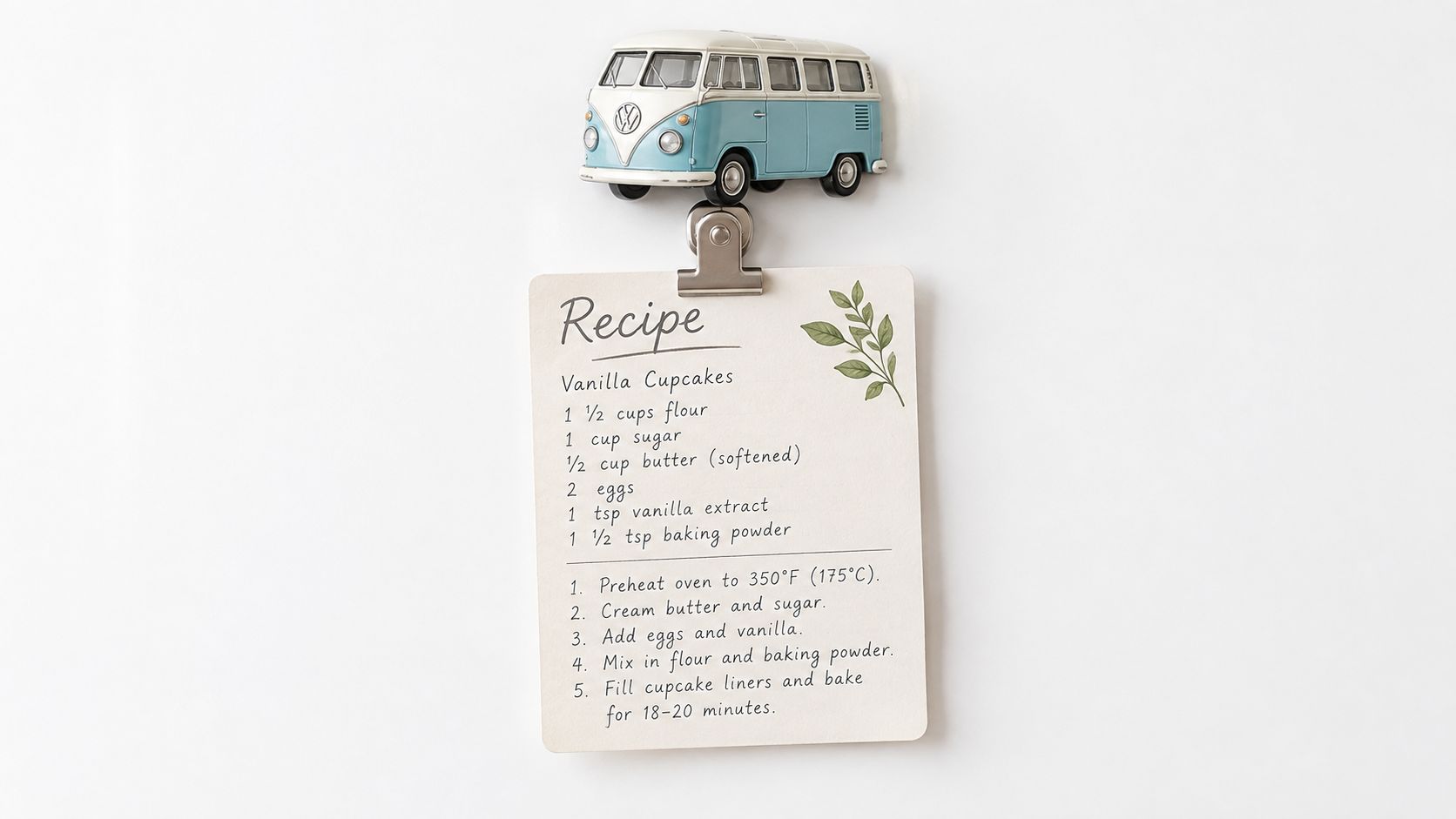
2. Personalised VW Fridge Magnet Recipe Holder
A good recipe holder should be useful first and decorative second. Place a Beetle or Kombi magnet at eye level, then add a small metal clip or hook nearby for recipe cards, camping meal notes, takeaway menus or handwritten family favourites. The result feels personal without turning the cooking area into a cluttered noticeboard.
Cream, pastel or lightly textured cardstock gives the arrangement a heritage look. Laminate cards that are handled often, particularly if the holder sits near a sink or stovetop, but keep paper and magnets away from direct heat and splashes. A magnet designed for display shouldn't be treated as heatproof kitchen hardware.
One simple system is to keep only a few active cards visible and store the rest in a labelled tin or recipe box. Match the subject to the vehicle:
Kombi cards: Use them for camp meals, picnic ideas and road-trip stops.
Beetle cards: Reserve them for everyday cooking, baking and family recipes.
Samba Bus cards: Pair them with weekend brunches, beach lunches or entertaining.
A personalised set also makes a thoughtful present for a VW enthusiast who enjoys cooking. The write-on fridge magnet range can add a practical note-taking element while keeping the display tied to Volkswagen style.
3. Custom VW Magnet Memory Timeline
Collectors who love the story behind the badge can arrange magnets as a visual history lesson. A kitchen wall, hallway or home office becomes a miniature museum when pieces are ordered by model generation, body style, colour or Australian ownership memories.
The Beetle has a particularly rich local story. Volkswagen Australia records that the car arrived in Australia in 1945 via the Australian military, while Museum Victoria states that the first Beetles were imported in late 1953. Volkswagen cars and commercial vehicles began production at Clayton in 1959, local Beetle manufacturing stopped in 1968 after just over 260,000 Beetles had been made, and the last new Australian-assembled Beetle appeared in 1976. Those details make a dated display more meaningful than a row of attractive shapes.
The Kombi timeline offers its own strong sequence. CarsGuide reports that Volkswagen began building the Type 2 in March 1950, with Kombi assembly at Clayton from 1964 to 1977. Australian enthusiasts can use that background to separate split-screen, bay-window and camper interpretations, while avoiding labels that claim more precision than the source material supports.
Build the timeline carefully
Start broadly: Arrange pieces by Beetle, Type 2, camper and special styling.
Add labels: Use small cards beneath each magnet, with model names and verified dates.
Check the wording: Don't call a magnet an Australian-built model unless its history supports that description.
Record the display: Photograph the finished timeline before rotating pieces into storage.
This approach works especially well after Volksfest or a VW Nationals visit, when new memories can join the historical line-up.
4. Coastal Cottage Magnet Gallery Ledge
A coastal ledge gives fridge magnets a more curated role. Instead of lining every piece across the refrigerator, display selected Beetles, Kombis and Samba Buses among driftwood, shells, framed surf art and nautical accents. The magnets become part of a room rather than just a kitchen accessory.
Shallow floating shelves suit this idea because they keep the display close to the wall. A ledge roughly the depth of a small décor shelf is usually easier to style than a deep bookcase, but choose the actual size around your wall and the objects you already own. Place heavier décor low and keep delicate magnets away from the edge where they could be knocked.
Odd-numbered groupings can create a relaxed, balanced arrangement, though the most important rule is visual variety. Set one Kombi upright, lean a small sign behind it and place a Beetle beside a shell cluster. A Samba Bus can act as the colourful focal point rather than being lost among similarly sized pieces.
“A coastal VW display works best when it feels collected, not crowded.”
For more room-by-room inspiration, browse these wall decoration ideas and look for a consistent palette. White décor, pale timber, faded aqua and warm red can echo beach-house styling without making the room look themed from floor to ceiling.
5. VW Magnet Advent Calendar
A VW advent calendar turns a collection into a shared ritual. Fill numbered envelopes, fabric pockets or small kraft pouches with a different magnet, sticker, charm or miniature surprise, then reveal one each day from December. A reusable backing board means the display can return every festive season with a new mix.
The best calendars don't rely on expensive contents. Variety creates the interest. Mix Beetle colours with Kombis, Samba Bus designs and a few Christmas-themed pieces, then add handwritten notes about a road trip, a favourite model or the reason a particular design matters to the recipient.
Use a backing that can support the contents without placing unnecessary pressure on the magnets. Felt, canvas or plywood can all work when securely mounted, while envelopes should be large enough to remove the surprise without bending it.
Make the calendar personal
Use vintage materials: Kraft paper, cream labels and hand lettering suit VW nostalgia.
Add small stories: Include a memory or clue with selected days.
Keep it reusable: Sew or buy pockets that can be refilled each year.
Protect the collection: Wrap painted or printed pieces so they don't rub against one another.
This makes a thoughtful gift for the enthusiast who already owns plenty of vehicle memorabilia. It also gives children and visitors a gentle introduction to the shapes and colours that make Beetles and Kombis so recognisable.
6. Industrial Metal Board Magnet Display
A steel board can solve two problems at once, display space and everyday organisation. Mount one in a kitchen, workshop, office or garage, then combine VW magnets with clips, small baskets and hooks for notes, keys or lightweight tools. The metal surface gives you the flexibility to rearrange the collection without repainting a wall.
Choose a finish that suits the room. Matte black and powder-coated steel feel industrial, stainless steel looks cleaner and a raw surface can complement timber, canvas and old workshop signs. Secure the board properly with suitable brackets and wall hardware, particularly if it will carry anything beyond lightweight magnets.
Keep part of the board empty. A modern arrangement needs space around the pieces, and a full surface can make even a carefully chosen collection look noisy. Put the most important magnet at eye level, then build outward with supporting colours and shapes.
Plan first: Lay the magnets on the floor before drilling.
Separate functions: Keep hooks and baskets away from fragile collector pieces.
Check the surface: Confirm that the board attracts the magnets before installation.
Use the board actively: Move reminders and display pieces as your needs change.
This is a stronger choice than a standard fridge door if the kitchen is already busy, or if you want your VW memorabilia visible in a dedicated work area.
7. Retro Campervan Interior Magnet Vignette
A Kombi interior has limited wall space, which makes a small magnet arrangement especially effective. Use the fridge door, a metal cupboard panel or another suitable ferrous surface to create a compact vignette that feels like part of the van's travel story.
Match the display to the vehicle's character. Flower Power pieces complement a retro camper atmosphere, while classic silver or restrained Beetle designs may suit an earlier restoration. Don't force historical accuracy if the van is a personal custom build. A display can celebrate the era without pretending every accessory belongs to the original factory fit-out.
Travel changes the practical rules. Vibrations, turns and repeated opening of cupboards can send loose pieces sliding or falling. Test the magnets while stationary, keep them away from moving catches and use small protective bumpers where they prevent scratching or movement. Remove particularly delicate pieces before a long trip.
Protect the van first. A charming interior display isn't worth scuffing original paint, timber or restored trim.
Create a rotating arrangement after each road trip. A magnet from a coastal weekend can sit beside a Samba Bus for the next outing, then return to a protected storage box when the van is used on rough roads. Photograph the interior before changing it, especially if you're preparing for a community event such as Volksfest Australia. The 2025 itinerary included market stalls, live music, food trucks, cruises, a display day and a VW swap meet, all useful settings for sharing thoughtful presentation ideas with fellow owners. Volksfest Australia's published itinerary provides the event details.
8. Themed Monthly VW Magnet Rotation Display
A rotation system lets a larger collection breathe. Rather than displaying every magnet at once, choose one theme for a month, photograph it, then return the pieces to an organised storage container before bringing out the next group.
The themes can follow the vehicles or the season. Beetles might lead one month, Kombis another and Samba Buses the next. Surf styling, Flower Power colours, coastal pieces and favourite show finds can each have their own turn. You can also rotate by collecting purpose, such as new acquisitions, best-preserved pieces or magnets connected to a particular trip.
A simple calendar keeps the system manageable. Store each group in a labelled sleeve or shallow archival-safe container, with a photo of the intended arrangement. That avoids the familiar collector's problem of remembering the look but not which pieces created it.
Keep each rotation deliberate
Choose a focal point: One standout magnet should anchor the display.
Limit the palette: Similar colours make mixed models feel intentional.
Record the date: A photo archive turns the rotation into a collecting journal.
Pair décor thoughtfully: Summer surf pieces and festive designs can change the surrounding room as well as the fridge.
The system also helps protect rarer or more delicate items from constant handling. Keep high-value or sentimental pieces in a display case or protected cabinet, and use sturdy everyday magnets for notes and shopping lists.
9. DIY Magnetic Bookmark and Note Card Set
Some magnets deserve a life away from the kitchen. A coordinated bookmark and note-card set can carry VW character into a reading chair, office or gift box, especially for someone who loves journals, travel writing or handwritten correspondence.
Use licensed imagery or artwork you have permission to reproduce. Photographing a magnet for personal inspiration is different from copying protected artwork for sale, so keep the project for private use or source approved designs. Mount the printed design on sturdy cardstock, protect it with a suitable laminate and attach small magnets so the bookmark grips the page without damaging it.
A Beetle, Kombi and Flower Power palette can make a cohesive set, while a Samba Bus theme suits a travel journal or camping notebook. Add a name, date or short personal message to the reverse side for gifting.
Choose durable card: Heavier cardstock feels better in the hand and resists curling.
Seal the surface: Lamination helps with handling and accidental moisture.
Round sharp corners: This protects pages and makes the set more comfortable to use.
Package with care: Kraft paper, a small sleeve or a reused gift box keeps the presentation warm.
This idea works best with lightweight components. Don't attach a heavy diecast model to a bookmark, and don't cut up a scarce collectible to make a craft piece. Keep the original magnet intact and create the stationery around a photograph or approved graphic instead.
10. Outdoor Patio Magnet Weather Station Display
An outdoor VW weather station can turn a patio corner into a daily ritual, but it needs more care than an indoor display. Start with an outdoor-rated steel or aluminium board in a sheltered position, then add durable weather indicators, temperature notes, rain markers and a few VW magnets.
The display suits a beach house, campsite or covered entertaining area. A Kombi can mark a sunny day, a Samba Bus can sit beside a rain note and a Beetle can identify the weekly forecast. The charm comes from updating it by hand, not from pretending a decorative magnet is a professional measuring instrument.
Protect every paper element with an exterior-safe coating, and keep the board away from direct wind and heavy rain. UV exposure can fade printed surfaces, while salt air near the coast can accelerate corrosion on unsuitable metal and hardware. Check the board and magnets regularly, then bring the collection indoors when severe weather is expected.
Outdoor display advice: Treat weather resistance as a location decision, not a product assumption. A covered patio is safer than an exposed fence or garden gate.
Use a removable board if you only need the station during holidays. At home, photograph it through the seasons and change the surrounding décor with shells, surf items or camping accessories. The result is practical, personal and unmistakably Australian.
📊 Functional weather station that doubles as outdoor display
💡 Coastal patios, campsites, outdoor entertaining areas
⭐ Unique blend of utility and nostalgia; eye‑catching garden feature
Give Your Magnets a Life Beyond the Fridge
The right idea depends on what you want the magnets to do. If your kitchen needs order, choose the recipe holder or industrial metal board. If your collection is growing faster than your available wall space, a monthly rotation gives each piece attention without creating a crowded display. A coastal ledge suits a beach house, while a campervan vignette keeps the VW spirit close during travel.
Collectors should separate everyday utility pieces from sentimental or scarce items. Use sturdy magnets for shopping lists, notes and active displays, then store delicate pieces in clean, dry containers when they're not on show. Protect painted and printed surfaces from moisture, direct heat and rough contact. A magnet beside a sink or outdoor board may look cheerful, but it still needs a dry position and regular checks.
Travel requires another layer of care. Remove loose magnets before driving on rough roads, especially from restored cupboards or original trim. Use protective bumpers where a piece might slide, and never rely on a decorative magnet to hold a heavy object in a moving vehicle. For a permanent wall arrangement, secure the wall hardware separately and let the magnets remain decorative.
A historical timeline deserves the same care as a diecast collection. Check model names and dates before printing labels, particularly when you're connecting Australian Beetle or Kombi history to a display. Volkswagen Australia says the early local story included a right-hand-drive Beetle brought to Sydney by German migrant Karl Regel and his family, while Museum Victoria documents Clayton production and the end of Australian Beetle manufacturing. Those details can turn a pretty arrangement into a conversation starter with real substance.
Fridge magnets also deserve a responsible end-of-life plan. The ACT advises that reusable magnets can go to Goodies Junction or craft projects, while Glen Eira says souvenir magnets may be donated to op shops. Maribyrnong Valley City Council directs unwanted magnets to the red-lid bin, and Ku-ring-gai Council launched a 2026 upcycling trial for flexible fridge magnets because they're difficult to separate from mixed waste and don't have an established recycling pathway in Australia. Check your own council's current guidance before putting magnets in a kerbside recycling bin, because decorative magnets generally aren't accepted there.
That practical question matters in a country where the category has grown beyond simple shopping-list holders. A 2021 Australian parliamentary petition estimated that a household could receive 1–2 magnets per week and argued that, across more than 8 million Australian households, this could mean over 4 million kg entering landfill annually. The petition has an advocacy perspective, so treat the estimate as a warning about durability and over-supply rather than a precise household audit. Reuse, donation and thoughtful purchasing remain better choices than treating every promotional magnet as disposable.
For VW enthusiasts, the most satisfying approach is selective. Choose a licensed Kombi Samba Bus diecast model as the centrepiece of a larger display, add a Volkswagen Beetle model for contrast, then use smaller magnets for the everyday jobs. The same principle applies to gifts. A carefully chosen VW memorabilia collectible has more emotional value than a random novelty item, particularly when it connects with the recipient's car, travel memories or coastal style.
Australia's wider permanent-magnet supply chain also helps explain why these products remain accessible. Industry data estimated that Australia consumed about 4.1 thousand tons of permanent magnets in 2024, with imports at 4.3 thousand tons, and valued the broader permanent-magnet market at about US$59 million that year. These figures cover far more than decorative fridge magnets, but they show the material ecosystem behind products that are easy to source and customise. The Australian permanent-magnet market overview provides that broader context.
Choose a wall if you want a statement. Choose a ledge if styling matters most. Choose rotation if collecting is the pleasure, and choose a personalised project if the magnet needs to become a memorable gift. Whatever you select, let the display reflect the relaxed, practical and slightly adventurous character that makes Beetles, Kombis and Samba Buses so enduring.
Volkswagen Memorabilia brings together licensed VW memorabilia collectibles, fridge magnets, Kombi Samba Bus and Beetle models, coastal décor and gift ideas for Australian enthusiasts. Browse Volkswagen Memorabilia for local stock, fast shipping and friendly Australian support, then give your magnets a display that feels at home beside your favourite VW.
The best fridge magnets depend on how you'll use them: choose custom photo formats for memories, strong themed designs for collecting, and VW-inspired pieces for nostalgic décor or gifts. Australian options range from everyday souvenir magnets to premium keepsakes, with listed prices running from AU$1.89 and AU$3.95 to AU$43.66 for a pewter platypus-and-friends design. Australian retailer listings
Make Your Fridge Part of the Story
The kitchen fridge can be a little family archive. There's the travel photo from a coastal weekend, a colourful souvenir picked up after a school holiday, and perhaps a tiny Kombi waiting beside the shopping list. Add a few carefully chosen pieces and the door starts to feel less like an appliance and more like a sunny Australian car show in miniature.
That's the appeal of the best fridge magnets. They hold reminders, display personality and make easy gifts without demanding a huge amount of space. Australia also has a long-established local manufacturing base, with Ad-Mag producing fridge magnets and importing magnetic materials for more than 32 years, beginning in Smithfield, Sydney, with magnetic calendars before expanding into many fridge-magnet shapes and formats. Ad-Mag's company history
This roundup compares photo flexibility, construction, creative choice, dispatch expectations, collecting appeal and practical drawbacks. Before buying, check the magnet strength, material, dimensions, finish, small-part safety, delivery timing and intended use. A decorative Kombi might be perfect for display, while a photo magnet needs to hold a reminder securely through daily kitchen use.
1. Fridge Magnets Australia for Travel Memories and VW Décor
A resin Sydney Opera House can bring back a school trip, a tin Kombi can recall a Gold Coast meet, and a hand-painted kookaburra can keep a Mornington Peninsula weekend on display. The best Australian souvenir magnets combine practical reminders with small artworks and easy conversation starters. They suit a fridge covered in family notes just as well as a carefully edited memorabilia display.
The Fridge Magnets Australia guide is the right starting point for shoppers who want local character rather than a generic photo product. It brings together Australian motifs and VW-inspired designs, including Kombi and Samba themes, surf styling and Flower Power details. Choose this category for a coastal kitchen, a VW enthusiast's home or a gift basket built around road-trip nostalgia.
Best for themed collecting
This range works best when you are building a story instead of buying one random magnet. Pair beach colours with shells and coastal details, or create a dedicated VW corner with a Kombi, a Beetle motif and a surf-inspired piece. A small group feels intentional, while too many unrelated designs quickly make the fridge look crowded.
Prices run from about AU$2 for simple souvenir shapes to AU$40-plus for hand-painted wildlife designs, so compare material, finish and holding strength before assuming every magnet is equally durable. A lightweight decorative piece suits display, while a frequently handled reminder needs a dependable hold and a finish that resists everyday wear.
Practical rule: Buy for the surface and the story. Match decorative magnets to a curated display, and choose stronger construction for notes, photos or reminders that are moved often.
Pros
Local character: Australian places, wildlife and VW culture feel personal rather than mass-produced.
Collecting appeal: Small pieces are easy to group around travel memories or a themed display.
Gift flexibility: A Kombi or coastal design suits birthdays, housewarmings and road-trip souvenirs.
Specialist support: A focused local retailer can help identify specific VW-inspired designs.
Cons
Clutter risk: Many small magnets need curation or the fridge can look untidy.
Safety limits: Small parts and strong magnets may not suit young children, pacemakers or sensitive electronics.
2. Tinyme Photo Magnets for Flexible Family Gifts
Tinyme is the most versatile pick for family photos, pet portraits and gift sets that need more than one visual style. Its Australian photo-magnet range includes flexible magnets, MDF wooden pop-out designs and acrylic formats, all printed edge to edge. Buyers can choose from square, circle, hexagon, and portrait layouts, then build a mixed display rather than ordering every magnet in the same shape.
The online builder lets you upload different photos or use Tinyme's art library. That's handy for a family fridge where a wedding image, a child's drawing and a holiday photograph may all need to sit together without looking repetitive.
Best for creative layouts
The Mosaic format is the standout option for a statement display. It lets several pieces work as one larger visual arrangement, while individual shapes suit smaller gifts or a rotating set of family memories.
Tinyme also gives shoppers standard and rush delivery guidance, which makes planning easier when a personalised gift has a firm occasion attached. The trade-off is construction. Wooden magnets are better treated as decorative pieces because their holding strength is lighter than a flexible magnetic format. Shipping can also involve a small fee below the service's minimum free-shipping spend.
Choose Tinyme when you care most about material choice, shape variety and an easy design process. For a daily-use fridge, select a format with enough holding power for the paper or photograph you expect it to carry.
3. Custom Magnets for Promotional Runs and Branded Displays
Custom Magnets, based in Dandenong South, Victoria, is built for businesses, events, councils, real-estate campaigns and small retailers. Its custom fridge magnet service offers a large shape library, including business-card formats, calendars, die-cuts and industry-specific designs. Artwork assistance is available, and the ordering process supports volume discounts.
This is the right tool when the magnet needs to carry a brand, event identity or useful information. A calendar magnet can stay visible in an office, while a shaped design can reinforce a local business without looking like a plain rectangle. Free Australia-wide delivery is included, and dispatch is typically planned around proof approval and production rather than an instant retail purchase.
Best for consistent bulk orders
Businesses will appreciate the proofing process and the ability to repeat a design across a run. Retailers can also use a distinctive die-cut shape to create a more memorable counter item or small add-on product.
The main drawback is that the website is oriented towards promotional production, not one-off photo gifting. Final pricing depends on the selected size and quantity, so buyers need to configure an order before they can judge the total cost.
Choose this supplier for branded consistency, custom shapes and business-ready ordering. It's less suitable if you want a handful of family photographs or a single nostalgic keepsake.
4. Snapfish Australia for Budget-Friendly Photo Variety
Snapfish Australia suits shoppers who want a familiar photo-gift workflow and plenty of format choices. The Snapfish AU fridge-magnet range includes hardboard, acrylic and flexible styles, along with large, vintage and Mosaic formats. The online builder also supports text and art embellishments, so a simple photograph can become a birthday gift, event favour or family display.
The attraction is breadth. You can order a conventional photo magnet, then choose a different format for a holiday image without changing platforms. Clear displayed pricing and regular promotions also make it appealing for value-conscious shoppers comparing several gift ideas.
Best for mixed photo gifting
Snapfish works well when one order needs to cover different people. A grandparent might prefer a classic family image, a friend might like a vintage treatment, and a child's room could suit a colourful Mosaic arrangement. The platform's Australian presence makes the ordering experience feel familiar, although personalised production and delivery expectations should still be checked before a special date.
Quality can vary between materials and designs, and mixed user feedback means buyers who care about a particular finish may prefer to sample a product first. Don't judge every format by the performance of another. A hardboard piece, acrylic design and flexible magnet can feel quite different in the hand and on the fridge.
For a more tactile coastal gift, compare the photo idea with this shell photo-frame buying guide. Snapfish is the better choice for photo variety and promotional value, while a specialist décor piece brings more texture and display personality.
5. Redbubble for Artist-Designed Retro Collections
Redbubble suits shoppers who want a fridge door with personality. The Redbubble marketplace connects buyers with independent artists, including designers working across retro cars, surf culture, travel illustrations and other niche themes. It is a strong choice for collectors who want something more distinctive than a repeated souvenir style in an Australian kitchen.
Its die-cut vinyl magnets are flexible and available in three sizes. Product pages list a 20 mil, 0.5 mm vinyl thickness, giving buyers a useful way to compare the physical format before ordering. That detail matters when a small artist-designed piece needs to sit neatly beside larger travel souvenirs or a favourite VW keepsake.
Best for a distinctive theme
Build a retro road-trip collection around surf vans, coastal graphics and old-school motoring imagery. VW enthusiasts can use the format to add a playful nod to Kombi culture without turning the fridge into a perfectly matched display. Artist-designed gifts work well too, because the artwork carries most of the personality.
Redbubble periodically offers multi-buy discounts, while its returns support provides some reassurance across a broad marketplace. The trade-off is consistency. Colour and finish can vary with the artist's file and third-party fulfilment, and shipping for one small order may compare poorly with a local photo lab. Check the dimensions and reviews for the exact design, rather than judging the marketplace as a whole.
A design-led magnet can sit neatly beside boho wall art in a relaxed coastal or eclectic room. Choose Redbubble for original visual identity, not uniformity across a large matching set.
6. SoMagnetic for Handmade Photo Sets
SoMagnetic, a Gold Coast maker, takes a curated approach to photo gifting. Its handmade photo magnets use a fixed 5 × 5 cm format, with set-based options including the Heart Set and magnetic calendars. SoMagnetic's handmade photo magnets are listed with dispatch of about one business day, giving gift buyers a local option when an occasion is close.
Best for presentation-ready gifts
The set structure keeps the choice simple. Select a gallery pack for a family display, a heart-themed set for a sentimental present, or a calendar for practical organisation. Flat Australian shipping and clear set pricing also make the total easier to understand than a highly configurable order where every variation changes the cost.
These sets suit a curated fridge display, especially for family photos, anniversaries or a thoughtful housewarming gift. Their consistent squares can sit neatly beside travel souvenirs, VW memorabilia and other collected pieces without making the arrangement feel cluttered.
The fixed format is the main limitation. A panoramic travel photograph, large feature magnet or collection with mixed shapes will suit a larger photo lab better. Personalised items do not accept change-of-mind returns, so check names, images and cropping carefully before ordering.
Choose SoMagnetic for handmade production, quick dispatch and a gift-ready set. Look elsewhere if you are building a deliberately mismatched collection of materials and dimensions. A small square photo set can complement coastal home décor without overpowering shells, timber, white décor or beach-inspired accents.
7. Magnetic Memory for Neat Family and Learning Sets
Magnetic Memory focuses on simple packs that are easy to buy and easy to give. Its handcrafted photo magnet collection emphasises strong magnets, vivid printing and a lasting finish, with custom-photo packs alongside ready-made options such as A–Z alphabet sets.
That combination makes the range useful beyond sentimental gifting. A family can create a tidy photo group, a child can use an educational set, and a small retailer can select a pre-configured pack without managing individual designs. The “How it works” process and set-based pricing also keep the ordering path straightforward.
Best for practical bundles
Magnetic Memory is a good answer when the buyer wants a finished solution rather than a design project. A themed alphabet pack has a clear purpose, while a photo pack can mark a family milestone or become a thoughtful present for someone moving into a new home.
The compromise is choice. Larger photo platforms offer more materials, shapes and individual-unit control. Magnetic Memory concentrates on bundles, so it's not the first pick for a single oversized image or a carefully mixed collection of acrylic, wood and flexible pieces.
Strong magnets are useful, but the right choice still depends on the fridge finish and what the magnet needs to hold. Test placement before loading a decorative piece with several sheets of paper.
The range suits family gifting, educational displays and small retail collections. It's practical, neat and easy to understand, without the more involved configuration found on specialist promotional sites.
Fridge magnets also sit within a wider Australian market covering advertising, souvenirs and gifts, household use, educational tools and corporate branding. Formats include custom-printed, 3D, photo, character and artistic designs, which is why the best option depends so heavily on purpose. Australian fridge-magnet market segmentation
Top 7 Fridge Magnet Brands Comparison
Product
Implementation Complexity 🔄
Resource Requirements ⚡
Expected Outcomes 📊
Ideal Use Cases 💡
Key Advantages ⭐
Fridge Magnets Australia: The Complete Buying and Decor
Low, retail buying + simple curation
Low, inexpensive units (~AUD 6), local support
Decorative, collectible themed displays
VW fans, coastal/home décor, souvenir collectors
Strong local/theme appeal; specialist retailer support
Unique, design-led die‑cut magnets; quality may vary
Collectors, retailers seeking niche/retro designs
Massive artist catalog; clear specs and return support
SoMagnetic (Gold Coast, QLD)
Low, set-based ordering, artisan production
Low, fixed 5×5 cm format, fast dispatch (~1 business day)
Gift-ready, presentation-focused magnet sets
Quick gifts, curated packs, themed gifts
Fast handmade dispatch; clear set pricing
Magnetic Memory
Low, set-based selection and ordering
Low, handcrafted packs, simple bundle pricing
Strong prints and magnets, durable family/learning sets
Family gifts, learning A–Z sets, small retailers
Straightforward bundles; emphasis on strong magnets and vivid prints
Choose a Magnet Worth Keeping
The best fridge magnet is the one that matches the story you want it to tell. For Australian souvenir collecting, VW nostalgia and themed coastal décor, start with Fridge Magnets Australia. It brings together local motifs and Volkswagen-inspired pieces, making it a natural fit for a fridge covered with road-trip memories, surf culture and classic car charm.
Choose Tinyme or Snapfish when flexible photo formats matter most. Tinyme offers a particularly broad mix of materials and shapes, while Snapfish works well for shoppers who want several consumer-friendly photo styles in one order. Pick SoMagnetic or Magnetic Memory for curated handmade sets, especially when the gift needs to arrive as a neat group rather than a one-off custom experiment.
For business, event or council orders, Custom Magnets is the clear choice because its process is designed around artwork, shapes and volume. Redbubble wins for independent artist designs and distinctive retro collections, though buyers should check the exact product specifications and fulfilment details.
Before ordering, run through this short practical check:
Dimensions: Make sure the magnet will suit the available fridge space and won't hide the image.
Finish: Compare flexible, acrylic, wooden, hardboard, vinyl and metal-style construction.
Holding strength: Match the magnet to the paper, card or object it needs to support.
Surface compatibility: Fridge finishes vary, so test a decorative or unfamiliar magnet before building a loaded display.
Delivery: Personalised products need production time, while local stock can be more convenient for a last-minute gift.
Safety: Keep small parts and strong magnets away from young children, pacemakers and sensitive electronics.
Returns: Read the conditions carefully, particularly for personalised items that may not qualify for change-of-mind returns.
VW fans have an especially good reason to make space on the fridge. The Kombi's history reaches back to its introduction in 1950, with Australian sales beginning in 1954. The T1 included five main body variants, and the T2 arrived in 1968 with a 1600 engine and panoramic windscreen. Club VeeDub's Type 2 history
That heritage pairs naturally with a small piece of memorabilia. A Kombi magnet can recall a Volksfest weekend, a Samba Bus model can anchor a display shelf, and a Beetle keeps the collection connected to Australia's own Volkswagen story. Volkswagen says full Beetle manufacture at Clayton, Melbourne, ended after six years, while its Australian brand history also records right-hand-drive imports brought in by German migrant Karl Regel and his family. Volkswagen Australia's Beetle history
For collectors building beyond fridge décor, scale matters too. A 1:18 diecast model is commonly about 25 to 30 cm long, while a 1:24 model is about 18 to 20 cm, making the former more display-focused and the latter easier to fit into a compact cabinet. Diecast scale guidance
Browse the fridge magnets first, then explore the Kombi Samba Bus, Beetle and coastal décor pieces that give the display a proper VW story. Local stock and Australian support are useful advantages, especially when you're choosing a gift or adding a new piece before the next car show.
Volkswagen Memorabilia offers VW-themed fridge magnets, Kombi and Samba Bus-inspired gifts, licensed diecast models and relaxed coastal décor for Australian homes. Visit the shop to find a small piece of Volkswagen nostalgia for your fridge, display shelf or the VW fan who already has everything.
You've got the shelf sorted at last. A 1:24 Kombi Samba Bus sits beside a faded photo from your first Beetle meet, but the old plastic frame looks out of place against the model's bright paint and the shell collection from last summer's coastal trip. A ceramic photo frame changes the whole scene. It adds weight, texture and a little handmade character, turning a row of VW memorabilia into a story about family, road trips and relaxed Australian living.
That pairing feels especially natural in Australia, where the Type 2 carries local history as well as surf culture. The Kombi first reached Australian buyers in 1954, and Volkswagen assembled it at the Clayton factory in Melbourne from 1964 to 1977, according to Australian Kombi history documented by CarsGuide. A ceramic frame holding a show-day snapshot or beach photograph gives that heritage a place beside your diecast collection, rather than leaving it tucked away in a drawer.
Why Ceramic Photo Frames Belong on Every VW Display Shelf
A ceramic frame has the same appeal as a well-finished diecast model. You notice its weight when you lift it, the surface catches the light differently from plastic, and small variations in glaze can make the piece feel personal. Place one beside a red-and-white Kombi, and the display gains a tactile accent that echoes the rounded bodywork and cheerful colours of classic Volkswagen design.
The frame also gives the eye somewhere to rest. A shelf filled only with models can look like a catalogue. Add a ceramic photo frame with a family road-trip image, a Volksfest moment or a coastal sunset, and the display starts to feel lived in. The Kombi becomes part of a memory rather than another object in a collection.
A natural fit for coastal styling
White, pale blue and sandy neutral finishes work beautifully with shells, timber, woven baskets and nautical accents. A glossy blue ceramic frame can pick up the colour of a Samba Bus, while a matte white frame lets a brightly painted Beetle remain the star. The result suits a beach house, a home office or a garage display without making the room feel like a showroom.
Practical rule: Give every model a companion object that explains why you collect it. A photo, ticket, map or small ceramic accent can tell the story better than another vehicle.
Ceramic also makes a thoughtful gift for someone who already owns plenty of Volkswagen diecast. A model celebrates the car, while the frame creates space for the owner's own memories. That combination is why ceramic photo frames sit comfortably between VW memorabilia collectibles and home décor.
Understanding Ceramic Frame Materials and Finishes
Ceramic photo frames usually begin with fired clay or porcelain. Clay tends to offer a more earthy, substantial appearance, while porcelain can produce a smoother, finer surface. Neither choice automatically guarantees quality. The frame's finish, edges, backing and firing quality matter just as much.
Read the surface before you buy
A gloss glaze reflects light and makes bold colours pop, which suits a colourful Flower Power Beetle or a display with polished metal details. Matte glaze feels quieter and more contemporary, particularly beside pale timber and linen. Crackle finishes introduce fine lines across the glaze for an aged, vintage look, while hand-painted surfaces can bring stronger personality through brush marks and irregular colour.
Kiln-firing hardens the ceramic body and fixes the glaze to the surface. For photo-ceramic imagery, the image can be glaze-sealed, which makes the finished surface highly durable and resistant to fading. Western Australian Museum conservation guidance still recommends limiting light exposure to 50 lux or less, excluding ultraviolet light where possible, and maintaining display conditions around 16 to 20 °C with 30 to 40% relative humidity for photographic materials.
Quality checks for online and market buying
Run through these checks before choosing a frame:
Glaze coverage: Look for an even surface without bare patches, unexpected pinholes or rough pools around the edges.
Edge finishing: The photo opening should feel smooth, with no sharp ceramic lip that could catch paper or fingertips.
Backing strength: The easel or wall fitting should sit firmly rather than wobble under the frame's weight.
Craft character: Hand-finished pieces may show small variations. Those differences can be attractive, but they shouldn't hide cracks or structural flaws.
Compared with a composite frame, ceramic feels more substantial and decorative. Timber brings warmth and grain, while metal offers a crisp industrial edge. Ceramic occupies the middle ground, with enough visual softness for a family photograph and enough presence to stand beside a carefully chosen Volkswagen diecast model.
Ceramic vs Timber vs Metal Frames for Collectors
Collectors usually make this decision with the shelf in mind. A light acrylic frame may be easy to move, but it can look less grounded beside a model. A heavy ceramic frame can anchor a small vignette, though you'll want to check the shelf depth and protect the surface underneath.
Criteria
Ceramic
Timber
Metal
Acrylic
Shelf stability
Weighty and steady
Usually stable, depending on construction
Stable, often with a slim profile
Light and easy to shift
Visual character
Tactile, glazed, decorative
Warm, natural and familiar
Clean, industrial or modern
Minimal and unobtrusive
Moisture considerations
Glaze resists surface moisture, but protect the backing
Can respond to damp conditions and finish wear
May suit practical spaces, with attention to corrosion
Handles casual wiping but can scratch
Customisation
Glaze colour, shape and painted detail
Stain, paint, carving and profile
Powder coat, brushed or polished finishes
Clear or coloured options
Sustainability conversation
Durable object with long use potential
Reclaimed or responsibly sourced timber can be appealing
Longevity depends on construction and finish
Material choice and lifespan need careful consideration
Match the material to the room
Choose ceramic for a display that needs a decorative focal point, especially in a coastal or retro setting. Timber suits a restoration-inspired garage, where natural grain complements tools, old signs and warm lighting. Metal works well with industrial shelving and larger vehicle displays, while acrylic is useful when the photograph should remain visually quiet.
Sustainability deserves a thoughtful answer rather than a blanket label. Australian and Asia-Pacific buyers are showing interest in FSC-certified timber, recycled materials, low-VOC finishes, bamboo and reclaimed wood, and some segments support a premium of roughly 10 to 20% for eco-friendly frame materials, as discussed in the Australia gallery-wall frame market analysis. Ceramic can be a sensible choice when you value durability and intend to keep the piece for years, but recycled or reclaimed alternatives may better suit buyers whose first priority is material sourcing.
How to Choose the Right Ceramic Photo Frame
Start with the photograph, not the décor. Australian print sizes commonly include 4×6, 5×7 and 8×10, so check the frame's stated image opening rather than relying only on its outside dimensions. A wide beach scene usually needs horizontal orientation, while a portrait of a family member or a front-on Beetle photograph often looks stronger vertically.
Work through the practical details
Measure the print: Confirm the visible photo area and allow for any overlap beneath the frame lip.
Choose the orientation: Check whether the backing supports portrait, horizontal, or both.
Match the finish: Blue and white glazing suits coastal décor, while cream, red or distressed finishes can complement a retro garage.
Inspect the backing: An easel stand suits shelves and mantelpieces. Wall fittings help with gallery arrangements. Dual-purpose designs give you both options.
Check the packaging: Ceramic needs protective wrapping and a firm outer carton for safe Australian delivery.
Glazing affects how the photograph appears. A clear, even surface should preserve colour without creating distracting reflections from a nearby window or display light. If you're buying online, read the product description carefully for the photo opening, backing style and finish. If those details aren't listed, ask before ordering.
For a diecast shelf, the frame should also relate to the model's scale. A 1:18 model is typically around 25 to 30 centimetres long, while a 1:24 model is generally around 16 to 20 centimetres, according to this Australian diecast collecting guide. A compact frame can sit comfortably beside a 1:24 Kombi, while a larger frame may need more breathing room beside a 1:18 display.
If your shelf needs a more secure presentation, browse practical display cases for models and plan the frame as a separate visual layer rather than squeezing everything into one enclosure.
Styling Your Ceramic Frames with VW Diecast and Coastal Décor
A small shelf can carry a surprising amount of personality. Set a 1:24 Kombi Samba Bus at a slight angle, place a white ceramic frame behind its rear quarter, and fill the frame with a faded beach photograph. Add a small shell dish and a piece of driftwood, but leave enough open space for the model's silhouette to read clearly.
Build the display around one hero model
Start with the largest or most meaningful item. A Samba Bus, a Volkswagen Beetle model or a surf-themed van should hold the visual centre. Place the ceramic frame slightly behind or beside it, then add one low coastal object, such as a shell or small piece of pale timber, to balance the height.
A mantelpiece arrangement can tell a broader family story. Put a Beetle model at one end, two ceramic frames with road-trip photographs near the centre, and white shell décor at the other end. Vary portrait and horizontal images so the arrangement doesn't become a rigid row.
For more ideas involving shells, nautical accents and relaxed beach styling, explore coastal home décor ideas.
Let the memories change with the season
Swap the photograph when the display needs a fresh note. A summer surf image works with blue-and-white ceramic, while a family Christmas photograph can sit in a festive frame during December. The model doesn't need to change. A new photograph can make the familiar Kombi feel connected to a different chapter.
Keep colours linked rather than identical. A red detail in the photograph can echo a red Beetle, while sandy neutrals can soften a bright diecast van. The best displays feel collected over time, not assembled from one matching set.
Caring for and Cleaning Your Ceramic Photo Frame
Dust the frame with a soft, dry microfibre cloth. Support the piece from underneath as you wipe, especially when the frame has a projecting ornament, uneven base or delicate hand-painted detail.
For marks, use a lightly damp cloth with mild soap, then wipe away residue and dry the surface. Avoid abrasive powders, rough sponges and strong chemical cleaners, which can dull a glaze or damage painted areas. Don't spray liquid directly onto the frame because moisture can reach the backing, print or easel mechanism.
Remove the photograph carefully when changing images. Lay the frame face down on a folded towel, release the backing gently and keep fingers away from the ceramic opening. If the frame feels tight, don't force the print through. Trim or replace the photograph rather than risking a chipped edge.
Bright Australian sunlight deserves attention, particularly in coastal homes with large windows. Keep the frame away from direct sun, and in tropical regions avoid persistently damp areas where humidity can affect paper, backing materials and photographs. Glaze-sealed photo imagery is durable, but sensible light and moisture control will protect the whole display.
Gift Ideas and Sourcing Ceramic Frames in Australia
A ceramic frame makes a thoughtful present for a VW enthusiast who already has shelves full of models. Pair one with a 1962 Kombi Samba Bus or a Flower Power Beetle, then add a printed family photograph so the gift feels personal rather than generic. It works for birthdays, Father's Day and Christmas, especially when the recipient enjoys both classic cars and coastal décor.
A shell-themed design can suit someone who prefers beach styling, while a colourful retro finish belongs beside a garage sign or restored Beetle photograph. For a complementary option, consider a shell photo frame that carries the coastal theme through with a lighter, nautical feel.
Australian-based importers offer practical advantages for fragile décor and collector gifts, including local stock, faster shipping and support within Australian business hours. Australia's picture-frame market was valued at USD 268 million in 2025 and is projected to reach USD 285.42 million in 2026, then USD 472.37 million by 2034, with a projected 6.5% CAGR from 2026 to 2034, according to the Australia picture-frame market benchmark. Ceramic frames sit within that broader decorative framing category, alongside the diecast and gift pieces that make a VW display feel complete.
Browse Volkswagen Memorabilia for licensed Volkswagen diecast models, Kombi Samba Buses, Beetles, coastal décor and gift-ready photo frames. Choose a ceramic accent for your display, pair it with a favourite VW model, and give an old road-trip memory the shelf space it deserves.
Sunlight falls across the living-room wall, a classic Kombi print brings in the colour of a long summer drive, and a small Volkswagen model sits nearby beside a shell-filled bowl. The room already feels relaxed, but the right beach theme art can give that feeling a stronger sense of place. The best choices don't show waves or sand. They create a mood, connect with VW heritage, and make space for the collecting, gifting and coastal memories that feel distinctly Australian.
This gallery compares seven approaches, from curated Volkswagen van wall art and accessible coastal prints to premium Australian photography. Each option is considered for its visual character, styling flexibility, presentation details, trade-offs and placement needs. You can then build around the art with licensed diecast models, metal décor, nautical accents and friendly local assistance from Volkswagen Memorabilia, without forcing every piece to match too closely.
1. Volkswagen Van Wall Art That Turns Any Room Into a Classic
A vintage Volkswagen Kombi or Beetle print gives a coastal room something an ocean photograph often can't, a personality with wheels. The Volkswagen Van Wall Art collection brings together retro VW silhouettes and surf-inspired imagery with a sun-washed character that suits beach houses, relaxed living rooms and nostalgic display corners.
These prints work especially well above a sofa, console or low cabinet. A single strong image can anchor the room, while a smaller print can join a gallery wall containing framed photographs, surf pieces and seaside objects. The visual language stays consistent across the range, so you don't need to spend hours hunting for artwork that sits comfortably beside a Kombi Samba Bus diecast or a small Beetle model.
Why VW imagery works so well beside coastal décor
The appeal isn't only decorative. Beach imagery became an important part of Australian identity during the twentieth century, with the beach increasingly rivaling the outback as a national icon during the 1930s. Charles Meere's Australian Beach Pattern, conceived and executed between 1938 and 1940, is identified by the Art Gallery of New South Wales as a 1940 work that helped mythologise the beach as a uniquely Australian social space. This history of the Australian beach image explains why coastal scenes carry such cultural weight.
A VW van adds another layer of movement, freedom and social memory. Use warm sand, faded blue, cream or red from the artwork elsewhere in the room, then leave enough wall around the print for the image to breathe.
Practical rule: Let the print provide the main story, then repeat only one or two colours through cushions, model cars or nautical accents.
Pros
Authentic VW nostalgia: Iconic Kombi and Beetle imagery speaks directly to enthusiasts and classic-car owners.
Easy coastal mood: Retro surf motifs bring relaxed beach-house character without needing a complete room makeover.
Cohesive styling: The designs pair naturally with living-room wall accents, diecast models, metal décor and nautical pieces.
Flexible placement: Use one as a statement or combine several pieces in a themed gallery wall.
Cons
Distinctive style: The retro VW look may not suit a strictly minimalist or highly contemporary interior.
Framing decisions: You'll need to consider size, frame style and wall position, while styling questions can be directed to the store during weekday support hours, Monday to Friday, 9 am to 2 pm.
2. The Print Emporium
The Print Emporium suits decorators who want Australian coastal scenery first and VW memorabilia as the nostalgic accent. Its coastal range includes Byron, Noosa and Wategos Beach imagery, with options spanning photo-realistic views and more painterly interpretations. That variety makes it easier to match a Hamptons room, a modern apartment or a timber-lined beach cottage.
Australian-made-to-order production is a useful consideration for buyers who care about presentation choices. Fine-art paper, stretched canvas, framed and unframed formats, timber frames and a broad range of sizes let you decide whether the work should sit behind a collection or command attention above it. Filters by theme, colour, room and location also make browsing less of a treasure hunt.
Pairing a real coastline with a classic car
A broad Australian shoreline photograph can give a room its sense of place, while a shell wall-art accent and a licensed Beetle model add texture and personality. Try placing the photograph behind a console, then position the model slightly to one side rather than directly in the centre. This creates an informal display that feels collected over time.
The University of Sydney's Coastline exhibition demonstrated how central shorelines have been to Australian art history, spanning colonial and regional works, Impressionism, Cubism and contemporary pieces across five continents and several generations. The exhibition background from the University of Sydney also names artists including Arthur Streeton, Rupert Bunny, Ethel Carrick Fox and Emanuel Phillips Fox, showing that coastal subjects have long been more than a décor trend.
Pros
Broad visual range: Photography and painterly designs can suit different interiors.
Clear specifications: Size and framing choices help you plan the wall before ordering.
Australian coastal focus: Byron, Noosa and Wategos themes bring a recognisable local feel.
Straightforward shopping: Filters, visible ratings and shipping information simplify selection.
Cons
Made-to-order timing: Production may take longer than buying an in-stock item.
Mixed provenance: Some designs come from international artists, so not every scene is uniquely Australian.
A wide Australian coastal scene can give a VW display its horizon. Choose Mark Gray Fine Art Photography when the wall needs scale, atmosphere and a collector-level finish. The photographs focus on shorelines, beaches, rocks and reefs, so the image can carry the room while a Kombi or Beetle model supplies the nostalgic detail.
The gallery offers limited-edition prints that are hand-signed and numbered. Edition-size control gives collectors clearer provenance, while Metallic Pearl printing and archival-life information help buyers consider presentation and longevity. Open-edition works provide a more accessible option when the picture should support, rather than compete with, a treasured Volkswagen collection.
A simple styling formula works well: let the photograph set the pace, then keep nearby objects quiet. Place a licensed Kombi diecast on a shelf beside the artwork rather than in front of it. Repeat one colour from the image in a ceramic vessel, cushion or seaside accent. The polished model against an open coastal scene creates the visual rhythm of a surf trip, especially beside pale timber or white walls.
The result feels considered without becoming too formal. Woven pieces and relaxed texture, such as coastal boho wall art, can soften the photographic finish and connect the display with casual coastal living.
Mark Gray has galleries in Victoria and Queensland, along with an online store. Where practical, viewing a work in person can help with scale, surface and framing. That option also gives gift buyers a more deliberate way to choose a premium piece.
Pros
Collector-grade presentation: Hand-signed and numbered editions offer a stronger sense of provenance.
Australian subject matter: Beaches, rocks and reefs connect the artwork to local coastal identity.
Format flexibility: Open editions provide an alternative to limited-edition collecting.
In-person viewing: Galleries support a more tactile buying decision.
Cons
Premium positioning: These works sit above mass-market prints in presentation and cost.
Careful delivery planning: Larger framed or acrylic pieces need thoughtful freight and installation arrangements.
A familiar stretch of coast can give a VW display its sense of place. Matt Lauder Gallery focuses strongly on New South Wales locations, including Bondi, Manly, Newcastle and the Central Coast, alongside other Australian coastal icons. The result feels more personal than a generic tropical image, especially for anyone whose beach memories belong to the east coast.
Production and framing are handled in-house, so the studio controls how each photograph reaches the wall. Buyers can select framed photographic prints, stretched canvas, acrylic facemounts or metallic photo paper. Each finish changes the mood. Canvas has a softer, relaxed character, while acrylic and metallic surfaces sharpen the effect of bright surf, sunlight and water.
Build the display around the finish
Use the room's existing style as your guide. A large acrylic facemount suits clean, contemporary furniture and can make a modern coastal room feel crisp. Canvas or a framed photographic print sits more comfortably with vintage timber, woven textures and classic Volkswagen memorabilia.
A small Samba Bus model on a timber shelf can warm the arrangement without competing with the photograph. The beach image supplies the view, while the licensed VW piece adds the social, road-trip feeling associated with coastal cruising. Seaside accents, such as a weathered sign or pale ceramic, can complete the display without turning it into a themed set.
The gallery also presents examples of shipped products and available formats. These examples help buyers understand the finished presentation before ordering. Larger framed works and acrylic pieces still need careful transport planning, suitable wall support and enough space around the artwork.
Best suited to
NSW beach memories: Recognisable local locations give the display a grounded identity.
Flexible styling: Canvas, framed paper, metallic paper and acrylic support different rooms.
VW-led collections: Coastal photography provides a calm backdrop for licensed diecast models.
Careful buyers: Fulfilment examples make the presentation easier to assess before purchase.
Large framed and acrylic works require extra freight care and may cost more to ship. For Australian surf photography with a distinctly local feel, browse Matt Lauder Gallery.
5. Scott Leggo Gallery
Scott Leggo Gallery suits a modern coastal room where the artwork should feel calm rather than heavily themed. Its Coastal Wall Art collection brings together ocean baths, open beaches and Australian seascapes, including Sydney ocean pools and rugged shorelines. The images can act like a wide window, giving a VW display a sense of place without competing with the vehicles.
Start with the room's existing colours. A blue-grey ocean photograph can steady a bright Flower Power Beetle model, while a pale beach scene leaves room for a small group of licensed diecast Volkswagens to provide the colour and personality. Add one seaside accent, such as a weathered sign or pale ceramic, and the arrangement feels connected without becoming a novelty set.
Scott Leggo is particularly useful when you want photography rather than illustration. Its consistent style works well above a sofa, sideboard or display cabinet, with framed prints, canvas and other finishes helping you match the artwork to the available wall space. Check the size and finish before ordering, especially where the piece must sit comfortably beside models or other coastal décor.
A hand-drawn surf graphic or bold retro poster may better suit a dedicated VW wall. Choose this gallery when visual calm, Australian scenery and a polished coastal finish matter more than comic-book colour.
A good fit for
Modern coastal rooms: Consistent photography supports clean, relaxed interiors.
Australian memories: Ocean pools, beaches and rugged shores give the display a local sense of place.
VW-inspired styling: Seascapes create a quiet backdrop for licensed diecast models and seaside accents.
Straightforward planning: Size and finish choices make it easier to coordinate the artwork with existing furniture.
Limited-edition and specialist finishes may cost more than generic prints, and the catalogue offers fewer painterly or illustrated choices. Browse Scott Leggo Gallery for Australian coastal wall art that can give a classic Volkswagen display a composed seaside setting.
6. Temple & Webster
A beach-themed display often starts with one artwork, then grows around the room. Temple & Webster suits that approach because its Nautical & Beach category brings canvases and prints together with mirrors, frames and other decorative pieces. You can compare styles, price points and customer ratings while considering how the artwork will sit beside a licensed diecast Volkswagen model, a pale ceramic or a weathered seaside accent.
Read each product specification before ordering. Details may cover framing materials and protective covers, including glass or Perspex. That information matters in a busy family room, rental property or display area where weight, glare and breakage affect the choice.
Let the catalogue support the display
The broad range is useful for testing a coastal colour palette. A soft ocean print can act as the background layer, while a more characterful VW image becomes the room anchor. Pairing both gives the display a relaxed rhythm, much like a seaside road trip where the van is the focal point and the view supplies the atmosphere.
Quality can vary between brands and manufacturers, so inspect image resolution, finish, dimensions, frame construction and customer photographs where available. A mass-market canvas may suit a casual holiday unit. A dedicated collector may instead choose a distinctive licensed print and give it more space beside a better-finished model display.
Nationwide delivery, promotions and local support add convenience, though the artwork should lead the decision rather than the discount.
Strengths
One-stop convenience: Art, mirrors, frames and décor can be considered together.
Broad price range: Options suit different budgets and room roles.
Useful specifications: Framing and glazing details make practical comparisons clearer.
Visible reviews: Customer feedback may reveal presentation or finish concerns.
Limitations
Variable quality: Marketplace ranges can differ between manufacturers.
Less gallery depth: Museum-grade finishes and limited-edition provenance are less central.
Explore Temple & Webster for broad nautical and beach décor options that can provide an accessible coastal setting for a classic Volkswagen display.
7. Print & Proper
Print & Proper suits a coastal display that needs to feel coordinated without becoming a formal gallery wall. Its Coastal collection brings together ocean, beach and tropical themes across framed prints, canvases and posters, including Australian-made ready-to-hang options in several sizes. The result is an approachable starting point for a VW-inspired room.
A framed beach print can set the mood, while the vehicle details provide the personality. For a renter or gift buyer, that might mean choosing a finished piece in a known size, then adding a licensed Volkswagen model, a small photograph or a shell-toned accessory. Waves and tropical foliage also balance the harder surfaces of metal signs and diecast cars, much like sea air softens the look of polished chrome.
Give the wall a little breathing room
Choose one coastal artwork as the visual anchor. Rather than filling the wall, place a narrow shelf below it with a licensed Beetle or van model, a small framed photograph and one nautical object. Keep the shelf shallow so the model sits safely within the room, and leave clear space around the arrangement. That gap helps each item read properly, like windows between stops on a coastal drive.
Print & Proper offers a more directed décor range than a fine-art gallery. Buyers seeking highly specialised or limited-edition work will find fewer choices, while made-to-order framing may take longer than in-stock décor. For a ready-to-hang refresh, those compromises can make sense.
Pros
Focused coastal style: Waves, beach and tropical motifs work together.
Simple specification: Size and finish choices are easy to compare.
Ready-to-hang formats: Framed prints and canvases reduce installation work.
Australian-made options: Suitable for shoppers seeking locally produced décor.
Cons
Curated selection: Fewer specialised or limited-edition works.
Lead-time planning: Made-to-order framing may require patience.
Explore the range for a relaxed backdrop to classic Volkswagen character.
Beach Theme Art: 7-Vendor Comparison
Product
Implementation Complexity 🔄
Resource Requirements & Speed ⚡
Expected Outcomes 📊⭐
Ideal Use Cases 💡
Key Advantages ⭐
Volkswagen Van Wall Art That Turns Any Room Into a Classic
Low 🔄, curated prints, may need framing
Moderate ⚡, in-stock styles; limited support hours
The most successful coastal displays usually have one clear visual anchor. That might be a sweeping Australian photograph, a bold Volkswagen van print or a textured canvas above the sofa. Once you've chosen it, repeat a small colour or motif, perhaps faded turquoise in a Beetle model, rope detail in a nautical accent or warm timber around a framed print.
Scale matters just as much as colour. A large photograph needs breathing room, while a small wall print can sit comfortably above a shelf of memorabilia. A 1:18 scale diecast car is usually about 24 to 30 centimetres long, depending on the actual vehicle's size, so measure the shelf depth and available clearance before choosing a showcase model. This Australian diecast size guide provides a useful physical reference for planning.
Australian coastal photography works particularly well when a room needs a stronger sense of place. Volkswagen van wall art works better when the room needs personality and nostalgia. Combining both can be lovely, provided one remains dominant and the other supports it.
A practical styling and buying checklist
Choose the anchor: Decide whether the room's main story is Australian coastline, VW heritage or relaxed surf culture.
Check the finish: Compare paper, canvas, metallic surfaces, acrylic, frame materials and protective covers.
Measure first: Allow for the artwork, frame, shelf depth and the length of any diecast model.
Plan delivery: Made-to-order and premium framed pieces may need more preparation than locally stocked décor.
Match the collecting goal: Select a statement piece, collector-grade finish, flexible gallery-wall element or budget-friendly refresh.
Keep the display breathable: Leave open space around the main artwork instead of filling every available wall.
Volkswagen memorabilia gives the display its emotional centre. A licensed Kombi Samba Bus model recalls the classic Type 2, while a Volkswagen Beetle model brings the rounded silhouette that has charmed generations of owners. The Kombi's Australian story is especially rich. Volkswagen introduced the Beetle formally in Australia in 1953, local assembly began at Clayton in Victoria in 1954, and the final Australian-assembled Beetle left the line in July 1976, according to Museum Victoria's Australian Volkswagen history.
The Type 2 also offers plenty of collecting depth. Volkswagen first produced the Kombi in 1949, with T1 running from 1950 to 1967, T2 from 1967 to 1979, and T3 from 1979 to 1992. This Australian Kombi model guide explains the generation split and the change from split-window models to the larger bay-window version in 1967. Those details make a diecast model more than a decorative object. They give collectors a way to start conversations about design, travel and Australian motoring history.
For a coastal display, browse the Volkswagen Diecast range first, then add Vans & Cars Metal Decor, wall art, nautical pieces or giftable accents. Local stock and fast shipping can make the Australian importer experience more convenient, while weekday support from 9 am to 2 pm, Monday to Friday, gives collectors and gift buyers a useful point of contact. The aim isn't to create a showroom. It's to build a warm corner that feels like a favourite beach trip, a classic car show and a well-loved home all at once.
Volkswagen Memorabilia brings together licensed VW diecast models, Kombi Samba Bus and Beetle collectibles, wall art, metal décor and coastal home accents for relaxed Australian displays. Visit Volkswagen Memorabilia to find the piece that will give your beach theme art a little more VW soul, with local stock, fast shipping and friendly weekday support.
The tissue box is usually the last thing anyone thinks about on a carefully styled side table. There's a bright cardboard carton beside the coffee, a favourite Kombi diecast on the shelf, and perhaps a few coastal treasures gathered after a weekend by the water. The clash is small, but obvious.
A wood tissue box cover fixes that awkward detail while adding another tactile, handcrafted piece to the room. Built around the tissue boxes you buy in Australia, it can echo the warmth of timber dashboards, surf wagons and relaxed coastal interiors without competing with your Volkswagen collection.
Why a Wood Tissue Box Cover Belongs in Your VW Display
A tissue box cover earns its place when it makes an everyday object feel intentional. A plain carton can interrupt a display built around a Volkswagen Samba Bus, a Beetle replica and a few nautical accents. Timber softens that interruption. Its grain, weight and natural colour sit comfortably beside painted metal, glass, rope and weathered furniture.
The idea has plenty of retro history behind it. Tissue box covers became a significant gift and homeware category during the 1960s and 1970s, with wood among the common materials used, as described in this history of tissue packaging and decorative covers. That timing feels right for VW enthusiasts, because the decorative cover belongs to the same broad mid-century world as optimistic colours, practical design and homes styled around personality rather than uniformity.
A small project with plenty of character
On a cluttered side table, a timber cover creates a visual bridge. A pale finish can pick up the cream of a classic Kombi, while a richer stain works with red Beetle paint or aged leather. Add a surfboard print, woven mat or small piece of nautical décor and the arrangement starts to feel collected rather than merely occupied.
Australian homewares retailers position tissue boxes within broader home organisation and storage ranges, not as a standalone household necessity. Marketplace listings also show a wide spread of tissue-box holder formats, which reinforces the practical point: shoppers are choosing these covers for convenience, styling and gift appeal as much as for concealment. The local market is small and fragmented, but wood tissue box covers clearly sit within Australian decorative homewares.
A handmade cover also gives collectors room to personalise. Leave the timber clear, add a discreet engraved VW motif, or paint a small panel in ocean blue. The best result doesn't look like a novelty prop. It looks like a useful piece of furniture that happens to share the same free-spirited outlook as your favourite Volkswagen.
Choosing Timber and Sizing Your Cover
Measure the tissue box before choosing timber. An external cover size of 24.5 cm × 13.5 cm × 11 cm provides a useful starting point for standard supermarket tissue boxes, as shown in this Australian marketplace sizing example. Confirm the dimensions of the box in your home, because packaging varies. Allow enough clearance for the cover to slide on and off without catching the carton.
Select stable, locally familiar timber
Tasmanian oak and Australian chestnut both suit a VW display or coastal-retro room. Tasmanian oak has a clean, adaptable surface for a clear finish or paint. Australian chestnut brings warmer grain and a more settled, nostalgic feel beside timber shelving, surf colours or a vintage Kombi model. Choose boards for straight grain, sound edges and consistent thickness, rather than colour alone.
Australian dressed-all-round stock commonly includes widths of 116 mm, 90 mm, 70 mm, 42 mm and 35 mm, according to this Australian timber sizing guide. Selecting stock close to the panel width reduces ripping and limits the small errors that accumulate across four walls.
Timber Width
Best Use in Cover Build
Notes
116 mm
Taller side panels or broad outer walls
Adds visual weight beside larger display pieces
90 mm
Main side walls for many standard boxes
A practical starting width for compact covers
70 mm
Narrower side sections or trim
Suits a lighter, less bulky profile
42 mm
Rails, edging and small frame pieces
Useful for a defined top frame
35 mm
Fine trim and decorative details
Creates a slim accent around a retro-style cover
Match the timber width to the display. Broader walls look grounded beside a scale VW bus, while narrower stock keeps a small shelf arrangement light and uncluttered.
Control moisture before cutting
Specify timber near an in-service equilibrium moisture content of about 8 to 14%, and install it within ±2% of that target to reduce warp, shrinkage and joint failure in Australian conditions, as explained in this Australian timber moisture guide. Store the boards in the room where the finished cover will live before machining. Measure the stock rather than trusting its appearance, since a dry-looking board may still move.
Moisture above 20% creates a fundamental risk of fungal decay and mould growth in construction-grade wood products. Wet stock is a poor choice for a small precision project, because the top opening and lid fit rely on stable dimensions.
Build slightly oversize where practical, then trim for the final fit. Corner thickness adds up quickly, and dressing tolerances can turn a seemingly generous cavity into a tight fit once all four walls meet. Leave enough internal space for easy removal, especially if the cover will be handled while rearranging VW memorabilia or coastal décor.
Building the Cover from Cut to Assembly
A tidy cover comes from the order of the work. Cut the panels, join the walls, check the fit, then cut the tissue opening. Cutting that aperture first can leave a polished cover that does not suit the actual tissue box or pack.
Prepare and cut the panels
Mill or buy dressed stock close to the required panel widths. Mark each piece before cutting. Mitred parts may look identical until the grain direction, colour or finish reveals a mismatch. Keep the best-looking grain for the front face, especially when the cover will sit beside a scale VW bus or a small coastal-retro display.
Cut the side walls with accurate mitres, generally aiming for 45-degree corners. Use a sharp blade, firm support and a test cut in scrap timber. Check panel thickness before cutting the final pieces, because one thicker edge can push the assembled cover out of square.
Dry-fit the walls without glue on a flat bench. A square and light clamps will show whether the corners close evenly and whether the internal cavity clears the tissue box. Correct a short panel or refine a mitre now, while the timber is still easy to adjust.
Assemble before cutting the opening
Apply a suitable woodworking adhesive sparingly to the mitres. Excess glue makes clamping untidy and can spoil a crisp finish. A band clamp or several light clamps spread pressure around the box, while short pieces of masking tape help hold the mitres in line during assembly.
Once the sides are joined and square, mark the tissue opening from the actual box. Cutting it after assembly keeps the aperture aligned with the tissue pack rather than relying on nominal measurements. Allow enough room for tissues to pull through without catching, while retaining enough material for a firm top frame.
A router and template produce a clean opening. For a straightforward rectangle or softened oval, a jigsaw followed by careful sanding is suitable. Work slowly around the corners, where rough cuts can weaken the frame or remain visible beneath the finish.
Practical rule: Dry-fit the cover around the tissue box before applying glue, then test it again before finishing. Bare timber makes fit problems easier to solve.
Sand progressively, starting only as coarse as needed to remove saw marks. Move to a finer abrasive on the visible faces and edges, then ease the sharp corners slightly. A softened edge feels better in the hand and takes oil or paint more evenly.
For a display idea that connects timber craft with VW collecting, see this shadow box shelves woodworking project. Measure the featured object, protect the grain and leave breathing room around the piece. The same approach helps a tissue box cover sit naturally among model buses, badges and coastal décor rather than looking like a separate utility item.
Finishing Options for Coastal and Retro Interiors
The finish changes the personality of the cover more than many builders expect. Clear oil keeps the piece grounded in natural timber, while paint turns it into a deliberate colour accent. In a coastal home, avoid making every surface bright white. A little grain or muted colour gives a room the relaxed, collected feel that suits old Volkswagens and surf culture.
Australian marketplace listings show wood tissue box covers priced from around AU$34 to over AU$150, with premium finishes and native timbers appearing in the mid- to premium home-decor bracket, as shown in this Australian rustic tissue box cover marketplace. A DIY build lets you spend attention where it matters, on fit, touch and a finish that belongs in your room.
Finish Type
Best For
Durability
Maintenance
Clear oil
Natural timber and Scandinavian-coastal rooms
Good for ordinary indoor handling
Reapply when the surface looks dry
Whitewash
Soft beach interiors and pale furniture
Moderate, with visible grain retained
Dust gently and touch up worn areas
Chalk paint
Flower Power, retro and playful displays
Moderate once properly sealed
Clean with a soft damp cloth
Marine-grade varnish
Humid rooms and stronger surface protection
High, but more visibly coated
Wipe clean and inspect edges over time
Match colour to the collection
Ocean blue works beside cream and white Kombi models. Surf cream keeps a darker shelf feeling open. Vintage red can echo a Beetle or a small retro sign, but use it as an accent rather than covering every surface.
A clear satin coat is often the safest compromise. It protects the timber while keeping the grain visible and doesn't introduce the heavy gloss that can make a handmade cover look like plastic. In salt-air environments, pay attention to the top opening and underside, where moisture and handling tend to collect.
For a broader styling reference, explore these coastal home décor ideas. The strongest rooms combine rough and smooth textures, rather than matching every item exactly.
Styling Your Cover with VW Memorabilia and Coastal Décor
Place the finished cover where tissues are used, then build the display around its height and visual weight. On a side table, the cover can sit behind a small Beetle model, with the car angled slightly towards the room. On a shelf, place it at one end and give a Kombi Samba Bus diecast the central position, so the practical object supports the display without stealing the story.
Build a relaxed display zone
Australian VW collectors and decorators often pair diecast models with coastal and natural-material décor. Wooden covers, nautical accents and surf-inspired pieces create a warm setting for metal models, especially when the room already includes woven baskets, pale linen or weathered boards.
Try one of these arrangements:
Side table pairing: Place the tissue cover beside a licensed Kombi model, then add a small dish for keys or a length of nautical rope below the display.
Shelf grouping: Keep the cover at one end, a Beetle replica in the centre and a smaller coastal accent at the opposite end. Vary height without crowding the cars.
Surf corner: Combine the cover with a surfboard motif, starfish or seashell detail and a Flower Power-inspired model for a cheerful retro arrangement.
Workshop-inspired display: Use a darker timber finish with a van model, framed garage artwork and restrained metal accessories.
The cover should remain easy to lift, clean and refill. Don't wedge it behind fragile models or place it where a tissue pull will knock into a prized vehicle. Collectors know that a display works best when it feels lived in, not sealed off from daily life.
Natural timber also balances the visual density of diecast metal. It adds warmth beneath a cool-painted vehicle and gives the eye a quiet resting point between brighter colours.
More ideas for mixing practical pieces with retro accents are collected in this guide to vintage home accessories.
Frequently Asked Questions
How should I clean a finished wood tissue box cover?
Dust it with a soft, dry cloth. For marks, use a lightly damp cloth and dry the surface straight away. Avoid soaking the timber, especially around the opening and mitred corners.
Will it fit cube-shaped or larger tissue boxes?
Only if you build the internal cavity around those dimensions. Measure the actual carton, allow clearance for easy removal and check the cover before applying a permanent finish. A cover made for standard supermarket tissue boxes won't automatically suit a cube-shaped pack.
How do I repair a small scratch?
Lightly sand the affected area in the direction of the grain, remove the dust and apply a compatible touch-up coat. Test the colour and sheen on an offcut first, particularly with whitewash or chalk paint.
Is it a good gift for a VW fan?
Yes, particularly when paired with a licensed model that reflects the recipient's taste. A Kombi Samba Bus suits a surf-loving collector, while a Volkswagen Beetle model works beautifully in a smaller office or bedside display. When buying diecast, check the scale, finish and licensing details. Australian model specialists describe licensed replicas and true-scale models as established categories in the local market, so authenticity is worth checking before purchase.
Can I display other VW models beside the cover?
Absolutely. Keep the timber finish and model colours connected, but don't make the arrangement too uniform. One hero vehicle, one useful homeware piece and a small coastal accent usually creates a more natural vignette than a crowded row of objects.
Volkswagen Memorabilia offers licensed Volkswagen diecast models, including Kombi Samba Bus and Beetle pieces, alongside coastal home décor for relaxed retro displays. Visit Volkswagen Memorabilia to find a memorable companion for your handmade wood tissue box cover and build a collection with genuine Aussie surf and VW spirit.
At a coastal show, a seafoam-green bay-window Kombi rolled past with surfboards on the roof and two owners polishing its chrome. People stopped talking, phones came out, and for a moment the whole crowd was looking at the same familiar shape.
Why the Volkswagen Transporter T2 Still Captivates Aussie Enthusiasts
The Volkswagen Transporter T2 has a way of turning a car show into a gathering place. Its curved one-piece windscreen, broad front beam and friendly, upright stance look practical at first glance, but the details reward a closer look. Early cars still carry the memory of the split Safari front window, while later Bay Window models trade that divided glass for a wider, more open view of the road.
Australia gave the Kombi a life of its own. The broader Volkswagen manufacturing operation began Australian assembly at Clayton, Victoria, in 1955, and Transporter assembly continued locally from 1955 until 1976, as recorded in the Volkswagen Group historical chronology. Volkswagen Australasia later shifted to kit assembly before moving from assembly to production, which helps explain why local examples can differ from later German imports.
By the 1960s and 1970s, the T2 worked everywhere. Tradespeople loaded tools into panel vans, service fleets relied on the simple rear-engined layout, and families treated Kombis as holiday machines. Surf clubs, campervan hire fleets and long Pacific Highway drives added another layer to the story. The van wasn't just transport. It became a little rolling promise of weekends away.
Why the shape still works
Collectors gather at Volksfest, the VW Nationals and local Show and Shine events because the T2 invites conversation. One owner remembers a family holiday, another remembers a first surf trip, and someone else is there because a Kombi was the first vehicle they learned to repair.
You don't need a full-size restoration to take part. A carefully chosen licensed model, a period brochure or a small coastal display can carry the same visual language without placing a rusty shell in your driveway.
From Split Screen to Bay Window The T2 Story
The Transporter story began with the split-screen T1 predecessor in the 1950s. The T2 arrived globally in 1967, and Australian market coverage identifies the second-generation Kombi and Transporter period as 1968 to 1979, with German imports continuing after local production ended. Just Kampers Australia's Bay Window guide is useful for checking the Australia-specific fitment window when you're identifying panels or trim.
The key Australian timeline looks like this:
Period
What changed
1950s
The split-screen T1 established the Transporter formula
1955
Australian assembly began at Clayton, Victoria
1959
Volkswagen Australasia shifted to assembling vehicles from kits
1962
The operation moved from assembly to production
1967
The T2 was introduced globally
1968 to 1979
The Australian-market T2 Bay Window era
1973
Higher front blinkers, larger tail lights and further safety upgrades
1976
Fuel injection appeared in Australian models, while the upright 1600cc engine was discontinued
1976
Australian Transporter assembly ended, with imported examples continuing afterwards
The T2's curved windscreen and longer body made it feel more modern than the T1, while improved safety equipment helped it meet changing expectations. The rear-engined, cab-over layout remained, so the driver still sat close to the front axle with the mechanical heart tucked behind the cabin.
Australian production history also matters when buying memorabilia or restoration parts. Australian Volkswagen history records the localised manufacturing path, while the Volkswagen Type 2 story notes that Transporters were first sold in Australia in 1954 and made locally from 1955 to 1976.
For a compact way to keep that history close, the Volkswagen Type 2 collection captures the recognisable family resemblance across the Transporter lineage.
Kombi Samba and Westfalia Variants Compared
Three T2 names dominate enthusiast conversations: Kombi, Samba and Westfalia. They share the basic Transporter identity, but each one served a different owner.
Variant
Window Count
Typical Years
Original Purpose
Aussie Asking Range (AUD)
Kombi
Varies by body style
1968 to 1979 Australian market
Commercial work, passenger transport and family use
Not stated
Samba
21 or 23 windows
1967 to 1974
Premium passenger and leisure transport
Not stated
Westfalia
Varies by conversion
Period T2 camper conversions
Touring, camping and surf trips
Not stated
The standard Kombi was the dependable all-rounder. In panel-van form it carried equipment and stock, while microbus versions moved people with an ease that made them useful for families, clubs and small businesses. Its appeal today comes from honesty. You can see the working vehicle underneath the nostalgia.
The Samba is the showstopper. Its panoramic glazing, two-tone finish and distinctive roof windows turn the familiar van into a rolling conservatory. Samba examples are especially popular with collectors because every side offers another detail to inspect, from the window arrangement to the polished trim.
The Westfalia took the same basic vehicle and made it a touring companion. Pop-top roofs, compact furniture and sleeping arrangements transformed the rear cabin into a small travelling room. Owners chasing the coastal road-trip dream often gravitate towards this version because it connects the T2 directly with camping, surfing and slow travel.
Collector's rule: Choose the body style that matches the memory you're trying to preserve. A work van tells a different story from a Samba, and a camper tells a different story from both.
The table's missing asking-price column is deliberate. Australian classic-vehicle prices vary with originality, rust, documentation, conversion quality and mechanical condition, and no verified price range is available here. Treat a glossy restoration, a solid survivor and a project shell as separate propositions rather than assuming the badge tells you everything.
Under the Skin T2 Engineering and How It Stacks Up Today
The T2's charm starts with its mechanical layout. A rear-mounted, air-cooled flat-four leaves the nose free for the driver and front passengers, while the cab-over body keeps the vehicle compact relative to its carrying space. The arrangement feels unusual now, but it made sense for a van designed to work in tight streets and carry useful loads.
Australian Bay Window models evolved through the era with larger engines, safety revisions and improved equipment. By 1978, Australian market coverage records a 1970cm3 engine producing 51kW and 143Nm, with a three-speed automatic option available, while T2 payload had increased to 900kg, according to Club VeeDub's Australian T2 coverage.
A modern Transporter shows how far the commercial-van formula has moved. Volkswagen Australia's current Transporter range quotes 125kW and 390Nm from a 2.0-litre turbo-diesel, a 3,225kg GVM, payloads from 760kg to 1,062kg depending on wheelbase and drivetrain, and braked towing of up to 2,800kg on some variants in its current Transporter brochure.
Spec
1974 T2 Australian
2024 T6.1
Engine character
Air-cooled flat-four
Turbo-diesel
Cooling
Air-cooled
Liquid-cooled
Drive layout
Rear engine
Modern commercial-van layout
Transmission feel
Analogue manual driving experience
Contemporary automated and manual options depending on variant
Load focus
Practical utility van packaging
Higher-capacity commercial work
Safety and refinement
Period equipment and cabin noise
Modern safety, braking and noise insulation
Technical benchmark
Earlier low-power utility approach
125kW, 390Nm and up to 2,800kg braked towing on some variants
The comparison makes the trade-off plain. A modern van delivers torque, braking confidence, safety systems, quieter cruising and stronger towing capability. The T2 answers with visibility, mechanical simplicity and a direct connection between hand, lever, pedal and road.
For a scale reminder of the camper side of the family, the Volkswagen Transporter camper range reflects the touring image that still gives the T2 so much emotional pull.
Keeping a T2 on the Road Restoration Realities in Australia
A T2 can look cheerful above the beltline while hiding serious corrosion underneath. Australian owners commonly inspect battery trays, heater channels, jacking points, cargo-floor outriggers and the lower windscreen scuttle. Coastal salt air makes regular inspection even more important because moisture and contamination can remain trapped in seams, cavities and floor edges.
Start with the structure, not the accessories. Shiny bumpers and fresh upholstery won't compensate for weak mounting points or poorly repaired floors.
A sensible inspection order
Lift the mats and inspect the cargo floor. Rust can begin where damp gear, dirt or old leaks sit unseen.
Check the battery area. Acid damage and previous patching can affect nearby metal.
Look closely at jacking points and outriggers. These areas carry loads and reveal rushed repairs.
Inspect the heater channels and windscreen surrounds. Structural corrosion here can be more serious than a cosmetic door blemish.
Separate local-era and imported fitment. Australian cars and later imports may require different panel, trim or electrical choices.
Parts support remains one of the T2's strongest practical advantages. Just Kampers Australia lists more than 2,400 VW T2 Bay and Brazilian Bay Window parts, including cross members, outriggers, jack points, cargo floors and rear valances. Australian specialist suppliers also advertise windscreens, steering-wheel restoration and T2-specific alternator and accessory parts.
That doesn't mean every repair is quick or cheap. Structural panels may be available locally, while unusual trim, period-correct details or particular right-hand-drive components can involve imported stock and waiting. A buyer should ask which parts are on the shelf, which are ordered in, and whether the replacement matches a split-screen, Bay Window or Brazilian Bay application.
Workshop reality: The question isn't simply whether parts exist. Ask whether the correct part is available for your body style, steering position and production history.
Before buying, get an inspection from someone who understands air-cooled Volkswagens. A tidy weekend driver may suit an enthusiast who accepts gradual repairs, while a full restoration demands much deeper planning. The sensible choice depends on whether you want to drive, learn and improve over time, or commission a finished showpiece from the outset.
For owners planning broader maintenance, the VW replacement parts guide offers a useful place to organise the practical side of the hobby.
Collecting the Legend Diecast Models and Memorabilia
A licensed diecast model gives you the T2 silhouette without asking you to weld a battery tray on a Saturday morning. For many Australian enthusiasts, that makes a 1:18 or 1:24 Samba Bus a smart first step. You still get the roofline, glazing, colours and surf-era character, but the display fits on a shelf rather than in a garage.
Choosing scale and maker
Scale changes the experience. A 1:18 model has more room for visible trim and interior detailing, while a 1:24 model is easier to group with other cars, vans and signs. Collectors should check the model's construction, licensing, paint finish, wheel alignment, opening features and packaging before buying.
Names enthusiasts often encounter include Schuco, Greenlight, Hot Wheels Premium and AUTOart. Their ranges differ, so compare the exact release rather than assuming every model from a particular brand has the same finish.
The most visually commanding subjects tend to be Samba buses, Westfalia campers and single-cab liveries. That doesn't guarantee future value. Secondary-market demand changes with colour, condition, rarity, packaging and buyer interest, so collect what you enjoy rather than treating every model as an investment.
Display without damaging the collection
Use low-UV lighting. Bright direct sunlight can fade paint, decals and packaging over time.
Add acrylic dust covers. They keep shelves clean while leaving the model visible.
Rotate the display. A turntable or rotating shelf lets you appreciate the rear-engine-era shape from every angle.
Group by decade or theme. Pair a Samba with a Beetle, a camper with surf photography, or commercial vans with period signage.
Keep packaging organised. Original boxes help protect models and make future handling easier.
Memorabilia can extend beyond diecast. Australian sales brochures, dealer signage, Bosch parts catalogues and period surf stickers add context, especially when sourced through reputable sellers, swap meets or established auction channels. Check condition carefully, look for restoration or reproduction clues, and keep paper items away from damp garages and strong sunlight.
A model isn't a substitute for a real Kombi. It is a practical way to keep the story present while you save, restore or just enjoy the design from the comfort of home.
Styling Your Space Coastal Décor with a VW Twist
A T2 display works best when it feels lived in rather than crowded. Start with one location, such as a beach-house nook, garage wall or reading corner, and give the hero model enough breathing room to read clearly from across the room.
Floating reclaimed-timber shelves suit 1:24 Samba models because the wood brings warmth while the scale remains easy to handle. Place larger memorabilia, such as framed brochures or enamel-style signs, in a lower glass cabinet where visitors can inspect them without brushing against the shelf.
Build the scene in layers
Use weathered marine ply, whitewashed brick or a simple painted wall as the backdrop. Jute rugs, rope details and natural timber bring in the nautical mood, while one strong VW colour on a diecast model prevents the display from becoming visually flat.
Lighting needs care. Warm LED strips behind a shelf can create a soft evening glow, while a matte-black picture light can highlight surf photography or a period poster. Keep paper and painted models out of harsh direct sunlight, particularly near west-facing windows.
Mix scales with a clear hierarchy
Put the main diecast at eye level and keep smaller Beetle models, magnets or surf-themed pieces below it. Avoid placing a large model directly beside several tiny pieces with no visual separation. A tray, timber riser or framed backdrop can give each group its own boundary.
Rotate pieces seasonally. Bring out a camper and beach colours during summer, then swap in a darker commercial livery, enamel sign or workshop-themed arrangement later. The collection stays fresh, and you avoid filling every surface at once.
Styling idea: Let one Samba Bus tell the story. Add supporting objects only when they help explain its world.
The strongest displays connect materials and memories. A model beside a faded surf photograph feels more convincing than a shelf packed with unrelated novelty items, while a Beetle positioned near a Kombi creates a simple visual link between two beloved Volkswagen shapes.
Bringing the T2 Spirit Home
The T2 matters because it carries several Australian stories at once. It was a locally connected working vehicle, a family hauler, a camper, a surf companion and a familiar shape at shows. Its Bay Window design modernised the Transporter without losing the friendly proportions that made earlier Kombis so memorable.
Owning a full-size example can be rewarding, but it asks for patience. Rust inspection, body-style compatibility, imported parts and workshop decisions all belong in the dream. The people who enjoy T2 ownership most usually understand that restoration is a continuing hobby, not a one-off purchase.
Collecting offers another route. A licensed Samba or Westfalia model can anchor a shelf, while a Volkswagen Beetle model adds the companion car that so often appears in the same enthusiast world. Add a brochure, sign or surf image and you've created a small scene with genuine character, not just a row of objects.
The choice can be simple:
Restore a real van if you want a hands-on mechanical project and accept ongoing decisions.
Buy a diecast Kombi if you want the design, history and display appeal without workshop commitments.
Style a coastal corner if your strongest connection is with surf culture, travel and relaxed beach living.
Give a Volkswagen model if you're choosing something meaningful for a collector, nostalgic friend or family member.
For those looking for VW Kombi diecast Australia, buy diecast Kombi, or Volkswagen diecast models for sale, the important question is less about chasing a perfect object and more about choosing a piece that feels personal. A seafoam Samba, a practical panel van or a bright Flower Power model can all keep the T2 spirit close.
Volkswagen Memorabilia brings together licensed VW diecast models, Kombi Samba Bus pieces, Beetle models and coastal décor for collectors and gift buyers who want that unmistakable Australian VW feeling at home. Visit Volkswagen Memorabilia to browse the collection and choose a small piece of Transporter history for your shelf, study or beach-house display.
At a sunny Australian car show, a blue-and-white Kombi rolls onto the grass and gathers a crowd before the engine has even cooled. Nearby, a tiny Samba Bus sits in a collector's display case, proving that the Volkswagen Type 2 can fill a driveway, a beach road, or a bookshelf with the same generous sense of adventure.
Why the Volkswagen Type 2 Still Captures Hearts
The Volkswagen Type 2 has a way of making strangers start talking. Someone remembers family holidays near the coast. Someone else recalls a mate's camper, a surfboard strapped to the roof, or the smell of vinyl warming in the afternoon sun. At a show, the van becomes a meeting point, with owners discussing paint shades, trim, restorations and the small details that separate one era from another.
That warmth comes from the shape itself. The upright windscreen, friendly nose, split windows and generous cabin made the Kombi instantly recognisable. It looked practical rather than aggressive, yet it carried an enormous emotional load. People associated it with weekends away, music, beach life, work, freedom and the simple pleasure of travelling with room for friends.
More than a transport van
The original Type 2 began production in March 1950 and became widely recognised as Volkswagen's second vehicle after the Beetle. Carsales' Australian history of the Combi records that the model reached Australia in 1954, with 334 Transporters sold locally that year.
That early arrival matters to collectors because the Australian Kombi story developed its own character. Local assembly, changing body styles and Australian-market components created a rich trail of variants for enthusiasts to identify. A diecast model is therefore more than a miniature van. The right one can represent a particular design era, a cultural mood or a memory that never quite left the road.
Why miniatures belong in the story
A full-size Kombi needs space, maintenance and a sympathetic owner. A licensed diecast model needs a shelf, a case and a little care. That makes collecting an approachable way to celebrate the same history, whether you're a long-time owner, a first-time buyer or searching for a thoughtful gift for a VW fan.
The best collections tell a story through colour and form. A classic Samba Bus can sit beside a Beetle, a surf-inspired van or a later Transporter, creating a small garage scene that feels personal rather than mass-produced.
The Australian Story of the Volkswagen Type 2
When the first Transporters reached Australia in 1954, they weren't just imported curiosities. Volkswagen quickly began building a local presence around them. The Type 2 was assembled from completely knocked down, or CKD, kits in Melbourne from June 1954, according to the Club VeeDub Australian chassis history.
The CKD approach brought German-pressed parts together with Australian fitting, trim and compliance work. For owners, that created a practical relationship with parts and servicing. For the company, it offered a way to adapt the vehicle to local conditions without replacing every part of the production system.
From kits to Australian manufacturing
Australian production grew steadily. The first Australian stampings were made in 1959, and local content reached 75% by 1964, as documented in the Club VeeDub reference. In 1961, Australia produced its 100,000th Volkswagen, a milestone that shows how quickly the brand established itself in the local market.
The production story can look slightly different depending on how historians describe assembly and manufacturing stages. CarsGuide's account of Kombi production places Clayton assembly from 1964 to 1977, mostly using CKD kits, while Club VeeDub records Transporters as locally made from 1955 to 1976 and notes that fully imported Volkswagens followed from 1977.
For a collector, those distinctions are useful rather than confusing. They remind us that an Australian Type 2 may reflect several layers of production, from German-pressed shells to locally fitted components and later imported vehicles.
The van that businesses trusted
The Kombi also earned its reputation through work. Australian historical accounts describe Type 2s in service fleets, including vehicles associated with the Postmaster-General's Department during the 1960s. By 1975, the Kombi held more than 60% of Australia's 1-tonne market, according to Club VeeDub's historical article.
That working history gives Australian collectors another way to read the vehicle. The Kombi wasn't only a holiday icon. It was a delivery van, fleet vehicle, tradesperson's companion and dependable part of everyday life. When choosing a diecast replica, think about which story you want it to carry, a polished Samba, a practical panel van or a bright surf-themed display piece.
For a closer look at the local connection, the Kombi's Australian life offers a useful companion to the production timeline.
Key Type 2 Variants and How to Identify Them
At a show, identification often starts with the windows. The body shape gives you the broad answer, but roof details, front doors, side glass and trim help narrow down the variant.
The Split Screen, often called the T1, has the distinctive divided windscreen and an unmistakable early profile. Its production run is recorded as 1950 to 1967, with 1,477,330 Split Screen vehicles built, according to Heritage Parts Centre Australia's Type 2 history. That production scale helps explain why restorers and collectors continue to encounter a wide range of parts, specifications and condition levels.
The Bay Window followed with a broader, single-piece windscreen and a more modern body design. It still carried the same cab-forward charm, but the larger glass area changed the face and improved the driver's view. In diecast form, the windscreen and front profile are usually the quickest clues.
The Samba Bus is the jewel many collectors notice first. Look for the extensive window arrangement, raised roof section and bright detailing associated with the people-moving version. A Samba replica should make those features clear rather than hiding them behind vague “retro van” styling.
Type 2 Variant Quick Reference
Variant
Production Years
Key Identification Features
Collector Appeal
Split Screen
1950–1967
Divided windscreen, early upright body, period-specific window layouts
Strong historic identity and broad variant interest
Bay Window
Later Type 2 era
Single-piece windscreen, wider front glass, updated body profile
Practical camper and commercial-van character
Samba Bus
Commonly associated with early Split Screen styling
Extensive side windows, raised roof section, bright people-mover trim
Display presence and strong cultural recognition
The Transporter Combi Van collection is a helpful place to compare the familiar van shape with the different moods created by livery, colour and body style.
Reading a diecast model carefully
Collectors should compare the miniature with reference photographs from the same era. Check the number and position of windows, the shape of the bumpers, the roof treatment and the placement of badges. A model can look charming while still representing a generic interpretation rather than a faithful licensed Type 2.
Surf Culture, Hippie Freedom, and the Kombi's Cultural Legacy
A Kombi parked near an Australian beach never looks out of place. Its roof seems ready for boards, its cabin suggests a day's worth of towels and picnic gear, and its broad sides invite a hand-painted logo or a burst of colour. That visual language helped connect the Volkswagen Type 2 with surf culture and the wider idea of travelling light.
The van's cultural role grew because it made shared travel feel possible. Friends could load boards, guitars, camping gear and a chilly bin, then head towards the coast without needing everything to be perfectly organised. That sense of possibility turned the Kombi into a symbol, not merely a body style.
Colour became part of the message
Flower Power graphics, tie-dye finishes and surf imagery gave each van a personality. Some owners wanted a calm coastal look. Others preferred bold graphics that made the vehicle feel like a moving poster from another era. The same visual choices now shape memorabilia collecting, especially when a diecast model captures a period-inspired livery.
A 1962 Samba Bus with Flower Power decoration tells a different story from a plain commercial van. A 1967 Beetle with a surfboard brings the same coastal conversation into a smaller silhouette. These pieces work because they connect a vehicle to a setting, a soundtrack and a way of spending time.
A miniature can sit on a desk, but it can still suggest a long drive, a sandy car park or a sunset beside the water. The VW travel van range reflects that broader travel and lifestyle connection.
The following visual adds atmosphere to the history, especially for collectors building a display around surf and road-trip themes.
For many enthusiasts, that's the appeal. They aren't collecting a shape in isolation. They're keeping a little piece of beach culture, shared adventure and relaxed Australian optimism within reach.
Building Your Volkswagen Diecast Collection
A good collection usually starts with a question rather than a shopping list. Do you want to follow the Type 2 through its body changes, gather colourful lifestyle vans, pair Kombis with Beetles, or build a display around Australian coastal culture? Once you know the story, scale and quality become much easier to judge.
Start with scale
Scale controls how much visual impact a model has and how easily it fits into your home.
1:18: Choose this when the model is intended to be the centrepiece. It gives body lines, trim and interior details room to stand out, but it needs more shelf depth and display space.
1:24: This is a useful middle ground for collectors who want visible detail without giving an entire cabinet to one vehicle.
1:32: Pick it for a growing scene, a compact shelf or a collection that groups several vehicles together.
Don't mix scales accidentally if you're building a realistic garage display. A large Samba beside a much smaller Beetle can look intentional when the arrangement is clearly styled, but it can also make proportions feel wrong if the models are meant to represent the same scene.
Check the model before you buy
A licensed Volkswagen diecast model should communicate the design with care. Look closely at the paint coverage, badge placement, window surrounds, decals and wheel design. Rolling wheels are useful for handling and play, while opening doors or a pull-back mechanism may add interaction, depending on the model's intended style.
Collector's rule: Buy the version that represents the era and personality you love, not simply the first van with a familiar silhouette.
Packaging also matters, especially if you're buying a gift or keeping the item as a long-term collectible. Inspect the box for the Volkswagen branding and product details, then check that the model's proportions and livery match the description. Generic replicas can borrow the visual language of a Kombi, while licensed products are made to represent the brand more directly.
Protect the display
Dust and strong sunlight are the enemies of a tidy collection. A glass cabinet, acrylic case or enclosed shelf makes cleaning easier and reduces handling. Keep models away from hot windows, rotate the arrangement when you dust and retain the original packaging if storage or gifting matters to you.
Group models by era, colour, body style or story. A Samba beside a Beetle creates a classic pairing. A surf van with coastal décor gives a room a relaxed holiday feel. The strongest display isn't always the largest one. It's the one that makes visitors ask why each model is there.
VW Memorabilia Beyond Diecast Models
A miniature Kombi can anchor a collection, but it doesn't have to stand alone. Volkswagen memorabilia works especially well when the surrounding objects reinforce the same mood, whether that's coastal living, retro motoring, workshop style or relaxed road travel.
Metal van décor can add shape to a wall without needing the cabinet space required by a larger model. A framed print or photo frame can introduce colour, while fridge magnets offer a small, affordable way to mark a favourite vehicle or holiday memory. These pieces suit collectors who want their enthusiasm visible in everyday rooms rather than confined to a display case.
Building a themed corner
A coastal living room might combine a blue-and-white van motif with nautical accents, starfish, seashell pieces and simple white décor. A study or garage could lean towards vintage signage, Beetle imagery and a row of diecast vehicles grouped by colour. A man cave can handle bolder graphics, while a quieter display may suit a single Samba Bus beside a carefully chosen piece of wall art.
Seasonal decorations broaden the gift possibilities. A VW-themed Christmas piece can appeal to someone who already owns plenty of car models, while a small magnet or centrepiece suits a friend who loves the brand but has limited display space.
The important point is balance. Don't fill every surface with unrelated pieces. Choose one central vehicle, then add supporting items that echo its colours, era or travel story. That approach makes a collection feel organised and personal.
For gift buyers, match the object to the recipient's habits. A serious collector may appreciate a carefully detailed licensed model. Someone who loves beach style might prefer metal van décor or a coastal accent. A new enthusiast can start with a compact Beetle or Kombi and grow the display over time.
Where to Find Licensed Volkswagen Collectibles in Australia
The best collecting decisions begin with accurate identification. Know whether you're drawn to a Split Screen, Bay Window, Samba Bus, commercial van or a Beetle companion. Then choose a scale that suits your space, inspect the paint and decals, and decide whether the model belongs in a cabinet, a themed room or a thoughtful gift box.
Buying locally also makes practical sense for Australian collectors. An Australian importer can offer local stock, faster shipping and friendly support, which helps when you're buying a present, checking availability or trying to avoid the uncertainty of an overseas order. Local assistance is particularly welcome when a collection includes several scales, mixed packs or décor pieces that need to arrive safely.
A focused shop can also make browsing easier. Look for clear categories covering Kombi Samba Bus diecast models, Volkswagen Beetle models, vans, cars, wall décor and coastal gifts. The right range lets you compare a heritage vehicle with a surf-inspired variant without losing sight of the story behind each design.
Collecting a Volkswagen Type 2 model is a small act of preservation. It keeps Australian assembly history, surf culture, family travel and the friendly shape of the Kombi present in a form you can enjoy every day. Whether you're adding your first licensed replica or refining a display built over years, choose pieces that give the shelf a story.
Volkswagen Memorabilia offers licensed Volkswagen diecast models, including Kombi Samba Bus and Beetle designs, alongside VW-themed gifts and coastal home décor. Visit Volkswagen Memorabilia to find a meaningful piece for your display, your home or the VW enthusiast who still dreams of the next open-road adventure.
You're standing in a coastal gift shop with sand still on your thongs, looking at another anchor plaque, another shell-covered frame, and another sign telling everyone to relax. Or you're scrolling online before a housewarming, birthday or Christmas visit, trying to find something that feels personal rather than pulled from the same beach-themed display.
The better answer is to choose a gift with a story. A classic Volkswagen model brings design heritage, surf culture and a sense of travel into the room, while modern coastal styling keeps the result calm, useful and distinctly Australian. The best beach house gifts don't shout “seaside”. They suggest freedom, salt air and weekends spent chasing the next good road.
Finding Beach House Gifts That Actually Feel Special
A friend recently asked me to help find a present for a beach house owned by a lifelong VW fan. The obvious options were easy to find, but none felt right. A basket of shells would have suited the room, yet said nothing about the owner. A novelty anchor sign might have earned a laugh, but it would have added clutter rather than character.
The winning idea was a licensed Volkswagen diecast model, chosen to echo the recipient's real interests. A Kombi Samba Bus made sense for someone who associates the coast with surfboards, road trips and open tailgates. A Beetle would have worked just as well for a collector drawn to compact, unmistakable design. Either piece could sit on a shelf as décor, then become the starting point for a conversation when guests arrive.
Australian coastal living gives this approach broad relevance. About 87% of Australians live within 50 kilometres of the coast, according to That Beach Shop's Australian coastal living overview, so seaside-inspired styling isn't limited to people who own holiday homes. Coastal references connect with everyday Australian homes, shopping habits and memories across the country.
My rule for beach house gifts: choose something that reflects the person first, then let the coastal setting shape the colour, material and presentation.
That's why I favour gifts combining practical longevity with genuine personality. A well-made model car, a restrained piece of wall art or a useful serving object can fit a beach house without turning it into a themed souvenir shop. The strongest choices also avoid fragile finishes and untreated materials that struggle with salt-laden air.
For VW lovers, the Kombi and Beetle offer a particularly good shortcut to that balance. They carry real heritage, but their rounded forms and cheerful colours also sit naturally beside linen, timber, woven textures and relaxed summer interiors.
What Makes a Great Beach House Gift in Australia
A smart coastal gift has to pass three tests. It should suit the recipient, work with contemporary Australian interiors and survive the practical demands of a humid, salt-prone environment.
Start with the home's actual style
Modern coastal rooms have moved well beyond a pile of shells, anchors and navy stripes. Australian design coverage now points towards seafoam greens, sandy neutrals, driftwood tones, linen, jute and pale timber, with marine references used more subtly. Homes to Love's guide to modern coastal décor is a useful reference when you're trying to choose something current rather than kitschy.
A turquoise Kombi can bring a lively accent to a neutral shelf. A white Beetle can reinforce a soft, pared-back palette. A darker model may suit a room with charcoal joinery, aged leather or industrial details. Match the gift to the home's existing mood instead of forcing a beach theme.
Check the materials before you buy
Salt-laden air accelerates corrosion on exposed metals. Technical guidance treats locations within about 1 kilometre of surf beaches as high-corrosivity environments, so frames, fixings and hardware should favour marine-grade aluminium, 316 stainless steel or powder-coated non-ferrous components, as explained in this Australian coastal corrosion guide.
For broader décor, sealed hardwoods, fibre cement, marine fabrics and stainless or galvanised fasteners are safer choices than untreated timber or basic steel. Drainage and drying gaps matter too, particularly for pieces used on balconies, verandahs or outdoor entertaining areas. Landmark Pro's coastal material guidance explains why stable, moisture-resistant materials reduce swelling, corrosion and maintenance.
Choose a gift that earns its place
The strongest beach house gifts support real life. Think about a model for a bookshelf, a framed piece for an entryway, or décor that can sit comfortably near an alfresco dining area without getting in the way. Australian coastal design is closely tied to summer entertaining and indoor-outdoor living, so a useful or display-friendly gift will usually beat a novelty object.
A good shortcut is to browse coastal home accessories with the recipient's routines in mind. Do they host friends? Collect automotive pieces? Prefer white décor, retro colour or natural texture? The answer will point you towards a gift that feels chosen, not generic.
Volkswagen Diecast Models as Unique Coastal Gifts
A VW diecast model works because it brings two kinds of nostalgia together. The Kombi Samba Bus evokes surf trips, campgrounds and the easy optimism of the road. The Volkswagen Beetle model adds a smaller, more sculptural note, with a shape recognised even by people who aren't serious collectors.
Scale is the first practical decision. The most popular diecast scales include 1:12, 1:18 and 1:24, with models commonly measuring about 16 centimetres to 33 centimetres in length. Australian diecast collecting guidance explains why this range works well: the models remain display-friendly while retaining room for fine detailing.
For a beach house shelf, I'd usually favour a compact scale that doesn't dominate the room. A larger model suits a dedicated display cabinet or collector's study. A Flower Power Kombi with surfboards brings more visual energy, while a classic two-tone Samba Bus looks polished beside books, ceramics and framed coastal photography.
Exact prices depend on the current model, finish, licensing and availability, so it's better to compare the specification and presentation than chase the cheapest box. Use this guide to narrow the choice:
Recipient Type
Recommended Model
Scale
Price Range
Best For
Casual VW admirer
Classic Beetle
1:24
Check current listing
Shelf décor and first-time gifting
Dedicated Kombi fan
Samba Bus
1:24 or 1:18
Check current listing
Collectors and beach-house displays
Surf and retro enthusiast
Flower Power Kombi with surfboards
Compact display scale
Check current listing
Colourful coastal interiors
Experienced collector
Detailed Beetle or Samba Bus
1:18
Check current listing
Display cabinets and established collections
The key is buying from a range that clearly identifies licensed Volkswagen diecast models. Look for clean paint, crisp badges, accurate body proportions, neatly fitted glazing and packaging that protects the model. A model should feel like a considered collectible, not a flimsy novelty.
You'll find the widest choice by comparing Volkswagen model cars by body style, colour and scale. For someone who already owns one iconic VW, a complementary model often makes a better present than an attempted duplicate.
Blending VW Memorabilia with Modern Coastal Styling
The trick is to style a VW model as an object with history, not as proof that the room has a theme. Give it breathing space, pair it with natural materials and let the shape do the talking.
A 1962 Kombi Samba Bus looks right at home on a floating timber shelf beside a stack of travel books and a piece of beach photography. Keep the surrounding objects restrained. Driftwood, linen-covered books, a small ceramic vessel and a pale frame can connect the model to the room without competing with it.
For a different vignette, group Beetle models with vintage surf magazines or a simple woven tray. The Beetle's compact profile works particularly well on a console, where it can add a flash of colour without blocking the view. A Flower Power version can be the one bright note in an otherwise sandy, white and seafoam palette.
Build a story, not a display pile
A strong arrangement usually has one main object, a few supporting textures and a clear sense of direction. Place the Kombi facing towards an open section of shelf, as if it's ready to leave for the next coastal stop. Use books or a low box to create height, then soften the grouping with jute, timber or stoneware.
Display idea: Pair automotive colour with coastal texture. Let the model provide the personality, while linen, jute, pale timber and glazed ceramics keep the setting relaxed.
Wall art follows the same principle. A VW print can sit beside an abstract coastal painting, a muted horizon photograph or simple linework. Avoid matching every item to the vehicle. Contrast makes the arrangement feel collected over time.
This short visual reference also shows how effectively a classic bus can sit among books and timber rather than shells and anchors.
A beach house doesn't need to look like a showroom, either. One carefully positioned model near the entry, living room or reading nook often says more than a crowded shelf of matching ornaments. The result feels authentic because the objects point towards travel, freedom and Australian coastal life without spelling out the message.
Caring for Beach House Gifts in Coastal Conditions
Coastal air is beautiful, but it's hard on exposed finishes. Salt residue settles on surfaces, humidity affects paper and untreated timber, and direct sun can fade paint over time. A thoughtful gift lasts longer when the recipient can display it in the right place and clean it without damaging the finish.
Protect the model first
Keep diecast models inside a display case where possible. A case limits dust and salt residue, reduces handling and adds a barrier against accidental knocks. Display cases for models are especially useful for collectors who want to keep packaging, accessories and the model itself in good condition.
Dust regularly with a soft brush or damp microfibre cloth. Don't spray cleaner directly onto the model, and don't soak painted surfaces. Direct sunlight deserves equal attention. Position the display away from strong windows, or use UV-blocking curtains when the room receives harsh afternoon light.
Choose coastal-ready supporting pieces
Glazed ceramics and stoneware are sensible choices for moisture-prone rooms. Aluminium, treated stainless steel and powder-coated finishes handle coastal exposure better than untreated steel. Solution-dyed acrylic and Sunbrella fabrics are useful around outdoor entertaining areas because they're designed to resist fading and mould.
Paper prints, cardboard packaging and untreated timber need more protection. Store delicate items indoors during humid periods, keep frames away from damp walls and allow air to circulate behind wall art. These small decisions prevent a beautiful beach house gift from becoming a maintenance job.
Why VW Gifts Resonate with Australian Collectors
The Beetle and Kombi aren't just retro shapes. They're part of Australia's motoring memory. Volkswagen formally introduced the Beetle here in 1953, began local assembly at Clayton, Victoria, in 1954, and reached nearly 95% Australian content by the early 1970s. The final Australian-assembled Beetle left the line in July 1976, as recorded in the Volkswagen Beetle history reference.
The Kombi has an equally strong local connection. Volkswagen sold 4.5 million Kombis worldwide since 1950, and the Microbus launched in 1954 accounted for more than one million of those sales. The first Type 2 vehicles were made in September 1952, sold in Australia from 1954, and the T2 arrived here in 1968, with German imports continuing after Australian assembly ended, according to Club VeeDub's Kombi history.
That heritage explains why a VW gift feels more personal than generic coastal filler. It can recall a family car, a surf trip, a restoration project or a long-held dream of owning a Samba Bus.
Australian events keep that community spirit visible. Volksfest Australia publishes its venue at 1 Dobinson Drive, Swansea NSW 2281, giving collectors a real gathering point for the culture, while VW Nationals and local Show and Shine events bring cars, owners and stories together. A diecast model fits naturally into that world. It's a compact way to celebrate the full-size cars, even when the beach house has no garage.
Wrapping and Presenting Beach House Gifts
Presentation should feel relaxed, tactile and easy to open. Use kraft paper, jute twine and a small dried flower or shell as an accent. Keep the decoration restrained, so the wrapping suggests the coast without repeating the same novelty motifs you were trying to avoid.
For a diecast model, leave the original display box intact and make it part of the presentation. Add a handwritten note explaining why you chose the Beetle, Samba Bus or Flower Power variant. If you're giving a housewarming present, pair the model with a small coastal accessory. For a birthday, build the bundle around the recipient's collecting interests. At Christmas, a model with a simple timber or linen accent makes a memorable display piece after the wrapping comes off.
Buying from an Australian importer also makes sense for collectors who value local stock, fast shipping and authentic licensed products. Check the current model details before ordering, especially when the gift needs to arrive for a specific gathering.
Volkswagen Memorabilia brings together licensed VW diecast models, Kombi Samba Bus and Beetle collectibles, surf-inspired pieces and coastal home décor for gifts with genuine character. Visit Volkswagen Memorabilia to find a beach house gift that celebrates Australian coastal living and the unmistakable spirit of classic Volkswagens.
At a sunny Australian car meet, a Karmann Ghia can stop conversation without making a sound. Parked beside a Beetle, its low nose, flowing guards and crisp chrome look like the Beetle dressed for a night out.
The Story Behind the Karmann Ghia Name
The Karmann Ghia has always carried two identities. Underneath, the familiar Type 14 used the Beetle's mechanical foundation. Above it, coachbuilder Karmann shaped the body, while Italian design house Ghia gave the car its elegant lines. That combination explains why the Ghia feels related to a Beetle but looks entirely different.
Karmann's role matters because this wasn't a Beetle with a new badge. The body required its own panels, trim, glass and finishing details. For collectors, that distinction is still important. A model catalogue may list a Karmann Ghia beside a Beetle, yet the two miniatures can represent very different body shapes and production details.
Collector's eye: Treat the Karmann Ghia as a Volkswagen with shared mechanical DNA and a separate visual personality.
Australians encountered the Ghia as a stylish alternative to the more practical Volkswagens already becoming familiar on local roads. Its low roof and sculpted sides suggested European glamour, while its Volkswagen underpinnings kept it connected to the dependable Beetle family.
That blend gives the car lasting appeal at shows. A Beetle celebrates honest simplicity. A Kombi recalls travel, surf trips and open-air adventure. The Karmann Ghia adds a touch of grand-touring elegance, which makes it a terrific subject for licensed Volkswagen diecast models and display collections.
Type 14 and Type 34 Side by Side
Think of the two main Karmann Ghia models as siblings. The Type 14 is the rounded, familiar sibling, while the Type 34 is sharper, larger-looking and more angular. Both wear the Karmann Ghia name, but they don't share the same platform or visual language.
Type 14
The Type 14 is the classic coupe that many picture first. It was built on the Beetle chassis, with smooth, rounded fenders and a low, flowing roofline. It was also offered as a convertible, giving the design an even stronger connection with relaxed cruising and sunny coastal motoring.
Its mechanical relationship with the Beetle helps owners understand parts sourcing, although the body, trim and many exterior fittings remain specific to the Ghia. In miniature, a Type 14 usually has the soft curves, rounded nose and graceful rear haunches that make the full-size car so recognisable.
Type 34
The Type 34 used the Type 3 chassis, not the Beetle platform. Its styling is crisper, with more defined body lines, a squarer roof and a more formal fastback or notchback character. The windows, dashboard treatment and interior layout also give it a different feel from the Type 14.
The engine story follows the platform. Type 14 cars are closely associated with Beetle-based mechanical components, while Type 34 parts align more closely with Type 3 engineering. That difference matters when reading restoration guides or checking whether a diecast listing represents the right car.
For a quick identification, start with the silhouette. A rounded coupe or convertible points towards the Type 14. A squarer, more angular car with a larger-looking cabin suggests the Type 34. Catalogues sometimes use the type code because “Karmann Ghia” alone isn't precise enough for collectors ordering parts or choosing a miniature.
Why Australia Got So Few Karmann Ghia Models
Australia's local Karmann Ghia story is unusually scarce. Volkswagen Australasia introduced the model here in 1959 as a fully imported luxury coupe, and it remained on sale until 1968, according to Club VeeDub's Australian Karmann Ghia history.
The early sales record shows why Australian-delivered cars attract so much attention. Only about 800 Karmann Ghias were officially sold in Australia across that ten-year span. The first three recorded years were especially small, with 13 units in 1959, 264 in 1960 and 284 in 1961.
Year
Units Sold
1959
13
1960
264
1961
284
Those figures don't tell you the condition or history of any individual car, but they do explain the emotional response when a genuine Australian-delivered Ghia appears at a display day. The local population was never large, so surviving examples sit in a very different context from imported cars sourced from markets where the model was more common.
Local car or private import
Paperwork is the starting point. Ask for registration history, import documentation, chassis information and restoration invoices. A seller who can explain where the car came from and which work was performed gives you a stronger basis for judging originality, parts choices and future maintenance.
A private import isn't automatically a poor purchase. It needs to be assessed as its own category, with attention to market specification, replacement panels and compliance work. Local scarcity also means an owner may depend on specialist suppliers and mixed sourcing rather than finding every item on one Australian shelf.
Spotting the Year on a Real Car
Model-year identification is best treated like reading clues at a crime scene. Don't rely on a badge, a sales description or one shiny replacement part. Walk around the car and compare several body details together.
Start at the front
Early cars are associated with lower-set, round headlights and smaller bumpers. Later styling brought altered headlight positions, revised grilles and more substantial bumper treatments. A car with replacement guards can confuse the picture, so inspect mounting points, inner panels and the consistency of the brightwork rather than judging a single lamp.
Move along the sides and rear
Side vents, fender louvers, window proportions and rear glass shape can help narrow the era. Taillights changed as the design developed, and later cars generally present a more substantial lighting treatment than the earliest examples. The rear window is another useful clue, but it should support the rest of your observations, not decide the year by itself.
Use this simple order when inspecting a car:
Check the headlights: Compare round early shapes with later positioning and treatment.
Inspect the bumpers: Look for the car's original style, not merely what has been fitted during restoration.
Study the side vents: Fender louvers and their absence can separate different styling periods.
Confirm the rear window: A smaller oval appearance and a larger rectangular treatment point to different eras.
Match the details: Make sure lights, trim, glass and interior choices belong together.
For a visual walk-through before visiting a show or seller, watch this Karmann Ghia identification video. It's still wise to verify chassis information and documentation before making a restoration or purchase decision.
Karmann Ghia Diecast Scales and Makers
Diecast scale tells you how large the miniature is compared with the full-size car. A 1:18 Karmann Ghia is a substantial display piece with room for stronger body detail, while a 1:24 model takes up less shelf space and usually sits at a more accessible price point. A 1:43 model works well when you want a whole street scene or a broad Volkswagen collection.
An Australian diecast retailer lists 1:18 models at $110 and 1:24 models at $45, giving collectors a useful local comparison between scale and price. These figures are a guide to listed retail pricing, not a universal valuation, as maker, edition, condition and availability still matter. See the Australian diecast models guide for more collecting context.
Choosing the right shelf companion
Look for a model with clean proportions, correctly shaped lights and a finish that matches the era it claims to represent. Recognised makers such as AutoArt and Bburago are familiar names in larger-scale collecting, while other licensed releases may prioritise affordability, playful decoration or compact display size.
A Ghia looks especially good beside a Beetle or a Flower Power Samba Bus. The Ghia brings the polished coupe profile, the Beetle supplies the unmistakable rounded family connection, and the Samba Bus adds the unmistakable travel story. Free-wheeling wheels, opening doors and pull-back action can be enjoyable, but collectors should decide whether they want a display model, a play-oriented piece or a mixture of both.
Buying Tips for New Collectors
A good first purchase starts with condition, not excitement. A rare-looking colour or dramatic box can catch your eye, but the miniature still needs straight panels, even paint and tidy detailing.
Four checks before paying
Inspect the box: Look for shelf wear, crushed corners, missing inserts and complete labelling. Packaging can matter to collectors who plan to keep the piece boxed.
Examine the blister: Cracks, clouding or yellowing plastic may affect presentation, especially when the model is intended as a gift.
Study the miniature: Check for paint chips, loose parts, uneven badges, crooked wheels and fingerprints under clear finishes.
Confirm the licence and provenance: Ask whether the model is an officially licensed Volkswagen product and whether the seller can explain its edition, previous ownership or special release status.
Licensing matters because it connects the miniature to the manufacturer's identity and gives buyers clearer expectations about the design. It doesn't guarantee perfect condition or future resale value, so keep your receipt, photograph the model when it arrives and store the packaging carefully.
Buying from an Australian importer or local seller can simplify the experience. Local stock, faster domestic shipping and accessible after-sales support are practical advantages over waiting on an international hobby shipment, particularly when you're buying a gift or trying to complete a display before a club event.
Display Ideas for Cars and Diecast Together
A Karmann Ghia miniature doesn't need to sit alone in a glass box. Try building a small coastal scene with the coupe at the centre, a licensed Samba Bus behind it and a Flower Power Beetle angled as though the group has just arrived at the beach. Surfboards, starfish accents and pale timber tones can reinforce the relaxed Australian character without distracting from the cars.
Another approach is a family display. Put a Beetle beside the Type 14 to show their shared visual heritage, then add a Kombi to represent the travelling side of Volkswagen culture. Keep the arrangement at eye level, leave enough space between vehicles to see their profiles and avoid crowding several large models onto one narrow shelf.
The care routine is simple:
Control sunlight: Direct sun can fade paint and packaging over time.
Use a soft brush: A clean, fine brush lifts dust from grilles, badges and wheel arches without rubbing the finish.
Protect the boxes: Store packaging flat where possible, away from damp areas and heavy objects.
Handle by the base: Holding the miniature by its base or sturdy underside reduces fingerprints and pressure on mirrors or trim.
For a more formal setup, display cases for model cars can keep dust away while letting the details remain visible.
Australian FAQs and Where to Shop
Which parts are Karmann Ghia specific?
The Beetle-based Type 14 shares important mechanical foundations with the Beetle, so some brakes, suspension and engine-related components may be sourced through the wider air-cooled Volkswagen network. The body is another matter. Ghia panels, exterior trim, glass, seals, lights and bumpers can be model-specific, and Type 34 parts follow the Type 3 platform rather than the Beetle.
Australian owners face a practical supply challenge because the local population is small. Karmann Ghia Australia shows that specialist parts and services exist locally, while broader Australian air-cooled VW suppliers support mixed sourcing. Owners may still need to combine local specialist help, compatible Beetle-based components and private imports.
What Australian events help collectors connect?
The VW Nationals 2025 was scheduled for Sunday 25 May at Fairfield Showgrounds in Prairiewood, while the announced 2026 Nationals included a Saturday 25 May VW Cruise and Sunday 26 May Car Show, as listed by Volkswagen Australia's Kombi information. Check event details before travelling, especially where a schedule refers to a future event.
What makes a useful gift?
A Volkswagen Beetle model suits someone who loves the original people's car. A Samba Bus miniature works for a surfer, traveller or Kombi admirer, while a Karmann Ghia model makes a thoughtful choice for someone drawn to elegant coachwork and less common VW history. Mixed packs can also help a new collector discover which scale and style they prefer.
For a focused browse, explore Karmann Ghia models for sale and compare the shape, scale and finish before choosing.
Volkswagen Memorabilia brings together licensed VW diecast, including Beetles, Kombi Samba Buses and playful Flower Power pieces, alongside coastal décor for a relaxed display. Visit Volkswagen Memorabilia to find a Karmann Ghia companion, build a classic VW shelf or choose a thoughtful gift for the enthusiast who never walks past a Volkswagen without taking a second look.
At a summer VW show in Australia, the Beetle that stops people in their tracks usually isn't the loudest one. It's the one sitting just right on its wheels, with the hubcaps polished, the stance honest, and the details looking like they belong there. That's where vw beetle wheels go from simple hardware to part of the car's whole personality.
A Beetle can wear the wrong wheels and still roll into the shed. It won't look right, it won't steer right, and if the fitment is off, it may not even behave safely at highway speed. The good news is that once you understand the basics, the whole topic starts to make sense quickly.
Why VW Beetle Wheels Matter More Than You Think
At a sunny Aussie car show, the Beetle that gets the slow walk-around is usually the one with wheels that suit the body. A stock-looking set of steel rims and tidy hubcaps can make a car feel properly period-correct, while the wrong offset or a too-modern alloy can throw the whole shape out. On a Beetle, the wheels don't just finish the look, they define it.
The reason that matters is bigger than style. Volkswagen's own history shows the Beetle wasn't a short-run model with a tiny parts window, it became one of the longest-running single-generation cars ever built, with 21,529,464 first-generation Beetles produced between 1938 and 2003. Volkswagen also says the Beetle took the overall sales record from the Ford Model T in 1972, and finished its final Puebla, Mexico production run on 30 July 2003 after a 65-year production span. Volkswagen Beetle production history
That long life explains why Beetle wheel choices can feel like a family tree instead of a single spec sheet. Some owners chase exact factory appearance, others want a subtle stance change, and plenty just want something that drives straight and clears the guards. If you've ever seen one Beetle look tidy and another look awkward on almost the same body, the difference is usually the wheels.
Practical rule: on a Beetle, wheel choice changes the car's character faster than almost any other bolt-on part.
There's also a collector side to it. Australian owners, restorers, and memorabilia fans often gravitate to Beetles because the model's long production life preserved parts continuity, which helps explain why wheel-related restoration demand stayed active well after production ended in Europe and then Mexico. That same continuity is why the humble hubcap can become a talking point at a club picnic.
Understanding the Critical Bolt Pattern Split
The first thing to check on any classic Beetle wheel is the bolt pattern. If you get this wrong, nothing else matters, because the wheel won't mount correctly. Classic Volkswagen Beetles used two main lug patterns, 5×205 on models up to 1966, and 4×130 from 1967 onward. Heritage Parts Centre Beetle alloy wheel guide
Early and late Beetles belong to different fitment families
Early cars are known for the 5×205 pattern, often called the “wide 5”. Later Beetles moved to 4×130, which opened the door to a different pool of factory and aftermarket wheels. For Australian owners, that split is the single most important thing to know before buying rims, hubcaps, or restoration parts.
Here's a quick reference for the classic era:
Model Years
Bolt Pattern
Common Name
Hub Bore
Notes
Up to 1966
5×205
Wide 5
Not specified in the verified data
Early Beetles use the wide 5 layout
1967 to end of production
4×130
Four bolt
57.1 mm on later models
Non-OEM wheels often need hubcentric rings
The hub bore matters because a wheel can bolt on and still fit badly. For later-model Beetles, the 57.1 mm bore is common, and non-OEM wheels often need hubcentric rings so the hub carries the load instead of the studs. Australian Heritage Parts Centre notes that the wrong PCD or a non-hubcentric fit can lead to steering vibration, uneven clamp load, and wheel runout at highway speeds. Heritage Parts Centre AU wheel guide
Why the split matters in the real world
A lot of confusion starts when buyers shop by badge instead of chassis era. A “VW Beetle wheel” listing sounds simple, but the actual fit depends on whether the car is an early wide-5 car or a later four-bolt car. That's why period-correct hubcaps and original-style wheels often need era-specific checking, not just a glance at the car's shape.
A Beetle wheel that looks right in a photo can still be completely wrong on your chassis.
That's also why many owners keep original wheels if they can. Once you've identified the bolt pattern family, the rest of the decision gets much easier, whether you're hunting parts at a swap meet or sorting a restoration in the garage.
Offset and Width Explained in Plain English
Offset sounds technical, but the idea's simple. It tells you where the wheel sits relative to the hub, and on a Beetle that position affects guard clearance, steering feel, and whether the tyre sits tucked in or sticks out too far. Classic Beetle wheels are typically in the ET25 to ET45 range, with common widths around 4.5 to 6 inches. Just Kampers Beetle wheel fitment guide
Why factory-style sizing works
Volkswagen built the Beetle around relatively narrow wheels, and wheel-size reference data for a 1970 Beetle shows OE combinations such as 4Jx15 ET20 and 4.5Jx15 ET34. Those specs show the original idea clearly, modest positive offset, conservative width, and a tyre position that stays inside the fender line while still allowing steering lock and suspension movement. Wheel-size Beetle fitment data
That's why the classic 15-inch factory-style wheel is still such a familiar sight. Heritage Parts Centre notes most stock Beetle wheels are 5Jx15, with positive offset usually around +25 to +34 ET. Heritage Parts Centre wheel fit guide
Once you move outside that envelope, the car starts talking back. Go too wide and you can get inner suspension contact or outer fender rubbing. Change offset too far and you alter scrub radius and steering effort, which can make the car feel heavier or more nervous on the road.
Good fitment is a geometry problem, not just a looks problem.
What to check before you fall in love with a rim
A wheel's diameter alone doesn't tell the story. You need to look at width, offset, backspacing, and tyre section width together, because those numbers work as a set. A Beetle on a pretty rim with the wrong backspacing can look fine parked up and still rub hard on the first full-lock turn.
For club cars and street Beetles, a careful measured approach beats guesswork every time. If the wheel fits the arch but scrubs the steering, or clears the front but kisses the rear guard under load, the spec wasn't matched to the car. That's why the old VW crowd talks about fitment with the same respect as paintwork.
Popular Wheel Styles for Every Beetle Vision
The nicest thing about Beetle wheels is how much personality they carry. A set of plain steel wheels with clean hubcaps says one thing, while alloy rims with a sharper profile say something else entirely. The car hasn't changed, but the mood has.
OEM steel wheels and polished hubcaps
For concours-style restorations, the factory steel wheel is still the cleanest answer. It keeps the car visually honest, especially when paired with tidy hubcaps and sensible tyres. On a Beetle, that simple setup suits the body lines better than many owners expect, because the car was designed around that restrained look.
If you're considering refurbishing original rims, proper finishing matters. A refreshed factory wheel set can transform a driver-grade Beetle without forcing the car into a modified look, and a professional refinish can lift a tired car while keeping it period-aware. VW rim powder coating ideas
Aftermarket and period-inspired choices
Cal-Look builds often lean toward wider steelies or subtle alloys, while 70s-inspired cars sometimes suit slot mags or other retro patterns. Porsche-style Fuchs-inspired alloys also have a following because they sit neatly in the overlap between classic VW culture and German sports-car styling. The best choice depends on whether the car's story is restoration, street use, or a deliberate period tribute.
A few style cues help owners narrow the field:
Stock steel and hubcaps, best for original presentation and show-day authenticity.
Widened steel wheels, popular for a tougher stance without abandoning the old-school vibe.
Slot mags, a strong choice for 70s-flavoured builds that want a bit more visual muscle.
Fuchs-style alloys, chosen when the owner wants a cleaner, more performance-leaning German look.
All of those choices still need correct fitment. A beautiful rim that lands outside the Beetle's practical offset window will cause more grief than joy, especially if the car gets driven often.
The right wheel style respects the Beetle's shape instead of fighting it.
If you want to keep the look authentic, start from the car's era and build outward. If you want a more customised result, keep the stance controlled so the wheel choice still looks like it belongs under a Beetle body.
Measuring and Installing Your New Wheels
Before you buy anything, measure what's on the car now. Start with the bolt pattern, then check the centre bore, then measure width and offset. If the current wheel already fits well, it gives you a baseline that's worth more than a guess from a catalogue photo.
A simple workshop method
The two identifiers that trip people up most are PCD and centre bore. Australian Heritage Parts Centre states that Beetles up to 1966 use 5 x 205, while cars from 1967 onward use 4 x 130. For later Beetles, the 57.1 mm hub bore is commonly referenced, and non-OEM wheels may need hubcentric rings. Heritage Parts Centre AU wheel guide
Once the wheel is in hand, check the face, the backspacing, and the tyre size together. If you're changing only the rim diameter but ignoring the tyre section width, you're still flying blind. That's where people get caught out by rubbing that only appears when the suspension compresses or the steering reaches full lock.
A sensible fitting process looks like this:
Confirm the bolt pattern, because a wheel that doesn't match the hub family is dead on arrival.
Measure the centre bore, so you know whether hubcentric support is needed.
Compare width and offset, then test the wheel against actual clearance on the car.
Check tyre section width, because the tyre can be the part that rubs first.
Trial-fit before driving, especially if the wheel is non-OEM or the offset differs from stock.
Install with safety in mind
Use the correct tightening sequence and torque procedure, and don't assume a wheel that spins on the studs is mounted correctly. If the wheel is aftermarket, hubcentric rings can be the difference between a clean fit and a shimmy you'll feel through the steering wheel. For any wheel and tyre change that alters offset, track width, load rating, or tyre choice together, Australian compliance rules can come into play, so the legal side matters as much as the mechanical side.
Practical rule: if the wheel looks close but not quite right, stop and measure again before the first drive.
When the basics are measured properly, wheel installation becomes calm work instead of guesswork. That's especially true on a Beetle, where small changes can have a surprisingly big effect on how the car drives.
From Real Cars to Diecast Displays
The fun part of learning Beetle wheel specs is that the knowledge doesn't stop at the shed door. Once you know what a factory wheel should look like, you start spotting accuracy in scale models too. That makes a Volkswagen Beetle model far more satisfying, because the wheels, hubcaps, and stance suddenly tell the same story as the full-size car.
Licensed diecast Beetles and Kombis earn their keep when the details are right. Collectors notice whether a model's wheel style suits the era, whether the hubcap shape feels believable, and whether the car sits like a real Volkswagen rather than a generic toy. That's why people chasing VW memorabilia collectibles often care about wheel fidelity almost as much as paint colour.
A good display doesn't need dozens of pieces. A classic Beetle on one shelf, a later model on another, and a Kombi Samba Bus nearby can show the progression of Volkswagen design in a way that feels authentic. If you've got a VW Kombi diecast Australia collectors' shelf, pairing it with a Beetle model that matches the same era language makes the whole setup stronger.
The best collections usually mix display logic with memory. One car can represent a family restoration, another can stand in for a car show favourite, and a third can be the model you always wanted as a kid. When those models come from a trusted Australian source, you're also more likely to get the kind of licensed pieces that serious collectors prefer. Volkswagen model cars
A scale model feels more valuable when it matches the real car's proportions and wheel story.
For anyone building a shelf, the easiest starting point is a themed pair. Match a classic Beetle with a Samba Bus, or line up a stock-style car beside a more customised version, and let the wheels show the difference in era and attitude. That's the quiet pleasure of collecting, the details are small, but they make the whole scene feel true.
Your Next Steps in the VW Community
Beetle wheels are one of those topics that pull together the whole VW hobby. They connect restoration, safety, styling, and collecting in a way that makes sense whether you're standing under a car at Volksfest or unpacking a model from the box at home. Once you know the bolt pattern, offset, and era cues, you stop guessing and start choosing well.
That's the heart of the Aussie VW scene. People love the cars, but they also love the shared knowledge, the club banter, the swap-meet finds, and the satisfaction of getting the details right. Whether you're chasing a tidy factory look or building a small display of licensed Volkswagen pieces, the right wheel knowledge adds another layer of enjoyment.
So keep learning, keep comparing notes with other enthusiasts, and keep going to the events where these cars still get celebrated properly. Volksfest, VW Nationals, and local club meets are full of owners who've already made the mistakes, fixed them, and are happy to tell the story over a cuppa and a close look at the hubcaps.
If you're ready to keep the Volkswagen passion going at home, Volkswagen Memorabilia brings together VW-themed gifts, diecast models, and display pieces that suit Beetle and Kombi lovers alike. Visit Volkswagen Memorabilia to browse pieces that fit the same heritage-minded spirit as the cars themselves, and add something special to your shelf, garage, or gift list.
You know that feeling when your lounge is almost right, but it still doesn't sound like you? The couch is in place, the light's good, maybe there's a bit of surfy ease in the room, yet it's missing the one thing a true enthusiast notices straight away, personality with a story behind it. That's where living room boho comes into its own, especially if you're the sort of person who can spot a Kombi by its silhouette, smile at a Beetle on the road, and still want a home that feels relaxed, coastal, and a touch nostalgic.
The trick is to make your room feel collected, not crowded. Boho has always been about eclectic layering, and its roots go back to the late 18th century counterculture that followed the French Revolution, later tied to the unconventional lives of artists in Paris, so it's hardly a style that was ever meant to be rigid or polished to death, and that long run matters because boho has stayed recognisable for more than two centuries as it moved from social identity into mainstream interiors House Beautiful. In Aussie homes, that makes it a beaut fit for VW lovers who want vintage charm, natural textures, and a laid-back finish that still feels intentional.
1. Vintage VW Diecast Displays in Boho Living Spaces
A mate's boho lounge in Byron had a little timber shelf above the sideboard, and the whole room came alive the moment he lined up a couple of Volkswagen diecast models beside a clay pot and a woven basket. That's the sweet spot here, models that look like they've rolled in with the rest of the room, not like they're waiting behind glass for inspection. A floating timber shelf with 1:43 classic Beetles works a treat, and a low console with 1:18 Kombi models on a macramé runner brings the same easy, sun-warmed feel.
The best displays feel like they've been built in little moments. Three cars on a shelf looks more relaxed than a neat row, especially when one sits a touch higher on a stack of old motoring books or a timber riser. A deeper shelf helps too, because it gives the models room to breathe and stops the whole setup from looking flat.
Practical rule: If the shelf looks too tidy, it starts feeling like retail. Bring in a plant, a ceramic vessel, or a worn timber tray so the diecasts sit inside a room with texture and warmth.
That approach suits Australian VW collectors beautifully, because the room ends up telling a personal story instead of just showing off a stash. A brighter Kombi can come out in summer, while a darker Beetle can stay on show through winter, and the change keeps the corner feeling fresh without any fuss. If you're building out a bigger collection, the VW diecast range at Volkswagen Memorabilia gives you a handy starting point for choosing a few favourites and styling the shelf around them.
2. Kombi Gallery Wall With Posters, Prints and Vintage Signs
A Kombi gallery wall is a quick way to turn a plain lounge into a room with proper living room boho character. One larger travel print above a rattan chair, a cluster of smaller frames, a weathered sign, and a tiny mounted shelf for a diecast or two can give the space that sun-faded, collected feel that sits so well in a coastal Aussie house.
The best walls usually start with one strong piece. A bold Kombi print, a vintage service sign, or a surf-travel artwork can set the tone, then the smaller pieces can follow the same mood without making the wall feel crowded. That keeps the display personal, which suits VW people who'd rather tell a story than hang decor for the sake of it.
For the colour palette, sandy neutrals, soft blues, and terracotta work beautifully. Those tones echo the relaxed boho style that often draws on Moroccan and Mediterranean influences and pairs well with textured rugs, patterned textiles, and handcrafted décor House Beautiful. Around a Kombi theme, the same colours also sit neatly beside timber, cane, and linen, especially in a room that already feels light and airy.
Boho wall art for VW lovers gives you a handy starting point if you want the wall to revolve around one anchor piece instead of filling every gap. That anchor might be a graphic Kombi print, a vintage road sign, or a travel artwork that nods to long drives and beach stops without tipping the room into novelty territory.
Keep the wall airy
Leave some negative space so the display can breathe. A gallery wall packed with tiny frames starts to feel busy fast, while a clear rhythm between prints keeps the room calm and easy on the eye.
The best VW wall displays feel like they were collected after a long road trip, not ordered all at once.
Mix paper, metal, timber, and woven pieces so the textures carry the display. If a rattan lounge chair sits underneath, even better, because the wall and the furniture will speak the same laid-back language. A soft, slightly uneven arrangement suits boho living rooms far more than a rigid grid, and it leaves room for the odd treasured sign or print to stand out properly.
3. Beetle Accent Pieces With Soft Furnishings and Lamps
A little Beetle piece can carry a room in the same way a favourite old Kombi badge does at a car show, with plenty of heart. A pair of cushions with stylised Beetle silhouettes, a small lamp with a rounded base, or a ceramic accent on a side table is usually all you need to bring VW character into a boho living room without tipping it into novelty territory.
That gentle touch suits boho living rooms, which are built from layered textures and a mix of decorative pieces rather than one strict formula Business Insider. Let the Beetle sit inside that mix as one part of the story, not the whole scene. Linen cushions, wool throws, and a lamp that spills a warm glow across a timber side table do the heavy lifting, while the VW detail adds the grin.
A real room setup might look like this. A mustard cushion with a Beetle outline sits on one end of the sofa, a teal cushion balances it on the other, and the rest of the couch stays plain so the motif feels chosen, not crowded. A small Beetle lamp on a woven side table brings a friendly glow to the corner, while a rounded ceramic vase or bowl keeps the shape language soft and in step with the rest of the room. If the palette already runs through sand, rust, and faded blue, the Beetle accents slide in naturally.
One cushion pair: Use Beetle-print cushions in mustard and teal, then keep the sofa plain so the colour pop feels deliberate.
One lamp only: A small Beetle lamp on a woven side table does the job without turning the corner into a themed display.
One ceramic accent: A rounded vase or bowl in a matching colour pulls the motif back into the boho palette.
For a family lounge, that restrained approach makes life easier. The room still works for movie nights, visitors, and daily traffic, but it also gives the Beetle collector something personal to enjoy every time they settle in. When the rest of the space leans on texture, warmth, and easy colour, even one little Beetle shape can feel right at home.
4. Kombi-Inspired Coastal Boho Styling
Kombi culture and coastal boho go together like a summer arvo and a cold drink. If you want the room to feel like a beach stop just beyond the dunes, start with driftwood tones, soft stripes, and natural fibres, then bring in Kombi imagery or a restored part as the hero detail.
One Australian Scandi-boho project handled glare beautifully by swapping the window dressing for an airy but light-blocking fabric so the room stayed visually light while cutting evening sun, and it also carried material continuity through the open-plan zone with a quartz fireplace surround that matched the kitchen's marble surfaces Decorilla. That's a smart lesson for coastal boho in Australia, where the light can be fierce and the style still needs to work at 5 pm, not just in a styled photo.
For your own room, aim for sun-bleached blues, sandy beige, and rust. A framed Kombi surf print above a low timber credenza, a macramé hanging beside a vintage photo, or a hood emblem mounted like art all bring in the VW story without making the room feel cramped. Natural fibres, like sea-grass rugs and cotton throws, keep the whole thing honest.
Practical rule: In bright Australian rooms, choose textiles for both softness and function. A sheer that can't cope with glare looks pretty for five minutes, then becomes a nuisance.
Boho and coast really suit VW enthusiasts. The Kombi already carries surf, road-trip, and freedom energy, so the room only needs a gentle hand to make that heritage feel at home.
5. Repurposed VW Parts as Boho Wall or Table Art
A genuine VW part can become the strongest talking point in the whole room. Hubcaps, badges, grille pieces, and even old trim bits can be turned into wall art or a table centrepiece that feels rustic, personal, and properly collected.
The best examples use contrast. A round hubcap display above a cedar console looks great because the metal shape sits against the warmth of timber, while VW badges in a reclaimed frame give you a clean focal point without looking too polished. If you've got rust or patina, seal the piece properly so it doesn't shed onto textiles, because nothing kills the mood faster than a lovely linen cushion with orange flecks on it.
The vintage home accessories collection is handy here because it keeps the look tied to the room, not just the garage. Add a woven bowl, a potted jade plant, or a linen runner nearby, and the whole vignette starts speaking boho instead of workshop.
Balance the metal with softness
A smart repurposed VW corner usually mixes one hard surface with a couple of soft ones. That might mean a badge frame on timber, a ceramic pot beside it, and a woven mat underneath.
If you want to keep the room cohesive, pick one metal tone and stick with it. If you prefer a more eclectic feel, mix finishes, but keep the background calm so the parts themselves can shine. That's the sweet spot for a VW home, a bit rugged, a bit soulful, and never overly precious.
6. Retro VW Coffee Table and Sideboard Styling
A coffee table or sideboard can carry a lot of personality without needing much space. Set up a few Volkswagen memorabilia collectibles on top, add a book stack, a candle, and a plant, and suddenly the room feels like someone who loves old buses and beach drives lives there.
This works beautifully on a mid-century sideboard, especially if you place Kombi models beside surf magazines and a woven basket. On a coffee table, one feature diecast, a couple of books, a ceramic pot, and a trailing plant gives you that layered boho finish while still keeping the surface usable for cups and conversation.
A related design guide uses a 60-30-10 colour balance with 2–3 neutral base colours, 3–5 accent colours, and a 60% / 30% / 10% splitField Flower Collective. That idea translates neatly to a VW sideboard, where the timber or neutral base does most of the work, the model or art gives you the medium colour field, and the smallest accent, maybe a candle or book spine, adds the final spark.
Keep the centrepiece low. Boho is meant to feel easy, and no one wants to peer around a towering arrangement just to pass a cuppa. Use trays to group smaller diecasts or keepsakes so the surface doesn't drift into clutter, and leave a bit of breathing room around the edges.
If you're furnishing an Aussie lounge with a coastal bent, this is the simplest way to make the room feel finished without buying a heap of new furniture. A single sideboard styled with intent often does more for the room than another chair ever could.
7. Diecast Display Cabinets With Boho Flair
A display cabinet doesn't have to look corporate. Choose a glass-fronted cabinet or open cubbies with a warm timber frame, and it can feel relaxed enough for living room boho while still protecting the models from dust and little hands.
A tall cabinet with 1:18 models lit from above, plus trailing plants on top, gives you a nice vertical line in the room. Open-front cubbies work well too, especially if you mix diecasts with books and woven baskets so the cabinet feels styled, not showroom-stiff.
Soft background finishes make the biggest difference. If the cabinet back is textured, fabric-lined, or wallpapered, the models look richer straight away.
The trick is to keep the cabinet from going too glossy or too sharp-edged. Boho warmth comes from timber, fibres, and organic shapes, so a sleek high-gloss unit can fight the rest of the room unless you soften it with plants, shells, or a few woven objects. That mix is especially handy in Australian homes where display space is often limited and every surface needs to earn its keep.
For collectors who want a proper home for their pieces, display cases for models are worth a look because they let the collection breathe without exposing it to dust. Done well, a cabinet becomes part of the room's texture rather than a separate object sitting on top of it.
8. Boho Textiles and Rugs With VW Stripe Motifs
A faded kilim under the coffee table, a striped throw over the sofa, or a cushion stitched with VW-style lines can do a lot of heavy lifting in a living room boho setup. These pieces bring in the colour and rhythm of classic VW paintwork without making the room feel like a decal shop at the local swap meet.
That soft mix suits boho because the style already welcomes lots of textures, colour, and textile art on walls and floors. A striped rug or a layered throw sits naturally in that mix, especially if the tones echo the Kombi or Beetle you love. One or two colours from the van, matched with the rest of the soft furnishings, can pull the whole room into line without making it feel overdone.
A simple room might start with a neutral sofa, then add one patterned rug, a folded throw on the arm of a rattan chair, and a couple of cushions that bring the colour back through the space. In a larger lounge, layered rugs can add warmth underfoot and give the room more depth, which works especially well when the furniture is spread across a wide floor.
Houzz's boho decorating guide says there are no true rules for boho-chic decorating, and suggests beginning with neutral walls, then adding a rug or two and some Moroccan influence Houzz. That lines up neatly for VW fans too, because a calm sofa and wall colour give the stripes room to breathe, and the patterned textiles can carry the character without the room fighting itself.
Keep the bold pattern balanced with textured plains. Linen, boucle, cane, and washed cotton sit well beside a VW-striped rug, and they stop the room from tipping into visual noise. In a coastal home, that mix feels especially right, a little sun-faded, a little nostalgic, and full of the easy charm you'd want after a day out by the beach or parked beside a row of polished old VWs.
VW-Inspired Boho Living Room: 8-Item Comparison
Design
Implementation 🔄
Resources ⚡
Expected Impact 📊 ⭐
Ideal Use Cases
Tips 💡
Vintage VW Diecast Displays in Boho Living Spaces
Medium 🔄, styling, shelving
Low–Medium ⚡, diecasts, lighting, risers
Intentional décor, warm personal character, ⭐⭐⭐
Open shelving, vignette tables in living rooms
Arrange in odd groups, use risers, rotate seasonally
Kombi Gallery Wall: Posters, Prints and Vintage Signs
Medium 🔄, framing, layout, secure hanging
Medium ⚡, prints, frames, small ledges, hardware
Bold focal wall, easily updated, ⭐⭐⭐
Accent wall above rattan chair, cafés, boutiques
Start with an anchor piece, mix textures, leave negative space
Beetle Accent Pieces: Soft Furnishings and Lamps
Low 🔄, swap-in accents
Low ⚡, cushions, lamps, ceramics
Subtle VW nods, high flexibility, ⭐⭐
Rentals, quick refreshes, subtle themed rooms
Limit motif repetition to 1–2 pieces, match palette
Kombi-Inspired Coastal Boho Styling
Medium 🔄, cohesive palette and larger pieces
Medium–High ⚡, driftwood, artworks, authentic parts
Strong storytelling, relaxed holiday vibe, ⭐⭐⭐
Beach houses, surf-inspired living rooms, vanlife themes
Use sun-bleached palette, anchor with one larger piece
Keep centerpieces low, use trays to contain smaller models
Diecast Display Cabinets with Boho Flair
High 🔄, sourcing cabinets, lighting, layout
High ⚡, cabinet cost, lighting, floor space
Protected, organised showcase for valuable pieces, ⭐⭐⭐⭐
Valuable collections, homes with children, collectors
Line shelf backs for depth, mix organic props, mind reflections
Boho Textiles and Rugs with VW Stripe Motifs
Low 🔄, textile selection and layering
Medium ⚡, rugs, throws, cushions (authentic pieces cost more)
Subtle automotive reference, adds warmth and texture, ⭐⭐⭐
Floor anchoring, layering in living areas, colour pulls
Pull colours from a favourite model, balance bold patterns
Ready to Hit the Road with Your New Style?
A great living room boho space doesn't need to be complicated. It just needs a few pieces that feel like you, a calm base to hold them together, and enough texture to make the room feel warm when you walk in after a long day. That's why VW memorabilia works so well here, it brings in history, shape, colour, and a bit of road-trip spirit without forcing the room to become a theme.
If you're working with a smaller Aussie home, start with one shelf, one cushion pair, or one framed Kombi print and build slowly. If you've got more space, let a sideboard, cabinet, or gallery wall carry the story, then tuck in diecasts, soft furnishings, and repurposed parts so the room feels collected over time. The best part is that this style plays nicely with coast-inspired interiors, so you can keep the light, breezy vibe while still celebrating your VW passion.
As you refine the room, think about what you want the space to say. Maybe it's “road trips and surf weekends,” maybe it's “classic Beetles and Kombis,” or maybe it's “this home belongs to someone who loves old Volkswagens.” Once that story is clear, the rest gets easier.
Volkswagen Memorabilia brings together VW diecast models, coastal home décor, and gift ideas that suit this exact kind of room. If you want locally stocked pieces that help a lounge feel relaxed, nostalgic, and properly Aussie, visit Volkswagen Memorabilia and start building a boho display with a bit of VW soul.
You're standing at a showground, coffee in hand, when a low, muscular little SUV rolls past with an R badge on the tail. It doesn't look like a wild concept car or a softened family hauler, it looks like a Volkswagen that knows exactly what it's doing. That's the charm of the VW T-Roc R, a performance SUV that lands somewhere between everyday practicality and the sort of grin you usually reserve for a quick blast down a coastal road.
For Australian VW fans, that mix matters. We grew up around Beetles parked beside fibro houses, Kombis loaded with boards, and Samba Bus stories that still get told at club meets. The T-Roc R feels like part of that same family tree, just wearing modern hardware and a very confident stance. It's a niche performance SUV, but it carries the brand's old instinct for doing more with less fuss, which is exactly why it's getting attention from enthusiasts who usually spend half their weekends talking models, restorations, and what makes a genuine Volkswagen special.
Meet the VW T-Roc R Volkswagen's Performance SUV Arrives in Australia
The first time you see a Volkswagen T-Roc R in the metal, it tends to catch you off guard. It's compact enough to sit neatly in traffic, yet it has the posture of something that's ready to leave the lights hard and clean. At a dealership, a car show, or even parked outside a café in a coastal town, it looks like the sort of VW that's been sharpened rather than merely dressed up.
Volkswagen's R division created it as the high-performance derivative of the T-Roc range, and that lineage is part of the appeal. The model was introduced internationally as a compact crossover with 300 horsepower class output, then brought into Australia as a niche performance SUV that fits neatly between sensible daily transport and genuine enthusiast machinery. Volkswagen Australia positions it as the brand's performance SUV, which tells you straight away where its priorities sit. Volkswagen Australia's T-Roc R model page
Why it resonates with Volkswagen people
There's a particular kind of VW fan who notices the badging, the stance, the way the body sits over the wheels, and immediately starts comparing it with the brand's history. The T-Roc R taps into that instinct. It doesn't need a huge size or dramatic styling trickery to make its point, it just feels purposeful.
Practical rule: if a modern VW still makes you think about how the brand moved from humble, air-cooled beginnings to serious performance engineering, it's doing something right.
That's why the T-Roc R matters in Australia. It gives enthusiasts something current to talk about at a meet, while still feeling connected to the broader Volkswagen story. It's the sort of car that can sit in the same conversation as a treasured Beetle model or a diecast Kombi on a shelf, because both are about more than transport. They're about identity, memory, and the way Volkswagen keeps reinventing itself without losing the thread.
Under the Bonnet T-Roc R Performance Specs and Engineering
The first thing you notice in a T-Roc R is not a gimmick or a theatrical flourish, it is the engine note and the way the car sits ready to pounce from a standstill. Under the bonnet, Volkswagen fits a 2.0-litre four-cylinder turbocharged direct-injection petrol engine with 1984 cc displacement, rated at 221 kW at 5300 to 6600 rpm and 400 Nm at 2000 to 5300 rpm. It is paired with a 7-speed DSG and 4MOTION all-wheel drive, a combination that gives the car its sharp, planted character. Volkswagen Australia brochureVolkswagen Australia model page
What the torque spread means on Australian roads
That wide torque band from 2000 rpm to 5300 rpm is the part you feel on a damp on-ramp, on a passing lane with traffic building ahead, or when you squeeze the throttle out of a slow corner on a coast road. The engine keeps pulling without feeling peaky, so the car comes across as flexible and eager rather than fussy. On a Sunday run through the hills, that matters just as much as any badge on the tailgate.
The official sprint to 100 km/h in 4.9 seconds gives the T-Roc R its serious edge, while the electronically limited top speed of 250 km/h keeps it firmly in performance-SUV territory. Volkswagen's launch material and Australia model information align with that setup, and the figures match the car's brief as a road-focused performance SUV. Volkswagen newsroom launch material
The fuel story is calmer, and it belongs in the world of commuting, weekend runs, and the occasional spirited drive. The WLTP combined fuel-use figure of 8.3 L/100 km sets the official benchmark, while Australian-market reporting also recorded a review result of 9.5 L/100 km on local testing. That difference is a good reminder that performance and thrift rarely shake hands without a small compromise, especially once the road opens up and the right foot gets busy.
The simplest way to read those figures is to treat the official number as the benchmark, then judge the rest by your commute, your roads, and how often you hear that turbo working.
T-Roc R Performance Heart
For enthusiasts who like the engineering as much as the driving, the appeal goes beyond acceleration figures. The 4MOTION system helps put the power down cleanly, and the DSG keeps shifts quick enough to suit the car's sharper personality without making it feel harsh in daily use. It is the kind of setup that makes a late-model VW feel worthy of a shelf next to a favourite diecast, especially for collectors who already enjoy comparing modern performance cars with the brand's older icons. A good example is these Volkswagen Touareg reviews and memorabilia notes, where the same blend of machinery and memory keeps showing up in a different form.
That is where the T-Roc R earns its place among VW people. It gives you a modern turbocharged performance SUV with the sort of technical balance that is easy to admire at a car show, then lets you carry that same appreciation home through model cars, display pieces, and coastal-inspired décor that nods to the brand's heritage without feeling stuck in the past.
How the T-Roc R Stacks Up Against Other T-Roc Variants and Compact SUVs
The price conversation is where the T-Roc R starts to separate itself from the rest of the range. Australian sources show the standard model at $60,300 plus on-road costs, with the Grid Edition at $54,300 plus on-road costs. That puts it well above the cheaper T-Roc variants that most buyers would normally cross-shop, and it's exactly why the question isn't just “is it fast?”, it's “does the performance premium make sense for you?” carsales review
Where the R badge earns its keep
The answer depends on what you want from a compact SUV. If your shortlist is built around everyday commuting, weekend errands, and sensible running costs, a lower-spec T-Roc probably makes more sense. If you want the sort of car that still feels special when the road opens up, the R badge is doing real work here.
Model
Power Output
0-100 km/h
Price (AUD)
Volkswagen T-Roc R
221 kW
4.9 seconds
$60,300 plus on-road costs
Volkswagen T-Roc R Grid Edition
Not stated in verified data
Not stated in verified data
$54,300 plus on-road costs
Mainstream compact SUV alternatives
Not stated in verified data
Not stated in verified data
Generally below the T-Roc R in market positioning
That table tells the story clearly enough. The T-Roc R isn't trying to be the cheapest choice in the segment, it's trying to be the most engaging one. For buyers who care about punchy acceleration, AWD confidence, and a stronger sense of occasion, the premium can feel justified.
For a wider Volkswagen ownership lens, this comparison is worth reading alongside Volkswagen Touareg reviews, because both cars show how VW shapes different SUVs for different jobs, from comfort-led touring to performance-led versatility.
The value question in plain language
Insurance, fuel, and maintenance all move the total cost higher than the sticker alone suggests. That's the reality of any performance SUV, and the T-Roc R is no exception. If you're cross-shopping it against mainstream compact SUVs, you're really deciding whether you want the R's extra pace and all-wheel-drive hardware more than you want the lower buy-in and softer running costs of a regular crossover.
Ownership Reality What Australian T-Roc R Buyers Should Know
If you're serious about buying a T-Roc R in Australia, start with the way it fits into daily life. The purchase price is only part of the story. Insurance, fuel, and servicing all matter once the keys are in your hand, especially if your weeks are made up of school runs, suburbs, and the odd clear stretch of road where the car can stretch out a bit.
As covered in the specs section, real-world testing recorded 9.5 L/100 km, so budget with that in mind. The official figure sits lower, but the gap is exactly why owners should plan on more than the brochure number alone. That is the kind of detail that helps you buy with your eyes open.
A sensible ownership checklist
Use the car the way you'll really live with it. That means thinking about whether your commute is stop-start, whether your weekend routes open up on the highway, and how often you'll be tempted to let the R badge do what it was built to do. Performance SUVs make the most sense when the owner knows what kind of driving is waiting outside the showroom.
Practical rule: buy the car for the life you drive, not the life you picture on a perfect Saturday.
A few points deserve attention:
Fuel budgeting: plan around the Australian real-world figure instead of relying only on the official number.
Service care: follow the Volkswagen service schedule and use authorised Volkswagen service centres so the car stays within the proper support channel.
Insurance: get quotes before you sign, because the R badge usually pushes premiums higher than a regular compact SUV.
Secondhand shopping: look for clean documentation, honest service history, and signs that the car hasn't been thrashed every time the road cleared.
If you're looking at a used example, patience pays. The best cars are usually the ones owned by people who understood what they had, not the ones driven like a rental with extra horsepower. For a broader look at how enthusiasts track Volkswagen ownership and model history, the Volkswagen Golf Mk 7 archive is a useful reference point.
What to inspect before you buy
A pre-owned performance SUV should feel tight, tidy, and consistently serviced. Check the DSG shifts, listen for any unusual drivetrain noises, and make sure the cabin wear matches the mileage. If the car has lived an easy life, it will usually show in the details, from the steering wheel to the seat bolsters. A clean interior, crisp controls, and even wear patterns can tell you more than a shiny wash ever will.
The ownership picture for any performance SUV comes down to honesty about use, running costs, and condition. The T-Roc R rewards buyers who want pace and all-wheel-drive confidence, but it asks for careful budgeting and a realistic view of how often that performance will be used. That balance is what separates a happy garage story from an expensive impulse buy.
Celebrating VW Heritage From Modern Performance to Timeless Collectibles
A car like the T-Roc R makes more sense when you see it as part of a bigger Volkswagen story. It belongs to the same family that gave us Beetles, Kombis, and Samba Buses, only now the family has turbocharged muscle and all-wheel drive. That's why so many VW fans enjoy collecting the brand's older shapes in miniature, because the models carry the memory of the marque even when cars are long gone.
Why collectors keep coming back to the classics
A Volkswagen Beetle model or a VW Kombi diecast Australia release does more than sit on a shelf. It captures a bit of design history, a bit of surf culture, and a bit of family nostalgia all at once. A 1962 Kombi Samba Bus replica feels different from a modern SUV in every way, but the emotional connection is the same, it's still Volkswagen doing what Volkswagen does best, which is turning practicality into personality.
Different scales suit different spaces. 1:18 models tend to look brilliant as a centrepiece, 1:24 pieces feel easy to display in a study or office, and 1:32 items are a neat fit when you want a broader collection without taking over the room. Quality licensed models stand out because they respect the original vehicle, right down to the trim, proportions, and finish.
If a display makes you smile every time you walk past it, you've set it up properly.
A few display ideas work especially well with VW memorabilia:
Coastal shelf styling: pair Kombis and Beetles with shells, pale timber, and relaxed beach tones.
Desk-side collections: keep a T-Roc R model beside books, framed prints, and a couple of older Volkswagens for contrast.
Cabinet grouping: mix classic vans, surf-inspired Beetles, and newer performance VWs so the collection tells a timeline.
The lovely thing about collecting is that a modern car like the T-Roc R can sit beside a Samba Bus or a Beetle and still feel connected. One shows where Volkswagen's engineering is now, the others remind us where the affection started.
Perfect Gifts for VW Enthusiasts and Coastal-Inspired Décor
A good VW gift works because it feels personal, not generic. A 1962 Volkswagen Classical Samba Bus in flower power colours, a Blacktop series Kombi with pull-back action, or a 1967 Beetle with a surfboard all hit that sweet spot between collectible and display piece. They're easy to appreciate, and they suit birthdays, anniversaries, Father's Day, or a surprise for the person who still talks about their first Beetle like it was yesterday.
For shoppers building a themed space, the mix matters. VW diecast models pair neatly with nautical décor, wall art, photo frames, and beach-inspired accents, which is why they work so well in coastal homes and retro interiors. If you're buying for a collector, mixed packs can be a smart way to build a display quickly, especially when you want a balanced lineup rather than a single hero piece. The diecast models Australia collection is the sort of place that makes that kind of gift hunting much easier.
Fast local dispatch matters too. Australian importers with stock on hand take the stress out of last-minute gifting, and they're a practical choice when you want something to arrive safely and on time. For anyone who loves the brand, a well-chosen diecast Kombi or Beetle isn't just decoration, it's a little piece of Volkswagen history.
If you're ready to add a bit more Volkswagen spirit to your shelf, desk, or gift list, take a look at Volkswagen Memorabilia. You'll find VW-themed diecast models, nostalgic décor, and thoughtful pieces that suit collectors, gift buyers, and anyone who still lights up at the sight of a Kombi, Beetle, or a sharp modern VW badge.
You pull up to a VW meet with sand still in the footwells, a Kombi full of camping bits, and a Beetle that still smells faintly of vinyl and sunscreen. That's when vehicle interior accessories stop being little add-ons and start becoming part of the story, the kind of detail that keeps a classic usable on the drive home from the coast and still worthy of a slow lap around the show field.
For Australian VW lovers, the cabin matters as much as the paint. A smart set of mats, a well-chosen seat cover, or a tidy organiser can protect original trim, make long drives easier, and keep that nostalgic feel intact. It's the same instinct that makes collectors line up a diecast Kombi on the shelf at home, then go back out and make the one you drive feel right again.
Why Interior Accessories Matter for Classic VWs
The best VW cabins have character before you touch them. A Beetle with its simple dash, a Kombi with bench seats and a bit of patina, a Samba Bus with that rolling holiday feeling, they all invite you to keep things practical without killing the charm. That's why vehicle interior accessories matter so much, they let owners keep the cabin usable on real Australian roads while still respecting the original personality.
At a sunny show, you can spot the difference straight away. One owner has floor mats that catch the sand after a morning at the beach, another has a seat cover that shields tired vinyl from extra sun, and someone else has tucked a neat organiser into the cabin so maps, sunnies, and charging cables aren't rolling around under the seats. The car still looks like a classic, but it's ready for a longer day out.
Practical rule: the best accessory is the one that improves daily use without making the cabin feel cluttered or fake.
That balance matters for collectors too. A diecast Beetle on a shelf often mirrors the same styling instinct, clean lines, retro colour choices, and a few well-placed details that make the whole display feel intentional. When you treat the actual car and the model with the same eye, you end up with a VW story that feels consistent from the driveway to the display cabinet.
Key Categories of Vehicle Interior Accessories
The easiest way to shop well is to break the cabin into jobs. Some accessories protect, some organise, some style, and some help the modern bits sit more comfortably inside an older shell. That's especially useful in a classic VW, where every addition has to earn its place.
Start with the bits that take the punishment
Floor mats are the first line of defence in a Kombi after a beach run. Heavy-duty rubber mats make sense when you've got sand, wet towels, and the odd leaf from a coastal car park. In a Beetle, mats also protect the original carpet from scuffing where your heels naturally land.
Seat covers come next, especially if the car still wears vintage vinyl. They help guard against UV and everyday wear, and they can add a bit of colour without committing to a full retrim. A good cover should feel like a safeguard, not a costume.
Add the pieces that keep the cabin livable
Organisers are a gift to anyone who uses their VW properly. A glovebox tidy, a seat-back pocket, or a no-drill storage solution keeps road-trip essentials close without hacking into classic panels. If you're after a neat dash-friendly option, have a look at dashboard covers and cabin protection ideas.
Dash trims are where personality really shows. Brushed-metal looks suit a cleaner restoration vibe, while retro wood tones can echo the warmth of old-school camper furniture. In a Samba Bus, that little bit of visual warmth goes a long way.
Don't forget the modern helpers
Phone mounts and charging-friendly accessories are part of the modern cabin reality. They're especially handy in older Volkswagens, where navigation still matters on unfamiliar coastal roads. The trick is choosing mounts that sit securely without dominating the dash or blocking your view.
A quick way to sort your shopping list is to think in four questions.
What gets dirty first? Start with mats and seat protection.
What gets lost most often? Add organisers and storage.
What changes the feel of the cabin? Look at trim and dash accents.
What makes the car easier to drive today? Consider phone and tech mounts.
For a more customised feel underfoot, the fit and finish of custom floor mats can make a classic cabin feel tidier straight away.
Materials, Fit and Safety Considerations
Australian sun is brutal on cabin materials, especially in older Volkswagens that spend time parked at shows, beaches, or weekend meets. That's why manufacturers often turn to ABS, PC-ABS, PP-TD, and glass-filled PA for interior accessory and trim parts, because these polymers balance dimensional stability, impact resistance, and cabin heat performance. UV-stabilised and heat-resistant formulations also help reduce warping, clip loosening, and surface creep when the car bakes in the sun, which is exactly the kind of wear that turns a neat cabin into a squeaky one. That material approach is reflected in the way some Australian suppliers describe their interior accessory and trim parts, with fitment precision and validated clips used to keep things secure in service Jairaj Group on automotive interior and exterior plastic components.
Fit matters just as much as material. A poorly designed add-on can create squeaks, rattles, or electrical interference with cabin systems like reading lights, power outlets, and infotainment modules. In a classic VW, that kind of mismatch is more than annoying, it can make the whole interior feel tired even if the car's still mechanically sound.
Practical rule: if an accessory needs force to install, it'll probably cause trouble later.
There's also the compliance side. In Australia, interior accessories that affect occupant safety have to be considered against the Australian Design Rules. ADR 5/05 covers seatbelt anchorages and the static-load performance they must meet, while ADR 42/04 governs general safety requirements for interior fittings and controls ADR document. In plain English, a seat cover, console organiser, or armrest insert shouldn't obstruct belt anchorages, reduce access to controls, or interfere with the load paths of restraint hardware.
That's why the safest cabin upgrades are the ones that respect the original structure. If an accessory changes how a belt anchors, blocks a control, or presses against a safety component, it's not just a style choice anymore. It's a cabin decision with real consequences.
For a simple buying filter, look at three things together.
Material strength: ask what's used where the sun hits hardest.
Clip quality: check whether the fit is made to stay put.
Safety clearances: make sure belts, switches, and cabin systems stay unobstructed.
When the part fits properly, the car feels quieter, tidier, and more original. When it doesn't, you usually hear it before you see it.
Styling Ideas Inspired by VW Memorabilia and Coastal Living
The nicest VW cabins don't shout. They pick a theme and carry it through with a light hand, a colour here, a texture there, maybe a bit of chrome or timber that reminds you of a surf stop at Byron or a Sunday at a local swap meet. That same instinct works beautifully in a Kombi, a Beetle, or a Samba Bus, especially if your home already leans coastal.
A soft blue and cream palette can echo the sea without turning the interior into a novelty act. Woven textures, brushed finishes, and simple retro trims feel at home beside old VW curves, and they also sit nicely in a display cabinet with diecast models. A 1962 Samba Bus model beside a small shell piece or a framed photo can carry the same relaxed mood as a carefully styled real cabin.
Let one detail lead the theme
If your car already has a standout element, build around it. A restored Beetle steering wheel can inspire a cleaner dash treatment. A Kombi with warm timber accents might suit subtle tan organisers or a stitched seat cover that softens the cabin without hiding the original lines.
Flower Power styling works best when it stays restrained. One patterned cushion, one retro print, or one playful dash detail is often enough. Too much, and the cabin starts competing with the car's shape instead of celebrating it.
For collectors, the home display can echo the same logic. A 1967 Beetle diecast, a surf-inspired wall piece, and a tidy shelf arrangement create a little museum of memory, not just a pile of objects. The result feels more authentic because the car, the model, and the décor are speaking the same visual language.
Keep the palette easy on the eye, then let the VW badge do the heavy lifting.
Maintenance, Installation and Smart Buying Tips
A clean cabin starts with the simple habits. Vacuum sand and grit out of mats before it works into fabric, spot-clean spills early, and use non-abrasive protectants on dash trims so the surface doesn't fade or dry out. In coastal conditions, that routine matters even more because salt, moisture, and sun all work together on trim and fabric.
Installation should stay reversible wherever possible. Clips are better than screws on classic panels, because they avoid permanent holes and make it easier to return the car to original condition later. Adhesives can be useful, but they're risky on vintage surfaces, so test carefully and avoid anything that leaves residue or pulls at old material.
When you're shopping, look for licensed, high-quality pieces from a trusted Australian importer so you're not guessing about stock or shipping. Local stock helps when you want the right item for a weekend install, and it's handy to deal with a seller who understands the difference between a Beetle cabin, a Kombi layout, and a general universal fit. For display pieces, a protective case can keep the finish clean and the shelf looking sharp, and display cases for models are worth considering if you're building out a serious collection.
A good checklist keeps the decision simple.
Weekly cleaning: stay ahead of dust and beach grit.
Careful installation: choose the method that preserves original trim.
Fit to model: make sure the accessory suits the exact VW shape.
Seller reputation: buy from someone who knows classic Volkswagens.
Display care: keep memorabilia out of harsh sunlight and heavy dust.
Bringing Your VW Story to Life
The best vehicle interior accessories don't try to reinvent a Volkswagen, they help it stay useful, safe, and loved. That's the sweet spot for Aussie VW owners, a cabin that still feels authentic on a Sunday cruise, a beach run, or the trip home after a show.
If your collection already includes diecast Kombis and Beetles, it makes sense to let the car and the shelf display share the same spirit. A thoughtful interior, a coastal accent, and a well-chosen model on the shelf all tell the same story, one that honours heritage without turning it into something precious.
Volkswagen Memorabilia brings that same love of VW style into one place, with licensed models, display pieces, and coastal-inspired accents that suit collectors and gift buyers alike. If you're ready to pair practical cabin touches with authentic VW keepsakes, visit Volkswagen Memorabilia and browse pieces that fit your car, your home, and the story you want to keep driving.
At a sunny Aussie car show, I once stopped dead in front of a vintage bonnet because the badge looked like it had just flown in from another era. The wings caught the light, the chrome had that old-school depth, and for a second the whole row of cars faded out. That's the magic of a car emblem with wings, it doesn't just decorate a vehicle, it tells you where the brand came from and what it wanted people to feel.
The Story Behind the Wings
A winged badge always makes a car feel like it has somewhere better to be. That's why the motif keeps showing up across luxury and performance marques, from Bentley to Aston Martin and beyond, where the wings have long been used to suggest speed, freedom, dreams, and exploration (car logos with wings).
Why wings keep appearing on classic badges
The shape works because it says a lot in a small space. On a grille, wheel cap, or diecast bonnet, the silhouette has to read instantly, and wings do that without needing a long explanation. That's why winged marks often become the part collectors remember first, even when the rest of the branding changes around them.
Practical rule: if a badge uses wings as the main shape, it's usually trying to communicate motion, aspiration, or prestige, not a literal mechanical feature.
For Australian enthusiasts, that symbolism lands well because it feels at home beside the country's love of road trips, surf culture, and weekend cruising. A winged emblem on a polished classic can evoke the same mood as a Kombi parked near the coast, ready for an early start and a long drive. It's part of the visual language of motoring heritage.
There's also a collector's angle here. Once you start looking closely, the wings stop being simple decoration and become a clue about era, brand identity, and whether a piece belongs in a period-correct display or a modern reproduction box. That's where the fun begins for anyone who collects badges, brochures, or diecast models with real provenance.
A Century of Winged Emblems in Automotive History
Winged automotive branding didn't appear out of nowhere. It rose with the art-deco years, when designers favoured clean lines, motion, and the feeling that machines could carry people into a modern future. In that context, wings made perfect sense, they looked elegant, technical, and a little bit heroic.
The timeline that collectors keep coming back to
Aston Martin first adopted wings in 1927, Bentley's winged “B” became its official emblem in 1930, Chrysler added wings in the 1930s as a symbol of speed and modernity, and Mazda's first winged emblem appeared in 1936 (Aston Martin logo meaning). Those dates matter because they help separate early design language from later heritage revivals. In collector terms, that's the difference between a badge that belongs to the original period and one that merely echoes it.
The Mazda story is especially useful because it shows that winged emblems weren't frozen in time. Mazda's wing theme began with an explicit idea of agility, speed, and ability to soar to new heights, then shifted into the modern curvy “v” form by 1997 (list of car logos with wings). That kind of redesign helps explain why a 1930s brochure badge looks so different from a later corporate emblem, even when both are trying to project the same broad idea.
For Australians who collect imported memorabilia, that timeline matters even more. Many British and American cars entered local enthusiast culture through postwar motoring clubs, restoration scenes, and memorabilia collecting, so the wing motif often turns up in local collections as a sign of age, class, or heritage. A winged badge on a vintage Bentley or Aston Martin is usually a historical marker, not a random styling flourish.
Famous Winged Logos and How to Spot Them
Bentley is the benchmark. Its logo uses a bold circular crest with outstretched wings, and it has been the official emblem since 1930. The wings point back to founder W.O. Bentley's service in the Royal Naval Air Service, where he developed engines for fighter aircraft (KBB luxury car logos).
What separates a true winged emblem from a wing-like badge
That aviation link gives Bentley's badge a stronger provenance story than a simple decorative motif. Aston Martin's wings are sleeker and more aerodynamic, while Chrysler's wing designs changed across eras to suit different styling trends. Mazda's winged forms began in a more direct way and later flattened out, which is exactly the kind of evolution collectors need to recognise when they're comparing a brochure, hubcap, or diecast bonnet badge.
Iconic Winged Car Emblems at a Glance
Brand
Year Adopted
Key Visual Features
Heritage Connection
Bentley
1930
Circular crest, outstretched wings
Aviation and engineering history
Aston Martin
1927
Sleek spread wings
Early sporting brand identity
Chrysler
1930s
Winged radiator-cap and badge variations
Speed and modernity
Mazda
1936
Winged and later oval-wing forms
Agility and upward motion
Not every badge that looks airy is a winged emblem. Rolls-Royce is a good reminder, because its main logo is the interlocking double-R monogram, while the Spirit of Ecstasy is a hood ornament, not the primary logo (Alibaba logo insights). That distinction matters at shows and in online listings, where monograms, mascots, and winged badges can get mixed together.
For a deeper look at how branding language connects across marques, the Volkswagen logo history piece is a handy companion. It's a nice reminder that emblem design is never just about decoration, it's about identity, memory, and the story a maker wants the badge to tell.
Collector's eye: a genuine winged emblem should use wings as the dominant visual motif, not just a shape that vaguely suggests flight.
Authenticating Winged Badges for Your Collection
The tricky part is telling a period-correct badge from a modern reproduction. In the Australian market, that question comes up fast because so much buying now happens online, and the Australia Post eCommerce Industry Report 2025 says 8.4 million Australian households shopped online in 2024 (Man of Many on car emblems). When you're shopping from a listing photo, tiny differences start to matter.
Four checks that save collectors headaches
Examine the material feel. Authentic older badges usually have a different weight and finish than lightweight decorative decals.
Look for period markings. Part numbers, maker marks, and mounting details often help place a badge in the right era.
Compare the shape closely. Feather count, outline thickness, and text placement can shift between production runs.
Check the hardware. Age-appropriate pins, clips, and wear patterns often tell a better story than the front face alone.
Minor changes aren't trivial here. Bentley's wing count has historically varied by model, and Mazda's winged forms changed significantly over time, so a “close enough” badge can still be wrong for a specific vehicle or restoration. That's why collectors who care about originality look beyond the front view and study the whole object.
Working rule: if the badge looks perfect but the mounting hardware looks too new, slow down and ask for better photos.
The Australian angle matters too, because online listings can blur the line between official memorabilia and decorative aftermarket pieces. A seller might use the right brand name but still offer a badge that's only inspired by the original. That's where careful comparison to catalog images, model-year references, and known production styles protects you from buying the wrong piece for your build or display.
For vintage pieces and memorabilia hunts, the vintage Volkswagen memorabilia category style of collecting is a good benchmark for how serious collectors think, period fit first, then condition, then presentation. That mindset works just as well for winged badges as it does for VW gear.
Displaying Winged Emblems in VW-Themed and Coastal Décor
Winged emblems look surprisingly good next to Volkswagen pieces, especially when the whole display leans into vintage travel and beachside nostalgia. A chrome badge, a diecast Kombi Samba Bus, and a Beetle model can sit together like a tiny garage story, one that feels right at home on an Aussie shelf, in a study, or beside coastal accents.
Small displays that feel personal, not cluttered
The best arrangements use height, texture, and a clear theme. A framed wing badge above a Volkswagen Beetle model gives the eye a focal point, while a Kombi on a lower shelf adds shape and movement. If the room already has beach tones, timber, linen, and sea-glass colours, the chrome and enamel details pop without feeling overworked.
A display also gets stronger when it mixes eras deliberately. A winged badge from a luxury marque beside a classic VW diecast creates a contrast between aspiration and everyday nostalgia, which is exactly why collectors enjoy these pieces so much. The result feels like a conversation between different parts of motoring history, not a random pile of shiny objects.
For coastal styling ideas, the coastal home decor ideas collection approach works beautifully with automotive memorabilia because both rely on light, space, and a sense of relaxed movement. Add a shadow box, a small framed print, or a surf-inspired backdrop, and you've got a display that feels curated rather than crowded.
A good shelf tells a story in three objects, a car, a badge, and one piece of décor that ties them together.
Start Your Winged Emblem Journey Today
A winged emblem is never just a shape. It carries aviation history, brand identity, and the kind of detail collectors love to study, especially when the goal is to separate a true period piece from a later reproduction. If you enjoy that mix of heritage and display appeal, pair your badge hunting with licensed VW diecast, a Kombi Samba Bus, or a classic Beetle for a setup that feels properly Australian and unmistakably nostalgic.
If you're ready to build a display with real character, visit Volkswagen Memorabilia for licensed VW diecast models, coastal décor, and gift ideas that suit collectors, restorers, and anyone who loves the look of old-school motoring. It's a great place to find pieces that sit beautifully with your favourite badges, and they're made for the kind of home display that still feels like a car show on a sunny weekend.
You've got a Beetle on one shelf, a Kombi on the TV unit, and a Samba Bus still sitting in its box because you haven't found the right home for it yet. That's the usual sign the collection's grown past casual storage and needs a proper display with a bit of theatre. Shadow box shelves solve that problem neatly, because they give your models depth, protection, and a framed stage that feels worthy of a sunny Aussie car show.
A shadow box is a display case or vitrine, a framed enclosure with a transparent front and enough depth to hold three-dimensional pieces, not just flat photos or paperwork Display case definition and use. That depth is the whole trick. A Volkswagen model, especially a chunky Kombi or a curvy Beetle, looks far better when it's presented as an object in space rather than lined up like stock on a regular shelf.
From the Mantelpiece to a Masterpiece Display
A lot of collectors start the same way. One model becomes three, then five, then a few “temporary” spots around the house turn into a scattered little museum of VW life. The trouble is that ordinary shelves don't frame the story, and a flat picture frame can't handle the physical presence of a diecast Kombi or Beetle.
A shadow box is built for that job. Independent product guidance describes shadow boxes as framed display cases made to showcase three-dimensional objects and memorabilia, which is why they work so well for a Volkswagen Beetle model or a VW Kombi diecast Australia favourite What a shadowbox frame is. The transparent front protects the model while still letting the colour, shape, and trim details breathe.
Why depth matters for VW models
The depth turns a model from a thing you own into a thing you've curated. A shallow shelf can hold a car, but a proper shadow box shelf gives the bonnet line, roof curve, mirrors, and surfy roof racks room to read cleanly from the room. That matters if you're displaying a Flower Power Kombi, a split-window Bus, or a classic Beetle in a way that tells a story.
Practical rule: if the model looks crowded from the side, the box is too shallow for the job.
For VW lovers, the payoff is visual as much as practical. You get a tidy display that feels closer to a gallery than a storage solution, and that suits the heritage of these cars. The Beetle and Kombi already carry nostalgia, so the display should lean into that rather than hide it.
Planning Your Perfect VW Showcase
Before you buy timber or click through to a ready-made unit, measure the actual models you want to show off. A bigger 1:18 scale Samba Bus needs more breathing room than a tighter 1:24 scale Beetle, and the display should suit the tallest object, not the average one. That one step saves a lot of frustration later, especially when roof racks, mirrors, or surf accessories push past the line you thought you had.
Measure first, then choose the wall
Start with the collection, not the wall. Lay out the models you want together and note the widest, tallest, and deepest pieces. If you're planning a mixed display, include anything with extra thickness, such as accessories, stands, or boxed extras you want to keep nearby.
The next question is location. A wall near natural light can look brilliant, but bright sun can be harsh on finishes and plastics, especially in coastal homes. The available guidance for Australian conditions points to the same common-sense idea, treat the display as a micro-climate decision, because moisture, UV, and placement affect how long the materials stay looking sharp Material choice for Australian conditions.
Material choices that suit Australian homes
For most collectors, the trade-off is between looks, weight, and durability. MDF can be neat and paintable, plywood can be sturdy, solid timber brings warmth, and acrylic fronts can feel lighter than glass. The right answer depends on where the display sits and whether you're building for a dry lounge room, a humid coastal space, or a brighter area that sees plenty of sun.
A sensible approach is to think like a restorer. The finish should suit the room, not just the car. If the display is going near a beachy interior, sealed timber and careful coating choices often make more sense than an unfinished craft look.
A good display starts with a place, then a size, then a finish. Reverse that order and you usually end up compromising on all three.
For model selection and display inspiration, it helps to browse a focused range of Volkswagen model cars and compare how different scales sit together: Volkswagen model cars.
Choosing Your Shadow Box Style
The biggest decision is simple. Do you buy a ready-made shadow box or build one yourself? Both paths can produce a great VW display, but they suit different people. A bought unit is quicker and usually cleaner out of the gate, while a DIY build gives you more control over depth, finish, and character.
Buying ready-made
A good pre-made unit should feel solid, square, and purposeful. Look for a strong frame, a clear front, and enough internal depth that your model doesn't press against the glazing. The source material also points to framed cases being selected first by width, height, and depth, then by back style, then by whether shelves are added later if the case is drilled for them Shadow-box supplier workflow.
That order matters. If you need multiple cars in one display, the back style becomes part of the plan, not an afterthought. A solid back suits single hero pieces, while a pegboard-style back helps when you want to wire objects in place or move them around.
Building your own
DIY makes sense if you want the box to echo the mood of the collection. A retro paint finish, a weathered timber look, or a clean painted frame can all work beautifully with VW memorabilia. The trade-off is time and accuracy. You need clean cuts, square joints, and a clear sense of what the box is meant to hold.
A custom build also lets you match the display to the actual model rather than the other way around. That's especially handy if your collection includes a taller Kombi, a low Beetle, or a mix of both. If you're building for a surf-style room, a slightly rustic finish often feels right, because it echoes the relaxed colour palette of coastal VW culture.
Building Your Own VW Shadow Box Shelf
A simple DIY build starts with a cut list, a square frame, and patience with the finish. The most useful guide from practical woodworking is to size the case first, then decide on the back, then add shelves only if the frame is drilled for them Shadow-box supplier workflow. That keeps the structure honest and avoids trying to force components into a frame that was never meant to hold them.
Tools and materials that actually help
You don't need a full workshop to do this well, but accuracy matters. A measuring tape, saw, wood glue, painter's tape, finish nails, a square, and a level will get most hobbyists a long way. The build method documented by experienced woodworkers stresses exact cuts, taped joints, and finish nails while the glue cures, plus proper wall anchoring once the shelf is ready How to make shadow box shelves.
The build sequence that keeps the frame clean
A proven workflow is to cut the frame parts to length, dry fit everything, and make sure the corners close flush before glue ever touches the timber. One build example used 45-degree corners and cut the frame sides 1/2 inch wider than the shelves to make room for a back panel, with shelf slots placed four inches from each endExample build dimensions. Those details matter because they control whether the internal parts fit neatly and whether the display finishes square.
The practical part is not fancy, it's disciplined. Tape the joints so they don't creep, glue them carefully, and add nails only as support while the adhesive sets. A common mistake is overdriving fasteners or mis-cutting the pieces, which stops the corners closing properly How to make shadow box shelves.
Useful workshop rule: if the dry fit isn't clean, the glued version won't magically improve.
For collectors who want a display that feels more like a proper cabinet than a craft project, that clean assembly is what separates a tidy VW wall from a wobbly one. If you want a display base for a car and a few accessories, explore display cases for models.
Installation and Lighting Done Right
Mounting is where a nice-looking shelf becomes a serious display. Most DIY content spends plenty of time on the build and not enough on how to hang the finished unit safely, yet that's the part that protects the models and the wall. A loaded shadow box shelf should be treated like furniture, not just decoration, especially once metal diecast pieces and mixed memorabilia are inside.
Safety first on the wall
Find the studs where you can, use the right anchors where you can't, and level the shelf before you tighten anything fully. The practical advice in the source material makes the point clearly, wall anchoring and wall-type-matched hardware are essential, and the fitter should use a level rather than trusting the eye How to make shadow box shelves. That's especially true in typical Australian plasterboard walls, where the substrate matters as much as the shelf itself.
A crooked display distracts from the models, and a weak fixing can turn a prized Kombi into floor scrap. The better habit is to test the weight path before the collection goes in. If the shelf feels marginal empty, it won't improve once the cars are loaded.
Lighting that suits the models
Lighting should flatter details, not blast them. LED strips give a clean gallery feel, while small puck lights can highlight a single hero vehicle or a focused corner of the display. The point is to bring out paint, chrome, and glass without creating reflections that make the front look busy.
Secure mounting first, lighting second. If the shelf isn't solid, no amount of glow makes it better.
For a wall display that sits near living areas, discreet lighting usually works best. It keeps the silhouette clean and lets the vehicles remain the star, which is exactly what you want with a well-kept Beetle or a bright Kombi Samba Bus. If the room already has strong ambient light, use the LEDs sparingly so the display still feels relaxed rather than overdone.
Styling Your Display Like a True Enthusiast
Once the shelf is up and lit, the fun part starts. A shadow box display looks best when it tells a small story, not when it holds objects. That might mean a Flower Power Kombi with a tiny surfboard beside it, or a Beetle line-up that tracks different eras of VW design in a tidy visual rhythm.
Build a scene, not just a row
A beach-day setup works beautifully for Australian VW culture. Put the Kombi at the centre, angle a smaller model beside it, and leave a little breathing space so the eye can move across the frame. Add a shell, a miniature sign, or another understated piece from your memorabilia stash, but keep the scene restrained so the cars stay dominant.
You can also theme by memory. One shelf might hold the model that reminds you of your first Volksfest run. Another might feel more like a Kombi-and-coastline tribute, with softer colours and a relaxed layout that suits a room with surf style. For more wall-friendly pieces that echo that look, browse wall accents for the living room.
Keep the rotation fresh
Seasonal styling works well with VW displays because the models themselves carry so much personality. A Christmas touch can be as simple as a small red accent or a festive background card, then back to a clean summer look once the holidays pass. That keeps the shelf feeling alive without turning it into clutter.
The strongest displays usually have one thing in common. They reflect the owner's taste, not a generic showroom. If your collection leans toward licensed diecast Kombis, Beetles, and surfy VW pieces, let the colour palette and props nod to that heritage rather than fighting it.
Volkswagen Memorabilia has a strong range of VW-themed gifts, diecast models, and coastal décor that fits this kind of display beautifully. If you're ready to build a proper home for your VW memorabilia collectibles, visit Volkswagen Memorabilia and start turning your favourite models into a display worth showing off at the next car meet.
Cruising past the surf clubs on a blue-sky arvo, a Kombi parked under the palms can stop you in your tracks faster than any showroom window. That's the spirit you want at home too, a space that feels sun-warmed, easygoing, and a little bit story-rich, with a Volkswagen Beetle model on the shelf and a bit of coastal character on the mantle.
1. Product Wooden Sailboat Decoration Retro White 53cm
This is the kind of piece that changes a room the moment it lands. The 53 cm size gives the Wooden Sailboat Decoration Retro White 53cm real presence, so it reads as a focal point rather than a small filler accent, and that suits a retro room that wants a bit of seaside theatre. Its retro white finish leans weathered and handmade, which makes it sit nicely beside VW keepsakes, especially if your display already has a Kombi or a surf-van theme.
The beauty of this sort of piece is how easily it bridges two moods. Retro decor ideas can go flat when everything leans too hard into one decade, but a sailboat like this adds a softer, coastal layer that keeps the room relaxed. It also works in a way that feels very Australian, because beach references, timber textures, and old-school motoring nostalgia have always played well together in local homes.
Practical rule: start with one hero object, then build around it with smaller bits that echo the same story. A sailboat, a diecast Kombi, and a framed surf print can do more than a room full of tiny decorations.
Where it shines
Put it on a mantel, a console, or a shelf where it can catch the light. The weathered white look suits pale walls, but it also gives darker furniture a nice lift, especially if you're working with timber, rattan, or painted cabinets. It's also a strong gift idea for anyone who loves beach houses, VW memorabilia, or both.
A couple of things to keep in mind. The product page doesn't spell out the construction details or mounting options, so it's safest to treat it as an indoor decorative feature. That said, the relaxed, surfy feel makes it a natural fit for coastal home decor ideas and for a display that already includes licensed Volkswagen keepsakes from the shop.
You can also use it to soften a more mechanical collection. A row of diecast models can look very precise, very linear, very “display case”, but a sailboat breaks that up with a breezier shape and a more handmade feel. That contrast is where the room starts to feel lived in, not staged.
2. Temple & Webster
Temple & Webster is useful when you want the fastest jump from inspiration to a purchasable retro room. Its Room Ideas area and style browsing make it easy to move from a Mid-Century or Retro look to actual items without losing the thread, which is handy if you're trying to assemble a room around a single VW Kombi diecast Australia display and a few supporting pieces. The site's “shop the look” approach suits people who'd rather see a finished vignette than start from scratch.
The big win here is variety. You can browse styled rooms, then click through the pieces one by one, which saves a lot of guesswork when you're building a retro corner with a chair, lamp, rug, and wall art that all need to talk to each other. For collectors, that matters because a carefully chosen shelf display beside a Volkswagen theme looks much stronger than random bits pulled from different styles.
The platform also suits buyers who like to compare options without leaving the one site. That's useful for retro decor ideas because the style can slip from warm and nostalgic into cluttered if the mix is off, and Temple & Webster gives you plenty of ways to refine the mood before you buy.
The best use of a big inspiration hub is not copying a room exactly. It's stealing the balance, then swapping in pieces that feel more personal, like a Kombi print, a brass lamp, or a low timber sideboard.
For an Aussie VW fan, the practical angle is simple. Use the site to source the bigger supporting furniture, then let the memorabilia carry the personality. That keeps the room from looking like a theme park set, and it gives your diecast collection room to breathe. You can browse the main Temple & Webster room ideas hub when you want a broad starting point, then narrow down to details that match your collection.
3. Adairs Insider Inspiration
Adairs works best when you want retro flavour without rebuilding the whole room. Its Insider Inspiration pages lean into quick styling ideas, and that's a good match for someone who already owns a few favourite pieces, maybe a Beetle model, a framed VW print, and a sofa that just needs the right cushion or throw to feel more intentional. The site is handy because it nudges you toward soft finishes and easy layers rather than hard, expensive commitments.
That makes it a strong stop for smaller retro updates. Cushions, throws, glassware, and rugs can shift a room toward a warmer, more nostalgic mood without demanding a full renovation, which suits Australian homes where people often want a refresh that feels light and practical. If you've got a shelf or sideboard that's already carrying a model car or van, these smaller pieces help the surrounding space feel curated rather than empty.
Adairs also plays nicely with a coastal-retro scheme. Think soft blue tones, textured fabrics, and glass accents that echo beach light and old holiday houses. Those details pair well with VW memorabilia because both worlds lean on memory, family trips, and a sense of easy summer living.
A good approach is to keep the hero objects obvious and use Adairs for the supporting cast. A retro diecast Kombi on a timber shelf looks better when the surrounding textile choices are calm and cohesive, not noisy. That's where a simple cushion or rug can do a lot of the heavy lifting.
You can start with the Adairs Insider Inspiration hub if you want quick room-refresh ideas, then bring the look home with one or two memorabilia pieces from your own collection. It's a neat way to keep the style relaxed, affordable, and still very much tied to your VW story.
4. Freedom
Freedom has a useful middle ground for retro lovers, because it combines inspiration with furniture ranges that lean into mid-century shapes. That's a solid fit for someone who wants a room to feel like a real living space, not just a display corner. A clean-lined sofa or chair gives your memorabilia proper context, especially if you're showing off a Kombi or Beetle model beside books, lamps, and framed prints.
The reason it works is simple. Retro decor ideas need structure as much as personality, and mid-century-inspired seating gives you that structure without making the room feel stiff. A lounge zone with the right chair or sofa can frame your collection beautifully, especially in an Australian home where natural light and open-plan living can make smaller decorative items disappear if the base furniture is too bulky or too bland.
Freedom's inspiration pages are handy because they point you toward occasional chairs and similar pieces that can anchor a corner. That matters if you're styling around one standout item, like a model display on a side table or a framed Volkswagen print above a low cabinet. The room stays calm, and the memorabilia gets the spotlight.
How to use it with VW pieces
Think in layers. A timber or upholstered anchor piece gives the room shape, then your memorabilia brings the story. If you're mixing a Volkswagen Beetle model with books and ceramics, the seating and side tables should sit back and let the pieces do the talking. If you're building a lounge with a Kombi vibe, choose furniture with rounded edges and a low visual profile so the whole space feels easy and open.
You can browse the main Freedom site for mid-century-inspired furniture and inspiration, then style the finished room with licensed Volkswagen memorabilia on shelves, tables, and consoles. That's a clean route for buyers who want retro character with a polished finish.
5. IKEA Australia Ideas by Style
IKEA Australia is the practical mate in the group, the one that helps you get the look without blowing the budget. Its Ideas by Style pages are especially handy for retro decor ideas because they show how to work with compact spaces, and that matters if your place is an apartment, studio, or a tricky little corner that needs more personality than floor space. The styling cues are approachable, and the flat-pack format makes it easier to test a look before you commit to anything bigger.
The best part is how easy it is to keep things functional. Retro style doesn't have to mean clutter, and IKEA's small-space ideas are a good reminder that a couple of strong shapes and colours can carry the whole room. If you're trying to display a diecast Kombi without overwhelming the shelf, this is the sort of place that helps you think in tidy, modular layers.
That's also where VW memorabilia wall art can earn its keep. A simple print above a compact console or storage unit gives the room a clear focal point, and it stops the setup from feeling like a pile of accessories. Use the furniture to solve the space problem, then let the memorabilia bring in the warmth.
Good fit for renters and first-time stylers
IKEA works well if you're testing a palette before moving on to more distinctive pieces. You can try out a bold chair, a playful lamp, or a simple shelving unit, then build the personality with your VW collection, some coastal accents, and maybe a vintage-style frame or two. That approach keeps the room flexible and lets you change things seasonally without starting over.
Browse the IKEA Australia Ideas by Style pages when you want a simple, budget-friendly base. Then finish the room with memorabilia that tells your story, not just a catalogue story.
6. Holy Funk
Holy Funk is the sort of retailer you visit when you already know you want a proper retro mood, not just a passing nod to it. The range is tightly curated around Mid-Century, Scandinavian, Danish, and Retro furniture and homewares, which makes it easier to keep a room visually coherent. That's a huge help if you're styling around a Kombi display or a Volkswagen diecast models for sale collection and don't want random pieces fighting for attention.
The site's strength is discipline. Big-box retailers can make retro styling feel scattered, but Holy Funk keeps the focus on furniture with the right lines, proportions, and finish. That means sideboards, bar carts, entertainment units, and similar anchor pieces become part of the story rather than background noise. For VW fans, that's perfect, because the memorabilia can do the talking while the furniture supports the mood.
There's also a local-showroom feel to how the site presents itself, which matters for buyers who want to check scale and finish before they commit. Retro decor ideas often live or die on proportions, and a low, clean-lined cabinet beneath a display of diecast models looks far better than something tall and heavy that swallows the whole wall.
Best pairing: use one strong furniture anchor, then keep the accessories intentional. A clean sideboard, a lamp with a sculptural shape, and a single row of licensed VW models can look far more considered than a crowded shelf.
If you're building a lounge or media area with vintage character, Holy Funk gives you the bones. Then your memorabilia, wall art, and coastal bits give it soul. Start with the Holy Funk homepage if you want a tighter retro edit and a cleaner path to a finished room.
7. Coastal Vintage
Coastal Vintage is where the seaside story gets more authentic and a bit more rugged. The mix of maritime pieces, brass hardware, glass fishing floats, oars, life rings, and vintage decor makes it a strong fit for anyone who wants a room that feels like an old coastal shack with better taste and less dust. If your VW taste leans toward surf vans, road trips, and beach-town memories, this is the kind of retailer that can make that mood feel real.
What stands out here is the sense of patina. New pieces can capture the look, but vintage or weathered items bring texture that's hard to fake. That matters when you're styling around Volkswagen memorabilia, because the cars and vans already carry a lot of personality, and the surrounding decor should feel like it belongs to the same world. A porthole mirror or a brass accent can do that beautifully.
The vintage home accessories range at Volkswagen Memorabilia fits neatly into this thinking too, because it helps you build a layered display without losing the relaxed coastal feel. Pair one strong maritime accent with a diecast Kombi, and the whole shelf suddenly tells a clearer story.
The best thing about this kind of shop is that one-off pieces don't feel generic. They feel collected. That's ideal for retro decor ideas because the style is at its best when it looks gathered over time, not bought in one cart and dropped into place. If you're aiming for a more authentic finish, this is the place to look for accents that give the room age and character.
Use the Coastal Vintage homepage when you want something with a bit of salt air in the grain. It's a good stop for anyone building a VW-themed room that leans into beach culture, road-trip memory, and the easy charm of old Australian seaside living.
Retro Decor Ideas, 7-Item Comparison
Item
Complexity (🔄)
Resource requirements (⚡)
Expected outcomes (📊)
Ideal use cases (💡)
Key advantages (⭐)
Product – Wooden Sailboat Decoration Retro White 53cm
Low 🔄, ready-to-display; minimal setup
Low ⚡, single-item purchase; 53 cm footprint; indoor use likely
⭐, Authentic vintage finds; wholesale for small retailers
Ready to Hit the Road with Your Retro Style?
You've got the map, you've got the inspiration, now it's time to start your retro decor journey. Whether you begin with a hero piece like a diecast VW Kombi or a coastal-cool sailboat, the trick is to choose items that tell your story and leave a little breathing room around them. That's where the room starts to feel like yours, not just like a mood board.
The strongest retro decor ideas usually start small and get better with restraint. A 60-30-10 colour split can help keep the balance steady, especially when you're mixing timber, white, brass, and a bright accent, while a few anchored statement pieces stop the look from drifting into clutter. If your place is compact, keep pathways clear and let one shelf, one console, or one corner carry the nostalgia.
Australian buyers are already comfortable with pre-owned and unique pieces, which makes this style feel right at home. A 2024 PayPal and Australian Retailers Association report found 68% of Australian consumers bought at least one pre-owned item in the previous 12 months, and 25% said they did so to find something more unique, which lines up neatly with the way retro styling depends on characterful finds and mixed sources. The same report also pointed to saving money and reducing waste as common motivations, so this isn't just about looks, it's about practical buying habits too.
If you're building a room with a VW heart, start with one anchor, then add the details that make you smile. Browse the Volkswagen Memorabilia shop for licensed diecast models, Kombi Samba Bus pieces, Beetle models, and coastal accents that suit a relaxed Aussie home, then mix in the bits that remind you of road trips, surf stops, and sunny show days. You'll end up with a space that feels warm, personal, and properly full of life.
You're at a sunny Aussie car show, a Kombi Samba Bus is parked two bays down, and your mates are crowding around a tablescape that's doing more work than it should. The trick isn't piling on more shells, more rope, or more blue. It's building a nautical table decor setup that feels relaxed, practical, and a bit nostalgic, the same way a well-kept Beetle feels timeless without trying too hard. That's the sweet spot, coastal living with enough restraint to keep it fresh, not souvenir-shop loud.
Introduction to Nautical Table Decor
A good nautical table starts the same way a good VW display does, with one clear idea and no clutter fighting for attention. The style itself has deep roots in Europe, where marine decoration took off in the 18th century and became especially popular in the 1800s. Dining and side tables were styled with anchors, boats, maps, lanterns, and blue-and-white palettes that still read as coastal today, which is why the look has real staying power in Australia's beach-minded homes, not just holiday rentals or summer pop-ups. History of marine decoration
That matters here because Australia is a coastal country in both lifestyle and population distribution, with about 27.2 million residents as of June 2024, and most of them living in coastal states and territories rather than inland regions, according to the ABS population estimates cited in the marine-decoration history source. In other words, the style fits the way people live, entertain, and gather. It's not a novelty. It's a natural extension of coastal living.
Practical rule: if your table looks like a seaside gift shop exploded, you've gone too far. Keep the story tight, keep the objects intentional.
A smart starting point is to think in layers, one for colour, one for texture, one for the focal point. If you want a broader coastal-home angle to pair with your table styling, the coastal home decor ideas collection is a handy companion. The best tablescapes feel like they belong at a relaxed backyard lunch after a VW run, not like they were assembled in a panic ten minutes before guests arrived.
Choosing a Coastal Colour Palette
A limited palette is what makes nautical table decor look polished instead of random. If you throw every beach colour onto the table, the eye bounces around and the whole setting loses its calm. Stick to navy blue, crisp white, and natural tones, then let the materials do the rest of the work. That restrained mix is the core visual language of nautical decor, with anchors, rope, driftwood, stripes, and ocean-life imagery reinforcing the theme rather than fighting it. Nautical decor overview
How to balance the colours
Use the 60-30-10 approach as a simple visual check. Keep about 60% neutral, 30% secondary colour or texture, and 10% accent colour, while keeping the overall height low enough for easy conversation across the table. That rule comes from polished tablescape guidance, and it works because it stops the table from becoming top-heavy or visually noisy. Tablescapes as an art
For a VW collector, this palette is a gift. Navy and white frame a Volkswagen Beetle model beautifully, while a Kombi's red, cream, pastel, or surf-inspired paintwork pops against neutral linen and sand-toned pieces. The classic VW shapes already carry the nostalgia, so the table shouldn't compete with them.
Here's the simplest way to test the palette before you commit:
Lay the textile first. Start with a white, natural, or navy base so the table reads calm from the edge of the room.
Add one dominant tone. Navy works best if you want a crisp maritime look, while white keeps things airy.
Reserve accent colour for the smallest items. A tiny flash of red from a VW diecast or a pale seafoam napkin keeps the eye moving without breaking the theme.
Good styling is subtraction. Every colour you remove makes the final look more confident.
If you're unsure, place your items in natural daylight and step back. If the table still looks balanced from a few metres away, the palette is doing its job.
Selecting Textures and Tableware
The table feels coastal when your hand notices the materials before your eye notices the props. That's why linen, rope, wood, and ceramic matter more than extra trinkets. A practical AU-relevant nautical setup is built around a constrained maritime material system, because tactile contrast is what makes it read as coastal rather than just blue. Table-setting in a nautical style
Build the base first
Start with a linen or canvas runner. That gives the table a soft foundation and stops the surface from feeling stark. A jute table runner is a strong choice if you want something with a bit more texture and a slightly earthier coastal feel.
Then layer in rope placemats or a woven charger if you want each setting to feel framed. Don't overdo the hard nautical cues. You're after texture, not a ship's chandlery display.
Choose tableware that supports the scene
White porcelain or blue-rimmed plates are the cleanest options because they echo the palette without stealing focus. Low-profile glassware keeps the sightline open, which matters once you add a model Kombi or a shell bowl to the centre. Brushed silver or aged brass flatware works too, but only if the finish stays quiet.
A few sharp choices beat a pile of themed objects every time:
Linen runner. Soft, simple, and easy to style around.
Rope placemats. Enough texture to signal coastal without shouting.
White or blue-rimmed plates. Clean shape, classic look.
Anchor or fish accents. Use sparingly, on napkin rings or serving pieces.
Low glassware. Keeps the table open and conversational.
That's the whole game. Let the tactile layers do the storytelling, then place the VW memorabilia where it can be seen clearly, not buried in clutter.
Creating Centrepieces with Shells and VW Collectibles
The centrepiece is where the tablescape either lands beautifully or tips into chaos. Keep it low, keep it anchored, and give the eye one clear object to settle on. A shallow glass bowl, a sand-filled vase, or a low tray gives you a base that can handle shells, driftwood, and a Kombi Samba Bus diecast without blocking the view across the table. Marine-decoration catalog categories
Build around one focal object
Marine-decor assortments are usually organised around defined product families, like model ships, lighthouses, knot frames, and nautical replicas. Use that logic at table scale. Pick one primary focal object, for example a model Kombi, a lantern, or a small ship, then support it with shells or rope rather than competing focal points.
That approach keeps the arrangement readable. If you add too many sub-themes, the table starts to feel eclectic instead of nautical. One clear story is always stronger than five weak ones.
Keep the arrangement low and balanced
Drop a few natural shells into the bowl, add a driftwood piece, then nestle the diecast slightly off-centre so it feels placed rather than staged. A starfish can work if it's secured well and doesn't look like an afterthought. If you want evening ambience, a small lantern cluster beside the bowl gives you glow without raising the height.
A simple arrangement order works best:
Place the base. Use the tray, bowl, or sand-filled vase.
Set the focal object. Put the Kombi Samba Bus or Beetle model where it can be seen from multiple angles.
Add texture. Shells, driftwood, and rope come next.
Check the height. If guests can't see each other, trim it back.
A Beetle model gives the arrangement a more compact, retro feel. A Kombi adds the surf-culture mood. Both fit the same scene, so choose the one that suits the table's personality. For a longer dining table, the dining table decor category is the neatest way to keep the styling tied together without overfilling the space.
Adapting Decor for Seasons and Budgets
The best coastal tables aren't locked to one look. They shift with the weather, the mood, and the occasion, which is exactly why they work so well for Australian homes. The modern version of the style leans toward natural textures, restrained palettes, and layered neutrals rather than loud anchor-and-shell overload, so you can keep the look current without losing the seaside feel. Coastal inspired accent table
Budget-friendly versus premium pieces
If you're building a table on a tighter budget, start with mixed shell sets, painted driftwood, linen napkins, and a single diecast focal piece. Those items give you the mood without draining the wallet. If you want a more refined finish, hand-blown glass buoys, solid brass lanterns, and heavier ceramic serveware lift the whole scene.
The smart move is to buy the pieces that work hard every time, then rotate the decorative extras. A quality runner, durable tableware, and one good focal object will outlast a drawer full of novelty bits.
Seasonal swaps that still feel nautical
Summer wants lighter energy. Think crisp whites, pale blues, seafoam accents, and a looser arrangement with more breathing room. Winter asks for deeper tones, so grey linens, storm-blue accents, and darker wood pieces make the table feel grounded without turning heavy.
Seasonal styling works best when the palette shifts, not the theme. Keep the maritime story, change the temperature.
You can also repurpose VW bits with a bit of humour and sentiment. A small Beetle key ring can work as a place marker, and a miniature van can sit beside a guest's napkin as a casual conversation starter. That's how you make the table feel personal without loading it with extra purchases.
Where to Source Durable Decor in Australia
Durability is the big missing piece in most nautical decor advice, especially for Australian outdoor entertaining. Humidity, strong UV, and constant in-and-out dining demand materials that won't look tired after one season. Most guides stay on the surface, but outdoor settings need pieces that are easy to clean, stable in heat, and sensible around food. Yacht table decor beginner's guide
What to buy for Australian conditions
Choose food-safe ceramics, sealed wood, and rope pieces that can be wiped down without fuss. Shells and driftwood look right, but they need to be used as accents, not fragile centre-stage pieces that will be knocked around during service. For model cars and vans, look for finishes that won't be handled roughly or left baking in direct sun for hours.
A simple maintenance routine is enough. Rinse salt exposure off outdoor pieces, use a gentle detergent where needed, and store anything delicate inside when the weather turns rough. That's not fussy, it's sensible.
Why local sourcing helps
Australian importers have the edge because local stock reduces waiting and keeps replacement simple when you need it fast. For gift buyers and collectors, that's a real advantage, especially if you're trying to line up a table for an event or a weekend catch-up. A local source also makes it easier to match a diecast model to the rest of your decor while keeping the look cohesive.
Use the rules below when you shop:
Outdoor settings: prioritise wipe-clean finishes and stable materials.
Food-adjacent decor: keep ceramics and serveware clearly food-safe.
Feature pieces: choose one strong model or lantern rather than several small distractions.
Sun exposure: keep delicate items shaded, because UV is unforgiving.
That approach is more practical than chasing every trend piece you see online. The table needs to survive Australian conditions first, then look good second.
Bringing It All Together and Next Steps
The strongest nautical tables are built in layers. Lock in the navy, white, and natural palette, add linen and rope for texture, keep the centrepiece low, and use a VW Kombi Samba Bus or Volkswagen Beetle model as the personality piece. Once you do that, the table feels modern, coastal, and nostalgic at once, which is exactly the right mix for an Aussie home or car-show gathering.
Before you call it done, check three things, balance, sightlines, and material durability. If the arrangement feels calm from across the room and still looks good up close, you've nailed it. For more ways to finish the look with locally sourced pieces, head to Volkswagen Memorabilia and choose the accents that suit your table best.
You're polishing up a listing for a tidy little Kombi Samba Bus diecast. The photos look sharp, the box is crisp, and you know some other VW tragic out there will love it. Then your cursor hovers over one word and stalls.
Is it collectable or collectible?
That tiny spelling choice feels small, but it matters more than most of us realise. It shapes how local buyers read your listing, how your product sounds in Aussie English, and how search engines connect your page with people hunting for a Volkswagen Beetle model, VW memorabilia collectibles, or a buy diecast Kombi gift for Dad before the next Volksfest.
That Classic Collector's Conundrum
I've seen it happen at swap meets, club displays, and online seller groups. Someone has a lovely Beetle model or a surfy old Kombi piece on the bench, and they can describe every detail of the paint, the scale, and the era. But when it comes time to write the listing title, they pause at the same fork in the road. Collectable or collectible?
That hesitation makes sense. Collecting in Australia isn't some niche side hobby anymore. Australia has an estimated 7.6 million active collectors, and personal collections are estimated at $16.8 billion AUD, which means more Aussies collect than attend live theatre or hold Netflix subscriptions, according to eBay's State of Collectables Report 2025.
When a hobby gets that broad, language starts doing heavy lifting. The right word helps buyers feel they're dealing with one of their own. It also helps when your diecast display spills into other parts of the home, like vintage shelves, beachy corners, or VW-inspired home accessories that carry the same nostalgic spirit as the vehicles themselves.
Practical rule: If a word in your listing makes an Aussie buyer stop and think, it's worth choosing the spelling that feels local and natural.
For VW fans, that's not nit-picking. It's part of the culture. We care about details because details are what make a Beetle look right, a Samba Bus feel special, and a model shelf tell a story.
The Great Spelling Showdown Explained
Both spellings are real. That's the first thing to get straight.
Collectable and collectible both point to the same general idea. They describe something people want to collect. Where the confusion starts is in tone and usage.
How the two words usually behave
A handy way to think about it is this:
Word
Common feel
Typical use
Collectable
Broader, more descriptive
An adjective in Australian and British usage
Collectible
More market-focused, more American
Often used as a noun, or in US retail language
You might say, “That's a collectable VW Kombi diecast,” because you're describing the model as something worth collecting.
You might also hear, “It's a rare collectible,” especially in American marketplaces where the word often stands alone as a noun.
Why both spellings keep turning up
Part of the reason both spellings are everywhere is that diecast collecting itself is global. The audience isn't limited to one country, and online shopping mixes British, Australian, and American wording on the same results page. That's no surprise in a market this big. The global automotive diecast scale model market was valued at USD 4.09 billion in 2025, with collectors and hobbyists contributing over 65% of total demand, according to Business Research Insights' automotive diecast scale model market report.
So yes, both spellings are technically acceptable.
But they don't land the same way.
Use collectable when you want your wording to sound Australian and natural. Use collectible strategically when you want to catch searches or speak to overseas buying habits.
That's the sweet spot. Grammar, audience, and search intent all pulling in the same direction.
Aussie Lingo and The Rest of The World
If you write for Australian buyers, collectable is usually the better fit. It sits comfortably alongside colour, centre, and organised. It sounds like us.
That matters in the VW world because the local connection runs deep. The Beetle wasn't some passing curiosity in Australia. The Volkswagen Beetle was formally introduced to Australia in 1953, with local assembly beginning the following year at Clayton, Victoria, as noted in the Volkswagen Beetle history summary. That heritage is one reason these little cars still stir up such affection at shows and on display shelves.
Why local spelling builds trust
Aussie buyers notice tone even when they don't consciously think about it. If a listing says “collectible,” “color,” and “center,” it can read like a copy-paste from an overseas seller. That doesn't make the item bad, but it can make the listing feel less grounded.
For locally minded VW enthusiasts, these signals help:
Australian spelling: It gives your listing a familiar voice.
Specific VW naming: Beetle, Kombi, Samba Bus, Type 2. Buyers know what they're looking at.
Clear condition notes: Boxed, licensed, display-ready, shelf wear, mint paint, or opened but complete.
A simple way to decide
If your audience is mostly Australian, write the way you'd speak at VW Nationals over a coffee van queue.
If your audience is broader, keep collectable as your main spelling in visible copy, then work collectible into less prominent places like tags, alt text, or secondary wording.
The best listings don't sound imported. They sound like they came from someone who knows the local scene and cares about the details.
That local feel is especially important with nostalgia-driven models. A vintage Volkswagen Beetle model isn't just a product. For plenty of buyers, it's a memory of family road trips, first cars, beach holidays, and old photos tucked into the glovebox.
Writing Titles That Sell Your VW Models
A good title does three jobs at once. It tells the buyer what the item is, it gives search engines enough context, and it nudges the emotional part of the brain that says, “Yep, that's the one.”
Start with the model, then add collectable value
For Australian listings, I'd usually build a title in this order:
Brand or vehicle name
Model type
Scale or edition
Condition or licensed status
Collectable phrasing
That gives you titles like these:
Volkswagen Kombi Samba Bus 1:18 Diecast Model, Licensed Collectable
Volkswagen Beetle Model in Display Box, Highly Collectable Gift
The weak versions are vague. They waste precious words on broad language and skip the terms buyers search for, such as VW Kombi diecast Australia, Volkswagen Beetle model, and Volkswagen diecast models for sale.
What to highlight in the description
The description is where you support the word collectable with real reasons.
A short checklist helps:
Licensed authenticity: Say if the model is officially licensed.
Scale detail: Mention whether it's 1:18, 1:24, or another scale.
Condition notes: Be clear about box condition, paint, moving parts, or display wear.
Edition status: If it's a limited run, say so plainly.
That last point matters. In the Australian diecast market, limited-edition models with fewer than 500 units can appreciate by 35 to 50 per cent more than mass-produced versions, especially for classic Kombis, according to Redline Diecast's analysis of diecast investing.
Before and after examples
Before
After
collectible VW bus
Licensed Volkswagen Kombi Samba Bus Diecast, Limited Edition Collectable
Beetle toy model
Volkswagen Beetle Model Car, Boxed Collectable for Display
VW van for sale
Buy Diecast Kombi Model, Classic VW Van Collectable in Gift-Ready Box
If you're browsing ideas for naming conventions, scales, and model wording, it helps to study how dedicated Volkswagen model car collections are grouped and described.
Seller's shortcut: Don't use “collectable” as fluff. Use it after you've shown why the piece deserves the label.
That's the difference between a title that sounds padded and one that sounds credible.
Our SEO Strategy for VW Memorabilia
If I were setting up an Australian VW store from scratch, I'd standardise on collectable as the primary spelling across category pages, product titles, and blog articles. It gives the whole site a consistent local voice.
Why one main spelling works better
Search engines can understand close variants, but people still respond to clarity. If half your pages say collectable and the other half say collectible, the site can feel messy. A single house style keeps product pages, image labels, and category names aligned.
That's especially sensible in Australia because toys, which include diecast models, are the second most-collected category in the country at 33% of all collectors, according to the Sterling Currency summary of the 2025 State of Collectables Report. In other words, there's a big local audience for this niche, and speaking their language helps.
How to use the American spelling without losing your voice
You don't need to ignore collectible. You just need to place it carefully.
A sensible approach looks like this:
Primary copy uses collectable: Page titles, headings, and main descriptions stay in Australian English.
Secondary references use collectible: Tags, search synonyms, and occasional blog phrasing can catch American spelling habits.
Product-specific keywords stay concrete: “VW memorabilia collectibles” can work as a search phrase, but it should sit beside sharper terms like “Volkswagen Beetle model” or “buy diecast Kombi”.
The local importer edge
For Australian buyers, spelling is only part of trust. The other part is confidence in the seller. Local stock, faster shipping, and support during local business hours are practical advantages, especially when you're buying a gift or a fragile diecast piece you want packed properly.
That's why the strongest SEO strategy isn't only about keywords. It's about matching the expectations behind the search. Someone typing “VW Kombi diecast Australia” usually wants an Australian seller, local delivery, and a clear product description written by someone who understands the hobby.
A good keyword strategy gets the click. Local credibility gets the order.
That applies whether the buyer is after a boxed Beetle for the study shelf or a Kombi Samba Bus model to sit beside coastal décor in the lounge room.
Your Collectable Questions Answered
Does the spelling matter for hashtags on social media
Yes, a bit. Use both if you can do it naturally. For an Australian audience, I'd lead with #collectable, then add #collectible if the platform and caption suit it. Social discovery is looser than on-page SEO, so covering both spellings can help without making your caption look odd.
Should I use both spellings in product tags
Yes, but don't cram both into the title. Keep the visible title clean with collectable, then use collectible in backend tags, image names, or supporting copy. That gives you broader reach without making the listing feel clunky.
Is one spelling better for vintage pieces and the other for new releases
Not really. The better distinction is audience, not age. A mint new Beetle release can still be called a collectable in Australia, and a vintage Samba Bus can still appear under a collectible search from an overseas buyer.
What about display items that aren't diecast, like décor or signs
Use the same principle. If it's part of a VW-themed display, collectable works well in Australian-facing copy. For pieces you want to protect and show off properly, pairing them with proper display cases for models or dedicated shelving also helps reinforce that they're valued items, not random ornaments.
The short answer is simple. If you're writing for Australians, lead with collectable. If you're selling online, make room for collectible behind the scenes.
If you're keen to add something special to the shelf, the study, or the gift list, have a look through Volkswagen Memorabilia. You'll find licensed Volkswagen diecast models, Kombi and Beetle favourites, coastal-inspired VW pieces, and local Australian stock with friendly support and fast shipping.
You know the feeling. The Beetle's finally sitting right, the Kombi interior smells faintly of old vinyl and warm weekends, or the beach house entry is almost there, just waiting for that one piece that pulls the whole look together. Not a generic mat from a chain shop. Something with a bit of soul. Something that looks like it belongs beside salt air, timber floors, chrome hubcaps, and a shelf full of carefully chosen VW models.
That's where a customised floor mat earns its keep. It isn't just there to catch sand, road grit, or the drip from a wet esky. It's the finishing touch that tells people what you're into before you even say a word. In a classic Volkswagen, it can echo the curves and colours of the cabin. In a coastal home, it can carry that surfy, laid-back energy without looking kitschy.
There's a good reason this kind of product stands out. Australia's broader floor covering retail industry has been sliding, with a 3.1% annual decline between 2021 and 2026, yet it still represents $3.7 billion in 2026 across 2,049 businesses according to IBISWorld's Australian floor covering retailing profile. Mate, that tells you plenty. Buyers aren't rushing toward generic. They're hunting for pieces with purpose, fit, and personality.
That Finishing Touch for Your Ride or Retreat
A stock-standard mat does the job. A well-made customised floor mat does more than that. It ties the whole story together.
Take the classic VW owner who's spent months chasing the right trim, the right seat pattern, the right stance. Dropping in an off-the-shelf mat at the end feels wrong. Same with a coastal hallway styled with whitewashed timber, shell pieces, and vintage surf prints. A plain black rectangle kills the mood in two seconds flat.
Why generic often falls flat
Generic mats usually miss in one of three ways:
The fit is sloppy. Corners ride up, edges curl, pedals catch, or the mat floats awkwardly in the room.
The material is wrong. Too plush for a sandy entry. Too flimsy for a workshop. Too shiny for a period-correct cabin.
The design says nothing. It fills space, but it doesn't add character.
A mat should look intentional. If it feels like an afterthought, it usually looks like one too.
That's why custom work suits VW people so well. Beetle and Kombi owners already think in details. They notice stitch lines, paint shades, hubcap styles, roof racks, and period decals. The same instinct applies to the floor.
Where it works best
A customised floor mat can earn its place in more than one setting:
Setting
What matters most
What usually looks best
Classic Beetle cabin
Fit, pedal clearance, vintage feel
Period-friendly carpet or rubber-look finish
VW Kombi or Transporter
Coverage, durability, easy cleaning
Hard-wearing layered construction
Garage display corner
Sharp edges, logo clarity, visual impact
Branded or silhouette-led design
Coastal entryway
Sand control, colour stability, moisture handling
UV-stable, easy-clean surface
If you're the sort who can spend ten minutes choosing between a surfboard rack and a stock roofline for your Kombi display, you'll appreciate this. The right mat doesn't just protect the floor. It anchors the whole vibe.
Choosing the Right Material for Your Masterpiece
Material is where good intentions either turn into a ripper result or an expensive annoyance. If you get this part wrong, the nicest design in the world won't save it.
For the VW cabin and workshop crowd
If the mat's going inside a car, shed, or service area, think first about mess, movement, and edge stability. In Australian custom roll-out applications, a triple-layer construction is commonly used: polypropylene on top, a closed-cell foam core, and a non-slip rubber backing rated to AS/NZS 4586 for wet slip resistance. One supplier states this setup reached a 94% success rate in containing spills up to 5mm depth during standardised testing, while 38% of early failures were tied to poor edge sealing that allowed liquid to wick underneath, according to EzyMats' custom roll-out mat product information.
That matters if your old VW sees wet shoes, oily tools, or the odd dribble from a leaky classic. It also matters if the mat sits under a display or workbench and gets a hiding.
For the beach house and coastal entry
Home use near the coast is a different beast. Salt in the air, high humidity, relentless sun, and sandy feet will sort the decent materials from the rubbish very quickly.
The safest call for exposed or sunlit coastal spots is UV-stabilised polyethylene. According to Mats R Us, it retains 87% of its colour after 2,000 hours of simulated Australian sunlight, while non-stabilised alternatives can lose over 60% of their colour in the same period. If your mat sits near a bright front door, under a louvre window, or in a sunny beach shack entry, that difference shows up fast.
Practical rule: For coastal styling, choose the material for sun and moisture first, then choose the colour and artwork.
If you're already matching the inside of your vehicle, it's worth checking related trim pieces too. A lot of enthusiasts pair floor treatments with automotive dashboard covers so the whole cabin feels thought-through instead of patched together.
What works and what usually doesn't
Rubber or layered utility mats suit workshops, drivers, and messy jobs.
Carpet-style mats suit show cars and tidy interiors, but they need the right backing and edge finish.
UV-stabilised polyethylene suits bright coastal spaces where fading is the enemy.
Cheap non-stabilised plastics often look tired long before the rest of the room does.
A flashy design on poor material is still a poor mat. Start with the abuse it'll take, then build the look from there.
Getting the Perfect Fit for a Classic or a Coastline
Fit is where plenty of custom jobs go sideways. The artwork might be spot on, but if the shape is off, the whole thing feels second-rate.
Classic Volkswagens are the big challenge here. There's a genuine gap in the local market for older models. Search data cited by Matcraft Australia's Facebook presence indicates 68% of vintage car owners are looking for non-destructive fitment for pre-1970s vehicles. That makes sense. Nobody restoring a tidy early Beetle or Kombi wants to drill fresh holes or butcher original rubber mounts just to hold a mat in place.
How to template a classic VW properly
For an older VW, don't trust a “close enough” template. Build one from the actual floor area.
Use kraft paper or builder's paper and tape sections together until they cover the footwell.
Mark pedal travel clearly so nothing fouls the accelerator, brake, or clutch.
Trace around seat mounts, rubber studs, and tunnel edges without forcing the paper into unnatural lines.
Cut slightly proud first, then trim back gradually.
Test with the seats in driving position, not pushed back for convenience.
The trick is to respect the car. A proper customised floor mat for a vintage VW should sit securely without demanding permanent changes.
Sizing a mat for a coastal room
Home sizing is less mechanical, but it still needs discipline. A mat at the front door should look intentional, not like it shrank in the wash. In a hallway or beach-house nook, you want enough coverage to catch sand and frame the space cleanly.
Here's a simple check:
At the entry. Make sure the mat looks centred to the doorway, not just the wall line.
Under a bench or console. Let the mat extend visibly beyond the furniture so it reads as part of the styling.
Near a display. Give diecast shelves or a surfy accent chair enough visual breathing room around the edge.
If your space leans more workshop or van-life than lounge room, van fit-out ideas can help you think about how floor areas, storage, and styling work together.
Don't measure the car or room once and call it done. Measure, mock it up, then look at it from standing height. That's when odd proportions show themselves.
Designing Your VW or Coastal Inspired Artwork
You can spot the good ones straight away. A mat under the pedals of a tidy Beetle, or by the door of a weatherboard beach house, says something before anyone notices the details. Get the artwork right and it feels personal. Get it wrong and it looks like a novelty gift that turned up in the wrong place.
A good starting point is whatever you already keep around you. The diecast on the shelf, the old club sticker, the faded photo of your Kombi at the coast. Those pieces usually reveal the shapes, colours, and era you care about, and that matters more than grabbing a random template with a surfboard or VW badge slapped on it.
Design directions that actually translate well
Floor mats reward bold, readable design. They sit low, cop dirt, and get viewed from standing height. That means the artwork needs to read fast.
The designs that hold up best usually fall into a few proven lanes:
Vehicle silhouette. A Beetle side profile, Kombi front, or early bus roofline is clear and familiar without needing much detail.
Coastal graphics. Clean wave lines, sun shapes, palm forms, and retro floral cues suit both a surf-inspired room and an old VW with a bit of personality.
Personal references. A suburb name, trip slogan, shed name, or plate-style text gives the mat character without clutter.
Period colour blocking. Cream, aqua, mustard, faded orange, seafoam, and sandy neutrals work because they connect classic VW paint culture with coastal interiors.
Mate, here's the trick. Pick one hero idea and one support idea. Kombi nose plus a subtle stripe. Beetle silhouette plus a dune colour palette. If you try to squeeze in flowers, waves, engine parts, number plates, and three fonts, the mat loses its punch.
Use your collection as a design brief
Collectors already have a design brief sitting on the shelf. Line up a few favourite models or bits of memorabilia and look for repetition. You might notice that every piece you love has rounded forms, two-tone paint, or that faded pastel look older Volkswagens wear so well.
For inspiration, it helps to browse broader VW memorabilia collectibles and study the recurring colours and motifs across Kombis, Beetles, and garage pieces. That usually gives you a stronger direction than generic custom mat galleries.
The crossover with coastal styling is stronger than plenty of people realise. Both worlds like weathered charm, practical materials, sun-washed colour, and design that feels collected over time instead of bought in one hit. That shared character is what makes a VW-inspired mat work just as well in a beach house entry as it does in a classic bus.
Prepare artwork so the final piece looks sharp
Suppliers can tidy small issues, but they cannot rescue weak source art. Start with clean files and the finished mat has a far better chance of looking crisp.
Vector artwork suits line work and logos best because the edges stay clean at different sizes.
High-resolution raster files are fine for photos or textured artwork if the original image is sharp.
Strong contrast matters because floor-level graphics lose definition quickly once dust and foot traffic enter the picture.
Simple fonts beat ornate ones because script and thin lettering tend to blur or fill in.
Limit the colour count if you want a classic look. Too many tones can make the design feel busy, especially in smaller footwells.
Here's a handy visual reference for VW-inspired styling and model cues:
A useful test is to print the design on plain paper and put it on the floor. Stand over it. If the shape still reads clearly and the text is easy to catch in a glance, you are on the right track. If it only works when you hold it at arm's length like an art print, simplify it.
The best customised floor mat designs feel tied to a real life. A Beetle in the shed. Salt on the doorstep. A bit of road-trip history under your feet.
From Design to Your Doorstep Ordering and Care
Ordering a custom mat is much easier when you know what questions to ask before you pay the invoice. The Australian automotive floor mat segment is already substantial, valued at USD 3.12 billion in 2024 and projected to reach USD 4.85 billion by 2033, growing at 5.2% annually, according to this Australian car floor mats market overview on LinkedIn. That tells you the category is active and competitive. You've got options, which is great, but it also means you need to separate the proper suppliers from the mobs who just print and pray.
What to ask before ordering
Start with the build, not the artwork mock-up.
Ask this
Why it matters
How is the edge finished?
Weak edging shortens mat life and can lead to lifting
What backing is used?
Backing controls slip, shape retention, and floor compatibility
Is the material suited to sun, moisture, or workshop use?
A good print on the wrong substrate still fails
Can the fit be templated for older vehicles?
Essential for classic VW owners avoiding permanent modification
Is the stock in Australia?
Local supply usually means quicker delivery and easier problem-solving
Printed, flocked, or inlaid
Each production method has its place.
Printed mats suit colourful graphics and home decor themes. Best when the design itself is the hero.
Flocked finishes can give a softer visual effect, though they're better in lighter-duty settings.
Inlaid styles tend to feel more integrated and durable, particularly when you want a cleaner, more premium look.
For Australian buyers, local stock is worth favouring where possible. You'll usually get faster shipping, easier communication, and less mucking around if there's a fit issue or production question. That matters when the mat is part of a gift, a show setup, or a tidy-up before an event weekend.
Basic care that keeps them looking right
A mat doesn't need babying, but it does need sensible care.
Shake or vacuum regularly if it lives in an entryway or garage corner.
Rinse utility-style mats promptly after oil, sand, or salt exposure.
Avoid harsh scrubbing on printed areas. Use a gentler clean so the artwork stays tidy.
Dry fully before putting it back down, especially in humid coastal rooms.
The best custom mats age like old Volkswagens do. Not by accident, but because somebody kept on top of the basics.
Styling Your Space and Final Thoughts
Once the mat arrives and drops into place, the payoff is immediate. The cabin feels finished. The hallway feels intentional. The garage display suddenly has a centre.
A classic Beetle looks more complete when the floor treatment matches the personality of the car instead of fighting it. A coastal corner feels warmer when the mat picks up the same easygoing lines as your wall art, model vans, or beach finds. That crossover is part of the charm. VW culture in Australia has always sat nicely beside surf culture and road-trip freedom.
That's especially true when you remember the local language around these vehicles. In Australia, the passenger van version was marketed as the VW Kombi, while the commercial variants were known as VW Transporters, as outlined in this Australian Kombi history note. That naming carries a whole mood with it. Kombi means beach runs, mates, boards, and long drives with nowhere urgent to be.
If you're styling a room around that spirit, coastal home decor ideas can help pull the rest together. The best result doesn't scream for attention. It just feels right the moment you walk in.
Frequently Asked Questions
Can I use the same design for a car mat and a home mat?
Yes, the artwork can carry across, but the build should change to suit the job. A Beetle front mat has to clear the pedals, sit flat over older floor pressings, and stay put when you climb in with sandy thongs or wet boots. A home mat has different problems. It needs the right backing for timber, tile, or polished concrete, and it usually wants a lower-profile edge where doors swing over it.
Mate, here's the trick. Keep the colours, linework, or VW and coastal theme consistent, then let the material and backing do the hard work for each setting.
What's the safest way to clean a printed customised floor mat?
Start dry. Shake out grit, vacuum with a plain head rather than a hard beater, and spot-clean before dirt gets ground into the print. For most printed mats, mild soap in lukewarm water works better than strong cleaners, because harsh products can dull the surface, stiffen the fibres, or weaken the edge binding over time.
Car mats usually cop heel wear, dust, and the odd bit of oil. Home mats near an entry cop salt, sand, and moisture. In both cases, soak less, scrub lightly, and let the mat dry flat before it goes back down. If the supplier gives care instructions for the print method, follow those over generic rug advice.
Are custom mats worth it for older Volkswagens?
Usually, yes. Older Volkswagens often have floor shapes, seat mounts, and pedal layouts that off-the-shelf mats never quite respect. A proper custom set sits cleaner, looks period-correct if that's the goal, and saves you from trimming corners just to make something “close enough” fit.
That matters more in classics than many owners expect. A bad mat can bunch under the pedals, curl near the heater channels, or look out of place against original trim. A well-made one can echo the cabin without pretending the car just left the factory. Same story in a coastal room. The custom route gives you the freedom to nod to Kombi culture without ending up with a loud novelty piece.
What should I budget for?
For a basic printed home mat or simple universal design, expect the lower end of the range. For a templated classic VW set, heavier carpet, better rubber backing, stitched edging, or inlaid rather than printed details, the price climbs fast.
As a rough guide, a simple custom home mat often starts around $80 to $150. A better-quality large home mat with denser pile or marine-friendly materials can land around $150 to $300. For vehicle mats, a basic custom pair or set can start around $150, while a multi-piece set made to suit an older Beetle, Kombi, or Transporter with proper templating and upgraded finishes can run from $300 to $600 or more.
The biggest price jumps usually come from three things. Complex patterns, especially multi-colour inlays. Custom templating for classics where no standard pattern exists. Better backing and edging, which is money well spent if the mat will see sand, wet feet, heavy use, or plenty of time in the sun.
A cheap mat can look fine on day one and turn shabby fast. The better buy is the one that fits properly, cleans up well, and still looks right after a season of road trips or summer traffic through the house.
If you're into classic Volkswagens, diecast collecting, or giving your space that relaxed Kombi-meets-coast feel, Volkswagen Memorabilia is well worth a look. The shop carries local stock, offers friendly Australian support, and has a strong range of licensed VW pieces, from diecast Beetles and Samba Bus models to beachy decor that fits the same laid-back lifestyle. If you're chasing inspiration for your next display, gift, or styling project, it's a top place to start.
The other night I was tidying a shelf of old favourites. A little 1962 Samba Bus sat beside a rounded Beetle model, both beautifully painted, both nearly swallowed by shadow once the room light went off. All that chrome trim, all those cheerful curves, and the display still looked flat. If you've ever fussed over the angle of a Kombi diecast on a shelf, you'll know the feeling. You want the collection to feel alive, not like it's parked in a dim shed.
The same thing happens in a real VW, too. Plenty of classic Kombis and Beetles still wear the sort of interior lighting that was acceptable decades ago but feels a bit tired now. You open the camper at dusk, flick the light on, and get a weak yellow puddle instead of the warm, welcoming glow you were hoping for after a day by the coast.
That's where G4 LED lights earn their keep. They're tiny, practical, and perfect for compact fittings, whether you're lighting a display cabinet or freshening up a vintage 12V setup. Across the country, LED adoption keeps growing. The Australian LED lighting market was valued at AUD 2.06 billion in 2025 and is projected to grow to AUD 5.20 billion by 2035. That tells you something simple. LEDs aren't a novelty anymore. They've become the standard choice for smart, energy-efficient lighting in homes, workshops, and campers alike.
Giving Your VW Collection the Spotlight It Deserves
A mate of mine keeps his VW pieces in the lounge room, not the garage. Good choice, too. He's got a shelf with a Beetle model, a couple of buses, and a prized Samba sitting centre stage. During the day they look bonza. At night, though, the whole display disappears unless the overhead light is blazing, and that ruins the mood of the room.
What changed it wasn't a new cabinet or a bigger shelf. It was adding compact lighting in the right spots. Suddenly the paintwork had depth, the windows caught the light properly, and the little chrome bits stopped vanishing into the dark. That's the sort of job G4 LED lights do brilliantly. They suit the tucked-away fittings often used in cabinets, displays, and older camper interiors.
Why small lights matter for small treasures
Classic VW memorabilia has personality in the details. The split windows, the two-tone paint, the roofline of a Samba Bus. A bulky bulb can overpower all that. A compact G4 globe slips into places where a standard bulb won't fit, which makes it handy for shelves, under-cabinet lighting, and neat custom display work.
If your models live in a glass cabinet or a timber unit, proper lighting can matter almost as much as the shelf itself. A good display setup isn't only about storage. It's about presentation. That's why collectors who care about neat presentation often pair careful lighting with proper display cases for models.
A well-lit model doesn't just look brighter. It looks more finished, more intentional, and more loved.
It's not just for shelves
If you've got a classic Kombi camper, you already know how valuable a reliable interior light can be. You're making a cuppa at dusk, looking for a jumper, or sorting gear after a surf. In those everyday moments, better light makes the van feel easier to live with.
That's the charm of G4 LED lights for VW folk. They sit right at the intersection of practicality and nostalgia. They help your diecast collection look its best, and they can also bring a cleaner, more dependable glow to the cosy corners of a beloved old bus.
What Exactly Are G4 LED Lights
The name sounds more technical than it really is. G4 refers to the bulb base. It's the little two-pin fitting, with the pins spaced 4mm apart. That's the bit that matters most when you're standing in front of a fitting wondering whether the new bulb will slot in.
Choosing the right part for an old Beetle provides a useful comparison. You wouldn't expect any random wheel to suit the car. The fitting has to match. Same story here. If the socket is built for a G4, that two-pin arrangement is what you need.
The little bulb with a very handy job
G4 bulbs are popular because they're compact. That makes them useful in places where there isn't much room to move, including:
Display cabinets where you want discreet lighting above or beside your models
Reading lights and camper fittings in classic vans
Small accent lights tucked into shelves, nooks, or custom display boards
Their size is the magic. You can hide the light source more easily and let the model or the interior do the talking.
Why LED makes the old fitting feel modern
The older halogen versions of these little bulbs did the job, but they ran hotter and worked harder for the same result. The LED version gives you a more modern option in the same style of fitting. For VW people, that's ideal. You keep the spirit of the original setup, but you get a smarter light source.
Here's a quick comparison of the idea:
Feature
Traditional small halogen fitting
G4 LED equivalent
Fitting style
Small two-pin style
Same G4 two-pin style
Best use
Older cabinets and vintage fittings
Updated lighting in the same compact spaces
Feel
Old-school, often dimmer and hotter
Cleaner, more efficient, longer-wearing option
Practical rule: Always match the base first. Brightness and colour come after that.
For a VW enthusiast, that's the beauty of G4 LED lights. They're not some giant upgrade that changes the whole character of your setup. They're a neat little improvement that fits into the spaces you already have.
Choosing the Right Bulb for Your Bug or Bus
Picking the right bulb is a bit like choosing paint for a restoration. The wrong choice works, technically, but it never feels right. With G4 LED lights, there are three things worth checking before you buy. Voltage, brightness, and colour temperature.
Start with voltage
For classic VWs, campers, and a lot of automotive-style fittings, 12V is the key number to look for. If the bulb doesn't match the system, you're asking for trouble. In a Kombi or Beetle, the voltage needs to suit the vehicle setup. In a cabinet at home, the voltage needs to suit the transformer or driver running the lights.
This sounds obvious, but plenty of headaches start here.
Then check light output
Brightness is usually described in lumens, while power use is measured in watts. What matters in plain English is this. You want enough light to see what you're doing or to highlight the model, without turning the shelf or cabin into an operating theatre.
For VW owners, the efficiency side is especially handy. According to the federal Energy Rating lighting guidance, high-quality G4 LED lamps use at least 75% less energy and last up to 25 times longer than the old halogen bulbs they replace. For a classic car owner, that means less strain on a vintage electrical system and battery.
A related tip for those refreshing older lights around the house as well as in the shed. The same guidance notes that replacing ten halogen lamps with LEDs can save over $2,000 and cut three tonnes of greenhouse gas emissions over 10 years.
Colour is where the mood lives
For old Volkswagens, I usually steer toward warm white, around 2700K to 3000K. That range keeps the light cosy and flattering. It suits timber interiors, cream paint, old gauges, and nostalgic displays.
Cooler white light has its place, especially if you want a crisp, modern display look, but it can make a classic setup feel a bit clinical. If your shelf features a VW headlight-inspired piece or other nostalgic details, a warmer glow usually feels more in tune with the era.
A quick box-checking list
For your Kombi or Beetle. Check the bulb is suitable for 12V use.
For a display shelf. Decide whether you want a soft accent or enough light to fully illuminate the models.
For vintage atmosphere. Pick warm white if you want that familiar old-school glow.
Warm light tends to flatter classic curves. That matters when the whole reason you bought the model was the shape.
Compatibility Traps for Aussie VW Owners
This is the bit that catches people out. You buy the bulb, fit it carefully, turn it on, and instead of a lovely glow you get flickering, buzzing, or a bulb that gives up early. Many might blame the bulb straight away. Often, the actual culprit is the existing transformer.
For Australian collectors and restorers, that's a very real issue. A local guide on G4 LED compatibility notes that around 50% of households with older G4 halogen fixtures experience flickering when switching to LEDs due to incompatible magnetic transformers. It also notes that only about 30% of replacement LEDs sold here clearly state they are "transformer-compatible".
Where this shows up in VW life
The problem isn't limited to kitchen cabinets and hallway fittings. It turns up in all sorts of places VW owners care about:
Older display cabinets picked up second-hand or built years ago
Custom shelving with inherited low-voltage fittings
Classic camper fit-outs where a previous owner added lighting long ago
If you're working with older hardware, don't assume a new G4 LED will play nicely with it.
What to do before you blame the bulb
A quick check can save a lot of mucking around:
Check
Why it matters
Look at the transformer
Older magnetic transformers can cause flicker with LEDs
Read the packaging carefully
"Transformer-compatible" wording matters
Check the broader wiring setup
Old components elsewhere can affect performance
For restorers already chasing hard-to-find bits and pieces, this is another reason to stick with trusted suppliers for VW parts in Australia and to inspect the whole setup, not just the globe itself.
If an LED flickers, don't force the issue and hope it settles down. Check compatibility first.
Lighting Up Your VW Pride and Joy
A properly lit diecast display changes the whole room. One warm pool of light above a little Beetle model can sharpen the roofline, bring out the wheel detail, and stop the shelf looking like dead space. A Kombi Samba Bus model, especially one with cheerful paintwork and extra window detail, comes alive when the light lands from slightly above and to the front instead of straight down.
For diecast displays
If your shelf holds several models, don't just blast the whole thing with one harsh light. Use smaller points of light to create depth. That way the front bumper of a Beetle catches a gleam, and the side windows of a Samba don't sink into darkness.
Collectors searching for VW Kombi diecast Australia, Volkswagen Beetle model, or Volkswagen diecast models for sale usually care about the same thing. They want the model to look special once it's home, not just while it's sitting in the product photo.
A few display ideas work especially well:
Top-front placement gives a gentle showroom feel
Side lighting helps with chrome, mirrors, and trim
A warm bulb behind the model can add depth in deeper cabinets
For the real bus
The same logic applies in a classic Kombi. Interior lighting should feel useful and sympathetic to the age of the vehicle. You want enough light to read a map, sort gear, or find the kettle, but you don't want the inside of the van to feel like a modern office fit-out.
And because classic VW values have climbed, even the smaller touches feel worth doing properly. The RACV feature on the VW Kombi revival notes that top-condition 21-window VW Kombi vans can sell for over $100,000 in Australia. When the full-size icon is that prized, it makes sense to show equal care with the scale models and memorabilia that celebrate it.
Matching light to collectible style
If you're curating a shelf or buying a gift, here are the combinations that usually look best:
Collectible style
Lighting mood that suits it
Samba Bus diecast
Warm and slightly directional
Classic Beetle model
Soft warm white that flatters curves
Surf-themed VW memorabilia collectibles
Relaxed glow with gentle side lighting
Mixed shelf of buses and bugs
Even warm lighting with one subtle highlight point
That's the core appeal. Good lighting doesn't steal attention from the VW piece. It helps the design do what it's always done. It makes people smile.
A Quick and Safe Installation Guide
Swapping a G4 bulb is usually a simple job, but old fittings deserve a bit of respect. If it's a display cabinet, unplug it first. If it's in a Kombi or Beetle, disconnect the relevant power source before putting your fingers anywhere near the fitting.
The basic swap
Turn the power off first. Don't skip this, even for a quick test.
Let the old bulb cool down. Older halogen bulbs can stay hot.
Remove the old globe gently. Pull it straight out if the fitting allows.
Insert the new G4 LED carefully. Don't force the pins.
Restore power and test it.
If it lights up cleanly, you're in business.
If it doesn't work properly
Most of the usual hiccups are straightforward:
It doesn't light at all. Remove it, turn it around, and reinsert it. Some LED bulbs are polarity-sensitive.
It flickers. The transformer or driver may not suit LEDs, especially in older Australian fittings.
It sits loose. Check that the bulb base is the correct G4 size and that the socket hasn't worn over time.
Old fittings reward gentle hands. If the bulb doesn't want to go in, stop and recheck the base instead of pushing harder.
For vehicle interiors, it's also smart to test one bulb first before replacing the whole lot. That keeps troubleshooting simple.
Common G4 Questions from VW Mates
Can I use any 12V G4 bulb in my Kombi
Not automatically. The voltage might match, but the bulb still needs to suit the fitting and the electrical setup. In an old van, space inside the housing, polarity, and overall compatibility all matter. If the light is part of an older conversion or camper fit-out, check the existing hardware before buying a full set.
Will swapping to LEDs drain my classic car's battery
In normal use, LEDs are chosen because they put less strain on the system than the halogen bulbs they replace, as noted earlier. That makes them appealing for campers and older VWs where every bit of battery efficiency helps. They're not a magic cure for a weak battery, though. If the battery or wiring already has issues, lighting upgrades won't solve those on their own.
How many lights do I need for my diecast display shelf
That depends on shelf depth, model size, and how dramatic you want the look to be. A small shelf with a single Beetle model might only need one well-placed light. A wider shelf with several buses usually looks better with multiple smaller light points rather than one strong source in the middle. Start modestly, test the shadows at night, and adjust from there.
If you're trying to buy diecast Kombi pieces, arrange VW memorabilia collectibles, or build a shelf around Volkswagen diecast models for sale, lighting is one of those finishing touches that makes the whole collection feel complete.
If you're ready to give your shelf, study, or camper corner a proper VW glow, have a browse through Volkswagen Memorabilia. It's a ripper spot for licensed Volkswagen gifts, Beetle models, Kombi favourites, and locally stocked pieces that make collecting easier for Australian enthusiasts.
You shut the study door, drop into the chair, and want the room to feel a bit like an early run up the coast to a VW meet in Coolum or Byron. Salt-air calm. Old-school character. Enough order to get through the day's work.
That's the mark of a good beach office for a VW fan. It uses coastal colour, texture, and light in a way that suits the memorabilia instead of fighting it. A few well-chosen Beetle or Kombi pieces can carry plenty of personality, but the room still needs to read as an office first, not a cluttered display corner.
The trade-off is always the same. Go too hard on surf shack styling and the space starts to feel noisy. Strip it back too far and you lose the charm that makes classic Volkswagen gear worth showing off in the first place. The best result sits in the middle, with soft whites, sandy neutrals, washed blues, and natural materials giving your collection room to breathe.
That approach fits where Australian coastal interiors are heading too, with recent trend forecasts from Coral Homes favouring serenity, simplicity, and relaxed finishes over heavy theming. For collectors, that's good news. A calmer backdrop makes chrome trim, vintage badges, diecast paintwork, and retro beach artwork stand out without turning the whole room into a museum.
If your desk is flat, your wall is bare, or your shelf looks like it needs a proper run through a swap meet and back, these beach office decor ideas will help you build a space that feels personal, usable, and unmistakably VW.
1. Vintage VW Kombi and Samba Bus Diecast Displays
You walk into the office with a coffee, glance at the shelf, and there it is. A tidy row of Kombis and Samba Buses that feels a bit like an early morning cruise to a coastal VW show. That small setup can carry a lot of mood without crowding the room.
Diecast models work well here because they bring in nostalgia, colour, and shape on a manageable scale. For a beach office, the best displays usually stick to a narrow palette. Soft white, faded blue, sage, cream, and sandy tones sit comfortably against coastal finishes. If you own a louder piece, like a Flower Power bus or a bright split-window hero, give it space and let it do the talking.
Placement matters more than collectors sometimes realise. Filtered natural light gives chrome trim and curved panels a nice lift, but hard afternoon sun can fade paint and warm up plastic windows over time. In a spare room, study nook, or studio, a shelf near the light usually beats a shelf in the light.
How to make the display look intentional
Start with a simple base. A floating shelf in light timber, a slim glass-front cabinet, or a compact tiered stand all suit the coastal VW mix better than a chunky dark bookcase. The room stays airy, and the models read as part of the decor instead of a stash tipped out after a swap meet.
The other part is editing. Modern Australian coastal interiors generally look better with fewer, better-chosen objects, so keep the beach references subtle. One small driftwood piece, an old surf snapshot, or a weathered tray is plenty. Shells, rope, anchors, and ten buses on one shelf will push the room away from relaxed and straight into themed.
A few setups that work well:
Group by colour or body style: A row of two-tone Kombis looks calmer than a mixed shelf with every finish competing for attention.
Create one clear hero piece: Put the best Samba Bus slightly higher or centred, then support it with smaller models.
Leave negative space: Empty space around each model helps the curves stand out and keeps the shelf from feeling fussy.
Rotate pieces through the year: Boxed models stay cleaner, and the display stays interesting without getting overcrowded.
Practical rule: If the shelf feels busy, remove one-third of the pieces before adding anything else.
This is also one of the easiest ways to bring your collection out of storage and into daily life. A couple of well-placed diecasts from a local memorabilia shop or your own stash can give the office that familiar Australian VW club feel, without turning your workspace into a full museum wall.
2. Nautical Metal Wall Art Featuring VW Icons
You sit down at the desk, the light's good, the timber looks right, and the wall still feels flat. That's usually the moment a metal VW piece earns its keep. It gives the room a focal point straight away, and it brings a bit of grit that stops coastal decor from going too soft.
A Kombi cut-out works particularly well in a beach office because the shape already carries a bit of surf-club nostalgia. Go for seafoam, weathered white, driftwood grey, or sandy beige if you want it to sit comfortably with the rest of the room. Beetle-themed metal art suits a cleaner setup, especially if your desk, shelving, and storage already have simple lines.
Why metal works better here than another print
Metal has presence. It casts a slight shadow, catches the afternoon sun, and gives the wall some texture without asking for a whole gallery arrangement. In a home office, that means one piece can do the job of three smaller framed prints and still leave the room feeling calm.
Placement matters more than people realise. Hang it where you see it from the chair, not too high, and give it clear space around the edges. A good wall piece needs room to breathe, especially in a coastal office where the whole point is to keep things light and uncluttered.
Soft wall colours make these pieces read better. White, cream, pale blue, and light grey are the safe choices.
There's also a trade-off with metal that's worth being honest about. It can look brilliant against plaster, VJ panelling, or limewashed walls, but a heavily distressed finish can tip into café-fitout territory if the rest of the room is already busy. If you've got patterned rugs, retro signs, or a shelf of memorabilia from local VW shows, choose a simpler silhouette rather than a rusty, overworked design.
I usually prefer one strong Kombi or Beetle piece over a themed cluster. It feels more like a considered nod to Australian VW culture, the kind of thing you'd spot in a tidy corner at a club meet, rather than a wall trying to prove the point too hard. A well-chosen piece from your own collection, or from a good Australian memorabilia shop, ties the office back to the hobby without turning the space into a novelty room.
If the choice is between another generic beach print and a VW metal wall piece, the VW piece usually gives the room more identity and does more visual work.
3. Soft Furnishings with Beach and VW Themes
You roll back into the office after a Sunday coastal drive, drop into the chair, and the room should feel like the calm part of the day, not a spare bedroom with a desk shoved in the corner. Soft furnishings do that job better than people give them credit for. They take the hard edge off a workspace, cut a bit of echo, and make the VW theme feel collected rather than stuck on.
The colour mix is simple. Soft white, seafoam, faded blue, sandy beige, and sun-washed green all sit nicely in a beach office. Add VW motifs carefully and the room keeps its coastal feel. Go too loud with prints and it starts reading like a kid's surf shop.
Cream linen cushions with a small Kombi sketch work well. A light throw over the chair with a subtle Beetle pattern also works. Big prints with vans, palms, surfboards, and slogans all on the one cushion usually feel busy, especially if you already have diecast models, posters, or club-meet finds elsewhere in the room.
Natural fabrics suit this style best. Linen, cotton canvas, and textured blends have that relaxed Australian beach-house character, and they age better than shiny synthetics. They also sit comfortably with light timber, painted joinery, and older VW memorabilia that has a bit of patina.
I'd keep the ratio heavily in favour of plain pieces. One themed cushion can carry the idea. Two is often enough for a full office.
Start with solid colours: Cream, sand, pale blue, or washed sage give the room a calm base.
Use one hero VW print: A single Kombi or Beetle cushion reads cleaner than a matched set.
Choose washable covers: Home offices collect dust, coffee splashes, and everyday grime faster than people expect.
Repeat the motif once only: If the cushion has the van graphic, let the throw stay plain.
That last point matters. Repeating the same Kombi print across cushions, throws, and curtains can tip the room from nostalgic to novelty. The better approach is restraint, the same way a tidy Beetle at a car show stands out more than one covered in every accessory from the swap meet.
If you want ideas that fit that balance, have a look at VW wall accents and home decor pieces and match soft furnishings to one standout item rather than building the whole room around fabric prints.
A lightweight throw is also practical, not just decorative. Air-conditioned rooms can feel cold and a bit clinical, even in summer. A soft cotton throw on the chair back warms up the space and finishes it off without crowding the desk.
It's a small layer, but it changes the feel of the whole office.
4. Coastal Wall Shelving with Curated Collections
A good shelf does what a well-set-up Kombi display does at a local VW meet. It gives every piece room to be noticed without turning the whole scene into visual noise.
In a beach office, wall shelving works best when the materials feel relaxed and sun-worn. Pale oak, whitewashed timber, and natural pine sit comfortably with sea-glass blues, sandy neutrals, and older VW pieces with a bit of history to them. If your desk or filing cabinet has a cleaner, more modern look, steel brackets can tighten up the shelf line and stop the room drifting too rustic.
The trick is curating, not just storing. A row of 1:24 Kombis arranged by colour can look brilliant in a Melbourne studio. A smaller shelf in a coastal home office might carry one Beetle model, a framed swap-meet photo, and a single shell or coral-toned object. Both approaches work because each item has space around it.
Shelf styling that stays tidy
Collectors often own more good pieces than a shelf should hold. That is where restraint pays off.
Build one focal point per shelf: Try one hero VW item, then support it with two or three quieter pieces.
Mix finishes carefully: Diecast metal, aged timber, glass, and a natural coastal element usually give enough contrast.
Keep some open space: Gaps make the collection feel deliberate and keep the office calmer to work in.
Rotate pieces by season or mood: You do not need every favourite item out at once.
I've found shelves look better when the memorabilia tells a small story. One shelf might nod to surf-trip nostalgia with a Kombi, a faded beach photo, and a simple driftwood piece. Another might feel more club-rego and car-show weekend, with a Beetle model, a badge, and a clean framed print. That sort of separation keeps a collection from blending into one busy line of objects.
Modular shelving still makes sense here, even without overthinking it. Shelves that can be shifted, added to, or spaced differently are easier to live with as your collection changes. That matters in a working office, because today's display shelf can become tomorrow's book shelf, printer shelf, or spot for a framed photo from the last VW Nationals.
5. Nautical and Beach-Themed Photo Displays
You walk into the office, set the keys down, and the wall gives you the same feeling as rolling into a coastal VW meet just after sunrise. That is what a good photo display can do. It brings in the salt-air mood without crowding the room with more objects.
For VW people, photos carry the story better than almost anything else. Old Beetle workshop shots, a Kombi parked near the dunes, a faded beach print from an Australian road trip. Put those together with a bit of restraint and the office feels personal, settled, and easy to work in.
Keep the story clear
A Brisbane accounting office might suit neat timber frames with vintage VW brochure images and quiet Queensland beach scenes. A Gold Coast creative studio can handle a looser layout with Kombi restoration photos, surf snapshots, and one stronger hero image that pulls the wall together. Different rooms, same rule. The photos need a shared colour palette and a clear reason for being there.
Frame choice does a lot of the heavy lifting. Natural timber, brushed metal, and whitewashed finishes usually sit well in a beach office. Mix too many frame styles and the wall starts to feel like a market stall instead of a considered collection.
I usually tell people to lay the arrangement out on the floor first. It saves patching holes later, and it helps you spot when one photo is throwing the balance off.
There is a practical side to this as well. Beach-style spaces often get strong natural light, and that is great until glossy glass starts bouncing glare onto your screen. Keep reflective frames away from direct sun and opposite your monitor. If the room gets hard afternoon light, matte prints or anti-glare acrylic are often the better buy.
Renters have an easier path than they realise. Removable strips work well for lighter frames, while owners can use paper templates on the wall before hanging anything permanently. A bit of planning makes the whole display look sharper.
This approach works because photos add character without eating up desk space. In a working office, that balance matters.
6. Vintage Signage and Retro Beach Posters
You walk into the office, spot a faded surf poster beside an old-school Kombi tin sign, and the room suddenly feels less like a spare study and more like a little corner of Cooly after a Saturday car show. That shift matters. Good signage sets the mood fast, especially in a coastal VW space where nostalgia is part of the appeal.
The trick is restraint. Signs and posters carry more visual punch than photos, so a small number usually works better. Three pieces often does the job. One hero print or metal sign can anchor the wall, then two supporting pieces can bring in surf culture, beach colours, or a nod to classic Beetle and Kombi travel.
I've found the best mix is one part motoring history, one part seaside attitude. A retro beach poster with sun-faded blues and sandy reds sits nicely beside vintage-style VW advertising art. That pairing feels collected, not themed to death.
Choose pieces that suit the room, not just the hobby
A home office with timber shelving and white walls can handle a distressed tin sign without feeling heavy. A cleaner commercial fit-out usually looks better with framed retro prints and just one metal piece for texture. The trade-off is simple. Too many weathered finishes and the room starts to feel like a garage wall. Too many polished frames and you lose the relaxed coastal character.
A Sunshine Coast studio might use a large beach poster as the main feature, then add a smaller Kombi sign near a bookcase. A Sydney collector with a tighter office could hang one vertical surf print beside the desk and keep the VW element on the adjacent wall so the whole setup breathes.
Start with a feature piece: Pick the sign or poster you want people to notice first.
Match the colour story: Sea blues, off-whites, faded reds, and sun-worn yellows usually sit well together.
Mix materials carefully: One or two metal signs add charm. More than that can make the wall feel noisy.
Watch the finish: Matte posters are easier in bright rooms than glossy prints.
Character matters in a workspace, but placement matters just as much. Keep bold graphics off the wall directly behind your screen if you do long hours at the desk. Strong colours and busy lettering can pull your eye all day. Put the hero piece where you can enjoy it on breaks or when someone walks in, and the room keeps its personality without getting in the way of work.
7. Beach-Inspired Table Décor and Desk Accessories
The desktop is where beach office decor ideas can go wrong fastest. Too much stuff, and you've got nowhere to work. Too little, and the room feels unfinished. The answer sits in the middle.
A single diecast Beetle or Kombi at the desk corner does more than a pile of novelty trinkets. Add a shell pen holder, a driftwood tray, or a simple coastal photo frame, and the desk feels personal without losing function.
What earns a spot on the desk
Every item should either help you work or make the space calmer. If it doesn't do one of those jobs, it probably belongs on a shelf instead.
A Sydney lawyer might keep one neat Kombi model, a pebble paperweight, and a timber organiser. A Melbourne designer might lean into a mini VW planter, a desk mat in sandy tones, and one small stack of reference books.
Keep the count low: Five to seven accessories is usually enough for a working desk.
Choose natural finishes: Timber, metal, stone, and shell all suit the beach look.
Mind the light: Put your diecast where a lamp or soft window light catches the curves.
The hidden trade-off is distraction. A desk full of collectibles can look fun for about a week, then start to feel visually noisy. You'll realise pretty quickly which pieces help the mood and which ones just take up elbow room.
This is also where gift buyers can do well. A licensed Volkswagen Beetle model or a small Kombi piece makes an easy, displayable present that doesn't ask for a full room makeover.
8. Colour Psychology and Coastal Paint Treatments
Late arvo sun hits the office wall, the cream on your Beetle diecast starts to glow, and suddenly the whole room feels more like a surf-club nook than a spare study. That shift usually comes down to paint.
Paint sets the mood before the memorabilia even goes up. Soft whites, sandy neutrals, muted aqua tones, and washed seafoam shades all suit a coastal VW office because they calm the room and let the fun pieces do their job. A bright two-tone Kombi or a vintage sign has more presence against a quiet wall than it does against a colour shouting for attention.
Colours that work in a real office
Soft white is the reliable choice if you want flexibility. It reflects light well, keeps smaller rooms open, and won't fight with red, blue, or cream VW pieces. Sandy beige or warm stone is better if the space already has lots of white furniture, because it stops the room feeling clinical. Seafoam and pale blue can look brilliant behind timber shelving or a framed poster wall, but they need testing first. In some Australian light, especially near the coast, a cool paint can turn flat or slightly grey by mid-afternoon.
One feature wall is often enough. The wall behind the desk, display cabinet, or floating shelf usually gives you the biggest return for the least effort.
Texture matters too. Limewash, mineral paint, or a low-sheen finish can soften the room and give it that weathered beach-house feel VW fans tend to love. The trade-off is maintenance. Textured finishes hide small scuffs well, but they can be harder to patch neatly if you move shelves or swap artwork after the next VW show haul.
The wall should support the memorabilia, not compete with it.
I'd also be picky about undertones. A warm white works beautifully with cream Kombis, timber frames, and older metal signs. A blue-based white can make those same pieces feel colder and less nostalgic. Grab sample pots, paint decent-sized test patches, and check them in morning light, afternoon light, and under your desk lamp before committing.
Australian homes near the coast also deal with strong light for much of the year, so finish choice matters as much as colour. Washable paint with a durable low-sheen or satin finish usually makes more sense in a working office than flat matte, especially if the room gets salt air, dust, or plenty of sun. If you want styling ideas that already suit this softer palette, browse these coastal home décor ideas for VW-inspired spaces.
Warm lighting ties it together. A soft globe around 2700K to 3000K keeps seafoam, sand, and off-white tones relaxed and flattering. Cool office lighting can make a carefully chosen coastal palette feel like a medical fit-out, and that's no place for a lovely old Kombi display.
8-Item Beach Office Decor Comparison
Item
🔄 Implementation Complexity
⚡ Resource Requirements
📊 Expected Outcomes
Ideal Use Cases
⭐ Key Advantages
Vintage VW Kombi & Samba Bus Diecast Displays
Medium, requires shelves/cabinets, careful placement and dust control
Moderate cost; display shelving or cases, lighting; larger scales need more space
High visual nostalgia and focal interest; strong engagement with visitors
Medium–High, paint/finish selection and application; may need professionals
Moderate, quality paint, samples, possible contractor; lighting adjustments
Cohesive calming atmosphere; improved focus and long-term wellbeing/productivity
Full office refreshes, feature walls behind displays or seating
Unifies aesthetic; enhances other décor; evidence-based calming effects
Your Coastal VW Escape Awaits
The best beach office setups feel like the morning after a big VW show on the coast. Salt in the air, a Kombi parked nearby, and that easy mix of nostalgia and calm that makes you want to stay a while. That is the mood worth chasing in a workspace.
A good result comes from restraint. Start with a coastal base that allows the room to function. Soft whites, sea blues, weathered timber, natural fibres. Then bring in the VW pieces with some discipline, the Kombi Samba Bus diecast you hunted down years ago, the Beetle model that reminds you of your first project car, or a sign that feels right for an old surf club office. Give each item space so it reads like part of the room, not stock piled from a swap meet.
That balance matters in real offices as much as home setups. As noted earlier, Australian fit-out trends continue to favour spaces with personality, provided they still feel organised and practical. In plain terms, themed décor works best when it earns its place. A shelf can hold diecast models and still keep reference books close. A framed poster can set the tone without shouting over the whole room. That is usually the difference between a collector's office and a cluttered spare room.
For Australian VW fans, the connection runs deeper than style. Australians first got Volkswagens as imports in late 1953, with official sales beginning in early 1954, and local assembly at Clayton in Victoria gave the market its own chapter before fully imported sales resumed from March 1977, as noted by the Club VW history of Australian Volkswagen sales. That history is why a Kombi or Beetle on display carries weight. It points to road trips up the coast, car show mornings, restoration chats over a bonnet, and the freedom these cars have always represented here.
Keep the final look simple and honest. Choose licensed pieces. Repeat colours already in the room. Mix metal, timber, linen, and glass so the space feels collected over time. If a piece does not suit the room or means nothing to you, leave it out.
If you are ready to finish the space properly, Volkswagen Memorabilia is a solid place to start. The range suits Australian collectors who want licensed diecast models, Kombi and Beetle display pieces, and coastal-friendly décor that fits a study, studio, reception area, or collector's corner without going over the top. Local stock and fast Australian shipping help too, especially when you have finally found the exact spot for that next Kombi or Beetle piece.
A bloke rolled into a sunny VW meet in a faded Bay Window, and two spaces over sat a bright ID. Buzz with kids climbing in and out like it was already part of the family. That's the moment the penny drops. The story never stopped, it just changed soundtrack.
The Electric Kombi We Have All Been Waiting For
If you grew up around Volkswagens in Australia, you already know the silhouette. A Kombi parked near the surf. A Beetle tucked under a gum tree at a country show. A Samba Bus on a poster wall, promising a freer sort of life than the Monday morning commute.
The reason the Volkswagen ID. Buzz lands so warmly here isn't just that it's new. It's that plenty of us have spent years hoping Volkswagen would build a proper spiritual successor to the old bus. Not a cold appliance. Not a cynical retro badge. Something with the same generous face, the same sense of occasion, and the same invitation to gather your mates, your family, or your dogs and just head for the coast.
At Aussie shows, that feeling is easy to spot. The classic owners lean in for a proper look. The younger crowd realise they're seeing a van that speaks both languages at once. One is memory. The other is tomorrow.
The ID. Buzz feels less like a replacement for the Kombi and more like a reunion with an old friend who's learned a few new tricks.
That's why the buzz around the Buzz matters. It's not only a car launch. It's a cultural handover from split screens and air-cooled fan shrouds to batteries, silent cruising, and a fresh generation of Volkswagen fans who'll collect this chapter just as lovingly as the old ones.
A Legend Reimagined The Story Behind the ID Buzz
Volkswagen's place in Australia goes back further than plenty of people realise. Volkswagens were first imported to Australia in late 1953 and commenced official sales in early 1954, which marked the brand's formal local arrival before assembly began, as noted in Australian Volkswagen history records.
That matters because the Kombi didn't become beloved here by accident. It became part of the furniture. It hauled boards, tools, camping gear, market stock, and whole friend groups. It wasn't precious. It was useful, cheerful and unmistakably Volkswagen.
The design cues old fans spot straight away
Stand in front of an ID. Buzz and the family resemblance jumps out before anyone mentions platforms or battery packs. The friendly face is there. The broad stance is there. So is that visual lightness people love in the old vans.
A few touches do the heavy lifting:
The V-shaped front recalls the classic Type 2 nose without pretending it's still the 1960s.
Two-tone colour schemes bring back the playful spirit that made old Kombis feel more like companions than transport.
The cab-forward look keeps that sense of sitting up front, looking out at the world rather than being buried in it.
More evolution than imitation
That's why the ID. Buzz works. It doesn't copy the old van panel by panel. It translates the idea. The old Kombi was honest about its era, and the ID. Buzz is honest about this one.
You can sense that long thread of intent in the shape. It feels like Volkswagen finally stopped flirting with the notion of a reborn Kombi and built one capable of a real Australian life, from suburban school runs to coast road weekends.
The Electric Heartbeat ID Buzz Specs and Performance
The clever bit about the Volkswagen ID. Buzz is that its tech doesn't need to feel intimidating. Think of it the same way you'd think about the old Kombi's mechanical personality. Back then, enthusiasts learned the engine note and the rhythm of the gearbox. Now, you learn battery range, charging habits, and how beautifully smooth an electric motor feels in traffic.
For Australia, the core numbers are straightforward. The ID. Buzz uses a 77kWh lithium-ion battery, sends 150kW to a rear-mounted electric motor, offers a WLTP-tested range of up to 450km, and comes with Volkswagen Australia's 5-year, unlimited kilometre warranty, according to the official Volkswagen Australia ID. Buzz model page. If you want a broader local look at the electric van conversation, this guide to electric van Australia adds useful context.
What those numbers feel like on the road
The easiest way to understand 150kW is this. You press the pedal, and the van moves with clean, immediate shove rather than building power with revs and noise. Around town, that suits the ID. Buzz brilliantly. Pulling away from lights feels effortless, and the quietness changes the whole mood in the cabin.
The up to 450km WLTP range is equally easy to frame in real life. For many owners, that's the kind of figure that covers daily driving for days at a time, then asks for a recharge when it suits your routine rather than when the vehicle starts nagging you every afternoon.
Practical rule: Treat battery size like a fuel tank and range like the distance you can expect in the right conditions. Driving style, load, weather, and road speed all shape the real outcome.
Why the warranty matters
Volkswagen's 5-year, unlimited kilometre warranty brings the sort of reassurance family buyers and long-distance drivers want. It takes some of the unknowns out of the shift from combustion to electric. If you're keen on the idea but wary of making the jump, that warranty is one of the friendliest parts of the whole package.
The result is a van that feels less like a gadget and more like a modern touring companion. It's easy to operate, easy to understand, and still has enough character to feel special every time you walk up to it.
Find Your Perfect Buzz Australian Models and Pricing
The local line-up makes decent sense. Australian buyers can choose a five-seat short-wheelbase version or a seven-seat long-wheelbase version, which means the ID. Buzz can lean either family runabout or people-mover depending on how you want to use it.
Pricing changed the conversation in a big way. Following price cuts of up to $12,000, the five-seat ID. Buzz Pro now starts at $79,990 drive-away and the seven-seat LWB sits at $84,990 drive-away, and that shift helped triple interest and lift December 2025 sales to 108 units, according to Drive's Australian ID. Buzz sales report. Buyers comparing local offers may also find this breakdown of Volkswagen ID. Buzz Australia price handy.
Volkswagen ID. Buzz Australian Models at a Glance (2026)
Feature
ID. Buzz Pro (SWB)
ID. Buzz Pro (LWB)
Seating
5 seats
7 seats
Wheelbase
Short-wheelbase
Long-wheelbase
Drive-away price
$79,990
$84,990
Best suited to
Smaller families, urban use, weekend touring
Larger families, extra passenger flexibility
Why the pricing shift matters
This isn't only about shaving money off the sticker. It changes who can realistically consider one. The ID. Buzz went from being something people admired from a distance to something more buyers could pencil into the family spreadsheet.
And the sales movement gives that story some weight. A model that recorded 108 unit sales in December 2025, after a slower start earlier in the year, looks like a vehicle finding its audience rather than fading as a curiosity. That matters if you're the sort of buyer who likes knowing your quirky choice is also gaining local traction.
A simple way to think about it is this:
Choose SWB if you want the tidier footprint and don't regularly need the extra row.
Choose LWB if your life involves more passengers, more flexibility, or a bit more people-moving duty.
Watch the market closely because the recent adjustment shows Volkswagen is serious about giving the model a stronger foothold here.
Old Soul New Body ID Buzz vs Classic Kombis
No one who loves old Volkswagens needs to be told that a classic Kombi has its own heartbeat. The steering talks back. The cabin smells like old vinyl, warm metal and adventure. The engine doesn't hum politely. It chatters and works for its living.
The historical line is part of that affection. The second-generation Volkswagen Kombi entered production in 1967, the third-generation followed in 1979, and later the line gave way to the Transporter and Caravelle in Australia, as outlined in this history of the Volkswagen Kombi van.
Same spirit, different soundtrack
The ID. Buzz doesn't try to recreate the mechanical theatre of an old bus. It captures the social side instead. You still sit high. You still get that broad, airy view. You still feel like the vehicle wants to be part of a trip rather than merely complete one.
That's the true bridge between generations. A classic Kombi makes every drive feel slightly ceremonial because it asks something of you. The ID. Buzz makes every drive feel easy, but still memorable, because it keeps that warm, open-hearted sense of occasion.
For a moving side-by-side impression, this clip shows the family connection from another angle.
A Splitty, a Bay, and an ID. Buzz all answer the same question in different accents: how do you make travel feel cheerful?
If you're a purist, you won't confuse them. You shouldn't. But if you love what Kombis have always represented, freedom, friendliness, and a touch of playfulness, the lineage is easy to see.
Living the Dream What to Expect Owning an ID Buzz
Owning an ID. Buzz in Australia looks best when you're realistic from day one. Home charging is the quiet hero because it turns the van into something you top up while you sleep or while the house is already switched on and humming along. Public charging is still useful, especially on longer runs, but the easiest ownership rhythm starts at home.
The most useful reality check comes from other owners. Australian owners have reported that real-world range can fall to around 300 km in cold weather, especially if they're sticking to the recommended 80% daily charging limit, which is worth remembering in southern-state winters compared with the official range figure, based on owner discussion in this Australian ID. Buzz community post. If you like the idea of eventually turning the modern van dream into a touring lifestyle, the idea-rich world of the ID Buzz camper is easy to get lost in.
Everyday habits that make ownership easier
A few habits help quickly:
Charge around your week rather than waiting for the battery to get low.
Expect winter variation if you live in Melbourne, Canberra, Hobart, or colder inland pockets.
Use the official service rhythm to keep ownership simple. Volkswagen Australia specifies service intervals every 30,000km or 24 months on the local ID. Buzz range, as noted earlier from the official model information.
Honest expectations make happy owners
The ID. Buzz establishes trust because it doesn't need fantasy to be appealing. For many households, a realistic winter estimate and a simple home-charging routine are enough to make the van feel easy.
In mild conditions, range worries fade quickly. In colder weather, planning matters more than optimism.
That sort of honesty is good for buyers and good for the broader VW community. The old Kombi crowd has always respected practical knowledge, and the electric era deserves the same straight talk.
Start Your Collection The ID Buzz and VW Memorabilia
Every time Volkswagen launches a vehicle that stirs emotion, collectors respond almost instinctively. The ID. Buzz feels made for that response because it sits at such a lovely meeting point. It's recognisably linked to the classic vans people already treasure, yet distinct enough to deserve its own place in a display cabinet.
For collectors, that opens up a fun way to tell the whole Volkswagen story on a shelf. You might line up a classic Beetle model beside a 1962-style Samba Bus diecast, then finish the row with an ID. Buzz to show how the design language travelled from rear-engine simplicity to electric modernism.
Display ideas that feel personal
Collectors don't need giant rooms or museum budgets. A strong display usually comes down to theme.
Timeline shelf with Beetle, early Kombi, Bay Window and ID. Buzz in order.
Beachy corner display using surf-themed VW pieces, pale timber shelving and coastal décor.
Gift pairing where a licensed Volkswagen Beetle model sits with a Kombi diecast for a birthday or Father's Day present.
What to look for when buying
If you're shopping for VW Kombi diecast Australia, Volkswagen Beetle model pieces, or newer Volkswagen diecast models for sale, a few basics matter most:
Licensed branding matters because it gives the piece proper credibility for long-term collecting.
Finish and paint detail can make a modestly sized model feel premium.
Local stock is a genuine advantage for Australian buyers who want faster shipping and easier support.
A balanced collection often looks better than chasing one era only. Old and new Volkswagens play brilliantly together.
That's the charming twist with the ID. Buzz. It isn't only a new car. It's already part of the memorabilia story, joining the Beetles and Kombis that have filled cabinets, workshops and study shelves for years.
FAQ
Is the Volkswagen ID. Buzz sold in more than one Australian body style?
Yes. Australian buyers can choose a five-seat short-wheelbase version and a seven-seat long-wheelbase version, as covered in the local pricing section above.
What's the official Australian range figure for the ID. Buzz?
Volkswagen Australia lists the ID. Buzz with a WLTP-tested maximum range of up to 450km on the official local model page linked earlier.
Does real-world range always match the WLTP figure?
Not always. Owner reports in Australia suggest colder weather and an 80% daily charging limit can bring practical range closer to around 300 km in winter conditions.
How often does the ID. Buzz need servicing in Australia?
Volkswagen Australia specifies 30,000km or 24 months service intervals for the local ID. Buzz range.
Why does the ID. Buzz matter to collectors?
Because it bridges eras beautifully. It gives collectors a modern electric chapter that still belongs naturally beside classic Kombi and Beetle memorabilia.
If the Volkswagen ID. Buzz has you feeling keen to celebrate both the old-school classics and the electric future, have a wander through Volkswagen Memorabilia. It's a terrific Australian source for licensed VW memorabilia collectibles, from Kombi Samba Bus diecast and Beetle models to gift-worthy display pieces, with the local-stock advantage of fast shipping and friendly support for Aussie collectors.
You're heading off for a decent run. Maybe it's the coast, maybe it's a club meet, maybe it's just the school drop followed by work and a coffee. Then an orange symbol lights up on the dash and suddenly the whole drive feels a bit less carefree.
If you grew up loving old Volkswagens, this sort of warning can feel especially rude. A Beetle with an air-cooled flat-four never tried to talk to you with dashboard hieroglyphics. It rattled, hummed, smelt faintly of warm oil, and got on with it. Modern diesel VWs are a different beast. They're cleaner, cleverer, and a fair bit fussier.
That doesn't mean the DPF warning light is a disaster. Most of the time it's your car asking for the right kind of driving or the right kind of diagnosis. If you know what it means, you can often sort it before it turns into a proper wallet-bruiser. Keep your cool, think methodically, and treat it like advice from an old club mate who's seen a few things before.
That Unwanted Light on Your VWs Dash
One of the most common stories goes like this. The car's been doing short trips all week. Shops, traffic lights, school zones, stop-start suburban stuff. Then on Friday or Saturday, the warning pops up just as you finally point the nose toward a better road.
That catches plenty of VW owners off guard because the car may still feel normal. It starts, drives, and idles. No smoke show, no mechanical racket, no drama. But the dash is telling you the diesel particulate filter needs attention, and it's best handled sooner rather than later.
Why it feels more alarming than it is
Classic VW people are used to faults you can feel. Loose cable. Sticky carb. Valve noise. A DPF issue is different because it begins as a system problem, not a sensation problem. The car often gives you a warning before it gives you a symptom.
Practical rule: If the vehicle still drives normally and the light is steady, don't panic. Start with the basics and give the car the conditions it needs before assuming the worst.
The DPF itself is part of the emissions setup on modern diesel Volkswagens. It traps soot from the exhaust and then burns that soot off when the conditions are right. When those conditions never arrive, usually because the car lives on short urban trips, the filter starts loading up.
The modern VW problem in plain English
Think of it this way. An old Beetle liked being driven. A modern diesel VW also likes being driven, but in a very specific way every so often. It needs heat, load, and time. Without that, soot hangs around longer than it should.
If you keep service records in the glovebox, it's worth treating them with the same respect as a Volkswagen service book. Patterns matter. How the car is used matters. When the warning appeared matters. That little bit of context helps you decide whether the fix is a solid road run or a booking with the workshop.
What Your Diesel VW Is Trying to Tell You
The Diesel Particulate Filter, or DPF, is basically a self-cleaning soot trap in the exhaust. It catches the dirty particles a diesel makes, then burns them off during regeneration when the exhaust gets hot enough. Clever bit of engineering. Slightly needy bit of engineering too.
According to Volkswagen Australia's DPF guidance, the DPF warning light illuminates when the filter is approximately 45% full of soot. That's the car telling you regeneration is required. It isn't saying the filter is ruined. It's saying the car hasn't been able to finish the clean-out process by itself.
Steady light versus flashing light
Owners save themselves a lot of grief by reading the signal properly.
Warning state
What it usually means
Your next move
Steady DPF light
The filter is loaded with soot and wants a proper regeneration
Give it the correct driving conditions promptly
Flashing DPF light
The situation is more urgent and may involve faults beyond normal soot build-up
Stop guessing and get it checked professionally
A steady light is often a request. A flashing light is closer to a complaint.
The mistake I see most often is treating every DPF warning the same. They aren't the same, and the dash is trying to tell you that.
Why this matters for VW owners
A modern diesel VW is happiest when it gets a regular open-road stretch. If your daily routine is mostly crawling through suburbs, idling in traffic, or short cold starts, the car may never get the chance to complete regeneration properly.
That's why it helps to understand the system, not just the symbol. If you want a plain-language explainer on the hardware itself, a diesel particle filter overview makes the jargon easier to follow before you start chasing faults that may not even be there.
How to Safely Clear the DPF Warning Light Yourself
If the light is steady, the first move is usually a proper regeneration drive. This is not a quick lap around the block. It's a deliberate run to give the exhaust enough heat and time to burn the soot off.
Volkswagen's own guidance is specific. The driver must operate the vehicle above 60 km/h under a higher engine load of 2,500 to 3,000 RPM for approximately 25 to 30 minutes, and regeneration won't activate if the fuel tank is less than one-quarter full. Those details matter because guesswork often fails where a disciplined run succeeds.
The right way to do the regeneration run
Use an open road where you can drive legally and steadily. This job doesn't suit dense city traffic, a school-zone crawl, or a quick errand.
Check fuel first. If the tank is under a quarter, fill up before you try. The car may refuse to start regeneration otherwise.
Pick the right road. You want a sustained stretch, not a route broken by traffic lights and roundabouts every few hundred metres.
Hold the revs where they need to be. Keep the engine in that 2,500 to 3,000 RPM band rather than lugging along in a tall gear.
Give it enough time. Stay at it for 25 to 30 minutes. Cutting the run short can leave the job unfinished.
What works and what usually doesn't
A lot of owners lose time by doing the almost-right version.
Works well: A clean highway or regional road run where speed and engine load stay consistent.
Usually fails: City driving that occasionally touches the right speed but never holds it long enough.
Also fails: Turning around halfway through because the light hasn't disappeared yet.
Here's a useful visual rundown before you try it:
Workshop reality: If the light clears after a proper run, great. If it comes straight back, don't keep repeating the same trick forever. At that point you're no longer testing the simple fix. You're delaying diagnosis.
When Your DPF Light Is Flashing or Just Wont Go Away
A flashing DPF warning light is a different conversation. Auto Expert Australia notes that a flashing orange DPF light means the filter is over-capacity and needs immediate attention, often because of upstream faults such as injector issues, EGR failures, or excessive ash accumulation from long use. You can read that directly in their explanation of DPF warning light faults.
If you've already done the proper road run and the light stays on, treat that as a sign the car needs more than enthusiasm. It may need a scan, a forced regeneration in the workshop, or repair of the fault that caused the DPF problem in the first place.
What a mechanic should check before talking replacement
A good technician won't jump straight to “new filter.” They'll look at the reason the filter can't clear.
Driving pattern: Lots of short trips and idling can stop normal regeneration from finishing.
Upstream engine faults: Injectors, EGR problems, or air leaks can increase soot production.
Oil level issues: Some vehicles can also flag DPF trouble when the oil level is too high.
Sensor trouble: The pressure sensor and its wiring can send the whole system astray if they're not reading properly.
That last point matters more than many guides admit.
The overlooked Australian angle
In coastal parts of Australia, sensor connections can suffer from corrosion and terminal oxidation. That means some cars show repeat DPF lights not because the filter is hopelessly blocked, but because the sensor side of the system is giving poor information.
That's why I'd always want a mechanic to inspect the pressure sensor circuit and connector condition before signing off on a major parts bill. A simple connection issue can send owners chasing an expensive answer to the wrong question.
If the warning is flashing, or if a steady light survives a proper regeneration run, the smartest money is spent on diagnosis first and replacement talk second.
Looking After Your VWs DPF and Your Wallet
Prevention is cheaper, simpler, and far less annoying than dealing with a blocked DPF after the car has had enough. The broad pattern is familiar across brands. Diesel vehicles that miss out on regular open-road running tend to build soot more quickly, while those that get a decent stretch cope much better.
For a lot of owners, the practical answer is to build one proper drive into the routine. Not a heroic blast. Just a regular, sensible road run that lets the car get fully warm and stay there.
Habits that help
Give it open-road time: Short urban trips are hard on a diesel DPF. A regular longer drive gives the system a better chance to look after itself.
Use the correct oil: The wrong oil can leave ash the DPF can't burn away. Always stick to the specification the vehicle calls for.
Act on warning signs early: A workshop regeneration or inspection is usually kinder to the budget than waiting until the car is sulking in reduced-power mode.
Some Australian vehicles add another wrinkle. A flashing DPF light can indicate oil dilution exceeding 10%, which means the oil needs replacing straight away rather than trying another regeneration drive, as discussed in this Australian video on DPF light and oil dilution.
The expensive mistake to avoid
Owners often assume every DPF light means “take it for a flog and she'll be right.” Sometimes that works. Sometimes it absolutely doesn't. If the issue is oil dilution, a faulty sensor, or another supporting fault, driving harder won't fix the root cause.
That's where sensible maintenance pays off. If you're already tracking service items and sourcing bits for the car, it helps to stay organised with dependable VW parts options in Australia. Keeping the right consumables and service habits in mind is far cheaper than turning neglect into a major repair.
Back to Simpler Times A True VW Legacy
There's comfort in knowing this modern nuisance still responds to the same old-fashioned approach VW owners have always valued. Listen to the vehicle. Don't panic. Do the simple checks first. Then get the right expert involved if the simple path doesn't work.
That may sound a long way from air-cooled motoring, but the spirit is familiar. Australians have been living with Volkswagens for generations, and our connection runs deep. Volkswagen Australia assembled Knocked Down Beetle kits at Clayton, Victoria from 1954 until 1976, creating a distinctly local chapter in the marque's story, as noted in this reference to Clayton Beetle assembly.
The old Beetles and Kombis were simpler. No argument there. But the reason people still love the badge is bigger than carbies versus computers. It's the shape, the memories, the road trips, the club chats, the thumbs-up from strangers, and the feeling that every VW has a bit of personality. Sort the DPF properly, keep the modern daily driver happy, and you can get back to enjoying the broader Volkswagen story without the panic.
If you'd like to celebrate that VW heritage once the dashboard drama is sorted, have a look at Volkswagen Memorabilia. It's a local Australian shop with licensed Volkswagen-themed gifts, diecast models, Kombi and Beetle pieces, local stock, and fast shipping that suits collectors, gift buyers, and anyone who still smiles at the sight of a classic Vee-Dub.
You're parked on the grass at a sunny VW show, kettle just boiled, and someone three cars down has fired up a conversation about split screens, semaphores, and whether any modern van will ever have the soul of a proper Kombi. You reach into the back of the bus, pull out your chair, flip out the side table, and suddenly your whole patch feels sorted. Mug on one side. Sunnies on the other. Keys off your pocket. You settle in and the day starts properly.
That little ritual is why a camping chair with side table has become such a good fit for the Aussie VW crowd. It isn't only camping gear. It's part of the setup. It belongs beside a Beetle at a coastal lookout, outside a Kombi at Volksfest, or next to the esky while the kids chase each other between rows of chrome and two-tone paint.
A lot of people are leaning into that kind of outdoor comfort now. The global camping chair market was valued at USD 128.16 million in 2024 and is projected to surge to USD 210.53 million by 2032, driven by growing outdoor activity and demand for multi-functional furniture in places including Australia, according to Data Bridge Market Research on the camping chair market. That feels about right when you look around any beach car park or show field. We're all trying to travel lighter, relax better, and make a small space feel like home.
More Than Just a Seat Your Home on the Road
Last summer at a coastal meet-up, a bloke in a tidy cream Beetle rolled up with the kind of setup that makes you nod in respect. No fuss. No giant gazebo. Just a classic picnic rug, a striped cooler, and a sturdy chair with a fold-out side table parked neatly beside the car. By the time everyone else was balancing coffee cups on bumpers and searching the grass for dropped phones, he was already settled, chatting away like he'd been there for hours.
That's the charm of this sort of chair. It creates a little home base straight away. You're not just sitting. You're claiming a comfortable corner of the day, whether you're beside the show ’n' shine line or pulled up near the dunes with the back doors of the Kombi open.
A small comfort that changes the whole stop
Classic VW owners already understand compact living. Beetles teach you to pack cleverly. Kombis teach you to make every bit of space count. A chair with its own table fits right into that mindset. It gives you a perch, a place for a drink, and a handy landing zone for the bits and pieces that usually end up in the sand or under the seat.
If you love the road-trip side of the hobby, there's a familiar rhythm to it. Pull over. Open the hatch. Set the chair. Put the cuppa down. Watch people wander over to yarn about their first Bug, their uncle's Bay Window, or the dream Samba they still hope to own one day.
Practical rule: The best camp gear for VW travel earns its space twice. Once for comfort, and once for convenience.
That's why this style of chair suits the scene so well. It feels organised without being flashy. It's useful at a campsite, but just as handy at a club run, swap meet, or beach picnic after a Sunday drive. If you enjoy road stories and old buses, there's a similar spirit in this look at van life in Australia and the open-road adventure.
Where the chair fits in the VW lifestyle
A good camping chair with side table works especially well for:
Car shows and Nationals days where you'll be parked for hours and want a proper spot to sit
Beach stops with a Kombi when you need somewhere to keep your drink and phone out of the sand
Scenic roadside breaks where a quick fold-out setup beats sitting on the grass
Backyard barbies when you want that same relaxed VW-and-coast mood at home
Why a Side Table Makes All the Difference
A standard folding chair is fine until you start noticing the little annoyances. Your coffee ends up on the ground. Your phone slips between the chair legs. Your keys jab your thigh because there's nowhere else to put them. Then the wind picks up and your snack napkin heads for New Zealand.
That's where the side table earns its keep. It handles all the tiny jobs that make a stop feel easy instead of messy.
The upgrade you notice all day
The attraction isn't hard to understand. Portable chairs and stools hold a 47.90% share of the global camping furniture market, and dedicated tables account for 14.8%, according to Future Market Insights on camping furniture. Put those two needs together and the appeal of an integrated table becomes obvious. People want a seat, and they want a surface.
At a VW event, that surface does more than hold a drink. It keeps your camera ready for photos. It gives your sunglasses a safe landing spot. If you collect models, it's even a tidy little platform for a quick snap of your favourite Volkswagen Beetle model or Kombi diecast against a car in the background.
Where it beats an ordinary chair
Some advantages are simple, but they matter:
Drink security so your mug or can isn't wobbling on uneven grass
Cleaner gear because your phone, wallet, and keys stay off dusty ground
Easy reach when you're in and out of the chair all afternoon
Tidier photos if you're styling a little display around your car
Keep the chair beside the vehicle, not behind it. You'll spend less time twisting around for your gear and more time enjoying the day.
There's also a quirky side to these tables that plenty of campers recognise. Some chairs include a circular holder meant for stemware, yet people often use these little cut-outs for odd bits and bobs instead. In real life, owners adapt gear to suit the trip. That's the sort of practical thinking VW people have always been good at.
A side table suits the way VW people gather
VW meets are social. You're rarely sitting alone for long. Someone asks about your wheels. Someone else wants to know the paint code. Another person notices the old dealer sticker on the rear window and suddenly you're twenty minutes deep into a story. A side table lets you stay in that conversation without juggling your belongings like a circus act.
That's why this feature stops feeling like an extra and starts feeling necessary.
Choosing Your Perfect Road Trip Companion
Not every chair suits every VW outing. The one that works beautifully beside a Splitty at a full-day show might be a pain to squeeze into a Beetle boot with tools, picnic gear, and a jacket stuffed around it. Choosing well comes down to a few practical details.
Start with the frame
Frame material shapes the whole experience. Steel usually feels more planted and confidence-inspiring, especially in a director-style chair. Aluminium tends to be lighter and easier to carry, which matters if you're loading up a smaller car or walking from the car park to the beach.
If you favour comfort and support over featherweight packing, a stronger frame can make sense. The KingCamp ASH C30 has a 200 kg weight limit, with a heavy-duty powder-coated steel frame and reinforced cross-bracing, which shows what sturdier engineering looks like in practice, as outlined on the KingCamp ASH C30 product listing.
What weight capacity really means
It is easy to glance at a weight rating and move on. It's worth pausing there. A higher capacity often points to more than just who can sit in it. It can also suggest how the chair handles getting in and out, leaning to reach for a drink, or shifting around over a long afternoon.
For VW touring, that matters. Sometimes you're not only carrying yourself. You've got a jacket over one arm, camera in your pocket, maybe a snack plate on the side table. A better-built chair tends to feel calmer and more stable through all that movement.
A chair that feels solid when you stand up from it is often the chair you'll keep using for years.
Don't ignore the pack-down shape
Classic Volkswagens reward compact gear. In a Kombi, you've got room, but it disappears quickly once the esky, bedding, and tools go in. In a Beetle, every oddly shaped item starts a negotiation with the boot lid.
Look for these practical signs:
Flat-folding design that slides beside other gear instead of fighting it
Reasonable carry weight if you often walk from parking areas to the event grounds
Firm side table that won't feel flimsy once it's loaded with the basics
If your trips usually include roadside lunches or simple camp cooking, a compact setup works especially well with an organised camping utensil set for road trips.
Table design matters too
Not all side tables are equal. Some are rigid and stable. Others are really just fabric organisers with a token cup holder. Think about how you'll use it.
If you mostly want a place for a mug, keys, and sunnies, a smaller table is enough. If you want to hold a plate, camera, notebook, or a diecast model for photos, a firmer hard surface feels much more useful.
Camping Chair Feature Comparison
Feature
What to Look For
Best For
Frame
Powder-coated steel for strength, aluminium for easier carrying
Shows, beach trips, regular use
Weight capacity
A chair that feels stable when you sit, shift, and stand
Long sits, larger users, gear-heavy days
Seat width
Enough room to relax without perching on the edges
Director-style comfort
Pack-down size
Flat or compact folding shape
Beetle boots, tightly packed Kombis
Side table
Firm surface, sensible cup space, easy swing-out action
Drinks, phones, snacks, display photos
Fabric
Tough, easy-clean material that dries well
Coastal trips, dusty events
From Surf Trips to Show and Shines
The best chair for a beach run isn't always the best one for a full day on the oval at Volksfest. That's where a bit of matching helps.
For the coast
If your favourite drives end at the water, go for something light enough to carry over sand and practical enough to wipe down after a salty afternoon. A lower-fuss chair works well here. You want it to set up fast, hold the essentials, and not feel precious.
The side table shines on these trips. It keeps your phone, car keys, and drink off the sand while you watch the surf roll in beside the bus.
For show days
Car shows ask more of a chair. You might be in it for hours, hopping up to admire an Oval, returning to chat, then sitting back down for lunch. A taller director-style chair usually suits this rhythm better because it's easier to get in and out of and tends to feel more supportive.
That's also the style that looks right beside classic Volkswagens. There's something about a neatly parked Beetle, polished hubcaps, and a proper camp chair that feels part of the tradition.
For home and everything between
Some chairs earn a permanent spot on the deck after a trip. That's not a bad sign. It means you picked something versatile enough to carry the same easy-going spirit from the road to home.
A camping chair with side table suits plenty of VW-centred moments:
Surf checks at dawn beside the Kombi
Swap meets and club runs where you want a dependable perch
Backyard display days with mates and model cars on show
Christmas and birthday gatherings when extra seating suddenly matters
It becomes less of a camping item and more of a familiar part of the lifestyle.
Styling Your Setup The VW and Coastal Way
A good setup has a bit of rhythm to it. The chair isn't trying to outshine the vehicle. It's there to complement it, the same way a striped beach towel suits a pastel Kombi or a faded canvas bag looks right beside an old Beetle.
Build around the car's colour and character
A Sea Blue bus, a cream Beetle, or a brighter retro finish each asks for something slightly different. Neutral chairs let the car do the talking. Soft blues, greens, and sandy tones lean beautifully into the coastal look many VW owners love.
The nicest setups usually keep things simple:
Match one accent colour from the car, not all of them
Use natural textures like canvas, timber-look accessories, or woven rugs
Keep the table uncluttered with only a mug, book, camera, or one display piece
A side table can also become a tiny stage. Put a small diecast there, line it up with the car in the background, and you've got one of the best photo opportunities of the day.
Why the old VW shapes still work so well
That connection runs deeper than style. The 1962 Volkswagen T1 Samba Kombi Bus was Volkswagen's second car model, evolving from the original Type 1 Beetle, a lineage noted in this video on the 1962 Volkswagen T1 Samba Kombi Bus. That shared design heritage is a big reason both full-size classics and their model versions feel so instantly recognisable.
If you collect, that history adds another layer to the scene. A split-screen Samba diecast on the side table beside a real Type 2 doesn't feel random. It feels like the story folding back on itself.
For a closer look at that kind of model presence, this clip captures the visual appeal nicely.
A full setup that feels lived in
One of the best-looking arrangements I've seen was beside a two-tone Kombi at a beachside meet. The owner had a simple navy chair with side table, a cream throw for the late arvo breeze, and a small VW model placed on the table while he chatted with passers-by. Nothing expensive-looking. Nothing overdone. Just thoughtful.
The best VW setups don't look staged. They look ready for another story.
That's the sweet spot. Your chair should feel like it belongs with the car, the coast, and the memories attached to both.
Care Maintenance and Perfect Gift Ideas
A chair that travels with you deserves a little care, especially after a beach run. Salt, sand, and damp fabric can shorten the life of even a decent frame if you chuck it straight back in the car and forget about it.
Keep it ready for the next trip
A quick routine helps:
Brush off sand early before it grinds into hinges and fabric
Wipe the frame down after coastal use, especially if it's been near salt spray
Dry it fully before folding it away for more than a day or two
Store it somewhere sheltered so the fabric and moving parts stay in better nick
If the side table swings or folds, check that area now and then. A bit of grit there can make a good chair feel old before its time.
Why it makes such a good gift
For a VW enthusiast, this sort of chair lands in a sweet spot. It's useful, a little nostalgic, and easy to picture in real life. It suits the person who goes to shows, the Kombi owner who loves the beach, and the collector who enjoys creating a full retro setup around their cars and models.
If you're buying for someone like that, it also pairs beautifully with model cars, coastal décor, or retro motoring gifts. A thoughtful place to start is this guide to unique gifts for car lovers with VW gift ideas.
Quick FAQs
Is a camping chair with side table better for car shows than a standard folding chair
Usually, yes. The side table gives you a dedicated place for a drink, phone, keys, and small items, which makes long show days much easier.
Is a heavy-duty chair worth it for occasional use
It can be, especially if you value comfort, easier standing, and a sturdier feel over the lightest possible pack weight.
Can a chair like this work for a Beetle as well as a Kombi
Yes, but pack-down shape matters more in a Beetle. Look for a flatter folding design that won't fight for boot space.
If your idea of a great day includes classic Volkswagens, coastal air, and a few well-chosen pieces that bring the whole scene together, have a look through Volkswagen Memorabilia. It's a local Australian shop with VW-themed gifts, licensed diecast models, Kombi and Beetle favourites, plus coastal-inspired décor that fits beautifully with the laid-back road-trip look. For collectors and gift buyers alike, local stock and fast shipping make it easier to find something special without the long wait.
You're probably doing what plenty of VW people do on a Sunday arvo. Coffee in hand, tabs open, searching for a VW Caddy Maxi Kombi for sale while half-dreaming about beach runs, market mornings, and that first overnight trip where everything just works. Not a full-size camper. Not a fragile classic that needs a trailer and a prayer. Just a sensible Volkswagen with enough Kombi spirit to make everyday life feel a bit more like a holiday.
That's the sweet spot the Caddy Maxi hits in Australia. It's the van for the person who grew up loving Splittys and Samba Buses, but also likes air-conditioning, easy parking, and a diesel that's built to do real work. One mate brings his polished Beetle to the show field. Another rolls up in a weathered Bay Window with surf stickers on the glass. Then someone arrives in a clean Caddy Maxi, tailgate up, camp chair out, kettle on. Different era, same tribe.
The charm of the old Volkswagen world still matters. In Australia, the first-generation Volkswagen Kombi was produced from the 1950s until 1967, and that local history helped turn the Kombi into a symbol of surf culture and road-trip freedom, as noted in this history of the Volkswagen Kombi van. That's why so many buyers aren't just shopping for transport. They're buying into a lifestyle that stretches from real vans to shelves full of licensed diecast and garage memorabilia.
The Modern Kombi Dream A Caddy Maxi Awaits
You see it at a beachside car park in Byron. A Splitty gets the cameras. A tidy Bay Window gets the nods. Then a silver Caddy Maxi rolls in with two kids in the back, boards on the roof, a camp table in the tailgate, and enough room left over for the dog. By the time the kettle is on, you understand why so many Australian buyers end up here.
The Caddy Maxi carries the part of the Kombi story that still fits real life. It suits the school run, the hardware store, the early surf check, and the long haul up the coast without asking you to become a part-time mechanic. That matters if you love old Volkswagens but want to spend your weekends driving them, not lying under them.
A lot of people hunting for a VW Caddy Maxi Kombi for sale are chasing that balance. They grew up with posters of Samba Buses, or maybe a parent had a Beetle, and now they want something with the same friendly Volkswagen character in a shape that works every day. The Maxi earns its keep here. The extra length gives bikes, prams, camping tubs, and market gear proper space, so the cabin feels settled instead of packed to the roof.
That extra room also explains why the Caddy keeps popping up in conversations about practical camper builds. A well-bought example can become a smart weekender, but Australian buyers need to keep an eye on conversion costs, engineering shortcuts, and home-built fit-outs that look neat in photos and cost a bomb to sort later. If that side of ownership is already on your mind, this guide to a VW Caddy van camper setup gives a good sense of how the platform fits into the wider VW lifestyle.
There is a strong emotional thread running through all of this. Australians still put serious value on classic Kombis. One locally delivered 1960 Volkswagen Kombi Samba Bus brought $202,000 at auction in Melbourne, as reported by Shannons Club and detailed later in this guide. The point is not that a Caddy Maxi belongs in the same collector bracket. The point is that the badge still means something here, from a concours bus to a daily driver with sandy floor mats.
That is the modern Kombi dream in a nutshell. You get the Volkswagen spirit, the upright view out, the useful boxy shape, and the freedom to throw gear in the back and go. Then, if you are the sort of VW tragic who keeps diecast models on the shelf at home, the Caddy slots neatly into that bigger story too. It is transport, yes, but it is also membership in the same old tribe.
Finding Your Dream Caddy Maxi in Australia
Start broad, then get picky. The Australian market can look simple at first glance, but Caddy listings often blur the line between commercial vans, passenger models, and camper conversions.
A realistic budget helps straight away. A 2025 Volkswagen Caddy Maxi can start from around $48,060 in Australia, and it measures 4,500 mm long with an 11.4-metre turning circle, which explains why it feels tidy around town for something so useful, according to Carexpert's Volkswagen Caddy pricing and dimensions.
Where to search beyond the obvious
Carsales and dealer stock are the first stop, but the best vans often surface through enthusiast circles before they hit the big listing sites. VW clubs, local Facebook groups, and word-of-mouth at events can be gold, especially if you're chasing a cared-for example rather than a hard-worked fleet van.
Try a mix of these:
Dealer-used stock: Ex-fleet or trade-in vans can be worth a look if they've been serviced properly.
VW owner groups: Owners often share details the ad forgot, including what the van's been used for.
Independent specialists: Some workshops know which vans have had thoughtful conversions and which ones have been stitched together.
Lifestyle-focused pages: If you're considering a light camper setup, browse inspiration like this VW Caddy van camper guide to sharpen your eye for useful layouts.
Know your Caddy language
A lot of confusion comes from badges and body styles. “Cargo” usually points to a commercial van. “Kombi” tends to mean a people-friendly setup with extra seating and windows. “Maxi” means the longer body, which is usually what buyers want if touring, family duties, or conversion plans are part of the brief.
Here's a simple way to sort your shortlist:
Model type
Best suited to
What to watch
Standard Caddy
Daily urban use, lighter loads
Less room if you plan to camp or carry bulkier gear
Caddy Maxi
Touring, family use, flexible storage
Make sure the extra space hasn't been wasted on a poor conversion
Cargo
Trade work, gear hauling
Commercial wear can be heavier than the photos suggest
Passenger or Kombi-style setup
Mixed lifestyle use
Check seat configuration and compliance if modified
If you want a moving look at the shape and feel of the van, this walkaround helps bring the Caddy Maxi into focus before you inspect one in person.
A buyer's filter that saves time
Don't just search by price. Search by intended life. If the van needs to carry family, camping gear, and maybe a dog, be ruthless about rear access, seat setup, and evidence of careful ownership. A shiny ad can hide a tired van. A plain ad from a fussy owner can hide a gem.
Practical rule: Buy the van that fits your weekends as well as your workdays. That's where the Caddy Maxi earns its keep.
Your Caddy Inspection Checklist Beyond the Basics
A mate in Byron bought a silver Caddy Maxi that looked perfect in the listing. Clean seats, tidy paint, cute little camp setup in the back. On inspection day, the story changed fast. The sliding door roller grated, the rear floor felt damp under the mat, and one peek underneath showed flaky surface rust starting around a poorly finished fit-out. That is the sort of van that teaches you to slow down.
The Caddy Maxi can be a brilliant Australian all-rounder. Plenty run the 2.0 TDI diesel, and it suits the longer body well if the van has been serviced properly. The catch is hidden cost. Compliance work, rust repair, and fixing rough camper conversions can run into thousands, so your inspection needs to go further than a quick walk around with the seller chatting in your ear.
Under the bonnet and underneath the van
Start with a cold engine if the seller allows it. A warm engine hides plenty. You want a clean start, steady idle, and no plume of smoke hanging around longer than it should.
Then get your knees dirty. Look under the front lip, along the sills, around jacking points, and near the rear floor. Beach air, wet camping gear, and badly sealed accessories can all leave their mark on an Australian van.
Check these areas closely:
Engine behaviour: Listen for rattles on startup, feel for vibration at idle, and check for warning lights that disappear a bit too conveniently.
Gearbox feel: A manual should engage cleanly. A DSG should shift without jerks, hesitation, or a thunk into gear.
Leaks and residue: Scan around the engine, gearbox, intercooler hoses, and undertray area for oil mist, fresh drips, or coolant staining.
Tyre wear: Feathering, inner-edge wear, or mismatched tyres can point to suspension wear, poor alignment, or a harder life than the ad suggests.
Suspension and underbody: Bushes, shocks, exhaust hangers, and scraped underbody sections tell you how the van has been treated.
The conversion traps that catch people out
This is the part many buyers get wrong, especially if they have one eye on road trips and another on the shelf of VW models at home. A real Caddy and a diecast one can both look spot on from three metres away. Only one can hide dodgy wiring behind a timber panel.
A “ready camper” setup needs the same scrutiny as the vehicle itself. Check seat mounts, extra batteries, inverters, USB outlets, flooring, insulation, and any cut panels around windows or vents. If the seller says, “Previous owner did that,” ask what paperwork backs it up. In Australia, the neatest-looking conversion can still sting you later if the work was never finished properly or does not line up with compliance requirements in your state.
A tidy folder of records helps here. Even a small habit like keeping notes in a Volkswagen service book themed collectible says something about how an owner thinks. You are looking for that same care in the van.
Cabin checks people rush
The inside usually gives the game away before the mechanicals do. A family Caddy with honest wear feels different from an ex-tradie van that has spent years hauling tools and getting slammed shut ten times a day.
Take your time with the cabin.
Seats and rails Slide, fold, lift, and latch every seat. If it is a Kombi with aftermarket seating, inspect the mounting points and surrounding floor closely.
Switches and electrics Test windows, mirrors, lights, wipers, air conditioning, infotainment, charging points, and any added camping electrics.
Water ingress signs Lift mats, press into the rear corners, check window seals, and trust your nose. Damp carpet always has a cause.
Load area condition Scratches are normal. Patch repairs, random bolt holes, cracked trims, and fresh carpet over rough metalwork deserve questions.
What a good test drive feels like
A sorted Caddy Maxi feels settled. It should track straight, brake evenly, and stay composed over rough patches instead of bouncing or crashing through them. On a tight turn, listen for clunks from the front end. On a clear stretch, ease off the wheel for a moment and see if it pulls.
Drive it at suburban speed first, then on a faster road if you can. A van that feels fine around the block can still reveal wind noise, transmission hesitation, or tired suspension once it stretches its legs.
And if the seller keeps talking, ask for a minute of quiet. The van has plenty to say on its own.
Making an Offer and Navigating Aussie Paperwork
Buying well isn't just about spotting a good van. It's also about finishing the deal cleanly, with no loose ends waiting for you after the handshake.
Keep the final steps boring
Boring is good here. Before money changes hands, confirm identity, registration details, and ownership status. Ask direct questions and match the answers to the documents in front of you. If the seller gets slippery about paperwork, walk away politely.
A few habits make this easier:
Run a PPSR check: It helps confirm there isn't money owing or a write-off history hanging over the vehicle.
Check the roadworthy rules in your state: A certificate matters, but it doesn't replace your own inspection.
Confirm registration transfer steps early: Each state handles timing and forms a bit differently.
Keep receipts and messages: Save everything, even if the deal feels friendly and informal.
Negotiation that fits the VW community spirit
You don't need to smash a seller to get a fair deal. Most VW people respect a buyer who's prepared, calm, and honest. If you've found faults, name them clearly. If the van has good history and presents well, recognise that too.
A respectful offer usually lands better when you can point to specifics:
What you found
How to raise it
Cosmetic wear
Mention it as future tidy-up cost, not a moral failing
Missing service records
Ask for a sharper price because uncertainty has value
Questionable conversion work
Treat it as risk, because you may need to redo it
Good history and careful ownership
Say so. Sellers respond well when buyers notice effort
Buy with your head, but don't leave your manners at home. The VW scene in Australia is smaller than it looks.
If you're also daydreaming about the broader Volkswagen van world while you shop, browsing a page like Kombi for sale can remind you how wide the VW family tree really is, from practical vans to dream garage classics.
The final handover
On collection day, take your time. Get the spare key, books, receipts, wheel lock, and anything included in the sale. Pair your phone later. First, make sure the basics are in your hands.
Then drive home the long way.
The Caddy Maxi vs Its Classic VW Cousins
Saturday morning in Byron Bay, a white Caddy Maxi pulls up beside a split-window Kombi at the markets. One has child seats, surf wax in the door pocket, and a boot full of camping gear. The other has everyone crouching for photos before the owner has even switched it off. That little scene explains the whole VW family better than any brochure ever could.
The Caddy Maxi earns its place with use. It handles the school run on Monday, the Bunnings dash on Wednesday, and a run down the coast on the weekend without turning every outing into a mechanical gamble. For plenty of Australian buyers, that matters more than romance by the second month of ownership.
The classics live in a different part of the heart. They bring ritual, shape, and history. Early Type 2 production was tiny, which helps explain why collectors still chase them so hard. Heritage Parts Centre notes that in 1949, only 8 Volkswagen Type 2 vehicles were built globally for the year, made up of 6 panel vans, 1 Kombi, and 1 Microbus, according to Heritage Parts Centre's Type 2 history.
Practicality versus pure nostalgia
A Caddy Maxi suits the owner who wants one Volkswagen to do the lot. You can load bikes, friends, tools, or camping gear and still expect decent manners in traffic and on the highway. That is a big part of the modern Kombi dream in Australia. You stay in the VW world without signing up for constant tinkering.
A classic Kombi, Beetle, or Samba gives back something less practical and more personal. The steering wheel feels different. The smells are different. Even the way people smile at traffic lights is different.
That is why the decision is rarely about which one is better. It is about which chapter of VW life you are in.
A side-by-side view
VW type
Best quality
Trade-off
Caddy Maxi
Everyday usability, comfort, flexibility
Less of the old-school visual theatre
Classic Kombi
Heritage, charm, club appeal
More upkeep, more compromise
Beetle
Simple joy, unmistakable style
Not the same cargo or touring versatility
Samba Bus
Collector icon status
A dream garage piece for many enthusiasts, but not an easy daily choice
There is an Aussie reality here too. A classic van that looks affordable at first glance can hide expensive conversion rework, rust repair, missing trim, and engineering headaches. A Caddy Maxi usually keeps those surprises in check, while still giving you the badge, the community, and the excuse to park beside older Volkswagens at a meet and feel part of the same story.
Classic buyers and diecast collectors often chase the same thing. They want a shape they can keep close. Listings on sites like Carsales show that older models can still appear at entry-level prices, while the best examples sit in a very different bracket. That spread is part of the appeal. You can join the VW lifestyle with a usable modern van, then collect the icons in smaller form while you decide whether a full classic project belongs in your future.
A smart VW garage in Australia often starts with the Caddy you can use and grows into the classics you admire, whether they live under a carport or on a shelf.
Why diecast belongs in this story
That collector streak makes perfect sense once you have owned a Volkswagen. You notice the roofline of a Samba, the stubby stance of a Beetle, the honest shape of an early Kombi. A diecast version keeps that connection alive without the cost, storage worries, or workshop bills.
The Caddy Maxi sits neatly in that broader VW journey. It is the van that gets you to the beach, to the swap meet, and home again. The classic cousin, even if it only lives in miniature for now, keeps the older dream in view.
Celebrate Your New VW With the Collector's Spirit
Once you've found the right van, something shifts. It stops being a search and starts being ownership. You begin noticing other Volkswagens more keenly. You wave at Kombis. You park carefully. You start collecting little bits of VW life without even meaning to.
That collector's instinct has always sat beside real-world ownership. Some people restore a Beetle. Some hunt vintage brochures. Some line up licensed buses and Beetles in 1:18 and 1:24 scale on the office shelf because the shapes make them smile at the end of a long day. It's all part of the same culture.
Small objects, big memories
A real van gives you stories. A diecast model lets you keep them in sight. That's why VW Kombi diecast Australia, Volkswagen Beetle model, buy diecast Kombi, VW memorabilia collectibles, and Volkswagen diecast models for sale all feel connected rather than separate. They serve the same affection from different angles.
If you're choosing pieces for a display, gift, or garage corner, a few categories always feel right:
Classic Kombi and Samba Bus diecast: Ideal if your heart still leans toward the old buses.
Beetle models: Perfect for rounding out a collection with another all-time Volkswagen icon.
Mixed display pieces: Great for a shelf that tells the whole story, from workhorse vans to surfy classics.
Gift-ready memorabilia: Handy when the VW fan in your life already has the tools and the T-shirts.
FAQ for buyers and collectors
Is the Caddy Maxi a good modern stand-in for the Kombi spirit
Yes. Not because it looks the same, but because it supports the same kind of life. It's useful, compact enough for real roads, and still feels like a Volkswagen with purpose.
Should I buy a converted van or build my own
That depends on the quality of the conversion. A poor conversion can create compliance and repair headaches, so careful inspection matters more than the sales pitch.
Why do diecast models appeal to real VW owners
Because they carry the same design language and history in a form you can keep close. For many enthusiasts, collecting is another way of enjoying the brand.
Are local Australian shops better for collectors
Often, yes. Local stock is simpler for gifts, easier for support, and generally a nicer experience when you want your item without a long wait.
That blank wall above the sofa can be surprisingly hard to crack. You know the one. The couch is in, the rug's down, maybe there's a surfy lamp in the corner and a shelf full of little VW treasures, but the wall still looks like it's waiting for something with a bit of soul.
For a lot of us, that “something” isn't generic décor from a big box shop. It's a framed Beetle print, a metal Kombi sign, a small shelf with a licensed Samba Bus diecast, or a laid-back mix of coastal tones that feels right at home after a morning at a car meet and an arvo by the water. Good living room wall hangings don't just fill space. They tell your story.
That's why a VW-themed approach works so well in Aussie homes. Volkswagen has a rich history down under, officially starting sales in 1953 and assembling the iconic Beetle from Knocked Down kits at the Clayton, Victoria factory from 1954 until 1976, as noted in this Shannons history of Volkswagen in Australia. If you love classic Volkswagens, you're not decorating around a fad. You're putting a bit of motoring heritage on the wall.
Turn That Blank Wall Into a VW Story
A bare living room wall often feels bigger than it is. The room can be comfortable and still seem unfinished, a bit like a tidy Beetle shell before the badges, trim, and proper wheels go on. The structure is there, but the character hasn't arrived yet.
That's where living room wall hangings can do their best work. They anchor the seating area, soften a big stretch of plasterboard, and give visitors something to notice straight away. If that piece also nods to your first Kombi trip, your diecast collection, or the old Beetle your family had years ago, even better.
Start with the memory, not the frame
The easiest mistake is shopping by colour first and meaning second. A better method is to ask what you want the wall to say.
Maybe it says:
Road-trip nostalgia with a framed print of a split-window Kombi and faded beach tones
Collector pride with a neat row of licensed diecast models displayed on slim picture ledges
Australian coastal ease through sandy neutrals, weathered timber, and hints of surf culture
Classic VW history with one hero piece centred above the sofa and a few supporting objects nearby
Good wall décor should feel like part of the room, not something stuck on after the fact.
Why VW themes suit coastal interiors
Classic Volkswagens already carry that relaxed spirit. A Beetle brings curves, charm, and simplicity. A Kombi leans naturally into freedom, adventure, and beach-town energy. Put those cues beside white walls, pale timber, rattan textures, or ocean blues, and the whole room starts to feel coherent without looking over-styled.
That's the sweet spot. Not a shrine. Not a showroom. Just a living room that reflects what you love.
Choosing Pieces With a VW & Coastal Vibe
The best walls usually mix more than one type of object. A single framed print can look great, but a room gets more personality when you blend flat art, small display pieces, and a few materials with texture.
The Kombi is especially useful as a decorating theme because its story already carries so much feeling. The iconic Volkswagen Kombi (Type 2) concept was first presented by Dutch pioneer Ben Pon to Volkswagen in 1949, sparking the creation of a vehicle closely tied to freedom and adventure, as shown on Volkswagen Australia's Kombi history page.
What works on the wall
You don't need to stop at framed prints. Some of the most inviting living room wall hangings use a layered mix.
Framed Volkswagen artwork. Think Beetle side profiles, Kombi beach scenes, old-style motoring posters, or surf-inspired illustrations.
Metal wall signs. These bring a bit of garage character and pair well with timber, linen, and coastal whites.
Small floating shelves or picture ledges. Handy for licensed diecast pieces, especially if you want to rotate displays now and then.
Shadow box frames. Great for smaller memorabilia, such as a special miniature, a badge-style piece, or a compact themed arrangement.
Coastal companions. Shell tones, driftwood finishes, woven textures, and soft blue-green accents stop the display from feeling too heavy.
A simple way to combine both styles
Try this formula if you're stuck:
Pick one VW hero piece. A Kombi Samba Bus image, a Volkswagen Beetle model display, or a surf-themed sign.
Add one coastal texture. Timber, rope, woven matting, or a washed frame finish.
Keep the palette relaxed. White, sea blue, sandy beige, faded red, and sun-worn green all play nicely together.
Repeat one motif. Curves, chrome, beach colour, or vintage type.
If you want more inspiration for the overall look, this guide to coastal home décor ideas gives you a handy visual direction.
Which VW pieces suit which mood
Style you want
VW piece to start with
Best room feel
Beachy and bright
Kombi Samba Bus artwork or surf van sign
Relaxed, sunny, casual
Vintage and nostalgic
Beetle print or retro dealer-style art
Warm, story-rich, classic
Collector display
Licensed diecast on ledges or in shadow boxes
Organised, personal, curated
Playful and colourful
Flower Power van piece or mixed miniatures
Fun, conversational, light-hearted
Getting the Scale and Size Just Right
Scale is what makes a wall look polished instead of accidental. You can choose a beautiful piece, hang it carefully, and still feel something's off if the size doesn't relate to the furniture underneath.
Consider hubcaps on a classic VW. The details matter, but they still have to fit the car. Wall art works the same way.
The easiest sizing rule to remember
For living room wall hangings above a sofa, professional guidance in Australia says the artwork should span 60% to 75% of the sofa's total width. That rule helps avoid the floating look that happens when the art is too narrow for the furniture beneath it. The same Australian guide also notes a 2/3 rule as a practical shorthand for statement pieces and grouped arrangements above furniture, as outlined in this room-by-room wall art size guide.
Practical rule: If the wall piece looks tiny compared with the sofa, don't measure the wall first. Measure the furniture.
What that looks like in real life
A long sofa needs art with some visual presence. That could be one large framed Kombi print, two coordinated coastal-VW pieces treated as one arrangement, or a compact gallery grouping that reads as a single unit.
A smaller sofa can carry one medium piece well, especially if the frame has enough visual weight. Thin little prints above broad furniture rarely look intentional.
For Beetle fans, a dedicated VW Beetle wall art collection streamlines the process. It helps you compare options that already suit the theme, so you can focus on proportion and placement instead of starting from scratch.
A quick gut check before buying
Ask yourself these three questions:
Does it relate to the sofa? If not, it may feel adrift.
Will it still read from across the room? Fine detail can disappear in a larger living area.
Does it suit the wall shape? Wide walls usually prefer wider arrangements.
If you're torn between slightly too small and slightly too big, bigger usually looks more deliberate.
The Art of Placement Hang It Like a Pro
Once the size is sorted, placement becomes much less mysterious. Most hanging mistakes come from one of two things. Art goes too high, or it sits too far from the furniture beneath it.
Australian interior design standards suggest hanging art with its centre at 152 cm from the floor. When you're hanging above furniture, the bottom of the frame should sit 15 to 25 cm above the piece to create a visual link, according to this Australian wall art placement guide.
The centre-point rule
For a single piece on an open wall, use the 152 cm centre height as your starting point. That puts the artwork around natural eye level and helps the room feel settled.
If you've ever walked into a room and felt like the art was hovering near the ceiling, that's usually the problem. The piece wasn't anchored to where people see it.
Above a sofa is different
When art sits over seating, the sofa becomes part of the composition. That's why the 15 to 25 cm gap matters so much. It creates a connection between the furniture and the hanging above it.
Too high, and the art looks detached. Too low, and it can feel cramped.
A quick method that works well:
Measure the sofa width first
Confirm the artwork suits the width, as covered earlier
Mark the sofa centre on the wall
Hang the piece so the bottom edge lands 15 to 25 cm above the backrest
Step back and check from both seated and standing positions
Stand on the opposite side of the room before you commit. A wall can feel balanced up close and awkward from the seat where you actually relax.
Creating a Cracking VW-Themed Gallery Wall
A gallery wall is perfect for collectors because it lets you tell a bigger story. One frame can celebrate a favourite model. A gallery can show your whole VW personality, from Beetle nostalgia to Kombi surf culture to a few coastal touches that make the room feel easy and lived-in.
Build it on the floor first
Before you put a single hook in the wall, lay everything out on the floor. That lets you shuffle frame sizes, test colours, and work out where the visual weight sits.
For gallery walls, treat the whole group as one piece. The combined width should be 60% to 75% of the furniture beneath it, and spacing between frames should stay consistent at 5 to 8 cm to keep the arrangement visually calm, as explained in the Australian placement guide noted earlier.
Mix media, but keep one thing consistent
A great VW gallery wall doesn't have to be all prints. In fact, it's often better when it isn't.
Try combining:
A large anchor print with a Kombi or Beetle theme
Two or three smaller framed photos from shows, road trips, or restorations
A small metal sign for texture
A slim shelf holding a licensed diecast model
One coastal element such as a weathered timber frame or beach-toned artwork
The consistency can come from frame colour, subject matter, or palette. Black frames feel crisp. Timber feels more beachy. White frames lighten things up.
For more layout inspiration, this coastal boho gallery wall guide is useful if you want the collection to feel curated rather than crowded.
A good sequence for hanging
Put the biggest piece down first in your floor layout.
Add medium pieces around it.
Fill gaps with smaller works or objects.
Check that the outer edge of the whole grouping still suits the furniture below.
Keep frame spacing even. Don't eyeball this part too casually.
This walkthrough can help if you want to see a gallery arrangement come together in motion.
A gallery wall should look collected, not chaotic. If every piece is shouting, none of them get heard.
Your Wall Your Story Now Go For It
The nicest living room wall hangings are the ones that feel personal the moment you walk in. They suit the room, they sit at the right height, and they say something real about the people who live there.
If you remember only a few things, make it these. Choose pieces you'd still love even if nobody commented on them. Make sure the scale relates to the sofa or wall area. Hang them with intention, not guesswork. And if you've got a few favourite VW pieces, don't hide them away in cupboards when they could be part of the room every day.
A classic Volkswagen theme works beautifully in Australian living rooms because it carries warmth, history, and that easy coastal spirit so many of us love. A Beetle print can bring charm. A Kombi display can loosen the room up. A gallery wall can turn a plain lounge into a proper conversation starter.
You don't need a designer's budget or a giant house to make it work. You just need a clear idea, a tape measure, and a bit of confidence.
A Few More Questions Answered
Some decorating questions only pop up when you've already started hanging things. Fair enough too. Real homes have odd proportions, high ceilings, kids, sunlight, and all the little quirks that don't show up in perfect showroom photos.
One common issue in Australia is ceiling height. A significant challenge for Australian homeowners is adapting wall art placement for high ceilings, with 68% reporting their art feels “too low” because many guides focus only on standard 2.4 m ceilings, according to this article on wall décor ideas in Australian homes.
Quick FAQ Guide
Question
Answer
How do I handle high ceilings in the living room?
Don't automatically push the art higher just because the ceiling is tall. Keep the arrangement visually connected to the furniture and the part of the room where people sit and look.
Can diecast models be part of living room wall hangings?
Yes. Use slim shelves, enclosed shadow boxes, or ledges so the models feel displayed rather than perched.
Should all my frames match?
Not necessarily. Matching frames look neat, but mixed frames can work well if the colour palette or subject matter stays consistent.
What if my wall art feels too small?
Group pieces together so they read as one larger arrangement, or swap to a wider hero piece that better suits the furniture below.
How do I keep memorabilia looking tidy, not cluttered?
Limit the number of colours, repeat one material, and give each item breathing room. Crowding is usually the issue, not the objects themselves.
Is direct sun a problem for wall displays?
It can be. If possible, keep framed prints, paint finishes, and collectible displays out of harsh direct sunlight to help preserve colour and surfaces.
One smart approach for unusual pieces
If you've got something a bit different, such as a metal badge-style piece, a small sign, or a miniature that matters to you, use a shadow box or ledge instead of forcing it into a standard frame setup. That keeps the display feeling intentional.
For collectors who like to rotate displays
Seasonal rotation works well in living rooms. You might show beachy Kombi pieces in warmer months, then bring in richer colours or a more heritage-heavy Beetle mix later on. That keeps the wall fresh without needing a complete redo.
If you're ready to bring a bit of VW charm into your lounge room, have a browse through Volkswagen Memorabilia. It's a handy spot for officially licensed Volkswagen diecast, VW-themed gifts, and coastal décor pieces that suit Australian homes, with the added bonus of local stock and fast shipping from an Australian specialist that gets the hobby.
The morning usually starts the same way. Salt in the air, kettle just starting to mutter on the camp stove, and the Kombi side door open to that lovely little world you've packed with care. Not crammed. Curated. Towel rolled tight, enamel mugs nested properly, tea bags where you can grab them half asleep, and a camping utensil set tucked where it won't rattle the whole way up the coast.
If you've ever chased a sunrise out of a Beetle boot or cooked brekkie from the back of a Type 2, you already know the small gear matters more than people think. A dodgy spoon, a knife that bends, or tongs that vanish into the cutlery drawer chaos can turn a relaxed camp meal into a grumble. The right kit keeps the vibe intact. That matters when the road is the point.
The Joy of a Perfectly Packed Kombi
A Kombi has a way of teaching you discipline without making it feel like work. Every item has to earn its place. You learn fast that the things you touch every day matter most. The mug. The torch. The tea towel. The camping utensil set.
I remember a beach run up the New South Wales coast in an old two-tone bus, the sort of trip where the destination kept changing because the weather was too good to ignore. One mate brought a flimsy drawerful of mismatched cutlery wrapped in a supermarket bag. I had a compact roll with the proper basics, a serving spoon, a decent knife, a spatula that could flip a fritter without folding in half, and tongs long enough to save my knuckles from the pan. By the second camp breakfast, everyone knew which setup felt like home.
That little ritual is becoming more familiar all over the country. In 2025, caravan and camping trips in Australia, including glamping, increased by 14%, with Australians taking a total of 17.3 million caravan and camping trips, according to Tourism Research Australia's caravan and camping data. More people are getting outdoors, and more of them are realising camp cooking works best when your gear is sorted before the wheels start turning.
Packing for comfort, not clutter
A classic VW doesn't reward overpacking. It rewards intention.
Keep daily-use gear together: Your utensil set should live near the stove, not buried under bedding.
Pack for the meal you cook: If you make pasta, eggs, snags, toasties, and salads, pack for those jobs.
Use your van like a tiny kitchen: A good layout saves time and keeps the camp mood easy.
Camp rule: If you need it at every stop, it deserves a fixed home.
A tidy van feels better to drive and better to live in. If you're refining that setup, this van fit-out planning checklist is handy for getting the essentials in the right order before your next trip.
Beyond the Spork What Is a Camping Utensil Set
A spork is fine if you're hiking light and dinner comes from a pouch. That's not how most VW road-trippers cook. A proper camping utensil set is less about surviving and more about eating well by the beach, at a bush stop, or at a meet-up where someone always says, “Throw another onion on.”
For van life, a useful set usually covers two jobs. First, personal eating tools. Second, cooking and serving tools. If it only handles one, you'll still end up rummaging through odd bits and pieces.
What belongs in a proper road kit
The best camping utensil set for a Kombi or Beetle trip usually includes a mix like this:
Eating pieces: Fork, spoon, knife, and a mug or bowl setup that nests neatly.
Problem-solvers: Bottle opener, can opener, corkscrew, and something for turning food over a hot plate.
Storage: A roll, pouch, or compact box that stops metal-on-metal chatter.
That last bit matters more than people think. In a van, every loose item develops a soundtrack. The wrong storage turns a scenic drive into a percussion session.
Why van campers need more than a backpacker kit
Backpackers strip things back because weight rules everything. VW travellers have a bit more room, so the better question is whether a piece earns its space. A full-size spatula often earns it. So do proper tongs.
The nicest camp meals happen when your tools feel familiar enough to use without thinking.
A camping utensil set should make your mobile kitchen feel settled. Not fancy. Not overloaded. Just ready. When you can make breakfast one-handed while balancing a mug of tea in the other, you've packed well.
Choosing Your Utensil Material for Aussie Adventures
Material changes everything once you leave the driveway. It affects how your gear feels in the hand, how it copes with heat, and how long it lasts after beach runs, dusty inland stops, and damp mornings near the water.
The coastal factor is where many buyers get caught. Most camping utensil content fails to separate normal wear from real durability in Australian conditions. 68% of Australian campers report replacing their utensil sets annually due to corrosion from coastal salt and heat, as noted in Cranky Croc's discussion of camp kitchen utensil considerations. If your VW weekends usually end with sandy feet and salty windows, material deserves a proper look.
Camping Utensil Material Comparison
Material
Pros
Cons
Best For
Stainless steel
Durable, easy to clean, familiar feel
Heavier, can get hot fast
Regular road trips and general camp cooking
Titanium
Very light, strong for its weight
Higher cost, can feel less solid in use
Minimalist packers and serious lightweight travellers
Bamboo or wood
Retro look, gentle on non-stick cookware
Holds odours, needs more care
Relaxed camp setups with a natural, coastal feel
Recycled plastics
Light and budget-friendly
Less durable, heat sensitive
Backup kits, casual use, or very simple meals
How each material suits VW travel
Stainless steel feels right in a classic setup because it's dependable. It washes up easily and suits campers who cook often. If your style is more “park by the dunes and fry something proper”, stainless is usually the safe choice.
Titanium suits travellers who love compact, efficient packing. It's especially appealing if your Beetle has very little spare room or you just enjoy finely made gear. The trade-off is cost. Some Australian camping utensil sets range from about $2 for a simple spoon to $30 for premium titanium spoon and fork sets, while a mid-range set noted by Outdoor Life sits at $22 with a 4.6 out of 5.0 rating, according to Outdoor Life's guide to the best camping utensils.
Bamboo and wood have undeniable charm. They look good on a striped towel beside the van and feel perfect for the retro crowd. They do ask more of you, though. Dry them well and don't treat them like something you can forget in a damp tub overnight.
Recycled plastics have their place, mostly as a second kit, a picnic backup, or something for easy snacks rather than serious cooking.
Material test: If your trips lean coastal, choose for salt, heat, and cleaning ease first. Style comes second.
Must-Have Features for the VW Adventurer
The right features matter more than clever marketing. On the road, practical design wins. You notice it when you're parked at a windy headland trying to make dinner before dark.
A tidy storage roll is high on my list. Corrugated roads and old VW cabins don't forgive loose gear. If your fork, knife, and opener all knock together in one tin, you'll hear them all day. A proper pouch or box also means you can lift the whole set from van shelf to picnic table in one move.
Full-size tools beat novelty combos
Compact multi-tools look brilliant in the shop. They don't always shine when you're cooking for more than one person. Only 22% of Australian campers use compact multi-utensil sets for week-long tent trips because they lack the prep efficiency of full spatulas, knives, and can openers needed for shared meals, as discussed in this Australian camping conversation on Reddit.
That lines up with what plenty of road-trippers already know. A combined spoon-fork-knife gadget can be handy for lunch. It's not much fun when you're trying to prep veg, open a tin, flip fish, and serve a group.
Look for these features:
Secure storage: Rolls and boxes stop rattles and keep drawers organised.
Real handles: Full-grip tools are easier to use when your hands are wet or sandy.
Useful extras: Can opener, bottle opener, and serving spoon save you from packing duplicates.
Easy cleaning: Smooth surfaces and simple joins are kinder at wash-up time.
Construction matters when gear gets used hard
If you cook often, pay attention to how pieces are built. The Front Runner Camp Kitchen Utensil Set is one example built with triple-riveted composite handles and full-size stainless steel blades, a design intended to prevent handle detachment under repeated torque stress. One retailer description notes this addresses a failure point seen in 15% of non-riveted consumer sets under Australian field testing conditions, with the riveted design increasing shear strength by approximately 40%, according to Roof Racks Galore's Front Runner product page.
That's the sort of detail you appreciate halfway through a trip, not at the checkout.
For a quick visual on camp kitchen essentials, this clip gives a decent sense of what practical setup looks like in a compact space.
Easy Packing and Cleaning Tips on the Road
Camp kitchen order doesn't come from buying more stuff. It comes from repeating a few good habits until they're automatic. Old Kombi owners know that once clutter starts, it spreads from the sink tub to the bed shelf in about ten minutes.
A simple routine that works
I like to wash in stages. Scrape first, rinse second, proper wash last. That keeps greasy water under control and stops your clean spoon ending up in yesterday's bacon film.
A few habits make life easier:
Pack by use, not by type: Keep cooking utensils with the stove gear, not with eating cutlery.
Dry before stowing: Even a little trapped moisture can leave things musty by the next stop.
Use a mesh bag or open roll: Airflow helps when you've washed up late and hit the road early.
Do a reset each evening: Two minutes of putting everything back saves a messy breakfast.
Wash-up is part of camp comfort. Do it before you sit down for the night and tomorrow starts better.
Keep the kit legal, clean, and easy to access
Storage also depends on where you stop and how you set up. If you're moving around Australia in a van, it helps to understand local expectations around overnight stays, camp behaviour, and how much gear you really want outside at any one time. This guide to van life Australia camping rules is useful for planning a setup that stays simple and respectful.
One more tip. Give every utensil a home you can reach without unpacking half the van. The best road setups aren't glamorous. They're calm.
Style Your Kit for Coastal and Retro Trips
Late afternoon at Crescent Head, the kettle is rattling on the stove, salt is still drying on the windscreen, and someone reaches into the cutlery roll for a fork that looks like it belongs in the van. That little detail changes the whole mood. In a Kombi, the camp kitchen is part of the scene, same as the striped towel on the door and the sandy thongs under the step.
A utensil set does more than help with dinner. It becomes part of the character of the trip. Stainless steel has that clean, old-school look that suits a silver Beetle or a tidy white Kombi. Bamboo handles bring in a weathered beach-shack feel. Bright retro colours suit vans with flower decals, vinyl coolers, and chairs that have seen thirty summers up and down the coast.
Let the Kombi story shape the mood
Part of the charm has always been that mix of useful and beautiful. On the official Kombi history page from Volkswagen Australia, the story begins with Ben Pon's sketch and the early Type 2 production that followed. That heritage still shows up every time a Kombi owner packs practical gear that also feels full of personality.
That is why some camp setups just look right straight away.
Classic silver and cream: Stainless utensils, a canvas or neutral roll, enamel mugs, plain napkins.
Coastal surf trip: Bamboo servers, faded blue or sea-glass tones, striped tea towels, timber boards.
Playful retro weekender: Colourful handles, patterned plates, sunny mugs, old folding chairs beside the van.
Bring the same eye to your display at home
I have always liked the way road gear follows you home. A neat cutlery roll in the van often sits beside a shelf with maps, a tiny Kombi model, and a photo from some windy breakfast stop near the water. The same taste is at work in both places.
If your place has that beachy, retro VW feel, these coastal home decor ideas are worth a look. They suit the kind of home where an enamel mug, a surf print, and a little blue bus on the shelf all make perfect sense together.
A well-styled camp kit keeps the trip going long after you have parked the van.
The same eye for detail shows up in searches for VW Kombi diecast Australia, Volkswagen Beetle model, buy diecast Kombi, VW memorabilia collectibles, and Volkswagen diecast models for sale. People who care about a good-looking camp drawer usually care about the shelf in the garage or the corner of the lounge room too.
If your road-trip style spills over into the garage, office, or living room, Volkswagen Memorabilia is well worth a look. It's a strong local option for Australian VW enthusiasts who want licensed pieces with local stock and fast shipping, whether you're after a Kombi Samba Bus diecast, a classic Volkswagen Beetle model, or VW memorabilia that matches the easygoing spirit of life on the road. You can browse the range in the shop and find pieces that feel right at home beside a classic bus, a beach map, and a properly packed camp kitchen.
You know the feeling. You've come home from a beach run, kicked off your thongs at the door, and looked around the lounge thinking it still doesn't carry that same loose, sun-faded calm you get near the coast. The room's fine. It's tidy enough. But it doesn't feel like salty air, old road trips, market finds, and a weekend parked beside the surf in a faithful old Kombi.
That's where coastal boho wall art earns its keep.
Done well, it doesn't look like a theme. It looks lived in. It feels like a home with stories in it, the sort of place where a woven hanging can sit happily beside a weathered beach print, and where a small nod to classic Volkswagen life feels completely at home rather than bolted on for effect.
For plenty of us, that sweet spot is the main challenge. You want the relaxed beach-house mood, but you don't want a wall that looks like a souvenir shop. You want warmth, texture, and personality. Maybe even a little Surf Safari nostalgia. The good news is that coastal boho gives you room to do exactly that, whether you live two streets from the water or a long inland drive away.
Bringing That Sun-Soaked Vibe Into Your Home
A lot of people start with colour and get stuck there. They think coastal means blue cushions, a shell print, maybe a bit of driftwood, and job done. But the rooms that really work don't start with objects. They start with a feeling.
Think of the homes that stay with you after a weekend away. The ones with soft light, timber that looks slightly weathered, art that feels collected rather than ordered in one hit, and little details that hint at road trips, beach mornings, and family history. That's the spirit coastal boho wall art should bring into a room.
For VW lovers, that idea lands naturally. A classic Beetle or Kombi has never just been transport. It's memory, freedom, and design rolled into one. That same energy translates beautifully into interiors when you resist the urge to make every piece shout “beach” or “retro”. A room works better when it suggests a coastal life rather than spelling it out.
A helpful way to frame it is this: your wall art should feel like a personal album, not a styling checklist.
Coastal boho works best when the room feels collected over time, a bit like a well-loved VW that carries its history proudly.
That might mean a quiet shoreline print, a woven wall hanging from natural fibres, an old photo from a surf trip, or a subtle vintage automotive accent tucked among softer textures. If you're chasing ideas that tie beach living to classic VW nostalgia, these coastal home decor ideas are a good place to spark the look without drifting into cliché.
What the vibe actually looks like
Relaxed, not rigid. Straight lines and perfect symmetry can make the room feel showroom-stiff.
Personal, not generic. Pieces should say something about where you've been and what you love.
Layered, not overloaded. The best walls have breathing room.
Nostalgic, not novelty. A nod to surf culture or a vintage Kombi is plenty. Ten of them is a theme park.
That balance is what gives coastal boho wall art its charm. It's less about matching decor and more about building a space that feels as easy-going as a Sunday Volkswagen meet by the water.
The Building Blocks of Coastal Boho Style
Coastal boho has a clear backbone. If you get the bones right, the room feels natural even before the art goes up. The strongest approach in Australia follows a simple layering method described in this Australian coastal boho wall art style guide: start with seagrass, raffia, jute, and driftwood, then add ocean elements like shells, coral, and sea glass, build over that with mushroom greys, warm stones, bleached woods, and pearl whites, and finish with touches of coral, aqua, or sea glass green spread through the space.
Start with colour that looks sun-washed
The best palette is quieter than many people expect. Bright nautical blue can push a room into holiday-rental territory fast. Coastal boho usually feels stronger when the foundation is neutral and a bit dusty.
A good working palette includes:
Mushroom and stone tones for softness
Bleached timber shades to echo weathered coastal materials
Pearl whites and warm creams to bounce light around
Aqua, coral, or sea-glass green as accents rather than dominant blocks
Since wall art rarely hangs in isolation, the colours in your prints, frames, fibres, and shelves all talk to each other. If the base palette is too loud, every added piece has to fight for attention.
Lean into texture before pattern
Texture is what keeps coastal boho from feeling flat. It also stops a neutral room from becoming dull. On a practical level, that means choosing surfaces and materials that catch light differently across the day.
Try mixing:
Element
What it adds
What to avoid
Woven fibres
Warmth and movement
Too many similar weaves together
Timber frames
Structure and grounding
High-gloss finishes
Linen or cotton art surrounds
Softness
Heavy synthetic shine
Driftwood and natural pieces
Organic character
Polished, overworked “beach” props
Practical rule: if every piece is smooth, printed, and framed, the wall will feel one-note. Add at least one tactile element.
That's one reason boho style room ideas often feel more inviting when they include mixed materials rather than only framed prints.
Use natural elements with restraint
Shells, coral forms, and sea glass can be beautiful. They can also tip a room straight into over-themed territory if they're used like costume jewellery. One or two natural references usually do more than a whole wall of obvious seaside motifs.
Think in layers instead of labels. A driftwood-framed print says more than a print of a giant shell. A raffia hanging beside a soft beach photograph gives you coastal mood without having to announce it.
Choosing Wall Art That Tells Your Story
The smartest coastal boho wall art choices begin with one strong anchor piece. Not seven medium-sized maybes. One hero piece gives the room direction, then the supporting pieces can build mood around it.
That hero might be a quiet coastal photograph, a large neutral abstract with sandy tones, or even a print that nods to road-trip nostalgia, like a classic Kombi parked near dunes at sunrise. If it means something to you, it will outlast trend-driven art every time.
Why mixed media usually wins
The broader market is moving toward more personalised decorating. The Australia-New Zealand wall art market is projected to grow at a 6.1% CAGR from 2025 to 2035, and while canvas and digital prints remain dominant, macramé and fabric tapestries hold an estimated 18 to 20% share in 2024, which points to an ongoing appetite for tactile boho pieces, according to wall art market analysis from Future Market Insights.
That tracks with what works in real rooms. Prints bring imagery and scale. Textiles bring softness. Sculptural pieces add shadow and depth. When you combine all three, the wall feels far more settled and intentional.
A useful formula is:
One hero piece that sets the mood
Two to four supporting items in different sizes
At least one textured piece such as macramé, a woven hanging, or fabric art
One grounding element like timber shelving or a natural frame
Scale matters more than people think
A tiny artwork on a big wall rarely looks thoughtful. It usually looks temporary. On the flip side, oversized art in a tight room can swamp everything around it.
Use this quick guide:
Room situation
Better choice
Wide sofa wall
One large piece or a broad mixed-media arrangement
Small reading nook
A pair or trio of smaller works
Entry wall
Tall vertical art or a slim layered grouping
Bedroom above bed
Soft, wider pieces with gentle contrast
Buy the piece that fits the wall, not just the one that looks good in your hand or on your phone screen.
The other key test is emotional. If the art could hang in anyone's beach house, it may not be the right piece. Coastal boho wall art lands best when it feels a bit personal, a bit imperfect, and tied to your own version of the coast.
Add Nostalgic Charm with a VW Twist
This is where things get fun.
A coastal boho space can carry classic Volkswagen details beautifully, but only if you style them like memories rather than merchandise. The aim isn't to build a “VW room”. It's to let old Kombi and Beetle cues sit inside a broader coastal story, the same way a surfboard or vintage market find might.
Australian interior design discussion around the Gold Coast mood makes that pretty clear. 68% of renters and homeowners in coastal Australian regions reject generic coastal art, preferring subtle colour pops and natural textures that feel lived-in rather than staged, as noted in this Gold Coast mood styling discussion. That's exactly the right lens for adding Volkswagen character. Keep it subtle. Keep it textured. Keep it real.
What works in a Surf Safari look
A vintage VW element works best when it feels earned. Good examples include a licensed Kombi Samba Bus diecast displayed on a floating shelf beside coral-toned books, a framed photograph of a real Beetle from a family trip, or a retro metal sign paired with softer woven textures so the whole arrangement doesn't go hard and shiny.
Try these combinations:
A 1:24 Kombi on a timber shelf with a small shell dish and a linen-backed frame
A Beetle photo in a natural timber frame mixed into a neutral gallery wall
Retro VW metal decor balanced with raffia, jute, or macramé
Surf-inspired VW colour accents used sparingly through cushions, ceramics, or matting
The common mistake is stacking too many obvious references together. A wall with surfboard art, wave signs, shell garlands, blue-and-white stripes, three Kombi prints, and a “beach life” slogan doesn't feel relaxed. It feels crowded and overly literal.
A better rule is to let one VW item play the lead and let the others whisper.
A classic Kombi has enough personality on its own. It doesn't need a chorus line of matching props around it.
That's also why licensed pieces matter. They tend to have cleaner proportions and better detail, which helps them read as collectable objects rather than novelty filler. For readers searching terms like VW Kombi diecast Australia, Volkswagen Beetle model, or buy diecast Kombi, that distinction makes a big difference when the piece is part of your home styling rather than tucked in a display cabinet.
Curating and Hanging Your Coastal Gallery
Once you've picked the pieces, the last job is making them sit together properly. Good gallery walls look effortless, but they're usually planned with care. In Australian coastal boho projects, 87% of professional installations use mixed-media gallery walls, and 45% of installation failures come from improper mounting of natural material sculptures, according to Australian coastal boho installation benchmark data.
Build the layout on the floor first
Set everything out before you touch the wall. This saves a lot of unnecessary patching and helps you spot visual clashes early.
A practical order looks like this:
Place the hero piece first and decide what it anchors.
Add supporting works around it with varied shapes and sizes.
Put textured pieces slightly off-centre so the wall doesn't feel too rigid.
Step back and check breathing room between items.
Keep spacing generous
Crowding is the fast lane to a messy result. Natural materials need a bit of air around them, especially woven hangings and small sculptural pieces. If items are too close, the texture gets lost and the whole arrangement feels tense.
A mixed gallery often looks best when it includes:
Framed art for structure
Woven or fabric elements for softness
One small sculptural object for depth
A shelf or ledge if you want to rotate smaller accents over time
Hang with the right hardware
This part matters more than the styling. Driftwood, coral-inspired pieces, and mounted memorabilia can behave differently from standard frames. If the fixings aren't suited to the material and wall type, they can twist, drop, or pull away.
Worth remembering: organic materials often need more secure mounting than people expect, especially if they're uneven in shape or weight.
The final check is simple. Does the wall feel airy, personal, and a little nostalgic? If yes, you've nailed it. If it feels busy, themed, or overly matched, remove one or two obvious pieces and let the stronger ones breathe.
If you're ready to bring that laid-back Surf Safari mood home, Volkswagen Memorabilia is a cracking place to start. You'll find officially licensed VW memorabilia collectibles, coastal-friendly decor, and standout pieces for anyone looking for Volkswagen diecast models for sale, a Volkswagen Beetle model, or a proper VW Kombi diecast Australia display piece. The local stock and fast Australian shipping make it easy to style your space without the long wait, whether you're adding a subtle Samba Bus accent to a gallery wall or picking up a gift for the VW fan who already talks Kombis over every cuppa.
You're probably in that familiar spot right now. There's a shelf with a Kombi model you love, a few beach finds from past trips, maybe a cane chair, maybe a surf photo, and the room still doesn't feel joined up. It's got good bones, but not that relaxed, sun-warmed personality you get from a tidy old Beetle at a Sunday meet or a pastel Kombi parked near the dunes.
That's where bohemian chic home decor works beautifully for VW people. Not the overdone version with clutter in every corner. The good version. Collected, easy, full of story, and a little bit nostalgic. The sort of room that feels like it belongs to someone who'd happily talk split screens, road trips, surf checks and old number plates over a cuppa.
For Australian homes, especially coastal ones and compact urban spaces, the trick isn't copying a global boho look. It's shaping one around our light, our climate, and that classic Volkswagen sense of freedom. A home can carry the same spirit as a Kombi roadie. Open, personal, and never too polished.
What is Bohemian Chic The Aussie VW Way
Bohemian chic started long before festival cushions and macramé became the default shorthand. The style has a documented historical lineage spanning over 200 years, originating in France shortly after the French Revolution in 1789, and the term was codified in the 19th century, linked to the nomadic artists and writers of 1800s Paris who rejected conventional lifestyles, as noted in Robern's history of bohemian interior design.
That origin matters because it explains why boho still feels right at home with Volkswagen culture. Both have that same anti-stuffy streak. A classic Kombi has never been about rigid formality. It's about travel, mates, memory, character, and making something personal.
The feeling matters more than the formula
Aussie VW-flavoured boho usually starts with a simple scene. Think white walls warmed by timber, a worn leather strap on an old bag hung by the door, a surfboard leaning in the corner, a shelf with a Beetle model, and a mix of pieces that look found rather than ordered in one hit.
That's the key difference between a room with soul and a room that just follows a trend.
Boho works best when the space looks lived in, not staged. A good Kombi has a few stories in the paint. A good room should too.
What it looks like in practice
The most convincing version of bohemian chic home decor for VW lovers usually blends three influences:
Coastal ease with breezy materials, sun-faded colours and a casual layout
Vintage character through older furniture, patina, flea market finds and framed motoring nostalgia
Volkswagen personality with tasteful nods to Beetles, Kombis and Samba Buses instead of turning the room into a themed garage
A room like this doesn't need matching everything. It needs a point of view. If your idea of a good weekend includes old Volkswagens, a beach run, and a stop for coffee on the foreshore, your home style already has its brief.
Choosing Your Boho Colour Palette and Materials
Most boho rooms go wrong at the start. People throw in rust, mustard, teal, woven baskets, printed cushions and a vintage lamp, then wonder why the room feels noisy. Colour needs a pecking order.
In Australian boho chic decor, the palette prioritises soft, neutral base tones like white or beige for 60 to 70% of the space, with smaller accents in bold colours like turquoise or deep red for 10 to 20%, which helps the style stay balanced, according to L'Antic Colonial's boho chic home decor guide.
Start with the Kombi-friendly base
If you want a room to feel coastal and VW-inspired, begin with the colours you'd see around an old beachside van setup.
Area
Best direction
Why it works
Walls and large furniture
Warm white, sand, beige, soft grey
Gives the eye a place to rest
Mid-level accents
Sea blue, eucalyptus green, terracotta
Brings in coast and bush without looking sharp
Small highlights
Mustard, faded red, brass, turquoise
Adds character without taking over
A good shortcut is to think of the body colour of a classic Kombi, the tone of sun-bleached canvas, and the colour of weathered timber on a coastal boardwalk. Those references sit together naturally.
Pick materials that feel right in Australia
Boho without texture is flat. But texture doesn't mean piling in random woven bits. It means choosing materials with a clear job.
Natural fibres like cotton and linen soften a room and suit our climate better than heavy, fussy fabrics.
Rattan and cane bring that beach-house looseness, especially on occasional chairs, lamp shades or storage.
Timber should feel a little honest. Reclaimed, brushed, or lightly worn timber works harder than shiny formal finishes.
Metal accents in brass or muted gold add warmth, especially beside creamy neutrals.
Practical rule: If the palette reminds you of sand, sea, gum leaves, terracotta pots and vintage Volkswagen paint, you're on the right track.
Layering Textiles for That Lived In Vibe
Textiles are where boho goes from nice to inviting. This is the part that makes someone sink into the couch, kick shoes off, and stay longer than they planned. It's also the part frequently overdone.
A 2024 Interior Design Australia study found a 92% success rate in creating a “warm and inviting” atmosphere by layering 3 to 5 distinct textile textures. The same study found 68% of failed attempts came from pattern overload caused by mixing too many incompatible patterns without a consistent colour anchor.
Work from the floor up
The easiest way to build textile depth is to move upward in layers instead of buying soft furnishings at random.
Begin with a grounding rug A jute-look or natural-fibre rug gives the room its first hit of texture. Keep the tone warm and fairly plain if other pieces will carry more pattern.
Add one relaxed throw Drape it rather than folding it sharply. Cotton slub, light wool, or linen blends all work well in that slightly undone coastal style.
Use cushions in mixed surfaces Mix weave, knot, fringe, embroidery or soft print. Keep at least one colour repeated across the set so the group feels related.
Finish with wall softness A macramé hanging, textile art piece, or even a faded beach towel framed well can soften hard walls and keep the room from feeling too stiff.
Keep one thing calm
The room needs an anchor. If the rug has a strong pattern, keep the cushions quieter. If the cushions are lively, let the throw and wall hanging stay plain.
One bold print is charming. Three unrelated ones start arguing with each other.
This walkthrough gives a useful visual sense of how layered boho softness comes together in real rooms.
What works and what doesn't
Works well Cream bedding with a knitted throw, faded rust cushion, woven bench seat, and one patterned lumbar cushion
Usually fails Loud rug, loud doona cover, loud cushions, shiny synthetic throw, and no repeating colour to settle the whole lot
The lived-in look isn't messy. It's layered with restraint. Think of an old Kombi interior done right. Timber, fabric, a bit of wear, and nothing screaming for attention.
Furnishing and Decorating with VW Personality
Furniture gives boho structure, but the personality comes from what you place around it. VW lovers possess a distinct advantage here. You've already got a visual language to draw from. Rounded forms, vintage enamel, surf nostalgia, two-tone colour, chrome details, old travel energy. Those cues sit naturally in a boho room when they're handled with a light touch.
According to a 2023 report by the Australian Institute of Interior Design, using a 70% vintage to 30% new furniture ratio can maximise authenticity scores by 88% in a boho-styled space, strengthening its storytelling value.
Why old pieces do the heavy lifting
A proper boho room needs some age in it. Not fake distressing. Real age, or at least pieces that carry authentic texture and imperfection. That might be a market stool, a weathered console, an older rattan chair, or a timber coffee table with proper marks in it.
Then the newer items can support the room. A fresh lamp, a clean sofa, a neat side table, or tidy shelving helps stop the space from feeling too loose.
Where VW pieces belong
Volkswagen collectibles work best when they're treated as design objects with personal meaning.
A Volkswagen Beetle model looks terrific on a stack of books, especially beside travel photography or a small ceramic pot. A VW Kombi diecast Australia collector piece suits an open shelf, desk, or entry console where it reads as part of the room's story. If you're looking to buy diecast Kombi pieces for styling, choose colours that echo the room rather than fight it.
Here's a simple way to place them:
Shelf styling Use one Kombi Samba Bus diecast beside books, a small shell or coral piece, and a framed coastal print.
Desk or study corner A Beetle model adds personality without dominating the space, especially in a room that already has timber, leather and warm neutrals.
Hall table focal point Larger metal VW decor can anchor an entry if the rest of the table is kept spare.
“The boho aesthetic thrives on imperfection and narrative. Each piece should tell a story, whether from a local flea market or a family heirloom.”
A quick furnishing mix that usually lands well
Piece type
Better choice
Avoid
Sofa
Simple neutral upholstery
Busy print as the biggest item
Coffee table
Timber with age or texture
Glossy formal finish
Accent decor
One or two VW memorabilia collectibles
Too many novelty car items in one spot
Seating
Cane, leather, low relaxed profiles
Bulky suites with no visual lightness
With bohemian chic, home decor becomes personal. The room stops being generic and starts sounding like you.
Boho on a Budget and Coastal VW Touches
You don't need a full reset to get this look going. In fact, boho usually improves when it's built slowly. A room gains more charm from one market find, one better throw, and one well-placed VW accent than from a rushed weekend shop.
That gradual approach matters even more in coastal Australia. AU-specific research from 2024 indicates that 68% of coastal homes in NSW and Queensland face high humidity challenges that accelerate degradation of natural fibres like rattan and jute, making material choice critical for longevity.
Spend where wear matters
If you live near the coast, don't blow the budget on delicate fibres in the hardest-working spots. Use your natural materials where they'll age gracefully, then be practical elsewhere.
For rugs and baskets choose pieces that can handle moisture or are easy to rotate out seasonally.
For cushions and throws favour breathable covers that won't feel heavy in warmer months.
For decor accents metal, glass, sealed timber, and framed pieces often outlast softer woven items in humid rooms.
Small VW and coastal details that add a lot
The easiest way to work VW style into bohemian chic home decor is through small accents with a bit of charm.
Try a mix like this:
A diecast Samba Bus on a shelf beside a shell, postcard, or beach stone
A fridge magnet cluster that keeps the kitchen playful without becoming kitsch
A small metal car model on a study desk or hallway niche
A coastal photo frame with a snap from Volksfest, VW Nationals, or an old family beach trip in the Kombi
A modest centrepiece that blends nautical texture with vintage motoring personality
Budget moves that still feel thoughtful
A few low-cost changes often do more than one expensive statement piece:
Budget move
Why it helps
Re-cover tired cushions in sandy or faded coastal tones
Fast lift without changing furniture
Repaint a side table in a chalky neutral
Creates a calmer base for layered decor
Group collectibles instead of scattering them
Makes even small items feel intentional
Use one shelf for Volkswagen diecast models for sale
Turns collecting into display rather than clutter
If the room feels busy, remove half the objects and keep the ones with a story. That rule nearly always improves a boho space.
If you're ready to bring that easy coastal Volkswagen spirit into your place, have a look at Volkswagen Memorabilia. It's a handy local source for VW memorabilia collectibles, licensed diecast favourites, coastal accents, and gift-worthy pieces that suit shelves, studies, beach houses and Kombi-loving living rooms. Buying from an Australian importer means local stock and fast shipping, which makes life easier when you've finally found the right Volkswagen Beetle model, want to buy diecast Kombi pieces without waiting ages, or need Volkswagen diecast models for sale for a present before the next show weekend.
You know the feeling. You've come home from a Sunday cruise in the Beetle, the salt's still in the air, and the house feels a bit too ordinary after a morning full of old Volkswagens, surf talk and sun-faded paint. That's usually when little styling choices matter most. A jute table runner is one of those simple pieces that can pull the whole room toward that relaxed coastal-VW mood without trying too hard.
It works because it feels honest. Jute has that natural, earthy texture that sits comfortably with timber, white crockery, faded blues, old maps, beach finds, and a diecast Kombi or Beetle that deserves more than a dusty shelf. It isn't just decoration either. Used well, it gives the table a visual centre and a practical layer for everyday styling.
Bringing the Open Road Vibe to Your Table
A lot of VW lovers want their homes to feel like their favourite cars look. Relaxed. Character-filled. A bit nostalgic. Not polished within an inch of their life. That's where a jute runner earns its keep.
At an Aussie car show, you'll often see the same mix of textures that works beautifully at home. Cream paint on a Kombi. Worn timber on a market stall. Canvas chairs. Old enamel mugs. A jute table runner fits straight into that world because it brings in natural texture without stealing the show.
Many people wonder if a jute runner is purely a table accessory or a functional decor layer. The answer is both, especially in Australian coastal and natural-texture interiors, where the trick is making it feel elegant rather than overly rustic, as noted in Target's jute runner styling context.
Why it suits the VW crowd
A runner like this has the same appeal as a classic Kombi interior. It's unfussy, tactile, and full of personality. On a dining table it can frame a casual lunch. On a sideboard it can sit under a lamp, a framed beach photo, and a small model car display. On a coffee table it softens harder surfaces and gives scattered pieces a sense of purpose.
A good example is a simple timber dining table with a jute runner down the centre, white plates, blue glassware, and one favourite VW model as the talking piece. That setup feels collected, not staged.
Jute works best when you let it be the quiet base layer. The hero should be the story you build on top of it.
If you're after more ideas that tie table styling into relaxed automotive nostalgia, this guide to VW-inspired dining table decor is a handy place to keep the mood cohesive.
Choosing Your Perfect Jute Table Runner
A good jute runner should fit the table the way a set of period-correct rims fits an old Beetle. Right proportion, right texture, no fuss. Get that balance wrong and even a lovely coastal setup starts to look awkward.
Start with size
Size decides whether the runner feels relaxed and intentional or like it was bought in a hurry on the way home from the markets.
Curated Events notes that table runners have a long history and that common widths usually sit between about 25 cm and 48 cm, with 35 cm often working well as a practical middle ground for everyday tables in modern homes, according to Curated Events' guide to table runner dimensions and history.
In practice, the best width depends on how you use the table. A family dining table needs breathing room for plates, glasses, and serving bowls. A hallway console or sideboard can handle a wider runner because it is mostly being viewed, not worked around. If you are styling a laid-back surf-coast look, these coastal home decor ideas help you judge how much texture the space can carry before it starts feeling heavy.
A simple buying check helps:
For dining tables: leave enough exposed tabletop on both sides so the runner frames the setting instead of swallowing it.
For sideboards: a slightly wider piece can look more grounded under lamps, vases, or framed beach prints.
For coffee tables: keep the drop tidy and controlled so it does not catch on knees, magazines, or the remote.
Compare the common jute looks
The weave changes the whole mood. Some runners suit a clean white-weatherboard dining room. Others belong in a more rugged setting with aged timber, striped linen, and a Kombi model parked in the middle of the story.
Style
Best for
Watch for
Flat woven
Cleaner coastal or modern settings
Can feel a bit flat if the room already lacks texture
Braided
Relaxed beach-house tablescapes
Textured edges usually show wear sooner
Chunkier weave
Decorative layers on consoles or sideboards
Uneven surfaces can make delicate glassware wobble
Flat woven styles usually suit Beetle fans who like things neat, simple, and classic. Braided and chunkier weaves have more of that old Kombi spirit. Casual, sun-worn, and full of character. Neither is better. The right one depends on whether you want your table to feel crisp or collected.
What quality looks like
The best runners do not need to shout. You can usually spot a decent one by how straight it sits and how controlled the edges look straight out of the packet.
Check these details before buying:
Finished edges: they help keep fraying from becoming the first thing you notice.
Even weave tension: loose or baggy sections tend to age badly.
A straight shape: a runner that twists or wanders will always look untidy on the table.
Clear care instructions: natural fibre needs sensible maintenance, not rough treatment.
I treat jute the same way I'd treat original trim in a classic VW. A bit of variation gives it charm. Sloppiness is another matter.
Practical rule: if a jute runner already looks shaggy or misshapen when it's new, it will look worse after a few lunches, a couple of candle nights, and one enthusiastic pass of a serving platter.
Creating Your Coastal Kombi Tablescape
The fun begins. A coastal Kombi table should feel like an early start at the beach with boards on the roof, not a themed restaurant trying too hard. Jute gives you the sandy base. Everything else should feel breezy and a little sun-worn.
Build the base like a beach track
Lay the runner down the centre of the table and let the texture do its work. Then layer in contrast. Crisp white plates sharpen the look. Soft blue napkins or placemats pull in the sea. If the table is darker timber, the jute will warm it up straight away.
What usually works best is restraint. One or two coastal notes beat a pile of shells and rope every time.
A good mix is:
White ceramics: they keep the setting fresh and uncluttered.
Faded blue linens: enough colour to suggest the coast without becoming nautical cliché.
Natural pieces: driftwood, a few shells, or a woven tray.
Glass or clear candle holders: they stop the centre from feeling heavy.
Make the Kombi the hero
The centrepiece should have personality. A miniature VW Kombi or Samba Bus fits the mood beautifully because the shape is playful, iconic, and instantly tied to beach culture. Place it in the middle of the runner, then keep the supporting pieces low so the model remains the focal point.
The best coastal tablescapes usually have one object that sparks conversation. In a VW-loving home, that's often the Kombi.
Put the most characterful piece in the centre, then style around it as if you're parking at the perfect campsite. Leave breathing room.
There's a big difference between decorative and useful styling here. If you're setting the table for lunch, keep the centre narrow and low. If it's a sideboard or hallway console, you can build out the scene with a framed beach print, a bowl of shells, and stacked books.
For a room that leans into surf nostalgia, this collection of coastal home decor ideas with a VW twist shows how to carry the same mood beyond the dining table.
What works and what doesn't
Here's the honest bit.
Works well
Low centrepieces: people can still talk across the table.
Soft colour palettes: sand, white, pale blue, weathered timber.
One hero collectible: it feels intentional.
Doesn't work
Too many novelty items: the table starts to look like a souvenir shelf.
Heavy dark accessories: they fight the airy coastal feel.
Messy layering: jute already has texture, so it doesn't need visual chaos on top.
Styling a Nostalgic Volkswagen Beetle Setting
If the Kombi look is all surf and sea breeze, the Beetle version is a bit more playful. Think flower-market energy, old road-trip snapshots, and that cheerful, rounded shape that still makes people smile. A jute table runner suits this style because its earthy tone balances brighter retro colours.
Lean into colour without losing balance
Start with the runner, then bring in sunny shades through napkins, small plates, or flowers. Mustard, burnt orange, soft yellow, and muted avocado can all work if you keep the rest grounded. The jute stops those colours from drifting into costume territory.
A Beetle tablescape often looks best with a slightly lighter touch than people expect. One vase of daisies. A ceramic jug. A classic Beetle model in cream, yellow, or red. That's enough to get the nostalgic feel across.
Try this combination:
Element
Best choice
Base texture
Natural jute runner
Accent colour
Yellow, orange, or warm white
Centrepiece
Vintage-style Beetle model
Supporting detail
Small florals or retro crockery
Add a small DIY detail
If you like custom touches, this is one place where a tiny bit of craft can work. Use a simple stencil and fabric-safe paint to add a small peace sign, daisy, or subtle stripe at each end of the runner. Keep it light. The charm comes from restraint, not from turning the whole runner into a mural.
The best version of this idea is almost hidden. You notice it when you lean in, the same way you notice a period-correct badge on an old Beetle.
If you want to pair a table setup like this with other display pieces around the home, these VW-themed home decoration items can help keep the room feeling connected rather than random.
Keeping Your Jute Runner Looking Great
A jute runner suits the relaxed, salt-air look beautifully, but it asks for a bit more care than cotton or linen. That is the bargain. You get that sandy, natural texture that feels right at home with shell-white plates, faded blues, and old VW charm, and in return you treat it gently.
I handle jute much like I would an original Kombi parcel shelf. Use it, enjoy it, but do not soak it and expect it to stay pristine.
How to deal with spills
Speed matters more than force. If someone sloshes a bit of rosé or drops dressing during lunch, blot it straight away with a clean white cloth. Press lightly. Rubbing pushes the spill deeper into the fibre and roughs up the weave.
Use only a small amount of moisture if the mark needs more help. A barely damp cloth usually does the job better than a wet one. Then leave the runner flat or hanging in a well-ventilated spot until it is properly dry.
Skip the hairdryer and skip direct sun for long stretches. Fast heat can make natural fibres stiff or uneven.
Routine care that actually works
Day-to-day upkeep stays simple:
Shake out dust and crumbs outside
Use a soft brush or the upholstery attachment on a vacuum for loose debris
Roll it for storage instead of folding it
Keep it away from repeated dampness, especially on outdoor tables near sea air or splashy pools
Rotate it now and then if one end gets more sun or heavier serving wear
Jute tends to age well if you respect what it is. It is a plant fibre, not a wipe-clean plastic surface.
One more practical point. If your table gets a real workout with kids' painting, seafood feasts, or regular outdoor entertaining, swap the jute runner out for those occasions and bring it back for drier meals. That keeps the look without forcing the material into jobs it does not enjoy.
A good jute runner should gather character the way an old Beetle does. A little softness, a bit of lived-in charm, and no obvious abuse.
FAQ Your Jute Runner Questions Answered
Can I use a jute table runner outdoors
Yes, but only with care. A covered patio table is usually the better option. Jute doesn't enjoy repeated exposure to moisture, and damp conditions can shorten its good looks.
My new runner smells earthy. Is that normal
It can be. Jute is a natural plant fibre, so a fresh, earthy scent isn't unusual. Airing it out in a dry, shaded spot usually helps. I wouldn't spray it heavily with fragranced products.
How do I flatten a runner after unrolling it
Lay it flat and give it time. If the ends are lifting, place a few light books along the length for a while. Don't soak it or hit it with strong heat.
Is a jute runner too rustic for a modern coastal home
Not if you style it with cleaner pieces around it. Jute brings texture. White ceramics, pale linens, and simple glassware keep the overall look elegant.
If your table styling naturally spills into your shelves, sideboards, and display corners, Volkswagen Memorabilia is well worth a look. It's a great Australian spot for VW-themed gifts, diecast models, and coastal decor pieces that suit Kombi and Beetle lovers who want their home to carry that same open-road spirit.
A diecast model car is a miniature metal replica made by forcing molten metal into a precision mould, and common collector scales run from 1/18 down to 1/64. In plain terms, it's a small car you can hold in your hand, but when it's done well, it still carries the shape, character, and spirit of the original machine.
If you're standing in the shed, staring at a classic Beetle photo, or you've just spotted a tiny Kombi in a shop window and felt that little tug of memory, you already understand the appeal. A good diecast doesn't just look like a car. It brings back road trips, surf racks, Sunday markets, and the sound of an old VW engine on a bright Australian morning.
For plenty of us, that's where the collecting starts. Not with investment talk or display cases. Just with one model that feels familiar. A cream Beetle like your mum used to drive. A two-tone Samba Bus that reminds you of beach holidays. A little metal memory that somehow feels bigger than its size.
More Than a Toy What Makes a Diecast Car Special
The first time you pick up a nicely made little VW, you notice the weight before anything else. It doesn't feel like a throwaway trinket. It feels solid. The curved guards, the tiny bumpers, the cheerful face of a Kombi. That's why diecast has always lived in that lovely space between toy and keepsake.
A diecast model car is a miniature vehicle replica made by forcing molten metal into a precision mould. That simple process is what gives the body its crisp shape and lets makers repeat it accurately across a whole production run. If you'd like a plain-English backgrounder, this guide on about diecast collecting is a handy place to start.
Why collectors get attached to them
A plastic toy might remind you of a car. A diecast often feels closer to a tribute.
That's especially true with classic Volkswagens. The Beetle and Kombi were never just transport in Australia. They were surf wagons, first cars, family runabouts, project builds, and festival favourites. Shrink one down into metal and you haven't lost the charm. You've concentrated it.
Some collectibles sit on a shelf. A diecast VW often sits in your life story.
A hobby with real history
This isn't some recent fad dressed up as nostalgia. According to the history outlined by ModelCars.com's diecast background article, the category has roots in the early 1900s, with diecast model cars as we know them today taking shape in the early 20th century after the technique was adapted for miniatures following World War I. In the hobby's commercial story, Meccano Ltd. launched early diecast vehicles in the 1930s, and Matchbox began in 1947, with its 1–75 series named because it always had 75 different vehicles in the range.
That history matters because it explains why people don't talk about diecast the same way they talk about ordinary toys. Collectors see these models as little pieces of motoring culture. For VW fans, that means a tiny Beetle can hold the same design magic as the full-sized car parked on the grass at a show.
From Molten Metal to Miniature Icon How a VW Diecast Is Born
A diecast model starts life in a much more industrial way than one might expect. Before there's shiny paint or a split-screen windscreen, there's heat, metal, tooling, and a mould built to capture the shape properly.
The basic process in plain English
It involves repeatedly making the same tiny sculpture, yet with far greater precision than a handmade toy.
The body is designed so the proportions look right.
A mould is created to capture those shapes.
Molten metal is forced into that mould under pressure.
The casting is trimmed and refined so rough edges are removed.
Parts are added, including wheels, glazing, interior pieces, and trim.
Paint and printed details go on to bring the model to life.
According to AUTOBarn Model's guide to diecast realism and larger scales, this production method supports accurate body shells and fine exterior features, plus functional details such as opening doors, hoods, trunks, working suspension, and realistic interiors.
Why some models feel more premium
The finish is where a model either sings or falls flat. A great VW diecast has clean paint, tidy window fitment, straight wheels, and little touches that make you grin when you spot them. Door handles that look right. A dashboard that doesn't feel like an afterthought. A stance that matches the car's character.
Practical rule: If the body shape is wrong, no amount of shiny paint will save the model.
There's also a straightforward trade-off in the hobby. Larger, hand-finished models usually cost more because they use more material and labour, while smaller scales stay affordable and easier to stock, ship, and display. That's one reason you'll see collectors mix formats. One hero-piece on the shelf, then a row of smaller Beetles and Kombis for variety.
Speaking the Lingo A Guide to Diecast Scales
If you're new to collecting, scale can sound more confusing than it is. Once you know the trick, it becomes simple. In diecast, the smaller denominator means the larger model. So a 1:18 Kombi is bigger than a 1:64 Kombi.
For VW fans, scale shapes the whole collecting experience. A big model gives you presence and detail. A small one gives you variety and easier storage. This Volkswagen model cars scale guide makes that easier to visualise if you want to compare sizes before buying.
What the numbers feel like in real life
According to this diecast scale size guide, a 1:18 model is typically about 9 to 12 inches (25 to 30 cm) long, while 1:64 models are about 2.5 to 5 inches long. For Australian collectors, that matters because 1:18 works beautifully as a showcase piece, while 1:64 is the practical favourite when space, shipping volume, and mixed collections matter more.
Scale
Approx. Length (Kombi)
Best For
1:18
about 25 to 30 cm
Feature display pieces with more visible detail
1:24
mid-sized shelf display
A balanced choice for desks, gifts, and casual collectors
1:43
compact collector display
Traditional display cabinets and classic collector setups
1:64
about 2.5 to 5 inches
Building a broader collection without filling the house
A simple way to choose
Want one centrepiece? Go larger and let it own the shelf.
Buying a gift? A mid-sized Beetle usually feels substantial without demanding too much space.
Planning a whole VW lineup? Smaller scales make it easier to collect different colours and body styles.
Starting Your VW Collection What to Look For
The smartest collectors don't start by asking, “What's cheapest?” They ask, “What feels right in the hand, and what will still make me smile in a year?” That question usually leads to better models.
In Australia, people often talk about diecast through the lens of collecting and valuation rather than factory output. Scale, rarity, and condition shape how a model is judged. The market itself is commercially significant too. Warwick & Warwick's diecast guide notes that the global automotive diecast scale model market was estimated at USD 3,695.6 million in 2025 and projected to reach USD 5,385.1 million by 2034, which is a projection that points to sustained collector demand.
The signs of a quality model
When you inspect a Beetle or Kombi, slow down and look closely.
Body shape: Does the silhouette feel true to the actual VW?
Paint finish: Look for even colour and tidy edges around windows and trim.
Printed details: Badges, lights, and number plate graphics should look sharp, not fuzzy.
Moving parts: If the model includes opening panels, they should fit neatly.
Tyres and stance: A VW should sit properly. If it looks awkward on the shelf, you'll notice every time.
A short walkaround can help train your eye:
Why licensing matters
A licensed model usually feels more trustworthy because the maker has had to respect the actual vehicle's identity. For a Volkswagen collector, that matters. The charm of a Beetle isn't generic. The lines, proportions, colours, and little signature details are what make it a Beetle.
Buy the model that tells a story you recognise. That's the one you'll keep reaching for.
Collectors also keep an eye on condition. A boxed model in clean shape generally appeals more than one with bent mirrors, rubbed paint, or missing trim. Even if you're not collecting for value, condition protects the pleasure of owning it.
Buying Your First VW Diecast in Australia
The easiest first purchase is the one that matches your taste straight away. If you love surf culture, a Kombi with a breezy coastal feel will probably grab you first. If your heart belongs to rounded guards and cheerful simplicity, a classic Beetle is hard to beat.
If you're browsing for a starting point, this collection of Volkswagen model cars shows the sort of variety that makes the hobby fun, from Beetles to Kombis and Samba-style favourites.
Diecast versus resin or plastic
One of the most useful buying questions isn't about colour or era. It's about material.
According to Hobbyco's guide to diecast versus model kits, diecast models are made using metal alloys, which gives them weight and durability and can allow for opening parts. Resin models are often lighter, more brittle, and commonly have sealed bodies. That makes diecast the better fit for collectors who want a model that feels sturdy and interactive.
Here's the practical version:
Choose diecast if you like weight, durability, and moving parts.
Choose resin if your priority is display detail and you don't mind a more delicate model.
Choose a plastic kit if you enjoy building and painting rather than buying a finished piece.
A local buyer's checklist
Buying in Australia comes with a few everyday advantages when the seller holds local stock. Delivery is usually simpler. Support is easier to reach. You're also dealing with people who understand the local VW crowd, from show-day collectors to gift buyers hunting for the right Kombi.
Use this quick checklist before you hit buy:
Match the model to the person: A desk gift needs a different scale from a cabinet centrepiece.
Check the photos closely: Look for clear shots of the body, interior, wheels, and packaging.
Read the description for features: Opening doors, surfboards, roof racks, or display plinths all change the feel of the piece.
Think about where it will live: Shelf, office, workshop, display cabinet, or man cave.
A first diecast doesn't need to be rare to be special. It just needs to feel like your Volkswagen.
Your Diecast Questions Answered
How should I clean a diecast model car?
Use a soft dry cloth or a gentle duster for regular care. For awkward corners around mirrors, roof racks, or window trims, a soft brush helps lift dust without scratching paint. Keep models out of harsh direct sunlight if you want the finish and decals to stay looking fresh.
Dust them lightly and often. Aggressive cleaning usually does more harm than good.
Are diecast cars for kids or collectors?
Some are perfectly fine as playful display pieces, but many detailed models are better treated as collectibles. Small parts, fine mirrors, opening panels, and delicate trim mean a nicely finished Beetle or Kombi is often best for older kids, adult fans, or anyone who'll handle it carefully.
What's the best scale for a gift?
Think about where the gift will go. A larger scale suits someone who has a shelf or cabinet ready for it. A smaller scale works beautifully for an office, bookshelf, or collector who enjoys lining up several VWs together. If you know the recipient loves one specific real-world VW, matching the body style often matters more than chasing the biggest model.
How do I display a collection properly?
Enclosed cabinets are brilliant because they cut dust and let the colours pop. Open shelving works too, especially if you group models by theme, such as Beetles on one shelf and Kombis on another. Some collectors like to create little scenes with signs, surfboards, or garage-style backdrops so the models feel part of a story.
What makes a diecast model car feel valuable?
Not just price. Collectors usually care about condition, rarity, scale, accuracy, and emotional pull. A model can be modestly priced and still become a favourite because it reminds you of a real car, a family trip, or a chapter of your life.
If you're ready to find a model that brings those VW memories back, have a look through Volkswagen Memorabilia. It's a great spot to browse licensed Volkswagen diecast models, from Beetles to Kombis and Samba Bus favourites, with local Australian stock, friendly support, and pieces that suit collectors, gift buyers, and anyone who just wants a little bit of classic VW spirit on the shelf.