

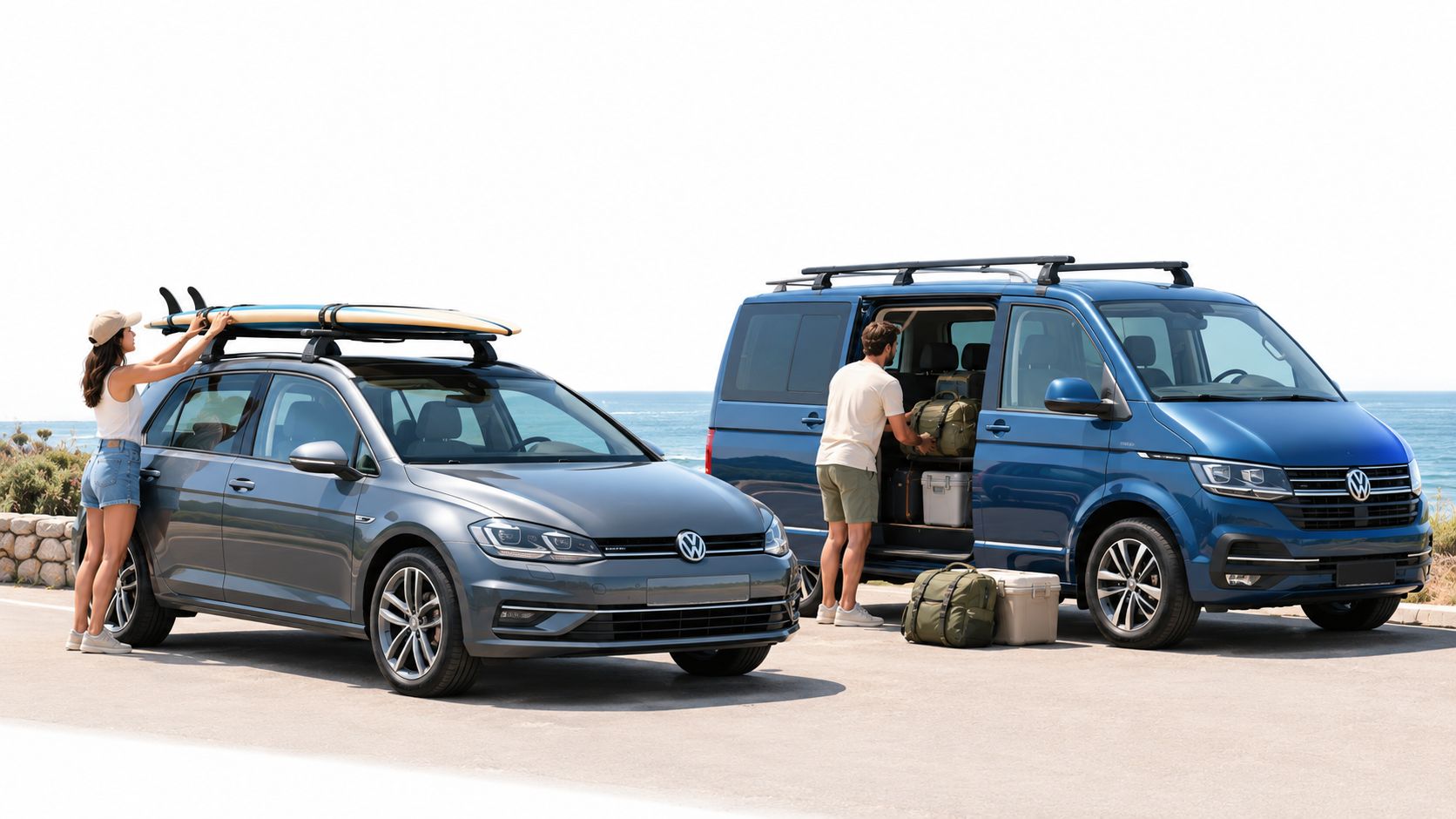
You've packed the boards, bags and camping gear, then opened the boot and realised the holiday still needs more room. That's a familiar moment for Australian VW owners, whether the vehicle is a modern Golf heading down the coast or a much-loved Kombi carrying the relaxed spirit of a surf trip.
Introduction to Volkswagen Roof Bars and Why They Matter
You're at a sunny weekend show, admiring a Beetle and a Kombi, when your own Volkswagen needs room for bikes, boards or holiday luggage. Volkswagen roof bars turn unused roof space into a practical part of the vehicle. They also form the starting point for a wider transport system, supporting a roof box, bicycle holder, or ski and snowboard carrier. Volkswagen Australia describes roof bars as a base for these additional attachments.
The bars are only one part of that system. Fittings, attachments and cargo must suit one another, just as a trailer and towball need matching specifications. A setup designed for a Tiguan with raised rails may not suit a Golf with fixed mounting points or another roof arrangement. Choosing poorly can mean wind noise, extra height, incompatible accessories, or an unsafe load.
This guide helps everyday drivers, touring families, adventurers and VW enthusiasts make a sound choice. It explains the base system, mounting styles, vehicle compatibility, load limits, installation options and safety checks. It also connects practical ownership with Volkswagen heritage. The affection people have for a real Kombi or Beetle often appears in a carefully displayed diecast model, where scale, shape and period details matter. The same eye for authenticity helps when checking fitment on a full-size car.
Your needs should guide the system. A driver carrying bikes each weekend needs different attachments from someone using a roof box for an annual holiday. A classic Volkswagen owner may prioritise period appearance and paint protection, while a modern VW driver may prefer a quiet, low-profile aluminium design.
Work through five checks in order: roof type, exact fitment, approved rating, compatible attachments, then who fits them.
How Volkswagen Roof Bars Work as a Base System
Think of roof bars as a power board for transport accessories. The power board doesn't perform every job itself. It provides organised connection points so different devices can work from one dependable base. Roof bars do something similar across the roof of a Volkswagen.
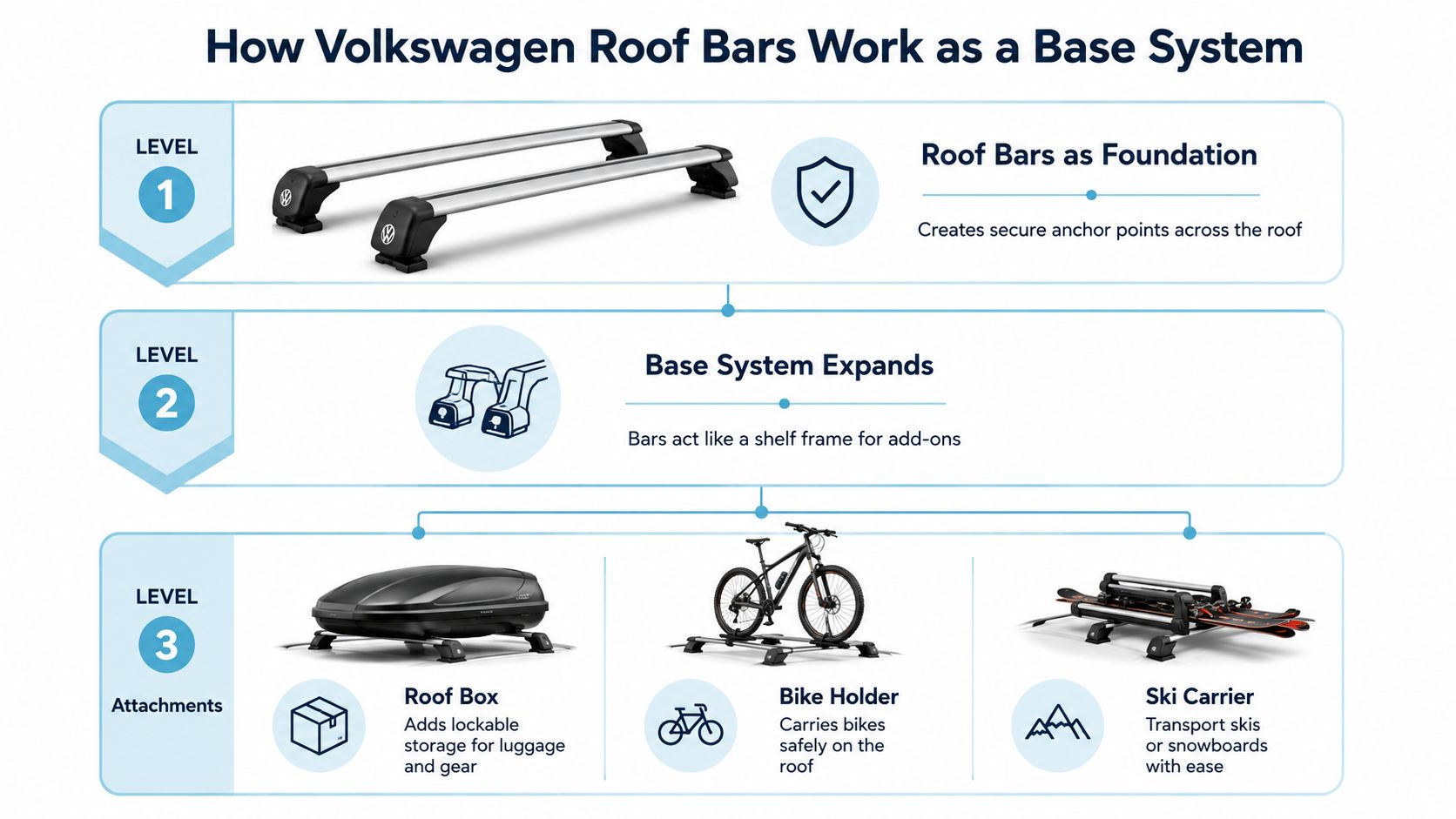
The basic arrangement has several parts:
- Feet or towers connect the system to the vehicle's roof points, rails or gutters.
- Cross bars run from side to side and provide the load-bearing platform.
- T-slots in some aluminium profiles allow compatible accessories to slide into an enclosed channel.
- Attachment hardware joins a roof box, bike holder or other carrier to the bars.
The mounting point determines which feet and fittings you need. A vehicle with fixed points beneath small covers requires a different arrangement from one with raised roof rails. Flush rails also need their own compatible feet because the bar must grip the rail without relying on a visible gap beneath it.
The key idea: roof bars create the foundation, but the vehicle's approved roof load remains the governing limit.
That means you can't judge capacity by looking at the bar alone. The total working load includes the bars, their feet, the attachment and the items being carried. If a roof box is already heavy, the amount left for luggage will be lower than the vehicle's maximum roof rating.
The same principle applies to a bicycle holder. The bar may accept the holder, but the holder must be suitable for the bicycle, and the complete assembly must remain within the vehicle's approved limit. Every connection should be locked, tightened and checked before travel.
Volkswagen Australia positions its genuine cross bars as part of this broader system, with support for roof boxes, bicycle holders and ski or snowboard holders. That gives owners a useful way to think about an upgrade. You're not buying a single-purpose accessory. You're choosing a platform that may need to support different travel, sporting or touring equipment over time.
Types of Volkswagen Roof Bars and Mounting Styles
The roof on your Volkswagen determines the starting point. Once you know whether it has fixed points, raised rails, flush rails or another approved mounting arrangement, you can compare bar profiles and appearance with far less guesswork.
Fixed-point systems attach to designated points in the roof, often beneath small covers. They can give a tidy factory-style appearance when removed, but the feet and spacing must match the vehicle exactly. Raised-rail systems grip the rails that stand above the roof, offering flexible positioning within the manufacturer's limits. Flush-rail systems attach to rails that sit close to the roof and usually require dedicated low-clearance feet.
| Mounting Style | Best For | Height and Aero Benefit |
|---|---|---|
| Fixed points | Vehicles with dedicated mounting locations | Neat appearance, with height determined by the approved feet and bar profile |
| Raised rails | Vehicles with visible rails and varied accessory needs | Flexible positioning, though the complete setup may sit higher |
| Flush rails | Modern vehicles where a close-fitting look matters | Lower visual height and a streamlined installation |
| Integrated or factory-style rails | Owners seeking a matched appearance | Designed around the vehicle's roof architecture, subject to exact fitment |
The bar itself also affects daily use. Aluminium aerodynamic profiles often have shaped surfaces intended to reduce turbulence and present a cleaner finish. Steel bars can offer a traditional, sturdy appearance, while an enclosed T-slot can make accessory fitting less fiddly by accepting compatible sliding hardware.
A low-profile design illustrates why height deserves attention. An Australian retailer lists a Vortex StealthBar system that sits 35 mm above factory raised rails, a detail that helps explain the appeal of close-fitting aerodynamic bars in everyday driving. See the Australian Volkswagen roof-rack listings and the StealthBar detail.
Lower height may help with garage clearance and visual neatness, but it doesn't automatically make a system suitable. You still need enough space for the attachment clamps, the load and the vehicle's roof shape. A roof box can add substantial height even when the bars themselves are compact.
A sleek profile is a useful preference, not a substitute for verified fitment.
If your VW carries specialist equipment, check the attachment before choosing the bars. Some accessories fit around the bar, while others connect through a T-slot. The right combination will be secure, compatible and easy enough to use that you won't avoid fitting it when the next coastal weekend arrives. For owners considering other vehicle-mounted equipment, a practical example of planning around vehicle structure appears in this Fiamma F45 awning installation guide.
Model Compatibility and Load Limits You Must Check
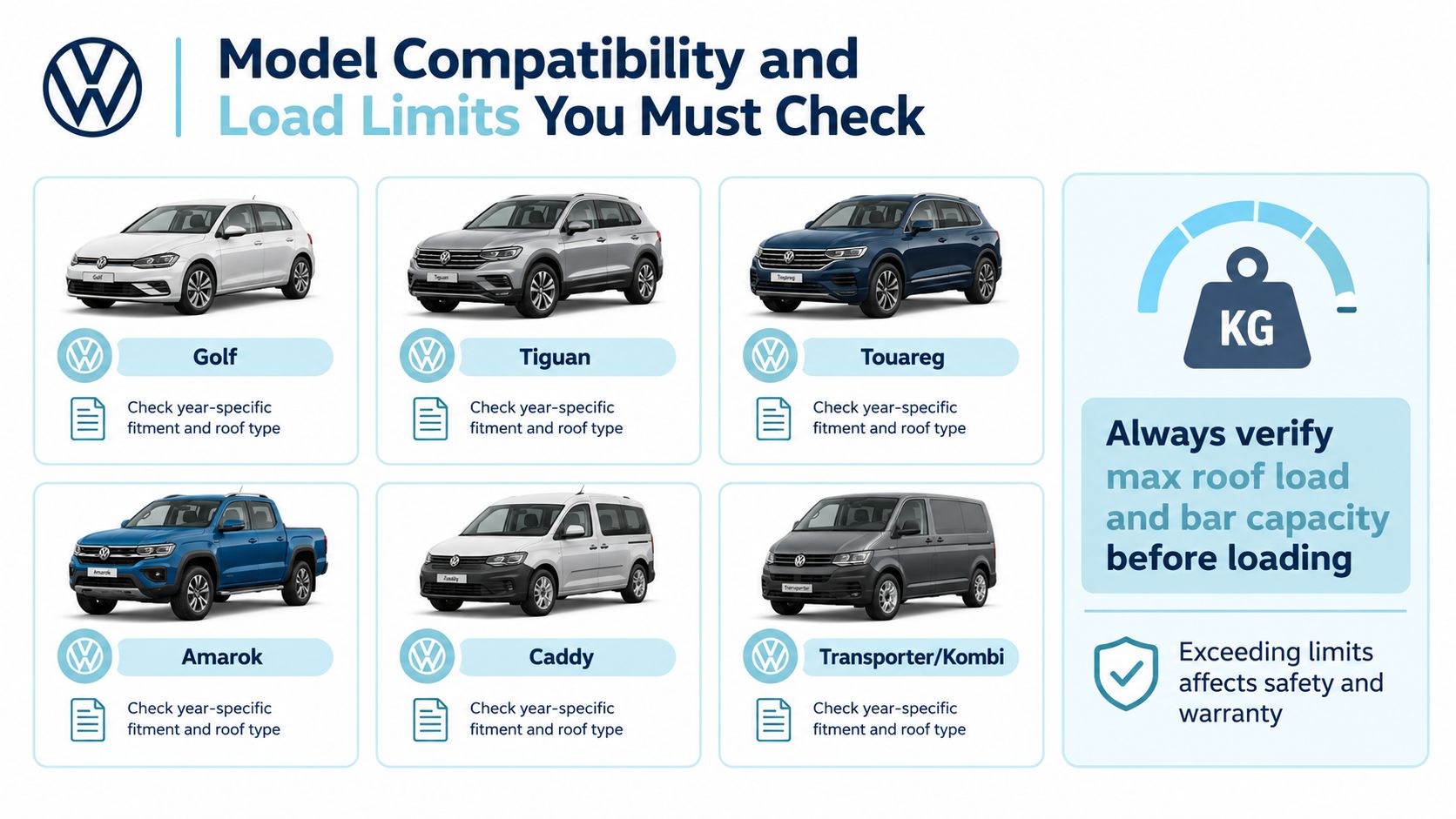
A roof-bar search starts with the exact Volkswagen, not simply the badge on the grille. Confirm the model, year, body style and roof type before comparing products. A Golf, Tiguan, Touareg, Amarok, Caddy or Transporter can require different mounting hardware, spacing and approved limits. The same careful identification helps collectors too: a diecast Kombi may share the family story, but its scale and display accessories tell you nothing about a real vehicle's load rating.
Australian roof-bar listings cover models including Amarok, Caddy, Golf, Tiguan, Touareg, Transporter and Kombi. That broad range reflects Volkswagen's wider transport ecosystem, from family cars and work utes to the vans that carried surfboards, camping gear and show equipment. It does not mean one bar set can move between every model. Australian Volkswagen roof-bar listings show the range of model-specific applications.
Match the system to the vehicle
Begin with the roof architecture. Identify raised rails, flush rails, fixed points or another specified mounting position. Then check the product listing for the exact model and year. A product photograph or a broad description such as “VW roof rack” cannot confirm fitment.
One Australian Genuine Accessories listing describes a T-slot aluminium system with a 1,440 mm overall length, 140 mm width and 245 mm height. It also identifies a city-crash-tested design. Those measurements apply to that specified product, rather than every Volkswagen roof-bar system. Review the Australian Genuine Accessories roof-bar specifications.
Calculate the usable load
The figure printed on a bar or carrier is only one part of the calculation. Start with the vehicle's approved roof rating, then subtract the weight of the bars and attachment before adding luggage.
Usable cargo = approved vehicle roof load minus bars minus attachment
Australian accessory information lists an 80 kg load rating for an Amarok roof-bar set and 95.5 kg for VW supporting rods. These examples show why capacity belongs to a particular accessory and vehicle platform. Do not transfer either figure to another Volkswagen without checking its documentation.
Amarok owners should confirm the vehicle-specific limit with a dealer where the documentation is unclear. The governing rule remains simple: the vehicle's approved roof rating governs the complete arrangement. That includes the bars, carrier, roof box, straps and cargo, rather than the luggage alone.
Before ordering, run through this list:
- Vehicle details: Record the exact model, year and body configuration.
- Roof structure: Confirm the mounting style and measure only at permitted points.
- System specification: Compare bar length, profile, feet, locks and accessory compatibility.
- Load calculation: Include the bar set, carrier, roof box, straps and cargo.
- Dealer confirmation: Ask a Volkswagen dealer when the roof rating or fitment remains uncertain.
A spacious roof box can encourage extra packing. Keep heavy items low, distribute the load evenly and secure everything against forward, backward and sideways movement. Owners planning a wider touring setup can also review tie-down rail installation as part of a complete load-management approach.
This video provides a visual reference for the fitting process and accessory arrangement:
Professional vs DIY Installation and Safety Tips
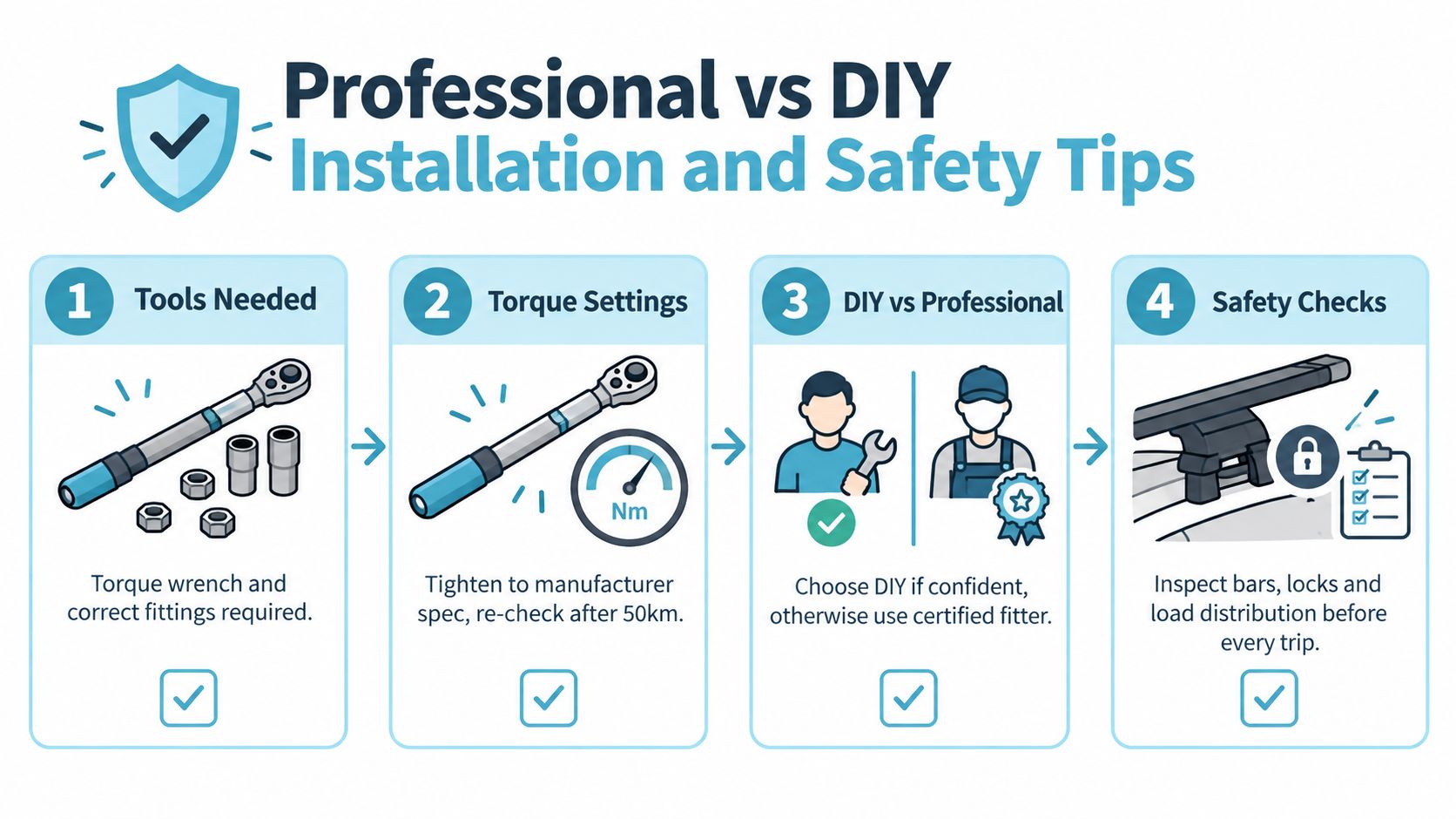
A confident home mechanic may be comfortable fitting roof bars, but confidence should come with the correct tools and a willingness to follow the supplied instructions precisely. A professional fitter makes sense when the roof is unfamiliar, the vehicle has unusual trim, or you'd rather have someone verify alignment and fastening.
Choose the fitting route
DIY fitting usually requires the correct feet, pads, bolts and covers, along with a suitable torque wrench. The bars need to sit squarely, the feet must contact their intended points and the fasteners must be tightened to the manufacturer's specification. Guessing torque by feel can leave a fitting loose or place excessive pressure on the roof.
Professional installation is the safer choice when the system is complicated, the vehicle has been modified or you're unsure how the roof points are accessed. Ask the fitter to explain the load rating, demonstrate the locks and provide any relevant fitting information for your vehicle.
Volkswagen Australia states that genuine accessories fitted at first delivery are backed by a 5-year, unlimited-kilometre warranty from the delivery date. The Australian accessories pages were updated in 2026, showing that roof bars remain an active part of Volkswagen's local ownership offering. Check Volkswagen Australia's current roof-bar and accessory guidance.
A warranty supports the accessory, but it doesn't remove the need to follow the vehicle's load limit and fitting instructions.
Use a repeatable safety check
Before loading:
- Inspect the contact points: Look for dirt, paint damage, corrosion or displaced pads.
- Check the locks: Make sure covers and locking mechanisms close properly.
- Confirm alignment: View the bars from the front and rear to ensure they sit evenly.
- Recheck fasteners: Use the specified torque rather than relying on hand tightness.
- Distribute the load: Keep heavier items low and central, then restrain every item.
- Measure clearance: Remember the new overall height before entering a garage or car park.
Wind changes the way a roof box, surfboard or bundle of luggage behaves. Loose straps can flap against the paint, while a broad load can shift even when it feels secure at the kerb. Drive conservatively, stop soon after setting off to inspect the arrangement, and repeat the check during longer trips.
Remove the bars when you don't need them if the manufacturer permits removal and refitting. Clean trapped road grime, inspect pads and hardware, and store the components where they won't be bent or misplaced. Owners carrying recovery equipment should also consider the fitting details in this high-lift jack bracket installation guide, because every roof and vehicle-mounted accessory deserves the same careful approach.
Volkswagen Heritage From Real Kombis to Diecast Displays
Roof bars belong to the practical side of Volkswagen ownership, but VW culture has always joined utility with character. In Australia, the Type 2 story carries a distinction that collectors often enjoy discussing at shows. The passenger van was marketed as the VW Kombi, while the utes and commercial carriers were known as the VW Transporter. Type 2 vehicles were also assembled from CKD kits with local content in Melbourne from the 1950s through the late 1970s. Read the Australian history of the Volkswagen Kombi and Transporter.
The original-shape Kombi became a worldwide symbol of open-road travel. One Australian automotive source records more than 2.6 million built during its 18-year lifespan, including 725,000 for export markets, while another notes that Volkswagen sold 4.5 million Kombis worldwide since 1950. Explore the production history of the original Kombi.
The Beetle has its own Australian chapter. Volkswagen introduced it locally in 1953, began assembly at Clayton, Victoria, the following year, established Volkswagen Australia Ltd in 1957, and produced the final Australian-assembled Beetle in July 1976. Review the documented Australian Beetle milestones.
That history translates beautifully into a display cabinet. A 1:18 model measures about 25 to 30 cm, while a 1:24 model measures about 16 to 20 cm. Smaller formats include 1:32 at about 12 to 15 cm, 1:50 at about 10 to 12 cm, 1:64 at about 7 to 8 cm and 1:87 at about 5 to 6 cm. Use this diecast scale guide to plan shelf space.
A 1962 Samba Bus model can anchor a coastal-themed shelf beside surf décor, while a Volkswagen Beetle model suits a smaller desk or bedside display. Matching scale across a scene helps the collection feel intentional, even when each piece recalls a different chapter of VW life.
Choosing Your Volkswagen Roof Bars and Next Steps
A good buying decision follows a clear order.
- Identify the roof type. Check for fixed points, raised rails, flush rails or the mounting arrangement specified for your VW.
- Confirm model-specific fitment. Use the exact model, year and body details.
- Check the vehicle roof rating. Treat the approved vehicle limit as the boundary for the complete system.
- Choose the profile. Compare aerodynamic aluminium, steel and low-profile options according to height, appearance and attachment needs.
- Select compatible accessories. Make sure the roof box, bike holder or other carrier suits the bar profile.
- Decide on installation. Fit it yourself only if you have the right hardware, torque information and confidence, otherwise use a qualified installer.
Avoid the common traps. Don't select bars from a photograph alone, don't assume a bar rating applies to another Volkswagen, and don't load the system without including the weight of the bars and attachment. A neat-looking setup is only a good setup when it fits correctly, stays within the approved limit and can be checked easily before every journey.
Once the practical job is done, the enthusiast side can continue at home. A licensed diecast Kombi Samba Bus or Beetle model captures the same touring spirit in a format that fits a shelf, study or coastal display. It's a lovely way to keep the VW story close between club runs, show days and weekend drives.
Volkswagen Memorabilia offers licensed Volkswagen diecast models, including Kombi Samba Bus and Beetle pieces, alongside VW gifts and relaxed coastal décor. Browse the collection, enjoy local stock and fast Australian shipping, and visit Volkswagen Memorabilia to find a display piece that keeps your own VW adventures rolling.