

The Kombis
The history of the Volkswagen Kombi, Transporter & Microbus
The Volkswagen Type 2, known officially (depending on body type) as the Transporter, Kombi or Microbus, or, informally, as the Bus (US) or Camper (UK), is a panel van introduced in 1950 by the German automaker Volkswagen as its second car model. Following – and initially deriving from Volkswagen’s first model, the Type 1 (Beetle) – it was given the factory designation Type 2.

As one of the forerunners of the modern cargo and passenger vans, the Type 2 gave rise to forward control competitors in the United States in the 1960s, including the Ford Econoline, the Dodge A100, and the Chevrolet Corvair 95 Corvan, the latter adopting the Type 2’s rear-engine configuration. European competition included the 1960s FF layout Renault Estafette and the FR layout Ford Transit.
Like the Beetle, the van has received numerous nicknames worldwide, including the “microbus”, “minibus”, and, because of its popularity during the counterculture movement of the 1960s, “Hippie van”.
Brazil contained the last factory in the world that produced the T2. Production in Brazil ceased on December 31, 2013, due to the introduction of more stringent safety regulations in the country. This marks the end of an era with the rear-engine Volkswagens manufactured (after the 2002 termination of its T3 successor in South Africa), which first originated in 1935 with their Type 1 prototypes.

The concept for the Type 2 is credited to Dutch Volkswagen importer Ben Pon who first sketched the van in a doodle dated April 23, 1947, proposing a payload of 690 kg (1,520 lb) and placing the driver at the very front. Production would have to wait, however, as the factory was at capacity producing the Type 1.
Although the aerodynamics of the first prototypes were poor. Simple changes such as splitting the windshield and roofline into a “vee” helped and it was approved for production in 1949 and the first production model, now designated Type 2, rolled off the assembly line.
Initially only two models were offered: the Kombi (with two side windows and middle and rear seats that were easily removable by one person), and the Commercial. The Microbus was added in May 1950, joined by the Deluxe Microbus in June 1951. In all 9,541 Type 2s were produced in their first year of production. An ambulance model and a single-cab pickup were added by 1952
The Type 2 was available as a:
Panel van, a delivery van or blind van (without side windows) or rear seats.

Double-door Panel Van, a delivery van without side windows or rear seats and cargo doors on both sides.
High Roof Panel Van, a delivery van with raised roof.
Kombi, from German: Kombinationskraftwagen (combination motor vehicle), with side windows and removable rear seats, both a passenger and a cargo vehicle combined.
Bus, also called a Volkswagen Caravelle, a van with more comfortable interior reminiscent of passenger cars since the third generation.
Samba-Bus, a van with skylight windows and cloth sunroof, first generation only, also known as a Deluxe Microbus. They were marketed for touring the Alps.
Flatbed pickup truck, or Single Cab, also available with wider load bed.
Crew cab pick-up, a flatbed truck with extended cab and two rows of seats, also called a Doka, from German: Doppelkabine.
Westfalia camping van, “Westy”, with Westfalia roof and interior. Included optional “pop up” top.
Adventurewagen camping van, with high roof and camping units from Adventurewagen.
Semi-camping van that can also still be used as a passenger car and transporter, sacrificing some camping comforts. “Multivan” or “Weekender”, available from the third generation on.

Apart from these factory variants, there were a multitude of third-party conversions available, some of which were offered through Volkswagen dealers. They included, but were not limited to, refrigerated vans, hearses, ambulances, police vans, fire engines and ladder trucks, and camping van conversions by companies other than Westfalia. There were even rail-going draisines built in 1955.
The first generation of the Volkswagen Type 2 with the split windshield, informally called the Microbus, Splitscreen, or Splittie among modern fans, was produced from March 1950 through the end of the 1967 model year. From 1950 to 1956, the T1 (not called that at the time) was built in Wolfsburg; from 1956, it was built at the completely new Transporter factory in Hanover. Like the Beetle, the first Transporters used the 1100 Volkswagen air-cooled engine, an 1,131 cc
German production stopped after the 1967 model year; however, the T1 still was made in Brazil until 1975, when it was modified with a 1968–79 T2-style front end, and big 1972-vintage tail lights into the so-called “T1.5” and produced until 1996.

The Volkswagen Samba, in the United States also known as Sunroof Deluxe, was the most luxurious version of the Volkswagen Transporter T1. Volkswagen started producing Sambas in 1951. In the sixties this version became popular as a hippie bus.
Originally Volkswagen Vans were classified according to the number of windows they had. This particular model had 23 windows including eight panoramic windows in the roof. To distinguish it from the normal 23-window Volkswagen van the name Samba was coined.
Instead of a sliding door at the side the Samba had two pivot doors. In addition the Samba had a fabric sunroof. At that time Volkswagen advertised with the idea of using the Samba to make tourist trips through the Alps.
When Volkswagen started producing the successor of the T1 (the T2) the company also stopped producing the Samba so there are no Sambas in later versions of the Volkswagen Transporter.
This Article is an extract from Wickipedie. For full details of the history of the Vikswagen Type 2, Volkswagen Kombi, Transporter & Microbus click here.
The VW Beetle
The History of the Volkswagen Beetle.
In 1932, Ferdinand Porsche had developed three prototypes running of what he called “the car for everybody” for Zündapp a motorcycle company.
Then In April 1934, The German Government gathered his idea and gave the order to Ferdinand Porsche to develop a Volkswagen (literally, “people’s car” in German, and provided Porsche with specifications, insisting on a basic vehicle, capable of transporting two adults and three children at 100 km/h (62 mph) while not using more than 7 litres of fuel per 100 km. The engine had to be powerful enough for rapid sustained cruising on Germany’s new Autobahnen. Everything had to be designed to ensure worn out parts could be quickly and inexpensively exchanged. The engine had to be air-cooled The “People’s Car” would be available to citizens of the Third Reich through a savings scheme, for 990 Reichsmark, then about the price of a small motorcycle.
In October 1935 the first two Type 60 prototypes, known as the V1 and V2 were ready. In 1936, testing began of three further V3 prototypes, built in Porsche’s Stuttgart shop. A batch of thirty W30 development models, that were produced for Porsche by Daimler-Benz, underwent (2,900,000 km) of further testing in 1937.
All these cars already had the distinctive round shape and the air-cooled, rear-mounted engine. Included in this batch was a rollback soft top called the Cabrio Limousine.
A further batch of 44 VW38 pre-production cars produced in 1938 introduced split rear windows; both the split window and the dash were retained on production Type 1s until 1953. The VW38 cars were followed by another batch of 50 VW39 cars, completed in July 1939.

The car was designed to be as simple as possible mechanically, so that there was less to go wrong. The air-cooled 25 hp 995 cc motors proved especially effective in actions of the German Afrika Korps in Africa’s desert heat. This was due to the built-in oil cooler and the superior performance of the flat-four engine configuration. The suspension design used compact torsion bars instead of coil or leaf springs. Additionally the Beetle was nearly airtight and will float for a few minutes in the water.
The Volkswagen factory opened in May 1938 and had only produced a handful of cars by the start of the war in 1939. The first volume-produced versions of the car’s chassis were military vehicles, the Type 82 Kübelwagen (approximately 52,000 built) and the amphibious Type 166 Schwimmwagen (about 14,000 built).

The first Beetles were produced on a small scale in 1941. A handful of Beetles were produced specifically for civilians, primarily for the Nazi elite, in the years 1941 to 1945, but production figures were small.
Mass production of civilian VW cars did not start until post-war occupation. The Volkswagen factory was handed over by the Americans to British control in 1945. It was to be dismantled and shipped to Britain however no British car manufacturer was interested
The factory survived by producing cars for the British Army instead. The re-opening of the factory is largely accredited to British Army officer Major Ivan Hirst. Hirst was ordered to take control of the heavily bombed factory, which the Americans had captured. His first task was to remove an unexploded bomb that had fallen through the roof and lodged itself between some pieces of irreplaceable production equipment. If the bomb had exploded, the Beetle’s fate would have been sealed.
Knowing Germany needed jobs and the British Army needed vehicles, Hirst persuaded the British military to order 20,000 cars,

and by March 1946 the factory was producing 1,000 cars a month (in Army khaki, under the name Volkswagen Type 1), which Hirst said “was the limit set by the availability of materials”. During this period, the car reverted to its original name of Volkswagen and the town was renamed Wolfsburg. The first 1,785 Type 1s were made in 1945.
After World War II, it was officially designated the Volkswagen Type 1, but was more commonly known as the Beetle, with the one-millionth car coming off the assembly line by 1955.
During the 1950s, the car was modified progressively: the obvious visual changes mostly concerned the rear windows. In March 1953, the small oval two-piece rear window was replaced by a slightly larger single-piece window. More dramatically, in August 1957 a much larger full width rear window replaced the oval one.
The same body appeared during 1966, with a 1,300 cc engine in place of the 1,200 cc.
In 1972, with over 15 million produced, Beetle production surpassed the previous record holder, the Ford Model T. By June 1992, over 21 million had been produced.
(This article is an abbreviated extract from Wikipedia. For full details see Volkswagen Beetle History here. )
About Diecast

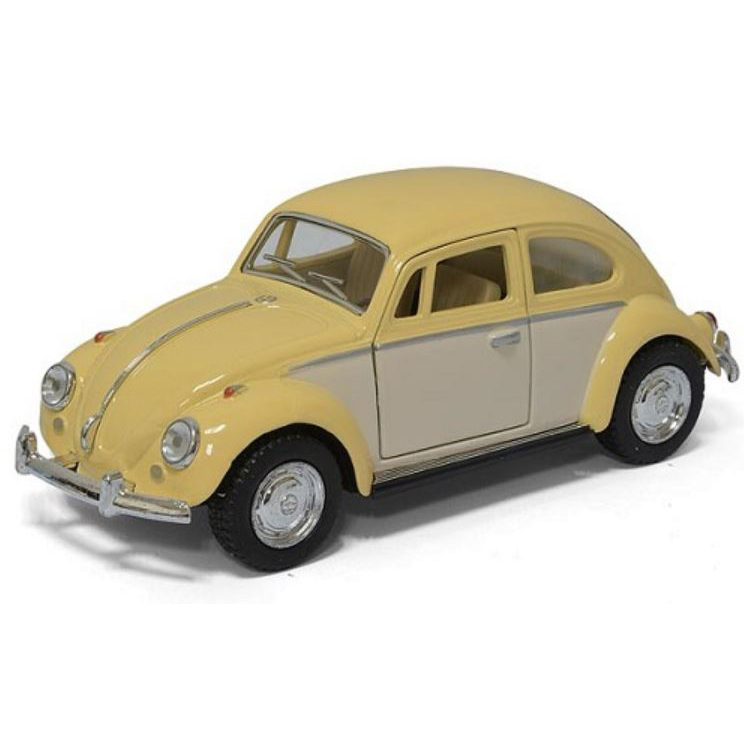
Diecast cars and vans are products that are exact miniature replicas to scale of the original designs.
Larger sizes are usually made of metal and smaller products all plastic. These days many of the metal diecast products have plastic parts.
Die-cast products are made in molds that keep their scale size exactly in proportion.
Handmade metal cars are quite different products and are hand welded and riveted from metal parts and may not have true replica scale.
The term die-cast refers to any toy or decorative collectible models, that have been manufactured by using the die casting system. The products used are metal, with plastic, rubber, or glass details. Fully plastic models are made by a similar but different process called injection molding.
VW Links
For information about Classic Volkswagen Clubs and restorations or units or parts for sale visit these VW web pages :-
The Volkswagen Club of Victoria Inc
If you have a VW Website we would be glad to exchange links with you. Just put our VWmemorabilia.com.au link up on your site then Contact us