

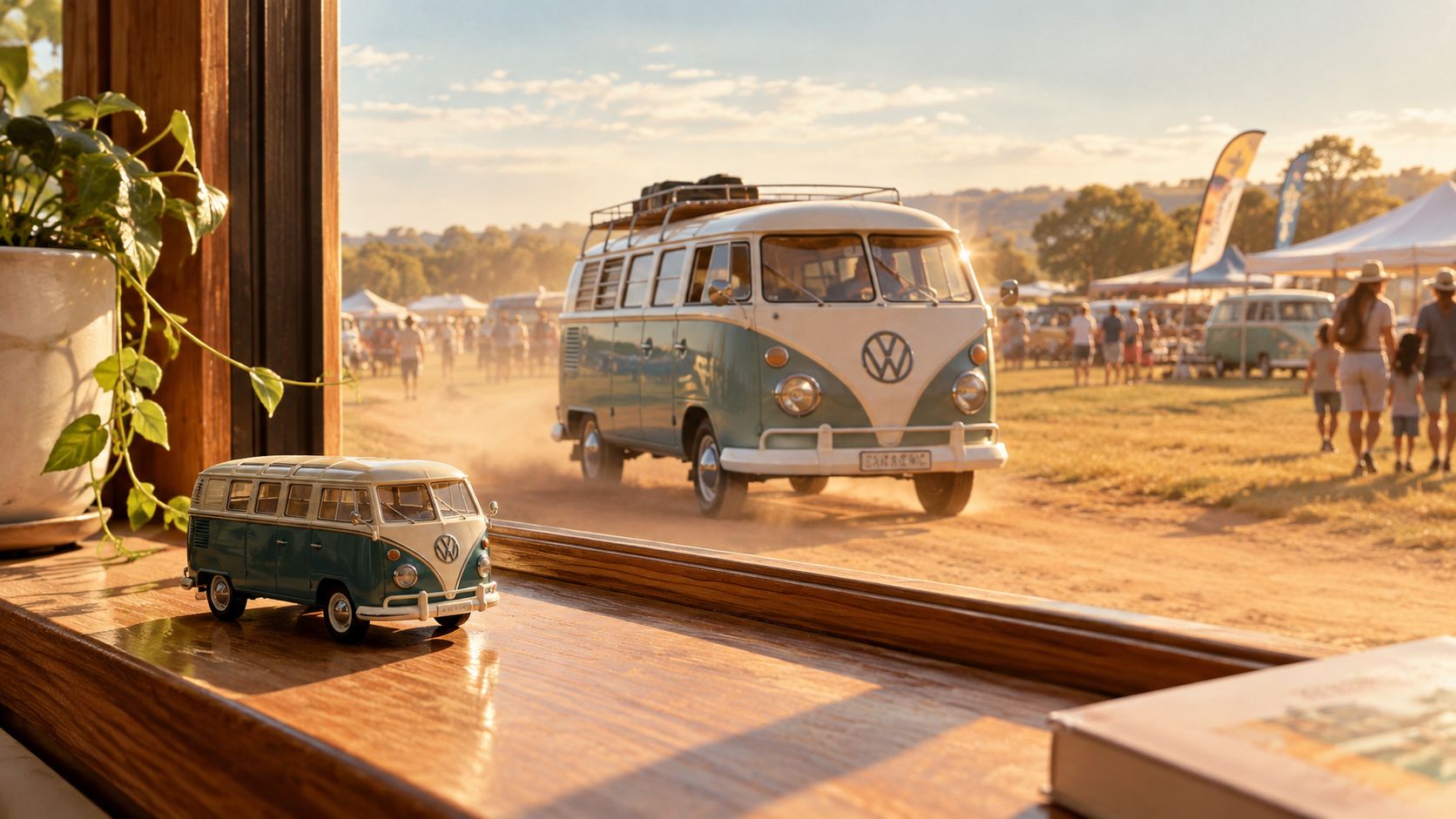
A Kombi easing into a showground always gets the same reaction, people turn their heads before they've even finished their coffee. On a sunlit shelf, a tiny Volkswagen does something similar, it pulls a whole bit of Australian motoring memory into one glance.
A Kombi Roll-Up and a Shell-Washed Hobby
A well-kept VW collectible carries the same pull as a Kombi easing into a showground. It brings back beach runs, club days, family holidays, and the Beetles that once filled driveways across Australia. On a shelf, that kind of model feels less like a toy and more like a small, familiar piece of motoring history.
Australian collecting has a strong local backbone. Museum Victoria records that the first Beetles imported in meaningful numbers arrived through Melbourne-based Regent Motors in late 1953 Museum Victoria's Volkswagen history. Earlier private imports also existed, including two vehicles brought in for Department of Munitions examination in 1947. Australian assembly later produced just over 260,000 Beetles between 1959 and 1968 at Clayton.
That matters in the cabinet as much as it does at a show. A miniature Beetle is not just an overseas shape, it points back to a car that was sold here, assembled here, and remembered here by local owners and restorers. The same logic applies to the Kombi, which carries real weight with Australian collectors because it has long sat inside family motoring, club culture, and the surf scene.
Scale and finish still decide value. Licensed diecast with clean badges, correct trim, and tidy paint usually sits in a different bracket from customs, where the appeal often comes from hand-built detail rather than factory accuracy. A roof rack, patina finish, or period surfboard can add charm, but it should still look deliberate, not thrown together.
Condition is where Australian buyers separate display pieces from shelf filler. Scratched windows, bent mirrors, and repainting can all affect value, while original boxes and crisp decals help a model hold its place in a serious collection. If a model reminds you of a family car, a club convoy, or a beach run before you think about resale, it is probably the right kind of collectible for you.
The Big VW Categories Worth Collecting
Beetles That Belong to Australian History
The Beetle is usually the first stop because it sits squarely in Australia's Volkswagen story. Early imports, later local assembly at Clayton, and the long run of Beetles on Australian roads gave the model a local presence that still matters to collectors Museum Victoria's Volkswagen history. If you are choosing a Volkswagen Beetle model, start with the details that mark its era. Oval-window styling, later sedan cues, bumper shape and trim all change how faithfully the miniature matches a real car.
Kombis and the Type 2 Line
The Kombi has a different appeal. It feels more open, more social, and more tied to travel and club life. First Australian examples appeared in 1953, assembly began in Melbourne in 1954, and the model reached a notable local peak in 1975 when 8,974 Kombis and Microbuses were sold and the vehicle held 43% of the Australian one-tonne van market Club VW history. That sort of local reach is why VW Kombi diecast Australia searches often turn up split-screen vans, panel vans and Microbuses before anything else.
The body style changes the feel straight away. A split-screen Kombi brings the early commercial look, while a bay-window version has the later, broader face that many Australian owners remember from family trips and work use. Panel vans suit plain workhorse builds, while Microbuses and passenger versions carry more colour and detail. For collectors, that difference matters more than a generic badge on the box.
Samba Buses, Surf Themes and Flower Power
Samba Buses sit higher on the desirability scale because the shape is instantly recognisable and the detailing can be excellent when a maker gets it right. The surf connection also fits the Australian eye, since Kombis became part of touring and coastal life. The best diecast versions capture that with colour, roof racks and beach-themed graphics rather than forced retro styling.
A few collectable pieces are tied to serious full-size money as well. Rare restored examples, including a 1960 T2 Deluxe Microbus sold at Melbourne auction, show how far the top end can go Melbourne auction report. That does not make every Kombi model expensive, but it does explain why clean, well-made versions hold attention in Australian collections.
Metal Décor and Home Accents
Not every collector wants another row of vehicles. Signs, badges, wall pieces, fridge magnets and ornaments all bring in VW character without taking much shelf space. They also work well as gifts, especially for someone who likes the culture but does not want to start a full cabinet.
A good collection usually starts with a clear theme, then builds around it. Pick the era, body style or local memory you want to show, and the rest of the shelf falls into place much more naturally.
Choosing the Right Diecast Scale
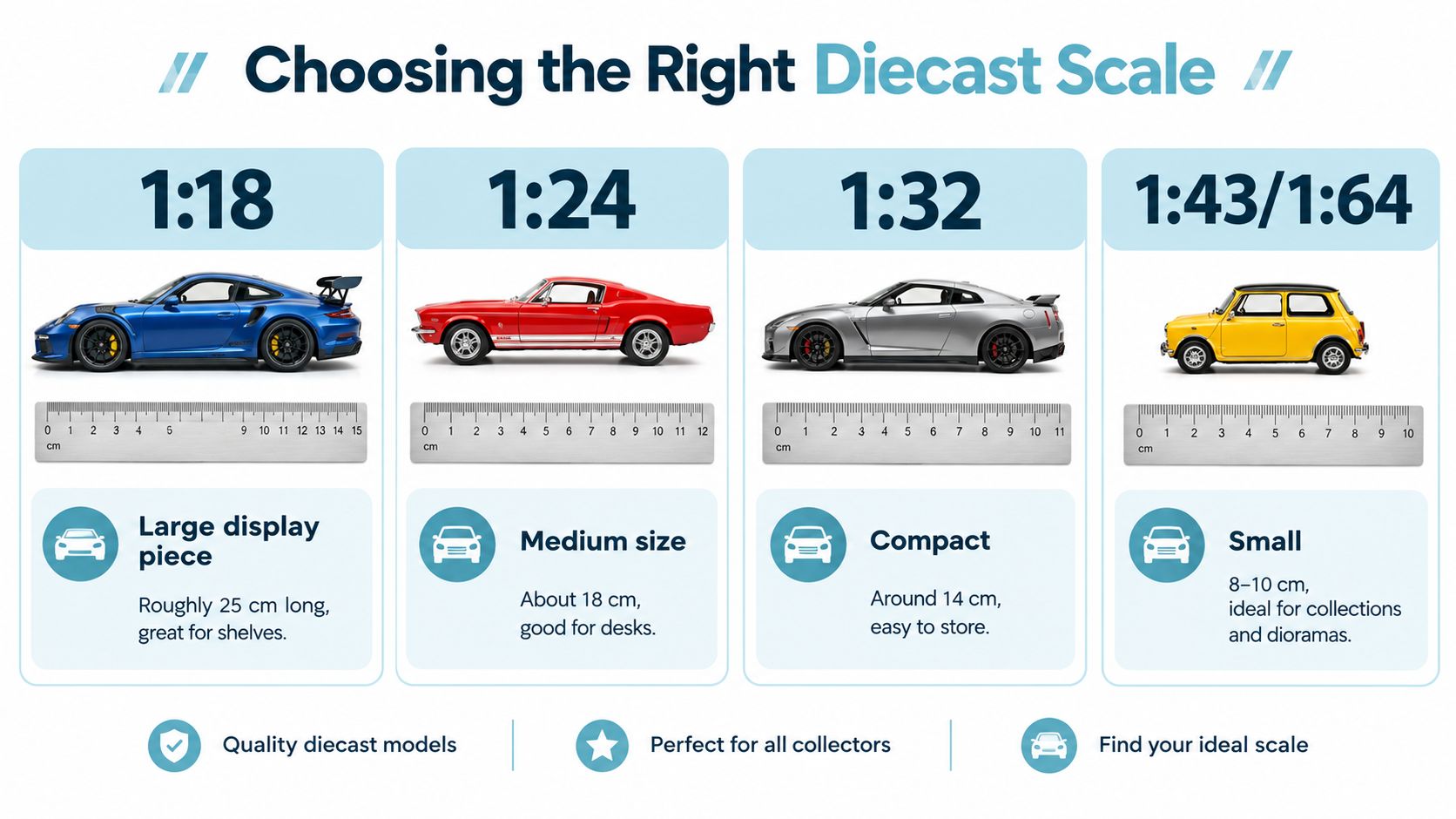
At a VW show, you can usually spot the collectors who know their shelf space before they buy. The display is tidy, the gaps are deliberate, and the scale choices make sense for the models on hand. A 1:18 model has real presence, with enough room for trim, interior detail and sharper paintwork. A 1:24 model is easier to place on a desk, cabinet or display case, while still feeling substantial scale guide.
Compare the practical trade-offs
| Scale | Approx. Length | Best For | Price Tier |
|---|---|---|---|
| 1:18 | Roughly 25–30 centimetres | Main display pieces, hero models | Higher |
| 1:24 | About 16–20 centimetres | Desks, cabinets, gifting | Mid |
| 1:32 | Smaller than 1:24, compact in hand | Tight shelves, mixed scenes | Lower to mid |
| 1:43 / 1:64 | Small, easy to group | Large collections, dioramas, play | Lower |
Those dimensions matter because scale is the single biggest factor in shelf footprint. A few 1:18 Kombis can take over a cabinet quickly, while 1:43 and 1:64 pieces let you build out more colour and variety without crowding the room. If you want one standout model, 1:18 is hard to beat. If you are buying a few gifts or filling a mixed Beetle-and-Kombi shelf, 1:24 usually sits in the sweet spot. For a practical overview of the size differences, see this guide to VW diecast model scales.
Measure the display area before you buy. That habit saves plenty of frustration later, especially if you are planning around a narrow cabinet or a long run of shelves.
1:24 also suits collectors who want a model that still looks serious without demanding the room of a larger piece.
Shelf reality: the nicest model on the site can still be the wrong buy if it arrives too big for the spot you had in mind.
Spotting Licensed Quality and Real Value
A tidy photo can hide a lot. In VW collecting, rare and valuable are not the same thing, and Australian classic-car valuation guidance notes that ordinary pricing tools can miss highly original or unusual vehicles, while ownership and service history can change value in a meaningful way classic car valuation guidance. The same logic applies to models, especially in a market where authentic club pieces, licensed diecast and custom builds all sit side by side.
What to check before you buy
- Official licensing marks: look for clear Volkswagen licensing references on the packaging or model where applicable. That is the cleanest sign you are buying an authorised piece rather than a casual copy.
- Packaging condition: corner crush, tape residue and sun-fade matter, especially if resale or long-term display matters to you.
- Model markings: check the scale, product code and manufacturer details so you can identify the exact item later.
- Edition clues: numbered releases, certificates and insert cards help separate an ordinary run from a limited one.
- Paper trail: keep receipts, seller details and photos of the box and model. If you ever compare pieces or pass one on, that record helps.
Sealed boxes often draw stronger interest from buyers, but an opened model can still be a good buy if it is clean and complete. The trade-off is simple. A sealed piece tends to suit collectors who care about presentation and resale, while an opened piece can be the better value if the model itself is sharp and the packaging is all there. If the box has been opened, keep every tray, insert and sheet together so the item still reads as a proper collectible.
Useful habit: photograph the model the day it arrives, front, rear, underside, box labels and any defects. That record is worth having later.
Treat the listing details as part of the object. A listing that omits scale, finish or box condition is a listing to walk away from.
Storing and Displaying Models in Coastal Australia
Humidity is the quiet troublemaker in coastal homes. The Western Australian Museum recommends keeping most metal objects below 45% relative humidity, iron or visibly corroding metals below 35%, and light exposure to a maximum of 300 lux WA Museum storage guidance. That guidance makes sense for VW diecast and metal décor because corrosion, lifting decals and paint blistering all get worse when moisture and pollutants hang around.
A glass case earns its keep when the room is damp, dusty or close to a window. It reduces exposure, but it shouldn't trap condensation or volatile materials, so leave space for air movement and avoid stuffing it with fresh paint, cleaners or scented products. An open shelf is fine in a drier room if you're willing to dust regularly and keep models out of direct sun.
Simple rules that work
- Use acid-free padding: it stops abrasion between pieces and protects packaging.
- Separate metal from metal: stacked cars scratch each other far more easily than many realize.
- Choose stable shelving: painted, baked-enamel or powder-coated surfaces are friendlier than raw timber in a humid room.
- Inspect often: orange-brown corrosion, sticky surfaces, decal lift and paint blisters are early warning signs.
- Match storage to the most delicate part: if the model has paper packaging, decals or fabric details, treat those as the limiting factor.
That last point matters because mixed-material collectibles behave differently from plain diecast. A model with paper inserts or printed packaging needs more care than a bare metal ornament, even if the car itself looks tough.
Read about model display cases for VW collectibles
Collection Ideas and Gift Bundles That Travel Together
A good VW collection has a clear feel. One collector builds a coastal shelf around Flower Power Kombis, sea-toned décor and a few surfy accents. Another lines up 1960s-style Transporters in a garage cabinet, so the cars read like a small parade of Australian touring history. Both work because the pieces speak to each other instead of fighting for space.
The Kombi's Australian role gives those displays real context. Split-screen vans recall the club runs and road trips of the 1950s and 1960s, while bay-window models carry the later surf-trip mood. That is why a Samba Bus or Flower Power variant makes such a strong gift. It carries the mood people remember, not just the shape.
A well-chosen bundle also helps when you want a gift that feels local rather than generic. For a friend who knows the scene, a licensed diecast, a period-style badge, and a card with a short note about the model can land better than a random mix of VW bits. If you want ideas that suit different budgets and tastes, VW gift ideas and themed bundles give you a practical place to start.
Three combinations that work well
- Coastal shelf: one bright Samba Bus, one Beetle, and a small mix of beach-themed décor. It suits a lounge or home office where the colours can breathe.
- Garage display: a row of Kombis in different body styles, plus a metal sign or badge. Clean spacing and a darker backing board help the shapes stand out.
- New-fan gift bundle: one boxed diecast, one smaller décor piece, and a card that explains why the model matters. That keeps the gift personal without making it fussy.
Scale still matters. A smaller model often suits a child or casual fan who wants something easy to handle. For a serious collector, packaging, authenticity and model-year detail matter more than flash. A sharp boxed piece at the right condition level is usually a better buy than a loose model with tired paint or a hard-to-trace custom job.
Connecting Your Shelf to the Australian VW Scene
The local scene has real depth. The VW Nationals has a documented Australian history reaching back to 1988 at Hawkesbury Agricultural College, and later events drew around 900 Volkswagens and an estimated 3,000 to 4,000 attendees VW Nationals history. That's why these collectibles feel bigger than the shelf they sit on. They echo the colours, people and customs you still see at Volksfest, VW Nationals and Surf Show & Shine.
A Beetle on a windowsill can point back to Clayton. A Kombi on a cabinet can point back to touring culture, surf runs and club nights. Together they remind you that the hobby isn't just about ownership, it's about belonging to a long-running Australian Volkswagen story.
Common Questions and Where to Browse Next
The first question is usually price. For a licensed diecast, fair value comes down to scale, finish, packaging, and whether the model still has its inserts and box in decent shape. A mint 1:24 piece in a tidy box will sit in a different bracket from a loose model with scuffs, even if they wear the same badge.
The next question is how to separate licensed models from custom-painted pieces. Check the branding, product codes, inserts, and seller notes, and keep your own receipt and box photos so you know what you bought later on. That matters in the Australian market, where provenance helps when you compare a clean licensed piece with a one-off custom build.
Gift buying is simpler. A Volkswagen Beetle model suits anyone who likes the classic shape, while a VW Kombi diecast Australia pick usually suits someone with beach trips, road holidays, or club memories in the mix. For a first licensed 1:24 model, a sensible entry-level budget is usually enough to start well without chasing a rare box or a special edition.
The story behind Kombis also carries weight. A restored 1960 T2 Deluxe Microbus with a period Golde folding roof sold at a Melbourne auction for A$202,000, reportedly setting an Australian auction record for a Kombi Melbourne auction report. That kind of result shows why condition, originality, and local history matter when you judge a collectible.
If you want to browse licensed Beetles, Kombis, and Samba pieces with that same collector's eye, visit Volkswagen Memorabilia and look through the diecast and décor ranges at your own pace.