

You're at a VW show in Australia, coffee in hand, admiring a tidy oval-window Beetle and a sun-faded Kombi with surfboard racks. Then, across the grass, you spot something wearing the same badge but looking like it arrived from another planet. Big wheels. Sharp suit. No air-cooled chatter. Just a polished, modern presence.
That's usually how the Touareg enters the conversation.
For a lot of us who grew up loving Beetles, Kombis, and all the lovely oddball bits of old Volkswagen history, the Touareg can feel like the rich cousin nobody properly introduced. It's not the people's car in the old sense. It's not simple. It's not cheeky. But once you start reading Volkswagen Touareg reviews with an open mind, you realise it has its own place in the family.
The Big Fella in the Volkswagen Family
Last summer at a club meet, one of the blokes rolled up in a Beetle he'd spent years restoring. Next to him, another mate arrived in a late-model Touareg. The Beetle drew smiles. The Touareg drew squints, raised eyebrows, and that classic question: “That's a Volkswagen?”
It is. And that's the funny part.
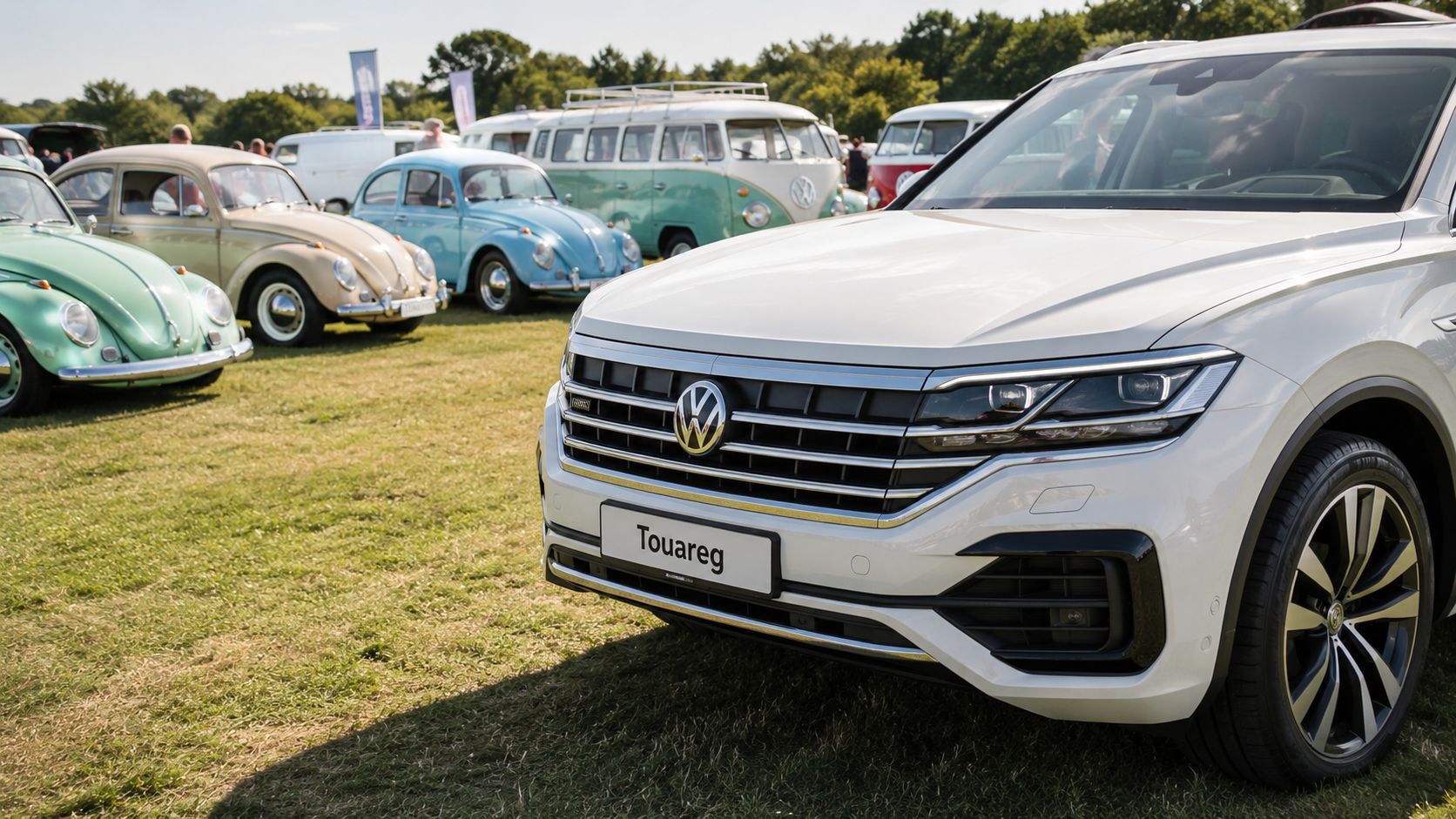
Same badge, very different mission
A classic Beetle wins you over with honesty. You hear everything. You feel everything. A Kombi adds charm, space, and that irresistible road-trip spirit. The Touareg walks in wearing leather shoes and carrying its own briefcase.
That doesn't make it less interesting. It just means you have to judge it by a different yardstick.
Modern Volkswagen Touareg reviews in Australia often circle around the same real-world questions buyers care about:
- Can it tow properly? Big SUVs here earn their keep with caravans, boats, and trailers.
- Is it comfortable over distance? Australia is not a gentle little city-state. Cars have to cope with long roads.
- Does it still feel like a Volkswagen? That's the emotional test, not just the mechanical one.
Practical rule: If you come to the Touareg expecting Beetle simplicity, you'll miss the point. If you come to it asking whether VW can build a serious grand tourer for Aussie conditions, it gets a lot more compelling.
Why classic VW fans are curious about it
Most of us aren't cross-shopping a Touareg against a split-window Bus restoration. It's not that sort of choice. The curiosity is more personal than that. You love the brand. You know its roots. You want to know whether the big modern flagship still carries some of the old VW DNA, even if it now wears a luxury jacket.
That's why the Touareg is worth a fair review from a classic enthusiast's point of view. Not because it replaces the old heroes, but because it shows how far Volkswagen has travelled from humble air-cooled beginnings.
And yes, standing beside a Beetle, it looks absolutely enormous. Like a bouncer at a family barbecue.
What Exactly Is a Touareg Then?
The easiest way to understand the Touareg is this. It's Volkswagen's large, premium SUV. Not a runabout. Not a budget family wagon. Not an offshoot of the old practical VW idea. It was built to play in a more upmarket part of the market.
It sits at the posh end of the VW tree
If your mental picture of Volkswagen is a cheerful Beetle, a Type 3, or a Kombi packed with camping gear, the Touareg can feel like a sharp left turn. It was created for buyers who wanted something refined, substantial, and capable, with the Volkswagen badge rather than a flashier luxury badge on the nose.
That shift matters. It tells you why Touareg reviews often talk about ride quality, cabin hush, towing, and road-trip comfort rather than simple mechanical charm.
From rugged roots to polished tourer
Early Touaregs built a reputation for mixing proper SUV presence with a bit of genuine toughness. Over time, the model moved further toward the luxury-touring end of the spectrum. The current vibe is less muddy-boots off-roader, more long-distance express with enough muscle for real work.
That evolution makes sense in Australia. Plenty of buyers want one vehicle that can do weekday commuting, weekend towing, and school-holiday road trips without feeling like a farm truck.
Here's the simplest way to frame it:
| Touareg trait | What it means for a classic VW fan |
|---|---|
| Premium positioning | It's closer in spirit to a luxury wagon than a humble people's car |
| Large SUV format | Think family hauler and tourer, not lightweight simplicity |
| Modern technology | A long way from a Beetle's sparse dash and basic controls |
| VW badge | Still part of the same broad family, even if the personality is very different |
Why it deserves a look anyway
Classic Volkswagen fans are often generous judges. We know one badge can cover a lot of history. A Beetle, a Karmann Ghia, a Bay Window, and a modern SUV don't have to do the same job to belong to the same story.
The Touareg makes the most sense when you stop asking whether it's “like” a Kombi and start asking whether it's a well-sorted modern Volkswagen for the sort of Australian buyer who needs space, refinement, and proper touring ability.
It doesn't carry the old VW spirit in a literal way. It carries the badge's engineering ambition in a very modern one.
Under the Bonnet of Aussie Touareg Models
A mate from our club turned up to a Sunday run in a Touareg after years of bringing a tidy late Bay. We all had the same reaction. Where's the engine rattle, where's the fan whirr, and since when does a Volkswagen pull like a freight train from barely above idle?
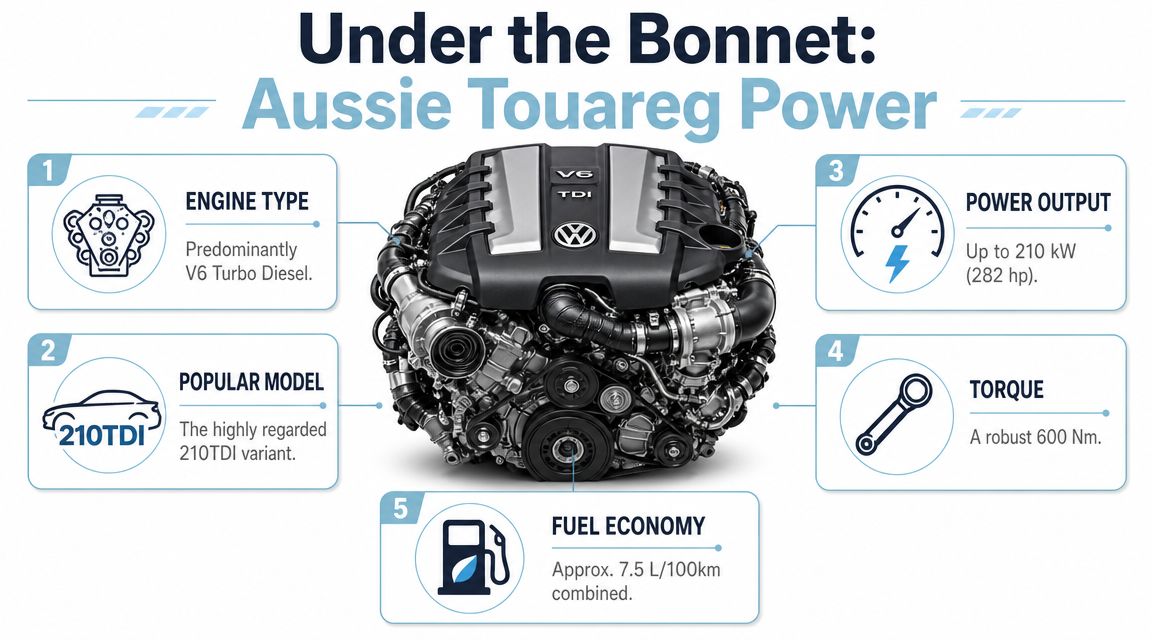
That first squeeze of the throttle explains a lot about the Australian Touareg story. Around here, the badge you hear most is 210TDI, and while the name sounds like something printed on a warehouse shelf, the hardware underneath is dead serious.
The diesel that defines the local Touareg
In Australia, the 210TDI runs a 3.0L V6 turbo-diesel with 210 kW and 600 Nm, matched to an 8-speed automatic and all-wheel drive. On paper, that reads like premium SUV business. On the road, it feels like effortless shove. You roll into the throttle and it gathers itself without drama, without revving its head off, and without making you work for the pace.
For classic VW people, that's the strange part. A Beetle earns its speed with noise and enthusiasm. A Kombi asks for patience and a bit of planning. The Touareg just hauls. With little noise too, which almost feels rude the first time.
What those numbers mean on real Australian roads
The useful bit is not the spec sheet bragging. It's how that V6 suits the demands of Australian driving. Long country stretches, overtaking with a caravan up ahead, a boot full of gear, kids in the back, and a weekend that starts three hours after you leave the suburbs.
CarsGuide's Touareg family review found the official fuel figure can drift upward in hilly and dirt-road driving, yet the big tank still gives the Touareg proper touring legs. That lines up with the reputation it has among owners. It is a distance machine more than a city poser.
A few practical takeaways matter here:
- For towing owners: the torque arrives low and feels relaxed, which is what you want when there's weight behind you.
- For regional drivers: the diesel setup suits big kilometres and fewer fuel stops.
- For anyone new to modern diesels: it pays to understand things like diesel particulate filter behaviour in diesel cars before buying.
And what about the Touareg R?
The Touareg R heads off in another direction. It's the plug-in hybrid, the quicker one, the flashier one, the one for buyers who want their big VW to arrive with more punch and a bit more theatre.
Still, the diesel feels like the Touareg that makes the most sense for Australia. It fits the school run, the tow ball, the holiday drive north, and the big empty spaces between towns. For those of us raised on Beetles and Kombis, there's nothing air-cooled or simple about it. But there is something familiar in the way it tackles a job straightforwardly and gets on with it. That part still feels very Volkswagen.
Behind the Wheel What's It Like to Drive?
The first shock for an old VW tragic is the silence.
You climb out of something like a Beetle, where every mechanical mood becomes part of the soundtrack, and into a Touareg, where the world seems to move a few metres further away. It's still a Volkswagen, but the experience is filtered, polished, and calm in a way classic owners might find slightly spooky at first.
The strange luxury of not hearing much
A Beetle talks to you through pedals, steering wheel, vibrations, and sound. A Kombi does too, often quite loudly and with a bit of comedic flair on a windy day. The Touareg doesn't chatter. It murmurs.
That's a big reason modern Volkswagen Touareg reviews lean so heavily on comfort. It's built to smooth out the ordinary business of driving. Traffic, rough patches, long distances, the daily grind. The cabin experience is more lounge room than machine shed.
Here's the contrast in plain terms:
| Driving feel | Classic Beetle or Kombi | Modern Touareg |
|---|---|---|
| Noise | Mechanical and ever-present | Quiet and insulated |
| Controls | Simple and direct | Tech-heavy and layered |
| Road feel | Constant feedback | Comfort-first refinement |
| Character | Analogue charm | Effortless sophistication |
Big on the outside, easygoing from the driver's seat
That bulk can look intimidating when parked among older VWs, but behind the wheel the Touareg tends to come across as composed rather than clumsy. The drivetrain does the hard work without drama, and the whole thing gives the impression that distance is no big deal.
That's probably the greatest compliment you can pay it. It shrinks around you once you settle in.
Some cars entertain by making every trip feel lively. The Touareg's trick is making a hard day feel easy.
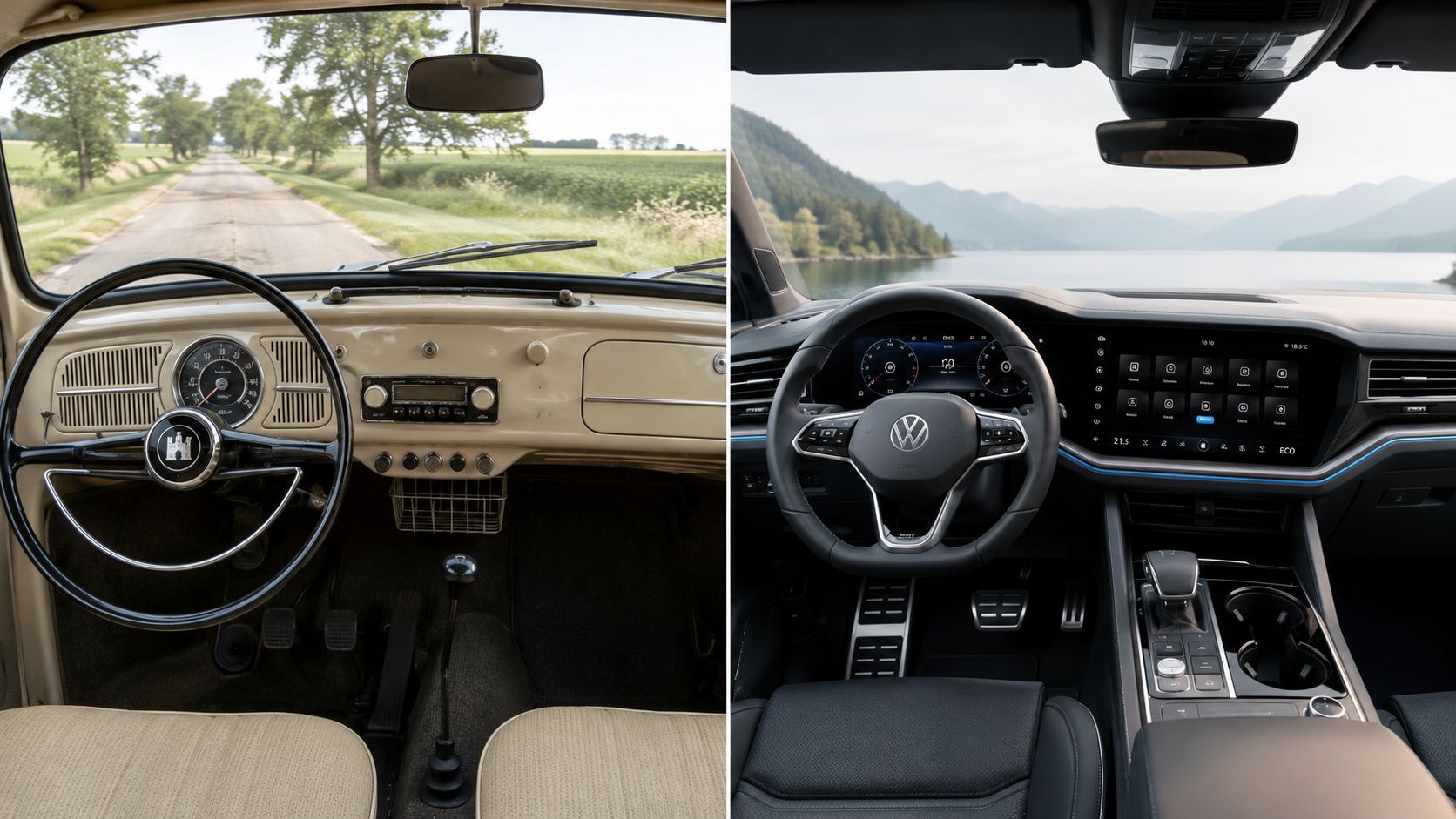
A moving look at the interior experience helps make the point better than words alone.
The dashboard shock for old-school VW people
If your ideal dash has painted metal, a thin steering wheel, and only the gauges you absolutely need, the Touareg's interior will feel like a spaceship. Screens, menus, driver aids, and digital interfaces replace the old mechanical plainness.
Some owners will love that. Some will miss the simplicity. Most will probably do both.
That's really the Touareg in one sentence. It's accomplished, very grown-up, and miles away from the cheerful sparseness that made so many of us fall in love with Volkswagens in the first place. Yet for the job it's meant to do, that polished nature is exactly the appeal.
Reliability and Running Costs in Australia
At this point, the romantic haze clears a bit.
A classic VW can be fiddly, sure, but its simplicity is part of the charm. You can look at it, understand it, and often fix plenty of things with ordinary tools, patience, and tea. The Touareg lives in a different universe. It's a premium, complex vehicle, and ownership needs to be approached with open eyes.
Complexity brings comfort, but also commitment
The reward is refinement. The price is that there's more going on beneath the skin, and more to think about when buying new or used. That doesn't automatically make the Touareg a bad ownership prospect. It just means buyers should treat it like an advanced machine rather than a simple old-school Volkswagen.
For anyone who enjoys the paperwork side of motoring history, there's something charming about keeping records properly too. Old logbooks and modern ownership records both matter, which is why collectors often get a kick out of items like a Volkswagen service book keepsake, even when talking about much newer models.
The plug-in hybrid cost trap
One of the more useful Australian insights concerns the Touareg R plug-in hybrid. A local road test found the car's claimed 51 km electric range was close to the 43 km achieved in that test, but once the battery was depleted, fuel use was estimated at about 10 L/100 km. The same review described the official 3.3 L/100 km figure as largely meaningless unless the battery is recharged very frequently. That detail comes from Chasing Cars' Touareg R review.
That's the sort of nuance many buyers need to hear.
- If you can charge often: The Touareg R's electrified side matters more.
- If you can't charge daily: Running costs may feel very different from the headline figure.
- If you do lots of long trips: A diesel-focused setup may align better with how you drive.
Buying the Touareg R on the official economy figure alone would be like judging a Kombi only by how nice it looks in sunset photos. You'd be missing the practical bit.
The sensible ownership mindset
The best approach is boring but effective. Buy carefully. Maintain properly. Don't pretend a flagship SUV will cost or behave like a simple classic.
That sounds less romantic than chatting about Beetles and Buses, but it's the truth. And fair reviewing means saying it plainly. The Touareg can be a lovely thing to live with, but the ownership experience depends heavily on choosing the right version for your routine, especially if you're tempted by the plug-in hybrid badge.
How the Touareg Stacks Up Against Its Rivals
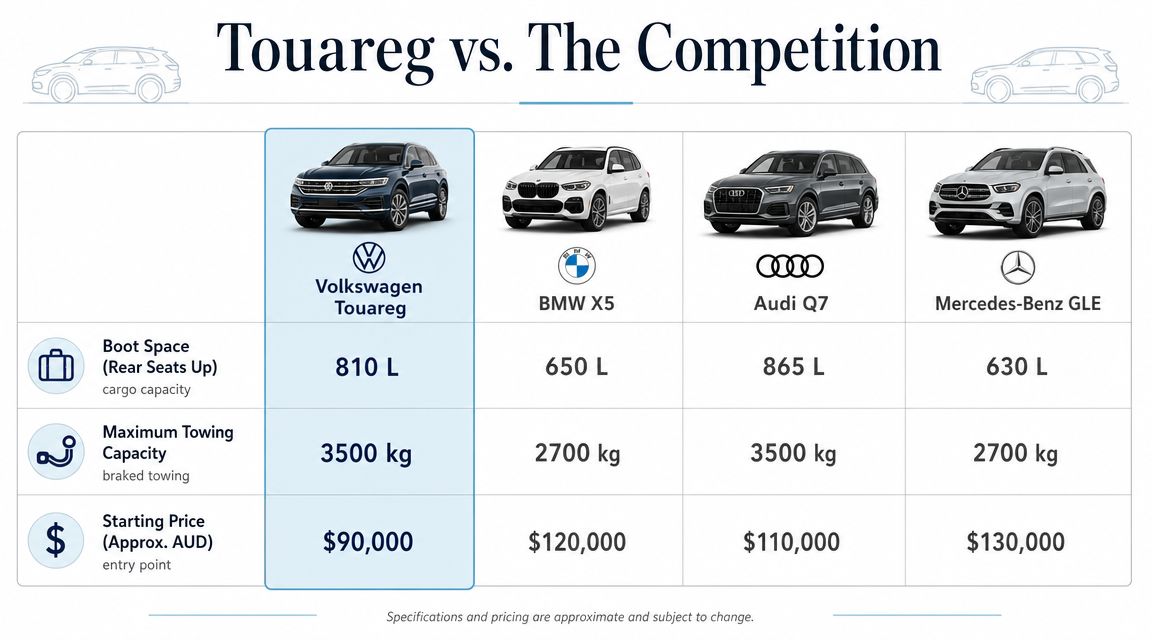
You're at the boat ramp before sunrise, coffee in hand, and parked nearby are the usual suspects. A BMW X5 with the polished-school-run look. An Audi Q7 that could pass for an airport shuttle in Toorak. A Mercedes-Benz GLE wearing that big-star confidence. Then there's the Touareg, sitting there like the quiet bloke from the VW club who used to own a Bay Window and now needs something that can tow, cruise, and keep the family happy on the way to Lakes Entrance.
That's where this comparison gets interesting for VW people. The Touareg is a long way from a Beetle with pop-out windows or a Kombi loaded with surfboards, but it still attracts buyers who care more about how a vehicle is engineered than how loudly it announces itself.
Where it earns its place
Among these big German SUVs, the Touareg tends to appeal to the buyer who wants the useful bits sorted first. Towing strength matters. Cabin comfort matters. Long-haul touring manners matter. It belongs in that serious-large-SUV chat, not as the flashy one, but as the one that often feels most honest about its job.
That honesty suits the badge.
A BMW X5 usually pulls buyers who want a more athletic flavour and the prestige that comes with it. The Audi Q7 speaks to families who like clean design and a polished, almost understated premium feel. The GLE has that unmistakable Mercedes presence, which is enough reason for some people before they've even opened the door.
The Touareg sits a little differently. It often feels like the choice for someone who has done the sums, driven the rivals, and decided they'd rather have quiet confidence than theatre.
Why classic VW fans might warm to it
If you grew up around old Volkswagens, there's a funny moment with the Touareg. You walk up expecting to feel nothing because it's huge, expensive, and full of technology your old Type 3 never dreamed of. Then you spend time with it and notice the familiar VW trait. The thing feels thoughtfully put together. Controls make sense. It has purpose.
That doesn't make it nostalgic. It makes it easier to respect.
The broader VW family has stretched a long way from air-cooled vans and cheerful little sedans. If you enjoy seeing how wide that spread now goes, the Volkswagen ID.4 side of the family shows just how far the badge has travelled.
The rival question in plain English
Choose the X5 if image and sharper road manners sit at the top of your list. Choose the Q7 if you want a close cousin in spirit with a different cabin and badge. Choose the GLE if the three-pointed star is part of the dream.
Choose the Touareg if you want the all-rounder.
It has the sort of appeal that grows on you. A bit like the mate who turns up to a VW meet in a tidy old Squareback, says almost nothing, then casually solves everyone's breakdown with a box of spares and a stubby holder full of zip ties. The Touareg carries itself like that. Less peacocking, more getting on with it.
For a classic VW enthusiast, that counts for plenty.
The Final Verdict A True Volkswagen at Heart?
If you define Volkswagen only by Beetles, Kombis, and cheerful simplicity, then no, the Touareg isn't a true Volkswagen in the old emotional sense. It's too polished, too complex, too premium, and too far removed from the humble charm that made so many of us fans.
But that's not the only way to judge it.
The Touareg still feels like a Volkswagen in its engineering mindset. It's thoughtful, solid, and built with a clear purpose. In Australian Volkswagen Touareg reviews, that purpose comes through strongest when people talk about long-distance comfort, diesel muscle, and real towing usefulness. It's a flagship for grown-up jobs, not a nostalgia machine.
So where do I land as a classic VW tragic? I wouldn't swap a tidy old Kombi for one. Not for a second. But I can absolutely respect it. The Touareg proves the badge can still stand for substance, even when the formula looks nothing like the old air-cooled legends.
If your heart still belongs to the classics, that's the fun of it. You can admire the Touareg for what it is, then head back to the good stuff at Volkswagen Memorabilia, where you'll find VW-themed gifts, coastal décor, and diecast favourites that celebrate the Beetles, Kombis, and Samba Buses most of us fell in love with first. Browse the shop collection, check out the Volkswagen diecast range, or pick a nostalgic piece that brings a bit of old-school VW spirit into your home, shed, or display shelf.