

You're standing beside a sunny Australian show field, eucalyptus in the air, while a restored Kombi burbles past and collectors compare paintwork, wheels and trim. On a nearby table, a little Samba Bus catches the light. It's small enough to hold in one hand, yet it carries the same sense of travel, freedom and character as the full-size Volkswagen beside it.
That's the appeal of diecast model cars. They're not merely toys. A well-made model preserves the shape, colours and details that make a Beetle, Kombi or Samba Bus memorable, while giving you a practical way to enjoy VW history at home. Whether you're building a display around a real car, choosing a birthday present or starting a collection from scratch, the right model should feel connected to the story behind the vehicle.
Welcome to the World of Diecast Model Cars
A good collection usually starts with a personal memory. Perhaps you rode in a Kombi during family holidays, owned a Beetle, or spent show day admiring a lowered Type 2 with polished trim. The model you take home doesn't need to be rare to matter. It needs to remind you why the vehicle has stayed with you.
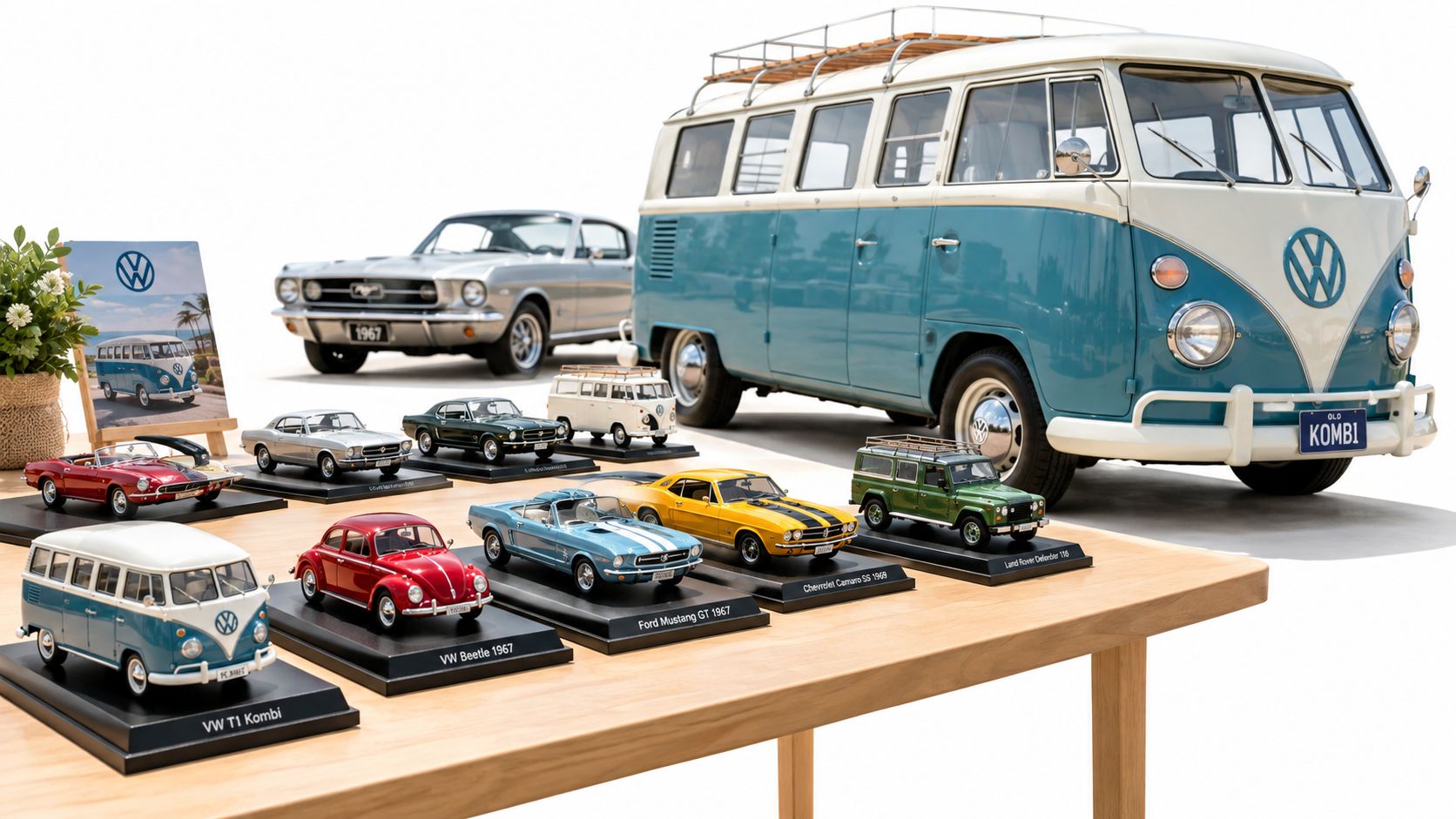
Australian collecting has a strong practical side. Display space is rarely unlimited, shipping can become awkward with larger boxes, and imported stock may involve uncertainty around availability, delivery and final cost. That's why scale, construction and licensing deserve attention before colour or packaging.
A useful collecting rule: buy the model you'll enjoy seeing every day, not simply the one that looks impressive in an online listing.
The local scene has depth behind it. Diecast Distributors Australia says it began in 1998 as the Australian distributor for Matchbox Collectibles, added Hot Wheels Elite within 12 months, and later expanded beyond 1,500 individual SKUs. Its DDA Collectibles brand now holds more than 150 tooling sets across scales from 1:64 to 1:18, evidence of a sector that has grown from importing branded products into broad wholesale distribution and local product development. Diecast Distributors Australia's market history puts that progress into perspective.
For a VW enthusiast, the best collection often mixes nostalgia with discipline. Choose a theme such as air-cooled Volkswagens, Australian heritage, surf culture or favourite show colours. Then let each addition earn its place.
Understanding Diecast Scales and Sizes
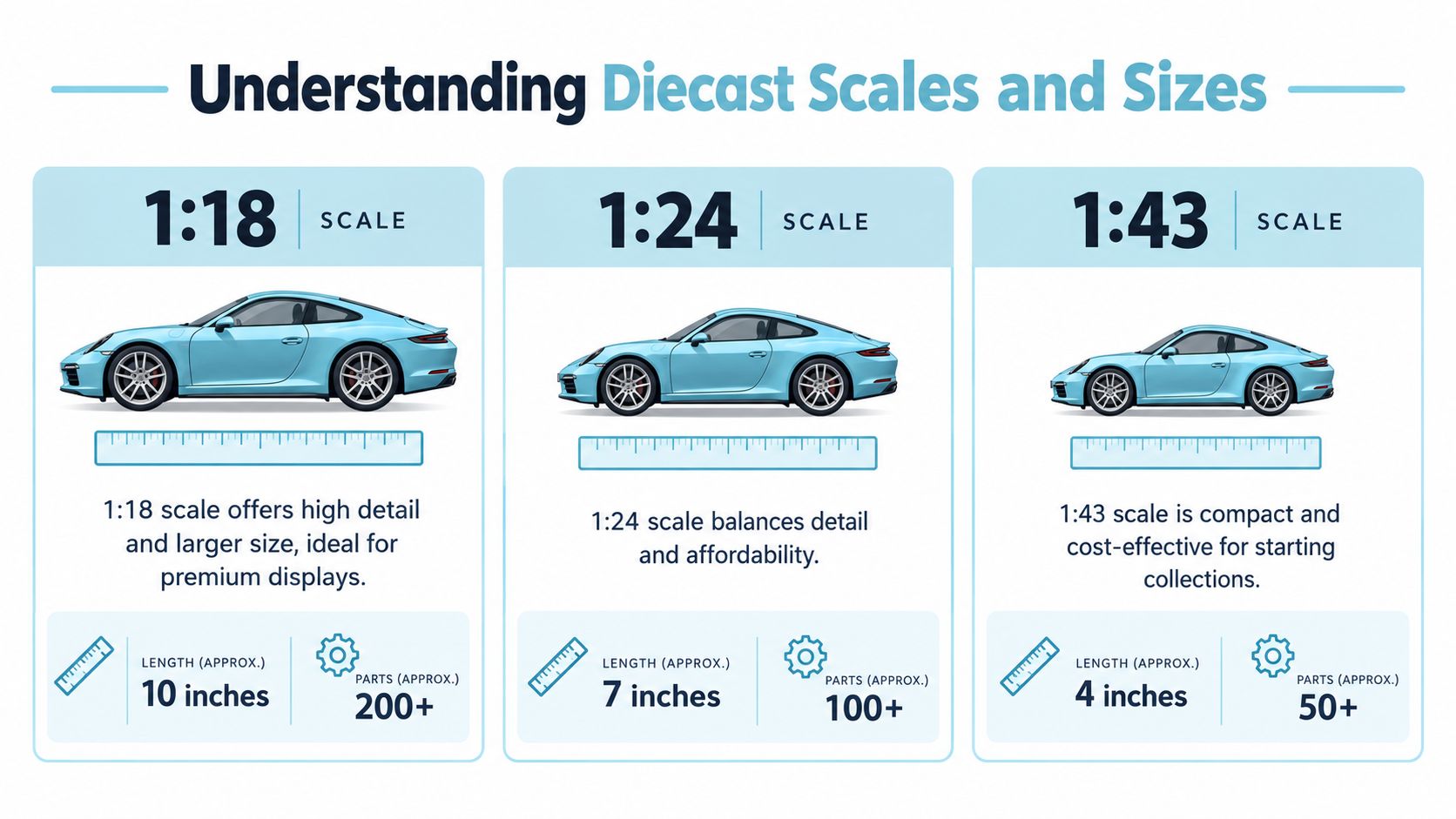
Scale tells you how large the model is compared with the actual vehicle. A 1:18 model is one-eighteenth the size of the original, while a 1:24 model is one-twenty-fourth. Collector guides generally place 1:18 models at about 9 to 12 inches long and 1:24 models at roughly 6.5 to 8 inches, with the larger format allowing more elaborate interior and engine-bay treatment. This scale guide explains the practical difference between the two formats.
The familiar Australian favourite is 1:43. Local hobby guidance describes it as the country's most popular diecast size, usually around 11 cm long, although the finished length depends on the actual vehicle. A compact 4.2 metre hatchback becomes about 9.8 cm at 1:43, while an 11 metre bus becomes about 25.6 cm. Anthony's Diecasts' model car size guide provides those comparisons and explains why the same scale can create very different shelf footprints.
Choosing the right format
| Scale | Best suited to | Main advantage | Main compromise |
|---|---|---|---|
| 1:18 | A statement display or detailed premium piece | Strong presence and room for fine features | Takes more shelf and storage space |
| 1:24 | A balanced display with several larger models | Useful middle ground between detail and footprint | Less expansive than 1:18 |
| 1:43 | Themed collections, gifts and compact shelving | Efficient storage with convincing detail | Smaller parts need careful handling |
A 1:43 Beetle works beautifully on a bookcase, desk or cabinet where you want several vehicles together. A 1:18 Kombi, by contrast, becomes the centrepiece. Before buying, measure the shelf depth, allow room for the packaging and remember that a long-wheelbase vehicle or bus can occupy considerably more space than a small car in the same nominal scale.
For a VW display, consistency matters more than chasing one “best” size. A row of 1:43 Volkswagens feels organised, while a single large Samba Bus can anchor a mixed arrangement. Explore the 1:18 diecast scale range when you want a feature model, and choose smaller formats when the collection itself is the visual story.
Materials and Build Quality in Diecast Models
The alloy beneath the paint affects how a model feels, holds detail and ages. Australian diecast and die-casting sources identify zinc and aluminium as core metal families. Zinc alloys generally produce heavier-feeling body shells with good dimensional stability, while aluminium is often selected where strength-to-weight, corrosion resistance and thermal conductivity are important. The Australian die-casting market overview also reports that aluminium die castings held a 50% share of the local components market in 2025.
Collectors should inspect more than the word “diecast” on the box. A zinc-die-cast body can support crisp grille lines, sturdy panels and a reassuring weight in the hand. Aluminium-based or mixed-material construction may reduce weight, but thin sections and surface finish can behave differently during production.
What to check before buying
- Body material: Look for clear information about zinc-die-cast bodywork, lighter alloy construction or mixed materials.
- Paint finish: Check whether colour sits evenly around door edges, roof gutters and wheel arches. Uneven coverage is more distracting on a bright Kombi.
- Glazing and trim: Clear windows, separate mirrors and cleanly fitted bumpers add realism, especially at 1:43.
- Tooling detail: Grilles, hubcaps, headlights and chassis features should look sharp rather than soft or moulded into a single flat surface.
- Licensing: Official Volkswagen branding supports authenticity and makes the model a stronger choice for a heritage-focused collection.
The practical takeaway is simple. Scale alone doesn't determine quality. Alloy selection, tooling complexity, paint application and assembly all matter, so compare the actual finish rather than assuming a larger model is automatically better.
The Heart of the Collection, Volkswagen Diecast Models
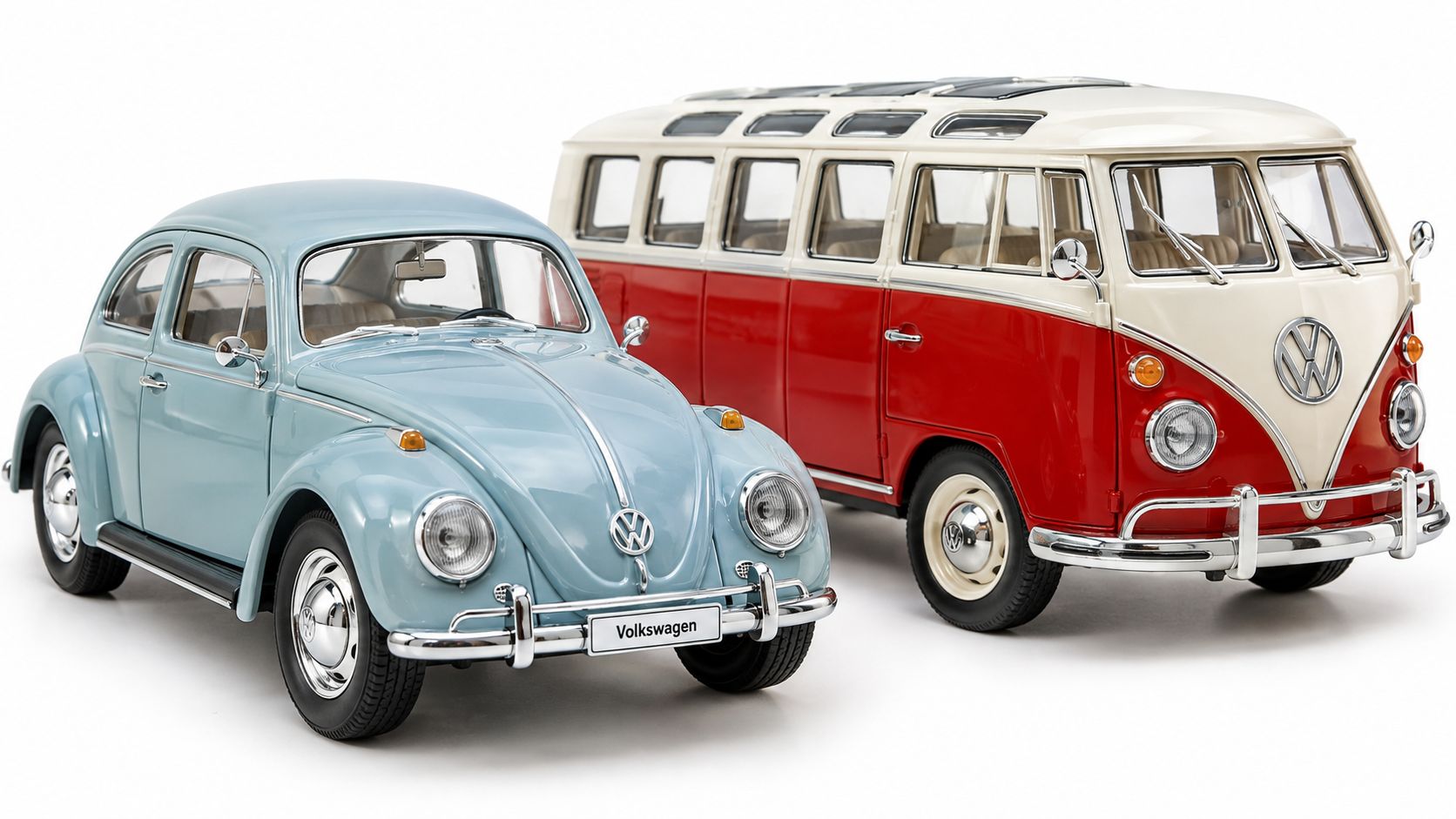
A VW model earns its place through character. The Beetle's rounded roof and friendly face are instantly recognisable, while the Kombi's upright body, split-window heritage and open-road associations invite a different kind of nostalgia. A Samba Bus adds another layer, with its bright colour schemes and holiday feeling making it a natural centrepiece for a display.
Volkswagen's Australian story gives these shapes extra meaning. Beetle assembly began at Clayton, Victoria, in 1954, using CKD kits, and Australian Beetle kit assembly ended in 1976. This Australian assembly history makes a Volkswagen Beetle model more than a generic classic car souvenir for local collectors. It connects the miniature vehicle to a real production chapter close to home.
The Type 2 entered production in March 1950, and Volkswagen had sold 4.5 million Kombis worldwide by the time the Australian club history was written. Australian assembly began in the 1950s, while Clayton-built Kombis were later produced largely from local parts between 1959 and 1968. Club VeeDub's Type 2 history provides valuable context for collectors drawn to Australian Kombi heritage.
Collecting with VW culture in mind
At Volksfest, VW Nationals or a local Surf Show and Shine, authenticity matters. Enthusiasts notice whether the badge, body line, wheel style and colour belong to the vehicle's era. Officially licensed models are therefore a sensible foundation, particularly when the collection celebrates a specific Volkswagen rather than just a general retro look.
The Kombi also has a distinctly Australian emotional register. Local enthusiasts assembled and used these vehicles for work, holidays and surf trips, helping the Type 2 become part of the country's motoring identity. CarsGuide's look at Australian Kombi culture captures why the model continues to turn heads at community events.
A good display might pair a Volkswagen Beetle model with a Samba Bus, then add a colour or theme that reflects your own car. The result feels curated rather than crowded.
Top Brands and Where to Buy in Australia
Brand reputation helps narrow the field, but inspection still matters. A respected manufacturer may offer different finish levels across its range, while a smaller licensed release can reproduce a particular Volkswagen variant with surprising accuracy. Choose the vehicle and scale first, then compare construction, paint, glazing, wheels and packaging.
Australian collectors benefit from established local distribution. Diecast Distributors Australia began in 1998 and now lists more than 1,500 SKUs alongside over 150 DDA Collectibles tooling sets. Its range covers formats from 1:64 to 1:18, although 1:43 remains a practical choice for many Australian VW displays because it balances detail with shelf space.
Local buying versus imported stock
| Buying route | Where it works well | Watch carefully |
|---|---|---|
| Australian retailer | Local stock, domestic dispatch and easier support | Popular colours may sell through |
| Imported listing | Unusual variants and harder-to-find releases | Shipping, packaging damage and final landed cost |
| Mixed pack | Gifts, starter collections and variety | Less control over every colour or model |
| Single premium model | Focused displays and special occasions | Higher entry price and greater expectation of finish |
Domestic stock usually means quicker delivery, simpler returns and fewer surprises when a parcel arrives. Imported listings can fill gaps in a collection, especially for uncommon Kombi, Beetle or limited-edition variants. Check the seller's measurements, packaging method and total delivered cost before comparing prices. Currency conversion and international postage can change the apparent bargain.
Australian Etsy listings show Volkswagen die-cast items around AU$60.81 to AU$67.76, while rare listings range from roughly AU$22.84 to AU$110.80. The Australian Volkswagen die-cast marketplace demonstrates why condition, licensing, rarity, scale and local availability belong in the same decision.
For a wider comparison of manufacturers and finish levels, consult the best diecast car brands. The strongest purchase has clear provenance, sound packaging and details that still matter after the initial excitement fades.
Caring for and Displaying Your Diecast Collection
Australian conditions can be hard on a display. Strong sunlight may fade paint, humidity can affect metal and plastic components, and temperature swings can stress packaging and adhesives. A model doesn't need elaborate museum treatment, but it does benefit from a stable, clean environment.
Keep the main display away from direct windows, heaters and damp areas. A cabinet with doors reduces dust, while a shallow riser lets rear vehicles remain visible without forcing you to pack the shelf tightly. For open shelving, use a soft detailing brush and a clean microfibre cloth. Don't spray cleaner directly onto the model, especially near glazing, decals or moving parts.
Display habit: rotate the models you handle most, and keep scarce or fragile pieces behind a closed door.
Retain boxes, inserts and any paperwork. Original packaging helps protect mirrors, aerials and delicate trim during a move, and it preserves the model's identity if you later sell or trade it. Store boxed models flat where possible, without placing heavy items on top.
For a more polished setup, consider display cases for models. The best case isn't necessarily the largest. It's the one that gives each Kombi, Beetle or bus enough breathing room to be seen clearly.
Start Your Diecast Journey Today
A meaningful collection doesn't need to begin with a rare release or a full cabinet. Start with the Volkswagen that means something to you, whether that's a Kombi Samba Bus, a classic Beetle or a bright Flower Power variant, then build around its story. Australian collectors can also choose local stock and fast shipping, which makes it easier to buy thoughtfully, find gifts and avoid unnecessary import uncertainty.
Licensed Volkswagen diecast models turn familiar shapes into lasting display pieces. They suit a show enthusiast, a classic car owner, a nostalgic traveller or anyone who still believes a Kombi makes an ordinary day feel like a holiday.
Volkswagen Memorabilia brings together licensed Volkswagen diecast models, Kombi Samba Bus pieces, Beetle designs and VW memorabilia collectibles for displays and thoughtful gifts. Browse the curated range and visit Volkswagen Memorabilia to find the model that belongs on your shelf.