

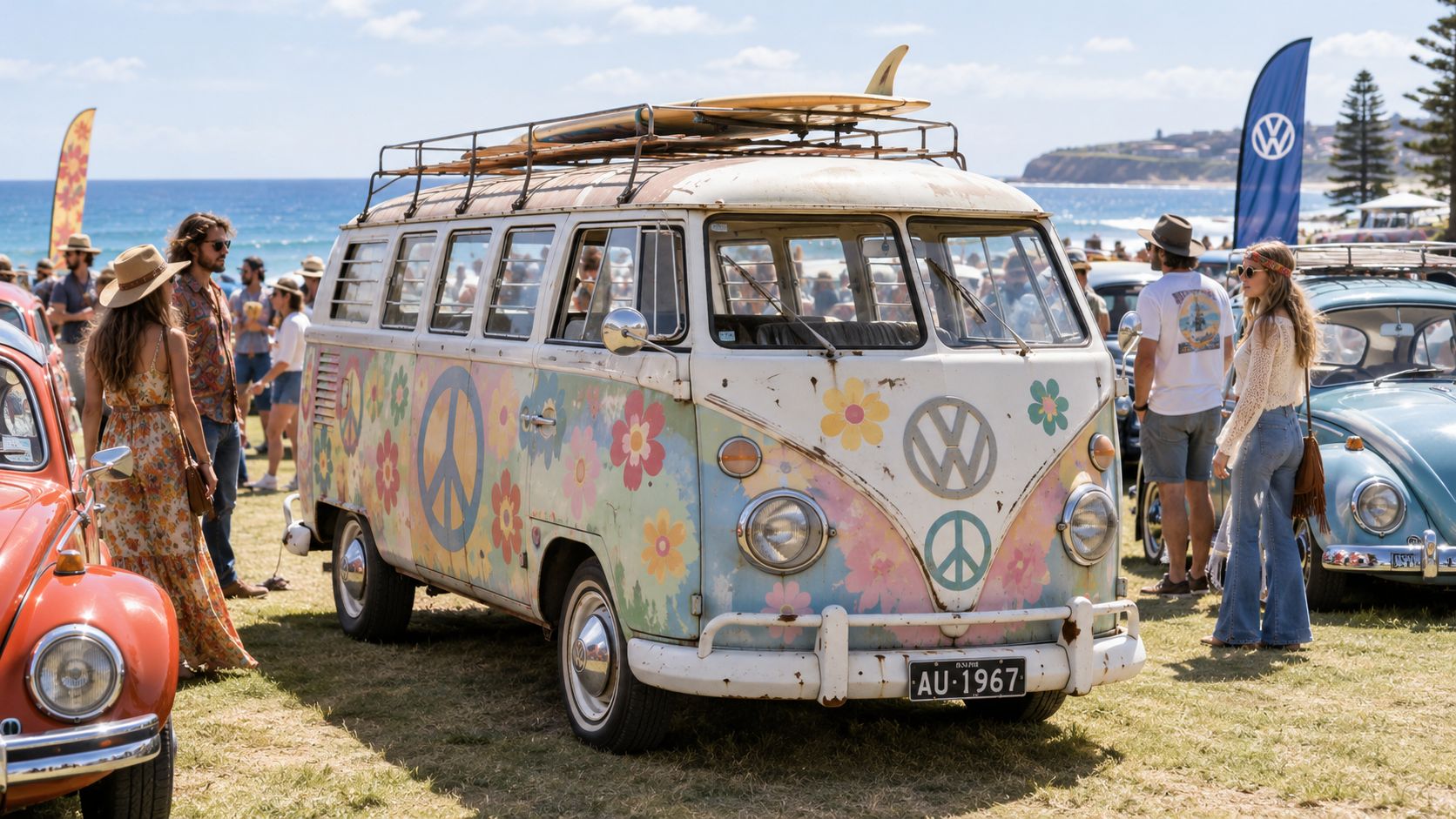
You know the feeling. You're standing at a sunny VW show, coffee in hand, and a flower-power Kombi rolls in with surfboards on the roof, a Beetle gleaming beside it, and suddenly you're staring at the whole scene, not just the cars. That's where vintage car memorabilia really lands, it turns a passing glance into something you can take home, hang on the wall, or set on a shelf and enjoy every day.
For a lot of us, the first piece isn't a museum-grade treasure at all. It's a diecast Kombi from a market stall, a retro sign for the shed, a little badge picked up after a club run, or a print that reminds you of summers, road trips, and the old air-cooled crowd. In Australia, that sort of collecting makes sense because the VW story here is proper deep, from local Beetle assembly history to the Kombi's place in everyday motoring culture.
What Vintage Car Memorabilia Really Means Today
At a coastal show, the memorabilia table often tells its own story before the trophies come out. One person is drawn to a licensed Beetle model, another is lining up enamel signs, and someone else is holding a postcard or framed print because it brings back a Kombi they rode in as a kid. That mix is exactly why vintage car memorabilia works so well, it is memory you can handle, not just shelf filler.
More than one kind of collector's object
The category spans diecast models, badges, posters, books, photographs, apparel, signs, ornaments, and themed décor. Some pieces are meant for close viewing in a cabinet, while others are there to give a room a bit of surfy mood without pretending to be museum relics. A licensed Kombi diecast and a retro wall print might both say “VW”, but they do very different jobs in a display.
That distinction matters. Officially licensed collectibles carry brand and model credibility, while decorative replicas focus more on atmosphere. Generic retro décor can still look great in a beach house or garage, but it usually does not give the same collector confidence or model-specific meaning.
Practical rule: buy the piece for the story it tells, not just the way it looks on the day you unwrap it.
For apartment dwellers, gift buyers, and coastal-home decorators, that story is often the whole point. A small Beetle on a shelf can bring back a classic Aussie summer without needing a driveway, a shed, or a restoration budget. If you are chasing that sort of piece, a good starting point is the Volkswagen diecast selection, where Kombis, Beetles, and surfy variants sit in one easy-to-browse place.
The charm of VW memorabilia is how neatly it sits between hobby and home styling. A Kombi model can be a collector's item, a conversation starter, or a cheerful reminder of road trips and beach culture. For more VW-specific pieces, the Volkswagen diecast selection shows how broad the category can be while keeping its air-cooled heart.
Australian VW History That Gives Memorabilia Meaning
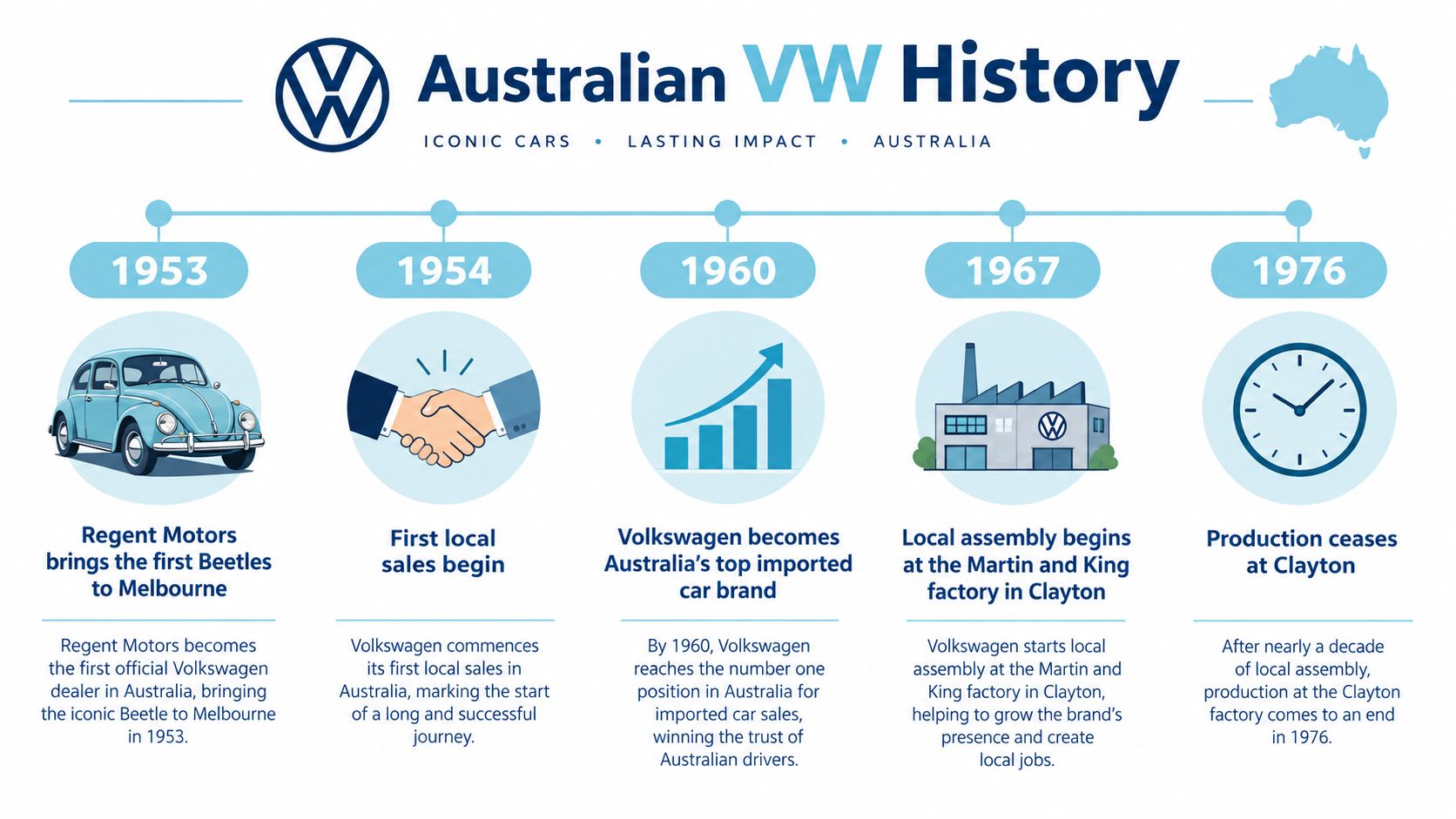
A Beetle badge or a Kombi miniature feels different once you know the local story behind it. Museum Victoria records that the first Volkswagen Beetles officially entered Australia through Melbourne-based Regent Motors in late 1953, apart from a few private imports and two cars brought in for Department of Munitions examination. That puts a small replica in a real Australian motoring context, which is why collectors care so much about provenance.
The Beetle dates that collectors keep in mind
Local Beetle assembly began at the Martin & King railway-carriage factory in Clayton, Melbourne, in 1959, and more than 260,000 Beetles had been made locally by the time that production run ended in 1968. The last new Australian-assembled Beetle appeared in 1976, according to Museum Victoria's account of the model's local history. Those dates help you separate an Australian-assembled car from a later imported example, which matters if you are buying a model, a photo caption, or a display piece with a specific heritage story.
A Clayton-era Beetle badge, print, or scale model carries a chapter of Australian manufacturing along with the nostalgia. That is a very different feel from generic retro styling, and it explains why collectors ask where the car, artwork, or reference came from.
The Kombi has its own strong local story. According to an Australian Volkswagen history record, the first Volkswagen commercial vehicles arrived from Germany in 1954, and in 1975 the Kombi reportedly held more than 60 percent of Australia's one-tonne commercial-vehicle market. A Samba Bus model picks up a bit of swagger from that, because it points to real commercial success as well as beach-day symbolism. You can trace more of that model history through Volkswagen memorabilia with local context.
Why body style and generation matter
The same history source identifies several Type 2 formats that collectors may meet in old references, including single- and double-cab pickups, panel vans, factory-window Kombis with removable seats, and Microbuses with proper seats and full upholstery. It also notes that the second-generation T2 arrived in 1968 with more room, improved safety, double-joint rear axles, a 1600 engine, and a panoramic windscreen. Australian-built production ended with the T2 era, while German imports continued until 1979.
For memorabilia buyers, those details matter. A window arrangement or body style can separate a generic retro van from a piece that points to a real Australian motoring story. That is why a period-correct Kombi diecast can feel far more satisfying than an anonymous van shape, especially if you have spent time around clubs, shows, and restorations.
Key Categories Every New Collector Should Know
A sunny car show in Australia can sort out a new collector fast. One table has a row of Beetle badges, the next has enamel signs, and somewhere nearby a Kombi shelf is doing most of the talking. That is the charm of vintage car memorabilia, because it is not one lane at all, it is a small parking lot of pieces that serve different jobs. Some are built for display, some carry nostalgia, some are easy everyday buys, and a few manage all three.
What belongs in a VW memorabilia collection
A solid starter collection usually mixes licensed diecast models, enamel signs, posters, badges, keychains, photo frames, and themed décor. Diecast models often do the heavy lifting, since a Beetle, Kombi, or Samba Bus gives the eye a clear focal point. Signs and posters add wall presence, while badges and keychains work well on desks, shelves, and in gift boxes.
The best pieces feel deliberate. Print should be sharp, colours should look right, and the model should match the actual vehicle shape instead of drifting into a loose retro look. A surf-inspired Kombi with a board, or a Beetle in Flower Power style, sits naturally in a coastal room because it ties the car to a lifestyle, not just a badge.
For diecast buyers, scale helps more than guesswork.
| Scale | Approx length | Display role |
|---|---|---|
| 1:18 | 25-30 cm | Centrepiece, strong shelf presence |
| 1:24 | 16-20 cm | Balanced display piece, good for desks and cabinets |
| 1:32 | 12-15 cm | Compact showcase model |
| 1:50 | 10-12 cm | Small display, works well in mixed décor |
| 1:64 | 7-8 cm | Group display, gift-friendly, easy to fit several models |
| 1:87 | 5-6 cm | Tiny cabinet accent, best for tight spaces |
A larger model usually gives more detail and a stronger visual hit, while smaller scales let you group several Volkswagens without crowding the room. If shelf space is tight, the diecast display cases and scale-friendly accessories can help match the piece to the space instead of leaving it to guesswork.
Licensed models stand apart
Licensed Volkswagen diecast models sit in a different lane from generic retro toys because the branding and model identity are recognisable. That matters when the piece is meant to do more than sit there and look cheerful. A Beetle or Kombi that feels accurate gives the collector a better sense of place, especially if it is being bought as a gift or a keepsake.
For a new buyer, that is usually the sweet spot. You want something that looks good, feels authentic, and does not need a full restoration budget to make you smile. A licensed model with clear packaging and tidy presentation also makes it easier to buy a Kombi piece for a beachy home or a VW shelf without second-guessing the pick.
How to Authenticate and Evaluate Condition
At a sunny Aussie car show, the pieces that stop people in their tracks are usually the ones with a story behind them, not just a shiny face. Treat every item like evidence rather than decoration. Rarity, originality, condition, restoration quality, and paperwork all tell you more than the gloss ever will, whether you're looking at a diecast Beetle, a metal sign, or a brochure that's survived a few swap meets.
Start with the paper trail
If the item still has its original packaging, keep it. If it came with a receipt, club note, certificate, or seller history, keep that too. For memorabilia tied to a specific Volkswagen, preserve the approximate date, the event or vehicle connection, and any printed material that came with it. Those details make later insurance, estate, or resale assessment much easier to support.
Practical rule: a polished surface with no context is just a look, a clean trail of ownership is the provenance story.
A thick folder is not needed for every piece. A dated photo, a well-kept box, or a note from the seller can carry real weight. That matters even more for collectors chasing a coastal vibe, where a Kombi badge, a beachy enamel sign, or a tidy model on a shelf needs to feel authentic, not staged.
What to check before you hand over cash
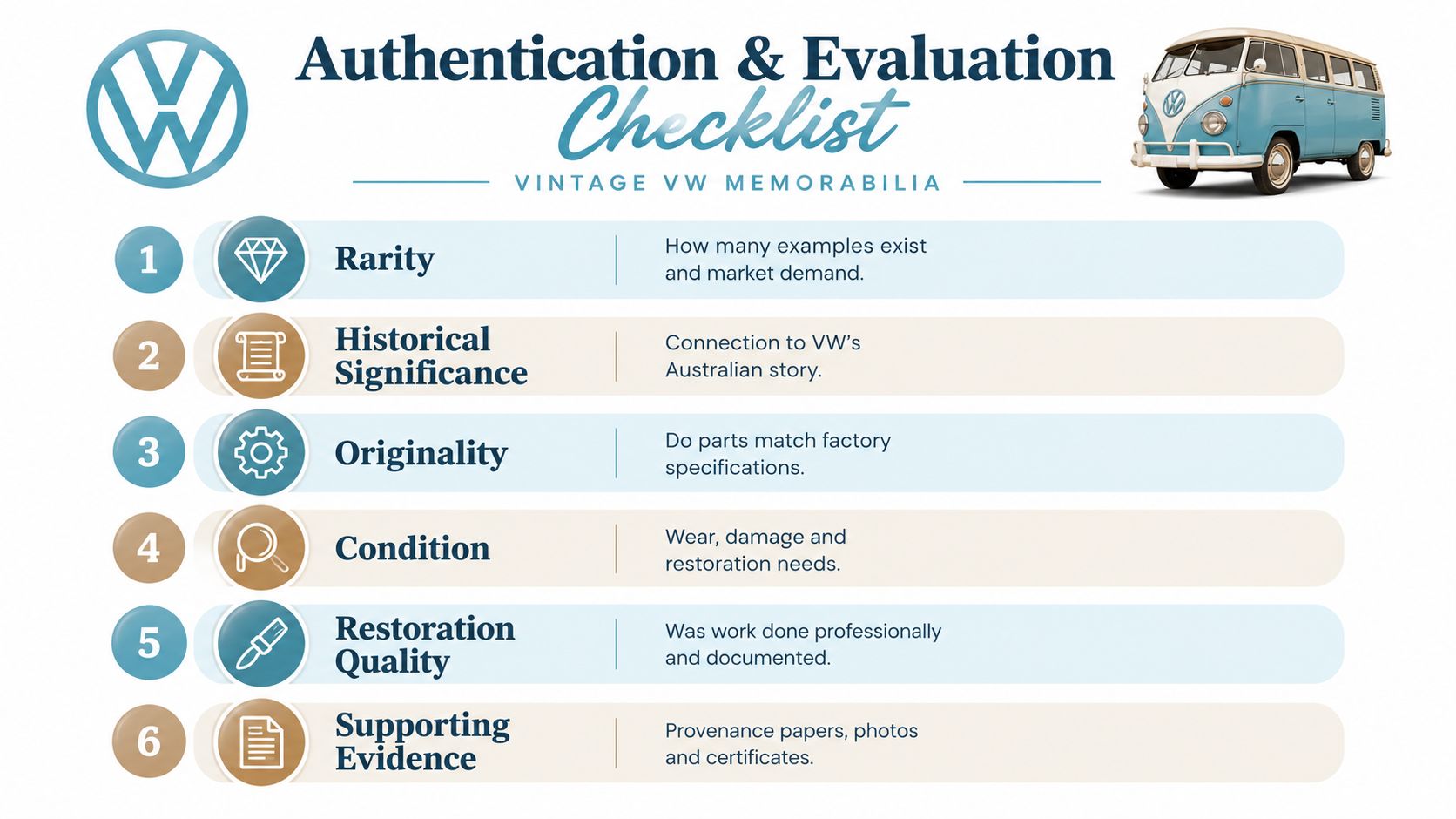
- Rarity and demand: Ask how often similar pieces show up, and whether the item is a common decorative knock-off or a licensed model.
- Originality: Check whether the colours, logos, badges, trim, or printed artwork match the expected design.
- Condition: Look for chips, scratches, sun fade, foxing on paper, and missing parts on models.
- Restoration quality: If something has been repaired, ask whether the work was done professionally and whether it's documented.
- Supporting evidence: Keep photos, packaging, and ownership notes together so the item keeps its story.
Good sellers usually welcome those questions. Collectors care about authenticity more than a glossy pitch, especially with VW-themed logos, badges, and branded pieces. The Volkswagen logo history reference page is a handy reminder that small branding details can change how a piece is read.
Display and Care Tips That Protect Value
Bad storage flattens a beautiful collection faster than anything else. Keep paper, photos, posters, and mixed-material pieces away from direct sun, heat, damp corners, and anything that can transfer oils, acids, or plasticisers. The National Library of Australia says preservation means reducing hazards in an item's surroundings and weighing its life cycle, condition, significance, intended use, and operating context before any treatment is chosen.
Build the display around the material
A good cabinet does more than look tidy. It keeps dust off, cuts down on handling, and gives you control over light and airflow. For diecast models, use stable shelves and leave enough clearance around opening doors, mirrors, display bases, and surfboards so the piece does not feel cramped.
Paper items need their own care. Brochures, photographs, and posters do best in archival enclosures and stable surroundings, not in a steamy bathroom or on a hot garage wall where afternoon sun hammers the glass. If you want a display that ages well, use UV-filtering glazing, inert supports, and occasional condition photographs so fading or mould shows up before it becomes permanent.
A simple room-by-room guide
- Cabinets: Best for diecast models and signed or boxed pieces because they reduce dust and handling.
- Walls: Great for posters and signs if they are kept out of direct sunlight.
- Shelves: Fine for small models, as long as the shelf is level and strong enough.
- Garages and attics: Use with caution, because heat swings and moisture can be rough on paper and paint.
- Mixed displays: Keep metals, plastics, and paper apart where possible so materials do not react over time.
The little details matter more than people think. A model placed on an inert mount, a brochure stored flat, or a sign kept out of the afternoon glare can hold its presentation far better than a rushed setup. If you are putting together a showcase, the display cases for models are worth a look because they make shelf planning much easier.
Keep the display clean, keep the light soft, and keep the humidity stable. That is the boring part of collecting, and it is also the part that saves the good stuff.
For VW memorabilia, good care keeps the colour, print, and shape honest for years, so the piece still feels special on a quiet weekday, no museum gloves required.
Collecting Versus Investing in Today's Market
A bloke might buy his first piece for the sheer grin it brings, then realise later it sits nicely in the collection and might even hold its value. That happens, and it happens often enough at a sunny car show when a minty Beetle tin sign or a well-kept Kombi model pulls a crowd. Vintage car memorabilia tends to work best as a collectible or display piece first, and an investment second.
The honest read on value
Australian market conditions have softened in parts of the wider collector-car scene, with prices easing and listings taking longer to shift, while scarce pieces with real history still draw attention. Online collector-car sales across Australia and New Zealand have stayed active too, with Collecting Cars, the major platform in question, reporting more than AU$80 million in sales, over 1,100 successful auctions, and a clearance rate 30% higher than in 2024 in 2025. That shows there is plenty of action, but it does not mean every badge, brochure, or miniature will behave like a blue-chip asset.
The common mistake is assuming strong full-car auction results automatically flow through to memorabilia. They usually do not. A diecast Kombi, a badge, or a sign tends to hold up better when it has licensed production, documented provenance, local relevance, condition, and clear model identity. A clean, original piece from the right period can still be the one that gets the nod from collectors who know their VWs.
Who's buying what now
Younger buyers, first-time collectors, and renters often gravitate toward European, Japanese, and identity-led themes rather than old-school muscle-car symbolism. That makes room for pieces that feel at home in coastal places, like Flower Power Kombis, surf-themed Beetles, and compact display items that suit apartments as well as garages. Around Byron, the Gold Coast, or a breezy Perth place with salt in the air, VW memorabilia just fits.
If you're weighing an object's value, ask three plain questions.
- Would someone else recognise and want this exact piece later?
- Can I prove what it is and where it came from?
- Am I buying it because I love it, or because I expect a return?
If the honest answer is “I love it,” that is usually the right call. If the answer is “I want resale potential,” focus on scarcity, condition, documentation, and relevance to Australian VW history rather than assuming all retro items rise together.
Smart Buying and Sourcing in Australia
Where you buy matters as much as what you buy. Club shows, swap meets, estate sales, online auctions, and licensed local importers all offer a different experience. At a show, you can pick up the piece and talk to the seller face to face. Online gives you range and convenience. Local importers usually mean stock that is already here, with less guesswork about what lands on your doorstep.
Where Australian collectors tend to shop
A strong local scene gives buyers plenty of places to look. The Australian VW community is broad and well organised, with a national survey of 2,430 owners and enthusiasts covering 6,511 vehicles, 98% of owners belonging to historic-vehicle clubs, and an average of 1.8 national club memberships per owner. That kind of network is why pieces move through club tables, swap rows, and word-of-mouth sales so easily. It also means collectors are used to asking proper questions about provenance, packaging, and detail.
Read listings with a cold eye. Check the scale, the packaging condition, any licence details, and whether the seller shows the actual item rather than a stock image. Small mixed packs can be a smart first buy for new collectors and gift buyers, because they let you test a shelf theme before you commit to a larger display.
Australian stockists have another practical advantage. Local shipping is usually quicker, support is easier to reach during weekday hours, and returns are far less painful than dealing with an overseas parcel that has wandered halfway around the globe. If you are after licensed Volkswagen diecast models, a specialist like Volkswagen Memorabilia – diecast models is one option among several Australian sources that focuses on VW-themed gifts, Kombi and Beetle replicas, and coastal décor.
A first shelf works best when it feels chosen, not crowded. Start with one Beetle or Kombi diecast, add a small display accessory, and settle on one theme, surf, Flower Power, or heritage, so the display feels deliberate. In a place with salt in the air, that mix suits the room as much as the garage.