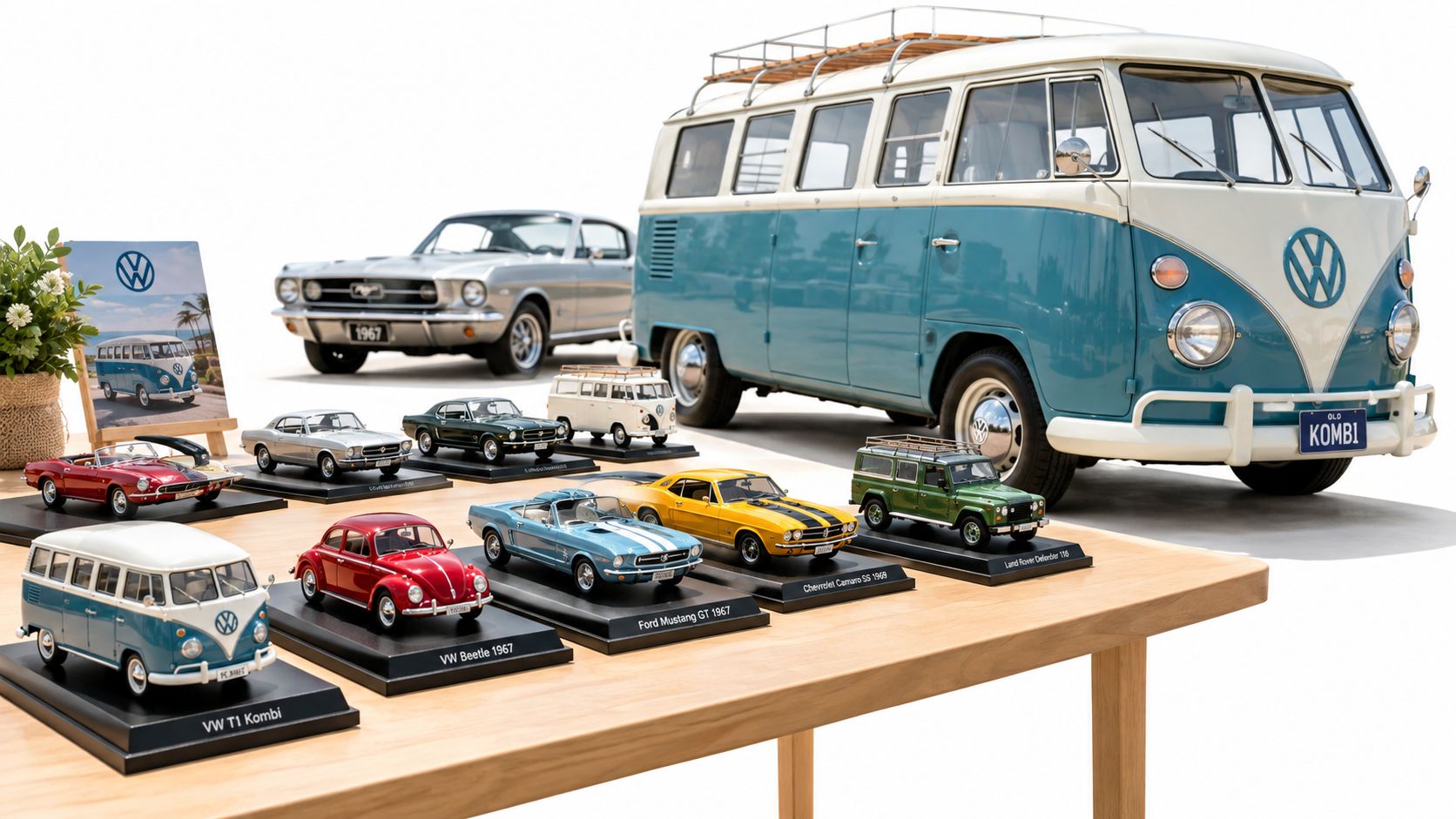
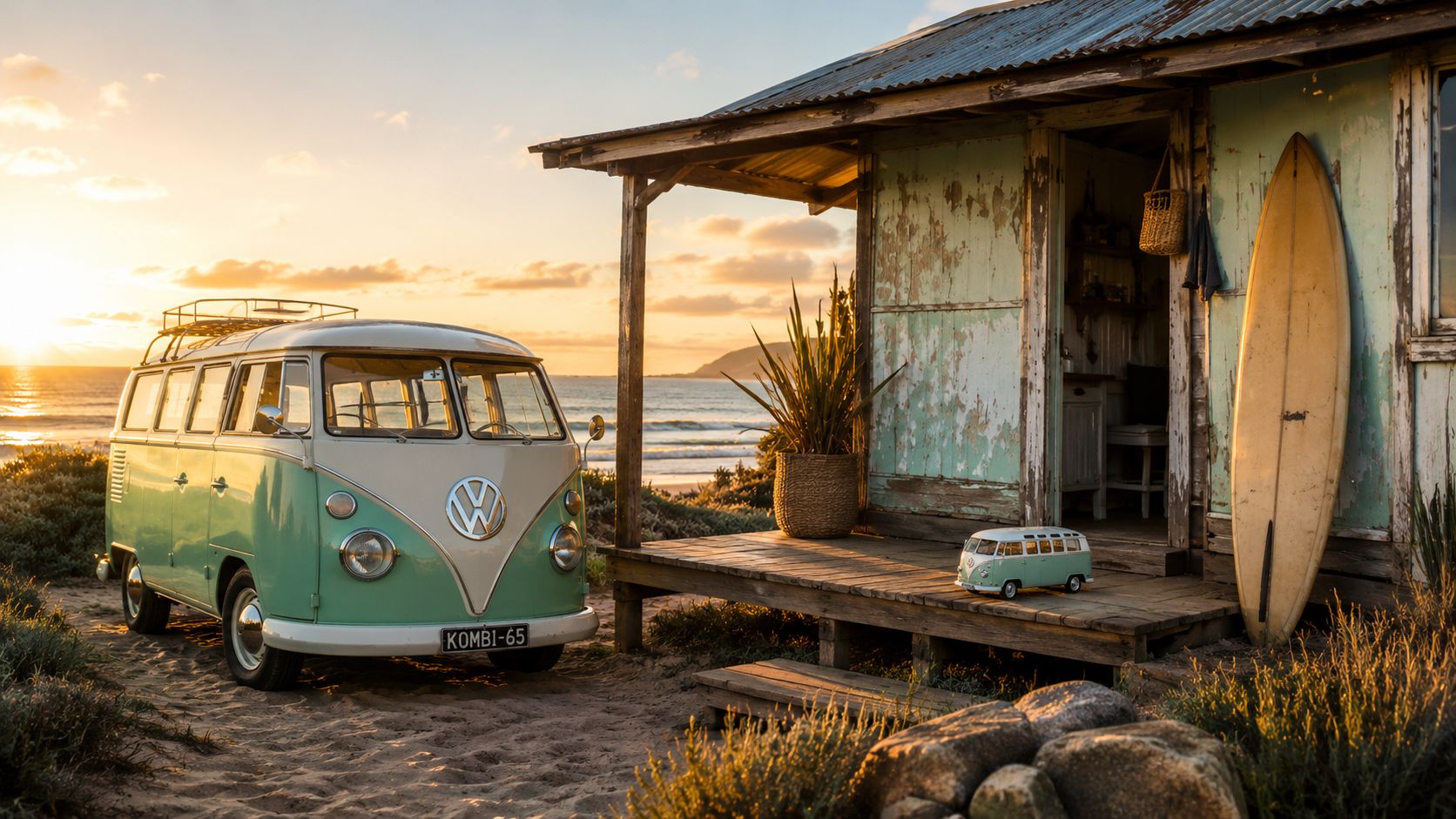
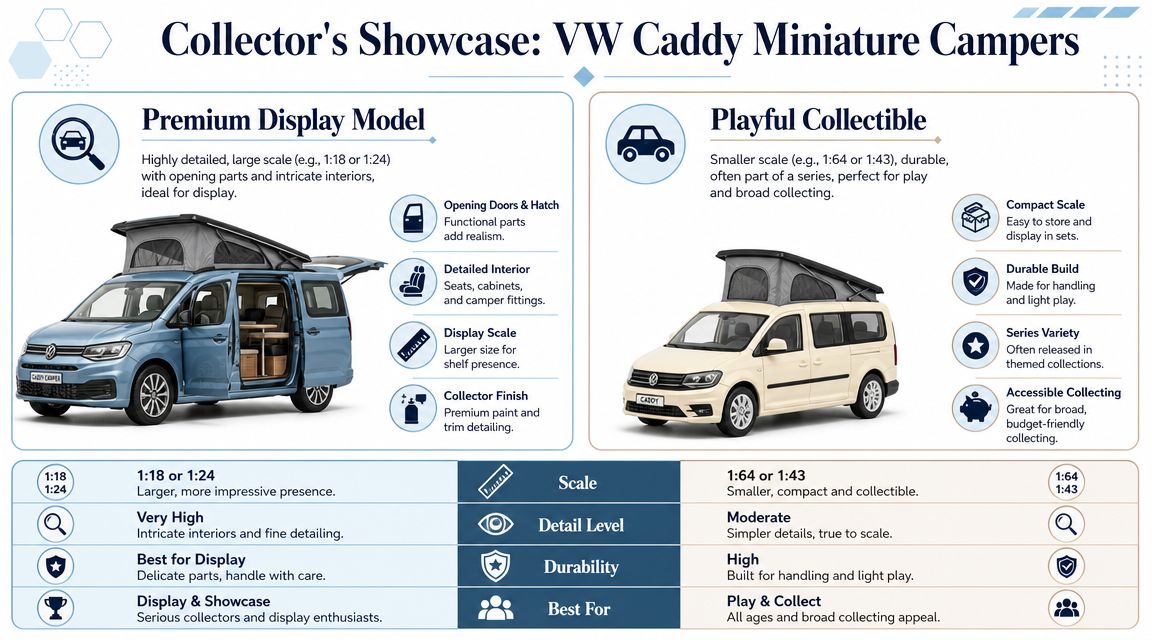
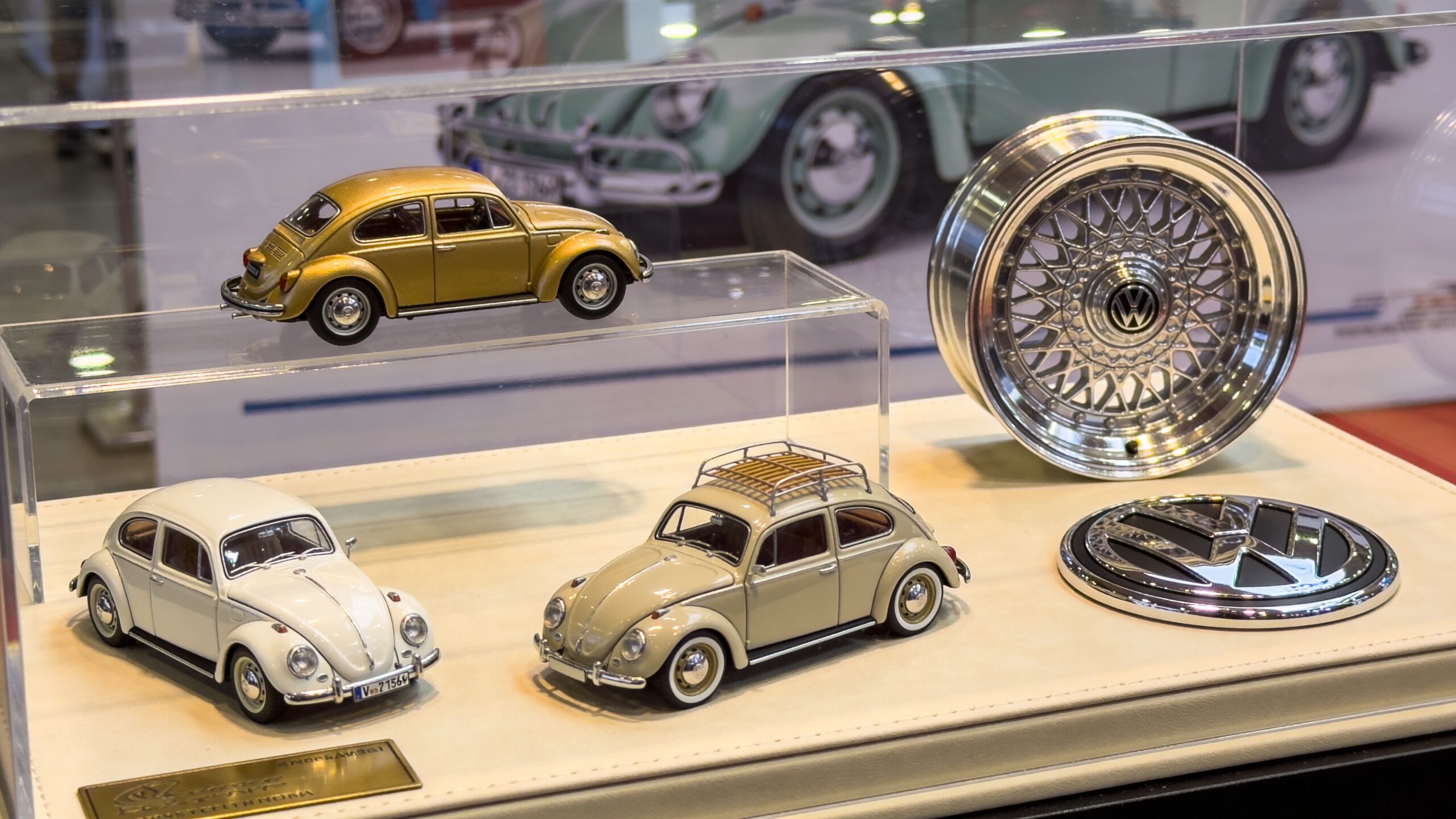
You're standing beside a sunny Australian show field, eucalyptus in the air, while a restored Kombi burbles past and collectors compare paintwork, wheels and trim. On a nearby table, a little Samba Bus catches the light. It's small enough to hold in one hand, yet it carries the same sense of travel, freedom and character as the full-size Volkswagen beside it.
That's the appeal of diecast model cars. They're not merely toys. A well-made model preserves the shape, colours and details that make a Beetle, Kombi or Samba Bus memorable, while giving you a practical way to enjoy VW history at home. Whether you're building a display around a real car, choosing a birthday present or starting a collection from scratch, the right model should feel connected to the story behind the vehicle.
Welcome to the World of Diecast Model Cars
A good collection usually starts with a personal memory. Perhaps you rode in a Kombi during family holidays, owned a Beetle, or spent show day admiring a lowered Type 2 with polished trim. The model you take home doesn't need to be rare to matter. It needs to remind you why the vehicle has stayed with you.
Australian collecting has a strong practical side. Display space is rarely unlimited, shipping can become awkward with larger boxes, and imported stock may involve uncertainty around availability, delivery and final cost. That's why scale, construction and licensing deserve attention before colour or packaging.
A useful collecting rule: buy the model you'll enjoy seeing every day, not simply the one that looks impressive in an online listing.
The local scene has depth behind it. Diecast Distributors Australia says it began in 1998 as the Australian distributor for Matchbox Collectibles, added Hot Wheels Elite within 12 months, and later expanded beyond 1,500 individual SKUs. Its DDA Collectibles brand now holds more than 150 tooling sets across scales from 1:64 to 1:18, evidence of a sector that has grown from importing branded products into broad wholesale distribution and local product development. Diecast Distributors Australia's market history puts that progress into perspective.
For a VW enthusiast, the best collection often mixes nostalgia with discipline. Choose a theme such as air-cooled Volkswagens, Australian heritage, surf culture or favourite show colours. Then let each addition earn its place.
Understanding Diecast Scales and Sizes
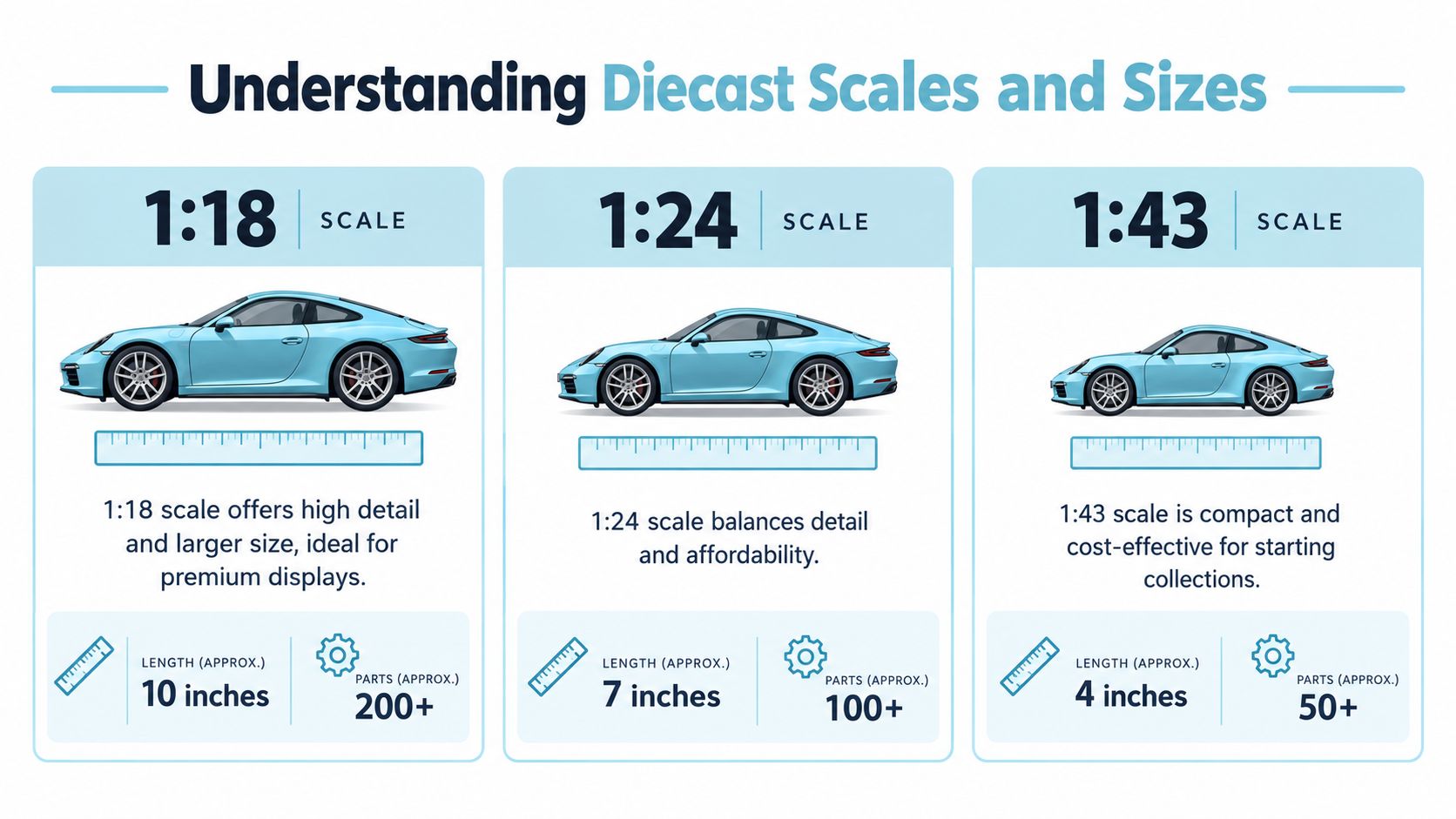
Scale tells you how large the model is compared with the actual vehicle. A 1:18 model is one-eighteenth the size of the original, while a 1:24 model is one-twenty-fourth. Collector guides generally place 1:18 models at about 9 to 12 inches long and 1:24 models at roughly 6.5 to 8 inches, with the larger format allowing more elaborate interior and engine-bay treatment. This scale guide explains the practical difference between the two formats.
The familiar Australian favourite is 1:43. Local hobby guidance describes it as the country's most popular diecast size, usually around 11 cm long, although the finished length depends on the actual vehicle. A compact 4.2 metre hatchback becomes about 9.8 cm at 1:43, while an 11 metre bus becomes about 25.6 cm. Anthony's Diecasts' model car size guide provides those comparisons and explains why the same scale can create very different shelf footprints.
Choosing the right format
Scale
Best suited to
Main advantage
Main compromise
1:18
A statement display or detailed premium piece
Strong presence and room for fine features
Takes more shelf and storage space
1:24
A balanced display with several larger models
Useful middle ground between detail and footprint
Less expansive than 1:18
1:43
Themed collections, gifts and compact shelving
Efficient storage with convincing detail
Smaller parts need careful handling
A 1:43 Beetle works beautifully on a bookcase, desk or cabinet where you want several vehicles together. A 1:18 Kombi, by contrast, becomes the centrepiece. Before buying, measure the shelf depth, allow room for the packaging and remember that a long-wheelbase vehicle or bus can occupy considerably more space than a small car in the same nominal scale.
For a VW display, consistency matters more than chasing one “best” size. A row of 1:43 Volkswagens feels organised, while a single large Samba Bus can anchor a mixed arrangement. Explore the 1:18 diecast scale range when you want a feature model, and choose smaller formats when the collection itself is the visual story.
Materials and Build Quality in Diecast Models
The alloy beneath the paint affects how a model feels, holds detail and ages. Australian diecast and die-casting sources identify zinc and aluminium as core metal families. Zinc alloys generally produce heavier-feeling body shells with good dimensional stability, while aluminium is often selected where strength-to-weight, corrosion resistance and thermal conductivity are important. The Australian die-casting market overview also reports that aluminium die castings held a 50% share of the local components market in 2025.
Collectors should inspect more than the word “diecast” on the box. A zinc-die-cast body can support crisp grille lines, sturdy panels and a reassuring weight in the hand. Aluminium-based or mixed-material construction may reduce weight, but thin sections and surface finish can behave differently during production.
What to check before buying
Body material: Look for clear information about zinc-die-cast bodywork, lighter alloy construction or mixed materials.
Paint finish: Check whether colour sits evenly around door edges, roof gutters and wheel arches. Uneven coverage is more distracting on a bright Kombi.
Glazing and trim: Clear windows, separate mirrors and cleanly fitted bumpers add realism, especially at 1:43.
Tooling detail: Grilles, hubcaps, headlights and chassis features should look sharp rather than soft or moulded into a single flat surface.
Licensing: Official Volkswagen branding supports authenticity and makes the model a stronger choice for a heritage-focused collection.
The practical takeaway is simple. Scale alone doesn't determine quality. Alloy selection, tooling complexity, paint application and assembly all matter, so compare the actual finish rather than assuming a larger model is automatically better.
The Heart of the Collection, Volkswagen Diecast Models
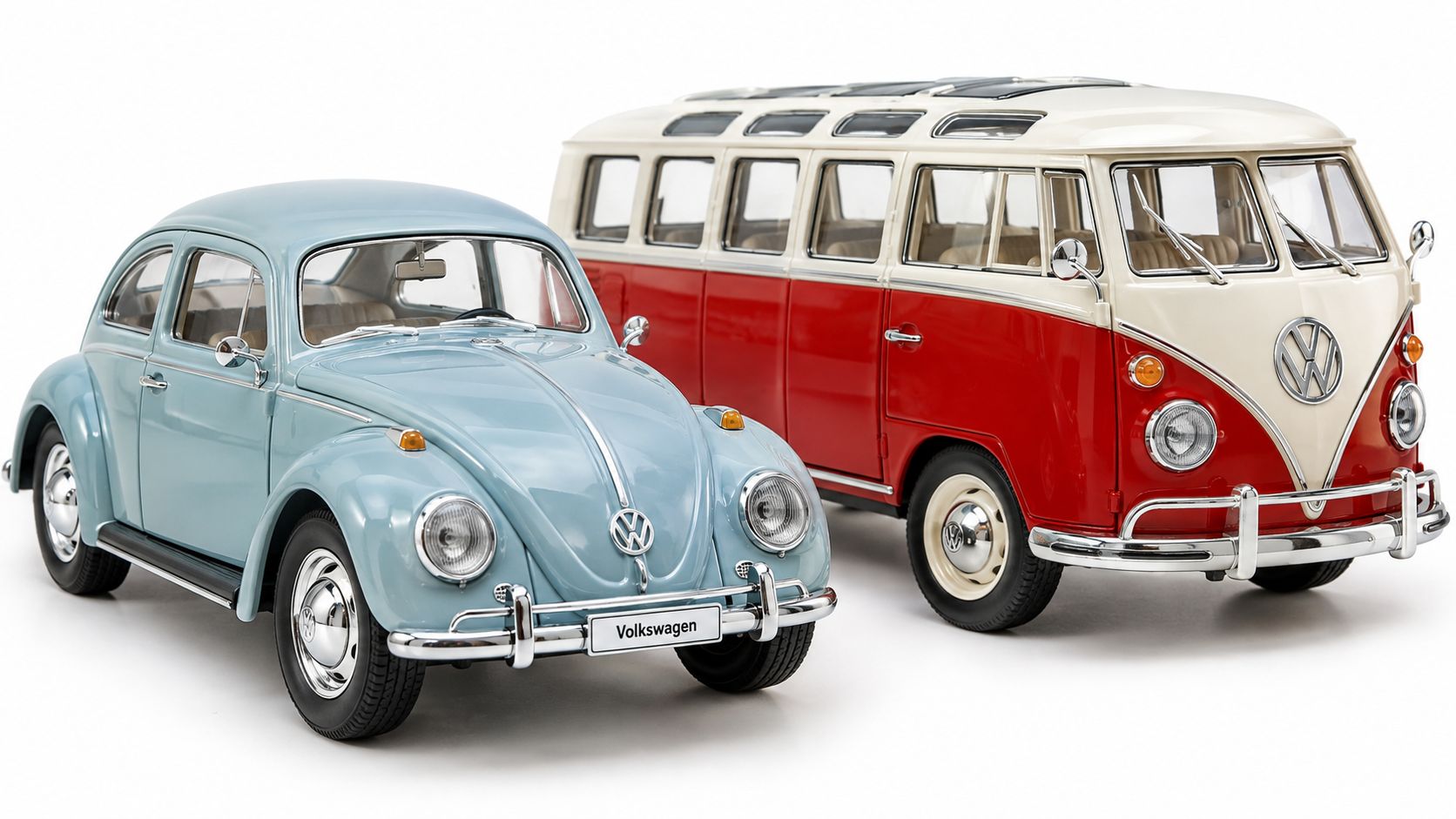
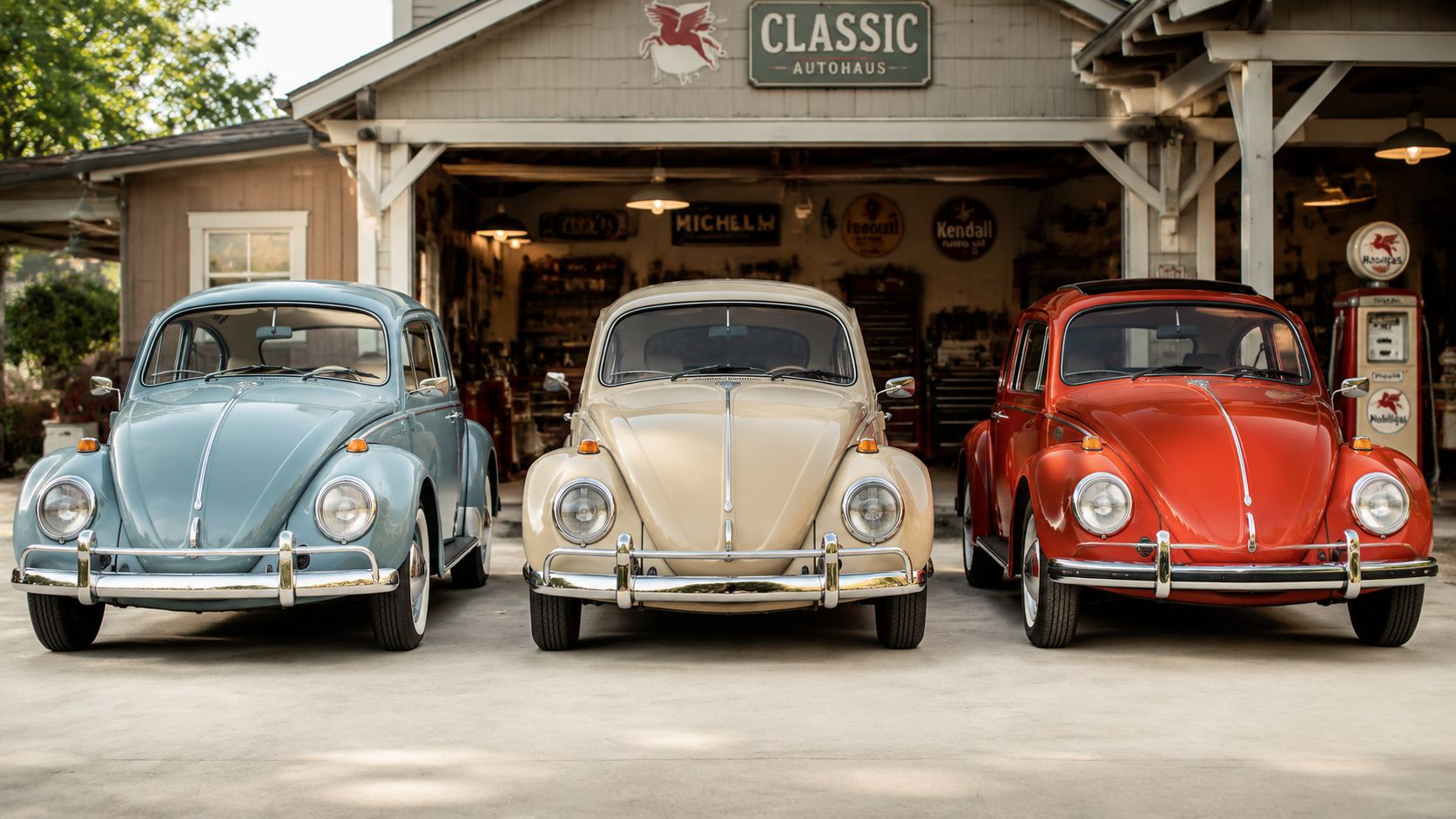
A VW model earns its place through character. The Beetle's rounded roof and friendly face are instantly recognisable, while the Kombi's upright body, split-window heritage and open-road associations invite a different kind of nostalgia. A Samba Bus adds another layer, with its bright colour schemes and holiday feeling making it a natural centrepiece for a display.
Volkswagen's Australian story gives these shapes extra meaning. Beetle assembly began at Clayton, Victoria, in 1954, using CKD kits, and Australian Beetle kit assembly ended in 1976. This Australian assembly history makes a Volkswagen Beetle model more than a generic classic car souvenir for local collectors. It connects the miniature vehicle to a real production chapter close to home.
The Type 2 entered production in March 1950, and Volkswagen had sold 4.5 million Kombis worldwide by the time the Australian club history was written. Australian assembly began in the 1950s, while Clayton-built Kombis were later produced largely from local parts between 1959 and 1968. Club VeeDub's Type 2 history provides valuable context for collectors drawn to Australian Kombi heritage.
Collecting with VW culture in mind
At Volksfest, VW Nationals or a local Surf Show and Shine, authenticity matters. Enthusiasts notice whether the badge, body line, wheel style and colour belong to the vehicle's era. Officially licensed models are therefore a sensible foundation, particularly when the collection celebrates a specific Volkswagen rather than just a general retro look.
The Kombi also has a distinctly Australian emotional register. Local enthusiasts assembled and used these vehicles for work, holidays and surf trips, helping the Type 2 become part of the country's motoring identity. CarsGuide's look at Australian Kombi culture captures why the model continues to turn heads at community events.
A good display might pair a Volkswagen Beetle model with a Samba Bus, then add a colour or theme that reflects your own car. The result feels curated rather than crowded.
Top Brands and Where to Buy in Australia
Brand reputation helps narrow the field, but inspection still matters. A respected manufacturer may offer different finish levels across its range, while a smaller licensed release can reproduce a particular Volkswagen variant with surprising accuracy. Choose the vehicle and scale first, then compare construction, paint, glazing, wheels and packaging.
Australian collectors benefit from established local distribution. Diecast Distributors Australia began in 1998 and now lists more than 1,500 SKUs alongside over 150 DDA Collectibles tooling sets. Its range covers formats from 1:64 to 1:18, although 1:43 remains a practical choice for many Australian VW displays because it balances detail with shelf space.
Local buying versus imported stock
Buying route
Where it works well
Watch carefully
Australian retailer
Local stock, domestic dispatch and easier support
Popular colours may sell through
Imported listing
Unusual variants and harder-to-find releases
Shipping, packaging damage and final landed cost
Mixed pack
Gifts, starter collections and variety
Less control over every colour or model
Single premium model
Focused displays and special occasions
Higher entry price and greater expectation of finish
Domestic stock usually means quicker delivery, simpler returns and fewer surprises when a parcel arrives. Imported listings can fill gaps in a collection, especially for uncommon Kombi, Beetle or limited-edition variants. Check the seller's measurements, packaging method and total delivered cost before comparing prices. Currency conversion and international postage can change the apparent bargain.
Australian Etsy listings show Volkswagen die-cast items around AU$60.81 to AU$67.76, while rare listings range from roughly AU$22.84 to AU$110.80. The Australian Volkswagen die-cast marketplace demonstrates why condition, licensing, rarity, scale and local availability belong in the same decision.
For a wider comparison of manufacturers and finish levels, consult the best diecast car brands. The strongest purchase has clear provenance, sound packaging and details that still matter after the initial excitement fades.
Caring for and Displaying Your Diecast Collection
Australian conditions can be hard on a display. Strong sunlight may fade paint, humidity can affect metal and plastic components, and temperature swings can stress packaging and adhesives. A model doesn't need elaborate museum treatment, but it does benefit from a stable, clean environment.
Keep the main display away from direct windows, heaters and damp areas. A cabinet with doors reduces dust, while a shallow riser lets rear vehicles remain visible without forcing you to pack the shelf tightly. For open shelving, use a soft detailing brush and a clean microfibre cloth. Don't spray cleaner directly onto the model, especially near glazing, decals or moving parts.
Display habit: rotate the models you handle most, and keep scarce or fragile pieces behind a closed door.
Retain boxes, inserts and any paperwork. Original packaging helps protect mirrors, aerials and delicate trim during a move, and it preserves the model's identity if you later sell or trade it. Store boxed models flat where possible, without placing heavy items on top.
For a more polished setup, consider display cases for models. The best case isn't necessarily the largest. It's the one that gives each Kombi, Beetle or bus enough breathing room to be seen clearly.
Start Your Diecast Journey Today
A meaningful collection doesn't need to begin with a rare release or a full cabinet. Start with the Volkswagen that means something to you, whether that's a Kombi Samba Bus, a classic Beetle or a bright Flower Power variant, then build around its story. Australian collectors can also choose local stock and fast shipping, which makes it easier to buy thoughtfully, find gifts and avoid unnecessary import uncertainty.
Licensed Volkswagen diecast models turn familiar shapes into lasting display pieces. They suit a show enthusiast, a classic car owner, a nostalgic traveller or anyone who still believes a Kombi makes an ordinary day feel like a holiday.
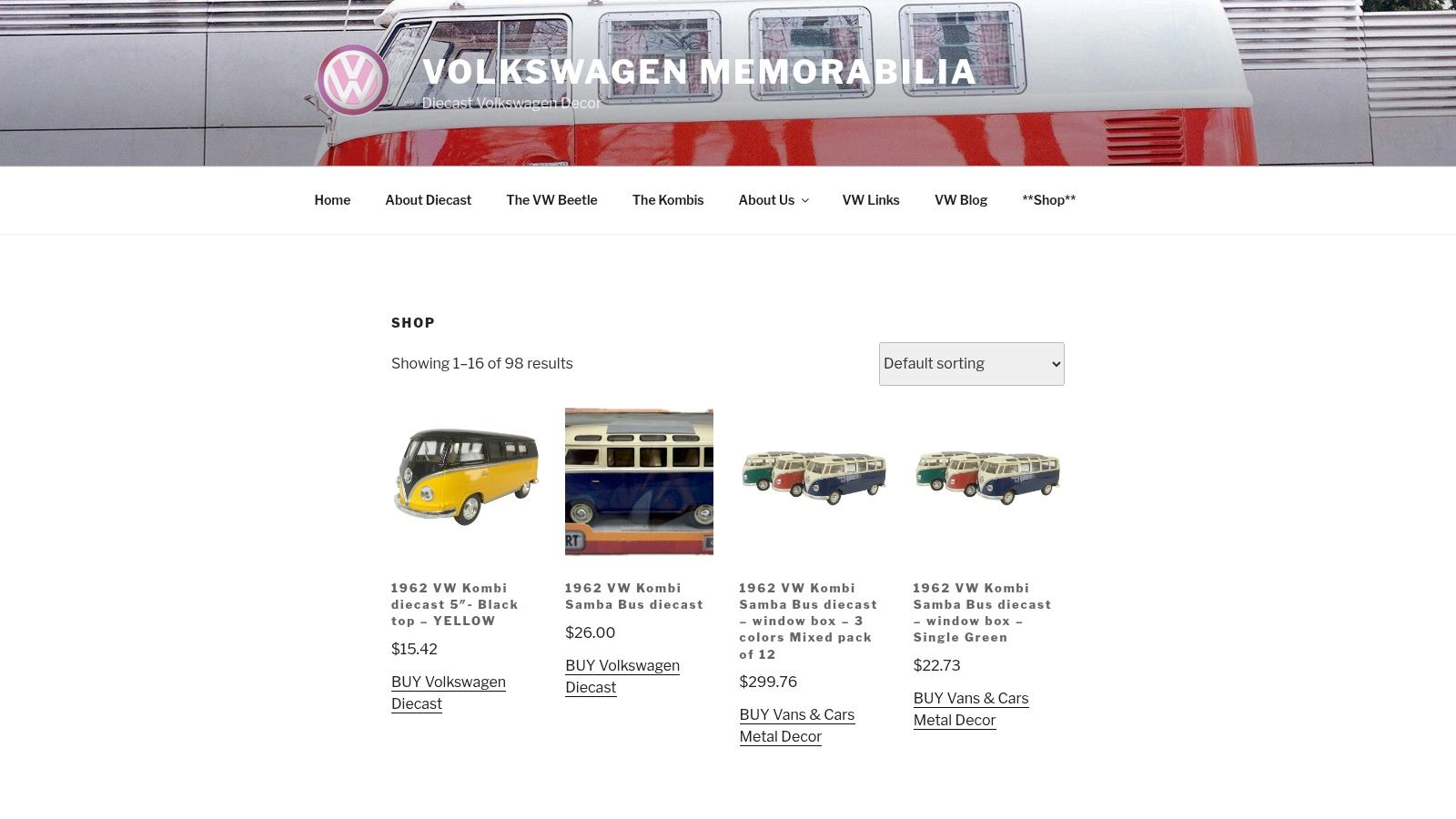
Volkswagen Memorabilia brings together licensed Volkswagen diecast models, Kombi Samba Bus pieces, Beetle designs and VW memorabilia collectibles for displays and thoughtful gifts. Browse the curated range and visit Volkswagen Memorabilia to find the model that belongs on your shelf.
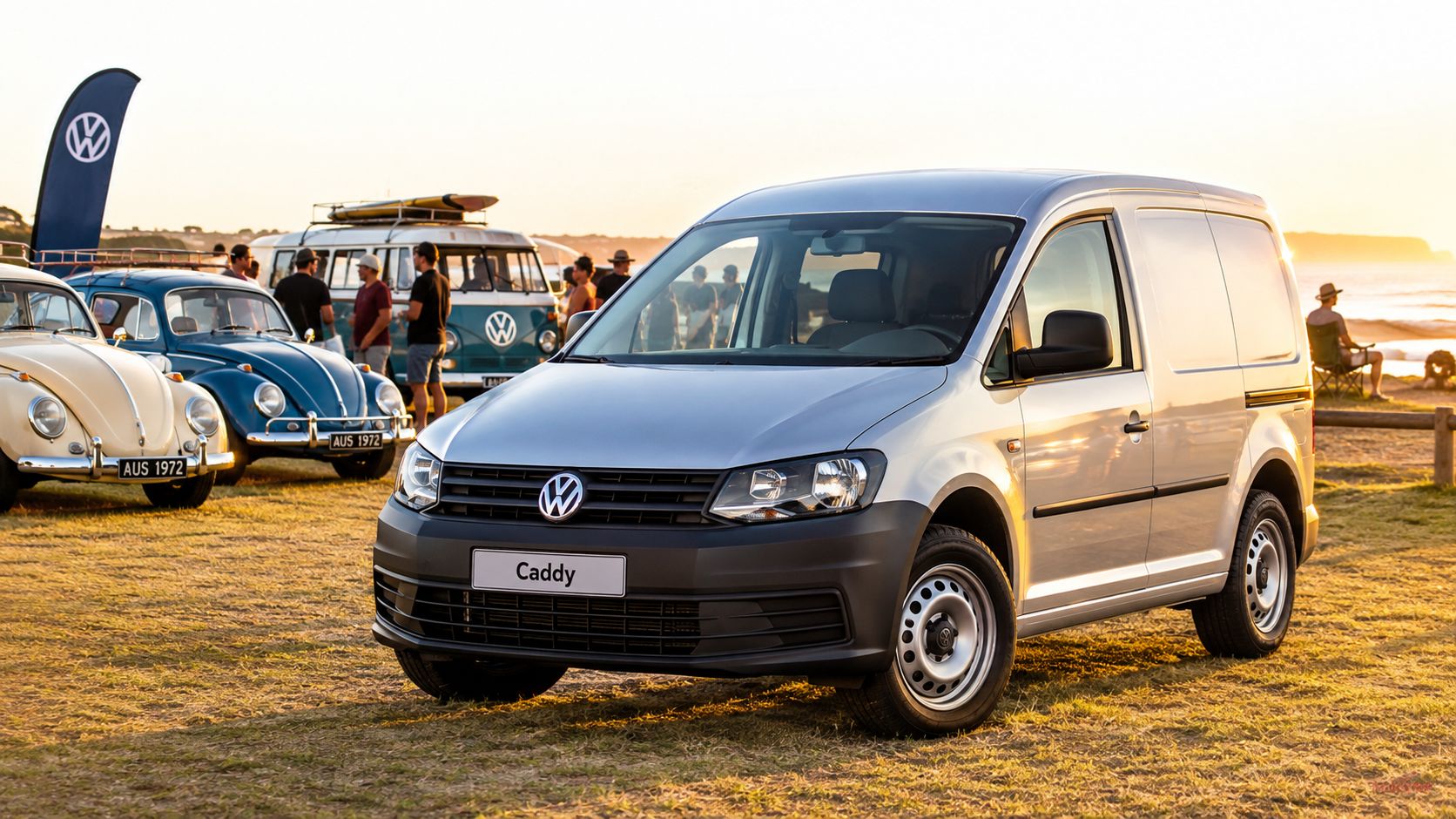
At an Australian VW gathering, the Beetles and Kombis usually draw the first wave of attention. Then a silver Caddy rolls in with camping gear, show supplies or a tradesman's tools aboard, proving that the Volkswagen family has always had room for a practical everyday hero.
Introduction to the Volkswagen Caddy Van Story
The Volkswagen Caddy van sits in an interesting corner of the VW story. It doesn't carry the instant nostalgia of a split-window Kombi or the rounded charm of a Beetle, yet it shares the same basic idea: make motoring useful, approachable and easy to live with. For Australian owners, the Caddy has become the compact workhorse that fits between a passenger car and a larger commercial van.
That middle ground matters. A city electrician may need room for tools without driving a large van through tight streets. A small delivery operator may want a flat load area but still appreciate car-like comfort. A weekend traveller may prefer the compact footprint of a Caddy California-style layout over a full-size camper. The appeal isn't about showing off. It's about choosing a vehicle that matches the job.
This guide follows the Caddy from its Australian arrival through its working life, then moves into the questions that matter to owners: how much it can carry, how its load space should be used, and what current running-cost clues tell us. It also connects the modern van to the wider VW enthusiast world, where history, local shows and diecast collecting all overlap.
A modern member of the VW family
Volkswagen heritage isn't limited to vehicles built for holidays. The Beetle carried families, the Kombi became a symbol of travel and community, and the Caddy has carried the less glamorous essentials that keep businesses moving. That makes it a natural subject for anyone who enjoys the complete VW story, not only the famous silhouettes.
Collectors can explore that story through licensed miniatures as well. A diecast Caddy can sit beside a Volkswagen Beetle model, a Samba Bus and other VW memorabilia, creating a display that shows how the brand moved from people's-car icon to practical commercial partner.
A useful way to view the Caddy: it's the working-age cousin of the Beetle and Kombi, less theatrical but just as connected to everyday Australian life.
What Makes the Volkswagen Caddy Van Different
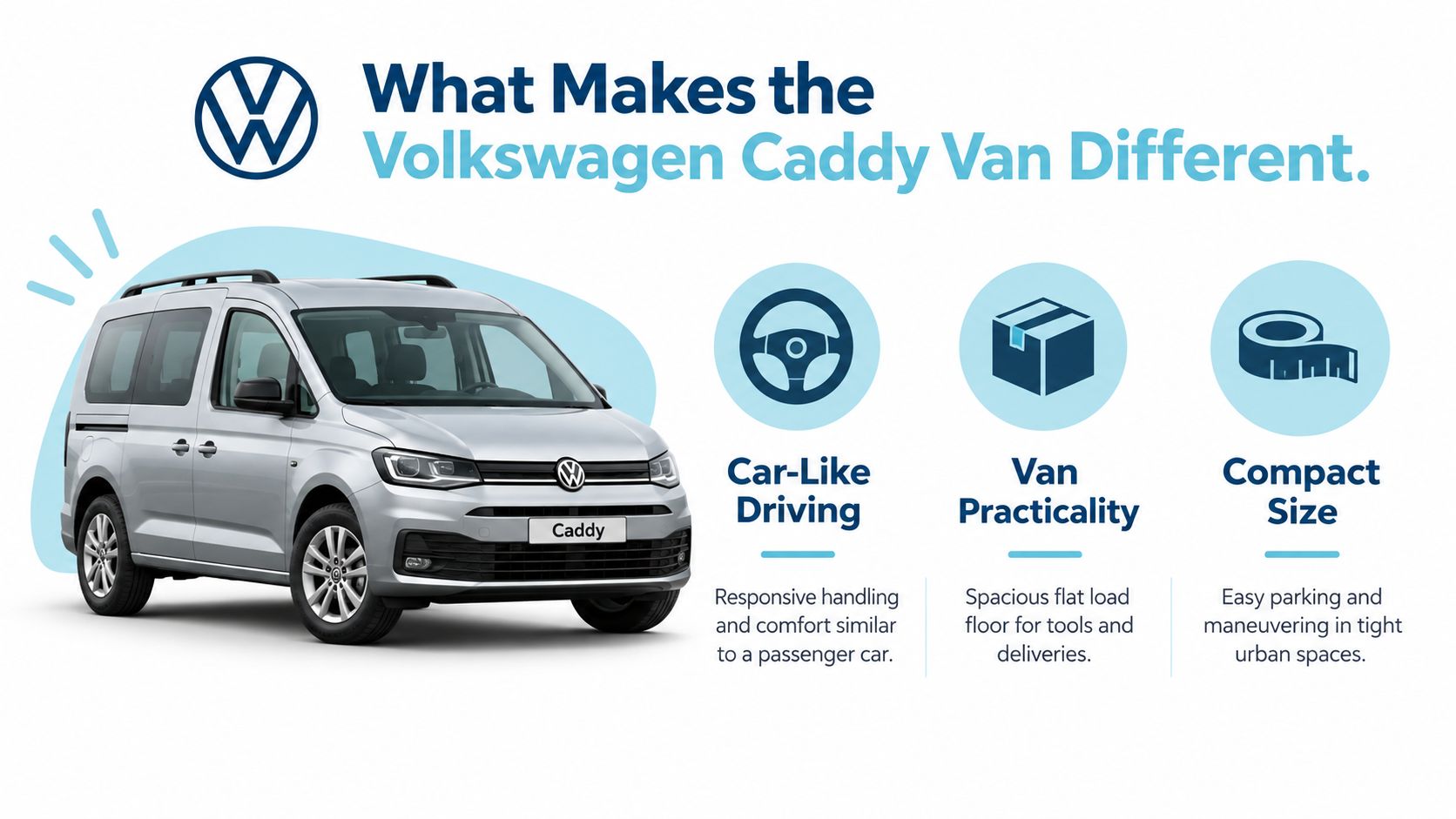
The easiest way to understand the Caddy is to place it on a size ladder. A small hatchback is the city-friendly end, the Caddy is the compact van step above it, and a Transporter or Crafter occupies the larger commercial end. The Caddy gives you a dedicated load area without the bulk of a full-size van.
That shape creates its main advantage. You sit higher than in many passenger cars, the rear load area is more useful than a conventional boot, and the vehicle remains manageable in urban streets. It's a bit like replacing a deep household cupboard with a long, accessible workbench. The available space is shaped for boxes, cases, tools and equipment rather than soft luggage.
Volume isn't the same as payload
Two measurements often confuse first-time van buyers.
Load volume describes how much physical space is available, usually in cubic metres.
Payload describes how much total weight the vehicle can carry, including occupants, equipment and additions.
A van may have spare floor space but be too close to its weight limit for another heavy load. The reverse can also happen, where the weight allowance looks comfortable but bulky items won't fit through the doors or within the load length.
The Caddy is offered in Cargo form for work duties, while people-focused and lifestyle variants serve different priorities. Cargo buyers usually care about flooring, access and fit-out potential. A family or leisure buyer may value seating, comfort and flexible interior use more highly.
Why small vans earn their keep
A compact van can suit a business that makes frequent short trips, particularly where parking and access matter. Plumbers, florists, mobile repairers, caterers and local couriers may not need the capacity of a larger van for every job. The Caddy's car-derived feel also makes it less intimidating for drivers who spend part of the week in passenger vehicles.
The right question isn't, “Is the Caddy big enough?” Ask instead:
Are your regular loads mainly bulky or heavy?
Will shelving, drawers or refrigeration equipment be installed?
Do passengers travel with the load?
Does the vehicle need to fit into older car parks and narrow streets?
Those answers point towards the right variant more reliably than a brochure headline. The Caddy works best when the operator respects its compact role rather than treating it like a shrunken heavy-duty van.
History and Evolution of the Caddy in Australia
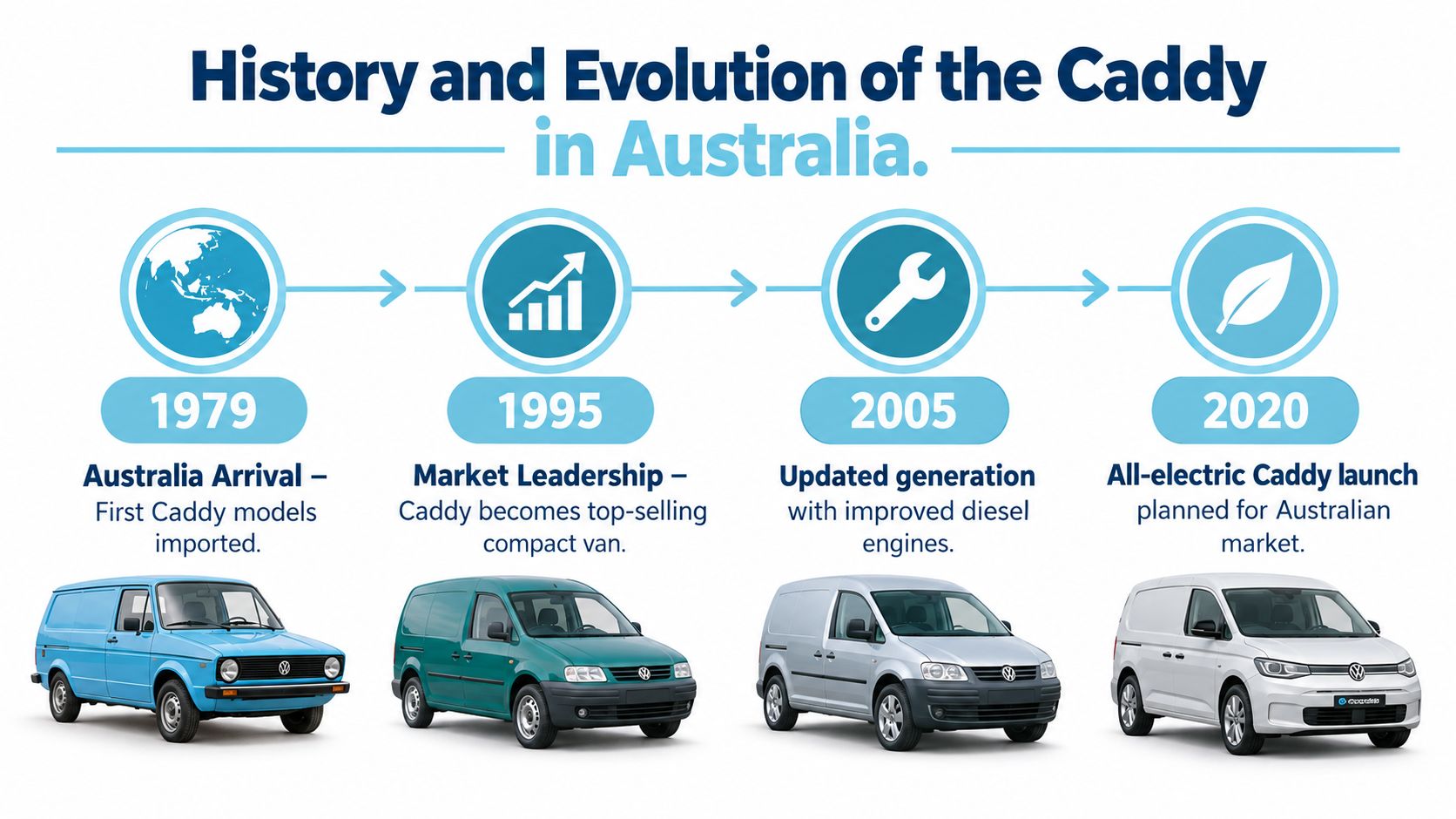
The Australian Caddy story moved quickly. The Volkswagen Caddy arrived in Australia in late 2004, and by 2007 it had captured a 42% share of the Australian small-van market, making it the segment leader, as recorded in the Volkswagen Caddy history reference. That's a significant early milestone because the model was competing with vans that already had established local reputations.
Australian buyers were introduced to 1.6-litre petrol and 1.9-litre turbo-diesel options, reflecting Volkswagen's effort to offer practical, fuel-conscious engines for commercial use. Those choices also helped define the Caddy's character. It wasn't presented as a stripped-back delivery appliance, but as a compact vehicle designed to combine sensible running with daily usability.
From new arrival to established workhorse
The Caddy stayed central to Volkswagen's Australian commercial range through the 2010s and 2020s. A ClubVW Australia history summary identifies the Caddy as the biggest-selling small van on the Australian market in 2010. Independent Australian sales tracking recorded 1,142 sales in 2024, 1,113 in 2025 and 42 year to date in 2026, showing that demand continues even though the model now operates at a much smaller volume than during its early growth period.
That history gives the Caddy a place in VW heritage displays. It represents a different kind of nostalgia, the memory of workdays, family businesses, local deliveries and road trips rather than only beach holidays. At a show, a tidy Caddy can tell visitors what Volkswagen looked like when practicality became the main attraction.
The longer VW timeline
Volkswagen's heritage stretches much further back. German Beetle production ended in stages, with Wolfsburg stopping in July 1974 as production switched to the Golf, Emden continuing until noon on 19 January 1978, and Karmann's convertible line ending on 10 January 1980, according to this documented Beetle production history.
The Caddy belongs to that same pattern of evolution. VW kept the recognisable values of sensible packaging and approachable driving, then adapted them for modern commercial needs. That's why it deserves more than a footnote in a van catalogue.
Key Generations Variants and Specs Explained
Caddy generations make more sense through their jobs than through a string of engineering codes. Earlier Australian models established the compact-van formula. Later versions refined comfort, safety, connectivity and load management. Used-van shoppers should still check the exact model year and variant, because equipment can differ substantially.
The current Australian range includes work-focused Caddy Cargo models, longer-body Maxi variants and lifestyle-oriented versions such as California. Cargo suits tools and deliveries, while Maxi gives operators more room for longer items. California-style models use the same compact platform for leisure and travel, showing how the Caddy can shift from workhorse to weekend companion.
Current figures in plain English
Australian local Caddy Cargo documentation lists a 1,797 to 2,150 mm load length, a 3.1 to 3.7 m³ load area and a 722 to 792 kg payload range, according to the Australian Caddy model documentation. Combined fuel consumption is listed at 4.9 to 6.2 L/100 km, depending on the selected model and powertrain.
Spec
Caddy Cargo Range
Load length
1,797 to 2,150 mm
Load area
3.1 to 3.7 m³
Payload
722 to 792 kg
Combined fuel consumption
4.9 to 6.2 L/100 km
These figures provide a useful starting point, much like measuring a garage before buying shelving. They do not replace the full variant specification. A longer load floor may suit timber or event gear, while dense tools can use the payload allowance before the cargo bay looks full. Permanent racking, drawers and other equipment also reduce what remains available for daily work.
What the MY25 refresh changes
The MY25 refresh added Digital Cockpit Pro, a 10-inch infotainment screen, parking sensors, keyless go and additional safety technology, as described in Australian Caddy coverage. These changes suit a van that spends its days in traffic, loading zones and tight worksites. Parking assistance can reduce stress in confined spaces, while clearer displays and connectivity make repeated driving tasks easier.
The current Caddy also gives collectors a clear marker of VW's practical heritage. A Volkswagen Caddy Maxi diecast model captures the long-body work-and-travel character in a smaller scale, ready to sit beside nostalgic Beetle and Kombi shapes. The van carries the gear. The model preserves the story.
Payload Practicality and Real World Work Use
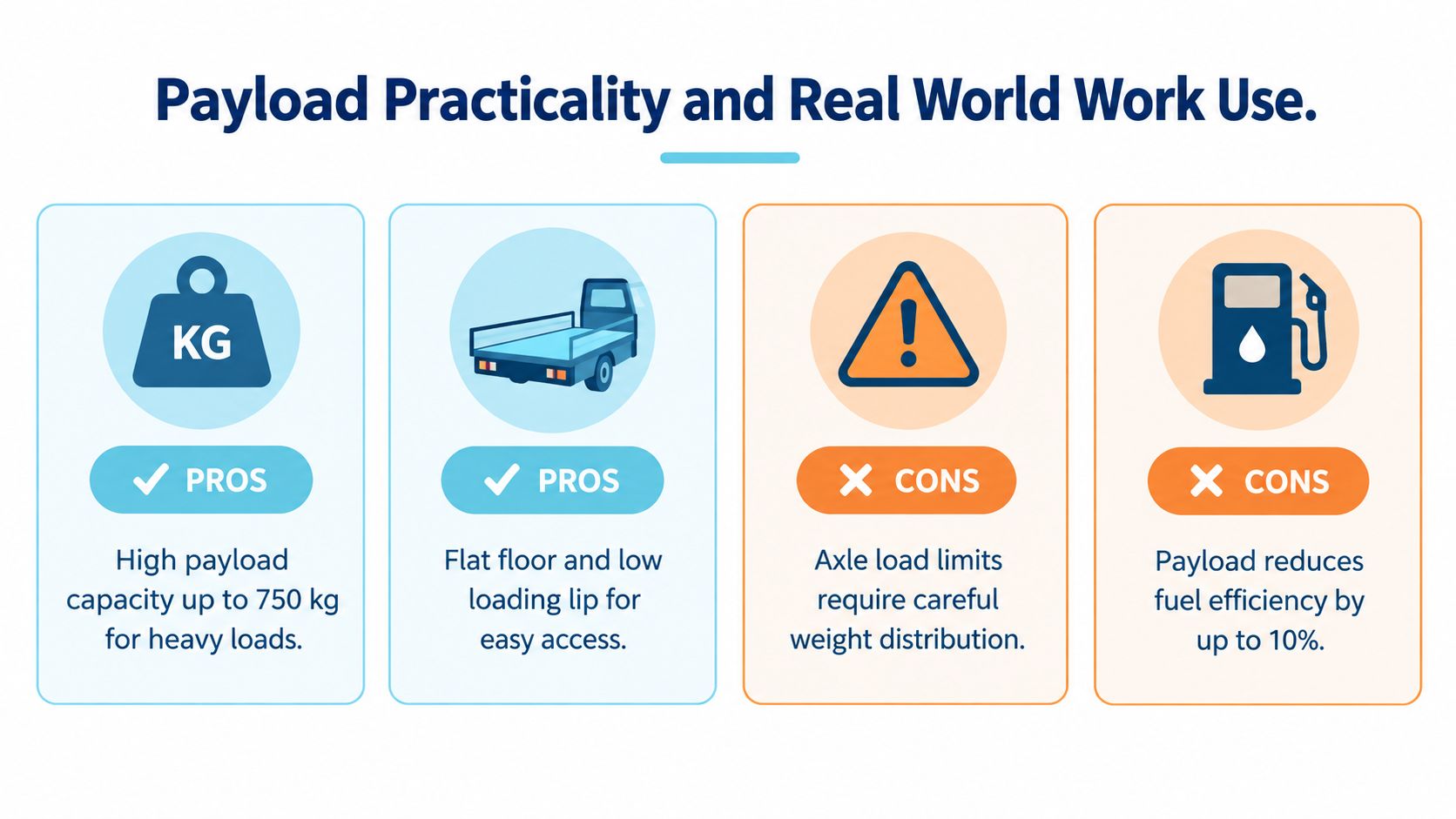
At a car show, a tidy Caddy can look ready for any job. In daily work, its usefulness depends on payload management, not cargo-bay size alone. Volkswagen defines payload as GVM minus unladen weight, and that allowance covers occupants, cargo, added structures and tow-ball down weight. The figure on the specification sheet is the van's complete carrying budget, not a box-and-tools allowance.
As noted earlier, the Cargo's published volume and payload describe a compact work envelope. The practical question is how shelving, passengers and tow-ball weight reduce what remains available. Weight distribution also matters, because a van can look half-empty while carrying too much mass in one area.
How a fit-out changes the calculation
Start with the van as delivered, then count everything that becomes part of the working vehicle:
Shelving and drawers: Organisation adds permanent weight before the first tool is loaded.
Tools and materials: Dense items can consume the allowance faster than their size suggests.
Passengers: Every occupant counts, including the driver.
Tow-ball down weight: A trailer affects the vehicle's remaining payload as well as the trailer's own limits.
Accessories: Roof systems, barriers and protective equipment also belong in the calculation.
A tradie carrying ladders, power tools and fittings may reach the payload limit before the floor looks full. A florist may fill much of the available volume with lightweight arrangements while staying below the weight limit. The job profile decides which constraint arrives first.
Axles and load placement
The Caddy's specifications include separate front and rear axle load limits. Placing dense equipment at the very back can overload the rear axle even when the combined vehicle weight appears acceptable. Keep heavy items low, secure them properly and spread them across the load floor rather than stacking everything behind the rear axle.
Check the vehicle's compliance plate, handbook and variant-specific documentation before loading for work. A Caddy light commercial vehicle collection celebrates the van's working identity and its place in VW history, much like a diecast model preserves a familiar shape on a collector's shelf. Safe operation, however, depends on the actual vehicle, its fit-out and the load carried that day.
VW Culture Events and the Caddy Connection
Volkswagen culture in Australia has always been bigger than any single model. Beetles, Kombis, Samba Buses, Golfs and commercial vans share the same gathering space because owners value the stories attached to them. One car may recall a first road trip, another a family business, and another years spent restoring a tired classic in a home garage.
The VW Nationals, Australia's biggest Volkswagen show, offers a clear example. It's a club-run event with a documented history dating back to 1988, when the first Nationals formed part of the Australian Bicentennial celebrations, as recorded in the VW Nationals history archive. The event's continuing format includes a car show, swapmeet, raffle draws and trophy presentation at Fairfield Showgrounds.
Where the Caddy fits in
A Caddy may arrive carrying display stands, spare parts or picnic gear, but it can also become part of the display itself. Its appeal is quieter than that of a bright Flower Power Kombi, yet enthusiasts recognise the design language and the care that goes into presenting a clean, well-kept van.
The local event mechanics make the Nationals approachable for newcomers. The 2025 listing set general admission at $10, with children under 16 entering free, show-and-shine entry at $30 and swapmeet sites at $30. Gates opened at 7:30 am, car show entry closed at 10:30 am, peer judging closed at 12:30 pm, and the trophy presentation took place at 3:00 pm, according to the 2025 VW Nationals event details.
The best part of a VW show isn't only the polished paint. It's the conversation beside the car, where someone explains how they found it, fixed it or kept its story alive.
That same spirit leads naturally into memorabilia. A collector might choose a Beetle for its shape, a Samba Bus for its travel associations and a Caddy for the practical chapter of VW history.
Collecting the Caddy and VW Diecast Models You Will Love
A diecast model makes the Caddy story easy to keep close, even if a full-size van isn't practical. The strongest collections usually begin with a theme rather than an impulse purchase. You might build a timeline from Beetle to Kombi to Caddy, focus on commercial vehicles, or create a display around Australian surf and travel culture.
Look for officially licensed Volkswagen products, accurate badging, clean paint application, crisp glazing and a model that feels solid in the hand. Opening doors, detailed interiors and realistic wheels can add appeal, but the most important feature is consistency. A beautifully detailed model sits more comfortably in a collection when its scale and finish match the vehicles around it.
Choosing a scale
Scale affects both detail and shelf planning. A 1:18 model is typically about 23 to 30 cm long, while a 1:24 model is typically about 16.5 to 20 cm long, according to this diecast scale guide.
Scale
Typical length
Best suited to
1:18
23 to 30 cm
Feature displays and collectors who want a larger model
1:24
16.5 to 20 cm
Compact shelves and balanced collections
A 1:18 Caddy gives the body more visual presence and usually leaves more room for exterior and cabin detail. A 1:24 model takes less space, making it easier to display several vehicles together. Before buying, measure the shelf depth, allow room for dusting and check whether the model will sit beside a Beetle or Kombi without crowding the display.
Building a thoughtful display
Start with one anchor: A Kombi Samba Bus or Beetle can establish the collection's visual identity.
Add the working chapter: A Caddy model brings a useful contrast to classic people-movers.
Use height carefully: A riser can make smaller models visible without hiding the cars behind them.
Protect the finish: Keep models away from harsh direct sunlight and handle them with clean, dry hands.
Buy for the recipient: A Volkswagen Beetle model suits a nostalgic gift, while a Kombi or Caddy may appeal to someone who enjoys travel, work vehicles or Australian motoring culture.
Collectors looking for a broader selection can browse Volkswagen model cars and compare body styles before choosing. For VW Kombi diecast Australia, wanting to buy diecast Kombi, or comparing Volkswagen diecast models for sale, scale, licensing and display compatibility are more useful filters than choosing the largest box on the shelf.
Volkswagen Memorabilia offers licensed VW diecast pieces, including Kombi Samba Bus and Beetle models, for enthusiasts, collectors and thoughtful gift buyers. Visit Volkswagen Memorabilia to find a Caddy-inspired addition or start a display that brings the wider Volkswagen story home.
At a sunny coastal car show, the best VW displays always seem to attract a crowd. A mint Kombi catches the light, a Beetle model sits on a folding table, and someone nearby is explaining which parts came from a long-finished restoration. You might've arrived looking for a small gift, then found yourself wondering whether a licensed diecast model, an enamel sign or a genuine vintage replacement part belongs in your own garage.
That's the charm of vintage VW supplies. The category stretches from practical restoration components to VW memorabilia collectibles, licensed Volkswagen diecast models, printed material and relaxed coastal décor. This guide focuses on the Australian buyer, with straightforward advice for choosing authentic pieces, checking fitment, comparing local and overseas sourcing, and building a collection that feels connected to real VW history.
Walking into the World of Vintage VW Supplies
The old Kombi beside the fibro beach shack tells a story before anyone turns the key. Its rounded roof, split windscreen or cheerful two-tone paint carries memories of road trips, surfboards, family holidays and weekends spent chasing the next coastal campsite. A small model on a bookshelf can bring back the same feeling, even when the full-size bus is out of reach.
More than parts in a cardboard box
For a restorer, supplies might mean brake components, suspension pieces, body hardware or an obsolete engine item. For a collector, they can mean a licensed Volkswagen Beetle model, a 1962 Kombi replica, a metal sign or a tin plate decoration. Renters and beach-house owners often prefer smaller objects that add retro character without requiring a full garage fit-out.
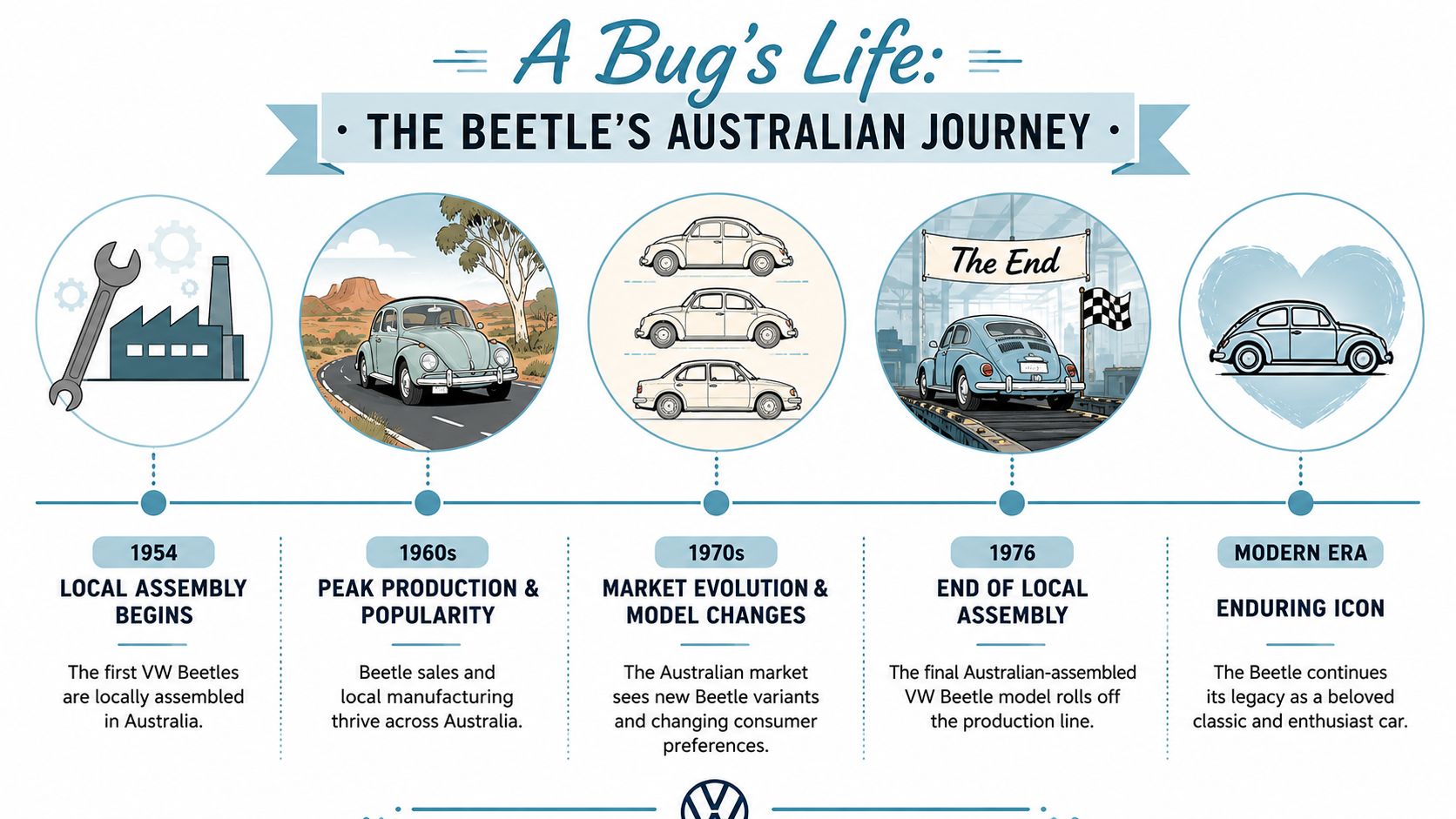
Australia has a particularly rich Volkswagen story. Early Beetles arrived in the 1950s, and local assembly began at Clayton, Victoria, in 1954. Manufacturing later ended in 1976, making the Clayton period an important part of the country's VW heritage, as documented by Museums Victoria's Beetle history.
The Beetle also became localised. By 1962, Australian content had reached 80 per cent, rising to 95 per cent by the mid-1960s, according to Carsales' account of the Beetle's Australian story. That background helps explain why an Australian collector might value a small model, workshop sign or period-style object as more than decoration.
Collector's mindset: Choose pieces that connect with a memory, a model year or a real Australian VW story. A collection feels stronger when every item has a reason for being there.
The Kombi carries its own local history. Volkswagen began building the Type 2 in March 1950, while Australian assembly took place at Clayton from 1964 to 1977. CarsGuide's history of the Australian Kombi notes that most were assembled from CKD kits, with some vehicles made from mostly local parts between 1959 and 1968.
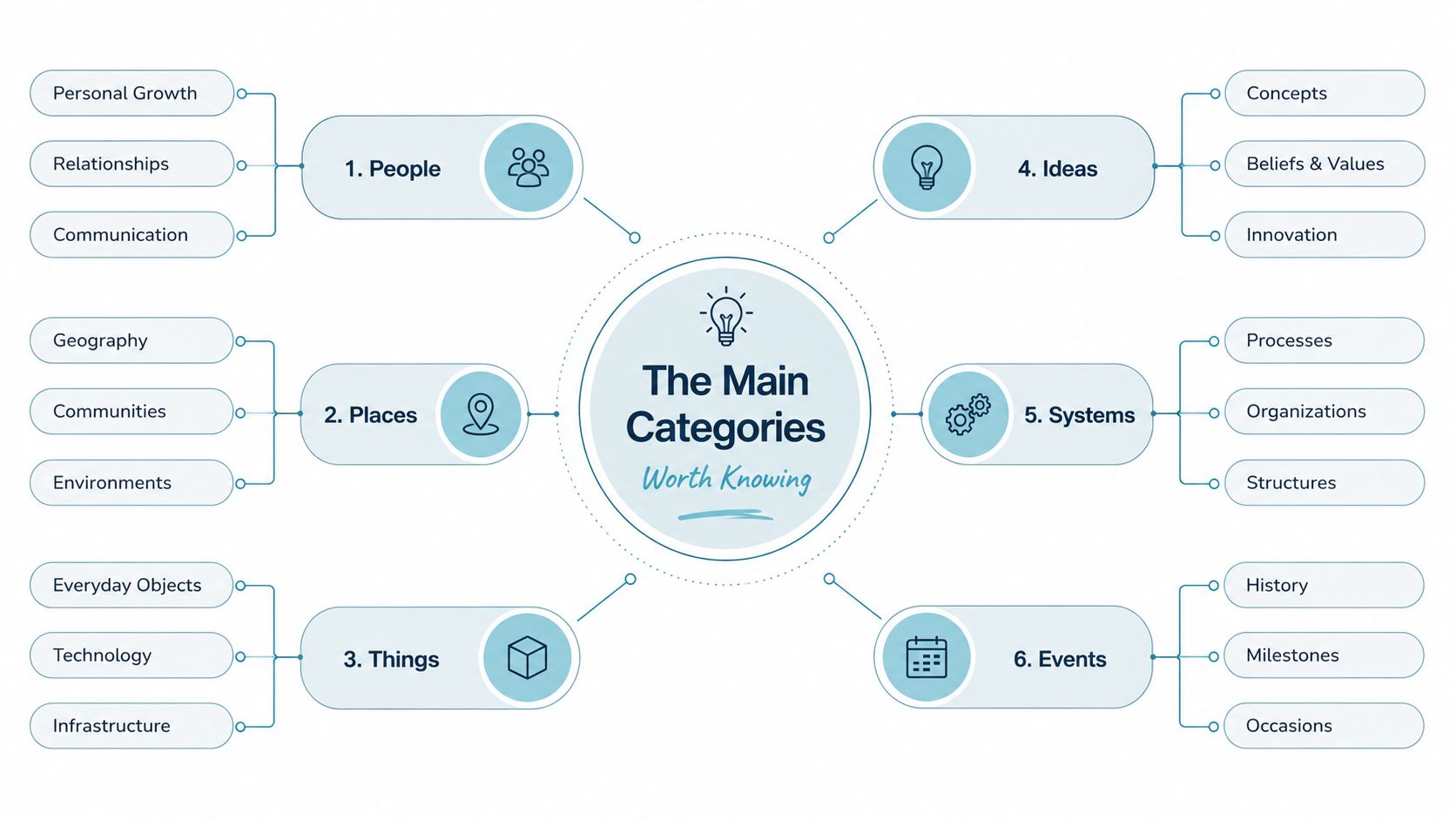
The Main Categories Worth Knowing
A first trip through a vintage VW shop can feel like walking into a busy swap meet. Start by separating the range into three broad groups, then explore the smaller niches once you know what suits your space and budget.
Licensed diecast models
Diecast is the serious collector tier, a bit like Matchbox grown up. The metal body, detailed interior, wheels, badges and paintwork give a Beetle or Kombi a stronger sense of presence than a basic toy. Scales such as 1:43, 1:24 and 1:18 help you judge the model's size before ordering, although the right choice depends on your display rather than a universal rule.
A 1:43 Volkswagen Beetle model suits a compact shelf or a growing line-up of different cars. A 1:24 Kombi has enough visual impact for a sideboard, while a 1:18 piece usually needs a dedicated cabinet or plinth. Check whether the model has opening panels, a fixed pose, a clear case or a presentation box, because those details affect how you'll display and handle it.
Printed and workshop memorabilia
Printed memorabilia works like the coffee-table literature of VW culture. Enamel signs, workshop manuals, period posters and reproduction garage graphics bring context to a collection, especially when you're displaying several models together.
A wall sign behind a Beetle model can make the car look like it has just rolled out of a service bay. A workshop manual beside a diecast Kombi adds a practical, mechanical note and gives visitors something to browse while they admire the model.
Home décor and smaller collectables
Home décor is often the easiest entry point. Cushion covers, lamps, metal wall art, enamel mugs, keyrings and tin toys can add a surf-shack mood without taking over the room. These pieces work well for gift buyers, renters and collectors who want VW style in a hallway, kitchen or office.
Limited-edition runs and mixed packs sit between casual décor and dedicated collecting. A mixed pack can introduce several colours or body styles, while a single special colourway may suit someone who already has a carefully organised display.
Start with the object you have room for, not the object that looks biggest online. A well-placed small model often has more impact than a crowded cabinet.
Spotting Licensed Diecast and Avoiding Reproductions
A genuine licensed model should look considered from every angle. The paint should sit evenly across the body, the graphics should be crisp, and the interior should show deliberate detail rather than a dark, featureless block. Brands such as Schuco, AUTOart and Greenlight are familiar names among collectors, but the manufacturer name alone isn't enough. Inspect the complete listing and the model itself.
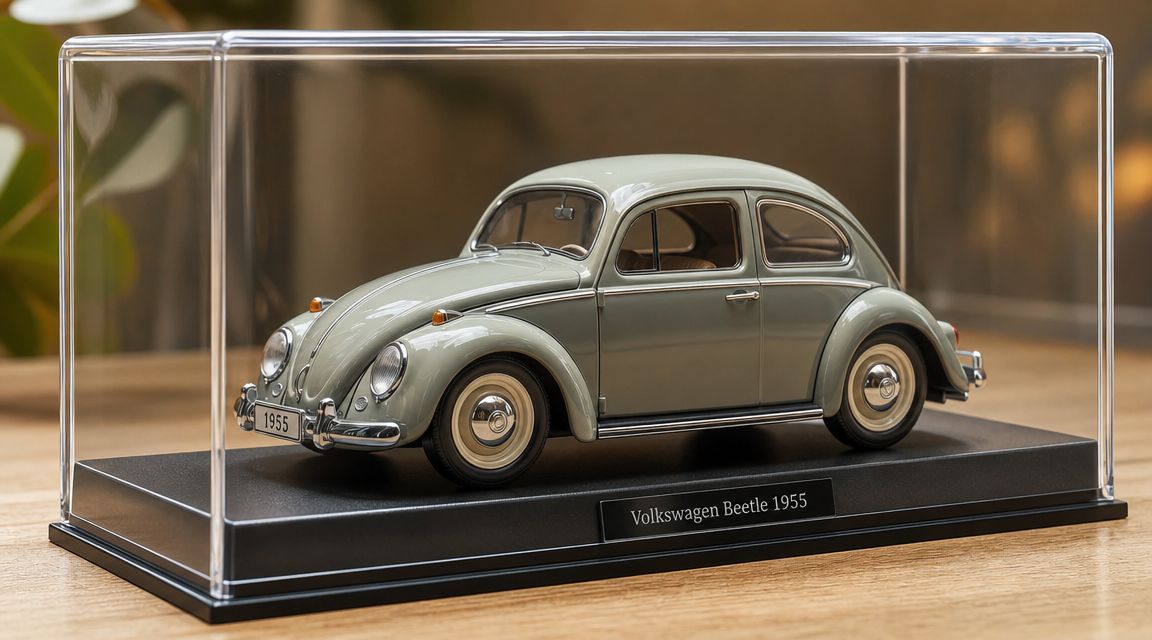
Volkswagen licensing marks, manufacturer stamps, packaging information and a clear product description all help establish provenance. A weighted chassis can give a model a more convincing feel in the hand, while a clear acrylic case protects the finish and makes the piece display-ready. None of these details replaces careful checking, but several consistent signs together are reassuring.
Compare the construction, not just the price
Feature
Licensed Diecast
Reproductions
Branding
Volkswagen licensing and manufacturer information are visible
Branding may be missing, altered or unclear
Graphics
Tampo-printed details are usually sharp and aligned
Decals can look blurry, uneven or poorly positioned
Bodywork
Panel lines, bumpers and trim are shaped with care
Gaps, flat surfaces and simplified trim are common
Interior
Seats, steering wheels and dashboards receive attention
Interior detail may be minimal or absent
Presentation
Original packaging or an acrylic case may be supplied
Packaging can be generic or inconsistent
Provenance
Seller can usually explain the brand and product
Listing may rely on vague “vintage style” language
A model described only as a “retro bus toy” deserves extra questions. Market stalls and overseas listings can contain attractive pieces that aren't licensed collectibles, and mixed packs may combine different quality levels under one broad description. That doesn't automatically make them worthless, but it changes what you should expect to pay and how you assess future desirability.
Use this diecast model explainer to understand the construction and terminology before comparing listings.
A quick authenticity check
Read the brand details: Look for the Volkswagen name, licensing information and the actual manufacturer.
Inspect every photo: Check wheels, glazing, trim, graphics and the underside if it's shown.
Ask about the box: Confirm whether original packaging or a protective case is included.
Question vague wording: “Vintage inspired” isn't the same as officially licensed.
Keep the receipt: Documentation helps if you later trade, insure or gift the model.
Licensed pieces generally make a more dependable foundation for a collection because their identity is clear. Generic reproductions can still suit a playful display, but don't confuse decorative appeal with documented collectability.
Where Aussie Buyers Source Their Supplies
The smartest buying channel depends on what you're sourcing. A local specialist may be ideal for an unusual restoration item, while an Australian online retailer can make more sense for a boxed diecast gift that needs to arrive promptly.
Match the channel to the job
Local VW specialists often carry parts for engine, suspension, rear axle, brakes and body systems. Australian suppliers also advertise reproduction components and used parts for older or discontinued Volkswagens. That range reflects how fragmented the supply chain can be, with new, used, reproduction and imported stock filling different gaps.
Rare parts need a more technical approach. One Australian classic-parts partner says it can source over 40,000 rare and obsolete genuine Volkswagen parts from the VW Classic Parts warehouse in Wolfsburg, with orders quoted in Australian dollars including freight to Australia, as explained by Mick Motors' classic-parts information. Exact identification matters because revision letters can distinguish different versions or even different models.
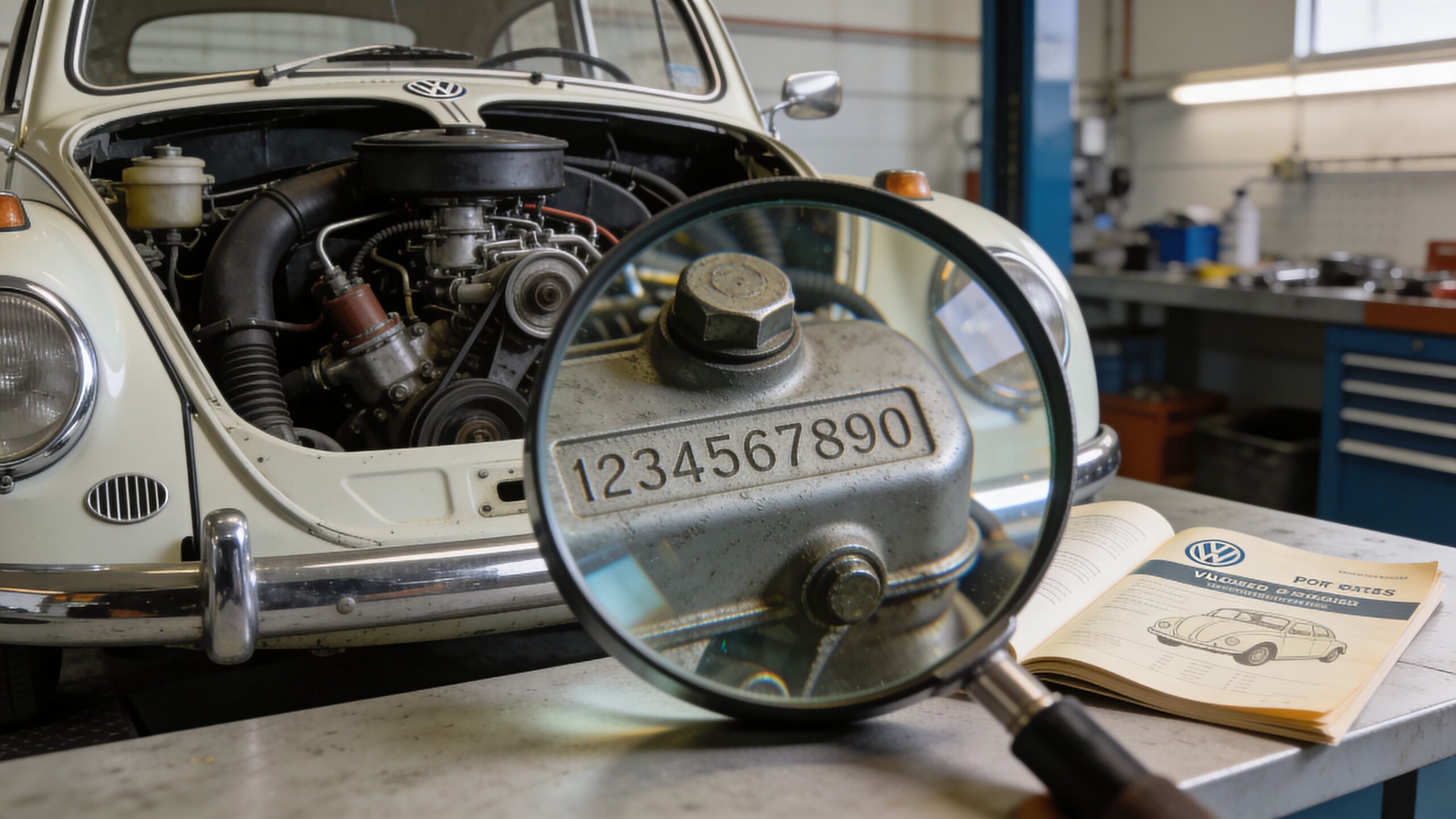
For restoration work, use the stamped nine-digit VW part number as your main reference, rather than relying only on a casting number or appearance. Special-order items may not be returnable unless faulty, so confirm fitment before committing.
A practical sourcing checklist
Local specialist shops: Best for technical questions, used components and model-specific advice.
Australian online retailers: Useful when domestic stock, AUD pricing and straightforward returns matter.
Mixed packs and bulk lots: Handy for variety, gifts or starting a display without choosing every item individually.
Online marketplaces: Offer breadth, but require closer inspection of photos, descriptions and seller history.
Peer-to-peer auctions: Can uncover unusual pieces, although condition and provenance need careful verification.
The Australian diecast models guide is a useful starting point for comparing local options. Domestic sellers can also remove the uncertainty that comes with international listings, including customs handling, currency conversion and long waits.
Before you buy: Ask for extra photos, confirm the licensing details, check the seller's reviews and make sure the return conditions are written clearly.
Local delivery isn't the only advantage. An Australian seller can answer questions in local business hours, quote in AUD and explain whether an item is stocked domestically or ordered from overseas. Those details make a bigger difference when the product is fragile, special-order or intended as a time-sensitive gift.
Styling a Collection With Coastal Retro Charm
A good VW display shouldn't look like a toy shop shelf unless that's exactly the mood you want. The most relaxed collections mix diecast models with timber, metal, woven textures and the sun-faded colours associated with Australian beach culture.
One collector might place a 1:24 Kombi on reclaimed timber beside a weathered road sign. Another could line a hallway runner with small buses, spacing them so each silhouette has room to breathe. In a living room, a Beetle model can sit on a brushed aluminium shelf above a rattan console, while a tin plate graphic adds a garage note without making the space feel industrial.
Build the display around a story
Group models by colour if you're chasing a calm visual rhythm. Mint green, cream, pale blue and red can create a cheerful coastal palette, while a collection arranged by body style gives a more automotive feel. A Samba Bus display works especially well with surf references, roof-rack details and small objects that suggest a road trip.
A dedicated cabinet with LED strip lighting protects the models from dust and gives darker paintwork a clean outline. Keep lighting soft and indirect, particularly if the cabinet sits near a window. For a patio or veranda, use metal signs and weather-tolerant décor rather than delicate diecast models.
Three rules keep shelves photogenic
Leave breathing space: Crowding hides the details that make licensed models worth displaying.
Mix heights: Combine a low model with a taller sign, lamp or framed print.
Repeat one colour: A shared accent, such as turquoise or warm cream, ties separate pieces together.
The coastal look works because it feels lived-in. A collection can include a polished boxed model, a slightly weathered sign and a practical key rack without pretending everything came from the same decade. That balance is what makes a room feel like a real enthusiast's space rather than a themed showroom.
Caring for, Storing and Valuing Your Collection
Diecast models and printed memorabilia last best when you treat them as display objects, not indestructible toys. Handle models with clean hands, use a soft cloth for dust and avoid dragging them across shelves. Direct sunlight can fade dashboards, graphics and paint, even when the model is safely behind glass.
Protect the finish and the packaging
A display cabinet gives better control than an open shelf, particularly in homes exposed to dust, humidity or salt air. Original boxes matter too. They protect the model during moves and help document its identity if you later trade or insure it. If you prefer an open display, keep the packaging flat, dry and away from heat.
Australian summers can be hard on enclosed rooms and window ledges. Choose a stable indoor position, avoid hot sheds and use silica gel packs where appropriate. Don't place collectibles directly beside a heater, in a damp garage or against a salty coastal window.
For a more polished setup, display cases for models can keep individual pieces visible while reducing handling and dust exposure.
Keep a simple record
A collection log doesn't need to be complicated. Record the model name, scale, manufacturer, licensing information, purchase date, packaging condition and any marks or repairs. Add photographs from several angles, especially for rarer pieces.
Valuation comes from comparison, not wishful thinking. Look for recent comparable sales, then adjust for box condition, paint quality, missing parts and whether the model is officially licensed. An unlicensed copy may look similar in a photo, but it shouldn't be valued as though it carries the same documented identity.
A tidy record turns a shelf of models into an organised collection. It also makes gifting, trading and insurance conversations much easier.
Gift Ideas for the VW Fan in Your Life
The safest gift is one that matches the recipient's existing habits. A collector who fills cabinets with precise models may prefer a carefully chosen scale, while a beach-house stylist might get more joy from a sign or mug used every day.
Recipient
Best Gift Match
Why It Works
Coastal home stylist
VW-inspired tin sign, surf-themed print or enamel mug
Adds retro character without needing a large display
Experienced collector
Licensed 1:43 or 1:24 model, special colourway or mixed pack
Fits an established line-up and offers variety
Younger VW fan
Robust diecast model for a bedroom shelf
Introduces the hobby through a recognisable vehicle
Tradie or garage enthusiast
Metal workshop sign, oil-can replica or key rack
Combines VW identity with useful garage decoration
Nostalgia seeker
Beetle or Kombi model linked to a remembered era
Turns a personal story into a physical keepsake
Choose by display style
A Kombi Samba Bus diecast suits someone who talks about camping, surfing or family road trips. A Beetle model works well for a person who remembers their first car, follows local shows or has a soft spot for the rounded original shape. If you're unsure which colour they like, a mixed pack can provide a wider spread without forcing you to guess one exact variant.
For a homewares lover, look beyond the car itself. Metal wall art, printed signs, cushion covers and enamel-style kitchen pieces can carry the VW mood into everyday spaces. Garage types often appreciate practical objects, particularly key racks or signs that look at home beside tools and parts.
Check scale and packaging before ordering. A collector may already have a particular series, so clear photographs and manufacturer information help you avoid an accidental duplicate. For children, choose a display-friendly model with sturdy construction and avoid assuming that every small item is designed for rough play.
Wrapping Up and Where to Shop Locally
The best vintage VW supplies do more than fill a shelf. They preserve the shapes, colours and stories that make Beetles, Kombis and Samba Buses such enduring parts of Australian car culture. That connection is visible in the Beetle's local manufacturing history, and in the affection surrounding the Kombi at shows, club gatherings and beachside meet-ups.
Australia's Beetle sales history gives the nostalgia some useful context. 1960 was the Beetle's most successful sales year in Australia, with 24,388 sold, according to the Club VeeDub reference history. That kind of local presence helps explain why an old Beetle often feels familiar even to people who've never owned one.
The buyer's short list
Choose licensed diecast when accurate branding, construction and long-term collectability matter. Choose décor when you want a broader coastal look, and consider mixed packs when you're starting a display or buying for someone whose exact preferences you don't know.
For restoration parts, slow down before ordering. Confirm the complete part number, including suffix letters, check the model and system version, and ask whether the item is stocked locally, imported or special order. Suppliers serving Australian restorers may combine domestic inventory with overseas warehouses, so lead times and return rules deserve the same attention as price.
Local sourcing also makes practical sense for memorabilia. Domestic stock can mean faster shipping, AUD pricing, easier communication and fewer surprises than an overseas marketplace listing. A local importer or specialist seller may also provide weekday support when you need help checking a model, scale, brand or product description.
The VW community has always been about sharing knowledge. At Volksfest, VW Nationals, Surf Show and Shine events and smaller club gatherings, a conversation about a model often leads to a story about a real car. Start with one piece that means something, give it a safe place to live, then let the collection grow at its own pace.
Volkswagen Memorabilia brings together licensed VW diecast models, including Kombi Samba Bus and Beetle pieces, along with coastal décor and gift-ready memorabilia. Visit Volkswagen Memorabilia to browse locally supplied pieces, find a relaxed retro addition for your home or choose a thoughtful gift for the VW fan who already has the stories.
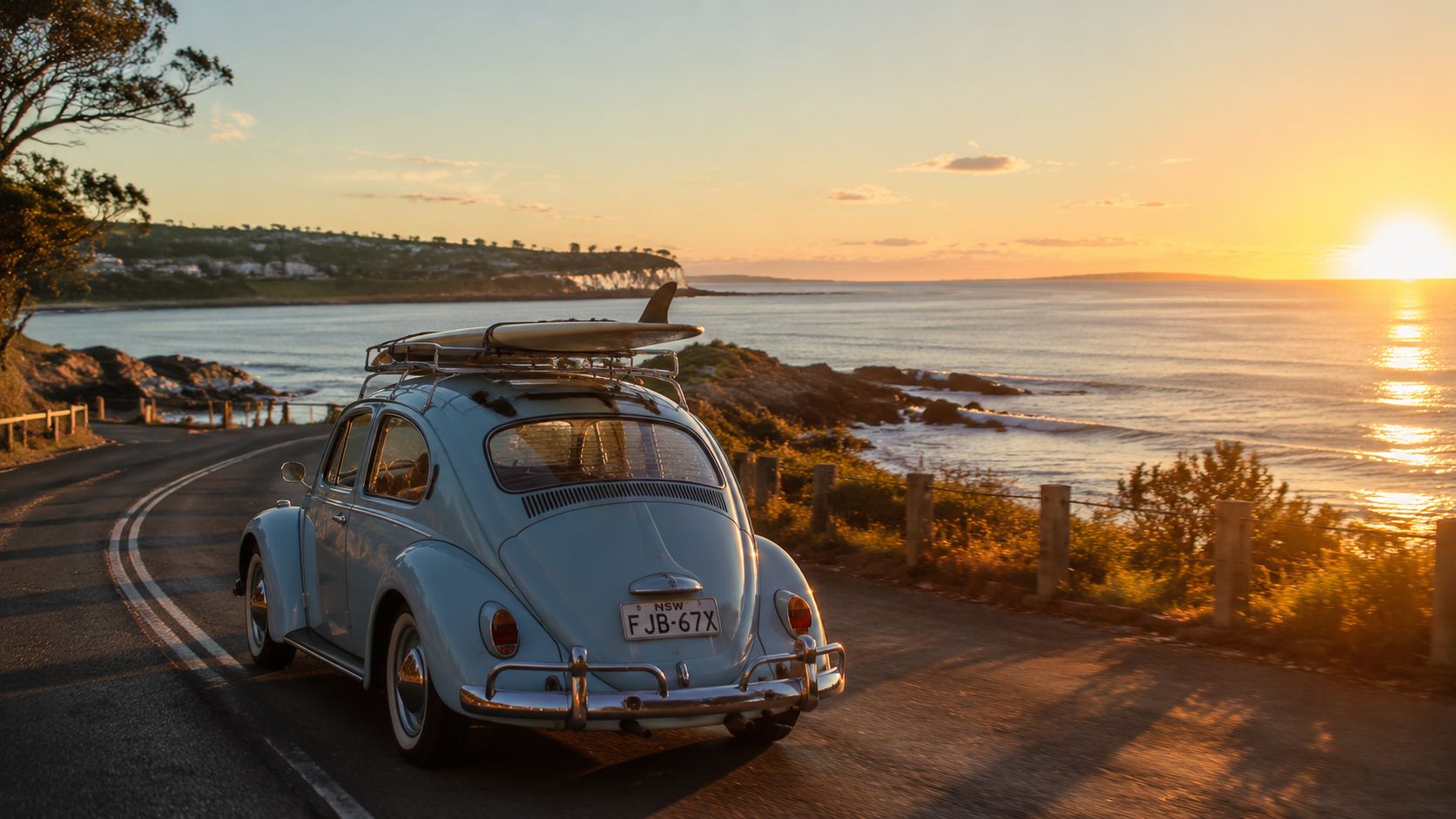
A mate of mine once spotted a pale blue Beetle rolling past the esplanade with a surfboard on the roof, and the whole car park turned to look. Nobody asked what year it was at first. They just smiled, because some cars do that.
Remember Your First Beetle Sighting
For plenty of us, the first proper Beetle memory isn't from a museum or a buyer's guide. It's from the road. A rounded bonnet catching the afternoon light, a cheery engine note, maybe a driver with one arm out the window and a grin that says the trip matters as much as the destination.
That image has become part of Australian car culture. It's why a Beetle parked outside a milk bar still draws a crowd, and why a tidy Bug at a Sunday meet can spark ten different stories at once. One person remembers learning to drive in one. Another remembers family holidays. Someone else remembers seeing one with flowers on the dash and a board strapped on top, heading for the beach.
There's also a fresh layer to that nostalgia. The cultural narrative behind the 1967 VW Beetle's resurgence in Brisbane and Melbourne is a growing local trend, with locals sharing stories of reviving neglected cars, and that renewed affection lines up with stronger interest in retro diecast pieces and coastal décor that feature Beetle styling, as seen in this Australian VW community discussion.
Some cars become transport. A Beetle becomes a memory keeper.
Why the little Bug still lands so well
The Beetle works on two levels at once. It's approachable enough for a casual fan, but the deeper you go, the more detail you find. Local-market trim quirks, different engines, year-specific bits, Australian-only touches. That's where the hobby really opens up.
That's also why collecting Volkswagen Beetle models feels so satisfying. A diecast Beetle isn't just a small car on a shelf. It can be the beach cruiser you saw as a kid, the one your uncle restored in the shed, or the exact shape you still scan for every time you pass a classic car show.
The shelf version of a real feeling
Miniatures let you hold onto the part that matters most. The curves. The colour. The surf vibe. The simple joy of seeing a Bug and instantly feeling lighter.
If you've ever slowed down to admire one at the lights, you already understand why VW Beetle models have such pull.
A Bugs Life The Beetles Journey in Australia
At plenty of Aussie shows, the story starts the same way. Someone points at a tidy mid-sixties Bug, smiles, and says, “Ours had different bumpers.” That small memory says a lot. Australia gave the Beetle its own local character, and those differences still matter when you are trying to match a real car from memory with the right diecast on the shelf.
Australia's chapter began with CKD assembly in the mid-1950s and ran through to the final Australian-assembled Type 1 at Clayton, Victoria, in the mid-1970s, as outlined in this history of the Volkswagen Beetle.
That long local run is why an Australian Beetle can feel slightly “off” if you compare it with a British or American guidebook. The shape is familiar, sure, but the details often aren't. Trim, engines, electrical setup, and market positioning all took their own path here.
A good early example comes from Volkswagen Australia's own Beetle history. It notes that early Australian-market Type 1 cars used a smaller-output air-cooled engine, which gave local Bugs a gentler, less hurried character on the road than some overseas buyers expected. You can read that background in Volkswagen Australia's Beetle history.
That personality carries into collecting. A miniature Beetle only really clicks for an Aussie collector when it resembles the car they remember from the school pick-up, the beach carpark, or a neighbour's driveway in Geelong or Newcastle.
How Australian Beetles became collector clues
By the middle of the sixties, local differences had become the sort of details enthusiasts love arguing over beside the bonnet. Shannons notes that the Australian-market 1965 Beetle used a 1300cc engine, and that 1967 Australian Bugs were sold with 1300 or 1500 engines while staying on a 6-volt electrical system, according to this Shannons Club feature on the Volkswagen Beetle.
For restorers, those are handy facts. For diecast collectors, they are even more useful because they help explain why a generic overseas model can look close but still miss the mark.
That is especially true once you get into the Australian Deluxe and Custom variations of 1966 and 1967. Those cars are part of the memory bank for many local collectors, and they are exactly the sort of variations that can make one shelf model feel “right” and another feel like a near miss. If your heart is set on the later classic shape, this 1970s Volkswagen Beetle collectible shows how strongly those familiar lines still translate into miniature form.
A few local milestones worth keeping in mind
Local assembly gave Australian Beetles their own production story and helped create the market-specific versions enthusiasts still chase.
Local tuning and equipment choices meant Aussie Bugs did not always match overseas specifications, even when the body style looked similar at first glance.
The end of assembly at Clayton closed the factory chapter, but it also fixed those Australian variations in time, which is why collectors still search for replicas that match local memories rather than global averages.
That is the charm of the Australian Beetle story. The car stayed recognisably a Beetle, but the version we knew here picked up its own accent. For anyone collecting VW Beetle models, that local accent is often the difference between a nice miniature and the one that instantly takes you back.
The Different Beetles Youll Spot Down Under
If there's one area where Aussie collectors get caught out, it's the 1966 and 1967 Beetle variants. At a glance, they can seem close enough. Park them side by side and the local-market clues start talking.
The key point is simple, but it's often glossed over in global guides. Australian Deluxe models in 1966 and 1967 featured “Towel rail” bumpers, while the Custom models had blades, a distinction highlighted in this discussion of Australian Beetle trim differences. For anyone checking authenticity, that's not trivia. It's a core identifier.
The trim detail that changes everything
Collectors often focus on paint, wheels, and badges first. Fair enough. But bumper style can be the clue that sorts an accurate restoration from a muddled one.
Here's the quick read:
Deluxe: Look for Towel rail bumpers on Australian 1966 and 1967 cars.
Custom: Look for blade bumpers in those same years.
Collector takeaway: If a diecast or restored car mixes those cues, it may not match the Australian-market version it claims to represent.
A good example of how Beetle styling carried forward in collectible form is this 1970s Volkswagen Beetle model, which shows how strongly period details influence what collectors choose to display.
Why this matters for diecast buyers
A miniature can be beautifully painted and still feel wrong if the trim doesn't match the car in your memory. That's especially true for Australians chasing a specific family car, a car-show favourite, or a suburb-by-suburb memory from the sixties and seventies.
Plenty of diecast buyers aren't hunting for a generic Beetle. They want their Beetle. The one that used to sit in a driveway in Geelong, Brisbane, Newcastle, or Adelaide. That's where local identification knowledge becomes useful, because it lets you judge a model with more confidence.
For a closer look at Beetle styling in motion, this walkaround helps sharpen the eye:
When you know the bumper story, Australian VW Beetle models suddenly become much easier to read.
From Full Size to Your Shelf Collecting VW Beetle Models
The jump from real cars to diecast usually starts with recognition. You spot a model and think, “That's the one.” Then the practical questions arrive. Which scale suits your shelf? How much detail do you want? Do you want a display piece, a gift, or the start of a proper collection?
The first thing I tell new collectors is to buy with your eyes, then confirm with your head. If a model captures the spirit of the car you remember, that matters. After that, check the quality, the finish, and whether it's an officially licensed piece rather than a vague imitation.
Choosing the right scale
Scale changes the whole experience. A larger model gives you presence and detail. A smaller one is easier to group into a themed display with multiple Beetles, Kombis, and buses.
Here's a simple guide.
Scale
Average Length
Best For
Detail Level
1:18
Larger display format
Feature shelves, desk centrepieces, collectors who want presence
High
1:24
Mid-sized display format
Home décor, gift giving, balanced detail and footprint
Strong
1:32
Compact display format
Group displays, smaller shelves, mixed VW collections
Moderate
If you're browsing across different formats, the Volkswagen model cars collection is a useful place to compare what feels right for your space and taste.
What quality looks like in a Beetle model
A good diecast Volkswagen Beetle model usually gets the basics right before the fancy bits.
Body shape first: The roofline, guards, and stance should feel unmistakably Beetle from across the room.
Trim accuracy matters: On Australian-inspired models, bumper style and period cues can make or break the illusion.
Paint and finish: Clean lines, tidy chrome-style detailing, and a colour that suits the era all help.
Licensed presentation: Officially licensed pieces tend to feel more considered in both design and packaging.
Collector's note: The best model isn't always the biggest one. It's the one that still makes you smile after the novelty wears off.
Matching the model to the memory
Some collectors chase showroom neatness. Others prefer surf-themed cars, flower-power colourways, or display pieces that echo coastal living. Beetles are brilliant for this because the car has always moved between worlds. Daily transport, beach runabout, rally oddball, restored classic, pop-culture icon.
That flexibility makes VW Beetle models easy to fold into a broader display too. A Beetle can sit happily beside a Kombi, a Samba Bus, or other VW memorabilia collectibles without looking out of place.
Top Tips for the Aspiring Beetle Collector
A strong collection doesn't need to start big. It needs to start with a point of view. The most enjoyable shelves usually say something about the person who built them, whether that's “classic Australian Bugs,” “surf-themed Volkswagens,” or “every Beetle that reminds me of childhood road trips.”
That's why collecting feels so accessible. You don't need a dedicated showroom. A bookshelf, a study nook, or a coastal-style living room cabinet can do the job beautifully if it's arranged with a bit of care.
Build a collection with a theme
Try choosing one angle and following it for a while.
Year-led collecting: Focus on one era, such as mid-sixties or seventies Beetles.
Lifestyle-led collecting: Surfboards, flower-power styling, beachy colours, and sunny display settings work especially well with Beetle pieces.
Family-memory collecting: Recreate the cars you grew up with, or the ones your parents and grandparents still talk about.
Collectors sometimes overcomplicate this part. You don't need a museum method. You need consistency.
Keep dust under control: A soft cloth or gentle duster goes a long way.
Give each piece room: Beetles have shape. Let those curves breathe instead of cramming models bumper-to-bumper.
Use décor intentionally: Timber shelves, white walls, and coastal accents suit VW displays beautifully.
A Beetle model works best when it looks like it belongs in the room, not when it's hidden away like something too precious to enjoy.
Buy slower and enjoy more
The hobby becomes richer when each piece earns its place. Rather than grabbing every model you see, pause and ask a few simple questions:
Does it match the era or style I'm collecting?
Does it remind me of a real Beetle I know or remember?
Will I still enjoy seeing it on the shelf next month?
That small pause usually leads to a stronger, more personal collection.
Bringing a Beetle Home The Perfect VW Gift
The best VW gifts usually land because they feel personal. Not expensive for the sake of it, and not flashy. Just right. A Beetle model can do that in a heartbeat, especially when the recipient already has a story tied to the car.
I've seen this play out often with birthdays and Christmas gifts. Someone spends ages talking about an old Bug they once owned, or the one their parents had near the beach, and then a small boxed model turns up that brings the whole thing flooding back. It's not just décor. It's recognition.
Why the surf-themed Beetle works so well
Among the most cheerful examples is the 1967 Volkswagen Beetle with a surfboard in 1:24 scale, a classic collector's piece and a popular retro décor item that reflects the Beetle's close connection with Australian surf culture, as shown in this 1967 VW Beetle Flower Power Surfboard model.
That sort of gift works because it carries more than one mood at once. It says classic VW. It says summer. It says Australia. And if the person you're buying for also loves buses and vans, the same charm carries straight across to VW Kombi diecast Australia favourites and Samba Bus pieces.
A few gift ideas that rarely miss
For the nostalgic driver: Pick a Beetle colour or era that echoes a car they once owned.
For the beach-house decorator: A surf-themed Beetle sits naturally with coastal styling.
For the broader VW fan: Pair a Beetle with a Kombi or Samba Bus for a fuller display story.
If you're buying from an Australian importer, the practical advantages are clear too. Local stock, fast shipping, and straightforward support make gift shopping much easier, especially when you want the model to arrive without fuss.
FAQ
Which VW Beetle models are most confusing for Australian collectors?
The Australian 1966 and 1967 Custom and Deluxe variants create plenty of confusion. Deluxe cars had Towel rail bumpers, while Custom models used blade bumpers, a local-market distinction that catches people out.
Were Australian Beetles different from US versions?
Yes. Australian-market Beetles had local differences in engines, trim, and specification. That's one reason overseas guides don't always line up neatly with the cars Australians remember.
What should I look for in a Volkswagen Beetle model?
Start with shape, stance, trim accuracy, and overall finish. If you're chasing an Australian memory, period-correct details matter more than flashy packaging.
Is a Beetle diecast a good gift for non-collectors?
Absolutely. Beetles carry such strong nostalgia that even people who don't think of themselves as collectors often love receiving one, especially if it matches a memory or suits a coastal décor style.
Are Beetles the only classic VW worth collecting?
Not at all. Beetles are often the gateway, but many collectors branch into Kombis, Samba Buses, and broader VW memorabilia collectibles once the display starts taking shape.
If you're ready to find a Beetle that looks like the one from your memories, or you want a Kombi or Samba Bus to round out the shelf, have a browse through Volkswagen Memorabilia. It's a great spot for officially licensed VW pieces, local stock, fast shipping, and the kind of selection that makes building a proper collection feel easy and fun.
You've probably done it yourself. You bring home a cracking little Beetle or Samba Bus, set it on a shelf, step back, and think, that looks brilliant. A few weeks later there's a film of dust on the roofline, a fingerprint on the side window, and the once-crisp finish doesn't feel quite as special.
That's where proper display cases for models earn their keep.
For VW collectors, a case isn't just storage. It's part protection, part presentation, and part respect for the story that model carries. Whether it's a neat 1:43 Beetle that reminds you of your first car or a larger Kombi that captures every chrome strip and two-tone panel, the right case keeps the details sharp and the nostalgia intact.
More Than a Box Protecting Your Prized VWs
There's a real pleasure in holding a fresh diecast VW model. You notice the shape of the guards, the little badge work, the paint, the windows, the stance. That feeling is exactly why a case matters. If the model means something to you, protecting it shouldn't be an afterthought.
Dust is the obvious enemy, but it's not the only one. Sunlight, accidental bumps, moisture in the air, and plain old handling all chip away at a model over time. Decals can fade, paint can lose its punch, and delicate bits like mirrors and roof accessories can cop damage just from being moved around too often.
Why museum thinking matters at home
Australian collectors can learn a lot from conservation practice. In Australia, heritage institutions like the National Museum of Australia display objects in sealed cases with controlled lighting, often as low as 50 lux for highly light-sensitive materials, to reduce deterioration, as noted in this overview of display case conservation practice. That same principle applies beautifully to diecast Volkswagens, because paints, plastics, adhesives, and decals don't enjoy heat, dust, or harsh light any more than museum objects do.
Practical rule: If a model is worth displaying, it's worth separating from the room around it.
That doesn't mean every collector needs a museum-grade cabinet in the lounge. It means the logic is sound. A sealed or semi-enclosed case with a clear front, stable base, and sensible lighting will usually protect a model far better than open shelving ever will.
Why open shelves often disappoint
Open shelves look tidy for about five minutes. Then the cleaning starts. If you've ever tried dusting around aerials, mirrors, gutter lines, roof racks, or tiny trim pieces on a Kombi, you already know how risky that is.
A decent case helps with all of this:
Less dust build-up means less cleaning and less touching.
Better physical protection keeps models safer from pets, kids, elbows, and general household chaos.
A cleaner visual frame makes the model look intentional, like a proper display piece rather than a toy parked on furniture.
If you want a few practical basics on ongoing upkeep, the collectible care advice is worth a look. Good care starts long before anything needs repairing.
Choosing Your Armour Acrylic Glass or Timber
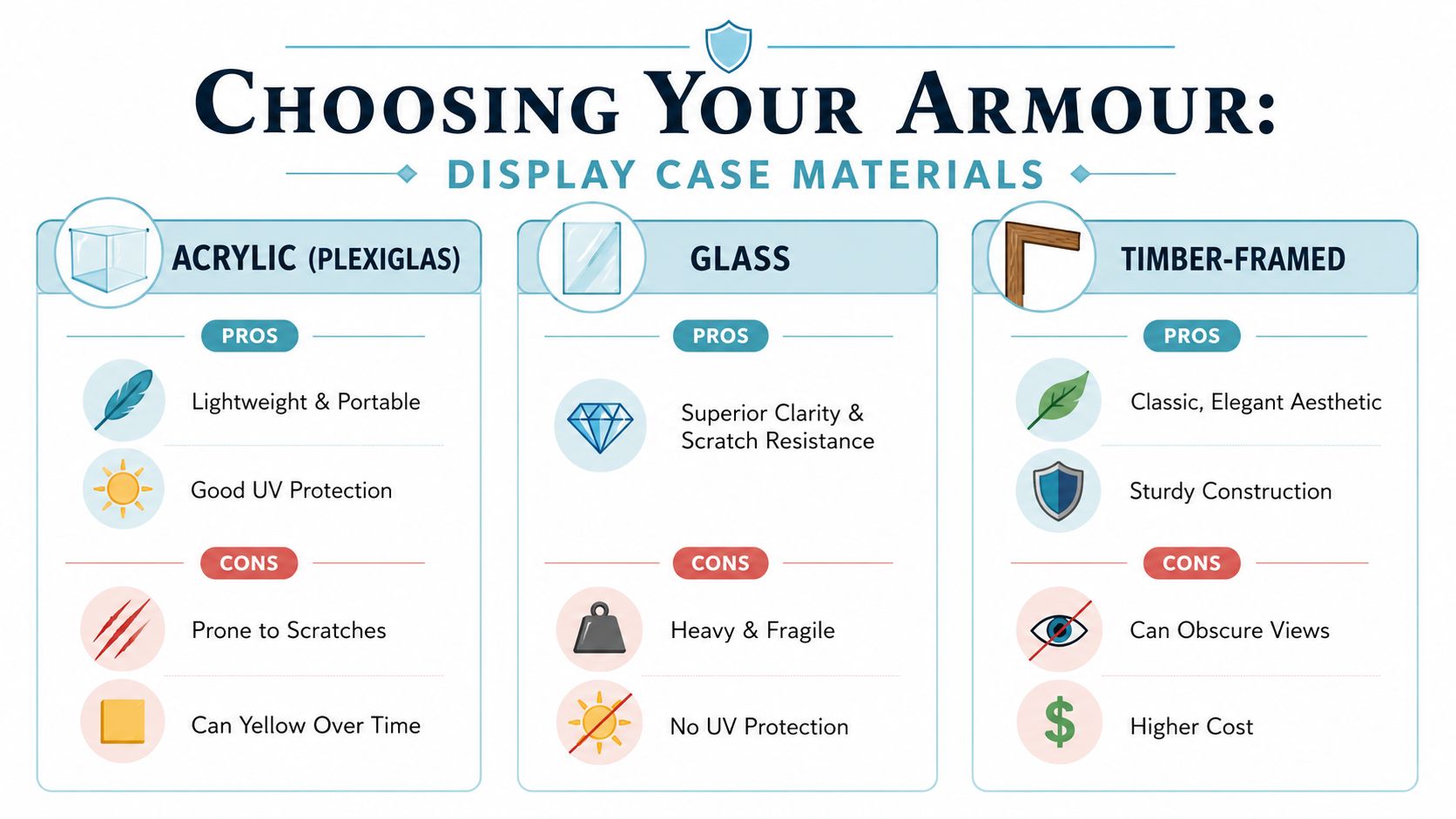
Material choice changes both the look and the day-to-day reality of your display. Some collectors chase the clean, almost invisible look of acrylic. Others love the heft and clarity of glass. Then there's timber-framed cabinetry, which can make a collection feel like part of the room rather than something added to it.
Acrylic for everyday collectors
Acrylic is popular for good reason. It's lighter than glass, easier to move, and usually safer if the case is going into a family room, office, or shop where it might get bumped. For smaller VW displays, that lower weight makes a big difference when you're rearranging shelves or carrying a case to a club display.
It also suits the way many collectors buy and display models in Australia, where centimetre-based sizing and lightweight clear enclosures are common. The downside is familiar. Acrylic can scratch, and cheaper panels can lose their crisp look over time.
Glass for a sharper finish
Glass has a classic feel. It's harder to scratch in normal use and often gives a more premium look, especially in a cabinet with good lighting and a dark base. A glass case around a detailed Beetle can look superb on a sideboard or in a study.
The trade-off is weight and fragility. It's less forgiving to move, less ideal around active kids or pets, and if something goes wrong, it goes wrong more dramatically than acrylic.
In Australian homes, the acrylic-versus-glass decision matters because UV exposure and coastal conditions can affect plastics, decals, and paint finishes, a gap many generic buying guides leave unanswered, as noted in this display case buying guide.
Timber-framed cases for furniture-style display
Timber-framed cases work best when you want the display to feel permanent. They suit a study, lounge, or hallway where the case becomes part of the room's character. For classic VW collections, timber can bring in that warm vintage note that pairs nicely with cream, pastel, or two-tone models.
A few things to weigh up:
Acrylic works well if you want lighter handling and a simple modern look.
Glass suits collectors who value scratch resistance and visual crispness.
Timber-framed cases shine when aesthetics matter as much as protection.
What doesn't work so well is choosing purely by looks. A beautiful case placed in a hot sunny room is still a poor choice. Material and location have to work together.
Getting the Size Right for Your Favourite VW Models
Most case-buying mistakes happen here. People look at the outside measurements, think it should be fine, and only realise the problem when a mirror touches the wall or the roofline sits too close to the top panel.
Internal clearance is what matters.
Custom case guidance recommends defining the object's internal dimensions first, then working out material, wall thickness, base, and access details from there. For diecast VWs, that's the difference between a model sitting safely and a model under pressure from a case that looked big enough from the outside.
Measure the model, not the shelf
Start with the model itself. Measure the longest, widest, and tallest points, including mirrors, roof racks, lights, or any accessory that protrudes. For many VW pieces, those are the bits that catch first.
A good rule of thumb is to add 1 to 2 cm of clearance around the model's length, width, and height. For a typical 1:18 VW model that's about 25 cm long, that extra space helps stop mirrors or accessories touching the sides and reduces handling damage, as noted in this model display sizing guide.
Tight cases rarely look premium. They look like the model was squeezed in as an afterthought.
A simple way to size a case
Use this order and you'll avoid most of the headaches:
Measure the actual model including fragile bits.
Add clearance so nothing sits hard against the walls.
Allow for the base if the case includes one.
Think about access because a case that's awkward to open will lead to rough handling.
Check the internal dimensions only, not the cabinet's outside footprint.
Here's a practical quick guide for common VW diecast scales.
Model Scale
Typical VW Model
Recommended Minimum Internal Case Size (cm)
1:18
Beetle or Kombi with detailed mirrors and trim
Model dimensions plus at least 1 to 2 cm clearance on length, width, and height
1:24
Beetle coupe or Kombi bus
Model dimensions plus at least 1 to 2 cm clearance on length, width, and height
1:43
Classic Beetle, Type 2, or Samba Bus
Model dimensions plus at least 1 to 2 cm clearance on length, width, and height
1:64
Small Beetle or micro display grouping
Model dimensions plus at least 1 to 2 cm clearance on length, width, and height
Collectors browsing different scales can compare what suits their shelves in the Volkswagen model cars collection. It makes planning mixed displays much easier if you know whether you want one standout 1:18 hero piece or a row of smaller classics.
What works in real displays
A 1:18 Kombi Samba Bus usually looks best with a little breathing room. That extra space makes room for a label, a neat plinth, or just a cleaner view around the body. It also makes the case feel deliberate rather than cramped.
What doesn't work is buying a generic cube because the numbers seemed close. Cases should fit the model. Not the other way around.
Lighting and Mounting to Make Your Models Pop
A great VW model can disappear under bad lighting. You lose the curve of a Beetle bonnet, the split in a Samba windscreen, the sparkle in chrome, and the depth in two-tone paint. Good display cases for models don't just protect. They stage the model properly.
Plan the light before you build the case
Many home setups go off track. People buy a case first, then try to stick lighting in afterwards. The better approach is to design construction and lighting together.
For the best results, integrated LED strips with diffusers should be considered from the start, because the lighting type, colour temperature, wiring path, and power location all affect frame depth and access. In enclosed acrylic cases, a 12V supply and diffused LEDs help keep heat low and reduce glare on glossy paint and chrome, as shown in this LED display case build example.
Mounting choices change the whole mood
A black base can make bright Kombi colours jump out. A mirrored base shows off underbody detail and gives a bit of that show-and-shine drama. Timber plinths add warmth and suit vintage displays, especially if you like older Beetles and buses in cream, red, pale blue, or surfy pastel shades.
A few setups collectors tend to like:
Freestanding single-model cases for one hero piece on a desk or sideboard.
Wall-mounted displays when floor or shelf space is tight.
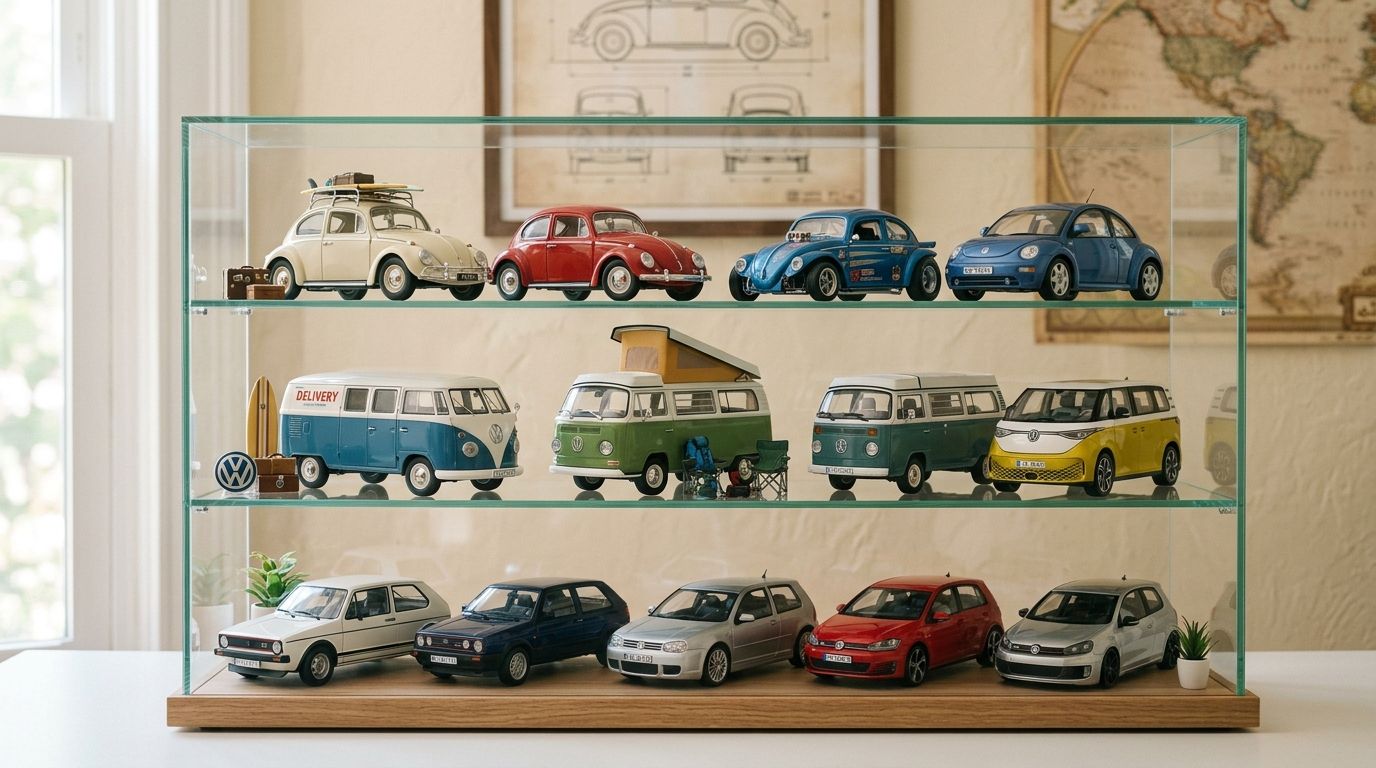
Tiered cabinets if you're arranging several scales and want easy viewing.
Soft, diffused light flatters diecast better than harsh direct light every single time.
The goal isn't to blast the model with brightness. It's to reveal the lines, trim, and colour without glare bouncing back at you.
Styling a Collection with VW Heart and Soul
This is the fun bit. Once the protection and fit are sorted, the case becomes a little stage for your VW story. A display should say something about why you collect, not just what you own.
Display ideas that feel personal
A lovely approach is to group by mood rather than scale. A shelf of surf-themed Kombis, beachy colours, and relaxed coastal styling has a completely different feel from a tidy row of Beetles arranged by decade or paint colour.
You might try:
Through the decades with early Beetles through to later classics.
Surf culture styling with Kombis, buses, and relaxed coastal props.
Colour grouping so creams, blues, reds, or flower-power finishes work together visually.
Let the collection tell a story
Some of the best displays aren't the biggest. They're the ones with a theme. A single Flower Power Beetle beside a couple of bright Kombis can say more than a crowded shelf of unrelated pieces.
If you want to blend VW collecting into your room styling, the home decoration range can spark ideas for tying diecast displays into a broader coastal or vintage setup. That's especially handy if your collection lives in the lounge rather than a dedicated hobby room.
Keep props simple. The star should still be the Volkswagen.
Frequently Asked Questions
How do I clean an acrylic case without scratching it?
Use a very soft microfibre cloth and clean gently. Don't scrub dry dust around the surface, because that's when fine scratching happens. Light pressure and patience beat aggressive wiping every time.
Can I stack display cases?
You can, but only if the lower case is stable, flat, and built to carry the weight. Heavy stacking on flimsy acrylic tops is asking for trouble. If you want a vertical display, a proper cabinet or shelf system is usually the safer option.
What if dust still gets inside the case?
That's normal with cases that aren't fully sealed. Open the case carefully, remove the model by its sturdier points, and clean both the base and the inside panels before putting it back. The less often you do this, the better.
Is a bigger case always better?
No. Too much empty space can make the model look lost. You want enough clearance for safety and viewing, but not so much that the case overwhelms the car.
Should I display my best model in a sunny room?
It's better not to. Even a beautiful bright room can be rough on paint, decals, and plastics over time. Choose a spot with stable conditions and indirect light if you can.
Are wall-mounted cases good for VW diecast?
They can be excellent if they're properly fixed and sized for the model. They suit smaller spaces well and can turn a hallway or study wall into a tidy gallery of Beetles and Kombis.
If you're ready to give your collection the kind of home it deserves, Volkswagen Memorabilia is a great place to browse officially licensed VW-inspired pieces, from diecast classics to display-worthy home décor. It's especially handy for Australian collectors who want local stock, quick shipping, and a range that understands the charm of Beetles, Kombis, Samba Buses, and the whole laid-back VW spirit.
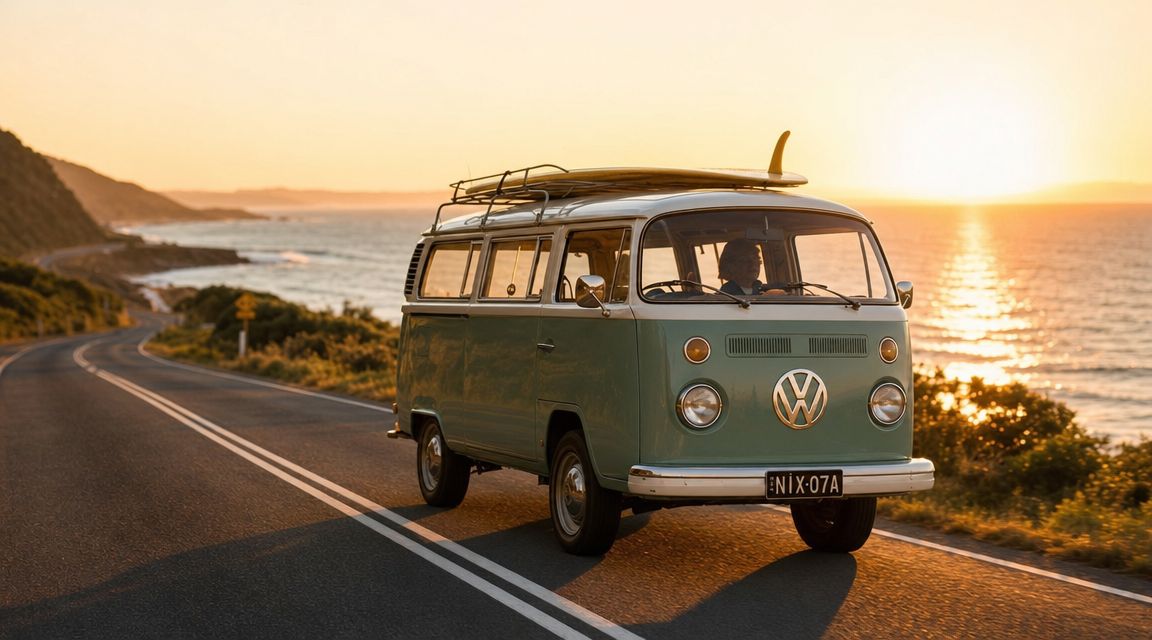
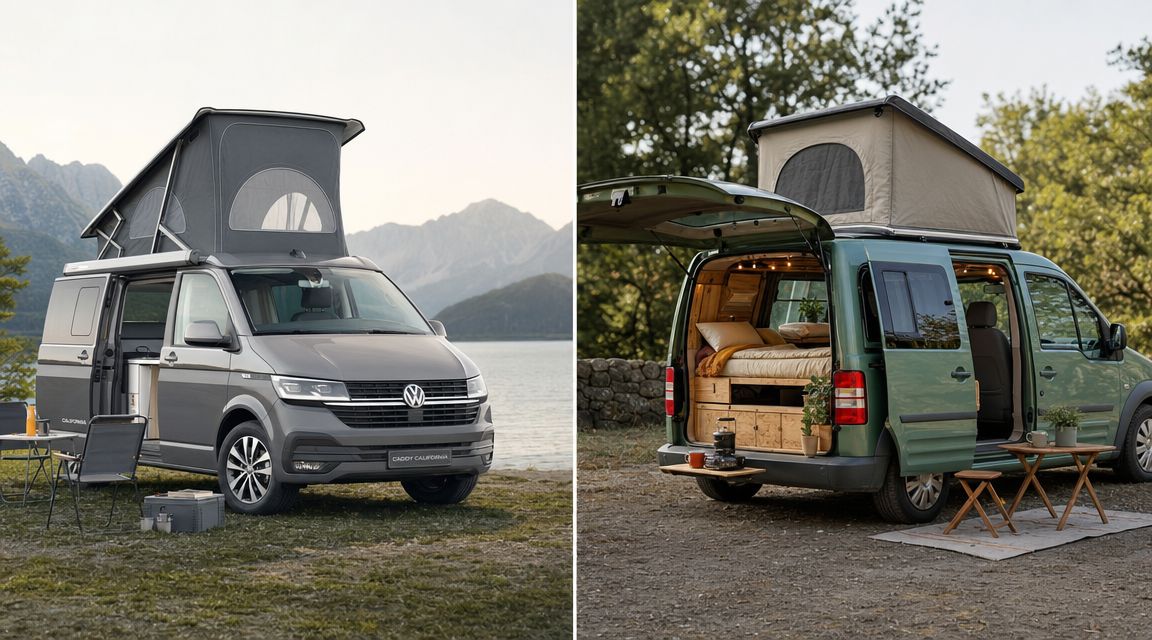
At a beachside VW meet, an old Kombi rolled in with salt still clinging to the window rubbers, and half the crowd drifted over before the engine even switched off. A little later, a newer Caddy California parked beside it, and you could feel the same curiosity ripple through the grass.
The Enduring Dream of a VW Camper
Anyone who's spent time around Volkswagens in Australia knows the feeling. A Kombi doesn't just arrive. It brings a whole mood with it. You see the faded curtains, the picnic basket, the surfboard wax in the rear tray, and suddenly you're not standing in a showground anymore. You're somewhere between the coast and the next good bakery.
That's why the modern Caddy Volkswagen camper is such an interesting little machine. It doesn't try to be a retro tribute act. It's not pretending to be a split-window bus or a bay-window weekender. But it carries the same old VW promise. Go light, go straightforwardly, and go often.
Why the idea still grabs us
The classic Kombi spirit was never only about size or styling. It was about access. A weekend away didn't need a caravan park empire or a huge tow rig. It just needed a vehicle that felt ready for a detour.
That's where the Caddy makes sense to so many Australian buyers. It suits the sort of trips people take:
Quick coastal escapes for one or two nights
Regional drives where parking in town still matters
Everyday duties during the week, then camping gear on Friday arvo
Beach runs and national park stops where a smaller footprint feels easier to manage
A VW camper has always sold a kind of freedom. The shape changes over the decades, but the promise stays familiar.
A modern cousin, not a replacement
If you grew up loving Kombis, the Caddy can look a bit too tidy at first glance. More polished. More suburban. More sensible. Then you watch one being used properly, chairs out, rear setup organised, bed folded flat, and it clicks.
This is the same story in newer clothes.
The old buses made adventure feel communal and a bit chaotic. The Caddy California makes it feel compact, organised, and easier to fit into modern life. That difference matters. Plenty of Australian enthusiasts still want the VW camping feeling, but they also want something that can handle the grocery run, the school pickup, or the tight car spaces near the beach.
For many people, that's not losing the magic. It's finally making the magic practical.
Meet the Modern Adventurer The VW Caddy Camper
At a swap meet in Geelong last summer, a bloke parked his cream-and-white Bay Window beside a newer Caddy California. Kids drifted to the Kombi first. Their parents kept wandering back to the Caddy, peering inside, checking the bed setup, opening the tailgate, asking the same question over and over. Could you live with this every day and still nick off for a weekend down the coast?
That question explains the Caddy better than any brochure.
What the Australian Caddy California actually is
In Australia, the Caddy California arrives as a compact five-seat camper package with a foldable bed, storage bags, table and chairs, extra lighting, and ventilation in a 2+3 seating layout. The point is simple. You are not starting with an empty van and a camping shop receipt. Volkswagen has already sorted the basics into a tidy, usable setup.
That gives the Caddy its own personality. A classic Kombi always felt like an invitation to improvise. The Caddy California feels more organised, more urban, and more ready for Friday arvo without a shed full of loose gear.
The sizes and specs that matter on Aussie trips
For Australian buyers, size is half the story. A camper has to fit the trip, but it also has to fit the Woolies car park, the unit block, and the cramped beachside street with one shady spot left.
CarsGuide's Caddy California review notes that the current Maxi measures 4,835 mm long with a 2,970 mm wheelbase, a 577 kg payload, a 100 kg roof load limit, and towing ratings of 750 kg unbraked and 1,500 kg braked. It is also designed to sleep two adults and is offered here in short-wheelbase and Maxi long-wheelbase forms.
Those numbers matter once the romance wears off and the gear goes in. Bedding, an esky, a couple of bags, maybe a surfboard on top, maybe bikes out back. A camper only earns its keep if it still works when the holiday stops being hypothetical.
If you want a clearer feel for the stretched body that suits longer trips, the VW Caddy Maxi range gives a handy visual reference for the shape many enthusiasts recognise straight away.
Why the Caddy appeals beyond camping
Part of the Caddy's appeal is that it never forgot its working roots. It still carries that honest Volkswagen habit of doing ordinary jobs well. School drop-off on Tuesday. Bunnings run on Thursday. Camp chairs out at Aireys Inlet by Saturday morning.
RAC's Volkswagen Caddy and Caddy Life review lists the standard Caddy at 4,500 mm long, 1,855 mm wide, and 1,832 mm high, with passenger versions available with seven seats. The same review reports WLTP fuel economy figures of up to 53.3 mpg combined for the most efficient 2.0 TDI and 43.5 mpg combined for the 1.5 TSI petrol.
That is why the Caddy lands so well with Australians who love the old VW camping idea but live very modern lives. It carries a bit of Kombi spirit in a shape that suits tighter streets, busier weeks, and shorter escapes. The old vans taught us to chase freedom. The Caddy makes room for it in the calendar.
Factory Fresh or DIY Dream Which Caddy Camper is for You
The big question usually arrives right after the first burst of excitement. Do you buy the factory camper, or do you start with a standard Caddy and build your own version of the dream?
I've heard both stories told at shows and campgrounds. One owner loves that the California arrives sorted from the start. Another swears by a home-built setup because it suits fishing gear, a dog bed, and the exact way they travel. Both can be right. The trick is being honest about your patience, skills, and tolerance for paperwork.
What the factory route gives you
The appeal of the official Caddy California is simple. Volkswagen has already done the packaging work. The vehicle is sold as a compact camper rather than a van someone has adapted in the driveway over a few long weekends.
The current Caddy California line uses the fifth-generation MQB architecture and offers a 2.0 TDI with 122 PS and a 1.5 TSI with 116 PS. The diesel delivers 320 Nm at 1,600 to 2,500 rpm, while the petrol delivers 220 Nm at 1,500 to 3,000 rpm. Volkswagen Commercial Vehicles also notes combined-cycle figures of roughly 40.9 to 42.2 mpg, about 5.3 to 6.9 L/100 km depending on variant, in the Caddy California brochure PDF from Volkswagen Commercial Vehicles UK.
For camper use, that low-rpm torque band matters more than brochure bragging. A loaded camper feels better when it moves off cleanly and doesn't constantly ask for downshifts on inclines.
Why DIY can look easier than it is
A standard Caddy can absolutely become a charming little camper. That's part of the fun. You can tailor storage, sleeping layout, and daily usability around your life instead of a factory template.
But Australian conversions have a sting in the tail. A major consideration for DIY builders here is the true compliance burden. Australian Design Rules for seating, glazing, and cabinetry restraint are strict, and what looks cheap at first can become far less cheap once engineering approval and insurance changes enter the picture, as discussed in this Australian-focused Caddy conversion video context.
The cheapest build on video isn't always the cheapest build on the road.
That's the bit many buyers miss. Factory and DIY can start far apart in your head, then edge closer once legal and insurance realities pile up.
Caddy California vs DIY Conversion at a Glance
Aspect
Factory Caddy California
DIY Caddy Conversion
Setup
Ready-made camper package from Volkswagen
Built around your own priorities
Interior planning
Foldable bed, storage bags, table and chairs already integrated
Can be customised for surf gear, dogs, tools, or simpler sleeping
Compliance
Factory solution avoids much of the owner-led modification burden
Needs careful attention to ADR-related issues and insurer requirements
Time
Faster path to camping
Slower, especially if plans change mid-build
Feel
More polished and cohesive
More personal and often more experimental
For readers who enjoy the visual side of the Caddy story as much as the practical one, this VW Caddy van camper collection is useful for seeing how the van's lines translate into collectible form.
A walkaround helps make the factory setup feel more tangible:
Which owner each path suits
Some people should go factory without overthinking it:
Busy buyers who want to camp soon, not after months of planning
Drivers who value a tidy OEM feel inside and out
Owners wary of engineering and insurance headaches
DIY suits a different crowd:
Hands-on tinkerers who enjoy solving layout problems
Owners with unusual cargo needs that factory packaging can't match
People happy to research compliance properly before cutting, fitting, or wiring anything
If your camping style is light, frequent, and close to daily driving, a factory Caddy California often feels like the smoother path. If you love building as much as travelling, the DIY route can still be very satisfying. You just want open eyes before open toolboxes.
The Collector's Corner Caddy Campers in Miniature
One of the best VW displays I've seen at a local meet had a sun-faded Kombi, a tidy Beetle, and, right at the end, a little Caddy camper in silver. The old stuff drew people in first. Then the Caddy kept them there. You could watch them smile when they noticed the story on the shelf. Same holiday spirit, different generation.
What to look for in a Caddy model
That's the charm of the Caddy in miniature. It still feels fresh in collector circles, especially beside Beetles and Kombis that have had a long head start. A good one should look like a proper camper, not just a small van with VW badges.
The details matter more than people expect. Collectors usually notice the roofline, the proportions, the trim, and whether the model hints at the clever camping setup that gives the Caddy California its character. If those cues are missing, the model can feel anonymous. If they're right, it has that lovely, instantly familiar VW honesty.
A few things are worth checking before you buy:
Body shape that matches the right Caddy generation and wheelbase
Cabin or rear detailing that suggests a camper fit-out rather than a plain cargo van
Factory-style finishes instead of fantasy graphics that were never part of the actual vehicle
Scale that suits how you collect, whether that means one centrepiece or a full VW lineup
Choosing a scale that suits your shelf
A larger model has presence. You notice the mirrors, the glasshouse, the little trim touches. It feels like something to stop and study.
Smaller scales are a different kind of fun. They let you build a whole Volkswagen family on one shelf, from the rounded old Beetle through to the beach-bred Kombi and on to the practical Caddy. If that broader story appeals to you, a range of Volkswagen model cars can help you piece the generations together without the display feeling random.
A Caddy model earns its place by showing the same clever, everyday camping spirit that made the full-size van worth a second look.
Why the Caddy belongs beside the classics
The Caddy sits beside the classics beautifully because it carries the same idea of freedom into modern life. The Kombi promised open-road adventure with sand on the floor and a surfboard out the back. The Caddy answers with a neater footprint, smarter packaging, and the kind of versatility that suits a quick coastal weekend or an overnight stop inland.
Set the two together in miniature and the family resemblance comes through fast. One speaks in nostalgia. The other speaks in practicality. Both still say Volkswagen camper.
Styling Your Space with Volkswagen Spirit
At a swap meet in Geelong last summer, one bloke had a simple display on a timber shelf. A faded photo of his family's old bay-window Kombi sat at one end. A neat little Caddy camper model sat at the other. In between, a Beetle tied the whole story together. You could read the journey in one glance. Seventies surf trips, Sunday tinkering in the shed, and the modern weekend dash up the coast in something compact and clever.
That is what a good VW display does. It gives a room a bit of travel dust, a bit of memory, and a clear sense that the Volkswagen camper spirit never really disappeared. It just changed shape.
Display ideas that feel lived-in, not staged
The best setups usually borrow from real life. Australian homes suit VW pieces especially well because the look already sits comfortably with beach culture, old motoring gear, and relaxed family spaces. A Caddy camper model looks right at home on pale timber, near sun-washed colours, a stack of road atlases, or a framed holiday snap from Lorne, Yamba, or the Mornington Peninsula.
A few themes work beautifully without trying too hard:
The family timeline. Place a Beetle, a Kombi, and a Caddy in a loose line by era. Add one old photograph or a vintage map, and the shelf starts telling a proper Volkswagen story.
The coastal weekender. Pair the Caddy with surf-inspired pieces, worn timber, and soft sandy tones. The result feels more like an Aussie beach shack than a collector's cabinet.
The garage shelf. Use darker shelving, a couple of old workshop manuals, and metal accents for a display that feels like the back corner of a well-loved shed.
The Caddy earns its keep in these spaces because it brings the modern chapter into view. The Kombi carries the romance. The Caddy carries the same spirit in a shape that suits present-day roads, tighter garages, and quick escapes after knock-off on Friday.
Small styling moves that make a big difference
Good displays breathe. A shelf packed bumper to bumper loses the charm of each piece, especially when the models have distinct shapes and eras.
Try a few easy fixes:
Raise one or two models with books or small stands
Let one colour lead so brighter pieces do not fight each other
Group by mood or memory instead of only by size
Leave open space around your favourite model so it can be noticed
Collectors often spend ages picking the right diecast, then rush the shelf itself. The setting matters just as much. Warm light in the afternoon, a bit of texture from timber or linen, and one or two personal objects can make the whole arrangement feel like part of the home rather than a row of purchases.
Volkswagen Memorabilia is one local option that carries VW-themed gifts, diecast, and styling pieces in the same catalogue. That makes it easier to build a display with a bit of continuity, especially if you want the old Kombi soul and the tidy modern Caddy spirit living happily on the same shelf.
Your Guide to Finding the Perfect VW Model
A mate at a swap meet in Ballarat once picked up a little Caddy model because it reminded him of his weekday runabout. Ten minutes later he was back at the table holding a Kombi as well, grinning like he had just found the missing half of the story. That is often how VW collecting goes in Australia. You start with the shape you know, then the older legends begin calling from the shelf.
If you are hunting for the right piece, search like someone who knows the badge. Broad terms can bury the good stuff under generic toy listings, while sharper searches usually pull up models with the right scale, body style, and trim. Phrases such as VW Kombi diecast Australia, Volkswagen Beetle model, buy diecast Kombi, and Volkswagen diecast models for sale will help narrow the field faster.
Collectors drawn to the modern camper side of the story often start with a Caddy, then add the icons that gave it its spirit. A tidy little VW Kombi diecast selection or a Volkswagen Beetle model range can turn one good find into a display that feels like a family line rather than a random row of vehicles.
A few buying tips that save disappointment
Study the photos closely so you can catch camper-specific details, wheel styles, windows, and trim.
Read the product title line by line because scale changes the presence of a model more than many buyers expect.
Check where the stock is based if delivery time matters to you.
Buy with a scene in mind because a Caddy beside a Kombi or Beetle usually tells a richer VW story.
Gift buying gets easier once you know which chapter of Volkswagen history the person loves most. For someone who lights up at split screens and beach-trip memories, start with Kombi and Samba-inspired pieces. For someone whose taste runs across the whole badge, from old Bugs to newer vans, the Volkswagen gifts and collectibles range gives you more room to choose.
The best model is usually the one that sparks a memory straight away. It might be a Caddy that looks ready for a quick surf run down the coast, or a Kombi that brings back family holidays and sunburnt afternoons. Volkswagen Memorabilia carries licensed VW diecast and collectible pieces that let you follow that thread from the classic Kombi era to the newer Caddy chapter, with all the charm of VW freedom still intact.
The first time a newcomer asked me about vw type 1 parts, we were leaning over a pale blue Beetle at a weekend show, flat whites in hand, while its owner rummaged through the boot for a loose badge he’d been hunting for months. He didn’t start by asking about horsepower or paint codes. He pointed at a tiny trim piece and said, “How do you even know what’s right on these things?”
Introduction The Heartbeat of the Beetle
That’s the Beetle in a nutshell. It pulls you in with a shape you’ve known your whole life, then keeps you there with details. The little hum from the rear, the upright windscreen, the smell of old vinyl and warm paint in the sun. A Volkswagen Type 1 isn’t just transport. It’s memory on wheels.
For a lot of us in Australia, the Beetle sits somewhere between family history and hobby. One bloke remembers mum driving one to the beach. Another has spent years chasing the right decklid, the right taillights, the right engine tin. Someone else doesn’t own a full-size Bug at all, but has a shelf lined with beautifully made diecast models because that rounded silhouette still means freedom, simplicity and good times.
The Beetle's charm is that it makes sense once you stop being intimidated by it. Its major systems are honest and readable. The engine is the heart. The chassis is the backbone. The body is the face everybody falls for. The electrical system is the nervous system that keeps the whole thing awake. Once you see the car that way, the world of vw type 1 parts stops looking like a jumble of numbers and old catalogue pages.
Practical rule: If you can name the system a part belongs to, you’re already halfway to finding the right replacement or spotting whether a model car captures the real thing properly.
That matters whether you’re rebuilding a driver, restoring a show car, or choosing a miniature Beetle that respects the original. The more you understand the car’s mechanical soul, the more every proper badge, wheel, bumper and engine detail means something.
Decoding the Bug Understanding Major VW Type 1 Systems
At a club meet in country Victoria, a young bloke once parked his newly bought Beetle beside a row of polished cars and asked why everyone kept crouching near the back wheels, peering under guards and lifting decklids. Within ten minutes, three owners had shown him more than he had learned in months of scrolling classifieds. One pointed out the engine tin. Another tapped the pan and said, “Start there before you fall in love with shiny paint.” A third picked up a diecast model from a swap table and showed how the wrong bumper and taillights gave away the wrong year straight away.
That is the charm of a Type 1. It reveals itself quickly if you know where to look.
The engine gives the Beetle its voice, its smell, and half its personality. Open the rear lid and you are looking at a layout that rewards curiosity. No water hoses snaking everywhere. No radiator cluttering the nose. Just a compact air-cooled flat-four and the pieces that keep it alive.
A few names come up again and again at swap meets and in workshop talk:
Carburettor meters fuel and air.
Distributor sends spark at the right moment.
Pushrods and valve gear open and close the engine’s breathing passages.
Crankcase forms the main housing.
Flywheel helps the engine carry its momentum smoothly.
The drivetrain sits close by and takes that power to the road. Clutch parts, gearbox mounts, axle components and transmission internals all shape how the car feels leaving the lights or climbing a hill. If a Beetle shudders, baulks at gear changes, or clunks on take-off, experienced owners usually start here.
For collectors, this matters too. A detailed model with the right engine layout, air cleaner, pulley arrangement and exhaust style feels far more convincing on the shelf because it respects what made the full-size car special in the first place.
Chassis and suspension
Under every Beetle is the pan. It carries the body, supports the running gear and tells you a lot about whether a car is a cheerful project or a wallet-emptying rescue. Australian cars deserve especially careful checking here because coastal air, wet carpets and old repairs have claimed plenty of floorpans over the years.
The suspension is simple, but simple does not mean careless. Front-end wear changes the steering feel quickly. Rear suspension condition affects ride height, cornering attitude and how settled the car feels with that engine weight hanging out the back.
Area
What it does
Parts you’ll hear about
Pan
Supports body and running gear
floor sections, mounting points
Front suspension
Controls ride and steering feel
arms, bushes, shocks
Rear suspension
Carries the engine and manages weight
spring plates, mounts, shocks
Brakes and wheels
Stops and plants the car
drums, backing plates, wheel hardware
A straight, solid chassis makes every other decision easier. It also gives scale model collectors a sharper eye. Once you know how a Beetle sits when the suspension is right, you start noticing whether a diecast car has the proper stance or looks oddly nose-high.
Body and interior
The Bug's allure is undeniable to many. One glance at a good set of guards, the curve of the bonnet, the shape of the decklid, and you understand why people collect these cars in full size and miniature alike.
Body parts tell the story of year changes, local tastes and old repairs. Bumpers, lights, door handles, badges, hubcaps and trim can place a Beetle in its proper era, or expose a life spent borrowing bits from whatever was available. In Australia, that story often includes practical fixes from decades ago, when keeping the family Bug on the road mattered more than matching every detail to the brochure.
A tidy Beetle usually wins you over with the little things first. The trim sits straight. The shut lines look honest. The seats, wheel and dash feel like they belong together.
That same eye helps when you are buying memorabilia. A model car that gets the body pressings, wheels and brightwork right captures the genuine article properly, not just the rough silhouette.
Electrical and ancillary parts
The wiring on a Beetle can look intimidating until you spend an hour with it. Then it starts to feel refreshingly plain. Battery, starter, charging system, ignition, switches, lamps and a handful of connections. That is the network keeping the car alert.
Old Volkswagens often teach electrical lessons the memorable way. A faint headlight. A starter that clicks on a hot afternoon. Wipers slowing to a crawl in the rain. Problems like these often trace back to earth points, tired switches, brittle wires or a charging issue rather than some mysterious failure.
Patience helps more than fancy tools here.
Owners who understand the electrical side tend to buy better parts, diagnose faults faster and spot when a restored car has been cosmetically freshened but mechanically ignored.
Reading the car as a whole
The best Beetle people I know do not look at parts as isolated objects. They read the car in systems. Engine. Chassis. Body. Electrical. Once you can do that, a swap-meet table full of mixed vw type 1 parts stops looking like scrap and starts making sense.
That is also the meeting point between restoration and collecting. The restorer wants a Bug that drives, fits and lasts. The memorabilia collector wants a model, sign, brochure or display piece that rings true to the original car. Both are chasing the same thing in the end. A clearer picture of what this little Volkswagen was, and why it still gets under your skin.
The Collector's Rosetta Stone VW Part Numbers and Year Changes
A bloke at a Sydney swap meet once held up a decklid handle and swore it was right for any Beetle. An older club member beside him smiled, turned it over, read the number, and politely explained that it belonged to a later car than the one parked in front of us. The young buyer saved his cash, bought the right piece an hour later, and learned one of the great Beetle lessons. Part numbers are not bookkeeping. They are the language of the car.
Reading the code without losing your mind
Volkswagen gave its parts numbers a logic that starts to feel reassuring once you have handled enough greasy tins, switches, brackets and trim. The opening digits point you toward the model family. On Beetle parts, you will often see 111, 113 or other Type 1 prefixes. After that, the number usually leads you into a parts group, so the code begins to hint at whether you are looking at engine hardware, gearbox pieces, brake components or body fittings.
That matters at a market stall, in a shed, and even while scrolling late-night classifieds. A seller might describe something as "Bug only" because it looks close enough. The number often tells a stricter story. It can reveal that a piece came from a different year, a different engine generation, or another Volkswagen entirely.
You start seeing patterns after a while. Early engine pieces carry clues from the 36hp and 40hp years. Later numbers often reflect the shift into the 1300, 1500 and 1600 era, where Volkswagen shared some design thinking across models and changed details that catch out new owners. A pushrod, tinware screw, carburettor fitting or switch bezel can seem interchangeable until the code says otherwise.
For restorers, that saves money and frustration. For collectors, it sharpens the eye. If you own a diecast Oval or a neatly restored 1967 sedan, the right details are what give it honesty.
Year changes that shape the car’s identity
A Beetle can fool you from ten paces.
I have seen tidy cars wearing the wrong taillights, later bumpers on earlier guards, and interiors that looked handsome until you noticed the steering wheel belonged to another decade. Nothing was unusable. Much of it bolted straight on. Yet the car felt slightly out of tune, like a cover band hitting the notes but missing the swing.
That is why year changes matter so much in Type 1 circles. The rear window shape tells one chapter of the story. Lights, bumpers and decklids tell another. Door furniture, dash layout and seat frames carry their own little timeline. Each change marks Volkswagen's slow evolution from spare post-war people's car to the Beetle many Australians grew up with.
A quick check list helps when you are sizing up a car, a part, or even a model on a shelf:
Rear window style sets the era at a glance.
Headlights, taillights and bumpers often reveal whether the body matches its claimed year.
Decklids, guards and exterior trim are common swap points because they fit across more than one period.
Steering wheels, dashboards and seats shape the whole character of the cabin.
That same eye helps diecast collectors avoid the usual disappointments. A miniature meant to represent an early 1960s Beetle should carry early 1960s cues, not a mash-up of later wheels, brightwork and lamps. The best replicas feel right because somebody cared about the same details a restorer cares about.
OEM, NOS and reproduction in plain English
At club meets around Australia, this conversation never gets old. One owner waves a dusty factory box like treasure. Another says the reproduction part worked perfectly. A third mutters that he fitted three cheap versions before finding one that lined up.
The terms are simple enough once you strip away the jargon.
Type
Best for
Trade-off
OEM
Factory-spec fit and feel
Can be harder to find
NOS
Unused period stock for original cars and serious collectors
Age and storage still matter
Reproduction
Keeping cars on the road when originals are scarce
Quality varies from excellent to disappointing
OEM parts are the benchmark many owners use when they want a Beetle to shut, steer, run or fit the way Volkswagen intended.
NOS, or New Old Stock, carries a special thrill. You open an old box, smell the paper and preservative, and for a moment you are back in a dealership parts department. Still, old stock is still old. Rubber hardens. Chrome can suffer. Paint and packaging can hide a rough life on the shelf.
Reproduction parts keep the hobby alive, especially here in Australia where local supply can be patchy and freight can turn a small purchase into a serious decision. Some reproduction pieces are excellent and save a project. Others need trimming, fettling or a second attempt. Old hands usually spend their money carefully on structural, mechanical and safety-related items, then relax a little on minor trim.
Workshop wisdom: Buy quality for the jobs that punish you for doing them twice.
Why this matters to collectors too
The bridge between the workshop and the display cabinet is shorter than it looks.
A person restoring a Brunswick Blue Beetle and a person hunting the perfect 1:18 model are chasing the same thing. They both want the car's character to ring true. The right wheel style, the proper badge, the correct year of bumper, the shape of the rear lamps. Those details are how a Beetle keeps its identity.
That is part of the Beetle's soul, especially in Australia where local memories matter as much as factory facts. Maybe your reference point is a family Bug that spent summers down the coast. Maybe it is a dealer brochure from Melbourne, a service sticker from Adelaide, or a diecast model that matches the car your grandfather drove in Perth. Once you can read part numbers and year changes, those objects stop being generic Volkswagen things. They become pieces of one very specific story.
OEM Repro or NOS Navigating the World of Type 1 Parts
Every Beetle tells you what sort of life it’s had. One car has a soft, original feel with old German metal still doing its job. Another has lived through decades of budget fixes, aftermarket improvisation and one owner who clearly believed a hammer was a precision tool. That’s where the parts question gets real.
A local Bug I know well started as a tidy driver with a smoky engine and a gearbox mount that had seen better days. Its owner wasn’t building a museum piece. He wanted a reliable Sunday runner that still felt like a Beetle. So every purchase became a balancing act between authenticity, availability and common sense.
The purist path and the practical path
For structural or core mechanical pieces, many owners still prefer original-spec parts when they can get them. A genuine crankcase, for example, carries a certain confidence because it’s what the engine’s design was born around. But not every original component is waiting on a shelf in mint condition, and not every project needs concours purity.
Reproduction parts can be the difference between a stalled project and a finished car. The trick is knowing where compromise is safe and where it becomes expensive later. Cheap cosmetic trim might only annoy you. Poor internal engine parts can ruin a weekend and an engine together.
Engine choices that change the whole personality
Type 1 engines live and die by correct matching. Displacement comes from bore and stroke working together, and common configurations include 1600cc, 1641cc and 1776cc. Crankshaft matching matters because the wrong combination can cause engine damage. The same source also notes that builders weigh original VW crankcases against aftermarket alternatives, and some builds use specs such as 8 dowel pin counterweight crankshafts. That foundation is outlined in this VW Type 1 bore and stroke engine size guide.
That sounds technical until you see it play out in the shed. A stockish engine usually suits an owner who wants easy manners, a familiar feel and less fuss. A larger combination can wake the car up, but only if the rest of the build respects the geometry and the parts work together.
A Beetle’s common aches and the parts choices behind them
Here, stories from old cars become useful.
The tired commuter Beetle often wants sensible reliability parts. Good ignition pieces, sound fuel delivery parts, proper mounts and carefully matched internals.
The sentimental family Bug usually rewards restraint. Keep the driving character intact, repair what’s worn, and avoid upgrades that erase its personality.
The weekend toy gives you more freedom. You might accept a few non-original choices if they improve drivability and don’t upset the car’s balance.
One owner I know chased NOS anything he could find, then switched to selected reproduction parts for the jobs nobody sees and the items he needed quickly. Another went the other way. He started cheap, got burned on fit and finish, then rebuilt sections properly with better quality pieces.
The right answer isn’t a slogan. It depends on whether you value period correctness, day-to-day reliability, or simply getting the car back into the sunlight.
A simple buying filter
If you’re stuck, use this order of priority:
Safety first. Brakes, steering and structural hardware deserve quality over convenience.
Core engine internals next. If it means splitting the engine again later, don’t gamble.
Fit-sensitive body parts after that. Badly made panels and trim create endless frustration.
Minor cosmetic items last. These are easier to revisit when better examples turn up.
This is also where collectors can learn something from restorers. When you know how much care goes into choosing a real crankcase, mount or trim piece, you start appreciating why an accurate miniature with the right details feels special. It reflects decisions that mattered on the actual car.
Trouble in Paradise Common Failures and Must Do Maintenance
The Beetle is tough, but it isn’t magic. Leave one sitting, ignore its warning signs, or trust ancient rubber and wiring just because the car still starts, and it’ll eventually remind you that simplicity still needs care.
Rust never sleeps
Ask any long-time owner where to look first and the answer usually comes fast. Heater channels, under the battery, and the spare wheel well. Those spots cop moisture, neglect and years of “it’ll be right” storage.
What matters is not just spotting rust, but understanding what it means:
Heater channels affect structure as well as comfort.
Battery tray corrosion can spread further than it first appears.
Spare wheel well rust often hints at front-end water ingress or past repairs.
A shiny Beetle can still hide nasty surprises in these places. Tap, inspect, torch in hand. Don’t let glossy paint do the talking.
The lumpy idle and the lazy start
A Beetle that won’t settle into a smooth idle often needs basic honesty before exotic diagnosis. Check ignition condition, fuel delivery and carburettor tune. Many rough runners don’t need heroics. They need patient adjustment and parts that aren’t half-worn.
Electrical gremlins also love old Volkswagens. A weak connection, tired switch, poor earth or charging issue can turn a cheerful little Bug into a stubborn one. The car usually gives clues. Dim lights, slow cranking and random cut-outs rarely arrive unannounced.
A Beetle rewards methodical owners. Change one thing at a time, test, and listen to what the car is telling you.
Maintenance that keeps a Type 1 sweet
There are jobs every owner should either learn or understand well enough to discuss with a mechanic.
Job
Why it matters
Typical parts involved
Valve adjustment
Keeps the engine breathing properly
rocker gear hardware, gaskets
Ignition service
Helps starting and running
plugs, leads, distributor items
Fuel system checks
Reduces leaks and poor running
hoses, clamps, carburettor service parts
Brake inspection
Keeps the car safe and predictable
shoes, cylinders, hoses, hardware
A collector’s eye gets sharper too. If you understand what proper engine tin, plug leads, badges or lights should look like on an authentic vehicle, you’ll judge models and memorabilia differently. The details stop being decoration. They become evidence.
Why real parts knowledge improves collecting
A lot of people treat restoration and collecting as separate hobbies. I don’t think they are. They’re two ways of paying attention.
When you’ve spent time learning what a correct decklid handle looks like, or why a wheel style belongs to a certain era, you’ll spot that same truth in miniature. You’ll notice when a model captures a Beetle’s stance properly. You’ll care whether the trim matches the year. Your shelf becomes a little more informed, and a lot more satisfying.
Beyond the Engine Bay Collecting and Displaying VW Heritage
I watched a young bloke at a Sydney cars and coffee pick up an old VW bonnet badge once. He turned it over in his hands longer than he spent looking at the engines. The chrome was tired, the pins were worn, and it had the kind of scratches you only get from years of washing, polishing and daily use. His father was beside him talking carburettors, but the son kept coming back to that badge. He could see the car in it.
That is part of the Beetle’s magic. A Type 1 lives in its little details as much as its mechanicals. The bonnet badge. The hubcap with the proper dome. The trim that catches low afternoon light in a way no modern hatch ever seems to manage.
Among VW people, those pieces create a natural meeting point between the restorer chasing correct parts and the collector building a shelf full of memories. One wants the right emblem for a car. The other wants the same emblem because it carries the shape, era and feeling of the Beetle into a study, garage or living room. In Australia, where family Bugs, beach trips and local club runs sit so close to the culture, that overlap feels especially strong.
The parts that tell stories
A rocker cover can be spotless and still say very little. An original badge or trim strip often says plenty.
Exterior pieces age where everyone can see them. Sun dulls them. Hands polish the high spots. Road grit leaves its little marks. If you have ever found an old dealer badge in a swap meet box, you know the feeling. You are not just buying metal. You are holding a clue to where that Beetle lived and who cared about it.
That is why home and garage displays work best when they borrow from real cars instead of looking like generic retro decor. A shelf with an original emblem, a period brochure and one well-chosen diecast Beetle has more heart than a dozen random ornaments. The same appeal runs through vintage home accessories for VW-themed spaces, especially if you want your display to feel like a tribute rather than a catalogue.
Why diecast gets better when you know the real car
The best Beetle models are convincing for the same reason a good restoration is convincing. The details are right.
A collector who knows Type 1 parts will spot the difference straight away. The wrong bumpers can throw off the whole year. Wheels can date a model in seconds. Window shapes, trim lines, taillights and badges all matter. A diecast Beetle is small, but the judgement behind it is not.
That makes collecting more satisfying in a very practical way:
Year-correct details stand out once you know what belongs on an early car and what belongs on a later one.
Trim and emblem pieces carry more weight because they are part of the Beetle’s identity, not just decoration.
Stance matters more because the Bug has a look that is cheerful, upright and unmistakably its own.
Collectors who start with one Beetle often branch into the wider VW family as their eye sharpens. Australian shelves are full of little stories like that. A Bug from childhood. A Kombi from a surf trip. A panel van that looks like one a local electrician drove in the 1970s.
For a closer look at why those details matter to enthusiasts, this short video captures the kind of visual affection VW people have always had for the marque.
Displaying the collection with a bit of soul
The best displays I have seen were never the biggest. They were the most personal.
One club member in Melbourne keeps a small oval-window diecast next to the hubcap from his first Beetle. Another has framed a dealer plate surround above a shelf of Australian-delivered VW models. Both displays work because they connect object to memory.
A few habits help:
Pair real and miniature pieces so the shelf reflects both the actual car and the memory of it.
Group items by era because early and late Beetles speak in different visual accents.
Use wall space well with signs, framed prints and small objects arranged like a tidy garage corner.
Let one piece lead whether that is a rare badge, a crisp diecast, or a model of a Kombi every local enthusiast recognises.
A good display makes the Beetle feel present, even when the car is parked somewhere else.
That is the pleasure of this side of the hobby. The greasy-knuckled restorer and the memorabilia collector are often chasing the same thing. They both want to keep the Beetle’s character alive, whether it sits on jack stands in the shed or in perfect miniature on a shelf.
Your Local Workshop Sourcing VW Parts and Memorabilia in Australia
Australian VW culture has its own flavour. You see it at Volksfest, at the VW Nationals, and in the way people chat around a car here. There’s less posing, more storytelling. Someone always knows where a car came from, who painted it, or which family had it before.
That local passion has deep roots. Volkswagen assembly in Australia started in 1954 at the Clayton plant in Melbourne, and the operation produced over 100,000 Beetles by the 1960s. The same historical overview notes that over 200,000 Type 1 vehicles were imported or assembled locally over the years, which helps explain why the Beetle still feels so embedded in Australian enthusiast life. That history is outlined in Heritage Parts Centre’s history of the VW Beetle.
Why buying locally matters
Anyone in Australia who’s ordered niche VW gear from overseas knows the feeling. You wait. You hope the photos were honest. You cross your fingers about shipping damage, customs surprises and whether the item will look the way it did on the screen.
Local sourcing takes a lot of that stress out of the hobby. It usually means clearer communication, easier support and a better feel for what Australian buyers want. That matters just as much for memorabilia as it does for practical parts, especially if you’re buying a gift or trying to complete a themed display before an event.
If your interest leans toward decorative and collectible pieces inspired by real Beetle details, a category like Volkswagen Beetle parts can make browsing simpler because it keeps the visual language of the Type 1 together in one place.
Practical checks before you buy
A few habits save disappointment:
Check the year feel. Even decorative items and models should suit the era you love most.
Read the finish closely. Chrome, paint tone and trim style are often what separate average from memorable.
Think about display context. A shelf piece for a study may differ from what you’d choose for a garage or gift.
Buy with a story in mind. The best piece is usually the one that connects to a real memory, car or period.
For Australian enthusiasts, that local connection counts for a lot. We’re not just buying objects. We’re keeping a long-running conversation alive, one that started on local roads decades ago and still turns heads every time a Beetle rolls into a sunny car park.
Conclusion Keep the Passion Rolling
The beauty of the Beetle is that it welcomes all kinds. The hands-on restorer chasing the correct mount or pushrod. The nostalgic owner preserving family history. The collector who wants a Volkswagen Beetle model that gets the details right. It’s all part of the same affection for one of the world’s most recognisable cars.
Learn the right parts, and the car opens up. Learn the visual details, and every badge, trim piece and diecast replica gains meaning. That’s how the passion keeps rolling.
If this article has stirred up your love for classic Volkswagens, have a look through Volkswagen Memorabilia for licensed VW-themed diecast models, collectible gifts and display pieces that celebrate the Beetle, Kombi and the wider VW story with an Australian touch.