
Your Guide to Every Electric Van Australia Offers in 2026

You might be here because you've noticed something different on Australian roads. One minute it's old-school charm, surf stickers, and memories of a Kombi by the beach. The next, you're spotting battery-powered delivery vans performing the daily grind. That's the interesting part of electric van australia right now. It sits at the meeting point of nostalgia and change.

For VW fans, that makes the topic more fun than it first appears. The same country that fell in love with Beetles and Kombis is now watching a new generation of vans arrive with charging ports instead of fuel caps. If you love the story of Volkswagen in Australia, it's worth understanding both the actual vans on the road and the miniature ones that end up proudly on the shelf.

From Aussie Roads to Your Shelf The Magic of VW

I still think a lot of us had the same early memory. A Kombi rolling past with boards on top, windows open, and that shape you could recognise from half a suburb away. Or a Beetle tucked into a city street, somehow looking cheerful even standing still.

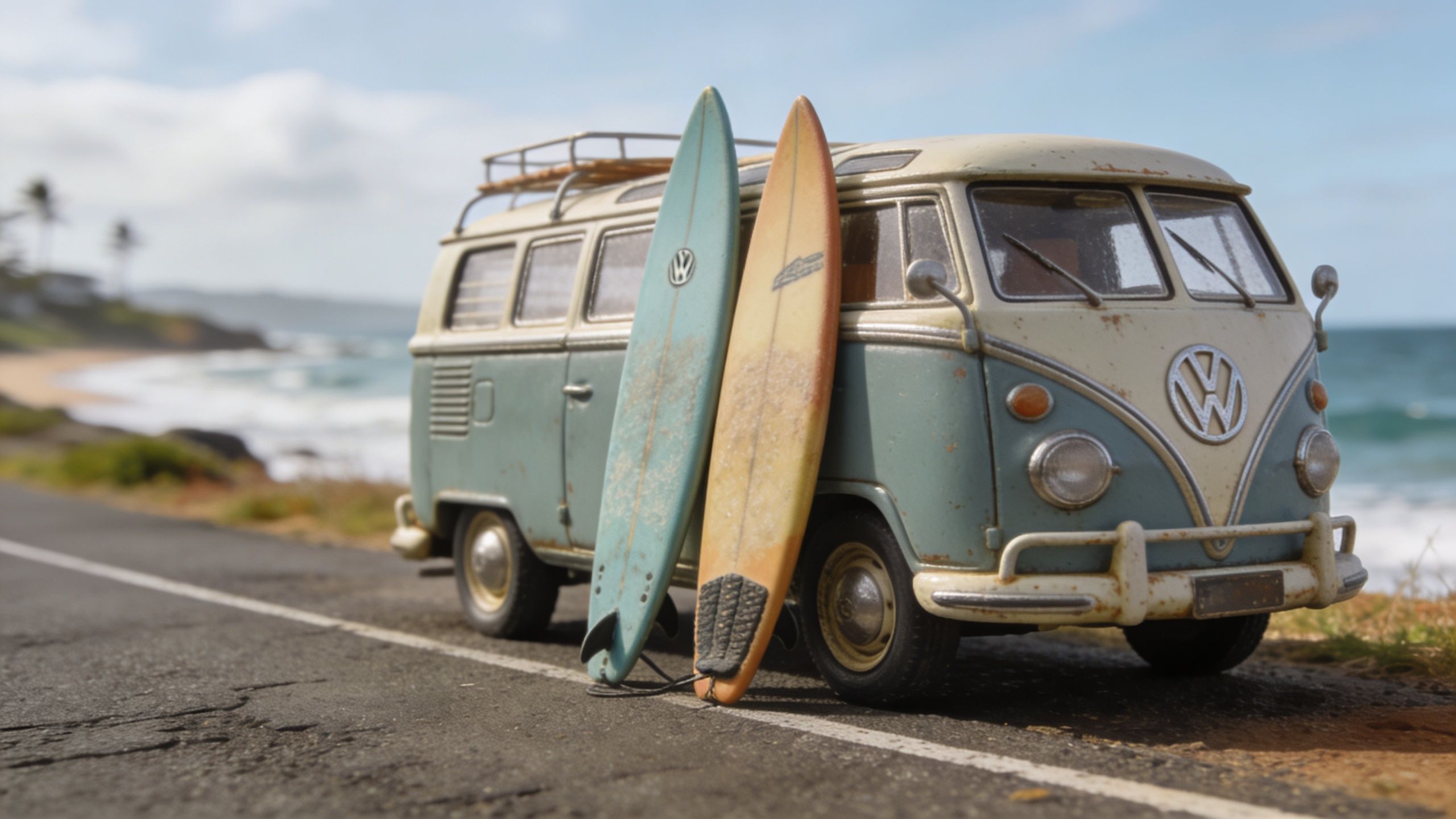
A classic vintage Volkswagen van parked on a coastal road next to two surfboards, overlooking the ocean.

That feeling isn't accidental. Volkswagen has deep roots here. Volkswagen's Australian history in Clayton, Victoria notes that VW vehicles were assembled there from 1954 until 1976, with over 250,000 vehicles produced, including the Beetle and Kombi. That's a big reason these vehicles feel woven into Australian life rather than imported curiosities.

Why that heritage still matters

Collectors don't usually fall for diecast models because they're just small cars. They buy them because the actual vehicles meant something first. A Beetle can remind someone of a first car. A Kombi can bring back family camping trips, market runs, surf weekends, or long coastal drives.

That's also why the newer electric chapter is so interesting. Australia's electric van market is growing as part of the broader EV shift. Redline Pulse's Australia electric vans overview says the market was valued at USD 24.79 million in 2025 and is projected to reach USD 61.08 million by 2034, with 13 electric vans plus variants available in the Australian market in 2025.

Practical rule: If a vehicle has a strong story on the road, it usually becomes a stronger collectible on the shelf.

For VW enthusiasts, that link between past and present is easy to feel. The classic Kombi represents freedom. The modern electric van represents a new kind of practicality. And if you've got a soft spot for the future-facing VW side of things, the VW Buzz in Australia is part of that same conversation.

Electric vans and the old VW spirit

The vans may be changing, but the appeal hasn't vanished. Vans still mean movement, lifestyle, and personality. They still attract people who want function without giving up character.

That's why scale models remain such a satisfying hobby. You're not only collecting metal and paint. You're holding a tiny version of a much bigger story.

Choosing Your Champion Understanding Diecast Scales

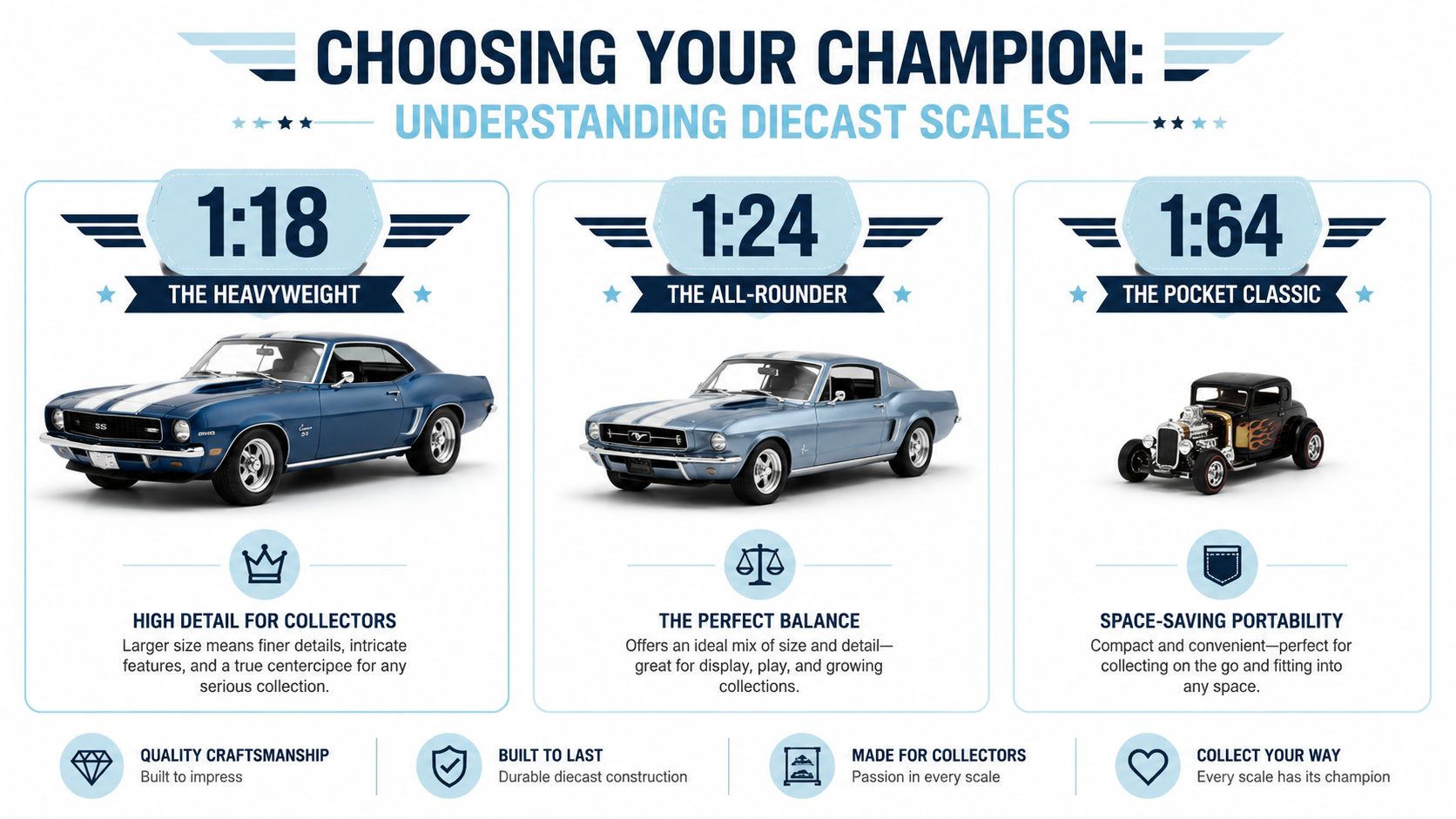
Scales can confuse new collectors fast. You see 1:18, 1:24, 1:32, 1:64, and suddenly it feels like you need a maths lesson before you buy a Beetle.

The trick is simple. The second number tells you how much smaller the model is than the actual car. So a 1:24 model is twenty-four times smaller than the actual vehicle.

An infographic titled Choosing Your Champion showing three diecast car model scales: 1:18, 1:24, and 1:64.

Wikipedia's 1:24 scale guide gives a handy example. A 1:24 scale model of a 4.3-metre-long VW Beetle would be about 18 centimetres long. That's why 1:24 feels so popular. It's large enough to show off the shape and details, but still easy to display on a shelf, sideboard, or office desk.

A simple way to think about size

Here's the easy collector's version.

Scale Best for What it feels like
1:18 Detail lovers A centrepiece model
1:24 Most collectors The balanced choice
1:64 Small-space collectors Easy to group in sets

How to pick the right one

Some buyers go too big too quickly. They fall in love with one large model, then realise they don't have room for the next five. Others go too small and later wish they had more visible detail.

A better approach is to choose based on how you'll enjoy the model day to day:

  • If you want a hero piece, go larger. A bigger model often shows more interior detail and has stronger shelf presence.
  • If you want a tidy collection, 1:24 is the sweet spot for many VW fans.
  • If you want a fleet, smaller scales make it easier to group Beetles, Kombis, buses, and support vehicles together.

Smaller isn't lesser. Larger isn't always better. The right scale is the one that suits your shelf and your eye.

One more tip. If you collect because you love body shape and paintwork, 1:24 often gives you the most satisfying balance. If you collect because you want to recreate a whole little VW world, mixing scales can work beautifully as long as you stay organised.

Spotting a Ripper What to Look For in a Quality Model

Not every model deserves display space. Some are charming little toys. Some are genuine collectibles. Knowing the difference saves disappointment.

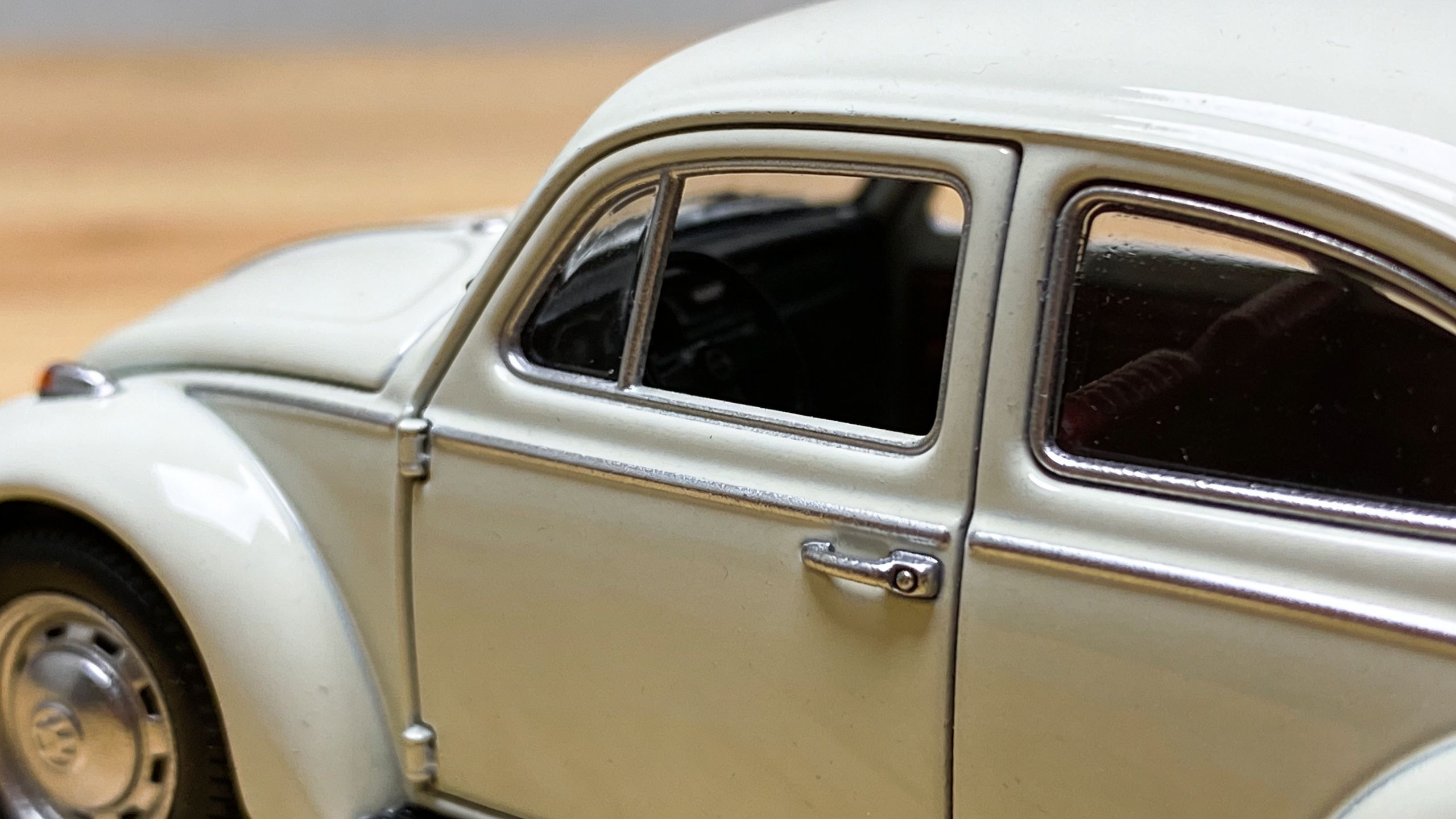
A close-up side view of a white Volkswagen Beetle miniature toy car model.

The first thing I look for is simple. Is it officially licensed by Volkswagen? If the answer is no, I usually move on.

Why licensed models matter

Volkswagen's brand and model information states that officially licensed Volkswagen models are created using original design blueprints from VW, which helps ensure details from the body curvature to the hubcap logos are accurate. For collectors, that accuracy is the whole game.

A licensed model tends to capture the little things that make a VW feel like a VW. The roofline sits properly. The front end looks right. The proportions don't feel guessed.

Your quality checklist

When you're inspecting a model, keep an eye on these points:

  • Body shape first. If the silhouette is off, no amount of shiny paint will rescue it.
  • Paint finish matters. You want even colour, tidy trim lines, and no blotchy patches.
  • Windows and lights should sit cleanly. Crooked plastic ruins the illusion fast.
  • Interior detail counts. Seats, steering wheel, dashboard, and cargo space all add life.
  • Wheels tell a story. Cheap models often get the wheels wrong before anything else.

A good model should look convincing from a metre away and rewarding up close.

The details that separate collectible from forgettable

Opening parts can be lovely, but only if they're done properly. Doors, bonnets, tailgates, roof racks, spare wheels, and surf accessories all add personality. If they feel flimsy or oversized, they can have the opposite effect.

Here's a quick look at model details in action:

A quality model should reward a slow look. You notice one detail, then another, and before long you're grinning at the tiny hubcaps.

There's a useful parallel with real electric vans too. Buyers of full-size vans have to judge trade-offs carefully. Renault Australia's Kangoo E-Tech information highlights how battery size, range, and payload can pull against one another in electric van design. Collectors face a gentler version of the same idea. You're balancing size, detail, display room, and budget.

The point is the same in both worlds. Look beyond the headline. Study the fine print.

Building Your Dream Garage From Kombis to Beetles

Some collections work because they're big. The memorable ones work because they have a point of view.

One collector might chase every Beetle variation they can find. Another might build a shelf entirely around buses and vans. Someone else might go full beach scene, with surfboards, roof racks, bright paint, and all the laid-back personality that made VW culture so beloved here.

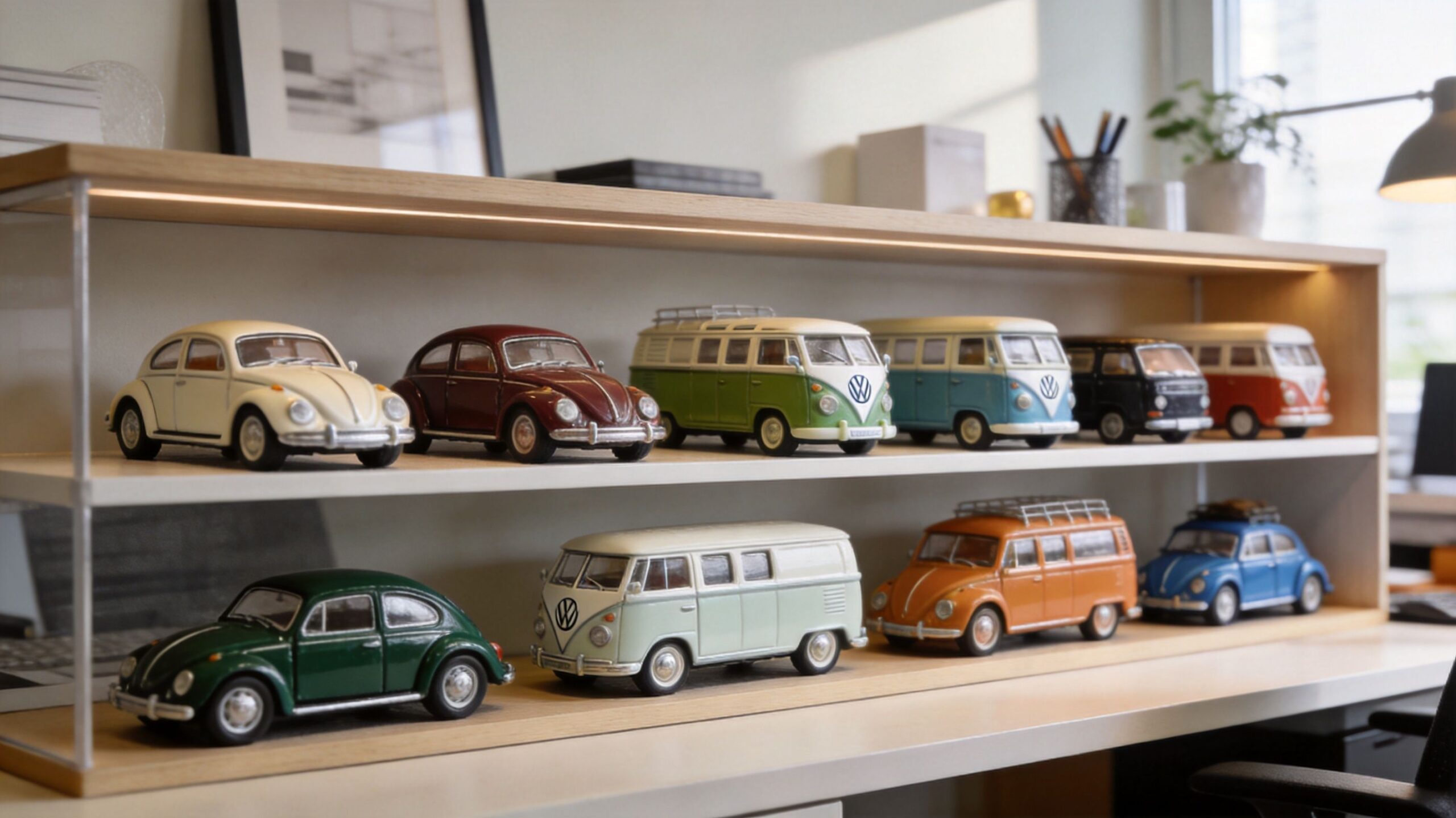
A wooden shelf holding a collection of vintage Volkswagen Beetle and van toy models in an office.

The Kombi shelf

If you're drawn to vans first, the Samba Bus is the obvious star. Volkswagen Newsroom's history of the Samba Bus explains that the sought-after Samba, also called the Deluxe Microbus, was known for 23 windows, including eight skylight windows and a cloth sunroof. No wonder it becomes the centrepiece of so many collections.

That model gives you instant visual theatre. It has presence even before you notice the details.

A Kombi-focused shelf might include:

  • A Samba Bus as the hero piece
  • A standard panel van for contrast
  • A surf-themed variant for colour and movement
  • A camper-style model to bring in the travelling spirit

If that camping side of VW life is what hooks you, the Volkswagen Crafter camper angle is an interesting modern callback to the same van-life appeal.

The Beetle shelf

Beetle collectors often take a different path. Instead of chasing window counts and roofline variations, they lean into colours, years, trim details, and playful editions. A bright Beetle can completely change the feel of a display.

That's why a Beetle shelf often feels more personal. You might choose one because it reminds you of a family car, another because the paint is pure sixties joy, and another because it looks right beside your Kombi.

Collector's note: A small, themed collection usually looks sharper than a random pile of models, even when the random pile includes good pieces.

Build around a story, not just a product

A shelf gets stronger when each model helps tell the same story. Coastal Australia. Road-trip freedom. Workshop classics. Family nostalgia. Show-and-shine favourites. Pick one lane and your display suddenly feels curated instead of crowded.

That's also where electric van australia fits the bigger picture. The full-size market is broadening, with new vans entering local consideration and buyers comparing practicality, range, charging, and carrying ability. WhichCar's round-up of electric vans in Australia reflects that growing variety, including upcoming models and van-life possibilities. For VW lovers, it's another reminder that van culture never sits still. It changes shape.

Show Off Your Pride Displaying and Caring for Your Models

A good model shouldn't end up forgotten on a crowded shelf behind old paperwork and a faded stubby holder. Display is part of the fun.

Keep them clean and visible

Dust is the quiet enemy. It dulls paint, settles into panel gaps, and makes clear windows look tired. Use a soft brush or a gentle microfibre cloth, and go slowly around mirrors, roof racks, and small trim pieces.

If the original box is tidy, keep it. Even if you display the model loose, storing the packaging gives you options later and helps if you ever move house.

Make the display feel intentional

You don't need a museum cabinet. A simple shelf with a bit of breathing room often looks better than cramming everything together.

Try these ideas:

  • Group by theme. Keep surf vans together, Beetles together, or buses together.
  • Vary the height. A small riser at the back helps every model get seen.
  • Avoid harsh sun. Direct light can be rough on paint and packaging over time.
  • Leave space around hero pieces. A Samba or standout Beetle needs room to shine.

If you can see every model properly, you'll enjoy the collection more often.

Handle them like collectibles

Pick models up from the solid body, not the mirrors, bumpers, or opening parts. If a piece has moving doors or accessories, don't force them. Small hinges and trim details reward patience.

A collection lasts longer when routine care is easy. Clean lightly, display elegantly, and resist the urge to overpack the shelf.

Start Your Volkswagen Journey Today

The charm of electric van australia isn't only in what's new. It's in how the new chapter sits beside everything Australians already love about vans. Practicality, personality, travel, community, and that unmistakable sense of movement all still matter. The shape of the story has changed, but the spirit is familiar.

Australia's broader EV shift gives that story some real momentum. AFMA's report on Australia's EV sales growth in 2025 notes that 103,300 battery electric vehicles were sold in 2025, 53,484 plug-in hybrid electric vehicles were sold, and more than 157,000 electric vehicles were sold nationally, accounting for 13.1 percent of all new car sales for the year. It also says electric vehicles reached 16.5 percent market share of new vehicle sales by April 2025. That rising familiarity helps electric vans feel less like oddities and more like part of the normal Australian road mix.

For collectors, all of this adds another layer of enjoyment. You can appreciate the old-school magic of a Beetle or Samba Bus while keeping an eye on where vans are heading next. If modern VW curiosity has already bitten, the Volkswagen ID Buzz Australia price guide is one more interesting place to wander.

The best collections usually start small. One Beetle you love. One Kombi that reminds you of summer. One licensed model with enough detail to make you stop for a second look every time you pass it. That's enough to begin.


If you're ready to add a little VW history to your shelf, have a browse through Volkswagen Memorabilia. You'll find officially inspired VW-themed collectibles, locally stocked in Australia, with fast shipping and plenty of charm for Beetle lovers, Kombi fans, and gift buyers chasing something with real personality.

1970s Volkswagen Beetle: An Aussie Collector’s Guide

A mate of mine still tells the story of spotting a mustard-yellow Beetle cresting the rise near the coast, roof rack loaded, boards strapped down, engine buzzing like a stubborn lawn mower that refused to quit. Before he saw the badge, he knew the shape. Every VW tragic does.

That Unmistakable Shape on the Horizon

Summer and a 1970s volkswagen beetle belong together in the Aussie imagination. You can almost hear it before it rolls into view. That flat-four chatter, that whiff of warm oil, the little bounce over a patchy country road, and the driver with one elbow out the window like the whole day is theirs.

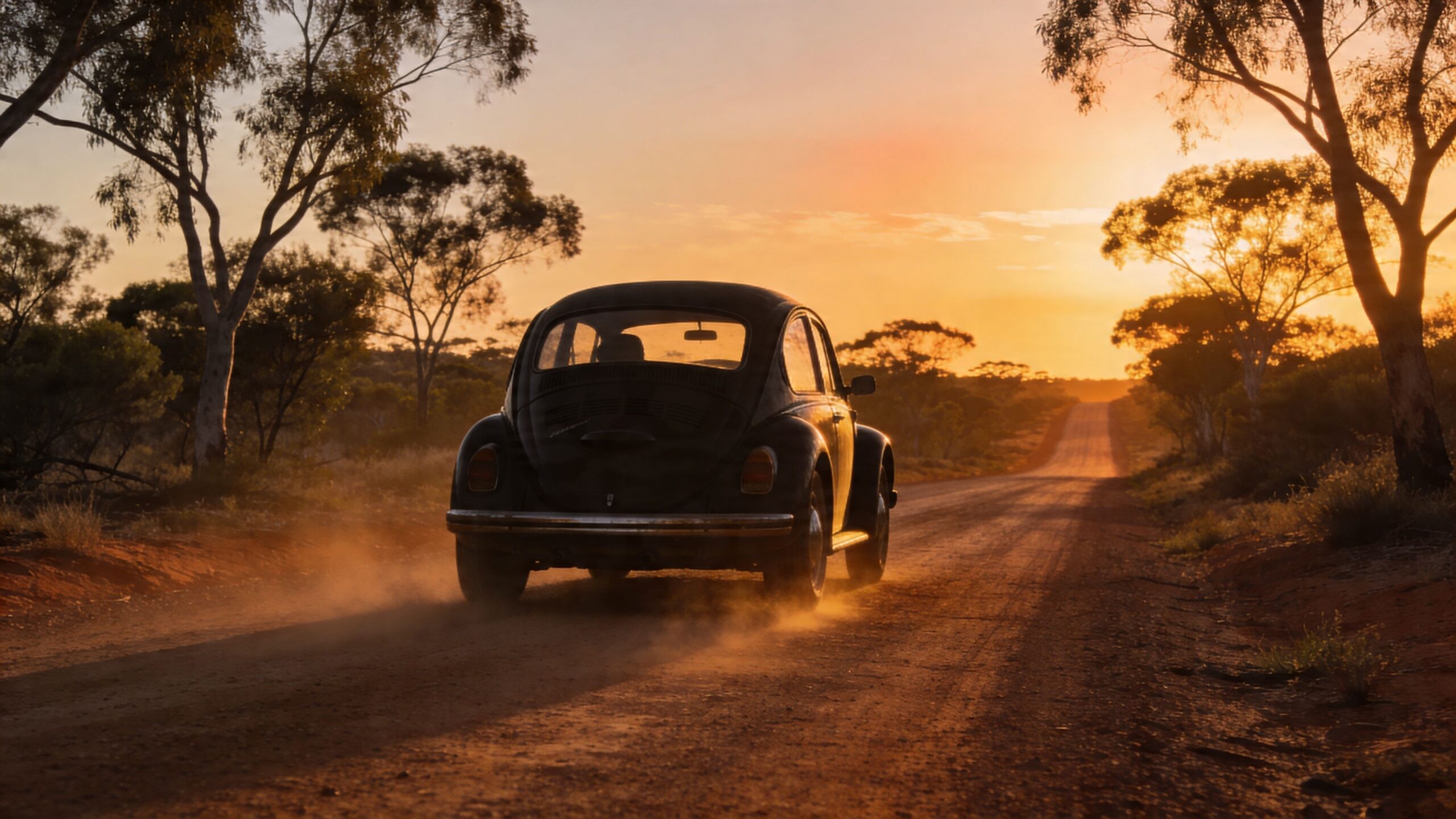
A vintage Volkswagen Beetle driving down a dusty dirt road during a beautiful golden sunset.

For plenty of Australians, the Beetle wasn’t some exotic museum piece. It was the car in the driveway, the cheap runabout parked by the milk bar, the little bug that made beach trips feel bigger than they were. A trip to the coast in one had its own rhythm. Windows cracked open. Vinyl seats hot enough to remind you it was January. A surfboard tied on with rope that looked one knot away from disaster.

The Beetle as a lifestyle car

The clever thing about the Beetle was that it fit into all sorts of lives. Uni students loved them because they were approachable. Young families squeezed into them because they had to. Surfers adopted them because they looked right beside the sand and salt and sun-faded fibro shacks.

Some cars become popular. The Beetle became familiar, and that’s a different kind of love.

Even now, when one rolls into a local showground among polished Falcons and burbling Monaros, people drift toward it with a grin. They remember the sound. They remember a relative who owned one. They remember learning to drive in one and stalling it half a dozen times before they got the hang of the clutch.

Why the memory sticks

Part of it is the shape, of course. Nothing else quite sits on the road like a Beetle. Rounded guards, upright stance, bonnet like a simple pencil line. No aggression. No fuss. It’s a design that still feels cheerful.

That’s why the 1970s cars matter so much. They sit at the point where the old Beetle spirit still felt intact, but the cars had grown into better long-distance companions for Australian roads. They weren’t just cute. They were useful, durable, and woven into the backdrop of daily life.

The Beetle's Golden Era Down Under

A mate of mine still talks about the 1973 Beetle his mum bought in Newcastle. Nothing flash. Marina blue, cracked basket-weave seats, a faint whiff of warm oil after a long run. Yet in the family photo albums it keeps turning up like an extra relative, parked outside school gates, beside fibro holiday shacks, and nose-out in a muddy country showground. That was the Beetle in Australia during the early 1970s. It stopped being an odd little European car and became part of the scenery.

That rise mattered because Australia was still strongly loyal to local cars. Holdens, Fords and Valiants owned the sales charts and the family driveway. For a small German design to win a proper following here, especially outside the capitals, it had to fit everyday life. The Beetle did.

Why it clicked here

Part of the answer was timing. Imported cars became easier to buy in the early 70s, and the Beetle arrived with a reputation already built. It was cheap enough for young couples, simple enough for handy owners, and cheerful enough that people forgave its quirks. If you were living in a beach suburb, a country town, or a narrow inner-city street, a Beetle made sense in a way a bigger sedan sometimes didn’t.

You still hear the same stories at swap meets. First-year apprentices bought tired ones and kept them alive with second-hand parts. Teachers used them as everyday commuters. Surf clubs had one member who always turned up in a Bug with wax on the parcel shelf and sand in the floorpan seams.

That last bit matters in Australia. Our cars age differently here. Salt air in coastal towns, hot sun on rubber seals, and rust creeping into heater channels and under battery trays gave Beetle ownership a local flavour all its own. That is part of why surviving cars now feel so personal. Every solid shell on the show field has beaten the odds a little.

If you enjoy that wider history, the background on the VW Beetle’s legacy in Australia fills in the bigger picture nicely.

A global icon, seen through an Australian windscreen

In February 1972, the Beetle passed the Ford Model T as the world’s most-produced car. Australian owners felt that achievement in a very grounded way. Their little runabout, the one idling outside the milk bar or rattling into a caravan park, belonged to one of the great motoring stories.

That global fame fed local enthusiasm. Clubs grew. Wreckers learned which bits to keep on the shelf. Kids ended up with tin toys and diecast Beetles that matched the actual one parked in the carport. Plenty of collectors still start that way now. They buy a 1:18 in the same colour as Dad’s old 1300, then before long they are hunting bonnet badges and workshop manuals for the full-size car too.

The Australian flavour of Beetle devotion

The 70s Beetle suited the Australian idea of freedom. It was modest, game for a road trip, and happy to be used. Owners packed tents in the front boot, tied boards to roof racks, and accepted that a hard summer drive might leave everyone a bit dusty and smiling. No one bought one to make a statement. The statement happened anyway.

That is why this decade feels like the Beetle’s golden patch here. The cars were still common enough to be daily transport, but distinctive enough to build memories around. Today, whether you are chasing an honest survivor or a diecast replica in the right period colour, you are really chasing that same feeling. A small, round car that somehow carried half a country’s weekend stories.

An Aussie Spotter's Guide to 70s Beetles

Walk through any VW meet and you’ll hear it within minutes. “Is that a Standard or a Super?” Then three blokes lean in, squint at the windscreen, and start pointing at tail-lights like they’re discussing fine art.

That’s half the fun. The 1970s Beetle changed in small but noticeable ways, and once you know what to look for, you’ll start picking them from across a car park.

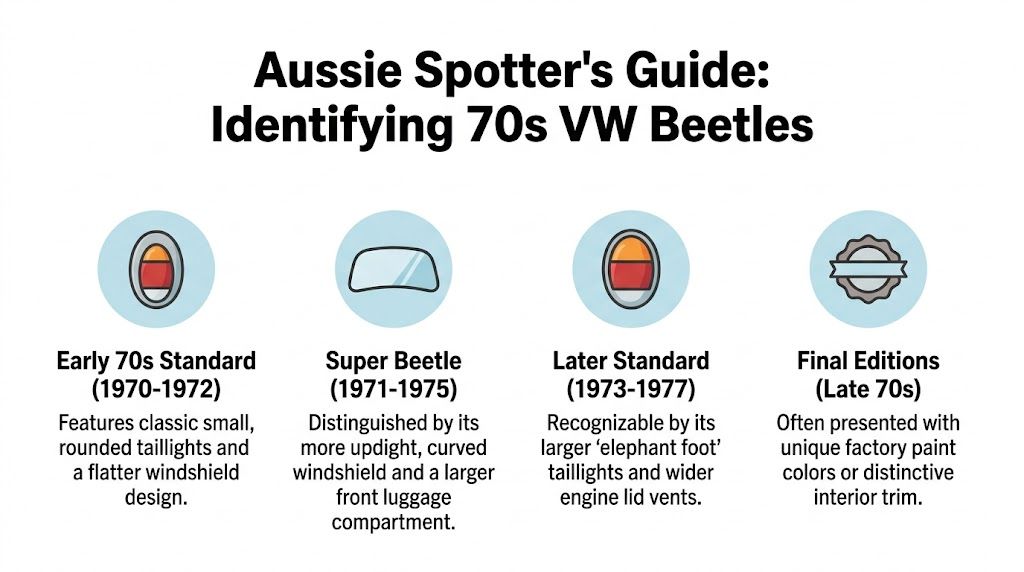
An infographic titled Aussie Spotter's Guide identifying different 1970s Volkswagen Beetle models and their unique features.

Start with the glass and stance

The quickest clue is often the windscreen. Early 70s cars keep more of that traditional Beetle look with a flatter screen. The Super Beetle line, especially later on, is easier to pick once you’ve seen that more upright, curved windscreen.

Then look at the nose and overall posture. Supers often seem a little different in front, and experienced owners will usually spot them before they’re close enough to read a badge.

Tail-lights tell plenty

For many enthusiasts, the rear end is where identification gets easiest. Earlier 70s cars wear smaller, more delicate tail-lights. Later cars move toward the bigger style that owners often call elephant’s foot tail-lights.

Engine lid vents also changed through the decade, so the rear view gives away more than many newcomers realise.

Practical rule: If you’re unsure, walk around the car once before asking the owner what it is. Windscreen, tail-lights, vents, then badges.

Standard vs Super in plain English

A Standard Beetle is the one many people imagine straight away. It holds onto the classic silhouette and simpler feel. A Super Beetle adds changes that were meant to modernise the driving experience and practicality, including the more distinctive windscreen shape on later versions.

That distinction matters for real cars and for collectors buying models. If you’re hunting miniature versions, details like the right windscreen shape or correct tail-light style can make the difference between a charming shelf piece and one that doesn’t quite ring true.

If your taste leans toward the offbeat, custom side of VW culture, the old Baja scene is worth a look too. This VW Baja Bug feature captures that dirt-road spirit beautifully.

1970s VW Beetle Key Identifying Features

Year(s) Model Type Key Features
1970-1972 Early 70s Standard Smaller rounded tail-lights, flatter windscreen, classic Beetle profile
1971-1975 Super Beetle More upright curved windscreen on later examples, larger front luggage area, distinct front-end feel
1973-1977 Later Standard Larger “elephant’s foot” tail-lights, wider engine lid vents
Late 1970s Final Editions Special trim touches, distinctive factory colour and interior combinations on some cars

A few easy spotting habits at shows

You don’t need to memorise every production quirk to sound like an old hand. Try these instead:

  • Check the rear first. Tail-lights and engine lid vents often narrow it down fast.
  • Step to the side. The windscreen profile becomes clearer from an angle.
  • Look for consistency. A car with later lights but earlier trim might have been restored with whatever parts were available.
  • Ask about delivery history. Australian-delivered details matter, especially if originality is part of the appeal.

What collectors should notice too

Diecast collectors can use the exact same spotter’s guide. If you’re buying a Volkswagen Beetle model, don’t just focus on paint colour. Check whether the maker got the tail-lights right, whether the screen shape matches the variant, and whether the trim suits the year.

That’s where collecting becomes more satisfying. You’re not just buying a cute miniature. You’re choosing a tiny version of a very specific car from a very specific moment.

Under the Bonnet and On the Road

A mate of mine from Newcastle still talks about the first time he pointed his yellow 1974 Beetle north out of Sydney at dawn. No radio worth trusting, a warm vinyl seat, that busy little flat-four thrum behind him, and a glovebox full of spare fuses and a fan belt. By modern standards, it was slow. From the driver’s seat, it felt alive.

That’s the trick with a 70s Beetle. The appeal starts with the sound and the rhythm. Turn the key and the engine settles into that familiar air-cooled chatter. Ease out the clutch, keep your shifts tidy, and the car gets into a groove that suits old highways, suburban errands, and Sunday runs to a cars-and-coffee meet.

Most Australian 70s Bugs you’ll come across use the later air-cooled flat-four, a popular choice, especially the 1600. On paper, the figures are modest. On the road, a healthy car feels eager because it weighs little, the controls are direct, and you can hear every change in revs from just behind your back. It teaches you to carry momentum, plan overtakes early, and drive with a bit of sympathy.

Super Beetles add their own flavour. Around town, the front end feels different from a standard Beetle, and plenty of owners notice the extra luggage room straight away. On rougher suburban roads, though, any 70s Beetle tells the truth about its condition very quickly. A tight car feels cheerful. A tired one wanders, shimmies, and asks for attention.

That’s often where Australian ownership gets real.

A Beetle that has spent years near the coast can still sound sweet while hiding all sorts of age-related annoyances. Oil mist around the engine is common. So are brittle wires, lazy indicator stalks, tired door seals, and heaters that promise more than they deliver. None of that is unusual in an old VW. What matters is whether the car has been serviced by someone who understands air-cooled habits, not just modern car routines.

A few gremlins come up again and again:

  • Oil leaks and oil seepage. Many old flat-fours sweat a little. Fresh drips on the driveway or oil flung around the engine bay deserve a closer look.
  • Electrical faults. Poor earths, ageing fuse boxes, and decades-old wiring can cause flickering lights or intermittent starting trouble.
  • Carburettor tune issues. A Beetle that stumbles off idle or smells overly rich often needs patient tuning, not guesswork.
  • Heat and ventilation complaints. In winter, weak heating usually points to missing parts, tired seals, or problems further down the system.
  • Front-end wear. If the steering feels vague, parts up front may be tired, especially on cars that have done plenty of country kilometres.

The old hands listen before they diagnose. A change in tappet noise, a new vibration through the gear lever, or a flat spot on acceleration usually gives you a clue long before the car leaves you stranded.

That mechanical honesty is a big part of the bond. A 1970s Beetle asks you to participate. You smell the fuel, hear the valves, notice the way a crosswind nudges the body on an open road. Even a short drive to Bunnings can feel like an outing.

Collectors of diecast Beetles chase the same feeling in miniature. The best little replicas capture more than the shape. They get the stance right, the ride height right, the narrow tyres, the simple cabin, even the slightly nose-up look some real cars carry. If you’ve spent time with an Australian-delivered Bug, you start noticing whether a model looks like a car ready for a run to the servo or a polished showpiece that never sees rain.

That’s why this part of Beetle ownership sticks. The actual car gives you the sound, smell, and mechanical quirks. The diecast version lets you keep a tiny piece of that experience on the shelf when the full-size one is waiting for its next tune-up.

Buying and Restoring a 70s Bug in Australia

If you’re shopping for a 1970s Beetle in Australia, don’t let shiny paint hypnotise you. Crawl underneath. Bring a torch. Get your hands dirty. Rust can turn a cheerful little Bug into a wallet-emptying saga very quickly.

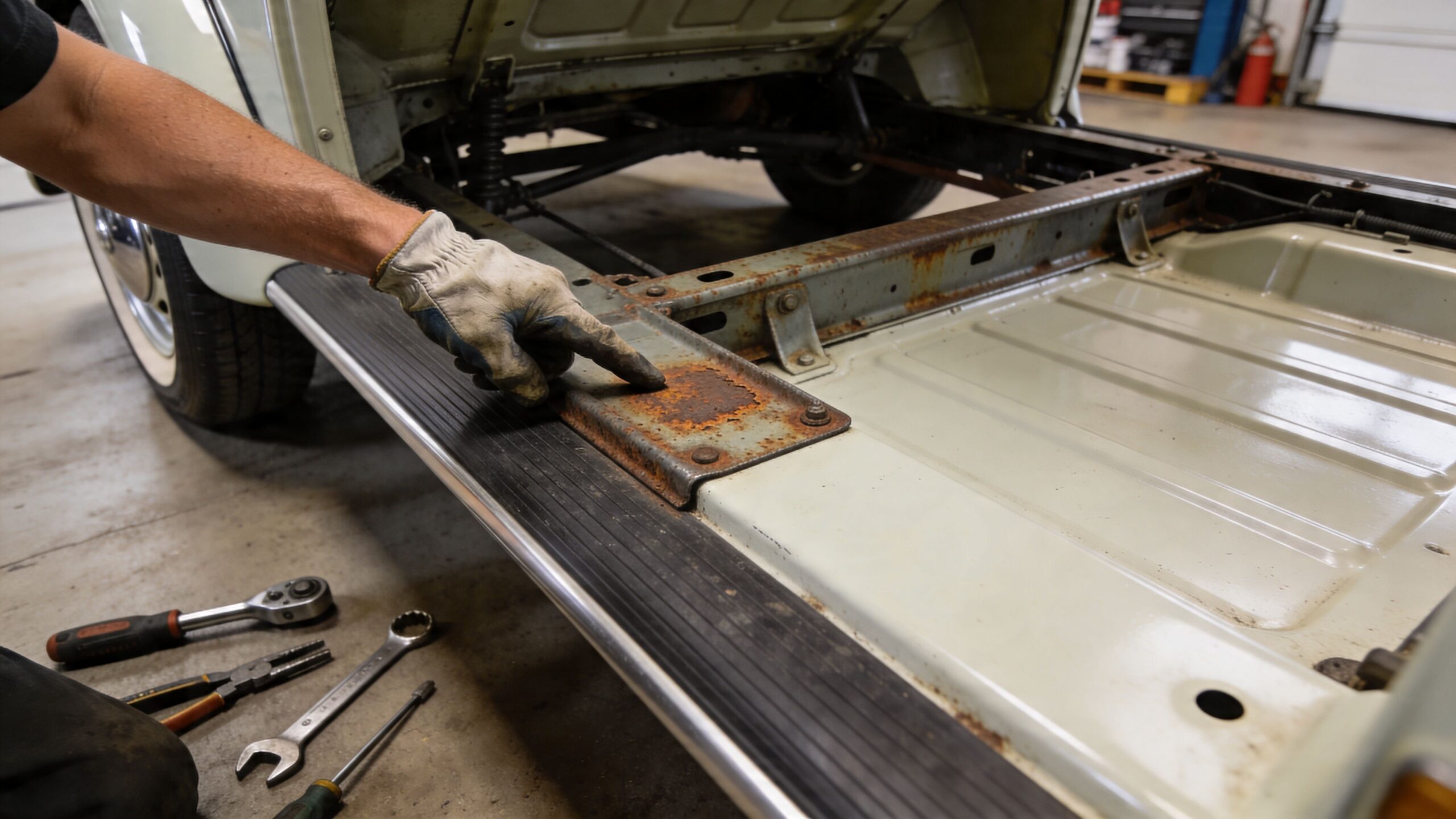
A gloved hand points to a rusted metal plate on the floor frame of a Volkswagen Beetle.

The Australian wrinkle is climate. Coastal air, beach use, and years of moisture trapped where it shouldn’t be have made corrosion the first thing sensible buyers check. Enthusiast forum surveys suggest up to 80% of surviving Australian 1970s Beetles need floorpan replacement due to beach proximity, with underbody pans and heater channels named as key danger areas in this Beetle rust discussion on YouTube.

The rust spots that matter most

The places that hurt most are usually the places you don’t notice in a flattering online listing. Pans can look passable until you tap them. Heater channels can hide ugly surprises. Battery areas can corrode unnoticed until the damage spreads.

When you inspect one, pay close attention to:

  • Floorpans. Look for patches, weak metal, fresh underseal hiding rough work, or obvious replacement sections.
  • Heater channels. These are structural. Trouble here isn’t cosmetic.
  • Battery tray area. Acid and moisture can do nasty work over time.
  • Bottoms of doors and guards. Not always catastrophic, but often a clue to how the whole shell has lived.

Questions worth asking the seller

A good inspection starts before you even see the car. Ask direct questions and listen for direct answers.

  • Has it lived near the coast? A beach-town life sounds romantic until you’re welding half the shell.
  • What metalwork has been done? “Restored” can mean anything from careful panel work to rough patching.
  • Who did the repairs? Receipts and photos matter.
  • Are the rubber seals new? Fresh seals can help, but they can also distract from deeper issues if the shell wasn’t sorted first.

Buy the body first. Mechanical parts can usually be fixed more easily than major structural rust.

Restoration in Australia needs local thinking

Generic overseas advice often misses the local context. A Beetle restored for a dry inland climate isn’t facing the same life as one that will live near the coast. Owners here need to think about moisture, storage, and proper rust prevention from the outset.

This short walkaround is a handy companion before you inspect a car in person:

A sensible buying mindset

The smartest buyers aren’t the ones who fall for the cheapest ad. They’re the ones who realise a dearer car with solid metal can save endless grief later.

A cautious approach usually looks like this:

  1. Inspect the shell before discussing accessories.
  2. Prioritise structural integrity over fresh cosmetics.
  3. Budget emotionally as well as financially. Restorations test your patience.
  4. Accept that some “bargains” are parts cars wearing a nice grin.

If a car is rough but honest, that can still be a wonderful starting point. If it’s shiny and evasive, walk away.

From Paddock Find to Prized Possession

Here’s the surprise that catches plenty of newcomers. In Australia, the car that gets all the chatter isn’t always the one bringing the stronger money. The market has a soft spot for the simpler, more traditional-looking Beetle.

According to Australian market notes discussed at SuperBeetles.com, clean standard 1600cc 1970s Beetles fetch AUD 15,000 to AUD 22,000, while 1303 Super Beetles sit around AUD 12,000 to AUD 18,000. That bucks the assumption that the “more advanced” Super automatically wins.

Why Standard Beetles often edge ahead

The answer is as emotional as it is practical. Many buyers prefer the Standard because it looks more like the Beetle they remember in family photos. It also carries a reputation for simpler maintenance, which matters when you’re buying a classic to enjoy rather than analyse in the shed every second weekend.

There’s another factor too. Survivor cars have a pull all their own. An honest Beetle with original trim, correct badging, and a lived-in feel can be more appealing than one restored into something over-finished and a bit sterile.

What makes one desirable

Collectors usually start with the same handful of questions:

  • Is it original in the right places? Dash, seats, lights, wheels, trim, and badges all matter.
  • Does it have documentation? Old papers, service history, and delivery details help the story.
  • Has it been modified tastefully, or just modified? There’s a difference.
  • Does the car feel coherent? A Beetle with mixed-year parts can still be lovely, but it won’t appeal to every buyer.

The most desirable cars often feel honest. They don’t need to shout.

Patina versus perfection

Not every Beetle has to look like a concours queen to be cherished. Plenty of enthusiasts now gravitate toward cars that wear their years openly. Sun-softened paint, a tidy original interior, and a few age marks can feel more authentic than a full nut-and-bolt finish.

That thinking spills into memorabilia too. The collector who loves a survivor Beetle often loves a miniature with period-correct colours, surf flavour, or a touch of personality rather than something too glossy and generic. It’s the same instinct that draws people toward old Kombi pieces when they want to buy diecast Kombi collectibles alongside Beetle items.

The best paddock finds aren’t always the rarest. They’re the ones with enough truth left in them to tell a story.

Celebrating the Bug in Miniature

Not everyone has the shed space, time, or patience for a full-size Beetle. That’s where diecast collecting becomes such a joy. You still get the curves, the colour, the nostalgia, and the character, just without lying on cold concrete wondering why a stubborn bolt hates you.

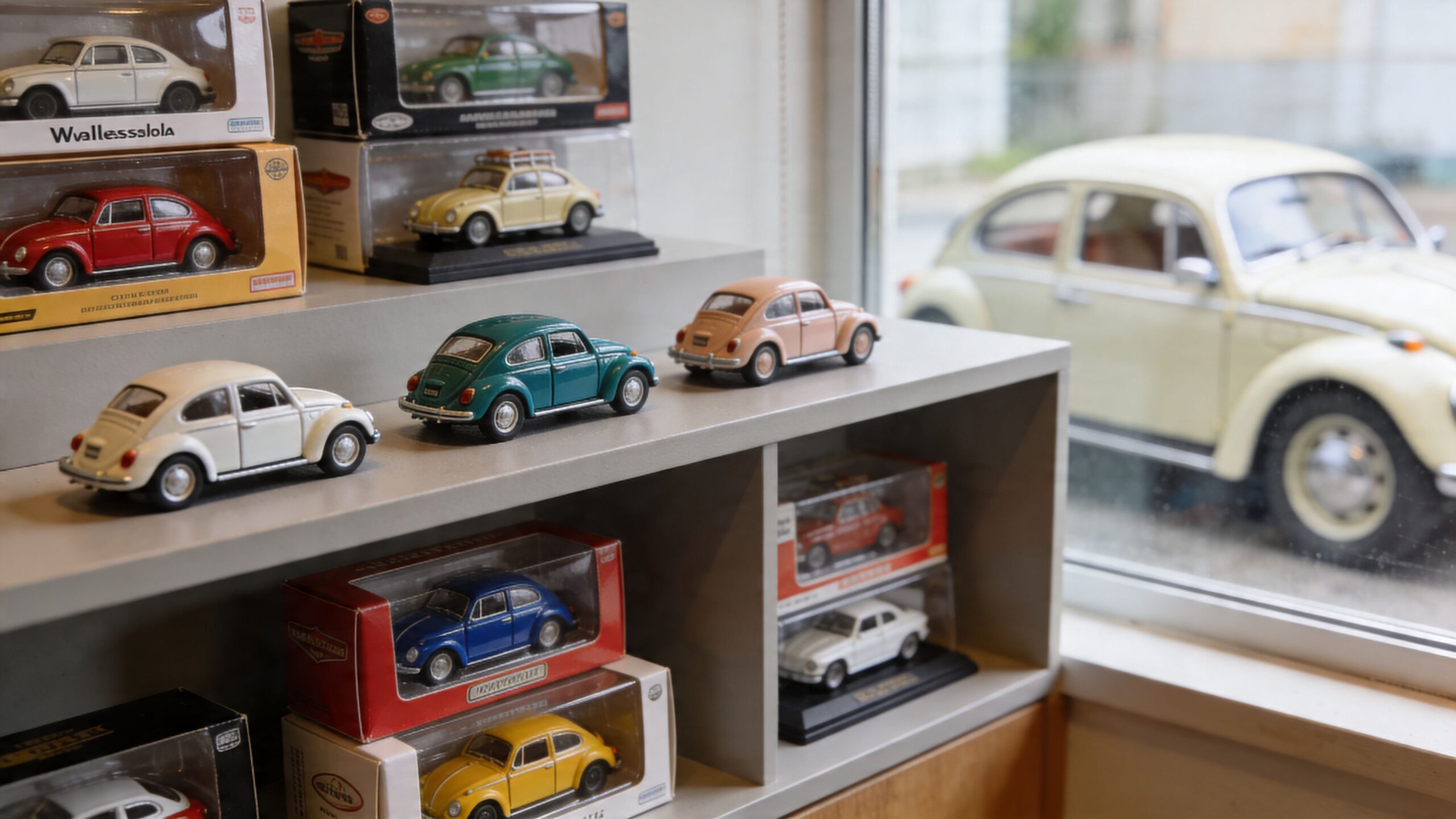
A collection of colorful Volkswagen Beetle model cars displayed on shelves in a store display window.

A good Volkswagen Beetle model scratches the same itch as the actual vehicle. You notice the roofline. You check the wheel style. You admire the paint. You start comparing one era to another and before long you’ve got a shelf full of Bugs and a plan for one more.

Picking a scale that suits your style

Different collectors want different experiences.

  • Larger scales suit people who love details like trim, cabin treatment, and accurate stance.
  • Mid-size pieces work well for desk displays and mixed collections.
  • Smaller models are great if you want a whole lineup that tells the story of VW design over time.

The trick isn’t chasing size for its own sake. It’s matching the model to the reason you’re collecting.

What makes a miniature feel right

A quality licensed model should capture the spirit of the car, not just the badge. For a 1970s Beetle, that often means looking closely at:

  • Body shape
  • Screen profile
  • Tail-light style
  • Period-correct colour schemes
  • Clean paint and trim application

If your display leans beachy or surf-inspired, coastal styling around the models can work beautifully. Natural textures, pale timber, and a few carefully chosen décor pieces help a Beetle collection feel lived with rather than just stored. Something like seashell wall art for a coastal VW-themed display can tie that whole mood together without turning the room into a theme park.

The real-car link is the best part

This is what makes Beetle diecast more than a casual hobby. Every miniature can stand in for a real memory. Maybe it matches the colour your aunt drove. Maybe it echoes the Bug you nearly bought. Maybe it’s the perfect tiny version of the beach-runner you’re restoring slowly in the garage.

That emotional connection is why Volkswagen diecast models for sale still pull people in. They’re easy to gift, easy to display, and easy to love, but they also carry proper enthusiast value when the details are right.

For plenty of collectors, the shelf becomes a little private car show. No rego. No rust. Just the enduring charm of the Bug in miniature.

Keeping the Beetle Spirit Alive

A 1970s Beetle still speaks to people because it offers something modern cars rarely do. Simplicity. Character. A sense that driving can feel light-hearted rather than managed by screens and warning chimes.

In Australia, that appeal picks up an extra layer. The Beetle belongs to beach towns, road trips, suburban memories, and the sort of weekends where the destination mattered less than the drive itself. It’s why a rough-but-loved Bug can draw a crowd faster than a far more expensive classic.

If you own one, preserving it properly matters. If you’re hunting one, patience matters. If you collect the miniature versions, detail matters. All three paths come from the same place, which is affection for a design that never stopped looking friendly.

Go to a local show. Chat with owners. Learn the differences between a Standard and a Super. Hunt for a model that matches the one you remember. Keep your eyes open on the road, because every now and then you’ll still see that unmistakable rounded silhouette bobbing along and making people smile.

That’s the Beetle magic. It never needed to be the fastest car in the car park. It just had to be itself.

Frequently Asked Questions

Question Answer
Are 1970s Beetles good first classics? Yes, if you buy carefully. They’re approachable and full of character, but body condition matters enormously. Rust can turn a simple purchase into a major restoration.
What’s the biggest thing to check on an Australian car? Rust underneath. Floorpans, heater channels, and the battery area deserve close inspection before you worry about paint or accessories.
Is a Standard Beetle better than a Super Beetle? “Better” depends on what you value. Many Australian buyers prefer the Standard for its classic look and simpler ownership feel, while some drivers enjoy the Super’s differences.
Are survivor cars worth considering? Absolutely. A tidy, honest survivor can be more appealing than a heavily restored car with mixed details, especially if originality matters to you.
What should I look for in a Beetle diecast model? Start with shape accuracy. Then check trim, lights, stance, and whether the model matches the era you want to represent. Licensed pieces usually feel more convincing in the details.
Do diecast Beetles make good gifts? They do, especially for VW fans, restorers, and anyone with old family memories tied to the Bug. They’re personal without being hard to display.

If you’d like to bring some of that Beetle nostalgia home, have a wander through Volkswagen Memorabilia. It’s a top spot for licensed VW-themed diecast, gifts, and coastal-inspired pieces, with local Australian stock and fast shipping that makes collecting a whole lot easier.

From 9 Seconds to Glory: A Guide to the Golf GTI’s 0-100 Times

For anyone who loves that push-you-back-in-your-seat feeling, the modern Volkswagen Golf GTI (Mk8) clocks its 0 to 100 km/h sprint in about 6.2 seconds. But that's just the final chapter of a story that began over four decades ago, with the mighty Mk1's respectable 9.2-second dash. A lot's changed, but the magic is still there.

A Legacy of Acceleration: The GTI From Mk1 to Mk8

G'day, mate! If you're anything like us, you know the 0-100 sprint. It's more than just a number on a spec sheet; it’s the gold standard for that pure, unadulterated thrill. For VW lovers, the Golf GTI's 0-100 time is a benchmark, a way of tracking the evolution of our favourite hot hatch from a plucky underdog to a performance icon.

When the first Mk1 GTI landed, it wasn’t the fastest car on paper. But crikey, its lightweight design and zippy engine delivered a raw, accessible, and totally addictive buzz. It instantly created a legend and set a seriously high bar for every generation that followed. It reminds us of that same simple, honest engineering we adore in the classic Beetle and Kombi.

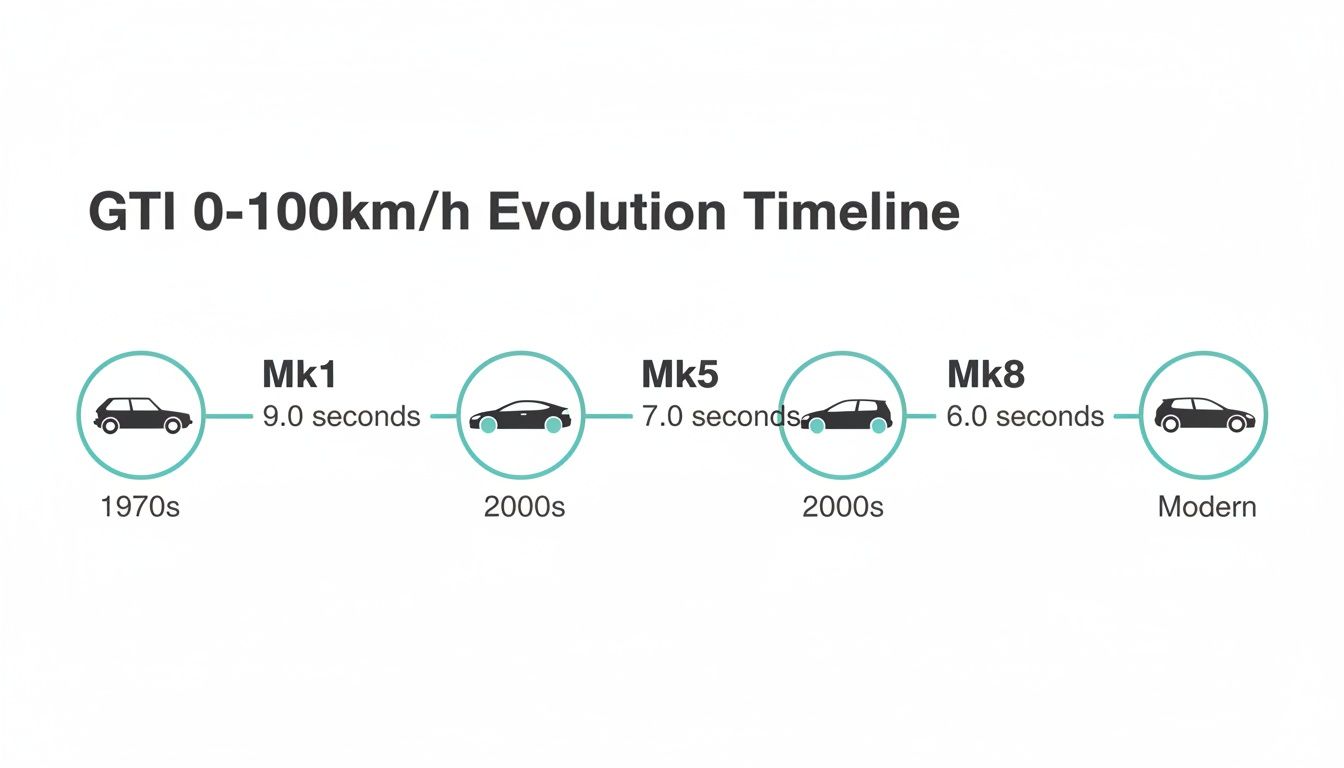
This timeline shows just how far the GTI has come, from the classic Mk1 to today's tech-packed Mk8.

Timeline illustrating the Volkswagen Golf GTI's 0-100km/h acceleration improvement across generations.

As you can see, clever German engineering has consistently shaved precious seconds off that sprint time, cementing the GTI's place in performance history.

How The GTI Got Quicker

Over the years, Volkswagen's engineers have steadily chipped away at that 0-100 time. They bolted on turbochargers for more punch, introduced the lightning-quick DSG transmission, and perfected electronic launch control systems.

Each improvement was a massive leap, turning a nine-second car into a genuine six-second pocket rocket, all while keeping the GTI's unique character and everyday usability intact.

Volkswagen Golf GTI 0-100 km/h Times By Generation

This table gives you a squiz at the factory-claimed 0-100 km/h times for the standard GTI model of each generation. It’s a fantastic snapshot of how the car has evolved over the years.

GTI Generation Model Years Engine Approx. 0-100 km/h Time
Mk1 1976–1983 1.6L / 1.8L NA I4 9.2s
Mk2 1984–1991 1.8L NA I4 (8v/16v) 8.5s
Mk3 1991–1998 2.0L NA I4 (8v/16v) 8.7s
Mk4 1998–2004 1.8L Turbo I4 7.9s
Mk5 2004–2008 2.0L Turbo FSI I4 6.9s
Mk6 2009–2012 2.0L Turbo TSI I4 6.9s
Mk7 2013–2020 2.0L Turbo TSI I4 6.4s
Mk8 2020–Present 2.0L Turbo TSI I4 6.2s

It's amazing to see the progress, from the original's plucky spirit to the sheer capability of the modern car.

This passion for performance is stronger than ever here in Australia. In fact, 2023 was a record-breaking year for VW's performance car sales, including the GTI and Golf R. You can read more about the incredible demand for VW performance models in Australia and see how strong the community is.

It's a passion we can all share, whether it's through restoring a classic Volkswagen Beetle model or admiring the history captured in our range of VW memorabilia collectibles.

The GTI's acceleration is more than a number—it's the tangible result of Volkswagen's commitment to creating a car that is, above all else, incredibly fun to drive. It's the reason we fell in love with the badge in the first place.

What Really Affects Your GTI's 0-100 Time

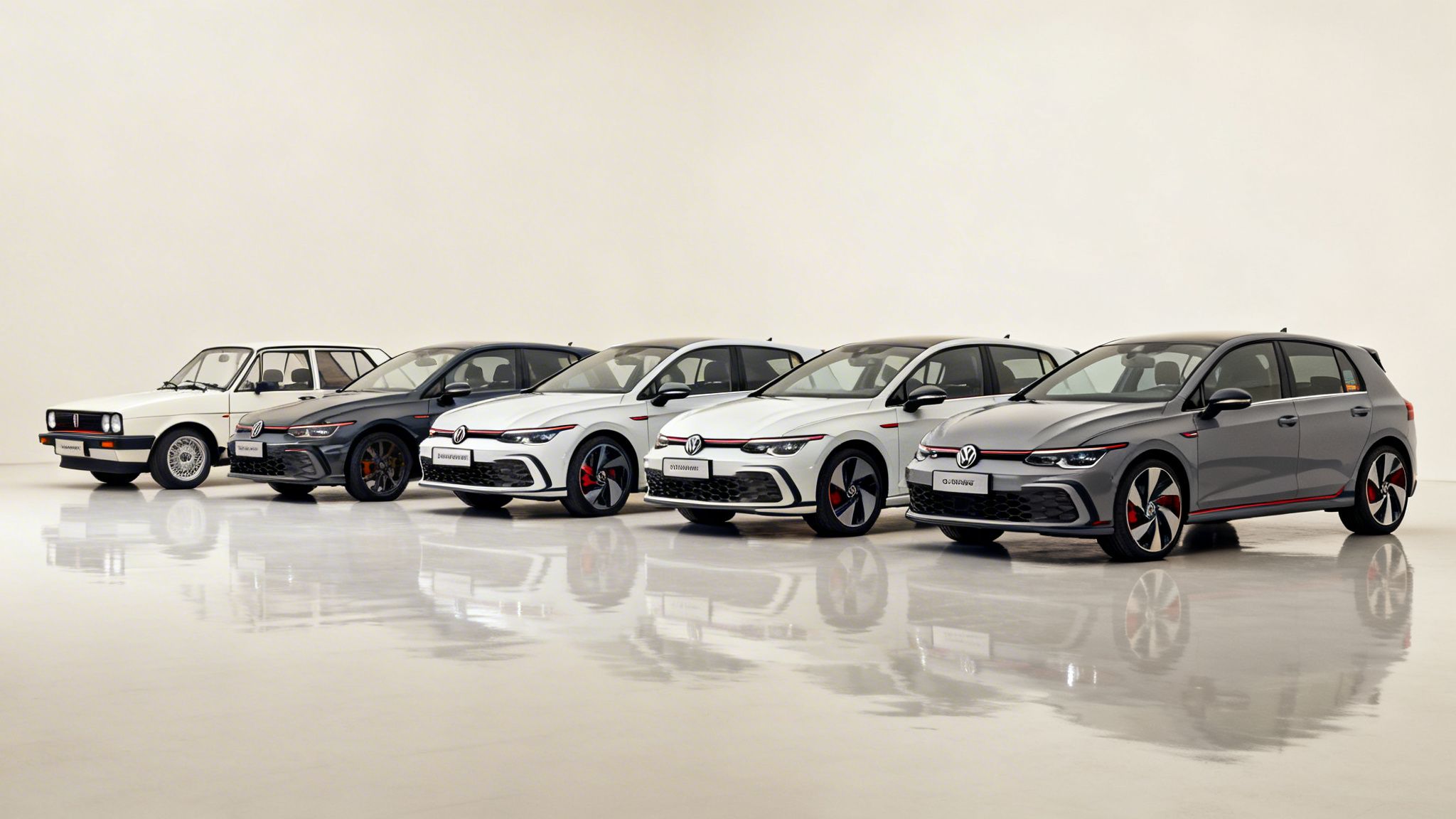
A row of six Volkswagen Golf GTI models showcasing their evolution from classic to modern designs.

Ever wonder why some GTIs feel punchier off the line, or why your own car feels so much more alive on a cool morning? The official Golf GTI 0-100 time you see in a brochure is just the beginning of the story. Let's get into what really makes a difference to that launch when the light turns green.

Think of it this way: the spec sheet is the recipe, but how you cook it—and the conditions of your kitchen—determine how it actually tastes. It’s exactly the same with your GTI's real-world acceleration.

Engine Power and Torque

Naturally, it all starts with the engine. While power (kW) is what you chase for top speed on a long straight, it’s torque (Nm) that gives you that immediate, satisfying shove in the back when you launch. A GTI’s turbocharged engine is brilliant at this, delivering a huge wave of torque very early in the rev range. That’s why it feels so eager from a complete stop.

A healthy engine is a fast one. If you want to get under the bonnet and understand what makes these motors so special, take a look at our deep dive on the legendary Golf GTI Mk6 engine. It's a must-read for any true enthusiast.

Transmission: DSG vs Manual

The choice between a DSG and a manual is a classic debate around the barbie, and for good reason. It makes a huge difference in the 0-100 dash.

  • DSG (Direct-Shift Gearbox): For pure, raw acceleration, the DSG is king. No question. Because it pre-selects the next gear, the shifts are almost instant—we’re talking milliseconds. This means the power delivery to the wheels is practically uninterrupted. It’s brutally efficient and consistently fast.

  • Manual Gearbox: A manual might lose a few tenths of a second in a straight line, but what you gain is an unbeatable feeling of connection and control. There are few things more satisfying for a driver than absolutely nailing a perfect launch and a series of crisp gear changes yourself.

The DSG is like having a professional race driver changing gears for you every single time. The manual puts all that skill, challenge, and reward right back in your own hands.

Grip and Road Conditions

All the power in the world is useless if you can't get it to the road. This is where your tyres and the road surface become the main characters in your acceleration story.

Good quality performance tyres are not a luxury; they're essential for a quick launch. They provide the grip needed to transfer the engine's grunt to the tarmac without just spinning the wheels and creating smoke. A smooth, dry road is your perfect stage. A wet or gravelly surface, on the other hand, will kill your time as the tyres scramble for traction.

Weather and Environment

Believe it or not, even the day’s weather plays a part. Cool, dense air contains more oxygen, which helps the engine produce a little more power. It’s the reason your car often feels noticeably perkier on a crisp winter morning.

On the flip side, high altitudes or hot, humid days can slightly sap performance because the air is less dense. It’s a subtle effect, but for those of us who really know our cars, it’s a difference you can definitely feel.

A Journey Through Eight Generations Of GTI Power

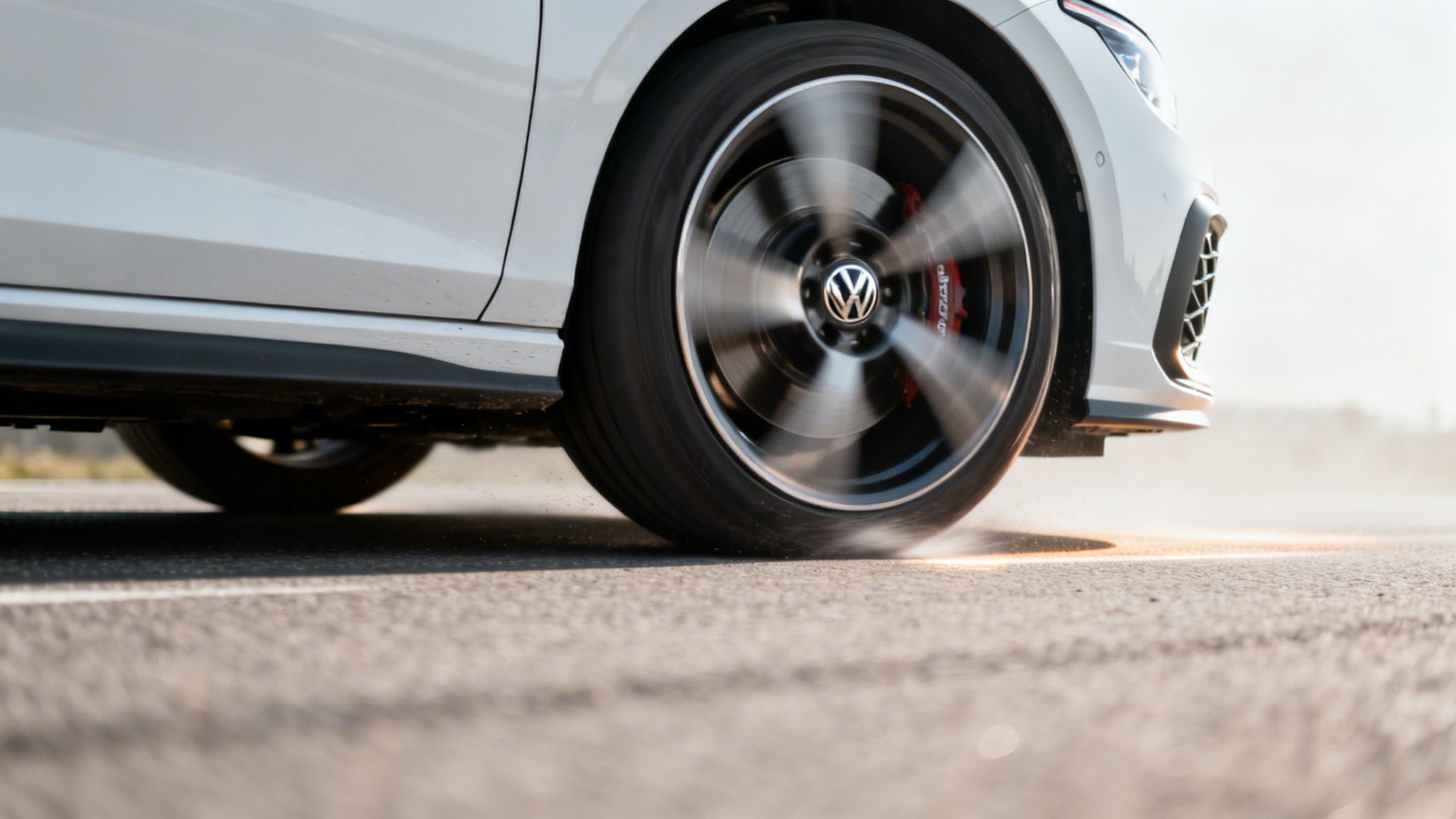
Close-up of a white Volkswagen Golf GTI's spinning wheel during a burnout on asphalt.

The engine has always been the heart and soul of the Golf GTI. It's more than just a lump of metal; it’s the source of the car's personality, that magic mix of daily-driver practicality and weekend-warrior fun. Looking back at how its engine has evolved is like taking a walk through hot hatch history itself.

It all started with the original Mk1 GTI. Its beautifully simple 1.6-litre fuel-injected engine was a proper revelation in its day. It wasn't about huge, intimidating power, but its zesty character and the car's light weight created an unfiltered driving experience that set the benchmark for decades to come.

The Rise Of The 16V And The Turbo

When the Mk2 GTI arrived, it brought the legendary 16-valve engine to the party. This was a real game-changer. By allowing the engine to breathe better and rev higher, it delivered a thrilling top-end rush that enthusiasts still rave about. It was a genuine taste of motorsport tech made for the street.

Then came the Mk4 GTI, which introduced one of the most adored engines in VW's playbook: the 1.8-litre 20-valve turbo, better known as the "1.8T". This thing was a tuner's dream. The turbo gave it an addictive surge of low-down torque, making the car feel punchy in any gear and proving that a small engine could hit far above its weight.

The Modern Era Of Direct Injection

The next great leap forward came with the Mk5 GTI and its groundbreaking 2.0-litre TFSI engine. This was one of the very first engines to bring turbocharging and direct fuel injection together for the mass market.

This technology meant fuel could be controlled with incredible precision, leading to a massive jump in both power and efficiency. It’s what created the smooth, muscular pull that has defined the modern Golf GTI 0-100 sprint ever since.

From the Mk6 onwards, VW has been perfecting this formula with the updated TSI engine family. Engineers have constantly tweaked and refined the design, squeezing out more power, boosting fuel economy, and making sure that trademark GTI responsiveness is always front and centre. You can dive deeper into this pivotal era with our closer look at the Volkswagen Golf GTI Mk6, a true modern classic.

This incredible engine lineage is a huge part of why the Golf has become such a global icon. Since its debut, over 35 million have been sold, cementing its place in automotive history. It's a journey that's mirrored in the details of our favourite Volkswagen diecast models for sale, where every tiny part tells a piece of a much larger, incredible story.

Maintaining Peak Performance In Your GTI

A GTI is built to be driven, and a huge part of owning one here in Australia is keeping that sharp, 'factory fresh' feeling alive. It’s not about complicated procedures or mechanical wizardry; it’s simply about giving the car the respect it deserves.

These are the straightforward, real-world tips we enthusiasts live by to keep our GTIs running like they should. No fluff, just what actually matters when you want that perfect Golf GTI 0-100 launch.

Fuel and Fluids: The Lifeblood of Your Engine

You wouldn't put cheap fuel in a high-performance machine, and your GTI is no exception. What you put in has a direct impact on what you get out.

  • Premium Fuel: Don't be tempted to skimp at the pump. Your GTI's turbocharged engine is designed for high-octane fuel, with 98 RON being the sweet spot. It allows the engine to deliver its full power, prevents harmful 'knocking', and keeps things running clean.

  • Quality Engine Oil: This is non-negotiable. Using the specific, high-quality synthetic oil Volkswagen recommends is the single best thing you can do for your engine's health. It’s cheap insurance against wear and tear, especially under the stress of a hard sprint.

Drivetrain and Grip: Where Power Meets the Road

All the engine power in the world is useless if you can't get it to the ground. This is where the rest of the car comes into play.

A properly maintained drivetrain does more than just make your GTI quicker. It’s about feeling completely connected to the car and the road, making every drive more rewarding.

If you have a DSG, keeping up with its scheduled servicing is crucial for those razor-sharp gear changes. For manual drivers, a healthy clutch is just as important, ensuring every bit of power makes it from the engine to the wheels.

But honestly, your tyres are the single most critical performance part on the entire car. A good set of performance tyres will completely change how your GTI launches, turns, and stops. Just remember to check your tyre pressures regularly—even a few PSI off can mess with your grip. Keeping your brakes and suspension in top shape completes the picture, giving you the confidence to truly enjoy your GTI's performance.

Capturing The Legend: From The Road To Your Shelf

That heart-in-your-throat Golf GTI 0-100 rush is a huge part of what makes these cars special, but the passion goes way beyond what happens between the traffic lights. For so many of us, it’s about owning a piece of automotive history. It's a love for an icon you want to bring into your home, your office, or even your garage workshop.

This is where the joy of collecting kicks in. That same admiration we have for the full-sized car can be captured perfectly in miniature form. Let's be honest, high-quality diecast models are much more than toys; they're a physical link to the cars we adore and the memories we’ve made in them.

There’s a special kind of nostalgia you feel when holding a detailed 1:18 scale model of a classic Mk1 GTI. You can run your finger over the signature red-striped grille, admire the tartan seats, and appreciate the simple, perfect proportions that kicked off a whole revolution. It’s a brilliant tribute to the car that defined a genre.

From The Thrill Of The Drive To The Joy Of Display

That passion for collecting rarely stops at just one model. As the GTI’s engine and performance evolved through the years, so did the entire Volkswagen family. Each car tells its own unique story of clever design and the freedom of the open road.

It's this shared spirit that makes building a collection so satisfying. You might find yourself pairing your GTI model with other legends, creating a display that tells the broader story of VW’s incredible heritage.

  • The Iconic Kombi: A beautifully made VW Kombi diecast Australia model, especially a classic Samba Bus, just radiates a spirit of adventure and community. Its friendly face is the perfect nostalgic counterpoint to the GTI’s focused, sporty look.

  • The Timeless Beetle: What VW collection would be complete without a classic Volkswagen Beetle model? Its unmistakable shape is recognised and loved all over the world, representing a history of fun, accessible motoring for everyone.

These models aren't meant to just sit on a dusty shelf. They become conversation starters and daily reminders of the cars that captured our imaginations. They’re a way to share your passion with mates and family, sparking stories of road trips, car shows, and that first time you experienced the magic of a Volkswagen.

For many of us, the love for Volkswagen started long before we could drive. It began with a small diecast model, a poster on the wall, or seeing a classic Beetle trundle down the street. That same joy is what fuels our passion as collectors today.

The Golf’s popularity in Australia is undeniable, with sales figures consistently showing it as a favourite among Aussie drivers. You can dive into the fascinating breakdown of Volkswagen Golf sales figures to see just how deep that loyalty runs. Here at VW Memorabilia, we celebrate this heritage by offering a curated collection of officially licensed VW memorabilia collectibles.

Whether you're hunting for a specific Golf GTI Mk6 diecast model or you’re looking to buy a diecast Kombi, our selection is sourced with the same passion you have for the cars themselves. As local Aussie importers, we have stock on hand ready for fast shipping, making it easy to grow your collection and celebrate the legend.

Your Questions On Golf GTI Performance Answered

The world of the Golf GTI is full of passionate discussion. As enthusiasts ourselves, we love chatting about what makes these cars so special. Here are some answers to common questions we get about GTI performance, especially that famous Golf GTI 0-100 sprint.

Which Golf GTI Generation Is The Fastest?

As a general rule, the newest generation is the quickest. The current Mk8 GTI has the latest in engine tech, transmission efficiency, and launch control. Its 0-100 km/h time is a result of decades of constant improvement.

It’s also good to remember that Volkswagen has released special editions like the Clubsport, Edition 35, or TCR models. These often have a bit more power, making them even faster than the standard GTI of the same era.

Is The DSG Transmission Faster Than A Manual?

For a timed 0-100 km/h sprint, the answer is yes. The DSG (Direct-Shift Gearbox) is consistently faster.

Its magic is its ability to pre-select the next gear. This means shifts happen in milliseconds with almost no interruption in power. Even the best driver with a manual gearbox can't match that speed. Of course, many still prefer the feel of a manual, proving performance isn't just about numbers.

How Accurate Are The Official 0-100 Times?

Think of the manufacturer's time as a perfect-world benchmark. It’s a figure achieved under controlled conditions: a professional driver, a perfect surface, ideal weather, and new tyres. It's a useful number for comparing models.

In the real world, your 0-100 times will vary. Things like tyre wear, road surface, fuel load, and even the day’s temperature have an effect. Don't worry if your stopwatch doesn't match the official figure—just enjoy the thrill of the launch!

Can You Improve A GTI's Acceleration Time?

It’s possible, but be smart about it. ECU tunes and performance parts can lower the 0-100 time, but it's vital to use reputable experts to protect your car’s reliability.

The simplest ways to get the most from your GTI are often the best:

  • Proper Maintenance: Always use the high-quality fuel and oil your car was designed for.
  • Invest in Grip: High-quality performance tyres are the best investment for improving your launch.
  • Practice Your Technique: Learning how to get the power down smoothly makes a real difference, whether you have a DSG or a manual.

This passion for performance is what connects us all. It’s the same spirit we see in our community of collectors who appreciate the engineering and history captured in every Volkswagen Beetle model and diecast classic.


At Volkswagen Memorabilia, we share that passion. We're an Australian-based importer with local stock, ready to help you celebrate the VW legend with fast, reliable shipping across the country. Find your next piece of VW history by browsing our full collection of Volkswagen diecast models for sale today.