
Shell Wall Art Your Guide to Coastal Charm

G'day, fellow travellers! Close your eyes for a sec and picture it: the warm sun, the salty air, and the gentle sound of waves washing ashore. That’s the exact feeling shell wall art channels right into your home. It’s about taking those natural, beautiful elements from the coast and using them to tell a story of sun-drenched days and relaxed Aussie adventures.

Bring the Beach Home with Shell Wall Art

There’s a special kind of magic in bringing a piece of the coastline indoors. It’s a feeling that hits home for anyone who treasures the freedom of the open road—that moment you pull up your Kombi to a quiet beach, roll the windows down, and just listen to the ocean. Shell wall art isn’t just decor; it’s a snapshot of that very feeling.

Think of it as capturing a bit of that nostalgia and freedom. A single, striking piece of shell art can instantly become the heart of a room, catching the eye and sparking stories. It's a celebration of that laid-back lifestyle we love, where weekends are meant for chasing the horizon, combing the beach for little treasures, and making memories.

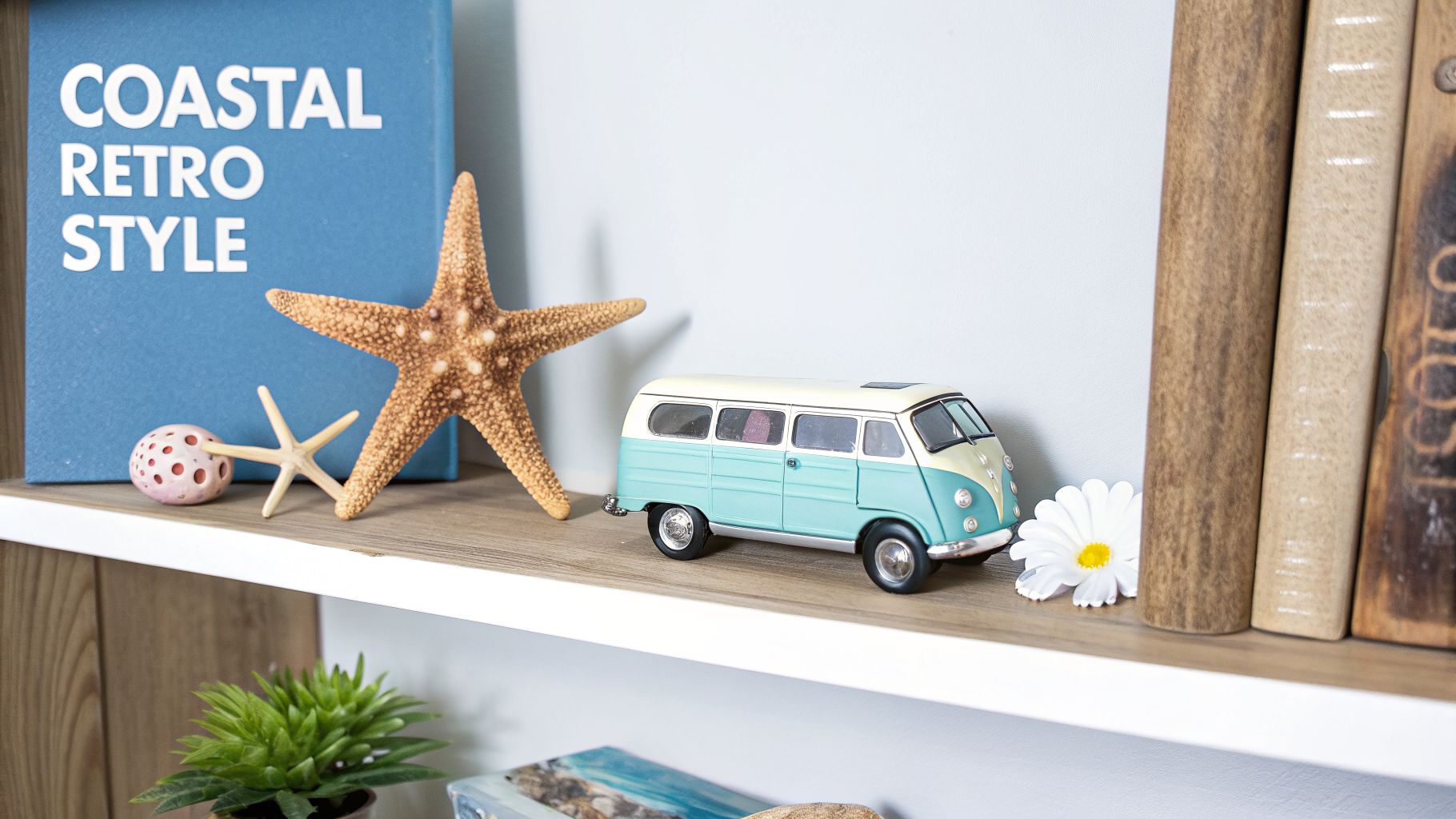
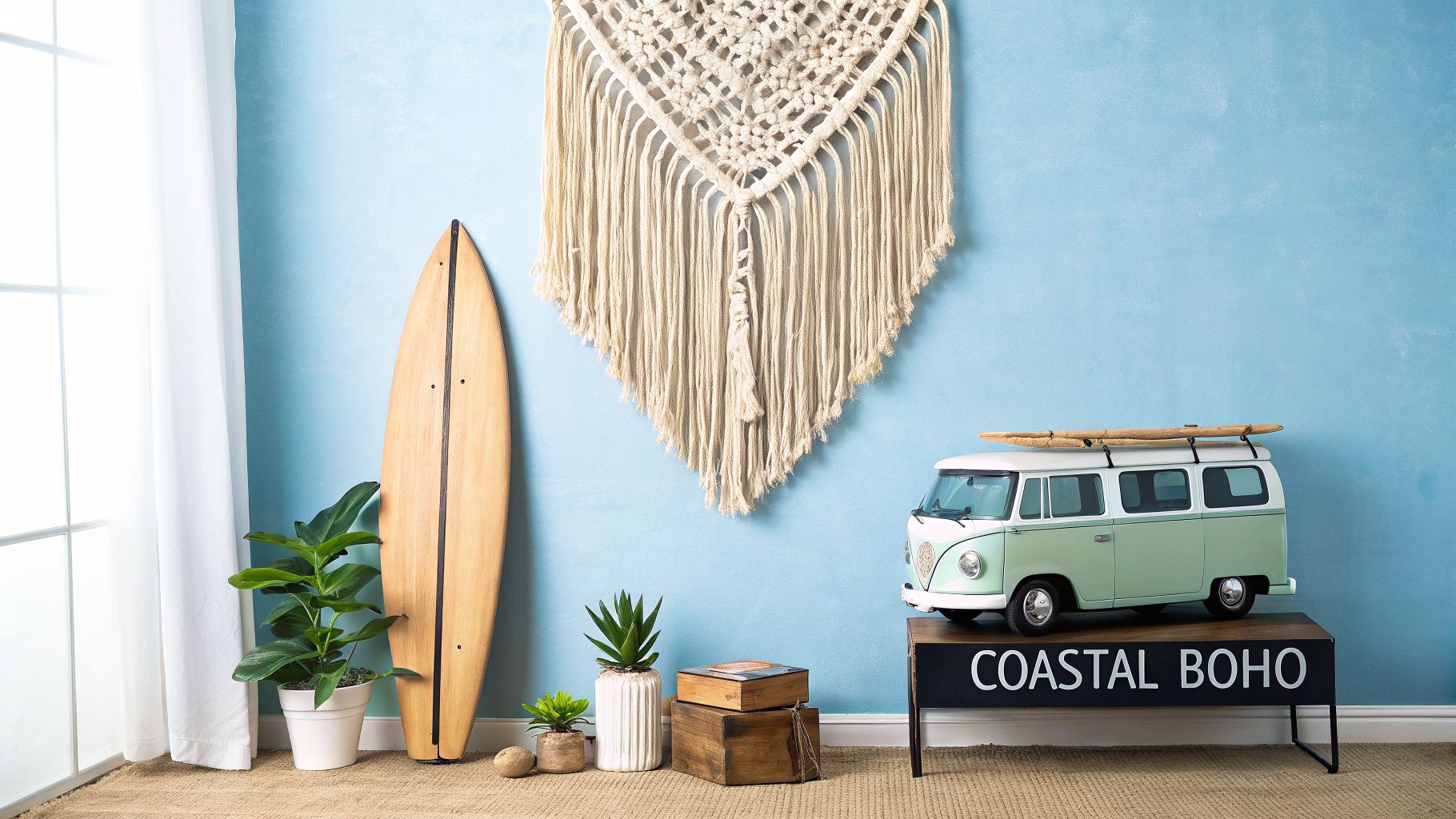
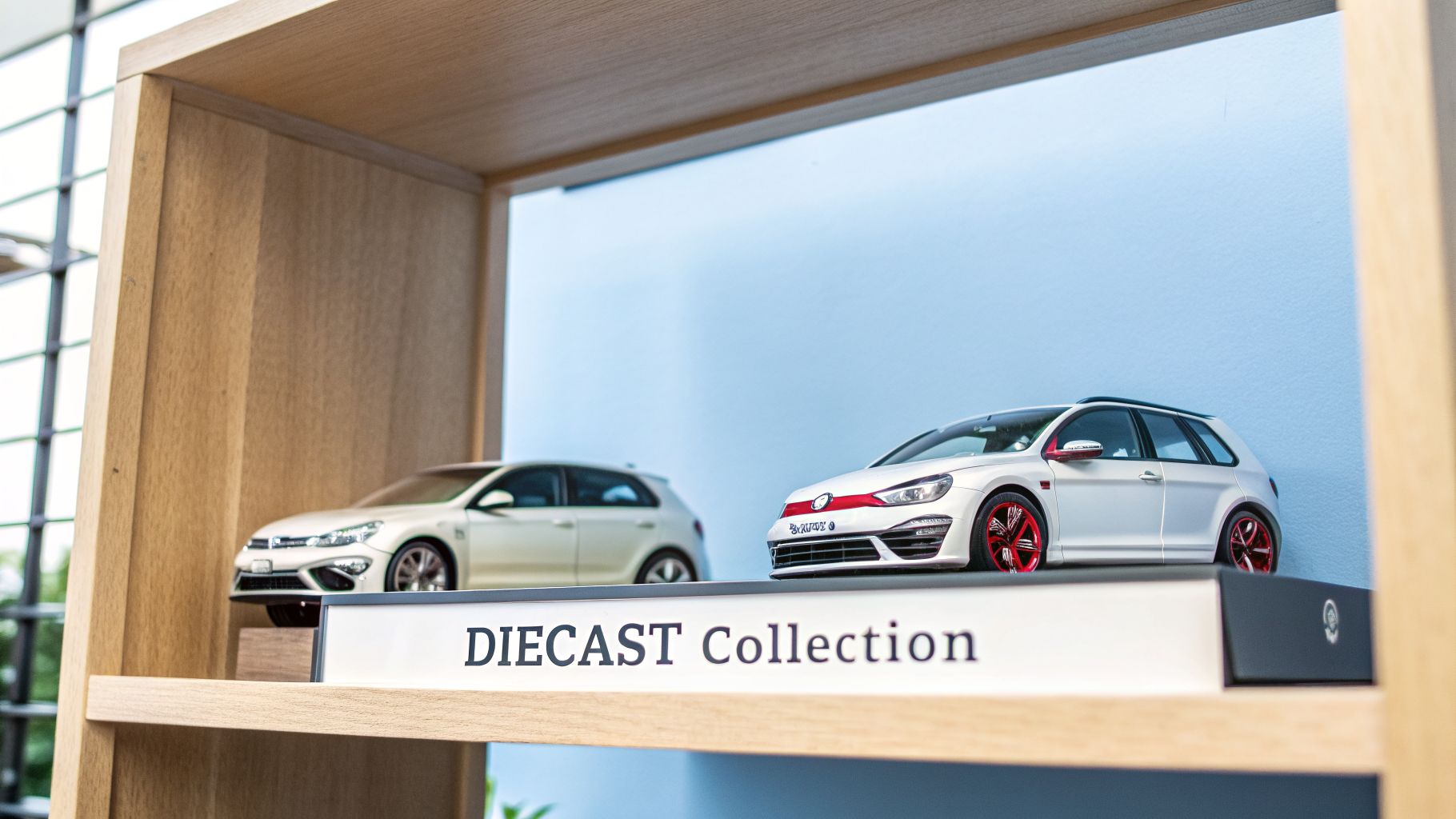
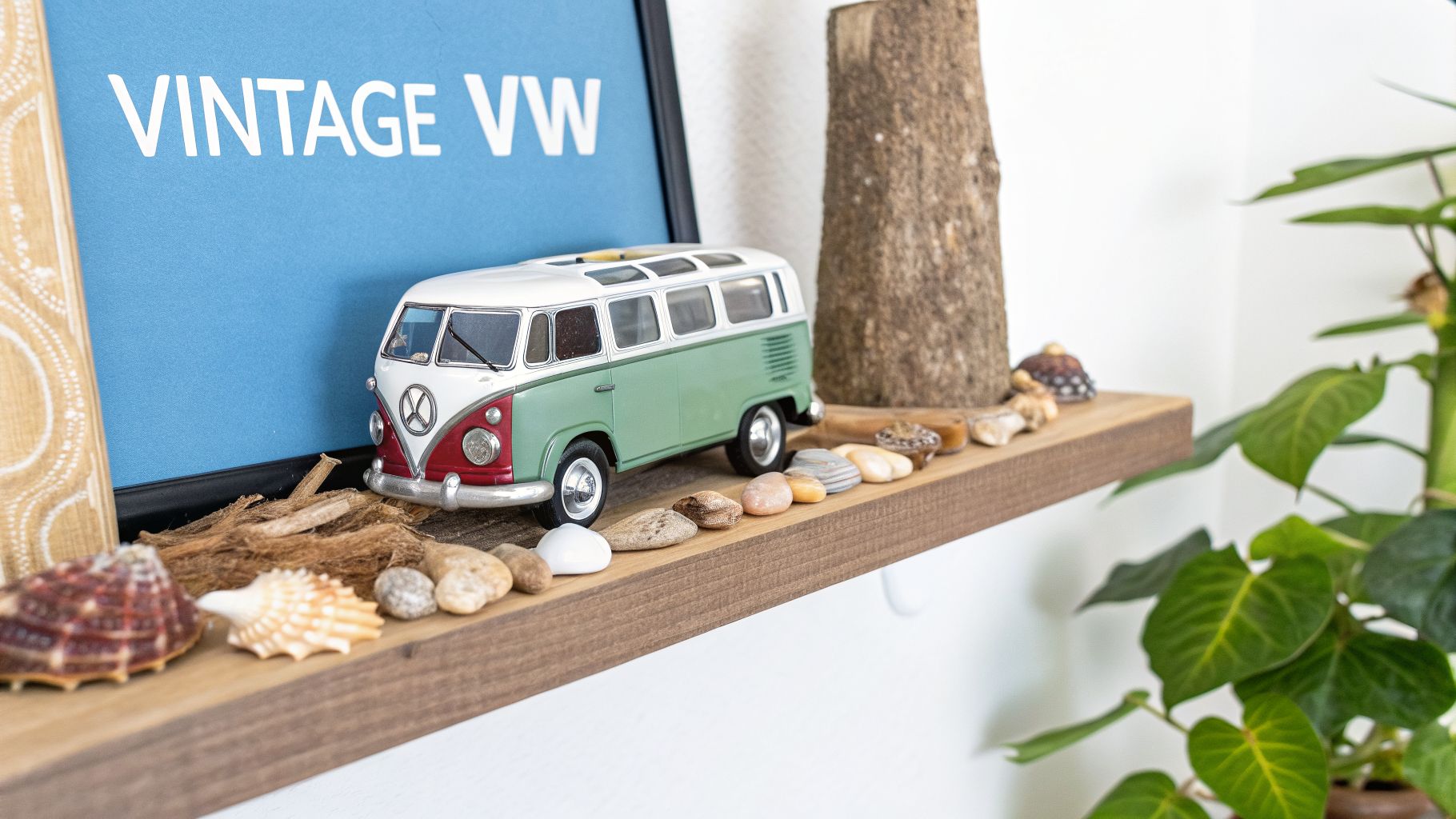
For those of us with a soft spot for the iconic design of a classic VW, shell art beautifully marries our two great loves. The organic, imperfect shapes of seashells create a stunning natural contrast against the slick, clean lines of a diecast model collection. It’s the perfect bridge between our passion for the road and our connection to the sea, helping to build a space that feels deeply personal and full of adventure.

It’s a way to ensure that even when you’re not at the beach, a piece of the beach is always with you, reminding you of the sun, salt, and endless horizons. This is a core idea behind many of our favourite coastal home decor ideas.

The real appeal of shell wall art is its power to evoke a specific mood. Whether it's one large, intricate piece or a scattered collection of smaller shells, each one carries the spirit of where it came from.

  • Sparks Nostalgia: It brings back fond memories of family holidays, long walks on the sand, and those perfect, lazy summer afternoons.
  • Adds Natural Texture: Shells introduce organic shapes and fascinating textures that can soften a space, making it feel warmer and more inviting.
  • Creates a Calming Vibe: That link to the ocean has a naturally soothing effect, which is perfect for creating a truly relaxing atmosphere in your home.

At the end of the day, using shell wall art is all about crafting a home that tells your unique story. It’s a way to honour a life filled with freedom, adventure, and a genuine love for Australia’s natural beauty. It's the perfect companion to the spirit of Volkswagen, complementing the heritage and freedom that a classic Beetle or Kombi stands for, and turning your house into a true sanctuary.

G'day, fellow travellers and collectors! When you hear “shell wall art,” you might picture the classic, handmade stuff from a beachside shack. We love those, but the world of shell decor is as big as the Aussie coastline. It's not just one style; it’s a whole range of looks that can bring that salty-air vibe home.

Let’s start with the heart of it all: the genuine, handcrafted pieces. These are the ones with a real story, often made from real cowries, scallops, and even starfish. Artisans might arrange them into mosaics or set them on weathered timber or woven seagrass. They have a raw, natural feel, like you've brought a piece of the beach right inside.

But it doesn't stop there. Shell decor now fits all sorts of styles, from modern to retro. It's about finding what works for you and your passions, whether that’s the ocean or the rumble of a classic flat-four engine.

Handcrafted and Natural Pieces

This is the classic style of shell art. It’s all about the real texture and beauty of the shells themselves.

  • Shell Mosaics: These are big, impactful pieces. Hundreds of shells are carefully placed to create a pattern. A large, round cowrie shell mosaic is a great focal point over a mantelpiece or bed.
  • Driftwood and Shell Combos: Artists often take sun-bleached driftwood and add shells to create rustic, one-of-a-kind wall hangings. They look rugged and delicate at the same time.
  • Juju Hats and Wreaths: These circular pieces, often made with shells and feathers, add a lot of texture and a bohemian look to a room.

People have used shells in art for hundreds of thousands of years. These handcrafted pieces are part of that long tradition. The appeal of a shell is timeless, a fact you can see by looking into ancient shell carvings.

Modern and Interpretive Styles

If your home is more contemporary or you want to mix coastal vibes with other themes, modern shell art has some great options. These pieces take the idea of a shell and rework it in new ways.

This is a good way to get a beachy feel without being too literal. It lets you add that coastal touch alongside other things you love, like a display of your treasured Volkswagen Beetle model cars.

For example, you could find:

  • Sleek Metal Wall Art: Think of a big, stylised nautilus shell made from brushed gold or matte black metal. It’s a sharp-looking nod to the coast that fits well in a modern living room.
  • Abstract Prints: Artists use shell shapes and colours to create nice abstract paintings and prints. You might see watercolour swirls in ocean blues and sandy beiges or bold, graphic spirals.
  • Vintage-Style Posters: This is where the VW love clicks. Picture a retro art print with a classic Splitty parked at the beach, with some subtle shell designs. It’s a great way to mix the nostalgia of VW culture with the chill vibe of the coast, especially if you're a fan of our Kombi Samba Bus diecast models.

Picking the right piece of shell wall art for your home is a bit like finding the perfect spot to park your Kombi at a show—it just needs to feel right. You're not just plugging a gap on a wall; you're choosing something that resonates with you and adds to the story of your space.

Let’s run through how to pick a piece with confidence, making sure it looks like it was always meant to be there.

You’re looking for art that works with your home's character, creating a room that feels thoughtfully put together yet still relaxed and personal. Just like you probably wouldn't put racing stripes on a classic Beetle, you want your art to enhance its surroundings, not fight them.

Considering Size And Scale

First thing’s first: how much space have you got to play with? The size of your shell art can completely change the vibe of a room. Are you going for a big, bold statement or just a subtle whisper of the coast?

  • Large Statement Pieces: Have a huge, empty wall over the sofa or bed? A single, large shell mosaic or a big metal shell sculpture can become an instant focal point. It anchors the whole room, drawing the eye and setting a clear coastal tone—think of it as the main event, like a beautifully restored Samba Bus at Volksfest.

  • Gallery Walls: If you've got a collection of smaller treasures, grouping them is a great way to make an impact. A gallery wall mixing different shell art, small prints, and maybe even a photo of your own VW down by the sea can tell a brilliant story. They work especially well in hallways, studies, or bedrooms.

  • Small Accents: Sometimes, a small touch is all you need. A single, nicely framed shell or a small driftwood piece can bring a hint of the beach to a bookshelf or a cosy corner without taking over.

Matching Colour And Texture

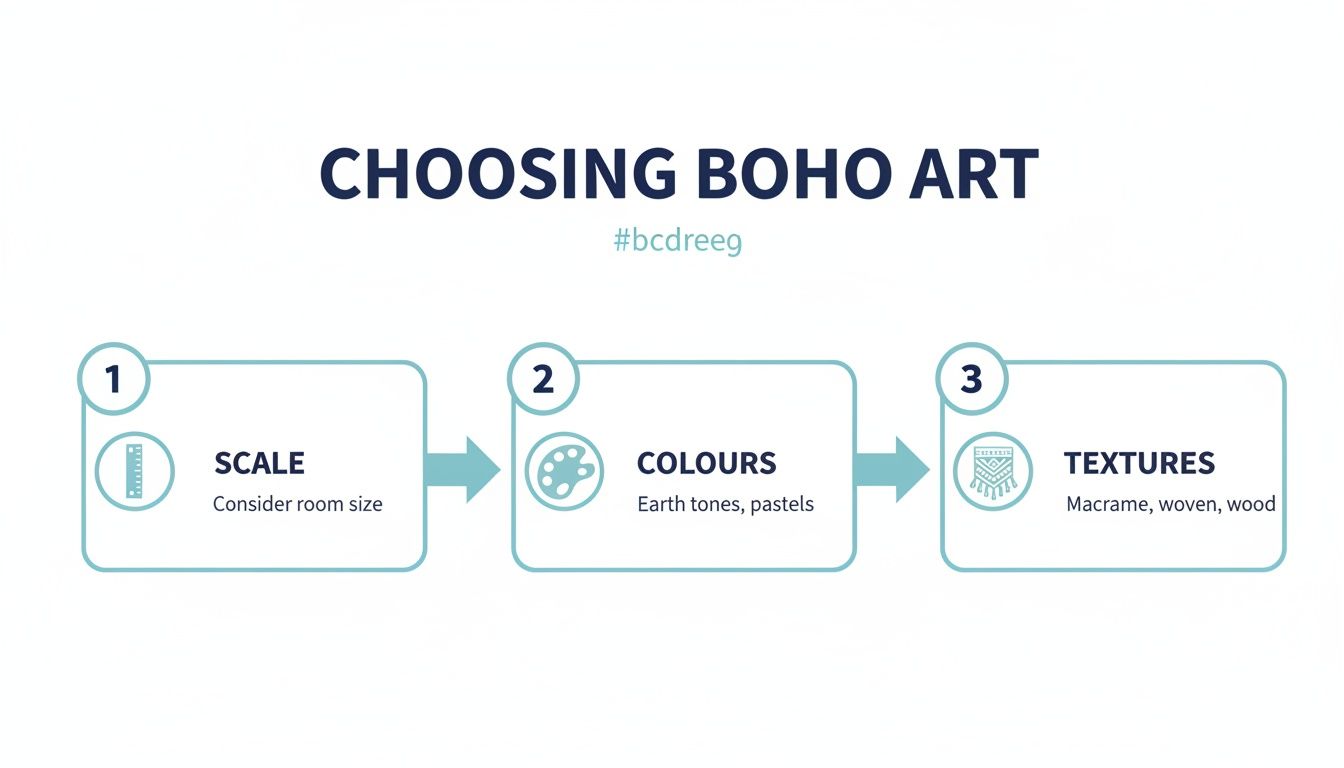
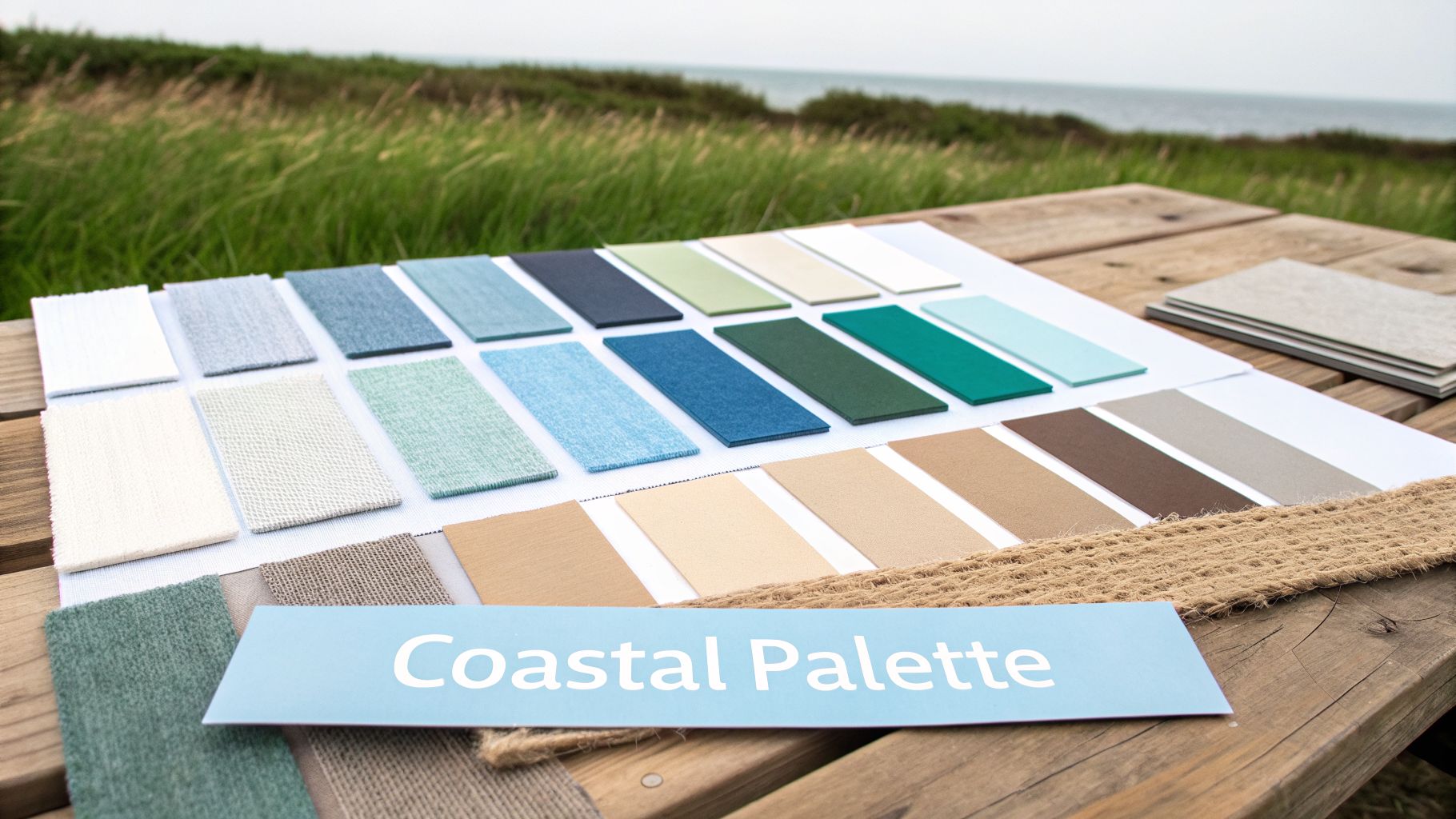
Alright, let's talk about colour. Your shell art needs to harmonise with the decor you already have. The good news is that shells come in a naturally beautiful palette that’s pretty easy to work with.

You can either match your art to your current colours or use it to throw in a bit of contrast. The sandy neutrals, creamy whites, and soft greys you find in most shells look great in almost any setting. On the other hand, the vibrant blues of abalone or the deep tones of certain mussels can add a splash of life to a more neutral room.

This infographic gives a good breakdown of the two main directions you can take with shell decor.
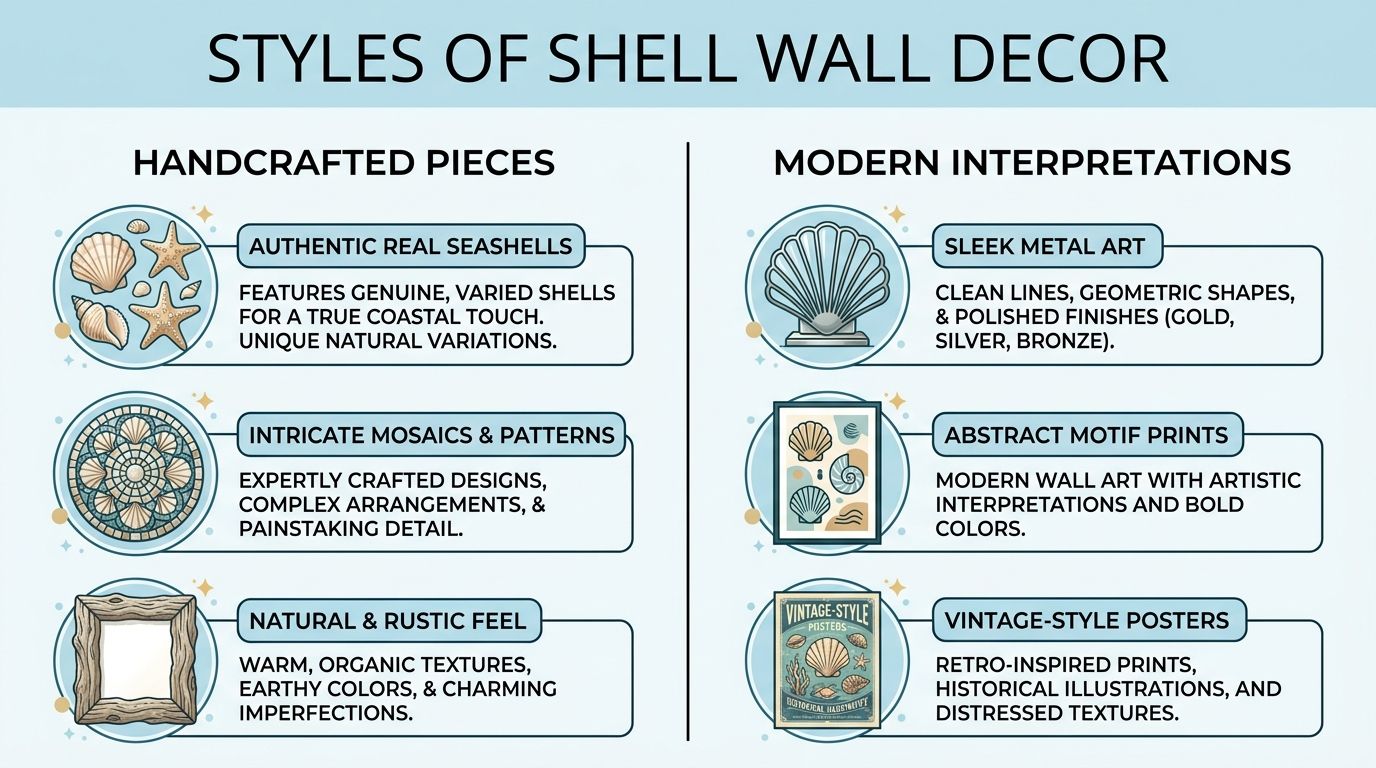
An infographic titled Styles of Shell Wall Decor comparing handcrafted seashell pieces with modern shell art interpretations.

As you can see, there's a clear split between the rustic, authentic feel and the more sleek, modern take. It’s a good starting point for figuring out which style suits your home best.

Texture is just as important as colour. The rough, organic feel of real shells can soften a room that has a lot of smooth, modern surfaces. On the flip side, a polished metal shell sculpture can add a bit of sleekness to a more rustic, textured space. It’s all about creating a nice balance.

"The art and the interior need to complement one another, not fight or match. It’s more important, though, that the art connects with you, rather than just fitting the house. The place to put it will come.”

That's really the key takeaway—at the end of the day, you have to love the piece. If a piece of shell art reminds you of a perfect day cruising down the coast, it’s probably the right one for you, no matter what the 'rules' say. It’s all about building a collection of things you love, from your favourite VW memorabilia collectibles to art that captures the Aussie seaside spirit.

Alright, this is where the real fun starts. You've picked out the perfect piece of shell wall art, and now it's time to get it playing nicely with the rest of your decor. So, how do you bring together the freedom of the open road and the calm of the coast without it looking like a total mess? It’s simpler than you might think.

The idea isn’t to create a themed room you’d find in a cheap motel. It's about letting your passions live side-by-side. Your home tells a story—your story. The VW models, the shell art, the old photos… they're all souvenirs from the journey.

By creating visual links and little narratives around your space, you can build a home that feels both personal and pulled-together, celebrating your love for coastal vibes and classic Volkswagens. Let's look at how to pull it off.

Creating Cohesive Corners and Vignettes

Instead of scattering your favourite pieces all over the house, try grouping them into small "scenes" or vignettes. This technique gives the eye a focal point and tells a much more compelling story. It’s like parking all the best Kombis together at a Show & Shine—the collective impact is huge.

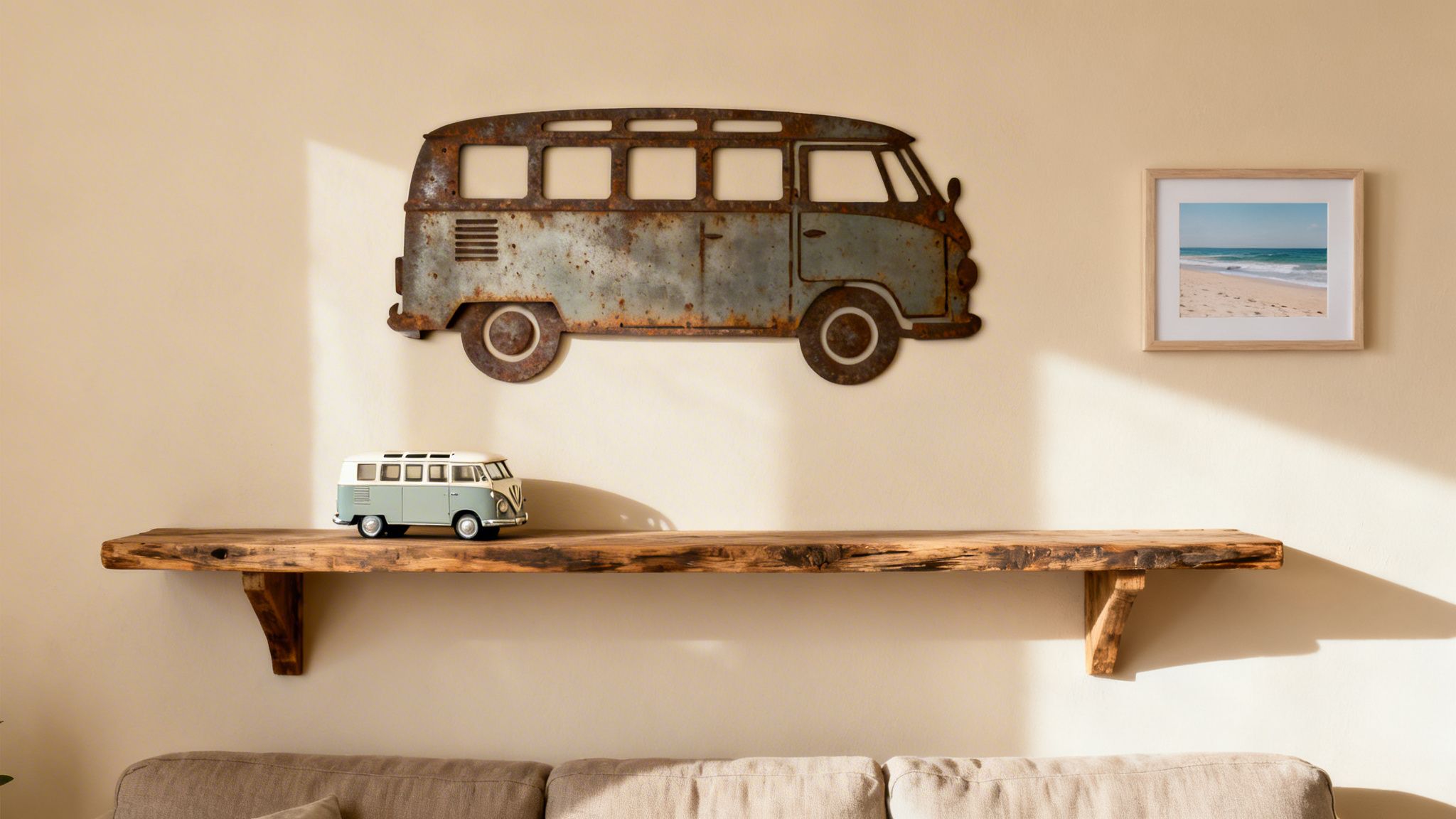
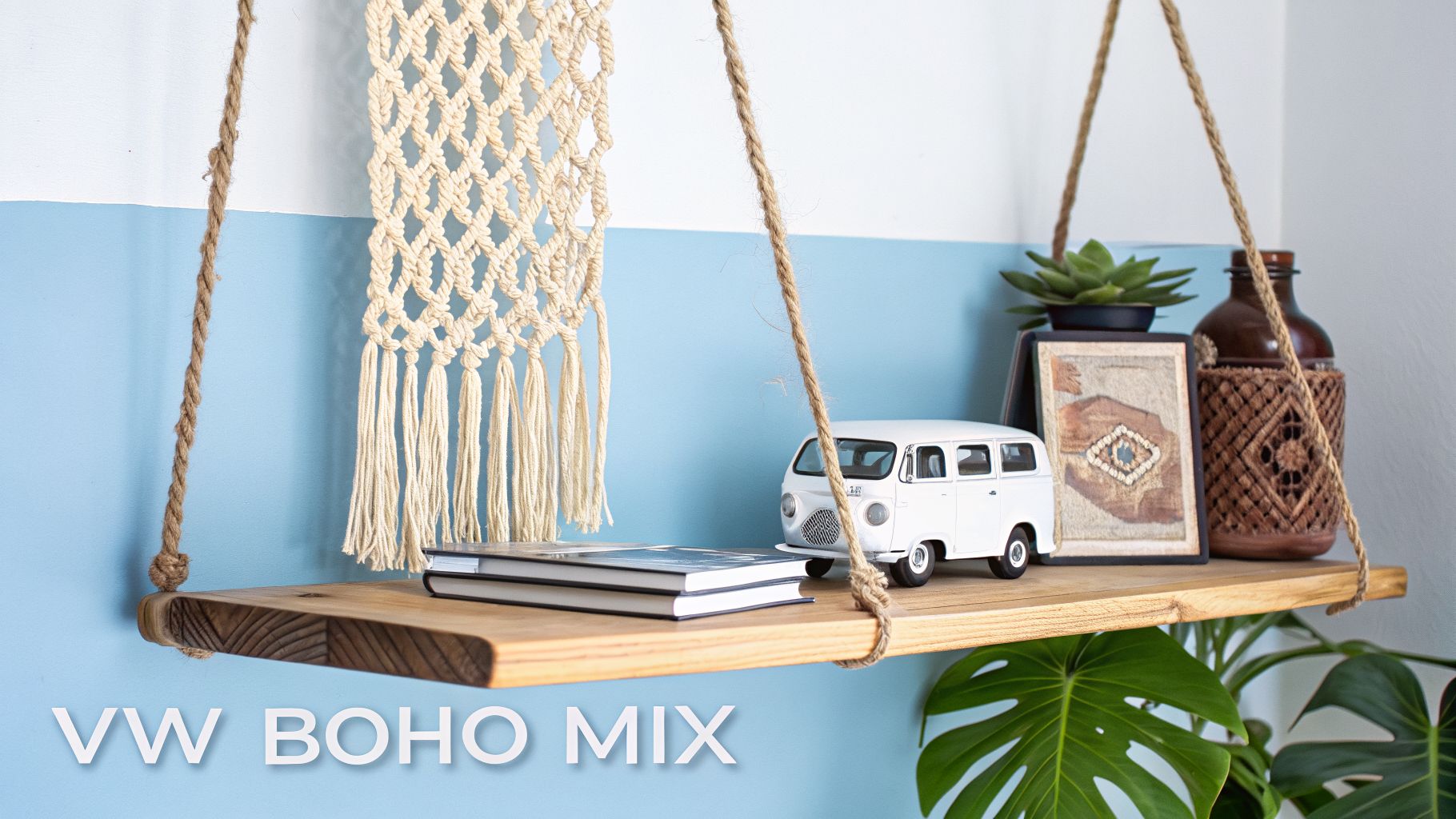
Picture a dedicated 'Surf's Up' corner in your living room. You could hang a big shell mosaic or a surfboard-shaped sign on the wall. Underneath, on a simple floating shelf, you could line up a few prized Kombi Samba Bus diecast models—maybe a classic woody wagon or a surf-themed van. Throw in a couple of smaller shell pieces and a framed beach photo, and you've got a perfect nod to surf culture right there.

Here are a few more ideas to get you started:

  • The Collector’s Shelf: An intricate, white cowrie shell mosaic makes a brilliant backdrop for a neat row of colourful diecast Volkswagen Beetle models. The organic, bumpy texture of the shells really makes the smooth, painted lines of the cars stand out.
  • The Hallway Gallery: Mix and match. Create a gallery wall that combines different styles of shell art with sharp, black-and-white photos of classic VWs. The contrast between the natural, flowing shapes of the shells and the clean, mechanical beauty of the cars is fantastic.
  • The Reading Nook: Find a quiet corner and set up a comfy armchair. On the wall, hang a piece of driftwood and shell art. On a small side table, you can have a stack of car mags and a single, beautifully detailed 1:18 scale model. It's the perfect spot to get away from it all.

Playing With Colour and Contrast

Colour is your best friend for tying different themes together. The classic coastal palette—think crisp whites, sandy beiges, and every shade of blue imaginable—is the perfect neutral backdrop. It lets your more colourful pieces do all the talking.

Just imagine how a vibrant, "Flower Power" diecast van pops against a calm, white wall. The colours just sing. That clean, breezy feel of nautical decor lets the bold personality of your VW memorabilia take centre stage, so don't be afraid to use that contrast.

A good rule of thumb is that art should connect with you personally before it has to "match" the room. This is especially true when you're blending styles. If you love both the coastal and VW aesthetic, making them work together is just part of the fun.

You can also borrow colours from your VW models and weave them into your coastal pieces. Got a stunning sea-green Kombi model? Look for shell art with hints of that same green, or simply add a cushion in a similar shade to a nearby chair. These little connections create harmony. For more ideas, our guide on wall accents for the living room has some great visual inspiration you can borrow from.

At the end of the day, styling your home is about surrounding yourself with things that make you happy. It's about creating a space that feels like it could only belong to you. By blending the raw, natural beauty of shell wall art with the iconic charm of Volkswagen culture, you’re not just decorating—you’re telling your own story of adventure and freedom.

Simple Care Tips for Your Shell Decorations

Just like you wouldn't leave your classic Kombi out in the rain with the top down, your shell art deserves a bit of TLC. A little care goes a long way in keeping these pieces looking as fresh as the day you got them, ensuring they bring that coastal vibe to your space for years to come.

For the most part, a simple, gentle dusting is all your shell art needs. Think of it like a quick polish before a car show. Because shell mosaics and natural arrangements can be delicate, you'll want to skip the harsh sprays or cloths. A soft paintbrush or a can of compressed air (held at a distance) works wonders for getting into those little nooks and crannies without risking any damage.

Cleaning Different Materials

If you need to do a bit more than just dusting, your approach will change depending on the material. The key is to always be gentle, especially with those handcrafted pieces that mean the most.

  • Real Shells: Has your piece made of real shells lost a bit of its lustre? Just use a slightly damp cloth with a tiny drop of mild soap. Wipe it down gently, then immediately pat it dry with a clean, soft cloth to get it shining again.
  • Metal Shell Art: For metalwork, a quick wipe with a dry microfibre cloth is usually all it takes. If you find a stubborn spot, a damp cloth will do the trick, but make sure you dry it completely to prevent any rust or water marks from forming.
  • Wooden Pieces: If your shell art is mounted on or includes wood, stick to a light dusting. It's best to avoid water and cleaning solutions entirely, as they can cause the wood to warp or lose its colour.

Placement Is Everything

Believe it or not, where you hang your shell wall art is just as important as how you clean it. The two biggest culprits to watch out for are direct sunlight and high humidity.

Just as you’d park a vintage car in the shade to protect the paintwork, think about where your art will live. Constant, direct sunlight can cause the beautiful, natural colours of shells to fade over time.

High-humidity spots, like a bathroom without great ventilation, can also be tough on your decor. It can make the shells brittle and damage any wood or fabric elements. A living room, bedroom, or hallway is a much safer environment for your pieces to thrive. It’s interesting how much thought goes into this; you can even find market research on how Aussies care for their coastal decor. To learn more about the stories behind collecting, check out the insights on theartssociety.org.

With just a little bit of attention, your shell decorations will stay looking incredible. They'll continue to serve as a brilliant reminder of coastal drives and salty air—the perfect companion to your passion for VW memorabilia collectibles.

DIY Shell Art Projects for VW Enthusiasts

For those of us who enjoy a hands-on project—much like tinkering with a classic Beetle on a weekend—creating your own decor offers a unique satisfaction. There’s something special about making a piece with your own two hands, especially when it’s filled with memories from your favourite Aussie beaches.

The best part of any DIY project is that it becomes a small part of your story. Every shell can be a reminder of a specific road trip down the coast or a perfect afternoon spent with family. It’s the ultimate way to personalise your space, blending a love for the sea with that unmistakable VW spirit. If you're keen to make your own shell wall art, here are a couple of great ideas to get you started.

Project Idea: Custom Shell Photo Frame

This is a fantastic starter project that’s both simple and incredibly meaningful. The goal is to create a unique frame for a cherished photo—maybe one of your Kombi parked up at Byron Bay, or the family gathered around the Beetle on a camping trip.

Here’s what you’ll need:

  • A Plain Wooden Photo Frame: Any size works, but an 8×10 is a good starting point.
  • A Collection of Small Shells: Use a mix of colours and shapes you’ve gathered over time.
  • Strong Craft Glue: A clear-drying glue will give you the best finish.
  • Optional Sealer: A clear acrylic spray can add a bit of shine and protection.

Begin by laying out your shells on the frame to plan your design. Once you’re happy with the arrangement, glue them down one by one. After it dries completely, insert your favourite photo, and you’ll have a piece of art that’s 100% you.

Project Idea: VW or Surf-Themed Shell Letters

This project makes a bigger statement and is perfect for a feature wall. You can customise plain wooden letters from a craft shop to spell out a word that resonates—'SURF' is a classic, but 'VW' or 'KOMBI' would look just as legendary.

The process is similar to the photo frame. Just arrange and glue your shells to cover the surface of the wooden letters. This is a great chance to get creative with patterns, perhaps making waves with smaller shells or using larger, unique ones as focal points. When mounted on the wall, they create an immediate coastal, retro vibe that’s full of personality.

The most rewarding part of any DIY project is that it carries your own personal touch. No two pieces will ever be the same, just like no two classic VWs have the exact same story.

These projects are about more than just making something decorative; they're about building another layer of character into your home. Each creation becomes a talking point and a reminder of good times and salty air. For more ideas on how to blend these themes, have a look at our curated selection of seashell wall art that captures this very spirit.

FAQ: Your Shell Wall Art Questions Answered

Got a few questions about mixing that classic coastal charm with your VW passion? Good. You're in the right place. It's a common thing we see – you love the freedom of the open road and the chilled-out vibe of the beach, so why wouldn't you want your home to reflect that? Let's get into some of the questions we hear all the time.

How Do I Securely Hang Heavy Shell Art?

This is a smart question, especially when you’ve found a stunning, large-scale shell mosaic that has a bit of weight to it. The last thing you want is for it to take a dive. For anything with some real heft, forget about a single nail. Your best bet is to find a stud in the wall and use a proper screw or a heavy-duty picture hook that’s rated for the piece’s weight.

But what if a stud isn't right where you need it? No dramas. A plasterboard anchor is your new best friend. These little gadgets expand behind the plasterboard, creating a much stronger anchor point. You can grab them from any hardware shop, and they’ll let you rest easy knowing your new treasure is secure.

Can I Use Shell Decor in a Room That Isn’t Fully Beach-Themed?

Of course you can! In fact, that's one of the best ways to do it. Think of shell wall art as a personal accent, not part of a strict theme. It's just like placing a favourite diecast model on a bookshelf—it’s a nod to what you love, a piece that tells a story.

A single, well-chosen shell piece can introduce a fantastic organic texture to any room, whether your style is modern, rustic, or a bit of everything. The trick is to treat it as you would any other piece of art. If you connect with it, it belongs. It’ll sit perfectly alongside your collection of VW memorabilia collectibles, adding another layer of your personality to the space.

As any good collector knows: “It’s more important, though, that the art connects with you, rather than just fitting the house. The place to put it will come.”

Where Can I Find Quality Shell Art That Complements VW Memorabilia?

The goal is to find pieces that echo that same retro, free-spirited feel of your VW collectibles. You want art that feels authentic, not mass-produced. Local artisan markets and little shops in coastal towns are goldmines for finding unique, handcrafted treasures.

For a more curated approach, we’ve hand-picked a collection of coastal and shell wall art designed specifically with the VW enthusiast in mind. Each piece is chosen to capture that laid-back, adventurous vibe that looks right at home next to everything from a diecast Beetle to a classic Kombi model. Because we're a local Aussie importer, you can be sure of fast shipping and quality gear that's already on our shores.


Ready to find that perfect piece to finish off your space? At vwmemorabilia.com.au, we’ve sourced a fantastic range of coastal decor that celebrates the classic Aussie lifestyle. Browse our shop to find beautiful shell wall art and other coastal treasures that feel right at home with your collection.
Flower Wall Decor: A VW & Coastal Style Guide

I once set a little cream Kombi diecast on a shelf and realised the shelf was doing it no favours. The van looked ready for a beach run to Lennox, but the wall behind it looked like a waiting room in Parramatta.

More Than Just a Wall The Soul of a VW-Inspired Floral Display

A good flower wall decor piece does more than fill blank space. It gives your memorabilia a setting, a mood, a bit of road-trip magic.

That matters if you’re the sort of person who sees a Beetle and remembers who drove one, where it broke down, or which mate painted daisies on the side of a Kombi in the seventies. A floral backdrop taps into that same feeling. It softens the room, adds colour, and makes the display feel lived in rather than lined up like stock on a shelf.

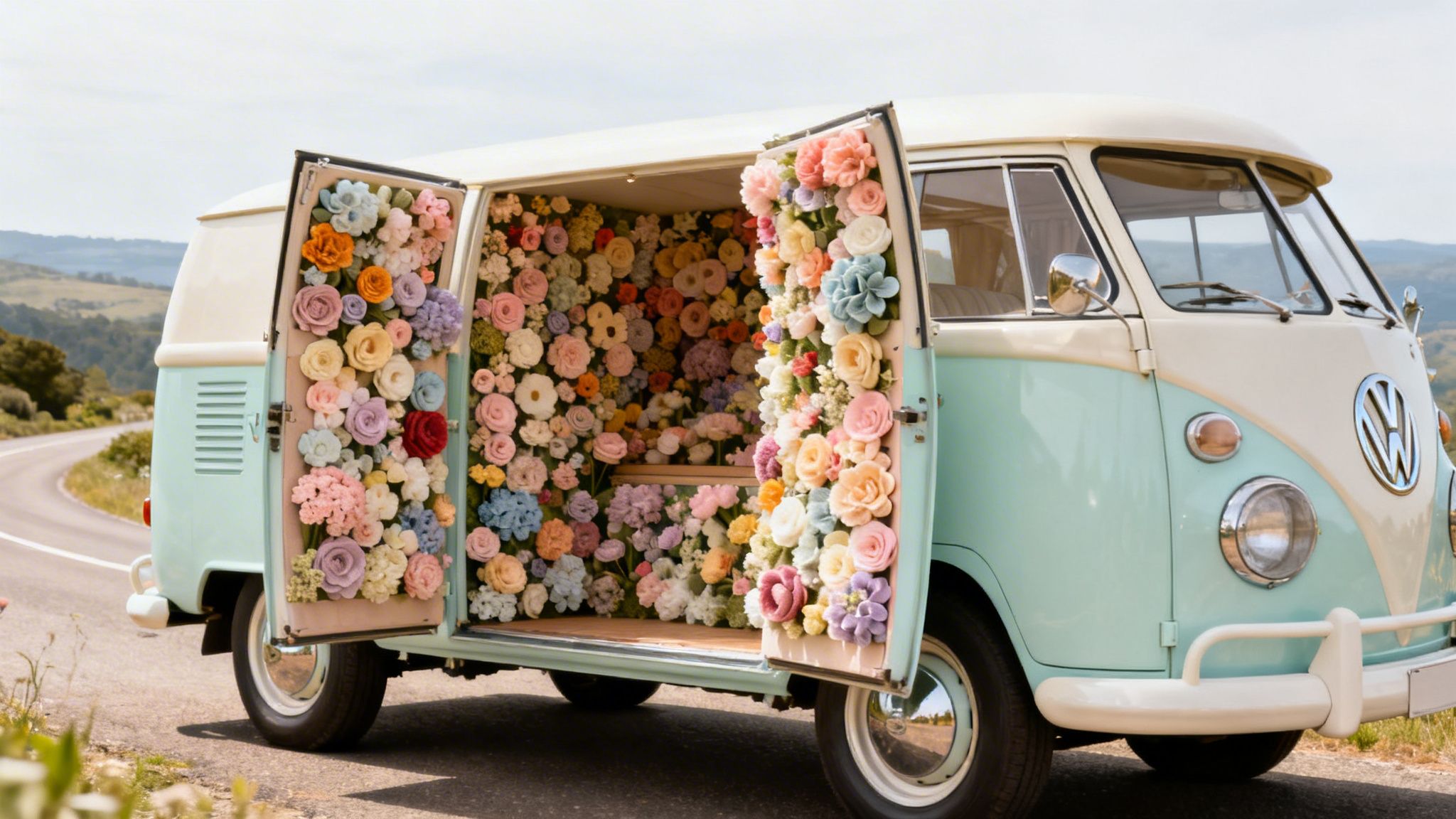
A vintage Volkswagen camper van filled with colorful paper flower wall decor on a scenic road.

Why flower walls feel right beside classic Volkswagens

The link isn’t forced. It’s baked into the culture.

The Waratah has been New South Wales’ state emblem since 1962, and flower wall decor in Australia sits inside a much older floral art tradition. By the 1970s, when Flower Power rolled through surf hubs like Byron Bay, floral decals and retro prints were right at home beside Kombis, beach towels, and salt-crusted longboards. Cultural archives cited in this history of flower arranging in Australia note that sales of retro floral prints increased by 35% during 1969 to 1974, and the same source says the Australian home decor market for botanical wall art now exceeds AUD 250 million yearly.

That history gives flower wall decor a bit of backbone. It is not just pretty filler. It belongs here.

A display should tell a story

The best setups feel like a scene from a life you know.

A pale blue Beetle model in front of native-inspired blooms can feel like a Sunday drive down the coast. A bright Samba Bus against orange, pink, and cream florals can bring back markets, records, and the old flower-child spirit without trying too hard. Even a modest shelf can start to feel like a little stage set.

Tip: If your collection has one hero piece, build the wall to support that model’s colour and character rather than fighting for attention.

I’ve always liked displays that feel collected over time. A flower wall helps with that. It lets the car stay the hero while the background carries the atmosphere, a bit like a good photo from a show field where the sky, grass, and people all make the car look better.

Planning Your Vibe Flower Power Hippy or Sun-Kissed Coastal

Before you buy a single stem, decide what sort of story the wall should tell. If you skip this bit, you end up with a mishmash of colours that looks more craft cupboard than curated corner.

I reckon most VW-inspired flower wall decor lands in one of two camps. The first is bright and cheeky. The second is breezy and beachy. Both work. The trick is matching the wall to the personality of your room and your collection.
The Flower Power look

This is the full-colour option. Think hot pink, orange, cream, yellow, and soft purple with plenty of movement.

It suits a cheerful Kombi display, especially if your favourite model has that playful seventies energy. A bold floral wall behind a classic van can feel like an old festival poster come to life. The colours don’t have to be random. Pick a few repeating tones from the vehicle itself and let the flowers echo them.

This style works best if you already lean retro in your home decor. Timber shelves, old cameras, vintage signs, and sun-faded prints sit nicely with it.

The Sun-Kissed Coastal look

This one feels more Noosa shack than Nimbin market.

Use softer tones, sandy neutrals, muted whites, eucalyptus greens, and native-inspired textures. The result is calmer, which is handy if you want the display to sit naturally in a lounge room, hallway, or study without shouting over everything else. If you like layered beach styling, a browse through this boho wall art collection can help you pin down the mood.

A coastal flower wall decor setup suits cream, pale blue, sage, and white VW pieces beautifully. It also works with surf memorabilia, driftwood, or small framed beach prints.

A quick way to choose your direction

Use this simple check before you commit.

Vibe Best match Colours Best room feel
Flower Power Bright Kombis, retro signs, playful shelves Pink, orange, yellow, cream Lively, nostalgic
Sun-Kissed Coastal Beetles, surf pieces, natural textures White, sand, green, soft blush Relaxed, airy

Three decisions that save headaches later

  • Start with the hero item: Choose the model, print, or object that matters most. Everything else should support it.
  • Look at your wall in daylight: A colour that feels soft in the shop can look muddy at home.
  • Measure the visual footprint: Mark the intended wall area with painter’s tape first. It helps you see whether you need a full backdrop or just a framed floral zone behind shelves.

Key takeaway: The strongest flower wall decor doesn’t begin with flowers. It begins with mood, colour, and the one VW piece you want everyone to notice first.

Building Your Masterpiece A Guide to DIY and Ready-Made Walls

Some people love a weekend project. Others would rather skip straight to the fun bit and start styling. Both paths are fair dinkum.

If you want to build your own flower wall decor, you need a base that can handle the job, flowers that won’t look tired in coastal conditions, and enough density to stop the whole thing looking patchy. If you’d rather buy ready-made panels, the game shifts from making to choosing well.

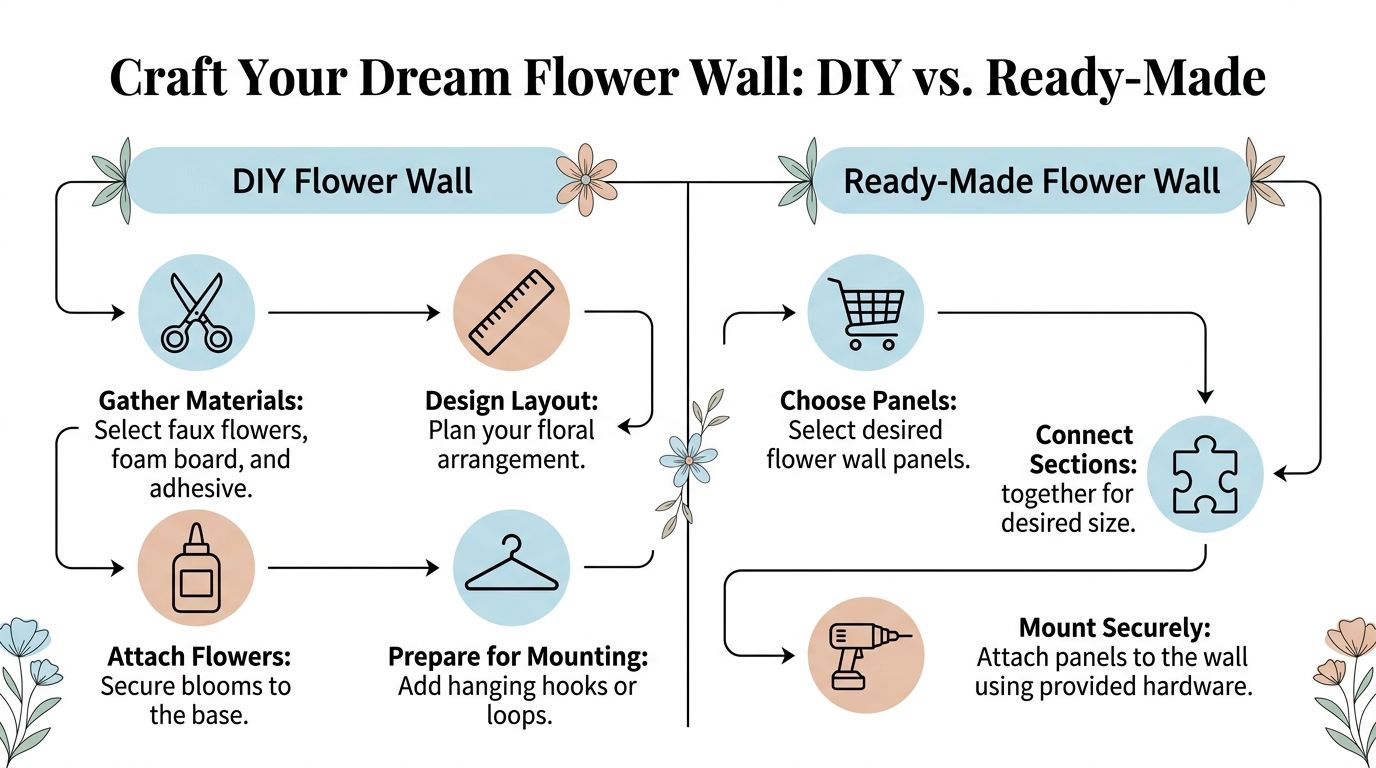
Infographic

The DIY route for hands-on VW fans

The verified Australian guidance is refreshingly practical. Use marine-grade plywood (12mm thick) or EVA foam boards as your base. For flowers, choose UV-resistant faux silk flowers and allow AUD 200 to AUD 800 for sourcing. For a lush finish, calculate 200 to 300 roses per square metre. Assembly uses industrial hot glue and zip ties, and the process can take 12 to 24 hours, according to this Australian DIY flower wall guide from Boxwood Rose.

That all sounds a bit workshop-heavy, but it’s straightforward when broken down.

Step one choosing the base

Marine-grade ply makes sense if the finished wall will live somewhere with coastal humidity, changing temperatures, or regular handling. EVA foam is lighter and easier to move, which can be handy if you’re renting or rearranging displays.

If your flower wall decor is going behind a low shelf of diecast models, lighter can be better. If it is a freestanding statement piece or a larger panel, sturdier is often worth the extra effort.

Step two sourcing flowers that hold up

Many home projects falter at this stage. The flowers need to look convincing from a few steps back and survive ordinary Australian conditions.

The same Boxwood Rose source notes that AU event planners report 75% success for DIY walls, but common pitfalls include using non-UV resistant flowers in high humidity and underestimating costs, which can push budgets up by 30% without bulk purchasing. That means the bargain bunch that looks fine in a packet may not stay schmick once it’s on the wall.

A practical mix works best:

  • Background greens: Build a base with leafy texture first.
  • Mid-layer fillers: Add smaller blooms or soft texture to stop gaps.
  • Focal flowers: Place your showy blooms where the eye naturally lands.

Step three building the panel

Lay the board flat. Start with the broadest greenery and work inward.

Then add shape. Keep stepping back every so often. A flower wall decor panel looks better when colours are repeated in loose clusters rather than placed in strict rows. Think balance, not symmetry.

Tip: Build denser around the centre if the wall will frame a single shelf or hero object. That keeps the visual weight where the eye already wants to go.

Step four checking the finish

Before you hang anything, inspect the edges. Sparse edges are the giveaway of a rushed build.

Tuck in small stems to hide the board, trim anything awkward, and test how the panel looks in the room’s natural light. If the blooms swallow your VW pieces whole, pull back a little from the centre zone so the memorabilia can breathe.

The ready-made route for quicker results

Not everyone wants glue strings on the kitchen bench for two days. Ready-made flower wall panels can be a ripper option if you value speed and neatness.

What matters is not brand hype. It’s construction.

Look for panels with believable colour variation, flexible backing that joins cleanly, and enough depth to avoid that flat plastic-grid look. Connect a couple of panels on the floor before mounting so you can check whether the joins disappear from normal viewing distance.

A coastal scene can look even more cohesive if the florals sit near other natural textures. For example, a floral backdrop paired with pieces in this seashell wall art coastal decor style creates a softer beach-house feel than florals alone.

DIY or ready-made at a glance

Option Best for Strengths Watch for
DIY flower wall Tinkerers, custom sizing, colour control Custom look, hands-on fun Time, hidden costs, flower quality
Ready-made panels Fast styling, cleaner install, less mess Quick setup, consistent finish Panel joins, flat texture, generic colour mixes

A ready-made panel suits collectors who already spend their spare time tinkering with shelves, lighting, and display cabinets. Save the effort for styling, and let the backdrop do its job without becoming a project of its own.

Installation Tips Getting Your Wall Show-Ready

The build can be brilliant, but a crooked or wobbly install will undo the lot. Hanging flower wall decor properly is what makes it look intentional rather than temporary.

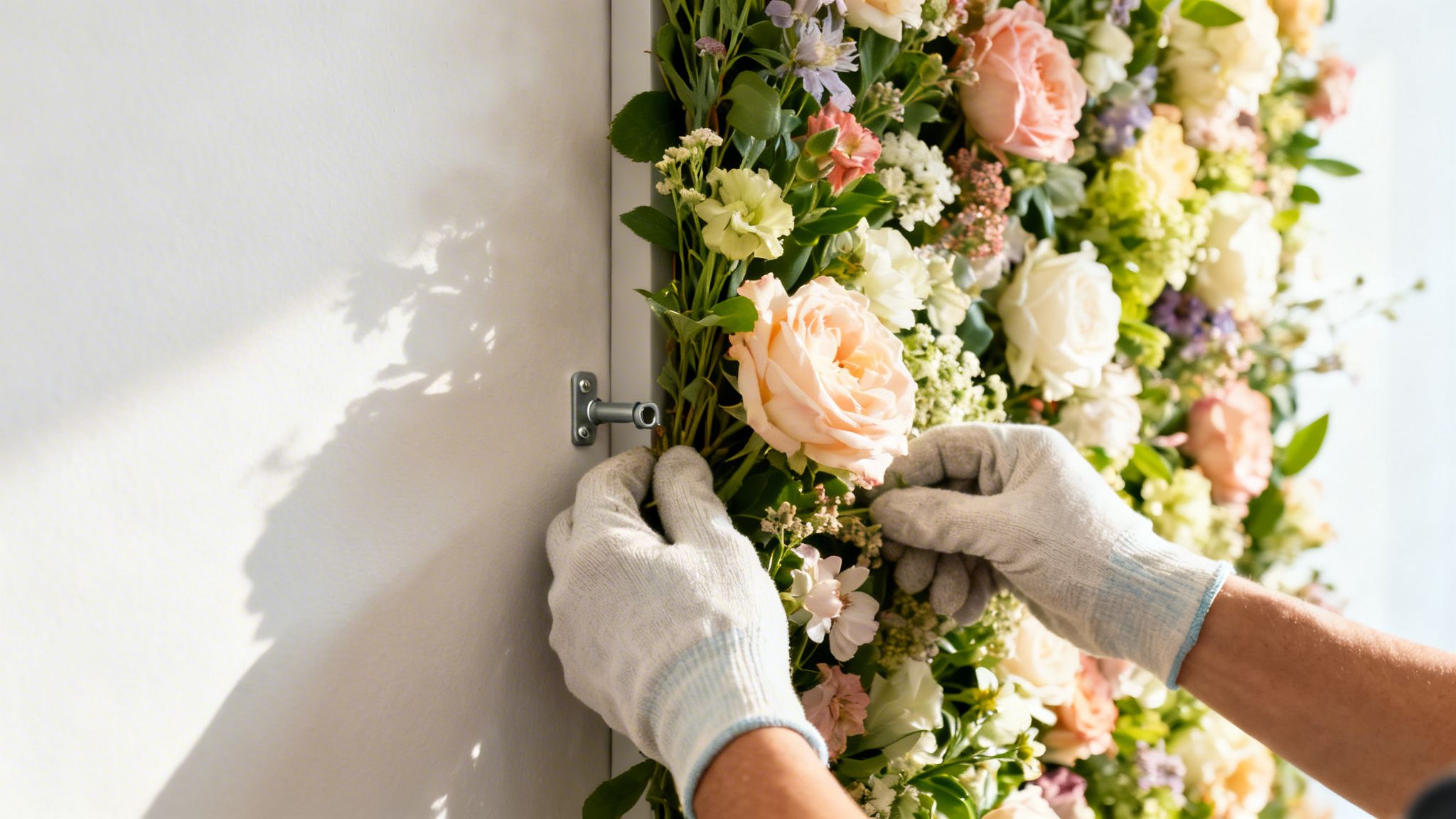
A professional installer wearing work gloves attaches a lush decorative flower wall panel to a white wall.

Get the position right before lifting

Mark the area on the wall first. Painter’s tape is your mate here.

Stand back from the room’s usual viewing angle and check the height against your shelves, console, or display cabinet. A flower wall sitting too high can make your memorabilia feel disconnected. Too low, and the whole scene feels cramped.

If you’re centring the wall behind a shelf, find the midpoint of both the shelf and the panel. Tiny measuring errors are obvious once flowers and diecast models are in place.

Choose a fixing method that suits the weight

A lightweight panel may work with lighter-duty hardware or a freestanding frame. A heavier build needs a more solid approach, especially if you used ply.

Good installation habits are simple:

  • Check the wall type: Plasterboard, brick, and timber all need different hardware.
  • Spread the load: Two fixing points sit better than one.
  • Protect the flowers while lifting: Hold from the base or frame, not from the blooms.

Tip: If you rent, consider mounting the panel to a freestanding support rather than directly to the wall. You still get the backdrop without turning bond cleaning into a drama.

This short video gives a useful visual feel for mounting and handling the panel during installation.

Final checks make it look professional

Once it’s up, fluff the flowers. Transport and handling can press some blooms flat.

Then check the edges, the level, and the sightline from the doorway. The wall should support your display the moment someone enters the room. If something feels off, it usually needs a small shift, not a full redo.

Styling the Scene Bringing Your VW Memorabilia to Life

The fun starts now. The wall is up, the room feels different, and now your VW pieces need to look like they belong there.

I like to style flower wall decor in little vignettes rather than one long line of objects. A vignette gives each model a role. One becomes the hero. One adds scale. One adds a wink of personality.

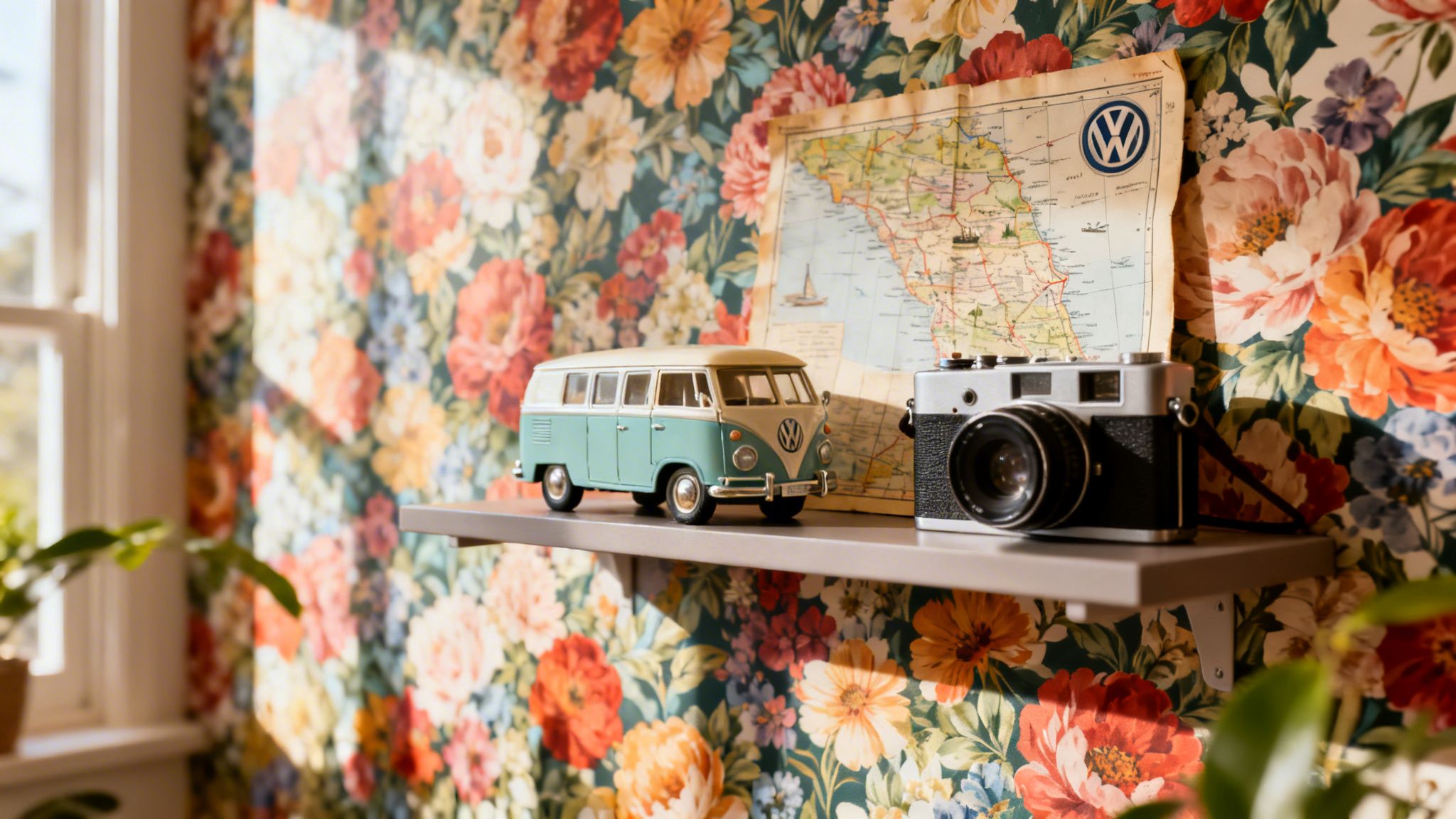
A vintage toy Volkswagen van and a film camera on a shelf against a colorful floral wallpaper.

A shelf scene that feels like a road trip memory

A cream or pastel Kombi works beautifully on a floating shelf in front of a softer floral wall. Add one weathered object beside it, perhaps driftwood, a tiny camera, or a framed beach snapshot, and the display starts to feel like a memory rather than a product lineup.

If the wall is bright and playful, a Flower Power van can carry the scene. If the floral backdrop is coastal and muted, a Beetle with clean lines can be the calm centre of attention. The point is contrast. Let the flowers create atmosphere while the vehicle provides shape and identity.

For collectors who enjoy layering home pieces around their display, a browse through vintage home accessories can spark ideas for companion objects with the right retro character.

Use depth so everything does not flatten out

A common mistake is putting every item on one narrow shelf and calling it done. That turns the whole display into a straight line.

Try this instead:

  • Front layer: The hero diecast model.
  • Middle layer: A small frame, shell, timber block, or compact ornament.
  • Back layer: The flower wall itself, carrying colour and texture.

You can also stagger shelf depths if you have the space. A slightly deeper lower shelf and a shallower upper shelf give the eye somewhere to travel.

Lighting changes everything

A display can look ordinary at noon and magic after dinner with the right lamp. Warm side lighting picks up the curves of a Beetle and the windows of a Samba Bus far better than harsh overhead light.

If your flower wall decor has texture, side light will also create gentle shadows in the petals. That makes the whole setup feel richer without adding clutter.

Key takeaway: Treat the arrangement like a tiny film set. The VW model is the lead actor. Every flower, shelf, and prop should support its scene.

Two easy vignette formulas

Style What to place Why it works
Coastal shelf Kombi, driftwood, small beach print Relaxed, airy, natural
Retro colour pop Flower Power van, old camera, bright florals Playful, nostalgic, bold

A well-styled flower wall decor display does not need dozens of objects. It needs restraint, rhythm, and one unmistakable star.

Keeping Your Display Looking Schmick Maintenance and Care

Once the wall is in and styled, maintenance is a light-touch job. That’s good news if you’d rather spend your weekends at a show-and-shine than dusting petals.

Simple habits that help

  • Dust lightly and often: A soft duster, cool hairdryer setting, or gentle puff of air helps stop buildup settling deep into the blooms.
  • Keep it out of harsh direct sun: Bright windows can fade colour over time, especially in rooms that cop strong afternoon light.
  • Check the fixings now and then: If the panel shifts, tighten or adjust before it starts leaning.
  • Spot clean gently: If one bloom gets marked, dab it carefully rather than scrubbing the whole panel.

Watch the room, not just the wall

Humidity, heat, and airflow all affect how flower wall decor holds up visually. If the panel starts looking flattened, reshape a few blooms by hand and rotate small companion items on the shelf to keep the display fresh.

A little care keeps the whole scene looking deliberate rather than dusty.

Frequently Asked Questions

Question Answer
Is DIY flower wall decor worth it for a memorabilia display? Yes, if you want control over colour, size, and mood. DIY suits collectors who enjoy making the display as much as owning the pieces on it. If you’d rather get to the styling stage quickly, ready-made panels are the easier path.
What flowers look best with VW displays? That depends on the vibe. Bright, playful blooms suit Flower Power and festival-inspired setups. Softer whites, greens, and native-inspired textures work better for coastal or surf-styled displays. The best choice is the one that supports the vehicle without visually swallowing it.
Can flower wall decor work in a smaller room? Absolutely. You do not need a full wall. A framed floral panel behind one shelf or a compact vertical section beside a cabinet can be enough to change the feel of the room. Smaller spaces benefit from tighter colour palettes and fewer props.
How do I stop the wall from looking too busy? Limit the number of competing colours, keep one VW model as the hero, and give the eye a place to rest. Negative space matters. If every inch is filled with flowers, signs, shells, and models, the display loses its focal point.
Is flower wall decor too feminine for a VW room? Not at all. In a VW-inspired setting, florals read as nostalgia, surf culture, festival history, and Australian coastal style. Pair the wall with timber, metal, vintage cameras, or old motoring pieces and it feels balanced rather than fussy.

If you’re ready to turn that blank wall into a proper VW-inspired scene, have a stickybeak at Volkswagen Memorabilia. You’ll find locally stocked VW diecast, coastal decor, and gift ideas that suit collectors, Kombi lovers, and anyone chasing that laid-back beach-and-bus feel, with the bonus of fast Australian shipping and friendly local support.

From the Beach to the Bookshelf: A Guide to Volkswagen Diecast Collecting

G'day, mate! There's something truly special about the shape of a classic Volkswagen, isn't there? Whether it's the friendly curve of a Beetle or the adventurous silhouette of a Kombi, these icons are more than just cars—they're time machines. They take us straight back to sun-drenched road trips, salty air, and the incredible feeling of freedom.

For many of us, that passion doesn't just stop at the driveway. It finds a home on our shelves, in our display cabinets, and on our desks. This is the wonderful world of collecting Volkswagen diecast models—a way to hold a piece of that history and nostalgia right in the palm of your hand. It's about celebrating timeless design and the memories that go with it.

More Than Just a Toy: The Enduring Magic of VW Models

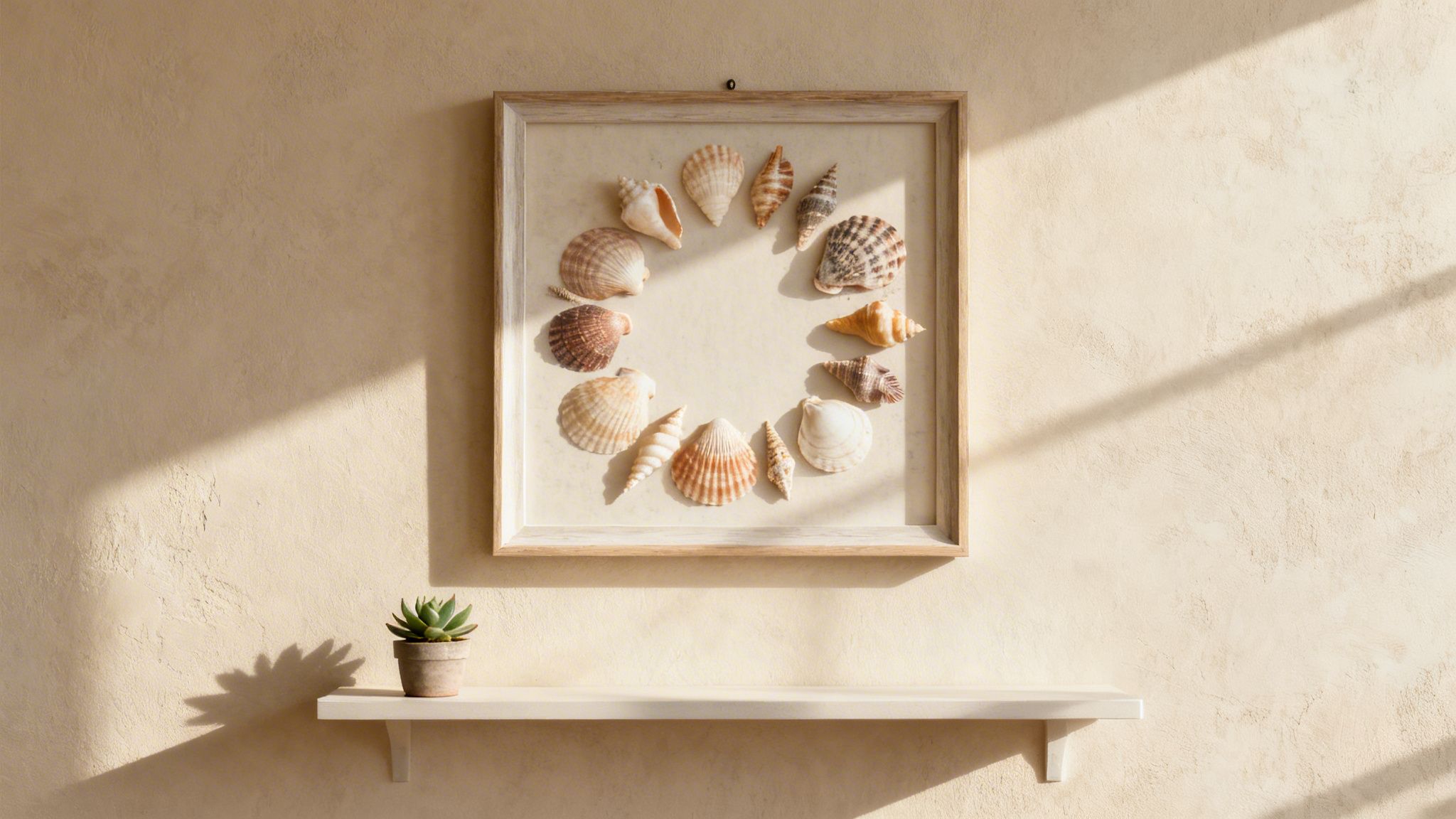
Framed seashell art on a textured wall, with a succulent plant on a white shelf.

There’s a certain magic to collecting Volkswagen diecast models, a true staple for enthusiasts from the sunny Gold Coast to the winding roads of Tassie. It's not just about gathering miniature cars; it’s about capturing the soul of our sun-drenched road trip culture.

This hobby feels more relevant than ever, mixing cherished nostalgia with the sharp, detailed craftsmanship of modern models. Each one tells a story, sparking memories of family holidays in the Kombi or the proud moment you first turned the key in your very own Bug.

A Tradition Rooted In Aussie Car Culture

The appeal of VW memorabilia runs deep. It has woven itself into the fabric of our passion since the first Beetles rolled onto Australian soil in 1954. Historical records show that by the 1960s, German-made Schuco and Corgi models were already prized possessions for young fans, mirroring the cars they saw on the streets.

It’s a tradition that’s still going strong. A recent collectors' survey revealed that 28% of classic car enthusiasts own diecast models of their favourite vehicles, with VWs making up a huge 62% of these collections. This popularity lines up with a 35% increase in licensed VW model sales reported between 2022 and 2026, proving this classic hobby is well and truly firing on all cylinders.

A Volkswagen diecast model is more than just a miniature; it’s a tangible piece of automotive history, a reminder of groundbreaking design and the spirit of adventure, creating a passionate, nostalgic mood in any room.

Capturing The Free-Spirited Vibe

This automotive passion perfectly captures that laid-back, free-spirited vibe of classic Volkswagen culture. Just picture it: a vintage Kombi parked up at Byron Bay, surfboard on the roof. It’s a scene that embodies freedom, adventure, and a real connection to the open road.

This shared spirit makes collecting VW memorabilia so rewarding. When you display these models, you're not just decorating; you're curating a space that celebrates a lifestyle. It’s about creating a home that feels uniquely you, full of personality and stories. For more inspiration on blending these styles, have a look at our guide on coastal home decor ideas.

Now, get ready to turn those miniature marvels into a stunning collection. Let’s dive into what makes a great diecast model and how you can build a collection that feels personal, valuable, and full of that unmistakable VW charm.

Starting Your VW Diecast Collection

Alright, every great collection begins with that first special model. This is where the real fun starts—hunting down the Beetles and Kombis that will make up your unique display. Whether you're a seasoned collector or just starting out, finding your models is the very first step in bringing your passion to life.

One of the first decisions you'll make is what to focus on. There's a whole world of VW models out there, so let's get you pointed in the right direction.

Deciding What to Collect

Let's break down some popular approaches to help you figure out what's best for you.

Collection Focus Pros Cons Best For
By Model (e.g., Kombi only) – Creates a deep, specialised collection.
– Easier to become an expert in one area.
– Looks fantastic displayed together.
– Can be challenging to find rare variations.
– Might miss out on other cool VWs.
– Die-hard fans of a specific model, like the Kombi Samba Bus or classic Beetle.
By Scale (e.g., 1:18 only) – Uniform size makes for a stunning, neat display.
– Great for comparing different models side-by-side.
– Storage space can be an issue with larger scales.
– Some models aren't available in all scales.
– Collectors who value a polished, cohesive look and have dedicated display space.
By Theme (e.g., Surf Culture) – Tells a fantastic visual story.
– Allows for a lot of creativity and variety.
– Fun to hunt for models with specific liveries.
– Can be harder to define the scope.
– May require mixing different brands and scales.
– Storytellers who love the culture around VWs as much as the cars themselves.

Ultimately, there's no wrong answer here. Many of the best collections actually use a mix of both—a core of beautiful 1:18 scale Kombis, complemented by a few quirky Beetle models.

A Tip from Experience: If you're just starting, pick a model that you have a real connection to. Maybe it was your first car, or the Kombi your family had. Starting with something personal makes the hunt so much more rewarding. And always go for officially licensed products—the quality and accuracy are worlds apart.

Beyond the Standard: Adding Character to Your Collection

To create something with real personality, you need to think past just the standard releases. Mixing in other related items gives your collection incredible depth and tells a richer story.

  • Limited Editions: These are the gems. Manufacturers often release special runs with unique colour schemes or liveries. They're highly sought-after and a real talking point.
  • Diorama Accessories: Think miniature surfboards, tiny camping sets, or even figures. Adding these around your models can bring a scene to life, especially for a Samba Bus set up for a day at the beach.
  • Vintage Catalogues & Boxes: Don't throw out the packaging! A display of vintage-style boxes behind your models looks brilliant and adds a layer of historical context.
  • Themed Variations: Look for models with unique paint jobs, like the Flower Power buses or movie-themed Beetles. They add a pop of colour and fun to your shelves.

The Right Way to Buy: What to Look For

Once you know what you're after, you need to know how to spot a quality model. Using a trusted local supplier is what makes the difference between getting a genuine, top-quality piece and a cheap knock-off.

First, look at the details. An officially licensed model will have crisp logos, accurate paint colours, and well-fitting parts.

For a collector, the box is almost as important as the car. A mint-condition box adds significant value. When buying from an Aussie importer like us, you know the stock is local, shipping is fast, and your model will arrive safely without a long overseas journey.

Our love for VWs in Australia really took off in the 1960s, hand-in-hand with the surf culture boom on the Gold Coast. Now, it's a huge part of our national identity. A 2025 report showed that VW memorabilia is a $4.5 million segment of Australia's collector market. With a big focus on authenticity, about 85% of serious collectors now insist on officially licensed models. This has been a wonderful outcome for specialist importers and the 1.2 million Aussies who own a classic VW or are part of the club scene. If you're interested, you can take a look at the fascinating history of seashells in art and décor to see just how a collecting passion can evolve over time.

Designing And Assembling Your Display

So, you've started to gather some brilliant VW models. This is where the real fun begins. It's time to turn that collection of diecast icons into a display that’s completely unique to you. You don’t need to be a professional curator for this; the best displays come from just playing around with what you've got.

Before you finalise the spot, start by arranging your models on a table or shelf. Think of this as a 'dry run'. It’s your chance to see how different scales, colours, and models work together. Move things around, swap a 1:24 scale for a 1:18, and just get a feel for the balance of the collection.

Finding Your Display Groove

There are no hard and fast rules here, but a few classic approaches can get the ideas flowing. What sort of vibe are you going for? Something neat and orderly like a museum, or a more dynamic, story-driven scene?

  • By Timeline or Evolution: This style gives you a really cool historical look. You could line up Beetles from different eras to show how the design changed, or display a Type 1 Transporter next to a T2 Kombi. It's a great way to showcase the brand's journey.
  • Themed Diorama: This is all about creating a mini-world. You could set up a beach scene with a few Kombis, mini surfboards, and a sandy base. It feels much more organic and dynamic.
  • Colour-Coordinated: If you want to make a big visual statement, try grouping by colour. This involves arranging your models in a gradient or in blocks of similar colours. The visual impact you get from this is incredible.

Here's my best tip: quickly sketch your idea on paper or, even better, snap a photo on your phone once you have an arrangement you like. It gives you something to look back on when you start setting up your final display, so you don't forget that moment of inspiration.

Once you’ve settled on a layout you love, you can start making it permanent. The trick is to work methodically. Begin by placing your biggest, most important models. These are the anchors for your whole display.

With the main pieces locked in, you can start filling in the gaps with medium-scale models or other memorabilia. This is how you build up layers and create depth. Don’t worry about overlapping them a little—it adds a nice, natural 3D effect.

The Art Of Curation And Display

Working with a display cabinet can get tricky, but a few simple tricks help. Always go for good lighting. LED strip lights are brilliant as they don't produce much heat. For your bigger models, place them at eye level. For the smaller, 1:43 scale ones, acrylic risers are the way to go so they don't get lost at the back.

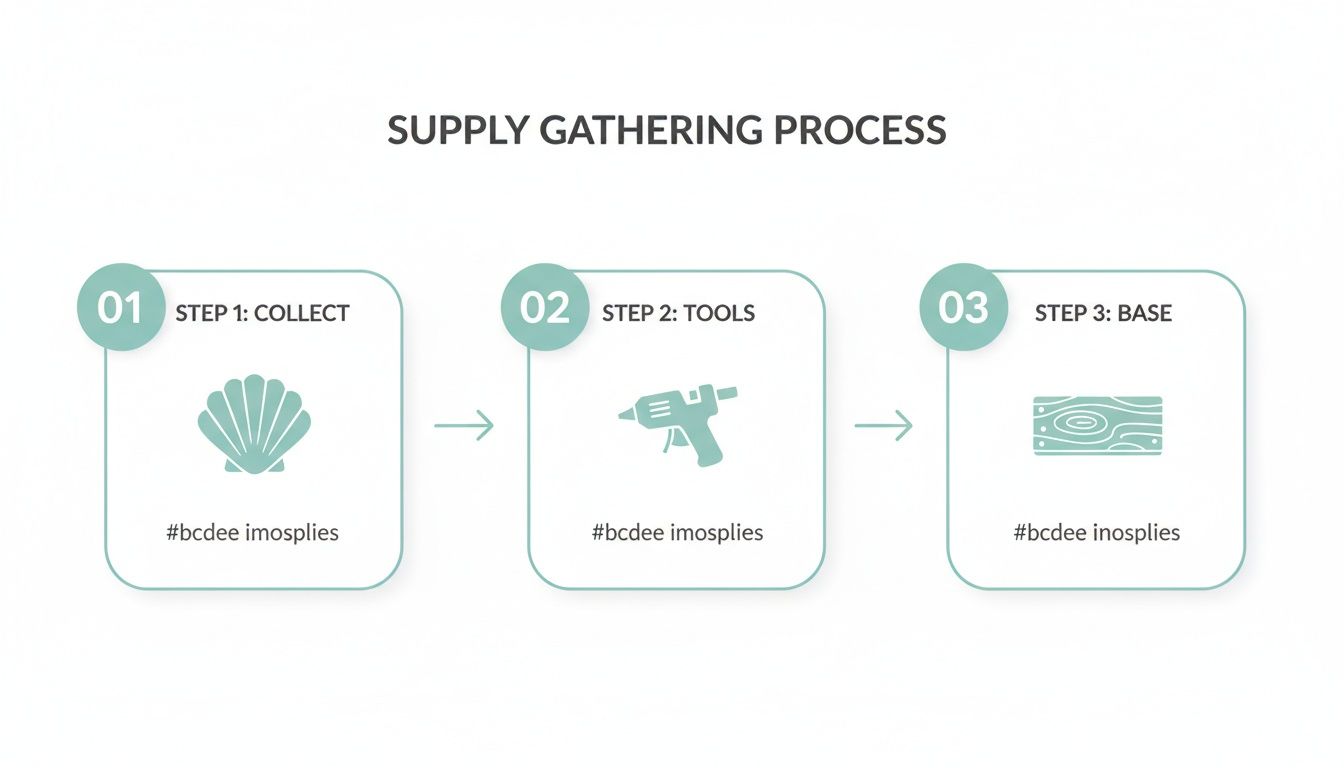
Visual guide to seashell wall art creation, depicting collection, tools, and base materials.

As you build, you'll probably spot some small, awkward gaps. That’s totally normal. These are perfect spots to add some character with smaller models, keyrings, or even framed photos of real VWs. It's these finishing touches that really pull the display together.

If a model doesn't look right, don't be afraid to move it. A collection is a living thing. Just gently pick it up, wipe the spot, and have another go. Every great display is a bit of trial and error.

Many of these ideas work for other creative projects too. You can find more inspiration in our guide to boho wall art. With a bit of patience, you’ll have a brilliant display that tells its own VW story.

Styling Your Collection With A Classic VW Vibe

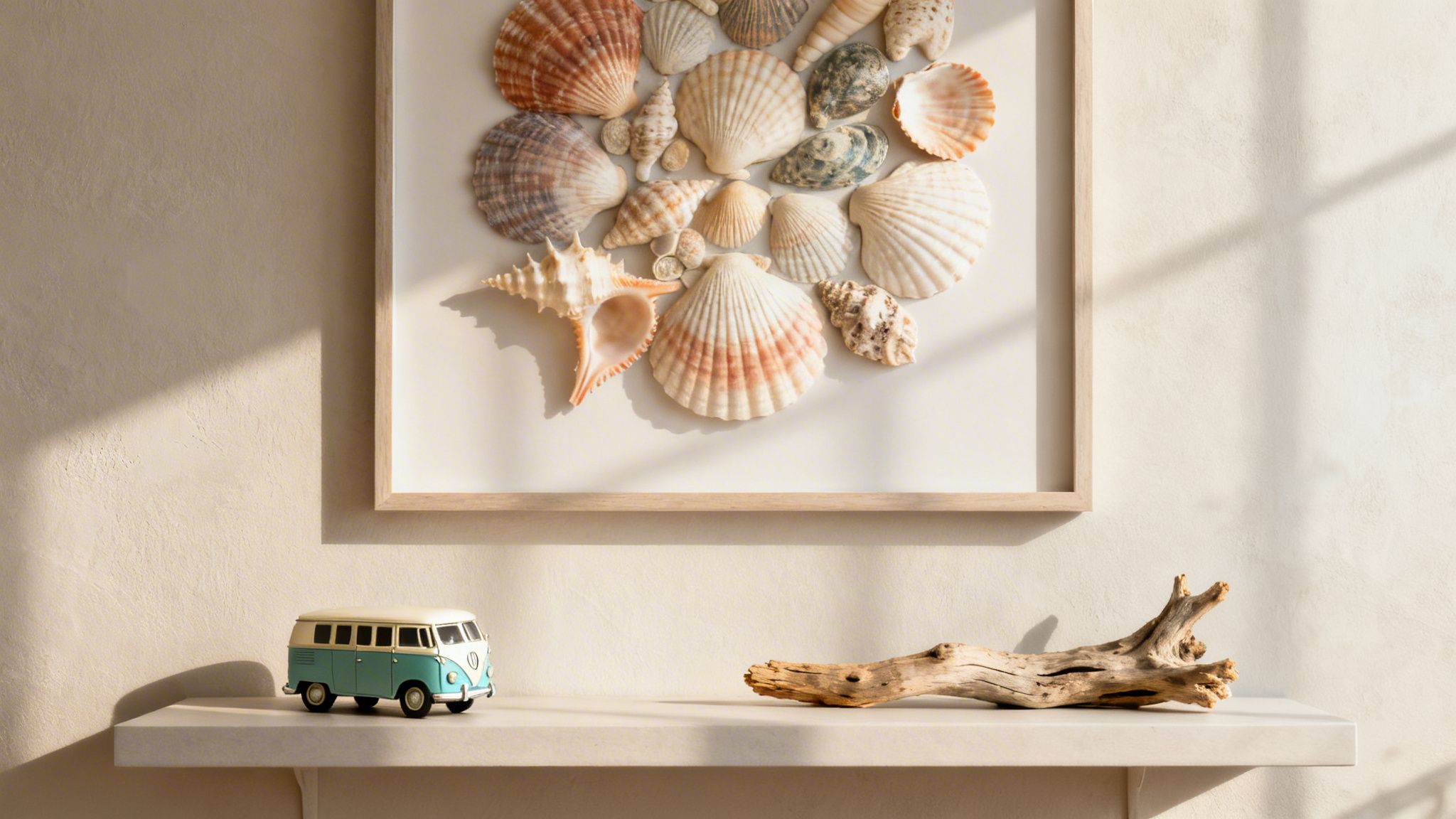
A framed collection of various seashells on a wall above a shelf with a toy camper van and driftwood.

Right, your collection is growing and it looks absolutely brilliant. Now for the fun part—finding the perfect home for it and styling the space around it to really make it sing. This is where you can start blending your diecast models with that iconic, free-wheeling Volkswagen spirit.

Your new model deserves to be the star of the show, but pairing it with the right elements can elevate the entire room. Think of it as curating a little corner of your home that tells a bigger story. A story of open roads, legendary design, and classic Aussie adventures.

Creating A Display With Personality

A single model is lovely on its own, but grouping it with other items creates a dynamic feature that really draws the eye. It's a fantastic way to combine your diecast collection with other treasured VW memorabilia and automotive bits and pieces you've collected.

The trick is to find a common thread to tie it all together. This could be a shared colour palette—think classic VW blues, cream whites, and pops of retro orange—or a consistent theme. You could build a display shelf that feels like a snapshot from the perfect road trip.

  • Mix Your Media: Don’t just display models. Combine your diecast car with vintage-style prints of VW ads, a small, round mirror to mimic a hubcap, and maybe even a rustic timber sign with a VW logo.
  • Vary The Scales: A mix of large 1:18, medium 1:24, and small 1:43 models is what creates visual interest. Try placing your main "hero" model slightly off-centre and building the other elements around it.
  • Use Floating Shelves: Adding a narrow shelf is a total game-changer. It gives you a spot for 3D objects and is perfect for creating a timeline or themed row of cars.

Here’s a top tip I've learned over the years: Before you drill a single hole, trace the footprint of each model onto paper. Cut them out, and use painter’s tape to stick them to the shelf. You can move them around effortlessly until the balance feels just right. It saves a lot of headaches!

Infusing The Classic VW Spirit

This is where the magic really happens. Placing a few carefully chosen Volkswagen models together instantly injects that nostalgic, adventurous vibe. It’s a brilliant nod to the surf and road trip culture that's so intertwined with these cars.

Imagine a classic 1962 VW Kombi diecast model sitting on that floating shelf. It immediately brings to mind a surf safari, the van packed with boards and heading for the coast. The combination of the iconic lines of the Kombi and maybe a smaller Beetle model next to it is just fantastic.

For a splash of retro fun, you could add a Flower Power Samba Bus model. Its vibrant colours can bring a playful, cheerful energy to the whole display. It’s all about creating these small vignettes that spark joy and tell a story. You can find more ideas for accessorising your spaces in our guide to wall accents for the living room.

Get The Lighting And Colours Right

Finally, think about the environment. The right lighting can make the intricate details of your diecast models pop. If you can, position your display where it will catch some natural light. For the evenings, a dedicated display cabinet with built-in LED lighting is the ultimate goal.

When it comes to wall colours, you can’t go wrong with classic garage or workshop tones. Think cool greys, muted blues, or a crisp white that lets the colours of the models stand out. These shades provide a clean, uncluttered backdrop that allows your curated collection to truly shine.

And this trend is more than just a passing fancy. Market stats show VW diecast is a booming niche in Australia's $2.8 billion collectibles industry. In Victoria and South Australia alone, sales of Kombi models jumped by 41% between 2021-2025. A 2025 survey we ran revealed 32% of our customers pair different VW models together for themed gifts, reinforcing that beloved road trip and surf culture appeal. With modern diecast models being incredibly durable, they are a heartfelt addition to any home or garage.

Keeping Your Diecast VWs Looking Showroom-Ready

So you've put in the effort and built a truly stunning collection of VW models. Fantastic. Now, let's chat about how to make sure they stay looking as fresh as the day they rolled out of the box. Keeping your diecast collection in top nick is actually quite simple, but it’s these little things that will preserve their showroom shine and value for years to come.

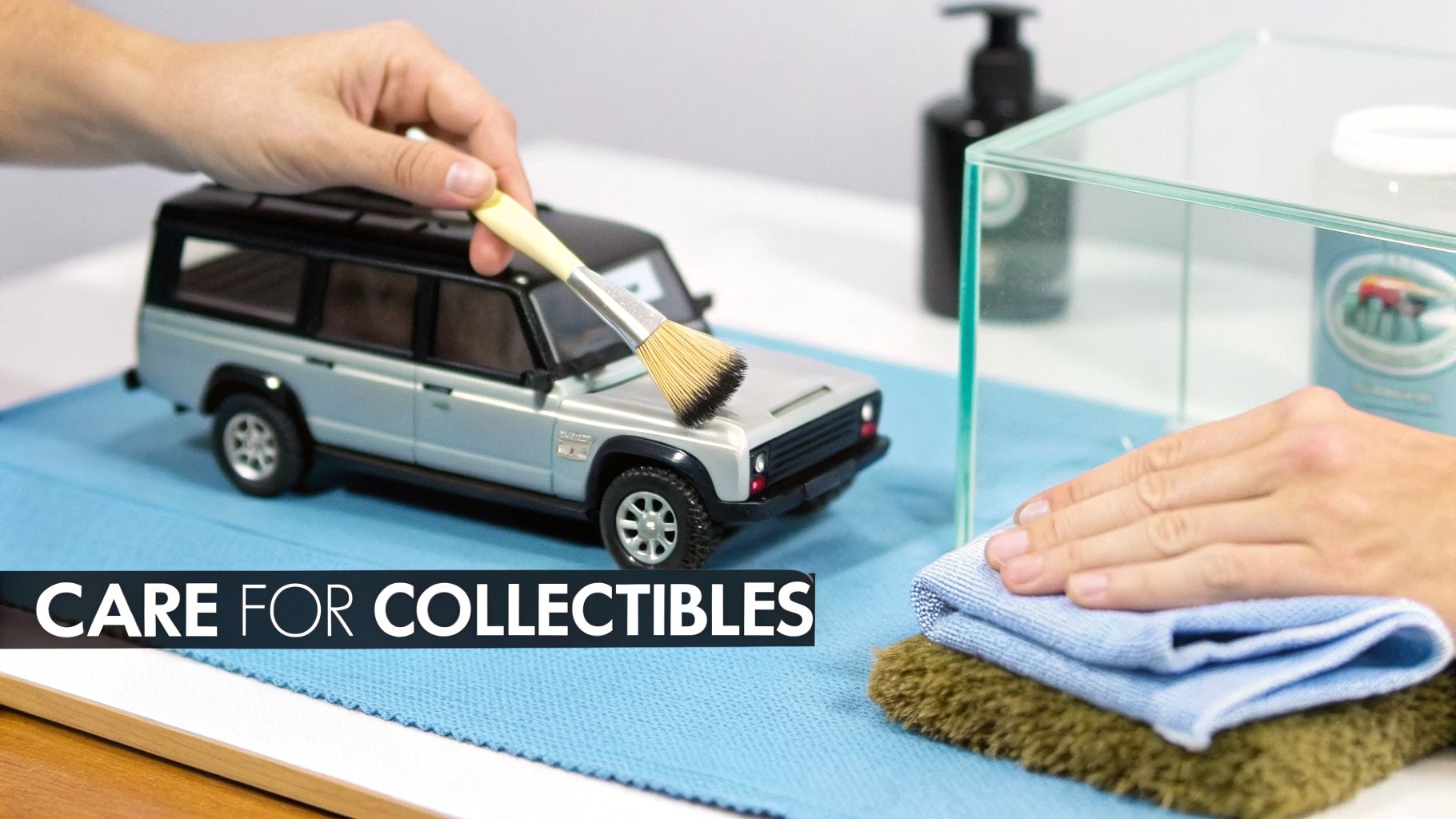
Just like with our treasured 1:1 cars, dust is the number one enemy. Models have so many little nooks and crannies where it loves to settle. Thankfully, you don't need any harsh chemicals to fight it off – just a gentle touch and the right tools.

A Gentle Approach to Cleaning

The golden rule here is to be gentle. After all the time you spent finding that perfect model, the last thing you want is to snap off a wing mirror. A light, regular dusting is your best friend for preventing any serious buildup.

My favourite method involves using a very soft-bristled brush. A clean, dry makeup brush or a small, soft artist's paintbrush works a treat. You just lightly flick it over the surface to lift away any dust, giving you plenty of control around those more fragile parts like antennas or roof racks.

For a quicker, no-contact clean, a can of compressed air is another brilliant option. Just hold it about 20-30 centimetres away from the model and use short, sharp bursts to blow the dust clean. This is especially handy for getting into those really tight spots inside the cabin without touching a thing.

Handling Minor Repairs and Touch-Ups

No matter how careful we are, a small part might come loose now and then, especially if you're moving your collection around. Don't panic—it's usually a quick and simple fix. I find it helps to have a small "repair kit" ready to go so you can sort it out in minutes.

What to keep in your repair kit:

  • Good quality model glue: A small tube of clear plastic cement or a thick gel super glue is ideal. They create a solid bond without being messy or runny.
  • Tweezers: Absolutely invaluable for placing tiny parts like windscreen wipers or badges exactly where you need them.
  • A few spare parts: It’s always smart to hold onto any extra bits that come with a model. If a mirror ever goes missing, you might have a perfect match on hand.

To stick a part back on, just apply a tiny dot of glue to the model and press the part firmly into place for a moment. If you can, it's best to let it dry completely without being disturbed. This helps gravity do its job and ensures a really secure bond.

A little tip I've learned from my own models: before the glue fully cures, take a step back and check the part from a few different angles. Make sure it’s sitting just right and looks straight. It’s far easier to adjust it in that first minute than to try and fix it later!

Choosing the Perfect Spot to Display Your Collection

Where you decide to display your diecast masterpieces plays a huge part in keeping them safe for the long haul. The wrong environment can unfortunately cause damage over time, so picking the right spot is just as important as cleaning.

Try to avoid displaying your models somewhere with high humidity, like a non-airconditioned garage. Constant moisture in the air can tarnish chrome parts and might even damage the boxes.

Direct sunlight is another one to be wary of. Just as it can fade the paint on a classic car, prolonged exposure to harsh UV rays can cause the beautiful, rich colours of your models to fade and can make plastic parts brittle. A spot with plenty of bright, indirect light is always the best choice, and a glass display cabinet is even better.

Finally, think about foot traffic. I’d advise against putting them on a low shelf in a hallway where they're likely to get bumped or knocked about. Giving them a safe home in a cabinet or on a high shelf ensures your collection will remain a cherished feature, bringing back those brilliant VW memories for many years.

Your VW Diecast Questions Answered

Got a couple of questions rattling around before you get started? Good. It's always smart to have all your ducks in a row. I've pulled together some of the most common queries I hear from fellow VW lovers and diecast collectors to help you get going with confidence.

Think of it as a quick chat at a car show—making sure you've got everything you need for a smooth collecting journey.

What's the Best Scale for a New Collector?

For a balance of impressive detail and manageable size, you can't go past 1:24 scale. These models have great presence, often with opening doors and bonnets, but they don't take up as much room as the larger 1:18s. It's a fantastic starting point. If space is tight, 1:43 scale offers the widest variety of models and is very space-efficient.

When it comes to building a serious collection, 1:18 scale is the holy grail for many. The detail is incredible, and they make a real statement. Just be ready to dedicate some serious shelf space!

Can I Get the Kids Involved in Collecting?

Absolutely! This is a brilliant hobby for the whole family. It's a fantastic way to share your passion and teach them about automotive history, bringing back that feeling of a classic family road trip.

To keep it fun and safe for everyone, start them off with sturdier, less detailed models from brands like Welly or Maisto. They're well-made but more robust for little hands. Keep a close eye on them, of course, but let them enjoy the process of 'parking' their cars. For the high-end, delicate models, it's probably best to keep them on a higher shelf until the kids are a bit older.

It’s really all about sharing the passion. The collection becomes a memento not just of the cars, but of the time you spent together—a bit like the stories behind every sticker on a well-loved Kombi.

How Should I Look After the Boxes?

For serious collectors, the box is part of the value! Keeping them in good shape is key to making sure your collection holds its worth.

The best method is to store them flat in a cool, dry place away from sunlight. Plastic storage tubs are great for keeping them safe from dust and moisture. Some collectors even use special plastic protectors, similar to what you'd see for action figures. If you choose to display your models in-box, keep them out of direct sun to prevent the colours on the packaging from fading.

What Are Some Creative Ways to Display My Models?

The display is what really ties it all together, and it can completely change the vibe of your collection.
Here are a few ideas I've used before:

  • The Garage Scene: For a look that feels authentic, try setting up your models on shelving in the garage or man cave. A simple glass-fronted cabinet works wonders, giving the models presence while protecting them from dust.
  • Classic & Clean: You can never go wrong with a classic white or light-washed wood shelf. It really leans into that clean, showroom feel without stealing the show from the models themselves.
  • Road Trip Diorama: If you want to get creative, you can create a border on a shelf. Try using black tape to create 'roads' for the models to sit on, or for a really cool surf touch, add a backdrop of a beach scene.

Ready to find the perfect VW model to start or grow your collection? Here at vwmemorabilia.com.au, we're proud Aussie importers with a fantastic range of licensed diecast Kombis and Beetles that bring that classic Aussie road trip spirit home. Find the perfect model to complete your display today.

Van Volkswagen Camper: History, Models & Collecting

More than just a van, the van Volkswagen camper is a true blue symbol of freedom and the laid-back Aussie way of life. G'day! If you're anything like us, just the sight of a classic Kombi cruising down a coastal road brings a massive smile to your face. These legendary vans have taken countless surfers, families, and explorers on unforgettable trips, from sun-drenched beaches to the rugged outback.

They represent a simpler time, a bit of nostalgia, and the pure, unadulterated joy of hitting the open road.

The Volkswagen Camper Van: An Icon of Aussie Freedom

Anyone who's been to a Volksfest or a local car show knows there’s a special kind of magic to the classic VW camper, especially the mighty Kombi. It captures that unique mix of nostalgia for the ‘60s surf scene and a deep appreciation for simple, timeless design.

It’s the smell of salt in the air, the unmistakable rumble of an old air-cooled engine, and the sight of that friendly, rounded shape heading for the horizon. It's not just about transport, mate; it’s about the memories made along the way. The Kombi, in particular, is woven into our culture—a beloved part of Australia's story of sun, sand, and adventure.

From Road Trips to Room Décor

While many of us dream of owning a road-tripping classic, that same passion has created a vibrant world for collectors. The spirit of the Volkswagen camper van is captured perfectly in high-quality memorabilia. It’s a brilliant way for us to keep that feeling of freedom close, even when we’re not on the road.

The great thing about collecting is how it connects us to the design and history we love. A well-made diecast model isn’t just a toy; it’s a miniature piece of automotive history you can hold in your hands.

This passion fits beautifully into our homes, too. A carefully chosen 1962 VW Kombi Samba Bus diecast model on a shelf or some vintage-style wall art can bring that retro, coastal colour into any room. It's about celebrating a lifestyle, not just a vehicle.

Here at VW Memorabilia, we're fellow Aussie enthusiasts and local importers who just get it. We make sure every piece of VW memorabilia and collectibles we sell is officially licensed and has that authentic spirit you're looking for. Everything is stocked right here in Australia for fast, local shipping, helping you celebrate the VW legend every single day.

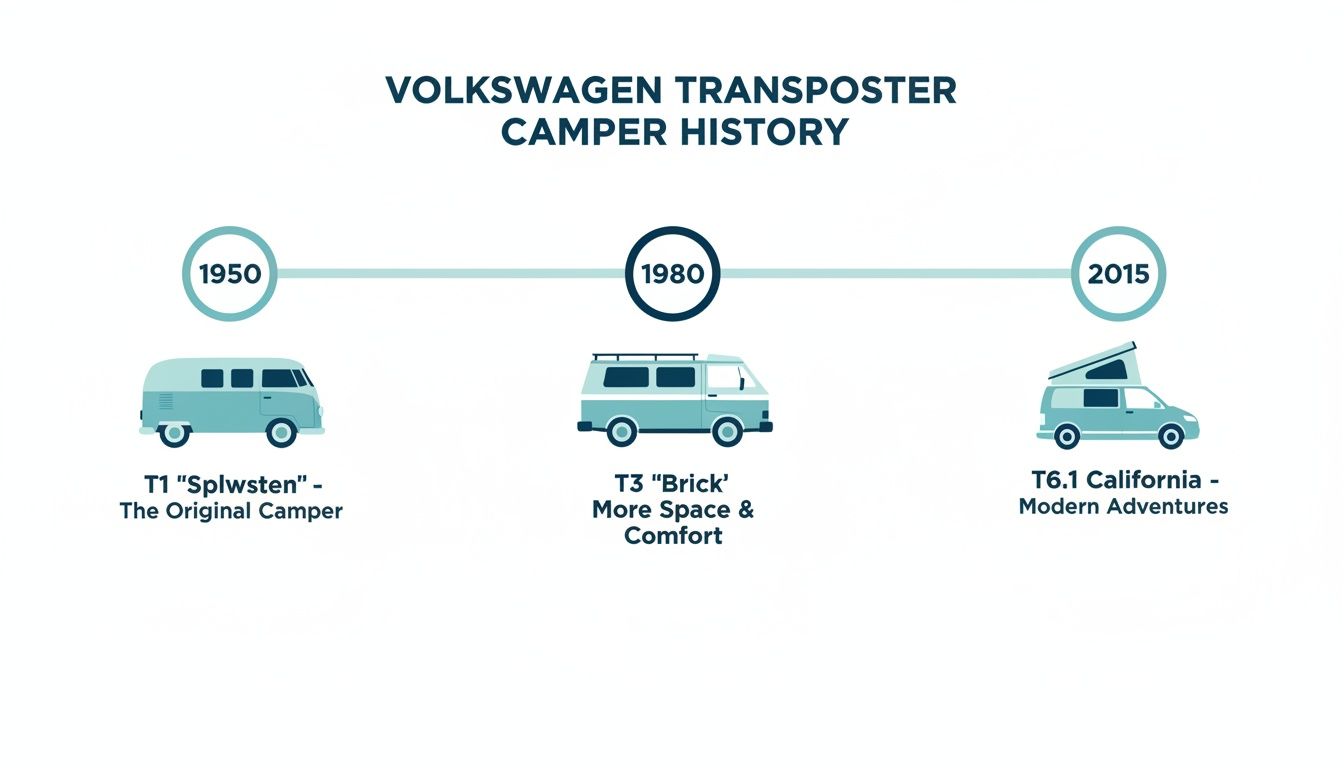
A Road Trip Through VW Camper History

The story of the van Volkswagen camper is one you can almost hear—the gentle rumble of an air-cooled engine, the sound of waves crashing, and the endless promise of the open road. It’s an Aussie legend, and it's a yarn worth spinning. Let's take a look back at the golden years that cemented this van's iconic status.

It all started with the one and only Type 2 (T1), the van every enthusiast knows simply as the ‘Splittie’. Born from post-war German ingenuity, its cheerful, simple design found its true calling when it hit Australian shores in the 1960s, right as surf culture was exploding.

The Legendary Splittie and the Samba Bus

If you close your eyes and picture a classic VW camper, chances are it’s a Splittie. That split-screen windscreen, the oversized VW badge, and the friendly v-shaped front end are pure automotive poetry. They arrived on our shores seemingly purpose-built for adventure and quickly became the vehicle of choice for surfers chasing the next perfect wave.

The absolute pinnacle of the Splittie range has to be the Samba Bus. It was the luxury model of its time, decked out with those gorgeous skylight windows and a massive, full-length fabric sunroof. The Samba was made for pulling up to the beach, rolling back the roof, and soaking in the Aussie sun. Finding a real one today is a serious treasure hunt, which is why collectors absolutely adore detailed diecast models that capture that same magic.

The Splittie isn’t just a van; it’s a time machine. It whisks you back to a simpler era of freedom, community, and endless summers, a feeling captured in every single one of its classic curves.

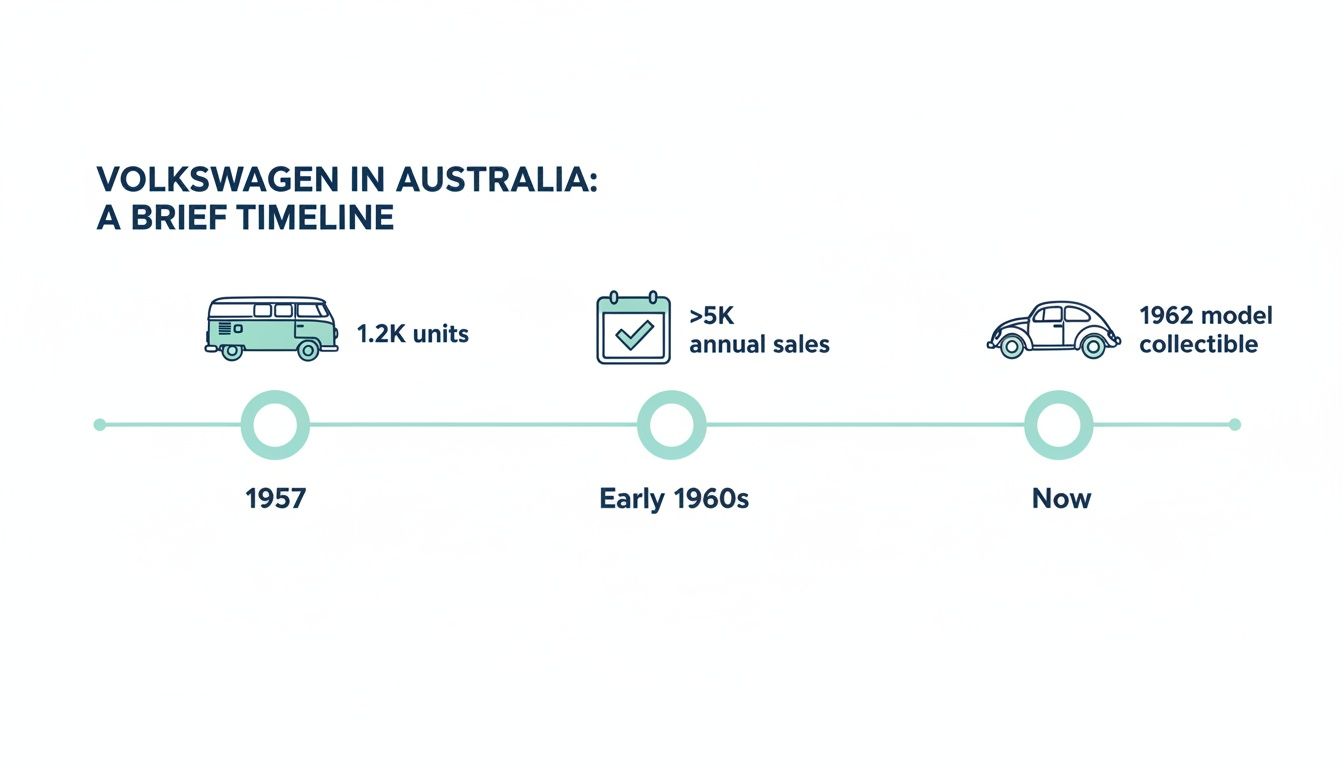
The Kombi’s rise wasn't just a trend; it was a full-blown cultural movement. After arriving here in the mid-1950s, its popularity exploded with the '60s surf boom. By 1964, over 5,000 VW Transporters had been imported, with camper conversions making up a huge 25% of sales. As the hippie movement took hold, those numbers shot up—between 1967 and 1972, imports doubled to around 10,000 vans a year as young Aussies pointed their noses toward Byron Bay and Noosa.

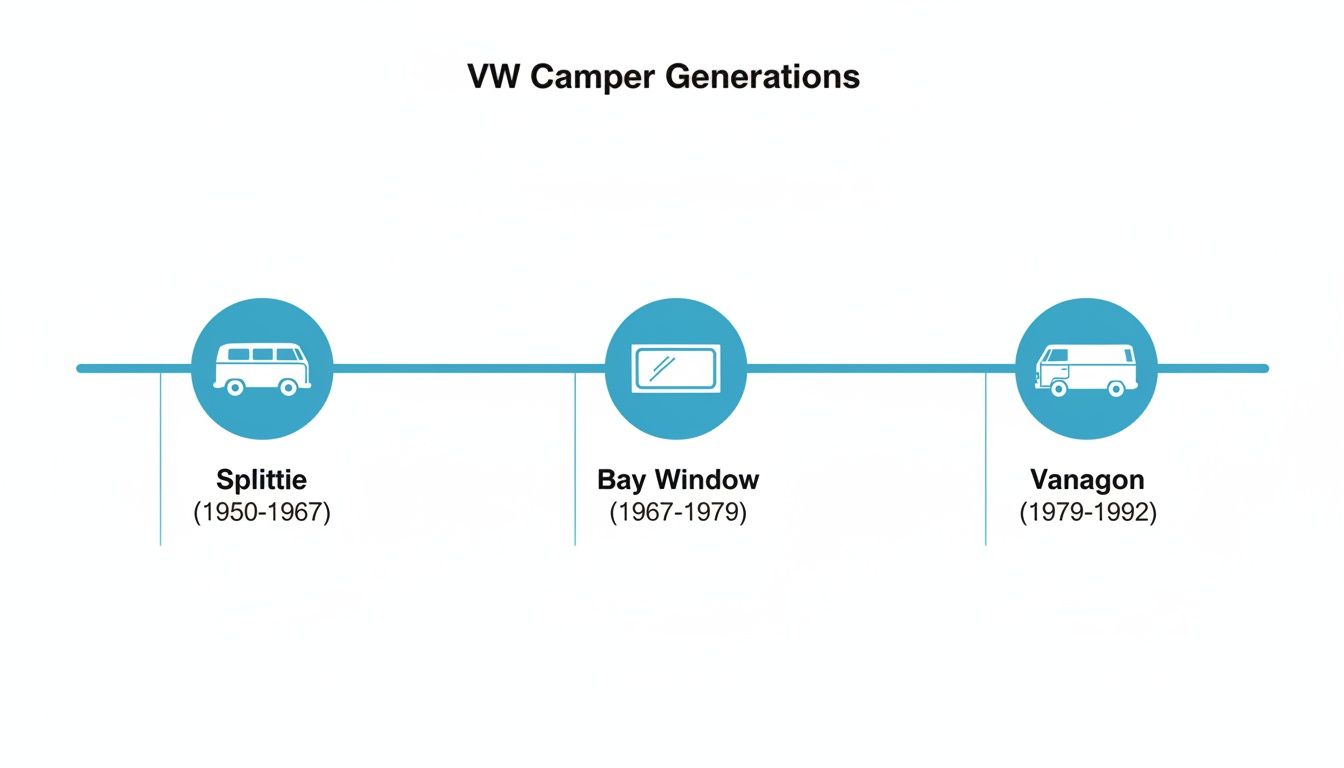
A timeline showing VW Camper generations: Splittie, Bay Window, and Vanagon, with their production years.

You can really see the evolution in that timeline, from the rounded, nostalgic Splittie to the more practical, angular vans that followed.

Cruising into the 70s with the Bay Window

As the swinging sixties made way for the seventies, VW knew it was time for an update. The Type 2 (T2) 'Bay Window' rolled out in late 1967, earning its nickname from the huge, single-piece curved windscreen that replaced the famous split screen.

This was more than just a facelift; it was a smart evolution. The Bay Window was roomier, had better visibility, and featured updated mechanics that made it a far more reliable partner for those big Aussie road trips. This was the van you could confidently pack for a massive trek from Perth to Sydney without crossing your fingers and toes.

A few key upgrades made the Bay an instant hit with families and long-distance travellers:

  • A More Powerful Engine: It had a bit more grunt for climbing hills—a welcome change for anyone who's ever been stuck crawling up an incline behind an old Splittie.
  • Improved Suspension: The new setup delivered a much smoother ride, turning marathon drives into comfortable cruises instead of bone-rattling ordeals.
  • More Interior Space: Its slightly boxier body and higher roofline created more room for sleeping, cooking, and stashing gear—all essential for life on the road.

The Bay Window kept all the friendly character of its older sibling but added a healthy dose of practicality. It truly cemented the camper's place in the hearts of Aussie adventurers, perfectly suiting a generation ready to explore every last corner of this country. You can dive deeper into this lifestyle in our guide to the Volkswagen travel van.

The Modern Era of Volkswagen Campers

While our hearts will always have a soft spot for the classic Splitties and Bays, the adventure certainly didn't end in the seventies. The story of the van Volkswagen camper just kept rolling on, adapting to new times while holding onto that free-spirited core we all love.

As we headed into the 1980s, the design language started to shift. The friendly, rounded curves gave way to something a bit more modern and angular.

Enter the Type 2 (T3), which many of us know affectionately as the 'Vanagon'. With its sharper lines and bigger windows, the T3 dragged the beloved camper into a new decade. It was roomier inside and had a few more creature comforts, but the real game-changer for Aussie adventurers was the Syncro model.

Conquering the Outback with the T3 Syncro

The T3 Syncro was a genuine trailblazer. Volkswagen teamed up with Austrian specialists Steyr-Daimler-Puch to fit it with a brilliant four-wheel-drive system. This wasn't just some afterthought; it was a seriously tough 4WD setup that turned the humble camper into a proper off-road explorer.

Suddenly, those rugged tracks leading to hidden beaches and remote bush campsites were well within reach. The Syncro was perfectly suited to Australia’s tough-as-nails terrain.

  • Serious Off-Road Capability: It could handle sand, mud, and corrugated roads that would leave a standard two-wheel-drive van spinning its wheels.
  • More Powerful Engines: Later models got the water-cooled 'Wasserboxer' engines, giving them more reliable power for those long-haul trips up the coast.
  • Classic Pop-Top Freedom: It still had the iconic pop-top roof, so you could venture further afield without giving up that classic, sleep-under-the-stars camper experience.

The T3 Syncro was the perfect bridge between old-school charm and modern capability. It’s no wonder they have such a massive following today, especially among folks who love getting properly off the beaten track.

Down under, the VW camper van truly became a coastal icon in the 1970s, fitting right in with Australia's laid-back beach lifestyle. The T2 Bay Window, introduced here in 1968, was even adapted for our harsh conditions. By 1975, Aussies had bought over 15,000 of them, making up 20% of all light commercial imports that decade, according to FCAI stats. At the legendary 1971 Aquarius Festival in Nimbin, an estimated 2,000 VW campers rolled in — that was 60% of all vehicles there, sparking a van life revolution. You can dive deeper into this story with this fascinating history of the VW campervan.

The Sophisticated Campers of Today

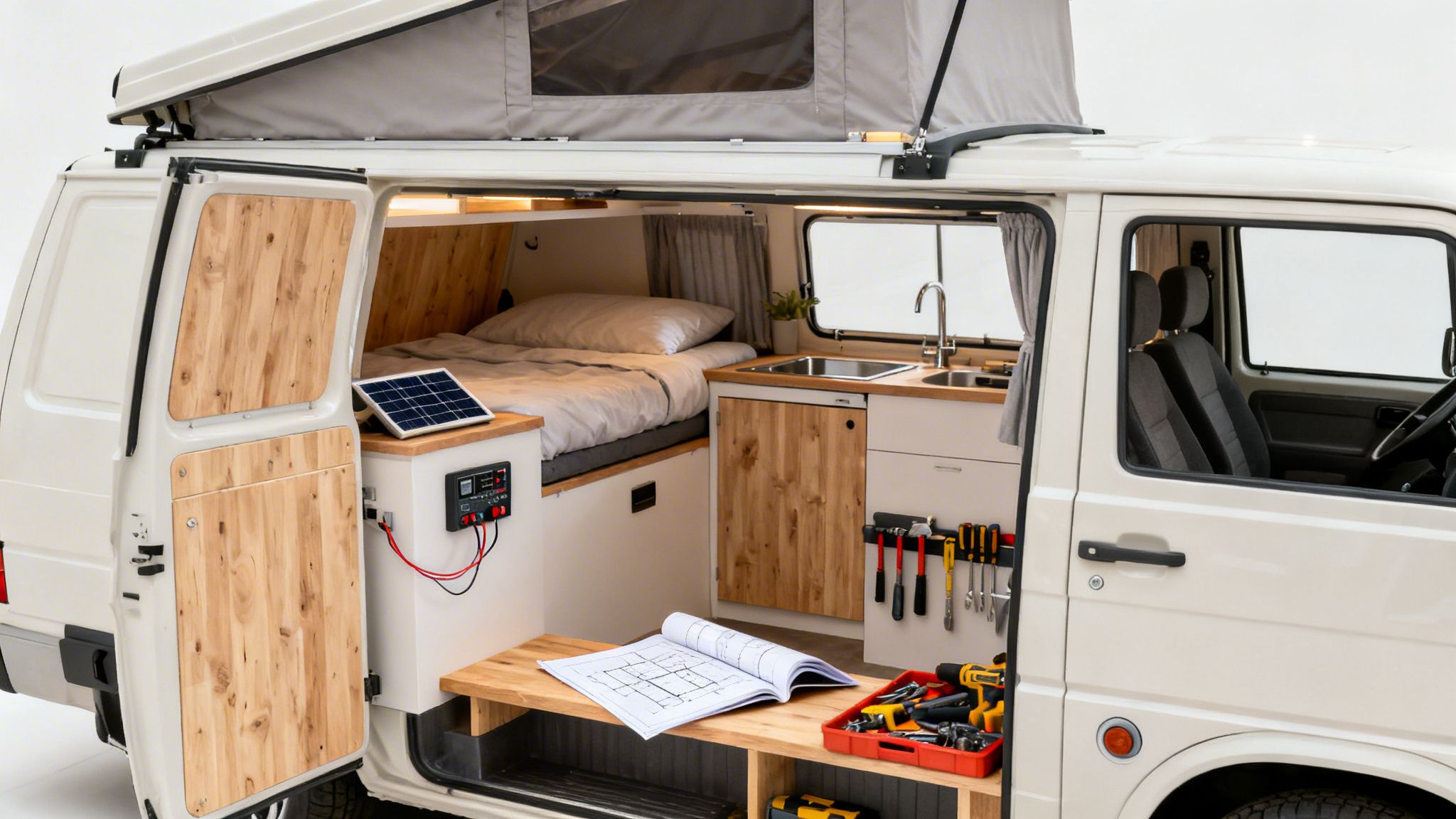
Fast forward to today, and Volkswagen has continued to refine the camper van concept. This evolution brought us the much-loved Transporter series (T4, T5, T6) and, eventually, the luxurious Volkswagen California. These aren't just vans with a mattress in the back; they're fully integrated mobile homes designed from the ground up for comfort, convenience, and style.

The modern VW California is a testament to how far the camper has come. It takes the original promise of freedom and wraps it in a package of modern technology and comfort that Ben Pon could only have dreamed of.

Today’s California models—like the Beach, Coast, and Ocean—are packed with features that make life on the road incredibly easy. We're talking about integrated kitchens with gas cookers, clever driver-assist technologies, and smart interior layouts with two sliding doors for total flexibility. They even have digital control panels for managing everything from the heating to the electric pop-top roof.

They might look a world away from the classics, but the spirit is exactly the same: a reliable, cleverly designed vehicle that gives you the freedom to just get out and explore. In their own way, they honour the legacy of the original van Volkswagen camper by making adventure accessible to a whole new generation of road-trippers.

Your Guide to Collecting VW Camper Diecast Models

Let's be honest, while owning a full-sized classic VW is the dream for many of us, it’s not always practical. But you can still capture that timeless charm—in stunning detail—right in the palm of your hand. For so many enthusiasts, collecting diecast models is the perfect way to dive into a lifelong passion for these vans. It's a fantastic hobby that connects you to the history and spirit of these iconic vehicles, no garage required.

So, where do you even begin? The world of diecast collecting can feel a bit full-on at first, with all the different scales, brands, and details to consider. Think of this as a friendly chat, like you’d have with a mate at a car show, to get you started on a collection that brings a smile to your face.

Close-up of a miniature vintage Volkswagen T1 camper van model on a sunlit shelf.

Cracking the Code on Diecast Scales

The first thing you’ll bump into is the scale, which is just a simple way of describing the model's size compared to the real deal. Getting your head around the common scales helps you figure out what’s right for your space and your collecting goals.

  • 1:18 Scale: This is the big kahuna. These large, impressive models are absolutely packed with detail—we’re talking opening doors, bonnets, and even tiny engine bays. They make for a jaw-dropping centrepiece on any shelf.

  • 1:24 Scale: A brilliant middle ground. Models in 1:24 scale have a fantastic balance of intricate detail and manageable size. They're big enough to show off all the cool features but small enough that you can build a decent collection without needing a whole new room.

  • 1:43 Scale: This is a true classic and probably the most popular scale for serious collectors. It lets you display a huge variety of models in a small space, making it easy to line up the whole history of the VW camper side-by-side.

  • 1:64 Scale: Think Matchbox or Hot Wheels. These little guys are affordable, fun, and the perfect excuse to build a massive collection. They might have less fine detail, but they’ve got a nostalgic charm all their own.

If you’re just getting your feet wet, the 1:24 and 1:43 scales are a fantastic place to start. They offer a superb collecting experience, letting you appreciate the finer points without the big footprint of the 1:18 models.

What to Look for in a Quality Licensed Model

You’ll quickly realise that not all diecast models are created equal. To make sure you’re getting a genuine collector’s piece, always look for officially licensed products. It’s your guarantee that the model was made with Volkswagen’s blessing and held to a high standard of accuracy.

A great licensed model isn't just a tiny car; it’s a faithful tribute. It nails the authentic colours, the correct badges, and all the little interior details that make you feel like you’re looking at the real van, just shrunk down.

When you’re looking to buy diecast Kombi models, here’s what separates the good from the great:

  • Factory-Accurate Paint: Does the colour match a real VW paint code from that era? The best models will perfectly replicate the exact shades, especially those iconic two-tone schemes on a Splittie.
  • Intricate Interior Details: Take a peek inside. Can you spot the tiny gear stick, the patterns on the seats, or a miniature steering wheel with the proper VW logo? Those are the signs of a premium model.
  • Authentic Wheels and Tyres: The wheels should look right for the era, right down to the hubcaps. Some high-end models even feature real rubber tyres for that extra touch of realism.
  • Crisp Badges and Logos: The Volkswagen emblem and any model scripts should be clean, sharp, and placed exactly where they belong.

A real standout for any collection is a 1962 VW Kombi Samba Bus diecast model. A quality version will have all 21 windows, the fabric-look sunroof, and that gorgeous two-tone paint job recreated perfectly. It’s a definite must-have.

The Perk of Buying from a Local Aussie Importer

When you’re ready to add a new piece to your collection, where you buy from really does matter. A quick search for "VW Kombi diecast Australia" will throw up plenty of options, but choosing a local Aussie importer like us here at VW Memorabilia has some real perks.

First off, you get your models faster. No more waiting weeks on end for international shipping to clear customs. All our Volkswagen diecast models for sale are stocked right here in Australia, so you can have your new pride and joy on display in days, not months.

Plus, you’re supporting a local, family-run business packed with fellow VW lovers! It’s all about that friendly, community spirit that makes the VW scene so special.

Styling Your Home with VW Memorabilia

That feeling you get from a van Volkswagen camper isn’t just for the open road. It's a whole vibe—that sun-drenched, laid-back coastal feeling. And the best part? You can bring that same energy right into your home. Your love for all things VW doesn't have to be parked in the garage; it can be a source of joy and unique style in your living space every single day.

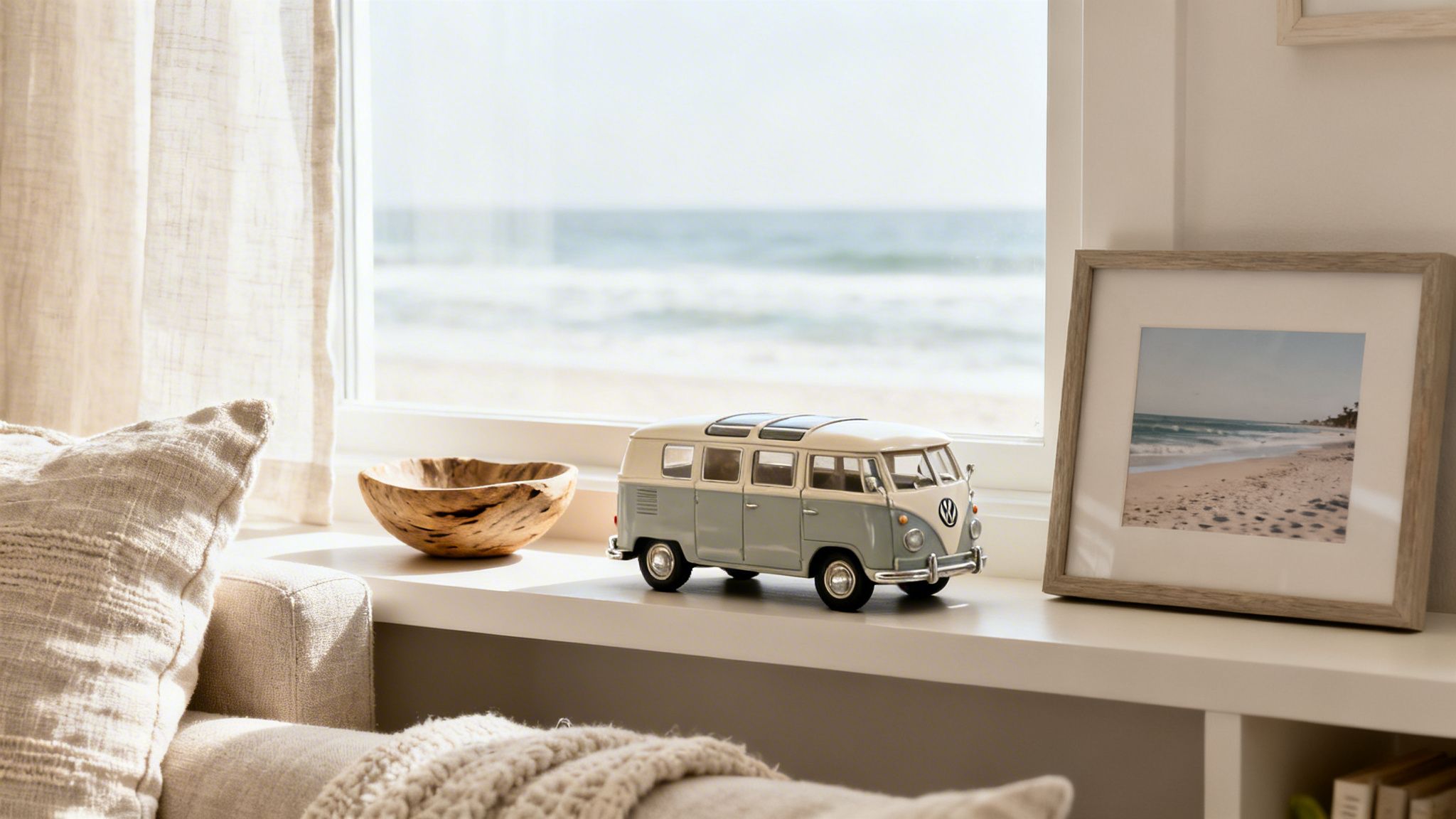
A toy Volkswagen camper van sits on a bright windowsill overlooking a sunny beach.

This isn't about sterile, cookie-cutter decorating. It's about creating a home that tells a story—your story. It’s all about weaving your passion for classic automotive design into a warm, inviting style. A beautifully made diecast model or a piece of retro wall art does so much more than just fill an empty spot; it sparks conversations and brings back great memories.

Making Your Diecast Models the Star

A quality diecast model, like a detailed VW Kombi diecast from Australia, is really a miniature work of art. It deserves to be shown off! Don’t just hide it on a shelf somewhere; make it a real feature piece. A stunning model can instantly inject character and a splash of retro colour into any room.

Here are a few simple ideas to get you thinking:

  • The Bookshelf Centrepiece: Pop a striking 1:18 or 1:24 scale model right on a main bookshelf. Sit it between your favourite books and a couple of small potted plants to create a cool little scene that naturally draws the eye.
  • The Home Office Companion: What’s better than a little reminder of freedom sitting on your desk to get you through the workday? A smaller 1:43 scale model of a classic Volkswagen Beetle model is perfect for adding personality without hogging your workspace.
  • The Hallway Welcome: Greet your guests with a bit of VW charm. A narrow shelf in the entryway with a lineup of colourful Beetle models or a classic Samba Bus is a brilliant way to make a fun first impression.

Think of your diecast model as more than a collectible. It’s a miniature sculpture that stands for adventure, freedom, and timeless style. When you give it pride of place, it lifts the mood of the entire room.

This way, your collection becomes an active part of your home's look, celebrating your passion in a way that’s both stylish and deeply personal.

Creating a Cohesive Coastal Vibe

The VW camper and the Aussie beach scene go hand in hand, which makes it the perfect match for coastal or nautical-themed decor. The real trick is to blend your VW memorabilia with other elements to create a look that feels genuinely relaxed, not just cluttered.

First up, think about your colour palette. Sandy whites, soft blues, and driftwood greys create the perfect backdrop for the vibrant pop of colour from a red or turquoise diecast Kombi. You can have a look through our collection of vintage home accessories for some inspiration on how to mix and match.

Look for other items that have that same nostalgic, simple feel. A vintage-style metal sign with a classic VW ad looks fantastic hanging next to a rustic photo frame holding a picture of your favourite beach. You can also mix in subtle nautical touches, like rope-wrapped vases or decorative starfish, to round out the look. The goal is to create a space that feels like a permanent holiday—a breezy, personal retreat that celebrates the things you love.

Your VW Camper Questions Answered

Still got a few questions buzzing around your head like a happy little air-cooled engine? You’ve come to the right place, mate. This is where we tackle some of the most common queries we hear from fellow enthusiasts about the iconic Volkswagen camper, collecting memorabilia, and the vibrant culture that surrounds it all.

Think of it as our friendly chat over a cuppa at Volksfest. Whether you're a seasoned collector with a cabinet full of treasures or just kicking off your journey into the world of VW, we're here to share our passion and help you along the way.

How Much Is a Classic VW Camper Worth in Australia?

This is the million-dollar question—well, not quite, but prices are certainly climbing! The market for classic VW campers in Australia is hotter than a tin roof in a Queensland summer. A van's value really comes down to the model, its condition, and how original it is.

The last decade has seen an explosion in the classic VW camper scene here. The VW Camper Club Australia logged 25,000 active classic registrations in 2023, a staggering 200% rise since 2010. A huge 45% of these are the iconic 1950-79 models used for coastal camping.

Auction houses like Pickles are reporting average sale prices for restored Splitties hitting AUD 75,000 in 2026—that’s a 250% increase from AUD 25,000 back in 2015. A clean T2 Bay isn't far behind, fetching around AUD 55,000. You can get a great feel for the history and the celebration of 70 years of the VW Campervan to understand the enduring love for these vans.

Which VW Camper Model Is Best for Collecting?

Ah, another cracking question! "Best" is always in the eye of the beholder, but a few fan favourites really stand out that every collector dreams of getting their hands on.

  • The Splittie (T1): This is the original icon. Any Splittie is a prize, but the absolute holy grail is the Samba Bus with its signature skylight windows and fabric sunroof. A detailed 1:24 or 1:18 scale Samba makes for a true centrepiece in any collection.

  • The Bay Window (T2): For so many of us, this is the van that represents the great Aussie road trip. Keep an eye out for models with classic '70s paint colours or camper-specific details like a pop-top roof.

  • The T3 Syncro: For those who love a bit of adventure, a diecast T3 Syncro represents the rugged, off-road evolution of the camper. They're a bit rarer to find but a fantastic addition to the shelf.

At the end of the day, the best model to collect is the one that puts a smile on your face. It might be a model of a Volkswagen Beetle model that reminds you of your first car, or a Kombi that looks just like one you spotted on a holiday.

What’s the Difference Between a Kombi and a Camper?

This one trips a few people up, but it's pretty simple once you break it down. Just think of it like this:

"Kombi" is the nickname for the van itself—the Volkswagen Type 2. A "Camper" is what you turn it into!

"Kombi" is just short for the German Kombinationskraftwagen, which translates to "combination vehicle." It was cleverly designed to carry both passengers and cargo. A camper, on the other hand, is a Kombi that has been fitted out with all the camping essentials like a bed, cupboards, and sometimes a small kitchen. You could buy a basic Kombi, and a third-party company (like Westfalia in Europe or local Aussie converters) would work their magic.

So, while every VW camper is a Kombi, not every Kombi is a camper. Simple as that.

Can You Still Use a Classic VW Camper for Trips Today?

Absolutely! That’s what they were built for, after all. All across Australia, you’ll find dedicated owners keeping these classics on the road, heading to the beach, music festivals like VW Nationals, and local Show & Shine events. Owning a classic does demand a bit more love and attention than a modern car—you have to get comfortable with their quirks and a much slower pace.

But that’s all part of the charm! The key is regular maintenance and becoming part of the community. There are fantastic clubs and online groups full of knowledgeable people who are always happy to share advice on keeping your classic van Volkswagen camper running sweetly. For those of us who prefer to admire them from home, a stunningly accurate diecast VW Kombi is the next best thing!


Ready to celebrate the spirit of the open road? At Volkswagen Memorabilia, we’re fellow enthusiasts passionate about bringing you the best licensed diecast models and coastal décor. Explore our collection and find the perfect piece to fuel your passion.

Find your next treasure in our online shop.

The Volkswagen Travel Van: An Aussie Icon on Wheels

G'day, mate! Is there anything more iconic than a classic Volkswagen travel van cruising along the Aussie coast? For so many of us, it’s more than just a vehicle—it’s a rolling piece of our history, a symbol of freedom, and the heart of a thousand sun-bleached memories. From the original Split-Screen Kombi to the modern vans still hitting the road, these legends have a special spot in Australia's heart, forever tied to our laid-back lifestyle.

A True Aussie Legend

Say "Volkswagen travel van" and you can almost smell the salt in the air, can't ya? You’re picturing a sun-drenched beach, a couple of longboards propped up against a classic Kombi, and nothing but the open road ahead. It’s an image that's as Aussie as a sausage sizzle. This van isn't just a hunk of metal; it’s a feeling, a memory, and a dream all rolled into one beautifully simple package.

For yonks, these vans were the trusty sidekicks for surfers, families, and adventurers making their way up and down our incredible coastlines. They were simple, practical, and just perfect for chasing the next wave or finding that secret campsite. They helped create the stories our parents and grandparents still yarn about today.

From Wolfsburg to Our Shores

Our national love affair with the Kombi kicked off when the Volkswagen Type 2 Transporter first landed on our shores in the mid-1950s. By 1957, we'd already brought over 1,200 of them. Fast forward to the early 1960s, and we were buying more than 5,000 every single year! That’s a massive 300% increase in just a few short years, proving just how much we Aussies fell for its rugged charm. You can get the full story on the Kombi's early days and see its global journey.

This rich history is exactly why we're all so passionate about collecting them now. Getting your hands on a piece of this legacy, whether it’s a fully restored van parked in the shed or a detailed Kombi Samba Bus diecast model on the shelf, is about connecting with that original spirit of adventure.

It’s about holding onto a design that screams freedom, simplicity, and the pure fun of the trip itself. Every curve on a classic VW tells a story of endless bitumen and sun-bleached summers.

So whether you’re tinkering with a '62 Splitty in the garage, lining up your colourful Volkswagen Beetle models on a shelf, or just daydreaming of your next coastal getaway, the Volkswagen travel van is an icon that’s here to stay. It’s a legacy of freedom we’re proud to be a part of.

The Classic Kombi Generations

There's a reason your head turns when a classic Kombi rumbles past. It’s not just a van; it’s a rolling piece of history, and for us Aussies, it's the symbol of the ultimate road trip. Let's have a chinwag about the two models that started it all.

First up is the legendary Type 2 (T1), which everyone knows and loves as the ‘Splitty’. Built from 1950 to 1967, this is the original. You can spot one a mile off thanks to its iconic split front windscreen and big, friendly VW badge. The design was brilliantly simple, with a small, air-cooled engine chugging away in the back.

This was the van that defined the Aussie surfari. Mates would chuck their boards on the roof, pile in, and chase the swell up the coast. Because they were so mechanically basic, you could practically fix them with a shifter and some good old-fashioned ingenuity, making them the perfect companion for an off-the-grid adventure. That raw, no-fuss freedom is exactly why an original Splitty is such a prized collector's item today.

This timeline shows just how fast the VW travel van went from a curious import to a true-blue Aussie icon.

A timeline depicting Volkswagen's history in Australia, showing units sold in 1957, annual sales in the early 1960s, and a 1962 collectible model now.

You can see how quickly the Kombi became part of the scenery, cementing its place in our beach and road-trip culture in just a few short years.

The Bay Window Takes Over

As the flower-power sixties rolled into the seventies, the Kombi got an update. The Type 2 (T2), or ‘Bay Window’, arrived in 1968 and quickly became the go-to family camper. The biggest change was ditching the split windscreen for a single, large, curved one—the ‘bay window’—giving you a brilliant, wide-open view of the road.

The Bay Window was a bit more grown-up. It rode smoother and had a few more creature comforts, which made it the perfect base for camper conversions. This is when the pop-top really took off in Australia. Local companies got to work turning these vans into little homes on wheels, fitting them out with fold-down beds, kitchenettes, and those famous pop-top roofs for extra headroom.

The 1970s Bay Window VW Kombi became the signature vehicle of our relaxed, coastal way of life. At their peak in 1972, a whopping 12,346 units were imported in that year alone.

By 1975, over 50,000 had been sold in Australia, and it’s estimated that a massive 40% of them were converted into campers by local businesses. These days, an original in good nick can be worth around AUD 65,000, and a great custom paint job can add even more to its value.

Whether you’re a fan of the pioneering Splitty or the classic family Bay, these two vans are true blue Aussie legends. If you want to get into the nitty-gritty of the different models, check out our detailed guide to the Volkswagen Type 2 Kombi.

The Modern Adventurer: T4, T5 and T6 Vans

The adventure didn't stop with the Bay Window, of course. It just got a whole lot more comfortable. While the classic air-cooled engines have a special place in all our hearts, the Volkswagen travel van kept evolving, shifting to front-engine, water-cooled generations that ushered in a new era for Aussie explorers.

Dark grey Volkswagen travel van with open doors, bed, kitchen, and bike, by the ocean.

It all kicked off with the T4 Transporter back in the '90s. This was the van that really changed the game, bringing a level of reliability and safety that the older models, charming as they were, just couldn't match.

The "van life" spirit was still there, but now it was wrapped in a package you could easily drive every day. The days of tinkering on the side of the road started to fade; these modern vans were built for long, hassle-free journeys up the coast.

The Rise of the T5 and T6

For today's Aussie adventurers, the true modern heroes are the T5 and T6 Transporter models. You’ll see them everywhere, from the popular Multivan to the factory-kitted California camper.

They perfectly blend everyday practicality with weekend freedom. Think of it as the ultimate two-for-one vehicle: a sensible people-mover during the week that transforms into a fully-fledged home-on-wheels come Friday arvo.

What makes these modern vans so special is that they honour the VW legacy. They still represent that same feeling of freedom and escape, but now with the added perks of modern tech, better fuel efficiency, and creature comforts like air con.

The VW Transporter T5 and T6 have completely re-energised Australia's camper market. For instance, the T6 Multivan recently snapped up 28% of the premium van segment with 4,872 sales.

Since 2010, over 35,000 T5/T6 models have hit our roads, and an impressive 62% of those now feature pop-top conversions from local Aussie outfitters. And with the T6's turbo diesel engine averaging just 7.5L/100km, those long coastal road trips are more affordable than ever. You can dive deeper into the evolution of these commercial vehicles and their history on the VW Group site.

A Modern Take on a Classic Vibe

These newer models are proof that the soul of the Volkswagen travel van is alive and well. Families can now experience the same joy of a coastal road trip their parents did, but in a van that’s safer, more reliable, and packed with all the mod-cons.

It’s the perfect middle ground for anyone who wants that nostalgic nod to the past without giving up the conveniences of today. This enduring appeal is exactly why our range of Volkswagen diecast models for sale now proudly features these newer generations right alongside the timeless classics.

A Guide to Collecting VW Diecast Models

You don't need a massive garage to own a whole fleet of classic VWs. For so many of us, the thrill of collecting diecast models is just as rewarding as owning the real thing! It’s a brilliant way to celebrate the long history of the Volkswagen travel van, letting you hold a piece of that iconic design right in the palm of your hand.

Building a collection is all about passion. It’s that feeling you get when you spot a perfect replica of a van you once owned, or finally track down a miniature of the one you’ve always dreamed of. Whether you’re just kicking things off or you’re a seasoned collector, the world of VW memorabilia is absolutely packed with fantastic finds.

Choosing Your Scale

One of the first things you’ll realise is that diecast models come in different "scales". This simply refers to how big the model is compared to the actual vehicle. Each scale offers something a little different, and the right one for you really comes down to what you value most—incredible detail, a wide variety, or simply the fun of collecting.

A quick comparison to help you choose the right diecast model scale for your collection, whether you're after detail, variety, or display flexibility.

Choosing Your VW Diecast Travel Van Scale

Scale Typical Size (approx.) Best For Our Recommendation
1:18 24 – 26 cm Incredible detail; standalone display pieces. Think opening doors, bonnets, and intricate interiors. Perfect if you want one or two stunning models to be a real centrepiece.
1:24 17 – 19 cm The "sweet spot" with great detail but a more manageable size and price for a growing collection. Our top pick for most collectors. It feels substantial and looks brilliant on a shelf.
1:43 10 – 12 cm Building a diverse collection of different models and years without needing huge amounts of space. Great for creating a visual timeline of the VW van's evolution on a single shelf.
1:64 7 – 8 cm Maximum variety and affordability. These are the classic "matchbox" size cars many of us grew up with. Ideal for collectors who want to own dozens of different colours and styles.

While the big 1:18 scale models are absolute showstoppers, we find they can be a bit tricky to display if you plan on having more than a few. On the other hand, the smaller 1:43 and 1:64 models are fantastic for amassing a huge variety of vans.

For many collectors, the 1:24 scale just hits the sweet spot. It provides that satisfying, weighty feel and visible detail you want, while still being practical enough to collect multiple models. It's the perfect scale to appreciate the beautiful lines of a 1962 Kombi Samba Bus diecast.

What to Look for in a Quality Model

When you’re ready to add a new diecast Kombi to your family, you want to be sure you’re getting a quality piece. Our best advice? Always look for officially licensed products. This is your guarantee that the model is an accurate, faithful reproduction that’s been given the tick of approval by Volkswagen itself.

Pay attention to the little things that bring a model to life: the quality of the paint job, the crispness of the decals, and the accuracy of the tiny features like mirrors and bumpers. A top-notch model will capture the unique personality of the Volkswagen travel van, making it a true collector’s item you’ll be proud to own.

If you’re keen to dive deeper into the nuts and bolts of it all, you can learn more about diecast models in our detailed guide. Being based right here in Australia, we make sure you get genuine, locally stocked models with fast shipping, so you can start enjoying your new collectible sooner.

Bringing The VW Vibe Into Your Home Decor

Your passion for the Volkswagen travel van doesn’t have to stay parked in the garage. It’s easy to bring that classic, adventurous feeling right into your home, blending the van's iconic style with a relaxed coastal aesthetic that feels like a permanent holiday.

Sunlit shelf featuring blue and white pillows, a toy VW van, and natural woven baskets.

This isn’t about creating a museum. It's about adding tasteful touches that bring you joy. When you pair your favourite VW memorabilia collectibles with natural textures and a sun-faded colour palette, you create a look that's both nostalgic and stylish. It’s where a love for classic vehicles meets that laid-back Aussie home design we all love.

Styling With Diecast Models

Your diecast collection is more than just a hobby—it's a goldmine of unique decor pieces. These little works of art are perfect for setting up charming scenes that tell a story. Don't hide them away; let them be part of the view.

  • Make It a Focal Point: A single, highly detailed 1962 Kombi Samba Bus diecast model looks fantastic on a floating shelf or sitting on your desk. Its unique shape and retro charm are a natural conversation starter.
  • A Pop of Colour: Try lining up a few colourful Volkswagen Beetle models along a mantelpiece or a wide windowsill. Mixing and matching different colours creates a vibrant, eye-catching display.
  • Bookshelf Stories: Tuck a classic Volkswagen travel van model in amongst your books. A surf-themed Kombi placed next to a stack of novels and a small pot plant creates a cool little scene that feels personal and thoughtfully arranged.

Treat each diecast model like it's a small sculpture. A well-made Volkswagen diecast has a presence all its own, adding a splash of colour and a bit of history to any corner of a room.

Creating a Coastal VW Atmosphere

To really nail that sun-drenched, beach holiday vibe, you need to think about the other decor elements that will sit alongside your VW pieces. The aim is a relaxed, cohesive style that feels effortless.

Think about textures and colours that remind you of the coast. Natural materials like light-coloured wood, rattan, and linen are perfect. Pair them with a colour scheme of sandy whites, ocean blues, and soft seafoam greens. This creates a calm, beautiful backdrop for your VW memorabilia to stand out.

You can also bring in other themed items, like retro wall art featuring old VW ads or surf posters to tie it all together. For some great ideas, check out our range of vintage home accessories that go perfectly with VW decor.

By combining your passion for the Volkswagen van with some simple styling, your home can become a personal retreat that celebrates freedom, adventure, and timeless design.

Your Volkswagen Travel Van Questions Answered

Still got a few questions about the classic VW bus? Good on ya. Here are some of the common ones we get from fellow collectors and enthusiasts.

What Is The Difference Between A Kombi A Samba And A Transporter

It's a common question, mate! They're all part of the Volkswagen Type 2 family, but here’s the breakdown.

‘Transporter’ is the official model name for the entire series. Think of it as the family name.

‘Kombi’ is the classic Aussie nickname we all use. It generally refers to the passenger or cargo versions of the Transporter.

The ‘Samba’, or Deluxe Microbus, is the top-of-the-line model. You'll know it by all the extra windows in the roof – either 21 or 23 of them – plus a massive fabric sunroof. It's the one most prized by collectors for a good reason!

What Makes The 1962 Volkswagen Travel Van So Special

The 1962 model is the absolute heart of the classic ‘Splitty’ era. It has that iconic V-shaped front end and the split windscreen that defined the look of Aussie surf culture.

For us collectors, the 1962 Kombi Samba Bus diecast models are a must-have. They capture that free-wheeling spirit perfectly in a detailed replica, making them a true cornerstone for any collection.

How Do I Care For My Diecast VW Models

Keeping your models looking brand new is simple if you follow a few tips.

  • Display them in a closed cabinet to keep the dust off and away from direct sunlight, which can fade the paint colour over time.
  • Use a soft makeup brush or a can of compressed air for light dusting.
  • Avoid water or any chemical cleaners. They’ll damage the paint finish and delicate decals.
  • Always handle them with care, especially around small parts like wing mirrors and windscreen wipers.

At VW Memorabilia, we’re just as passionate about this stuff as you are. As a local Aussie importer, we bring you the best, officially licensed collectibles with fast, local shipping on all our genuine diecast Kombi and Beetle models. Start or grow your collection today by exploring our handpicked range. C'mon, have a stickybeak at the shop: https://vwmemorabilia.com.au/shop/.

VW Campervans for Sale: An Aussie Buyer’s Guide to Finding Your Dream Ride

Picture this, mate: you're cruising down the coast, sun on your face, windows down, with nothing but the open road ahead. That's the great Aussie dream, and for so many of us, it has that iconic VW badge right on the front. If you've ever found yourself daydreaming about a classic Kombi, this guide is for you. It's like having a chat with a fellow enthusiast at a sunny car show, all about turning that dream into a reality that's parked right in your driveway.

Let's walk through everything you need to know about finding VW campervans for sale, from a classic Splittie to a modern weekender.

Your Adventure Starts With the Right VW Campervan

The love for the Kombi runs deep in our Aussie blood. It’s more than just a van; it’s a symbol of freedom, salty coastal drives, and a way of life that brings a massive community together at events like Volksfest and the VW Nationals. It’s a feeling of pure, unadulterated joy.

Before you dive headfirst into the classifieds, it’s worth taking a moment to really soak in the heritage. A brilliant way to do that is to get your hands on some proper VW memorabilia collectibles. Holding a classic Kombi Samba Bus diecast model in your hands… it really connects you to the history and the beautiful, timeless design you’re about to become a part of. It’s like holding a tiny piece of the dream.

Why Is Now a Great Time to Look?

If you feel like you're seeing more classic VWs on the road lately, you're not wrong! The market for VW campervans in Australia has been absolutely humming for the last few years, fired up by a huge swing back to local travel as we all started exploring our own incredible backyard again.

This rediscovery of the Aussie road trip has really shaken up the market in the best way.

  • Soaring Demand: Back in 2020, as folks looked for new ways to holiday at home, campervan sales more than doubled in just a year.
  • A Healthy Market: Fast forward to 2026, and you’ll find online marketplaces buzzing with used VW Transporter and California models. It’s not uncommon to see well over a thousand VW campers for sale at any one time.
  • Prices for Everyone: This means there's a van for almost any budget, with prices starting around $25,000 for a solid T3 project and heading north of $120,000 for a perfectly restored T2 Splittie that’ll make you weep with joy.

All this energy makes it a fantastic time to find VW campervans for sale. The market is buzzing with options that tap right into that classic, adventurous spirit—the same spirit captured in collectibles like the timeless 1962 VW Kombi diecast models.

Getting to Know the VW Campervan Family

Choosing a VW camper is a bit like picking a favourite band—every era has its own unique character and a legion of devoted fans. When you start looking at VW campervans for sale, you'll quickly realise you're not just buying a vehicle; you're buying into a piece of living history. From the iconic first generation to the comforts of today, let's meet the family.

Getting a feel for this evolution is part of the fun. A great way to appreciate the history is by exploring the details on a smaller scale, like with a classic 1:18 scale Kombi Samba Bus. It’s a fantastic way to connect with the lineage before you find your own life-sized adventure wagon.

The Icon: T1 Transporter 'Splittie' (1950–1967)

This is it. The one that started a global movement. The T1 is the undisputed king of cool, instantly recognisable by its split front windscreen and that big, friendly VW badge. It’s pure 1960s nostalgia on four wheels.

If you find a T1 for sale in Australia, you're looking at a genuine piece of automotive history. Their rarity and timeless appeal mean they command high prices. Owning one is less about getting somewhere fast and more about enjoying every single kilometre with a massive smile on your face.

The "Splittie" isn't just a van; it's a statement. It represents a simpler time of peace, love, and open-road freedom that still resonates with enthusiasts today. It’s the origin story of the entire van life movement.

The Surfer's Favourite: T2 Transporter 'Bay Window' (1967–1979)

When the Splittie passed the baton, the T2—or "Bay Window"—ran with it, becoming the go-to surf bus of the 70s. It traded the split screen for a single, curved panoramic windscreen (the 'bay'), giving drivers a better view and a more modern look for the time.

You only have to look at the sales figures to see how much Aussies fell in love with this model. After the T1, demand for the T2 absolutely exploded. Imports surged by a massive 200% to over 20,000 units a year as our surf culture boomed, cementing the Bay's place in our coastal identity.

For many, the T2 is the perfect sweet spot. It’s more affordable and easier to drive than a T1, but it still has all the vintage charm you could ever want for a weekend away or a local Show & Shine.

The Practical Classic: T3 Transporter 'Wedge' (1979–1992)

As the 80s rolled in, so did the T3. Affectionately nicknamed the "Wedge" for its sharper, more angular lines, this van was a huge leap forward in space and comfort. It was the last of the rear-engine VWs, cleverly bridging the gap between the old air-cooled classics and the water-cooled vans that followed.

T3s are known for their roomy interiors and smoother ride, making them a fantastic and often affordable entry point into VW camper ownership. They're incredibly versatile, and the many Syncro (4WD) models still out there prove their mettle on rugged Aussie tracks to this day.

The Modern Adventurers: T4, T5, and T6 (1990–Present)

From the T4 onwards, Volkswagen moved the engine to the front. This change created the reliable workhorses and comfortable, capable campers we know today. These models deliver modern performance, safety, and reliability that make long-distance touring an absolute pleasure.

If you want a van that can pull double duty as a daily driver during the week and an adventure machine on the weekends, this is the era you'll be exploring.

The whole campervan market, from classic to modern, has seen a huge surge in interest recently. This is driven by a new generation of adventurers who appreciate both nostalgia and reliability.

Timeline illustrating global campervan sales trends, from niche market in 2019 to projected growth by 2026.

This trend shows that prices are on the rise across the board. No matter which model captures your heart, it’s an investment in a lifestyle. You can find more tips on looking after your pride and joy in our dedicated guide for the Volkswagen Transporter camper.

VW Campervan Generations At a Glance

Feeling a bit overwhelmed by the choices? Don't be, mate. Here's a quick cheat sheet to help you tell your Splitties from your Wedges at a glance.

Model (Nickname) Production Years Key Feature Best For
T1 (Splittie) 1950–1967 Split front windscreen The purist wanting the ultimate classic icon
T2 (Bay Window) 1967–1979 Single curved windscreen Vintage charm with better drivability
T3 (Wedge) 1979–1992 Angular, '80s boxy shape An affordable and practical entry into classic VW life
T4/T5/T6 1990–Present Modern front-engine design Reliability and comfort for daily driving and touring

Each generation has its own story to tell. The fun part is deciding which one you want to be a part of.

Understanding VW Campervan Prices in Australia

Alright, let's talk money. Dreaming of a classic Kombi is one thing, but setting a realistic budget is how you actually get the keys in your hand. The price for a VW campervan for sale in Australia can vary dramatically, and it all comes down to a few key factors: the model, its age, condition, and the interior fit-out.

Much like a rare piece of Volkswagen memorabilia, say a stunning Volkswagen Beetle model, the value is tied directly to its history and how well it's been preserved. A perfect, all-original camper will always fetch a premium, but there are plenty of great vans out there that won't break the bank.

What Shapes the Price Tag?

As you start your search, you'll notice a massive spread in asking prices. It really helps to know exactly what you’re paying for.

  • Model & Rarity: A T1 'Splittie', particularly a sought-after 21- or 23-window Samba model, is the peak for collectors and commands a top-tier price. A T2 'Bay Window' is generally more affordable, and a T3 'Wedge' can be a brilliant, budget-friendly way into the classic VW world.
  • Condition: This is the big one. A van that needs a complete, bare-metal restoration might seem cheap upfront, but it will require a huge investment in both time and cash. At the other end, a fully restored, rust-free van ready for a car show will have the highest price tag.
  • Interior Fit-Out: Is it an empty van ready for you to customise, or does it have a complete camper setup with a pop-top roof, kitchenette, and bed? A quality, professional fit-out from a known brand like Westfalia adds serious value.

A Realistic Look at Aussie Market Prices

To give you a general idea, here’s a rough guide to what you can expect to pay for VW campervans for sale in Australia. Remember, these are just ballpark figures, so always do your own research.

  • Project Vans ($5,000 – $20,000): These are vans that need a lot of work. They’re a great choice if you know your way around a welder and want the satisfaction of a full restoration project.
  • Running & Roadworthy ($20,000 – $45,000): In this price range, you’ll find vans that are mechanically solid and ready for the road, though they might have a few cosmetic issues or an older interior. You can often find a good T3 or a tidy T2 here.
  • Excellent Condition ($45,000 – $80,000+): These are the turn-key adventurers. They have usually had major restoration work, feature a great interior, and are ready for a big trip tomorrow.
  • Show-Stoppers & Rare Models ($80,000 – $150,000+): This is the territory of immaculate, professionally restored Splitties and other rare, collectible models that are genuine investments.

An Investment in Adventure

One of the best things about owning a VW camper is how well they hold their value. A normal car starts losing money the second you drive it away, but a well-kept classic VW is a completely different beast. It's heart, not just metal.

Value retention is a huge benefit of VW campers. Data from the Australian market shows a modern VW California can hold onto 95% of its value after one year and still be worth 82% of its original price after three years—far outperforming typical SUVs. You can discover more on VW campervan value retention here.

This strong value retention, coupled with a growing national demand, means finding a good camper isn't just buying a vehicle—it's an investment in future adventures that’s likely to pay you back. As you can see, the value of these vans is tied to a rich history, which you can explore further in our guide to the Volkswagen bus camper for sale.

Your Essential Pre-Purchase Inspection Checklist

Alright, you’ve found a promising VW campervan for sale, and it looks like a pearler in the photos. Now for the moment of truth: getting up close and personal. This is more than just kicking the tyres; it's about knowing exactly what to look for past the shiny paint and groovy curtains.

Don't feel out of your depth! We'll walk you through a simple checklist, focusing on the big three: Rust, Mechanicals, and Electrics. With a bit of know-how, you can inspect a van with confidence and dodge any nasty surprises down the road.

A mechanic meticulously inspects a vintage VW campervan for rust using a flashlight and mirror.

Bodywork and the Hunt for Rust

Rust is the arch-nemesis of any classic vehicle, especially one that’s spent its life cruising the Aussie coast. A fresh lick of paint can hide a world of hurt, so it’s time to play detective. Be sure to bring a small magnet and a torch.

  • Gutters: Carefully run your fingers along the roof gutters. This is a classic spot for water to pool and for rust to take hold.
  • Wheel Arches: Check the inner and outer lips of all the wheel arches. You’re feeling for any bubbling or roughness under the paint.
  • Sills: The long panels right below the doors are prime real estate for rust. Use your magnet here—if it doesn't stick firmly, it’s probably because it’s sitting on a thick layer of body filler, not steel.
  • Window Seals: Gently press around the windscreen and rear window seals. Any soft spots or visible rust can signal a tricky and expensive repair job.

Pro Tip: Don't be shy about getting on your hands and knees. Slide underneath and point your torch at the chassis rails and floor pans. A bit of surface rust is often part of the territory, but any actual holes or flaky, crumbling metal are massive red flags.

Engine and Gearbox Check

You don't need to be a qualified mechanic, but you do need to trust your senses. A healthy VW engine has a personality and a sound all its own.

Before you even turn the key, have a good look in the engine bay for any obvious oil leaks. A bit of road grime on an old motor is completely normal, but fresh, dark drips on the ground beneath it point to active leaks that will need fixing.

When you start the engine from cold, just listen.

  • Does it fire up easily, or does it cough and splutter into life?
  • Listen for any loud, rhythmic knocking or rattling sounds coming from the engine.
  • Let it idle for a few minutes and watch the exhaust. A little puff of smoke on start-up is usually fine, but a continuous stream of blue smoke (burning oil) or white smoke (coolant) points to much bigger problems.

On the test drive, get a feel for the gearbox. Shifting gears should be relatively smooth, without any loud grinding or the shifter popping out of gear on its own.

Interior and Electrics

Now for the fun bit—flicking all the switches and seeing how the living space actually works. Systematically go through and test every single thing you can find.

  1. Lights: Check the headlights (both high and low beam), indicators, brake lights, and all the interior lights.
  2. Wipers and Horn: They seem simple, but they’re non-negotiable for a roadworthy certificate.
  3. Gauges: Watch the fuel gauge and speedometer on your test drive to make sure they’re giving a sensible reading.
  4. Camping Gear: If it has a pop-top, get the owner to show you how it works. Test the fridge, flick on the water pump, and plug something into the 12V outlets.

This is also your chance to judge the quality of the camper fit-out. Open and shut every cupboard door. Lie down on the bed. Does it all feel solid and well-made, or a bit flimsy and tacked together? The condition of the interior speaks volumes about how the van has been loved over the years.

Paperwork and History

Never, ever underestimate the power of a well-kept folder of receipts. Ask the owner if you can see the vehicle's service history. A big stack of invoices showing regular maintenance is a fantastic sign of a cherished van.

  • Check that the Vehicle Identification Number (VIN) stamped on the van matches the number on the registration papers.
  • Do the same for the engine number; make sure it matches what’s listed on the rego.
  • Ask about the current registration status and when it was last issued with a Roadworthy Certificate (RWC).

A seller who has kept meticulous records is almost always someone who has taken great care of their vehicle. Following this checklist will give you the confidence to make a smart decision and get you one step closer to that dream Aussie road trip.

Project Van or Ready-to-Roll Camper?

It’s the first big question every would-be VW owner asks themselves when looking at VW campervans for sale: Do I find a pristine, ready-to-go camper, or do I take on a promising project? Both paths lead to adventure, but they offer completely different journeys to get there. The right choice depends entirely on your personality, your skills, and what you truly want out of the experience.

This crossroads is a familiar one in our world. It's like choosing between a perfect, out-of-the-box Volkswagen diecast model and the rewarding task of restoring a vintage find. Both are born from the same passion, just expressed in different ways.

Before and after renovation of a rusty Volkswagen campervan on a beach, with tools and a cozy interior.

The Appeal of the Ready-to-Roll Camper

A turn-key van is all about one thing: instant freedom. You can literally pick up the keys on a Friday morning and be watching the sunset from a new postcode by Saturday. This is the way to go if your time is precious and your main goal is to start exploring right away.

Here’s what you get with a ready-to-roll van:

  • Immediate Use: Forget about long waits at the mechanic or weekends spent covered in grease. Your adventures start the moment you drive away.
  • Predictable Costs: The upfront cost is higher, no doubt. But you have a much clearer idea of your total investment, without the worry of surprise repair bills lurking down the road.
  • Proven Setup: The interior is already built, tested, and ready for life on the road. You’re buying a layout that works, avoiding the trial and error of a custom build.

The Romance of the Project Van

And then there's the project van. It might be a bit rusty and unloved, but it’s brimming with potential. This is the path for the dreamers, the tinkerers, and anyone who wants a van that is 100% theirs, inside and out.

The pull of a project is hard to resist:

  • Lower Initial Cost: A van needing work will always be cheaper to buy upfront. This makes ownership much more accessible if you’re working with a smaller initial budget.
  • Total Customisation: Every single choice is yours. From the paint colour to the kitchen layout and the fabric on the cushions, you can build the exact camper you've always pictured.
  • Deeper Connection: The blood, sweat, and maybe a few tears you pour into a restoration forges a bond like no other. It stops being just a van; it becomes your van.

Choosing a project van is a commitment not just to a vehicle, but to a journey of learning and creation. The skills you'll pick up and the stories you'll tell will last a lifetime, long after the last coat of paint has dried.

Ultimately, the best choice comes down to your budget, your timeline, and how hands-on you want to be. If you're leaning towards a full restoration, checking out a bare-bones van for conversion can give you a great starting point for inspiration. Whether you buy it done or build it yourself, the destination is the same: unforgettable adventures on the open road.

You've Bought It! Now, Let's Hit the Road

Right, you’ve done it. You’ve poked and prodded, done the deal, and now you’re standing in front of your very own VW camper. The feeling is electric, isn't it? But before you chuck the surfboard in and set the GPS for the coast, there are a few final bits of paperwork to sort out to make it officially yours.

Getting the admin right from the get-go is the key to a stress-free first journey. Trust me, it’s worth the small effort now to ensure your first drive is all smiles.

Making It Official, Aussie-Style

The last hurdle in buying any vehicle down under is the ownership transfer. The exact process changes a bit from state to state, so your first port of call should always be your local transport authority’s website for the latest rules.

Generally speaking, here’s what you’ll be dealing with:

  • Registration (Rego) Transfer: The seller will give you the signed transfer forms. It’s then on you to get them lodged, pay the transfer fee, and cover the stamp duty.
  • Roadworthy Certificate (RWC): In most states, it’s the seller’s job to supply a current RWC (or a Safety Certificate) to prove the van is safe. Unless you're tackling a ground-up restoration project, you really don't want to buy a van without one.
  • Proof of Purchase: Make sure you get a proper receipt. It doesn't have to be fancy, but it absolutely must have the date, the final price, the van's details (VIN and rego number), plus the names and signatures of both you and the seller.

Once those forms are in and the keys are in your hand, that’s it—welcome to the club! It’s a moment worth savouring. You're not just a vehicle owner; you're the custodian of a legend.

Your First Weekend of Freedom

With the serious stuff out of the way, the real fun begins. That first trip, no matter how small, is something you’ll never forget.

Here’s how to make it a great one:

  1. Plan a "Shakedown" Trip: Don't go halfway across the country just yet. Pick a local caravan park or a favourite nearby spot for a night or two. This is your chance to test everything—the pop-top, the fridge, how the bed sets up—without the pressure of being miles from home. It's all about learning your new rig.
  2. Join the Community: Hop onto social media and find your local VW club. Honestly, this is the single best resource for brilliant advice, finding parts, and hearing about upcoming shows and coffee runs with people who just get it.
  3. Make It Your Own: Now’s the time to add those personal touches. A cool, retro metal decor sign for the interior? Or maybe a little Volkswagen Beetle model on the dash for good luck? It’s these little things that start turning your van into a proper travel companion for the adventures ahead.

FAQ: Your Top VW Camper Questions Answered

Got questions? You're not alone. Buying a VW camper is a big step, and it's natural to have a few things you're wondering about. Here are some of the most common questions we get from people looking at VW campervans for sale in Australia.

How Much Does It Cost to Insure a Classic VW Campervan in Australia?

Insurance costs can vary quite a bit, mate. It really comes down to the model, its agreed value, your driving record, and even your postcode. For the classics (anything made before 1990), you'll almost always find the best rates with a specialist classic car insurer.

As a ballpark figure, you could be looking at annual premiums anywhere from $500 to $1,500. The best thing you can do is get a few quotes before you even think about buying a van. That way, you can build the real cost into your budget without any nasty surprises.

Can I Use a VW Campervan As My Daily Driver?

You absolutely can, but just know it's a lifestyle choice! A modern T5 or T6 drives much like a car and can handle the daily school run or commute without a fuss.

An older air-cooled van like a Splitty or a Bay Window is a whole different beast. It's a more… authentic experience. We’re talking no power steering, a slower pace, and a genuine feel for the road. Plenty of die-hards drive them every day, but we seriously recommend test-driving one in your usual traffic to see if that vintage charm works for your daily grind.

What Are the Most Common Mechanical Issues to Look Out For?

With the classic air-cooled vans (T1, T2, and early T3s), you'll often be dealing with little oil leaks and keeping the carburettor tuned. But the real enemy, hands down, is rust. Always, always check the wheel arches, sills, and that spot right under the windscreen seal—they're notorious trouble spots.

For the later water-cooled T4s and T5s, you need to see solid proof that the timing belt and water pump have been serviced on schedule. That's a critical job you simply can't afford to have fail on you.

Is It Better to Buy a Pop-Top or a Tin-Top Camper?

This one is all about how you see yourself using the van. A pop-top roof is fantastic for that extra headroom to stand up and cook. Plus, it usually adds an extra bed up top, which is a massive win for families. The trade-off? You've got canvas and lifting gear that need looking after.

A "tin-top"—a van with a standard solid roof—is simpler, more discreet, and has fewer places to spring a leak. They can feel a bit more compact inside, but they're a great, no-fuss option. Just think about how often you'll really need to stand up straight inside the van before you make the call.

Your campervan is your personal space for adventure, and getting the layout right is key. Whether you're a pop-top enthusiast or a tin-top purist, the goal is the same: creating a comfortable basecamp for making memories on the road.

Choosing between them is a classic debate in the VW community, and honestly, there's no right answer—only what’s right for you.


At vwmemorabilia.com.au, we're here for every part of your VW journey. We live and breathe this stuff. While you're on the hunt for the real deal, why not get inspired by browsing our massive collection of perfectly detailed VW Kombi diecast Australia models? As Australia's go-to importer, we've got a fantastic range in stock and ready for fast local shipping. They’re a brilliant way to keep the dream alive on your desk or shelf, and a perfect gift for the VW lover in your life. Happy hunting

Your Guide to the Volkswagen Transporter Camper

G'day, mate! Picture this: the open road, the sun glinting off your dashboard as you cruise Australia’s stunning coastline or venture deep into the rugged outback. For decades, one vehicle has been the ultimate symbol of this freedom—the Volkswagen Transporter camper. This guide is for all of us who get a little buzz seeing one on the road, a deep dive into what makes the Transporter a true Aussie icon, a classic piece of rolling history that’s both your home and your adventure vehicle.

The Enduring Legend of the Volkswagen Transporter Camper

There's a unique magic to the Volkswagen Transporter camper, isn't there? It’s more than just a van; it's a promise of adventure, a canvas for your personality, and a connection to a community that spans generations. Here in Australia, it’s a core part of our culture, right up there with beach days and backyard barbies.

Think of this guide as your starting point, like chatting with a mate at Volksfest. We're here to explore its incredible journey from a humble workhorse to the ultimate symbol of freedom for today’s van life enthusiast.

From Humble Beginnings to Aussie Icon

The story began with a beautifully simple concept in the late 1940s. The original Type 2, which we all affectionately call the 'Splittie' for its split windscreen, was first designed as a practical and reliable work van. It wasn't long, however, before clever folks realised its true potential. With a bit of creative thinking, this box on wheels could be turned into a mobile home.

Today, that spirit of ingenuity is still alive and kicking, even as the technology has leapt ahead. The Transporter is still the go-to for those who hear the call of the open road. It's a vehicle that connects generations, from the surf trips of the 1960s to modern off-grid adventures powered by solar.

The Transporter's special appeal comes from its unique blend of practicality and personality. You can use it for daily tasks during the week and escape to a remote national park on the weekend. This versatility is what has cemented its status as an enduring legend.

More Than a Vehicle, A Way of Life

Owning a Volkswagen Transporter camper gives you a backstage pass to a passionate and welcoming community. It means swapping stories at a VW car show, sharing a knowing nod with another Transporter owner on the highway, and trading tips on the best hidden campsites.

This guide will cover everything you need to know about the Transporter experience.

  • The Model History: A nostalgic journey through the generations, from the iconic T1 to the modern T6.
  • Buying and Building: An exploration of your options, from purchasing a pre-built camper to starting a DIY conversion.
  • Essential Features: A breakdown of typical layouts and must-have components for life on the road.
  • Styling Your Ride: Inspiration and ideas for personalising your camper, including celebrating its heritage with classic VW memorabilia collectibles.

A Trip Through Time: The Generations of the Transporter

Every great family has a story, and the Volkswagen Transporter family tree is an absolute ripper. It’s a tale filled with classic designs, clever engineering, and a whole lot of Aussie spirit. So, let's wind back the clock for a nostalgic road trip through the generations of this incredible Volkswagen Transporter camper.

Each model brought something new to the party, building on the legacy of its predecessor while carving out its own place in our hearts and on our roads. From the original icon to the modern workhorse, this is the story of how a humble van became a legend.

The T1 ‘Splittie’ (1950–1967): The Original Icon

This is the one that started it all. Affectionately known as the 'Splittie' for its split front windscreen, the T1 is the unmistakable face of the 1960s counter-culture. With its charming, almost-smiling V-shaped front and that classic air-cooled engine chugging away in the back, it was the ultimate symbol of freedom and adventure.

Its bare-bones interior was a blank canvas, just waiting for owners to create their own rolling homes. For many Aussies, the Splittie wasn't just a vehicle; it was a ticket to explore our stunning coastlines, a key part of the booming surf scene, and a truly beloved member of the family. Its simple mechanics meant you could often fix it on the side of the road with a basic toolkit and a bit of know-how.

The T2 ‘Bay Window’ (1967–1979): A Roomier Ride

As the swinging sixties gave way to the seventies, the Transporter evolved. The T2, or 'Bay Window', swapped the split screen for a large, single curved windscreen, which gave you a much better view of the road ahead. It was a bit bigger, a touch more powerful, and a whole lot more comfortable than its older sibling.

The Bay also introduced creature comforts like improved suspension and the option of an automatic gearbox, making it a far more capable tourer for those long Aussie road trips. It quickly became a fixture at campsites and surf breaks from Bells Beach to Byron Bay, cementing the Volkswagen Transporter camper as the go-to ride for a generation of adventurers.

The T3 ‘Vanagon’ (1979–1992): The Boxy But Brilliant Classic

The T3, also known as the Vanagon in some markets, marked a real design shift. It traded the classic curves for a distinctly boxier, more angular shape, which meant heaps more interior space. This was a game-changer for camper conversions, allowing for more ambitious and comfortable layouts than ever before.

Early T3s kept the air-cooled engine, but later models introduced water-cooled engines, offering better performance and reliability for tackling Australia’s vast distances. It was a brilliant bridge between the classic era and the modern Transporters we know today, still loved for its rugged charm and practicality.

For a quick look at how these vans stack up over the years, check out the table below.

Volkswagen Transporter Generations at a Glance

Generation (Nickname) Production Years Key Feature Aussie Cultural Impact
T1 (Splittie) 1950–1967 Iconic split windscreen The original surf bus and symbol of 60s freedom.
T2 (Bay Window) 1967–1979 Single curved windscreen A more comfortable tourer that dominated coastal campsites.
T3 (Vanagon) 1979–1992 Boxy shape, more space The practical choice that opened up bigger conversion potential.
T4 1990–2003 Front-engine, FWD design Revolutionised interior layouts with its flat floor.
T5 2003–2015 Efficient TDI engines The modern van-lifer's choice for reliability and comfort.
T6 / T6.1 2015–Present Advanced tech & driver aids A refined, car-like experience with classic van DNA.

Each model clearly builds on the last, adding new features while keeping that essential Transporter spirit alive and well.

Timeline graphic showing the evolution of Volkswagen Transporter camper vans from 1950 to 2015.

The T4, T5, and T6: The Modern Era

The T4 (1990–2003) was a massive leap forward. Volkswagen moved the engine to the front and switched to front-wheel drive, a move that created a completely flat floor throughout the van and totally revolutionised campervan design possibilities.

The T5 (2003–2015) refined this winning formula. It introduced powerful and efficient TDI diesel engines, advanced safety features, and a much more car-like driving experience. It quickly became the darling of the modern van life movement in Australia, offering the perfect blend of reliability and comfort for DIY builders and professional converters alike.

The T6 and T6.1 (2015–present) have continued this evolution, packing in the latest technology, driver aids, and even more refinement. They are sophisticated, comfortable, and incredibly capable, yet they still carry that unmistakable Transporter DNA.

The love for these vans has deep roots down under. In 1954, the Volkswagen Transporter debuted in Australia, winning us over with its ruggedness—perfect for our outback roads and coastal adventures. While its UK launch that same year saw only 786 units sold, our passion for practical, versatile vehicles meant our love affair with the Kombi was a story of steady growth. Thousands were exported here by the early 1960s to meet the demand from our farmers, surfers, and budding campervan converters. You can dive deeper into the early days and read more about the VW camper van's history on justkampers.com.

Each generation tells a part of a larger story—one of freedom, travel, and community. Whether you're drawn to the vintage appeal of a Splittie or the modern comforts of a T6, you’re part of a legacy that has been roaming Australia’s highways and backroads for over 70 years.

Finding or Building Your Dream Transporter Camper

So, you've decided a Volkswagen Transporter camper is for you. Good on ya! The next big choice is how to get one. You have two main paths: buying a pre-converted camper that's ready to go, or building your own from a base van.

Detailed interior view of a custom-built Volkswagen Transporter camper van with sleeping and cooking areas.

Buying a finished camper is the fast-track option. It’s professionally built and ready for immediate adventures. Building your own is a custom project where you control every detail, creating a van that is uniquely yours.

Both options have their merits, depending on your budget, timeframe, and how hands-on you want to be.

The Turn-Key Option: Buying a Pre-Converted Camper

A professionally converted camper offers the massive benefit of being adventure-ready from day one. Here in Australia, the market includes factory-built models and brilliant custom versions from local specialists.

  • Factory-Built (e.g., VW California): The premium option, built by Volkswagen themselves. The fit and finish are exceptional, with all components designed to work together seamlessly. Expect a higher price tag.
  • Professional Australian Converters (e.g., Trakka): These local companies have decades of experience building campers for Aussie conditions. Their vans are tough, practical, and often feature incredibly smart layouts.

When inspecting a used camper, check the fundamentals. Review the service history, inspect for rust around wheel arches and window seals, and test drive it to check the engine and gearbox. Test every single camper component, including the pop-top roof, fridge, water pump, and all electricals.

The DIY Adventure: Building Your Own

Building a Volkswagen Transporter camper yourself is a seriously rewarding project that gives you total creative control over the final layout. The first step is to choose a good quality base van.

The T5 generation (2003–2015) is a super popular choice for conversions in Australia. It was a bestseller, with over 150,000 units registered locally by 2020. During this time, the VW California model became a huge hit, making up 25% of all campervan sales in 2010. Many T5s were fitted out by Aussie converters like Trakka, adding pop-top roofs, kitchens, and solar systems ideal for touring.

Your choice of base van is a key decision. A high-roof "hi-top" gives you permanent standing height. A standard van with a pop-top is more discreet and can access underground parking.

With your van sourced, the conversion involves several key stages:

  • Insulation and Sound Deadening: Essential for comfort in Australia’s climate and for reducing road noise.
  • Pop-Top Roof: A major upgrade that adds a second bed and valuable headroom.
  • Layout and Cabinetry: This is your chance to design the interior, from a classic side-kitchen layout to a fully custom setup.
  • 12V Electrical System: The heart of your off-grid capability, powering lights, the fridge, and charging points. A solid system is crucial for freedom on the road.

Whether you buy or build, you're joining a great community of VW camper enthusiasts. For more tips on finding a vehicle, check our guide on what to look for when a Volkswagen bus camper is for sale.

Keeping Your Transporter Ready for Adventure

Owning a Volkswagen Transporter camper is a real labour of love. Like any good relationship, it needs a bit of attention to keep it happy. The good news is, a bit of regular care is all it takes to make sure your van is always ready for that next trip up the coast or out into the bush.

Whether you've got a classic air-cooled Kombi or a modern TDI, you need to understand its unique needs. These vans are more than just vehicles; they have their own personalities and quirks.

Classic vs Modern Maintenance

The work needed to keep a classic T1, T2, or T3 running is worlds apart from a modern T5 or T6. Think of them as different generations of the same family—they share a bloodline, but have completely different needs.

An older air-cooled Transporter, for example, is a much simpler machine. You’ll get to know these jobs pretty well:

  • Regular Oil Checks: The old engines are famous for leaving their mark. Checking oil levels often isn't just a suggestion, it's essential.
  • Carburettor Tuning: A well-tuned carby is the secret to a happy engine. It's a rewarding skill to learn how to dial it in just right.
  • Valve Adjustments: This is a routine job that keeps the engine running smoothly and is a key part of classic VW ownership.

The modern TDI Transporters (T4, T5, and T6) are far more complex. They’re incredibly reliable, but they come with service needs that often require specialist tools and diagnostic gear.

A few things to keep on your radar include:

  • EGR Valves: These emissions parts can get clogged with carbon over time. They'll need a clean or a replacement to keep the engine breathing properly.
  • Dual-Mass Flywheels (DMFs): If you've got a manual, the DMF can wear out. You’ll notice it as a rattle or vibration when using the clutch.
  • Timing Belt/Water Pump: This is non-negotiable. Stick to the replacement schedule (usually around 100,000 km) to avoid catastrophic engine failure.

Finding a Mechanic You Trust

While you can do plenty of checks yourself, every Transporter owner needs a good mechanic. The best you can find is a specialist who lives and breathes VWs. They know the quirks of each generation and can spot a problem long before it becomes a major headache.

A good VW mechanic doesn't just fix what’s broken—they help you look after your van for the long haul. They get the history and will work with you to keep it safe and on the road.

Don’t just head to any old workshop. Your best bet is to ask for recommendations from local VW clubs or online forums. That community connection is one of the best investments you can make for your van's health.

Pre-Trip Checks for Peace of Mind

Before any big trip, a quick "pre-flight" check can save you a world of hassle. It only takes five minutes and gives you the confidence that your van is as ready as you are.

  1. Fluids: Check your engine oil, coolant, and windscreen washer fluid.
  2. Tyres: Look at the pressure (don't forget the spare!) and check for wear or damage.
  3. Lights: Do a quick walk-around. Are all your headlights, taillights, and indicators working?
  4. Wipers: Make sure the blades are in good nick and clear the screen without smearing.
  5. Listen: When you first start it up, just listen. Any new or strange noises are worth a quick look before you hit the highway.

This simple routine is a great way to stay in tune with your Volkswagen Transporter camper and make sure the only thing you have to worry about is the beautiful Aussie road ahead.

Styling Your Rolling Home with VW Memorabilia

Alright, you’ve got the van sorted. Now for the fun bit—making it feel like yours. Your Volkswagen Transporter camper isn't just a way to get from A to B; it's your home on wheels, a blank canvas waiting for a splash of personality.

Cozy interior of a Volkswagen camper van, featuring a mini van, mug, and seaside decor.

This is about more than just chucking a few cushions in. It’s about creating a space that captures the spirit of the VW legacy and your own love for the open road. It's that feeling you get when you slide the door open to a view of the beach, and the inside of your van feels just as good as the outside.

Celebrate the Heritage with Diecast Models

A brilliant way to honour the brand's history is with a few well-placed diecast models. These aren't just toys; they’re little metal tributes to decades of iconic design.

Think about a classic 1:24 scale 1962 Kombi diecast model sitting on the dash, its bright colour catching the sunrise. Or maybe a few tiny Beetles arranged on a shelf above the bed. They’re fantastic conversation starters and a cool, constant nod to the history you’re now a part of.

These models are more than just decoration. They’re a tribute to the road-tripping soul of Volkswagen. A miniature Samba Bus on your kitchenette bench is the perfect homage.

They neatly connect your modern T6 to the pioneering spirit of the original Splitties that first forged the tracks for adventurers like us.

Create a Coastal Vibe

For so many of us in Australia, van life and the coast go hand in hand. Bringing that laid-back, beach shack vibe inside your Transporter is a great way to keep that holiday feeling rolling, no matter where you've parked up for the night. The look is light, breezy, and full of character.

Here are a few simple ideas to get you going:

  • Nautical Photo Frames: What better way to display your favourite travel snaps? It’s a great method for keeping those top memories in sight.
  • Quirky Fridge Magnets: That 12V fridge door is prime real estate! Cover it in fun VW or beach-themed magnets to stick up postcards and reminders.
  • Vintage-Style Metal Signs: A retro surf sign or a ‘Flower Power’ plaque screwed to a cabinet door adds an instant hit of nostalgic charm.

You can find all sorts of affordable bits and pieces to build a look that’s all you. For a bit more inspiration, have a look at our collection of vintage home accessories, which are perfect for adding character to a small space.

At the end of the day, styling your Volkswagen Transporter camper is about filling it with things that make you happy. It’s about weaving together the story of your van, your adventures, and your place in the VW community into a space that feels perfectly, and uniquely, you.

Why the Transporter Remains Australia's Favourite Campervan

What makes the Volkswagen Transporter the absolute go-to for Aussie adventurers? It’s not just a van. From coastal highways to the red dirt of the outback, it’s a true cultural icon and a rolling ticket to freedom.

It's the ultimate all-rounder. Use it for the school run and weekly shops, then come Friday afternoon, it’s your escape pod for a weekend away. That do-it-all nature is what makes the Volkswagen Transporter camper such a special part of our motoring history, connecting generations of Aussies with the great outdoors.

An Unbeatable Legacy Down Under

The numbers don't lie. Since the 70s, these vans have defined Aussie camper culture. There are over 300,000 registered across the country, making up a massive 35% of all camper conversions.

Even back in the T3 era during the mid-80s surfing boom, sales were through the roof. Today, pre-loved Transporters still outsell their closest rivals by a huge 2:1 margin. This deep-rooted history is why they’re still the undisputed choice for any adventure. You can read more about the rich history of the VW van on rvshare.com.

This legacy goes beyond sales figures; it’s about a shared spirit. It’s that feeling you get when you see another VW on the road and exchange a friendly wave. To dive deeper into this culture, check out our guide on the essence of van life in Australia.

It’s a connection forged over decades of shared adventures, passed down from one generation to the next. The Transporter isn't just a van; it’s a cherished member of the family.

Your passion for this iconic vehicle deserves to be celebrated. As Australia’s premier destination for officially licensed Volkswagen memorabilia, we invite you to explore our incredible collection. We’re Aussie importers with local stock, so you can find the perfect piece of VW history for your own collection and get it shipped fast. It’s the ideal way to keep that spirit of adventure alive, even when you’re not on the road.

Volkswagen Transporter Camper FAQ

Got a few questions about kicking off your Volkswagen Transporter camper journey? You're not the only one! It's a big, exciting world out there. Here are some quick, clear answers to the most common queries we get from fellow enthusiasts.

What is the Best Transporter Model for a First-Time Camper Owner?

That’s a great question, mate! For first-time owners after a sweet spot between modern reliability, comfort, and a reasonable budget, the T5 generation (2003–2015) is hard to go past.

These vans have tough, efficient TDI engines, a car-like feel on the road, and a massive community for parts and advice. They are modern enough to be dependable for long trips, but they’ve been around long enough that good, pre-loved examples are accessible. Plus, their flat-floor design makes them a fantastic base for a DIY conversion if you go down that track.

How Much Should I Budget for a Decent DIY Camper Conversion?

The cost of a DIY camper conversion can vary wildly, a bit like asking, "how long is a piece of string?" Still, you can definitely make a solid plan. A basic setup with a bed, some storage, and simple electrics might start from $5,000 to $10,000, assuming you already have the van.

A more comprehensive build with insulation, a pop-top roof, a quality 12V system with a fridge, and custom cabinetry can quickly climb to $20,000–$40,000+.

Our best tip? Budget for each stage of the build separately (electrics, insulation, cabinetry, plumbing) and always add a 10-15% contingency. Unexpected costs always pop up!

Are Older Air-Cooled VW Campers Reliable for Long Trips Around Australia?

Absolutely, with a bit of a reality check! An air-cooled classic like a Splittie or Bay Window can definitely tackle a lap of Australia—plenty have done it. It’s just a different kind of travel.

  • Pace: You won’t be doing 110 km/h up hills. These trips are all about taking it slow and savouring the journey.
  • Maintenance: You need to be comfortable with basic mechanics or have a good budget for specialist repairs. Regular checks for oil and tuning are part of the deal.
  • Simplicity: Their simple design is a huge plus. Many issues can be fixed on the roadside with a basic toolkit and a little know-how.

With proper preparation and a go-slow attitude, a classic VW camper makes for an unforgettable adventure.

What Are the Key Differences Between a Transporter, a Caravelle, and a Multivan?

This often confuses people! They all share the same base van but are kitted out for different jobs:

  • Transporter: This is the workhorse. It’s the base commercial panel van, perfect for tradies or as a blank canvas for a custom Volkswagen Transporter camper conversion.
  • Caravelle: Think of this as a people-mover or minibus. It's designed to carry up to nine people in comfort, with more windows and interior trim than a Transporter.
  • Multivan: This is the luxury version. It has a premium interior with features like swivelling seats, a fold-out table, and high-end finishes, designed as a versatile family vehicle.

At vwmemorabilia.com.au, we share your passion for the entire Volkswagen family, from the hard-working Transporter to the iconic Beetle. As proud Aussie importers with local stock and fast shipping, we’re the best place to find your next treasure. Find the perfect VW Kombi diecast model in Australia to complement your van or home, and keep the spirit of the road alive.

Your Ultimate Volkswagen Golf Mk7 Australian Guide

G'day mate! Let's have a yarn about a car that truly captured the hearts of Aussie drivers – the Volkswagen Golf Mk7. This wasn't just another hatchback; it was a game-changer. A car defined by its sharp German engineering, a surprisingly premium feel, and beautifully balanced performance. The Mk7 really set a new standard for small cars when it launched, and it's no surprise it's still a massive favourite among enthusiasts today.

The Volkswagen Golf Mk7 Arrives Down Under

Picture it: early 2013. The Aussie car scene was buzzing. A new player had just landed on our shores, and it wasn’t just another hatchback—it was a declaration of intent. The Volkswagen Golf Mk7 had finally arrived, carrying a mountain of hype and VW’s bold ambition to completely shake up the small car market.

This wasn't just a simple facelift of the much-loved Mk6. It was a complete, ground-up reinvention. Built on the then-brand-new MQB platform, the Mk7 promised to be lighter, stronger, and far more efficient. For Aussie VW fans, it felt like the future had landed. The car was sharper, more refined, and packed with tech you'd normally only realise was missing from your car after seeing it in a much pricier European sedan.

The excitement wasn't just bubbling up in enthusiast forums, either. Volkswagen Group Australia had massive plans, setting its sights on winning over thousands of new owners. This launch was more than just a car release; it was a cultural moment. It was a sign that top-tier German engineering was suddenly within reach for a lot more people.

Setting The Sales Pace

The initial demand was absolutely electric. Volkswagen Group Australia aimed high, setting a bold target to sell between 19,000 and 22,000 cars in its first year alone. The early sales figures proved this wasn't just wishful thinking.

An incredible 60% year-on-year surge was clocked in the first quarter, with 1,560 cars finding homes in January, 1,780 in February, and another 1,250 in March. This flying start was even more impressive considering some early supply chain issues from the main factory in Wolfsburg, which only made that first batch of Mk7s feel even more special.

Of course, the performance models were always going to be a huge part of the Mk7 story in Australia. Right from the get-go, the legendary GTI and the all-wheel-drive Golf R were expected to account for at least 15% of all sales. It just goes to show how much performance is baked into the Golf’s DNA and how much we Aussies love a proper hot hatch.

A Modern Classic Is Born

That initial wave of enthusiasm perfectly set the stage for the Mk7’s lasting legacy. It wasn't just a sales hit; it was a car that genuinely connected with people. It was stylish enough for the city grind, practical enough for a weekend getaway, and—in GTI or R trim—more than thrilling enough for a proper blast on a winding country road.

The arrival of the Mk7 wasn't just about a new model. It was about recapturing that promise of freedom and fun that defined the classic Beetles and Kombis before it. It perfectly fused that cherished heritage with modern-day performance.

This unique blend of practicality and passion is exactly what makes the Mk7 a modern classic. Even years on, it’s a car that still turns heads and rewards its driver every single time. It’s this specific moment in Aussie VW history that makes collecting memorabilia from this era so special. Owning a detailed diecast model of an early Golf Mk7, like the beautiful Volkswagen Beetle models we stock, is like holding a piece of that original excitement in your hands.

This design philosophy—practical, stylish, and fun—is a common thread in VW’s history. You can see a similar spirit in our tribute to the classic Volkswagen station wagon models.

Decoding The Mk7 Trims And Model Years

Alright, let's get down to the nitty-gritty. Choosing a Volkswagen Golf Mk7 comes down to understanding the different personalities in the lineup. Each model, from the base workhorse to the tech-loaded tourer, was built with a specific driver in mind. Getting to grips with the Australian range is the key to finding the perfect one for you.

The Mk7 family tree in Australia is quite diverse. Each branch offers that same core VW engineering excellence, just packaged slightly differently. It all starts with the humble, yet brilliant, entry-level models.

The Core Model Range

The range kicked off with the 90TSI base model, the entry point into Mk7 ownership from 2013 to 2017. This was the trusty, no-frills option. It gave you everything that made the Mk7 great—a superb chassis, a quality interior, and that solid VW feel—without the extra bells and whistles. A genuinely brilliant hatchback for the daily grind.

One step up was the 90TSI Comfortline. For many Aussie buyers, this trim was the sweet spot. It built on the base model's solid foundation by adding a welcome layer of creature comforts. Things like alloy wheels, dual-zone climate control, and nicer interior finishes made it a much more pleasant place to be day-to-day. It was the sensible all-rounder.

At the top of the standard range, you had the 103TSI Highline. This was the one for buyers who wanted a more premium, almost executive experience. It came loaded with more features, a punchier engine, and luxury touches like Alcantara seats and advanced driver aids. A practical hatch with a definite touch of class.

Volkswagen’s strategy for the Mk7 relied on this broad spread of trims to capture different buyers, from the budget-conscious to the luxury-focused.

A sales goal infographic for VW Golf MK7, detailing a 200,000 unit main goal and 180,000 total sales.

As you can see, VW's plan wasn't just about pure sales numbers. It was also about ensuring a healthy mix of higher-margin models, including the GTI and R, to make the whole program a success.

The Mk7.5 Facelift And Tech Upgrades

In mid-2017, Volkswagen rolled out the Mk7.5 facelift, a clever refresh for the whole lineup. The update was more about smart refinement than a complete overhaul. On the outside, the cars got sharper bumpers and modern LED lighting, but the biggest changes were found inside the cabin.

The key upgrades were:

  • New Standard Engine: The old 90TSI and 103TSI engines were retired. In their place, a more powerful and efficient 110TSI engine became the standard for the Trendline, Comfortline, and Highline models.
  • Upgraded Infotainment: The old systems made way for larger, glass-fronted touchscreens. Crucially, these new units came with Apple CarPlay and Android Auto as standard.
  • Digital Dash: Higher-spec models, especially the Highline and the performance variants, could now be optioned with the fantastic Active Info Display. This fully digital instrument cluster made the old analogue dials feel instantly dated.

The Mk7.5 felt like Volkswagen had paid attention to owner feedback. They took an already great car and just made it better. The updated tech, especially the new infotainment and digital dash, was a huge draw that kept the Golf feeling fresh against its rivals.

To help you navigate the used market, this table breaks down the core Australian models available throughout the Mk7’s life cycle.

Volkswagen Golf Mk7 Australian Trim Comparison (2013-2020)

Trim Level Typical Engine Key Features Best For
90TSI (Mk7) 1.4L Turbo Petrol (90-92kW) Basic essentials, quality build, excellent ride comfort. The value-conscious buyer needing a reliable daily driver.
Comfortline (Mk7/7.5) 90TSI / 110TSI Alloy wheels, dual-zone climate, auto lights/wipers, rear-view camera. The sensible buyer seeking the perfect balance of features and price.
Highline (Mk7/7.5) 103TSI / 110TSI Leather/Alcantara seats, satellite navigation, sunroof option, keyless entry. The driver who wants premium features without the performance price tag.
Trendline (Mk7.5) 1.4L Turbo Petrol (110kW) Replaced the base 90TSI with a better engine and more standard kit. The entry-point for the updated Mk7.5 range.

This gives you a good starting point for figuring out which model ticks the right boxes for your needs and budget.


What’s Powering The Mk7?

Let's be honest, the true heart and soul of any great Volkswagen lies right there under the bonnet. For the Mk7 Golf, the range of engines on offer was nothing short of a masterclass in modern German engineering. It's time to get our hands a little greasy and chat about what really makes these brilliant little hatches tick. While it’s easy to admire the Mk7's sharp lines, understanding its powerplants is what truly connects you to the drive.

For most models, the story revolves around VW’s exceptional TSI petrol engines. Early on, we had the punchy 1.4-litre 90TSI and 92TSI units. These small-capacity turbo engines were a genuine revelation, giving you zippy performance that was perfect for darting through city streets, all while sipping fuel at a rate that could make a diesel owner look twice.

Then, when the Mk7.5 facelift rolled around, the standard engine got a brilliant upgrade to the even more refined 110TSI. This quickly became the default for the Trendline, Comfortline, and Highline models. It offered a noticeable boost in power and smoothness, cementing the Golf's reputation as a properly premium daily driver.

The Petrol Powerhouses

The real genius of the TSI engines is just how versatile they are. They’re quiet and incredibly frugal when you're just cruising along. But the moment you put your foot down, the turbo spools up and delivers a surprising shove of acceleration. It’s this fantastic dual personality that made them so loved by Aussie drivers.

  • 92TSI: Found in the early base and Comfortline models, this little engine offered 92kW and a healthy 200Nm of torque. It was the perfect entry point, proving you didn't need a massive engine to have an engaging drive.
  • 110TSI: As the star of the Mk7.5 update, this engine pushed power up to 110kW and torque to a very useful 250Nm. It felt more muscular right across the rev range, making highway overtaking effortless and city driving an absolute breeze.

For those of us doing big kilometres on country roads, VW also offered the TDI diesel engines. Famous for their immense low-down torque and incredible fuel efficiency on long hauls, they were a very sensible choice for long-distance commuters. While they weren't as popular as their petrol siblings, they offered a different flavour of performance—a relaxed, muscular surge that was deeply satisfying out on the open road.

The Legendary Performance Engines

Of course, no chat about Golf engines is complete without paying respect to the icons. This is where the real magic happens, where you can feel the engineering passion truly shining through.

The Mk7 GTI was powered by the now-legendary 2.0-litre turbocharged EA888 engine. This motor is a modern classic, celebrated for its incredible responsiveness, its willingness to rev, and its fantastic soundtrack. It delivered thrilling performance that was perfectly accessible for daily driving—a quality that has defined the GTI for decades. To see what makes this icon so special, you can explore our breakdown of the Golf GTI's impressive performance figures.

At the absolute peak of the mountain sat the Golf R. It took the GTI’s brilliant 2.0-litre engine and turned absolutely everything up to eleven, then paired it with a sophisticated 4MOTION all-wheel-drive system. The result was staggering, all-weather performance that could humble genuine sports cars.

It’s this deep dedication to engineering excellence, from the wonderfully efficient 110TSI all the way to the powerhouse in the Golf R, that makes the Mk7 so special. Appreciating this mechanical art is what drives us to collect memorabilia. A finely detailed diecast model of a GTI or a Golf R isn't just a toy; it’s a tribute to the incredible heart beating inside the real thing, much like the iconic VW Kombi Samba Bus diecast models that celebrate their own legendary engines.

Celebrating The GTI And Golf R Performance Icons

Two Volkswagen Golf MK7 cars, a red GTI and a blue R, parked by the ocean at sunset.

For so many of us VW fans, the story of any Golf generation really kicks off with two little acronyms: GTI and R. While the standard models are fantastic cars in their own right, these are the ones that get your pulse pounding. They’re the high-performance heroes of the Mk7 family, the cars that became instant legends on Aussie roads.

You can’t talk about hot hatches without talking about the GTI. The Mk7 wasn’t just a faster Golf; it was the ultimate all-rounder. It was the car you could happily potter around in all week and then, come the weekend, throw down a winding mountain road with a massive grin on your face. It perfectly nailed that “one car to do it all” philosophy.

Volkswagen took the already brilliant Mk7 chassis and dialled everything up to eleven. The steering felt sharper, the engine more eager, the whole experience just more alive. With its classic red pinstripe across the grille and those iconic tartan seats, it was a complete package that hinted at its performance without shouting about it.

The Golf R: An Everyday Supercar Killer

Then you have the other side of the performance coin: the mighty Golf R. If the GTI was the sharp, agile athlete, the Golf R was the undisputed heavyweight champion. It didn't just bend the hot hatch rules; it ripped them up, delivering performance that could genuinely embarrass supercars costing two or three times the price.

The secret sauce was its brilliant 4MOTION all-wheel-drive system. This gave the Golf R an almost physics-defying level of grip, letting it claw its way out of corners and launch from a standstill with an addictive ferocity. It turned the humble Golf into a true all-weather weapon, equally at home on a wet, slippery road as it was on a sun-baked racetrack.

The Golf R wasn't just fast for a hatchback—it was ferociously quick, full stop. It was the absolute pinnacle of the Mk7 platform, a showcase of Volkswagen’s engineering packed into a practical, five-door body.

The demand for these cars down under was simply off the charts. The Golf R, especially the Mk7 and 7.5, became a cult classic almost overnight. For years, supply couldn't come close to meeting the number of Aussies desperate to own one, creating long waitlists and a real sense of exclusivity. This scarcity just cemented its legendary status.

Capturing The Performance Legacy

Having a diecast model of a Mk7 GTI or Golf R on your shelf is more than just collecting. It’s a nod to this incredible era of performance. It’s a way to celebrate the cars that pushed the limits and captured the hearts of enthusiasts everywhere.

Whether you admire the GTI’s perfect balance or the R’s sheer, brutal dominance, these models represent the soul of the Mk7 performance story. And if you’re curious about where it all began, our look at the classic Golf GTI Mk6 is a great way to explore its celebrated history.

Keeping Your Mk7 Happy: A Real-World Guide

Right then, let's talk about keeping your Mk7 happy. Owning one of these is an absolute joy, but like any brilliant piece of German engineering, it needs a bit of understanding and care to truly shine. Think of it less as a list of chores and more like getting the inside scoop from a mate who’s spent years under the bonnet of these things.

This isn't about scaring you with a list of things that might go wrong. It’s the opposite. This is about empowerment. We're going to walk through the well-known quirks and common jobs, drawing on years of real-world feedback from owners and the mechanics who know these cars inside and out. A little bit of proactive TLC goes a long way to ensuring every drive is a good one.

Water Pump and Thermostat Housing

If you've spent any time on a VW forum, you've seen this one come up. A lot. The water pump and the thermostat housing it connects to are easily the most-discussed weak point on the whole platform. They’re often made of a polymer composite that, after thousands of heat cycles, can get brittle and decide it’s had enough.

The usual tell-tale sign is a slow coolant leak that you can’t quite pin down. You might catch a whiff of that distinct, sweet coolant smell after a spirited drive, or maybe you'll spot a small, colourful puddle under the front of the car. It's a known issue across the entire EA888 engine family, so you’re in good company.

What to look for:

  • Keep an eye on your coolant reservoir. A quick glance every couple of weeks when the engine is cold is all it takes.
  • If you spot a leak, don’t ignore it. Get it checked out by a specialist. A small weep can turn into a major headache if left alone.
  • Smart money is on replacing the water pump and thermostat housing together. They live in the same spot, so doing both at once saves a heap on labour down the track.

Getting to Grips With the DSG Gearbox

That Direct-Shift Gearbox (DSG) is a masterpiece, isn’t it? The shifts are lightning-quick, and it’s fantastic for fuel economy. But it’s not a traditional automatic, and it needs a specific kind of love to stay healthy. The single most important thing you can do is stick to its service schedule religiously.

For most Mk7s with the wet-clutch DSG (that’s the DQ250 and DQ381 in the GTI and R), this means a full fluid and filter service every 60,000 kilometres. This is not optional. Seriously, skipping this service is the quickest way to turn a brilliant gearbox into a very expensive paperweight.

You might also notice some quirks at low speeds – a bit of a hesitation or a slight 'clunk' as it engages. That’s often just the nature of a dual-clutch system finding its feet. However, if you ever feel a serious shudder or the revs flaring without the car accelerating, get it looked at immediately.

Little Tech and Interior Gremlins

For a car packed with so much tech, the Mk7 is remarkably solid. But like any modern car, little electronic bugs and interior noises can pop up from time to time. These are rarely serious, but they're good to know about.

  • Infotainment Glitches: Every now and then, the main screen might freeze up or go blank. Before you panic, try a simple reset—just press and hold the power button for about 10 seconds until the VW logo reappears. That fixes it 99% of the time.
  • Rattles and Buzzes: Over time, you might notice a small rattle from a door card or a buzz from the dashboard trim on certain road surfaces. It's a common trait in many modern cars, and thankfully, they're usually easy to hunt down and silence with a little bit of felt tape.

To help you stay on top of things, here’s a quick-glance table for some of the most common checks and potential issues for Aussie owners.

Mk7 Maintenance Checklist and Common Issues

Component Potential Issue Recommended Action / Check Interval
Water Pump / Thermostat Coolant leaks (puddles, sweet smell) Visual inspection every month. Replace if leaking.
DSG Gearbox Shuddering, slipping, harsh shifts Fluid & filter change every 60,000 km (for wet-clutch units).
PCV Valve Rough idle, whistling noise, oil leaks Inspect at each service. A common failure point on EA888 engines.
Carbon Buildup Loss of power, poor fuel economy On direct-injection engines. Consider walnut blasting every 80,000-100,000 km.
Infotainment System Screen freezes or becomes unresponsive Perform a soft reset (hold power button for 10 seconds).
Sunroof Drains Water leaking into the cabin Check and clear drains annually to prevent blockages.
Interior Trim Minor rattles from dashboard or doors Usually a simple DIY fix with felt tape.

"The secret to a long and happy life with a Golf Mk7 isn't about worrying about what might break. It’s about respecting the engineering. Follow the service book, listen to what the car is telling you, and you'll be rewarded with one of the most rewarding drives on the road."

At the end of the day, don’t let this list put you off. The Mk7 Golf is a fundamentally tough and brilliantly put-together car. With an attentive owner and some basic preventative maintenance, it will deliver thousands upon thousands of kilometres of fun, reliable motoring. It’s earned its modern classic status for a reason.

How To Buy The Best Used Golf Mk7 In Australia

A man inspects a grey Volkswagen car with a flashlight and documents, possibly for a pre-purchase check.

So, you've decided to pull the trigger on a Golf Mk7. Fantastic choice. Hunting for a clean example on the Aussie used market is half the fun, and with a little inside knowledge, you can land yourself an absolute pearler. Think of this as your pre-purchase checklist—a mate's guide to separating the gems from the duds.

First things first: the most crucial part of the car isn't under the bonnet, it's in the glovebox. A complete, stamped logbook is non-negotiable. You’re looking for consistent oil changes and, for DSG models, proof the gearbox was serviced every 60,000 kilometres. Honestly, this is the number one sign of a well-loved car.

Key Inspection Points

When you’re kicking the tyres, don't be shy. Get in there and have a proper look. Even if you're getting a professional pre-purchase inspection later (and you absolutely should), these quick checks will help you weed out the bad ones from the get-go.

  • Check for Coolant Leaks: Pop the bonnet and scan around the coolant reservoir and under the engine. You're looking for any tell-tale pink or purple stains. The water pump and thermostat housing are known weak points, so even a hint of a leak gives you serious bargaining power.
  • Test the Tech: Hop in the driver's seat and play with every button. Is the infotainment screen responsive? Does your phone pair with Bluetooth and Apple CarPlay/Android Auto without a fuss? Check the steering wheel controls, too.
  • Listen for Noises: On the test drive, kill the radio and just listen. Tune your ears for any clunks from the suspension over bumps or weird whines from the engine bay. A healthy Golf should feel smooth and quiet.

Understanding Price and Value

What's a fair dinkum price? Here in Australia, a used Mk7’s value is a mix of its kilometres, model year, and trim level. It’s no surprise that a late-model Mk7.5 Highline with low kms will fetch a higher price than an early, high-mileage 90TSI.

There's a reason the Golf Mk7 holds its value so well. The timeless design, premium-feeling interior, and brilliant driving dynamics keep it in high demand, even as buyers flock to SUVs. It’s a testament to a car that just gets it right.

Even with the SUV craze, the Golf has shown incredible staying power. Data on Australian Volkswagen Golf Mk7 sales highlights its enduring appeal, bucking trends that have seen other passenger cars fall away. You can dig into more insights on the Golf's performance in the Aussie market over at goauto.com.au.

Ultimately, buying a used Golf Mk7 comes down to finding a car that’s been looked after. Prioritise that flawless service history above all else, get a professional to sign off on it, and you’ll be rewarded with one of the best all-rounders ever built. And once it's proudly parked in your driveway, you can celebrate by adding a perfect little Volkswagen diecast model to your desk—a mini tribute to your new pride and joy.

Your Golf Mk7 Questions Answered

The Volkswagen Golf Mk7 is a modern legend, and over the years we've heard just about every question you can think of at car shows and club meets. We’ve pulled together some of the most common ones to give you clear, straightforward answers for your own VW journey.

Is The Volkswagen Golf Mk7 A Reliable Car?

Yes, it certainly can be. A well-maintained Mk7 is a genuinely reliable car. Like any German-engineered machine, though, you can't skip the servicing. Sticking to the recommended schedule is the key to a happy ownership experience.

The well-known weak spots, like the water pump or the DSG mechatronics, are all thoroughly documented. A car with a solid service history will almost certainly have had these checked or sorted out already. It’s a tough platform that really shines when it's looked after.

What Is The Difference Between The Golf Mk7 And Mk7.5?

The Mk7.5 is the facelifted version of the Mk7 that landed in Australia around mid-2017. The changes were mostly about bringing the tech and styling up to date. From the outside, you’ll spot the Mk7.5 by its sharper front and rear bumpers and the sleeker, more advanced LED lights.

The real difference is inside. The Mk7.5 got a much bigger and better ‘Discover Pro’ infotainment screen, plus the option of the brilliant Active Info Display (the digital cockpit). The engine in the base model also got a nice bump, going from the 92TSI to the punchier 110TSI.

Which Mk7 Model Is The Best To Buy?

Honestly, the 'best' Mk7 really comes down to what you want to do with it. If you need a brilliant all-rounder, a Mk7.5 110TSI in Highline trim gives you an awesome mix of modern tech, performance, and fuel economy. For those chasing pure, unadulterated performance, the all-wheel-drive Golf R is the undisputed king of the lineup.

For that perfect sweet spot of daily driving fun and iconic hot hatch character, though, the GTI is a timeless choice that never fails to satisfy. No matter what, always put a car with a perfect service history at the very top of your list.

Whichever model you land on, you’re getting a fantastic piece of Volkswagen history.


Once you've found the perfect Golf, why not celebrate your new ride with something from Volkswagen Memorabilia? As a proud Aussie importer, we have local stock ready for fast shipping. Our shop is stocked with high-quality, officially licensed diecast models that perfectly capture the spirit of your favourite VW. Take a look at our collection of Volkswagen diecast models for sale and find the ideal tribute for your desk or garage.

Your Guide to Finding a Volkswagen Bus Camper for Sale in Australia

So, you've got the bug. The dream of owning a classic Volkswagen bus camper is a powerful one, and if you're here, you're already on the right track. Finding the perfect bus is all about knowing which models suit your style, where to look beyond the usual suspects, and what to check for before you hand over your hard-earned cash.

Chasing the Dream of a VW Camper

That iconic image of a classic VW Bus parked up at a sun-drenched Aussie beach? It’s a feeling we all know. It’s not just a van; it’s a symbol of freedom, of adventure, and of a life less ordinary that still pulls on our heartstrings.

For years, these campers have been a core part of the Australian story. They’ve carried us on surf trips down the coast, taken our families on unforgettable holidays, and become a ticket to escape the daily grind. It's always been about the journey itself, the stories you gather, and the memories you create. This shared love has created one of the best enthusiast communities you could ever hope to join.

A National Passion That's Still Growing

And that love affair is only getting stronger. The dream of hitting the open road has never been bigger in Australia. The number of registered campervans skyrocketed from 55,757 in 2014 to an incredible 97,701 by 2024. That's a 75.2% jump, and it’s put these iconic buses right back in the spotlight.

This boom is part of a huge national movement. The whole recreational vehicle scene was valued at $27.1 billion by 2022, and the classic VW camper holds a special, nostalgic place for anyone who loves our coasts. The growing popularity means it’s a fantastic time to begin your search, with a thriving community and more resources than ever before. The spirit of adventure is well and truly alive.

For so many of us, owning a VW Bus is that ultimate pipe dream. It’s the simple idea of packing a bag, turning the key, and just seeing where the road takes you, flower power curtains and all.

Getting there is an adventure in itself. You'll need to:

  • Get to know the different models and their unique quirks.
  • Figure out where to find well-loved campers from people you can trust.
  • Learn what to look for so you don't end up with a money pit.

Think of this guide as your friendly co-pilot. We're here to help you navigate the whole process with the confidence of someone who's been there and done that. We’ll cover everything you need to find, inspect, and finally buy your own piece of automotive history. To get in the right headspace, check out our piece on the soul of van life in Australia and what makes it so special.

Choosing the Right VW Bus Generation for Your Adventure

So, you've decided to take the plunge. Fantastic. But which Volkswagen bus is the one for you? It's a bit like picking a travel mate for a trip up the coast—each one has its own vibe, its own strengths, and its own set of lovable quirks.

Let’s run through the main players. Think of this as a quick chat at a car show, helping you figure out which classic VW camper best fits your dream. Picking the right one is the very first step, and honestly, it’s one of the most exciting parts of the whole journey.

This flowchart gets right to the heart of it. If you’ve got a love for adventure and that timeless vintage style, then a classic camper is already calling your name.

Flowchart helping decide if a vintage VW camper is right for you, based on adventure and style preferences.

As you can see, if that sounds like you, you're in the right place. Now, let’s find your perfect match.

To give you a quick overview, here's a look at the most popular generations side-by-side.

VW Bus Generations At a Glance

Generation Nickname Production Years Key Features Best For
T1 Splittie 1950–1967 Split front windscreen, large VW badge, iconic V-shape front. Collectors, weekend shows, and die-hard enthusiasts.
T2 Bay Window 1967–1979 Single curved windscreen, more interior space, improved engine. Classic road-trips, family adventures, and usable vintage charm.
T3 Vanagon 1979–1992 Boxy '80s design, water-cooled engine options, spacious interior. Long-distance touring, practical camping, and first-time owners.

Each of these has a dedicated following, and for good reason. Now let's get into the details of what makes each one special.

The T1 'Splittie' (1950–1967): The Icon

When you close your eyes and picture a classic VW Bus, this is almost certainly it. The T1 Type 2, or the 'Splittie' as it’s universally known, is defined by its split front windscreen and that massive VW emblem on the nose. It's the original surf bus, the poster child for a whole generation, and a guaranteed head-turner.

Owning a Splittie is a true labour of love. They ooze vintage charm like nothing else and easily command the highest prices, especially the famous 21-window Samba models.

  • Pros: Unbeatable retro style, highest collector value, the absolute heart of VW culture.
  • Cons: The most expensive to buy and restore, slower on the road, and their simple mechanics demand a more hands-on approach.
  • Price Guide: A project bus can start around $25,000, but a fully restored, show-quality Splittie can soar well past $100,000.

A Splittie is for the dedicated purist—someone who wants a prized collector's item for weekend cruises and car shows. It’s less about doing a lap of Australia and more about owning and preserving a beautiful piece of motoring history.

The T2 'Bay Window' (1967–1979): The Reliable Road-Tripper

Next in line is the T2, nicknamed the 'Bay Window' because it swapped the split screen for a large, single, curved windscreen. This is the model that truly brought the campervan dream to the masses. It’s noticeably more practical than a Splittie, with a bit more power, better brakes, and a comfier ride.

The T2 really hits the sweet spot between classic looks and genuine usability. It’s the go-to choice for so many adventurers and families who want to actually get out there and explore.

The Bay Window is the quintessential Aussie road-trip machine. It has enough of that old-school cool to turn heads, but it’s reliable enough to take you from Byron Bay to the Great Ocean Road without too much fuss.

You'll find two main versions. The 'Early Bay' (1967-1971) has its low front indicators and rounded bumpers, while the 'Late Bay' (1972-1979) sits a bit higher and features a more modern engine layout, making it slightly easier to work on.

The T3 'Vanagon' (1979–1992): The Modern Classic

Enter the T3, or Vanagon. This generation marked a shift to a more modern, angular, and boxy design. While it might lack some of the rounded charm of its predecessors, it more than makes up for it in sheer practicality and comfort. These were the first buses to offer options like water-cooled engines, power steering, and even all-wheel drive on the legendary 'Syncro' models.

For many, the T3 is a brilliant and affordable gateway into VW camper ownership. It’s roomier, more comfortable on long drives, and generally easier to live with. Don’t let the '80s styling fool you; these vans are incredibly capable and have a fiercely loyal following.

  • Pros: More affordable, spacious, and comfortable for long-distance travel. Parts are generally easy to find and well-supported.
  • Cons: The boxy aesthetic isn't for every classic purist, and they don't have the same iconic look as a Splittie or Bay.
  • Price Guide: You can find a T3 project for under $10,000, with good, road-ready campers typically sitting in the $20,000 to $40,000 range.

Ultimately, choosing your bus comes down to you. It's about finding the one that speaks to your sense of adventure and fits how you plan to use it. And while you’re planning the big purchase, you can always start small. A beautifully crafted VW Kombi Samba Bus diecast model on your desk is the perfect bit of inspiration to keep the dream alive.

Where to Find Your Dream Volkswagen Bus Camper for Sale

You’ve decided on the generation, and now the search begins. Finding a quality Volkswagen bus camper for sale requires looking in the right places, and the best ones are not always the most obvious.

While standard online classifieds are a starting point, the most sought-after buses are often found within the dedicated VW enthusiast community. Here is where to focus your search efforts.

Online Marketplaces: The Starting Line

The major Australian online classifieds offer the widest initial selection. These platforms provide a national overview of what is available, from restoration projects to immaculate, road-ready campers.

  • Carsales: As Australia’s largest vehicle marketplace, it’s a reliable place to gauge the market. We recommend setting up alerts for specific models like "VW Kombi" or "T3 camper" to receive notifications for new listings.
  • Gumtree: A great source for private sales where you can uncover genuine bargains. Gumtree is also a good spot to find project buses and unique owner-built conversions not always listed on mainstream sites.
  • Facebook Marketplace: Now a major centre for classic car sales. The volume is significant, so you will need to be methodical in your search to filter through the listings.

When using these sites, prioritise listings with extensive photos and clear, detailed descriptions. Vague advertisements are a potential warning sign. A passionate owner will be proud of their bus and will provide a thorough history of the work completed.

Community Hubs: Where the Best Buses Hide

Here is an insider tip: the best-maintained campers frequently change hands privately within the VW community, never reaching the open market. This is where you find buses with well-documented histories from owners who truly understand them.

Tapping into the VW club scene is like getting a backstage pass. You'll hear about campers for sale before anyone else, get honest advice from seasoned owners, and connect with people who share your passion.

Consider these community-focused avenues:

  • Dedicated VW Forums: Websites like The DUB GUM and Aussie Vee Dubbers are invaluable resources. Their "For Sale" sections are monitored by the community, which holds sellers to a high standard of transparency.
  • Owner Clubs and Social Media Groups: Search Facebook for groups such as "Kombi Club Australia" or "VW T3 Australia". Owners often post their buses for sale to fellow members first before advertising elsewhere.
  • VW Shows and 'Show & Shine' Events: Nothing replaces an in-person inspection. Events like Volksfest, the VW Nationals, or local club meetings are ideal for networking. Owners often place a "For Sale" sign in the window, allowing you to discuss the vehicle directly and inspect it on the spot.

Engaging with the community is about more than just a transaction; it's an entry into a network of knowledgeable enthusiasts. If you are thinking about a custom build, our guide on selecting a van for conversion offers additional expert advice.

Your Essential Pre-Purchase Inspection Checklist

Alright, this is where the rubber really meets the road. It’s incredibly easy to get swept up in the romance of a classic Kombi, but a smart buy is one you make with your head, not just your heart. Think of this as a checklist from a mate who's been there, helping you figure out if that Volkswagen bus camper for sale is your dream ride or a money pit in disguise.

Working through a bus systematically gives you the power to either confidently walk away from a dud or put in a fair offer on a gem. We’ll go over the non-negotiable checks to help you sidestep those nasty, expensive surprises down the track.

Person inspecting a rusty vintage Volkswagen bus with a flashlight and a clipboard.

Step 1: Hunt for Rust, the Silent Killer

Before you even pop the engine lid, you need to become a rust detective. Hands down, rust is the number one enemy of these old VWs and the most expensive problem you can face. A quick, cheap paint job can hide a world of hurt, so it’s on you to look deeper.

Be sure to bring a small torch and a magnet. Slide the magnet over all the usual trouble spots; if it suddenly loses its grip, you’ve likely found a thick patch of body filler covering up some dodgy repair work.

Here’s where you need to focus your attention:

  • Under the Mats: Don't be shy. Pull up every single floor mat, both in the driver's cab and throughout the living space. You’re looking for any sign of corrosion, dampness, or questionable repairs on the floor pans.
  • Wheel Arches & Sills: These areas get pelted with road grime and water. Get right down on the ground and have a good, long look at them from every angle.
  • Gutters: Those rain gutters running along the roofline are notorious for trapping moisture and rusting out from the inside. Keep an eye out for bubbling paint or any tell-tale brown streaks.
  • Window and Door Seals: Carefully peel back the rubber seals around the windows and doors to inspect the metal underneath. Water loves to pool here and start its dirty work.
  • Battery Tray: Over the years, a leaky battery can easily chew through the metal tray and the floor beneath it. Give this area a very thorough inspection.

Don’t get distracted by a fresh coat of shiny paint. Look closely for tiny bubbles or a ‘crinkly’ texture, particularly along the bottom 15 centimetres of the van. That’s a classic sign of rust brewing just below the surface.

Step 2: Get a Feel for the Engine and Mechanicals

Now it’s time to check the heart of the machine. You don’t need to be a qualified mechanic, but knowing the basic things to look and listen for is crucial. The air-cooled engines in these buses have their own unique character and sound.

If you can, try to start the bus from cold. A healthy engine should kick over without too much fuss. Let it idle and listen carefully for any loud knocking or rattling. A bit of tappet noise is pretty standard for these motors, but anything more dramatic is a serious red flag.

With the engine running, have a look for:

  • Oil Leaks: A few drips are part of the charm with these old girls, but if you see significant pools forming on the ground, it points to worn seals that will definitely need sorting.
  • Exhaust Smoke: Take a look at what’s coming out of the exhaust. A little puff of black smoke when it first fires up is generally fine, but constant blue smoke is bad news—it means the engine is burning oil, a sign of expensive internal wear.
  • Gearbox: On your test drive, pay close attention to the gear changes. It should shift smoothly without any awful crunching sounds. If it’s hard to find a gear, you could be looking at anything from worn linkages to a major gearbox problem.

Step 3: Check the Electrics and Camper Interior

Hop inside and start flicking every switch you can find. The electrical systems are fairly basic, but you’ll want to make sure the essentials are working. Check the headlights, indicators, windscreen wipers, and of course, the horn.

Next, turn your focus to the camper-specific gear. The condition of the interior tells you a huge amount about how the bus has been treated over its life.

  • Pop-Top Roof: If it has one, make sure you operate it. Does it go up and down without a fight? Check the canvas for any mould, mildew, or rips. A new pop-top canvas can be a surprisingly pricey job.
  • Cabinetry and Upholstery: Open every cupboard and drawer. See how the original fit-out has held up. Is the upholstery badly torn or stained? While it might seem cosmetic, a full re-trim can really blow the budget.
  • Appliances: If the bus is kitted out with a fridge, sink, or stove, ask the owner if they’re in working order. If possible, test them yourself.

And finally, always, always ask to see the paperwork. Double-check that the Vehicle Identification Number (VIN) on the registration papers matches the number stamped on the van’s chassis. This simple check confirms you’re looking at the right vehicle and can save you from a world of bureaucratic pain. Taking your time here will ensure your VW adventure gets off to a dream start, not a nightmarish one.

Budgeting for a Bus: The Real Costs of Ownership

Alright, you’ve found the one. It’s got the right look, the right feel, and you can already picture yourself cruising down the coast. Before you get swept away, let's have a real yarn about what happens after you’ve paid for it. The price tag on a Volkswagen bus camper for sale is just the start of your journey, not the whole road trip.

Getting your head around the full financial picture is the best way to make sure your dream of hitting the open road stays a dream, and doesn't turn into a financial headache. Let's pull back the curtain on the real costs of owning one of these classic beauties here in Australia, so you can plan properly.

The Upfront Costs Beyond the Purchase Price

That moment you shake hands on a price is a massive buzz, but that number isn't the final one to leave your bank account. A few other immediate costs will pop up straight away.

  • Stamp Duty: This is the government's slice of the pie, a tax on the vehicle's sale price. How much you pay depends on your state and the bus's value, but there’s no getting around it.
  • Registration: You can't legally drive your new home on wheels without it being registered. This is an annual fee that gets you your plates and keeps you on the right side of the law.
  • Specialised Insurance: Forget a standard car policy; it simply won't do. You need specialised classic vehicle insurance. These policies usually work on an "agreed value," where you and the insurer decide on the bus's true worth. It’s peace of mind, ensuring you're properly covered if something goes wrong.

These initial bits and pieces can easily add a few thousand dollars to your purchase, so make sure you’ve got that cash ready to go.

Ongoing Running and Maintenance Costs

Once the bus is officially yours, a new set of costs roll in—the ones that keep it humming along happily. These aren't one-offs, but the regular rhythm of keeping a vintage machine on the road.

First up, fuel. Let's be blunt: these old air-cooled engines were never built for today’s fuel economy. They’re thirsty beasts, no doubt about it. But the smiles-per-gallon are completely off the charts.

Then there’s the upkeep. A classic VW needs a bit more regular TLC than your modern daily driver. You'll want to budget for:

  • Regular Servicing: Get ready for more frequent oil changes and check-ups. It pays to find a mechanic who really knows their way around air-cooled VWs.
  • The "Just in Case" Fund: Old cars have character, and sometimes that character includes a few unexpected hiccups. Tucking away a couple of thousand dollars in a repair fund is one of the smartest things you can do.

Think of it like this: you’re not just buying a van; you’re becoming the caretaker of a little piece of history. A bit of ongoing love and money is what keeps that history alive and rolling.

The Big One: Restoration Costs

Finally, we need to talk about restoration. A lot of the buses you'll see for sale are rolling projects, and how much you spend here can vary wildly. It all comes down to how much work is needed and how perfect you want the end result to be.

  • Mechanical Refresh ($5,000 – $15,000): This sort of money will get the engine, brakes, and suspension solid and dependable. It’s about making it a reliable driver, not a show winner.
  • Cosmetic & Mechanical ($20,000 – $40,000): Here you’re covering the mechanical work plus tackling rust, laying down a fresh coat of paint, and giving the interior a proper tidy-up.
  • Full Nut-and-Bolt Restoration ($50,000+): This is the whole shebang. The bus is stripped back to bare metal for a finish that’s often better than when it left the factory. It's a massive undertaking, but the final product is a genuine masterpiece.

Knowing these costs doesn't take any of the magic away. It just makes you a smarter, more prepared owner. It means your VW adventure can kick off with pure excitement, not a surprise bill.

Celebrating the VW Icon Through Collectible Memorabilia

Owning a full-sized Volkswagen bus is the big dream, but it's not always a practical one. That doesn't mean the passion has to sit on the back burner. The spirit of the VW bus is just as much about celebrating its iconic design as it is about hitting the open road.

This is where collecting comes in. For many enthusiasts, a perfectly detailed diecast model is the next best thing. It’s a way to appreciate the classic lines and heritage of these vehicles right on your own shelf, keeping the dream alive with a colourful reminder of the VW community.

Miniature models of a teal and cream Volkswagen bus, Beetle car, and camper trailer on a shelf.

Your Home for VW Memorabilia in Australia

We get it because we're enthusiasts, too. Here at vwmemorabilia.com.au, we've sourced a huge range of collectibles for fellow VW fans. As a local Australian importer, we stock officially licensed VW memorabilia collectibles right here, so you get your gear quickly without the long international shipping delays.

Our online shop is a treasure trove for anyone looking to add to their collection or find the perfect gift. We have everything from stunning, highly detailed 1:18 scale models to the more compact 1:24 scale versions that are perfect for starting out. These aren't just toys; they’re miniature pieces of VW history. You'll find everything from the legendary VW Kombi Samba Bus diecast models to classic Beetle replicas that capture the feel of the originals.

Collecting diecast models is about more than just owning tiny cars. It's about building a personal display of automotive art that tells a story. Each model represents a piece of the VW legacy you can hold in your hand.

Tips for Starting Your VW Collection

Building a collection is a great way to stay connected to the VW culture, especially when you're between road trips. If you're looking to get started, here are a few simple tips:

  • Find Your Focus: Decide which models you love most. Are you a fan of the classic Split-Screen Kombi, or do you prefer the timeless Beetle? Focusing on a specific model, colour, or era can give your collection a great, cohesive look.
  • Create a Great Display: Don't hide your models away. A dedicated shelf, a glass cabinet, or even a simple diorama can turn your collection into a fantastic feature for your home or office.
  • The Perfect Gift: If you're searching for a gift for a VW lover, a high-quality diecast model is a personal and thoughtful present that's guaranteed to be a hit.

Diving into the world of Volkswagen diecast models for sale is a brilliant way to keep your passion for these vehicles burning bright. It’s a hobby that brings a lot of joy and celebrates the enduring magic of the VW brand every single day.

A Few Common Questions About Buying a VW Camper

Jumping into the world of classic VWs is an absolute thrill, but it's totally normal to have a few questions buzzing around. We get asked these all the time, so here are some straight-up answers to help you on your journey.

What’s the Go with Insuring a Classic VW Camper in Australia?

The cost of insuring a classic VW camper can be a bit of a "how long is a piece of string" question. It really hinges on the agreed value you and the insurer decide on for your bus, your own driving record, and even where you park it at night. Generally, you can expect to budget anywhere from $400 to over $1,000 a year for a proper classic car policy. It's well worth it, as these policies protect your investment with an agreed value, which is miles better than a standard car policy.

Can I Actually Use a VW Bus as My Daily Car?

Ah, the dream! While it sounds brilliant, using a vintage Kombi for the daily grind isn't the most practical idea. These old beauties lack modern safety features, the air conditioning is a wound-down window, and power steering is, well, you. They thrive on a bit of hands-on care and are far better suited for creating memories on weekend escapes and epic road trips, not so much the stop-start traffic on the way to work.

What's the Difference Between a Kombi and a Samba?

Great question, and one that gets to the heart of VW lore! Think of 'Kombi' as the family name for the entire VW Type 2 lineup. The 'Samba Bus', however, is a very specific, top-of-the-line model that truly gets collectors' hearts racing.

You'll know a Samba when you see one. They're famous for their incredible 21 or 23 windows, including the iconic little skylight windows that line the roof, and a massive canvas sunroof perfect for sunny days. It’s this distinctive look that makes them one of the most sought-after and valuable VWs on the planet.

Are Parts for Old VW Buses Hard to Find in Australia?

You’d be surprised! Thanks to an incredible global community and some brilliant specialist suppliers right here in Australia, getting parts is easier than you might think. Of course, tracking down a super-rare piece of original trim for a 1950s Splittie can be a bit of a treasure hunt. But for most of the crucial mechanical bits for T1 and T2 buses, the parts are out there. This fantastic support network is what keeps these classic campers on the road for us all to enjoy.


Here at VW Memorabilia, we're just as passionate about these amazing vans as you are. Whether you're chasing the real deal or starting a collection of your own, we’re here to help you celebrate the VW spirit. Check out our full range of officially licensed diecast models and memorabilia to bring a bit of that magic home.

From 9 Seconds to Glory: A Guide to the Golf GTI’s 0-100 Times

For anyone who loves that push-you-back-in-your-seat feeling, the modern Volkswagen Golf GTI (Mk8) clocks its 0 to 100 km/h sprint in about 6.2 seconds. But that's just the final chapter of a story that began over four decades ago, with the mighty Mk1's respectable 9.2-second dash. A lot's changed, but the magic is still there.

A Legacy of Acceleration: The GTI From Mk1 to Mk8

G'day, mate! If you're anything like us, you know the 0-100 sprint. It's more than just a number on a spec sheet; it’s the gold standard for that pure, unadulterated thrill. For VW lovers, the Golf GTI's 0-100 time is a benchmark, a way of tracking the evolution of our favourite hot hatch from a plucky underdog to a performance icon.

When the first Mk1 GTI landed, it wasn’t the fastest car on paper. But crikey, its lightweight design and zippy engine delivered a raw, accessible, and totally addictive buzz. It instantly created a legend and set a seriously high bar for every generation that followed. It reminds us of that same simple, honest engineering we adore in the classic Beetle and Kombi.

This timeline shows just how far the GTI has come, from the classic Mk1 to today's tech-packed Mk8.

Timeline illustrating the Volkswagen Golf GTI's 0-100km/h acceleration improvement across generations.

As you can see, clever German engineering has consistently shaved precious seconds off that sprint time, cementing the GTI's place in performance history.

How The GTI Got Quicker

Over the years, Volkswagen's engineers have steadily chipped away at that 0-100 time. They bolted on turbochargers for more punch, introduced the lightning-quick DSG transmission, and perfected electronic launch control systems.

Each improvement was a massive leap, turning a nine-second car into a genuine six-second pocket rocket, all while keeping the GTI's unique character and everyday usability intact.

Volkswagen Golf GTI 0-100 km/h Times By Generation

This table gives you a squiz at the factory-claimed 0-100 km/h times for the standard GTI model of each generation. It’s a fantastic snapshot of how the car has evolved over the years.

GTI Generation Model Years Engine Approx. 0-100 km/h Time
Mk1 1976–1983 1.6L / 1.8L NA I4 9.2s
Mk2 1984–1991 1.8L NA I4 (8v/16v) 8.5s
Mk3 1991–1998 2.0L NA I4 (8v/16v) 8.7s
Mk4 1998–2004 1.8L Turbo I4 7.9s
Mk5 2004–2008 2.0L Turbo FSI I4 6.9s
Mk6 2009–2012 2.0L Turbo TSI I4 6.9s
Mk7 2013–2020 2.0L Turbo TSI I4 6.4s
Mk8 2020–Present 2.0L Turbo TSI I4 6.2s

It's amazing to see the progress, from the original's plucky spirit to the sheer capability of the modern car.

This passion for performance is stronger than ever here in Australia. In fact, 2023 was a record-breaking year for VW's performance car sales, including the GTI and Golf R. You can read more about the incredible demand for VW performance models in Australia and see how strong the community is.

It's a passion we can all share, whether it's through restoring a classic Volkswagen Beetle model or admiring the history captured in our range of VW memorabilia collectibles.

The GTI's acceleration is more than a number—it's the tangible result of Volkswagen's commitment to creating a car that is, above all else, incredibly fun to drive. It's the reason we fell in love with the badge in the first place.

What Really Affects Your GTI's 0-100 Time

A row of six Volkswagen Golf GTI models showcasing their evolution from classic to modern designs.

Ever wonder why some GTIs feel punchier off the line, or why your own car feels so much more alive on a cool morning? The official Golf GTI 0-100 time you see in a brochure is just the beginning of the story. Let's get into what really makes a difference to that launch when the light turns green.

Think of it this way: the spec sheet is the recipe, but how you cook it—and the conditions of your kitchen—determine how it actually tastes. It’s exactly the same with your GTI's real-world acceleration.

Engine Power and Torque

Naturally, it all starts with the engine. While power (kW) is what you chase for top speed on a long straight, it’s torque (Nm) that gives you that immediate, satisfying shove in the back when you launch. A GTI’s turbocharged engine is brilliant at this, delivering a huge wave of torque very early in the rev range. That’s why it feels so eager from a complete stop.

A healthy engine is a fast one. If you want to get under the bonnet and understand what makes these motors so special, take a look at our deep dive on the legendary Golf GTI Mk6 engine. It's a must-read for any true enthusiast.

Transmission: DSG vs Manual

The choice between a DSG and a manual is a classic debate around the barbie, and for good reason. It makes a huge difference in the 0-100 dash.

  • DSG (Direct-Shift Gearbox): For pure, raw acceleration, the DSG is king. No question. Because it pre-selects the next gear, the shifts are almost instant—we’re talking milliseconds. This means the power delivery to the wheels is practically uninterrupted. It’s brutally efficient and consistently fast.

  • Manual Gearbox: A manual might lose a few tenths of a second in a straight line, but what you gain is an unbeatable feeling of connection and control. There are few things more satisfying for a driver than absolutely nailing a perfect launch and a series of crisp gear changes yourself.

The DSG is like having a professional race driver changing gears for you every single time. The manual puts all that skill, challenge, and reward right back in your own hands.

Grip and Road Conditions

All the power in the world is useless if you can't get it to the road. This is where your tyres and the road surface become the main characters in your acceleration story.

Good quality performance tyres are not a luxury; they're essential for a quick launch. They provide the grip needed to transfer the engine's grunt to the tarmac without just spinning the wheels and creating smoke. A smooth, dry road is your perfect stage. A wet or gravelly surface, on the other hand, will kill your time as the tyres scramble for traction.

Weather and Environment

Believe it or not, even the day’s weather plays a part. Cool, dense air contains more oxygen, which helps the engine produce a little more power. It’s the reason your car often feels noticeably perkier on a crisp winter morning.

On the flip side, high altitudes or hot, humid days can slightly sap performance because the air is less dense. It’s a subtle effect, but for those of us who really know our cars, it’s a difference you can definitely feel.

A Journey Through Eight Generations Of GTI Power

Close-up of a white Volkswagen Golf GTI's spinning wheel during a burnout on asphalt.

The engine has always been the heart and soul of the Golf GTI. It's more than just a lump of metal; it’s the source of the car's personality, that magic mix of daily-driver practicality and weekend-warrior fun. Looking back at how its engine has evolved is like taking a walk through hot hatch history itself.

It all started with the original Mk1 GTI. Its beautifully simple 1.6-litre fuel-injected engine was a proper revelation in its day. It wasn't about huge, intimidating power, but its zesty character and the car's light weight created an unfiltered driving experience that set the benchmark for decades to come.

The Rise Of The 16V And The Turbo

When the Mk2 GTI arrived, it brought the legendary 16-valve engine to the party. This was a real game-changer. By allowing the engine to breathe better and rev higher, it delivered a thrilling top-end rush that enthusiasts still rave about. It was a genuine taste of motorsport tech made for the street.

Then came the Mk4 GTI, which introduced one of the most adored engines in VW's playbook: the 1.8-litre 20-valve turbo, better known as the "1.8T". This thing was a tuner's dream. The turbo gave it an addictive surge of low-down torque, making the car feel punchy in any gear and proving that a small engine could hit far above its weight.

The Modern Era Of Direct Injection

The next great leap forward came with the Mk5 GTI and its groundbreaking 2.0-litre TFSI engine. This was one of the very first engines to bring turbocharging and direct fuel injection together for the mass market.

This technology meant fuel could be controlled with incredible precision, leading to a massive jump in both power and efficiency. It’s what created the smooth, muscular pull that has defined the modern Golf GTI 0-100 sprint ever since.

From the Mk6 onwards, VW has been perfecting this formula with the updated TSI engine family. Engineers have constantly tweaked and refined the design, squeezing out more power, boosting fuel economy, and making sure that trademark GTI responsiveness is always front and centre. You can dive deeper into this pivotal era with our closer look at the Volkswagen Golf GTI Mk6, a true modern classic.

This incredible engine lineage is a huge part of why the Golf has become such a global icon. Since its debut, over 35 million have been sold, cementing its place in automotive history. It's a journey that's mirrored in the details of our favourite Volkswagen diecast models for sale, where every tiny part tells a piece of a much larger, incredible story.

Maintaining Peak Performance In Your GTI

A GTI is built to be driven, and a huge part of owning one here in Australia is keeping that sharp, 'factory fresh' feeling alive. It’s not about complicated procedures or mechanical wizardry; it’s simply about giving the car the respect it deserves.

These are the straightforward, real-world tips we enthusiasts live by to keep our GTIs running like they should. No fluff, just what actually matters when you want that perfect Golf GTI 0-100 launch.

Fuel and Fluids: The Lifeblood of Your Engine

You wouldn't put cheap fuel in a high-performance machine, and your GTI is no exception. What you put in has a direct impact on what you get out.

  • Premium Fuel: Don't be tempted to skimp at the pump. Your GTI's turbocharged engine is designed for high-octane fuel, with 98 RON being the sweet spot. It allows the engine to deliver its full power, prevents harmful 'knocking', and keeps things running clean.

  • Quality Engine Oil: This is non-negotiable. Using the specific, high-quality synthetic oil Volkswagen recommends is the single best thing you can do for your engine's health. It’s cheap insurance against wear and tear, especially under the stress of a hard sprint.

Drivetrain and Grip: Where Power Meets the Road

All the engine power in the world is useless if you can't get it to the ground. This is where the rest of the car comes into play.

A properly maintained drivetrain does more than just make your GTI quicker. It’s about feeling completely connected to the car and the road, making every drive more rewarding.

If you have a DSG, keeping up with its scheduled servicing is crucial for those razor-sharp gear changes. For manual drivers, a healthy clutch is just as important, ensuring every bit of power makes it from the engine to the wheels.

But honestly, your tyres are the single most critical performance part on the entire car. A good set of performance tyres will completely change how your GTI launches, turns, and stops. Just remember to check your tyre pressures regularly—even a few PSI off can mess with your grip. Keeping your brakes and suspension in top shape completes the picture, giving you the confidence to truly enjoy your GTI's performance.

Capturing The Legend: From The Road To Your Shelf

That heart-in-your-throat Golf GTI 0-100 rush is a huge part of what makes these cars special, but the passion goes way beyond what happens between the traffic lights. For so many of us, it’s about owning a piece of automotive history. It's a love for an icon you want to bring into your home, your office, or even your garage workshop.

This is where the joy of collecting kicks in. That same admiration we have for the full-sized car can be captured perfectly in miniature form. Let's be honest, high-quality diecast models are much more than toys; they're a physical link to the cars we adore and the memories we’ve made in them.

There’s a special kind of nostalgia you feel when holding a detailed 1:18 scale model of a classic Mk1 GTI. You can run your finger over the signature red-striped grille, admire the tartan seats, and appreciate the simple, perfect proportions that kicked off a whole revolution. It’s a brilliant tribute to the car that defined a genre.

From The Thrill Of The Drive To The Joy Of Display

That passion for collecting rarely stops at just one model. As the GTI’s engine and performance evolved through the years, so did the entire Volkswagen family. Each car tells its own unique story of clever design and the freedom of the open road.

It's this shared spirit that makes building a collection so satisfying. You might find yourself pairing your GTI model with other legends, creating a display that tells the broader story of VW’s incredible heritage.

  • The Iconic Kombi: A beautifully made VW Kombi diecast Australia model, especially a classic Samba Bus, just radiates a spirit of adventure and community. Its friendly face is the perfect nostalgic counterpoint to the GTI’s focused, sporty look.

  • The Timeless Beetle: What VW collection would be complete without a classic Volkswagen Beetle model? Its unmistakable shape is recognised and loved all over the world, representing a history of fun, accessible motoring for everyone.

These models aren't meant to just sit on a dusty shelf. They become conversation starters and daily reminders of the cars that captured our imaginations. They’re a way to share your passion with mates and family, sparking stories of road trips, car shows, and that first time you experienced the magic of a Volkswagen.

For many of us, the love for Volkswagen started long before we could drive. It began with a small diecast model, a poster on the wall, or seeing a classic Beetle trundle down the street. That same joy is what fuels our passion as collectors today.

The Golf’s popularity in Australia is undeniable, with sales figures consistently showing it as a favourite among Aussie drivers. You can dive into the fascinating breakdown of Volkswagen Golf sales figures to see just how deep that loyalty runs. Here at VW Memorabilia, we celebrate this heritage by offering a curated collection of officially licensed VW memorabilia collectibles.

Whether you're hunting for a specific Golf GTI Mk6 diecast model or you’re looking to buy a diecast Kombi, our selection is sourced with the same passion you have for the cars themselves. As local Aussie importers, we have stock on hand ready for fast shipping, making it easy to grow your collection and celebrate the legend.

Your Questions On Golf GTI Performance Answered

The world of the Golf GTI is full of passionate discussion. As enthusiasts ourselves, we love chatting about what makes these cars so special. Here are some answers to common questions we get about GTI performance, especially that famous Golf GTI 0-100 sprint.

Which Golf GTI Generation Is The Fastest?

As a general rule, the newest generation is the quickest. The current Mk8 GTI has the latest in engine tech, transmission efficiency, and launch control. Its 0-100 km/h time is a result of decades of constant improvement.

It’s also good to remember that Volkswagen has released special editions like the Clubsport, Edition 35, or TCR models. These often have a bit more power, making them even faster than the standard GTI of the same era.

Is The DSG Transmission Faster Than A Manual?

For a timed 0-100 km/h sprint, the answer is yes. The DSG (Direct-Shift Gearbox) is consistently faster.

Its magic is its ability to pre-select the next gear. This means shifts happen in milliseconds with almost no interruption in power. Even the best driver with a manual gearbox can't match that speed. Of course, many still prefer the feel of a manual, proving performance isn't just about numbers.

How Accurate Are The Official 0-100 Times?

Think of the manufacturer's time as a perfect-world benchmark. It’s a figure achieved under controlled conditions: a professional driver, a perfect surface, ideal weather, and new tyres. It's a useful number for comparing models.

In the real world, your 0-100 times will vary. Things like tyre wear, road surface, fuel load, and even the day’s temperature have an effect. Don't worry if your stopwatch doesn't match the official figure—just enjoy the thrill of the launch!

Can You Improve A GTI's Acceleration Time?

It’s possible, but be smart about it. ECU tunes and performance parts can lower the 0-100 time, but it's vital to use reputable experts to protect your car’s reliability.

The simplest ways to get the most from your GTI are often the best:

  • Proper Maintenance: Always use the high-quality fuel and oil your car was designed for.
  • Invest in Grip: High-quality performance tyres are the best investment for improving your launch.
  • Practice Your Technique: Learning how to get the power down smoothly makes a real difference, whether you have a DSG or a manual.

This passion for performance is what connects us all. It’s the same spirit we see in our community of collectors who appreciate the engineering and history captured in every Volkswagen Beetle model and diecast classic.


At Volkswagen Memorabilia, we share that passion. We're an Australian-based importer with local stock, ready to help you celebrate the VW legend with fast, reliable shipping across the country. Find your next piece of VW history by browsing our full collection of Volkswagen diecast models for sale today.

From Blank Walls to a Bay Window View: A Guide to Nostalgic VW Wall Accents for Your Living Room

G’day, mate! Had a squiz at that big, empty wall in your living room lately? It’s not just dead space, you know. It’s a massive canvas just waiting to tell a story—your story. For those of us with a bit of road trip spirit in our veins and a deep love for classic Volkswagens, wall accents are how we bring that passion indoors.

From Blank Walls to a Statement of Style

A cozy living room with a beige sofa, blue pillows, a rustic shelf, and beach-themed wall art.

Let's have a yarn about turning what you love into a real, tangible part of your home. This is about more than just whacking a nail in the wall and hanging a picture. We’re going to get into the nitty-gritty of choosing, arranging, and even lighting your wall decor to properly capture that free-wheeling vibe of a Kombi cruise down the Great Ocean Road.

It’s all about creating a space that feels like you. We’ll look at everything from picking a hero piece, like a stunning print of a 1962 Splitty, to mixing it with other elements for a look that feels both personal and wonderfully nostalgic.

Creating a Vibe That's Uniquely You

The best living room wall accent designs don’t happen by accident. They’re thoughtfully put together, like a well-restored Bug. It’s about weaving your passions into a story on your wall that makes sense and looks schmick. Luckily, the classic cool of VW culture just happens to pair perfectly with another Aussie favourite: laid-back coastal decor.

And that’s not just a gut feeling; it’s a massive trend. Across Australia, wall accents are a cornerstone of living room makeovers, especially as design tastes shift toward earthy, nature-inspired palettes. In fact, a huge number of Aussie interior designers are tipping that neutral, organic tones—think warm terracottas, muted olives, and creamy sands—are the go-to for living spaces.

This lines up beautifully with those classic surfy VW Kombi accents in rusty oranges and seafoam greens. You can get a better feel for these trends and see how our coastal home decor ideas can help bring this look home.

The goal is to make your walls the most interesting part of your home, sparking conversations and bringing back fond memories every time you walk into the room. Let's make that happen, hey?

Choosing a Hero Piece for Your Wall

A cozy living room wall with rustic metal VW van art, a wooden shelf, and a framed beach photo.

Every great wall display starts with a hero piece. This is the anchor item that sets the tone and acts as the focal point for all your other living room wall accents. It’s the showstopper, the first thing people notice when they walk in.

For any VW enthusiast, this centrepiece should be something that truly represents your passion. It might be a sharp metal silhouette of a classic Beetle, a vibrant print of a Flower Power Kombi, or a dedicated shelf holding a prized 1:18 scale Kombi Samba Bus diecast model. It’s the piece you’ll look at every day, so make sure it's one you absolutely love.

This hero item will guide your choices for colour, style, and the overall story of your wall. Think of it as the chassis—everything else is built around it.

Finding Your Perfect Centrepiece

Choosing the right focal point is a personal decision, but a few practical considerations will ensure it works in your space. The goal is to balance an item you love with the scale and existing colours of your living room.

  • Consider the Scale of Your Wall: A large, empty wall will swallow a small print, just as a massive piece of art can overwhelm a smaller space. For a big wall, a large canvas or a substantial metal art piece makes a strong statement. On smaller walls, a detailed diecast model displayed on a floating shelf can have just as much impact. Think in metres, not just vibes!

  • Think About Visual Weight: A single, large statement piece immediately draws the eye and creates a clear focus. In contrast, a group of smaller items encourages a closer look, inviting people to explore the collection. Neither is better; they just create different effects, like the difference between spotting a lone Kombi on the highway versus a whole line-up at Volksfest.

  • Match Materials to Your Vibe: Taking a cue from modern Australian coastal design, materials like weathered metal and natural wood can add great texture. These elements complement the VW theme perfectly, giving the retro lines of a Kombi or Beetle a sun-bleached, salty-air character. Our guide to Boho wall art offers more ideas if you want to explore this style.

The best hero piece does more than just fill a space; it tells a story. It's what makes a guest stop and say, "That's fantastic, what's the story behind it?"

Don't hesitate to select an item that is a true reflection of your personality. Whether it’s a minimalist print or a quirky, colourful metal van, your hero piece is the heart of your display. Once it’s in place, you can begin adding the other pieces that complete the narrative.

Blending VW Nostalgia with Coastal Charm

Righto, you’ve picked your hero piece. It’s sitting there, ready to take centre stage. Now comes the seriously fun part—building a whole vibe around it. This is where we get creative and blend that adventurous spirit of a classic Volkswagen with the easy-going, relaxed feel of coastal decor.

Imagine pairing a bold, metallic VW van artwork with some subtle nautical touches. We're talking rustic driftwood frames holding photos of your favourite beach trips, or a small collection of seashells you've gathered over the years. It’s all about creating a personal story on your wall.

The secret to making it all work together is choosing a smart colour palette. Think of the colours you see on a perfect day down at the coast: sandy neutrals, ocean blues, and those brilliant sunset oranges. These colours can tie everything together beautifully.

Creating Your Style Recipe

You don’t need to be an interior designer to get this right. Think of it like a recipe—you just need the right ingredients. It’s about balancing different textures and scales to make sure your diecast models, wall art, and beach-found treasures all look like they belong together.

Sustainability is also becoming a huge part of how we decorate our homes. People are really starting to realise how important it is. In fact, trends show that Aussies are increasingly looking for eco-friendly décor. Pieces like hand-painted Kombi murals on recycled metal are a great example, showing a real shift towards conscious styling.

With so many Aussie home decorators now seeing wall accents as key to a wellness-focused living space, a VW-themed display is a perfect mix of feel-good nostalgia and timeless charm. For more on local trends, you can always check out Aussie design resources like Rug'n'Roll.

The trick is to create harmony without making everything match perfectly. A bit of contrast in texture—like a smooth diecast model next to a rough piece of driftwood—adds depth and makes your wall much more interesting.

Style Templates to Get You Started

To give you a head start, here are a few 'style recipes'. Use them as a starting point to cook up your own unique wall display.

VW & Coastal Wall Accent Style Recipes

Style Recipe Hero VW Accent Supporting Coastal Pieces Colour Palette
The Retro Surf Shack A colourful "Flower Power" Kombi print or metal art. A miniature surfboard, vintage-style beach signs, framed surf photos. Bright oranges, yellows, and turquoise against a white or timber backdrop.
The Coastal Explorer A detailed 1:18 scale Kombi Samba Bus diecast on a floating shelf. Old maps, a decorative compass, and jars of sand from different beaches. Deep navy blues, creamy whites, and brass or gold accents for a classic feel.
The Minimalist Beachcomber A simple, single-colour Beetle silhouette. A single piece of sculptural driftwood, a smooth sea-worn stone, black and white beach photography. Muted greys, soft whites, and natural timber tones.

These ideas are just here to spark your imagination. The best wall accents in your living room will always be the ones that tell your story.

So grab your hero piece, start layering in those coastal elements, and have some fun with it! Check out our collection of vintage home accessories for more inspiration.

Hanging Your Collection: The Nuts and Bolts

Alright, you’ve chosen your hero piece and rounded up a fantastic collection of coastal treasures. Now comes the practical part—getting it all up on the wall so it looks incredible and, more importantly, stays there. A bit of planning here makes all the difference, trust me. It’s what separates a professional-looking display from one that’s just a bit… wonky.

Before you even think about picking up a hammer, let's chat about placement. A golden rule I always stick to is hanging art at eye level. For most of us, that means the centre of your artwork or gallery arrangement should be about 145–152cm from the floor. This creates a really natural, balanced feel that just looks right.

Getting the spacing spot-on is just as important, especially when you're creating a gallery wall. You don’t want your VW memorabilia looking like it's stuck in peak hour traffic. As a good starting point, try to keep a consistent gap of around 5–8cm between each item. This gives every piece its own space to shine while still feeling like part of a cohesive collection.

Mastering the Layout and Hardware

Here’s my favourite trick for planning a layout without turning your wall into Swiss cheese: use the floor. Seriously, just lay all your pieces out and move them around until you land on an arrangement that makes you happy. Even better, trace each item onto paper, cut them out, and use a bit of painter's tape to stick the templates to the wall. You can live with it for a day or two and tweak things as much as you need.

Once you’re happy with the plan, it’s time to grab the right hardware. Please, don’t just reach for any old nail!

  • For Lightweight Prints: A simple picture hook is usually fine. I’ve even used sturdy Command strips with great success for lighter frames.
  • For Heavier Metal Art or Frames: You’ll definitely want a wall plug (sometimes called a drywall anchor) and a screw. This gives you a much more secure hold, which is essential for those precious metal Kombi silhouettes.
  • For Diecast Display Shelves: Always, always try to find a wall stud to screw into. It’s the single most secure way to hang a shelf that will be holding your prized Volkswagen diecast models.

The whole idea is to blend your standout VW accent with your coastal bits and pieces to create one unified look. It’s simpler than it sounds.

A three-step infographic on blending wall accents: hero piece, coastal items, and unified look.

This process really breaks it down: start with your VW hero piece, layer in those complementary coastal items, and then tie it all together with a consistent colour scheme. The result is a display that looks both personal and professionally styled.

Let There Be Light

Finally, never underestimate the power of good lighting. The right light can take a great display and make it absolutely spectacular. It’s what will make the chrome on a diecast Volkswagen Beetle model gleam and bring out the beautiful, rich colours in a sunset beach photo.

Think of lighting as the final polish. It's the finishing touch that elevates everything. A well-placed spotlight can draw attention to a single, special piece, while softer ambient light gives the whole wall a warm, inviting glow.

Consider installing a small, adjustable spotlight on the ceiling aimed at your hero piece. For a really classy touch, a slim picture light mounted directly above a special frame can look brilliant. Honestly, even a strategically placed floor lamp that casts a warm light upwards can make your living room wall accents feel so much more dynamic and atmospheric.

How to Grow Your Wall Collection Thoughtfully

For a real enthusiast, one piece is never just one piece. It’s the beginning of a story. Building up a collection of wall accents isn’t about just covering a blank wall; it’s about curating a visual history of your passion, one find at a time. It’s for those of us who see an empty space as an opportunity.

Whether you're all in on detailed diecast models, unique VW art, or coastal treasures, the aim is to expand your display with intention. A great collection feels like it has grown with you, reflecting your adventures and tastes from the VW Nationals to a weekend cruise.

Start with What You Love

The best collections come straight from the heart. Don't just grab something because it "fits" a theme. Only add pieces that genuinely get you excited. Stumbled across a rusty old sign at a swap meet that takes you back to your first car? That’s got more soul than anything you'll find in a big-box store.

Your wall should be a reflection of you. If you're a diehard Kombi fan, maybe you focus on collecting different scales or eras. If you love the classic Beetle, perhaps you gather memorabilia that charts its evolution. Let your passion be your compass.

Grow Your Gallery Wall Organically

A truly stunning gallery wall rarely comes together overnight. The most interesting ones look like they’ve been built over years, because they usually have been. Start with your main hero piece and a couple of supporting items, then slot in new treasures as you find them.

A gallery wall is a living project. Don't hesitate to shift things around, swap pieces out, or add new finds. This keeps your display feeling fresh and exciting—just like your passion for VWs.

One great approach is to rotate items with the seasons. A sunny, beach-themed display with surfy Kombis is perfect for summer. When winter rolls in, you could switch to more rustic scenes or a classic Volkswagen Beetle model set against a moodier backdrop.

Sourcing Quality Pieces Matters

As your collection expands, the quality and authenticity of each piece become more and more important. It’s what separates a fun hobby from a truly valuable collection. That’s why getting your gear from a dedicated, licensed Australian importer like VW Memorabilia makes all the difference.

When you buy diecast Kombi models or other VW memorabilia collectibles from a trusted source, you're investing in something that lasts. You get:

  • Authentic, licensed designs that properly honour the VW heritage.
  • Durable materials and craftsmanship built to stand the test of time.
  • The confidence that comes from fast, local shipping and backing an Aussie business that shares your passion.

Thoughtfully growing your collection of wall accents for your living room is one of the most rewarding parts of being an enthusiast. It’s a journey, not a race, so enjoy every step.

FAQs: A Quick Chat About Your Wall Display

Alright, you've got some great ideas brewing and you're ready to get started. But it's totally normal to have a few last-minute questions. Think of this as a quick chat over the bonnet of a Beetle at a car show—here are a few common things we hear from fellow VW and decor lovers.

How High Should I Hang My VW Wall Art?

Getting the height just right for your wall accents in the living room is crucial. The sweet spot is to hang your piece so its centre sits at eye level. For most of us, that’s about 145–152 centimetres off the floor. This makes it comfortable to view, whether you're standing up or kicking back on the sofa.

If you’re hanging something above your sofa, a good rule of thumb is to leave around 15-20cm of clear space between the top of the couch and the bottom of your art. This little gap helps connect the two visually without making your wall feel cluttered.

Can I Mix Different Materials and Themes?

Absolutely! In fact, mixing it up is what gives a wall display real character and texture. Imagine a sleek, metal Kombi silhouette hanging next to a weathered, framed print of Bells Beach and a small wooden oar you found on your travels. That’s the kind of display that tells a story.

The trick to making a mixed collection work is to find a common thread that ties it all together.

  • Shared Colour Palette: Try sticking to a family of colours, like ocean blues, sandy whites, and rusty oranges.
  • Consistent Theme: Make sure every piece feels like it belongs to the same story, for example "Aussie Surf Trip."
  • Similar Frame Style: Using similar frames—like simple timber or clean black—can unify even the most diverse collection of art.

Don't be shy about mixing it up. A wall with varied textures feels collected and personal, not like it came straight out of a catalogue. It tells a much more interesting story.

What's the Best Way to Plan a Gallery Wall Without Making Extra Holes?

The classic dilemma! No one wants a wall that looks like Swiss cheese. The simplest way to dodge this is to lay out your entire arrangement on the floor first. Fiddle with the pieces until you land on a balance you really love.

For a truly foolproof method, grab a big roll of kraft paper.

  1. Trace each of your art pieces onto the paper and cut them out.
  2. Use a bit of painter's tape (it won’t damage your paint) to stick the paper templates onto your wall.
  3. Now, just live with it for a day or two. This lets you move things around as much as you want without making a single hole.

Once you’re 100% happy with the layout, you'll know precisely where each nail or hook needs to go. It takes a little extra time upfront, but it saves a ton of patching and painting down the track.


Ready to build your own wall of VW history? At vwmemorabilia.com.au, we’re a local Aussie importer with a passion for authentic, officially licensed collectibles. As fellow enthusiasts, we stock the gear we love. Explore our full range of Volkswagen diecast models and memorabilia and find that perfect piece to kickstart your collection today. With stock right here in Australia, you'll get it fast

Van Life Australia Your Ultimate Outback Adventure Guide

G'day, mate! Imagine waking up to the sound of kookaburras, with the sun warming the side of your van and the whole day stretching out like an open map. This is the heart of van life Australia—a modern movement with a direct line back to the free-wheeling, adventurous spirit of the classic VW Kombi. It’s a lifestyle that celebrates freedom, simplicity, and discovery, trading a fixed address for endless horizons. It’s a feeling that just gets in your soul.

Embracing Freedom on the Great Australian Road Trip

A white campervan with a chair parked on a sandy beach at sunset, overlooking the ocean waves.

There’s a certain magic to packing your life into a few square metres and hitting the bitumen, isn't there? It’s a feeling that’s been part of our national identity for decades, harking back to when the first sun-bleached surfers loaded boards into a trusty Volkswagen Kombi. That spirit is more alive than ever today, and you see it everywhere, from the coast to the red centre.

The allure of van life isn't just about escaping the 9-to-5. It’s about forging a deeper connection with the incredible landscapes this country offers. It's the freedom to chase the sun, follow the surf, or find a quiet spot in the bush to call home for a night. This lifestyle is defined by experiences, not by possessions, and by the stories you'll tell for years to come.

The Modern Nomad Meets Classic Soul

Today’s van life movement is a brilliant mix of old and new. You'll see modern, high-tech rigs parked right next to lovingly restored classic Kombis at a sunny show 'n' shine, and each one has its own story. The core philosophy, however, remains the same: a desire for a simpler, more meaningful way to live and travel. It’s about prioritising what really matters, just like those pioneers of the '60s and '70s did.

The real journey isn’t just about the kilometres travelled; it's about the mindset you adopt. It's realising you need less to feel more, finding pure joy in a sunset, and making memories that last longer than any material possession.

Think of this guide as your friendly co-pilot. It’s for seasoned nomads dreaming of their next trip and for those just feeling the first pull of the open road. We get this passion because we share it—from the iconic, friendly face of a Split-Screen Kombi to the unmistakable rumble of a Beetle engine. It’s a passion that brings people together.

  • Discover Stunning Landscapes: From the turquoise waters of the Coral Coast to the rich red earth of the Outback, Australia is a playground for road trippers.
  • Join a Vibrant Community: The Aussie van life community is warm and welcoming, always ready with a tip, a friendly wave, or a chat at a VW car show.
  • Embrace True Freedom: Set your own schedule, follow your own path, and wake up with a new front yard every single day.

We'll explore everything you need to turn your dream of an Aussie road trip into a wonderful reality. For those who love the heritage that started it all, we'll connect you with the enduring spirit of the original adventure machine. You can explore the history and design of the iconic VW Camper in our dedicated article. Let's get this show on the road!

Is Van Life Legal in Australia? Understanding the Rules

Right, let's talk about the less glamorous side of things. The legal side of van life in Australia is a bit of a patchwork of rules from local councils, state governments, and national parks. There isn’t one simple rule for the whole country, unfortunately.

What's fine in one town might get you a knock on the window from a ranger in another. This is especially true for “freedom camping”—staying overnight in a spot that isn't a paid campground. The romantic dream of pulling up to any beach for the night needs a little bit of planning to avoid a hefty fine.

Where Can You Legally Park and Sleep Overnight?

The most common question you'll ask is, "Where can I sleep tonight?" The answer always depends on your location.

  • Council Bylaws: Local councils manage public spaces, and many have clear ‘no camping’ rules. Always look for signage, as fines can be anywhere from $250 to over $1,000. Ouch!
  • National Parks: Most parks have designated campgrounds with fees. Freedom camping outside these areas is almost always prohibited. You need to book and pay for a spot, usually online.
  • Designated Rest Areas: Major highways have 24-hour rest areas for travellers. They are a legal and safe option for an overnight stop. Signs will clearly state the maximum stay time.

A golden rule for van life: When in doubt, assume you can't. It's always better to find a confirmed legal spot than to risk a fine and a rude awakening.

Navigating Vehicle Registration and Roadworthiness

Your van must be legally compliant. If you convert a van, you may need to re-register it as a 'motorhome' or 'campervan'. This often involves an engineering inspection to check that your modifications like gas, electrics, and furniture meet Australian Design Rules (ADRs).

Proper registration ensures you are insured correctly. Keeping your vehicle roadworthy is also a legal requirement and absolutely essential for safety. Authorities are paying more attention as van life grows. Australia has over 901,000 registered caravans and campervans as of early 2024, a 27% jump since 2021. You can find more data on this from Australia's national tourism research agency.

Choosing Your Home on Wheels: From Classic Kombis to Modern Rigs

Your van is so much more than just a set of wheels. It’s your home, your transport, and your golden ticket to the great Aussie road trip. Picking the right one is the single most important decision you'll make, and it’s where the dream really begins to feel real. For so many of us, that dream has the friendly, unmistakable face of a Volkswagen Kombi.

There's a good reason the Kombi is the undisputed icon of van life Down Under. It’s a masterclass in clever, space-saving design, its mechanics are beautifully simple, and it just radiates character. Waking up in a classic Splitty or Bay Window, pulling back the curtains on a pop-top roof, is a feeling that connects you straight back to the pioneers of this lifestyle. The gentle rumble of its air-cooled engine is the authentic soundtrack to freedom.

The Great Van Debate: Kombi vs. Modern Rigs

But while the soul of van life might live in a classic VW, today’s modern vans bring their own serious advantages in comfort, reliability, and sheer space. It’s the classic Aussie dilemma: old-school cool or new-school convenience?

To help you figure out what's right for you, let’s see how some of the most popular choices on Australian roads stack up.

Van Comparison for Australian Adventurers

This table breaks down the pros and cons of four popular vans you'll see everywhere from the outback to the coast, each with its own personality and perks for life on the road.

Van Model Best For Pros Cons
Volkswagen Kombi (Classic) Nostalgia, Community & Style Iconic design, strong community, simple mechanics, holds its value. Older mechanics, less power, rust can be an issue, smaller living space.
Mercedes Sprinter Space & High-End Builds Massive interior space, reliable diesel engines, great for standing height. Higher purchase price, can be more expensive to maintain.
Ford Transit Customisation & Drivability Good driving dynamics, multiple height/length options, widely available parts. Can have a more "work van" feel without significant customisation.
Toyota HiAce Unbeatable Reliability Legendary dependability, easy to service anywhere, holds value well. Often less interior height, boxy shape can be less inspiring for some.

Ultimately, there's no single "best" van. The right one is the one that fits your budget, your DIY skills, and the kind of adventures you’re dreaming of.

To Build or to Buy: A Key Decision

Once you’ve got a model in mind, the next big question is whether to buy a ready-made camper or convert a blank-canvas van yourself. Buying a pre-built rig is fantastic if you want to hit the road yesterday. It’s the perfect choice if you don't have the time, tools, or confidence for a full conversion.

On the other hand, building your own is an incredibly rewarding journey. This path gives you total freedom to design a layout that’s perfectly suited to you—a true one-of-a-kind home on wheels. You get to pour your personality into every choice, from the kitchen layout to the colour of the curtains. If that sounds like your cup of tea, our guide on finding the perfect van for conversion has some great pointers to get you started.

The process of building your van is the first chapter of your van life story. Every cut of wood and every turn of the wrench builds a deeper connection to your future home.

No matter what you're driving, every van lifer eventually asks the same question: "Where am I legally allowed to camp tonight?" This flowchart makes it simple.

Legal camping decision tree flowchart for determining rules in council, national park, and rest areas.

As you can see, the first thing to do is always check the local council rules. If you're inside a national park, then their specific regulations are what you need to follow. It pays to know before you go.

How to Budget for Your Van Life Adventure in Australia

Dreaming about hitting the open road in your own van is one thing, but crunching the numbers can feel like a roadblock. Don't let it be. The beauty of van life in Australia is that it's whatever you make it—from a bare-bones solo trip to a more comfortable tour for two.

Think of your budget as your trusty co-pilot, not a backseat driver. Getting a handle on your finances gives you the freedom to relax and enjoy the ride, knowing you’re prepared. Let's break down what it really costs to chase that horizon.

Upfront Costs The Initial Investment

Before you can even think about finding that perfect beachside camp spot, you’ve got a few big-ticket items to sort. This is where you’ll spend the bulk of your initial savings.

  • Vehicle Purchase: This is the big one. You could find an older van that needs some love for a few thousand dollars, or you could go all out on a new or professionally converted rig for $50,000+.
  • Conversion or Fit-Out: Building your own home on wheels is half the fun. A simple DIY build using secondhand materials might run you about $5,000, while a full custom fit-out with all the mod-cons can easily push past $30,000.
  • Insurance, Rego & Essentials: Don’t forget the essentials! You'll need to cover registration, compulsory third-party insurance, and comprehensive vehicle insurance. On top of that, you'll be stocking up on gear like bedding, cooking supplies, and safety equipment for the first time.

These upfront costs are a hurdle, no doubt, but it’s a one-off investment in your freedom. Think of it as buying the ticket for the adventure of a lifetime.

Ongoing Expenses Fixed and Variable Costs

Once you’re actually on the road, your spending settles into a more regular pattern. I like to split these costs into two groups: the fixed bills you pay every month and the variable expenses that change depending on how far you drive and where you park up.

Fixed Monthly Costs:
These are the predictable bills that hit your account no matter what.

  • Insurance: Vehicle and health insurance premiums.
  • Phone & Internet: An absolute must for maps, finding camps, and staying in touch.
  • Subscriptions: Things like Spotify for your road trip playlists or cloud storage for your photos.

Variable Weekly Costs:
This is where your day-to-day choices really make a difference.

  • Fuel: This will likely be your biggest variable cost. The simplest way to save is to drive less and stay in one place for longer.
  • Food: Cooking your own meals is worlds cheaper than eating out every night. Hitting up local farmers' markets is a great way to eat well and support small towns.
  • Campsites: Your nightly costs can be anything from $0 for a free camp to $60+ for a powered site in a tourist park. An app like WikiCamps is your best friend for sniffing out free and low-cost spots.
  • Maintenance: Always keep a "just in case" fund. A good rule of thumb is to put aside $100-$200 a month for regular servicing or those unexpected repairs that always pop up.

A good van life budget isn’t about watching every dollar. It’s about creating a simple plan that lets you keep travelling without the constant stress of money. That’s the real secret to staying on the road long-term.

To really make your van your own, it’s all about the personal touches. For a bit of inspiration on decking out your space with that classic road-tripping spirit, have a look at our great collection of VW van accessories. A little planning goes a long way in making sure your Aussie van adventure is everything you dreamed it would be.

Australia's Most Iconic Road Trips and Hidden Gems

A white camper van drives along a stunning coastal road beside the blue ocean and green hills.

Right, let’s get to the good bit. With the van sorted and the maps spread out on the dashboard, it's time to actually hit the road. This is where the real adventure begins, because Australia is a place practically designed for the open road—a continent where the journey is every bit as important as the destination.

The whole spirit of Aussie van life isn't just about ticking off locations. It's a feeling. It's that moment you crest a hill and an endless coastline opens up before you, or the simple peace of brewing a cuppa while a few kangaroos graze in the morning light. It’s a feeling any Kombi driver from the ‘60s would know in their bones.

The Classic East Coast Pilgrimage

If there’s one road trip that defines Australian van life, it’s the long haul from Sydney to Cairns. This is a true rite of passage, weaving together a stunning tapestry of world-famous beaches, ancient rainforests, and some of the most vibrant towns in the country.

What makes this route so brilliant is its sheer diversity, perfect whether you’re a first-timer or a seasoned road warrior. You can be learning to surf in Byron one week, sailing the Whitsundays the next, and then exploring the Daintree rainforest before snorkelling the Great Barrier Reef. It’s an entire bucket list rolled into one epic drive.

  • Must-See Stops: The boho streets of Byron Bay, the incredible sand dunes of Fraser Island (K'gari), the impossibly white silica sand of Whitehaven Beach, and the waterfalls of the Atherton Tablelands.
  • Insider Tip: Don’t just blast up the main highway. Duck inland and explore the Sunshine Coast hinterland. Towns like Maleny and Montville offer a complete change of pace and some of the best local produce you'll find anywhere.

The Great Ocean Road and Beyond

For sheer, jaw-dropping coastal drama, nothing beats Victoria’s Great Ocean Road. It’s a relatively short drive, but it packs a serious punch. The Twelve Apostles get all the attention, but the real magic is found in the twists and turns between the famous landmarks.

Every bend in the road reveals another spectacular view, from the legendary surf at Bells Beach to the misty, fern-filled gullies of the Otways. But don't just turn around at the end. Keep pushing on past Warrnambool into South Australia to discover the Limestone Coast—a region of stunning sinkhole gardens, world-class wineries, and the impossibly vibrant Blue Lake in Mount Gambier. This trip truly captures the rugged soul of Australia's southern edge.

Uncovering Australia's Hidden Gems

As amazing as the classic routes are, the real heart of van life is often found on the roads less travelled. For those willing to point their van somewhere a little different, the rewards are immeasurable. This is where you find true solitude, untouched landscapes, and that priceless feeling of genuine discovery.

This sense of adventure is catching on. Van life was once seen as a young person’s game, but it's now being embraced by older Australians as an incredible way to retire. While millennials still make up 52% of the van life community, a growing number of over-60s are hitting the road. And it’s a wonderfully diverse scene, with women making up 42% of all van lifers. You can read more about these evolving van life trends in Australia to see how the community is changing.

Here are a few lesser-known journeys to get your imagination fired up:

  • Western Australia's Coral Coast: Head north from Perth to Exmouth. You can swim with whale sharks on Ningaloo Reef, meet the wild dolphins at Monkey Mia, and wander through the otherworldly Pinnacles Desert.
  • The Flinders Ranges, SA: Take a trip deep into an ancient landscape. The colours of the outback here are something else, especially as the sun rises and sets over Wilpena Pound. It feels like you’ve driven back in time.
  • The Savannah Way: This one’s for the truly adventurous. The route connects Cairns in Queensland all the way to Broome in WA, taking you through rugged cattle country, deep gorges, and incredibly remote national parks.

The best road trip isn’t one you find on a map. It’s the one you create yourself, filled with unplanned detours, friendly chats at roadside stops, and the quiet satisfaction of finding your own perfect slice of Australia.

This is the freedom that a little Volkswagen Beetle model sitting on your dash represents—the pure, simple promise of the open road. No matter which path you end up taking, the memories you make out there will be the best souvenirs you could ever hope for.

Your Adventure Is Calling

Van life in Australia is more than just a holiday; it’s a way of life built on freedom, community, and a real connection to the land. As we’ve covered, getting started is an adventure in itself, carrying on the spirit of the old VW Kombis that first inspired Aussies to chase the horizon.

You don’t need the perfect plan or the fanciest van to get going. The real trip starts the moment you decide to go—to follow that sunset and see what’s just around the next corner.

The journey doesn't begin when the engine turns over. It begins the moment you give yourself permission to explore.

While you're dreaming up your next escape, you can hold onto a piece of the culture that started it all. The soul of that adventure is in every line of a classic VW, a feeling we try to capture in our collection of detailed, officially licensed diecast models.

For any enthusiast, a VW Kombi diecast Australia model is the perfect nod to the adventures you've had and the open road still waiting for you. They’re a small piece of the dream, celebrating the style and heritage that makes this lifestyle so iconic.

Have a browse through our full range of Volkswagen diecast models for sale and find a piece of the journey to keep close. Whether it's a classic Kombi Samba Bus diecast or a loveable Beetle, our collection is stocked right here in Australia, so we can ship it to you fast.

Let that nostalgia fuel your wanderlust. Your journey starts now.

Your Van Life Australia Questions Answered

Right, you've got the dream, but a few practical questions are probably rattling around in your head. It’s the same for everyone before they hit the road. Let’s tackle some of the most common puzzles about day-to-day van life in Australia.

How Do You Receive Mail and Handle Official Documents?

This is the classic logistical hurdle! Getting mail sorted is actually pretty straightforward once you know the system. Most of us rely on Parcel Collect or a 24/7 Parcel Locker from Australia Post. You just have your parcels sent to a post office you know you’ll be driving through, and pick them up. It's a lifesaver for online orders.

For anything official, like rego or bank statements, the best bet is to use the address of a trusted mate or family member. While you want to go digital for almost everything, having a fixed "home base" for that crucial bit of mail is a non-negotiable.

What Are the Best Ways to Stay Safe as a Solo Van Lifer?

Hitting the road alone is an incredible experience, but staying safe is always front of mind. The Aussie van community is fantastic and looks out for one another, but you’re your own first line of defence.

  • Trust Your Gut: This is your most important tool. If a campsite or rest stop just feels wrong, leave. No questions asked. Find somewhere else.
  • Share Your Location: Keep a friend or family member in the loop with your rough itinerary. A quick text to check in regularly gives everyone peace of mind.
  • Use Community Knowledge: Apps like WikiCamps are brilliant. You can see recent reviews from other travellers about specific spots, which helps you vet a place before you even arrive.
  • Carry a PLB: If you’re heading even slightly remote or into the outback proper, a personal locator beacon (PLB) is an absolute must-have. When there's zero phone signal, it’s your lifeline.

How Reliable Is Internet Access in Remote Areas?

Ah, the digital nomad's dilemma. Along the coast and in major towns, you'll generally find decent 4G or even 5G. But the minute you push inland, that connection can get patchy or vanish completely. If you need to stay connected for work, Starlink has become the gold standard for reliable internet in the middle of nowhere.

A more budget-friendly setup is a mobile hotspot on the Telstra network (known for having the best rural reach) combined with a signal booster. It can make a huge difference in those fringe reception zones.

How Can I Connect With the Van Life Community in Australia?

The people you meet are easily one of the best parts of this lifestyle! Online, Facebook groups like ‘Van Life Australia’ and ‘Australia – Camp & Travel’ are buzzing with activity. They're perfect for asking questions, finding out about local meetups, and getting real-time advice from people who are out there doing it.

And don't forget the old-fashioned way. A simple “G’day” at a campsite often turns into a shared campfire and stories swapped with new friends. Popping into a van life gathering or a classic car show like Volksfest or the VW Nationals is another awesome way to find your tribe.


At Volkswagen Memorabilia, we’re all about the culture that kicked this whole movement off. While you’re mapping out your big adventure, keep the dream alive with a classic VW Kombi diecast Australia model on your desk—a perfect little reminder of the open road calling your name.

Your Ultimate Guide to Finding a Van for Conversion

There's nothing quite like the dream of hitting the open road in a van you've built with your own hands. G'day! Choosing the right van for conversion is where it all begins, and the best one is simply the one that fits your travel plans, budget, and skills—whether that’s a modern workhorse or a classic VW Kombi with a story to tell.

The Dream of Van Life and Finding Your Perfect Rig

For us, it all comes back to a love for the classic VW Kombi and the freedom it has always represented. The whole #vanlife movement really just taps into that same spirit—a simpler way to get out and explore this amazing country of ours.

A white camper van with open doors parked by the sea at sunset, living the van life dream.

A van isn't just a vehicle; it’s a blank canvas for your own adventure. It’s waiting for your ideas, your hard work, and your personality. Whether you’re dreaming of waking up to the surf or finding a quiet spot in the outback, it all starts with finding the right base for your build.

Why We Love the Journey

Many of us got our start with a passion for classic Volkswagens. The iconic shape of a Beetle or the friendly face of a Splitty Kombi just sparked something—a connection to great design and the freedom of the road. That very same passion is what drives the van conversion community today. It's about:

  • Building something that's yours: Every piece of wood you cut and every light you wire makes the van a part of you.
  • The freedom to just go: Knowing you can pack up and head off wherever you please is an incredible feeling.
  • Being part of a community: You’re joining a massive group of fellow travellers, from weekend builders to full-time nomads.

This desire for self-contained travel has absolutely exploded. Here in Australia, campervan registrations have more than doubled in two decades, jumping from 40,000 vehicles in 2004 to a projected 98,000 by 2026. It just goes to show that building a van is a massive lifestyle choice for tens of thousands of Aussies. You can dig into more data on campervan ownership trends to see just how big the movement has become.

This guide is for every Aussie with that dream—whether you’re a seasoned restorer with a classic Kombi Samba Bus diecast model for inspiration, or just starting to wonder what’s possible. Let's find the perfect van to get your adventure started.

Choosing Your Canvas: Van Types for Conversion

Alright, this is where the fun really begins. Picking your van is easily the biggest decision you'll make, and it sets the tone for your entire build and every adventure that follows. Think of it like a painter choosing a canvas – the size and shape will dictate everything you can create on it.

Your choice of van directly impacts your floor plan, your budget, and even the simple act of finding a park. To help you find the right fit, let’s break down the most common types you’ll spot on Aussie roads, each with its own personality and potential.

Panel Vans: The Versatile All-Rounder

Panel vans are the trusty workhorses of Australia and a brilliant starting point for many first-time builders. You see them everywhere—think Toyota HiAce, Hyundai iLoad, and the modern VW Transporter. Their popularity is a huge advantage when you need to find spare parts or a mechanic who knows their way around the engine.

They are the ultimate blank slate. That boxy, empty cargo area is just waiting for you to bring your ideas to life. Because they’re so common as trade vehicles, they also have a fantastic ‘stealth’ factor, letting you blend right into a city street without screaming “campervan!”

This makes them perfect for:

  • Weekend warriors who need a reliable daily driver during the week.
  • Solo travellers or couples happy with a more compact living area.
  • Stealth campers who want to fly under the radar in urban spots.

The main trade-off? Headroom. Most standard panel vans won’t let an average-height person stand up straight. This means you'll be sitting or crouching inside, which is something to seriously think about if you're planning longer trips.

High-Roof Vans: Your Studio Apartment on Wheels

If being able to stand up is a non-negotiable for you, then a high-roof van is the only way to go. These are the giants of the van world—like the Mercedes-Benz Sprinter, Ford Transit High Roof, and Fiat Ducato. Honestly, stepping inside one feels less like a van and more like a small studio apartment.

The ability to stand up fully changes everything. It makes cooking, changing clothes, and just hanging out inside on a rainy day a completely different experience. You’re building a home, not just a place to sleep.

That extra vertical space opens up a whole world of layout possibilities. You can build a fixed high bed with a massive ‘garage’ underneath for bikes and gear, or even find room to install a small shower. Of course, all that size comes with its own challenges. They can be much trickier to park, forget about underground car parks, and they are definitely less "stealthy". For those drawn to this spacious feel but with a love for the classics, the original campers set the standard. You can trace this design DNA back by exploring the history of the Volkswagen Type 2 Kombi and see where it all started.

High-roof vans are ideal for:

  • Full-time van lifers who need a comfortable and spacious living area.
  • Taller folks who don’t want to spend their entire trip hunched over.
  • Adventurers with bulky gear like surfboards, mountain bikes, or climbing equipment.

To help you weigh it all up, here’s a quick comparison of the most common van types.

Comparing Popular Van Types for Your Conversion

Here's a quick look at the pros and cons of common van types to help you decide which is the right starting point for your build.

Van Type Best For Pros Cons
Panel Van Weekend trips, stealth camping, and daily driving. Affordable, easy to drive/park, very discreet, great fuel economy. Not enough headroom to stand, limited layout options due to space.
High-Roof Van Full-time living, long-term travel, and tall people. Full standing room, tons of layout flexibility, feels like a home. Harder to park, can't access low-clearance areas, less fuel-efficient.
Camper-Specific Those wanting a ready-made or semi-converted base. Often come with pop-tops, windows, and insulation installed. Can be more expensive, less of a "blank canvas" for custom builds.
Classic VW Van Nostalgic travellers, VW enthusiasts, and unique builds. Iconic style, strong community, surprisingly versatile layouts. Older mechanics, can be prone to rust, requires more maintenance.

Ultimately, choosing a van is less about specs and more about feel.

In the end, the best van is the one that gets you excited for the journey ahead. Close your eyes and picture your life on the road. Are you parked up in a bustling city or waking up to a remote coastline? Are you travelling for a week or for a year? Your answers will point you toward the perfect canvas for your own adventure.

Alright, let's get this done. You've picked out your dream van, and it's easy to get swept up in the romance of it all. But before you hand over any cash for your future van for conversion, it's time for a reality check.

Think of it less like a date and more like a pre-purchase home inspection. This step is absolutely critical to make sure you're not buying a beautiful-looking money pit that will cause you endless headaches down the road. You don't need to be a top-level mechanic, but you do need to know the right questions to ask and where to look.

This simple flowchart can help you decide between a smaller, nimbler van and a larger, more liveable one based on how you plan to travel.

Flowchart guide for selecting a van size, differentiating between Compact for city driving or Spacious for long trips.

As you can see, a compact van is brilliant for zipping around town and weekend getaways, whereas a more spacious rig is almost essential for those long-haul adventures where comfort is king.

The Mechanical Deep Dive

Let's be blunt: the mechanical condition is everything. A shiny coat of paint can easily hide some serious, deal-breaking problems underneath.

Your number one enemy is rust. Get on your hands and knees and check everywhere. Look in the wheel arches, under the door seals, pull up the floor mats in the cab, and get right under the van to inspect the chassis. A bit of surface rust can often be treated, but if you find deep, flaky rust that has eaten right through the metal, it's best to walk away.

Once you’ve given it the rust check, it’s time to look at the guts of the van:

  • The Engine: Pop the bonnet and look for obvious oil leaks. When you start it up, listen for any weird knocking, clunking, or rattling noises.
  • Service History: A well-kept logbook with stamps and a folder full of receipts is a fantastic sign. It shows the van has been looked after and gives you a clear picture of what's been fixed or replaced.
  • Tyres: Check the tread. If the tyres are worn unevenly, it could signal an alignment or suspension issue, which can be an expensive fix.

Never just take the seller's word for it. If you feel out of your depth, spend a few hundred dollars on a pre-purchase inspection. A good mechanic will spot things you’d never notice and can save you thousands in the long run.

Fuel and Drivetrain Decisions

The old petrol vs. diesel argument is a classic, but for van life, diesel usually comes out on top. Diesel engines generally provide better fuel economy on long trips and deliver more torque, which is a huge help when you're hauling the weight of a full conversion. Modern petrols are getting better, but a solid diesel is hard to beat for this kind of work.

Next up is the drivetrain. The vast majority of vans are Rear-Wheel Drive (2WD), and for most people, that's perfectly fine. It'll get you down sealed roads and into most campsites without any trouble.

But if you dream of chasing snow, launching a boat, or exploring muddy forest tracks, you should seriously consider an All-Wheel Drive (AWD) or a full Four-Wheel Drive (4WD). They’re harder to find and will cost you more, but that extra traction can be the difference between a great story and a call to a tow truck.

Understanding Your Load Limits

This is one of the most important but most frequently ignored numbers on a van: the payload capacity. It sounds technical, but it’s simply the legal maximum weight your van can carry. That includes you, your passengers, your build materials, your water, your fuel—everything.

Treat it like a strict budget. Every piece of timber, every battery, every litre of water, and even your collection of favourite VW memorabilia collectibles adds up. Going over your payload isn't just illegal; it's dangerous. It puts a massive strain on the engine, brakes, and suspension. You'll find this number on the van's compliance plate (usually inside the driver's door) or in the owner's manual. Know this number before you even think about buying a single sheet of plywood.

Embracing the Iconic Volkswagen Legacy

A classic green and tan Volkswagen Type 2 van and a white vintage car on an asphalt road under a blue sky.

When you picture a van for conversion, chances are you’re thinking of a Volkswagen. It’s the one that started it all. Long before #vanlife, the Kombi was the true symbol of freedom and chasing the sun along the Aussie coast. For many, this is where the dream begins.

Choosing a VW isn’t just a practical decision; you’re buying into a legacy. There’s a special kind of magic in the friendly face of a Splitty and the unmistakable rumble of an air-cooled engine that modern vans just can’t copy.

The Original Adventure Machine: The Classic Kombi

Let’s be honest, the idea of converting a vintage Kombi is the ultimate dream. The style is unmatched. Pull into a campsite in a classic Type 2, and everyone wants to have a chat.

Of course, owning an icon comes with its own unique set of challenges.

  • The Body: These vans are decades old. Finding one without rust is your biggest hurdle. You have to look past the shiny paint and check the wheel arches, sills, and under the floors.
  • The Mechanics: The air-cooled engines are simple to work on and parts are easy to find. But they need more regular attention than a modern diesel. You’ll need to be comfortable with basic maintenance or have a good specialist mechanic on speed dial.
  • The Project: A classic VW build is a labour of love. It takes patience. The reward, however, is a home on wheels with more character than anything else on the road.

Modern VWs: The Best of Both Worlds

If vintage maintenance seems a bit daunting, you can still join the VW family. Modern Volkswagens like the Transporter and the larger Crafter offer a brilliant mix of that famous heritage with the reliability you need for long-haul touring.

These vans give you a solid platform to build on, but they still carry that special VW DNA. Volkswagen's dominance in this space is no accident. The original Kombi production started on March 8, 1950, leading to around 5 million buses over forty years. Today, that legacy is so strong that the first 150 units of the latest California camper sold out instantly in Australia.

A modern VW gives you peace of mind. You get the badge and a vehicle that starts every time, so you can focus on the adventure, not the mechanics.

Bringing the VW Vibe into Any Build

No matter what van you end up with, you can always bring that classic Volkswagen spirit into your design.

Start with a retro colour palette. Think classic two-tone paint jobs in sea blue, pale yellow, or sage green. Inside, use natural timber cladding and simple white cabinetry to capture that timeless feel. For a closer look at classic layouts, check out our guide on Kombi camper history.

The best way to tie it all together is to celebrate the heritage. A beautifully detailed model on your dashboard is more than just decoration; it’s a tribute to the van that inspired it all.

Planning Your Conversion Budget Timeline and Layout

With the van selected, the next stage is planning. This is where you map out the transformation from an empty vehicle into a functional mobile home, focusing on your budget, timeline, and layout.

It's a more common project than many think. An Australian survey found that 68% of people completed their own van conversions, showing just how achievable a DIY build is. You can see more details in the full insights from the Aussie van life survey.

Setting a Realistic Budget

Your budget will define the scope of your conversion, from the materials and appliances you choose to the final finishes. A spreadsheet is the best way to track your expected costs.

Group your expenses into clear categories:

  • The Big Three: These are the core systems of Insulation, Electrics, and Plumbing.
  • The Build: Includes all structural components like timber for framing, wall panels, flooring, and cabinetry.
  • Appliances: Your fridge, cooktop, fans, and other essential hardware.
  • Finishes: The final touches that complete the look, such as paint, fabrics, handles, and decorative items like a classic Volkswagen Beetle model.

Always factor in a contingency fund of 10-15% of your total budget. Unforeseen expenses are common in any build, and this buffer prevents stress and delays.

Creating a Practical Timeline

The time required for a conversion depends on your available hours, skill level, and the complexity of the design.

That same survey showed that 58% of builders finished their projects in six months or less. A basic build with a bed and storage might only take a few weekends, whereas a complex fit-out with a full kitchen and solar could take several months.

Designing Your Perfect Layout

Before starting the build, take detailed measurements of your van's interior. Use paper and a pencil to sketch out potential layouts.

Spend time in the empty space to get a feel for how you will move around. Consider your daily routines and design a floor plan that supports them, ensuring a natural flow between sleeping, cooking, and living areas. This is your opportunity to create a space built specifically for your needs.

Introducing the Big Three Conversion Systems

A successful campervan conversion relies on three foundational systems. Getting these right is essential for comfort and function.

  1. Insulation for Climate Control: Insulation is your first priority for managing interior temperature. It protects against Australia's hot sun and cool nights, keeps the van warm in winter, and helps dampen road noise.

  2. Electrics for Off-Grid Power: The electrical system is the heart of your mobile setup, powering lights, refrigeration, and devices. This can range from a simple auxiliary battery to a comprehensive rooftop solar array, determining your capacity for off-grid living.

  3. Plumbing for Water on the Go: Onboard water is a major convenience. A basic system consists of a freshwater tank for drinking and washing, a sink, and a grey water tank for waste. This allows for self-sufficient camping.

Finishing Your Build and Starting Your Adventure

The last of the sawdust is swept up, the final screw is tightened, and your van for conversion is now a home. It’s an incredible feeling, isn’t it? But before you throw your gear in and chase the sunset, a few last-minute jobs will make sure your adventure starts without a hitch.

All that planning, budgeting, and hard work was for this very moment. Every little challenge you pushed through has led to the freedom of the open road. Now it's just a matter of sorting the paperwork so you can get out there.

Making It Official

Your build isn't truly finished until the government says it is. Depending on how much you’ve changed, you may need to get your van’s classification updated.

  • Registration Updates: Here in Australia, if you’ve fitted permanent features like a bed and kitchen or altered the number of seats, your van will likely need to be re-registered from a commercial vehicle to a campervan. It’s best to check with your state’s transport authority for their specific rules.
  • Insurance: Don’t just assume your old policy has you covered. You'll need a specialised campervan or motorhome insurance policy. This covers not just the vehicle, but also the value you’ve added through the conversion and everything inside it. Be completely upfront with your insurer about every modification.

The Unwritten Rules of the Road

With your home now on wheels, you’ve joined a brilliant community. Being a good neighbour on the road is easy, and it ensures we are all welcome wherever we park up. It really just comes down to responsible camping—leaving no trace, respecting local bylaws, and putting a few dollars into the small towns you pass through.

After months of effort, finally seeing your vision come to life is something special. The journey from an empty steel box to a rolling home is an achievement that connects you to a long line of adventurers and dreamers.

As you map out that first trip, take a second to honour the build itself. A small memento on the dash can be a great way to capture the spirit of your newfound freedom. Many builders we know love having a detailed diecast model, a little nod to the classic heritage that inspired their own journey. Whether you're celebrating a classic Kombi or your brand-new rig, you can find the perfect piece in our extensive range of VW van accessories and models.

Welcome to the club. The road is waiting for you.

Your Van Conversion Questions Answered

We get a lot of questions from people starting out. Here are a few of the most common ones we see from aspiring van builders around Australia.

What Is the Best Van for a Stealth Camper Conversion?

For stealth camping, a panel van is your best option. Models like the Toyota HiAce, Ford Transit Custom, or a modern cousin to a classic Volkswagen Beetle model, the VW Transporter, are excellent choices. They look like regular work vehicles, which means they blend into city environments and don't attract the attention that a high-roof campervan would.

How Much Does a DIY Van Conversion Cost in Australia?

The final cost depends entirely on your build quality and the materials you choose.

  • A basic build using mostly second-hand or reclaimed materials can cost under $5,000.
  • A mid-range conversion with a solar power setup, quality insulation, and a proper kitchen generally falls between $10,000 and $25,000.
  • For a high-end, professional-style finish with custom cabinets, an internal shower, and advanced electrical work, the cost can be $40,000 or more.

Do I Need to Get My Van Conversion Certified or Engineered?

This depends on the modifications you make. Major changes almost always need to be signed off by a professional to be legal on Australian roads.

Before you begin building, always check the specific requirements with your state’s transport authority. Modifications like adding or removing seats, installing 240V electrical systems, or fitting gas appliances will require certification from a licensed engineer.

Getting this sorted out from the start will prevent major issues later. It makes sure your van is safe, fully legal, and ready for the road.


Looking for something to complete your new setup? At Volkswagen Memorabilia, we have unique pieces to celebrate your build. From diecast models to classic décor, find the perfect item to keep the inspiration going at https://vwmemorabilia.com.au.

Park Some Personality on Your Table: A Guide to VW-Inspired Dining Decor

G'day, fellow VW tragics! Let's have a yarn about the real heart of the home: the dining table. It's so much more than just a spot to eat, isn't it? It’s where you catch up with the family after a long day, share a laugh with mates over a good meal, and where so many brilliant memories are made.

That’s why dressing it up is such a ripper chance to inject some real personality into your space.

A cozy outdoor dining table setting with tableware, a plant centerpiece, and 'Heart of home' sign, with blurred guests.

Think of your table as a stage for the things you love. Whether you're a die-hard surfie who lives for the coast or a classic car nut who dreams in chrome, your table can reflect that. It’s all about creating a vibe that feels authentically you. For a VW lover, that could mean parking a favourite Volkswagen Beetle model right in the middle of the action.

Turn Your Passion Into a Centrepiece

Styling your table is really about curating a look that tells a story. It’s an opportunity to go beyond a simple vase of flowers and create something that genuinely sparks a conversation. Imagine a relaxed, coastal theme that makes every meal feel like a mini-getaway, or a fun, retro look that pays homage to the golden age of VWs.

The best dining table decor doesn’t just look good; it makes you feel something. It connects to your memories, your hobbies, and the life you love to live.

This shift towards more personal and expressive home styling is happening all across Australia. We’re investing more in our homes to make them feel special, and it shows. The Australian living and dining room market has grown to be worth a massive USD 4.8 billion. With more cash to spend, Aussies are enthusiastically putting it into quality furniture and decor that really show off their individual style.

It's clear we love creating spaces that are both functional and full of heart. So, what better place to start than the table where all the good times happen? It's the perfect spot to park a beautifully detailed Kombi Samba Bus diecast and let your love for classic Volkswagens take centre stage.

If you're not sure where to begin, don't you worry. Starting with a few key pieces can make a world of difference.

Here are a few simple, high-impact elements you can use to kick off your dining table decor journey.

Quick Swaps for Instant Table Style

Element What It Adds VW-Inspired Idea
Table Runner Creates a visual anchor and adds colour or texture. A simple jute runner for a beachy, Kombi-on-the-coast vibe.
Placemats Defines each person's space and protects the table. Round, woven placemats that mimic the shape of a VW hubcap.
Diecast Model The hero piece! Adds personality and a talking point. A bright red 1967 Beetle model for a pop of retro colour.
Small Accents Fills out the look and adds depth. A small potted succulent or a few scattered seashells.

Using just one or two of these items can completely change the feel of your table. It's all about experimenting and finding what makes you smile.

Right, let's get our toolkit sorted before we dive into the really fun part of styling. This isn't about rushing out to buy a whole new set of everything. It’s about being smart and choosing a few key, quality pieces that will become the foundation for any look you want to create.

Think of it like setting the stage for your hero piece—that stunning Volkswagen Beetle model just waiting for its moment in the spotlight.

Your first building block? A great table runner. This simple strip of fabric is an absolute powerhouse. It can add a splash of colour, bring in some much-needed texture, and create a clear visual path right down the centre of your table. It’s the road that leads the eye straight to your amazing centrepiece.

Choosing Your Base Layers

Next, let's talk placemats. They do more than just protect your table; they define each person’s individual space and add another layer of style and personality. You could match them to your runner for a really polished, cohesive look, or mix things up for a more eclectic, gathered-over-time feel. For that classic Aussie beach-shack vibe, you honestly can’t go wrong with woven rattan or jute placemats.

Speaking of which, natural materials are your best friend here. They're essential for creating that warm, relaxed atmosphere we all love. There's just something about timber, rattan, linen, and even stone that feels so right in an Australian home. These elements ground the space, providing an organic, textured base that makes everything else pop.

A strong foundation of natural textures and quality linens is like the solid, reliable engineering of a classic VW. It’s the dependable base that allows the fun, stylish exterior to truly shine.

Leaning Into Natural Materials

This love for natural warmth isn't just some fleeting trend; it’s a massive shift in how we're decorating our dining spaces. We’re seeing a huge 262% year-over-year surge in interest for darker woods, according to design industry forecasts. At the same time, over 76% of designers are pointing to natural stones like travertine as a top choice for creating sophisticated yet wonderfully relaxed settings.

Once you have these foundational elements sorted, you've created an incredibly versatile canvas. It’s a base that can easily be dressed up for a fancy dinner party or kept casual for a Sunday barbie with friends. For a few more ideas on how to weave these timeless pieces into your home, check out our collection of vintage home accessories.

Now your toolkit is prepped and ready. Let the creative magic begin!

Crafting a Centrepiece That Tells Your Story

Every great dining table needs a hero piece. This is where your personality truly gets to shine. Forget the standard vase of flowers for a moment; this is your chance to build a little narrative that gets your mates talking.

Coastal-themed dining table centerpiece with a red toy bus, starfish, seashells, and greenery on a wooden tray.

We're creating a small scene right there amongst the salt and pepper shakers. It’s an opportunity to show off what you love, and for us VW tragics, that means bringing our passion right to the table. Suddenly, the space isn't just for eating—it’s a display of your history and hobbies.

The Anchor of Your Story

The best way to pull this off is by starting with a base or a tray. Think of it as the stage for your display. A long, rustic piece of timber, a round woven tray, or even a slate platter can work wonders. This anchor is what pulls all the individual bits and pieces together into one cohesive look, stopping it from feeling like random clutter.

A tray also defines the boundaries of your centrepiece, which is incredibly practical. It means you can move the whole thing at once when it's time to clear the table for a big feed.

For a classic coastal theme, you can't go past a weathered timber tray. It instantly brings to mind driftwood washed up on the shore.

Adding Layers and Character

With your base sorted, it's time to add the layers. This is where you bring in different textures and smaller items that support your main story. For that coastal vibe, you could scatter some seashells, a few interesting pieces of sea glass, or a tangled knot of nautical rope.

These supporting actors add depth and interest, filling out the scene. The key is to choose items that feel connected and share a common theme or colour palette so it all makes sense visually.

A quick tip from experience: The goal is to enhance the view, not block it. Keep your centrepieces relatively low. You want guests to be able to see and chat with each other across the table easily. It’s about creating atmosphere, not a barrier.

You can also lean on the old designer's trick—the rule of three. Grouping items in odd numbers, like three small candles or a cluster of five seashells, is almost always more visually appealing and dynamic than even-numbered groups. It just feels more natural and less staged.

Placing Your VW Hero

Now for the main event: your hero VW model. This is the piece that ties it all together and injects that unmistakable personality. It’s the exclamation point on your design statement!

Position your diecast model as the star of the show. If you're using a long tray, you could have a stunning 1:24 scale VW Kombi Samba Bus diecast model "parked" at one end, as if it’s just pulled up to the beach. On a round tray, placing it right in the centre makes it the undeniable focal point.

Don't be afraid to let it interact with the other elements. Maybe your little Volkswagen Beetle model is nestled amongst some greenery, looking like it's on a country road trip. This little story is what makes your dining table decor unique and memorable. It’s not just a model on a table; it's a conversation starter.

Adapting Your Style for Any Occasion

The best part about getting your dining table decor just right is how easy it becomes to change things up. A great setup isn't meant to be static; it should feel alive, evolving with the seasons, holidays, and even just your mood. You don’t need to start from scratch every time—a few clever swaps are all it takes to give your everyday look a completely new feel.

Think of your table as your canvas. Your core pieces—the runner, placemats, and that hero VW model—are the foundation. Everything else is just detail.

From Summer Barbies to Festive Feasts

Let's imagine your go-to style is that breezy, coastal vibe. When summer hits and the backyard barbie becomes a weekly ritual, you can instantly dial up the energy. Switch out your neutral placemats for ones in bright, sunny colours—maybe a vibrant turquoise or a cheerful yellow. It immediately makes the whole setting feel more casual and fun.

Then, as the year winds down and Christmas is on the horizon, that same coastal setup can get a festive makeover. There's no need to hide your beloved Kombi; make it the star of the show!

Rather than packing away your everyday decor, just weave the festive spirit into what's already there. Try adding a few nautical-themed Christmas decorations—like tiny anchors or starfish ornaments—around your Kombi centrepiece. It keeps the theme uniquely yours. You get Christmas, but with a sun-kissed, Aussie twist.

This approach feels so much more personal than just pulling out generic holiday decorations. You're simply adding another layer to the story your table is already telling. For more ideas on nailing that year-round beachy feel, check out our full guide on coastal home decor ideas.

Simple Swaps with Big Impact

It’s amazing how a few small tweaks can completely shift the atmosphere. These quick changes take almost no effort but deliver huge style points:

  • Swap Your Foliage: Trade your everyday greenery for something more seasonal. Think fragrant eucalyptus branches in winter, vibrant bottlebrush for a splash of summer red, or delicate sprigs of wattle in the spring.
  • Change the Candle Colours: If candles are part of your centrepiece, switching up their colour is one of the easiest and most affordable updates you can make. Go for deep reds and greens at Christmas, or soft pastels for an Easter lunch.
  • Introduce New Textures: Drape a light, gauzy piece of fabric over your existing runner for a softer look, or add small metallic accents for a bit of festive sparkle.

By focusing on these simple, interchangeable elements, your dining table always feels fresh and exciting. It just goes to show that with a bit of creativity, your passion for VWs can be the star of any occasion, from a quiet weeknight dinner to the biggest celebration of the year.

Right, enough theory. Let's get our hands dirty and start styling. I'm going to walk you through three distinct looks you can pull together for your dining table today, each built around a classic VW model.

These aren't just about setting a table; they're about telling a story. More and more, the Aussie dining room is becoming a space for true personalisation. It's less about formal dining and more about creating a backdrop for great memories. It’s a trend you can read more about in this look at Australian dining rooms.

The Coastal Cruiser

This one is for everyone who loves that classic Aussie summer vibe—relaxed, breezy, and bathed in sunshine. It's how you bring the beach to your home, even if you're miles from the coast.

  • The Vibe: Think light, airy, and natural. It's that feeling of a lazy afternoon at a beach shack after a good surf.
  • The Palette: Stick with whites, sandy beiges, and soft blues. These colours are instantly calming and make the space feel open.
  • The Textures: This is where the look comes to life. Lay down a natural jute runner, use woven rattan placemats, and keep it simple with linen napkins.
  • The Hero VW: A surf-inspired diecast van is the only choice here. Picture a sky-blue or sea-green Kombi sitting in the middle of a timber tray, with a few seashells and a piece of weathered driftwood for company.

The Retro Road Trip

If you're ready for a blast from the past, this one's for you. It's all about the fun, freedom, and vibrant energy of the '60s and '70s—a real nod to the Flower Power era, packed with bold colour and playful character.

This look pairs perfectly with our collection of boho wall art, helping you tie that retro theme throughout the entire room.

  • The Vibe: Energetic, nostalgic, and a little bit cheeky. It’s a real conversation starter.
  • The Palette: Go bold or go home. We're talking burnt orange, mustard yellow, and avocado green. Use crisp white as a base to make those colours really pop.
  • The Textures: Look for smooth ceramics, colourful glassware, and maybe even some placemats with a great retro pattern.
  • The Hero VW: It has to be a classic Volkswagen Beetle model. A bright orange or yellow Bug parked on a simple ceramic platter adds just the right amount of vintage cool.

The infographic below shows just how easy it is to adapt a core look for different times of the year.

Infographic illustrating adapting decor for festive, seasonal, and everyday use, maximizing versatility.

With just a few simple swaps, your dining table can shift from a special occasion to a casual weeknight dinner without a fuss.

To help you visualise these setups, here's a quick breakdown of the core components for each theme.

Style Comparison VW-Inspired Dining Looks

Theme Key Colours Core Materials Hero VW Model
Coastal Cruiser White, Sandy Beige, Soft Blue Jute, Rattan, Linen, Timber Surf-Inspired Kombi Van
Retro Road Trip Burnt Orange, Mustard Yellow, Avocado Green Colourful Ceramics, Patterned Textiles Classic Volkswagen Beetle
Elegant Explorer Charcoal Grey, Navy, Forest Green, Gold/Brass Dark Linen, Marble, Slate, Quality Glass Premium 1:18 Kombi Samba Bus

As you can see, each style starts with a clear colour palette and a few key materials, all brought together by the perfect hero model.

The Elegant Explorer

This style is proof that diecast models can be seriously sophisticated. It's a much more refined, upscale look that takes the adventurous spirit of Volkswagen and pairs it with timeless, elegant materials.

This theme is perfect for showcasing a premium model. It’s less about playful nostalgia and more about appreciating the iconic design and engineering of a classic vehicle as a piece of art.

  • The Vibe: Polished, moody, and sophisticated. Everything feels curated and intentional.
  • The Palette: Think deeper, richer tones. Charcoal grey, deep navy, and forest green work beautifully, especially with metallic accents of brass or gold.
  • The Textures: Use a dark linen runner, slate or marble placemats, and high-quality glassware that feels good in your hand.
  • The Hero VW: This setting calls for a top-tier model. A premium 1:18 scale Kombi Samba Bus diecast in a classic two-tone scheme, like black and cream, becomes a stunning piece of sculpture on your table.

Your Dining Table Decor Questions Answered

We get asked some fantastic questions when we’re chatting with fellow VW fans and home decor lovers, whether we're at a car show like the VW Nationals or just online. When it comes to styling your dining table, there are no silly questions! Here are a few we hear all the time, along with our best advice for getting your setup looking just right.

Can My Dining Table Decor Stay Out All the Time?

Absolutely, mate! The trick is to keep it practical.

If you contain your entire centrepiece on a tray or a nice long piece of timber, it becomes one single unit. That means you can lift the whole display off in one go when it’s time for a big family dinner and pop it right back on afterwards. Simple.

A well-designed centrepiece won't get in the way of daily life, either. Just make sure it’s not so huge that it swallows the whole table. A Kombi Samba Bus diecast parked neatly on a runner leaves plenty of room for your plates and glasses.

How Do I Mix Different Styles Without It Looking Messy?

This is a great question, and one we love to tackle. The secret is to find a common thread that ties everything together. You might be a huge fan of a coastal vibe but also want to show off your love for retro VW cool. To pull it off, let one style take the lead and use the other for accents.

For instance, you could start with a coastal base—think a jute runner and woven placemats. Then, bring in pops of retro colour with your napkins or glassware. Your hero piece, a classic Volkswagen Beetle model, then becomes the focal point that cements the retro theme. It works because the overall look feels cohesive, but those little accents tell a more personal story.

Think of it like a good road trip playlist. You might have different artists and genres, but they all fit the same cruisey, open-road vibe. Your decor can do the same, blending themes that share a feeling of freedom and nostalgia.

Are Diecast Models Too Playful for an Elegant Dining Setting?

Not in the slightest! It all comes down to how you present them.

A high-quality, detailed diecast model is a piece of design history. When you place a premium 1:18 scale Kombi on a sophisticated base, like a slate platter or next to some elegant brass candlesticks, it stops looking like a toy.

Instead, it becomes a piece of sculpture. It shows an appreciation for classic lines and timeless engineering—the very essence of elegance. Choosing a model in a classic colour scheme, like a two-tone black and cream, instantly adds a mature, sophisticated feel that’s perfect for any dining table decor. It’s a brilliant way to showcase your passion with a real touch of class.


Here at VW Memorabilia, we reckon your home should be filled with things that make you smile. As proud Australian importers, we're your local source for officially licensed VW collectibles and unique decor, with fast shipping right to your door.

Ready to find the perfect hero piece for your table? Explore our full collection of diecast models and memorabilia today!

Your Ultimate Guide to Vintage VW Memorabilia

Ever walked into a room and felt an immediate sense of warmth, history, and character? That's the magic of vintage home accessories. We’re not just talking about ‘old stuff’ here, mate; we're talking about pieces that carry a story, capture the spirit of a bygone era, and infuse your space with a personality all its own, just like a classic VW.

What Makes Home Decor Feel Vintage

Let's get one thing straight—'vintage' is more than just a label for anything that's seen a few summers. It’s a feeling, a way of celebrating the history and style that turns a house into a home. Generally, a true vintage piece is at least 20 years old but shy of the 100-year mark (that's when it crosses into antique territory). They perfectly bottle the design and vibe of their time, whether that’s the groovy '70s or the optimistic post-war '50s.

But it’s about so much more than just age. It’s about the stories these items have gathered along the way. That weathered timber photo frame isn't just holding a picture; it's holding decades of sun-bleached beach holiday memories. A classic Volkswagen Beetle model on your shelf isn't just a toy car; it’s a tiny tribute to freedom, adventure, and truly iconic design.

Vintage style is all about curating a collection of pieces that genuinely resonate with you. Each one, from a nautical wall hanging to a diecast Kombi, should spark a little bit of joy and bring back a fond memory.

Here in Australia, our love for nostalgia is absolutely booming. The antiques and used goods market, which is where you’ll find these vintage treasures, was valued at a massive $4.8 billion in 2025, showing a solid 3.3% growth. It just goes to show how much we Aussies love filling our homes with character. You can find more details on this trend and the Australian market over at ibisworld.com.

To help you figure out if that piece you've spotted has true vintage soul, here’s a quick mental checklist.

Flowchart outlining the decision path to determine if an item is true vintage, based on age, style, and story criteria.

As you can see, an item's journey to becoming a vintage treasure really comes down to checking its age, identifying its design era, and connecting with the personal story it tells.

Defining Your Vintage VW Style

Now for the fun part: finding your groove. Are you someone who's drawn to the laid-back, sun-kissed feel of coastal decor, or do the vibrant colours of retro speak to you?

  • Coastal Vintage: Think weathered textures, deep ocean blues, and natural materials like timber and rope. This style beautifully complements our relaxed Aussie lifestyle. You can get some great ideas for creating this breezy atmosphere by incorporating a classic Kombi model into your decor.
  • Retro Revival: This is all about celebrating bold patterns, playful shapes, and giving a big nod to the mid-century. It's fun, energetic, and injects a fantastic dose of nostalgia into any room – the perfect backdrop for a classic Beetle model.

Spotting Genuine Vintage Treasures

So, you’re wandering through a sunny Sunday market or scrolling through listings online, and there it is—the perfect piece of decor that just oozes character. But how can you be sure it's a genuine treasure and not just a clever, modern lookalike? Learning to spot authentic vintage home accessories is all part of the fun, and it’s a skill you can pick up quicker than you might think.

A vintage blue toy Volkswagen van and a brass candlestick in a wooden crate at a market.

Telling the real deal from a reproduction really just comes down to paying attention to a few key details. Think of yourself as a bit of a detective looking for clues. The story of an item is written all over it; you just have to know the language. It’s all about spotting those subtle signs that separate a true classic from a mass-produced piece.

The Telltale Signs of Authenticity

When you're sizing up a potential find, it pays to look closely. Genuine vintage pieces carry the marks of time with a certain grace, which looks and feels very different from items that are deliberately made to look old.

Here’s what to keep an eye out for:

  • Genuine Patina vs. Intentional Distressing: Real wear and tear happens unevenly over decades. Look for a natural patina—that soft sheen on metal from years of being handled, or the gentle fading on a painted surface where the sun has hit it. Reproductions often have uniform, almost repetitive "distressing" that just looks a bit too perfect.
  • Materials and Weight: Older items were generally made with heavier, more substantial materials. A genuine mid-century metal sign will almost certainly feel weightier than a modern aluminium version. The type of wood, the thickness of the glass, and the hardware used can also be big clues.
  • Maker's Marks: Always flip it over! Many vintage pieces have a stamp, a signature, or a logo from the manufacturer. A quick search for these marks on your phone can instantly tell you about the item's origin and approximate age.

Think about it like collecting classic cars. You wouldn't mistake a replica kit car for an original 1967 Beetle. The same principle applies to collectibles—the details matter.

The Case for Quality Licensed Reproductions

Now, does all this mean you should steer clear of anything that isn't decades old? Absolutely not. High-quality, officially licensed reproductions are a fantastic way to celebrate a specific style without the hunt or the high price tag.

Take a Volkswagen Beetle model, for instance. A pristine, officially licensed diecast model gives you a perfect, detailed replica that captures the spirit of the original car. These pieces are made with a focus on accuracy and quality, offering a flawless way to bring that nostalgic vibe into your home. The sharp paintwork and authentic branding on a new buy diecast Kombi model from a trusted source is a treasure in its own right for any collector.

In the end, building your collection is all about finding pieces you love. Whether it’s a flea market find with a rich history or a beautiful reproduction that celebrates an iconic design, the real value is in the joy and character it brings to your space.

Styling with Coastal and Retro VW Decor

A shelf styled with coastal and retro decor, including a blue book, starfish, a toy van, and old books.

Alright, you’ve trained your eye to spot those hidden gems. Now for the fun part: bringing it all home and making it your own. Styling with vintage home accessories is less about following rigid rules and more about telling a story—your story.

Here in Australia, two aesthetics feel particularly close to our hearts: the breezy, sun-faded charm of coastal decor and the vibrant, optimistic energy of retro. And the best part? You don't have to pick a side. These two styles play together surprisingly well, especially when you use a common thread like a love for classic VWs to tie the look together.

Creating a Coastal Paradise

This style is basically a love letter to the Aussie coastline. It’s all about capturing that feeling of salty air, sandy feet, and the endless horizon. The goal is to create a space that feels like a permanent beach escape, relaxed and effortlessly cool. You’re building a look based on a foundation of light colours, natural textures, and a few perfectly placed nautical treasures.

To get the look right, start with a light and airy palette—think crisp whites, soft sea blues, and warm sandy beiges. From there, it’s all about texture. Bring in elements like weathered wood, natural rope, and soft linen to add depth and warmth. Your vintage pieces are what will truly make it sing.

  • Nautical Knots: A simple weathered timber photo frame, a small glass fishing float, or even a couple of carefully placed starfish are enough to set a coastal scene without going overboard.
  • Surf Culture: Nothing says Aussie beach life quite like a classic surf wagon. A beautifully detailed 1962 VW Kombi diecast parked on a bookshelf is the perfect nod to those iconic surfari road trips.
  • Subtle Hints: You really don't need a room full of anchors and shells. Sometimes, it’s just about capturing a feeling. For a deeper dive into this aesthetic, we've got plenty more coastal home decor ideas.

This laid-back style is a massive hit, especially in our coastal towns. Australia's home decor market was valued at a huge USD 8,708.0 million in 2024, and it’s no surprise that in hotspots like NSW and Queensland, a whopping 42% of decorators lean into vintage-inspired nautical themes. The Kombi became a true cultural icon during the 1970s Aussie surf boom, which is why it feels so authentic as a home accent today. You can read more about this growing trend in this home decor market report.

Injecting Retro Fun and Colour

If coastal style is calm and breezy, retro is its fun-loving, outspoken cousin. This look is a full-throated celebration of the '60s and '70s, defined by its bold colours, groovy patterns, and wonderfully playful attitude.

The real key to nailing retro is to just have fun with it. It’s about embracing a bit of nostalgia and not being afraid of a splash of colour. A pop of orange, a hit of turquoise, or a sunny yellow can completely transform a room’s energy.

For a retro-inspired space, let your iconic pieces do the talking. A 'Flower Power' Volkswagen Beetle model is a fantastic way to bring in that cheerful, free-spirited vibe. Just pop it on a shelf next to some geometric-print cushions, a lava lamp, or a brightly coloured art print. The goal is to create a space that feels optimistic and full of life—the kind of room that makes you want to put on a record and just chill out.

Vintage Styling Cheat Sheet

Feeling a little stuck on how to blend these looks or commit to just one? No worries. Think of this table as your quick-reference guide for mixing and matching the right elements to create a cohesive theme.

Style Element Coastal Theme Retro Theme
Colour Palette Whites, sandy beiges, soft blues, sea greens Burnt orange, mustard yellow, avocado green, turquoise
Key Textures Weathered wood, rope, linen, seagrass Velvets, plastics, shag pile, bold geometric prints
VW Accent Blue or white Kombi diecast, maybe with a surfboard 'Flower Power' Beetle, brightly coloured Kombi bus
Mood Relaxed, serene, natural, breezy Fun, optimistic, energetic, playful
Other Accents Starfish, glass floats, nautical maps, driftwood Lava lamps, abstract art, macrame hangers, funky pottery

Use this cheat sheet to pull together a look that feels authentic to you. Whether you go all-in on one style or create your own unique blend, these core elements will help guide your choices and ensure everything feels connected.

Where to Find Your Next Vintage VW Piece

The thrill of the hunt is half the fun when you’re building a collection of vintage home accessories. Knowing where to look is the key to unearthing those special pieces that really speak to you. From the buzzing atmosphere of a local car show to the curated shelves of an online specialist, your next treasure is out there waiting to be found.

The great news for Aussie collectors is that the appetite for nostalgic and unique decor is massive. In fact, the Australian home furniture market is projected to hit a whopping AUD 15.78 billion by 2035, with accessories like VW-themed metal vans and nautical frames playing a huge part in those popular coastal setups.

As sustainability becomes more important—with 55% of Aussies now considering reclaimed vintage items—the charm of an upcycled Kombi centrepiece has never been stronger. To dive deeper into these market trends, you can explore the full report from Expert Market Research.

Hitting the Pavement for Local Finds

There’s nothing quite like the feeling of discovering a gem in person. The energy at Australian VW events like Volksfest or the VW Nationals is absolutely electric, and you’ll almost always find stallholders with fantastic memorabilia up for grabs.

Keep an eye out for these spots:

  • Swap Meets & Car Shows: These are absolute goldmines for everything from original parts to quirky, handmade items and, of course, VW memorabilia collectibles. It’s the perfect place to chat with fellow enthusiasts and hear the stories behind the pieces.
  • Sunday Markets & Op Shops: You honestly never know what you’ll find! While you might have to sift through a bit more stuff, stumbling upon a classic diecast model or a retro-style frame is incredibly rewarding.

The Online Treasure Trove

For sheer convenience and a guaranteed selection, nothing beats shopping online from a trusted source. It’s where you can find a huge range of officially licensed products all in one place, without leaving home.

When you buy from a dedicated Australian importer, you're not just getting an item in a box. You're getting local stock, fast shipping, and friendly support from people who share your passion for VW culture.

When you're looking at Volkswagen diecast models for sale, paying attention to the scale is crucial. It really determines how the model will fit into your display.

A larger 1:18 scale model, for example, makes a fantastic statement piece, showing off all those intricate details up close. A smaller 1:24 scale is perfect for creating a whole scene on a shelf or desk. Understanding the difference ensures your collection looks cohesive and well-planned. By sourcing from a reliable Aussie store, you can browse a complete collection of VW diecast models and find the perfect scale and style to bring your vintage vision to life.

Caring For Your Collectible Treasures

A person meticulously cleans a silver toy car with a brush, demonstrating the careful maintenance of collectibles.

Your collection of vintage home accessories and diecast models is so much more than just décor. They're little pieces of history, packed with nostalgia and personal meaning. Just as you’d service a classic Beetle to keep it running beautifully, your collectibles need a bit of TLC to stay in top nick. The right care makes sure they’ll be a source of joy for many years.

The biggest enemies of any collection are always the same: dust, direct sunlight, and moisture. Sunlight can fade the paintwork on a diecast model faster than you can say "road trip," while moisture spells trouble for metal décor and delicate finishes. It all comes down to finding the right spot and knowing how to clean them properly.

Keeping Your Diecast Models Pristine

Your prized diecast models, especially a detailed Kombi Samba Bus diecast, deserve a careful touch. Getting dust and grime off these beauties without causing damage is simple once you know the ropes.

  • For light dusting, a soft, clean makeup brush or a can of compressed air is your best friend. This is perfect for getting into tricky spots like wheel wells and window frames without scratching the precious paintwork.
  • For a deeper clean, lightly dampen a microfibre cloth with water and gently wipe the surface. Steer clear of harsh chemical cleaners at all costs—they can strip the paint and ruin delicate decals in an instant.
  • For storage, a glass-fronted cabinet is your best mate. It keeps the dust off while letting you admire your collection. If you’re storing them away, wrap each model individually in a soft, acid-free cloth to prevent scratches.
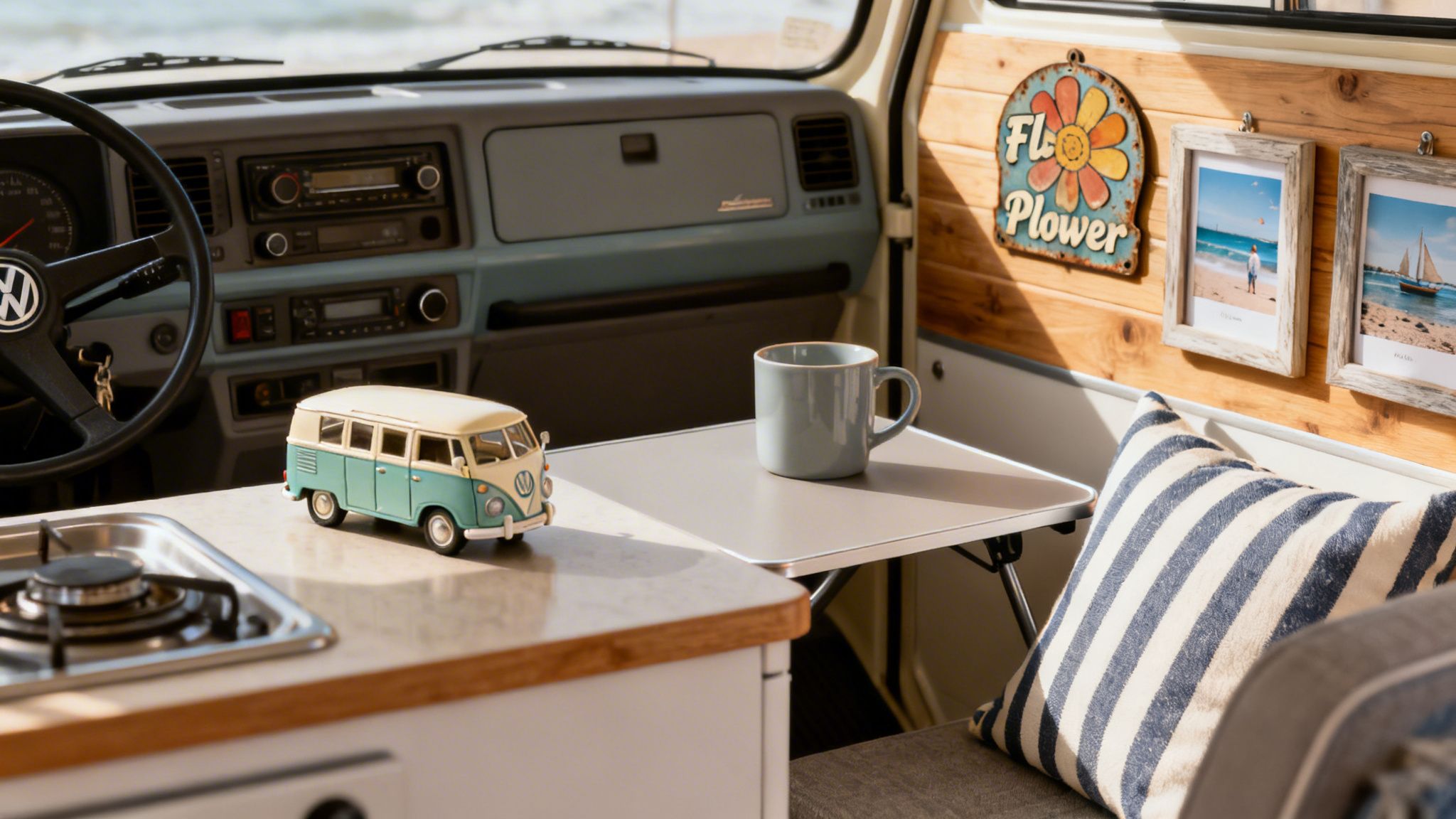
Preserving Your Coastal and Metal Decor

Those nautical treasures and metal signs that bring so much character to your space need protection, too. Thankfully, a bit of preventative care goes a very long way.

To stop tarnish from creeping in on metal décor, give it a light coat of carnauba wax (yes, the same stuff used on real cars!). This creates a clear, protective barrier against humidity and fingerprints, keeping that shine for much longer.

When it comes to coastal items like weathered timber frames or seashell arrangements, a gentle dusting is usually all that’s needed. Just be sure to keep them out of damp areas like bathrooms to prevent mould and mildew from setting in.

By taking these simple steps, you're not just cleaning your décor; you're preserving the stories and memories that make your collection of VW memorabilia collectibles so special. It's a small effort that pays off every single time you look at your treasured pieces.

Your VW Collecting FAQs Answered

Right then, let's answer some of the questions we get asked most often. Jumping into vintage collecting is a bit like planning your first big road trip—it's exciting, full of potential, but you’ve probably got a few things you're wondering about before you hit the road.

Think of this as a friendly chat over the bonnet of a classic Bug. We'll cover everything from how to get started without a massive budget to making those brilliant retro finds work with your modern decor.

How Can I Start Collecting VW Accessories on a Budget?

This is where the real fun begins! You absolutely don’t need a huge bankroll to build a collection packed with character. The secret is to start small but aim for pieces that make a big impact.

Instead of trying to find a massive, rare antique, why not look for a beautifully detailed 1:24 scale Volkswagen Beetle model? These smaller diecast models are much more affordable and are perfect for bringing a bit of life to a bookshelf or a desk. They have all the nostalgic charm of the real thing, just in a compact, budget-friendly size.

Another great way to go is to embrace high-quality reproductions of classic designs. An officially licensed metal VW sign or a brand-new diecast model gives you that authentic vintage feel without the hefty price tag of a piece from the 1960s. You get all the crisp details and a flawless finish, ready to display straight out of the box.

The most important thing is to collect what you truly love. At the end of the day, the value of your collection isn't just about money; it’s about the joy and nostalgia it brings you. A piece that puts a smile on your face is always a good investment.

What Is the Best Way to Mix Vintage Pieces with My Modern Decor?

Blending old and new is a bit of an art, but the trick is simpler than you might think. Aim for balance, not clutter. Think of your vintage home accessories as soulful accents that tell a story, rather than trying to turn your home into a museum.

A fantastic technique is to create small, curated displays, or 'vignettes'. For example, on a modern floating shelf, you could group a colourful diecast Kombi with a couple of old, weathered books and a small potted plant. The contrast between the clean lines of the shelf and the textures of your vintage items really makes your collectible pop, turning it into a genuine focal point.

Another clever trick is to use a 'colour anchor'.

  • Pick a standout colour from one of your vintage items, like the vibrant sea blue on a VW Samba Bus model.
  • Subtly repeat that same shade in small doses around the room.
  • This might be through a few scatter cushions, a throw blanket, or even a print on the wall.

This simple method ties the whole space together, creating a look that feels stylish, intentional, and thoughtfully put together.

Are Reproductions Less Valuable Than Authentic Vintage Items?

That’s a top question! It's true that a rare, original vintage piece will often have a higher monetary value for serious collectors. But the idea of 'value' is about so much more than just a price tag.

High-quality, officially licensed reproductions—like the incredible diecast models we have here at Volkswagen Memorabilia—offer tremendous value for enthusiasts and decorators. They give you a pristine, perfect version of a beloved classic, making that vintage style accessible to everyone.

Honestly, the best and most personal collections often have a healthy mix of both. You might have one or two precious, hard-to-find authentic items sitting proudly alongside a fantastic lineup of beautiful reproductions that complete the look and celebrate the spirit of the era.

How Do I Know If a VW Diecast Model Is a Quality Licensed Product?

Excellent question, and a really important one for any collector. Knowing how to spot a quality licensed product means you’re getting a piece that’s truly worthy of the VW badge.

First, always look for the official Volkswagen branding on both the packaging and the model itself. Licensed products have been given the green light by VW, which guarantees that the design, colour, and all those tiny details are accurate.

Second, check the build quality. A good VW Kombi diecast Australia model should feel solid and have a satisfying weight in your hand. Look for clean, crisp paint lines and parts that fit together properly. Your best bet is always to buy from a reputable Australian importer; it’s the surest way to know you’re getting a top-shelf collectible that does justice to the VW heritage.


Ready to find that perfect piece to start or grow your collection? Here at Volkswagen Memorabilia, we've put together a fantastic range of officially licensed VW models and coastal decor, all right here in Australia. Browse our shop today and bring a piece of that iconic, free-spirited vibe into your home.

Your Ultimate Guide to Boho Wall Art in Australia

Boho wall art is so much more than just something you hang on a wall. It’s a whole mood. It’s about creating a space that feels free-spirited, earthy, and deeply personal, using natural textures like macramé, timber, and woven fabrics to build a warm, lived-in atmosphere that tells your story.

What Is Boho Style and Why Does It Work so Well in Australia?

A vibrant coastal boho room featuring a macrame wall hanging, surfboard, plants, and a vintage toy van.

You know that feeling you get at a car show, surrounded by sun-bleached Kombis and classic Beetles? That vibe of freedom, community, and good times? That’s the exact spirit of boho style. It’s less about rigid design rules and all about creating a space that feels like an extension of you.

At its core, the boho look is a celebration of all things natural, handcrafted, and gathered over a lifetime of adventures. It’s an eclectic mix that just clicks with our laid-back Aussie lifestyle, especially when you blend it with coastal and surf-inspired decor. Think earthy tones, woven textures, and an air of effortless cool.

The real beauty of boho is how it turns a house into a home. It’s about surrounding yourself with things you love—pieces that spark a memory or tell the story of your adventures, whether that was a road trip up the coast or finding that perfect handmade artwork.

This style isn't about being flawless; it’s all about personality. It embraces the little imperfections and celebrates what makes your space unique. And that's exactly why it’s the perfect way to show off your passions. Your treasured Volkswagen memorabilia doesn’t need to be tucked away on a separate shelf—it can become a central part of the story you're telling on your walls.

To get a better sense of what makes this style tick, here’s a quick rundown of its core components.

Core Elements of Boho Wall Art

Element Description Examples
Materials Focuses on natural, raw, and organic textures that feel earthy and authentic. Macramé, rattan, wicker, jute, unfished timber, linen, cotton canvas.
Colours A warm and inviting palette drawn from nature, often with pops of vibrant colour. Cream, beige, terracotta, mustard yellow, olive green, dusty pink.
Themes Motifs that celebrate nature, travel, and a free-spirited approach to life. Botanical prints, sun and moon cycles, abstract patterns, mandalas, coastal scenes.

These elements aren't rules, just a starting point. The fun begins when you start mixing them to reflect your own taste.

The Rise of Personalised Decor

It’s really no wonder this trend has taken off. We’re all looking for ways to make our homes feel more genuine and connected to nature. In fact, the wall art market across Australia and New Zealand is seeing steady growth, especially for pieces like macramé and fabric tapestries. According to industry analysis from Future Market Insights, this lines up perfectly with a broader love for textiles in the Aussie home décor scene.

Boho wall art is the perfect answer to this desire for authentic living. It creates a stunning backdrop for everything from a detailed 1:18 scale Kombi Samba Bus diecast to a framed photo from the last VW Nationals. For more inspiration on bringing that relaxed vibe home, check out our guide on coastal home decor ideas.

Ultimately, it's about curating a warm, inviting space that truly reflects a life well-lived.

How to Choose the Right Boho Wall Art for Your Space

Feeling a bit swamped by all the woven tapestries and botanical prints out there? Don't worry, picking the right boho wall art isn't about following a strict set of rules. It’s more of a gut feeling—finding those pieces that just feel right for your home. Let's walk through how to choose with confidence.

First, let's talk size and scale. That huge, empty wall behind your sofa is practically crying out for a large statement piece. Think about a sprawling macramé hanging or even a triptych of coastal prints, like this stunning Beached canvas print set, to create an immediate focal point.

On the flip side, that cosy reading nook or the narrow wall in your hallway is the perfect spot for a smaller cluster of framed prints or a single, beautifully detailed woven basket.

Consider Your Colours and Textures

Take a good look around the room you're decorating. What colours do you see? Boho style is famous for its earthy palette—sandy beiges, warm terracotta, and olive greens—but the real goal is harmony. Your new art should complement the colours you already have, not clash with them. If your room is mostly neutral, a piece with a pop of mustard yellow or ocean blue can bring it to life.

Texture is just as crucial. Boho is a very hands-on, tactile style. If your space is full of smooth surfaces, like a sleek leather couch or a modern TV unit, bringing in some textured art creates a beautiful sense of balance.

Think of it like this: a large, soft macramé hanging can soften the hard lines of a modern apartment, while a collection of timber-framed prints can add warmth and structure to a room filled with plush fabrics.

It’s all about creating a mix. You want a space that feels layered and interesting, not flat or one-dimensional.

Real-World Scenarios to Spark Ideas

Let's make this practical. Imagine a living room with a big, comfy grey sofa and light-coloured walls—a fantastic blank canvas. You could:

  • Hang a large, intricate macramé piece centred above the sofa. This instantly introduces a soft, handcrafted feel.
  • Create a gallery wall with a mix of botanical prints, abstract art, and maybe a vintage map in different timber frames. This gives you a wonderful, collected-over-time vibe.
  • Go for a large canvas painting of a dreamy coastal scene to bring that relaxed beach atmosphere right into your living room.

Now, for a smaller area like an entryway, you don't want to overwhelm the space. A set of three small, framed photos from a past road trip, hung vertically, can draw the eye upward and make the area feel taller. Or, a single, eye-catching woven wall basket can add a touch of organic charm without taking up too much visual real estate.

At the end of the day, trust your instincts and pick what makes you happy.

Mastering the Art of the Eclectic Gallery Wall

A gallery wall is the best way to show off your personality, and for a boho vibe, it’s all about embracing a bit of beautiful, curated chaos. Forget those stiff, perfectly aligned grids you see in formal homes. We're going for something that feels organic and collected over time, like each piece was found on a different adventure.

The trick isn't a lack of planning; it's making the plan look completely effortless. The best way I’ve found to get started is to lay everything out on the floor first. Grab all your bits and pieces—framed prints, woven hangings, mirrors, maybe even a cool vintage number plate. Move them around until the balance just feels right. This gives you a great overview without hammering a single nail into the wall.

A boho gallery wall should feel less like a stuffy museum and more like a scrapbook of your life’s adventures. The goal is to create something that draws people in and gets them talking.

Once you’re happy with the layout on the floor, you can start putting it all up on the wall, one piece at a time.

Finding Your Anchor Point

Every great gallery wall has a starting point. Your first move is to pick your largest or most eye-catching piece and hang it slightly off-centre. This will be your "anchor," the piece you build everything else around. Placing it off-centre immediately stops the wall from feeling too static or symmetrical.

Your anchor can be anything, really. A big abstract canvas, a sprawling macramé hanging, or even a bold metal sign. Once that's up, you can start filling in the space around it with your smaller items, working your way outwards.

Unifying a Diverse Collection

So, how do you make a wild mix of different sizes, shapes, and textures look cohesive instead of just cluttered? You need to find a common thread that pulls it all together. This doesn't mean everything has to match—not at all!

Think about these unifying elements:

  • A Consistent Colour Palette: Your pieces might be all over the place, but if they share one or two key colours (like earthy terracotta, ocean blue, or even just simple black and white), they'll instantly look like they belong together.
  • Similar Frame Styles: Try grouping several pieces in natural timber frames or simple black frames. This creates a sense of harmony, even if the art inside is completely different.
  • A Shared Theme: Your theme could be as broad as "coastal vibes," where you mix seascapes with photos of your Kombi at the beach. Or it could be more personal, like "road trip memories."

Here’s a simple way to visualise how you can select your art.

A clear, concise guide illustrating three steps for selecting boho art based on scale, colors, and textures.

This guide shows how thinking about scale, colour, and texture—in that order—really helps you narrow things down. It's all about finding that sweet spot where each piece gets to shine, but the whole collection works as one.

Don't forget to leave a bit of breathing room between pieces. A gap of about 5-10 centimetres is a good rule of thumb. That negative space is just as important as the art itself; it’s what keeps the wall from looking overcrowded.

Blending Your Passion for VWs with Boho Decor

A wooden hanging shelf displays a white toy VW bus, books, a succulent, and boho decor.

Alright, this is where we get to the fun part. Bringing your love for classic Volkswagens into a boho space is all about crafting a look that feels completely, authentically you. It’s not just about placing a diecast model on a shelf—it's about weaving that iconic VW culture right into the very fabric of your home.

Boho style and VW heritage are a natural fit, really. Both celebrate a spirit of freedom, adventure, and hitting the open road. Picture a beautiful, hand-woven macramé piece hanging above a rustic timber shelf, with your favourite 1:18 scale Kombi Samba Bus diecast sitting proudly. It just works.

Creating a Focal Point with Diecast Models

Your diecast collection shouldn't be an afterthought; it deserves to be a hero feature. One of the best ways I’ve found to do this is with floating shelves or shadow boxes. They instantly turn your models into eye-catching, three-dimensional art.

Try arranging a few of your most-loved models on a simple wooden shelf. Then, surround them with smaller boho pieces—a trailing plant, a stack of old paperbacks, maybe a small, framed photo. Suddenly, it’s not just a display; it’s a little story, a vignette that draws people in.

Another great trick is to dedicate an entire nook to your hobby. A set of tiered corner shelves can transform into a mini-museum for your treasured Volkswagen Beetle models, where each level showcases a different era or style. For a bit of extra magic, wind some warm, battery-operated fairy lights around the shelves. It really makes them pop.

The key is to make your memorabilia feel like it belongs in the room. When you surround your models with natural textures like wood, rattan, and woven cotton, you bridge the gap between the industrial cool of the cars and the earthy warmth of boho decor.

This creates a look that feels personal and deliberately put together. It shows you love classic cars and you have a great eye for creating a relaxed, beautiful home.

Weaving VW Art into Your Gallery Wall

A gallery wall is the perfect canvas to let your VW flag fly. What I love about boho gallery walls is their eclectic, "collected-over-time" vibe, which gives you complete freedom to mix things up.

Here are a few ways to blend your passion seamlessly:

  • Mix Your Media: Don’t limit yourself to framed prints. A cool, retro-style metal Kombi sign looks fantastic hung next to woven wall baskets, macramé hangings, and abstract art. That contrast between the hard metal and soft textiles is what creates so much visual interest.
  • Get Personal: Frame some of your own photos! Got a favourite shot from VW Nationals, a memorable coastal road trip, or just a great picture of your Beetle parked under a jacaranda tree? Get it on the wall. These personal touches are what truly make a house feel like a home.
  • Hunt for Vintage Ads: Scour online marketplaces and local op-shops for original Volkswagen advertisements from back in the day. Their retro colours and classic fonts deliver an instant dose of nostalgia that pairs perfectly with the vintage feel of boho.
  • Frame Your Memories: Never underestimate how a great frame can tie everything together. Something on-theme, like this classic blue VW Beetle photo frame, is perfect for capturing a special moment while reinforcing the overall vibe.

When you start combining these elements, you’re doing more than just displaying a collection. You're creating a cohesive, stylish, and deeply personal space that celebrates everything you love—from the unmistakable sound of a flat-four engine to the quiet beauty of a handcrafted piece of art. It’s your story, told right there on your walls.

Finding and Caring for Your Boho Wall Decor

Half the fun of creating a boho-inspired space is the hunt for the right pieces. It’s less about a quick trip to a major retailer and more about uncovering decor with some real soul. I’ve found some of my best items at local artisan markets—think Byron Bay’s hinterland stalls or Sydney's Paddington Markets. These spots are absolute goldmines for one-of-a-kind, handcrafted art.

When you buy straight from the maker, you're not just getting a piece of decor; you're getting a story. Plus, you’re supporting a local Aussie creator, which always feels good. If you're searching online, skip the mass-produced stuff and head to platforms where independent artists sell their work directly. That’s where you’ll find the unique prints and woven hangings that make a space truly your own.

Caring for Your Treasures

Once you've got your art home, a little care will keep it looking fantastic for years. Different materials need different attention, but it’s all pretty simple.

Woven pieces like macramé or jute baskets can be dust magnets. Your best friends here are a lint roller or the soft brush attachment on your vacuum cleaner. Just use a low setting for a gentle clean. For a deeper refresh, take it outside on a dry, breezy day and give it a good shake. You’ll be surprised what a difference that makes.

Canvas prints and paintings are a bit more delicate. A quick wipe with a soft, dry microfibre cloth is usually all that’s needed to handle dust. Whatever you do, don't reach for chemical cleaners—they can strip the colour and damage the print finish over time.

A crucial tip for Aussie homes: Most of our internal walls are plasterboard, which can't support heavy art on its own. For anything with some real weight, like a large framed print or a chunky macramé piece, you must use a proper wall anchor. Even better, grab a stud finder, locate a wall stud, and drill straight into it. It’s a five-minute job that will save you from the disaster of a crash.

Finally, think about placement. To keep your colours looking sharp and vibrant, try to position your art out of direct, harsh sunlight. A bit of ambient light is fine, but hours of intense UV exposure will eventually fade even the boldest prints and textiles.

Taking care of your decor is what preserves the character and warmth you loved in the first place, ensuring your walls tell your story for a long time to come.

Your Boho and VW Wall Art Questions Answered

Got a few questions floating around about getting your boho and VW art just right? Don't worry, that's half the fun of decorating. Let's tackle some of the common things that come up, so you can get your walls looking absolutely spot-on with total confidence.

How Do I Hang Heavy Wall Art Like a Large Macramé Piece?

When you’re dealing with Aussie plasterboard, a single nail just isn't going to cut it for anything with a bit of heft. Trust me. You'll want to grab a weight-rated wall anchor or a toggle bolt to make sure that load is spread out. It’s a tiny bit of extra work that makes all the difference.

The absolute best-case scenario? Use a stud finder to locate the timber stud in your wall and drill right into that. It's the most secure hold you're going to get, hands down. If you're hanging something particularly big or heavy, I always recommend using two anchor points. It helps distribute the weight evenly and keeps the piece perfectly level. And always, always check the weight rating on your hooks and wire.

Take it from someone who’s learned the hard way: spending five extra minutes to find a stud or pop in a proper anchor will save you the heartbreak of seeing your favourite piece on the floor. It’s worth every second for that peace of mind.

What Is the Best Way to Clean Fabric Wall Art Like Tapestries?

Fabric art is brilliant for adding that soft, textural feel, but it does tend to catch a bit of dust. For a regular spruce-up, a simple lint roller or the soft brush attachment on your vacuum cleaner (on the lowest suction setting!) is your best friend. This will lift any surface dust without snagging the delicate fibres.

I’d steer clear of using water unless you are 100% sure the dyes won't run. If your piece just needs a good airing out, take it outside on a dry, breezy day and give it a gentle but firm shake. For any little spills or marks, you can try spot cleaning with a mild detergent, but always test it on a small, hidden area first to be safe.

Can I Mix Boho Wall Art with Other Decor Styles?

Oh, absolutely! This is where you can really start to create a space that feels like your own. The relaxed, earthy vibe of boho decor is incredibly versatile and plays surprisingly well with other styles, especially coastal, Scandinavian, and even mid-century modern.

The secret is to find a common element to tie everything together. This could be a consistent colour palette, a repeating material like rattan or natural timber, or a shared, relaxed theme. For example, a piece of boho wall art can bring a welcome touch of natural texture to a clean, modern room, or it can dial up the laid-back, earthy feel in a coastal home. It’s all about creating a balanced look that reflects you.

Where Can I Find Unique VW Decor That Fits a Boho Style?

You can skip the big-box stores for this one. For pieces that truly capture that blend of surf culture and VW nostalgia, your best bet is to look for specialists who live and breathe this stuff. Curated online shops are where you'll find the real gems.

Here at vwmemorabilia.com.au, we're all about officially licensed VW memorabilia collectibles. We hand-pick everything from highly detailed diecast Kombi models to unique wall art that just clicks with a boho, surf-inspired space. The big plus of buying from a dedicated Australian importer is you get local stock and way faster shipping. You're not just buying an item; you're connecting with a local community of fellow collectors and enthusiasts.


Ready to find that perfect piece to bring your wall to life? At Volkswagen Memorabilia, we’ve put together a collection that celebrates the free-spirited lifestyle of VW culture and coastal living. Have a browse through our range of diecast models, signs, and unique decor to find something special for your home.

Explore the Shop at vwmemorabilia.com.au

The Aussie Legend of the Station Wagon VW: More Than Just a Car

G'day mate! Let's talk about the humble station wagon VW. For so many of us, it wasn't just a car; it was the heart and soul of the classic Aussie family road trip. The mere mention of one can bring back a flood of sun-drenched memories: the smell of salty air, the feel of sandy feet on the dash, and the sight of an endless highway stretching out towards the horizon. It was our trusty chariot for holidays, surf trips, and everything in between.

The Enduring Legend of Volkswagen Wagons in Australia

Vintage green station wagon with surfboard on roof by the ocean, with 'AUSSIE ROAD TRIP' text.

Let's wind the clock back a bit, eh? Back to a time when life felt a bit simpler, and the family wagon was the undisputed king of the road. Volkswagen has always had this incredible knack for creating cars that feel like they're part of the family, and their wagons were no exception. They just perfectly captured that unique blend of solid German engineering and our laid-back Aussie lifestyle.

From the quirky, air-cooled charm of the Type 3 Squareback to the more refined, practical Passat and Golf wagons, these vehicles were literally built for adventure. It was never just about getting from point A to point B. It was all about the stories you created along the way.

More Than Just a Car

Just have a think about it for a second. How many of your best memories start with, "Remember that time we packed up the VW wagon…"?

  • Loading up the Esky and camping gear for a long weekend away.
  • Carefully tying the surfboard onto the roof racks before a dawn patrol session.
  • The sound of the kids chattering excitedly in the back seat on the annual holiday drive.

These cars were so much more than just metal, glass, and rubber. They were the keepers of our memories, the silent witnesses to countless family milestones and classic Aussie moments. They carried our hopes, our dreams, and a whole lot of luggage.

A Volkswagen wagon wasn't just transport; it was a promise of freedom. It was the freedom to explore our beautiful country, to chase the sun, and to make memories that would stick with you for a lifetime.

Even now, as these models have become a rarer sight in new car showrooms, their spirit is stronger than ever. That powerful sense of nostalgia and deep affection is exactly why they hold such a special place in our hearts. It's the reason they've gone from being daily drivers to treasured collectibles, celebrated by enthusiasts who truly get what they're all about.

A Quick History of Classic VW Wagons

Long before SUVs became the go-to family car, Volkswagen was quietly mastering the art of the practical, stylish hauler. While the beloved Beetle captured hearts and the iconic Kombi became a symbol of freedom, VW was also building a fantastic legacy of station wagons that really clicked with the Aussie lifestyle. It's a story that began with clever air-cooled engineering and evolved beautifully over the years.

The journey into the classic station wagon VW world really starts with a car that was the perfect next step for families outgrowing their Beetle. It kept that undeniable Volkswagen soul but gave them the space they desperately needed for life's adventures.

The Original Game Changer: The Type 3 Squareback

The Volkswagen Type 3, and especially the Squareback model that landed in the 1960s, was a proper game-changer. It took the dependable, rear-mounted, air-cooled engine platform that everyone knew and loved, and stretched it into a much more practical shape. All of a sudden, you had a boot in the front and a proper cargo space in the back over the engine.

For Aussie families, that meant room for everything—beach towels, cricket gear, the weekly shop, you name it. The Squareback had that unmistakable VW character but delivered the versatility a growing family needed. It was tough, simple, and had a handsome, distinctive look that still gets attention at car shows today. Its flat "pancake" engine was a brilliant bit of engineering that allowed for a much lower, more usable cargo floor.

The Type 3 Squareback wasn't just a bigger Beetle; it proved that you could have practicality and personality in one car. It really set the stage for all the Volkswagen family cars that followed.

The Water-Cooled Revolution: Passat and Golf

As the years rolled by, Australia's needs evolved, and Volkswagen kept pace. The 1970s and 80s brought a new generation of VWs, marking a big shift to front-mounted, water-cooled engines. This introduced two models that would become icons in their own right: the Passat and the Golf.

  • The Volkswagen Passat Wagon: Arriving in the 70s, the Passat offered a new level of comfort and sophistication. It was bigger, more refined, and built for long-distance family road trips, quickly becoming a favourite for those wanting European quality with wagon practicality.
  • The Volkswagen Golf Wagon: The Golf, famous for inventing the "hot hatch," also came in a brilliant wagon version. It had the same fun-to-drive feel and smart design as the hatchback but with a massive amount of extra boot space. It was the perfect all-rounder.

These models showed just how adaptable Volkswagen could be. Even though they moved on from their air-cooled roots, they stuck to the core principles of smart design and solid engineering. It's a fascinating part of the VW story, and if you're keen to learn more about another iconic people-mover, check out our article on the history of the Volkswagen Type 2 Kombi. Each model, from the classic Squareback to the modern Golf, tells its own chapter in the story of the Aussie family car.

Why Modern VW Wagons Became Rare Gems

Spend any time at a VW car show like the VW Nationals or even just scan the local car park, and you’ll realise something’s missing. Seeing a brand-new Volkswagen station wagon on Australian roads has become a genuinely special occasion. For decades, they were a familiar, welcome sight, but a huge shift in what Aussie families wanted from a car changed everything.

The simple truth? The SUV became an unstoppable force. Drivers across the country fell hard for the high driving position and tough looks. As SUV sales went through the roof, the classic family wagon started to get left behind. This wasn't just a VW thing; it was a wave that swept across the entire market, pushing many traditional body styles to the edge. For Volkswagen, it meant making some tough calls about its Australian lineup.

The Numbers Tell the Story

The data paints a pretty clear picture. While wagons were once the kings of the family haul, recent years saw a sharp decline. Volkswagen, for instance, delivered just 412 Passat wagons to Aussie buyers in 2023. That’s a massive drop from the 759 they sold during the whole of 2022.

This trend was a mirror of what was happening across the board, and it ultimately led VW to simplify its local offerings. We had to say a sad farewell to the Passat, Golf, and Arteon wagons. You can get the full rundown on this industry shift by reading the analysis on Chasing Cars.

This chart shows the proud family tree of the VW wagons that shaped Aussie road trips for generations.

Timeline illustrating the evolution of VW wagon models: Type 3, Passat, and Golf, with their production eras.

From the iconic air-cooled Type 3 to the sharp performance of the modern Golf, each model tells the story of its time.

But this isn't a sad story. Not at all. This is the exact moment these brilliant cars went from being everyday workhorses to something far more special: modern classics.

The end of their time in showrooms marked the beginning of their legacy as collectibles. Scarcity has a way of turning the overlooked into the treasured, and for VW wagons, this is their moment to shine.

Their rarity is precisely what makes them so desirable for enthusiasts today. A well-kept Golf R Wagon or a top-spec Passat is no longer just a practical car; it’s a statement. It’s a nod to a time when you could have performance, style, and a massive boot all in one slick package. For collectors, that scarcity is a huge part of the appeal, turning them from daily drivers into icons worth hanging on to.

Starting Your Own VW Wagon Diecast Collection

Alright, so you're hooked on the Volkswagen wagon story and ready to bring a piece of that history home. That's fantastic news! Starting a diecast collection is one of the best ways to get up close with the cars you love, and getting it right from the beginning is easier than you might think.

First, have a think about what you want your collection to be. You're the curator of your own personal car show, right on your shelf. Are you going to focus on a single model, like the classic Type 3 Squareback? Or maybe you want to create a timeline, showing the evolution from the old air-cooled legends right through to the modern Golf R Wagon. There's no wrong answer here; it’s all about what gets you excited.

A hand reaches over a wooden shelf with a green and white toy VW van and a "Start Collecting" sign.

Choosing Your Scale

One of the first terms you'll come across is "scale," which simply refers to the model's size compared to the real car. This is a big decision because it dictates everything from the level of detail to how many models you can actually fit in your space.

Two scales really dominate the collector's world:

  • 1:18 Scale: These are the big, beautiful display pieces. At this size, the detail is incredible—we're talking opening doors, a detailed engine bay, and a fully kitted-out interior. A 1:18 model of a Passat wagon isn't just a model; it's a centrepiece.
  • 1:43 Scale: This is often called the true "collector's scale" for a reason. It hits the perfect sweet spot between detail and size. You can build a much larger, more comprehensive collection in the same amount of space, making it ideal if you want to tell the complete story of the Volkswagen wagon's journey.

The table below gives a quick comparison to help you choose the right scale for your collection, whether you prioritise incredible detail or the number of models you can display.

Popular VW Station Wagon Diecast Model Scales

Scale Typical Length Best For Key Feature
1:18 20-30 cm Display centrepieces; intricate detail Fully interactive (opening doors, hood, etc.)
1:24 16-20 cm Classic car enthusiasts; good balance Great detail without needing massive space
1:43 9-12 cm Building extensive, themed collections The "collector's standard" for variety
1:64 6-8 cm Budget-friendly collecting; dioramas "Matchbox" size; fits hundreds on a shelf

Ultimately, many collectors start with 1:43 to build a diverse lineup and then grab a special 1:18 model of their absolute dream car. If you want to go deeper, you can learn more about diecast model scales in our guide.

What to Look For in a Quality Model

When you’re ready to buy your first piece, always look for officially licensed models. This is your seal of approval, guaranteeing the quality and accuracy are up to scratch and that the model is a faithful tribute to the real thing.

An officially licensed model isn't just a toy; it's a carefully crafted piece of memorabilia. It means Volkswagen has signed off on it, so you can trust the design, colours, and branding are all spot on.

Look for a crisp paint job with a smooth, even finish. Check that the little things, like the badges and model name decals, are sharp and placed correctly. A great diecast model will also have a realistic interior, right down to the shape of the dashboard and seats. It’s these small details that truly bring a model to life and make it a worthy piece for any collection.

The Most Collectible VW Wagon Models

Three colorful miniature Volkswagen station wagons displayed on a wooden surface with a 'TOP VW WAGONS' sign.

So, which models get all the attention? Every collection has its standouts, and when it comes to the station wagon vw, a few legendary models are always in high demand among Aussie collectors.

The appeal of these diecast models comes straight from the legacy of the real cars. We collect them because we love the full-size versions, and having a miniature is a way to hold a piece of that history.

The Grandfather: Type 3 Squareback

You have to start with the original. The Type 3 Squareback is the quirky grandfather of the VW wagon family, with its classic air-cooled charm and unforgettable shape.

For any serious collector, a diecast Squareback is a cornerstone piece. It’s pure nostalgia, representing that brilliant VW engineering that gave families the space they needed without losing an ounce of character.

The Cult Classic: Golf R Wagon

This one is the ultimate sleeper. The Golf R Wagon mixes blistering performance with the practicality of a daily driver—perfect for someone who needs to do a grocery run after leaving sports cars in the dust.

That dual personality has made it a modern cult classic. A diecast model of the Golf R is a salute to its wild engineering and its place as one of the most exciting wagons ever made.

The Golf Wagon used to be the go-to family hauler in Australia, but times changed. VFACTS data shows a massive sales drop from 10,012 units in 2020 to only 2,929 in 2024—that's a decline of over 70%. With wagons only making up around 10% of those sales, their eventual discontinuation has made them true collector's items. You can find out more on VW Australia's market growth insights here.

The Sophisticated Tourer: Passat Wagon

While the Golf R is the wild one, the Passat Wagon is the refined older sibling. It’s a stunning blend of class, comfort, and performance, especially in the sporty R-Line trim. This is the car built for those long family road trips along the coast.

A diecast Passat R-Line is more than just a model; it's a miniature of that perfect grand tourer. It captures the understated European elegance and performance that the real car was known for.

Each of these wagons tells its own story. Whether you love the vintage vibe of the Squareback or the modern power of the Golf, we have fantastic, officially licensed Volkswagen diecast models for sale to bring these icons to your shelf.

Styling Your Space With VW Wagon Memorabilia

Why keep your love for the humble station wagon VW confined to the garage? Bringing these icons inside is a brilliant way to show off their classic design. A well-made diecast model of a Passat or Golf wagon is more than just a collectible; it’s a small piece of automotive art with a story to tell.

But don't just line them up on a shelf. A proper display case or a few floating shelves can turn your models into a real feature. Give each car its own spot to avoid a cluttered look. This way, the unique shape and details of each wagon can really be appreciated.

Creating a Display With Style

Good lighting is key. A few small, battery-powered LED spotlights can bring out the sharp lines and bright colours of your models, making them pop. A perfectly detailed 1:18 scale Type 3 Squareback catching the light is a fantastic conversation starter.

These models are versatile and work well with a few different interior styles:

  • Coastal Cool: The clean, practical look of a VW wagon fits perfectly with a breezy coastal theme. Try placing a model on a bookshelf next to some driftwood or a photo of your favourite beach.
  • Retro Revival: A vintage Squareback or an early Passat wagon model looks right at home with retro furniture and old-school automotive art. It adds a genuine touch of the 60s or 70s.
  • Minimalist Modern: In a clean, modern office, a slick Golf R Wagon model in a bold colour can be a great accent. It adds a splash of personality without messing up a minimalist vibe.

Your collection is a part of your style. Displaying your VW wagon memorabilia is all about creating a space that feels like you—a space that celebrates the freedom, design, and memories these great cars stand for.

At the end of the day, it's about showcasing what you love. By working these models into your decor, you’re not just storing collectibles; you’re celebrating the long-lasting appeal of the Volkswagen wagon every day. For more tips, have a look at our guide to creating the perfect vibe with coastal home decor ideas.

Keeping the VW Wagon Legacy Alive

It’s getting harder to spot a classic VW station wagon on Australian roads these days. That’s why the memorabilia we collect is more than just a hobby—it’s about keeping a fantastic legacy alive. Every diecast model on your shelf is a small tribute to an era of family road trips, surprising performance, and brilliant, simple design.

This isn't just about collecting toy cars; it's about holding onto a feeling. It’s the memory of packing the boot for a summer holiday or the simple satisfaction of a car that just worked for the family. These models are a real, physical link to those great memories.

Your Piece of Volkswagen History

Let’s face it, the wagon market in Australia isn't what it used to be. In 2024, total wagon sales dropped to just 3,368 cars sold, a massive 69% fall from 2019. Poor sales for models like the Passat and Golf wagon even led VW to pull them from the local market, turning them into instant modern classics. You can read the full story on this huge market shift over at Drive.com.au.

This is exactly why collecting is so important. It’s our way of making sure the spirit of these brilliant wagons continues for a new generation of fans to discover and enjoy.

When we collect these detailed models, we become curators of the Volkswagen story. We keep the designs, the colours, and the memories alive, making sure the legacy of the VW wagon never really disappears.

Whether you're just starting your collection, adding a new piece, or looking for that perfect gift for a VW fan, every model you choose helps keep this history on display. Find the one that tells your story and celebrate the timeless cool of the Volkswagen wagon.


At Volkswagen Memorabilia, we’re passionate about helping you find that perfect piece of VW history. As a dedicated Australian importer, we stock a fantastic range of officially licensed VW memorabilia collectibles, all ready to go with fast, local shipping.

Explore our full collection of VW diecast models and memorabilia today!

Your Ultimate Guide to the Golf GTI Mk6 in Australia

The Volkswagen Golf GTI Mk6, built between 2009 and 2013, is far more than just another hot hatch. It represents a golden era for many Aussie car fans, nailing the perfect blend of sharp performance, everyday usability, and timeless style. With its punchy 2.0-litre turbocharged engine and engaging driving feel, it quickly became a legend in Volkswagen’s performance history.

The Enduring Legend of the Golf GTI Mk6

White Volkswagen Golf GTI MK6 lowered on custom wheels at an outdoor car meet.

Picture this: it’s a sunny Saturday morning at a bustling Aussie car show. You can smell the coffee and hear the friendly chatter of fellow VW fans. Right in the middle of it all, drawing admiring looks, sits a perfectly clean Volkswagen Golf GTI Mk6.

For so many of us, this car isn't just a machine. It's a cultural touchstone that defined the modern hot hatch for a generation of enthusiasts down under. The Mk6 captured a special kind of magic, blending thrilling turbocharged fun with the practicality you need for the daily grind. It was the car that could carve up a winding coastal road on Sunday and still handle the school run on Monday.

This brilliant mix of excitement and sensibility created a passionate community that stretches from Sydney to Perth. Its sharp, clean styling and that potent TSI engine still capture hearts today, cementing its spot as a true modern classic. It’s more than just a successor to the iconic Mk1; it carries on a tradition of fun and freedom that began with Volkswagen’s earliest air-cooled icons. You can feel that same spirit when you read about the beloved VW Beetle and its incredible journey.

A Legacy Beyond the Road

The passion for the Golf GTI Mk6 runs much deeper than just the driver's seat. It's about the shared stories, the club meets, and the pride of ownership. This guide is a celebration of that spirit, connecting the love for the real car to the joy of collecting its perfectly detailed diecast replicas.

For enthusiasts, the Mk6 represents a sweet spot in the GTI lineage—more refined than the Mk5 but with a raw, connected feel that some feel has softened in later models. It’s this balance that makes it so memorable.

This is for every fan who appreciates the signature red grille stripe, the classic tartan seats, and the unmistakable bark of the exhaust. We'll dive into its history, explore what makes it tick, and show you how to celebrate its legacy through the wonderful world of VW memorabilia. It's a tribute to the passion behind the badge, and we’re thrilled to have you along for the ride.

When the Volkswagen Golf GTI Mk6 rolled onto Australian shores in 2009, it had some pretty massive boots to fill. Its older brother, the Mk5, had been a smash hit, completely reigniting the country’s passion for the hot hatch. The big question on every enthusiast’s mind was simple: could VW possibly strike gold twice?

As it turned out, the Mk6 didn't just meet the hype; it confidently left it in the rearview mirror. Volkswagen didn’t reinvent the wheel. Instead, they took a long, hard look at what made the Mk5 such a legend—that brilliant blend of raw performance and daily driver polish—and dialled the refinement all the way up. The aim was to build a GTI that felt more premium and mature, but without losing a single ounce of the aggressive spirit that makes a GTI, well, a GTI.

A New Class of Polish and Performance

The design was instantly sharper, cleaner. It wasn't a revolution, but a confident evolution of the GTI look. Step inside, and the difference was even more obvious. The cabin materials took a huge leap forward, with soft-touch plastics, more elegant switchgear, and of course, those iconic tartan seats that somehow managed to feel both nostalgic and completely modern at the same time.

It felt less like a hatchback with a big engine bolted in and more like a purpose-built performance car that you could happily drive to work every single day. This was a very clever move from VW. While other hot hatches were screaming for attention with wild wings and loud paint jobs, the Mk6 offered a more sophisticated kind of thrill. It was the sort of car a professional could park at the office without raising eyebrows, then absolutely unleash on a winding back road on the weekend.

The Volkswagen Golf nameplate was already a force to be reckoned with in Australia. To put it in perspective, back in 2007, the brand sold a staggering 10,982 Golfs, making it the top-selling car from any German carmaker Down Under. The Mk6 GTI leveraged this incredible momentum, winning over enthusiasts with its punchy 2.0-litre TSI engine. It put out a healthy 157kW and 280Nm of torque, enough to launch the car from 0-100km/h in just 6.9 seconds, all while wearing that iconic red-striped grille with pride. For those interested, you can find more on Volkswagen's historical sales performance and deeper insights into their market impact.

The Perfect All-Rounder for Aussie Roads

This combination of genuine performance and everyday usability was exactly what the Australian market was after. The Mk6 GTI wasn't just quick in a straight line; its beautifully balanced chassis and sharp, precise steering made it an absolute joy on the kinds of roads we love—from the tight, twisting hairpins of a mountain pass to the flowing corners of a country B-road.

The Mk6 GTI proved you didn't have to compromise. You didn't need to choose between a fun car and a practical one. It was a master of both, giving you a driving experience that was thrilling when you wanted it and completely composed when you didn't.

It was this brilliant duality that cemented its spot in Aussie car culture. No, it wasn't the loudest or the most powerful car in its class, but it was arguably the most complete. It redefined what an Aussie hot hatch could be, proving that sophistication and pure, unadulterated fun could go hand-in-hand to create a modern classic that enthusiasts and collectors still rave about today.

Pop the bonnet on a Mk6 GTI, and you'll understand what the fuss is all about. This is where the magic happens, and it’s what gives the car its legendary character.

A white Volkswagen Golf GTI with its hood open, revealing the 2.0 TSI engine on a sunny day.

At its heart sits the brilliant 2.0-litre EA888 TSI engine. This turbocharged four-cylinder is the soul of the machine, delivering an eager, responsive kick that will put a smile on your face every single time. It's an engine built for real-world fun, not just impressive numbers on a spec sheet.

It’s not about overwhelming, tyre-shredding power. Instead, the EA888 is all about accessible performance that feels perfectly suited to Australian roads. It’s punchy and pulls strongly from low revs, giving you a smooth, confident surge of torque whether you’re jumping into a gap in traffic or powering out of a tight corner.

The Great Transmission Debate

How that power gets to the front wheels has always been a hot topic for GTI fans. Volkswagen gave buyers two fantastic choices, each offering a completely different driving experience. It was a tough decision back then, and it's still something enthusiasts love to debate today.

  • The 6-Speed DSG: The Direct-Shift Gearbox was a game-changer. This dual-clutch automatic delivers incredibly fast, seamless shifts that keep the engine right in its sweet spot. It's ruthlessly efficient and makes the GTI feel effortlessly quick.
  • The 6-Speed Manual: For the purists, there’s no substitute for a proper three-pedal setup. The manual in the Mk6 is a joy to use, with a crisp, mechanical feel that connects you directly to the action. There's nothing quite like the satisfaction of nailing a perfect downshift yourself.

Honestly, there's no wrong choice here. It all comes down to what you want. Do you prefer the high-tech efficiency of the DSG or the classic engagement of rowing your own gears?

More Than Just a Great Engine

But the Mk6 GTI's genius is about more than just its drivetrain. A key feature on many cars was Volkswagen’s Adaptive Chassis Control (DCC), a clever system that lets you change the car's personality with the push of a button.

Think of it as having multiple cars in one. 'Comfort' mode softens the suspension for a relaxed daily commute, soaking up bumps and rough patches. Switch it to 'Sport', and everything tightens up—the suspension gets firmer, the steering becomes weightier, and the throttle feels sharper. It instantly transforms the GTI from a comfortable hatch into a focused corner-carver.

This dual personality is what truly defines the Mk6. It’s a sophisticated and comfortable cruiser one moment and a proper back-road weapon the next.

Of course, you can't talk about a GTI without mentioning the iconic details. The 'Detroit' alloy wheels, with their distinctive polished faces, are instantly recognisable. Inside, the supportive sports seats trimmed in the classic 'Jacky' tartan fabric are a fantastic nod to the GTI's heritage, a legacy that goes all the way back to VW icons like the beloved Kombi Samba Bus.

To give you a quick snapshot, here's a look at the key specifications for the Australian-delivered Mk6 GTI.

Volkswagen Golf GTI Mk6 Key Specifications

This table gives you a quick-reference guide to the core numbers that made the Mk6 GTI a standout performer in its class.

Specification Details
Engine 2.0-litre EA888 Turbocharged Stratified Injection (TSI)
Power Output 155 kW @ 5,300–6,200 rpm
Torque 280 Nm @ 1,700–5,200 rpm
0-100 km/h 6.9 seconds (DSG and Manual)
Transmission Options 6-speed Manual or 6-speed DSG
Signature Wheels 17-inch 'Denver' or optional 18-inch 'Detroit' alloys
Interior Highlight 'Jacky' Tartan sports seats
Brakes Red-painted callipers with ventilated front discs

From its punchy engine to its sharp handling and classic styling cues, every element works together to create a complete and compelling package.

Building Your Ultimate Mk6 Diecast Collection

Two white diecast model cars on a display shelf, one with red wheels, against a blue background.

As the real Golf GTI Mk6 settles into its role as a modern Aussie classic, the world of diecast models is the perfect way to appreciate its clean lines and performance heritage. There's just something special about holding a perfectly scaled-down version in your hands—it’s a tangible piece of automotive history.

For plenty of us Volkswagen tragics, collecting these miniatures is a passion that runs just as deep as owning the real car. It’s your chance to build a dream garage, showcasing everything from the old air-cooled legends right through to today's heroes like the Mk6. So, let's dive into what you need to know to start or grow your own collection of these little gems.

Understanding Diecast Scales

Walking into the diecast model world for the first time can feel a bit confusing with all the different scales flying around. But it's actually pretty simple. Think of the scale as a ratio: for a 1:18 scale model, every 1 centimetre on the model represents 18 centimetres on the actual car.

Here’s a quick rundown of the most common scales you’ll come across for a Golf GTI Mk6:

  • 1:18 Scale: This is the big one, the scale for serious collectors who want maximum impact. These larger models have space for incredible detail—we're talking opening doors, bonnets, and boots, plus steerable wheels and a fully kitted-out interior and engine bay. A 1:18 Mk6 GTI makes a seriously impressive centrepiece.
  • 1:24 Scale: A brilliant middle-ground. A 1:24 model gives you fantastic detail without demanding as much shelf space as its bigger cousin. They often feature opening parts and are a popular choice for building a varied collection.
  • 1:43 Scale: This is a classic collector's scale, especially here in Australia and across Europe. It’s the perfect size to assemble a large, visually striking collection inside a display cabinet. Don't let the smaller size fool you; high-quality 1:43 models from premium brands still pack a surprising punch with their details.
  • 1:64 Scale: You’ll know this as the classic "Matchbox" or "Hot Wheels" size. These little guys are affordable, compact, and perfect for new collectors, younger fans, or anyone wanting to amass a huge variety of cars without needing a dedicated room.

Ultimately, the scale you pick really comes down to your personal goal. Do you want one or two highly-detailed hero pieces, or are you looking to build a whole fleet that tells the story of Volkswagen's history? There's no right or wrong way to do it!

What to Look For in a Quality Diecast Model

Not all diecast models are made equal. When you’re on the hunt for a Golf GTI Mk6 replica to add to your collection, a few key details will help you pick a model you'll be genuinely proud to show off.

First things first: always look for officially licensed Volkswagen products. This is your guarantee that the model was made with VW’s blessing, ensuring the shape, proportions, and badges are all spot on. Unlicensed models often just look off, with weird dimensions or incorrect details.

Next, get up close and check the finer points. The paintwork should be sharp and clean, without that bumpy "orange peel" texture. Take a look at the lights—are they just dabs of silver paint, or are they separate, clear plastic pieces? On a top-notch model, the GTI badges and VW logos will be tiny, perfectly printed decals, not clumsy blobs of paint.

A brilliant way to bring your collection to life is by creating a themed display. Picture it: your sharp, modern Golf GTI Mk6 diecast sitting next to a classic 1962 VW Kombi Samba Bus diecast. Placing them side-by-side tells a wonderful story on a single shelf—a story of Volkswagen's journey from carefree icon to performance-focused hero. It’s these creative touches that make collecting so rewarding, turning a group of models into a true celebration of VW passion.

The Reality of Owning a Mk6 GTI Today

So, you’re thinking about putting a Golf GTI Mk6 in the driveway? Great choice. It's a proper modern classic that still delivers a fantastic drive. But, like any performance car that's seen a few Aussie summers, there are a few things to keep in mind before you hand over the cash.

This isn’t a list to scare you off. Think of it more like the chat you'd have with a mate at a car meet—a friendly heads-up to help you buy a good one and enjoy years of happy motoring. Knowing what to look for changes everything; you go from crossing your fingers to confidently asking the right questions and checking the right spots.

Common Maintenance Checkpoints

Every car has its quirks, and the Mk6 GTI is no exception. The great thing is, the VW community here in Australia is massive and passionate, so these issues are incredibly well-documented. Being aware of them is the key to telling a cherished example from one that could become a bit of a project.

Here are the big ones to keep on your radar:

  • Timing Chain Tensioner: This is the one you’ll hear about most. Early Mk6 GTIs came with a timing chain tensioner that could, in a worst-case scenario, fail. A failure is catastrophic for the engine, so you absolutely must check if the updated, stronger version has been fitted. Any seller with decent service records should be able to show you the receipt for this job.
  • Intake Valve Carbon Buildup: The direct-injection engine is brilliant for performance and fuel economy, but a known side effect is carbon build-up on the intake valves over time. This chokes the engine, hurting power and efficiency. On any car with over 100,000 kilometres, you’ll want to see evidence of a 'carbon clean' in the service history.
  • Water Pump & Thermostat Housing: The factory water pump and its thermostat housing are made of plastic that can get brittle with age and heat cycles, eventually leading to leaks. It's a very common repair. When inspecting a car, have a good look around that area for any signs of pink or white crusty residue (dried coolant) or ask if the parts have already been replaced with updated versions.
  • DSG Service: If you’re eyeing up a car with the fantastic 6-speed DSG gearbox, its service history is non-negotiable. The transmission requires a fluid and filter change every 60,000 kilometres, like clockwork. A missing DSG service in the logbook is a huge red flag and a good reason to walk away.

Don’t let this list put you off. Think of it as your pre-purchase checklist. A car with records showing these have been sorted is a sign of a diligent owner and a well-cared-for machine.

Knowing these points puts you in the driver's seat during the buying process. You can inspect a car with confidence, knowing exactly where to look and what to ask. It's all part of being a responsible owner. For more general chats about the VW scene and ownership stories, feel free to check out other articles on our VW Memorabilia blog.

Unlocking Performance with Popular Modifications

The Mk6 GTI is a brilliant car right out of the box. But for many Aussie VW fans, that's just the starting point. The real fun begins when you start making it your own, and there's a huge tuning scene down under dedicated to getting a bit more performance out of this fantastic platform.

You can feel the potential simmering just beneath the surface from your very first drive. That’s why modifying the Golf GTI Mk6 is such a massive part of the ownership experience. It isn’t about correcting faults; it's all about dialling up the excitement and turning a great car into your perfect hot hatch.

Stage 1: The Gateway to More Grunt

The first stop for most owners is an ECU tune, commonly known as a "Stage 1" tune. You can think of it like a software patch for the car's engine management system. It tweaks parameters like fuel delivery, ignition timing, and turbo boost pressure to safely release the extra power VW left on the table.

This one modification can make a huge difference, often adding 20-30kW and a serious lump of extra torque. The car just feels stronger, pulling harder through every gear. A quality Stage 1 tune from a respected Aussie workshop really wakes the car up, making it feel more responsive without putting reliability at risk.

Of course, before you chase more power, you have to make sure the car is in good health. This decision tree is a great guide for the critical checks you should do before buying or modifying any Mk6 GTI.

Decision tree for MK6 GTI ownership, outlining pre-purchase inspection, timing chain, and carbon buildup checks.

Getting these basics right—especially checking that timing chain tensioner—is the key to building a reliable, high-performance car.

Beyond the Tune: Breathing and Handling

Once you get a taste of that extra grunt, it's hard to stop. The next logical steps involve hardware upgrades that help the engine breathe easier.

  • Performance Intake: Replacing the standard airbox with a high-flow intake lets the turbo gulp down more cool air. It not only helps make more power but also gives you a satisfying induction roar when you hit the accelerator.
  • High-Flow Downpipe: The downpipe connects the turbo to the rest of the exhaust. Fitting an aftermarket one with a better catalytic converter reduces backpressure, helping the turbo spool up quicker. When you combine this with a "Stage 2" tune, the Mk6 really comes alive.

It's not all about engine power, though. A balanced car is a fast car. Many owners invest in suspension parts like lowering springs or a full set of adjustable coilovers. This sharpens the handling and gives the car a tougher, more planted look.

This passion for customising the Golf GTI Mk6 is something we love in the memorabilia world. It's common for collectors to hunt down diecast models of modified GTIs, celebrating the creativity that defines the VW community. You can explore our range of Volkswagen diecast models for sale to find everything from pristine stock models to custom-tuned heroes.

Your Golf GTI Mk6 Questions Answered

We see the same questions popping up all the time at car meets and in online forums about the Golf GTI Mk6. Whether you're thinking of buying one, trying to keep yours in top shape, or just a fan of the model, here are the answers to the most common queries we hear from the Aussie VW community.

What Is a Fair Price for a Golf GTI Mk6 in Australia?

This is always the big question, isn't it? The market for the Mk6 GTI has found its groove, but the price can swing quite a bit depending on a few key things. For a solid, honest car with reasonable kilometres (think 120,000–180,000 km) and a good service history, you’ll be looking at prices between $12,000 and $18,000.

You might see mint-condition, low-kilometre cars—especially limited editions or ones with extras like the 18-inch Detroit wheels and sunroof—climb over the $20,000 mark. At the other end, cars with higher k's that need a bit of TLC can sometimes be found for under $10,000, but just be ready for some upcoming maintenance costs.

How Reliable Is the Mk6 GTI's DSG Gearbox?

The 6-speed DSG is a fantastic bit of engineering when it's looked after. It’s known for those lightning-fast shifts that make the car feel so sharp and responsive. The key to its reliability, though, comes down to one thing: regular maintenance.

The number one rule for a healthy DSG is getting the fluid and filter changed every 60,000 kilometres. Don't skip it. This is the single most important service for the gearbox's long-term health.

When issues like jerky shifts or hesitation do appear, it’s almost always because a service was missed or the mechatronics unit—the gearbox's electronic brain—is on its way out. A stamped logbook showing on-time DSG services is a huge green flag.

How Does the Mk6 Compare to the Mk5 and Mk7?

The Mk6 is really the perfect blend of its older and younger siblings. It took the raw, playful character of the Mk5 and refined it, wrapping it all in a sharper, more premium package with a much nicer interior.

Put it next to the later Mk7, and the Mk6 feels a bit more analogue and connected. The Mk7 brought in more tech and a lighter chassis, making it quicker and more efficient, but many drivers miss the slightly heavier, more hydraulic steering feel of the Mk6. Honestly, each one has its own unique charm.

What Are the Best Brands for Golf GTI Mk6 Diecast Models?

For any collector, a miniature Golf GTI Mk6 is a great way to show some appreciation for the car. If you're looking for quality, you can't go wrong with brands like Norev, Solido, or IXO Models. These manufacturers produce officially licensed models with fantastic attention to detail, right down to the correct wheel designs and tartan seat patterns.

A good diecast replica will have crisp paint, clear badges, and true-to-life proportions. We have a hand-picked selection of high-quality Volkswagen diecast models for sale right here on our site, so you can be sure you’re getting an authentic model for your collection.

Ready to celebrate the spirit of Volkswagen? Here at Volkswagen Memorabilia, we've gathered a brilliant collection of diecast models and VW-themed gifts that are perfect for any enthusiast. Click here to explore our full shop and find your next favourite piece today.

Coastal Home Decor Ideas: Creating Your Aussie Beach House Vibe

G'day, mate! There's nothing quite like that feeling of a permanent holiday, and that's exactly what coastal home decor is all about. It’s about capturing that relaxed, sun-drenched vibe you get after a long day at the beach. The goal is to create a light, airy sanctuary using a warm, natural colour palette, textured materials like rattan and linen, and an overall feeling of effortless, breezy living.

What Is Australian Coastal Style?

When we talk about Australian coastal style, it's so much more than just scattering a few seashells on a shelf. It’s about bottling that feeling you get after a long, sunny day at the beach—relaxed, warm, and completely at ease.

It's less about literal beach themes and more about creating an atmosphere that feels like an endless summer holiday, right in your own home. Think of it as designing a personal escape that echoes the sound of gentle waves and the warmth of sand under your feet. It's the design equivalent of kicking off your thongs at the door and breathing out a happy sigh.

But not all coastal styles are created equal, eh? You’ve got a few different flavours to play with, each with its own personality. Our unique Aussie style actually borrows bits and pieces from a few of the most popular looks from around the world.

Diagram illustrating Australian coastal style influenced by Hamptons, adapting Mediterranean, and embodying beach shack.

As you can see, the Aussie take on coastal is a beautiful blend of different influences, all adapted to our unique, laid-back way of life.

Finding Your Coastal Vibe

Getting to know these styles is the key to finding the perfect vibe for your space.

  • Classic Aussie Beach Shack: This is the heart and soul of our coastal look. It’s unpretentious, comfortable, and absolutely brimming with character. Think weathered timber, comfy second-hand furniture, and personal touches that tell a story—like a classic Volkswagen Beetle model perched on a bookshelf.

  • Hamptons Style: A bit more polished and sophisticated, the Hamptons look takes its cues from the luxe beach houses of Long Island. It’s all about crisp whites, deep blues, elegant furniture, and a more structured, formal feel.

  • Mediterranean Influence: This style brings in warmer, earthier tones you’d find along the coasts of Greece and Italy. You'll see things like textured render walls, terracotta pots, and arched doorways that add a rustic, sun-baked warmth to the space.

Ultimately, the best coastal homes mix these elements to create something that feels genuinely you. It's about creating a place where every day feels a little brighter and a whole lot more serene.

Building Your Coastal Colour Palette

Right, getting the colour right is where the magic really begins. It’s the very first step in creating a coastal vibe that feels genuine and lived-in. While cool blues and crisp whites definitely have their place, the modern Aussie coastal look is warming up, drawing its cues from the sun-baked sand and rich earth of our incredible landscapes.

Forget just slapping on a coat of white paint. We’re talking about layering colours that feel grounded and deeply calming, creating a space that’s both chic and a real sanctuary from the world outside.

Embracing Warmer Neutrals

The secret to this modern style is leaning into warmer tones. For a long time, stark whites and cool greys were the go-to, but there’s been a real shift towards colours that feel more organic and welcoming. Think sandy beiges, hints of terracotta, and lovely buttery creams. These shades capture the beauty of the Australian landscape, from the red centre to the golden coastline, and designers love how they bring that sense of the outdoors in, creating a true 'sanctuary' feeling. You can see more on this beautiful evolution in Australian interior design trends on eleliving.com.au.

These colours lay the perfect foundation for all your coastal home decor ideas. They work beautifully with the natural materials we’ll get into later, like light-toned timber, rattan, and linen.

How to Layer Your Colours

Building a rich, layered look is much easier than you’d think. It's not just about the walls; it’s about letting the colour flow through your whole room.

A great coastal palette isn’t about matching everything perfectly. It’s about creating harmony between different shades and textures, just like the subtle colour shifts you see on a walk along the beach at sunrise.

Here are a few simple ways to get started:

  • Start with Your Walls: Kick things off with a base colour like a soft, sandy beige or a creamy off-white. These shades make a room feel open and bright without ever feeling cold.
  • Layer with Textiles: This is where you bring in depth. Think about cushions in a muted terracotta, a jute rug with its natural brown variations, or a throw blanket in a warm, earthy green.
  • Add Your Accent Colours: Now for the fun part! Add small pops of colour that pull everything together. This could be the deep blue of a ceramic vase, the soft green of a beautiful indoor plant, or even the cheerful pop from a vintage-inspired Volkswagen diecast model sitting on a shelf.

By layering these warm, natural colours, you’ll craft a space that feels cohesive, timeless, and perfectly in tune with that relaxed Aussie coastal lifestyle.

Right, with the walls looking fresh and sandy, it's time to furnish. This is where the magic happens and your coastal theme really comes to life, turning a house into a proper home. The goal is to pick pieces that have a relaxed, breezy feel and are as practical as they are good-looking.

Think natural textures and pure comfort. This isn't the style for anything heavy, dark, or too formal. We’re leaning into materials that just feel right being close to the water.

Diverse fabric swatches and color cards displaying a 'Coastal Palette' laid out on a wooden table.

Go For Natural Materials

To nail that authentic Aussie coastal look, stick to furniture made from light-toned timbers, rattan, and wicker. These materials bring in that essential texture and a natural warmth that works perfectly with a neutral colour palette. A great-looking rattan armchair or a light-oak coffee table can become the centrepiece of your living room, inviting everyone to kick off their shoes and unwind.

For fabrics and textiles, natural fibres are always the best choice.

  • Linen: The undisputed champion of coastal fabrics. Think breezy linen curtains that catch the afternoon sea breeze or a plush linen sofa you can really sink into.
  • Jute and Sisal: These are brilliant for rugs. They bring a robust, earthy texture underfoot that instantly grounds the whole space.
  • Cotton: It's soft, breathable, and simple to care for. Cotton is a go-to for cushions, throws, and bedding.

Choosing the right materials is all about creating that tactile, lived-in feel. Below is a quick guide to some of the key players in coastal decor.

Key Materials for Authentic Coastal Decor

Material Common Uses Coastal Appeal
Light Timber Coffee tables, dining sets, bed frames Creates a light, airy foundation that feels clean and natural.
Rattan & Wicker Armchairs, side tables, pendant lights Adds beautiful woven texture and a relaxed, handcrafted vibe.
Linen Curtains, sofa slipcovers, bedding Its soft, breathable quality is the essence of breezy, relaxed living.
Jute & Sisal Rugs, baskets, placemats Provides an earthy, robust texture that connects the indoors with the outdoors.
Cotton Cushions, throws, towels Offers soft, casual comfort that's easy to live with and care for.

By layering these different materials—a smooth timber table, a rough jute rug, and soft cotton cushions—you build a room with genuine depth. It’s this mix of textures that stops a neutral room from feeling bland and makes it feel rich and inviting.

This shift towards natural fibres is part of a much bigger trend in home design. More Aussies are choosing quality over quantity, investing in pieces that are durable and eco-friendly.

We're moving away from throwaway decor and towards items built to last, which is really changing how we approach furnishing our coastal homes. You can get more insights on how sustainability is shaping design in this fantastic read on 2026 Australian interior design trends.

At the end of the day, your furniture and textiles should make your home feel like a permanent, restful escape.

Infusing Personality with Nostalgic VW Accents

Now, this is where the fun really begins—making your coastal house feel like your home. Anyone can have a house with good style, but a home that tells your story? That's something special.

For so many of us, nothing says "Aussie coast" and endless summer road trips quite like a classic Volkswagen. You see them at shows like Volksfest and the VW Nationals, and they just radiate freedom. This is our chance to weave that passion for VWs right into your coastal decor.

A rattan chair with pillows, a blue throw, and a jute rug in a breezy coastal room.

Don't worry, we’re not turning your living room into a garage. It’s all about adding those tasteful, charming touches that spark a bit of joy and share a piece of who you are. These little accents are the perfect way to blend nostalgia with style, creating conversation starters that feel right at home amongst the driftwood and linen.

Displaying Diecast Models with Style

Your collection of VW memorabilia collectibles deserves to be seen, not hidden away in a box. A beautifully detailed diecast model is a small work of art, and it can inject a huge amount of personality into a room. Let’s move beyond boring display cases and work them right into your coastal theme.

  • Create a Curated Shelfie: Imagine placing a stunning 1962 Kombi Samba Bus diecast model on a floating timber shelf. Surround it with a couple of your favourite books, a small potted succulent, and a piece of bleached coral. The mix of textures and colours will make the model the star.
  • The Centrepiece Statement: Why not build a fantastic centrepiece for your coffee or dining table? Start with a long timber or woven tray, then arrange a few candles, a vase of native grasses, and your favourite Kombi model nestled right in the middle. It’s an instant talking point for guests.
  • A Nook of Nostalgia: Find a small nook or a corner on a bookshelf and dedicate it to your passion. You could group a few different scale models together—maybe a classic Beetle next to a Kombi—to create a mini VW show of your own.

These displays honour the iconic design of the vehicles while adding a playful, retro touch that perfectly complements the relaxed coastal vibe. It's a fantastic nod to surf culture and that feeling of freedom. For more ideas on this, check out our post on the Kombi and surfboard connection.

Beyond the Models: Wall Art and Decor

Beyond the diecast models, you can bring that V-Dub spirit to your walls and surfaces, too. This helps tie the whole theme together without overdoing it. Think about adding a cool, retro-style metal sign featuring a Kombi van in a hallway, or leaning a framed print of a Beetle at the beach against a wall on your console table.

The key is subtlety. One or two well-placed VW pieces in a room are far more effective than a dozen. It makes them feel like treasured items, each with its own story to tell.

By thoughtfully adding these accents, you infuse your home with the unique warmth and nostalgia of the Volkswagen legend. It’s the perfect finishing touch for your coastal look, making it a true reflection of the things you love.

Styling Your Home Room by Room

Let's get practical. It's one thing to yarn about colours and textures, but another to apply these coastal home decor ideas to your space. We'll walk through the house, room by room, and show you simple ways to bring that seaside feel to every corner.

A coastal-themed shelf with a vintage VW van toy, framed art, seashells, and pebbles.

The Living Room An Airy Haven

Your living room is the heart of the home, so making it feel open and inviting is key. Arrange furniture to maximise natural light and pull sofas away from the walls. This creates a more intimate seating area and lets the room breathe.

A large jute rug is your best friend here. It anchors the space, adds texture, and its sandy colour grounds the room in a coastal palette.

The Bedroom A Serene Retreat

This is your sanctuary. Create a restful vibe with soft textures and gentle light. Layer your bed with high-quality linen bedding in warm neutrals like beige, off-white, or a muted olive green for relaxed comfort.

  • Soft Lighting: Use table lamps with woven rattan or fabric shades instead of harsh overhead lights.
  • Minimal Decor: Keep surfaces clear. A stack of books, a ceramic vase, or a framed photo is enough.
  • Personal Touches: Add a beautiful throw blanket to the end of the bed for another layer of texture.

Remember, the goal is calm. Think less about 'decorating' and more about creating a space that helps you unwind.

The Kitchen and Dining Area

You don’t need a full renovation for a coastal kitchen. Small swaps make a big difference. Switch plastic placemats for woven ones and upgrade to simple, earthy ceramic dinnerware. A bowl of lemons on the counter adds a fresh pop of natural colour.

Entryways and Bathrooms

Even small spaces can make a big coastal statement. In the entryway, a timber bench with striped cotton cushions creates a welcoming spot. For bathrooms, focus on textiles—plush cotton towels, a bathmat with a subtle pattern, and hand soap in a glass dispenser.

For an authentic beach shack feel, you could even drape something fun and textural like this decorator fishing net with shells over a hook. It's a simple, effective touch.

Sourcing Decor from Local Australian Artisans

A truly Australian coastal home reflects its environment. The best way to capture that feeling is by featuring pieces from our own local talent. Choosing decor handcrafted here in Australia goes beyond just shopping local; it’s about giving your home a genuine story and sense of place.

This is how you bring real character into your space. Think of a hand-turned bowl made from Tasmanian Blackwood, a textured throw woven from Australian wool, or ceramic mugs from a potter just down the coast. These items have a direct connection to the maker and the landscape that you simply don’t get from mass-produced goods.

Why Local Craftsmanship Matters

Adding locally made items is a simple way to give your coastal decor unique character. These pieces stop being just objects and become a key part of your home’s identity.

There is a definite trend toward genuine Aussie craftsmanship, with designers and homeowners seeking out authentic pieces. The focus is on handcrafted furniture and decor made from sustainable Australian timber, stone, and fabrics. This supports our local artisans and creates homes that feel more connected to our culture. You can see more on this trend toward authentic interiors over at bodabuildinggroup.com.au.

Finding Your Authentic Aussie Pieces

Tracking down these special items is part of the fun. Here’s where to look:

  • Visit Local Markets: Weekend farmers' markets and artisan fairs are goldmines for unique, handcrafted decor.
  • Explore Regional Galleries: Small town galleries often display fantastic work from local woodworkers, ceramicists, and textile artists.
  • Connect Online: Many Australian makers now sell directly through platforms like Instagram or Etsy, giving you a direct link to their work.

By choosing locally sourced decor, you're not just decorating; you're curating a collection of stories. Each piece adds a layer of authenticity that makes your coastal home truly one-of-a-kind.

These handcrafted items pair perfectly with other thoughtful accents. If you need specific pieces to complement your artisan finds or are just looking for ideas, you can browse the great selection in our Coastal Designs & Decor collection. Mixing these elements helps you create a space that’s stylish, personal, and proudly Australian.
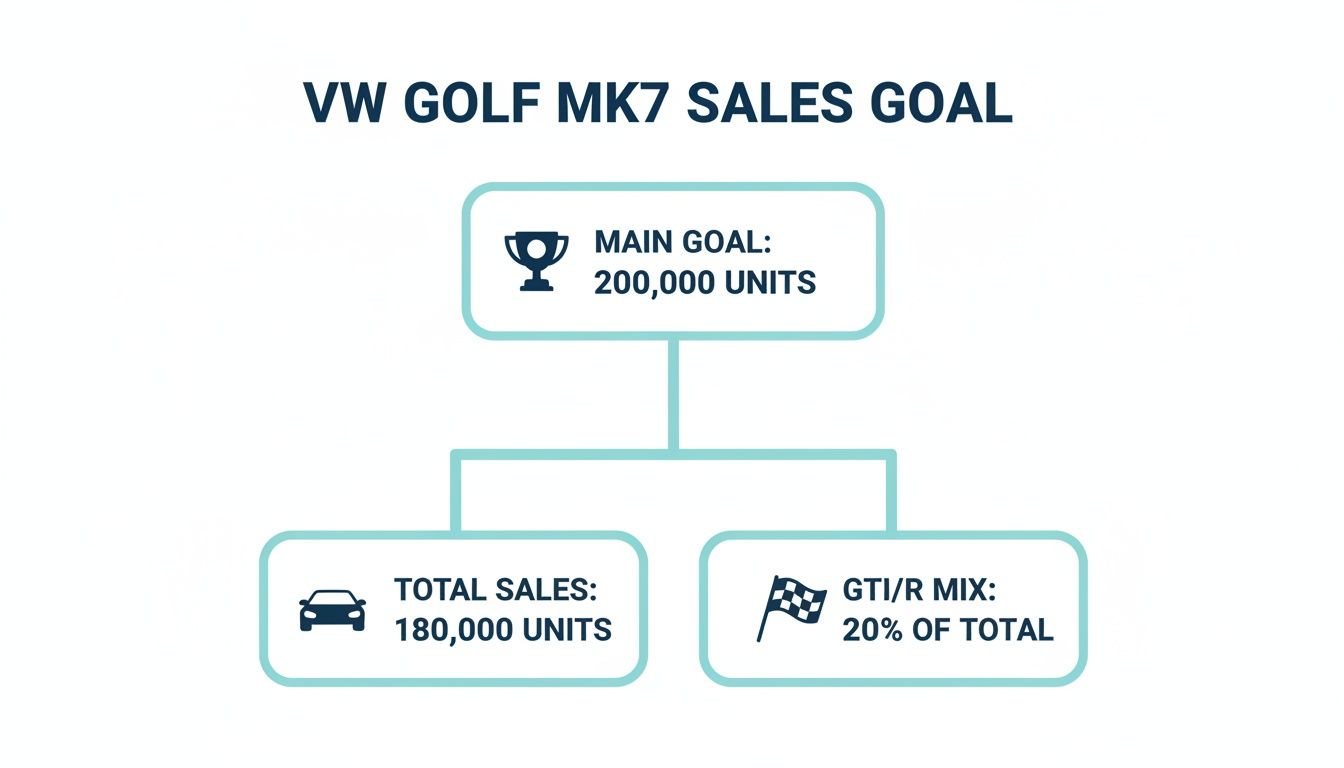

Your Coastal Decor Questions Answered

Got a few curly questions about creating a coastal look? No worries. This guide provides direct answers to help you finalise your decor choices.
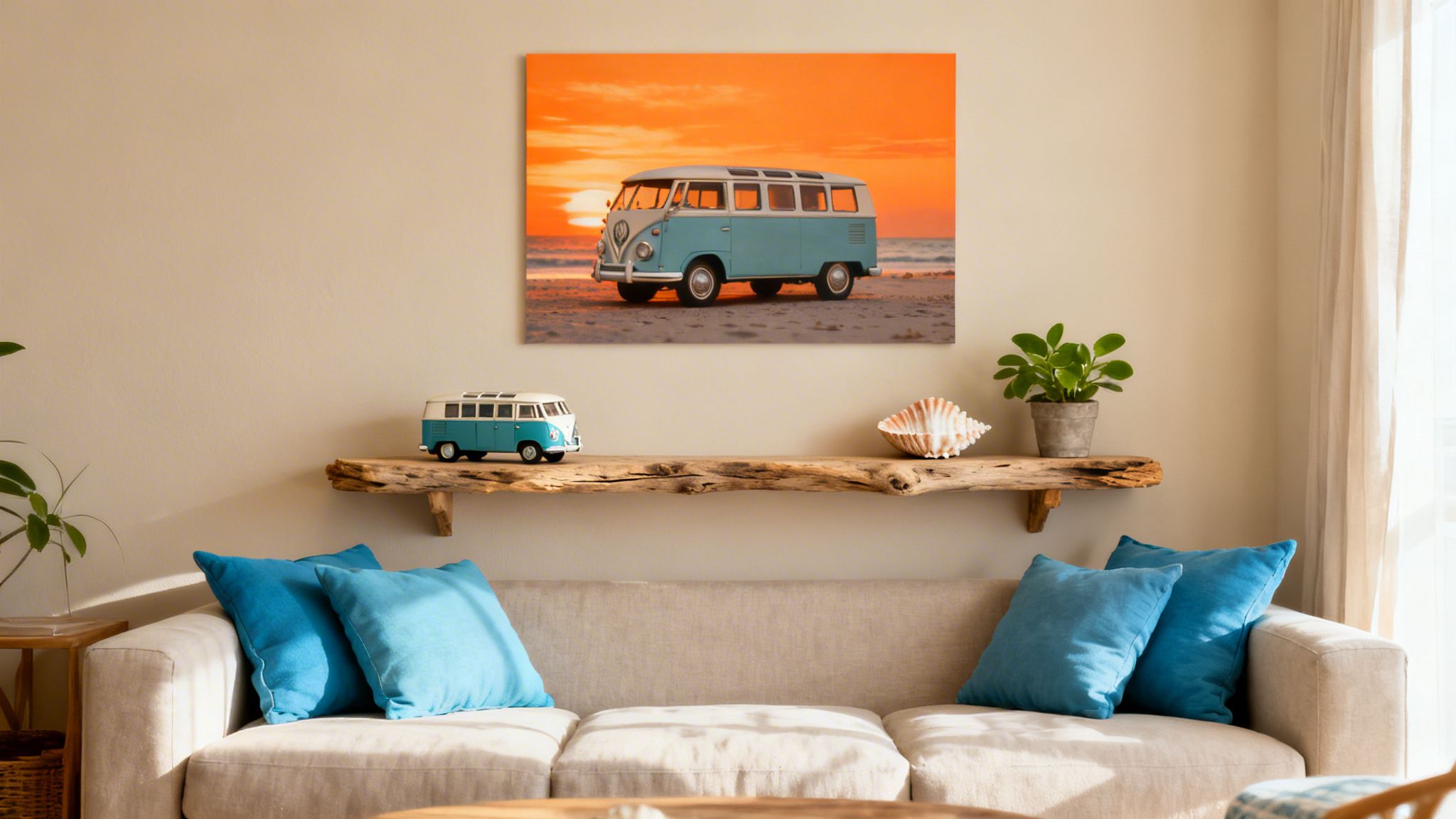
How Can I Make a Small Apartment Feel Coastal Without Clutter?

For smaller spaces, the focus is on light and simplicity.

Use light, sandy neutral wall colours to create a sense of space. Choose functional timber furniture, ideally with built-in storage. Avoid small, scattered items and instead select a few key statement pieces like a large beach print or a piece of driftwood.

A detailed Volkswagen Beetle model on a shelf offers a point of interest without adding visual clutter.

What Is the Difference Between Coastal and Nautical Decor?

There is a clear distinction between these two styles. Think of 'coastal' as the atmosphere and 'nautical' as a specific theme.

  • Coastal Style: Captures the relaxed feeling of the seaside. Achieved with light colours, natural textures (linen, rattan), and an open, airy layout.
  • Nautical Decor: Uses literal maritime motifs. Features items like anchors, ship wheels, and strong navy-and-white colour schemes.

A coastal home aims for the broader feeling of seaside life, while nautical is more specific.

Is Coastal Decor Expensive to Achieve?

Nah, it can be a very budget-friendly style due to its emphasis on simplicity and natural elements.

Decluttering and applying a fresh coat of sandy-coloured paint makes a significant impact. Look for second-hand timber furniture that can be sanded for a raw, natural finish. Incorporate found objects like shells and driftwood from the beach.

Affordable decor accents, such as VW memorabilia collectibles, are a cost-effective way to complete the look.


Ready to find those perfect finishing touches for your coastal theme? At Volkswagen Memorabilia, we're fellow VW lovers and official Australian importers, so we get it. We stock a huge range of officially licensed VW diecast models and decor that celebrate our iconic beach culture. Because we're local, you get fast shipping on all our in-stock items. Explore the shop today and find your next treasured piece.

Powered by the Outrank tool