

More than just a van, the van Volkswagen camper is a true blue symbol of freedom and the laid-back Aussie way of life. G'day! If you're anything like us, just the sight of a classic Kombi cruising down a coastal road brings a massive smile to your face. These legendary vans have taken countless surfers, families, and explorers on unforgettable trips, from sun-drenched beaches to the rugged outback.
They represent a simpler time, a bit of nostalgia, and the pure, unadulterated joy of hitting the open road.
The Volkswagen Camper Van: An Icon of Aussie Freedom
Anyone who's been to a Volksfest or a local car show knows there’s a special kind of magic to the classic VW camper, especially the mighty Kombi. It captures that unique mix of nostalgia for the ‘60s surf scene and a deep appreciation for simple, timeless design.
It’s the smell of salt in the air, the unmistakable rumble of an old air-cooled engine, and the sight of that friendly, rounded shape heading for the horizon. It's not just about transport, mate; it’s about the memories made along the way. The Kombi, in particular, is woven into our culture—a beloved part of Australia's story of sun, sand, and adventure.
From Road Trips to Room Décor
While many of us dream of owning a road-tripping classic, that same passion has created a vibrant world for collectors. The spirit of the Volkswagen camper van is captured perfectly in high-quality memorabilia. It’s a brilliant way for us to keep that feeling of freedom close, even when we’re not on the road.
The great thing about collecting is how it connects us to the design and history we love. A well-made diecast model isn’t just a toy; it’s a miniature piece of automotive history you can hold in your hands.
This passion fits beautifully into our homes, too. A carefully chosen 1962 VW Kombi Samba Bus diecast model on a shelf or some vintage-style wall art can bring that retro, coastal colour into any room. It's about celebrating a lifestyle, not just a vehicle.
Here at VW Memorabilia, we're fellow Aussie enthusiasts and local importers who just get it. We make sure every piece of VW memorabilia and collectibles we sell is officially licensed and has that authentic spirit you're looking for. Everything is stocked right here in Australia for fast, local shipping, helping you celebrate the VW legend every single day.
A Road Trip Through VW Camper History
The story of the van Volkswagen camper is one you can almost hear—the gentle rumble of an air-cooled engine, the sound of waves crashing, and the endless promise of the open road. It’s an Aussie legend, and it's a yarn worth spinning. Let's take a look back at the golden years that cemented this van's iconic status.
It all started with the one and only Type 2 (T1), the van every enthusiast knows simply as the ‘Splittie’. Born from post-war German ingenuity, its cheerful, simple design found its true calling when it hit Australian shores in the 1960s, right as surf culture was exploding.
The Legendary Splittie and the Samba Bus
If you close your eyes and picture a classic VW camper, chances are it’s a Splittie. That split-screen windscreen, the oversized VW badge, and the friendly v-shaped front end are pure automotive poetry. They arrived on our shores seemingly purpose-built for adventure and quickly became the vehicle of choice for surfers chasing the next perfect wave.
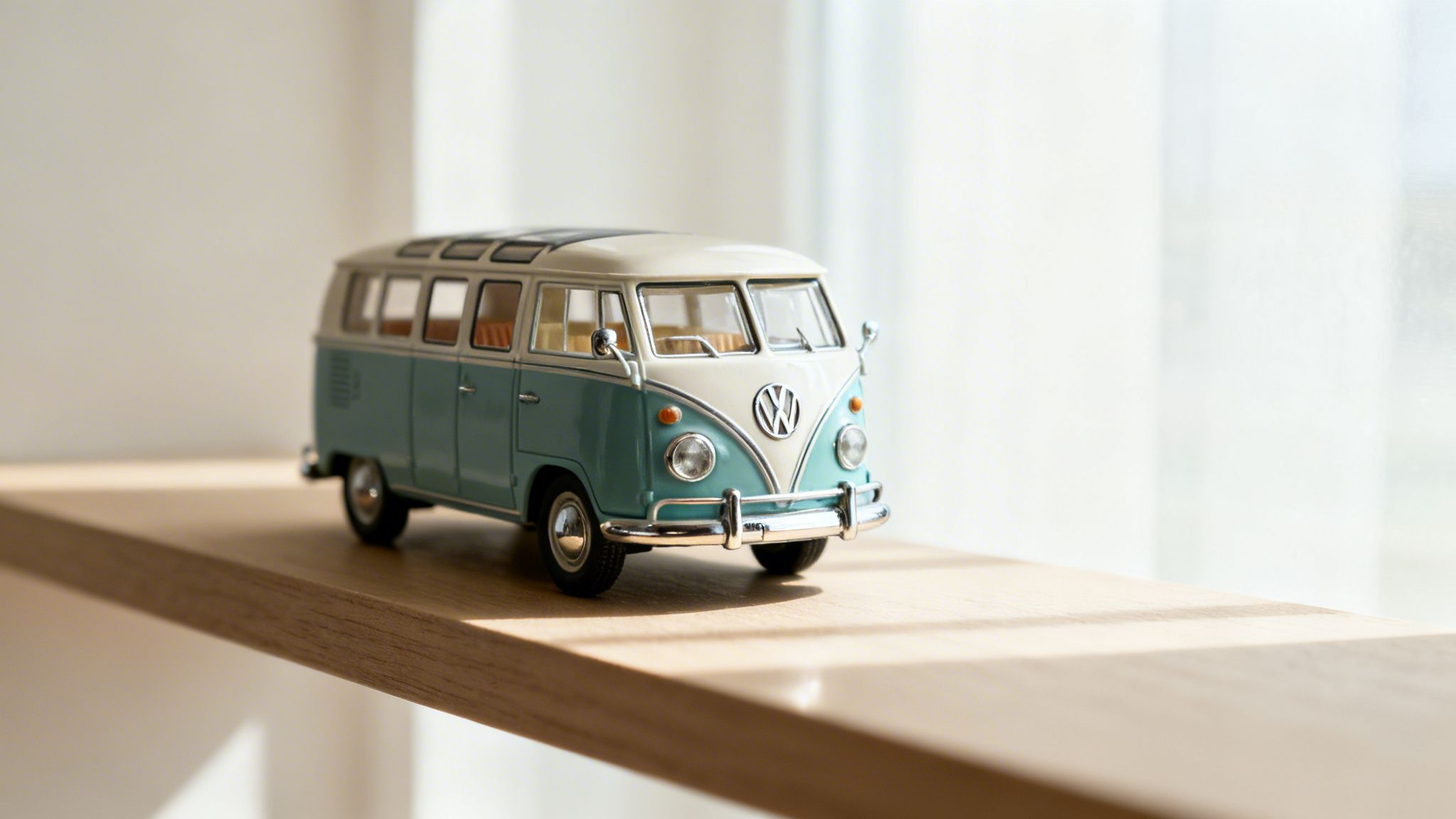
The absolute pinnacle of the Splittie range has to be the Samba Bus. It was the luxury model of its time, decked out with those gorgeous skylight windows and a massive, full-length fabric sunroof. The Samba was made for pulling up to the beach, rolling back the roof, and soaking in the Aussie sun. Finding a real one today is a serious treasure hunt, which is why collectors absolutely adore detailed diecast models that capture that same magic.
The Splittie isn’t just a van; it’s a time machine. It whisks you back to a simpler era of freedom, community, and endless summers, a feeling captured in every single one of its classic curves.
The Kombi’s rise wasn't just a trend; it was a full-blown cultural movement. After arriving here in the mid-1950s, its popularity exploded with the '60s surf boom. By 1964, over 5,000 VW Transporters had been imported, with camper conversions making up a huge 25% of sales. As the hippie movement took hold, those numbers shot up—between 1967 and 1972, imports doubled to around 10,000 vans a year as young Aussies pointed their noses toward Byron Bay and Noosa.
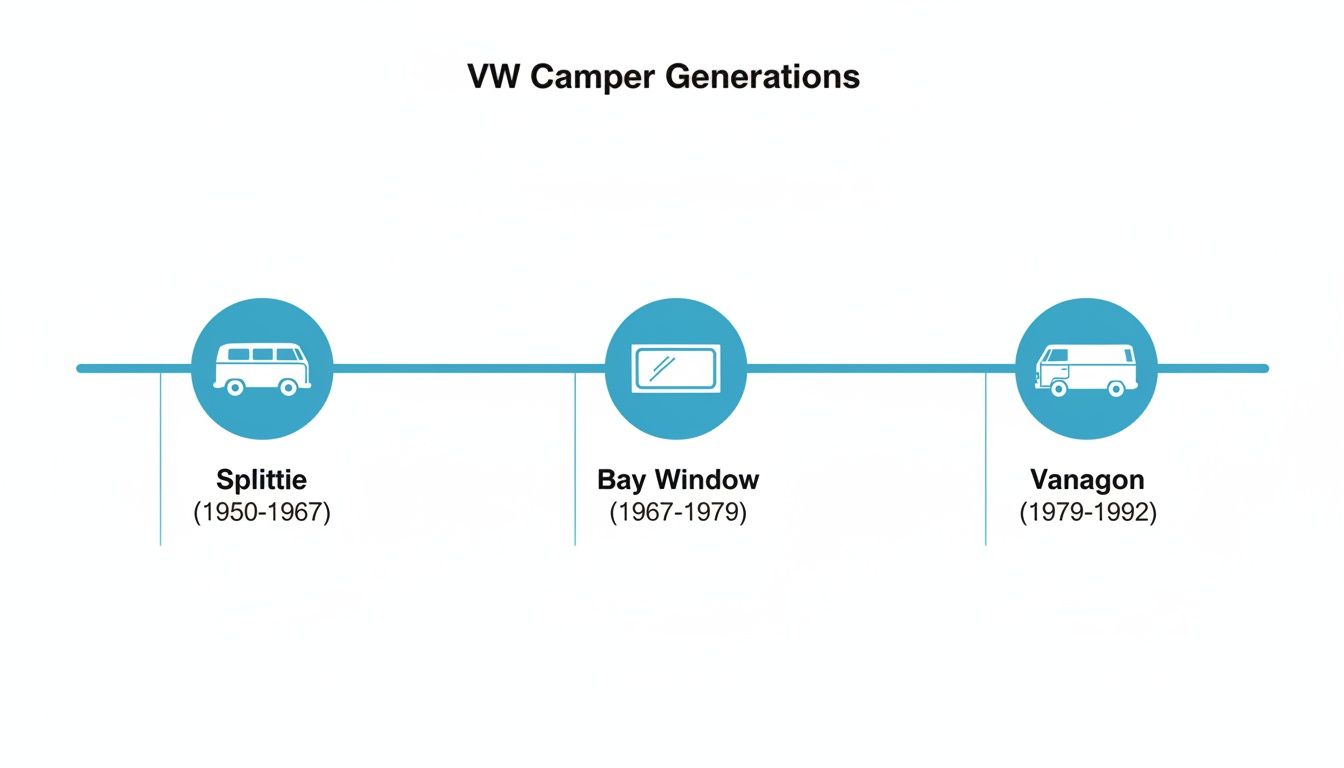
You can really see the evolution in that timeline, from the rounded, nostalgic Splittie to the more practical, angular vans that followed.
Cruising into the 70s with the Bay Window
As the swinging sixties made way for the seventies, VW knew it was time for an update. The Type 2 (T2) 'Bay Window' rolled out in late 1967, earning its nickname from the huge, single-piece curved windscreen that replaced the famous split screen.
This was more than just a facelift; it was a smart evolution. The Bay Window was roomier, had better visibility, and featured updated mechanics that made it a far more reliable partner for those big Aussie road trips. This was the van you could confidently pack for a massive trek from Perth to Sydney without crossing your fingers and toes.
A few key upgrades made the Bay an instant hit with families and long-distance travellers:
- A More Powerful Engine: It had a bit more grunt for climbing hills—a welcome change for anyone who's ever been stuck crawling up an incline behind an old Splittie.
- Improved Suspension: The new setup delivered a much smoother ride, turning marathon drives into comfortable cruises instead of bone-rattling ordeals.
- More Interior Space: Its slightly boxier body and higher roofline created more room for sleeping, cooking, and stashing gear—all essential for life on the road.
The Bay Window kept all the friendly character of its older sibling but added a healthy dose of practicality. It truly cemented the camper's place in the hearts of Aussie adventurers, perfectly suiting a generation ready to explore every last corner of this country. You can dive deeper into this lifestyle in our guide to the Volkswagen travel van.
The Modern Era of Volkswagen Campers
While our hearts will always have a soft spot for the classic Splitties and Bays, the adventure certainly didn't end in the seventies. The story of the van Volkswagen camper just kept rolling on, adapting to new times while holding onto that free-spirited core we all love.
As we headed into the 1980s, the design language started to shift. The friendly, rounded curves gave way to something a bit more modern and angular.
Enter the Type 2 (T3), which many of us know affectionately as the 'Vanagon'. With its sharper lines and bigger windows, the T3 dragged the beloved camper into a new decade. It was roomier inside and had a few more creature comforts, but the real game-changer for Aussie adventurers was the Syncro model.
Conquering the Outback with the T3 Syncro
The T3 Syncro was a genuine trailblazer. Volkswagen teamed up with Austrian specialists Steyr-Daimler-Puch to fit it with a brilliant four-wheel-drive system. This wasn't just some afterthought; it was a seriously tough 4WD setup that turned the humble camper into a proper off-road explorer.
Suddenly, those rugged tracks leading to hidden beaches and remote bush campsites were well within reach. The Syncro was perfectly suited to Australia’s tough-as-nails terrain.
- Serious Off-Road Capability: It could handle sand, mud, and corrugated roads that would leave a standard two-wheel-drive van spinning its wheels.
- More Powerful Engines: Later models got the water-cooled 'Wasserboxer' engines, giving them more reliable power for those long-haul trips up the coast.
- Classic Pop-Top Freedom: It still had the iconic pop-top roof, so you could venture further afield without giving up that classic, sleep-under-the-stars camper experience.
The T3 Syncro was the perfect bridge between old-school charm and modern capability. It’s no wonder they have such a massive following today, especially among folks who love getting properly off the beaten track.
Down under, the VW camper van truly became a coastal icon in the 1970s, fitting right in with Australia's laid-back beach lifestyle. The T2 Bay Window, introduced here in 1968, was even adapted for our harsh conditions. By 1975, Aussies had bought over 15,000 of them, making up 20% of all light commercial imports that decade, according to FCAI stats. At the legendary 1971 Aquarius Festival in Nimbin, an estimated 2,000 VW campers rolled in — that was 60% of all vehicles there, sparking a van life revolution. You can dive deeper into this story with this fascinating history of the VW campervan.
The Sophisticated Campers of Today
Fast forward to today, and Volkswagen has continued to refine the camper van concept. This evolution brought us the much-loved Transporter series (T4, T5, T6) and, eventually, the luxurious Volkswagen California. These aren't just vans with a mattress in the back; they're fully integrated mobile homes designed from the ground up for comfort, convenience, and style.
The modern VW California is a testament to how far the camper has come. It takes the original promise of freedom and wraps it in a package of modern technology and comfort that Ben Pon could only have dreamed of.
Today’s California models—like the Beach, Coast, and Ocean—are packed with features that make life on the road incredibly easy. We're talking about integrated kitchens with gas cookers, clever driver-assist technologies, and smart interior layouts with two sliding doors for total flexibility. They even have digital control panels for managing everything from the heating to the electric pop-top roof.
They might look a world away from the classics, but the spirit is exactly the same: a reliable, cleverly designed vehicle that gives you the freedom to just get out and explore. In their own way, they honour the legacy of the original van Volkswagen camper by making adventure accessible to a whole new generation of road-trippers.
Your Guide to Collecting VW Camper Diecast Models
Let's be honest, while owning a full-sized classic VW is the dream for many of us, it’s not always practical. But you can still capture that timeless charm—in stunning detail—right in the palm of your hand. For so many enthusiasts, collecting diecast models is the perfect way to dive into a lifelong passion for these vans. It's a fantastic hobby that connects you to the history and spirit of these iconic vehicles, no garage required.
So, where do you even begin? The world of diecast collecting can feel a bit full-on at first, with all the different scales, brands, and details to consider. Think of this as a friendly chat, like you’d have with a mate at a car show, to get you started on a collection that brings a smile to your face.
Cracking the Code on Diecast Scales
The first thing you’ll bump into is the scale, which is just a simple way of describing the model's size compared to the real deal. Getting your head around the common scales helps you figure out what’s right for your space and your collecting goals.
-
1:18 Scale: This is the big kahuna. These large, impressive models are absolutely packed with detail—we’re talking opening doors, bonnets, and even tiny engine bays. They make for a jaw-dropping centrepiece on any shelf.
-
1:24 Scale: A brilliant middle ground. Models in 1:24 scale have a fantastic balance of intricate detail and manageable size. They're big enough to show off all the cool features but small enough that you can build a decent collection without needing a whole new room.
-
1:43 Scale: This is a true classic and probably the most popular scale for serious collectors. It lets you display a huge variety of models in a small space, making it easy to line up the whole history of the VW camper side-by-side.
-
1:64 Scale: Think Matchbox or Hot Wheels. These little guys are affordable, fun, and the perfect excuse to build a massive collection. They might have less fine detail, but they’ve got a nostalgic charm all their own.
If you’re just getting your feet wet, the 1:24 and 1:43 scales are a fantastic place to start. They offer a superb collecting experience, letting you appreciate the finer points without the big footprint of the 1:18 models.
What to Look for in a Quality Licensed Model
You’ll quickly realise that not all diecast models are created equal. To make sure you’re getting a genuine collector’s piece, always look for officially licensed products. It’s your guarantee that the model was made with Volkswagen’s blessing and held to a high standard of accuracy.
A great licensed model isn't just a tiny car; it’s a faithful tribute. It nails the authentic colours, the correct badges, and all the little interior details that make you feel like you’re looking at the real van, just shrunk down.
When you’re looking to buy diecast Kombi models, here’s what separates the good from the great:
- Factory-Accurate Paint: Does the colour match a real VW paint code from that era? The best models will perfectly replicate the exact shades, especially those iconic two-tone schemes on a Splittie.
- Intricate Interior Details: Take a peek inside. Can you spot the tiny gear stick, the patterns on the seats, or a miniature steering wheel with the proper VW logo? Those are the signs of a premium model.
- Authentic Wheels and Tyres: The wheels should look right for the era, right down to the hubcaps. Some high-end models even feature real rubber tyres for that extra touch of realism.
- Crisp Badges and Logos: The Volkswagen emblem and any model scripts should be clean, sharp, and placed exactly where they belong.
A real standout for any collection is a 1962 VW Kombi Samba Bus diecast model. A quality version will have all 21 windows, the fabric-look sunroof, and that gorgeous two-tone paint job recreated perfectly. It’s a definite must-have.
The Perk of Buying from a Local Aussie Importer
When you’re ready to add a new piece to your collection, where you buy from really does matter. A quick search for "VW Kombi diecast Australia" will throw up plenty of options, but choosing a local Aussie importer like us here at VW Memorabilia has some real perks.
First off, you get your models faster. No more waiting weeks on end for international shipping to clear customs. All our Volkswagen diecast models for sale are stocked right here in Australia, so you can have your new pride and joy on display in days, not months.
Plus, you’re supporting a local, family-run business packed with fellow VW lovers! It’s all about that friendly, community spirit that makes the VW scene so special.
Styling Your Home with VW Memorabilia
That feeling you get from a van Volkswagen camper isn’t just for the open road. It's a whole vibe—that sun-drenched, laid-back coastal feeling. And the best part? You can bring that same energy right into your home. Your love for all things VW doesn't have to be parked in the garage; it can be a source of joy and unique style in your living space every single day.
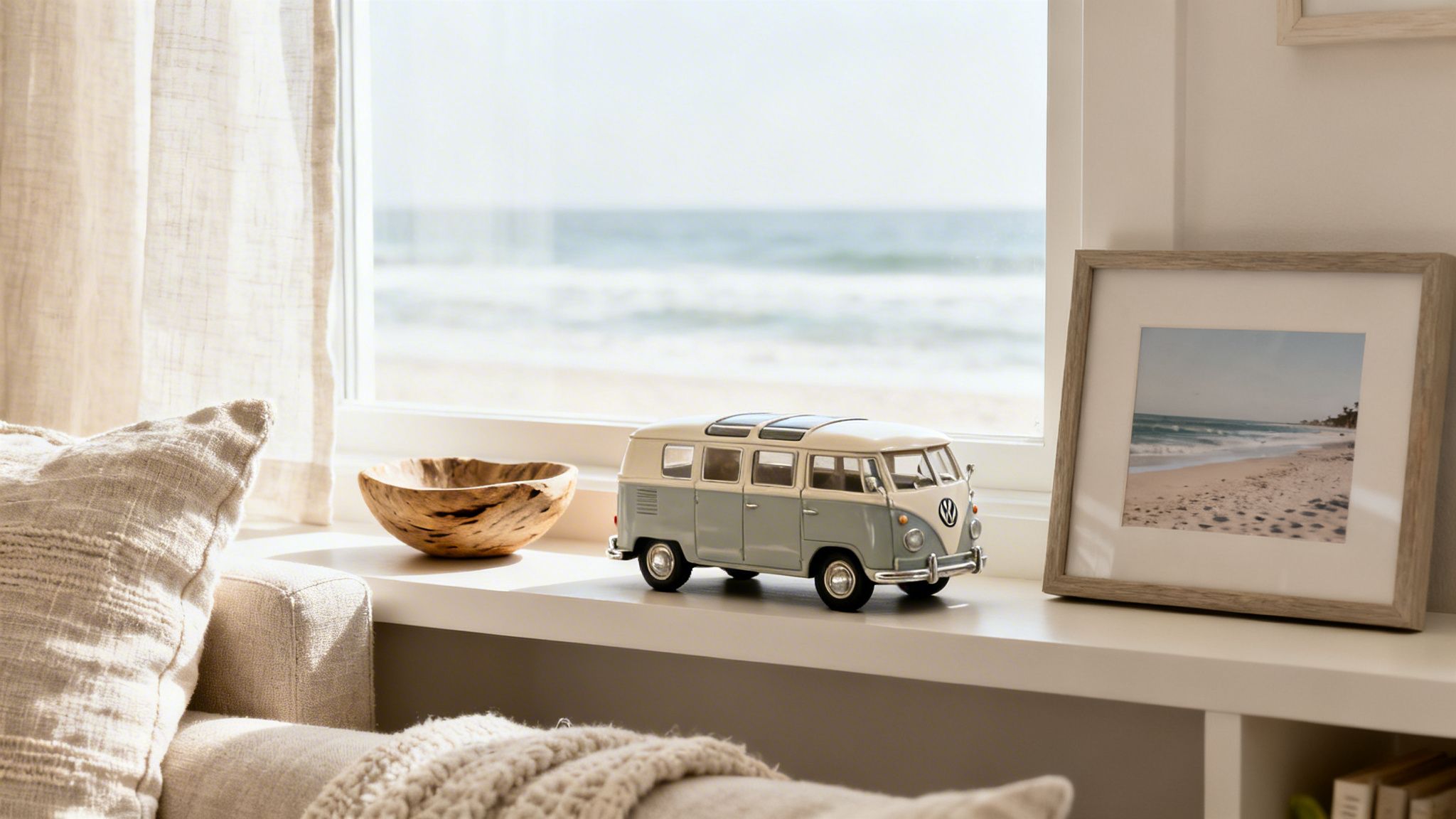
This isn't about sterile, cookie-cutter decorating. It's about creating a home that tells a story—your story. It’s all about weaving your passion for classic automotive design into a warm, inviting style. A beautifully made diecast model or a piece of retro wall art does so much more than just fill an empty spot; it sparks conversations and brings back great memories.
Making Your Diecast Models the Star
A quality diecast model, like a detailed VW Kombi diecast from Australia, is really a miniature work of art. It deserves to be shown off! Don’t just hide it on a shelf somewhere; make it a real feature piece. A stunning model can instantly inject character and a splash of retro colour into any room.
Here are a few simple ideas to get you thinking:
- The Bookshelf Centrepiece: Pop a striking 1:18 or 1:24 scale model right on a main bookshelf. Sit it between your favourite books and a couple of small potted plants to create a cool little scene that naturally draws the eye.
- The Home Office Companion: What’s better than a little reminder of freedom sitting on your desk to get you through the workday? A smaller 1:43 scale model of a classic Volkswagen Beetle model is perfect for adding personality without hogging your workspace.
- The Hallway Welcome: Greet your guests with a bit of VW charm. A narrow shelf in the entryway with a lineup of colourful Beetle models or a classic Samba Bus is a brilliant way to make a fun first impression.
Think of your diecast model as more than a collectible. It’s a miniature sculpture that stands for adventure, freedom, and timeless style. When you give it pride of place, it lifts the mood of the entire room.
This way, your collection becomes an active part of your home's look, celebrating your passion in a way that’s both stylish and deeply personal.
Creating a Cohesive Coastal Vibe
The VW camper and the Aussie beach scene go hand in hand, which makes it the perfect match for coastal or nautical-themed decor. The real trick is to blend your VW memorabilia with other elements to create a look that feels genuinely relaxed, not just cluttered.
First up, think about your colour palette. Sandy whites, soft blues, and driftwood greys create the perfect backdrop for the vibrant pop of colour from a red or turquoise diecast Kombi. You can have a look through our collection of vintage home accessories for some inspiration on how to mix and match.
Look for other items that have that same nostalgic, simple feel. A vintage-style metal sign with a classic VW ad looks fantastic hanging next to a rustic photo frame holding a picture of your favourite beach. You can also mix in subtle nautical touches, like rope-wrapped vases or decorative starfish, to round out the look. The goal is to create a space that feels like a permanent holiday—a breezy, personal retreat that celebrates the things you love.
Your VW Camper Questions Answered
Still got a few questions buzzing around your head like a happy little air-cooled engine? You’ve come to the right place, mate. This is where we tackle some of the most common queries we hear from fellow enthusiasts about the iconic Volkswagen camper, collecting memorabilia, and the vibrant culture that surrounds it all.
Think of it as our friendly chat over a cuppa at Volksfest. Whether you're a seasoned collector with a cabinet full of treasures or just kicking off your journey into the world of VW, we're here to share our passion and help you along the way.
How Much Is a Classic VW Camper Worth in Australia?
This is the million-dollar question—well, not quite, but prices are certainly climbing! The market for classic VW campers in Australia is hotter than a tin roof in a Queensland summer. A van's value really comes down to the model, its condition, and how original it is.
The last decade has seen an explosion in the classic VW camper scene here. The VW Camper Club Australia logged 25,000 active classic registrations in 2023, a staggering 200% rise since 2010. A huge 45% of these are the iconic 1950-79 models used for coastal camping.
Auction houses like Pickles are reporting average sale prices for restored Splitties hitting AUD 75,000 in 2026—that’s a 250% increase from AUD 25,000 back in 2015. A clean T2 Bay isn't far behind, fetching around AUD 55,000. You can get a great feel for the history and the celebration of 70 years of the VW Campervan to understand the enduring love for these vans.
Which VW Camper Model Is Best for Collecting?
Ah, another cracking question! "Best" is always in the eye of the beholder, but a few fan favourites really stand out that every collector dreams of getting their hands on.
-
The Splittie (T1): This is the original icon. Any Splittie is a prize, but the absolute holy grail is the Samba Bus with its signature skylight windows and fabric sunroof. A detailed 1:24 or 1:18 scale Samba makes for a true centrepiece in any collection.
-
The Bay Window (T2): For so many of us, this is the van that represents the great Aussie road trip. Keep an eye out for models with classic '70s paint colours or camper-specific details like a pop-top roof.
-
The T3 Syncro: For those who love a bit of adventure, a diecast T3 Syncro represents the rugged, off-road evolution of the camper. They're a bit rarer to find but a fantastic addition to the shelf.
At the end of the day, the best model to collect is the one that puts a smile on your face. It might be a model of a Volkswagen Beetle model that reminds you of your first car, or a Kombi that looks just like one you spotted on a holiday.
What’s the Difference Between a Kombi and a Camper?
This one trips a few people up, but it's pretty simple once you break it down. Just think of it like this:
"Kombi" is the nickname for the van itself—the Volkswagen Type 2. A "Camper" is what you turn it into!
"Kombi" is just short for the German Kombinationskraftwagen, which translates to "combination vehicle." It was cleverly designed to carry both passengers and cargo. A camper, on the other hand, is a Kombi that has been fitted out with all the camping essentials like a bed, cupboards, and sometimes a small kitchen. You could buy a basic Kombi, and a third-party company (like Westfalia in Europe or local Aussie converters) would work their magic.
So, while every VW camper is a Kombi, not every Kombi is a camper. Simple as that.
Can You Still Use a Classic VW Camper for Trips Today?
Absolutely! That’s what they were built for, after all. All across Australia, you’ll find dedicated owners keeping these classics on the road, heading to the beach, music festivals like VW Nationals, and local Show & Shine events. Owning a classic does demand a bit more love and attention than a modern car—you have to get comfortable with their quirks and a much slower pace.
But that’s all part of the charm! The key is regular maintenance and becoming part of the community. There are fantastic clubs and online groups full of knowledgeable people who are always happy to share advice on keeping your classic van Volkswagen camper running sweetly. For those of us who prefer to admire them from home, a stunningly accurate diecast VW Kombi is the next best thing!
Ready to celebrate the spirit of the open road? At Volkswagen Memorabilia, we’re fellow enthusiasts passionate about bringing you the best licensed diecast models and coastal décor. Explore our collection and find the perfect piece to fuel your passion.
Find your next treasure in our online shop.