

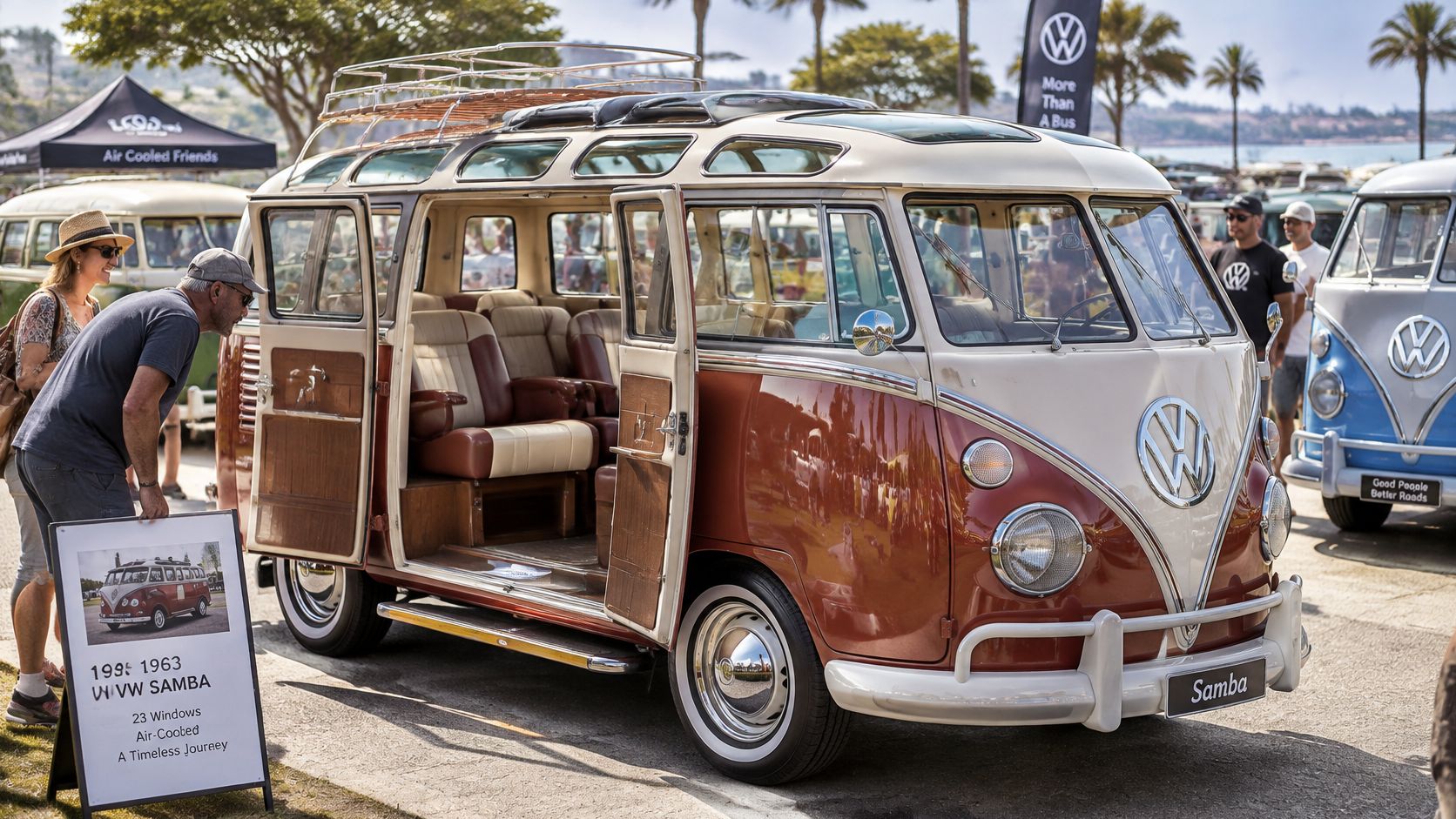
Say you're at a sunny Sunday show, a brown and cream split-window parked between two ordinary Kombis, and a mate asks what the bus is worth. The paint is glossy. The roof glass throws the light. That still doesn't tell you if the body is original, or whether the little VW Samba Bus on your bookshelf will fit the cabinet you've already measured. Looks win the conversation. Originality and the space on the shelf decide what you should pay, and what you should take home.
The VW Samba Bus at a Glance
At a sunny car show, the extra roof windows catch your eye first. On a full-size Samba, the 23-window layout and upgraded passenger seating help distinguish it from a standard Kombi, though a similar paint scheme alone proves little.
For a useful reference point, the 1963 Samba specifications listed by carsales describe a 23-window Deluxe Microbus with a rear-mounted, air-cooled 1,192 cc flat-four, four-speed manual, rear-wheel drive, four doors and eight seats. Period output was about 27 kW (36 bhp), with a top speed around 90 km/h. Its modest pace suits a bus built for carrying people and gear.
Samba Bus specification baseline
| Feature | Samba Bus detail |
|---|---|
| Engine | 1,192 cc air-cooled flat-four, rear-mounted |
| Output | About 27 kW (36 bhp) |
| Top speed | About 90 km/h |
| Transmission and drive | Four-speed manual, rear-wheel drive |
| Body and seating | Four doors, eight seats (Microbus) |
| Roof windows | 23-window configuration |
| Australian layout | Right-hand drive on locally delivered examples |
A 23-window roof, eight-seat Microbus layout and right-hand-drive configuration make a bus worth examining closely. Those details identify the model; they do not, by themselves, establish that its parts and specification are original.
Why the Samba Became a Surf and Freedom Icon
The story starts on paper. Volkswagen Australia's Kombi history dates the van to 1949, when Dutch businessman Ben Pon's sketch joined Beetle ideas to a roomier body. Australia took the Type 2 early. The Club VW chassis reference records the first Transporters sold here in 1954, local assembly from 1955 at the Clayton factory in Melbourne on German-pressed complete-knock-down kits, and production continuing through 1976. For more than two decades the bus was put together locally, not only landed as a finished import.
The split-window shape had a shorter life than that factory run. Retro Rides' Kombi buyer's guide notes that generation ended in 1967, when the wider bay-window body replaced it. The Samba sat at the premium end of that split-screen run, with the extra glazing, the better seats and, often, the folding roof.
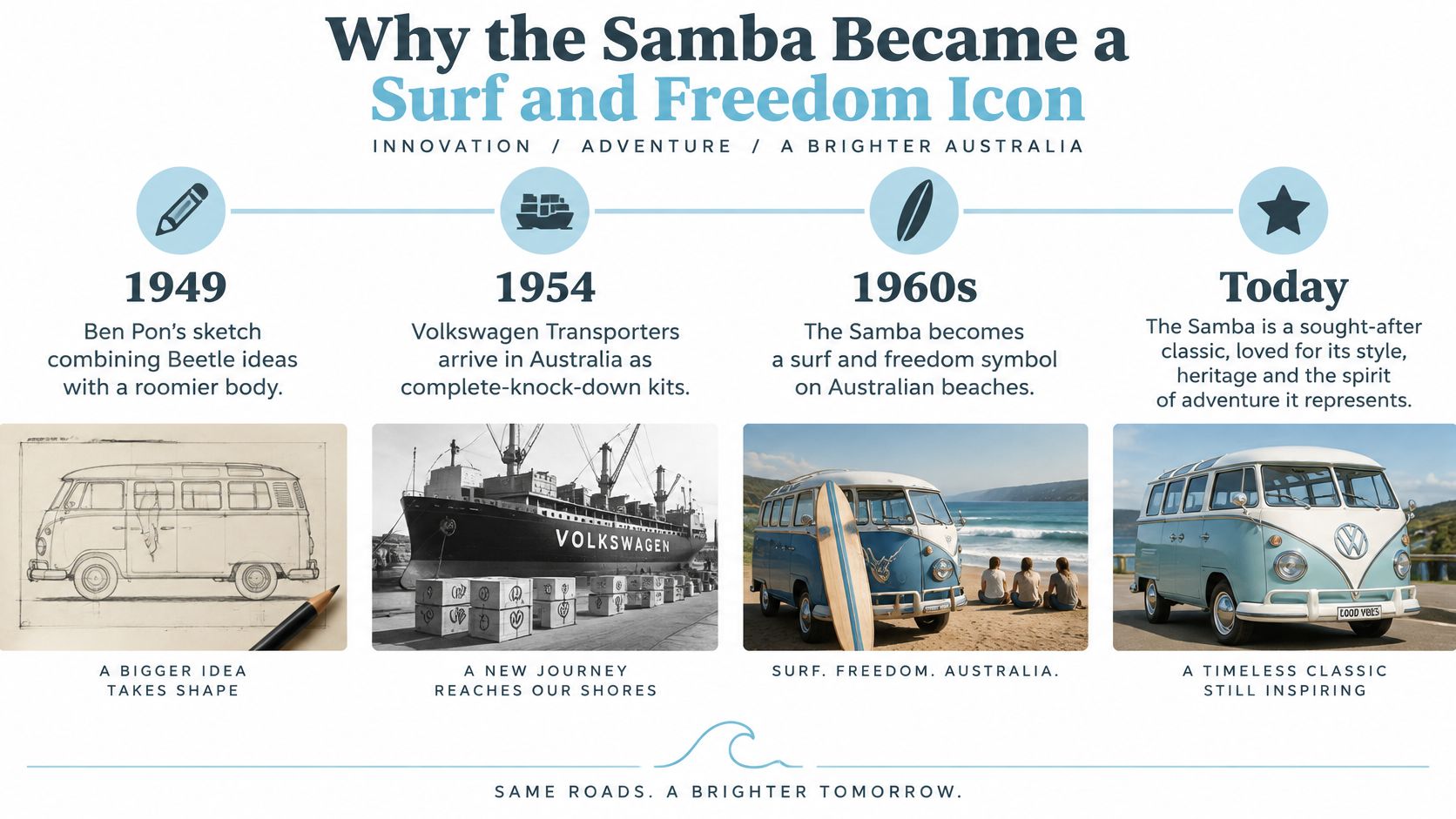
Through the 1970s surfing boom, owners ran the east and west coasts with boards strapped to the roof. Treat the Samba as a campervan that doubles as a surf shack on wheels, the van people kept long after it stopped being the sensible daily. Local assembly is why an Australian bus can differ from a European one in drive side and fittings. The Kombi's life in Australia is the backdrop those differences sit in.
A glossy roof doesn't make the bus. The windows, the seats and the local build do.
Spotting a Genuine Samba Bus and Its Value
Say a buyer finds a split-screen bus with bright paint and a tidy interior at a sunny Australian car show. The looks may draw a crowd, but originality is what shapes its value. Before considering the finish, compare the chassis and body numbers with the paperwork, check the window layout, and confirm that the documented drivetrain matches the vehicle. A later import or converted Microbus can resemble a Samba without having the same history.
Look closely at the roof-window openings, walk-through body and folding-roof surround before any panel work begins. Photograph and document them. A replacement roof can look convincing while reducing the historical value of a bus represented as an Australian-delivered Samba.
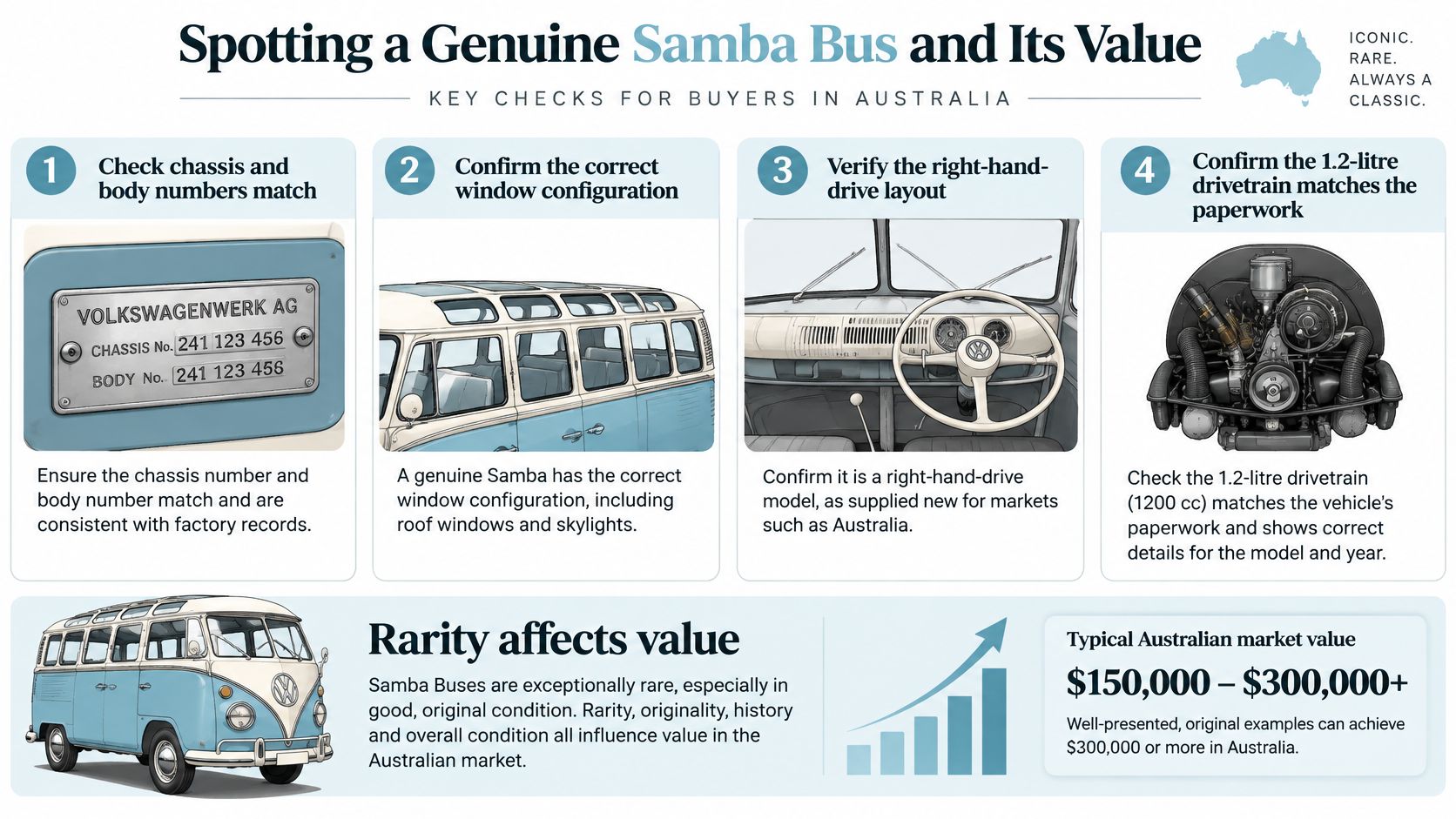
Market figures provide context, not a valuation for one particular bus. AutoMarkets' 2025 Type 2 Kombi market recorded an average sale of AUD 51,808 across 21 Australian Volkswagen Type 2 (Kombi) auction results, ranging from AUD 6,500 to AUD 91,000. The range is broad, so condition, originality and provenance still need to be assessed on the vehicle itself.
Australian Type 2 and Samba price references
| Market reference | Reported price (AUD) |
|---|---|
| Average Type 2 (Kombi) auction sale, 21 sales, AutoMarkets 2025 | 51,808 |
| Type 2 auction results, 21 sales | 6,500 to 91,000 |
| T1 Kombi sales since 2025, seven recorded | 38,000 to 65,500 |
A bus with a later engine should not be priced like an untouched example. Rust repairs, a missing roof section and incomplete provenance all affect the picture, whatever the badge says. For an overseas purchase, the Australian Border Force motor vehicle import guide sets out the import approval process and possible charges, including duty, GST and luxury car tax. Factor those costs in before committing.
Before you hand over the money:
- Match the numbers: Check the chassis and body against the papers.
- Count the glass: Confirm the roof-window layout rather than relying on a seller's description.
- Inspect the roof: Look for repairs or replacement panels around the folding-roof surround.
- Ask for Australian delivery history: Request documents to support claims about local build and right-hand drive.
- Collect restoration receipts: Use the records to understand what has changed, including mechanical work.
Once originality and condition are clear, a diecast model offers a way to enjoy the Samba silhouette without the demands of owning a registered bus. Volkswagen Memorabilia sells diecast Volkswagen decor, including models in its Kombi diecast range.
Choosing the Right Diecast Samba Bus Scale
Scale is a shelf problem, not a trivia question. Measure the cabinet first, then pick the model that lives there without crowding the Beetle beside it.
Diecast Samba Bus scales and packing
| Scale | Approximate size | Notable features |
|---|---|---|
| 1:18 | Largest of the three; a printed length isn't stated on typical listings | Largest scale for a cabinet or showpiece |
| 1:24 | About 7 inches (17.5 cm) | Doors open, free wheeling, decorated versions available |
| 1:32 | About 5 inches | Doors open, free wheeling, pull-back action |
A 1:18 is the showpiece, and you should measure the shelf because listings often skip a length. A 1:24 is the everyday Samba scale for a bookcase. A 1:32 tucks into a crowded display.
The 1962 Volkswagen Kombi Samba Bus diecast in a window box is 1:24. That window-box Samba comes in three colours and is sold as a mixed pack of 12, which suits a small shop display as well as a home shelf.
Fit the shelf first: Choose 1:24 for most gifts and displays, 1:32 when the collection is already tight, and 1:18 when one model is meant to be the centre of the cabinet.
Three common buys don't need the same model.
A birthday for a VW fan is usually the 1:24 in its window box. The packing is the present, and the bus sits at eye level on a bookcase without swallowing the shelf.
A surf corner wants a decorated body that sits with beach décor and a framed period photo. Colour and graphics matter more than an extra centimetre of length. Our guide to diecast model scales is the place to line those sizes up before you choose a paint scheme.
A compact run of vans is where 1:32 earns its keep. Doors still open, the wheels still free-wheel, and pull-back action gives you something to fidget with at a show. Keep the box. A model with its inner packing is easier to store upright and easier to pass on later.
When the scale matches the space, look through the Volkswagen diecast models for sale. Bring the new bus to the next local show and swap a photo with the people who already know a 23-window roof from a panel van.
What to Check in a Quality Licensed Model
A licensed model should survive a two-minute check at the bench. Skip any box that hides the branding.
- Licensed branding and a clear item number: You can match the box to the model later, which matters for insurance and a resale listing.
- Scale printed on the pack: It should be the size you measured for, not a surprise once the tissue comes off.
- Even paint: Runs or an orange-peel texture show up under show lighting and don't settle with age.
- Straight decals: Flower Power graphics should sit level. A crooked flower is a manufacturing slip, not a period look.
- Doors that open and close: They shouldn't bind on the pillar or spring back half shut.
- Free-wheeling axles: Spin each wheel. A tight axle usually means a bent pin, not a feature.
- Clear window glazing: Scratches in the plastic read as dirt from across the room.
- Intact window box and inner packing: The carton protects the resale value as much as the paint does.
Buying from an Australian importer with local stock usually means the parcel moves faster than an overseas order, and you can see the item details before it leaves. You can call us on 02 49544100, weekdays from 9 am to 2 pm, if a listing needs a second look. A model that passes these checks is one you'll still enjoy in ten years. When you're ready to compare licensed pieces, the VW memorabilia collectibles are grouped so the Samba, the Beetle and the surf-themed vans sit in one browse.
Displaying and Caring for Your Samba Model
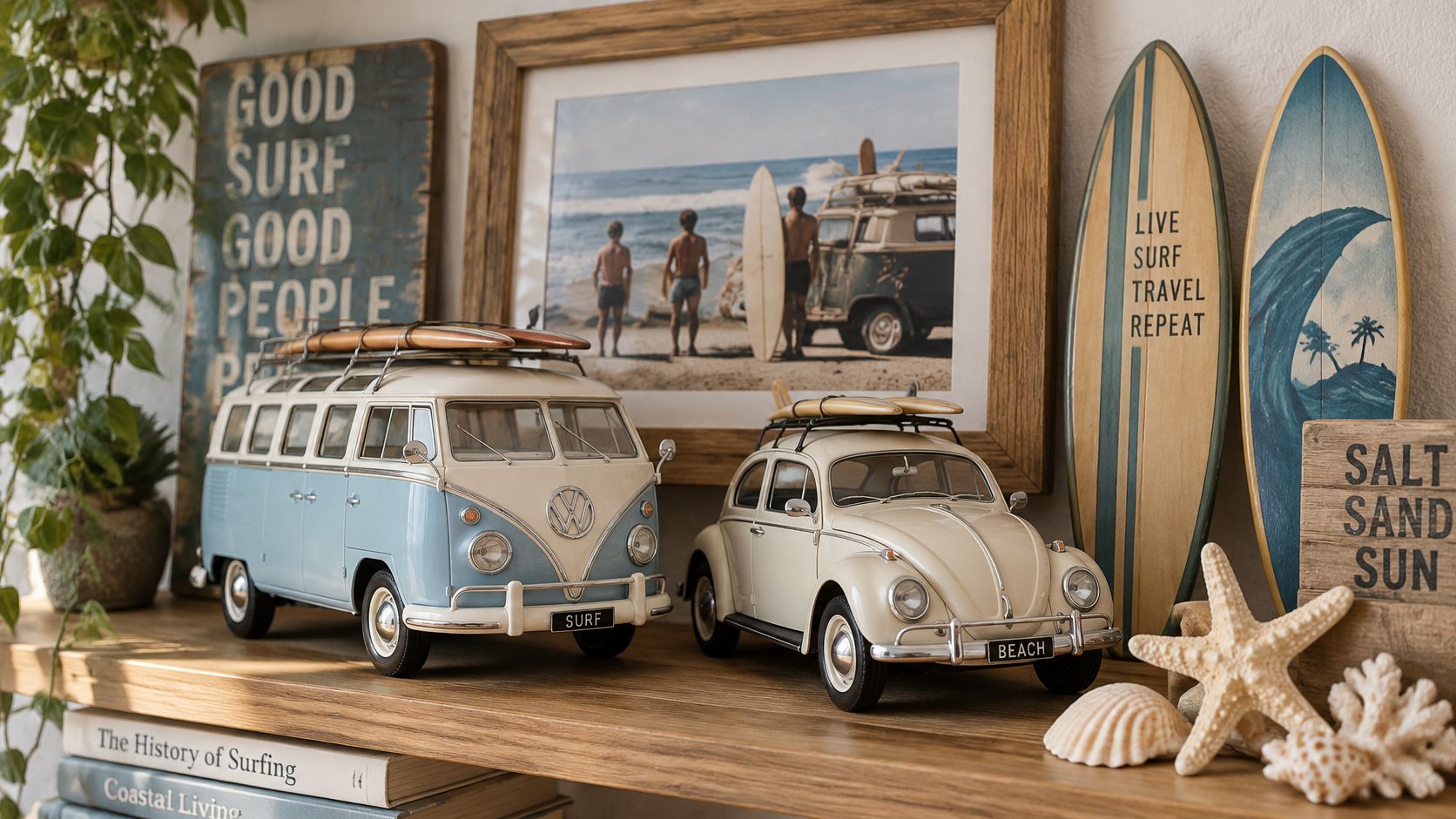
Shift from the showground to the shelf. A surf corner works when the Samba sits with a Volkswagen Beetle model, a bit of beach décor and one framed period photograph. The group tells a visual story without a paragraph of caption.
Light, dust and handling
Keep the models out of direct sun. Strong light fades paint and yellows plastic, and a north-facing window in an Australian lounge does that faster than people expect. A closed cabinet or a dust cover keeps grit off the glazing. Our notes on display cases for models cover the enclosed options if an open shelf is already dusty.
Hold the body, not the mirrors. Open the doors gently, and give the free-wheeling wheels a turn every so often so the axles don't sit seized. Store window boxes upright, not stacked, with nothing heavy on the lid.
Keeping the collection findable
Group by era, by colour or by scale, and stick to one system. A mixed shelf looks busy and makes a missing model harder to spot. Record item numbers and packing details in a simple spreadsheet, and photograph each model against a plain background. Those photos help with insurance and with a later sale, and they take less time than hunting through tissue paper on a Saturday morning.
Volkswagen Memorabilia keeps licensed Volkswagen diecast, including Kombi and Samba Bus models, alongside coastal décor for the same shelf. If a full-size bus is out of reach, a properly scaled model still carries the roof windows, the two-tone paint and the surf-era feel. Visit Volkswagen Memorabilia and pick the Samba that fits the cabinet you've already got.