

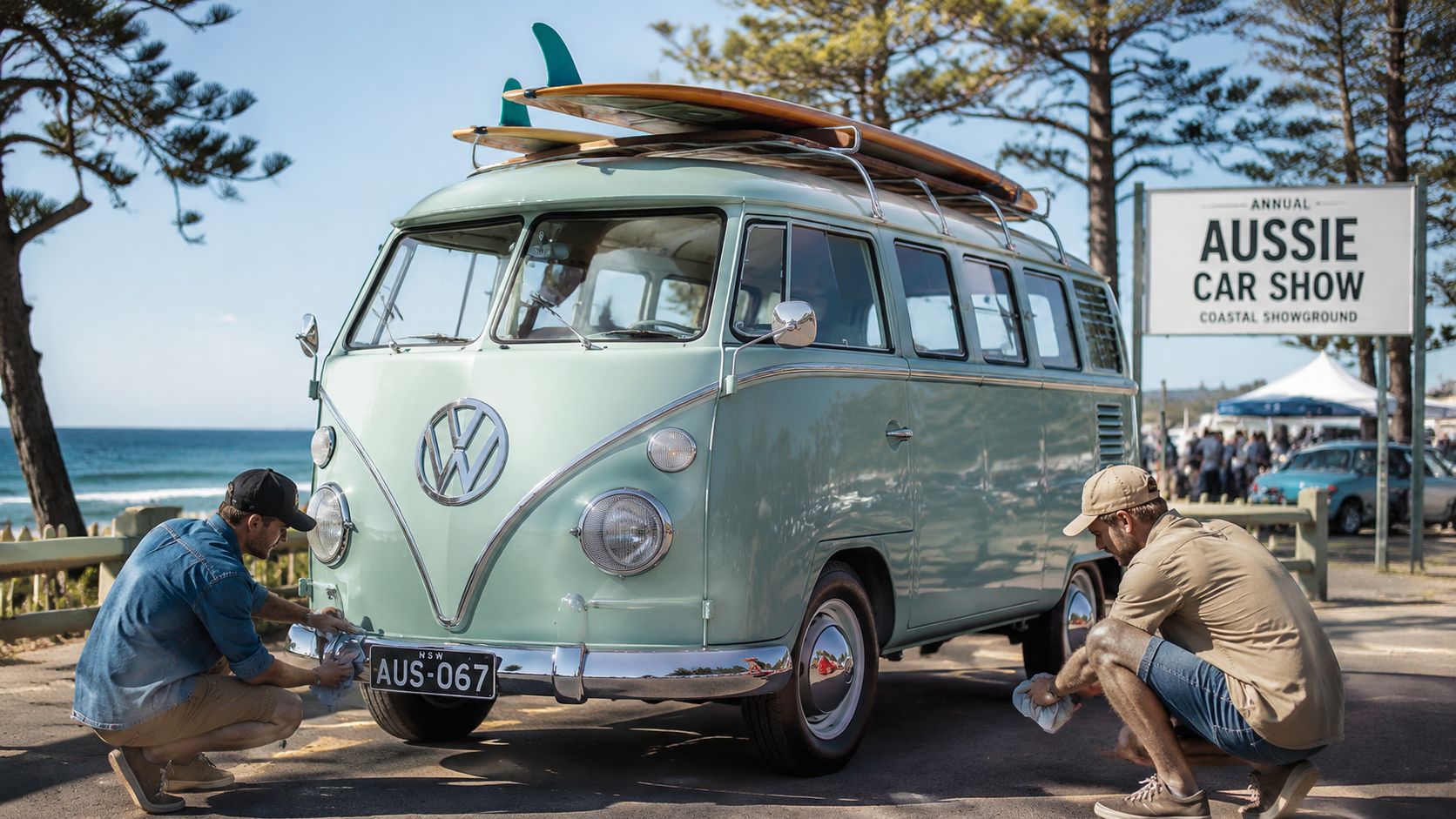
At a coastal show, a seafoam-green bay-window Kombi rolled past with surfboards on the roof and two owners polishing its chrome. People stopped talking, phones came out, and for a moment the whole crowd was looking at the same familiar shape.
Why the Volkswagen Transporter T2 Still Captivates Aussie Enthusiasts
The Volkswagen Transporter T2 has a way of turning a car show into a gathering place. Its curved one-piece windscreen, broad front beam and friendly, upright stance look practical at first glance, but the details reward a closer look. Early cars still carry the memory of the split Safari front window, while later Bay Window models trade that divided glass for a wider, more open view of the road.
Australia gave the Kombi a life of its own. The broader Volkswagen manufacturing operation began Australian assembly at Clayton, Victoria, in 1955, and Transporter assembly continued locally from 1955 until 1976, as recorded in the Volkswagen Group historical chronology. Volkswagen Australasia later shifted to kit assembly before moving from assembly to production, which helps explain why local examples can differ from later German imports.
By the 1960s and 1970s, the T2 worked everywhere. Tradespeople loaded tools into panel vans, service fleets relied on the simple rear-engined layout, and families treated Kombis as holiday machines. Surf clubs, campervan hire fleets and long Pacific Highway drives added another layer to the story. The van wasn't just transport. It became a little rolling promise of weekends away.
Why the shape still works
Collectors gather at Volksfest, the VW Nationals and local Show and Shine events because the T2 invites conversation. One owner remembers a family holiday, another remembers a first surf trip, and someone else is there because a Kombi was the first vehicle they learned to repair.
You don't need a full-size restoration to take part. A carefully chosen licensed model, a period brochure or a small coastal display can carry the same visual language without placing a rusty shell in your driveway.
From Split Screen to Bay Window The T2 Story
The Transporter story began with the split-screen T1 predecessor in the 1950s. The T2 arrived globally in 1967, and Australian market coverage identifies the second-generation Kombi and Transporter period as 1968 to 1979, with German imports continuing after local production ended. Just Kampers Australia's Bay Window guide is useful for checking the Australia-specific fitment window when you're identifying panels or trim.
The key Australian timeline looks like this:
| Period | What changed |
|---|---|
| 1950s | The split-screen T1 established the Transporter formula |
| 1955 | Australian assembly began at Clayton, Victoria |
| 1959 | Volkswagen Australasia shifted to assembling vehicles from kits |
| 1962 | The operation moved from assembly to production |
| 1967 | The T2 was introduced globally |
| 1968 to 1979 | The Australian-market T2 Bay Window era |
| 1973 | Higher front blinkers, larger tail lights and further safety upgrades |
| 1976 | Fuel injection appeared in Australian models, while the upright 1600cc engine was discontinued |
| 1976 | Australian Transporter assembly ended, with imported examples continuing afterwards |
The T2's curved windscreen and longer body made it feel more modern than the T1, while improved safety equipment helped it meet changing expectations. The rear-engined, cab-over layout remained, so the driver still sat close to the front axle with the mechanical heart tucked behind the cabin.
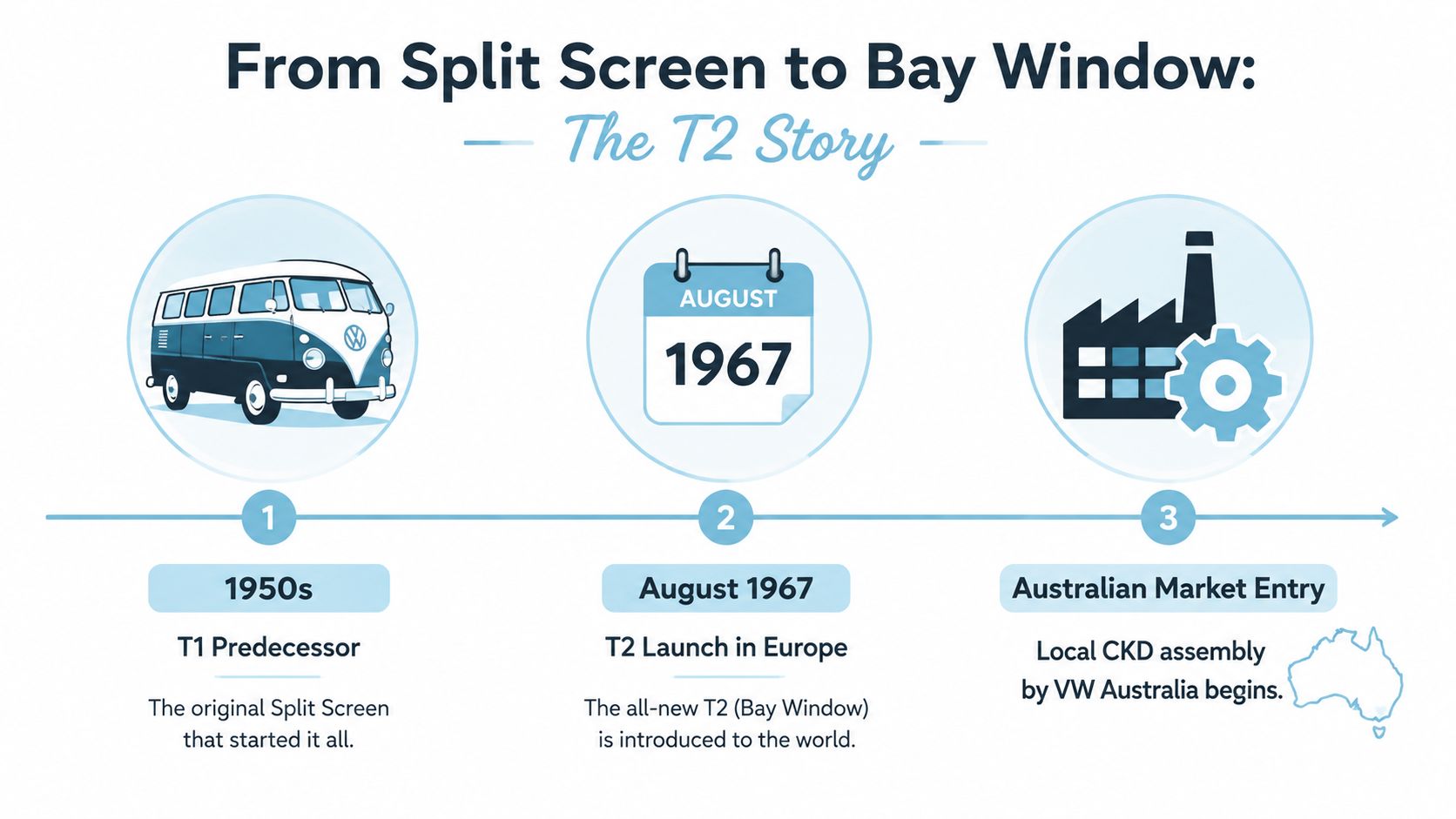
Australian production history also matters when buying memorabilia or restoration parts. Australian Volkswagen history records the localised manufacturing path, while the Volkswagen Type 2 story notes that Transporters were first sold in Australia in 1954 and made locally from 1955 to 1976.
For a compact way to keep that history close, the Volkswagen Type 2 collection captures the recognisable family resemblance across the Transporter lineage.
Kombi Samba and Westfalia Variants Compared
Three T2 names dominate enthusiast conversations: Kombi, Samba and Westfalia. They share the basic Transporter identity, but each one served a different owner.
| Variant | Window Count | Typical Years | Original Purpose | Aussie Asking Range (AUD) |
|---|---|---|---|---|
| Kombi | Varies by body style | 1968 to 1979 Australian market | Commercial work, passenger transport and family use | Not stated |
| Samba | 21 or 23 windows | 1967 to 1974 | Premium passenger and leisure transport | Not stated |
| Westfalia | Varies by conversion | Period T2 camper conversions | Touring, camping and surf trips | Not stated |
The standard Kombi was the dependable all-rounder. In panel-van form it carried equipment and stock, while microbus versions moved people with an ease that made them useful for families, clubs and small businesses. Its appeal today comes from honesty. You can see the working vehicle underneath the nostalgia.
The Samba is the showstopper. Its panoramic glazing, two-tone finish and distinctive roof windows turn the familiar van into a rolling conservatory. Samba examples are especially popular with collectors because every side offers another detail to inspect, from the window arrangement to the polished trim.
The Westfalia took the same basic vehicle and made it a touring companion. Pop-top roofs, compact furniture and sleeping arrangements transformed the rear cabin into a small travelling room. Owners chasing the coastal road-trip dream often gravitate towards this version because it connects the T2 directly with camping, surfing and slow travel.
Collector's rule: Choose the body style that matches the memory you're trying to preserve. A work van tells a different story from a Samba, and a camper tells a different story from both.
The table's missing asking-price column is deliberate. Australian classic-vehicle prices vary with originality, rust, documentation, conversion quality and mechanical condition, and no verified price range is available here. Treat a glossy restoration, a solid survivor and a project shell as separate propositions rather than assuming the badge tells you everything.
Under the Skin T2 Engineering and How It Stacks Up Today
The T2's charm starts with its mechanical layout. A rear-mounted, air-cooled flat-four leaves the nose free for the driver and front passengers, while the cab-over body keeps the vehicle compact relative to its carrying space. The arrangement feels unusual now, but it made sense for a van designed to work in tight streets and carry useful loads.
Australian Bay Window models evolved through the era with larger engines, safety revisions and improved equipment. By 1978, Australian market coverage records a 1970cm3 engine producing 51kW and 143Nm, with a three-speed automatic option available, while T2 payload had increased to 900kg, according to Club VeeDub's Australian T2 coverage.
A modern Transporter shows how far the commercial-van formula has moved. Volkswagen Australia's current Transporter range quotes 125kW and 390Nm from a 2.0-litre turbo-diesel, a 3,225kg GVM, payloads from 760kg to 1,062kg depending on wheelbase and drivetrain, and braked towing of up to 2,800kg on some variants in its current Transporter brochure.
| Spec | 1974 T2 Australian | 2024 T6.1 |
|---|---|---|
| Engine character | Air-cooled flat-four | Turbo-diesel |
| Cooling | Air-cooled | Liquid-cooled |
| Drive layout | Rear engine | Modern commercial-van layout |
| Transmission feel | Analogue manual driving experience | Contemporary automated and manual options depending on variant |
| Load focus | Practical utility van packaging | Higher-capacity commercial work |
| Safety and refinement | Period equipment and cabin noise | Modern safety, braking and noise insulation |
| Technical benchmark | Earlier low-power utility approach | 125kW, 390Nm and up to 2,800kg braked towing on some variants |
The comparison makes the trade-off plain. A modern van delivers torque, braking confidence, safety systems, quieter cruising and stronger towing capability. The T2 answers with visibility, mechanical simplicity and a direct connection between hand, lever, pedal and road.
For a scale reminder of the camper side of the family, the Volkswagen Transporter camper range reflects the touring image that still gives the T2 so much emotional pull.
Keeping a T2 on the Road Restoration Realities in Australia
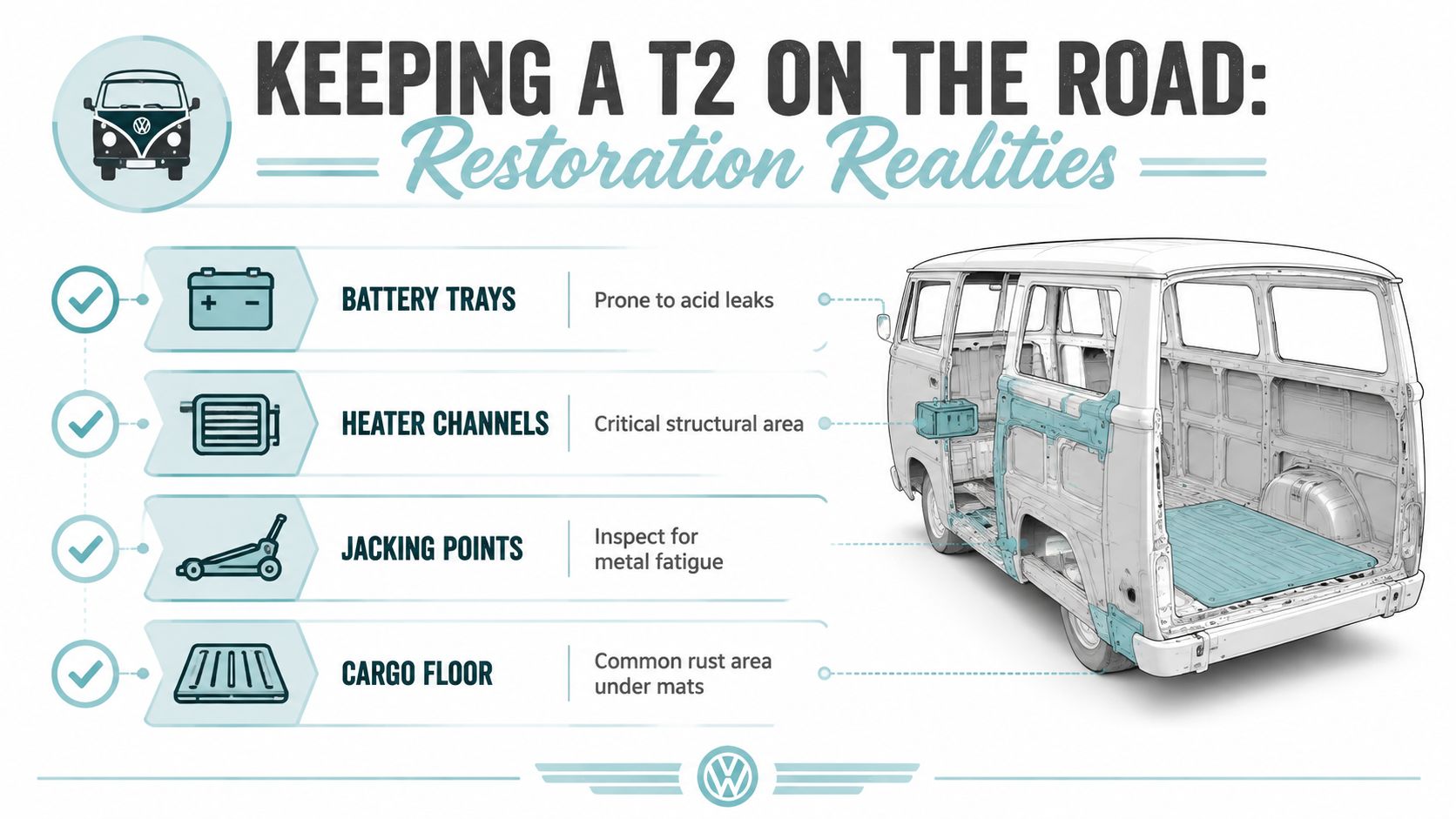
A T2 can look cheerful above the beltline while hiding serious corrosion underneath. Australian owners commonly inspect battery trays, heater channels, jacking points, cargo-floor outriggers and the lower windscreen scuttle. Coastal salt air makes regular inspection even more important because moisture and contamination can remain trapped in seams, cavities and floor edges.
Start with the structure, not the accessories. Shiny bumpers and fresh upholstery won't compensate for weak mounting points or poorly repaired floors.
A sensible inspection order
- Lift the mats and inspect the cargo floor. Rust can begin where damp gear, dirt or old leaks sit unseen.
- Check the battery area. Acid damage and previous patching can affect nearby metal.
- Look closely at jacking points and outriggers. These areas carry loads and reveal rushed repairs.
- Inspect the heater channels and windscreen surrounds. Structural corrosion here can be more serious than a cosmetic door blemish.
- Separate local-era and imported fitment. Australian cars and later imports may require different panel, trim or electrical choices.
Parts support remains one of the T2's strongest practical advantages. Just Kampers Australia lists more than 2,400 VW T2 Bay and Brazilian Bay Window parts, including cross members, outriggers, jack points, cargo floors and rear valances. Australian specialist suppliers also advertise windscreens, steering-wheel restoration and T2-specific alternator and accessory parts.
That doesn't mean every repair is quick or cheap. Structural panels may be available locally, while unusual trim, period-correct details or particular right-hand-drive components can involve imported stock and waiting. A buyer should ask which parts are on the shelf, which are ordered in, and whether the replacement matches a split-screen, Bay Window or Brazilian Bay application.
Workshop reality: The question isn't simply whether parts exist. Ask whether the correct part is available for your body style, steering position and production history.
Before buying, get an inspection from someone who understands air-cooled Volkswagens. A tidy weekend driver may suit an enthusiast who accepts gradual repairs, while a full restoration demands much deeper planning. The sensible choice depends on whether you want to drive, learn and improve over time, or commission a finished showpiece from the outset.
For owners planning broader maintenance, the VW replacement parts guide offers a useful place to organise the practical side of the hobby.
Collecting the Legend Diecast Models and Memorabilia
A licensed diecast model gives you the T2 silhouette without asking you to weld a battery tray on a Saturday morning. For many Australian enthusiasts, that makes a 1:18 or 1:24 Samba Bus a smart first step. You still get the roofline, glazing, colours and surf-era character, but the display fits on a shelf rather than in a garage.
Choosing scale and maker
Scale changes the experience. A 1:18 model has more room for visible trim and interior detailing, while a 1:24 model is easier to group with other cars, vans and signs. Collectors should check the model's construction, licensing, paint finish, wheel alignment, opening features and packaging before buying.
Names enthusiasts often encounter include Schuco, Greenlight, Hot Wheels Premium and AUTOart. Their ranges differ, so compare the exact release rather than assuming every model from a particular brand has the same finish.
The most visually commanding subjects tend to be Samba buses, Westfalia campers and single-cab liveries. That doesn't guarantee future value. Secondary-market demand changes with colour, condition, rarity, packaging and buyer interest, so collect what you enjoy rather than treating every model as an investment.
Display without damaging the collection
- Use low-UV lighting. Bright direct sunlight can fade paint, decals and packaging over time.
- Add acrylic dust covers. They keep shelves clean while leaving the model visible.
- Rotate the display. A turntable or rotating shelf lets you appreciate the rear-engine-era shape from every angle.
- Group by decade or theme. Pair a Samba with a Beetle, a camper with surf photography, or commercial vans with period signage.
- Keep packaging organised. Original boxes help protect models and make future handling easier.
Memorabilia can extend beyond diecast. Australian sales brochures, dealer signage, Bosch parts catalogues and period surf stickers add context, especially when sourced through reputable sellers, swap meets or established auction channels. Check condition carefully, look for restoration or reproduction clues, and keep paper items away from damp garages and strong sunlight.
A model isn't a substitute for a real Kombi. It is a practical way to keep the story present while you save, restore or just enjoy the design from the comfort of home.
Styling Your Space Coastal Décor with a VW Twist
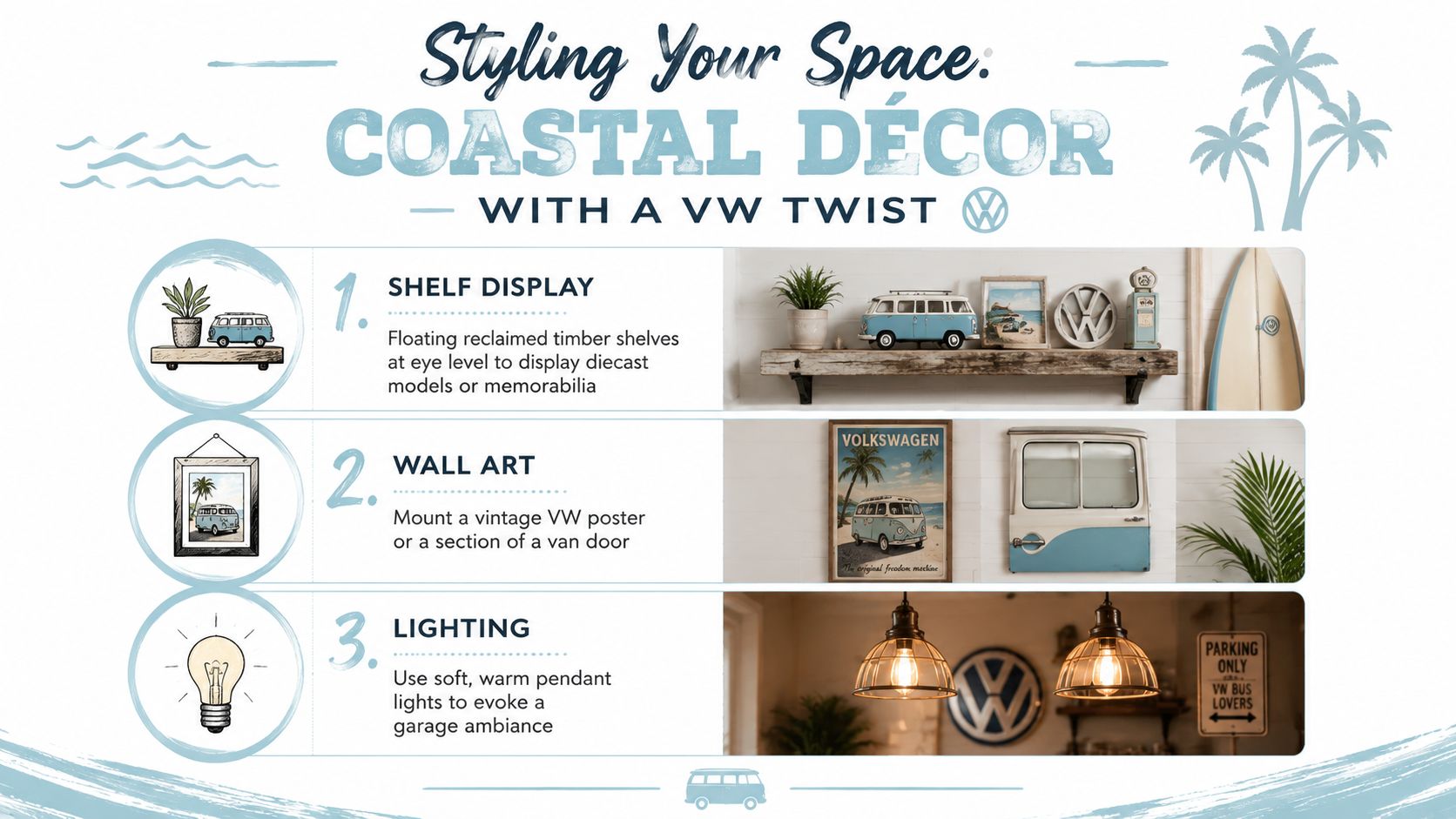
A T2 display works best when it feels lived in rather than crowded. Start with one location, such as a beach-house nook, garage wall or reading corner, and give the hero model enough breathing room to read clearly from across the room.
Floating reclaimed-timber shelves suit 1:24 Samba models because the wood brings warmth while the scale remains easy to handle. Place larger memorabilia, such as framed brochures or enamel-style signs, in a lower glass cabinet where visitors can inspect them without brushing against the shelf.
Build the scene in layers
Use weathered marine ply, whitewashed brick or a simple painted wall as the backdrop. Jute rugs, rope details and natural timber bring in the nautical mood, while one strong VW colour on a diecast model prevents the display from becoming visually flat.
Lighting needs care. Warm LED strips behind a shelf can create a soft evening glow, while a matte-black picture light can highlight surf photography or a period poster. Keep paper and painted models out of harsh direct sunlight, particularly near west-facing windows.
Mix scales with a clear hierarchy
Put the main diecast at eye level and keep smaller Beetle models, magnets or surf-themed pieces below it. Avoid placing a large model directly beside several tiny pieces with no visual separation. A tray, timber riser or framed backdrop can give each group its own boundary.
Rotate pieces seasonally. Bring out a camper and beach colours during summer, then swap in a darker commercial livery, enamel sign or workshop-themed arrangement later. The collection stays fresh, and you avoid filling every surface at once.
Styling idea: Let one Samba Bus tell the story. Add supporting objects only when they help explain its world.
The strongest displays connect materials and memories. A model beside a faded surf photograph feels more convincing than a shelf packed with unrelated novelty items, while a Beetle positioned near a Kombi creates a simple visual link between two beloved Volkswagen shapes.
Bringing the T2 Spirit Home
The T2 matters because it carries several Australian stories at once. It was a locally connected working vehicle, a family hauler, a camper, a surf companion and a familiar shape at shows. Its Bay Window design modernised the Transporter without losing the friendly proportions that made earlier Kombis so memorable.
Owning a full-size example can be rewarding, but it asks for patience. Rust inspection, body-style compatibility, imported parts and workshop decisions all belong in the dream. The people who enjoy T2 ownership most usually understand that restoration is a continuing hobby, not a one-off purchase.
Collecting offers another route. A licensed Samba or Westfalia model can anchor a shelf, while a Volkswagen Beetle model adds the companion car that so often appears in the same enthusiast world. Add a brochure, sign or surf image and you've created a small scene with genuine character, not just a row of objects.
The choice can be simple:
- Restore a real van if you want a hands-on mechanical project and accept ongoing decisions.
- Buy a diecast Kombi if you want the design, history and display appeal without workshop commitments.
- Style a coastal corner if your strongest connection is with surf culture, travel and relaxed beach living.
- Give a Volkswagen model if you're choosing something meaningful for a collector, nostalgic friend or family member.
For those looking for VW Kombi diecast Australia, buy diecast Kombi, or Volkswagen diecast models for sale, the important question is less about chasing a perfect object and more about choosing a piece that feels personal. A seafoam Samba, a practical panel van or a bright Flower Power model can all keep the T2 spirit close.
Volkswagen Memorabilia brings together licensed VW diecast models, Kombi Samba Bus pieces, Beetle models and coastal décor for collectors and gift buyers who want that unmistakable Australian VW feeling at home. Visit Volkswagen Memorabilia to browse the collection and choose a small piece of Transporter history for your shelf, study or beach-house display.