

You know that feeling. You've found the part you've been chasing for months at a swap meet, or finally picked up a boxed Samba Bus model that still has crisp corners and unfaded artwork, and the excitement lasts right up until you look at your boot, your trailer, or the back seat and think, “Right. How do I get this home without turning it into a cautionary tale?”
That's where a good tie down ratchet earns its keep. Not as glamorous as a period-correct roof rack or as charming as a split-screen bus, but every bit as important when you're hauling something you care about.
For VW people, this stuff matters more than most. We don't just move cargo. We move memories, rare finds, restored panels, market treasures, and little pieces of history.
That Heart-in-Mouth Moment Getting Your Treasure Home
A lot of us have done the optimistic load-up. A Beetle bumper wrapped in an old blanket. A roof rack balanced “just for the drive home”. A crate of parts shoved behind the front seats of a Kombi with the quiet hope that nothing rolls, rubs, or chips.
It usually starts well. You score the item, have a yarn with the seller, grab a coffee, and then reality kicks in. The roads home aren't smooth, braking isn't gentle, and even a short trip can be enough to let something slide, tip, or knock against a painted surface.
That's why the humble tie down ratchet belongs in the same mental category as a decent tool roll and a fire extinguisher. It's not exciting until the moment you need it, and then it's the difference between a clean arrival and a very ordinary afternoon.
A mate once described it perfectly at a car show. Buying the part is the thrill. Getting it home safely is the true skill.
Practical rule: If the item would upset you to see scratched, crushed, or shifted on the first corner, secure it properly before you leave the car park.
This applies whether you're hauling a full-size panel or something smaller and sentimental. The same careful thinking that protects a vintage door card also protects a boxed diecast piece or a rare garage sign. Even aspirational browsing can trigger the transport question. One minute you're admiring a dreamy Volkswagen bus camper for sale, the next you're thinking about roof racks, trailers, and what gear you trust to hold precious cargo still.
Why VW enthusiasts need a different mindset
Classic VW bits aren't always shaped nicely. A bonnet catches wind. A bumper can swing. A boxed model can crush at the corners long before the contents are damaged. The load might not be especially heavy, but it can still be awkward, delicate, or impossible to replace.
That's why “she'll be right” doesn't cut it. Good restraint isn't just about brute strength. It's about matching the strap, the shape, and the pressure to the item in front of you.
Choosing the Right Strap for the Job
Walk into any hardware aisle and it's easy to feel a bit lost. Hooks, loops, colours, widths, handles. Some look tiny enough for a carton, others look ready for a machinery trailer. The trick is to ignore the noise and look for one thing first. Working Load Limit, or WLL.
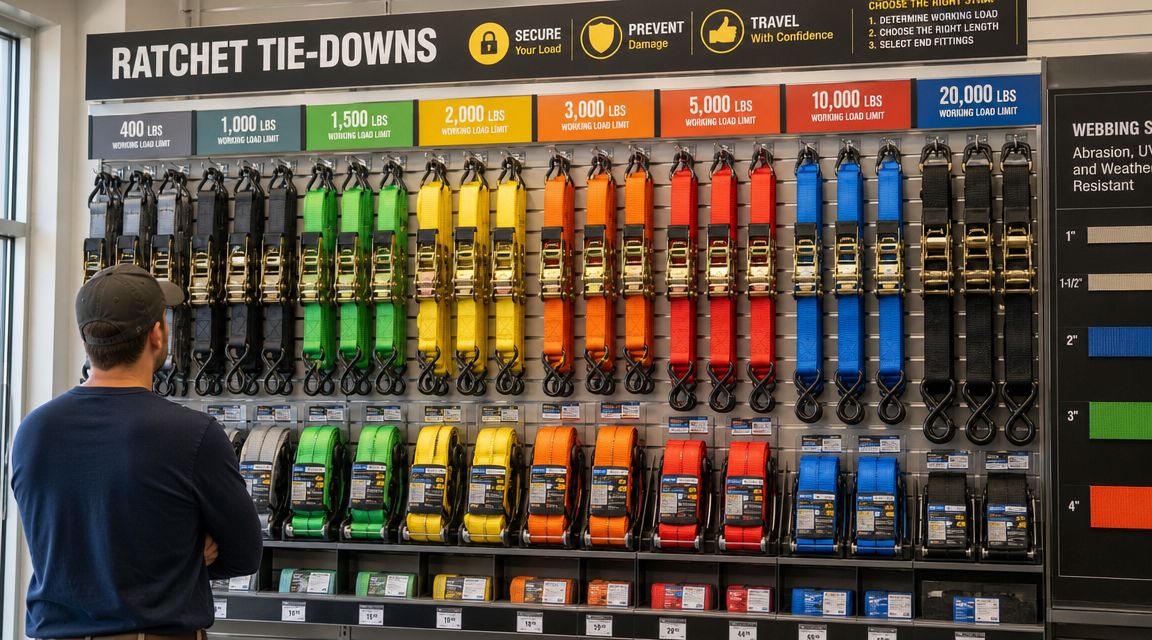
In Australia, that rating is the number that matters in practical use. According to this guide to understanding working load limits, a 1-inch (25 mm) strap is often rated around 500 lb to 1,100 lb WLL, or about 225 to 500 kg, while heavier 2-inch to 4-inch straps can handle from 3,335 lb up to 5,670 lb, or about 1,500 to 2,500 kg.
WLL first, not breaking strength
This catches plenty of people out. They see a bigger number on the packet and assume that's the safe number to work with. It isn't.
The safer way to choose a tie down ratchet is to read the tag and use the WLL. That's the practical capacity you're selecting for. Breaking strength sounds impressive, but it's not the figure you should use when deciding whether the strap suits the load.
A simple VW-friendly way to choose
Here's the way I'd sort common jobs.
| Job | Best strap approach | Why it works |
|---|---|---|
| Box of diecast models in a plastic tub | Light-duty ratchet with gentle tension | Stops sliding without crushing packaging |
| Loose VW magazines, banners, or soft display gear | Endless or loop-style restraint | Better for bundling, less metal hardware near delicate edges |
| Panels, wheels, heavier parts | Wider strap with clearly marked WLL | Spreads load better and gives more restraint confidence |
| Trailered mechanical bits | Heavier-duty ratchet and sound anchor points | More control over tension and movement |
What to inspect before you buy
Not all straps feel the same in the hand, and that matters.
- Read the tag: If the WLL isn't easy to identify, put it back.
- Check the webbing: You want flat, tidy webbing that doesn't feel cheap or fuzzy straight off the shelf.
- Look at the hardware: Hooks and ratchet bodies should feel solid, not flimsy.
- Match the gear to the job: Bigger isn't always better. A heavy strap on a delicate box can be as clumsy as using vice grips for trim clips.
If you're also sourcing restoration gear, trim pieces, or transport odds and ends, it helps to think about restraint gear the same way you think about buying from a solid VW parts Australia specialist. The right item for the job saves grief later.
Buy straps the way you buy spanners. The size and quality matter less in theory than they do on the day something expensive is in your care.
The Art of a Perfect Ratchet Technique
A tie down ratchet isn't hard to use, but there is a right sequence, and getting that sequence wrong is where most frustration starts.
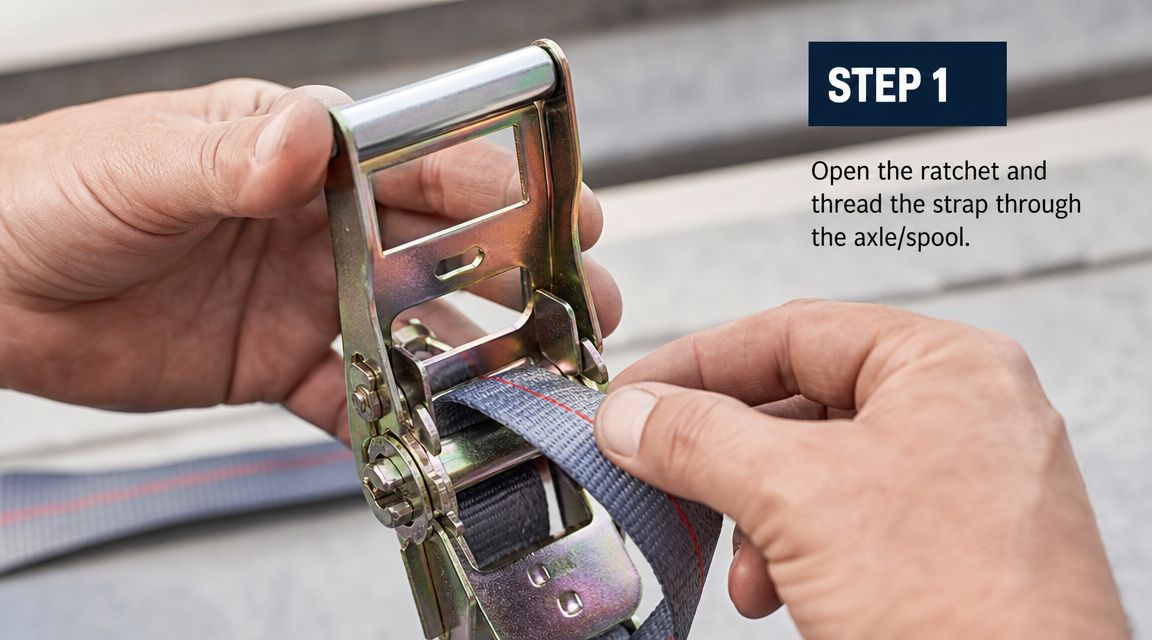
The correct process is clearly laid out in this ratchet strap how-to guide. Open the ratchet, thread the webbing through the mandrel, pull the slack through by hand, pump the handle until taut, then close the ratchet fully so the pawls lock. That same guide notes that incorrect threading is the most common reason for failure.
The sequence that works
Use this rhythm every time:
- Open the ratchet fully so the slot in the mandrel is accessible.
- Feed the webbing through the mandrel from the correct side.
- Pull almost all slack out by hand before you start ratcheting.
- Pump the handle until the load is secure and stable.
- Close the ratchet completely so the mechanism locks properly.
Most mistakes happen before the tightening even starts. If the strap is threaded the wrong way, the mechanism won't tension properly. If you leave too much slack in, you end up winding a mess onto the mandrel.
Taut is enough
The goal isn't to flatten the cargo into submission. The goal is to stop movement.
That matters with VW gear because lots of our favourite items don't like point pressure. Fibreglass parts, old cardboard packaging, polished trim, and even some reproduction pieces can mark or deform if you get carried away with the handle.
Here's a visual refresher if you prefer seeing the motion in real time.
Keep the webbing flat
The strap should sit flat across the load. No twists. No bunching. No awkward rub points if you can help it.
A flat strap spreads pressure better and behaves more predictably on the road.
That's one of those little habits that separates a secure load from one that starts fine and gets ugly after a few roundabouts.
A Bit of Simple Maths for Total Peace of Mind
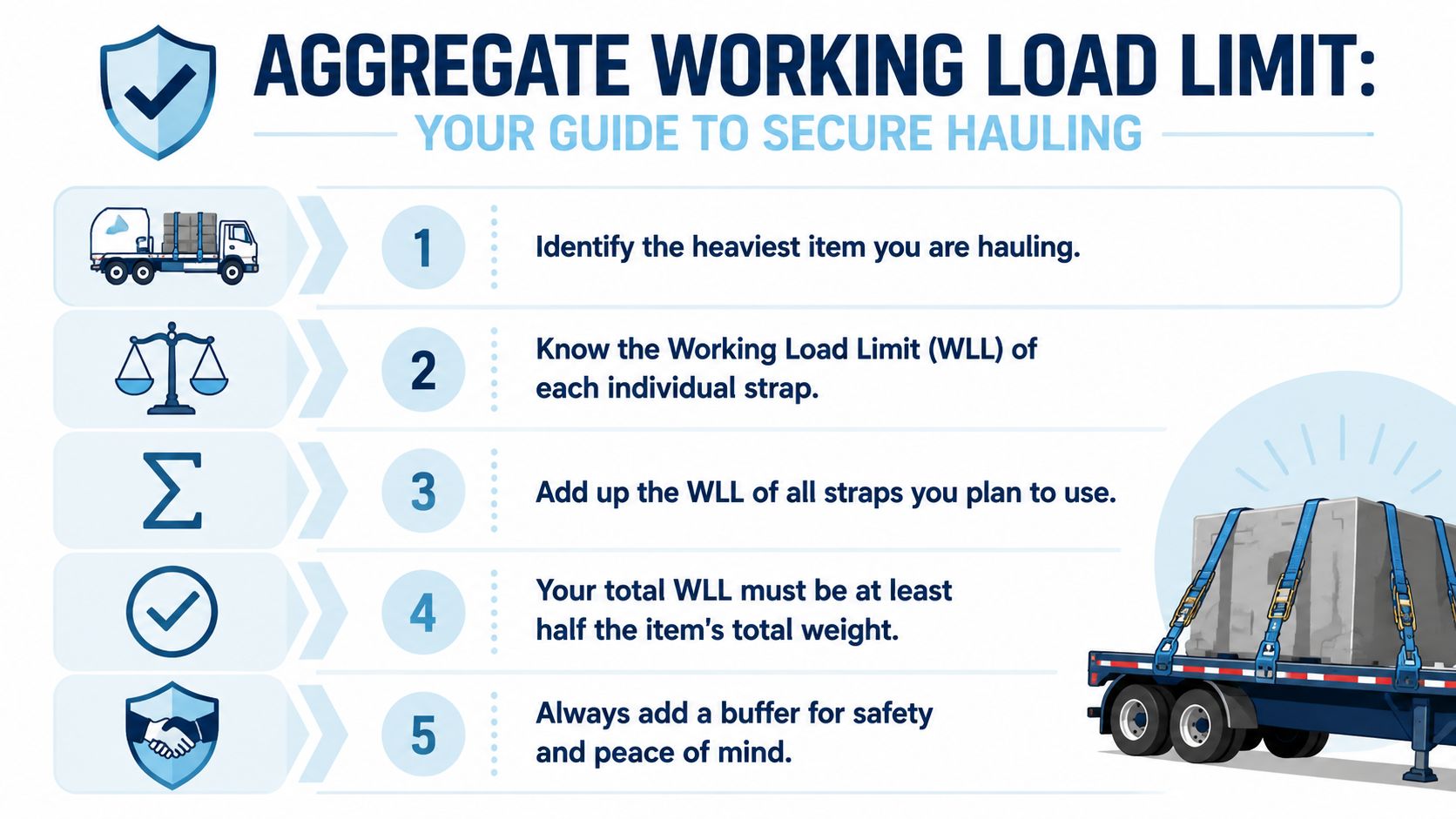
This is the part that sounds more technical than it is. The rule worth remembering is the aggregate working load limit. That means the combined WLL of the straps in the system must be enough for the load you're securing.
The benchmark given in this comprehensive guide to ratchet straps is straightforward. The aggregate WLL of your tie-downs must be at least half the mass of the load. For a 2,000 kg load, you need a combined WLL of at least 1,000 kg across all straps.
How to think about it without overcomplicating things
Say you're hauling a substantial pile of VW bits on a trailer. Don't look at one strap and hope for the best. Look at every strap you're using, read each WLL tag, and add them together.
Then ask one question. Does that total meet the minimum requirement for the load?
That's the basic discipline. It turns cargo restraint from guesswork into a quick check.
A field checklist that actually helps
- Identify the load mass: Know what you're really carrying, not what you reckon it probably weighs.
- Read the strap tags: Use the WLL on the tag, not the larger breaking-strength figure.
- Add the strap capacities together: You're assessing the whole restraint system.
- Build in practicality: More restraint points can give better control of movement and better redundancy.
- Check strap path and alignment: A strong strap doesn't help much if it's badly positioned.
More straps can do more than add capacity. They can stop rotation, reduce shifting, and give you options if the load shape is awkward.
For VW folk, that last bit matters. A stack of boxed parts behaves differently from a single engine case. A roof rack behaves differently from a wheel set. Good maths gets you legal and sensible. Good placement gets you home happy.
Common Blunders That'll Break Your Heart (and Your Gear)
The ugly stories are usually boring in hindsight. Nobody says, “I lost that rare bit because of some exotic engineering failure.” It's usually something simple. A twisted strap. Too much tension. The wrong style of tie down ratchet for the shape being carried.
The mistakes that show up again and again
- Over-tightening the strap: This is the heartbreak move. Too much force can crush cartons, stress fragile parts, and mark painted or plated surfaces.
- Letting the strap twist: Twists create poor contact and can increase rubbing on edges.
- Using hook-style straps for awkward bundling: Hooks are brilliant when you've got suitable anchor points. They're less helpful when the item itself needs to be wrapped and held neatly.
- Ignoring loose ends: Flapping webbing can abrade, distract, and generally make a tidy job look rushed.
Endless loop straps deserve more love
One of the most useful alternatives for collectors and classic car owners is the endless loop style. According to Tegral's guide to endless ratchet tie downs, for irregular loads or bundling items where anchor points are limited, endless loop ratchet straps are often a better choice than standard hooked straps, especially where you want to avoid damage to delicate or awkwardly shaped collectibles.
That's a proper niche solution for VW people. Think bundled magazines, framed signs, stacked swap-meet finds, or a storage tub full of fragile memorabilia. An endless loop lets you secure the load to itself without introducing extra hook hardware where it isn't welcome.
What works better in practice
A hooked strap suits a trailer anchor point. An endless loop suits a bundle.
A wide strap helps with heavier, broad items. A smaller strap helps when you need control, not brute force.
The best restraint setup is the one that secures the load without becoming the thing that damages it.
That's the line to remember when you're tempted to just give the ratchet “one more click”.
Your Ultimate VW Transport Checklist
This is the sort of list worth keeping in the glovebox, especially if your weekends involve swap meets, surfboards, club runs, or the occasional lucky find that won't fit where you planned.
Before you drive off
- Protect painted surfaces: Put a soft cloth, towel, or other non-abrasive barrier anywhere a strap or hook might touch paint, chrome, or trim.
- Stabilise boxed models first: If you're transporting diecast, place boxed pieces inside a larger tub or crate so the strap secures the container, not the packaging itself.
- Wrap unboxed collectibles properly: Bubble wrap and divided storage beat loose placement every time.
- Check anchor points: Strong straps are only half the equation. The point they connect to matters just as much.
On the vehicle
Some loads need downward pressure. Others need anti-movement support more than compression.
Surf gear on a Beetle roof rack is a classic example. The straps should hold the board to the rack securely, but not so tightly that you stress the board or create odd pressure points. Likewise, a crate of memorabilia in the back of a Kombi should be prevented from sliding, not crushed into the floor.
After the first stretch of road
Loads settle. Blankets compress. Boxes shift that tiny bit. Webbing beds in.
So stop and check.
- Recheck tension: A quick retension after the first few kilometres can make a big difference.
- Look for rub points: If the strap has moved onto an edge, fix it before it becomes damage.
- Secure loose tails: Tidy webbing now means less flap and less wear later.
If your trip is part of a bigger roadie, beach run, or show weekend, the same mindset carries over nicely to the broader van life Australia habit. Pack carefully, secure thoughtfully, and make the journey part of the enjoyment instead of a stress test for your gear.
Quick VW-specific checklist
| Item | Best habit |
|---|---|
| Painted panels | Use soft protection under contact points |
| Boxed diecast | Strap the storage tub, not the box |
| Unboxed models | Wrap and separate before loading |
| Roof-rack gear | Firm restraint, no over-tightening |
| Swap-meet bundles | Consider endless loop straps for awkward shapes |
A tie down ratchet isn't complicated, but it rewards care. Read the WLL tag. Thread it properly. Tighten it sensibly. Match the strap style to the item. Do those things and you'll spend more time enjoying the find than worrying about the drive home.
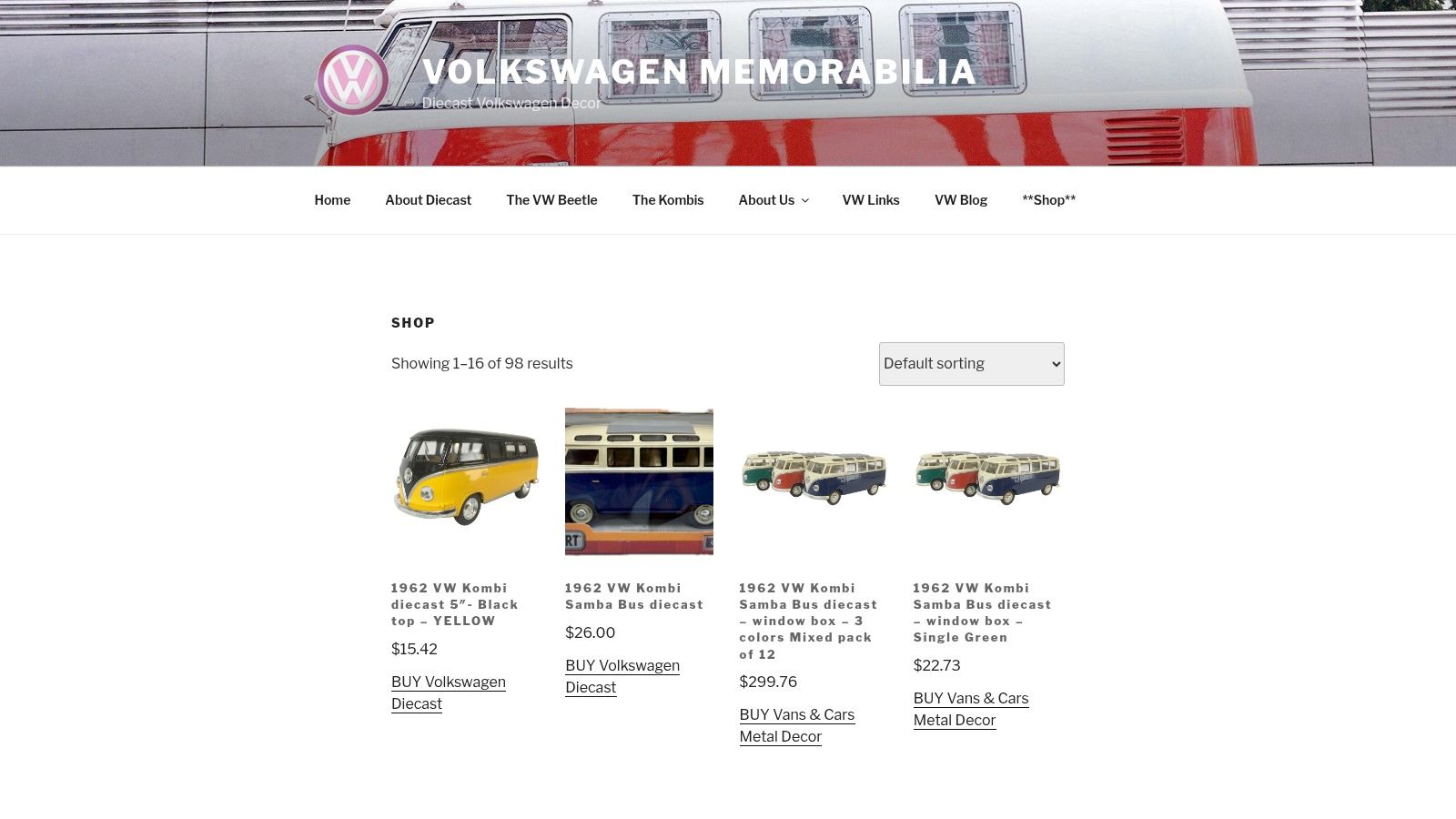
If you love the VW world as much as the drive itself, have a look through Volkswagen Memorabilia. It's a great spot for officially inspired VW-themed gifts, diecast models, Kombi favourites, Beetle pieces, and display-worthy collectibles with local Australian stock and friendly service. If you're hunting for a thoughtful present or the next gem for your own shelf, it's well worth a browse.