You're standing in the driveway with the Kombi idling, the late sun bouncing off the chrome, and someone's asking what to bring to the weekend barbecue in Noosa. A towel feels ordinary. A candle gets forgotten. But a beach themed gift that carries the same easygoing charm as a classic VW, that's the sort of present people keep on the shelf, in the lounge, or in the cab corner of the van and smile at every time they pass it.
That's why the best coastal gifts aren't just “beachy”. They feel like a memory from a road trip, a day parked near the dunes, or a summer run down the coast with the windows cracked and the radio low. For VW lovers, the sweet spot is simple, a gift that can live happily beside a Volkswagen Beetle model, a Kombi Samba Bus diecast, or a bit of sun-washed décor and still feel right at home.
Capturing the Endless Summer Feeling
A mate once told me the hardest part of buying for a beach-loving VW fan isn't the budget, it's the feeling. He didn't want another throwaway trinket. He wanted something that brought back childhood holidays, surfboard wax in the back of the van, and those long, lazy afternoons when the Kombi became the family base camp.
That's the magic with beach themed gifts, the best ones bottle up a scene. A diecast Kombi on a desk does it instantly, because it carries the same road-trip spirit as the full-size van parked by the esky. A shell-inspired accent or a nautical print does something similar, it shifts a room from plain to personal without trying too hard.
Practical rule: if a gift makes someone tell a story the moment they unwrap it, you've probably picked well.
A good coastal gift also holds its own in the house, not just in the car or the caravan. A piece with a weathered finish, a familiar VW shape, or a bit of seaside character can sit beside family photos and still feel like it belongs. For the right person, that is what turns a simple present into a keepsake, something they'll place on a shelf and point to years later while talking about the trip that first brought it home.
More Than Just Sand and Shells
There's a big difference between a souvenir and a keepsake. A souvenir says, “I was there.” A keepsake says, “This mattered.” That's the line beach lovers and VW people both understand, because both worlds are built on memory, movement, and a bit of personality.
What makes the gift feel personal
For a lot of Australian shoppers, the sweet spot is something that feels local and specific rather than generic. Independent gift guides show strong demand for beach gifts and coastal décor, but they don't always help with housewarming presents, caravan trips, or gifts that belong in a home rather than a beach bag (Bella Coastal Decor). That's where collectible pieces and styled décor start to make sense.
A licensed diecast VW lands as a collectible treasure because it gives the recipient a tiny, well-made version of something they already love. Coastal home accents do the same job in a different way, they turn a mantel, shelf, or entry table into a little seaside scene. The point isn't to buy more stuff, it's to choose something with staying power.
Why coastal décor belongs in the same conversation
Australia's 25,760 km of coastline explains a lot about our décor habits, because nautical styling keeps showing up in gifts and interiors, from wall art to photo frames and decorative accents (About Darwin). That's not a trend in the flimsy sense, it's a recurring visual language that feels familiar to a lot of homes.
A good beach gift should look at home beside a Kombi on the shelf, not fight for attention with it.
For a practical touch, shell and wind chime pieces can work beautifully when you want something relaxed, coastal, and a little nostalgic. If you're leaning into that soft seaside look, start with a curated piece like this shell wind chime and let the rest of the room follow its lead.
Gift Ideas for Every Beach and VW Lover
A good gift gets easier when you stop thinking about categories and start thinking about people. The diecast collector, the coastal home stylist, and the weekend wanderer all want something different, even if they'll all smile at a Kombi badge or a beachy colour palette.
The diecast collector
This is the person who notices panel lines, mirror placement, and whether the paint finish feels true to the original. A Kombi Samba Bus diecast or a Volkswagen Beetle model makes sense here because the joy is in the detail, the silhouette, and the authenticity of the miniature.
Scale matters too. A larger model like 1:18 gives more presence on a desk or display cabinet, while 1:24 usually hits a nice balance between detail and space. Smaller formats suit mixed collections, especially if the recipient already has a few models lined up together.
The coastal home stylist
This buyer wants pieces that feel relaxed, light, and easy to place in the home. Think nautical photo frames, wall art, or a decorative accent that works with timber, white, blue, and sand-toned rooms. In Australian homes, those pieces often end up on a console near the entry or on a shelf in the living room.
The draw here is less about “beach kit” and more about atmosphere. A coastal ornament or a styled accent can soften a room the same way a Kombi softens a car park, it changes the feel without shouting.
The weekend wanderer
This is the friend who's always planning the next escape. They're the ones who love practical gifts with character, something that belongs in the van, the caravan, or the holiday house. A surfy VW model, a playful magnet, or a small display piece can all work because they're easy to enjoy without needing much space.
A lot of beach gifts fail because they look good for one day and then vanish into a drawer. The better ones earn a permanent spot on a shelf, which is exactly what a collector or nostalgic traveller wants.
Good gift test: if it would still make sense in a beach house, a study, and a garage, it's probably a strong pick.
For a broader browse of themed ideas, the gifts for the beach collection is a handy place to start when you're matching personality to present.
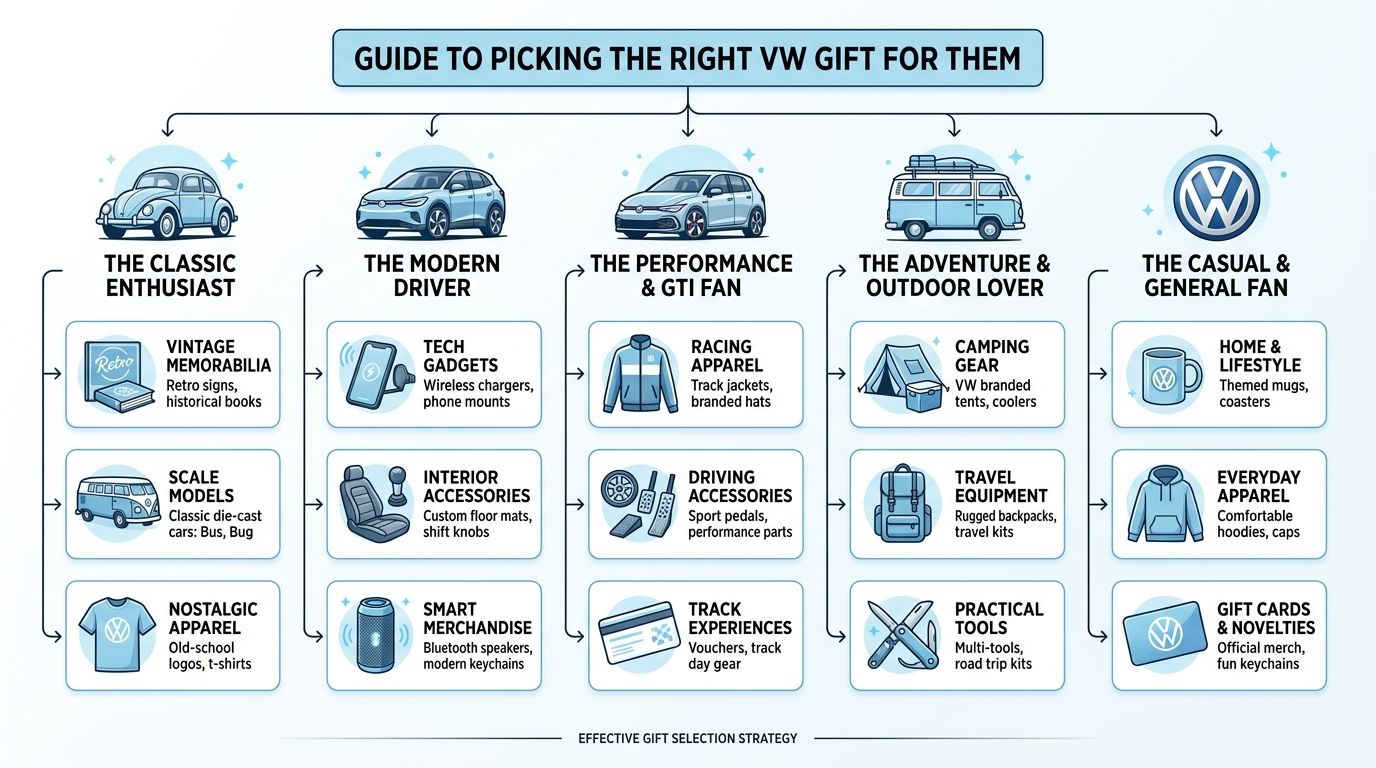
For a quick visual guide, the right item usually falls into one of these lanes:
Travel lane: compact, personal, and tied to road trip memory.
The best part is that these choices don't compete with each other. A diecast Kombi can sit beside a framed print or a shell-inspired accent and still feel cohesive, especially in a home that already leans into relaxed Aussie coastal style.
Choosing the Right Piece of Paradise
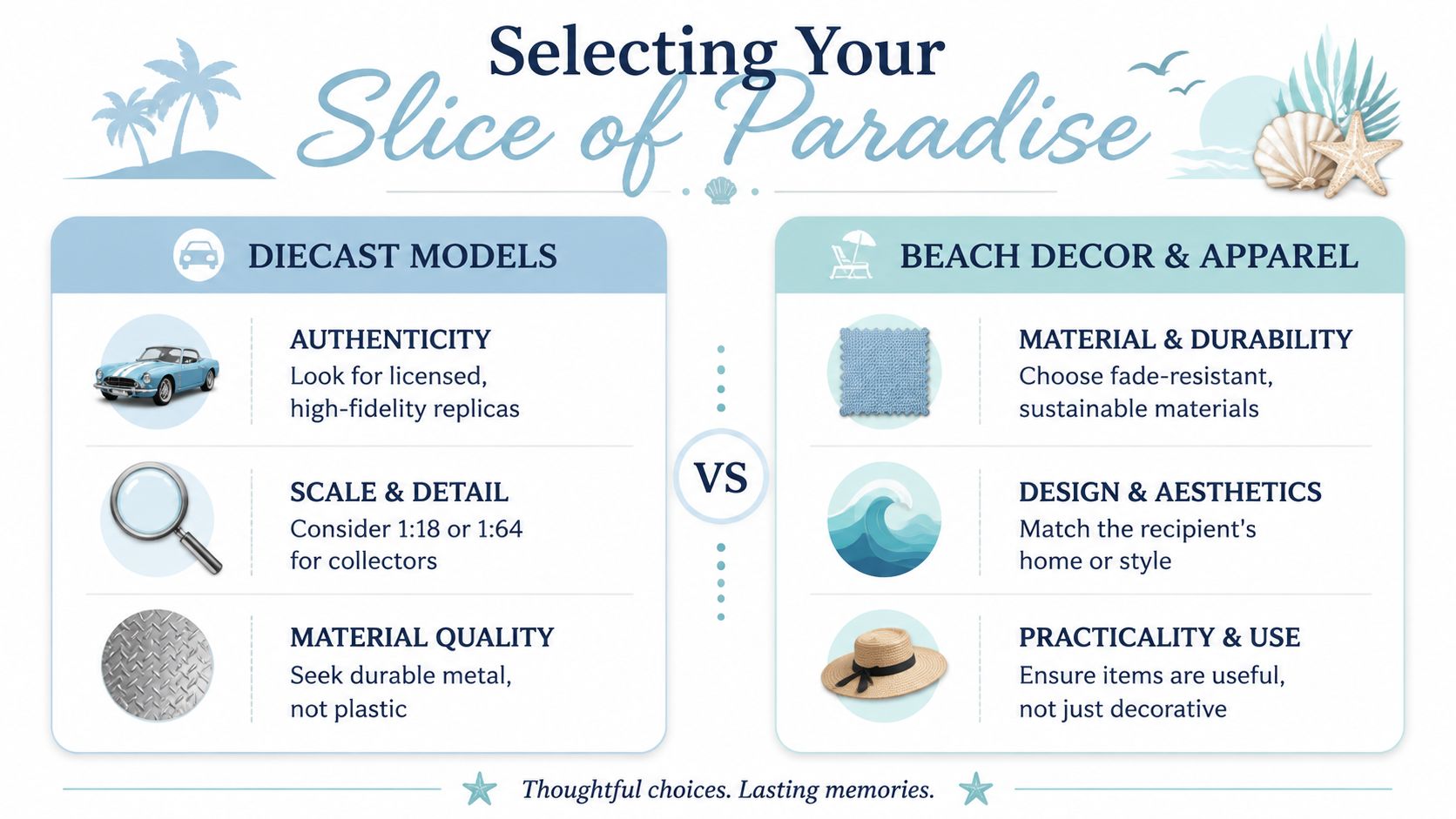
A thoughtful gift starts with fit, not just flair. The first question is whether the recipient wants something to display, use, or collect, because that decides everything from size to material to finish. A display piece can lean decorative, but a collectible needs authenticity and a sense of proportion that feels true to the original vehicle.
Diecast details that matter
For VW collectors, officially licensed models carry real weight because they signal fidelity, not guesswork. That matters when the gift is meant to celebrate a specific Kombi or Beetle rather than just nod at the shape of one. The closer the model stays to the actual vehicle, the more satisfying it feels to the person receiving it.
Scale is the other decision point. 1:18 models command attention and suit a feature shelf. 1:24 models are easier to work into an existing display without taking over the room. If the recipient already collects, matching scale to the rest of the shelf usually matters more than chasing the biggest box.
Beach décor and practicality
For coastal décor, material and finish matter just as much. A pale timber accent, a metal wall piece, or a framed print needs to sit comfortably with the home's palette, not clash with it. The safest route is to think in textures, timber, linen, metal, glass, and matte finishes tend to sit well in beach-style spaces.
Australian conditions add another layer. Many parts of the country regularly experience very high to extreme UV levels, so gifts that live near windows or spend time outdoors should be chosen with that in mind (GiftLab). That makes durability and placement worth thinking through before you buy.
Selection rule: if it's for a bright room, a beach house, or a sunlit display cabinet, choose a finish that still looks good after the afternoon light shifts.
A useful way to decide is simple.
Choose licensed diecast when the gift is for a collector or VW devotee.
Choose coastal décor when the recipient wants the beach feeling in the home.
Choose compact display pieces when space is tight but sentiment still matters.
The right piece feels deliberate. That's what separates a present from a placeholder.
Styling Your Coastal and VW Treasures
A gift really lands when it finds its place in the home. A Kombi model on its own is lovely. A Kombi model on a timber shelf with a framed surf photo and a small coastal accent turns into a story corner.
Start with one focal point. A road trip shelf works well for VW memorabilia, especially if the recipient already has a few models or keeps small travel keepsakes. Put the diecast in front, then build around it with a framed print, a map, or a small decorative piece that echoes the colour of the vehicle.
Make the room do the work
In a living room, coastal décor works best when it's grouped rather than scattered. A shell piece, a photo frame, and a neutral-toned accent will usually feel more considered than three unrelated items placed across the room. The goal is a calm, beach-house feel, not a souvenir shop.
For a study or home office, a single Beetle model can do more than a full shelf of clutter. It gives the space personality without crowding the desk, which is ideal for anyone who wants a nod to their VW side without turning the room into a garage display.
A few practical display ideas help:
Use height changes: place the model on a book or plinth so it sits above flat décor.
Repeat one colour: echo the Kombi's colour in a frame, cushion, or art print.
Leave breathing room: a small group looks more deliberate than a crowded shelf.
Keep direct sun in mind: bright light can be lovely, but it's not kind to every finish.
The beauty of this style is that it grows naturally. One gift becomes the start of a corner, then a shelf, then a whole room that feels like summer and road trips at once.
Your Go-To Aussie Shop for VW Memorabilia
A Kombi model on a shelf, a weathered map from a family trip, or a piece of beach-inspired home décor can carry the same feeling. It brings back the sort of day you still talk about later, the one where the windows were down, the esky was packed, and the coast kept appearing around the next bend. That is why the best beach themed gifts often end up being the ones with a story attached.
I have seen that at car shows and in living rooms alike. A collector sets a VW diecast beside a framed coastal print, and the whole corner starts to feel lived in, not staged. A decorator places a small Kombi next to timber, linen, and a pale blue accent, and the room suddenly feels like a holiday house that has been loved for years.
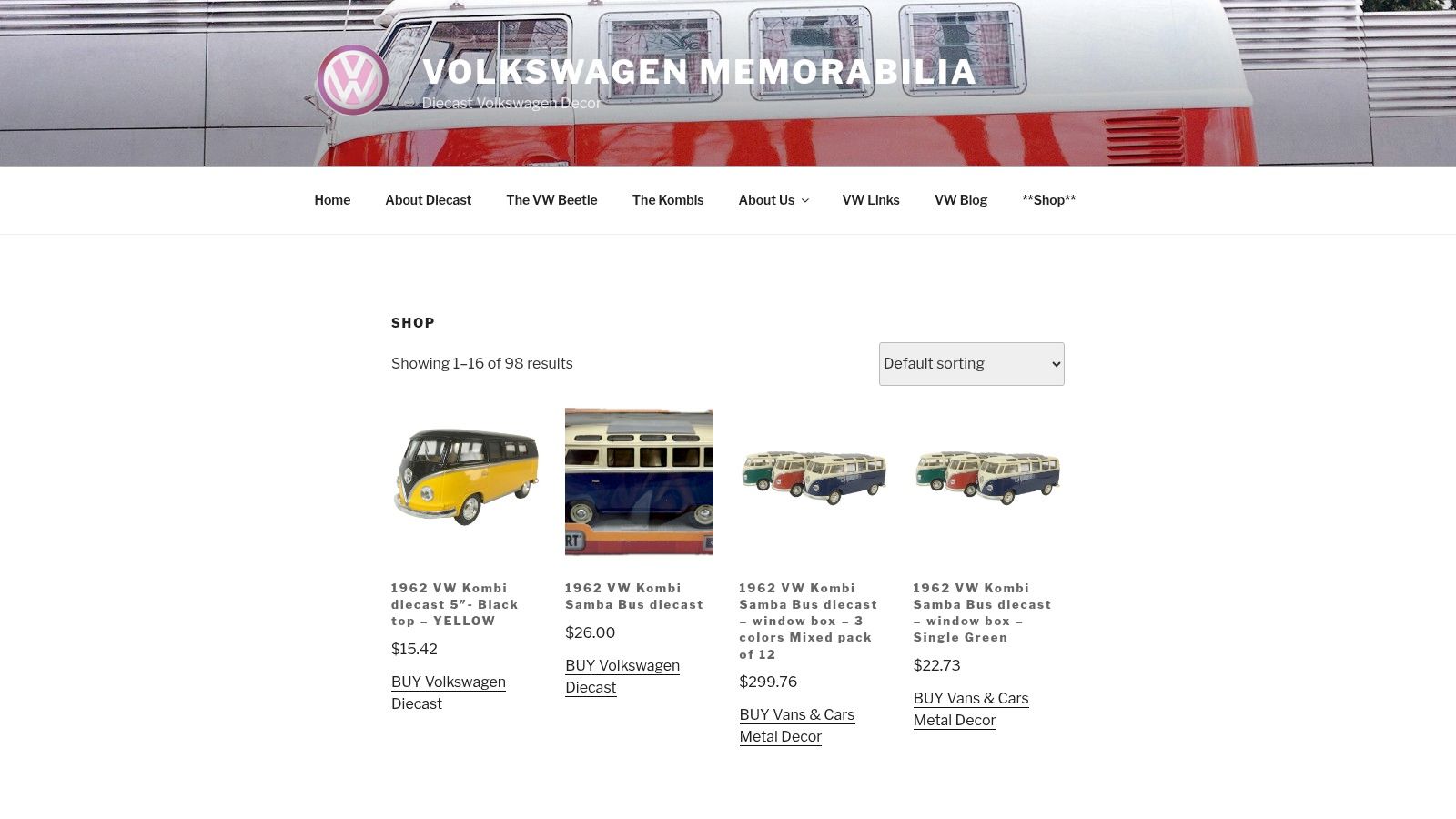
If you want a gift that feels local and personal, Volkswagen Memorabilia is a strong place to begin. The range suits the person who loves a clean display as much as the one who wants a reminder of summer drives, surf stops, and old-school motoring charm. You can browse beach-inspired home décor alongside VW diecast and other pieces that sit naturally in a collector's room or a coastal home.
A good gift does not need to shout. It just needs to land in the right hands, on the right shelf, in a room where the owner will spot it each morning and think of a Kombi by the water, a packed road trip, or a favourite stretch of coast. That is the kind of piece worth choosing from Volkswagen Memorabilia, especially if you want something that feels at home with Kombi nostalgia, beach style, and a proper Aussie road-trip spirit.
You're probably standing in the driveway right now with two versions of the same dream in your head. One is the glossy one. A tidy old VW with the side door open, kettle on, boards strapped up top, sunset throwing honey-coloured light across the dash. The other is the practical one. A van with tired trim, mystery wiring, a patch of rust near the sill, and a notebook full of half-finished sketches.
That's how most camper van conversion stories begin in Australia. Not with perfection. With affection.
At local shows, I always end up chatting to someone who's torn between keeping a classic Volkswagen untouched and turning it into something they'll use. My answer is always the same. If the van's meant to travel, build it to travel well. Respect the shape, respect the history, but make it yours. A good conversion doesn't erase the soul of a Kombi. It gives it another chapter.
The charm is already there. Australia formally welcomed the Volkswagen Beetle in 1953, and local assembly started at Clayton in Victoria in 1954 on the very next beat of that story, as noted in this Beetle history entry. The Type 2 story has its own local flavour too. In Australia, the passenger van version was marketed as the VW Kombi, while the utes and commercial carriers wore the VW Transporter name, as explained in this Australian Kombi overview. That distinction still matters when you're choosing a base for a camper van conversion, because the badge on the nose often hints at how the vehicle was originally used, loved, and worked.
The Blueprint for Your Dream Rig
A proper build starts long before the first screw goes in. It starts when you realise what sort of traveller you are.
Some people want a weekend surf wagon. Bed, storage, coolbox, nothing fussy. Others want a rolling little cottage with solar, water, cupboards, and enough comfort to disappear for days. If you skip that decision and buy only with your heart, you can end up with the wrong van for your own habits.
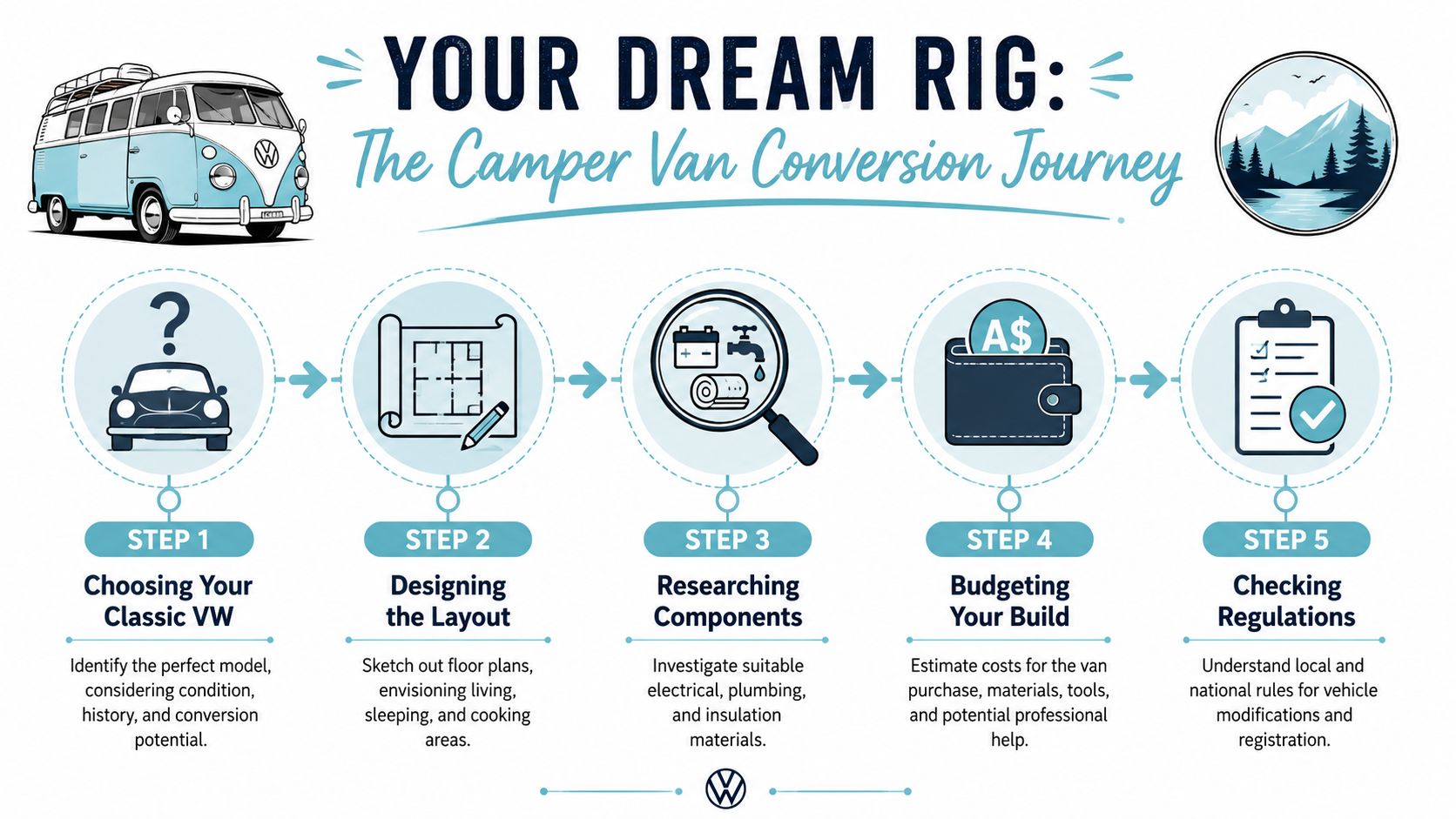
Choosing the right classic VW
The romance often points straight at a Kombi, and fair enough. Nothing else wears the road-trip grin quite like it. But nostalgia needs a partner called practicality.
A few starting points help:
Original use matters. A passenger-spec Kombi often gives you a different starting point from a harder-worked commercial Transporter.
Body condition beats pretty paint. Fresh paint can hide trouble. Solid metal saves misery.
Mechanical honesty counts. A van that starts, stops, and tells the truth is better than one with dazzling trim and a long list of promises.
Parts confidence helps. If your comfort with tools is modest, choose a base that won't frighten you every time something rattles.
If you're still hunting, it helps to browse a dedicated van for conversion shortlist and compare body styles with your intended use rather than just your favourite photos.
Practical rule: Buy the van that suits your trips, not the one that only suits your daydreams.
Sketch the life before the layout
I've seen beautiful builds that were awkward to live in because the owner designed them like a furniture catalogue instead of a moving campsite. Before you measure timber, measure habits.
Ask yourself where you'll make tea when it's raining. Where you'll throw sandy thongs. Whether you want to sit upright inside with the door shut. Whether the bed stays made, or folds into a bench. Whether storage needs to swallow tools, fishing gear, camera kit, or a little box of treasured VW bits from swap meets.
A simple planning sequence keeps things honest:
Mark your fixed needs. Bed length, cooking spot, and the gear you always carry.
Draw walking space. Tiny vans feel smaller once cupboards go in.
Decide your must-haves. Fridge, sink, surfboard slot, reading light.
Leave room for maintenance. Access panels save arguments with your future self.
Plan for weight and compliance early. Last-minute heavy additions can spoil the build.
Match the build to the story you want
A weekend warrior can stay charmingly simple. A longer-haul touring van asks more of the design. That's where the blueprint earns its keep. Once the sleeping, cooking, and storage zones are settled on paper, every later choice becomes clearer. You stop guessing and start building with purpose.
Building the Bones of Your Van
The glamorous photos never show the first filthy weekend. Seats out. Old lining peeled back. Dust in your hair. Surface rust staring at you like a smirk from the past. This is still one of my favourite phases, because it's the moment a van stops being “an old bus” and starts becoming your bus.
Strip it back and read the shell
Pulling out worn flooring and trim tells you what sort of life the van has lived. You'll find old screw holes, odd repairs, and sometimes the remains of someone else's half-finished dream. Don't rush this stage. Clean every surface and inspect the shell properly before you bury anything behind timber and panels.
Rust deserves patience. Treat what you can see now, because hidden rust doesn't become charming later. It becomes expensive.
A good bones-first approach usually looks like this:
Remove old interior pieces carefully. You may want templates, fixings, or reference points later.
Check every floor edge and seam. Moisture loves corners.
Test mounting points. Bed frames and cabinetry need trustworthy anchors.
Keep notes as you go. Label wiring routes, holes, and factory features before the shell disappears behind your fit-out.
Build a floor that feels solid
The floor changes the whole character of the van. Get it wrong and every step feels hollow, cold, or noisy. Get it right and the build starts to feel planted.
The subfloor is more than a sheet of board. It's the base layer that evens out irregularities, supports the finished floor, and helps the van feel quieter under way. I've seen people race to the visible finishes and regret it later when the floor creaks, flexes, or lifts at the edges.
A quick comparison helps:
Part
What it does
What happens if you rush it
Floor prep
Gives you a clean, sound base
Trapped moisture and hidden corrosion
Subfloor
Adds structure and support
Soft spots and movement underfoot
Wall panels
Shape the cabin and cover insulation
Rattles and poor fit around curves
Ceiling lining
Finishes the shell overhead
Sagging panels and awkward gaps
A neat timber finish can hide a bad foundation for a while. The first rough road will reveal it.
Keep the structure serviceable
A strong build also stays accessible. Don't entomb critical areas. Leave paths to wiring runs, wheel arches, and any area you may need to inspect later. Old Volkswagens reward builders who think like caretakers rather than decorators.
By the end of this phase, the van still won't look finished. That's fine. What you've done is harder to photograph and far more important to live with.
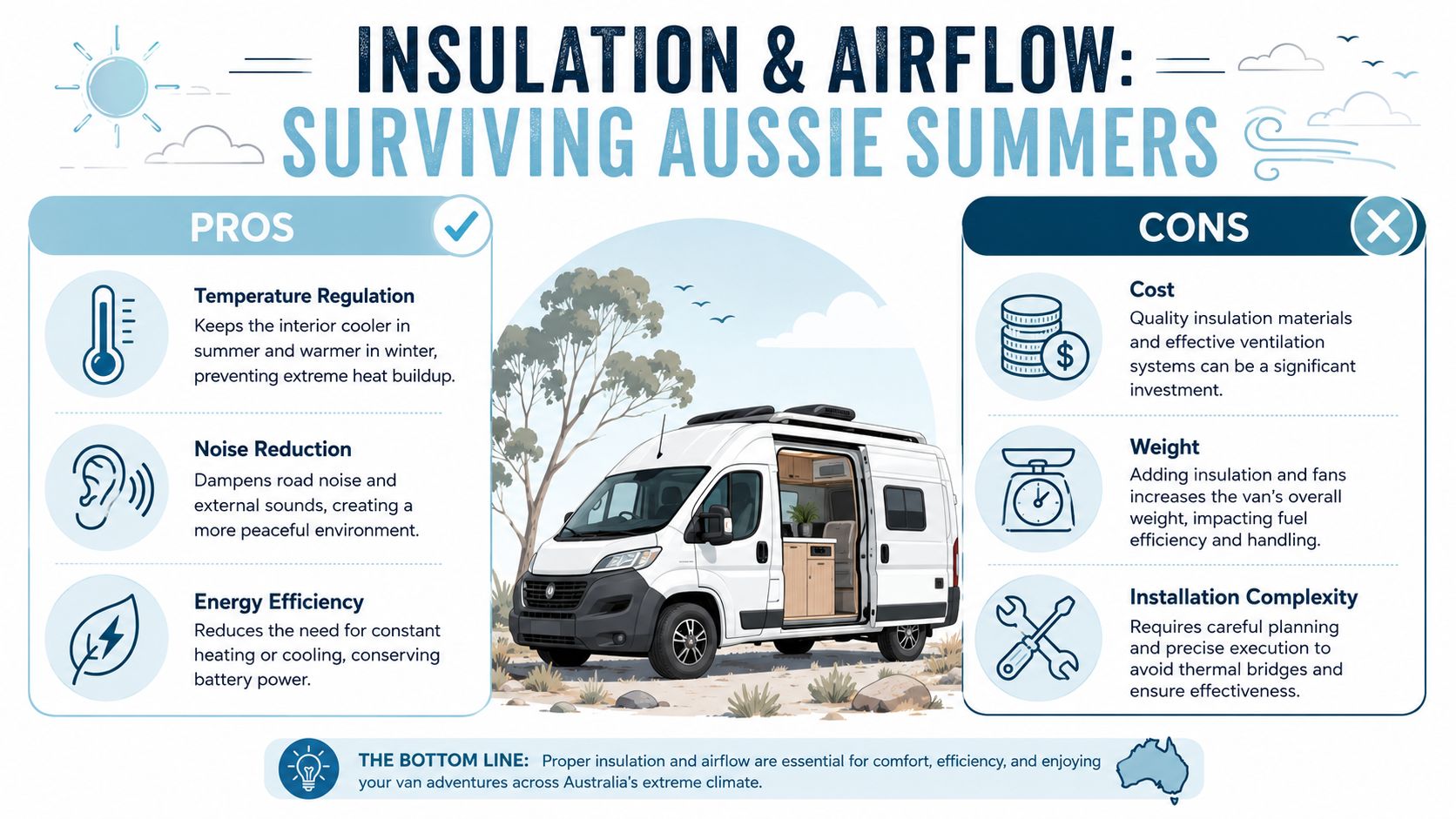
Insulation and Airflow for Aussie Climates
Australia is merciless with badly insulated vans. A metal shell left half-done turns savage in summer and clammy in winter. This is the stage where many first-time builders cut corners because insulation feels invisible. Then they spend their first trip sweating, wiping condensation, and wondering why the floor feels like an ice tray at dawn.
Cover every bit of bare metal
One of the most common mistakes in an Australian camper van conversion is leaving sections of metal exposed. According to this van build guide on insulation practice, the recommended approach is a two-layer system. First comes an adhesive closed-cell foam layer with aluminium backing, 1–2cm thick, covering the full interior. Then comes a second reflective layer, often called Reflectix.
That advice sounds fussy until you've camped through a hot spell or a cold snap. Any skipped patch becomes a weak point. Heat barges in. Condensation gathers. The van feels unsettled and damp.
If you're comparing materials for your own van insulation options, focus less on marketing language and more on full coverage, clean fitment, and how the layers work together.
Airflow isn't optional
Insulation solves only half the problem. A van also needs to breathe.
Warm air from cooking, sleeping, and wet towels has to go somewhere. If it can't leave, it turns into moisture on glass and steel. That's when mould, stale smells, and general misery arrive. Good airflow can be simple, but it has to be deliberate. A roof vent, smart window habits, and clear air paths matter more than decorative extras.
Consider the trade-offs in plain terms:
Closed-cell foam gives dependable coverage and helps with heat control.
Reflective layers support radiant heat management when fitted neatly.
Vinyl flooring with foam underlay can improve comfort underfoot when paired correctly, which matters in dusty Australian conditions noted in the same build guide.
Ventilation openings protect the interior from trapped moisture, even when the weather isn't dramatic.
Skip insulation and the van works against you. Add insulation without airflow and the van still wins.
Comfort changes the whole trip
People talk about engine notes, paint colours, and clever storage. Fair enough. But cabin comfort shapes every hour you spend inside. A well-insulated van settles down at night. It sounds calmer. It feels more controlled. It gives you the sort of quiet comfort that makes a short trip feel longer and a rough day easier.
That's why this part deserves care. You won't show it off much at a meet, but you'll thank yourself every morning.
Powering Your Adventure and Keeping the Water Flowing
This is the point where the van stops being a shell with furniture and starts acting like a tiny home. Lights flick on. A fridge hums. Water runs. The first time that happens, even a grizzled old VW hand feels a bit smug.
Start with simple electrical maths
Electrical planning frightens people because they picture black magic. In most DIY camper van conversion work, it starts with a list and some basic arithmetic.
The benchmark used in Australian DIY guidance is clear. Work out your daily power use in watt-hours, divide by six hours of proper sunlight per day, then round the required solar wattage up by 20% to cover shade parking or heavier use, according to Camplify's Australian van conversion guide.
Here's the practical shape of that process:
List each device you'll use in a day.
Convert usage into watt-hours for the full daily load.
Divide by six to estimate panel wattage for Australian conditions.
Add 20% headroom so the system isn't constantly on the edge.
Choose battery capacity based on how long you want to stay off-grid.
That same guide also outlines the battery side. Divide your watt-hours by system voltage to get amp-hours, then multiply by your desired autonomy days. It gives the example of 960Wh divided by 12V, then expanded by 2 days of autonomy. That's the kind of tidy working you can follow without pretending to be an auto sparky.
If you're planning a larger touring setup, a slim battery format such as this 200 Ah slimline lithium battery gives you a useful reference point for how modern storage solutions fit tighter spaces.
To see the systems thinking in action, this walkthrough is handy:
Wire for vibration, not just theory
Classic Volkswagens don't live pampered lives. They buzz, bounce, and vibrate. The Australian guidance above notes chassis mounting with self-tapping screws and shake-proof lock washers to reduce vibration-related issues. That's the sort of detail that separates a clean weekend install from a long-term reliable one.
Use fuses, tidy cable runs, and accessible shut-offs. Build so you can troubleshoot later without dismantling half the interior.
Small electrical choices become big reliability stories on corrugated roads.
Keep plumbing as simple as your trips allow
Not every van needs a pressurised palace. Some of the happiest setups use a basic sink, portable fresh water, and a simple waste container. Others justify pumps, fixed tanks, and more integrated plumbing because the van stays out longer and does more work.
A practical comparison looks like this:
Setup style
Best for
Character
Hand-pump sink
Weekend trips
Simple, light, easy to maintain
Electric pump and fixed tanks
Longer touring
More convenience, more planning
Minimal water storage
Day use and quick overnighters
Fast to fill, easy to clean
More developed water system
Multi-day living
Better comfort, more components
Build the system that suits your use, not the one that wins the loudest applause online.
Custom Cabinetry and Clever Storage Solutions
Cabinetry is where a camper van conversion gets its personality. Up until now, you've been protecting the shell, taming temperatures, and making the systems behave. Then one Saturday afternoon you dry-fit a bench, stand back, and suddenly the van feels hospitable.
I remember a split-screen build at a show years ago. On one side was a tidy but generic fit-out with square cupboards and dead space everywhere. On the other was a home-built interior in pale ply, curved corner shelves, a bench seat that turned into a bed, and hidden cubbies under the base for tools, leads, and camp gear. The second one wasn't fancy. It was thoughtful. That's why everyone kept peering inside.
Make each piece earn its spot
In a small van, furniture can't be lazy. A bench should store something. A bed base should lift, slide, or open. A galley should leave room to stand without twisting like a circus act.
The best cabinetry choices often follow these patterns:
Lightweight plywood keeps the fit-out manageable without making the van feel top-heavy.
Vertical storage turns dead wall space into shelves, spice racks, or slim lockers.
Lift-up bed bases make bulky items easier to reach than deep front-opening boxes.
Curved edges and rounded corners feel kinder in a tight cabin and suit classic VW lines.
Build around daily rituals
I like to judge a layout by tiny repeated moments. Can you reach the kettle without unpacking the bed? Can you grab a jumper at night without unloading half the van? Can the passenger seat still feel like a seat, not a barricade?
Those questions shape cabinetry better than any trendy fit-out phrase. One owner I met had built a narrow side cabinet just deep enough for enamel mugs, a torch, maps, and two weathered workshop manuals. Another used the void beside the wheel arch for a slide-out pantry. Neither solution looked showy. Both made the van easier to inhabit.
Good cabinetry doesn't just store gear. It reduces friction in the day.
Leave room for the van's character
Old Volkswagens already carry a strong personality. Cabinetry should work with that, not smother it. Keep sightlines to the windows. Don't overbuild until the interior feels like a timber corridor. Let the curves of the body still speak.
That balance is part craft, part restraint. A van should feel lived in, not packed to the roof with cleverness.
Styling with Classic VW Memorabilia and Diecast Decor
Once the practical work is done, you can finally have a bit of fun with the soul of the thing. At this stage, the build shifts from “nice conversion” to “that's your van, isn't it?”
The easiest mistake is going overboard and turning a beautiful old camper into a novelty shop. The better move is to use a few VW touches that feel earned. Think of them as punctuation marks, not wallpaper.
Let small objects tell the story
A finished van always benefits from personal details with history behind them. In a Volkswagen-themed interior, diecast models work beautifully because they echo the actual machine without shouting over it.
A few styling ideas that suit a classic VW camper:
A compact display shelf near the rear cabinet for a licensed Kombi or Samba Bus model.
A Beetle model on a dash shelf or overhead nook where it catches the morning light.
A small framed Volkswagen print or badge display tucked into the galley wall.
A themed storage tin or tray for keys, coins, and campsite odds and ends.
Collectors know the appeal already. A VW Kombi diecast Australia search usually starts as a gift hunt and ends as a shelf problem. That same instinct can soften a van interior. One carefully placed Volkswagen Beetle model can make a timber cabinet feel like part workshop, part memory box.
Match decor to the van, not just the brand
A bright Flower Power piece suits some builds and jars with others. A patinated split-window look calls for subtler accents. A surfy beach-runner can carry bolder colours and playful details. The trick is to style in harmony with the van's mood.
A simple pairing guide helps:
Van mood
Decor that fits
Restored classic Kombi
Heritage-style VW art, muted diecast pieces
Beachy cruiser
Colourful Kombi models, surf-inspired VW accents
Workshop-inspired build
Badge displays, manuals, metal signs
Minimal touring interior
One or two licensed models, restrained shelf styling
Keep it stable and useful
Anything decorative in a camper still has to survive the road. Use secure shelves, non-slip liners, and enclosed nooks for display items. If you're going to buy diecast Kombi pieces for the van itself, choose spots that won't send them skittering across the cabin at the first roundabout.
That's also why VW memorabilia collectibles work best when they're folded into useful features. A model on a lip shelf above the kitchen. A tiny framed piece above a book cubby. A Beetle tucked into the end of a cabinet beside a torch and a map. It should feel like the owner loves Volkswagens, not like the van is trying too hard to prove it.
Done well, the styling becomes the final handshake between machine and memory. That's when the conversion feels complete.
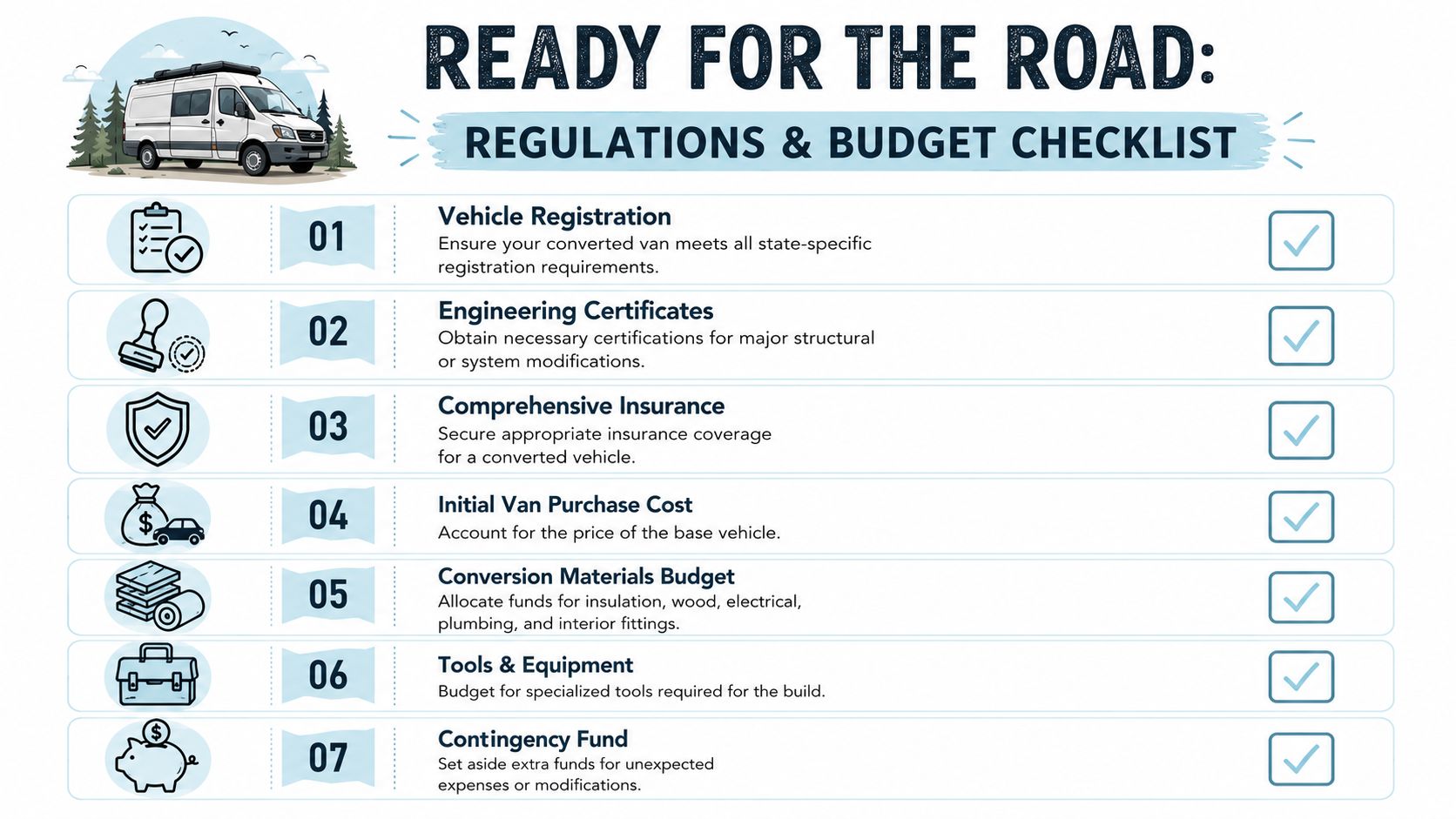
Navigating Aussie Regulations and Your Budget
The last stretch of a camper van conversion often feels less romantic than the first. There's paperwork, state rules, engineering questions, and the sharp reality of what the build has cost. It's still part of the craft. A van isn't finished when the curtains go in. It's finished when it's legal, insurable, and financially understood.
What the build can cost
Australian costs vary wildly by ambition. For 2026 projections, Rising Rides reports that camper van conversion costs range from $3,000 for a basic DIY setup to over $60,000 for a full professional touring conversion. The same source places a comfortable mid-range build at $10,000 to $25,000 for the conversion alone.
That spread tells an honest story. A simple weekend setup is one thing. A touring fit-out with proper systems, cabinetry, and finish quality is another. Builders often underestimate how quickly small purchases stack up. Timber, fasteners, flooring, sealants, electrical protection, plumbing fittings, trim pieces, and rework all have a habit of joining the tally.
State rules can trip you up
Australia doesn't give DIY builders one tidy national rulebook in practice. State-by-state differences in compliance can catch people badly if they treat registration, gas work, electrical changes, and modification approvals as a generic checklist.
That matters because confusion around compliance has been identified as a major reason projects get abandoned, and many guides still don't map the differences clearly. If your build includes gas or major electrical work, get proper local advice before the interior closes up. It's cheaper to ask early than to undo finished work later.
Insurance needs proof, not hope
Insurance is another area where people get casual at exactly the wrong moment. Standard vehicle cover may not respond kindly to uncertified DIY modifications. If your build includes significant changes, document them properly, keep receipts, photograph each stage, and ask insurers direct questions about converted vehicles before assuming you're covered.
A short checklist keeps the risks in view:
Confirm state-specific registration requirements before the build is final.
Check certification needs for gas, electrical, and structural changes.
Document the conversion with photos, receipts, and component details.
Ask insurers how they treat DIY modifications and certified work.
Budget for surprises, because old vans always have opinions.
If the build bug has bitten hard and you want the finishing touches that celebrate the old VW spirit, have a look through Volkswagen Memorabilia. It's a strong local option for officially licensed Volkswagen diecast models for sale, Kombi and Beetle gifts, and display pieces that suit a shed, shelf, or freshly finished camper. For Australian buyers, the local stock and fast shipping are a real advantage, especially when you want your next VW piece without the long wait.
You're probably in the same spot plenty of classic VW owners hit sooner or later. The car's running sweet, the paint still turns heads at the servo, and a late arvo drive feels spot on until the sun drops and those old headlights start looking more charming than useful.
That's where the led H1 headlight conversation usually starts. Not because anyone wants to modernise the soul out of a Beetle or Kombi, but because using these old girls on modern Australian roads asks a bit more of the lights than it did decades ago.
The trick is doing it properly. With classic Volkswagens, especially Australian cars and long-loved restorations, the primary issue isn't just whether an H1 LED bulb fits the socket. It's whether the beam pattern stays safe, tidy, and roadworthy once it's sitting inside an old reflector housing. Get that wrong and you haven't upgraded anything. You've just made the car harder to use and more likely to attract unwanted attention.
That Dusk Cruise Feeling Just Got Brighter
There's a special kind of joy in an evening run in an air-cooled VW. Windows cracked, engine humming away behind you, and that familiar view over a Beetle bonnet or through a splitty screen. It's part machine, part memory.
Then the road gets darker.
Anyone who's driven an older VW outside the city knows the feeling. A halogen setup that seemed acceptable around town suddenly looks thin and yellow on a country road. Signs don't pop the way they should. Surface changes arrive later than you'd like. You start driving the car around the headlights instead of driving with confidence.
That's why a led H1 headlight upgrade gets so much attention among restorers and owners who use their cars. It isn't about chasing a trendy white light for the sake of it. It's about making a classic Volkswagen easier to enjoy after sunset, without taking away the character that made you fall in love with it in the first place.
Australian VW history gives that idea a bit of weight too. The last original Volkswagen Beetle was assembled in Australia in July 1976, before the Kombi, Golf, and Passat assembly lines ended in February 1977, as recorded by Club VW's Australian Volkswagen reference. Keeping those cars practical now is part of keeping the story alive.
Old VWs earn their keep when you can drive them more often, not when they only come out in perfect daylight.
A tidy lighting upgrade can sit in the same camp as better tyres, careful brake work, or sensible wiring repairs. Respect the car. Improve the drive. Keep the spirit intact.
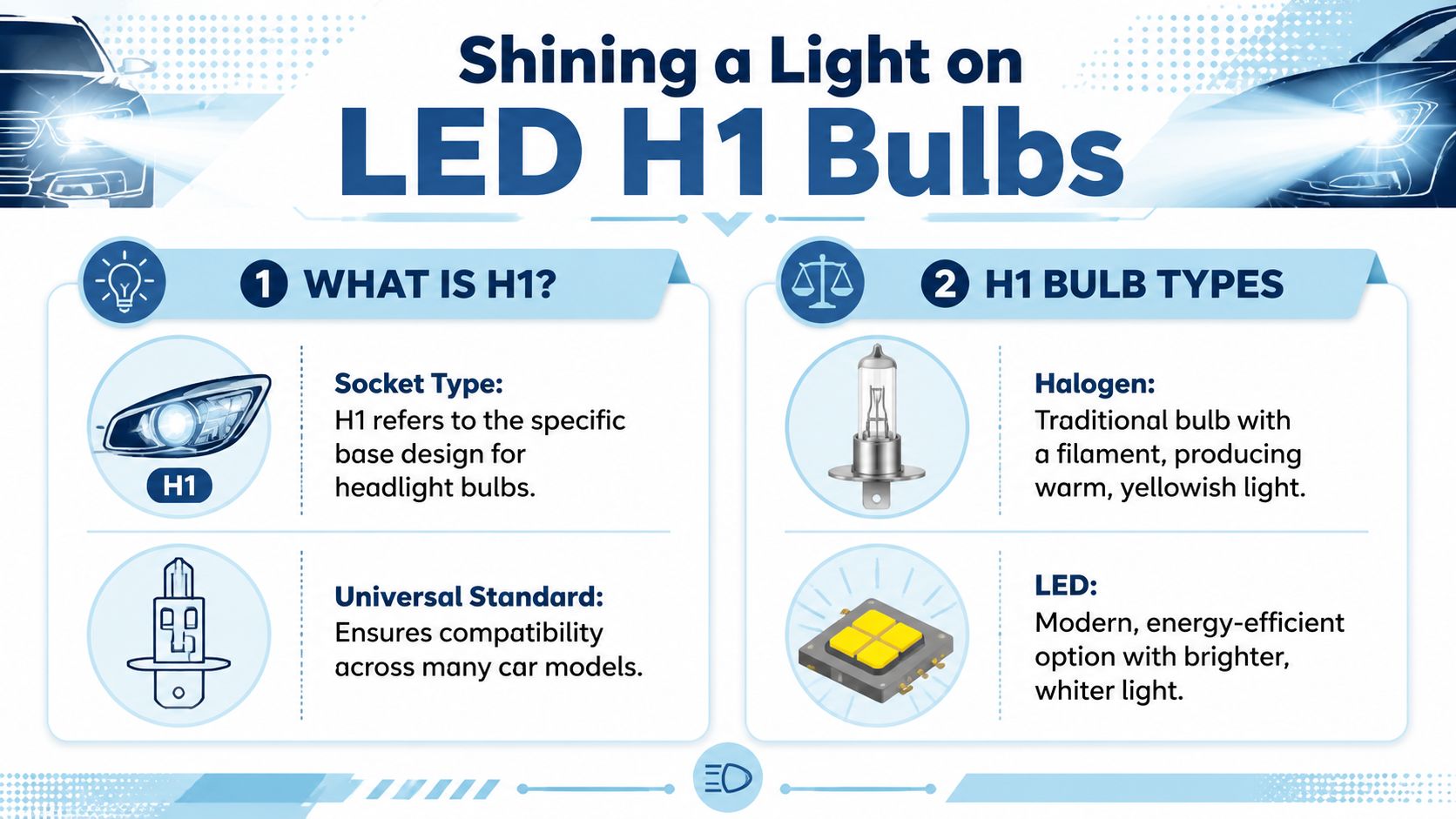
Shining a Light on LED H1 Bulbs
Before you buy anything, it helps to know what H1 means. It's the bulb format, not a magic performance label. In simple terms, an H1 bulb uses a P14.5s base, which is the round metal base design with a single spade connector used in many headlight applications.
What changes when you move from halogen to LED
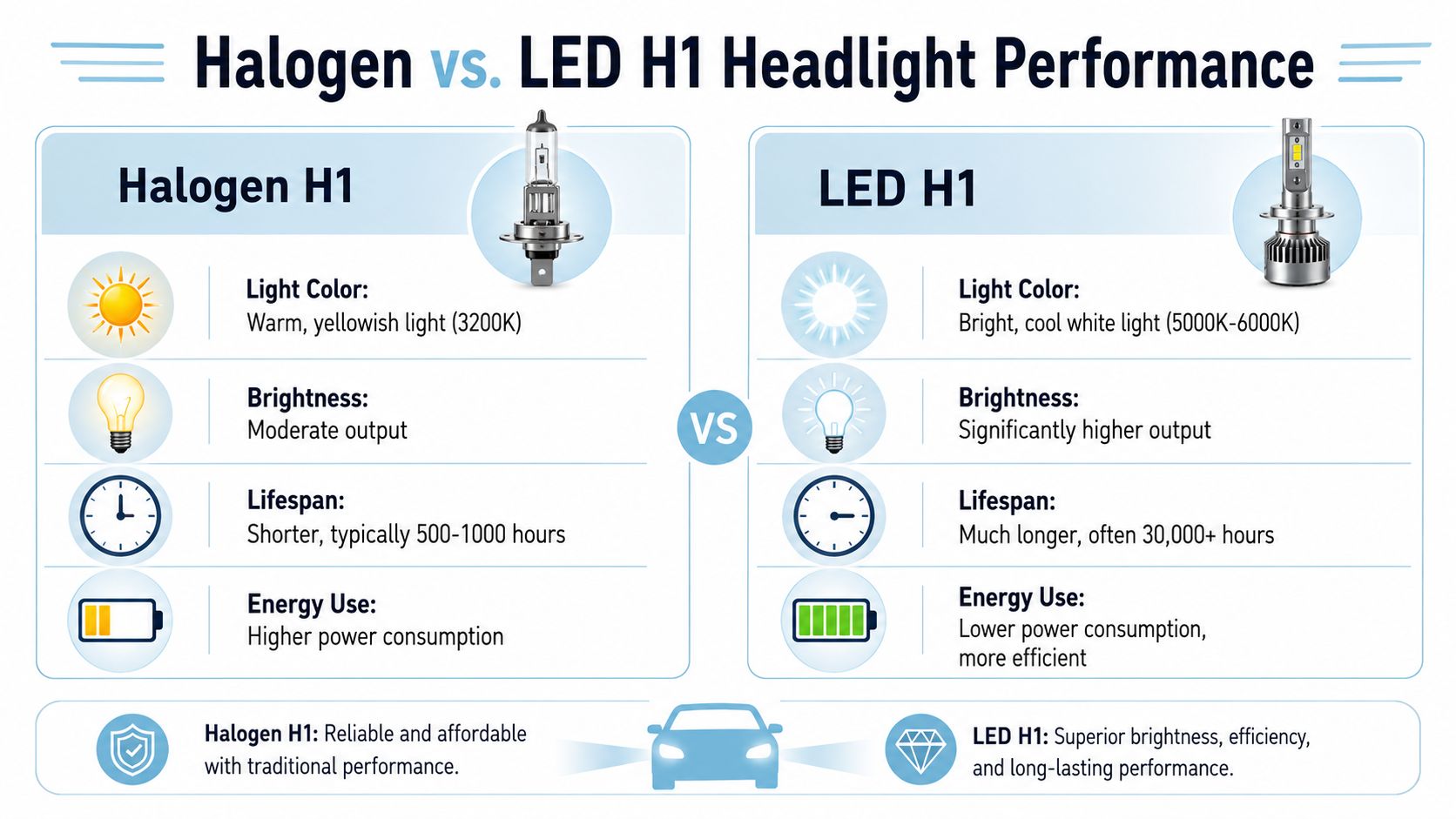
A traditional H1 halogen globe makes light with a filament. An LED version uses small light-emitting chips instead. That sounds simple enough, and in physical fitment terms it often is. According to the H1 lamp reference on Wikipedia, H1 LED headlight bulbs replace the original P14.5s base halogen globes and can produce around 2800 to 3600 lumens per bulb, compared with roughly 700 to 900 lumens for a typical H1 halogen.
That's the part that gets everyone excited. More light from the same basic socket.
But an LED bulb isn't just a halogen with a different glow. Most kits add extra hardware. You'll usually see a driver module, plus a cooling arrangement such as a fan or heatsink on the rear of the bulb. That matters a lot in a classic VW because headlight buckets don't offer endless room to play with.
The easy way to think about it
Consider the act of swapping an old torch globe for a modern LED torch insert. While both may fit the same space, they produce light differently, dissipate heat differently, and behave differently in a reflector.
Here's what to keep straight before ordering a kit:
Socket match: H1 tells you the bulb base style.
Light source shape: The reflector was designed around a filament, not automatically around LED chips.
Rear clearance: Cooling hardware can foul on the back of the bucket or dust cover.
Wiring style: Plug-and-play claims can still hide small fitment surprises.
That last point catches plenty of owners. A bulb can be marketed as easy-fit and still create real headaches once it meets old VW hardware.
Seeing the Difference Halogen vs LED Performance
The biggest practical difference between halogen and LED isn't marketing fluff. You see it on the road. A good LED setup produces a cleaner, whiter light that makes roadside detail easier to pick up, especially when your eyes are dealing with a dark stretch of road and mixed traffic.
The hard numbers that matter
The useful thing about quality H1 LED products is that some of the claims are backed by proper figures rather than pub talk. On Philips' Australian road-legal LED page, high-performance H1 LED replacements can achieve up to 2,345 Max Lux, compared with 482 Max Lux for standard halogen, and Philips says that's 238% brighter in that test. The same page notes the Philips Ultinon Pro6000 offers up to 3,000 hours of bulb life, lasting six times longer than comparable halogen globes, as shown on the Philips Ultinon Pro6000 page.
That sounds brilliant, and often it is, but there's a catch seasoned owners learn quickly. Not every LED bulb behaves the same way in every lamp.
A lot of Australian drivers also gravitate to the cool white look. Some commercial H1 LED kits sold for the local market, such as the F22 Series mentioned in the verified data, are listed at 6500K with 110W and 24,000 lumens total brightness. That sort of output can look fantastic on paper, but old reflector housings don't care about marketing. They care about where the light source sits.
Here's a quick side-by-side view.
Feature
H1 Halogen
H1 LED
Light colour
Warmer, more yellow
Usually cooler, whiter
Output potential
Lower
Can be much stronger
Bulb life
Shorter
Can last much longer
Electrical load
Higher
Often easier on an older system
A video walk-through helps if you want to see how beam shape changes from one bulb style to another.
What works well in a classic VW
The best result usually comes from restraint, not maximum claimed brightness.
Choose beam control over bragging rights: A lower-output bulb with better chip placement often beats a wild-output bulb with messy scatter.
Use white light sensibly: A crisp colour can improve clarity, but only if the beam lands where it should.
Value longevity: Changing bulbs in a classic isn't difficult, but fewer failures are always welcome.
Practical rule: If a bulb gives you more glare than reach, it's not an upgrade.
For a Beetle, Type 3, or Kombi that sees regular use, the sweet spot is a kit that offers tidy optical performance, manageable heat, and consistent reliability. That's the kind of upgrade you appreciate every time the daylight fades.
Installation and Wiring for Your Classic VW
Classic VW fitment is where the led H1 headlight story gets interesting. Plenty of kits are sold as plug-and-play, but anyone who has wrestled with an old headlight bucket knows there's often more going on than the listing suggests.
Bucket space is the first hurdle
The rear of many LED bulbs is bulkier than the old halogen globe they replace. Cooling fans, heatsinks, and drivers all need somewhere to live. In a Beetle or Kombi with snug buckets, that can mean the bulb fits the socket but not the housing.
That's why it pays to measure before buying. Check the bucket depth, check the dust cover clearance, and check where the wiring needs to sit once the lamp is reassembled. If you're sorting other restoration jobs at the same time, it's worth looking over your broader VW Type 1 parts options so the headlight upgrade isn't being asked to hide cracked boots, tired connectors, or brittle old hardware.
Orientation matters more than people realise
This is one of the big ones. Premium H1 LED kits can feature CSP LED chips and IP68 weatherproof ratings, but enclosed headlight buckets create thermal headaches, and the bulb must sit with the LED chips on the left and right sides for proper heat dissipation and beam pattern, as noted on Lightforce Australia's H1 upgrade kit page.
If the chips point up and down, the reflector usually won't throw the beam the way you want. You can end up with a smeared pattern, extra glare, and wasted light.
Fit the bulb, then check orientation before buttoning everything up. Three and nine o'clock is the usual goal.
A practical install checklist
Dry-fit first: Don't lock everything down until you know the fan or heatsink clears the bucket.
Watch the connectors: Old VW wiring can be serviceable but tired. Clean terminals and inspect insulation while you're in there.
Keep the rear sealed: If the dust cover won't go back on properly, moisture and grime will make a mess of things.
Aim after fitting: Even a correctly installed bulb can throw poorly if the lamp aim is off.
One more thing. Heat kills LEDs faster than most owners expect. A powerful bulb trapped in a small sealed bucket can cook itself over time, especially if airflow is poor. That doesn't mean LED is a bad idea. It means the kit has to suit the housing, not just the socket.
Staying Roadworthy With Your LED Upgrade
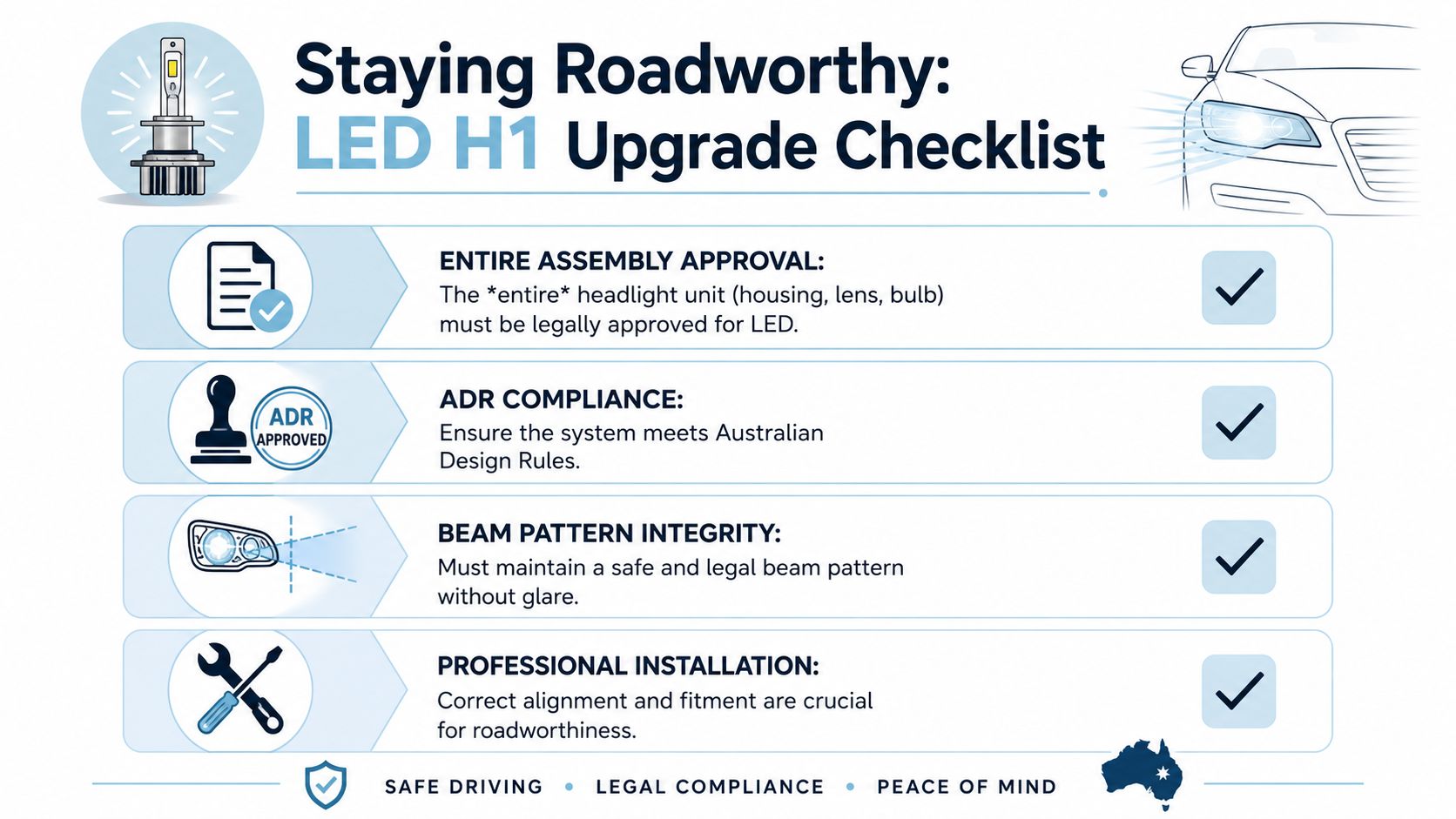
This is the bit many generic guides get wrong. In Australia, the issue isn't whether someone can sell you an LED bulb that fits an H1 socket. The issue is whether the entire headlight system remains compliant once that bulb is installed.
Legal bulb versus legal beam pattern
According to Drive's explanation of Australian headlight rules, LED headlights using the H1 format are legal only if they comply with ADR 13/00, which requires white light, intensity not exceeding 430,000 candelas, mounting height between 500mm and 1200mm, and placement not extending more than 400mm longitudinally from the vehicle. Drive also notes that non-compliance can lead to defect fines from $100 to $900, plus defect notices and a vehicle being deemed unroadworthy under enforcement, as detailed in this Drive article on LED headlight legality in Australia.
For classic VW owners, the most important part of that isn't the paperwork language. It's the beam. Old reflector housings were designed around a halogen filament shape. Swap in a flat LED chip layout and the reflector can scatter light in ways that don't show up until you test the beam against a wall or meet oncoming traffic.
That's why “ADR compliant bulb” and “ADR compliant result” are not the same thing.
Where restorers get caught out
A lot of Beetle and Kombi owners assume a plug-in globe is a legal shortcut. It often isn't.
Reflector mismatch: The lamp may throw glare instead of a controlled cut-off.
DIY aiming isn't enough: You can point a messy beam lower, but you can't fix bad optics with adjustment alone.
State-level quirks exist: Some wiring requirements and inspection expectations vary, which adds another layer for enthusiasts.
If you're refreshing the front end while sorting lights, it's worth checking broader Volkswagen Beetle parts for restoration jobs so the whole system is working as it should, not just the bulb.
A legal upgrade isn't the brightest one on the shelf. It's the one that puts clean light on the road without annoying everyone coming the other way.
For some cars, the honest answer is that a projector-style conversion or a professionally assessed setup is the safer path if you want LED performance without roadworthy dramas.
Choosing Your Kit and Cruising with Confidence
Once you know the traps, buying gets much easier. You're not shopping for a miracle bulb. You're shopping for a kit that suits an old VW housing, leaves enough room for cooling, and gives you the best chance of a proper beam.
The shortlist I'd use
Check dimensions first: If the rear hardware won't fit, stop there.
Look for adjustable positioning: Being able to rotate the bulb helps nail that left-right chip orientation.
Buy from an Aussie supplier who understands local fitment: That usually means better support and fewer surprises.
Treat huge brightness claims carefully: The neatest beam wins.
A reputable local supplier also means local stock and faster shipping, which is handy when the car's apart and you don't want it sitting on stands while a mystery parcel circles the globe. If you're already deep into a bigger build, keeping an eye on your broader VW parts in Australia can save you from doing jobs twice.
For plenty of owners, the best outcome is simple. Better night vision, less strain on old electrical gear, and a classic Volkswagen that still feels like itself.
To finish on a lighter note, there's something nice about celebrating the actual car while it's in the shed getting fettled. A shelf full of classic VW pieces keeps the passion alive between drives, especially if you're into VW Kombi diecast Australia, a well-made Volkswagen Beetle model, or hunting down Volkswagen diecast models for sale with proper licensed detail.
Quick FAQ
Are H1 LED bulbs always legal in Australia? No. The bulb fitting the socket doesn't automatically make the beam pattern legal.
Will an LED H1 bulb fit my classic VW? Maybe. The socket may match, but rear clearance, dust cover fit, and connector style can still cause trouble.
Do I need professional help? If you want the best shot at a compliant beam and proper aim, professional installation is the sensible move.
Are all LED kits brighter than halogen in practice? No. Output varies, and beam control matters just as much as raw brightness.
If you love cars and the stories wrapped around them, have a look through Volkswagen Memorabilia. It's a top spot for VW memorabilia collectibles, licensed Kombi and Beetle diecast pieces, and gift-worthy finds for the Volkswagen tragic in your life. Local Australian stock and fast shipping make it easy to grab a classic buy diecast Kombi piece or a beautifully finished Beetle model to keep that VW spirit going in the shed, the office, or the display cabinet.
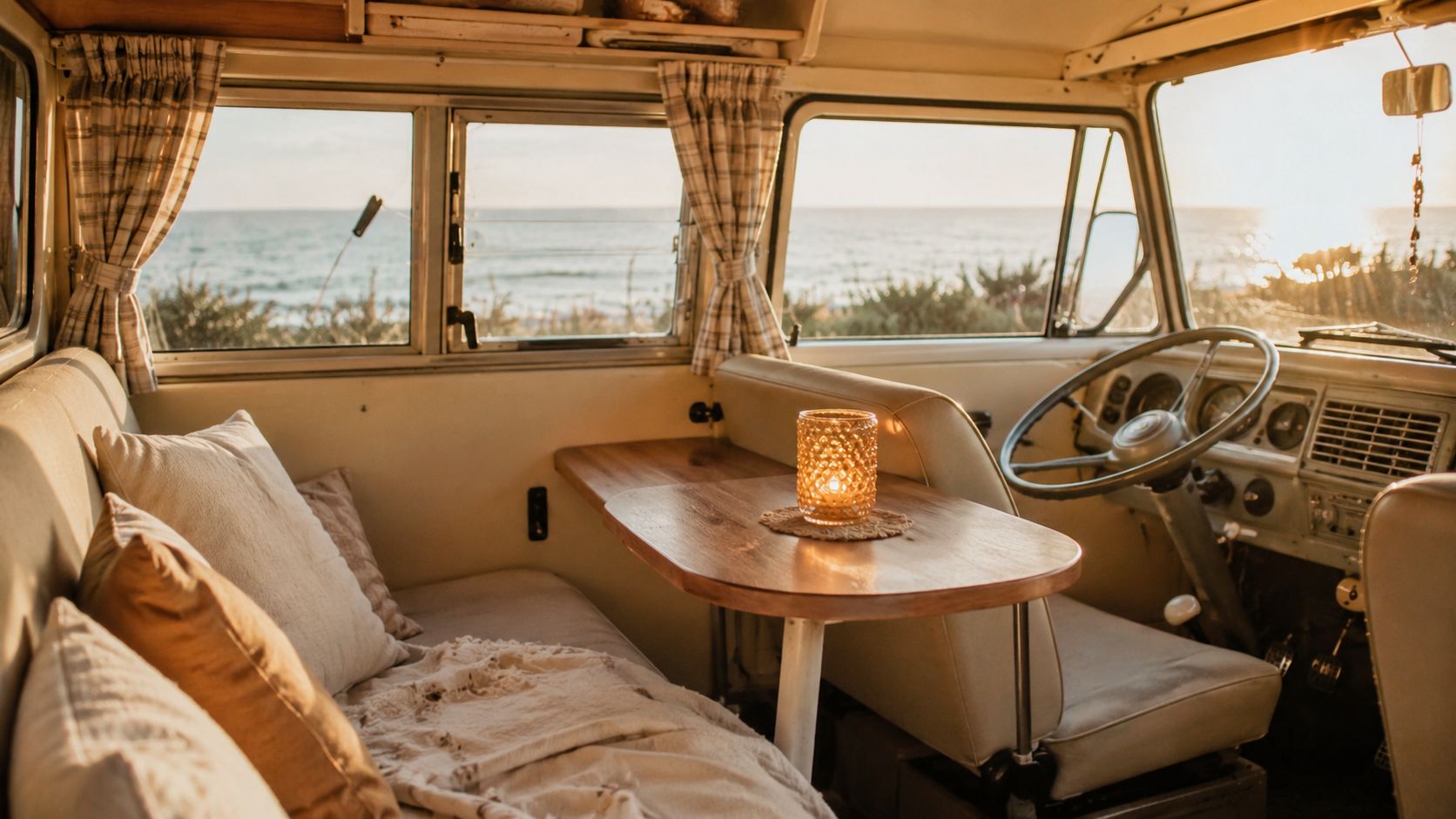
The other afternoon I was standing beside a tidy Beetle at a sunny local meet, coffee in hand, chatting with a bloke who'd nailed that hard-to-define vintage feel at home. Not with a full garage fit-out or a museum-grade man cave. Just a shelf, a small timber sideboard, a couple of diecast Kombis, and an old metal candle holder that looked like it had seen a few road trips of its own.
That's the charm of retro candle holders. They work like the right accessory on a classic VW. A small detail, but it changes the whole mood. Put one beside a surfy Kombi model or a neat Beetle display and suddenly the room feels less like a storage spot and more like a story.
If you're already the sort of person who slows down for a split-screen Kombi or spots a Beetle shape from half a car park away, you already get it. Home styling isn't about chasing trends. It's about bringing that same freedom, warmth and character indoors.
Introduction Light a Vibe Not Just a Candle
A classic VW has a way of turning ordinary moments into memorable ones. A Kombi parked near the beach at sunset. A Beetle rumbling into a weekend show. A Samba Bus with that unmistakable silhouette catching the light. Those scenes stick with you because they feel easy, honest and full of personality.
That same feeling can live in a corner of your home. Not in a forced, theme-park sort of way. More like a well-loved shelf, a coffee table, or a dining nook where a few carefully chosen pieces do the talking. A retro candle holder is brilliant for this because it brings warmth, shape and age into the mix without trying too hard.
I've seen this work best when the display feels lived-in. A brass holder near a Beetle model. A coloured glass piece beside a Kombi. A weathered tray under both. It's the home version of getting the wheels, paint and stance just right on an old Volkswagen. None of the parts need to shout. They just need to belong together.
A retro corner at home works the same way a good VW display does at a show. The details carry the feeling.
What Exactly Makes a Candle Holder Retro
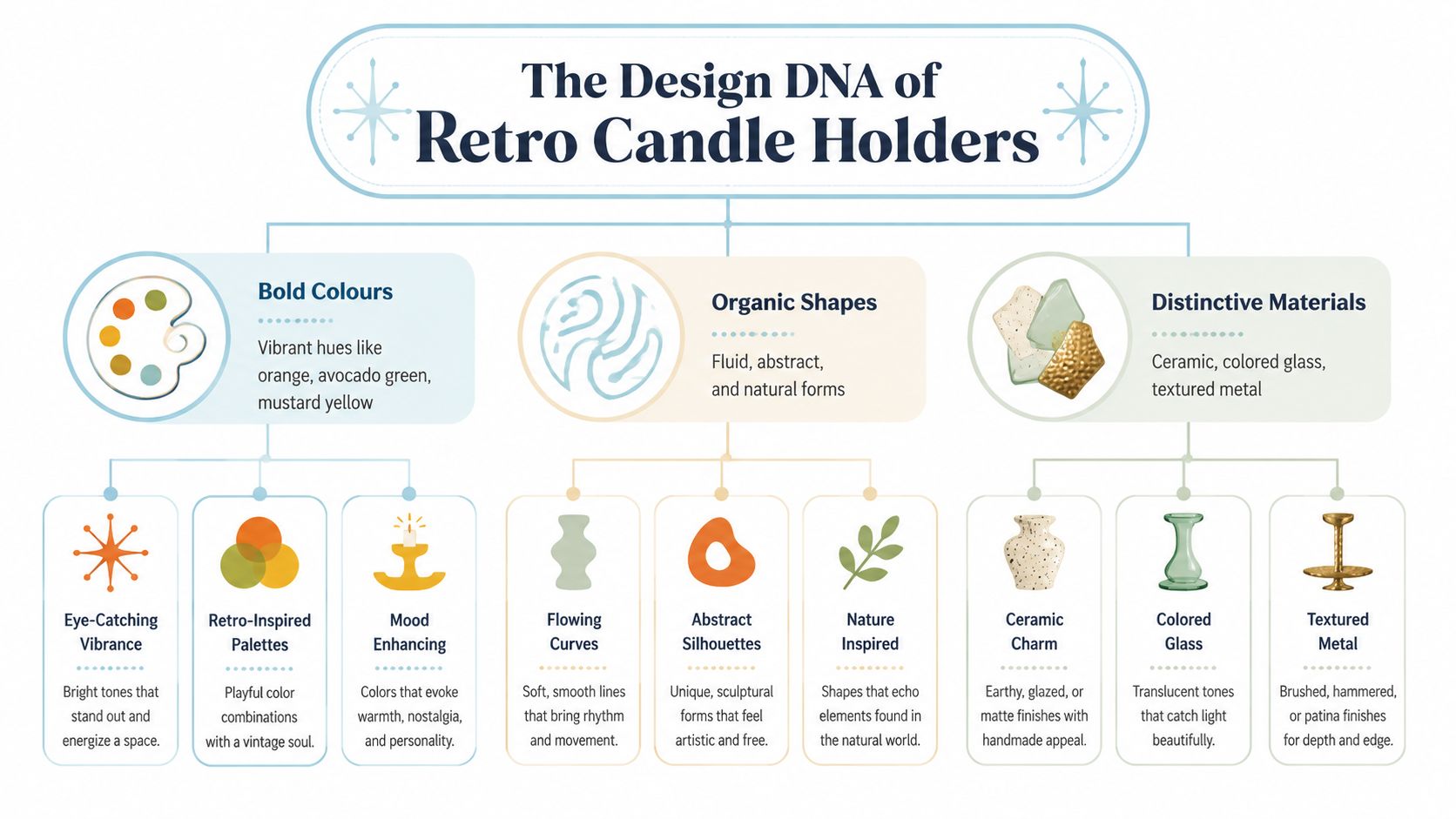
The word retro gets tossed around a lot, but with candle holders it usually points to pieces that borrow their character from earlier design eras. For VW fans, that's handy territory, because the same decades that gave us much-loved Beetles and Kombis also shaped plenty of home décor with colour, utility and bold silhouette.
There's also a deeper lineage behind the look. Decorative candle holders aren't some recent styling trick. As Britannica's history of the candlestick notes, candlesticks were used in churches before the Norman Conquest, and by the 13th century large hanging holders of wood or iron were common. So even when you buy a “retro” piece today, you're tapping into a design tradition that runs back centuries.
The shapes that feel right
Retro holders usually look confident from across the room. You'll notice:
Rounded forms that feel soft and playful
Chunkier stems or bases instead of fussy ornament
Practical handles or trays that hint at utility
Simple geometry that pairs well with mid-century furniture and garage-style shelving
That last point matters for VW displays. A Beetle has curves. A Kombi has clean panels and iconic windows. Retro holders often echo one side of that language, either soft and organic or neatly functional.
The colours and finishes that sell the mood
If a candle holder feels right with a vintage Volkswagen scene, colour is usually part of the reason. Think amber glass, mustard, sea-green, cream enamel, smoky brown, polished brass or painted metal with a bit of age on it.
Those tones work because they don't compete with memorabilia. They frame it.
Practical rule: If the holder grabs more attention than your diecast model, it's probably the wrong piece for that shelf.
Why VW lovers tend to like them
Retro décor and classic Volkswagens share a certain honesty. Neither needs to be over-designed. Both were shaped by usefulness, but they still ended up charming.
That's why retro candle holders don't feel random in a VW-inspired room. They carry the same spirit. A bit nostalgic. A bit practical. A bit cheeky. Just enough age and colour to make the space feel like yours.
Choosing Your Vibe Common Retro Materials
Materials do most of the storytelling. Before you worry about colour or placement, pick the material that matches the sort of VW mood you want in the room.
Glass for the coastal cruise feel
Coloured glass holders suit the laid-back side of VW culture. If your shelves lean beachy, with Kombis, surf prints and pale timber, glass gives off that easy sunset glow. Amber feels warm and nostalgic. Green and blue can nod toward sea and sky without becoming kitschy.
Glass also works well when you want the diecast model to stay the hero. It adds atmosphere without visual weight.
Ceramic for a more playful corner
Ceramic holders tend to feel handmade, cheerful and slightly bohemian. If you love flower-power liveries, bright kombi artwork, or shelves with a bit of festival spirit, ceramic fits naturally.
Some are glossy and bold. Others are earthy and muted. Either way, they add softness that balances metal model cars nicely.
Brass and enamel for the workshop-meets-camper look
If your taste runs more toward tool rolls, old maps, garage cabinets and road-trip gear, brass and enamelled metal are hard to beat. They've got that practical streak classic VW people tend to appreciate.
Mid-century Australian design often favoured durability. A typical 1960s retro holder might be made of sheet steel with an enamel coating, featuring a 13 cm diameter and a 2.5 cm candle receptacle, which gives you a useful benchmark when sizing a piece for a shelf or console. In humid coastal climates, those enamel finishes can chip, so it's smart to inspect rims, edges and handles before buying vintage.
A simple way to test the look is to compare a rugged holder with the softer styling in these white candle holders. The contrast helps you decide whether your space wants workshop toughness or cleaner coastal calm.
Material
Best VW styling mood
What to check
Glass
Coastal Kombi, beach shack, shelf glow
Chips, cloudiness, wobble
Ceramic
Flower-power, colourful display, relaxed lounge
Hairline cracks, glaze wear
Brass
Beetle study, garage-chic, warmer tones
Uneven base, heavy wax build-up
Enamelled steel
Camper, utility, mid-century vibe
Chipping around edge and handle
Styling Retro Holders with Your VW Memorabilia
The fun begins. A good display doesn't need loads of stuff. It needs a clear mood and a few pieces that speak the same language.
Coastal Kombi cruise
Start with a blue, aqua or sea-green glass holder. Put it on a timber tray or pale shelf. Then place a Kombi diecast nearby, not directly beside it, but offset so the candle holder acts like a soft visual anchor rather than a prop.
The trick is spacing. Leave a little breathing room. Add one natural texture, maybe a shell, driftwood piece or woven coaster, and stop there. Too many beach cues and it turns into a souvenir shop.
For a broader look at arranging these kinds of scenes on dining and living surfaces, the ideas in dining table décor are handy because they focus on layered but uncluttered styling.
Flower power freedom
This look suits bright ceramic holders, especially in rounded or slightly quirky shapes. Pair them with a colourful Samba Bus or a bus model with cheerful graphics. Keep the holder low and chunky if the diecast has a lot of visual detail, so the eye doesn't have to work too hard.
Try this three-part setup:
Centre piece with one colourful bus model as the hero
Side accent using a ceramic holder in a contrasting but friendly colour
Grounding layer with a book, timber riser or shallow tray underneath
The result should feel upbeat, not crowded.
Don't match everything exactly. Retro style usually looks better when colours rhyme rather than repeat.
A quick visual break helps here if you're collecting for display as much as for nostalgia:
Beetle in the workshop
For a darker shelf, study nook or garage-inspired room, go with brass or older-looking metal. A single holder beside a Volkswagen Beetle model can feel spot on, especially if the base has a bit of age and the Beetle has clean paintwork. That contrast is gold.
A few simple combinations work well:
Polished Beetle plus aged brass for a refined vintage look
Cream Beetle plus blackened metal for a mechanic's bench feel
Surf Beetle plus enamel tray holder for a road-trip corner with character
If you're shopping for pieces to build that scene, browse Volkswagen diecast models for sale and focus on one hero vehicle first. The holder should support the story, not become the story.
A quick shelf formula that works
If you ever feel stuck, use this balance:
Element
Role in the display
Diecast VW model
Hero piece
Retro candle holder
Warmth and shape
Base or tray
Pulls the grouping together
One extra object
Texture or personal meaning
That's enough for most shelves, sideboards and desks.
Sourcing Your Retro Treasures
The hunt is half the fun. Op-shops, vintage markets, salvage spots and online listings all turn up interesting pieces, and some of the best finds are the ones with a bit of wear and a believable past.
Price can vary wildly depending on who wants the piece, what condition it's in, and how rare it is. Historical buying guidance also shows the market is broad. Some holders can cost only “a couple of bucks” to “a few thousand” dollars depending on condition, rarity and audience, which helps explain why they've stayed relevant as collectible décor over time.
What to inspect before you buy
When you turn a holder over, the base tells you plenty. In Australia, materials and maker's marks are strong clues to value. A decorative piece bought for looks might be around $100, while a hallmarked sterling silver holder from the 1920s to 1940s can be worth over $450 AUD. Marks such as ST or 925, or a manufacturer's name under the base, can lift interest and value.
Use this as a practical check list:
Look underneath for maker's marks, hallmarks and stamped names
Check the rim and socket for distortion if it's meant for taper candles
Feel for wobble on a flat surface before you hand over cash
Watch for bad alterations if someone has heavily changed the original form
Mixing found vintage with themed décor
A good room rarely comes from one source. A market find might give you the age and texture, while your VW pieces provide the identity.
That's where surrounding décor matters. A metal sign, a beachy tray, or a small automotive accent can help the candle holder sit naturally with your collection. For that broader layer, vintage home accessories can give you companion pieces that support the look without pretending to be antique.
I'd also keep an eye on non-candle items that behave like display tools. A small metal car accent or coastal home object can frame a holder nicely, especially if you're building a shelf around VW memorabilia rather than around the candle itself.
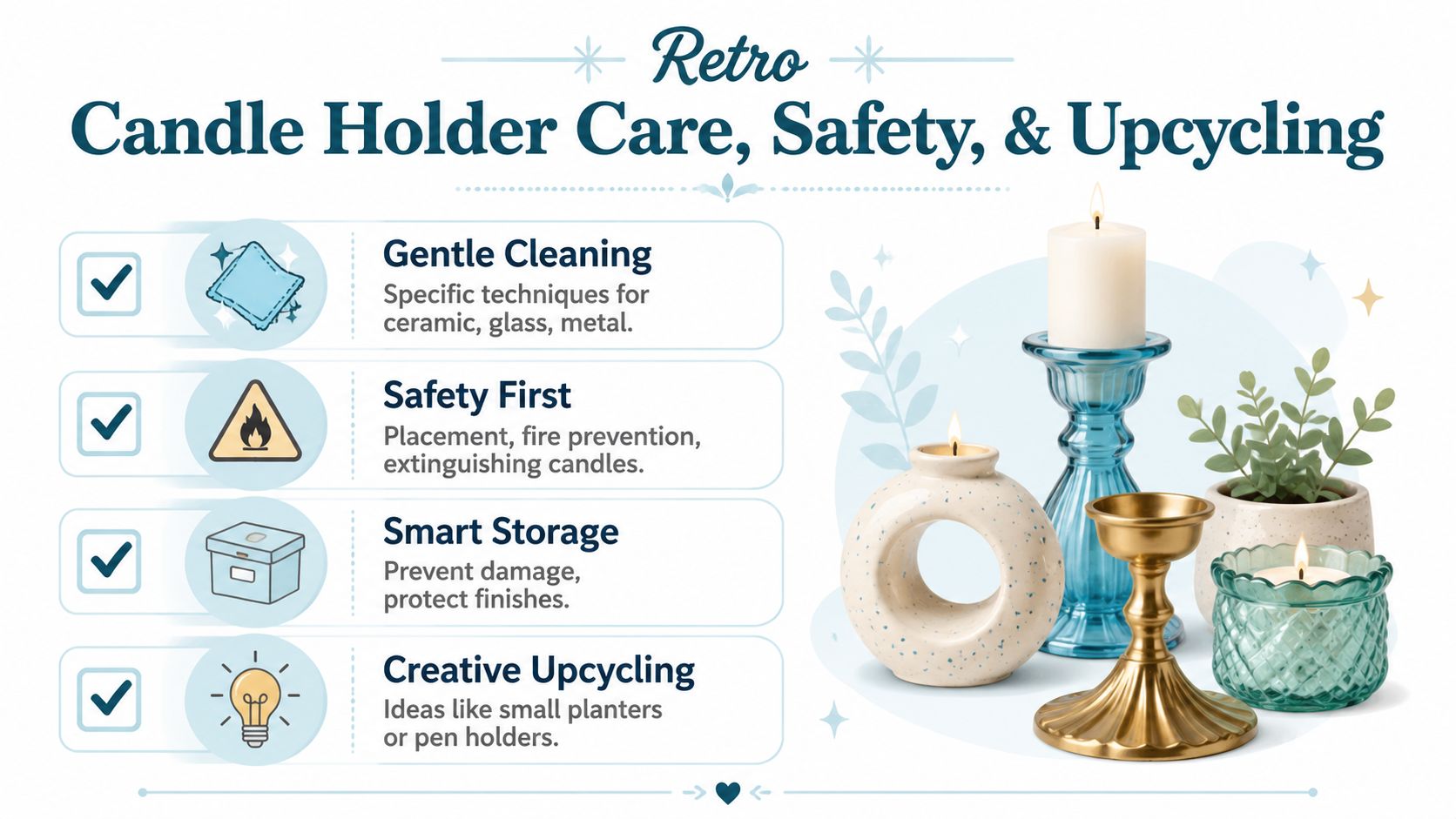
Care Safety and Clever Upcycling
A retro holder only earns its place if it's safe to use. Older pieces can look solid but still wobble, lean, or conduct heat in ways that don't suit modern living. Australian safety guidance for candles is straightforward. Use a stable, heat-resistant holder, keep flames away from flammable items like curtains, and never leave a lit candle unattended, especially with vintage pieces that may not meet current stability expectations, as noted in this Australian candle safety guidance.
Easy care that respects age
Use the gentlest approach first. Let wax cool, then lift it carefully rather than scraping hard at the finish. With older brass or enamel, a bit of patina often looks better than an over-cleaned shine.
Vintage charm doesn't need to be polished out of a piece to make it presentable.
Upcycling ideas that still feel VW
Not every old holder has to stay in active candle duty. If a piece feels unstable, repurpose it.
Desk use as a pen holder if the cup is wide enough
Shelf accent as part of a diecast display without lighting it
Small dried-flower vessel in a Beetle-themed reading nook
Tray element beside coastal VW décor and model buses
If you've got a holder with personality but questionable balance, giving it a non-flame job is often the smarter move.
Conclusion Your Home Your Vibe
The best retro candle holders do what the best Volkswagen displays do. They tell a story without needing a speech. A bit of brass, glass, ceramic or enamel can shift a room from ordinary to personal, especially when it sits beside a Kombi or Beetle model that already means something to you.
Build the room the same way you'd build a good collection. Piece by piece. Choose objects with shape, warmth and history. Keep what feels right, leave what doesn't, and let the whole setup reflect your version of the VW life.
If you're ready to bring that mood together, have a browse through Volkswagen Memorabilia. It's a practical place to find VW-themed pieces that work beautifully with retro candle holders, especially if you're after diecast Kombis, Beetles, and coastal-style décor from local Australian stock with straightforward shipping.
I once spent a whole Saturday at a swap meet chasing one tiny Beetle part. Not a door, not an engine lid, just the right little switch for a mid-sixties dash, and when it finally turned up in a dusty tray under a trestle table, it felt like striking gold.
That’s the funny magic of volkswagen beetle parts. You start by looking for something practical, then somewhere between the coffee van, the old blokes swapping stories, and the familiar shape of a Bug nose peeking from behind a stall, you realise you’re not only fixing a car. You’re keeping a memory alive.
That Feeling When You Find the Perfect Part
Every Beetle owner knows the difference between buying a part and finding a part. Buying is quick. Finding has a story attached to it.
At Aussie VW gatherings, the best moments often happen away from the polished show paint. They happen beside boxes of used trim, around the back of a shed, or in a wrecker’s yard where a forgotten Bug still has one useful piece left on it. Someone says, “Have a look in that crate, mate,” and suddenly you’re holding the exact semaphore lens, heater knob, or hubcap clip you’ve been chasing for months.
That’s why Beetle restoration gets under your skin. The car is simple enough to understand, but varied enough to keep you humble. Two parts can look nearly identical on the bench and still be wrong for your car. A bumper bracket might sit a touch differently. A carburettor might suit one engine but not another. A tail light housing might fit the guard but not match the year.
Why the hunt matters in Australia
The Australian experience adds its own flavour. We’ve had imported cars, local dealer histories, mixed parts streams, and plenty of old Bugs that have lived hard lives near salt, sun, and rough roads. That means your Beetle may not match a generic overseas guide perfectly.
A local owner often learns fast that the best answers come from three places:
Club knowledge: People who’ve owned the same year, same body style, or same engine setup.
Old parts stashes: Garages, farm sheds, swap meets, and specialist VW wreckers.
Careful identification: Knowing exactly what your car is before you spend money.
Practical rule: Never buy a Beetle part just because it “looks about right”. On a Bug, close can still mean wrong.
The lovely part is that this learning curve is half the fun. You begin to notice details other people miss. The curve of a guard. The shape of a tail light. The difference between a six-volt and twelve-volt component. Once that happens, every Beetle becomes a conversation.
And that same eye for detail changes how you see memorabilia too. A well-made model Beetle or Kombi stops being just décor. You start noticing whether the wheels suit the era, whether the trim lines feel right, whether the colour captures that sunny, carefree VW spirit.
A part is never just a part
A bonnet handle can remind someone of their first car. An oil-bath air cleaner can bring back memories of helping Dad in the driveway. A set of proper rubber seals can mean the difference between a car that feels tired and one that feels loved again.
That’s the charm of the Bug. It turns practical jobs into personal stories.
A Friendly Tour of Your Beetle's Major Systems
You can learn a lot about a Beetle just by standing behind one at a car show while the owner lifts the decklid. Someone points at a bit of tin, another person talks about a stubborn clutch cable, and before long the whole car stops feeling mysterious. It starts feeling logical. That’s one reason these little VWs get under your skin.
If you’re new to volkswagen beetle parts, it helps to see the Bug as a set of honest, hard-working systems. Each one has a job. Each one leaves clues when something’s off. Once you know the main players, parts catalogues and swap-meet tables become much easier to read.
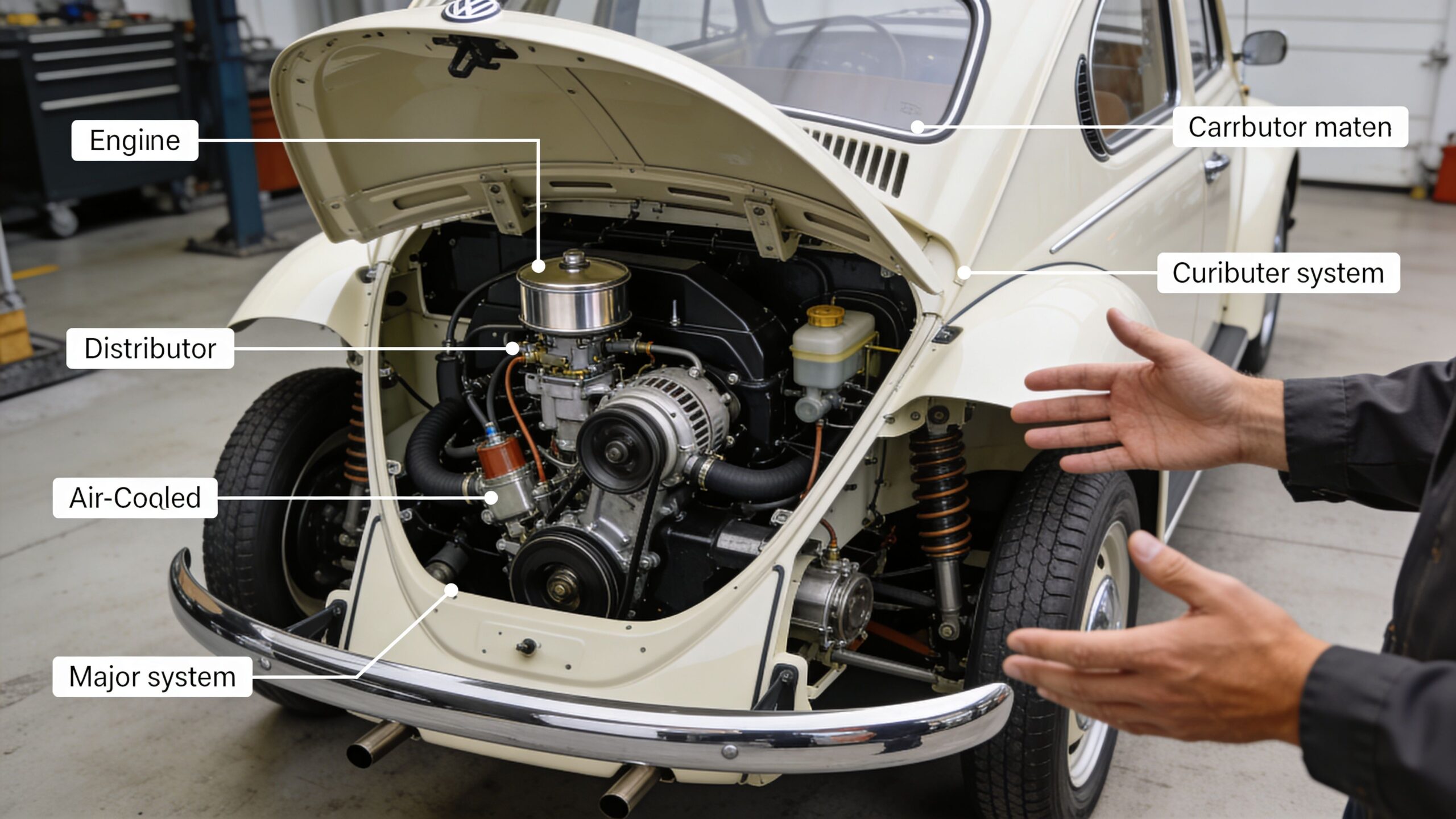
At the back sits the Beetle’s trademark air-cooled flat-four. It’s compact, simple, and full of personality. On many earlier Australian cars, especially ones that have stayed close to factory form, you’ll come across small-capacity engines such as the 1192cc unit used in period Beetles. Specifications varied by year and market, which matters in Australia because local cars, CKD assembly, imports, and decades of engine swaps have left plenty of Bugs with mixed identities.
The important bit for a beginner is this. A Beetle engine does not rely on water and a radiator to control temperature. It relies on airflow, and that means all the cooling pieces need to be there and need to fit properly. Fan shroud, cylinder tins, engine bay seals, breast plate tin, air cleaner. They are working parts, not decoration.
A missing rubber seal or the wrong bit of tinware can upset cooling in the same way a missing roof tile lets rain into a house. The car may still run, but it won’t be happy for long.
A few engine parts turn up again and again in conversations with owners:
Carburettor: mixes fuel and air for the engine
Distributor and ignition parts: trigger the spark
Generator or alternator: keeps the battery charged
Fan shroud and tinware: guide cooling air to the hot spots
Air cleaner: helps keep dust out, which matters on dry Australian roads
That last point catches plenty of people out. An inland country car that has spent years on dusty roads can wear its engine differently from a coastal car, and a Bug that has lived near salt air may have rusty cooling tins even if the engine itself still feels strong.
Gearbox, clutch, and driveline
The Beetle sends power to the rear wheels through a manual transaxle. Gearbox and differential share one housing, which keeps the layout neat and compact. It’s clever in a plain-spoken, Volkswagen sort of way.
Between the engine and gearbox sits the clutch. The clutch works like a handshake between the two. When that handshake is clean, the Bug pulls away with that familiar cheerful chug. When it isn’t, you’ll feel shuddering, hear complaints during gear changes, or find the pedal suddenly feels heavy or odd.
Common parts in this area include:
Clutch disc and pressure plate
Clutch cable
Bowden tube
Gearbox mounts
Shifter bushings and coupler
Australian owners often meet another wrinkle here. A Beetle registered as one year may carry a gearbox, engine, or clutch setup from another, especially if it has been kept going with used parts from wrecker’s yards or club spares over the decades. That isn’t a problem by itself. It just means you check what is fitted before ordering anything.
Suspension, brakes, electrics, and body
The suspension gives the Beetle much of its character. Torsion bars do the springing work, and the result is a ride that feels different from many modern cars. A healthy Beetle feels light on its feet. A tired one starts to wander, knock, or bounce in a way that tells you bushes, ball joints, link pins, or dampers want attention.
Brakes and electrics are where year-to-year differences often become expensive. Six-volt and twelve-volt cars use different components, and Australian-delivered or Australian-complied cars do not always line up neatly with the assumptions in American or British guides. Tail lights, semaphores on very early cars, indicator setups, switches, starter arrangements, and even small wiring details can vary. Local club members and marque specialists are worth their weight in gold here because they’ve seen the odd combinations before.
Then there’s the body and chassis. The Beetle’s separate platform chassis and body shell make repairs possible in a way many modern cars aren’t, but rust still needs a sober look. Floor pans, heater channels, battery tray, front apron, spare wheel well, and body mounts all matter. If those areas are weak, doors may fit poorly, seals may never sit right, and the whole car can feel tired no matter how shiny the paint looks.
Here’s a simple way to sort the car in your head:
System
What it does
Common parts people chase
Engine
Makes power and controls heat
Carburettor, tinware, seals, gaskets
Transaxle
Sends power to the rear wheels
Clutch parts, mounts, bushings
Suspension
Supports the car and manages movement
Torsion components, bushes, pins
Brakes
Slows and stops the car
Shoes, wheel cylinders, hoses, hardware
Electrics
Starts, charges, lights, and signals
Bulbs, switches, regulators, wiring
Body and chassis
Holds everything in shape
Floor pans, seals, trim, channels
Once you start sorting a Beetle this way, the parts hunt becomes much less foggy. You stop seeing a jumble of old metal and rubber. You start seeing a series of small jobs, each one bringing the car closer to the cheerful, familiar Bug you remember. And if you collect Beetle models too, you’ll notice the same thing there. The right wheels, the right stance, the right trim. The charm lives in the details.
Identifying Your Beetle's Unique DNA
The most expensive Beetle part is the wrong one.
That sounds harsh, but it’s true. Plenty of owners have bought a beautiful bit of trim, a fresh mechanical component, or a reproduction seal kit, only to discover it doesn’t suit their Bug. In Australia, that risk gets sharper because many cars have lived layered lives. Imported, repaired, swapped, rebuilt, titled oddly, or assembled from mixed origins.
When I’m helping someone identify a Beetle, I usually start with three things. Not paint colour. Not whatever year the seller says. These three:
The chassis VIN
The body cues
The engine type fitted now
The chassis VIN is your anchor because the body and engine may have changed over time. On Australian-imported cars, that VIN is typically stamped on the frame tunnel under the rear seat. It’s the clearest starting point when the car’s paperwork and appearance don’t quite agree.
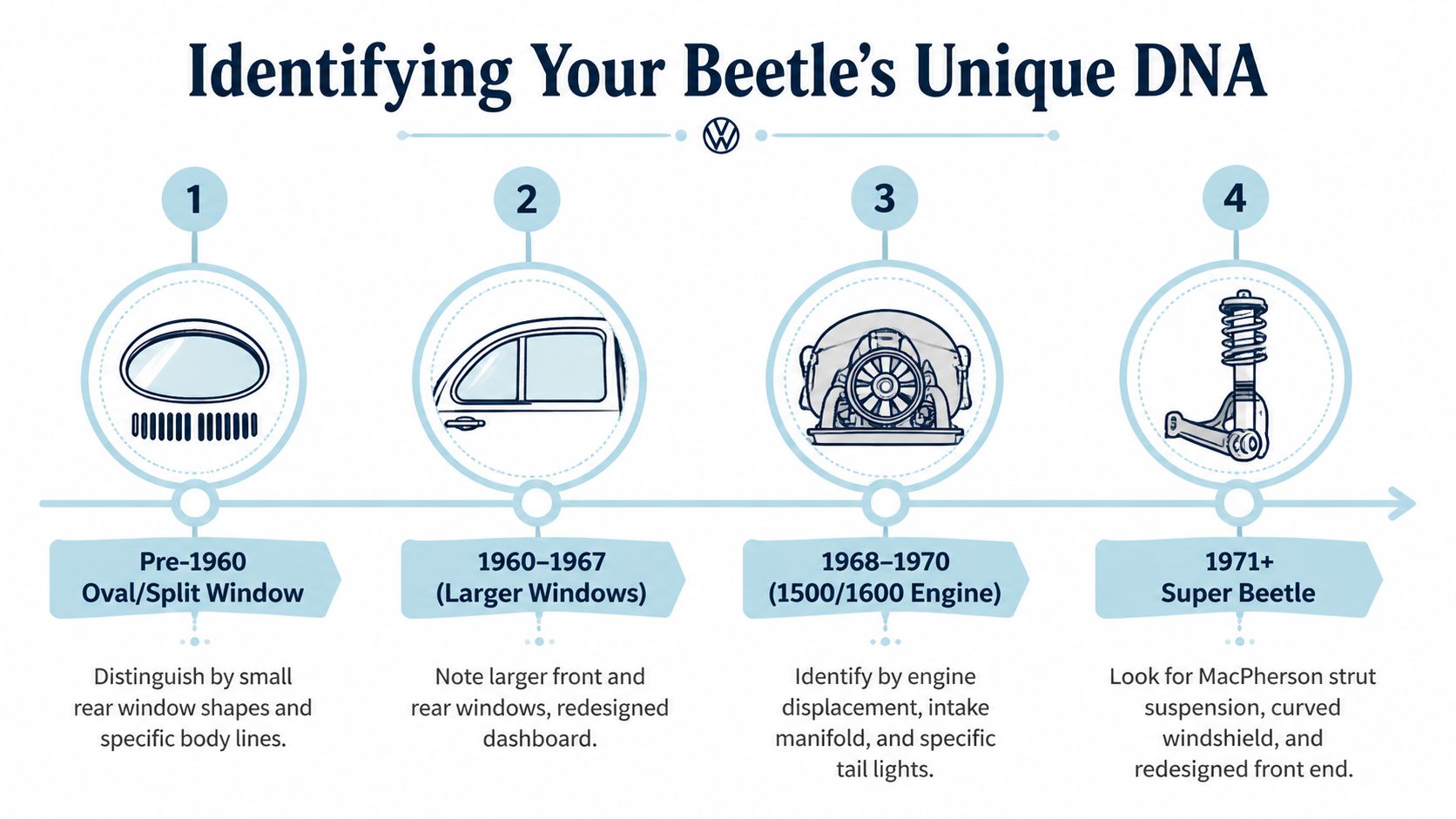
Then come the visual clues. Beetles evolved gently, not dramatically, so the changes can be subtle. Window sizes grew. Dash layouts changed. Tail lights shifted shape. Headlights, bumpers, and front indicators all tell part of the story.
The engine adds another layer. A car may have left the factory with one engine family and now carry something else entirely. That doesn’t make it bad. It just means you must separate what the car is from what engine is in it now.
Why an Australian '67 might want '66 parts
This is one of those classic bugbears that causes head-scratching at swap meets. Some Australian 1966-67 cars are titled as '67, yet need earlier parts in key areas. The verified guidance states that some 1966-67 models titled as '67 require specific '66 parts for their 1131cc engines.
That’s why old hands keep asking, “What’s the chassis number?” before they answer a parts question. They’re not being fussy. They’re trying to save you from buying twice.
Check the car first, the paperwork second, and the seller’s memory third.
Quick Beetle Identification Guide 1954-1976 AU Models
Model Year(s)
Key Visual Cue
Common Engine
Electrical System
1954-1959
Smaller rear window styles on earlier cars, early body details
Early smaller-capacity engines
Often 6-volt
1960-1965
Larger glass area than earlier cars, evolving dash and trim details
1200-class engines common
Often 6-volt
1966-1967
Transitional styling, details vary and some cars blur year lines in AU
1131cc or later engine depending on car
Changeover period, verify before buying
1968-1970
Later lights and trim cues, many cars with larger engines
1500 or 1600 often seen
Commonly 12-volt
1971-1976
Later front-end and body details, especially on Super Beetle variants
1600 commonly seen
12-volt
That table is a guide, not a verdict. Beetles are famous for mixing eras through repairs and upgrades.
Visual details worth training your eye on
At a glance, these cues can narrow things down fast:
Rear window shape: Early split and oval-window cars are easy to spot. Later cars open up visually.
Tail lights: Small early styles feel delicate. Later units are larger and more safety-minded.
Dashboard layout: Metal dash details, switch placement, and trim treatments can hint at era.
Bumpers and overriders: Useful clues, though many have been swapped.
Front suspension type: Super Beetles stand apart here, which helps when ordering front-end parts.
A clever habit is taking your own photo set before ordering. Capture the VIN, engine bay, front suspension, dashboard, tail lights, wheels, and underbody. That way, when a seller asks a question you didn’t expect, you’ve got evidence in your pocket.
When body, chassis, and engine don’t match
Many Bugs have become hybrids over the decades. That’s not unusual in Australia. Owners repaired rust with whatever shell sections they could find. Engines got upgraded. Gearboxes were swapped. Electrical systems were converted.
When that happens, sort the parts hunt into categories:
Chassis-based parts such as pan-related hardware and some structural items
Body-based parts such as guards, seals, lights, and trim
Engine-based parts such as carburettor, tinware, ignition, and exhaust
Conversion-based parts if the car has been updated from its original setup
That little bit of detective work saves grief later.
The Restoration Priority List Common Wear Items
I have watched plenty of fresh Beetle owners fall in love with the wrong end of the job. They spot a lovely set of hubcaps, dream about colour charts, then discover the brake hoses are older than the Bee Gees reunion rumours.
That is the Beetle lesson. Start with what keeps the car safe, straight, and dry.
A shiny Bug with tired structure works like a surf shack with rusted stumps. It can still charm you from the road, but once you know what is hiding underneath, the romance changes.
Start with safety and structure
The Beetle is simple, which is part of its magic. That simplicity also makes the weak points fairly predictable. On Australian cars, especially ones that have lived near the coast or sat outside through hard summers, the first money usually belongs under the body and behind the wheels.
Put your effort here first:
Brakes first: Shoes, wheel cylinders, flexible hoses, master cylinder, and the small springs and clips that people forget. If the car does not stop straight and cleanly, nothing else matters yet.
Rust in the pan and body next: Floor pans, heater channels, battery tray areas, and body mounts deserve a careful poke, not just a quick glance.
Steering and suspension after that: Worn bushes, ball joints or link pins, tie rod ends, dampers, and the steering coupler can make a Beetle wander like a shopping trolley with one crooked wheel.
Rubber seals next: Door seals, quarter window rubbers, bonnet and boot seals, and engine bay seals protect the work you have already paid for.
Cosmetics last: Paint, trim, and brightwork are far more satisfying once the car feels solid on the road.
Workshop habit: If a part affects stopping, steering, or structure, move it to the top of the shopping list.
That order saves money as well as frustration. A tidy respray can wait. Rust repair hidden under fresh paint usually cannot.
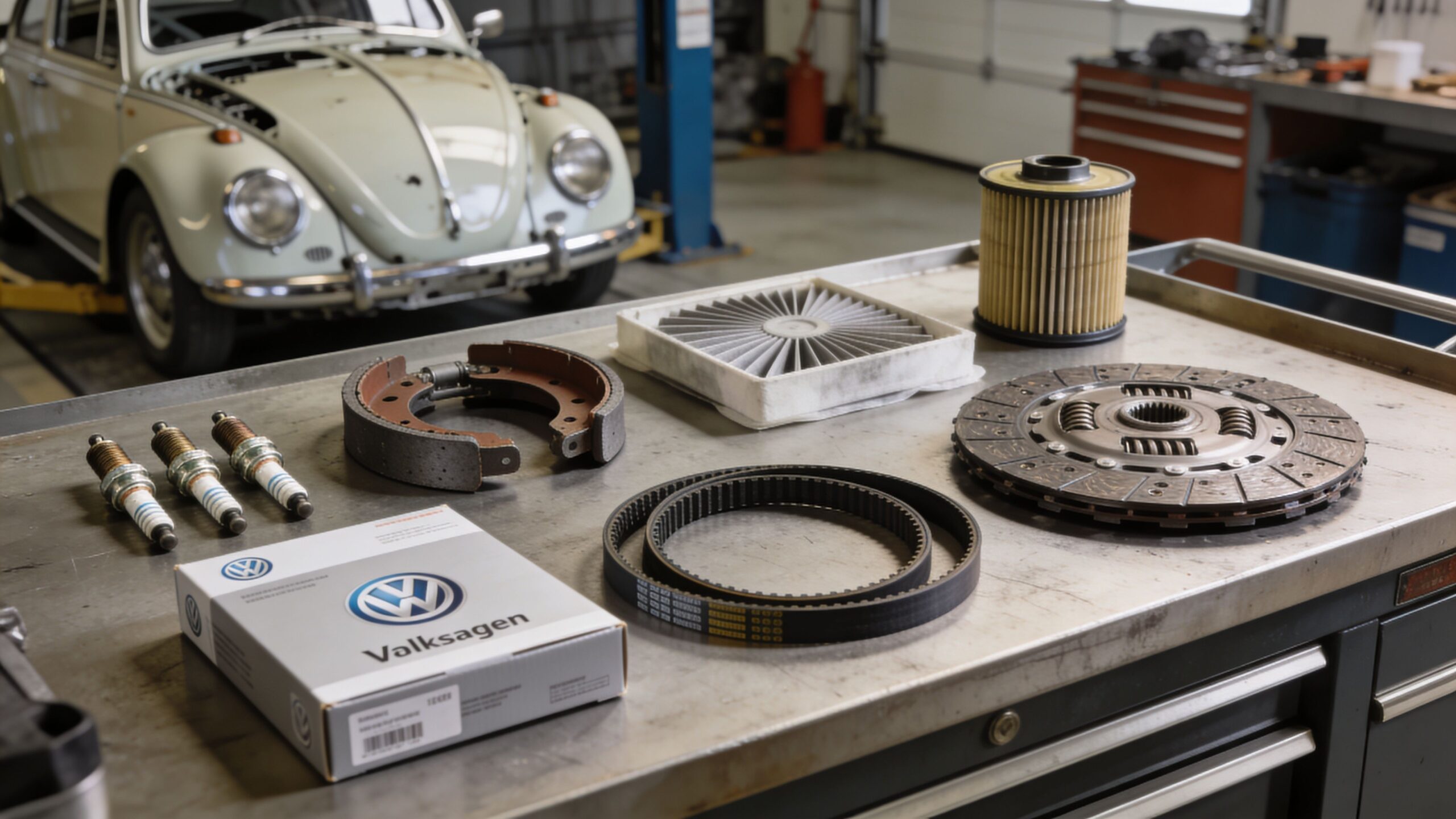
The common wear items most owners meet early
Age acts as the mechanic here. Even a well-loved Beetle will ask for certain parts sooner or later, and Australian conditions add their own little twists. Sun cooks rubber. Dust sneaks past tired seals. Cars that spent years in paddock sheds or suburban carports often need the same handful of fixes before they feel trustworthy again.
Area
Parts that commonly need attention
Why they matter
Brakes
Shoes, hoses, cylinders, hardware
Safe, confident stopping
Chassis
Floor pans, mounts, rust repair sections
Structural integrity
Suspension
Bushes, pins, dampers, steering coupler
Predictable handling
Driveline
Clutch cable, mounts, shifter bushings
Smooth shifting and take-off
Weather sealing
Door seals, bonnet seal, window rubbers
Keeps water and dust out
Engine service items
Plugs, belts, filters, gaskets
Reliability and tune
If you are new to Beetles, a few of those items deserve plain-English explanation.
The steering coupler is a small disc in the steering system, but it has an outsized effect on feel. When it perishes, the steering can feel vague and slightly spooky. Shifter bushings are another classic. When they wear out, first gear starts playing hide-and-seek. Engine bay seals look humble, yet they help keep hot air out of the engine’s cooling path, which matters a lot in an air-cooled car.
For cars with cracked or sun-damaged interiors, even trim choices can support a practical restoration. A proper vintage Volkswagen dashboard cover can tidy the cabin while you hunt for the right long-term dash solution.
This is a useful visual reminder of the sort of maintenance bits and wear items that often land on the bench during a Beetle refresh:
Good bones beat pretty paint
Australian restorers learn this early. The car that looks a bit scruffy but has a solid pan, decent heater channels, and honest mechanicals is usually the better buy than the glossy one with hidden sins.
Rust repair comes before cosmetics every time. Soft floors, crunchy channels, sagging door gaps, and a body that does not sit square on the pan are not little details. They shape everything else, from how the doors shut to how confident you feel at 90 km/h on a country road.
Then come the driving basics. Fresh brake parts, tight steering, and suspension bushes in good nick will not turn a Beetle into a sports car, but they do make it feel settled, willing, and cheerful. That is the feeling people remember. It is also the feeling diecast collectors chase in miniature. The right stance, the right wheels, the right trim. You can tell when the bones are right.
A Beetle does not need perfection. It needs honesty, and a priority list that respects how these funny little cars were built to be used.
The Great Aussie Parts Hunt Sourcing Your Spares
A Beetle part found in Australia often comes with a story. You hear about a bloke in Geelong with a shelf of early semaphores, then a club mate in Newcastle says the better pair is sitting in a biscuit tin at an old workshop out west. By the time the part reaches your bench, you have learned something about the car, the people around it, and the way Beetle ownership still runs on conversation as much as catalogues.
That is the Aussie parts hunt.
Overseas guides often make it sound as if every Beetle owner has easy access to endless shelves of stock. Here, the job is a bit more hands-on. You might buy service items from a supplier in one state, chase a used German hinge from a wrecker's yard in another, and ask your local VW club whether the reproduction switch you found fits an Australian-delivered car.
The four places that usually turn up the goods
A smart search spreads across a few channels, because each one solves a different problem.
Specialist VW wreckers and long-running workshops These places are brilliant for used original parts, fiddly hardware, and the odd little pieces that never seem to appear in neat online listings. Walk in with photos and part numbers if you can. A good operator often recognises the part before you finish your sentence.
VW clubs, swap meets, and Facebook groups with real local knowledge Australian club networks are still one of the best ways to find honest advice. You learn who rebuilds carbies properly, who has a stash of late-model guards, and which reproduction door handle is worth buying.
Established online suppliers These are handy for brake parts, seals, tune-up gear, cables, and other regular maintenance items. They save time, especially if your Beetle is a driver and you need it back on the road rather than sitting on stands while you chase one perfect old-stock piece.
Importers and sellers who understand Australian paperwork This matters more than new owners expect. If a shipment includes natural materials, grime, or poor paperwork, customs or biosecurity checks can slow everything down. Buying local stock, or using a seller who already handles importing properly, often saves a lot of mucking about.
Interior parts deserve a careful eye too, especially if you are trying to keep the cabin looking period-correct while sorting bigger jobs. These vintage Volkswagen dashboard cover ideas can help you decide what suits the character of the car.
Why Australian buyers need to be a bit more careful
Distance changes the whole equation. Freight is dearer, returns are slower, and the wrong part can sit in a box for weeks before you realise it was listed for a US-market Beetle with different fittings.
Australian-delivered cars can also have their own quirks. Depending on year and assembly details, you may run into differences in lighting, trim, safety equipment, and other market-specific items. That is why chassis numbers, engine numbers, and clear photos matter so much. Ordering by guesswork is like buying shoes by colour alone. Close is not the same as right.
A local seller who knows AU-spec cars can save you from that trap. So can club members who have already fought the same battle.
OEM, NOS, or reproduction?
Newcomers often get tangled here, so let’s keep it plain.
OEM-style parts follow the original factory pattern and are usually made by a recognised manufacturer or to a known specification.
NOS, or new old stock, means older unused parts from the period. They often fit beautifully, but age still matters, especially with rubber.
Reproduction parts are newly made replacements. Some are excellent. Some need trimming, tweaking, or patience.
I treat it like choosing timber for a deck repair. If the piece carries the weight, faces the weather, or sits where everyone can see it, quality matters more. On a Beetle, visible trim, switches, handles, and safety-related parts deserve extra care. A hidden bracket gives you more freedom.
A buying checklist that saves headaches
Before you hand over money, stop and check a few basics:
What year and spec is the car, exactly? Check VIN, body style, engine, and 6-volt or 12-volt setup.
Is the part for an Australian-delivered Beetle or an imported model? Ask directly.
Do I want original appearance, easy function, or both? That answer shapes the whole search.
Can the seller show clear photos, measurements, or part numbers? Good sellers do this without fuss.
If it is used, what condition are the threads, chrome, rubber, and mounting points in?
If it is coming from overseas, am I prepared for delays, inspection, or return hassles?
Half the success comes from knowing what to ask.
The other half comes from patience. That is part of the Beetle's charm in Australia. You do not always get the right part in one click. You find it through sheds, swap meets, workshop shelves, and quiet tips from people who have loved these cars for decades. And when the piece finally turns up, whether it is a real semaphore lens or the perfect tiny detail on a diecast model, it feels earned.
From Real Steel to Diecast Dreams Celebrating the Bug
At a country swap meet in Victoria a few summers back, I watched a bloke spend twenty minutes smiling at a tiny Beetle on a trestle table. He had grease under his nails, sun on his neck, and the look of someone who had spent half his life chasing the right parts through wrecker's yards and club chatter. He picked up the model, turned it in the light, and laughed because the taillights were right for the year.
That is what a real Beetle teaches you.
Once you have wrestled with rusty bumper bolts, cleaned years of dust from an air cleaner, or compared Australian-spec details against imported parts, your eye changes. You stop seeing a diecast as a generic old car. You start spotting whether the stance looks honest, whether the wheel style suits the era, and whether the little trim pieces respect the shape that made the Bug so lovable in the first place.
A good model works like a memory you can park on a shelf.
The full-size Beetle and the miniature one speak the same language. Rounded guards. Cheerful posture. Small details that tell you a story if you know how to read them. For Australian enthusiasts, that story often includes local clues that overseas guides skip past. A car sold here might carry details that differ from the US or UK examples people see online, so a collector who has spent time around Australian Beetles often notices authenticity faster.
That is part of the fun. Restoring sharpens your eye. Collecting rewards it.
Why restorers often become fussy collectors
Time in the shed teaches you to notice the details that give a Beetle its personality:
whether the wheel trim matches the model year
whether the paint colour feels true to the period
whether roof racks, surfboards, flowers, or interior touches suit the car's character
whether a Beetle or Kombi model captures the sun-faded, beach-holiday feel many Australian VW fans grew up with
A diecast piece becomes more satisfying once you know what you are looking at. It is no longer just a cute desk ornament. It is a little celebration of panel shapes, trim choices, road-trip memories, family photos, and all those Saturdays spent hunting the right part instead of settling for the wrong one.
That is why something like the 1967 Volkswagen Beetle Flower Power with Surfboard can feel so charming. It nods to the playful side of Beetle culture without losing the shape people fell in love with. If you want more of that familiar Bug silhouette lined up on a shelf, the full Beetles collection is a pleasure to browse.
If your taste runs beyond the Beetle, there is plenty of VW nostalgia in miniature:
VW Kombi diecast options for Australian collectors
More Volkswagen-themed collectibles and gifts are covered in the main shop range noted earlier.
A full-size car gives you the stories. The model lets you keep them in view, even when the garage door is shut and the tools are back on the pegboard.
Your VW Journey Starts Here
A Beetle teaches patience, observation, and a certain cheerful stubbornness. You learn to ask better questions, to trust the VIN over assumptions, and to fix the parts that matter before chasing the shiny bits.
That’s part of why the VW community remains such a pleasure in Australia. People will help if they can. They’ll point you toward a better supplier, tell you when a part number looks off, and celebrate with you when a long-idle Bug finally fires up and settles into that familiar air-cooled chatter.
If you’re restoring one, take your time and enjoy the wins. If you’re still dreaming about owning one, start learning the details now. Every part you recognise and every year cue you spot will make the journey easier later.
And if you love the shape, the colour, the nostalgia, and the surf-and-sun character that classic Volkswagens carry so well, there’s joy in collecting that heritage too. The Bug has always been more than transport. It’s a little piece of optimism on wheels.
Frequently Asked Questions about VW Beetle Parts
Are volkswagen beetle parts still easy to get in Australia
Many common service and restoration parts are still available, especially for the popular air-cooled years. The trick isn’t only availability. It’s correct fit. The right part for your exact car can take more effort than a generic listing suggests, especially if your Beetle has had engine, body, or electrical changes over the years.
What should I check before ordering any part
Start with the basics:
VIN details: Confirm the chassis number from the car itself.
Engine setup: Identify what engine is fitted now, not only what the car may have left the factory with.
Electrical system: Make sure you know whether the car is running six-volt or twelve-volt equipment.
Photos of the existing part: This helps when comparing brackets, connectors, and mounting points.
If the seller can’t answer fitment questions clearly, pause before buying.
Are German parts better than Brazilian or Mexican parts
Not automatically, but many owners prefer original German parts for fit, finish, and consistency when they can find them. Brazilian and Mexican parts can be perfectly serviceable depending on the component and manufacturer. The better question is whether the specific part is well made and correct for your car.
For visible trim, many enthusiasts chase original or higher-grade items. For service parts, reliability and fit often matter more than country of origin alone.
Should I buy used, NOS, or reproduction parts
It depends on the job.
A used original bracket or switch can be better than a poor reproduction. NOS can be wonderful when it has aged well and suits your car exactly. Reproduction parts are often the most practical path for seals, brake items, and common maintenance needs, provided you buy from a reputable seller.
Why do some Australian Beetles seem different from overseas guides
Because many Australian cars don’t line up neatly with one market’s catalogue logic. Import histories, local assembly influences, repairs, and decades of owner modifications mean your Beetle may carry a mix of features. That’s why local knowledge is so valuable.
What’s the safest first spend on a newly acquired Beetle
Put your first money into braking, steering, tyres, structure, and basic service items. If the car can’t stop straight, steer predictably, and stay structurally sound, cosmetic spending can wait.
A tidy Beetle that feels unsafe won’t get driven. A mechanically honest Beetle gets enjoyed.
How do I avoid disappointment when buying parts online
Use a short method:
Ask for clear photos
Confirm measurements or part markings where relevant
Compare against your own car
Check return terms before payment
Buy from sellers who understand old Volkswagens, not just general auto stock
Is collecting VW models worthwhile if I don’t own a real Beetle
Absolutely. Plenty of people start with the nostalgia and later fall for the actual cars. A good model captures the same shape, warmth, and personality that made the full-size Beetle beloved in the first place.
If the Beetle’s charm has got under your skin, Volkswagen Memorabilia is a lovely place to keep that feeling close. You’ll find officially licensed VW-themed gifts, diecast models, and collectible pieces that celebrate the same heritage, colour, and character that make classic Volkswagens so hard to forget.
You know the moment. You’re standing in a shop, or scrolling late at night, trying to buy for someone who can spot a split-window at fifty metres, argue about wheel trims over a sausage roll, and still remembers the smell of hot vinyl in an old Beetle. A generic car mug won’t cut it. Neither will another keyring.
The best unique gifts for car lovers aren’t random motoring bits. They carry a story. They bring back a road trip, a family Kombi, a first project car, or the memory of seeing a line of Beetles parked nose-to-tail at a local show.
At a Show & Shine, you can see it happen in real time. One bloke leans over a diecast Kombi and says, “My old man had one in that colour.” Another points to a Beetle and starts talking about beach runs, surfboards, and long summer afternoons. That’s why Volkswagen memorabilia works so well as a gift. It isn’t just shelf filler. It taps into memory, design, and a whole slice of Australian car culture.
Finding Unique Gifts for Car Lovers in Australia
A mate of mine had this exact problem before Christmas. He needed a present for his brother, the sort of fellow who already had the tools, the books, the caps, and a garage full of opinions. Every idea felt flat until he stopped thinking about “car accessories” and started thinking about what car story mattered to him most.
That changed everything.
His brother wasn’t just into cars in a broad sense. He loved Volkswagens. Old Beetles. Sunny-window Kombis. The rounded lines, the cheeky face, the way a VW can look friendly even when it’s parked still. Once you narrow the gift to that emotional centre, the search gets easier. A well-chosen Volkswagen model car collection makes more sense than ten generic gadgets ever will.
Why the right gift feels personal
A memorable gift usually does one of three things:
Brings back a real memory like a first car, a family holiday, or a childhood ride.
Reflects the person’s taste such as surf culture, retro styling, or classic European design.
Gives them something they’ll keep instead of something they’ll toss in a drawer.
That’s the sweet spot with VW pieces. They’re instantly recognisable, even to people who aren’t deep in the hobby. A Beetle doesn’t need an introduction. A Kombi doesn’t need explaining. They already mean something.
A good gift says, “I know what you love.” A great one says, “I know why you love it.”
Why Volkswagen keeps coming up
Volkswagen has that rare mix of design charm and cultural weight. In Australia, the Beetle and Kombi weren’t just transport. They became part of everyday life, especially along the coast. They turned up at beaches, campsites, festivals, driveways, and car club meets. That’s why VW-themed gifts often feel warmer and more thoughtful than generic motoring merch.
If you’re shopping for a collector, a restorer, or someone who just smiles every time they see a Kombi, you’re not buying a thing. You’re buying a little piece of a life they already care about.
More Than Metal The Enduring Legacy of VW in Australia
The story starts in Melbourne. The first Beetles landed on Australian shores in December 1954, and from there the little car took off. According to Car and Driver’s gift guide reference, Australia has over 35,000 active Volkswagen enthusiasts across 120 clubs as of 2025, and the Beetle had reached 300,000 units sold by 1975. That kind of staying power doesn’t happen by accident.
You still feel that history when you walk through a club display. The Beetle crowd tends to gather around the details. Badges, paint codes, trims, wheels, year changes. Then you drift toward the Kombis and the mood shifts. People start telling road-trip stories. Someone mentions surfboards on the roof. Someone else remembers sleeping in the back on a coastal run.
From humble import to national favourite
The Beetle earned affection because it looked different from everything else on the road. Rounded. Honest. Friendly. It didn’t have to posture. It just got on with it, and generations of Australians took to it.
The Kombi added another layer. It wasn’t only practical. It represented a slower, freer kind of motoring. Load your gear, gather your mates, point it toward the coast, and see where the day ends. That’s a strong image, and it still sticks.
For anyone styling a retro room or hunting for Volkswagen diecast models for sale, that emotional pull matters. A miniature Samba Bus isn’t just a van in scale form. It’s a symbol of a lifestyle people still admire.
Why clubs keep the spirit alive
VW culture in Australia isn’t tucked away. It’s visible, social, and welcoming. Club meets, local cruises, swap days, and big public events all keep the cars in front of people and the stories in circulation. That’s one reason memorabilia has such a loyal audience. The objects connect to a living community, not a forgotten brand chapter.
A lot of enthusiasts also have a soft spot for wagons and vans because they carry so much personality. If you’ve ever spent time around Type 2 fans, you’ll know how quickly one conversation about roof racks turns into an hour of stories. That same affection explains the appeal of pieces inspired by the classic VW station wagon and van style that collectors like to display at home.
Some marques inspire admiration. Volkswagen often inspires affection. That’s a different kind of loyalty.
What makes VW gifts land so well
For a gift buyer, this history solves a big problem. You’re not guessing. You’re choosing from a world with clear emotional anchors:
VW icon
What it tends to evoke
Why it works as a gift
Beetle
Charm, first-car memories, classic design
Easy to recognise and display
Kombi
Surf culture, travel, freedom, beach life
Great for coastal and retro styling
Samba Bus
Collectability, nostalgia, colourful personality
Strong shelf presence and conversation value
That’s why VW-themed presents often feel more thoughtful than standard motoring gifts. They already carry decades of meaning before the wrapping paper goes on.
Your Guide to Volkswagen Memorabilia Collectibles
Some gifts are made to use. Others are made to keep. Volkswagen memorabilia sits in that second camp, especially when the piece suits the recipient’s style and space. If you’re choosing between a diecast model, wall décor, or a beachy display piece, it helps to think about how they’ll live with it day to day.
There’s also a distinctly Australian angle here. As noted in Good Housekeeping’s gift guide reference, demand for VW-specific memorabilia gifts in Australia is rising among coastal enthusiasts, and many gift guides miss the connection between VW heritage and beach or nautical décor. That’s a missed opportunity, because Kombis and coastal styling belong together beautifully.
Diecast models that feel like proper collectibles
A good diecast model has presence. You pick it up and notice the shape first, then the finer details. Windows, paint, trim lines, wheels, stance. A licensed VW model should feel like a tribute to the original, not a rough cartoon of it.
Collectors often focus on familiar heroes:
1962 VW Kombi
Samba Bus variants
Volkswagen Beetle models
Flower Power editions
Surf-themed vans
Some buyers want accuracy. Others want colour and personality. Both approaches are valid. A shelf with a crisp Beetle and a bright Kombi side by side often tells a better story than a row of identical pieces.
Scale matters more than many buyers expect
If the recipient is already a collector, scale is worth checking before you buy. Even if they aren’t strict about it, matching the scale of pieces on a shelf makes a display look more deliberate.
Here’s a quick comparison:
Scale
Feel on display
Typical appeal
1:18
Bigger, more detailed, stronger centrepiece
Serious collectors and desk displays
1:24
Easier to place on shelves, balanced size
Casual collectors and gift buyers
Smaller novelty scales
Fun accents, lighter visual footprint
Stocking fillers and mixed displays
Collector’s rule: If they already display one scale prominently, buy to match it unless you know they want a standout centrepiece.
Retro metal décor for garage, bar, or living room
Not every VW lover wants another model car. Some want atmosphere. That’s where metal signs, wall plaques, and vintage-style decorative pieces come in. They work especially well in garages, home bars, workshops, and alfresco spaces.
The trick is choosing art that suits the room rather than shouting over it. A bright Kombi sign fits a fun beachy corner. A weathered Beetle piece can look spot-on in a more muted vintage setup. If you’re after styling ideas beyond shelf collectibles, coastal-friendly vintage home accessories can help tie the whole look together.
Coastal styling is the quiet winner
VW memorabilia can be more than a collector’s hobby; in the right setting, it becomes part of the home. Think of a pale timber shelf, a blue-and-white vase, a small stack of travel books, and a diecast Kombi parked neatly beside a shell or framed beach photo. That works because the Kombi already belongs to that visual world.
A few combinations that tend to look right in Australian homes:
Kombi plus driftwood tones for a relaxed beach-house feel
Samba Bus plus white frames for a lighter coastal wall arrangement
Flower Power variant plus coloured glass for a playful retro nook
Beetle model plus old holiday photos for a nostalgic hallway shelf
Small gifts can still have weight
You don’t need a huge centrepiece to give something memorable. Fridge magnets, compact décor items, and smaller display pieces often work well when the recipient already has a crowded shelf or limited space. The point isn’t size. It’s recognition.
The best memorabilia usually prompts a story within a few seconds. If it does that, it’s done its job.
How to Pick the Right VW Gift for Them
Buying for a car lover gets easier once you stop asking, “What’s a good gift?” and start asking, “What sort of VW person are they?” The answer usually tells you where to look.
Some people love precision. Some love nostalgia. Some want their hobby in the house, not the garage. Choose for the person, not just the badge.
The diecast collector
You’ll know this type straight away. They notice scale, packaging, model year, and whether the colour feels right. If they already collect, don’t buy blindly. Have a quick look at their shelves first.
For this person, the safest strong options are:
A Beetle or Kombi in a scale they already collect
A Samba Bus variant with distinctive livery
A model that matches a car they once owned or admired
Collectors often enjoy the hunt as much as the item. That means your thought process matters. If you can say, “I picked this because it matches your other models,” you’ve probably nailed it.
The classic car restorer
Restorers are practical people, but they’re sentimental in a very specific way. They appreciate reference points, design details, and pieces that reflect the car accurately. A good model can sit on a bench, office shelf, or bookcase and keep the project spirit alive between garage sessions.
This is also the sort of person who may appreciate useful tech. An OBD II Bluetooth diagnostic scanner can make a smart gift because it plugs into a vehicle’s diagnostic port, reads real-time engine data, and works with compatible apps such as Torque Pro and Car Scanner ELM OBD2, as described in MotorTrend’s guide to gifts for car lovers. It’s especially appealing to enthusiasts who like understanding what the car is doing, not just driving it.
Buy decorative gifts for their passion. Buy diagnostic tools for their process.
The home decorator with a VW heart
This person may love Volkswagens without wanting the house to feel like a workshop. They want pieces that blend in. Softer colours. A little retro charm. Maybe a Kombi on a shelf next to books and beach finds, rather than a wall plastered with logos.
For them, think in combinations rather than single objects:
Recipient style
Better gift direction
Why it works
Coastal home lover
Kombi model with beachy décor feel
Feels relaxed and lived-in
Retro colour fan
Flower Power or surfy van piece
Adds personality without needing a full collection
Minimalist collector
One clean Beetle model
Neat display, strong shape, no clutter
The nostalgic family gift
Sometimes the right present isn’t for a hardcore collector at all. It’s for a parent, sibling, or partner who has a VW memory. Maybe they learned to drive in a Beetle. Maybe they camped in a Kombi. Maybe they had a neighbour with one parked under a carport for years.
Those gifts work best when they echo a memory:
Match the vehicle type first
Then get as close as possible on colour or era
Keep the presentation simple so the story stands out
A small card explaining why you chose it often means as much as the gift itself.
A quick decision checklist
Before you buy, run through these questions:
Do they collect, decorate, or tinker?
Are they more Beetle or Kombi?
Would they prefer one standout piece or a smaller accent?
Will it live in a study, lounge room, garage, or office?
Are they sentimental about a specific model year, colour, or style?
If you can answer three of those clearly, you’re already close to the right gift.
Bringing Your VW Passion into Your Home
A well-chosen VW piece shouldn’t end up hidden in a cupboard. Half the fun is living with it. The right display turns a collectible into part of the room.
Build one shelf with a clear theme
The easiest mistake is trying to show everything at once. A better approach is giving one shelf a proper identity. A Beetle shelf might use black-and-white photos, older books, and more muted tones. A Kombi shelf can lean coastal with pale timber, shells, or framed beach prints.
Keep some breathing room around the model. If every centimetre is filled, the details disappear.
Use height and texture
A display comes alive when objects sit at different levels. Put a diecast model on a small plinth or stack of books. Lean a sign or framed print behind it. Add one natural texture, like timber, rattan, or ceramic, so the metal and paint don’t feel too cold.
A few combinations work especially well:
Diecast Kombi plus white frame plus shell accent
Beetle model plus vintage book stack
Metal décor plus smaller desk model below
Seasonal VW piece mixed into a Christmas or summer display
Don’t decorate around the collectible as if it’s fragile museum stock. Style it as part of the room so it feels owned and enjoyed.
Care matters if you want it looking sharp
Collectibles age well when they’re treated properly. Dust is the obvious enemy, but sunlight can be just as rough on colour over time. Keep painted pieces out of harsh direct sun where possible, especially in bright rooms.
A simple care routine works best:
Dust gently with a soft dry cloth or soft brush
Avoid damp storage in sheds or garages
Keep original packaging if the recipient values collectability
Handle by the base rather than delicate mirrors or trim
Let the gift tell a story
The nicest displays usually reveal something about the owner. A Kombi beside a beach holiday photo. A Beetle model near an old registration plate or travel postcard. These little pairings make the room feel personal.
That’s the charm of VW memorabilia. It doesn’t just say “I like cars.” It says what kind of life and memories sit behind that love.
Shopping Tips for Authentic Volkswagen Diecast Models
When you’re buying a gift, authenticity matters. It affects the finish, the detailing, and how the item feels in the hand. A licensed model usually looks more convincing because the proportions, badging, and overall presentation have been treated with proper care.
There’s strong interest in this area too. According to Consumer Reports’ gift guide reference, online searches in Australia for 1962 VW Kombi and Samba Bus diecast gifts have risen 40%, with demand focused on nostalgic collectibles priced under AUD 50.
What to check before you buy
A few details separate a proper collectible from a disappointing impulse buy:
Licensing details on the product listing or packaging
Clear model naming such as Beetle, Kombi, or Samba Bus
Crisp photos showing paint, trim, and proportions
Scale information if the recipient already collects by size
Condition notes if packaging matters to them
If a listing is vague, has poor images, or skips basic product details, treat that as a warning sign.
Why buying local helps
For Australian buyers, local stock makes the whole process easier. You can shop with more confidence when shipping is faster, support is nearby, and you’re not guessing how long a parcel will drift around in transit.
That matters even more when you’re buying for a birthday, Christmas, Father’s Day, or a club mate’s retirement gift. A present that arrives on time is already a better present.
Price isn’t the whole story
Affordable gifts can still feel thoughtful. In fact, many of the most appealing VW-themed pieces are smaller collectibles that land emotionally because they’re specific, not because they’re expensive.
Use this simple guide:
If they value…
Prioritise…
Accuracy
Licensing, model name, scale
Display impact
Colour, size, shelf presence
Nostalgia
Era, body style, surf or retro theme
Convenience
Local stock and straightforward delivery
Buying tip: If you’re unsure, choose the model with the strongest story connection. Sentiment usually beats technical perfection for gift giving.
Share the Ride A Gift That Goes the Extra Mile
The best gifts for car lovers don’t just fill space. They spark memories, start conversations, and keep a favourite chapter of motoring culture close at hand. That’s especially true with Volkswagen pieces. A Beetle brings instant charm. A Kombi carries that sun-faded surf spirit Australians still adore. A well-chosen model or décor piece can feel surprisingly personal.
If you’re trying to find unique gifts for car lovers in Australia, lean toward something with meaning. Think about the car they talk about most, the era they love, or the room where the piece will live. That’s usually where the right answer is hiding.
A great VW gift doesn’t shout. It smiles back from the shelf and reminds them why they fell in love with these cars in the first place.
Your VW Gift Questions Answered
What’s the difference between 1:18 and 1:24 diecast models?
The short answer is size and presence. 1:18 models are usually larger and often suit collectors who want more visual detail. 1:24 models are easier to place on shelves and make excellent gifts when space is limited.
Scale
Approx. Length (Beetle)
Typical Features
Best For
1:18
Larger display size
More prominent detailing, stronger shelf presence
Dedicated collectors, centrepiece displays
1:24
Medium display size
Balanced detail and easier placement
Gift buyers, casual collectors, office shelves
Are VW diecast models toys or collectibles?
Many are bought as collectibles first. Some are sturdy enough to handle gently, but licensed diecast pieces are usually better treated as display items, especially if the buyer cares about condition, paint finish, or packaging.
How do I know if a Volkswagen model is officially licensed?
Check the listing and packaging for clear licensing information and proper model naming. Good sellers usually show this plainly. If the product photos are vague or the wording feels generic, it’s worth being cautious.
What makes a VW gift feel more personal?
Matching the gift to a memory helps most. Choose a Beetle if they talk about family motoring stories or classic curves. Choose a Kombi or Samba Bus if they love surf culture, road trips, or coastal décor.
Can VW memorabilia work in a normal home, not just a garage?
Absolutely. Kombi and Beetle pieces work especially well in retro, coastal, and relaxed interiors. A single model on a shelf, sideboard, or home office desk can look stylish without turning the whole room into a car display.
If you’re ready to find a gift with a bit of heart behind it, have a look through Volkswagen Memorabilia. You’ll find licensed VW-themed diecast models, Kombi and Beetle collectibles, and coastal-inspired décor that suits Australian homes, with local stock and friendly support to make gift shopping easier.