


You're probably here because your current setup is doing your head in. The fridge works until late afternoon, the lights dim earlier than they should, and the old battery takes up half the storage space you wanted for tools, recovery gear, or the kids' bags. Plenty of Aussie tourers have lived that exact story.
A lot of the frustration comes from two problems at once. Traditional battery banks are bulky, and usable power often feels a long way short of what the label promised. That's why the slimline lithium battery 200ah has become such a popular option in caravans, canopies, campers, and touring rigs. It gives serious storage in a shape that suits modern vehicle layouts.
The trick, though, isn't just buying a battery with a big number on the sticker. In Australia, the setups that work well are the ones built as a full system. Battery, charger, solar, inverter, cabling, and heat management all need to play nicely together. If you're working on a camper conversion, that whole-vehicle thinking matters just as much as layout and storage planning, especially in a compact build like the ones discussed in this guide to a van for conversion.
The End of Flat Batteries and Bulky Setups
There's a familiar moment on a trip when the honeymoon ends. You've pulled into a ripper camp, dinner's sorted, the fridge is humming away, and then something starts dropping out. Maybe it's the compressor fridge. Maybe the inverter starts complaining. Maybe the battery monitor tells you what you already suspected. You're running out of puff again.
That old-school setup usually has three strikes against it. It's heavy, it's bulky, and it doesn't make good use of the space you've got. In a wagon, ute canopy, or caravan front boot, every bit of room matters. A fat battery box can force awkward compromises with drawers, water tanks, or recovery gear.
A 200Ah slimline lithium battery changes that conversation because it's built for the way Australians travel. Instead of trying to wedge a conventional battery bank into a space that was never designed for it, you can mount a slimline unit behind a seat, against a canopy wall, or into a narrow compartment in a van or caravan.
Most touring power dramas aren't caused by a lack of ambition. They're caused by gear that doesn't suit the space, the load, or the charging system.
That's why this battery size and shape has become such a practical benchmark in the local market. It sits in a sweet spot. Big enough for genuine off-grid use, compact enough to fit where a touring rig needs it.
For plenty of people, the shift isn't about chasing fancy tech. It's about wanting the fridge cold in the morning, the lights steady at night, and enough reserve to keep travelling without stressing over every amp.
What Exactly Is a 200Ah Slimline Lithium Battery
The name sounds technical, but it breaks down neatly once you know what each bit means.
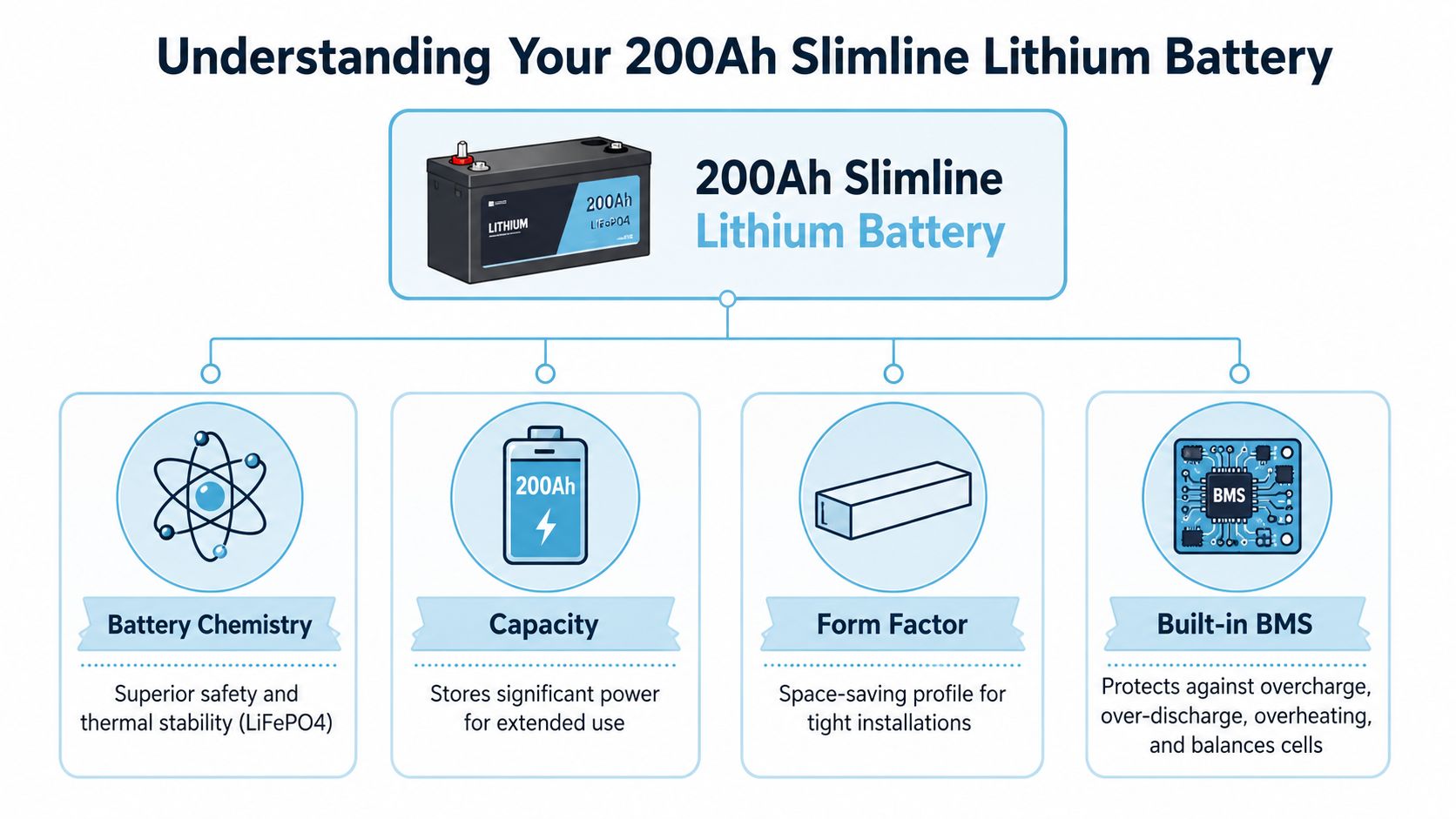
Lithium means LiFePO4 in most touring setups
When Australians talk about a lithium battery for caravans or 4WDs, they usually mean LiFePO4, which stands for lithium iron phosphate. It's the chemistry commonly used in these 12V auxiliary battery systems because it suits repeated deep cycling and vehicle-based use.
A slimline 12V 200Ah lithium battery is typically built around a 12.8V LiFePO4 pack architecture, giving about 2,560Wh or 2.56kWh of nominal energy, as outlined on Bonnen's 12V 200Ah slimline lithium battery page. That's the basic energy bucket you're working with.
What 200Ah means in plain English
The 200Ah part tells you the battery stores a substantial amount of energy for a 12V setup. In everyday touring language, it means you've got a battery designed to run the common camp loads people care about, such as fridges, lighting, chargers, pumps, and inverter-backed appliances.
It doesn't mean every 200Ah battery behaves the same. Two batteries can share the same capacity on paper and still perform very differently under real load. That's where charge limits, discharge limits, and battery management come into play.
Why slimline matters more than many buyers realise
The slimline shape is a big part of the appeal. Instead of a chunky block, you get a narrower profile that suits tight installs in caravans, canopies, and under-seat compartments. That narrow footprint is often the difference between a neat install and a compromise.
For many builds, one slimline unit can take the place of multiple lead-acid batteries while fitting into a much more usable space. That's a practical packaging win, not just a spec-sheet win.
The BMS is the battery's brain
Inside the battery sits the Battery Management System, or BMS. Think of it as a hard-working security guard and traffic controller rolled into one. It helps protect the battery from over-charging, over-discharging, and other conditions that can shorten life or cause problems in the field.
If you're comparing products, don't treat the BMS as a footnote. It's one of the parts that decides whether the battery behaves calmly in a touring setup or becomes temperamental when you ask a bit more of it.
Key Advantages Over Traditional Lead-Acid Batteries
If you've spent years with AGM or flooded lead-acid batteries, the jump to lithium feels less like a minor upgrade and more like a reset. The gain isn't only about capacity. It's about how much of that capacity you can use, how long the battery keeps doing the job, and how much space and weight you get back.
The real-world differences
A lithium setup usually feels better in use because voltage stays steadier under load, accessories run more happily, and the system recovers more smoothly when it's charged correctly. That's especially noticeable with compressor fridges and inverter loads.
Durability is another major dividing line. R&J Batteries says its Predator Slimline 12V LiFePO4 series delivers over 3,500 cycles at 80% depth of discharge, and the same Australian commentary notes some 200Ah LiFePO4 batteries are described at about 6,000 cycles at 80% DoD, while AGM batteries often sit around 300 to 500 cycles in comparison, as discussed in R&J Batteries' Predator Slimline Series overview.
Practical rule: Don't compare batteries by sticker capacity alone. Compare usable energy, cycle life, and how much room the install will actually take.
Slimline LiFePO4 vs AGM Lead-Acid at a Glance
| Feature | 200Ah Slimline Lithium (LiFePO4) | 200Ah AGM Lead-Acid |
|---|---|---|
| Form factor | Narrow profile suits tight install spaces | Bulkier shape can be harder to place |
| Usable capacity | Suppliers position LiFePO4 for near-full rated capacity use | Commonly less usable in practice |
| Cycle life | Over 3,500 cycles at 80% DoD, with some reaching about 6,000 cycles at 80% DoD in Australian commentary | Often around 300 to 500 cycles |
| Power delivery | Holds voltage more consistently under load | More prone to voltage sag |
| System impact | Can replace multiple lead-acid batteries in a narrower footprint | May need more than one battery to match practical use |
Why many tourers don't go back
Once people switch, they usually notice the install first, then the day-to-day convenience. You gain storage room, reduce clutter, and stop planning your camp routine around the battery's limitations.
There's also less of that annoying fade where gear seems fine early on, then starts acting tired. With a good lithium setup, the power delivery tends to feel more stable through the usable range.
That doesn't mean every lithium battery is automatically brilliant. It means the better ones solve several long-standing touring headaches at once.
Popular Uses for Slimline Lithium Batteries in Australia
The reason the slimline lithium battery 200ah has taken off locally is simple. It suits the way Australian vehicles and touring gear are built.
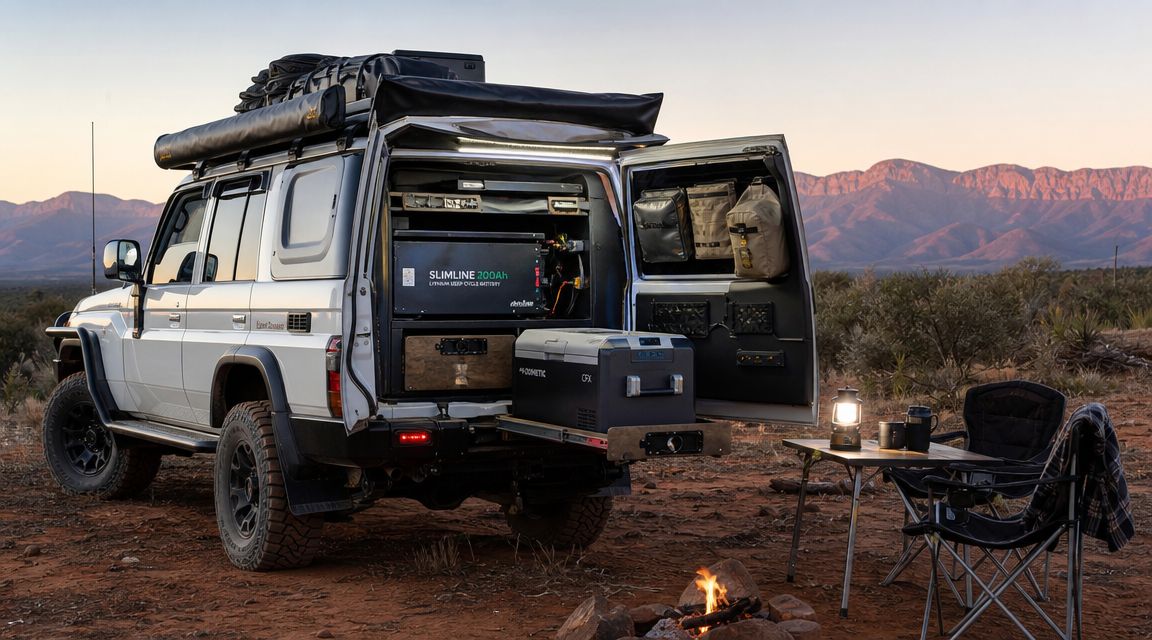
Australian retailers and reviewers have positioned 200Ah as a practical benchmark because it combines serious storage with compact packaging. One local retailer lists the AllSpark 12V 200Ah Slimline Lithium battery with a maximum inverter size of 2,500W, maximum continuous discharge of 200A, and a 5-second peak discharge of 500A, while also noting cycle life above 3,200 cycles at 80% depth of discharge and above 4,200 cycles at 60% DoD on its product page at Offroad Living's 200Ah slimline lithium battery listing. That helps explain why this size has become a go-to for serious off-grid use.
In 4WD canopies and ute trays
A canopy build is where slimline design really earns its keep. Mounting a battery hard against a wall leaves more room for drawers, a fridge slide, tools, and a clean cable run. That's a far better use of space than dropping a chunky battery box in the middle of the canopy and building around it.
For tourers chasing that tidy, long-range setup, this style of battery fits neatly with the wider travel mindset you see across the Australian van life scene. The same idea applies whether it's a Troopy, a ute, or a converted van. Use the awkward spaces properly and the whole rig works better.
In caravans and camper trailers
Caravans often have narrow voids under seats, beds, or dinettes. That's exactly where slimline units make sense. They can sit in spaces that would be wasted by a conventional battery shape.
The benefit isn't just fitment. It's also that you can support larger loads without building a sprawling battery bank. If your van uses an inverter, charging gear, and a compressor fridge, the tighter packaging becomes a major bonus.
Here's a walk-through that gives a feel for how these setups are often used in practice:
In boats and weekenders
Marine installs love compact gear too. Slimline batteries can work well where hull shape or compartment width limits your options. Less clutter and better packaging can make maintenance and access easier, which matters when you're trying to keep a small vessel practical rather than overstuffed.
The common thread in all these uses is straightforward. You get strong storage capacity in a battery shape that's friendlier to real vehicles and real trips.
Essential Installation and Safety Guidelines
A powerful battery deserves a proper install. This isn't where you save money with mystery cable, random lugs, and hope.
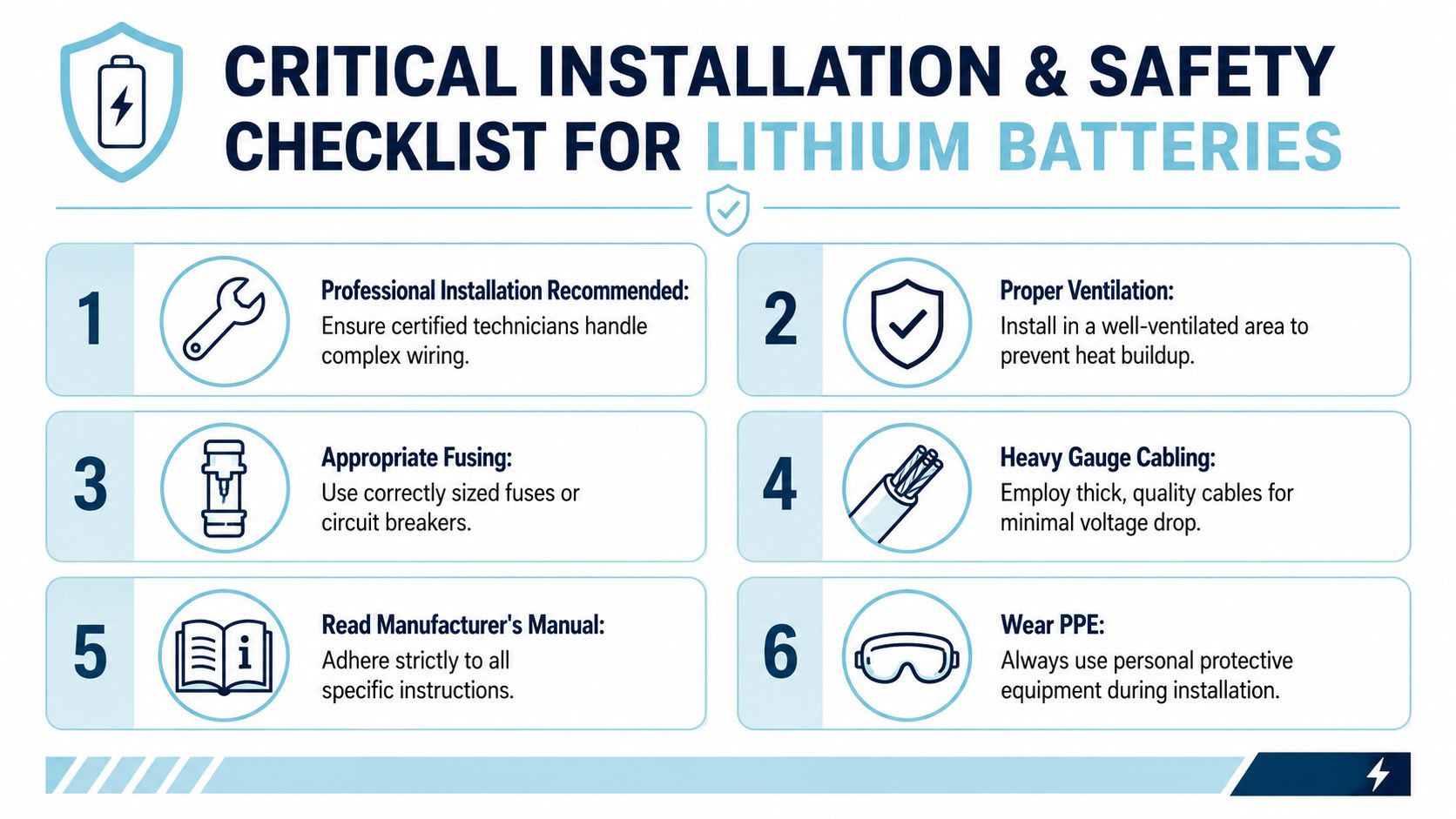
Mount it for Australian roads, not showroom floors
A battery that survives suburbia may still hate corrugations. In a touring vehicle, the mount needs to deal with vibration, bumps, and the constant punishment of rough roads. A loose battery or flexing bracket will eventually become your problem.
Keep the battery secure and supported across its mounting surface. Don't let it hang awkwardly off a thin panel or a flimsy partition.
Cable sizing and fusing are not optional
Improper installation is a frequent cause of issues. A battery with serious discharge capability can expose weak links very quickly. Itechworld notes that a 200Ah slimline battery with a 250A continuous discharge rating requires correctly sized cabling and fusing to safely power high-draw accessories, as outlined on the iTechworld 12V 200Ah super slim lithium battery page.
If the cable is undersized or the fuse arrangement is sloppy, heat builds up, voltage drops increase, and the BMS may cut out when you least want it to. That's how people end up blaming the battery when the install is the actual culprit.
Cheap wiring can make a premium battery behave like a bad one.
Watch access, airflow, and serviceability
Lithium batteries are often cleaner and easier to live with than lead-acid, but they still need sensible placement. Leave room to access terminals, inspect cable runs, and reach any isolation or protection gear.
A cramped compartment can also make heat management harder. You don't need to overcomplicate it, but you do need to avoid trapping the battery in a hot, inaccessible box with no thought for airflow.
A good install checklist
- Secure mounting: Use a rigid mount that can handle vibration and rough roads.
- Correct cabling: Match cable size to the current your inverter and accessories can draw.
- Proper fusing: Fit suitable protection close to the battery and on major circuits where appropriate.
- Clean terminations: Use quality lugs and solid connections. Loose joins create heat.
- Thoughtful placement: Leave room for inspection, servicing, and sensible airflow.
- Qualified help when needed: If you're unsure, get an auto sparky or caravan electrician involved.
This is one of those jobs where neatness usually tells you a lot. A tidy install is often a safer install.
How to Charge and Maintain Your Lithium Investment
A 200Ah lithium battery can only perform as well as the charging gear behind it. That's the part many buyers underestimate.
The battery needs a support crew
In a modern touring setup, charging usually comes from three places. Your alternator, your solar system, and your 240V charger when you're at home or on mains power. Each one needs to suit lithium charging.
That's why a proper setup often includes a DC-DC charger for charging from the vehicle, plus a solar regulator with a lithium profile. If you're using a van or camper in harsh conditions, thermal load matters too. Good insulation helps the whole vehicle environment stay more manageable, especially in compact builds where every compartment can get warm. That's one reason many converters pay close attention to insulation for van setups.
Why the whole charging chain matters
HHS Energy highlights a point that gets glossed over in plenty of battery marketing. To get the most out of a slimline 200Ah battery, the entire charging chain must be sized correctly. It also notes that a 3,000W inverter can draw 250A, which means your charging inputs need to be capable of putting meaningful energy back into the battery after use, particularly in Australian touring conditions with heat and long travel days, as discussed on HHS Energy's slim lithium battery product information.
A battery can have excellent specs and still disappoint if the charging system is undersized. If you run a high-draw inverter load and only trickle the battery back up, the weak point isn't the battery. It's the recharge plan.
What maintenance really looks like
The nice part is that physical maintenance is minimal. No topping up water. No acid concerns. No regular fussing over the kind of chores older battery types demanded.
Maintenance is mostly about three habits:
- Use the right chargers: Make sure each charger has a lithium or LiFePO4 profile where required.
- Keep an eye on the system: Monitor battery behaviour, charging performance, and unusual heat or cut-outs.
- Fix weak links early: A bad charger, loose cable, or poor regulator setup won't improve with time.
A lithium battery is low-maintenance, not no-thinking-required.
When the battery, charger, solar input, and load demands are matched properly, ownership becomes refreshingly simple.
Your Ultimate Slimline Lithium Buyer's Checklist
Shopping for a slimline battery gets confusing fast because many listings sound almost identical. Same capacity. Similar shape. Similar promises. The differences sit in the details.
Start with what your system actually needs
Before you compare brands, pin down the loads you expect to run. If you've got a big inverter, compressor fridge, charging gear, and regular camp use, you need a battery whose BMS and discharge limits suit that style of touring.
Don't buy a battery first and work the rest out later. That's how people end up with a battery that looks great on paper but doesn't fit the way they travel.
What to check before handing over your money
- BMS capability: Check whether the battery's management system suits your expected loads and charging setup.
- Charge and discharge limits: These matter more in practice than a flashy marketing label.
- Monitoring: Bluetooth can be handy. If it's not included, ask yourself how you'll keep track of the system.
- Warranty and support: Local after-sales support matters when you're remote or time-poor.
- Fitment: Measure the install area properly, including cable clearance and ventilation room.
Be careful with ultra-thin designs
There's always a temptation to chase the thinnest battery possible. Sometimes that makes sense. Sometimes it creates trade-offs that aren't obvious until the battery has spent years in a hot canopy or van compartment.
Anern notes a useful buying consideration in its discussion of slim battery form factors. Some batteries under 3 inches thick may have shorter cycle life or greater challenges with heat dissipation in confined canopies than slightly larger slimline models, particularly in hot Australian conditions, as raised in Anern's article on 200Ah lithium battery RV investment.
That doesn't mean thin is bad. It means thinner isn't automatically better.
A practical buyer mindset
Ask the seller ordinary touring questions, not just spec-sheet questions.
- Where is this best mounted in a hot vehicle?
- What charging gear does it need to perform properly?
- How will it behave with my inverter loads?
- What happens if I need support while travelling?
If the answers are vague, move on. A good seller should be able to talk through installation, charging, and real-world use without dodging the practical stuff.
Frequently Asked Questions
Is a slimline lithium battery 200ah too big for a weekend trip
Not necessarily. Bigger capacity doesn't force you to use more power. It gives you more reserve, more flexibility, and less stress if weather, shade, or camp length changes. Plenty of people like the breathing room even on short trips.
Can I just swap out my AGM and keep the same charger
Sometimes parts of the old system can stay, but it's risky to assume everything is compatible. Lithium batteries work best when the charging gear is suited to lithium charging. If you're unsure, check every charging source in the vehicle and van, not just one of them.
Will a 200Ah slimline battery run an inverter
It can, but only if the battery's discharge limit, cabling, fuse protection, and inverter demands all match up. Buyers often get tripped up by these complexities. The inverter size alone doesn't tell the full story.
Is slimline always better than a standard battery shape
No. Slimline is better when space is tight and the narrow profile improves the build. If you've got plenty of room and cooling is easier in a conventional compartment, a different form factor may still be worth considering.
Do I need Bluetooth monitoring
You don't have to have it, but it can make life easier. Good visibility into charge state and system behaviour helps you spot problems early. If the battery doesn't include it, many owners add separate monitoring to get a clearer picture.
Are these batteries suitable for caravans and 4WDs in Australian heat
They can be, but the battery has to be part of a well-matched system. Heat, ventilation, charge control, and installation quality all matter. In hot touring conditions, buying purely on slimness or price can be a false economy.
Is installation a DIY job
That depends on your experience. Mechanically mounting the battery may be straightforward. Designing and wiring a high-current system safely is another matter. Plenty of owners sensibly leave the electrical side to a qualified installer.
What's the biggest mistake people make
Treating the battery like the whole solution. It isn't. The battery is one part of the setup. If the alternator charging, DC-DC charger, solar input, inverter demand, and cable sizing aren't matched, the system won't feel right no matter how good the battery is.
If you love practical touring gear, classic vehicles, and the lifestyle that goes with them, have a look at Volkswagen Memorabilia. The shop is packed with officially inspired VW gifts, diecast Kombis and Beetles, and display-worthy collectibles for enthusiasts who appreciate iconic design. It's a great place to browse local stock, find a thoughtful present, or add a bit of Volkswagen character to your shed, office, or camper setup.