


You're standing in front of the display cabinet with a 1:18 Samba Bus in one hand and a Beetle still in its box. The shelf looked generous in the shop, but at home the Kombi's mirrors, bumpers and protective cover are already competing for room. Before you choose another Volkswagen diecast model, it helps to understand what the scale number really tells you, how many centimetres it occupies and whether it suits the collection you're building.
For Australian VW enthusiasts, scale is more than a number on packaging. It affects display footprint, visible detail, gift suitability, storage and how well a Beetle sits beside a Kombi. A large model can become the star of a cabinet, while smaller versions make it possible to build a whole themed fleet around surf trips, flower-power colours or show-day memories.
What Diecast Model Scales Actually Mean
A scale ratio compares the model with the actual vehicle. In 1:18, every 18 units on the full-size Volkswagen become one unit on the model. In 1:24, every 24 units become one. Because 18 is the smaller denominator, a 1:18 model is physically larger than a 1:24 model.
Take a Kombi measuring roughly 4.5 metres in real life. Convert the length to centimetres, then divide by the scale number:
- 1:18: 450 centimetres ÷ 18, or about 25 centimetres
- 1:24: 450 centimetres ÷ 24, or about 19 centimetres
- 1:32: 450 centimetres ÷ 32, or about 14 centimetres
- 1:64: 450 centimetres ÷ 64, or about 7 centimetres
That quick calculation works for any Volkswagen. Measure the vehicle in the same unit and divide by the number after the colon. The ratio applies across the whole car, including its length, width, height, wheels and interior proportions. It isn't a label that describes only how long the model happens to be.
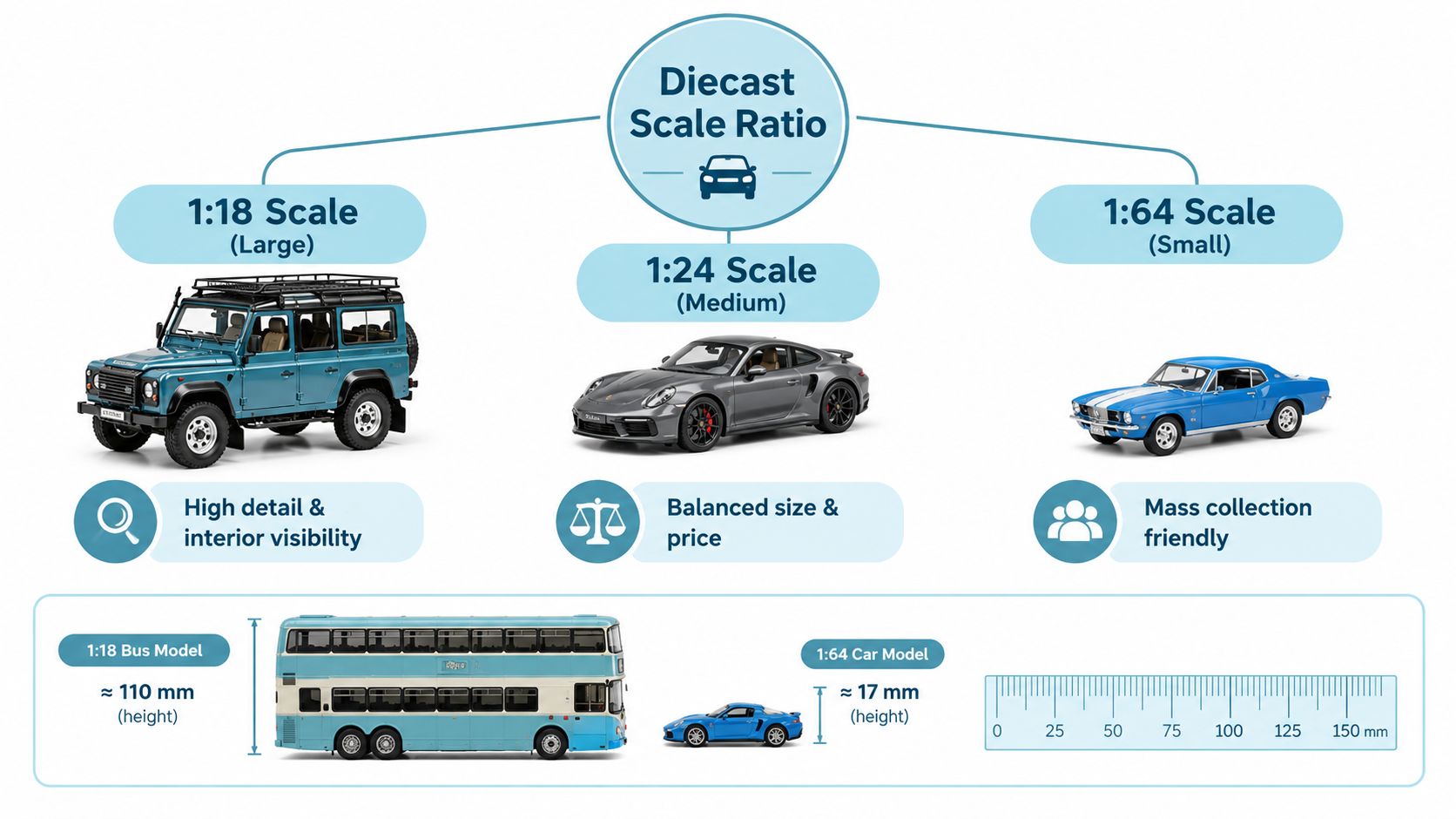
Practical rule: the smaller the number after the colon, the larger the model. Always check the actual product dimensions as well, because a long-wheelbase Kombi and a compact Beetle won't occupy identical space at the same scale.
If you're new to the hobby, what a diecast model car is is also worth understanding. Diecast construction, licensed details and scale are related, but they describe different parts of the buying decision. Scale tells you the proportions, while materials and finish tell you how the model feels and looks.
The Four Common Scales in Australian VW Collecting
Australian collectors commonly come across 1:18, 1:24, 1:32 and 1:64 Volkswagen models. Each serves a different purpose, and none is automatically the “best” scale.
1:18 is the feature-piece choice. A typical model is around 24 to 30 centimetres long, depending on the original vehicle, and a Kombi needs breathing room around its mirrors and bumpers. It suits a hero Samba Bus, a detailed Beetle or a cabinet where one vehicle deserves centre stage. For a practical guide to the format, see this overview of 1:18 diecast scale models.
1:24 gives you a useful middle ground. Australian collector guidance places typical models at about 16 to 20 centimetres, although body style changes the final measurement. A 1:24 Beetle can sit comfortably on a bookshelf, while a 1:24 Kombi still has enough presence to feel like a proper display model.
1:32 works well for compact themed displays. A roughly 4.5-metre Kombi calculates to about 14 centimetres in this scale, making it easier to place several vehicles together without turning the shelf into a traffic jam. A Blacktop Kombi in this format can provide strong visual character while leaving room for a Beetle, signage or a small coastal décor piece.
1:64 is the fleet-builder's scale. Depending on the full-size vehicle, models are roughly 6 to 13 centimetres long. The format suits collectors who want several colours, eras or body styles, and it can work well for a diorama or a broader scene.
| Scale | Typical length | Ideal use | Shelf depth |
|---|---|---|---|
| 1:18 | About 24–30 cm | Single hero model | Allow at least 30 cm for a Kombi |
| 1:24 | About 16–20 cm | Balanced display or gift | Measure the case before buying |
| 1:32 | About 14 cm for a Kombi | Compact themed collection | Suits shallower shelving |
| 1:64 | About 6–13 cm | Fleet, diorama or mixed pack | Often works in compact spaces |
These are planning figures, not promises of identical dimensions. Check the individual model listing before ordering, particularly when you're comparing a Volkswagen Beetle model with a larger Samba Bus.
Scale, Detail and the Look on the Shelf
A larger model gives your eyes more to explore. On a licensed 1:18 Samba Bus, you may be able to appreciate the steering wheel, seat shapes, dashboard, wheel design, badges and opening parts without picking up a magnifying glass. The body lines also read more clearly, which matters with the rounded roof, split-window character and bright trim of a classic Kombi.
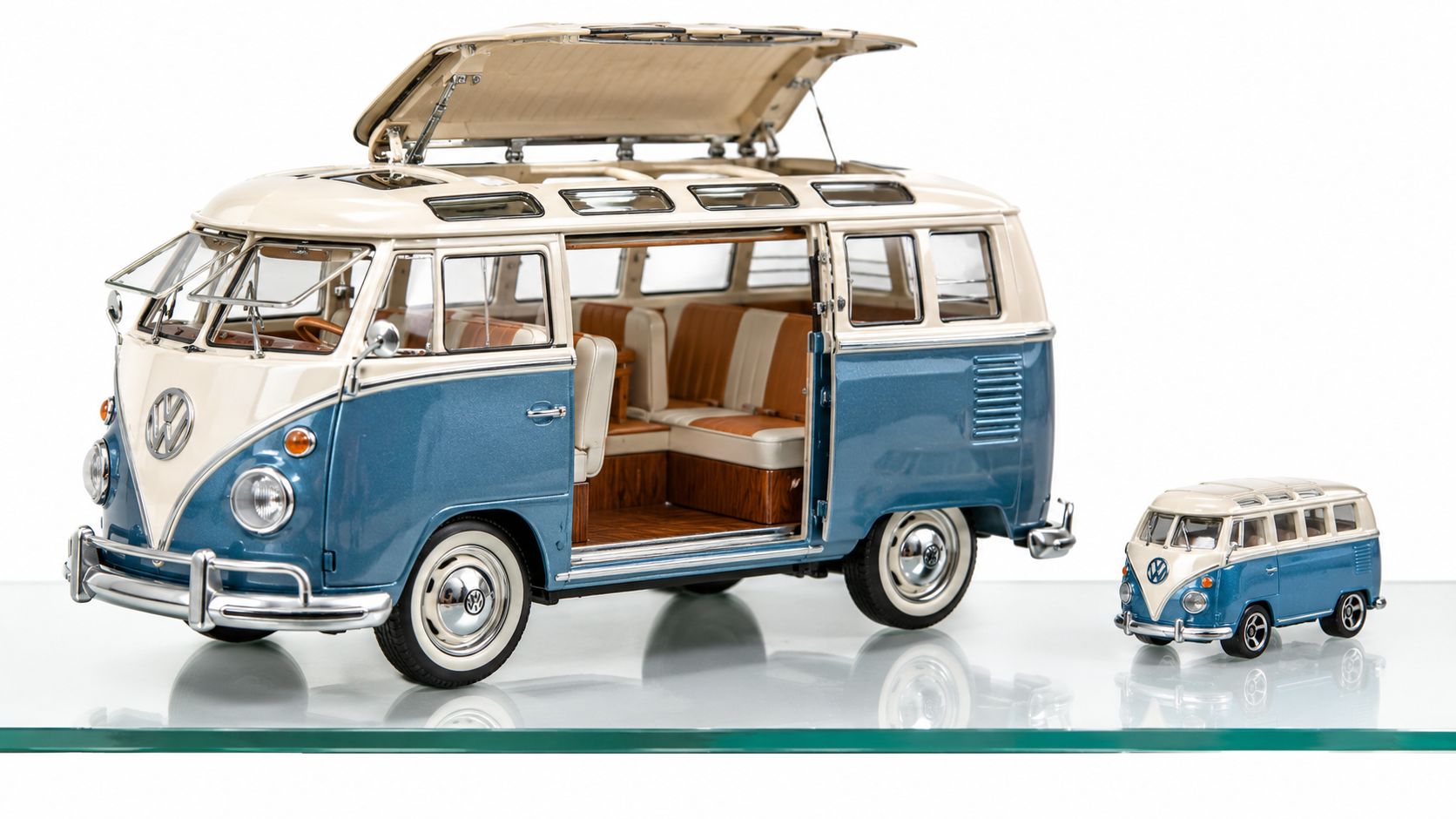
Scale doesn't guarantee quality, though. A smaller model can have excellent paint and crisp proportions, while a larger one can disappoint if the panel lines, glazing or wheels look poorly finished. Look for even colour, clean window moulding, straight axles, tidy printing and a body that sits squarely on its wheels.
A 1:32 Blacktop Kombi takes a different approach to the shelf. It relies less on tiny interior features and more on its silhouette, colour scheme and recognisable Volkswagen identity. That makes it a strong choice for a group display where the eye reads the overall scene before it studies individual trim.
A display case protects the finish from dust, curious fingers and accidental knocks. Australian buyers planning a cabinet can compare suitable display cases for model cars before committing to a large vehicle.
The following video gives another visual way to compare how model proportions and details present at different sizes.
The right question isn't “Which scale has the most detail?” It's “What detail will I enjoy seeing in my room?” If you love opening parts and studying the cabin, go larger. If you prefer a row of colourful Volkswagens that tells a story from across the room, a smaller scale may create the better result.
Why Smaller Scales Often Win for Australian Setups
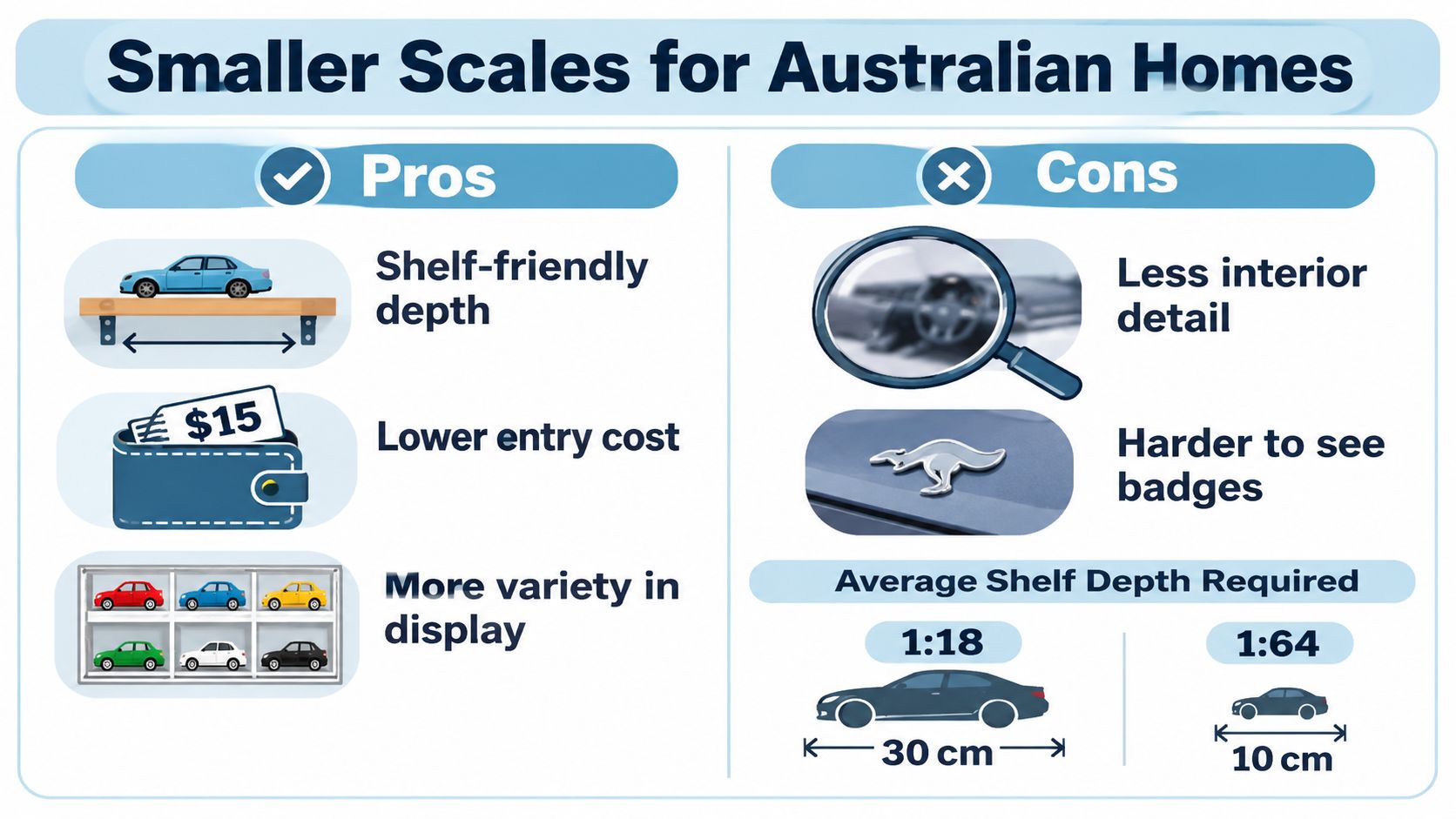
A 1:18 model makes an impression, but Australian homes don't all have deep display cabinets. A Kombi at this scale can need at least 30 centimetres of shelf depth so its mirrors, bumpers and cover aren't crowded. That can rule out a narrow bookcase, hallway shelf or compact office cabinet before the model has even arrived.
Smaller formats solve that problem without making the collection feel less personal. A 1:24 Beetle, 1:32 Kombi and 1:64 themed vehicle can create variety across a shelf, while a single large model may use the same footprint as several smaller pieces. Collectors building a surf, camping or Flower Power theme often value the number of stories they can show together.
Smaller models also make thoughtful gifts. A boxed Beetle or Kombi is easier to wrap, store and carry home from a show, and a mixed pack gives a recipient more than one colour or body style to enjoy. For small Australian retailers, compact mixed packs can also make it easier to test different themes without dedicating a large display area to one vehicle.
A smaller model isn't a downgrade. It's often the practical choice for a bigger story.
Choose the scale by the job it needs to do. A single desk centrepiece can justify 1:18. A family gift, themed shelf or multi-vehicle display may suit 1:24, 1:32 or 1:64 far better. Scale consistency matters most when you're creating an architectural scene, while colour, era and theme can matter more in relaxed home décor.
Buying Tips for Licensed VW Diecast in Australia
Once you've chosen a scale, check what you're buying. A licensed Volkswagen model should show clear brand identification on its packaging or base, and the product description should state the scale and, where available, the approximate dimensions. Licensing matters because a recognisable badge and correctly shaped body are part of the appeal, especially when the model represents a specific Beetle or Kombi era.
Use this quick checklist before checkout:
- Confirm the scale: Compare 1:18, 1:24, 1:32 or 1:64 with your available shelf space.
- Check the measurements: Treat the scale calculation as a guide, then allow room for mirrors, bumpers and packaging.
- Inspect the finish: Look for even paint, straight wheels, clean glazing and sharp printed details.
- Read the product description: Check whether the model has opening parts, a display base or protective packaging.
- Consider the seller: Australian local stock can mean faster shipping, clearer returns and easier support during weekday hours.
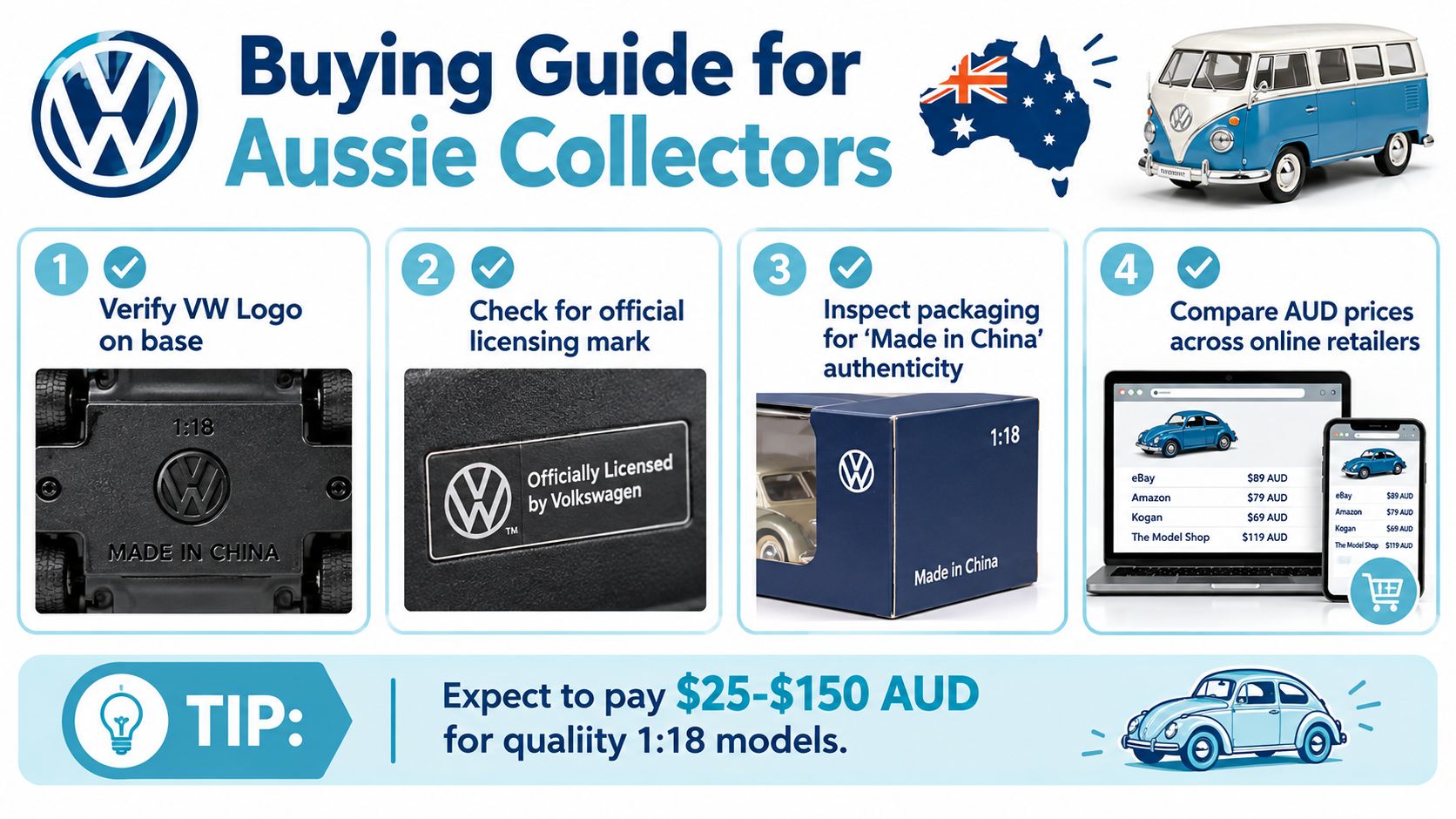
The phrase VW Kombi diecast Australia is useful when you want locally relevant availability rather than an overseas listing with uncertain delivery. Volkswagen Memorabilia offers licensed Volkswagen diecast cars in specific scales, including 1:24 and 1:32 Kombi and Beetle designs, along with local contact support during weekday hours. Compare the listing details, check whether the item is in local stock and choose the model that fits your display rather than chasing the largest box.
The Australian VW Story Behind Your Model
A Beetle on a shelf carries a particularly strong Australian story. Museum Victoria records that the first Beetles arrived here in late 1953, imported by Melbourne-based Regent Motors. Volkswagen later introduced completely knocked-down kits, which were assembled in Melbourne as the amount of Australian content increased.
Full production of Volkswagen cars and commercial vehicles began at the Martin & King railway-carriage factory in Clayton in 1959. Local Beetle production ended in 1968, after just over 260,000 Beetles had been made, while Australian assembly of imported vehicles continued and the last new Australian-assembled Beetle appeared in 1976. Museum Victoria's Australian Beetle history gives the timeline useful context.
That background changes how a collector sees a Volkswagen Beetle model. It isn't only a cute retro shape. It can represent Melbourne manufacturing, family motoring, weekend repairs and the long-running Australian affection for simple, practical Volkswagens.
The same connection appears at VW events. The VW Nationals has been held since 1988, when its first gathering formed part of the Australian Bicentennial celebrations. Event records describe meetings with around 900 Volkswagens and an estimated 3,000 to 4,000 people, another with 1,000 to 1,200 Volkswagens and Audis inside the venue plus roughly 200 outside, and a later event with more than 1,200 cars, several hundred outside, 127 trophy competitors and a crowd exceeding 3,000 VW fans. These figures are documented in the VW Nationals past events record.
A faithful Kombi or Beetle miniature therefore belongs beside photographs, restoration parts and show memorabilia. It connects a quiet cabinet at home with a lively Australian community gathered around real cars.
Choosing the Right Scale for Your Collection
Start with the display goal, not the biggest number on the box.
| Your goal | A sensible starting point |
|---|---|
| One hero model on a desk or cabinet | 1:18 Samba Bus or Beetle |
| A balanced Beetle and Kombi display | 1:24 |
| A compact themed shelf | 1:32 |
| A broad fleet, diorama or mixed gift | 1:64 |
| A collection built around exact architectural proportions | Keep one scale throughout |
A single 1:18 model can carry the visual weight of a feature piece, especially when you want to study the interior and opening details. For a collection with several vehicles, 1:24 or 1:32 usually gives you more freedom to combine body styles, colours and themes without overcrowding the shelf.
Gift buyers should think about the recipient's room as well as their favourite Volkswagen. A small Beetle may suit an office, while a larger Samba Bus can become the centre of a dedicated cabinet. If you're unsure, measure the intended shelf first, then compare that measurement with the model's listed dimensions.
A scale doesn't decide whether a model is meaningful. The right choice reflects the story you want to tell, the space you have and the way you enjoy the hobby.
Volkswagen Memorabilia offers licensed VW diecast models, including Kombi Samba Bus and Beetle designs in practical display scales, alongside VW-themed gifts and coastal décor. Visit Volkswagen Memorabilia to compare locally stocked models, check the measurements and choose a miniature that feels right for your shelf, collection or next VW-inspired gift.