

The most popular advice about beach wall art for bathroom styling is also the advice that causes the most disappointment: choose a beautiful coastal print, frame it, and hang it near the shower. That works in a showroom photograph. In a real Australian bathroom, where hot showers meet cool tiles and ventilation varies wildly, the print may curl, stain or develop mould before the coastal mood has had time to settle.
The better question isn't, “Does this look beachy?” It's, “Can this material survive a wet room?” Australian coastal bathrooms are a well-established style, with local design publications describing them as “popular” and among Australia's most popular bathroom approaches. Their familiar ingredients include crisp white surfaces, blue and green accents, sandy neutrals, timber, textured tiles and wall-mounted beach imagery, as outlined in Australian bathroom design coverage. The artwork should finish that scheme, not become the first thing ruined by it.
Why Most Beach Wall Art Fails in Bathrooms
A standard beach print isn't automatically bathroom art. Paper, canvas, cardboard backing and ordinary timber frames all respond to moisture, and bathrooms create plenty of it. Steam settles on cooler surfaces, condensation gathers behind frames, and repeated changes in temperature can leave materials expanding and contracting in ways they weren't designed to handle.
Paper fibres swell when they absorb moisture. As the sheet dries, it can buckle or pull against the frame. If a frame has a sealed back with nowhere for damp air to escape, moisture can remain trapped between the artwork and the glazing. That's when a calm ocean scene becomes a rippled rectangle with tide marks around the edges.
The room matters more than the picture
A large online marketplace image usually shows art in a bright, dry room. It won't tell you whether the print is protected by acrylic, whether the backing board resists swelling, or whether the frame has been sealed properly. Those details matter more than whether the image features a turquoise lagoon, a surf break or a beautifully weathered jetty.
Unsealed canvas is another common trap. A gallery-wrapped canvas may appear casual and coastal, but humidity can soften the fibres, distort the stretcher structure and encourage staining. A coating can improve performance, particularly when it is designed for moisture exposure, but no coating turns a splash-zone wall into a safe location.
The practical rule: Choose the substrate and sealing system before you choose the beach scene.
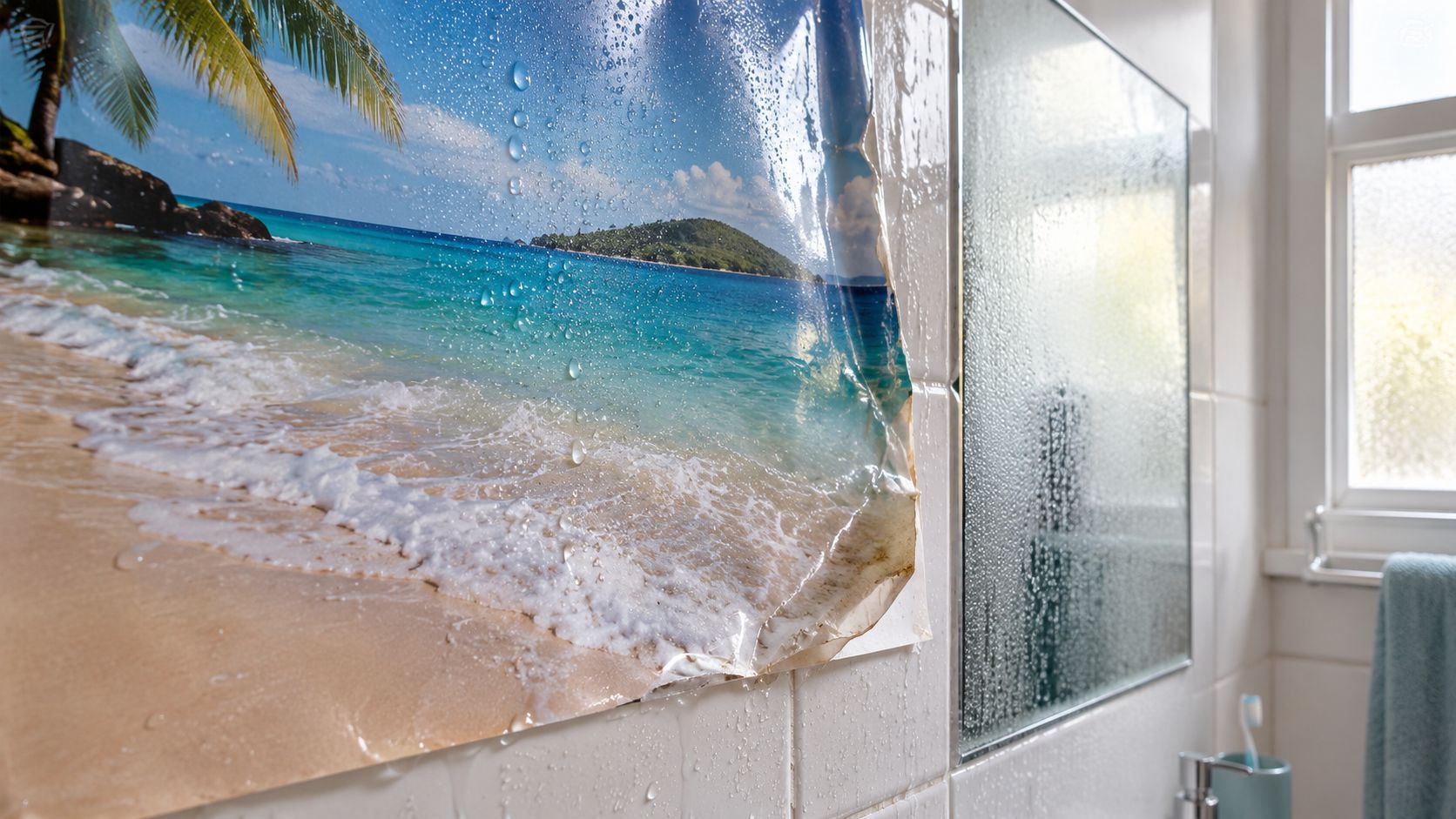
Australian bathroom guidance consistently identifies steam, trapped moisture and poor ventilation as the main risks for paper, canvas and framed works, as discussed in this Australian guide to bathroom art prints in humid conditions. Light exposure can fade an image over time, but humidity usually causes the more immediate failure.
That changes the buying process. Start with exposure, then select a material, then choose a size and style. A modest ceramic panel in a sensible location will outperform an expensive paper print hung directly above a shower. The most attractive artwork is still a poor purchase if it curls after a few weeks.
Moisture-Resistant Materials That Actually Work
Material selection is where bathroom art succeeds or fails. There isn't one perfect option for every Australian bathroom, so weigh appearance, installation, maintenance and exposure together.
| Material | Bathroom Suitability | Expected Lifespan | Cost Range | Best For |
|---|---|---|---|---|
| Giclée print on archival cotton rag paper | Suitable only behind glass or acrylic, away from splash | Can remain presentable when properly protected and ventilated | Varies by print, glazing and frame | Low-exposure walls and carefully sealed frames |
| Adhesive vinyl panel | Robust for humid areas when correctly installed | Designed for repeated moisture exposure, with performance depending on preparation | Varies by panel size and finish | Compact bathrooms and practical feature walls |
| Ceramic, marble or enamel-based piece | Highly suitable for humid areas | Durable when securely mounted and kept out of direct splash | Varies by material, artwork and installation | Long-term installations and premium finishes |
| Sealed canvas with a moisture or UV-resistant coating | Suitable in low-exposure, well-ventilated rooms | Can perform well when sealed and correctly positioned | Varies by coating, size and frame | Softer, textured coastal styling away from steam |
| Conventional paper, linen or unsealed canvas | Poor choice | Likely to warp, stain or deteriorate in humid conditions | Often inexpensive, but replacement risk is high | Dry rooms, not bathrooms |
Giclée printing on archival cotton rag paper can look superb, but it needs proper protection behind glass or acrylic glazing. The print itself isn't the moisture barrier. The frame, sealed back and placement do the hard work. For a bathroom with weak extraction, I'd choose a more resilient substrate rather than relying on a paper print to behave.
Adhesive vinyl is less romantic, but it earns its place. It's wipeable, comparatively light and useful where a traditional frame would take up too much room. Ceramic, marble and enamel-based pieces are the premium choices for wet-area durability, although they need sound mounting and a wall that can carry the load. If you're comparing a coastal wall accent with a more decorative shell-based option, consider the finish and cleaning requirements before buying something such as this capiz shell wall art.
Match the material to exposure
AS 3740:2021 sets minimum waterproofing requirements for domestic wet areas in Australia, as specified by Standards Australia's AS 3740:2021 listing. That standard isn't a product approval for artwork. The useful takeaway is that artwork should sit outside the waterproofing and splash-zone interfaces around showers and baths, with moisture-resistant finishes and suitable hardware taking priority.
For a low-exposure powder room, a glazed print may be perfectly sensible. A steamy family bathroom needs a more forgiving substrate. A wall inside the shower's direct spray should be treated as unsuitable for ordinary artwork, regardless of how well the image matches the tiles.
Australian wall décor coverage also identifies wall art, including paintings, prints and digital artwork, as a popular part of the local wall décor market, supported by renovation activity and demand for personalised interiors. That makes it easier to find coastal imagery in different formats, but it also means you need to read the material specification rather than assume every product is bathroom-ready.
Where to Hang Beach Wall Art Without Risk
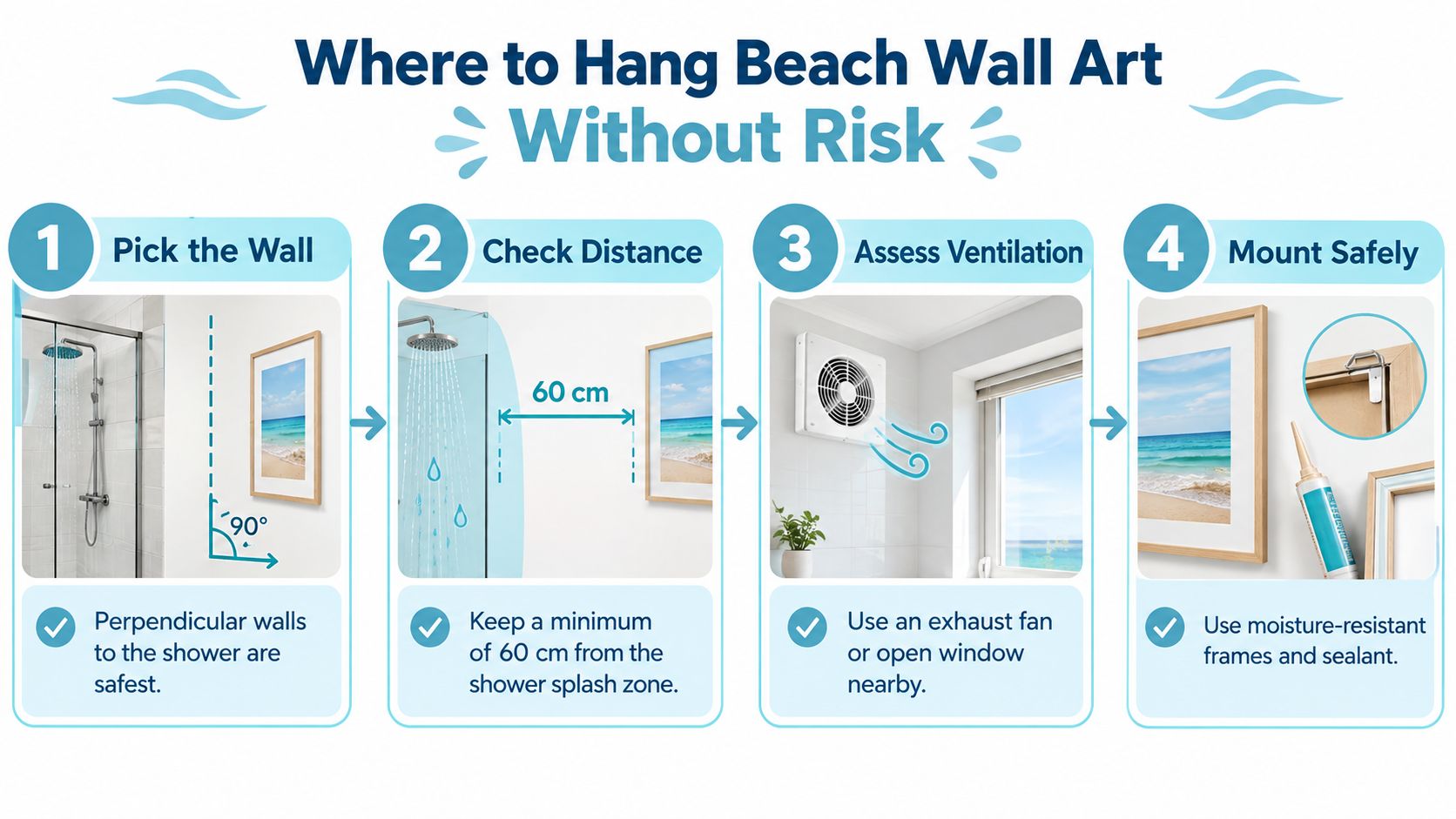
The safest location is usually boring, which is precisely why it works. Place artwork on a wall perpendicular to the shower, or above the toilet, rather than in the direct path of spray. A wall opposite the shower can still receive a lot of steam, so distance alone doesn't remove the need for ventilation and moisture-tolerant construction.
The wall above the toilet is often a useful visual zone because it sits outside the main splash area. Beside a vanity can work too, provided the piece isn't exposed to water from the basin and the frame won't interfere with cleaning. Avoid the temptation to fill every empty wall. One well-positioned piece is safer and usually looks more considered than several vulnerable prints.
Use a simple placement test
Before drilling, stand in the shower and identify where water and steam travel. Then check the proposed wall during and after a normal shower. If condensation repeatedly forms on the surface, move the artwork farther away or choose a substrate made for higher humidity.
- Pick a low-exposure wall: Perpendicular walls to the shower are safer than direct splash paths.
- Keep clear of spray: The supplied Australian infographic uses a 60 cm minimum from the shower splash zone as a practical checking point. Treat that as a cautious benchmark, not permission to install ordinary paper art in a wet area.
- Improve extraction: Run the exhaust fan during showering and afterwards. A humidity-sensor extraction fan that activates at 60% relative humidity can help reduce moisture spikes, as noted in the Australian guidance above.
- Allow wet work to settle: After painting or tiling, let the room cure and stabilise before mounting artwork. One Australian framing source recommends waiting at least 48 hours after wet works are fully cured, rather than hanging art immediately.
For mounting advice, use corrosion-resistant fixings and a frame with a properly sealed back. A practical wall-art hanging guide can help with positioning and hardware, but the bathroom itself still determines whether the chosen material is suitable.
A beautiful unsealed print above the shower screen is a predictable failure. A glazed print above the toilet, with the fan running and the frame kept away from condensation, is a much more sensible installation.
Styling Beach Wall Art in Small Aussie Bathrooms
Beach wall art often fails in small bathrooms before the styling does. Humidity, condensation and weak ventilation will warp paper, lift edges and stain poorly finished frames, so choose the bathroom-safe construction first. In a compact ensuite, the artwork needs to survive the room's wet conditions before it earns a place in the colour scheme.
Current Australian coastal styling favours abstract references, warm neutrals, pale timbers and organic texture, rather than a literal collection of anchors, shells and rope. Australian coastal home trend coverage describes a more restrained direction, while coastal design guidance from Castlery Australia supports softer, more livable interpretations.
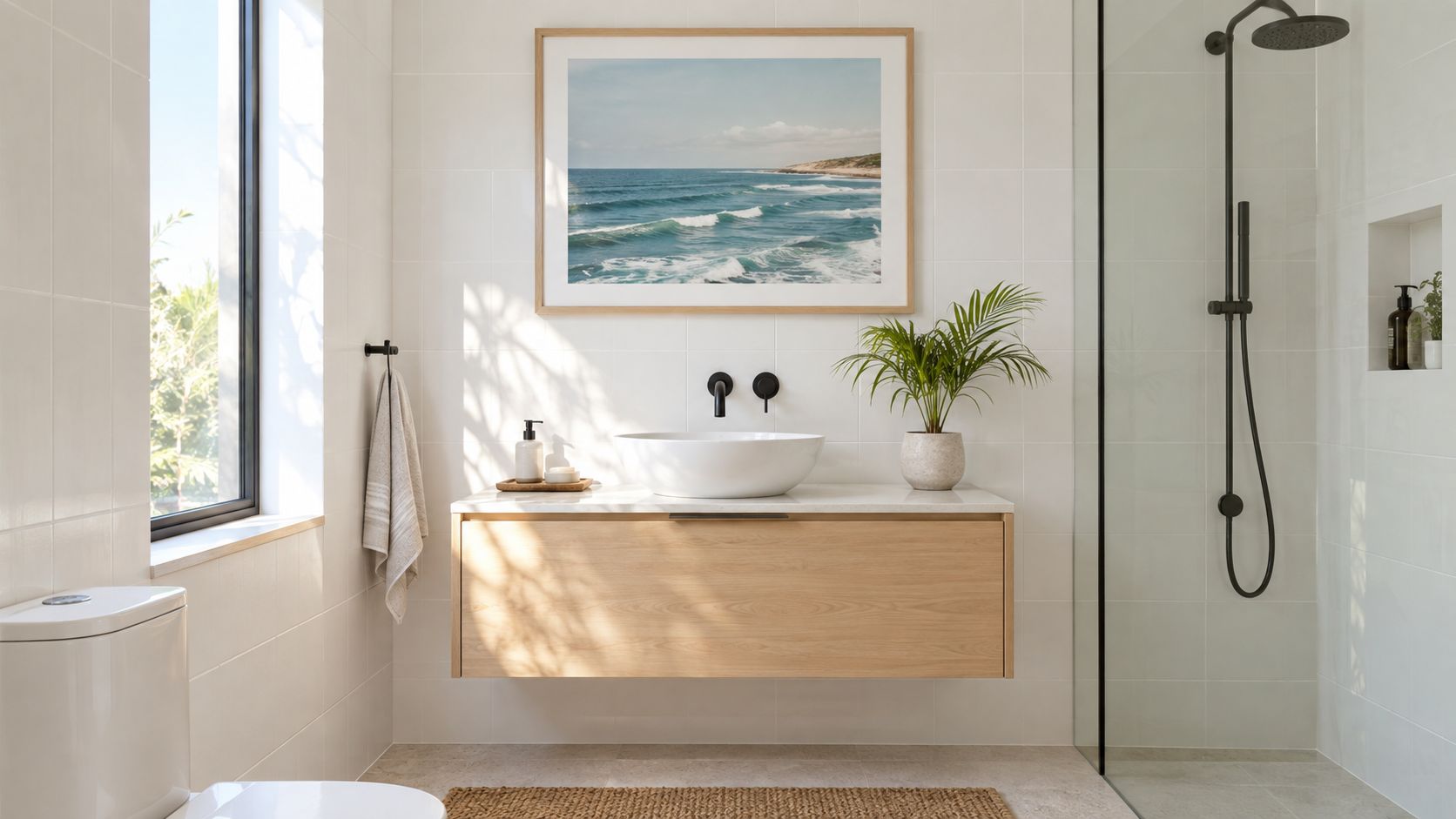
Start with one moisture-resistant piece, then build the room around it. An abstract horizon, softened wave forms, muted aerial beach pattern or restrained marine study can sit comfortably with white sanitaryware, textured tile and pale timber. In a bathroom with limited extraction, choose the vinyl or ceramic option first, then match its blue-grey, sandy or warm-white tones rather than selecting a vulnerable print for its colour.
For a moisture-tolerant coastal-boho finish, consider a sealed coastal boho wall art panel for humid bathrooms outside the splash zone. Check that the finish covers the edges and that the backing remains stable. A decorative surface alone does not make an artwork suitable for a wet room.
Give a small room one clear focal point
In a narrow ensuite, a wide panel can echo the vanity's width. In a tiny powder room, a vertical piece can make better use of the wall above the toilet. Keep the frame visually light. Deep mouldings collect dust and make a compact room feel crowded, especially beside a mirror and tapware.
A driftwood-inspired frame brings natural texture, provided its finish is sealed and its backing is moisture tolerant. Pair one artwork with a timber vanity, a simple round mirror and textured accessories. The result feels relaxed and Australian, rather than themed.
The video below offers another visual reference for combining coastal texture with a clean bathroom scheme.
Building Your Beach Wall Art Selection Strategy
Assess the room before browsing images. Start with three questions: how effectively does the bathroom ventilate, how close is the proposed wall to shower spray, and how much visual space is available? Those answers narrow the material choice faster than searching by colour.
Use this decision path:
- Small and steamy: Choose ceramic, enamel or adhesive vinyl, then place it above the toilet or on a perpendicular wall.
- Moderately ventilated: Consider a sealed canvas or glazed giclée print, provided the location stays outside direct splash.
- Large and well ventilated: You have more flexibility with a protected paper print, a coordinated pair or a larger statement piece.
Ask the retailer direct questions before paying. What is the substrate? Is the artwork sealed, and on which surfaces? Does the frame have glass or acrylic glazing? Is the backing board moisture tolerant? What hardware is supplied, and does the warranty address humidity damage or only manufacturing faults?
Ask for the specification, not the mood board. A photograph can show you the style. It can't prove the artwork belongs in a bathroom.
Current coastal styling may favour subtlety, but performance comes first. Choose the strongest material your room requires, then find an image that works with the tiles, vanity and fittings. That order prevents an expensive mistake and usually produces a more coherent result.
Quick Checklist Before You Buy
- Check the material: Confirm that it's moisture resistant or protected by a sealed system.
- Check the location: Keep it away from direct shower spray and favour a perpendicular wall or the area above the toilet.
- Check ventilation: Make sure extraction or natural airflow can clear steam.
- Check the scale: Select one considered piece rather than cluttering a compact wall.
- Check the mounting: Look for sealed backing and corrosion-resistant hardware.
- Check the warranty: Ask specifically whether humidity-related damage is covered.
Volkswagen Memorabilia brings together coastal décor and distinctive VW-themed pieces for relaxed, nostalgic interiors, including wall art and beach-inspired accents that can complement a well-planned bathroom scheme. Visit Volkswagen Memorabilia to browse the collection and choose a piece that brings genuine Australian beach character into your home.