


Saturday morning in Ballarat. There's a row of Beetles glinting in the sun, a tidy split-screen Kombi with the deck chair out, and someone's polished Golf TDI parked a few spaces over because, let's be honest, the old bus is for love and the diesel is for getting to work on Monday.
You're leaning on the Kombi talking carbs, chrome trims and road trips, then a mate says, “My Amarok's got that particle filter light again. What even is that thing?” That's the modern VW world in one sentence. We adore the simple charm of an air-cooled classic, but plenty of us drive a newer diesel VW through the week. Golf, Passat, Tiguan, Touareg, Amarok. Different beast, same badge.
If you've landed here because your modern diesel has flashed a warning and your heart sank a bit, you're not alone. A diesel particulate filter, or DPF, sounds like workshop jargon, but it's really just one of those modern parts that makes sense once someone explains it in plain English.
Think of this as a yarn between VW people. No lab-coat talk. No scare campaign. Just the practical stuff you'd want to know while standing near a classic Kombi with a coffee in hand.
A Yarn About Modern VWs and Pesky Warning Lights
Mick from Bacchus Marsh had a neat old Type 3 in the shed and a diesel Tiguan for the weekly grind. The Type 3 asked for spanners, patience and the odd swear word. The Tiguan usually just asked for fuel. Then one frosty morning, heading out for school drop-off and a coffee run, a warning light popped up on the dash and rattled him more than a noisy tappet ever had.
That catches plenty of VW owners out.
With an old Beetle or Kombi, you can often tell what mood the car is in by the smell, the idle, or the little noises it makes at the lights. A modern diesel VW is a different sort of clever. It keeps things tidy in the background, and when something needs attention, it speaks in dashboard symbols instead of rattles and puffs of smoke.
Why diesel owners get caught off guard
A lot of Australian VW diesels live a very suburban life. Short hops to work. School pick-ups. Stop-start traffic. A quick run to Woolies, then back in the driveway before the engine has really warmed through. That routine suits plenty of drivers, but it can leave a diesel grumpy because some of its emissions gear prefers a proper run, not five minutes between roundabouts.
So the warning light feels unfair. The car has been serviced, it still drives, and you have not been out there thrashing it or ignoring it. Yet up comes that little symbol, and suddenly your calm, sensible daily feels a bit high-maintenance.
Practical rule: If your diesel VW mostly does short suburban trips, the DPF warning light is often a use-pattern issue, not a sign the car has suddenly turned into a money pit.
It's usually a common modern diesel problem
This is a common issue for owners of modern particle filter diesel cars in Australia, especially people using them as weekday family transport rather than long-distance cruisers. Amarok owners see it. Golf TDI owners see it. So do people in Passats, Tiguans and Touaregs.
Once you know why that light comes on, the whole thing feels a lot less mysterious. You do not need to be a diesel wizard. You just need the plain-English version a mate would give you at a Ballarat car meet, coffee in hand, while the old Kombi cools beside you.
What Is a Diesel Particulate Filter Anyway
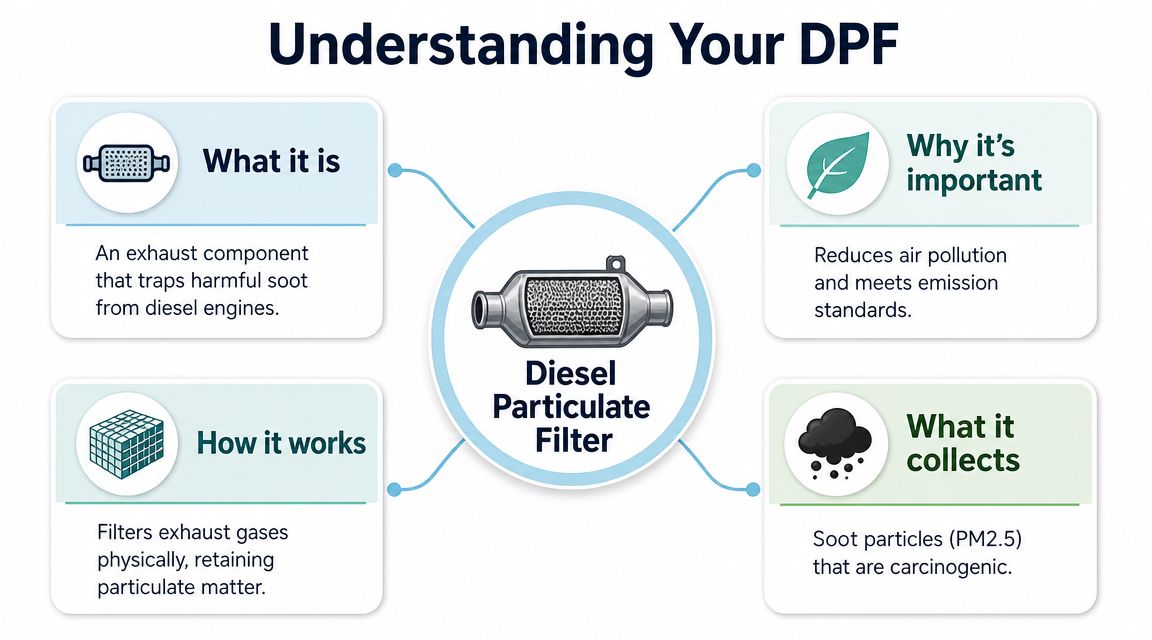
A mate rocks up at a VW meet in Ballarat with his Amarok parked beside a split-screen Kombi. The old bus smells faintly of fuel and warm oil. The Amarok doesn't puff a thing. That difference comes down to one bit of hardware tucked into the modern diesel's exhaust. The diesel particulate filter, or DPF, catches soot before it leaves the tailpipe.
That is why a modern Golf TDI or Passat diesel usually feels so much cleaner than the old-school diesels plenty of us grew up around. Instead of letting the black stuff head straight out the back, the exhaust system holds onto it inside the filter.
The simple version
A DPF works a bit like a very fine trap in the exhaust. Hot gases still pass through, but the soot gets caught in the filter's internal walls instead of floating into the air. In a VW diesel, that filter is usually made from a ceramic material with tiny channels that force the exhaust through porous sections.
Corning explains in its guide to how a diesel particulate filter works that wall-flow filters are designed to catch the fine particulate matter created during diesel combustion. That is the grubby stuff you cannot always see clearly, but it is exactly what emissions systems are meant to control.
Why Australian VW owners ended up with them
For Aussie VW owners, the DPF is part of living with a newer diesel in the post-Euro 5 era. Stricter emissions rules meant diesel passenger cars and light vehicles sold here had to use cleaner exhaust after-treatment systems, and the DPF became one of the main tools for doing that.
So if you daily a diesel Tiguan in Melbourne traffic or an Amarok around regional Victoria, you are driving a vehicle built to meet those later standards, not the simpler diesel rules older cars were designed around. It is the same broad story as classic Volkswagens versus modern ones. The old Beetle got by with simplicity. The newer diesel gets by with sensors, heat, and a filter doing the dirty job.
A decent fuel system cleaner for diesel maintenance can help as part of general upkeep, but it is separate from what the DPF itself does. The filter's job is straightforward.
- It traps soot: fine particulate matter gets caught in the exhaust system.
- It helps keep the air cleaner: less soot makes it out the tailpipe.
- It affects ownership costs: if the filter blocks or is removed, you can end up with poor running, warning lights, and legal headaches.
A classic Beetle's exhaust tells its story with noise and smell. A modern VW diesel tells it with sensors, temperature, and a filter hidden underneath.
The Magic of Regeneration Your DPFs Self Cleaning Trick
You know the sort of drive. Saturday morning in Ballarat, you duck out in the diesel Tiguan for coffee, swing past Bunnings, crawl through a couple of roundabouts, then head home before the engine has had a fair crack at warming up. Do that all week, and the DPF never gets the kind of heat it likes.
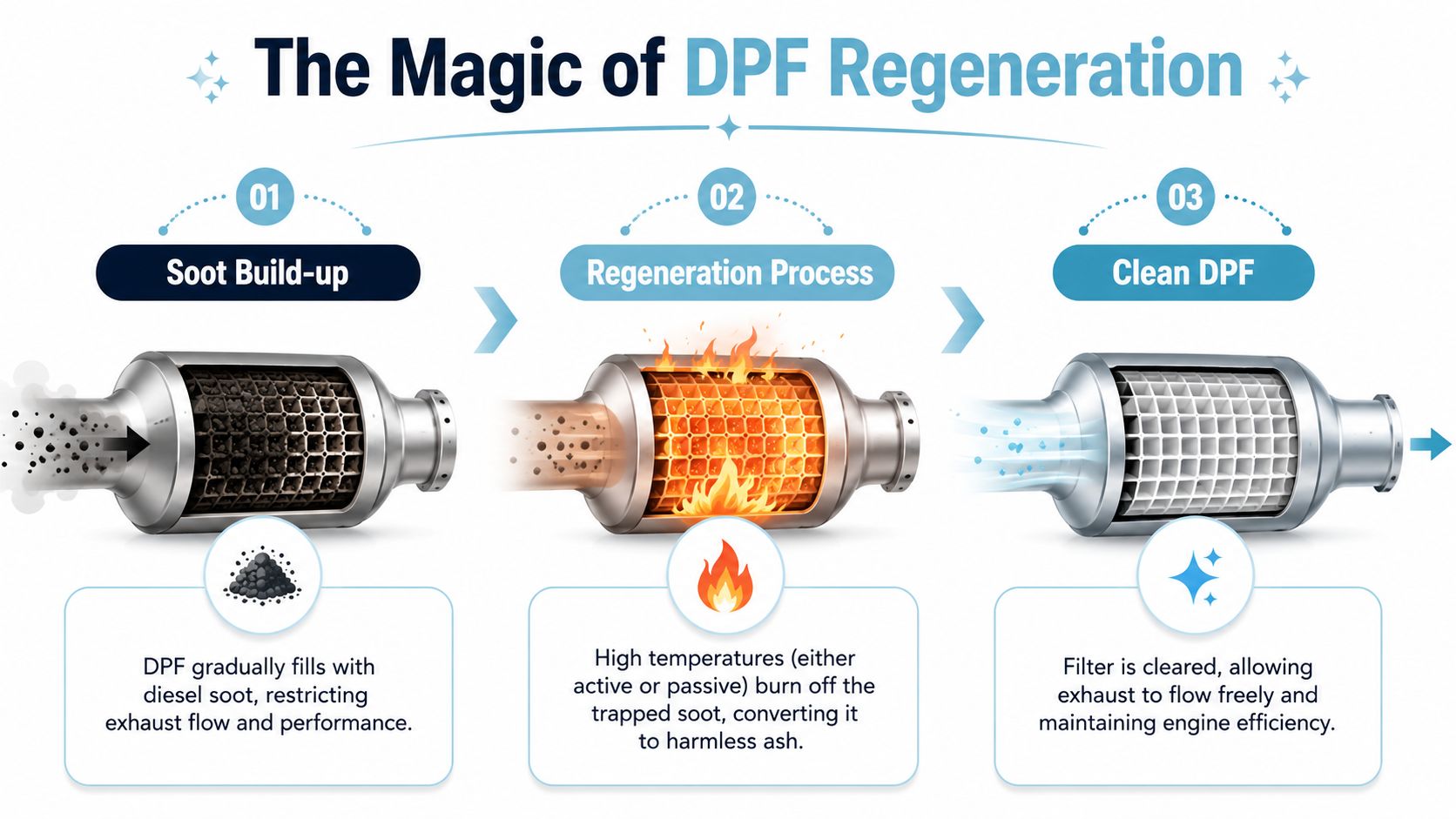
Regeneration is the car's way of cleaning the filter before it chokes up with soot. Old VWs used to ask for a tune-up and a bit of carb fettling. A modern diesel asks for heat.
Passive regeneration on a proper run
Give the car a steady highway stint up to Daylesford or down the Western Freeway, and the exhaust can get hot enough to burn off the trapped soot on its own. That is passive regeneration. No drama, no warning light, no special button to press. The system is just doing its job in the background while you rack up a few proper kilometres.
That is why old hands say a diesel likes a good run. They are not repeating workshop folklore. They are describing the exact conditions that help the DPF clean itself without fuss.
Active regeneration in suburban life
City use is a different story. School runs, stop-start traffic, idling at roadworks on the Ring Road, and five-minute trips to the shops do not give the exhaust much chance to build steady heat.
In those conditions, the car may decide passive regen has not happened often enough and start an active regeneration cycle instead. The engine management system lifts exhaust temperature by changing how fuel is injected, so the soot can still burn away even though the trip itself is not ideal.
A few VW owners notice it while it is happening. Idle speed can sit a bit higher. Fuel use can creep up for a short stretch. The cooling fans might keep running after you park, like the car is finishing a job after you have already grabbed the keys.
Why your driving pattern matters in Australia
This catches plenty of Aussie owners out, especially if their diesel VW lives a suburban life but was bought for its long-leg touring manners. A Touareg hauling up the Hume every other weekend will usually have an easier time than a Golf diesel doing short cold trips around town.
If those active regen cycles keep getting interrupted, soot keeps building. The car tries again later, then again after that, and eventually you get the grumpy dash light that sends everyone reaching for Google. Good fuel quality and general upkeep help the whole system do its work, which is why some owners also read up on fuel system cleaner for VW diesel maintenance as part of broader servicing.
A modern VW diesel is a bit like a Kombi that hates being started, moved ten metres, and switched off. It is happiest when it gets a proper run and finishes what it started.
Spotting Trouble Common Symptoms of a Blocked DPF
When a DPF starts getting unhappy, the car usually leaves clues. Some are obvious. Some feel more like the car has gone a bit flat and grumpy for no clear reason.
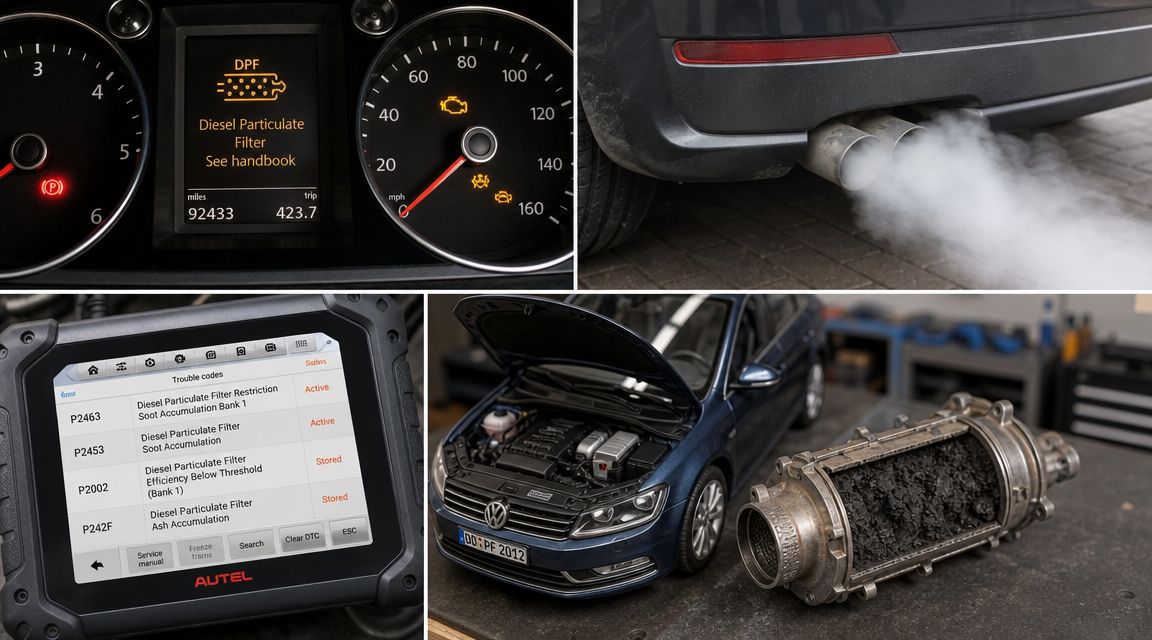
Near the top of the list is the dashboard warning light.
The clues your VW gives you
A blocked DPF often shows up as one or more of these:
- Warning light on the dash that points to the emissions or filter system
- Reduced power or limp mode, where the car feels like it's towing a caravan uphill
- Poorer fuel economy around the time regeneration struggles
- A hot or unusual exhaust smell after interrupted cleaning cycles
- A general reluctance to rev cleanly under load
None of those signs automatically mean the filter itself is ruined. They do mean the system needs attention before the problem snowballs.
DPF warning signs and what to do
| Symptom | What It Likely Means | Your Next Step |
|---|---|---|
| DPF or engine warning light | The car has detected soot loading or a related fault | Check the handbook, avoid ignoring it, and arrange diagnosis if the light stays on |
| Reduced power | The system may have limited performance to protect the engine and exhaust | Don't push it hard. Get the fault codes read |
| Fuel use seems higher | Active regeneration may be happening more often or unsuccessfully | Consider whether the car has only been doing short trips lately |
| Strong exhaust smell or hot fans | A regeneration may be underway or has just been interrupted | If safe and appropriate, allow the drive cycle to complete rather than switching off immediately |
| Repeated return of symptoms | Soot or ash loading may be beyond a simple self-clean cycle | Book a workshop inspection |
This quick explainer is handy if you want to see the sort of warning signs and workshop checks owners talk about in practice.
Don't assume, diagnose
The trap is guessing. A warning light can be caused by driving pattern, a failed regeneration, a sensor issue, or a filter that's packed up. If the light returns after a decent run, get it checked properly.
A blocked DPF is a bit like seeing smoke from an old Kombi engine bay. Maybe it's minor. Maybe it isn't. You don't keep driving for six months and hope for the best.
The Fix Cleaning vs Replacing a Blocked DPF
Once the workshop confirms the DPF is the issue, you're usually looking at two broad paths. Cleaning or replacement. Which one makes sense depends on what's inside the filter and whether the unit is physically sound.
When cleaning makes sense
If the filter is heavily loaded with soot but not damaged, professional cleaning can be the sensible first move. Workshops may perform a forced regeneration, or a specialist may remove the filter for off-car cleaning. That process is aimed at restoring flow through the filter rather than masking the symptoms.
This option is often the more practical one when urban use has interrupted normal regeneration. Australian diesel owners deal with this a lot because stop-start commuting can prevent the high temperatures needed for regular burn-off, leading to more forced regenerations and higher ownership costs, as explained by DieselNet's overview of DPF operation and city-driving impact.
Don't ask the workshop only, “Can you clear the light?” Ask, “What caused the soot loading in the first place?”
When replacement is the right call
Cleaning won't solve every problem. Ash is the long-game issue. Soot can be burned off during regeneration, but ash doesn't disappear that way. If the filter is full of ash, cracked, melted, or otherwise damaged, replacement may be the only durable fix.
That's also where owner conversations get more serious. You want to know:
- Is it soot or ash? Soot suggests a regeneration problem. Ash points more to age and long-term accumulation.
- Is there another fault upstream? Sensors, injectors, or oil choice can influence how quickly a DPF gets into trouble.
- Will the new or cleaned unit survive your daily routine? If the driving pattern never changes, the same drama can return.
A lot of owners also go hunting for additives. Some are marketed as miracle cures. Be careful. At best, they may support a broader maintenance plan. At worst, they become a delay tactic while the underlying fault keeps brewing. Proper diagnosis matters more than wishful chemistry.
If you're already talking parts, maintenance items and workshop planning, it helps to start with a supplier guide built for local owners, such as this page on VW parts in Australia.
Keeping Your VW Diesel Happy in Australia
You see it all the time at a Ballarat meet. One bloke has a spotless old Beetle that gets a Sunday run down the highway and barely misses a beat. Parked next to it is his newer Tiguan TDI, the weekday workhorse that does school drop-offs, bakery runs, and five-minute dashes across town. Guess which one is more likely to throw a warning light.
Owning a diesel VW in Australia is a bit like keeping an old Kombi sweet. The car likes a routine that suits how it was built. Give it the right sort of use, the right oil, and decent servicing, and life is usually pretty calm. Ignore the basics, and small annoyances can turn into workshop bookings.
Australia's mix of long country drives, hot weather, heavy towing, and stop-start suburban traffic means one owner's diesel can have an easy life while another owner with the same model gets regular DPF grief. That is why local habits matter so much with Golf TDI, Passat, Tiguan, Touareg, and Amarok models.
Habits that help
A few simple habits usually make the biggest difference:
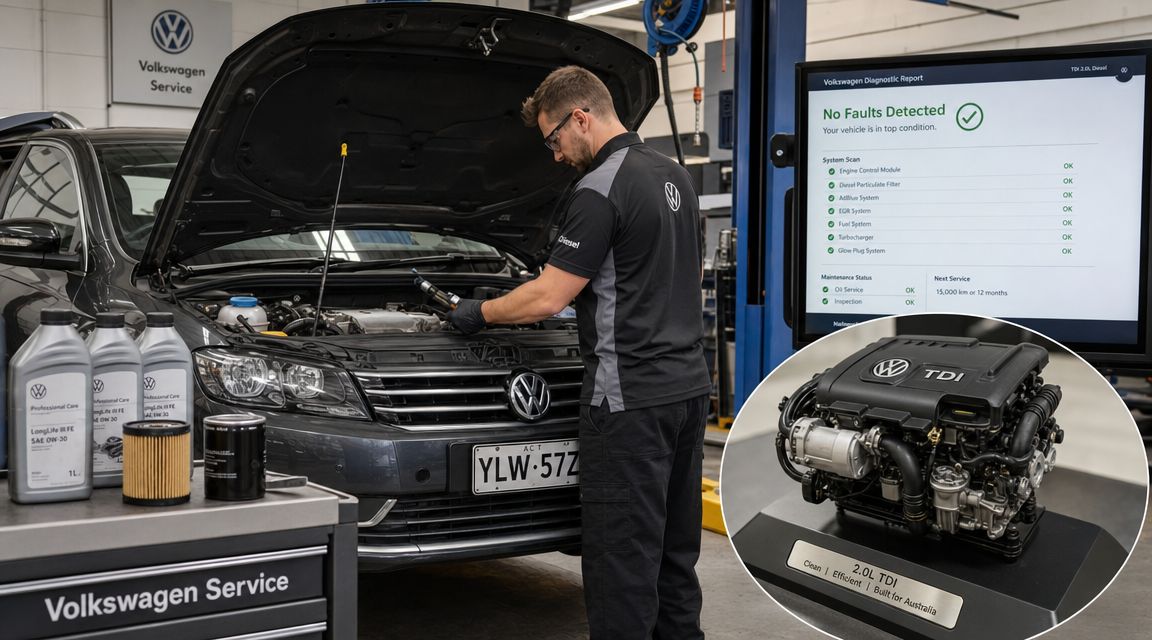
- Give it a decent run now and then: If your VW mostly does short trips, work in a proper drive where the engine gets fully warm and stays there for a while.
- Use the correct oil: Many VW diesels need low-ash oil that matches the factory spec. The wrong oil can shorten the filter's working life.
- Don't brush off warning lights: One brief light today can become forced regens, diagnosis time, or a cleaning bill later.
- Stick to regular servicing: Patchy maintenance often shows up in the exhaust system sooner or later.
- Be realistic about towing and hard use: An Amarok hauling gear or a Touareg doing caravan duty needs even less neglect than a lightly used commuter.
Australian driving makes a difference
A diesel that sees the Western Highway, the Hume, or regular regional runs usually has more chances to stay happy than one stuck doing cold starts and short suburban loops in Melbourne traffic. It is the same old story as classic VW ownership. Cars like being used properly.
City driving does not mean you bought the wrong car. It means you need to own it with your eyes open. If your Tiguan spends most of its week crawling between school, Coles, and the footy ground, it helps to plan the occasional longer drive instead of waiting for the dashboard to start the conversation.
Hot weather can add another wrinkle too. Australian summers, long idling, and heavy loads can make a hard-working diesel feel a bit more stressed, especially if the maintenance record is already patchy.
Keep records like an enthusiast
The owners who have the least drama are often the same ones who jot things down. Service dates, oil used, warning lights, regen-related visits, and any sensor work all help build a clear story of the car. That makes life easier for you and for the workshop trying to sort it.
If you like keeping your VW history straight, a dedicated Volkswagen service book is a tidy way to track what has been done and when.
A happy diesel is usually the boring one. It starts, pulls well, and gets on with the job while you get on with the drive.
Less Wrench Time More Drive Time
The best thing about understanding DPFs is that the fear drops away pretty quickly. Once you realise the filter traps soot, needs heat to clean itself, and gets cranky with endless short trips, modern particle filter diesel cars stop feeling mysterious. They just need the sort of informed ownership every Volkswagen has always needed, whether it's a split-screen Kombi or a late-model Amarok.
Preventative care beats drama every time. A regular proper drive, the right oil, and early attention to warning lights can save a lot of mucking about later. That means fewer workshop surprises, fewer interrupted weekends, and more confidence when you turn the key.
And really, that's the whole point. Volkswagens are supposed to be enjoyed. The old ones give us charm. The newer diesel ones give us practicality. Knowing how to look after both means more road trips, more club meets, and more time talking rubbish with mates beside a line of beautiful cars.
If today's DPF yarn has you feeling a bit more sorted, it's a good time to enjoy the fun side of the VW hobby too. Have a browse through Volkswagen Memorabilia, especially if you're into VW Kombi diecast Australia, a classic Volkswagen Beetle model, or you're looking to buy diecast Kombi pieces with local stock and fast Australian shipping. It's a top spot for VW memorabilia collectibles and Volkswagen diecast models for sale, whether you're adding to your own shelf or picking a gift for the VW nut in your life.