

A bloke rolled up to a coastal VW meet in an old two-tone Bay, parked beside a new ID. Buzz, and for ten minutes nobody talked about horsepower. They talked about surf trips, sleeping in the back, and whether this shiny electric bus might finally be the id buzz camper Aussies have been daydreaming about for years.
The Electric Kombi We've All Been Waiting For
At any proper VW gathering in Australia, someone always says it. Usually while leaning on a Beetle guard or peering into a lovingly restored Kombi. “If Volkswagen ever made a modern bus with the right shape, I'd have one.” For years, that chat lived in the same space as garage fantasies and restoration wish lists.
Now the ID. Buzz has arrived to make that conversation real.
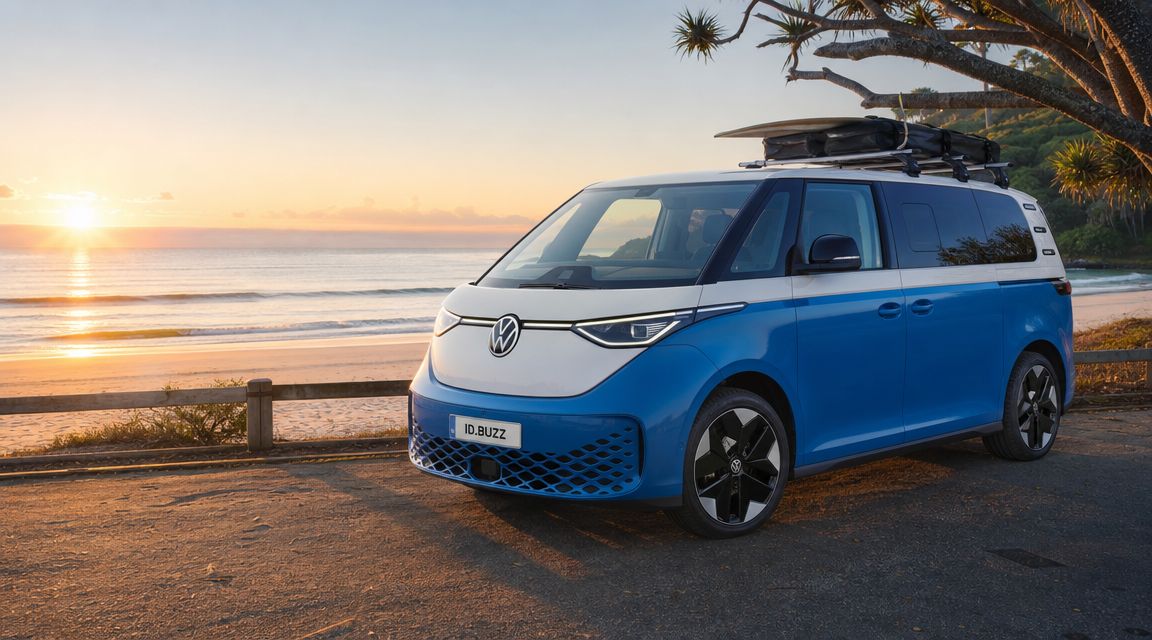
What makes the idea of an id buzz camper so compelling isn't just the badge. It's the feeling. The upright stance, the friendly face, the cabin that promises weekends away rather than school-run drudgery. For long-time VW people, it stirs the same part of the brain that lights up at the sight of a Split Screen in pastel paint or a sun-faded Bay Window loaded with boards.
Why VW fans instantly “get” the Buzz
The old Kombi earned its place in Australian life the honest way. It carried camping gear, kids, dogs, guitars, wetsuits and half-finished road trip plans. The new Buzz taps into that same spirit, even if the drivetrain is now all battery and silence.
A lot of local excitement has centred on whether it can become a proper touring machine rather than just a stylish people-mover. That's why the camper angle keeps coming up. Buyers aren't only asking what colour it comes in. They're asking if the back can sleep two, whether a weekend setup makes sense, and how close it feels to the Kombi dream.
The appeal of the ID. Buzz isn't nostalgia alone. It's nostalgia with the promise of modern comfort.
If you want the local market rundown before you start sketching bed platforms and awnings, the best starting point is this look at the Volkswagen ID. Buzz in Australia and its pricing. It grounds the dream in what's coming here.
The camper dream is back, just in a new form
This isn't the old story repeated. It's a new chapter. The original Kombi was simple and mechanical. The Buzz is tech-heavy, premium, and built for a different era. But the heart of it feels familiar. That's why so many enthusiasts are already thinking beyond factory trim and toward a life of beach runs, regional touring and clever little camping fit-outs.
From Splittie and Bay Window to Electric Buzz
The best thing about the ID. Buzz is that Volkswagen didn't pretend history didn't matter. You can see the family resemblance straight away. The broad face, the cab-forward look, the cheerful proportions. It doesn't copy the old buses line for line, but it absolutely knows where it came from.
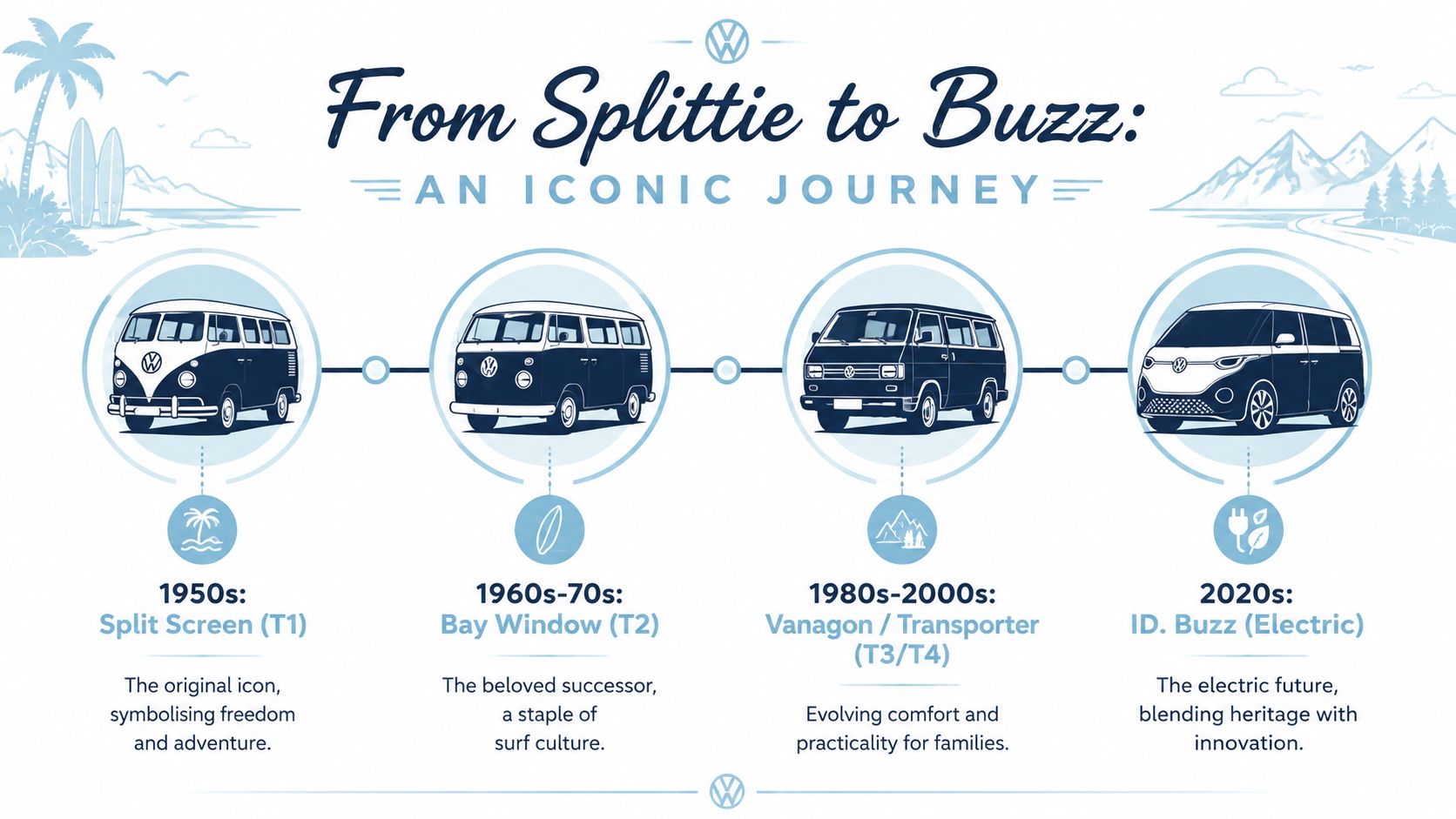
In Australia, that design lineage matters more than it might for another brand. The Split Screen was the free-spirited icon. The Bay Window became part of surf culture and family holidays. Later Transporters moved the game along with more comfort and practicality. The Buzz picks up all of that memory and gives it a new language.
The shape tells the story
A classic T1 or T2 has a kind of warmth that never goes out of style. Even people who don't know model codes recognise the outline from a mile away. The ID. Buzz leans into that recognition. It's modern, yes, but still playful in a market full of blunt, anonymous SUVs.
That's why the electric version works so well for collectors too. The Buzz isn't just another new vehicle. It's a continuation of a design story that's been sitting on shelves, in sheds and in family photo albums for decades.
Why collectors care as much as drivers
If you've ever lined up a Samba Bus diecast next to a Beetle model, you already understand this. Collecting VW pieces isn't only about owning miniatures. It's about keeping the design timeline visible. You can trace the brand's personality from one era to the next.
That's especially true if you love the old bus shapes. A browse through Volkswagen camper van memorabilia and model pieces shows how naturally the Kombi has always translated into collectible form.
Here's the neat part. The ID. Buzz makes the old pieces feel current again.
| VW era | The vibe it carried | What the Buzz keeps alive |
|---|---|---|
| Split Screen | Pure freedom and simplicity | The iconic face and cheerful presence |
| Bay Window | Surf culture, touring, family memories | Everyday adventure and relaxed style |
| Later Transporters | Practical comfort | Modern usability for longer trips |
| ID. Buzz | Electric future | Heritage without losing personality |
Collecting insight: A new model only becomes meaningful when it honours what came before it. The ID. Buzz does that better than most retro-inspired cars.
What to Expect When the ID Buzz Lands in Australia
A lot of overseas coverage talks about the Buzz as if every market gets the same thing. Australia doesn't. Local buyers need to think in local specs, local pricing and local positioning.
Volkswagen Australia has confirmed the ID. Buzz as a premium electric people-mover, not a stripped-back factory camper. According to Volkswagen's technical specifications, the 2025 ID. Buzz starts at A$79,000 MSRP for the short-wheelbase Pro, while the long-wheelbase 7-seat versions are A$91,290 for the Pro, A$97,990 for the Pro 4MOTION, and A$109,900 for the GTX. The same specifications note that the 5-seat model uses a 79 kWh battery, the 7-seat versions use an 86 kWh battery, and the 7-seat vehicle length is 4,962 mm (Volkswagen technical specifications).
What those numbers mean in plain English
Volkswagen isn't launching this thing here as a bargain beach hack. It's coming in as a polished, high-value EV with family and touring duties front of mind. That changes the conversation around the id buzz camper straight away.
You're not buying a bare shell and bolting in a dream. You're starting with a premium base vehicle. For some buyers that'll be perfect. For others, it means being selective about how far they go with conversion plans.
The Aussie buyer's quick guide
- Short-wheelbase Pro. This is the entry point at A$79,000 MSRP, with the 79 kWh battery.
- Long-wheelbase 7-seat Pro. More room, bigger touring brief, and an 86 kWh battery.
- Pro 4MOTION and GTX. These sit higher in the range and reinforce the premium positioning.
- Family-first packaging. The local setup tells you Volkswagen sees the Buzz as a people-mover first.
That matters because expectations stay realistic. In Australia, the “camper” version is mostly going to come from aftermarket thinking, not a ready-made factory solution.
If you've been following the rise of battery-powered vans locally, this overview of the electric van scene in Australia gives useful context for where the Buzz sits.
Creating Your Ultimate Aussie ID Buzz Camper
The smartest way to look at an id buzz camper in Australia is as a project, not a product. The base vehicle gives you the shape, the mood and the packaging. The camping side comes from what you add, and equally, what you decide not to add.
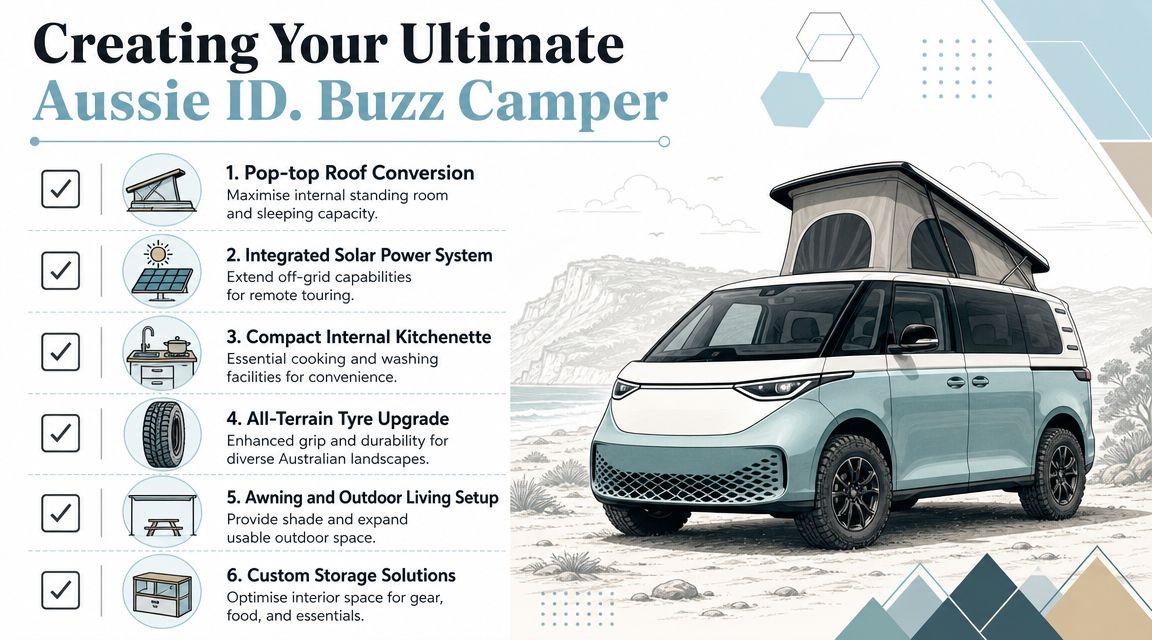
Plenty of enthusiasts get carried away here. Pop-top dreams, cabinetry sketches, water systems, induction cooking, auxiliary batteries, the lot. It's fun to imagine, but Australian reality is more practical. A light, removable setup often makes more sense than a full permanent build.
Why the micro-camper approach deserves respect
In Australia, converting an ID. Buzz into a camper isn't just about layout. It's also a compliance decision. The verified guidance for local buyers is clear that changes to seating, electrical systems or gas appliances are governed by state road authorities and national standards, and that can affect registration, insurance and resale value. That's why a minimal weekend micro-camper can be the more practical path (Australian conversion compliance discussion).
That's not a compromise. For many owners, it's the sweet spot.
Practical rule: If you can remove it without drama, insure it properly, and still use the van during the week, you're probably building the right kind of camper.
A sensible Aussie setup
A good weekend-focused build usually starts with:
- Sleeping platform. Keep it simple, flat, and easy to remove.
- Storage boxes. Gear needs to stay organised, especially in a compact electric van.
- Portable power. Handy for lights and devices without turning the whole vehicle into a wiring exercise.
- Cook outside when possible. It keeps the interior clean and avoids turning a touring van into a compliance headache.
- Shade and shelter. An awning can do more for comfort than a lot of expensive internal hardware.
A walkaround video can help you think through layout choices before committing to anything major.
Build for weekends, not fantasies
The temptation is to recreate a full campervan in miniature. But the Buzz may be better when you respect what it already is. Clean, modern, versatile. Add what supports the trip. Leave out what creates legal, insurance or usability pain.
That old Kombi spirit was never about stuffing every luxury into a van. It was about being ready to go.
The New School and the Old School VW Vibe
Drive an old Kombi up the coast and the trip has its own soundtrack. You hear the engine, feel the pace, smell a bit of oil, and learn patience whether you wanted to or not. The ID. Buzz flips that script. You glide away, the cabin feels modern, and the old bus ritual becomes something smoother and more deliberate.
Neither feeling is wrong. They're just different flavours of VW joy.
Where the Buzz suits Australian touring
For modern road trips, the Buzz brings a kind of ease classic owners will instantly recognise as valuable. Verified specifications used in local coverage show the 86 kWh battery version offers up to 293 miles, or 471 km, and that with DC fast-charging up to 200 kW, it can go from 10% to 80% in about 30 minutes on compatible chargers (ID. Buzz road trip charging and range).
That changes the rhythm of travel. You're no longer planning around carbies, hot starts and old-van temperament. You're planning around charging stops, meal breaks and route choices.
Old school versus new school
| Classic Kombi | ID. Buzz |
|---|---|
| Mechanical charm | Silent electric cruising |
| Slower, more involved journeys | Smoother touring flow |
| Character through quirks | Character through design and tech |
| Road trip planning around age and maintenance | Road trip planning around charging infrastructure |
Some people will always want the chatter and smell of an air-cooled flat-four. Others will realise the VW spirit survives perfectly well in near silence.
The dividing line isn't emotion. It's what sort of adventure you want. A classic bus turns every drive into an event. The Buzz makes regular touring feel easier to repeat. For plenty of Aussie owners, that means more weekends away, not fewer.
Celebrating a New Icon in Your Collection
The funniest thing at a VW event is how quickly a brand-new model can become collectible in people's minds. The ID. Buzz is still the fresh face in the paddock, yet enthusiasts already talk about colours, trims and future diecast versions the way they talk about early Beetles or 23-window buses.
That's the surest sign Volkswagen got the shape right.
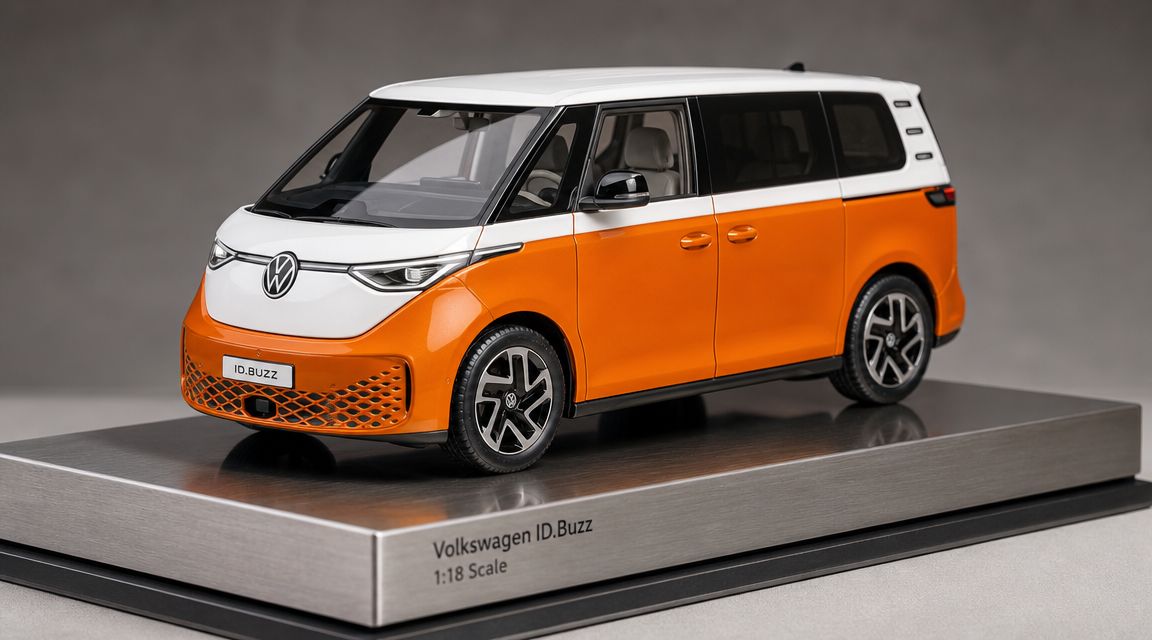
A shelf with a classic Samba, a flower-power Beetle and an ID. Buzz model tells a lovely story. It says the brand didn't stand still. It evolved, but kept enough soul that old and new still belong together. For collectors, that's half the fun.
Why the Buzz belongs beside the classics
You don't need to own the full-size vehicle to appreciate what it represents. A model does the same thing a great piece of memorabilia always does. It captures the design, the era and the feeling in a form you can live with every day.
A few display ideas work especially well:
- Era lineup. Place a Splittie, Bay Window and ID. Buzz in sequence.
- Colour story. Pair bright beachy tones with coastal decor for a relaxed VW corner.
- Road trip shelf. Add surf-themed or touring-inspired pieces around the models.
- Desk display. One modern Buzz model can spark the same grin as a garage full of memories.
The collecting side of the id buzz camper story
The id buzz camper idea isn't only about sleeping in the back of the vehicle. It's also about marking the moment VW's bus story turned electric. That's why the Buzz already feels bigger than a single vehicle launch. It feels like the next chapter in a collection many Australians have been building for years, whether that collection lives in a shed, a display cabinet or on a home office shelf.
If you love the old Kombi spirit and you're curious about where Volkswagen is heading next, the Buzz makes perfect sense. It doesn't replace the classics. It sits beside them.
If you'd like to bring that old-school and new-school VW magic into your own display, Volkswagen Memorabilia is a great place to browse licensed VW-themed diecast, Kombi favourites, Beetle models and gift-worthy collectibles, with local Australian stock and fast shipping that makes collecting a bit easier.