

The first time a newcomer asked me about vw type 1 parts, we were leaning over a pale blue Beetle at a weekend show, flat whites in hand, while its owner rummaged through the boot for a loose badge he’d been hunting for months. He didn’t start by asking about horsepower or paint codes. He pointed at a tiny trim piece and said, “How do you even know what’s right on these things?”
Introduction The Heartbeat of the Beetle
That’s the Beetle in a nutshell. It pulls you in with a shape you’ve known your whole life, then keeps you there with details. The little hum from the rear, the upright windscreen, the smell of old vinyl and warm paint in the sun. A Volkswagen Type 1 isn’t just transport. It’s memory on wheels.
For a lot of us in Australia, the Beetle sits somewhere between family history and hobby. One bloke remembers mum driving one to the beach. Another has spent years chasing the right decklid, the right taillights, the right engine tin. Someone else doesn’t own a full-size Bug at all, but has a shelf lined with beautifully made diecast models because that rounded silhouette still means freedom, simplicity and good times.
The Beetle's charm is that it makes sense once you stop being intimidated by it. Its major systems are honest and readable. The engine is the heart. The chassis is the backbone. The body is the face everybody falls for. The electrical system is the nervous system that keeps the whole thing awake. Once you see the car that way, the world of vw type 1 parts stops looking like a jumble of numbers and old catalogue pages.
Practical rule: If you can name the system a part belongs to, you’re already halfway to finding the right replacement or spotting whether a model car captures the real thing properly.
That matters whether you’re rebuilding a driver, restoring a show car, or choosing a miniature Beetle that respects the original. The more you understand the car’s mechanical soul, the more every proper badge, wheel, bumper and engine detail means something.
Decoding the Bug Understanding Major VW Type 1 Systems
At a club meet in country Victoria, a young bloke once parked his newly bought Beetle beside a row of polished cars and asked why everyone kept crouching near the back wheels, peering under guards and lifting decklids. Within ten minutes, three owners had shown him more than he had learned in months of scrolling classifieds. One pointed out the engine tin. Another tapped the pan and said, “Start there before you fall in love with shiny paint.” A third picked up a diecast model from a swap table and showed how the wrong bumper and taillights gave away the wrong year straight away.
That is the charm of a Type 1. It reveals itself quickly if you know where to look.
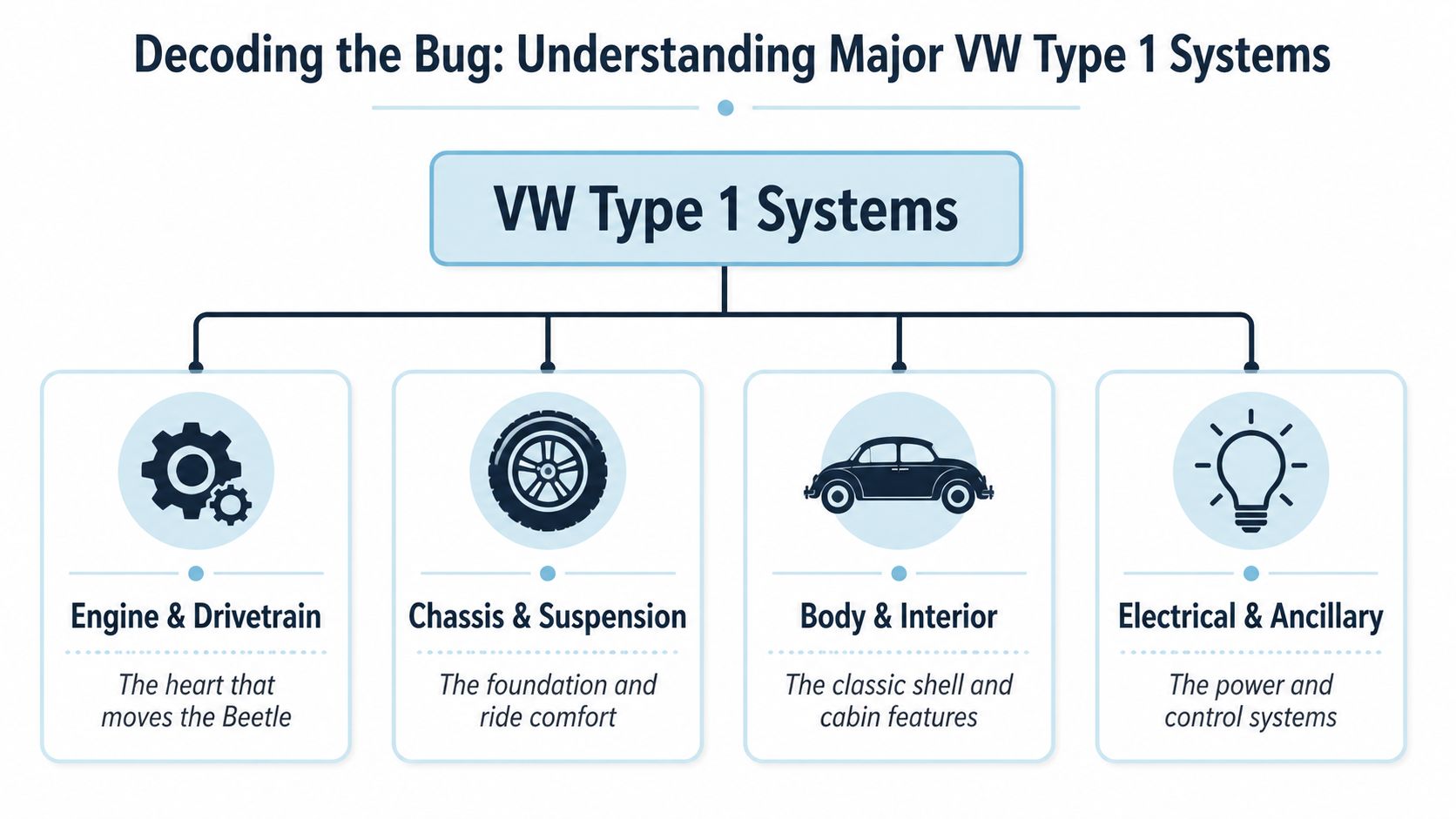
If you want a quick visual primer, this overview of the Type 1 VW Beetle's history and design pairs nicely with what follows here.
Engine and drivetrain
The engine gives the Beetle its voice, its smell, and half its personality. Open the rear lid and you are looking at a layout that rewards curiosity. No water hoses snaking everywhere. No radiator cluttering the nose. Just a compact air-cooled flat-four and the pieces that keep it alive.
A few names come up again and again at swap meets and in workshop talk:
- Carburettor meters fuel and air.
- Distributor sends spark at the right moment.
- Pushrods and valve gear open and close the engine’s breathing passages.
- Crankcase forms the main housing.
- Flywheel helps the engine carry its momentum smoothly.
The drivetrain sits close by and takes that power to the road. Clutch parts, gearbox mounts, axle components and transmission internals all shape how the car feels leaving the lights or climbing a hill. If a Beetle shudders, baulks at gear changes, or clunks on take-off, experienced owners usually start here.
For collectors, this matters too. A detailed model with the right engine layout, air cleaner, pulley arrangement and exhaust style feels far more convincing on the shelf because it respects what made the full-size car special in the first place.
Chassis and suspension
Under every Beetle is the pan. It carries the body, supports the running gear and tells you a lot about whether a car is a cheerful project or a wallet-emptying rescue. Australian cars deserve especially careful checking here because coastal air, wet carpets and old repairs have claimed plenty of floorpans over the years.
The suspension is simple, but simple does not mean careless. Front-end wear changes the steering feel quickly. Rear suspension condition affects ride height, cornering attitude and how settled the car feels with that engine weight hanging out the back.
| Area | What it does | Parts you’ll hear about |
|---|---|---|
| Pan | Supports body and running gear | floor sections, mounting points |
| Front suspension | Controls ride and steering feel | arms, bushes, shocks |
| Rear suspension | Carries the engine and manages weight | spring plates, mounts, shocks |
| Brakes and wheels | Stops and plants the car | drums, backing plates, wheel hardware |
A straight, solid chassis makes every other decision easier. It also gives scale model collectors a sharper eye. Once you know how a Beetle sits when the suspension is right, you start noticing whether a diecast car has the proper stance or looks oddly nose-high.
Body and interior
The Bug's allure is undeniable to many. One glance at a good set of guards, the curve of the bonnet, the shape of the decklid, and you understand why people collect these cars in full size and miniature alike.
Body parts tell the story of year changes, local tastes and old repairs. Bumpers, lights, door handles, badges, hubcaps and trim can place a Beetle in its proper era, or expose a life spent borrowing bits from whatever was available. In Australia, that story often includes practical fixes from decades ago, when keeping the family Bug on the road mattered more than matching every detail to the brochure.
A tidy Beetle usually wins you over with the little things first. The trim sits straight. The shut lines look honest. The seats, wheel and dash feel like they belong together.
That same eye helps when you are buying memorabilia. A model car that gets the body pressings, wheels and brightwork right captures the genuine article properly, not just the rough silhouette.
Electrical and ancillary parts
The wiring on a Beetle can look intimidating until you spend an hour with it. Then it starts to feel refreshingly plain. Battery, starter, charging system, ignition, switches, lamps and a handful of connections. That is the network keeping the car alert.
Old Volkswagens often teach electrical lessons the memorable way. A faint headlight. A starter that clicks on a hot afternoon. Wipers slowing to a crawl in the rain. Problems like these often trace back to earth points, tired switches, brittle wires or a charging issue rather than some mysterious failure.
Patience helps more than fancy tools here.
Owners who understand the electrical side tend to buy better parts, diagnose faults faster and spot when a restored car has been cosmetically freshened but mechanically ignored.
Reading the car as a whole
The best Beetle people I know do not look at parts as isolated objects. They read the car in systems. Engine. Chassis. Body. Electrical. Once you can do that, a swap-meet table full of mixed vw type 1 parts stops looking like scrap and starts making sense.
That is also the meeting point between restoration and collecting. The restorer wants a Bug that drives, fits and lasts. The memorabilia collector wants a model, sign, brochure or display piece that rings true to the original car. Both are chasing the same thing in the end. A clearer picture of what this little Volkswagen was, and why it still gets under your skin.
The Collector's Rosetta Stone VW Part Numbers and Year Changes
A bloke at a Sydney swap meet once held up a decklid handle and swore it was right for any Beetle. An older club member beside him smiled, turned it over, read the number, and politely explained that it belonged to a later car than the one parked in front of us. The young buyer saved his cash, bought the right piece an hour later, and learned one of the great Beetle lessons. Part numbers are not bookkeeping. They are the language of the car.
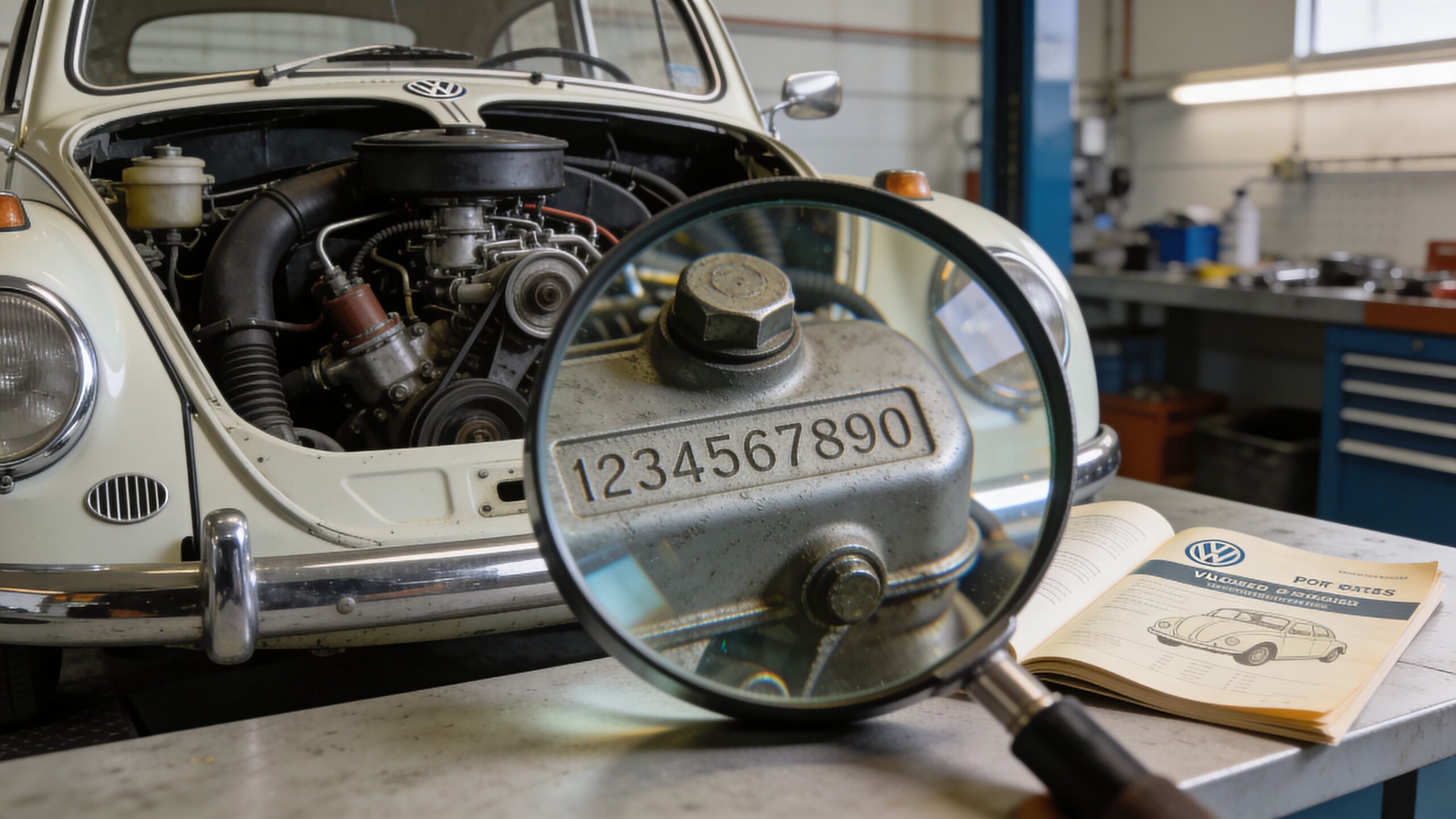
Reading the code without losing your mind
Volkswagen gave its parts numbers a logic that starts to feel reassuring once you have handled enough greasy tins, switches, brackets and trim. The opening digits point you toward the model family. On Beetle parts, you will often see 111, 113 or other Type 1 prefixes. After that, the number usually leads you into a parts group, so the code begins to hint at whether you are looking at engine hardware, gearbox pieces, brake components or body fittings.
That matters at a market stall, in a shed, and even while scrolling late-night classifieds. A seller might describe something as "Bug only" because it looks close enough. The number often tells a stricter story. It can reveal that a piece came from a different year, a different engine generation, or another Volkswagen entirely.
You start seeing patterns after a while. Early engine pieces carry clues from the 36hp and 40hp years. Later numbers often reflect the shift into the 1300, 1500 and 1600 era, where Volkswagen shared some design thinking across models and changed details that catch out new owners. A pushrod, tinware screw, carburettor fitting or switch bezel can seem interchangeable until the code says otherwise.
For restorers, that saves money and frustration. For collectors, it sharpens the eye. If you own a diecast Oval or a neatly restored 1967 sedan, the right details are what give it honesty.
Year changes that shape the car’s identity
A Beetle can fool you from ten paces.
I have seen tidy cars wearing the wrong taillights, later bumpers on earlier guards, and interiors that looked handsome until you noticed the steering wheel belonged to another decade. Nothing was unusable. Much of it bolted straight on. Yet the car felt slightly out of tune, like a cover band hitting the notes but missing the swing.
That is why year changes matter so much in Type 1 circles. The rear window shape tells one chapter of the story. Lights, bumpers and decklids tell another. Door furniture, dash layout and seat frames carry their own little timeline. Each change marks Volkswagen's slow evolution from spare post-war people's car to the Beetle many Australians grew up with.
A quick check list helps when you are sizing up a car, a part, or even a model on a shelf:
- Rear window style sets the era at a glance.
- Headlights, taillights and bumpers often reveal whether the body matches its claimed year.
- Decklids, guards and exterior trim are common swap points because they fit across more than one period.
- Steering wheels, dashboards and seats shape the whole character of the cabin.
That same eye helps diecast collectors avoid the usual disappointments. A miniature meant to represent an early 1960s Beetle should carry early 1960s cues, not a mash-up of later wheels, brightwork and lamps. The best replicas feel right because somebody cared about the same details a restorer cares about.
OEM, NOS and reproduction in plain English
At club meets around Australia, this conversation never gets old. One owner waves a dusty factory box like treasure. Another says the reproduction part worked perfectly. A third mutters that he fitted three cheap versions before finding one that lined up.
The terms are simple enough once you strip away the jargon.
| Type | Best for | Trade-off |
|---|---|---|
| OEM | Factory-spec fit and feel | Can be harder to find |
| NOS | Unused period stock for original cars and serious collectors | Age and storage still matter |
| Reproduction | Keeping cars on the road when originals are scarce | Quality varies from excellent to disappointing |
OEM parts are the benchmark many owners use when they want a Beetle to shut, steer, run or fit the way Volkswagen intended.
NOS, or New Old Stock, carries a special thrill. You open an old box, smell the paper and preservative, and for a moment you are back in a dealership parts department. Still, old stock is still old. Rubber hardens. Chrome can suffer. Paint and packaging can hide a rough life on the shelf.
Reproduction parts keep the hobby alive, especially here in Australia where local supply can be patchy and freight can turn a small purchase into a serious decision. Some reproduction pieces are excellent and save a project. Others need trimming, fettling or a second attempt. Old hands usually spend their money carefully on structural, mechanical and safety-related items, then relax a little on minor trim.
Workshop wisdom: Buy quality for the jobs that punish you for doing them twice.
Why this matters to collectors too
The bridge between the workshop and the display cabinet is shorter than it looks.
A person restoring a Brunswick Blue Beetle and a person hunting the perfect 1:18 model are chasing the same thing. They both want the car's character to ring true. The right wheel style, the proper badge, the correct year of bumper, the shape of the rear lamps. Those details are how a Beetle keeps its identity.
That is part of the Beetle's soul, especially in Australia where local memories matter as much as factory facts. Maybe your reference point is a family Bug that spent summers down the coast. Maybe it is a dealer brochure from Melbourne, a service sticker from Adelaide, or a diecast model that matches the car your grandfather drove in Perth. Once you can read part numbers and year changes, those objects stop being generic Volkswagen things. They become pieces of one very specific story.
OEM Repro or NOS Navigating the World of Type 1 Parts
Every Beetle tells you what sort of life it’s had. One car has a soft, original feel with old German metal still doing its job. Another has lived through decades of budget fixes, aftermarket improvisation and one owner who clearly believed a hammer was a precision tool. That’s where the parts question gets real.
A local Bug I know well started as a tidy driver with a smoky engine and a gearbox mount that had seen better days. Its owner wasn’t building a museum piece. He wanted a reliable Sunday runner that still felt like a Beetle. So every purchase became a balancing act between authenticity, availability and common sense.
The purist path and the practical path
For structural or core mechanical pieces, many owners still prefer original-spec parts when they can get them. A genuine crankcase, for example, carries a certain confidence because it’s what the engine’s design was born around. But not every original component is waiting on a shelf in mint condition, and not every project needs concours purity.
Reproduction parts can be the difference between a stalled project and a finished car. The trick is knowing where compromise is safe and where it becomes expensive later. Cheap cosmetic trim might only annoy you. Poor internal engine parts can ruin a weekend and an engine together.
Engine choices that change the whole personality
Type 1 engines live and die by correct matching. Displacement comes from bore and stroke working together, and common configurations include 1600cc, 1641cc and 1776cc. Crankshaft matching matters because the wrong combination can cause engine damage. The same source also notes that builders weigh original VW crankcases against aftermarket alternatives, and some builds use specs such as 8 dowel pin counterweight crankshafts. That foundation is outlined in this VW Type 1 bore and stroke engine size guide.
That sounds technical until you see it play out in the shed. A stockish engine usually suits an owner who wants easy manners, a familiar feel and less fuss. A larger combination can wake the car up, but only if the rest of the build respects the geometry and the parts work together.
A Beetle’s common aches and the parts choices behind them
Here, stories from old cars become useful.
- The tired commuter Beetle often wants sensible reliability parts. Good ignition pieces, sound fuel delivery parts, proper mounts and carefully matched internals.
- The sentimental family Bug usually rewards restraint. Keep the driving character intact, repair what’s worn, and avoid upgrades that erase its personality.
- The weekend toy gives you more freedom. You might accept a few non-original choices if they improve drivability and don’t upset the car’s balance.
One owner I know chased NOS anything he could find, then switched to selected reproduction parts for the jobs nobody sees and the items he needed quickly. Another went the other way. He started cheap, got burned on fit and finish, then rebuilt sections properly with better quality pieces.
The right answer isn’t a slogan. It depends on whether you value period correctness, day-to-day reliability, or simply getting the car back into the sunlight.
A simple buying filter
If you’re stuck, use this order of priority:
- Safety first. Brakes, steering and structural hardware deserve quality over convenience.
- Core engine internals next. If it means splitting the engine again later, don’t gamble.
- Fit-sensitive body parts after that. Badly made panels and trim create endless frustration.
- Minor cosmetic items last. These are easier to revisit when better examples turn up.
This is also where collectors can learn something from restorers. When you know how much care goes into choosing a real crankcase, mount or trim piece, you start appreciating why an accurate miniature with the right details feels special. It reflects decisions that mattered on the actual car.
Trouble in Paradise Common Failures and Must Do Maintenance
The Beetle is tough, but it isn’t magic. Leave one sitting, ignore its warning signs, or trust ancient rubber and wiring just because the car still starts, and it’ll eventually remind you that simplicity still needs care.
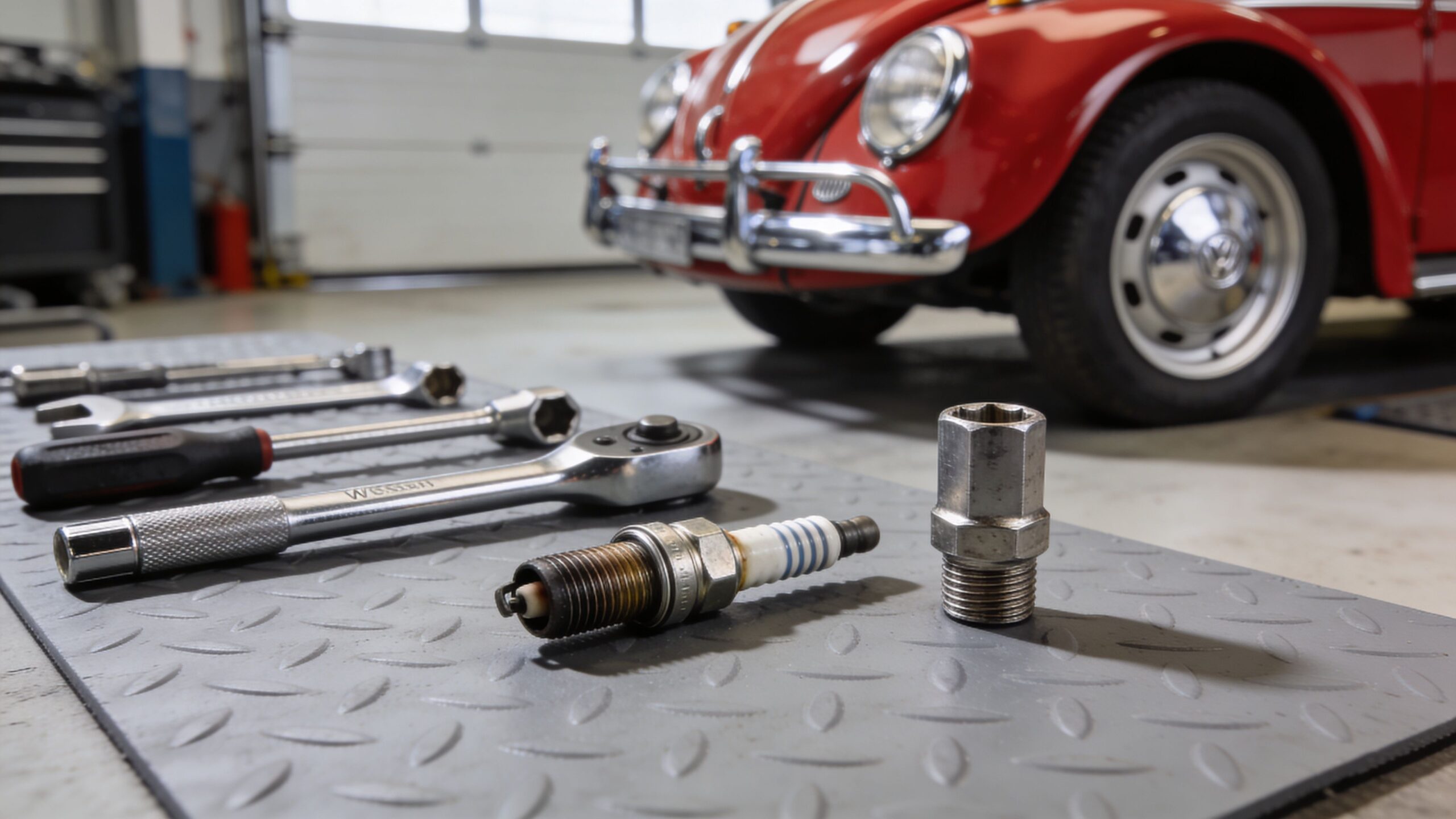
Rust never sleeps
Ask any long-time owner where to look first and the answer usually comes fast. Heater channels, under the battery, and the spare wheel well. Those spots cop moisture, neglect and years of “it’ll be right” storage.
What matters is not just spotting rust, but understanding what it means:
- Heater channels affect structure as well as comfort.
- Battery tray corrosion can spread further than it first appears.
- Spare wheel well rust often hints at front-end water ingress or past repairs.
A shiny Beetle can still hide nasty surprises in these places. Tap, inspect, torch in hand. Don’t let glossy paint do the talking.
The lumpy idle and the lazy start
A Beetle that won’t settle into a smooth idle often needs basic honesty before exotic diagnosis. Check ignition condition, fuel delivery and carburettor tune. Many rough runners don’t need heroics. They need patient adjustment and parts that aren’t half-worn.
Electrical gremlins also love old Volkswagens. A weak connection, tired switch, poor earth or charging issue can turn a cheerful little Bug into a stubborn one. The car usually gives clues. Dim lights, slow cranking and random cut-outs rarely arrive unannounced.
A Beetle rewards methodical owners. Change one thing at a time, test, and listen to what the car is telling you.
Maintenance that keeps a Type 1 sweet
There are jobs every owner should either learn or understand well enough to discuss with a mechanic.
| Job | Why it matters | Typical parts involved |
|---|---|---|
| Valve adjustment | Keeps the engine breathing properly | rocker gear hardware, gaskets |
| Ignition service | Helps starting and running | plugs, leads, distributor items |
| Fuel system checks | Reduces leaks and poor running | hoses, clamps, carburettor service parts |
| Brake inspection | Keeps the car safe and predictable | shoes, cylinders, hoses, hardware |
A collector’s eye gets sharper too. If you understand what proper engine tin, plug leads, badges or lights should look like on an authentic vehicle, you’ll judge models and memorabilia differently. The details stop being decoration. They become evidence.
Why real parts knowledge improves collecting
A lot of people treat restoration and collecting as separate hobbies. I don’t think they are. They’re two ways of paying attention.
When you’ve spent time learning what a correct decklid handle looks like, or why a wheel style belongs to a certain era, you’ll spot that same truth in miniature. You’ll notice when a model captures a Beetle’s stance properly. You’ll care whether the trim matches the year. Your shelf becomes a little more informed, and a lot more satisfying.
Beyond the Engine Bay Collecting and Displaying VW Heritage
I watched a young bloke at a Sydney cars and coffee pick up an old VW bonnet badge once. He turned it over in his hands longer than he spent looking at the engines. The chrome was tired, the pins were worn, and it had the kind of scratches you only get from years of washing, polishing and daily use. His father was beside him talking carburettors, but the son kept coming back to that badge. He could see the car in it.
That is part of the Beetle’s magic. A Type 1 lives in its little details as much as its mechanicals. The bonnet badge. The hubcap with the proper dome. The trim that catches low afternoon light in a way no modern hatch ever seems to manage.
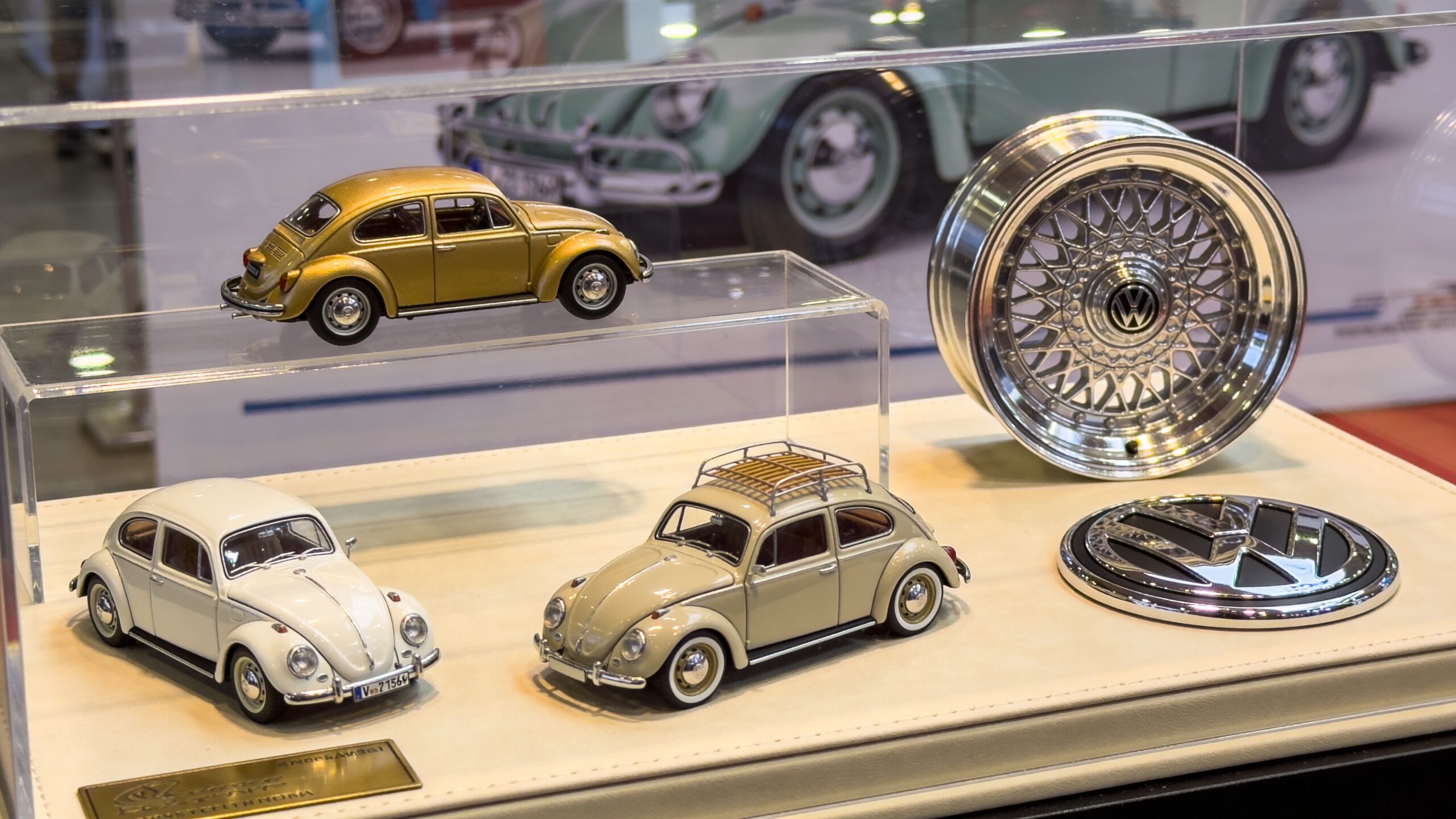
Among VW people, those pieces create a natural meeting point between the restorer chasing correct parts and the collector building a shelf full of memories. One wants the right emblem for a car. The other wants the same emblem because it carries the shape, era and feeling of the Beetle into a study, garage or living room. In Australia, where family Bugs, beach trips and local club runs sit so close to the culture, that overlap feels especially strong.
The parts that tell stories
A rocker cover can be spotless and still say very little. An original badge or trim strip often says plenty.
Exterior pieces age where everyone can see them. Sun dulls them. Hands polish the high spots. Road grit leaves its little marks. If you have ever found an old dealer badge in a swap meet box, you know the feeling. You are not just buying metal. You are holding a clue to where that Beetle lived and who cared about it.
That is why home and garage displays work best when they borrow from real cars instead of looking like generic retro decor. A shelf with an original emblem, a period brochure and one well-chosen diecast Beetle has more heart than a dozen random ornaments. The same appeal runs through vintage home accessories for VW-themed spaces, especially if you want your display to feel like a tribute rather than a catalogue.
Why diecast gets better when you know the real car
The best Beetle models are convincing for the same reason a good restoration is convincing. The details are right.
A collector who knows Type 1 parts will spot the difference straight away. The wrong bumpers can throw off the whole year. Wheels can date a model in seconds. Window shapes, trim lines, taillights and badges all matter. A diecast Beetle is small, but the judgement behind it is not.
That makes collecting more satisfying in a very practical way:
- Year-correct details stand out once you know what belongs on an early car and what belongs on a later one.
- Trim and emblem pieces carry more weight because they are part of the Beetle’s identity, not just decoration.
- Stance matters more because the Bug has a look that is cheerful, upright and unmistakably its own.
Collectors who start with one Beetle often branch into the wider VW family as their eye sharpens. Australian shelves are full of little stories like that. A Bug from childhood. A Kombi from a surf trip. A panel van that looks like one a local electrician drove in the 1970s.
For a closer look at why those details matter to enthusiasts, this short video captures the kind of visual affection VW people have always had for the marque.
Displaying the collection with a bit of soul
The best displays I have seen were never the biggest. They were the most personal.
One club member in Melbourne keeps a small oval-window diecast next to the hubcap from his first Beetle. Another has framed a dealer plate surround above a shelf of Australian-delivered VW models. Both displays work because they connect object to memory.
A few habits help:
- Pair real and miniature pieces so the shelf reflects both the actual car and the memory of it.
- Group items by era because early and late Beetles speak in different visual accents.
- Use wall space well with signs, framed prints and small objects arranged like a tidy garage corner.
- Let one piece lead whether that is a rare badge, a crisp diecast, or a model of a Kombi every local enthusiast recognises.
A good display makes the Beetle feel present, even when the car is parked somewhere else.
That is the pleasure of this side of the hobby. The greasy-knuckled restorer and the memorabilia collector are often chasing the same thing. They both want to keep the Beetle’s character alive, whether it sits on jack stands in the shed or in perfect miniature on a shelf.
Your Local Workshop Sourcing VW Parts and Memorabilia in Australia
Australian VW culture has its own flavour. You see it at Volksfest, at the VW Nationals, and in the way people chat around a car here. There’s less posing, more storytelling. Someone always knows where a car came from, who painted it, or which family had it before.
That local passion has deep roots. Volkswagen assembly in Australia started in 1954 at the Clayton plant in Melbourne, and the operation produced over 100,000 Beetles by the 1960s. The same historical overview notes that over 200,000 Type 1 vehicles were imported or assembled locally over the years, which helps explain why the Beetle still feels so embedded in Australian enthusiast life. That history is outlined in Heritage Parts Centre’s history of the VW Beetle.
Why buying locally matters
Anyone in Australia who’s ordered niche VW gear from overseas knows the feeling. You wait. You hope the photos were honest. You cross your fingers about shipping damage, customs surprises and whether the item will look the way it did on the screen.
Local sourcing takes a lot of that stress out of the hobby. It usually means clearer communication, easier support and a better feel for what Australian buyers want. That matters just as much for memorabilia as it does for practical parts, especially if you’re buying a gift or trying to complete a themed display before an event.
If your interest leans toward decorative and collectible pieces inspired by real Beetle details, a category like Volkswagen Beetle parts can make browsing simpler because it keeps the visual language of the Type 1 together in one place.
Practical checks before you buy
A few habits save disappointment:
- Check the year feel. Even decorative items and models should suit the era you love most.
- Read the finish closely. Chrome, paint tone and trim style are often what separate average from memorable.
- Think about display context. A shelf piece for a study may differ from what you’d choose for a garage or gift.
- Buy with a story in mind. The best piece is usually the one that connects to a real memory, car or period.
For Australian enthusiasts, that local connection counts for a lot. We’re not just buying objects. We’re keeping a long-running conversation alive, one that started on local roads decades ago and still turns heads every time a Beetle rolls into a sunny car park.
Conclusion Keep the Passion Rolling
The beauty of the Beetle is that it welcomes all kinds. The hands-on restorer chasing the correct mount or pushrod. The nostalgic owner preserving family history. The collector who wants a Volkswagen Beetle model that gets the details right. It’s all part of the same affection for one of the world’s most recognisable cars.
Learn the right parts, and the car opens up. Learn the visual details, and every badge, trim piece and diecast replica gains meaning. That’s how the passion keeps rolling.
If this article has stirred up your love for classic Volkswagens, have a look through Volkswagen Memorabilia for licensed VW-themed diecast models, collectible gifts and display pieces that celebrate the Beetle, Kombi and the wider VW story with an Australian touch.