Get Volkswagen Parts Australia: OEM, Aftermarket & Classic

You’re probably in that familiar spot right now. The shed door is open, the kettle’s gone lukewarm, and your Volkswagen is sitting there with one missing piece between “nearly done” and “back on the road”. Maybe it’s a Beetle waiting on a trim clip that nobody seems to list properly. Maybe it’s a Kombi with a door handle that looks right in the photo and turns out wrong in the hand. Maybe it’s a newer Amarok that needs the correct service parts without the usual guesswork.

That’s the core of volkswagen parts australia. It isn’t just buying bits. It’s the hunt, the decoding, the yarns swapped at club meets, and the little win you get when the right part finally clicks into place.

For a lot of us, that hunt doesn’t stop with the full-size car. It follows us onto workshop shelves, office desks, and lounge room displays too. The same eye that notices the proper mirror shape on a Splitty also notices when a diecast Samba Bus gets the stance just right. That’s part of the Volkswagen story in Australia. We keep them running, and we keep their spirit close.

That Unmistakable Feeling of Owning a VW

A mate of mine once spent half a Saturday chasing a rattly interior noise in an old Beetle. He was convinced the whole dash had to come out. Turned out to be one tiny loose fitting behind the trim, but by then the radio was on, the garage smelled of polish and old rubber, and three neighbours had wandered over for a stickybeak. That’s owning a VW in Australia. Even the small jobs become stories.

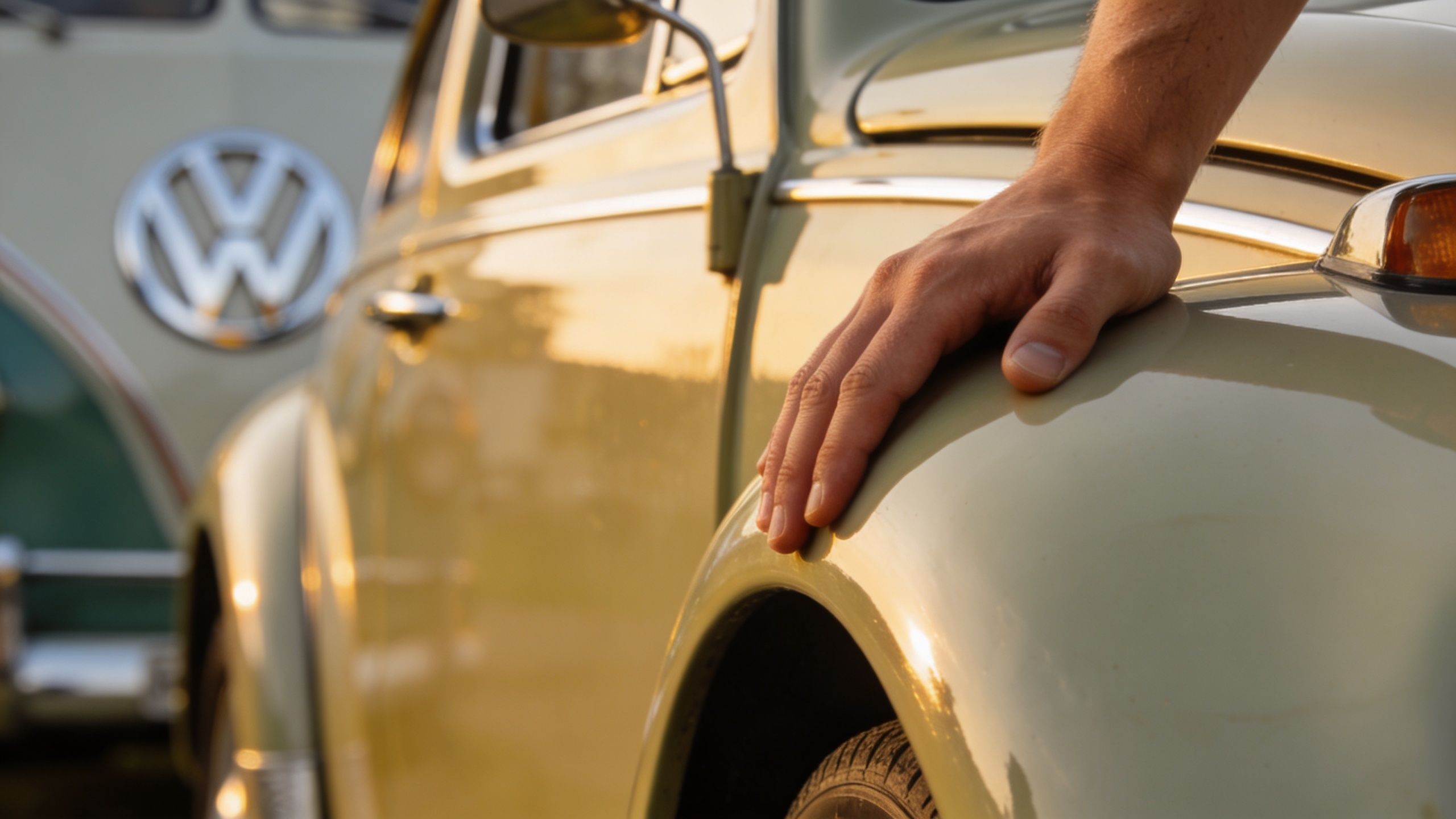
A close-up view of a person's hand resting on the smooth fender of a vintage Volkswagen car.

There’s a particular feeling you get with these cars. A Kombi parked nose-first to the beach. A Beetle cooling in the driveway after a Sunday run. A Golf GTI with that tidy, no-fuss solidity only a Volkswagen seems to do properly. They all feel like characters. They’ve got habits, quirks, and a way of getting under your skin.

The parts hunt is part of the romance

Nobody falls for a VW because it’s anonymous. You fall for the shape, the sound, the memories, and the way strangers start conversations at servo stops. Then the practical side arrives. You need a seal, a switch, a badge, a hinge, or the exact bit of trim that matches what the factory intended.

That’s when experience starts to matter.

Old Volkswagens reward patience. Rush the parts search and you usually buy the same thing twice.

In Australia, that search has its own flavour. Coastal air is hard on metal. Country miles are hard on wear items. Sun is hard on rubber, vinyl, and plastics. The right part isn’t just about fit. It’s about how that part will live in Australian conditions once you bolt it on.

The garage and the display shelf aren’t far apart

If you’ve ever restored a Kombi, you’ll know how often you pause to study details. Where the trim line sits. How the wheel finish should look. Whether the dash knobs are right for the era. That same instinct is why so many owners end up collecting VW pieces beyond the car itself.

A good model Beetle or Samba Bus isn’t separate from the hobby. It’s an extension of it. It keeps the story going when the tools are packed away and the garage light’s off.

How to Speak Fluent Volkswagen Part Numbers

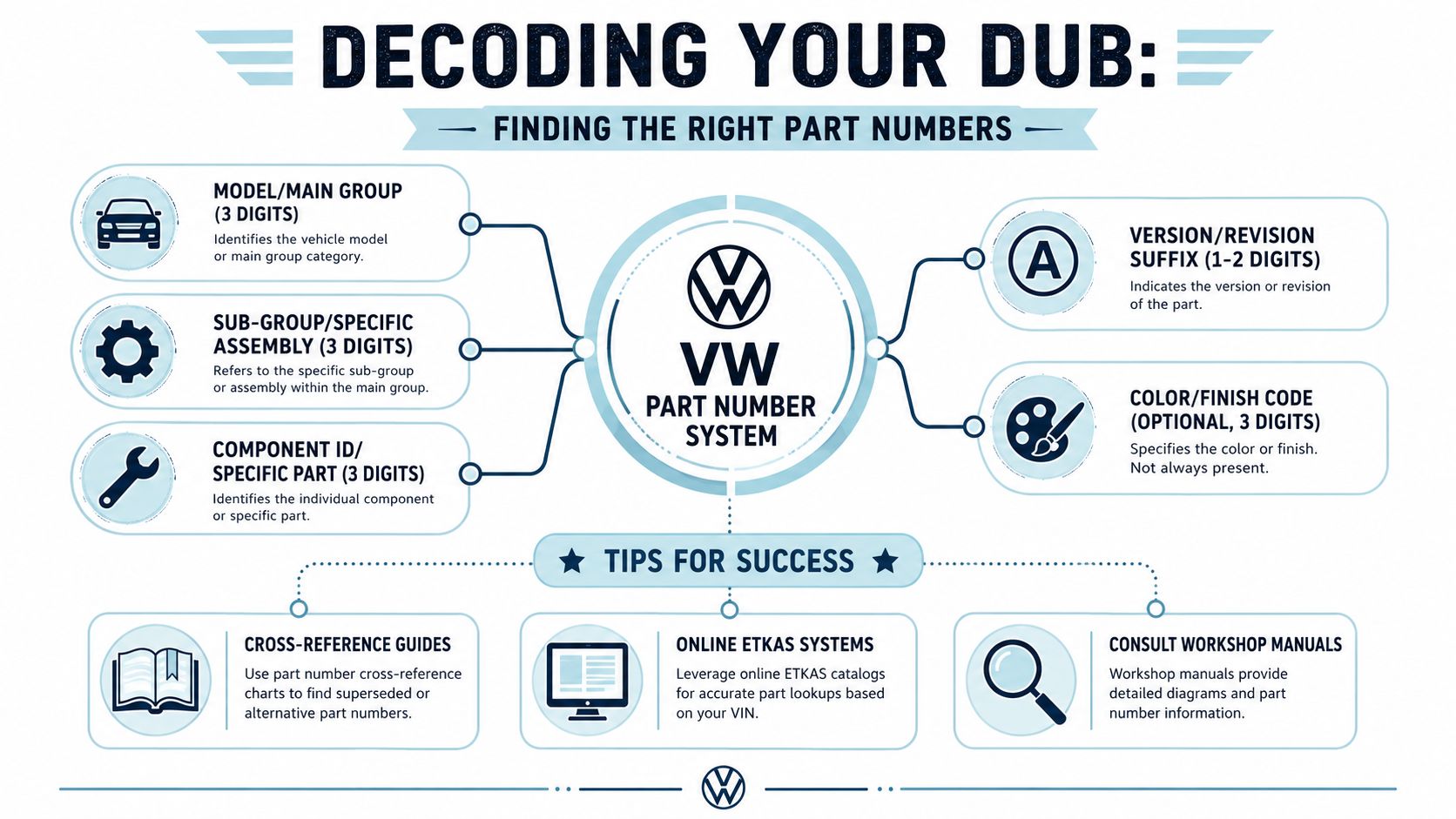
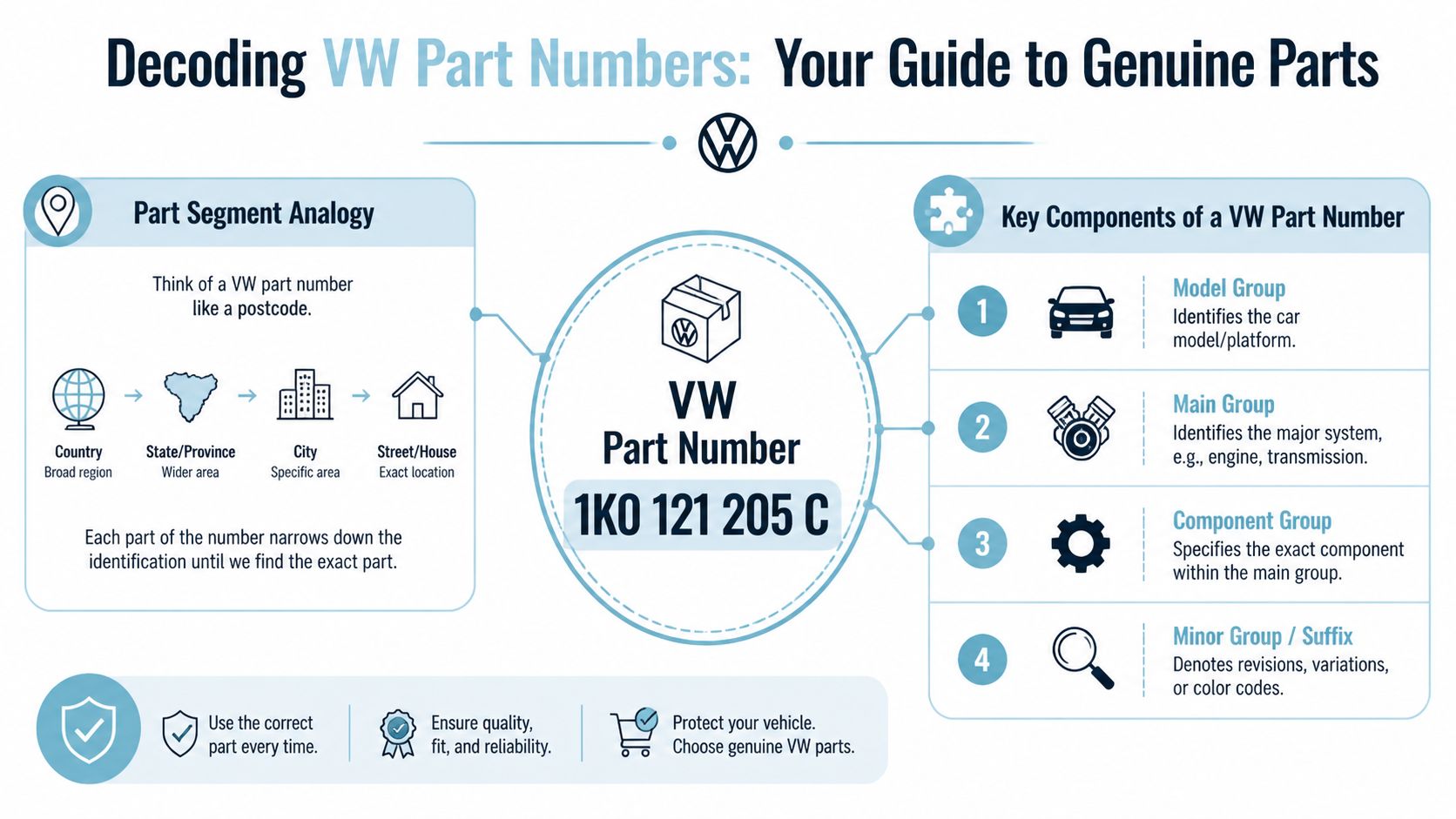
If VW part numbers have ever looked like secret code, don’t worry. They’re not random. Think of them like a postcode for car parts. Each section narrows the part down until you’re looking at one exact item, not a rough guess.

An infographic explaining the structure and meaning of Volkswagen automotive part numbers with a clear breakdown.

The basics are well established in the Club VeeDub guide to VW part numbers. Volkswagen uses a standardised 9 to 10 digit format, such as 171 819 047A. The first three digits identify the model, the fourth digit marks the main group, and the ending can show a revision or modification.

Breaking down the code

Here’s the easy way to read one:

Part number section What it usually tells you Why it matters
First three digits Model or unit code Helps match the part to the right vehicle family
Fourth digit Main group Tells you the major area, such as body or interior
Fifth and sixth digits Subgroup Narrows the search to a specific assembly
Last digits Consecutive part number Identifies the exact part itself
Final letter Modification code Can show a revision or update

That fourth digit matters more than many people realise. In the example from Club VeeDub, “8” indicates Body and Interior. If you’re searching trim, handles, seals, dash parts, or panels, this helps you stop wandering through the wrong catalogue section.

Left and right can catch you out

One of the handiest tricks is knowing that the consecutive numbers can indicate left or right-hand fitment. In Australia, that matters even more because we’re dealing with right-hand-drive cars and all the little fitment differences that come with them.

A mirror, hinge, or trim piece might look identical in a listing photo. It often isn’t.

Practical rule: Never order a left or right-specific VW part by appearance alone. Check the number first, then check the car.

Why suffix letters deserve respect

That final letter can seem small, but it can save a headache. The optional tenth character often shows a modification. That might mean a later revision, a slight design tweak, or a different finish. If you’re restoring a classic, that suffix can be the difference between “close enough” and “spot on”.

For Australian owners, this matters with anything exposed to salt air, sun, or repeated use. A later version of a part often exists because the earlier one had a weakness.

A quick workshop habit worth keeping

Before you order anything, write down:

  • The full part number from the old part if it’s legible
  • The model and year of the vehicle
  • Which side the part belongs on
  • Any suffix letter at the end
  • A photo of the mounting points for your own reference

That little checklist beats memory every time.

Your Go-To Map for VW Parts Across Australia

A mate of mine in Newcastle spent three weekends chasing a sliding-door roller for his Bay Window. The first seller swore it would fit. The second sent one from a different year. The third was an old club bloke who said, “Bring the busted one over.” Ten minutes in his shed, with a coffee going cold on the bench, the right part turned up in a tobacco tin beside a pile of old rego labels and a 1:64 Kombi model still in its blister pack. That is how VW parts hunting often works in Australia. Half detective work, half community, and a little bit of nostalgia every time.

Finding good volkswagen parts australia sources comes down to knowing which door to knock on for which job. A service item for a Golf, a proper German Beetle trim ring, and a Kombi latch with the right wear and stampings usually live in three different worlds.

Dealership parts counters

For newer Volkswagens, the dealer parts counter still earns its place. You walk in with the VIN, the part gets traced through the local catalogue, and you leave with far less guesswork than you would from a generic listing online. That scale translates to better support.

Best for:

  • Modern Volkswagens needing exact replacement parts
  • Warranty-sensitive jobs
  • Owners who want OE fit and finish

Less ideal for:

  • obscure used trim
  • bargain hunting
  • some niche classic odds and ends

Specialist VW parts suppliers

The specialist shops are where experience saves money. These suppliers know the little production changes that trip people up. They know which Beetle seal sits correctly, which Type 3 switch is close but wrong, and which “fits all” listing belongs in the bin.

You hear it in the language straight away. “Is it German-built?” “Early or late?” “Push-button or trigger handle?” Those questions can save you from buying the same part twice.

For air-cooled owners, these businesses often feel like part workshop, part archive. They keep cars on the road, but they also keep stories alive. The same owner chasing bonnet hinges for a Squareback is often the one collecting dealer brochures, enamel signs, or a little fleet of diecast buses at home. It is all the same instinct. Preserve the shape, the details, the feeling.

Wreckers and donor cars

A wrecking yard can still hand you the best find of the month. Used original German parts often beat shiny reproductions for fit, finish, and character. Handles, brackets, seat frames, vents, and odd bits of interior trim are classic wreckers territory.

Go in prepared:

  • Take your tools so you can compare old and new on the spot
  • Inspect mounting points for cracks, rust, and old repairs
  • Look past dirt but don’t ignore distortion
  • Check whether the part has been modified by a previous owner

The best donor parts feel right in your hand. You can see the age, the weight, the way the stamping was done. Anyone who has matched a survivor part to an old diecast model on the shelf knows the satisfaction. The tiny details are the whole point.

Online marketplaces

eBay, Gumtree, forums, and enthusiast classifieds can reward patience. They can also drain it. Good sellers show the part number, clear photos, and the car it came from. Rough sellers give you one blurry photo and a sentence like “should fit most VW.”

Ask for:

  1. the full part number
  2. clear close-up photos
  3. confirmation of the model it came from
  4. details of any repairs or damage

If the seller dodges those questions, keep scrolling.

Clubs and the VW community

The best parts in Australia often move privately through club circles, swap meets, and late-night messages between owners. Someone knows a bloke in Ballarat breaking a Superbug. Someone else has a shelf of early Kombi hardware wrapped in newspaper from 1998. Many coveted finds never reach public listings.

That community side is part of what makes the hobby stick. One person is hunting a fuel flap hinge. Another is chasing an old service sign or adding a Volkswagen bus camper inspiration piece to the collection in the shed. Mechanical parts and memorabilia feed the same obsession. You are not only keeping a VW alive. You are keeping its world intact.

The best VW parts source in Australia is often a person with a good memory, a crowded shed, and a shelf full of stories.

Genuine vs Aftermarket The Great VW Parts Debate

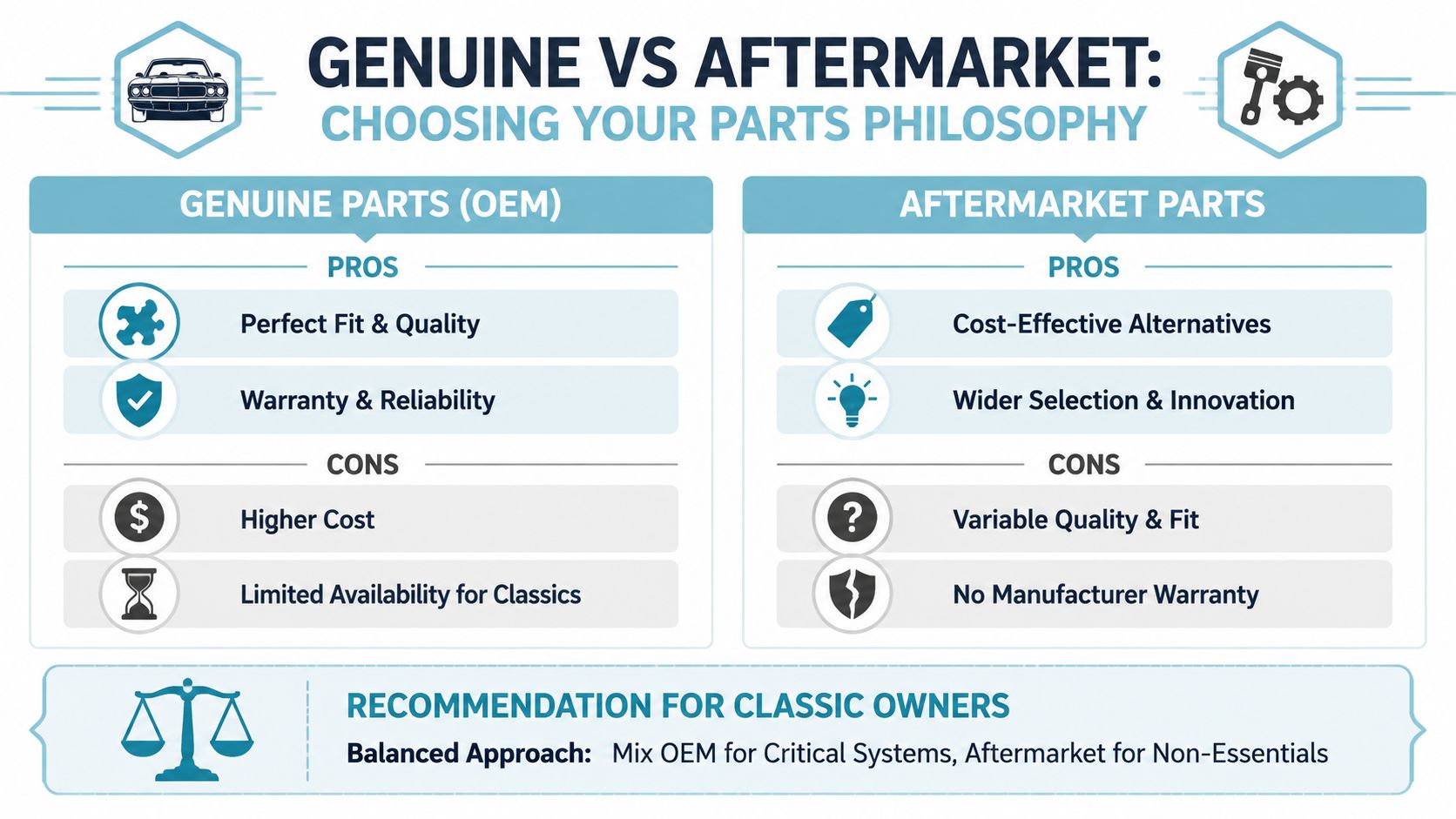
There’s no single right answer here. The right choice depends on the car, the job, and what sort of owner you are. A concours Beetle, a beach-run Kombi, and a hard-working daily driver won’t all make the same call.

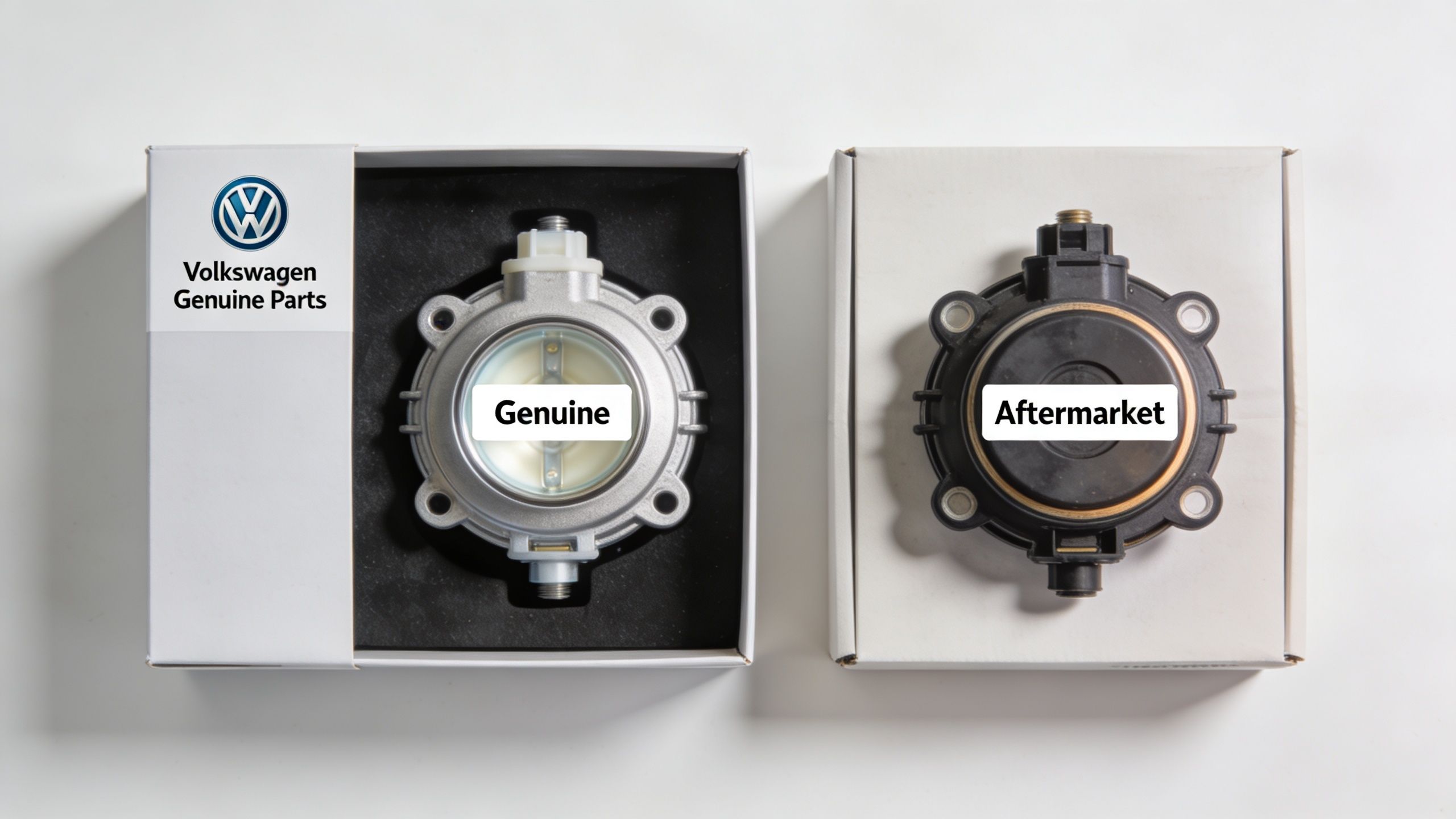
A side-by-side comparison showing a genuine Volkswagen automotive part versus an aftermarket replacement part in boxes.

Volkswagen’s own genuine parts offering in Australia comes with a clear advantage. According to Volkswagen Australia Genuine Parts information, Volkswagen Genuine Parts® carry a 2-year unlimited kilometre warranty when installed by an authorised technician.

When genuine makes the most sense

Use genuine parts when failure would ruin your weekend or your engine. That includes core mechanical items, sensitive sensors, major cooling parts, and anything that affects safety or proper system operation.

For newer cars, genuine often saves time. The fit is right, the catalogue trail is clear, and if something goes wrong you’ve got a cleaner path to support.

When aftermarket earns its keep

A quality aftermarket part can be perfectly sensible. Plenty of owners use aftermarket for consumables, cosmetic items, and non-critical bits where originality isn’t the top priority. If the supplier is reputable and the part is known to fit properly, it can be a smart move.

That’s especially true on daily drivers. Not every old Golf or Beetle needs concours-correct everything.

A simple comparison helps:

Option Best for Watch-outs
Genuine Newer cars, critical systems, factory correctness Higher cost
Aftermarket Budget-conscious repairs, non-critical items Quality varies a lot
Used original Hard-to-find classics, period-correct restorations Wear, age, hidden damage

For a visual rundown of the thinking behind parts choices, this video is worth a look:

The sensible enthusiast approach

Most seasoned VW owners don’t live at one extreme. They mix and match.

  • Engine and safety first: Buy the best part you can justify.
  • Trim and nice-to-haves second: Balance budget with originality.
  • Rare old parts: If you find a solid used original, grab it.

Buy cheap twice and you usually spend more than buying right once.

Restoration Gold for Classic Beetles and Kombis

You see it at swap meets all the time. One Beetle rolls in wearing thin original paint, stone chips on the nose, and a driver’s seat that has carried three generations. Another arrives fresh from a full rebuild, every rubber replaced, every trim piece sitting straight. Both can stop you in your tracks if the work feels honest to the car.

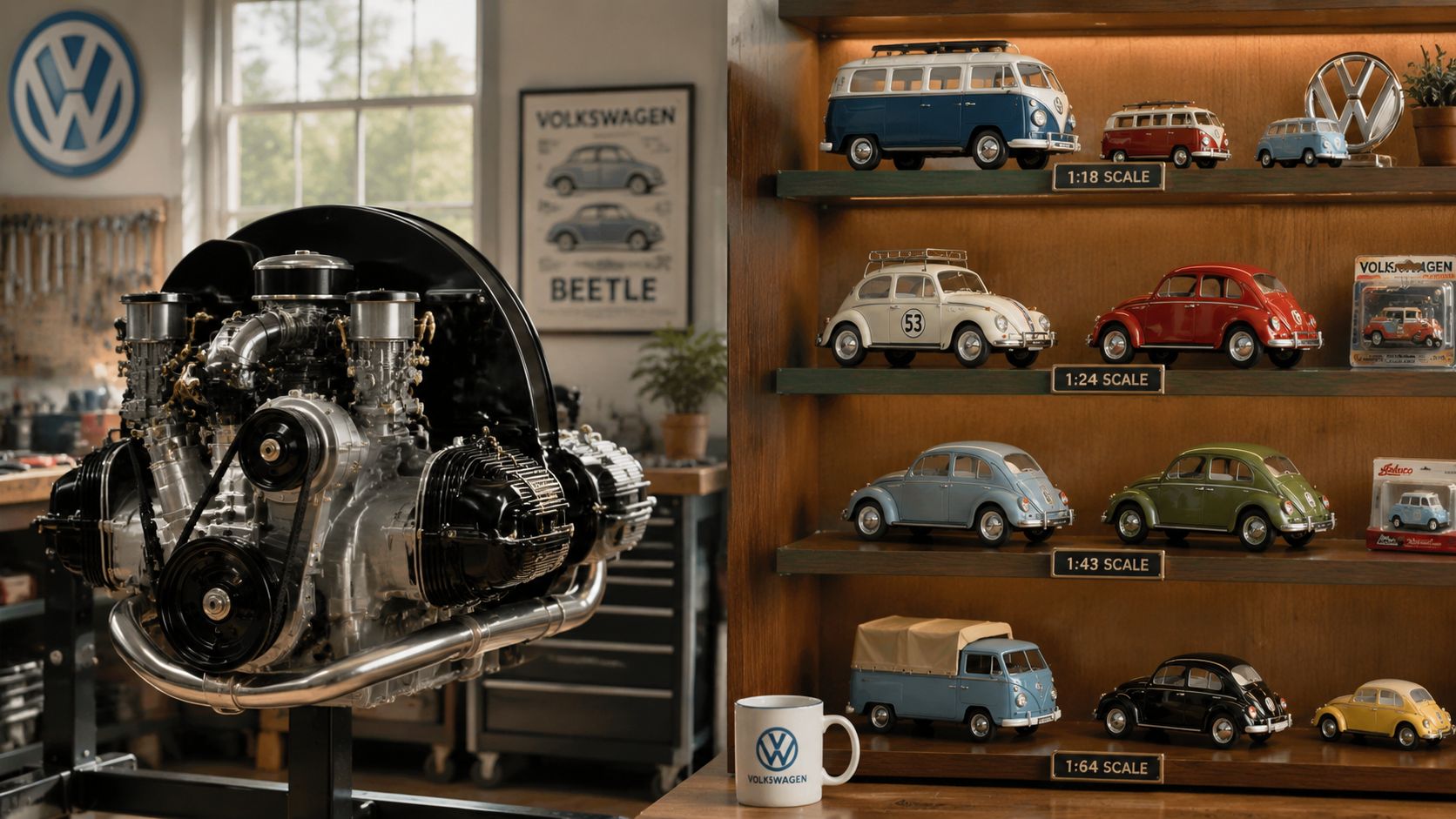
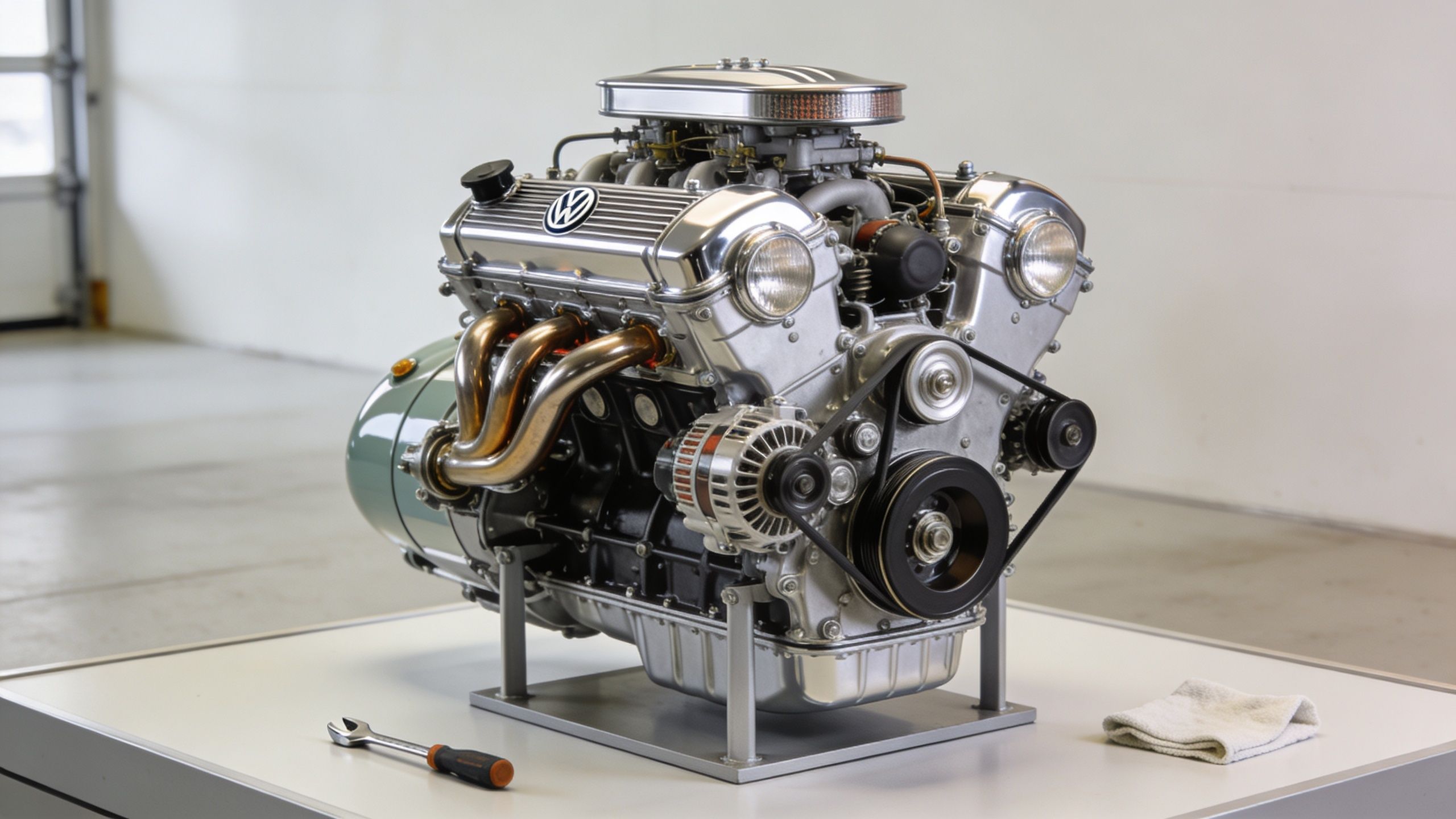
A chrome polished Volkswagen internal combustion engine displayed on a stand with a wrench and towel nearby.

A mate of mine spent half a winter sorting a Kombi rear hatch. He could have lived with a gap that looked fine from five metres away. He didn’t. He kept adjusting hinges, seals, and latch position until it shut with that familiar VW thunk. The first time it clicked home properly, the whole bus felt right again. That is the sort of victory classic Volkswagen people remember.

Start with the parts already telling the story

Before you fill a cart with replacements, pull the original bits off carefully and inspect them like artefacts. Old German handles, seat frames, latches, screws, catches, and trim often respond well to cleaning, plating, straightening, or a patient afternoon at the bench.

You save money, yes, but that is only part of it.

You also keep the car’s memory intact. A worn window winder or an original latch carries the same quiet charm as an old dealership brochure or a diecast Beetle on the garage shelf. The parts hunt and the collecting habit come from the same place. Respect for the details.

Use Australia’s VW network to your advantage

As noted earlier, Volkswagen has a serious footprint in Australia. For classic owners, that does not mean every air-cooled bracket or early Kombi trim clip is waiting in a local warehouse. It does mean the brand has a substantial local infrastructure around it, and that infrastructure is valuable when chasing parts pathways, references, old dealer knowledge, and compatible later pieces.

If your project is a Beetle and you are sorting through what is correct for a Type 1, these VW Type 1 parts references are handy for training your eye before you buy.

That matters most when a car has been “fixed” by five previous owners. A 1960s Beetle can pick up later lights, mixed fasteners, the wrong switches, and trim from entirely different years. Good restoration work often starts by spotting what should not be there.

The details that lift a restoration

Some choices shape the whole character of the car:

  • Patina or repaint
    Honest paint with good metal underneath can suit a Beetle or Kombi better than a glossy finish that erases its life.

  • Interior finishes
    Vinyl grain, seat piping, door cards, and colour tone decide whether the cabin feels period-correct or vaguely off.

  • Brightwork and trim
    Chrome needs restraint. Too perfect can look colder than the rest of the vehicle.

  • Hardware and fasteners
    Simple Volkswagens leave nowhere to hide. Wrong screws and odd clips stand out fast.

A classic Volkswagen does not need perfection. It needs the right feel.

Keep a reference on the shelf as well as the bench

Plenty of owners do this without making a fuss about it. A well-made Beetle or Kombi model sits near the tools while the actual car is in pieces. One glance can settle an argument in your own head about stance, wheel style, trim layout, or how much visual weight a bumper should carry.

That little model is not a substitute for factory literature. It is a reminder of what made you fall for the shape in the first place. In a proper VW garage, the spares shelf and the memorabilia shelf usually belong to the same story.

From Car Parts to Collectibles The Enthusiast's Corner

There comes a point in every VW obsession where the parts shelf stops being enough. You want something that celebrates the shape, not just the spanner work. That’s where collectibles step in.

Australia’s VW parts scene mostly serves the mechanical side. According to this look at the gap in the local market from V Dubs R Us, suppliers heavily focus on functional spares, while memorabilia and collectible parts remain underserved. That rings true for anyone who’s searched for proper display pieces, retro accessories, or a faithful little Kombi for the bookshelf and ended up knee-deep in mechanical listings.

Why collectors and restorers often become the same person

It makes sense, really. The same owner who cares about the right hubcap profile on a real Beetle will care about the right window layout on a model Samba Bus. Collecting isn’t a separate hobby for a lot of VW people. It’s another expression of the same affection.

A few collectible categories fit naturally beside restoration life:

  • Diecast Beetles and Kombis for desk, garage, or study displays
  • Workshop-inspired decor that keeps the VW mood alive indoors
  • Gift pieces for birthdays, Father’s Day, retirements, or club prizes
  • Beachy VW items that suit the surf-and-coast side of Kombi culture

For people who love that crossover between motoring nostalgia and home style, pieces like Volkswagen-themed dashboard cover decor show how the visual language of old VWs can carry into everyday spaces.

A few display ideas that work

Space What suits it
Garage shelf Kombi diecast, old manuals, cleaned original parts
Home office Beetle model, framed event photo, subtle VW accent
Living room Coastal VW decor, Samba Bus piece, understated retro touches

The nice thing about collectibles is that they hold the feeling of the car even when the car’s under a cover, waiting on the next job.

Your VW Parts Questions Answered

Can I still get parts for newer Volkswagens in Australia?

Yes. Volkswagen Australia’s parts network supports current models as well as enthusiast favourites. Commercial vehicles are part of that picture too, not just passenger cars.

What about Amarok parts specifically?

They’re well supported within the same broader network. The Amarok reached 8,400 units in 2024, and that demand sits behind the same catalogue of nearly 300,000 Genuine Parts, as reported by GoAuto’s market insight on Volkswagen Australia.

Are VW clubs worth joining just for parts?

Absolutely. Even if you never buy a part directly through a club member, the advice alone is worth it. Clubs help you avoid bad buys, identify correct pieces, and meet the people who know where the hidden stock lives.

Should I restore with all genuine parts?

Not always. For critical components, genuine often makes sense. For trim, older used parts, or budget-minded jobs, a careful mix can be the smarter path.

Owning a Volkswagen in Australia has never been just about transport. It’s about memory, identity, community, and the quiet satisfaction of getting the details right. Whether you’re chasing a genuine replacement part, reviving a tired Beetle, keeping a Kombi honest, or looking for something that captures the old VW magic, you’re part of a bigger story every time you go searching.


If that VW feeling follows you out of the garage and into the rest of your life, have a look at Volkswagen Memorabilia. It’s a warm, distinctly Australian shop for VW-themed gifts, diecast models, and coastal decor, with plenty to delight Beetle lovers, Kombi fans, collectors, and gift buyers who want something with real character.

Your 2026 Guide to VW Parts Australia

You’re probably here because a simple job turned into a proper VW scavenger hunt.

Maybe it started with a Beetle door handle that didn’t quite line up. Maybe your Kombi needs a seal, a badge, a trim clip, or that one maddening little bracket everyone swears is “easy to get”. Then three tabs become thirty, one seller says the part fits everything from a Bug to a Bus, another says “check number first”, and suddenly you’re wondering whether sourcing vw parts australia is meant to feel like archaeology.

It can feel that way. But after enough swap meets, shed clear-outs, late-night catalogue sessions, and hard lessons with left-hand-drive parts that should never have come near an Australian car, you realise there’s a pattern to it. Once you understand the families of parts, how VW numbers its components, where Australians find good stock, and when importing makes sense, the whole thing becomes less of a headache and more of a rewarding puzzle.

That’s the charm of old Volkswagens. Every part has a story. Every correct piece brings the car closer to itself again.

Decoding the VW Parts Universe OEM Aftermarket and NOS

The first confusion usually hits before you’ve even bought anything. A seller says it’s genuine. Another says OEM. Another says aftermarket but “just as good”. Then someone at a club meet starts talking about NOS like they’ve found pirate gold.

They’re talking about three different families of parts, and knowing the difference saves money, time, and arguments in the shed.

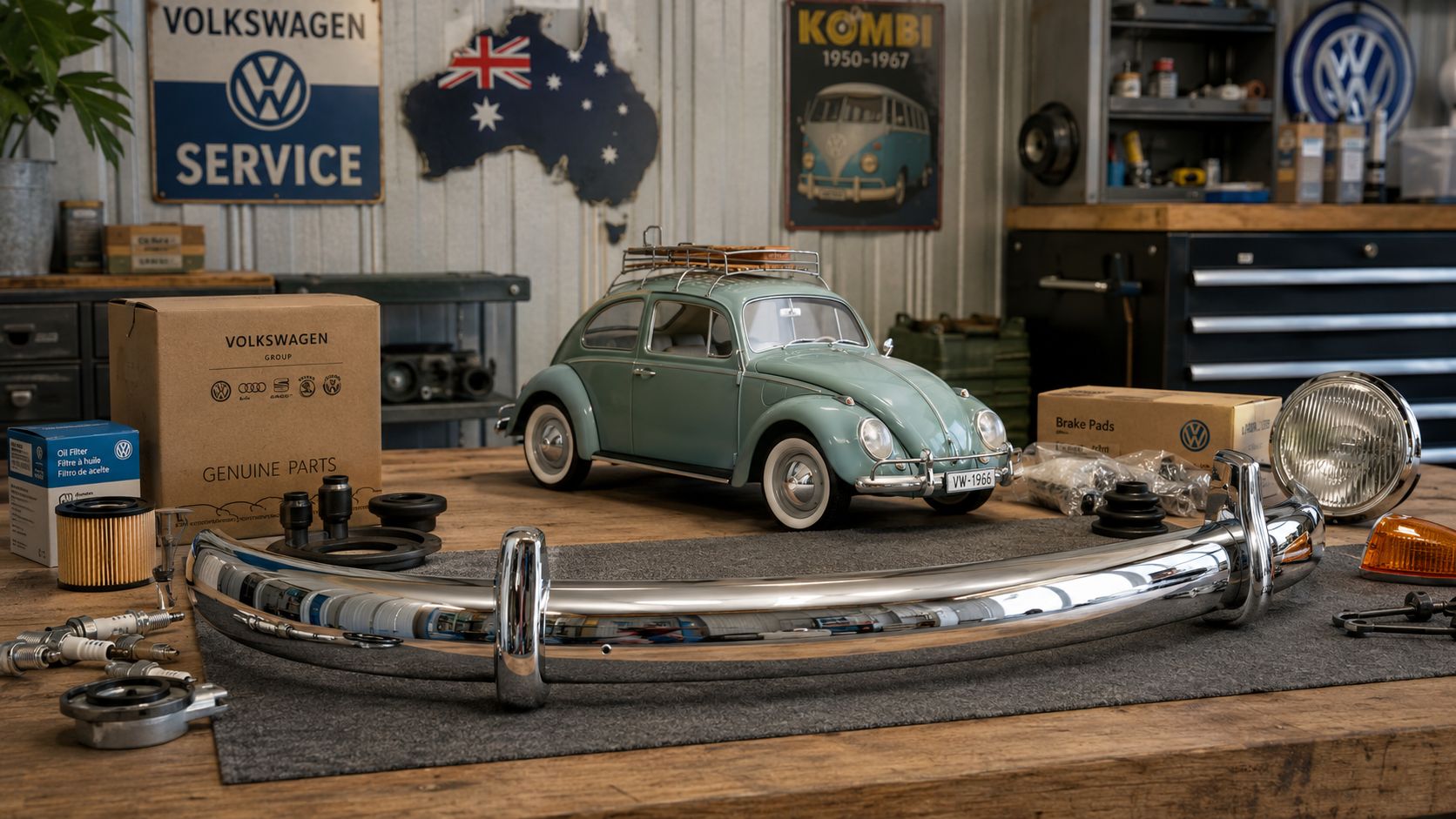
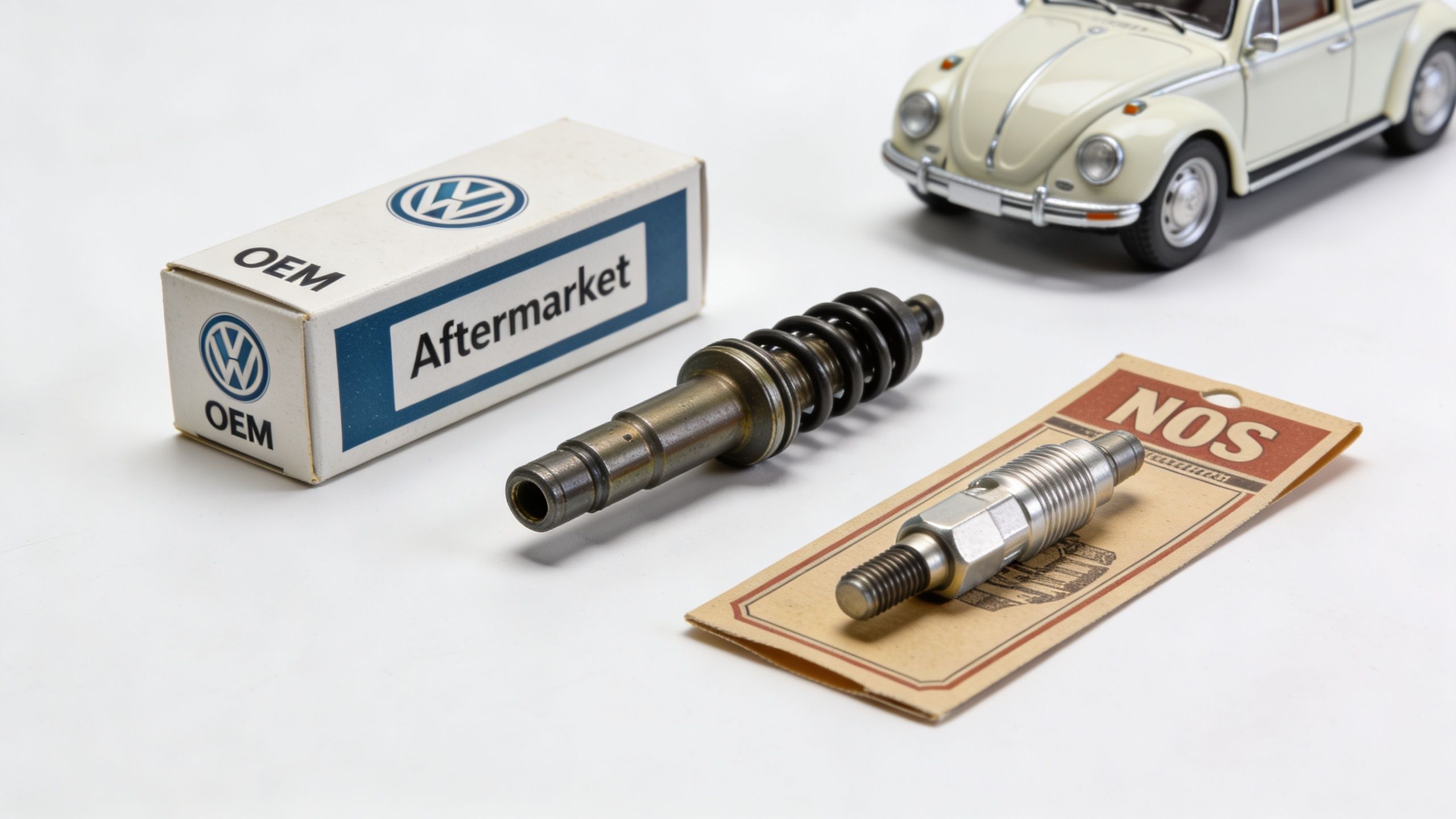
Automotive engine components displayed alongside a vintage Volkswagen toy car and branded packaging boxes.

Genuine parts feel like factory fresh

Genuine Volkswagen Parts are the closest thing to buying the part as Volkswagen intended for the car. In Australia, genuine parts sourced through official channels come with a 2-year unlimited kilometre warranty, which gives plenty of owners peace of mind when the job is too important to gamble on, especially for braking, suspension, sealing, or engine service items, as noted on Volkswagen Australia’s genuine parts information.

That doesn’t mean every project needs genuine everything. But when fitment matters, genuine parts usually remove the guesswork. You’re paying for consistency, correct engineering, and less mucking around with “close enough”.

Aftermarket parts can be the smart buy

Aftermarket parts are made outside Volkswagen’s official supply chain. That sounds risky to newcomers, but it doesn’t automatically mean poor quality. Some aftermarket options are sensible buys, especially for consumables, maintenance parts, or components where a trusted alternative is easier to source than genuine stock.

The trick is to separate the reputable option from the bargain-bin disappointment. In Australia, it’s wise to check whether imported aftermarket parts comply with Australian Design Rules, especially for safety-related items. If they don’t, you can end up with roadworthiness issues, insurance trouble, or a part that doesn’t belong on the car.

This can be understood as follows:

Part type Best for Watch out for
Genuine Correct fit, important systems, peace of mind Higher price, occasional wait times
Aftermarket Budget-conscious maintenance, broader availability Inconsistent quality, possible compliance issues
NOS Authentic restorations, period-correct details Shelf age, condition, rarity pricing

NOS is the time capsule find

New Old Stock, or NOS, is the stuff that gets old VW people grinning. It’s an original part made in the period, never used, often left sitting on a shelf for years. Sometimes decades. If you’re restoring a car and want proper period details, NOS can be magic.

It can also be a trap if you buy with your heart instead of your eyes.

Rubber hardens. Packaging lies. “New” doesn’t always mean “ready to fit”. An NOS seal or bush might be historically correct and still be the wrong choice for a car that’s driven.

Practical rule: Use genuine or quality aftermarket for function. Use NOS where originality matters and the material condition still makes sense.

A lot of owners end up mixing all three. Genuine for the critical bits, aftermarket for practical maintenance, NOS for those little finishing touches that make the car feel right. That’s often the sweet spot.

If your project centres on a Beetle or early Bug platform, it helps to browse a category built around the model itself, not just generic listings. A focused starting point like VW Type 1 parts can help you think in model families before you think in part listings.

What usually confuses people first

Most mistakes happen because buyers chase the lowest price before they’ve decided the goal of the build.

Ask yourself these questions first:

  • Is this a driver or a show car? A daily-driven Beetle needs dependable function before concours perfection.
  • Is authenticity part of the value? For a period-correct Kombi restoration, the right trim, handles, and finishes matter more.
  • Will the part affect safety or legality? Brakes, steering, seatbelt hardware, and suspension deserve extra caution.
  • Do you need it now or can you wait? Some parts are easy to source locally in aftermarket form, while genuine or NOS can take patience.

That one decision changes the whole search. Once you know which family of part you’re chasing, the next step is finding the exact number that belongs to your car.

Your VWs Fingerprint Finding the Right Part Number

Ask any long-time VW owner what separates a smooth parts order from a miserable one and you’ll hear the same answer. Part number first.

Volkswagen’s numbering system looks cryptic at first glance, but it’s not random. It’s your car’s fingerprint. Once you can read it, you stop guessing and start ordering with confidence.

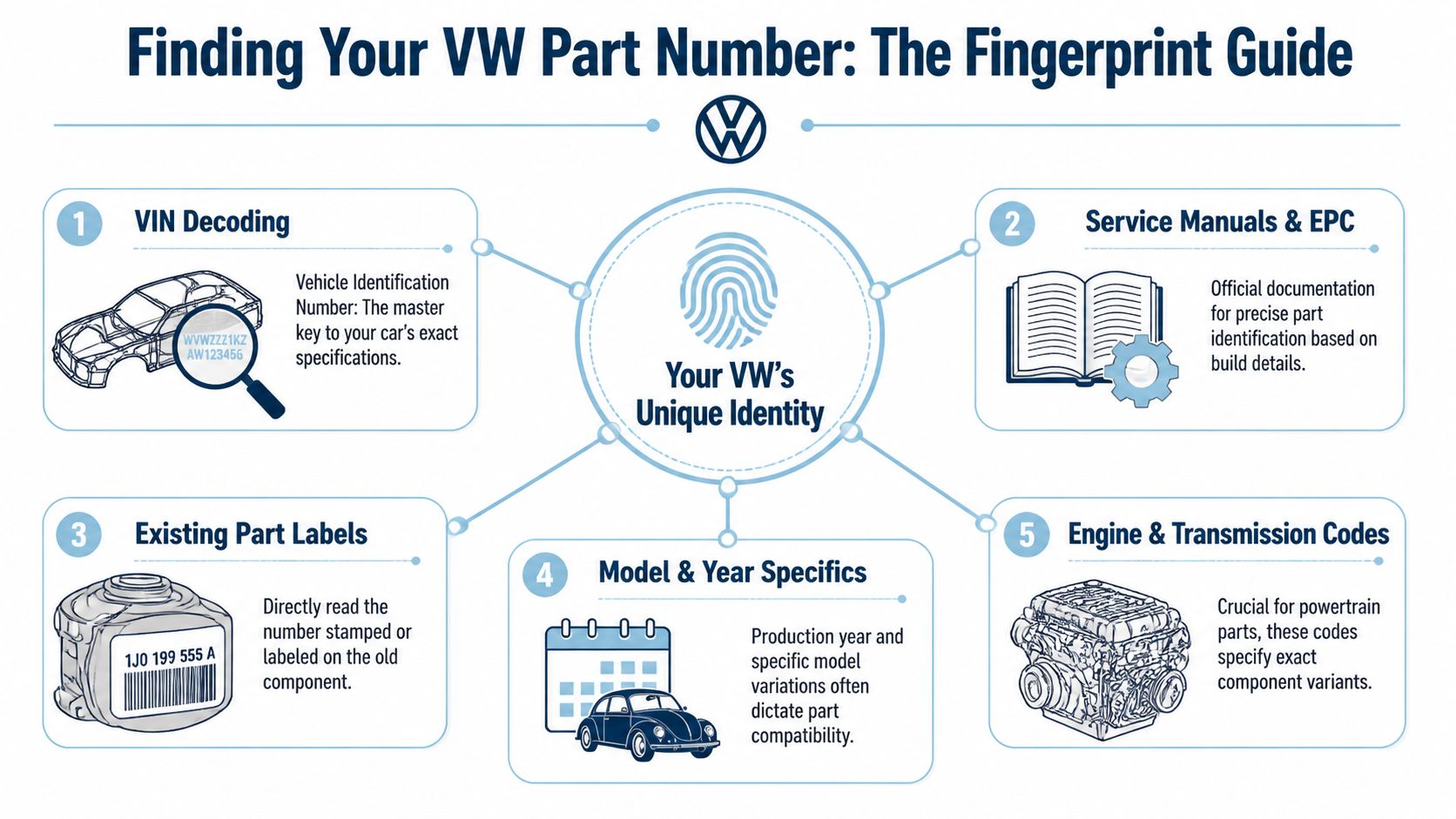
An infographic titled Finding Your VW Part Number explaining five methods to identify Volkswagen automotive parts.

How the nine-digit code works

According to Club VW’s guide to Volkswagen part numbers, the Volkswagen part numbering system uses a nine-digit code, sometimes followed by a modification letter. The key point for Australian buyers is right at the front of the number. Digits 1 to 3 denote the model, and odd numbers indicate left-hand drive while even numbers indicate right-hand drive.

That matters here because Australian cars are right-hand drive. Get that wrong and you can end up with parts that physically bolt on badly, interfere with mounting points, or are unsuitable for local vehicle layout.

In Australia, left-hand-drive and right-hand-drive confusion isn’t a minor catalogue error. It can lead to steering, mounting, and compliance headaches.

Club VW also explains the rest of the code in useful chunks:

  • Digits 1 to 3 identify the model or unit code
  • Digit 4 shows the main group
  • Digits 5 and 6 narrow it to a subgroup
  • Digits 7 to 9 identify the specific part
  • A final letter can show a revision or modification

Once you know that, the code starts to read less like gibberish and more like a map reference.

Five ways to find the right number

Most owners don’t need to decode everything from scratch. They need a repeatable method.

  1. Start with the old part
    If the original component is still on the car, clean it carefully and look for stamped or cast numbers. This is often the quickest lead, especially on metal components.

  2. Check the VIN and build details
    Build year, model variation, and mechanical specification can all change fitment. Beetles and Kombis may look similar across nearby years, but one small production change can shift the correct part.

  3. Use ETKA or an equivalent catalogue
    ETKA is the proper parts catalogue many VW enthusiasts rely on to cross-reference numbers. It helps confirm supersessions and model-specific changes.

  4. Match engine and gearbox codes
    For powertrain parts, broad model description isn’t enough. Engine and transmission codes often decide whether the part fits.

  5. Confirm against Australian specification
    If the seller is overseas, ask them to confirm the number rather than just the model name. “Fits Beetle” is not the same as “fits your Australian right-hand-drive Beetle”.

The easiest mistake to make

Newcomers often search by model name alone. That’s how you end up with a part that fits a Beetle in a general sense, but not your Beetle.

A practical example is a handle, mirror mount, dash fitting, or steering-related piece. It may look identical in photos, yet differ because of side orientation or right-hand-drive layout. That’s why catalogues and old club references still matter.

If you’re chasing bug-specific items, it helps to keep your browsing narrow and model-led. A collection like Volkswagen Beetle parts is useful because it keeps your attention on Beetle-compatible categories while you verify the exact part number elsewhere.

A simple order of operations

When I’m helping someone at a show who’s overwhelmed, I tell them to do it in this order:

Step What to do Why it matters
First Identify the exact model and year Similar cars can use different parts
Second Photograph the old part and any markings Saves memory-based mistakes
Third Check catalogue references Confirms supersessions and variations
Fourth Verify RHD compatibility Critical for Australian cars
Fifth Ask the seller to repeat the number in writing Creates a clear record before purchase

“If the seller can’t give you a part number, they’re asking you to buy hope.”

That sounds blunt, but it’s true. Hope doesn’t fit a Kombi. Numbers do.

Sourcing Your Parts Locally The Great Aussie VW Hunt

Finding parts in Australia has always been half logistics, half community. One day it’s a specialist who knows every seal profile by eye. The next it’s a retired club member pulling a dusty box from a shelf and saying, “I knew I kept that for a reason.”

That’s part of the joy. It’s not just shopping. It’s the hunt.

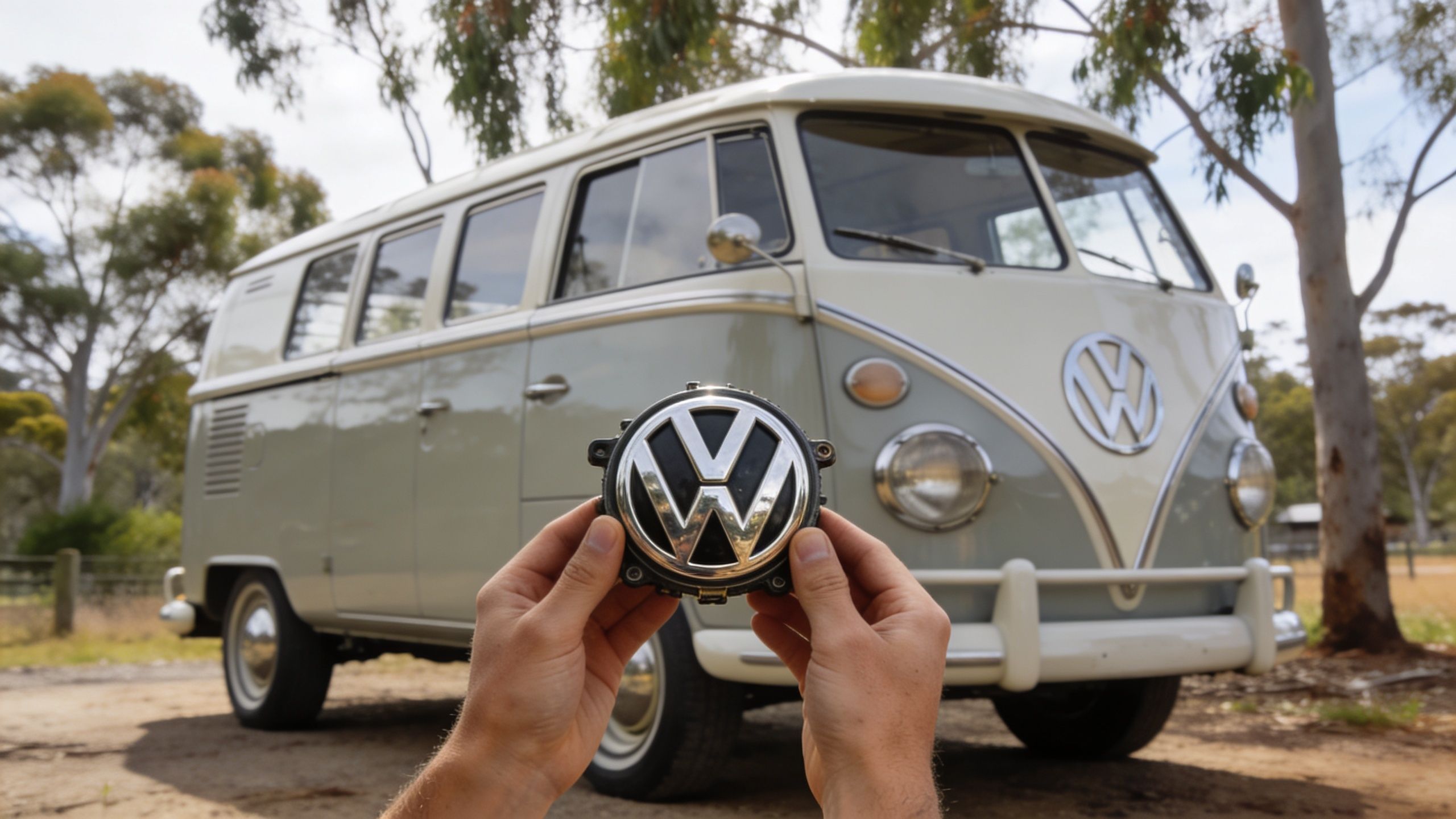
A person holds a vintage Volkswagen emblem in front of a classic beige and white VW bus.

Australia gives VW owners a decent base to work from. The local automotive aftermarket was estimated at $8,820 million in 2023, and Australia’s registered vehicle fleet reached 18.9 million, which helps sustain suppliers, wreckers, clubs, and all the side networks enthusiasts rely on, according to the Australia automotive parts country commercial guide.

The specialist supplier

The best specialist suppliers save you from expensive mistakes because they understand the difference between “sort of fits” and “fits properly”. They know which reproduction seals are too fat, which trim clips crack, and which parts should never be ordered without checking chassis details.

When you ring a good specialist, have these ready:

  • Your exact model details so they’re not guessing from a broad description
  • The part number if you have it because this speeds everything up
  • Photos of the old item especially if the car has had previous-owner modifications
  • A clear goal such as daily use, original restoration, or roadworthy repair

The better your question, the better the answer.

Wreckers and swap meets still matter

Modern online catalogues are handy, but old Volkswagens still reward old-fashioned searching. Wrecking yards, swap meets, and club events can turn up original hardware, brackets, trims, and obscure bits that don’t even make it into neat online stock lists.

The catch is condition. Learn to inspect before you get excited.

Look for:

  • Cracks and fatigue on handles, mounts, and brackets
  • Rust in hidden edges not just on visible surfaces
  • Thread condition on bolts, studs, and captive nuts
  • Signs of previous repairs such as welds, filler, or drilled holes

A used original German part can be better than a poor reproduction. But only if it’s still sound.

Here’s a helpful look at the kind of hands-on VW culture that keeps the scene going:

Clubs are where the real shortcuts live

If you’re not in a VW club yet, you’re making the hunt harder than it needs to be. Club members know who has stock, who rebuilds what, who hoards Type 3 bits, and who’s got a shed full of Kombi trim they swear they’ll sort through one day.

That local knowledge beats endless scrolling.

Club wisdom: Ask for the person, not just the part. In the VW world, the right contact often matters as much as the right catalogue.

You’ll also hear the unwritten truths. Which supplier packs well. Which one labels accurately. Which one is lovely to deal with but slow on email. That sort of advice isn’t flashy, but it’s gold.

Why local often wins

Buying local in the vw parts australia market has a few practical advantages that never go out of style:

Local source Why owners like it
Australian specialist shops Easier communication, familiar with RHD cars
Clubs and members Honest knowledge, rare spare parts, community trust
Swap meets and shows Chance to inspect parts in person
Wreckers and salvage Original pieces that reproductions can’t match

You also avoid the heartbreak of waiting weeks for something from overseas only to find it’s wrong, damaged, or built for another market. Local buying won’t solve everything, but it makes a lot of jobs easier and a lot of restorations more enjoyable.

Bringing It Home Importing Parts and Navigating Compliance

You finally find the part after weeks of searching. It is sitting in a warehouse in California, or on a shelf in Wolfsburg, or in the spare room of a seller in the UK who swears it fits your year perfectly. That moment feels like victory. Then the actual work starts.

Importing can save a restoration. It can also turn a tidy plan into an expensive lesson if you buy on hope instead of proof.

When importing makes sense

Overseas buying usually earns its place when the job is too specific for the local market. Rare trim, odd interior hardware, country-specific lenses, and period-correct finishes often fall into that category. Collectors know the feeling well. Sometimes the right piece is not just a spare part. It is the missing detail that makes the car feel whole, the same way a proper brochure, badge, or model car completes a memorabilia shelf.

That collector's instinct can be useful here, as long as you keep it disciplined. A careful buyer treats an imported part the way a serious collector treats a rare item. You check markings, provenance, condition, and whether it is exactly correct for the year and model, not merely close.

Part numbers matter more once a parcel is crossing oceans.

Compliance matters more than excitement

A part can look perfect in photos and still be wrong for an Australian car. That matters most with anything tied to safety, roadworthiness, or insurance. Imported aftermarket parts should be checked against Australian requirements if they affect braking, steering, suspension, lighting, seat belts, mounting points, or other regulated systems.

Volkswagen Australia says Genuine Volkswagen Parts bought through its official Australian network come with a 2-year unlimited kilometre warranty. Private overseas purchases usually do not give you that kind of backup, and returning a bad part across borders can cost more than the savings that tempted you in the first place.

That is the value equation many owners only learn after one wrong order.

If the part affects how the car stops, steers, lights the road, or protects passengers, treat exact fit and clear compliance as required, not optional.

The traps that catch eager buyers

The biggest problems are rarely dramatic. They are the small mismatches that stall a project for months. A left-hand-drive switch panel. A lens with the wrong markings. A reproduction rubber seal that looks right on the bench but fights the body opening like it was made for another car entirely.

Early Volkswagens are especially good at teaching humility. Mid-year changes, export-market differences, and previous-owner modifications can all confuse the trail. A 1967 Beetle is a famous example of this sort of mischief, but almost every model line has its own trouble spots.

A practical importing filter

Before you send money overseas, run through this short check:

  1. Match the part number to your car's chassis range, year, and model
  2. Confirm right-hand-drive suitability if the part relates to controls, trim, or visibility
  3. Ask for clear photos of stamps, labels, casting numbers, and wear
  4. Check freight costs, return terms, and import duties before paying
  5. Be stricter with safety-related parts than with decorative or collectible items
  6. Compare the overseas bargain with local genuine supply, especially when warranty support could save you later

Decor items, badges, books, signs, and display pieces usually carry less risk. Mechanical parts do not. That is where the collector's eye and the restorer's discipline need to work together.

The best importers are methodical. They buy with enthusiasm, but they verify like a sceptic.

Beyond the Spanner The Collector's Spirit and Your VW's Story

You finally find the right badge for the decklid, set it on the bench, and pause for a second longer than expected. Next to it sits an old brochure, a tiny diecast Kombi, and a photo of the car as it looked when you dragged it home. That little scene explains something every long-term VW owner learns sooner or later. Restoring the car and collecting the story around it are parts of the same hobby.

That is why the hunt for vw parts australia often grows beyond bolts, seals, and trim.

A close-up view of a hand touching the hood of a vintage white Volkswagen Beetle car.

Restoring and collecting belong together

A clear gap exists in the market here. People looking for Kombi decor, Beetle display pieces, or workshop-themed VW gifts often end up sifting through pure parts listings, even though many enthusiasts want both sides of the hobby under one roof.

That overlap is easy to understand if you have ever lived with an old Volkswagen project. A car in pieces can test your patience. A model on the shelf, a period sign on the wall, or one of these VW dashboard-themed display pieces keeps the car present in your life while the full-size version waits for its next round of work.

Collectors and restorers are usually chasing the same thing. Connection.

A diecast Beetle or Kombi helps in practical ways too:

  • It keeps enthusiasm alive during the slow months of cleaning, waiting, and reordering
  • It gives you a visual reference when you are still settling on colour, trim, or stance
  • It invites family into the story because a shelf piece is easier to enjoy than a discussion about door scrapers and chassis numbers
  • It marks progress so the project feels like part of the home, not just a machine stalled in the shed

The project deserves a place in the house too

Old VW hands have been doing this forever. We saved brochures from swap meets, stacked old workshop manuals, hung dealer signs, and kept worn badges that were too full of history to throw away. Plenty of us had a tiny bus or Beetle sitting above the vice long before anyone called it curation.

That habit matters because restoration can be slow, expensive, and occasionally maddening. Memorabilia gives the project a heartbeat when the car itself cannot move. It works like a campfire around the main event. People gather around it, ask questions, share memories, and suddenly the project stops being a pile of jobs and starts feeling like a story again.

The restoration starts long before the spanners hit the bench. It starts when the car takes up room in your memory, your plans, and your shelves.

Why memorabilia makes such good VW gifts

Some VW enthusiasts do not own the full-sized car. Some sold one years ago and still miss it. Some grew up riding in a Beetle or watching a Kombi pull into a caravan park every summer. For them, memorabilia is not filler. It is a manageable, lasting way to keep hold of the feeling.

That is also why gifts in this corner of the hobby tend to mean so much. A thoughtful model, sign, or display piece says you understand the person's taste, their memories, and the shape that never quite left their mind.

The collector's spirit sits inside every good restoration. One side sources the right parts. The other keeps the romance alive while the work gets done.

Your Essential Checklists for Buying VW Parts

By the time you’re ready to buy, excitement can undo all your careful thinking. A seller sounds convincing, photos look decent, and you want the job moving. That’s exactly when a checklist earns its keep.

Save these to your phone. Better yet, print them and keep them in the glovebox or workshop.

The restorer's pre-purchase checklist

Use this when you’re buying a single part for your own car.

  • Confirm the exact part number. Don’t rely on model name alone. Match the number to your vehicle’s year, variant, and Australian right-hand-drive setup.
  • Ask for photos of markings and all sides. Stamps, casting numbers, wear points, and mounting tabs tell you more than a polished hero shot.
  • Check whether the part is genuine, aftermarket, or NOS. Sellers often blur these lines. Make them be specific.
  • Look at material condition, not just appearance. Rubber, plastic, and plated finishes can age badly even when unused.
  • Ask what car it came off if it’s used. “Fits Beetle” is too vague.
  • Get return terms in writing before you pay, especially for imported or hard-to-find parts.
  • Pause on safety-critical items. If the part affects braking, steering, mounting, restraints, or suspension, be stricter than usual.

The retailer's sourcing sheet

If you buy for resale, gifts, workshop stock, or display ranges, the questions shift a bit.

Check Why it matters
Authenticity and licensing Especially important for themed collectibles and branded items
Consistency across multiple units Mixed quality creates headaches for returns and reputation
Packaging quality Matters for shipped goods and gift buyers
Supplier communication If there’s a stock issue, clear answers matter fast
Category fit Make sure the item suits your audience, whether that’s restorers, collectors, or decor buyers

A useful example is adjacent display stock. If you’re building a VW-themed retail or workshop corner, practical accessories can sit alongside collectibles and decor. Items such as automotive dashboard covers can help shape a display or themed range, provided you’re clear about whether you’re selling function, style, or both.

The final sense-check

Before you hit buy, ask one last question.

Does this part solve the actual problem, or am I buying it because I’m tired of searching?

That one question has saved plenty of us from boxes full of “nearly right” parts.

Frequently Asked Questions for the Aussie VW Enthusiast

How do I handle parts shipping to regional Australia

You find the right part at last, click through to checkout, and then the surprise arrives. Freight.

Regional buyers learn this early. Delivery to remote parts of NT or QLD often takes 5 to 7 days or more, and heavy-item shipping can run upwards of $20, according to VAGPARTS and the regional delivery reality for VW parts in Australia. That matters because a bargain bumper bracket or wheel drum can stop looking like a bargain once freight joins the bill.

The fix is simple, but it takes discipline. Ask for packed dimensions before you pay, confirm the courier being used, and bundle small service items into one order where you can. Old hands treat freight like part of the restoration, not an afterthought. Collectors do the same with rare brochures, badges, and model cars. The hunt only works when the whole cost makes sense.

Is genuine always better than aftermarket

Genuine parts usually give you the best shot at correct fit, especially on cars that have already lived a few different lives. A Beetle or Kombi that has been repaired over decades can be full of little surprises, so factory-spec parts often save time and swearing.

Good aftermarket parts still have their place. They can suit cosmetic items, trim pieces, and everyday maintenance jobs if the supplier knows the product well and states fitment clearly. The trick is to match the part to the job. A reproduction interior knob is one thing. A brake component asks far more of your trust.

What’s the easiest way to avoid buying the wrong part

Start with the part number.

That number is your VW’s fingerprint. Model names help, year ranges help, and photos help, but the part number cuts through a lot of confusion. It also keeps you grounded when a seller claims one item fits a long list of cars.

Check right-hand-drive compatibility, confirm any chassis or engine-code break points, and ask the seller to verify the number in writing before you buy. If they hesitate, slow the process down. A cheap wrong part usually costs more than a dear correct one once return freight and lost workshop time get involved.

How can I spot a poor-quality reproduction

Poor reproductions usually give themselves away if you know where to look. Rough casting, thin chrome, soft fasteners, missing markings, and vague fitment claims are common warning signs. So are listings that claim one part suits nearly every Beetle, Bus, or Golf variation under the sun.

Precise sellers tend to be better sellers. They will tell you measurements, production years, left or right fitment, and whether a part suits Australian-delivered cars or imported variants. That same eye for detail is what separates a meaningful piece of VW memorabilia from a generic trinket. Real enthusiasts notice accuracy.

Should I buy used original parts over new reproduction parts

Used original German parts can be the smarter buy, especially if the original piece was built from better material than the modern reproduction. Plenty of club members have fitted a clean second-hand latch, hinge, or switch and found it works better than a brand-new copy.

Condition decides everything. Check for corrosion, fatigue, cracks, worn threads, and old repairs. Rubber, seals, and other perishable materials need extra caution because age can beat originality. The best restorations, and the best collections, come from choosing pieces with a story and enough life left in them to justify bringing them home.

If you love the hunt as much as the finished result, have a look at Volkswagen Memorabilia. It’s a local Australian shop focused on VW-themed gifts, diecast models, and coastal decor that speaks directly to Beetle and Kombi fans. If your shed project has spilled into your office, lounge room, or gift list, it’s a lovely place to find officially inspired pieces that keep the Volkswagen story going long after the tools are put away.

Essential VW Type 1 Parts for Restoration

The first time a newcomer asked me about vw type 1 parts, we were leaning over a pale blue Beetle at a weekend show, flat whites in hand, while its owner rummaged through the boot for a loose badge he’d been hunting for months. He didn’t start by asking about horsepower or paint codes. He pointed at a tiny trim piece and said, “How do you even know what’s right on these things?”

Introduction The Heartbeat of the Beetle

That’s the Beetle in a nutshell. It pulls you in with a shape you’ve known your whole life, then keeps you there with details. The little hum from the rear, the upright windscreen, the smell of old vinyl and warm paint in the sun. A Volkswagen Type 1 isn’t just transport. It’s memory on wheels.

For a lot of us in Australia, the Beetle sits somewhere between family history and hobby. One bloke remembers mum driving one to the beach. Another has spent years chasing the right decklid, the right taillights, the right engine tin. Someone else doesn’t own a full-size Bug at all, but has a shelf lined with beautifully made diecast models because that rounded silhouette still means freedom, simplicity and good times.

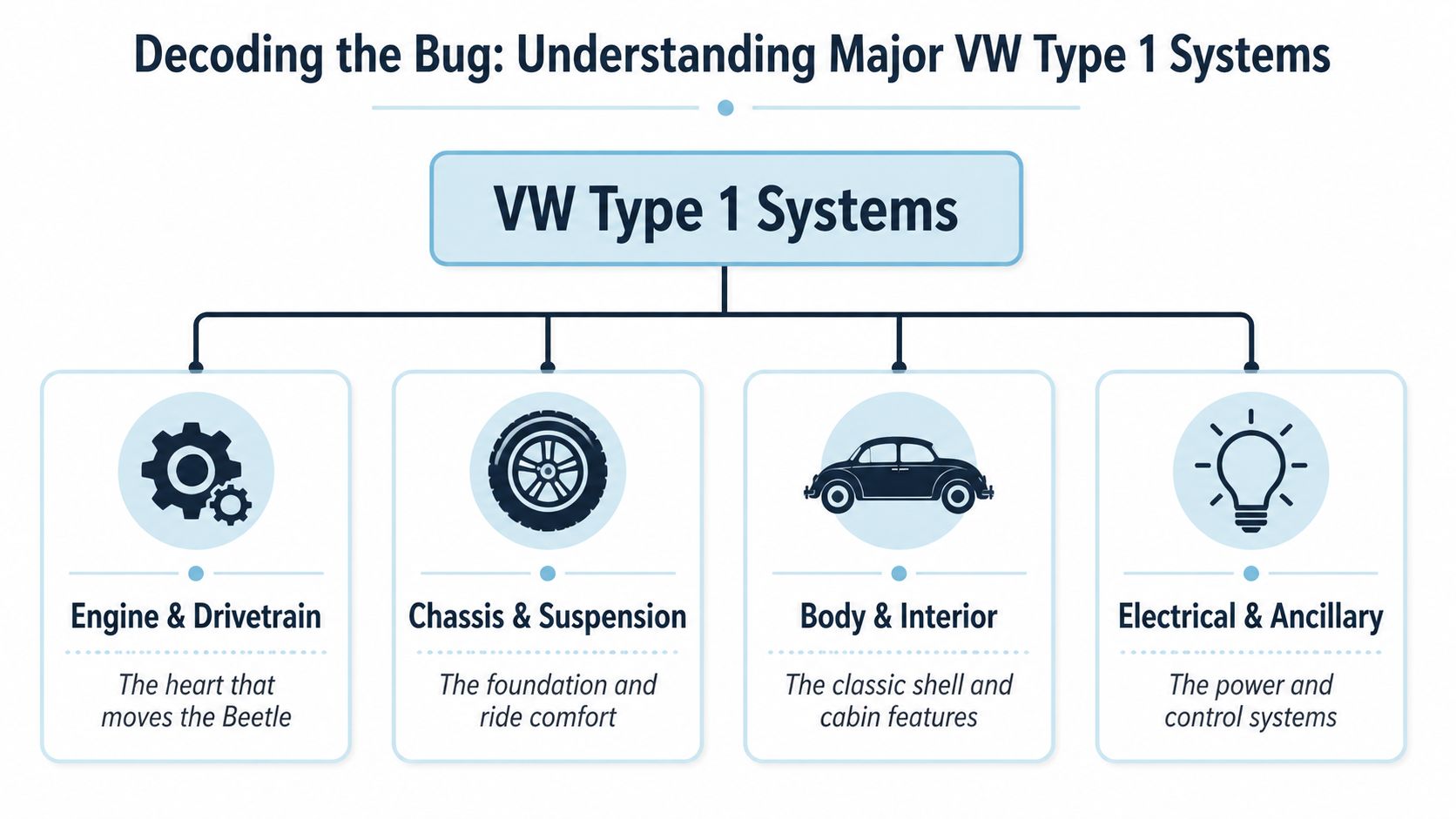
The Beetle's charm is that it makes sense once you stop being intimidated by it. Its major systems are honest and readable. The engine is the heart. The chassis is the backbone. The body is the face everybody falls for. The electrical system is the nervous system that keeps the whole thing awake. Once you see the car that way, the world of vw type 1 parts stops looking like a jumble of numbers and old catalogue pages.

Practical rule: If you can name the system a part belongs to, you’re already halfway to finding the right replacement or spotting whether a model car captures the real thing properly.

That matters whether you’re rebuilding a driver, restoring a show car, or choosing a miniature Beetle that respects the original. The more you understand the car’s mechanical soul, the more every proper badge, wheel, bumper and engine detail means something.

Decoding the Bug Understanding Major VW Type 1 Systems

At a club meet in country Victoria, a young bloke once parked his newly bought Beetle beside a row of polished cars and asked why everyone kept crouching near the back wheels, peering under guards and lifting decklids. Within ten minutes, three owners had shown him more than he had learned in months of scrolling classifieds. One pointed out the engine tin. Another tapped the pan and said, “Start there before you fall in love with shiny paint.” A third picked up a diecast model from a swap table and showed how the wrong bumper and taillights gave away the wrong year straight away.

That is the charm of a Type 1. It reveals itself quickly if you know where to look.

A diagram illustrating the four major systems of the Volkswagen Type 1, including engine, chassis, body, and electrical.

If you want a quick visual primer, this overview of the Type 1 VW Beetle's history and design pairs nicely with what follows here.

Engine and drivetrain

The engine gives the Beetle its voice, its smell, and half its personality. Open the rear lid and you are looking at a layout that rewards curiosity. No water hoses snaking everywhere. No radiator cluttering the nose. Just a compact air-cooled flat-four and the pieces that keep it alive.

A few names come up again and again at swap meets and in workshop talk:

  • Carburettor meters fuel and air.
  • Distributor sends spark at the right moment.
  • Pushrods and valve gear open and close the engine’s breathing passages.
  • Crankcase forms the main housing.
  • Flywheel helps the engine carry its momentum smoothly.

The drivetrain sits close by and takes that power to the road. Clutch parts, gearbox mounts, axle components and transmission internals all shape how the car feels leaving the lights or climbing a hill. If a Beetle shudders, baulks at gear changes, or clunks on take-off, experienced owners usually start here.

For collectors, this matters too. A detailed model with the right engine layout, air cleaner, pulley arrangement and exhaust style feels far more convincing on the shelf because it respects what made the full-size car special in the first place.

Chassis and suspension

Under every Beetle is the pan. It carries the body, supports the running gear and tells you a lot about whether a car is a cheerful project or a wallet-emptying rescue. Australian cars deserve especially careful checking here because coastal air, wet carpets and old repairs have claimed plenty of floorpans over the years.

The suspension is simple, but simple does not mean careless. Front-end wear changes the steering feel quickly. Rear suspension condition affects ride height, cornering attitude and how settled the car feels with that engine weight hanging out the back.

Area What it does Parts you’ll hear about
Pan Supports body and running gear floor sections, mounting points
Front suspension Controls ride and steering feel arms, bushes, shocks
Rear suspension Carries the engine and manages weight spring plates, mounts, shocks
Brakes and wheels Stops and plants the car drums, backing plates, wheel hardware

A straight, solid chassis makes every other decision easier. It also gives scale model collectors a sharper eye. Once you know how a Beetle sits when the suspension is right, you start noticing whether a diecast car has the proper stance or looks oddly nose-high.

Body and interior

The Bug's allure is undeniable to many. One glance at a good set of guards, the curve of the bonnet, the shape of the decklid, and you understand why people collect these cars in full size and miniature alike.

Body parts tell the story of year changes, local tastes and old repairs. Bumpers, lights, door handles, badges, hubcaps and trim can place a Beetle in its proper era, or expose a life spent borrowing bits from whatever was available. In Australia, that story often includes practical fixes from decades ago, when keeping the family Bug on the road mattered more than matching every detail to the brochure.

A tidy Beetle usually wins you over with the little things first. The trim sits straight. The shut lines look honest. The seats, wheel and dash feel like they belong together.

That same eye helps when you are buying memorabilia. A model car that gets the body pressings, wheels and brightwork right captures the genuine article properly, not just the rough silhouette.

Electrical and ancillary parts

The wiring on a Beetle can look intimidating until you spend an hour with it. Then it starts to feel refreshingly plain. Battery, starter, charging system, ignition, switches, lamps and a handful of connections. That is the network keeping the car alert.

Old Volkswagens often teach electrical lessons the memorable way. A faint headlight. A starter that clicks on a hot afternoon. Wipers slowing to a crawl in the rain. Problems like these often trace back to earth points, tired switches, brittle wires or a charging issue rather than some mysterious failure.

Patience helps more than fancy tools here.

Owners who understand the electrical side tend to buy better parts, diagnose faults faster and spot when a restored car has been cosmetically freshened but mechanically ignored.

Reading the car as a whole

The best Beetle people I know do not look at parts as isolated objects. They read the car in systems. Engine. Chassis. Body. Electrical. Once you can do that, a swap-meet table full of mixed vw type 1 parts stops looking like scrap and starts making sense.

That is also the meeting point between restoration and collecting. The restorer wants a Bug that drives, fits and lasts. The memorabilia collector wants a model, sign, brochure or display piece that rings true to the original car. Both are chasing the same thing in the end. A clearer picture of what this little Volkswagen was, and why it still gets under your skin.

The Collector's Rosetta Stone VW Part Numbers and Year Changes

A bloke at a Sydney swap meet once held up a decklid handle and swore it was right for any Beetle. An older club member beside him smiled, turned it over, read the number, and politely explained that it belonged to a later car than the one parked in front of us. The young buyer saved his cash, bought the right piece an hour later, and learned one of the great Beetle lessons. Part numbers are not bookkeeping. They are the language of the car.

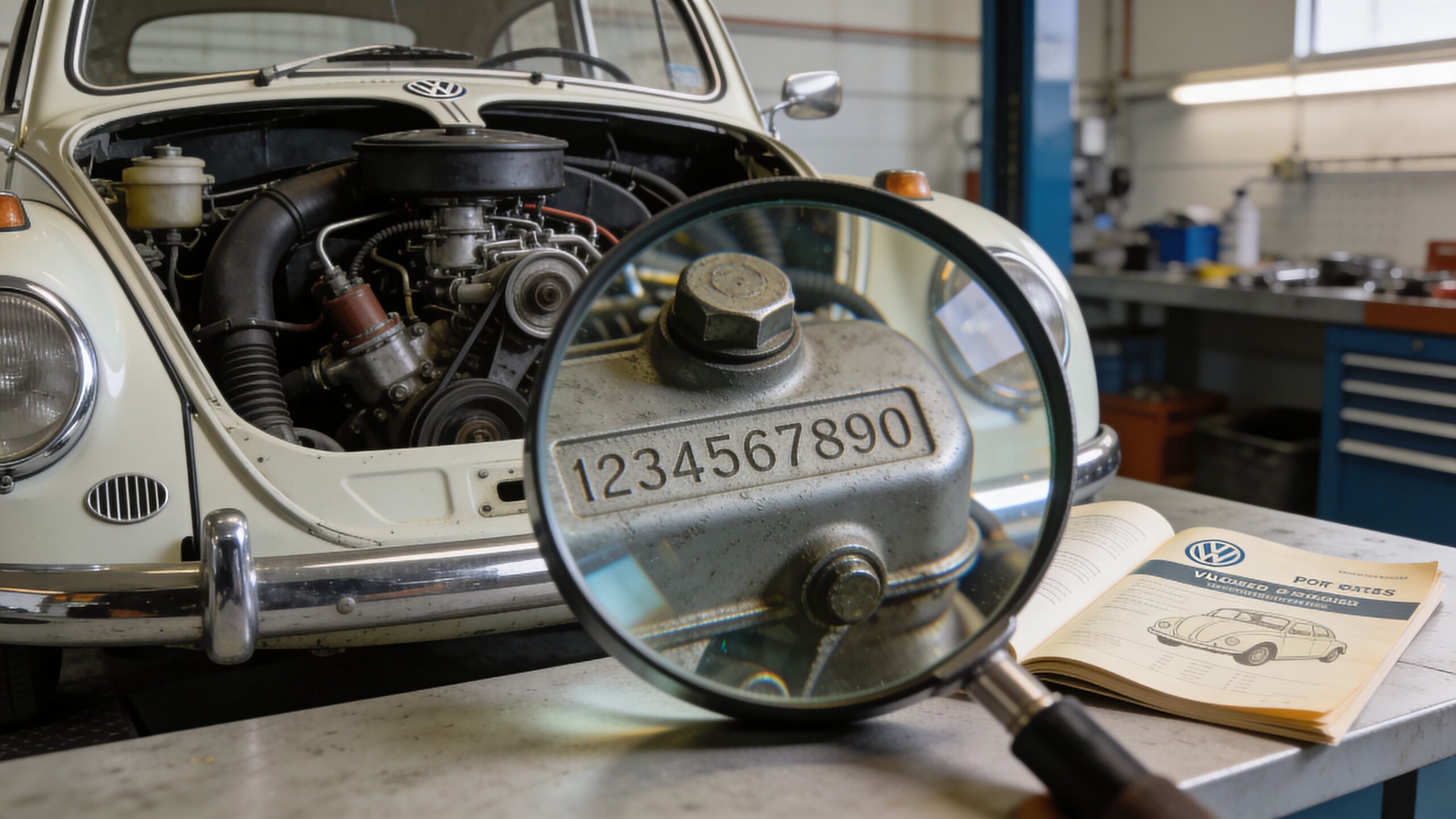
A magnifying glass focusing on a numeric serial code on a vintage Volkswagen Beetle engine part.

Reading the code without losing your mind

Volkswagen gave its parts numbers a logic that starts to feel reassuring once you have handled enough greasy tins, switches, brackets and trim. The opening digits point you toward the model family. On Beetle parts, you will often see 111, 113 or other Type 1 prefixes. After that, the number usually leads you into a parts group, so the code begins to hint at whether you are looking at engine hardware, gearbox pieces, brake components or body fittings.

That matters at a market stall, in a shed, and even while scrolling late-night classifieds. A seller might describe something as "Bug only" because it looks close enough. The number often tells a stricter story. It can reveal that a piece came from a different year, a different engine generation, or another Volkswagen entirely.

You start seeing patterns after a while. Early engine pieces carry clues from the 36hp and 40hp years. Later numbers often reflect the shift into the 1300, 1500 and 1600 era, where Volkswagen shared some design thinking across models and changed details that catch out new owners. A pushrod, tinware screw, carburettor fitting or switch bezel can seem interchangeable until the code says otherwise.

For restorers, that saves money and frustration. For collectors, it sharpens the eye. If you own a diecast Oval or a neatly restored 1967 sedan, the right details are what give it honesty.

Year changes that shape the car’s identity

A Beetle can fool you from ten paces.

I have seen tidy cars wearing the wrong taillights, later bumpers on earlier guards, and interiors that looked handsome until you noticed the steering wheel belonged to another decade. Nothing was unusable. Much of it bolted straight on. Yet the car felt slightly out of tune, like a cover band hitting the notes but missing the swing.

That is why year changes matter so much in Type 1 circles. The rear window shape tells one chapter of the story. Lights, bumpers and decklids tell another. Door furniture, dash layout and seat frames carry their own little timeline. Each change marks Volkswagen's slow evolution from spare post-war people's car to the Beetle many Australians grew up with.

A quick check list helps when you are sizing up a car, a part, or even a model on a shelf:

  • Rear window style sets the era at a glance.
  • Headlights, taillights and bumpers often reveal whether the body matches its claimed year.
  • Decklids, guards and exterior trim are common swap points because they fit across more than one period.
  • Steering wheels, dashboards and seats shape the whole character of the cabin.

That same eye helps diecast collectors avoid the usual disappointments. A miniature meant to represent an early 1960s Beetle should carry early 1960s cues, not a mash-up of later wheels, brightwork and lamps. The best replicas feel right because somebody cared about the same details a restorer cares about.

OEM, NOS and reproduction in plain English

At club meets around Australia, this conversation never gets old. One owner waves a dusty factory box like treasure. Another says the reproduction part worked perfectly. A third mutters that he fitted three cheap versions before finding one that lined up.

The terms are simple enough once you strip away the jargon.

Type Best for Trade-off
OEM Factory-spec fit and feel Can be harder to find
NOS Unused period stock for original cars and serious collectors Age and storage still matter
Reproduction Keeping cars on the road when originals are scarce Quality varies from excellent to disappointing

OEM parts are the benchmark many owners use when they want a Beetle to shut, steer, run or fit the way Volkswagen intended.

NOS, or New Old Stock, carries a special thrill. You open an old box, smell the paper and preservative, and for a moment you are back in a dealership parts department. Still, old stock is still old. Rubber hardens. Chrome can suffer. Paint and packaging can hide a rough life on the shelf.

Reproduction parts keep the hobby alive, especially here in Australia where local supply can be patchy and freight can turn a small purchase into a serious decision. Some reproduction pieces are excellent and save a project. Others need trimming, fettling or a second attempt. Old hands usually spend their money carefully on structural, mechanical and safety-related items, then relax a little on minor trim.

Workshop wisdom: Buy quality for the jobs that punish you for doing them twice.

Why this matters to collectors too

The bridge between the workshop and the display cabinet is shorter than it looks.

A person restoring a Brunswick Blue Beetle and a person hunting the perfect 1:18 model are chasing the same thing. They both want the car's character to ring true. The right wheel style, the proper badge, the correct year of bumper, the shape of the rear lamps. Those details are how a Beetle keeps its identity.

That is part of the Beetle's soul, especially in Australia where local memories matter as much as factory facts. Maybe your reference point is a family Bug that spent summers down the coast. Maybe it is a dealer brochure from Melbourne, a service sticker from Adelaide, or a diecast model that matches the car your grandfather drove in Perth. Once you can read part numbers and year changes, those objects stop being generic Volkswagen things. They become pieces of one very specific story.

OEM Repro or NOS Navigating the World of Type 1 Parts

Every Beetle tells you what sort of life it’s had. One car has a soft, original feel with old German metal still doing its job. Another has lived through decades of budget fixes, aftermarket improvisation and one owner who clearly believed a hammer was a precision tool. That’s where the parts question gets real.

A local Bug I know well started as a tidy driver with a smoky engine and a gearbox mount that had seen better days. Its owner wasn’t building a museum piece. He wanted a reliable Sunday runner that still felt like a Beetle. So every purchase became a balancing act between authenticity, availability and common sense.

The purist path and the practical path

For structural or core mechanical pieces, many owners still prefer original-spec parts when they can get them. A genuine crankcase, for example, carries a certain confidence because it’s what the engine’s design was born around. But not every original component is waiting on a shelf in mint condition, and not every project needs concours purity.

Reproduction parts can be the difference between a stalled project and a finished car. The trick is knowing where compromise is safe and where it becomes expensive later. Cheap cosmetic trim might only annoy you. Poor internal engine parts can ruin a weekend and an engine together.

Engine choices that change the whole personality

Type 1 engines live and die by correct matching. Displacement comes from bore and stroke working together, and common configurations include 1600cc, 1641cc and 1776cc. Crankshaft matching matters because the wrong combination can cause engine damage. The same source also notes that builders weigh original VW crankcases against aftermarket alternatives, and some builds use specs such as 8 dowel pin counterweight crankshafts. That foundation is outlined in this VW Type 1 bore and stroke engine size guide.

That sounds technical until you see it play out in the shed. A stockish engine usually suits an owner who wants easy manners, a familiar feel and less fuss. A larger combination can wake the car up, but only if the rest of the build respects the geometry and the parts work together.

A Beetle’s common aches and the parts choices behind them

Here, stories from old cars become useful.

  • The tired commuter Beetle often wants sensible reliability parts. Good ignition pieces, sound fuel delivery parts, proper mounts and carefully matched internals.
  • The sentimental family Bug usually rewards restraint. Keep the driving character intact, repair what’s worn, and avoid upgrades that erase its personality.
  • The weekend toy gives you more freedom. You might accept a few non-original choices if they improve drivability and don’t upset the car’s balance.

One owner I know chased NOS anything he could find, then switched to selected reproduction parts for the jobs nobody sees and the items he needed quickly. Another went the other way. He started cheap, got burned on fit and finish, then rebuilt sections properly with better quality pieces.

The right answer isn’t a slogan. It depends on whether you value period correctness, day-to-day reliability, or simply getting the car back into the sunlight.

A simple buying filter

If you’re stuck, use this order of priority:

  1. Safety first. Brakes, steering and structural hardware deserve quality over convenience.
  2. Core engine internals next. If it means splitting the engine again later, don’t gamble.
  3. Fit-sensitive body parts after that. Badly made panels and trim create endless frustration.
  4. Minor cosmetic items last. These are easier to revisit when better examples turn up.

This is also where collectors can learn something from restorers. When you know how much care goes into choosing a real crankcase, mount or trim piece, you start appreciating why an accurate miniature with the right details feels special. It reflects decisions that mattered on the actual car.

Trouble in Paradise Common Failures and Must Do Maintenance

The Beetle is tough, but it isn’t magic. Leave one sitting, ignore its warning signs, or trust ancient rubber and wiring just because the car still starts, and it’ll eventually remind you that simplicity still needs care.

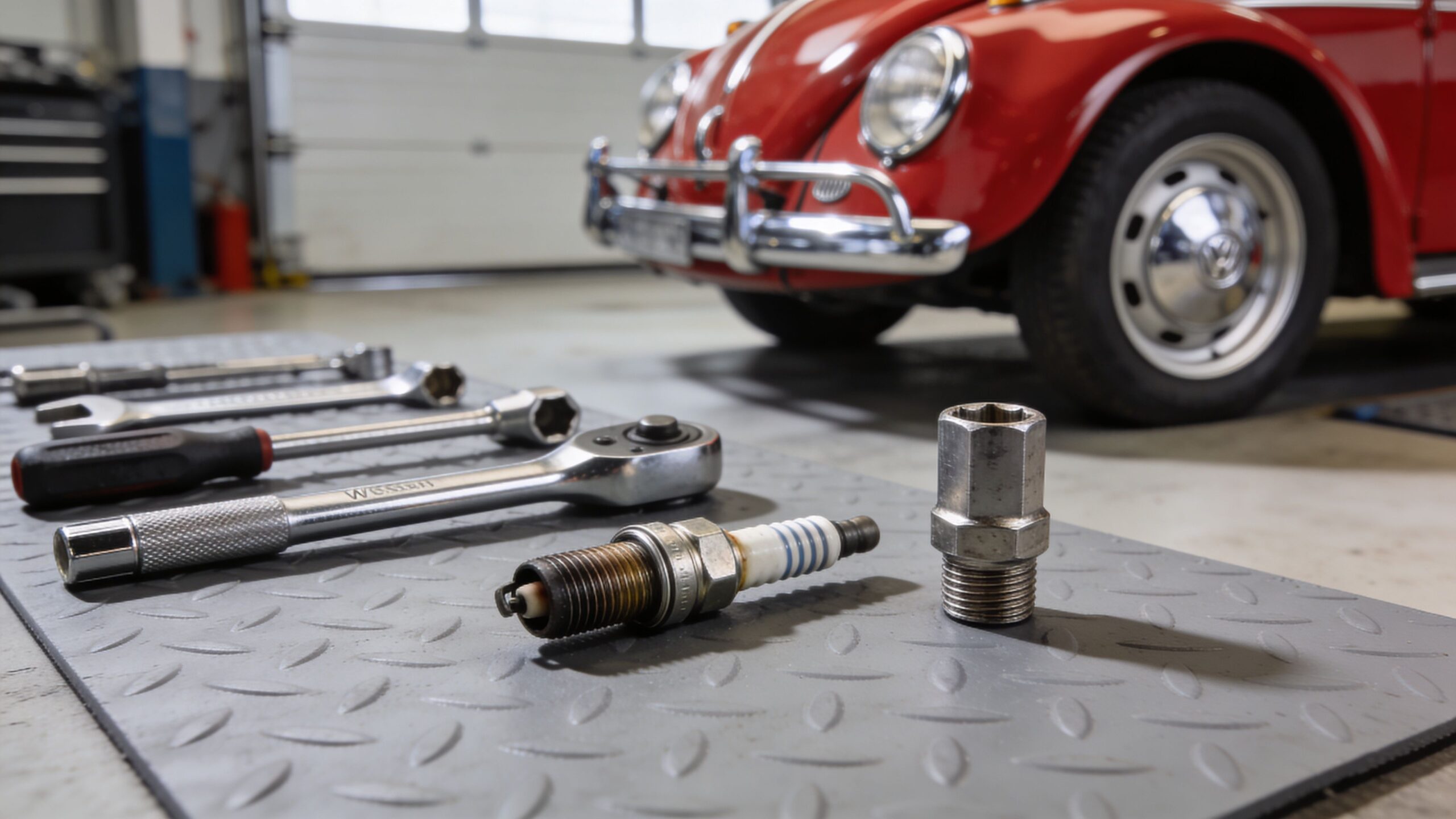
A close-up view of spark plugs and metal tools on a work mat with a red VW Beetle behind.

Rust never sleeps

Ask any long-time owner where to look first and the answer usually comes fast. Heater channels, under the battery, and the spare wheel well. Those spots cop moisture, neglect and years of “it’ll be right” storage.

What matters is not just spotting rust, but understanding what it means:

  • Heater channels affect structure as well as comfort.
  • Battery tray corrosion can spread further than it first appears.
  • Spare wheel well rust often hints at front-end water ingress or past repairs.

A shiny Beetle can still hide nasty surprises in these places. Tap, inspect, torch in hand. Don’t let glossy paint do the talking.

The lumpy idle and the lazy start

A Beetle that won’t settle into a smooth idle often needs basic honesty before exotic diagnosis. Check ignition condition, fuel delivery and carburettor tune. Many rough runners don’t need heroics. They need patient adjustment and parts that aren’t half-worn.

Electrical gremlins also love old Volkswagens. A weak connection, tired switch, poor earth or charging issue can turn a cheerful little Bug into a stubborn one. The car usually gives clues. Dim lights, slow cranking and random cut-outs rarely arrive unannounced.

A Beetle rewards methodical owners. Change one thing at a time, test, and listen to what the car is telling you.

Maintenance that keeps a Type 1 sweet

There are jobs every owner should either learn or understand well enough to discuss with a mechanic.

Job Why it matters Typical parts involved
Valve adjustment Keeps the engine breathing properly rocker gear hardware, gaskets
Ignition service Helps starting and running plugs, leads, distributor items
Fuel system checks Reduces leaks and poor running hoses, clamps, carburettor service parts
Brake inspection Keeps the car safe and predictable shoes, cylinders, hoses, hardware

A collector’s eye gets sharper too. If you understand what proper engine tin, plug leads, badges or lights should look like on an authentic vehicle, you’ll judge models and memorabilia differently. The details stop being decoration. They become evidence.

Why real parts knowledge improves collecting

A lot of people treat restoration and collecting as separate hobbies. I don’t think they are. They’re two ways of paying attention.

When you’ve spent time learning what a correct decklid handle looks like, or why a wheel style belongs to a certain era, you’ll spot that same truth in miniature. You’ll notice when a model captures a Beetle’s stance properly. You’ll care whether the trim matches the year. Your shelf becomes a little more informed, and a lot more satisfying.

Beyond the Engine Bay Collecting and Displaying VW Heritage

I watched a young bloke at a Sydney cars and coffee pick up an old VW bonnet badge once. He turned it over in his hands longer than he spent looking at the engines. The chrome was tired, the pins were worn, and it had the kind of scratches you only get from years of washing, polishing and daily use. His father was beside him talking carburettors, but the son kept coming back to that badge. He could see the car in it.

That is part of the Beetle’s magic. A Type 1 lives in its little details as much as its mechanicals. The bonnet badge. The hubcap with the proper dome. The trim that catches low afternoon light in a way no modern hatch ever seems to manage.

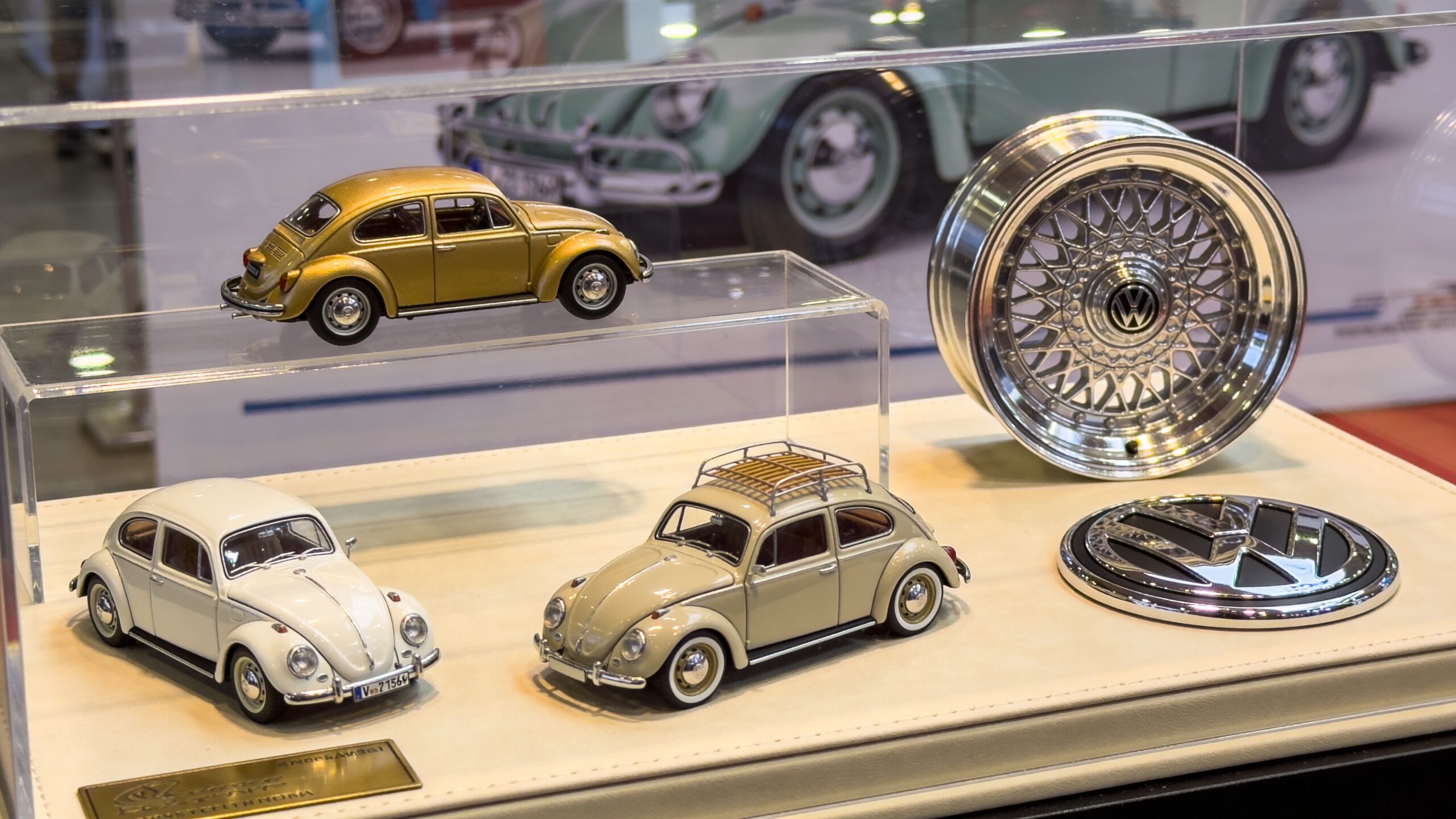
A display case featuring three miniature Volkswagen Beetle models, a metallic alloy wheel, and a VW emblem.

Among VW people, those pieces create a natural meeting point between the restorer chasing correct parts and the collector building a shelf full of memories. One wants the right emblem for a car. The other wants the same emblem because it carries the shape, era and feeling of the Beetle into a study, garage or living room. In Australia, where family Bugs, beach trips and local club runs sit so close to the culture, that overlap feels especially strong.

The parts that tell stories

A rocker cover can be spotless and still say very little. An original badge or trim strip often says plenty.

Exterior pieces age where everyone can see them. Sun dulls them. Hands polish the high spots. Road grit leaves its little marks. If you have ever found an old dealer badge in a swap meet box, you know the feeling. You are not just buying metal. You are holding a clue to where that Beetle lived and who cared about it.

That is why home and garage displays work best when they borrow from real cars instead of looking like generic retro decor. A shelf with an original emblem, a period brochure and one well-chosen diecast Beetle has more heart than a dozen random ornaments. The same appeal runs through vintage home accessories for VW-themed spaces, especially if you want your display to feel like a tribute rather than a catalogue.

Why diecast gets better when you know the real car

The best Beetle models are convincing for the same reason a good restoration is convincing. The details are right.

A collector who knows Type 1 parts will spot the difference straight away. The wrong bumpers can throw off the whole year. Wheels can date a model in seconds. Window shapes, trim lines, taillights and badges all matter. A diecast Beetle is small, but the judgement behind it is not.

That makes collecting more satisfying in a very practical way:

  • Year-correct details stand out once you know what belongs on an early car and what belongs on a later one.
  • Trim and emblem pieces carry more weight because they are part of the Beetle’s identity, not just decoration.
  • Stance matters more because the Bug has a look that is cheerful, upright and unmistakably its own.

Collectors who start with one Beetle often branch into the wider VW family as their eye sharpens. Australian shelves are full of little stories like that. A Bug from childhood. A Kombi from a surf trip. A panel van that looks like one a local electrician drove in the 1970s.

For a closer look at why those details matter to enthusiasts, this short video captures the kind of visual affection VW people have always had for the marque.

Displaying the collection with a bit of soul

The best displays I have seen were never the biggest. They were the most personal.

One club member in Melbourne keeps a small oval-window diecast next to the hubcap from his first Beetle. Another has framed a dealer plate surround above a shelf of Australian-delivered VW models. Both displays work because they connect object to memory.

A few habits help:

  • Pair real and miniature pieces so the shelf reflects both the actual car and the memory of it.
  • Group items by era because early and late Beetles speak in different visual accents.
  • Use wall space well with signs, framed prints and small objects arranged like a tidy garage corner.
  • Let one piece lead whether that is a rare badge, a crisp diecast, or a model of a Kombi every local enthusiast recognises.

A good display makes the Beetle feel present, even when the car is parked somewhere else.

That is the pleasure of this side of the hobby. The greasy-knuckled restorer and the memorabilia collector are often chasing the same thing. They both want to keep the Beetle’s character alive, whether it sits on jack stands in the shed or in perfect miniature on a shelf.

Your Local Workshop Sourcing VW Parts and Memorabilia in Australia

Australian VW culture has its own flavour. You see it at Volksfest, at the VW Nationals, and in the way people chat around a car here. There’s less posing, more storytelling. Someone always knows where a car came from, who painted it, or which family had it before.

That local passion has deep roots. Volkswagen assembly in Australia started in 1954 at the Clayton plant in Melbourne, and the operation produced over 100,000 Beetles by the 1960s. The same historical overview notes that over 200,000 Type 1 vehicles were imported or assembled locally over the years, which helps explain why the Beetle still feels so embedded in Australian enthusiast life. That history is outlined in Heritage Parts Centre’s history of the VW Beetle.

Why buying locally matters

Anyone in Australia who’s ordered niche VW gear from overseas knows the feeling. You wait. You hope the photos were honest. You cross your fingers about shipping damage, customs surprises and whether the item will look the way it did on the screen.

Local sourcing takes a lot of that stress out of the hobby. It usually means clearer communication, easier support and a better feel for what Australian buyers want. That matters just as much for memorabilia as it does for practical parts, especially if you’re buying a gift or trying to complete a themed display before an event.

If your interest leans toward decorative and collectible pieces inspired by real Beetle details, a category like Volkswagen Beetle parts can make browsing simpler because it keeps the visual language of the Type 1 together in one place.

Practical checks before you buy

A few habits save disappointment:

  • Check the year feel. Even decorative items and models should suit the era you love most.
  • Read the finish closely. Chrome, paint tone and trim style are often what separate average from memorable.
  • Think about display context. A shelf piece for a study may differ from what you’d choose for a garage or gift.
  • Buy with a story in mind. The best piece is usually the one that connects to a real memory, car or period.

For Australian enthusiasts, that local connection counts for a lot. We’re not just buying objects. We’re keeping a long-running conversation alive, one that started on local roads decades ago and still turns heads every time a Beetle rolls into a sunny car park.

Conclusion Keep the Passion Rolling

The beauty of the Beetle is that it welcomes all kinds. The hands-on restorer chasing the correct mount or pushrod. The nostalgic owner preserving family history. The collector who wants a Volkswagen Beetle model that gets the details right. It’s all part of the same affection for one of the world’s most recognisable cars.

Learn the right parts, and the car opens up. Learn the visual details, and every badge, trim piece and diecast replica gains meaning. That’s how the passion keeps rolling.


If this article has stirred up your love for classic Volkswagens, have a look through Volkswagen Memorabilia for licensed VW-themed diecast models, collectible gifts and display pieces that celebrate the Beetle, Kombi and the wider VW story with an Australian touch.