


You’re probably here because a vw baja bug has got under your skin.
Maybe you saw one years ago parked near the dunes with salt on the guards and a surfboard leaning nearby. Maybe you’ve got an old Beetle in the shed and keep wondering whether it wants to become something wilder. Or maybe you just love the look of those lifted, cut-away Bugs and want a diecast version for the shelf above your workbench.
Whatever brought you in, the Baja Bug has a way of doing that. It takes the familiar, friendly shape of a Volkswagen Beetle and gives it a rebellious streak. It still feels like a VW. It just looks ready to leave the bitumen behind.
The Roar of Freedom and the Smell of Salt Air
A Baja Bug makes sense the moment you hear one.
That air-cooled thrum bounces differently when the car sits higher, wears chunky tyres, and looks like it would rather chase a sandy track than sit politely in traffic. On an Aussie beach road or a dusty bush run, it has a kind of cheerful defiance about it.
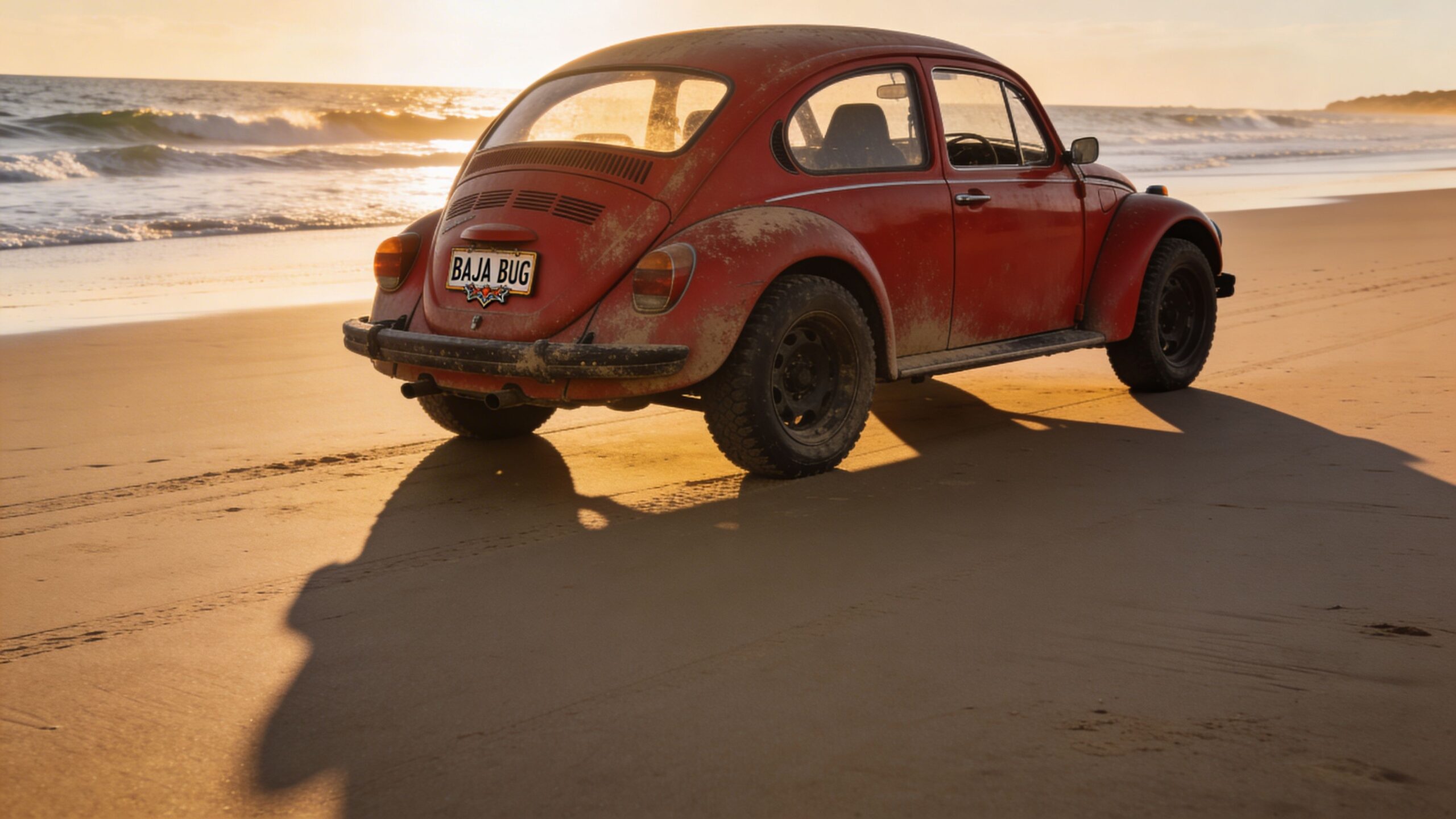
The charm starts with contrast. A standard Beetle is rounded, tidy, almost humble. A Baja Bug keeps that soul but adds attitude. The guards are cut back. The stance rises. The wheels look ready for ruts and washouts. Even standing still, it feels like motion.
Why people fall for them
Some classics impress you with chrome and polish. The Baja Bug wins people over another way.
- It looks honest: Nothing on a Baja Bug feels fussy. Every visible change suggests use.
- It invites adventure: You don’t need to know every mechanical detail to understand what it wants to do.
- It carries nostalgia: For many Australian VW fans, it taps into beach culture, shed-built projects, and old-school weekends away.
- It suits collectors too: Even in miniature, the shape is unmistakable. A good Volkswagen Beetle model in Baja trim brings that whole mood onto a shelf.
A Baja Bug is one of those rare cars that feels playful and tough at the same time.
At a car show, it’s often the one people lean in to inspect. Kids spot the raised suspension. Old hands look for clever fabrication. VW tragics start swapping stories about beach runs, broken mounts, fibreglass front ends, and the one they nearly bought years ago.
That’s the magic of it. The vw baja bug isn’t just a modified Beetle. It’s a rolling expression of freedom, ingenuity, and the idea that a simple little car can go a very long way with the right spirit.
From Dusty Mexican Trails to a Global Legend
The Baja Bug didn’t begin as a styling exercise. It came from people asking a practical question. How do you make a humble Beetle survive rough country and keep going?
The answer appeared in the harsh conditions of off-road racing.
Where the story really starts
The first Baja Bug in competitive racing history was pioneered by Californian cartoonist Dave Deal, who entered a modified Volkswagen Beetle in the inaugural Mexican 1000 rally in 1968 in Baja California. That event stretched for over 830 miles, and it showed just how adaptable the Beetle could be when prepared for rough terrain, according to the Baja Bug history summary on Wikipedia.
That matters because it gave the car a proper proving ground. The Beetle wasn’t being turned into an off-roader in theory. It was being tested where suspension travel, clearance, durability and simplicity genuinely mattered.
Why the Beetle was such a strong base
The Beetle had a few natural advantages that made this transformation possible.
First, it was light. A lighter car has an easier time on rough surfaces than a heavy one that sinks, crashes and drags itself through every obstacle.
Second, it was simple. That air-cooled layout and straightforward mechanical design made the Beetle easier to adapt than many more complicated vehicles of the time.
Third, it had a shape and structure that encouraged experimentation. Builders could trim bodywork, lift the stance and reinforce key areas without losing the basic identity of the car.
How racing shaped the formula
The early race builds established the recipe that people still recognise today:
- Lift it up: Extra ground clearance helped the Bug clear rocks, ruts and soft terrain.
- Trim what gets in the way: Cutting fenders and other vulnerable panels gave the wheels room to move.
- Strengthen the weak points: Rough tracks punish frames, mounts and suspension components.
- Keep the VW spirit: Even modified examples still relied on the Beetle’s core layout.
That same development path fed directly into SCORE International Class 11 rules, which require a stock VW chassis with modifications focused on increased ground clearance and frame strength, as noted in that same historical reference.
The Baja Bug became iconic because the changes were driven by need, not fashion.
Why the idea spread so widely
Once enthusiasts saw what a Beetle could do off-road, the concept travelled fast.
You didn’t need a factory team or a huge budget to understand the appeal. A common little Volkswagen could be transformed into something that looked rugged, purposeful and full of personality. That made it irresistible to racers, home builders and dreamers alike.
And that is why the Baja Bug still grabs attention today. Its origin story is not polished or corporate. It was born in dust, necessity and a bit of cheeky creativity.
The Anatomy of a True Off-Road Rebel
A proper Baja Bug has a look you can spot from across a paddock. It sits taller, shows more tyre, and wears fewer frills. But the best part is this. Most of those visual cues exist for a reason.
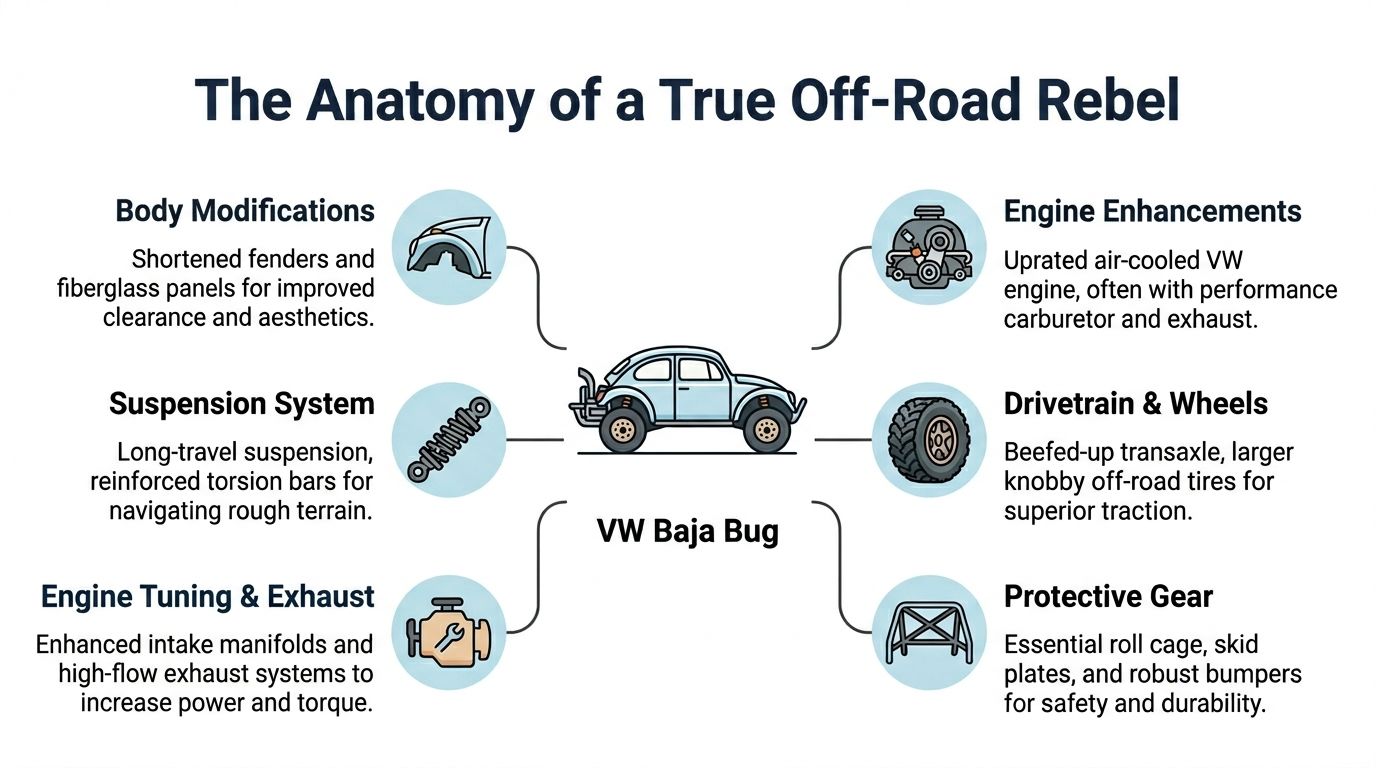
If you already love the classic Beetle shape, a Baja version can seem a bit rough on first glance. Then you realise every cut and every bolt-on piece is part of a practical off-road mindset. It’s the same kind of hands-on ingenuity that made the standard Beetle beloved in the first place. If you want a refresher on that original DNA, the story behind the VW Beetle helps explain why the platform works so well.
Body cuts that do more than look tough
The trimmed bodywork is often the first feature people notice.
Cut-away front and rear guards open up space around the tyres. That extra room matters when the suspension moves through bumps, dips and uneven ground. Many builds also replace steel panels with fibreglass pieces, which can simplify repairs and sharpen that unmistakable Baja silhouette.
The visual result is dramatic. The practical benefit is clearance.
Suspension and ride height
A Baja Bug needs to sit up properly. If it doesn’t, it just looks like a Beetle in costume.
Lifted suspension gives the car more room underneath and helps it cope with rough tracks, sandy approaches and rocky sections. The geometry, shocks and general setup vary from build to build, but the aim is always similar. Keep the underbody safer and let the wheels work over bad surfaces.
Here’s where people often get confused. A lift is not only about making the car taller. It’s about letting it travel and recover better when the ground gets ugly.
The exposed rear and engine character
Many Baja Bugs run with an exposed or partly exposed engine area.
That stripped-back rear end removes vulnerable bodywork and makes the car’s mechanical heart part of the visual theatre. You’ll often see a raised exhaust, commonly called a stinger, pointing proudly skyward. It looks wild because it is wild, but it also fits the no-nonsense spirit of these builds.
If a standard Beetle hides its hardworking bits, a Baja Bug puts them on show.
Tyres, wheels and protection
Chunkier off-road tyres are central to the whole package. They help with grip on loose surfaces and instantly change the personality of the car.
Then come the supporting pieces:
- Roll cages: added for safety and chassis support
- Skid protection: useful when terrain gets rough underneath
- Reinforced bumpers: handy on cars built for actual use
- Lighting upgrades: common on cars meant for trails or events
How to tell a real Baja-inspired build from a cosmetic one
Some cars wear Baja styling. Others were built with off-road use in mind.
A more serious build usually shows thought in the places casual viewers miss:
| Feature | Cosmetic build | Purpose-built build |
|---|---|---|
| Stance | Mildly raised for appearance | Lifted with usable clearance |
| Bodywork | Trimmed for style | Cut to improve wheel travel and clearance |
| Tyres | Road-biased look | Off-road tread chosen for terrain |
| Protection | Minimal | Cage, guards, or underbody protection often present |
| Overall feel | Custom Beetle | Off-road Beetle with intent |
That difference is part of the appeal. A vw baja bug is not one single formula. It’s a family of builds, all orbiting the same idea. Take a Beetle. Keep the soul. Make it fearless.
The Baja Bug Down Under An Aussie Icon
Australia was always going to warm to the Baja Bug.
We understand cars that are a bit scrappy, a bit clever, and ready for conditions that don’t flatter delicate machinery. Sand, scrub, corrugations, salty air, old beach roads. A lifted Beetle with a sense of humour fits right in.
Why it found a home here
The Baja Bug suits the local VW spirit because Australians tend to put their own spin on things. We respect originality, sure, but we also admire a practical build that solves real problems.
That’s part of why the scene has held on. In Australian VW enthusiast circles, Baja Bugs remain a lively niche, with median sale prices reaching AU$25,000 in 2026 auctions. The Volkswagen Club of Australia records over 500 registered Baja conversions since 1990, making up 12% of air-cooled VW off-road entries in national events, while 70% of Australian builds use aftermarket lift kits from Brisbane suppliers, according to The Classic Valuer’s Baja Bug market page.
Those figures tell you this is not some forgotten subculture. It’s a real slice of Australian VW life.
The Aussie flavour of the build
What makes an Australian Baja Bug feel local is often the atmosphere around it.
You see these cars linked with surf culture, coastal cruising, regional meets, dusty paddocks and friendly club talk. They share garage space, at least spiritually, with beach vans and road-trip Volkswagens. That same easygoing vibe is a big reason many enthusiasts also love the style of the VW travel van, even though the experience behind the wheel is completely different.
A Kombi says slow adventure. A Baja Bug says noisy mischief.
Why Australian enthusiasts ask different questions
American Baja content often focuses on desert builds, big fabrication projects and parts sources based overseas. Australian owners and buyers usually have a different set of concerns.
They want to know things like:
- Will this pass local roadworthy requirements?
- Has salt exposure already done damage to the shell?
- Can I still get sensible parts without endless waiting?
- Was this built for our conditions, or copied from a US look?
That local lens matters. A Baja Bug in Australia is not just a copy of a Californian idea. It has been adapted to our roads, our registration realities, and our coastal lifestyle.
The Australian Baja scene has always felt hands-on. Less posing, more practical tinkering.
That’s a big reason the vw baja bug still turns heads here. It isn’t precious. It’s personal.
Collecting the Legend Baja Bug Diecast Models
Not everyone has the shed space, budget, patience, or registration appetite for a real Baja Bug. That’s where collecting becomes such a joy.
A good diecast captures the same stance, the same cheeky attitude, and the same visual punch that makes the full-sized car so memorable. For plenty of enthusiasts, collecting is not the backup plan. It’s part of the hobby.
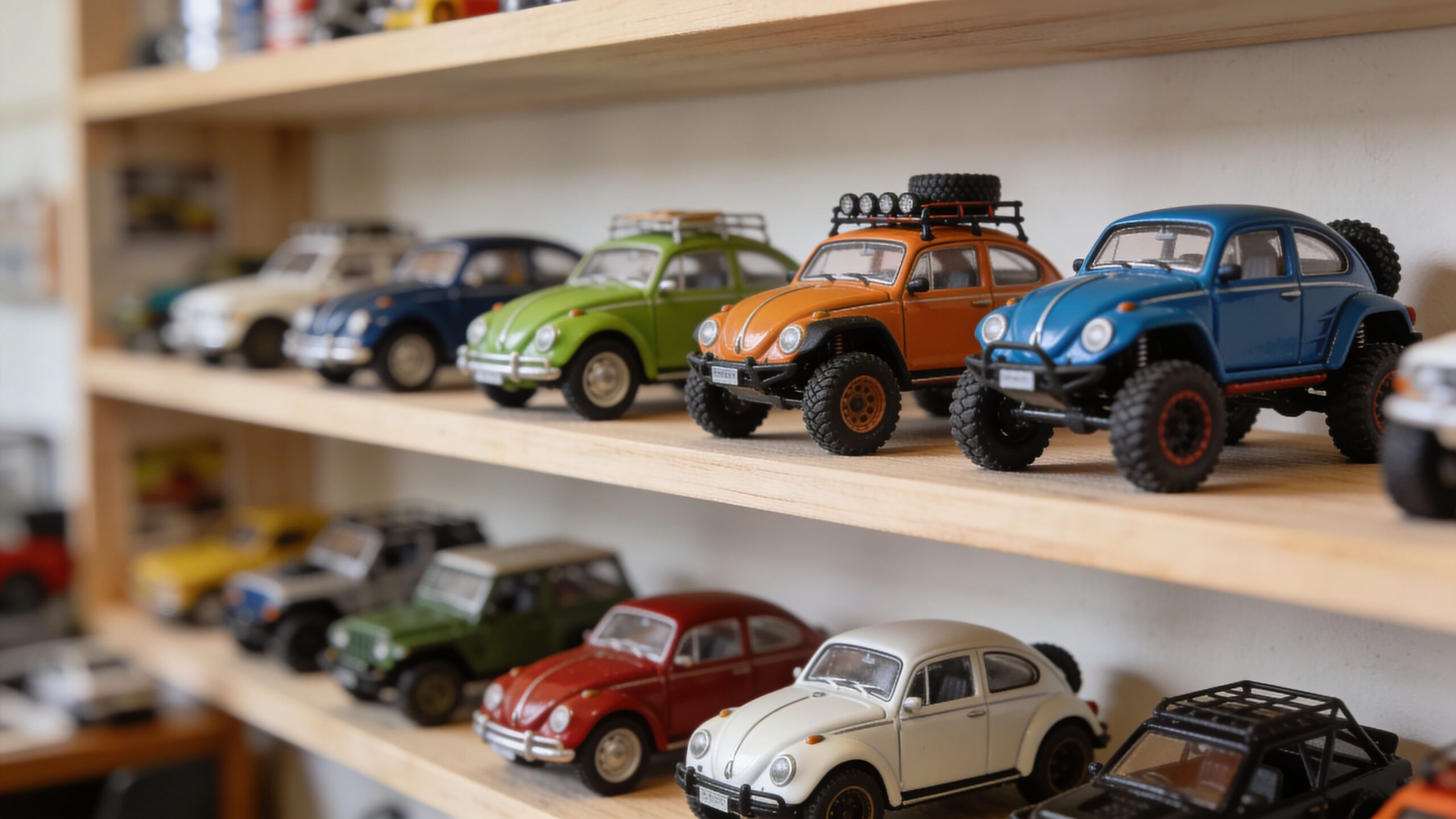
In Australia, interest is clearly there. Google Trends AU data shows “Baja Bug model” searches are up 45% in 2025-2026, linked to retro surf events, and the same source notes that this demand is underserved by guides because most existing content focuses on full-size cars rather than 1:18 or 1:24 replicas, as discussed in this Baja Bug memorabilia trend reference.
Choosing the right scale
Scale is where new collectors often hesitate. The best choice depends on how you want to enjoy the model.
Some people want a centrepiece with lots of visual detail. Others want a neat row of VWs on a shelf in the study, garage or rumpus room.
Here’s a simple comparison.
Baja Bug Diecast Scale Comparison
| Scale | Typical Length | Detail Level | Best For |
|---|---|---|---|
| 1:18 | Large display size | High visual detail | Feature shelves, desks, statement displays |
| 1:24 | Mid-sized and versatile | Strong balance of size and detail | Most home collections |
| 1:32 | Compact | Simpler detailing | Smaller shelves, grouped displays, casual collectors |
What to look for in a quality model
Not every model gives the same satisfaction once it’s in your hands.
A strong Baja Bug diecast usually gets the essentials right:
- The stance: It should sit with purpose. Too low, and the whole character disappears.
- Body shape: The cut guards and Baja proportions need to look intentional, not cartoonish.
- Wheel and tyre choice: These matter more than many collectors realise.
- Paint and finish: Baja models can be bright, dusty-looking, race-inspired or beachy, but the finish should feel consistent.
- Licensed presentation: For many collectors, officially licensed Volkswagen styling adds confidence and display value.
If you also collect buses and Beetles, you'll find the hobby gets fun here. A Baja Bug can sit beside a neat Volkswagen Beetle model, a clean street Beetle, or a row of VW Kombi diecast Australia favourites and instantly add contrast to the lineup.
Display pieces versus play pieces
Some collectors want boxed condition. Others want open-display charm.
Neither approach is wrong. It just changes what matters.
If the model will live on a shelf, focus on silhouette, stance and finish. If it will be handled often, durability matters more. Some people even create little display themes with surf signs, timber shelving, or retro service-station touches.
A few home display ideas sit nicely alongside broader vintage home accessories, especially if your style leans coastal, garage-inspired or mid-century relaxed.
Here’s a video that captures the energy many collectors love in Baja-themed Volkswagen models and builds.
A simple way to start a Baja collection
If you’re just getting into it, don’t overcomplicate the first purchase.
Try this approach:
- Pick one scale and stick with it first. Your shelves will look more organised.
- Choose one anchor piece. Let that be your hero car.
- Build around a theme. Off-road, surf, racing, or classic Beetle evolution all work well.
- Mix carefully. One Baja Bug beside cleaner VW road cars often looks better than a shelf full of near-duplicates.
A great collection doesn’t have to be huge. It just needs a point of view.
That’s why Baja models are so satisfying. They tell a story at a glance.
Styling Your Passion Display and Gift Ideas
A Baja Bug model deserves better than being shoved next to spare keys and old receipts on a crowded shelf.
If you’re going to collect, style it properly. These models have character. Give them a setting that helps that personality come through.
Display ideas that feel lived-in
A Baja Bug sits beautifully in spaces that already have warmth and texture.
Timber shelving works well because it softens the mechanical feel of the model. A surf print nearby, an old road sign, or a weathered photo frame can turn one diecast into a small scene rather than a random object.
Some collectors prefer tidy symmetry. Others go for a looser display that feels like a memory board from a shed near the coast. The Baja Bug suits the second style particularly well.
Try combinations like these:
- Coffee table feature: One larger model on a tray with a motoring book and a small coastal accent
- Garage shelf lineup: Baja Bug beside a standard Beetle and a Kombi for contrast
- Home office corner: A compact model near framed event photos or vintage-style art
- Workshop wall shelf: Pair the model with old tools or VW-themed tin signs
Creating a themed corner
Themed displays work best when they stay simple.
A “beach run” setup might include sandy tones, timber, and one or two blue accents. A “show and shine” arrangement could lean cleaner, with acrylic risers and stronger lighting. A “race-bred” display might include posters, number plates, and workshop textures.
The point is not to overfill the space. Give the Baja shape room to breathe.
The best displays make the model feel discovered, not crammed in.
Why Baja Bug memorabilia makes such a good gift
Gift buyers often struggle because car people can be picky. Fair enough too.
A Baja Bug collectible solves that problem rather neatly. It offers personality without requiring the recipient to commit to a full restoration project, a pile of spare parts, or another thing to register and maintain.
It works especially well for:
- Long-time VW owners who appreciate Beetle history
- Surf culture fans who love the beachy, rebellious vibe
- Collectors of Volkswagen diecast models for sale who want something less ordinary
- People styling a garage, office, bar area or holiday house with classic motoring touches
A Baja Bug model also has a conversational quality that a more formal collectible sometimes lacks. People smile when they see one. They usually have a story, or wish they did.
Keep it cohesive
If you’re adding one as a gift or to your own shelf, think about the wider display.
A Baja Bug often looks strongest when paired with pieces that support the mood rather than copy it. Natural textures, retro colours, clean lighting and a bit of breathing space do more than piling on every VW item you own.
That balance is what turns memorabilia into décor.
Your Guide to Owning a Piece of the Legend
Owning a real Baja Bug in Australia can be immensely rewarding. It can also test your patience if you rush in.
The first thing to look at is the shell. Rust changes everything on an old Beetle, especially if the car has lived near the coast or spent years as a half-finished project. After that, look closely at the quality of the modifications. A tidy Baja-inspired car is one thing. A poorly planned build is another.
What catches buyers out in Australia
Registration and compliance are where many dreamers get a rude surprise.
For Australian enthusiasts, lifted suspensions and shortened fenders need to satisfy Australian Design Rules and VSB14, and this is a frequent sticking point during roadworthy certification for the 150,000+ classic VWs imported annually, as noted in this Australian Baja compliance discussion.
That’s why a real-world buying checklist should include:
- Rust inspection: floors, lower sections, and hidden repair areas
- Modification quality: suspension, mounts, body cuts, wiring and safety equipment
- Paperwork: engineering and roadworthy history where applicable
- Intended use: road cruiser, event toy, display piece, or project base
For many enthusiasts, the smarter first move is to enjoy the legend in miniature while learning what style they love most. A diecast model gives you the shape, the colour, the history and the mood, without the workshop bills or compliance headaches.
If the vw baja bug has stirred up that old Volkswagen feeling, Volkswagen Memorabilia is a lovely place to keep the passion going. You’ll find locally stocked VW-themed gifts, diecast models, and coastal display pieces that suit collectors, classic car lovers, and gift buyers alike. It’s an easy way to bring a bit of Baja spirit, Beetle nostalgia, or Kombi charm into your home, with the bonus of Australian service and fast local shipping.