

At a VW show in Australia, the conversation usually starts the same way. Someone's leaning over a Kombi, someone else is polishing a Beetle badge, and then a mate asks whether Volkswagen has made an electric car that still feels like a proper VW on an Australian road. That question lands because the brand's story here has always been about more than transport, it's been about freedom, touring, and a bit of weekend personality.
That's why the phrase vw electric car australia matters to so many enthusiasts now. It's not just about switching fuel types, it's about whether the next chapter still carries the same shape, spirit, and practicality that made the Kombi, Samba Bus, and Beetle icons in the first place. If you're weighing up an ID.4, an ID. Buzz, or just trying to sort the rumour mill from the truth, this guide keeps the heritage in view while giving you the practical details you need.
From Air-Cooled Classics to Australia's Electric VW Lineup
Saturday mornings at Volksfest or the VW Nationals usually bring out two kinds of people. One group is there to admire patina, roof racks, and polished chrome, and the other is there because they've started wondering whether their next daily driver could be electric without losing the VW charm. That's a fair question, because Volkswagen's appeal in Australia has always blended design, usefulness, and a bit of road-trip optimism.
The modern EV range sits neatly inside that legacy. A Kombi was never just a van, it was a rolling holiday plan. A Beetle was never just a small car, it was simple, clever, and easy to love. The ID. family tries to carry some of that same thinking forward, with the difference that the new chapter is quieter, plugged in, and built for a market where charging, range, and touring need to make sense on real Australian roads.
Volkswagen's local EV story is still young, but it's no longer theoretical. In 2025, electrified vehicles in Australia reached 156,857 sales nationwide, made up of 103,355 battery electric vehicles and 53,502 plug-in hybrids, which lifted electrified vehicles to 13.1% of the market, up from 9.5% in 2024, according to the Australian year-in-review sales data compiled by zecar (zecar's 2025 Australian EV sales review). Volkswagen's own footprint was part of that broader shift, with the ID. Buzz recording 552 sales in 2025 in the local market context described in that same review.
Practical rule: if you love the shape and story of a VW, treat the EV question like a continuation of that story, not a replacement for it.
For collectors and enthusiasts, that makes the present moment a good one. You can keep building the nostalgic side of your garage, display cabinet, or office while learning how the electric side of the brand is settling into Australia. If you're browsing for a gift or a model to mark the transition, a licensed Kombi or Beetle piece is still the easiest way to celebrate the VW heritage while you research the future.
Which VW Electric Models Are Available in Australia Right Now
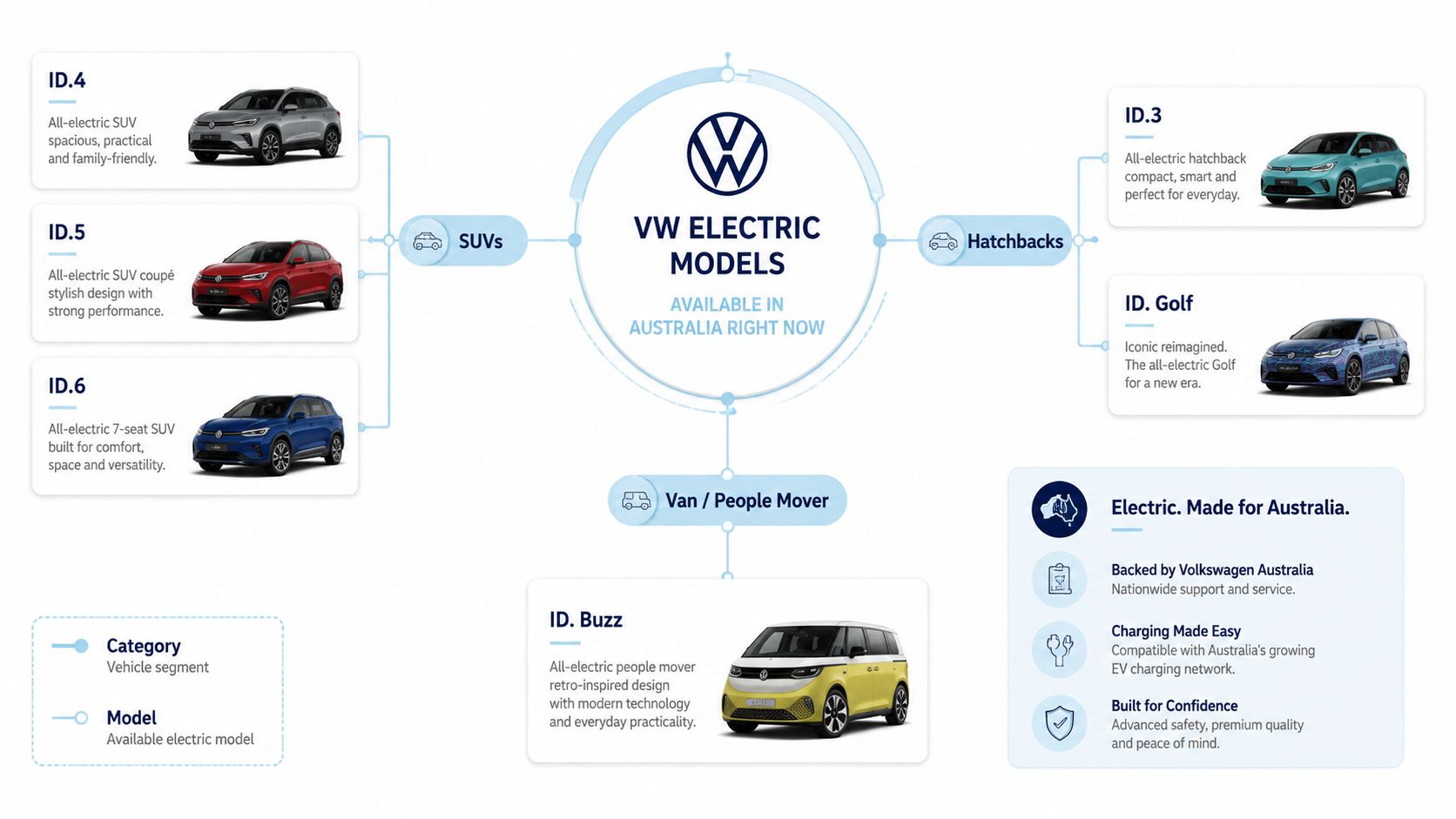
Volkswagen Australia's EV range is clearer than the online chatter makes it seem. The brand's Australian EV page confirms the ID.4 electric SUV and the ID. Buzz electric van as the local line-up, while also noting that images may show overseas models, optional equipment, or features not available here (Volkswagen Australia EV range page). That last part matters, because a lot of confusion starts when international photos get mixed up with Australian availability.
The simplest way to read the current market is by body style. The ID.4 is the family SUV choice, the ID. Buzz is the modern people mover and cargo van interpretation of VW utility, and the ID.5 appears in Australian reporting as part of the local ID. SUV conversation, even though buyers still need to check the current Australian configurator and dealer stock rather than assume every overseas variant is here. For shoppers who care more about real-world use than badge trivia, that distinction is the difference between shortlisting a car and waiting for a dream spec that may never arrive.
What the badges usually mean
The naming can trip people up, especially if you've followed VW Europe news. In plain English, the ID.4 and ID.5 are mid-size SUVs, the ID. Buzz is the electric heir to the Kombi idea, and the Cargo version is the commercial-style van for business buyers. Smaller names like ID.1 and ID.2 are the sort of cars people hope will make EV ownership cheaper and easier, but they're not locked into an Australian launch timetable.
If a model name sounds familiar from overseas media, check whether Volkswagen Australia has listed it locally before you treat it as real stock.
For anyone comparing options, the safest approach is simple. Confirm the model on Volkswagen Australia's own EV pages, then compare the local spec sheets and dealer information. That helps you avoid the common trap of assuming a European launch, a concept render, or an overseas review means the same car is sitting in an Australian showroom right now.
ID.4 and ID.5 Specs, Range and Charging Explained
If you grew up around Kombis and Beetles, the ID.4 Pro is the point where Volkswagen's old-school practicality meets its electric future in Australia. The local ID.4 page shows a rear-wheel-drive SUV with 210kW, 545Nm, a 77kWh usable battery, and 544km WLTP range. The GTX adds a front motor for all-wheel drive, lifts output to 250kW, trims range to 511km, and cuts the 0 to 100km/h time from 6.7 seconds to 5.4 seconds (Volkswagen Australia ID.4 page). That's the familiar EV trade-off, more grip and stronger acceleration in the dual-motor version, with a little less efficiency in return.
ID.4 Pro versus GTX at a glance
| Variant | Motors | Power (kW) | Battery (usable) | WLTP range | 0–100 km/h |
|---|---|---|---|---|---|
| ID.4 Pro | Rear-wheel drive | 210 | 77kWh | 544km | 6.7s |
| ID.4 GTX | Dual-motor all-wheel drive | 250 | 77kWh | 511km | 5.4s |
Those figures are easier to read once you picture everyday driving around Australia. The 545Nm in the Pro should give it the calm, immediate shove you want for merging, overtaking, and climbing hills without fuss. The 250kW GTX is the sharper choice if you want a more planted feel on wet roads or long highway runs, but that extra urgency comes at the cost of some range.
Volkswagen Australia also lists a 1200kg braked towing limit for the Pro, which gives caravan buyers, small trailer owners, and weekend gear-haulers a clearer idea of what the car is built to do (Volkswagen Australia ID.4 brochure). That is enough for many light towing jobs, yet it is still a passenger SUV, so it pays to be honest about the kind of load you plan to carry.
For shoppers who want a local ownership reference point, the model overview at VW ID.4 on Volkswagen Memorabilia sits neatly beside the official VW details while you compare how the car fits into the broader lineup.
ID. Buzz Cargo and People Mover Options for Australian Buyers
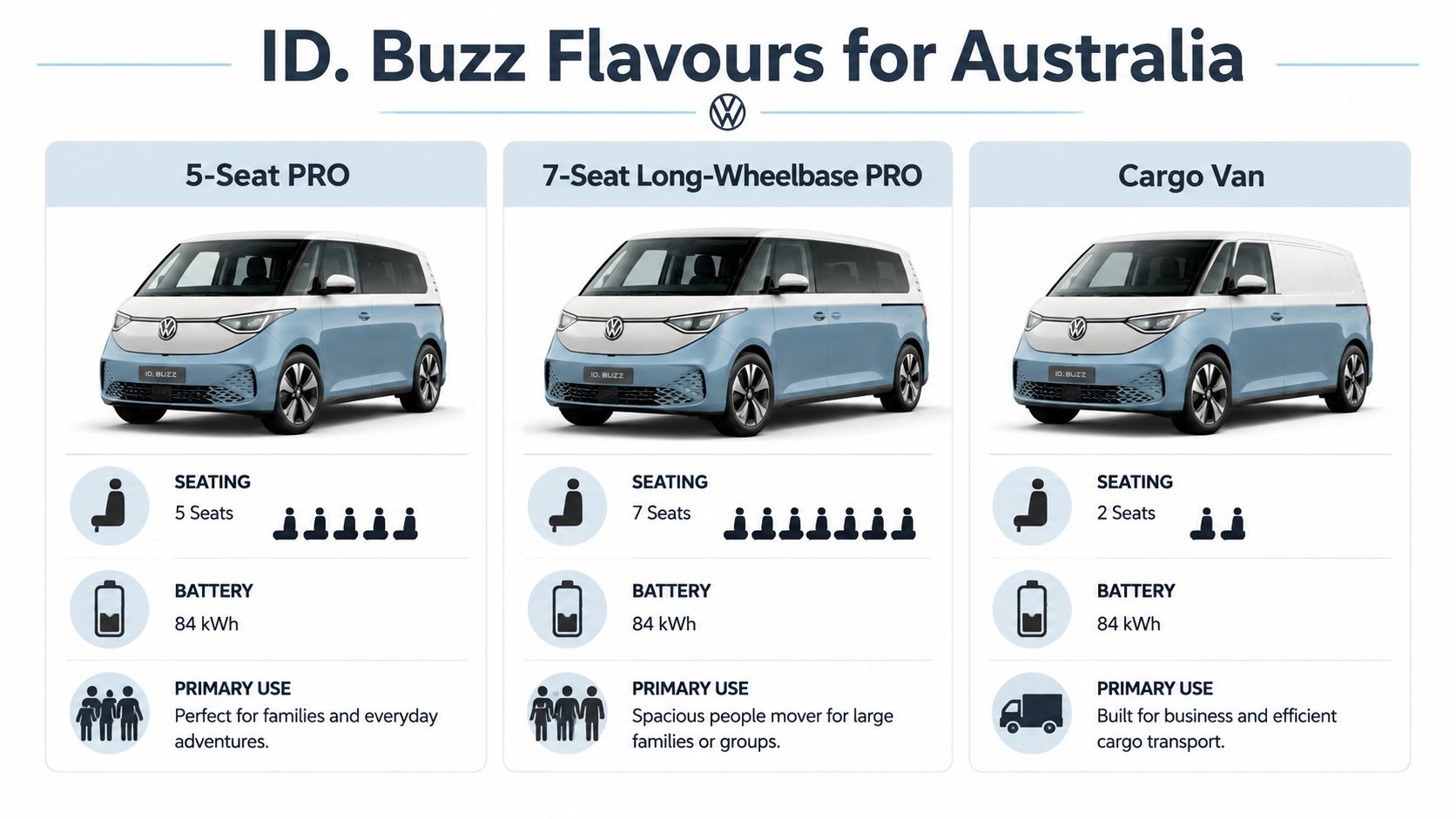
The ID. Buzz brings a bit of Kombi charm back into the showroom, but it does the job with modern EV practicality. For Australian buyers, that matters because the same nameplate can suit a family, a camper setup, or a small business that needs a van every week. Volkswagen Australia lists several local versions, including the 5-seat PRO, the 7-seat long-wheelbase PRO, the Cargo van, and the GTX performance variant, so there is a clear spread between passenger and load-carrying roles (Volkswagen Australia ID. Buzz GTX brochure).
The battery and range figures shift with body style, which makes sense once you remember how much space the Buzz body gives up for people or cargo. RACV reports the 5-seat PRO with an 84kWh battery and 422km WLTP range, the Cargo with 431km, and the long-wheelbase 7-seat PRO with a 91kWh battery and 452km WLTP range (RACV ID. Buzz price and specs). That spread points to the long-wheelbase people mover as the better touring pick, while the Cargo version is aimed at work duties, load space, and everyday hauling rather than family seating.
Charging and performance that suit Australian life
Volkswagen Australia lists 11kW AC charging that takes the battery from 0 to 100% in about 7h30m to 9h, plus DC fast charging up to 200kW with a 10 to 80% top-up in 26 minutes. That sort of charging rhythm suits the way Australians often travel, with a meal break or coffee stop doing double duty as a recharge stop.
The GTX version is the one that will catch the eye of drivers who want more urge without losing the Buzz shape. Volkswagen lists 250kW, 560 to 590Nm, and 6.4-second 0–100km/h acceleration, which helps a tall EV feel settled when it is carrying people, bags, or work gear. The figures line up with the broader local ID. Buzz details in the official Volkswagen Australia material, and the same model family is also discussed in the local buying guide at Volkswagen ID. Buzz Australia price.
A quick video walkaround helps too, especially if you are trying to judge space and stance before visiting a dealer.
Charging, Range and Running Costs in Real Australian Conditions
A lot of first-time EV questions start at the charger, not the showroom. With a VW electric car Australia buyer, that usually means one simple check, can it suit the way you already drive, park, and plug in at home without turning every trip into a planning exercise? The answer depends on the route, the weather, the charging access you've got at home, and how patient you are with stops.
What range really means on the road
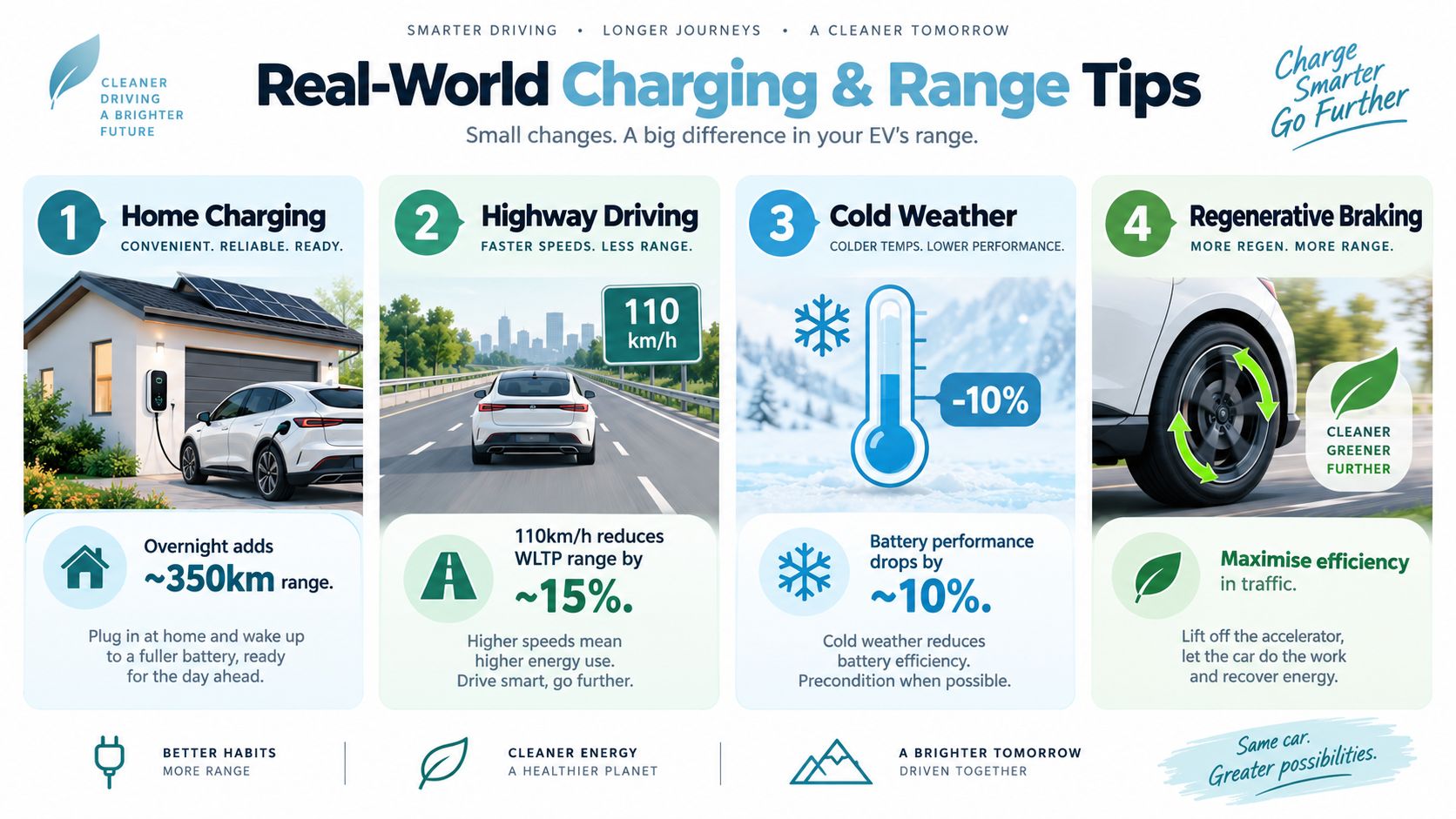
Brochure figures are a starting point, like a speedo reading with the car parked in the workshop. Real Australian driving adds steady motorway speeds, headwinds, hills, and sometimes towing, so the number on the page is best treated as a reference rather than a promise for every trip. That is why many buyers do better by planning around charging stops, instead of chasing the last few kilometres on the display.
The 544km WLTP range listed for the ID.4 Pro gives a useful benchmark, but it is not the whole story. The official Volkswagen Australia material for the ID.4 lays out the headline specs clearly, and the local brochure is the place to check the current figures before you compare trims or options. In day-to-day use, the same car will feel different on a flat suburban run, a hot inland highway, or a weekend trip with a loaded boot.
Practical rule: if your route already includes regular coffee or meal breaks, build the EV around those pauses instead of fighting them.
Public charging etiquette matters too. Park to charge, move on when you've taken enough energy for the next leg, and don't leave the car sitting at a fast charger while you wander off for an extra hour. Home charging is where most owners get the easy part done, so a wallbox in the 7kW to 11kW range makes sense for overnight top-ups and weekday use.
Running costs are usually easier to live with once the charging habit is set. Electricity at home is often the quiet advantage, because the car can refill while you sleep, much like charging a phone after a long day instead of hunting for power at lunchtime. Public charging still has a place for longer runs, but for regular commuting and local errands, home charging does most of the heavy lifting.
The towing question is simpler. The ID.4 Pro's 1200kg braked limit means it can handle some lifestyle jobs, but buyers should match the caravan, trailer, or tinny to the car rather than assume every SUV badge means serious tow work. That is the honest way to avoid disappointment.
For shoppers who want a broader look at van practicality as well as range, the electric van Australia guide sits neatly alongside the ID. Buzz discussion above.
Confirmed and Speculative VW EVs Coming to Australia
The easiest way to sort the Volkswagen EV roadmap is to split it into three piles. First, the cars Australians can already buy, which includes the ID.4, ID.5 and ID. Buzz conversation that's already underway locally. Second, the models that are being discussed as likely future additions, such as the smaller ID.1 and ID.2 city EVs. Third, the nameplates that keep turning up in overseas coverage but remain uncertain for Australia, including the kind of compact EVs that make more sense in Europe than in a large SUV-oriented market.
Carsguide's reporting captures the mood well, describing Volkswagen Australia as still in a “fence-sitting phase” on EVs and noting that sub-$40,000 models are being considered without any firm local timing locked in (Carsguide coverage). That's important for buyers because it explains why European timelines don't automatically translate to Australian showrooms.
What to watch next
- Confirmed now, keep an eye on the current ID.4 and ID. Buzz specs if you're ready to buy rather than wait.
- Announced but not scheduled, watch for clearer guidance on affordable small EVs such as the ID.1 and ID.2.
- Still uncertain, treat any overseas-only ID. nameplate with caution until Volkswagen Australia says it's coming here.
The practical takeaway is simple. If you need a family SUV or people mover now, work from the local cars already listed. If you're waiting for a cheaper city EV, keep checking announcements rather than assuming a launch is near. Australia's market still leans hard towards SUVs, so smaller VW EVs have a tougher business case here than they do overseas.
Buying Tips, Dealer Visits and VW Memorabilia for Enthusiasts
A proper dealer visit still beats a spec sheet. Book back-to-back drives in an ID.4 Pro and a GTX, then pay attention to steering feel, cabin comfort, and whether the extra performance of the dual-motor car suits your use case. Ask the dealer about software updates, after-sales support for EV-specific components, and what charging advice they give owners who park on a driveway rather than in a garage.
If you're comparing cities, it's smart to ask the same questions in Sydney, Melbourne, Brisbane, and Perth, because dealer experience and stock availability can feel different from one metro area to another. A quick chat with a finance or novated-lease adviser is also worth your time, especially if you want a simple ownership structure rather than a one-size-fits-all guess.
While you wait for the right delivery slot, keep the VW spirit alive on the shelf, not just in the driveway. A licensed 1:24 1962 Classical Samba Bus diecast or a Flower Power Beetle desk model is a neat way to mark the moment, and it keeps the Kombi-and-Beetle heritage front and centre while the electric side of the story grows.
If you love Volkswagen history as much as the next enthusiast at a sunny car show, now's the time to pair your EV research with something that celebrates the badge. Visit Volkswagen Memorabilia for licensed VW diecast models, nostalgic Kombi pieces, and gift ideas that keep the spirit of the brand alive while Australia's electric future settles into place.