

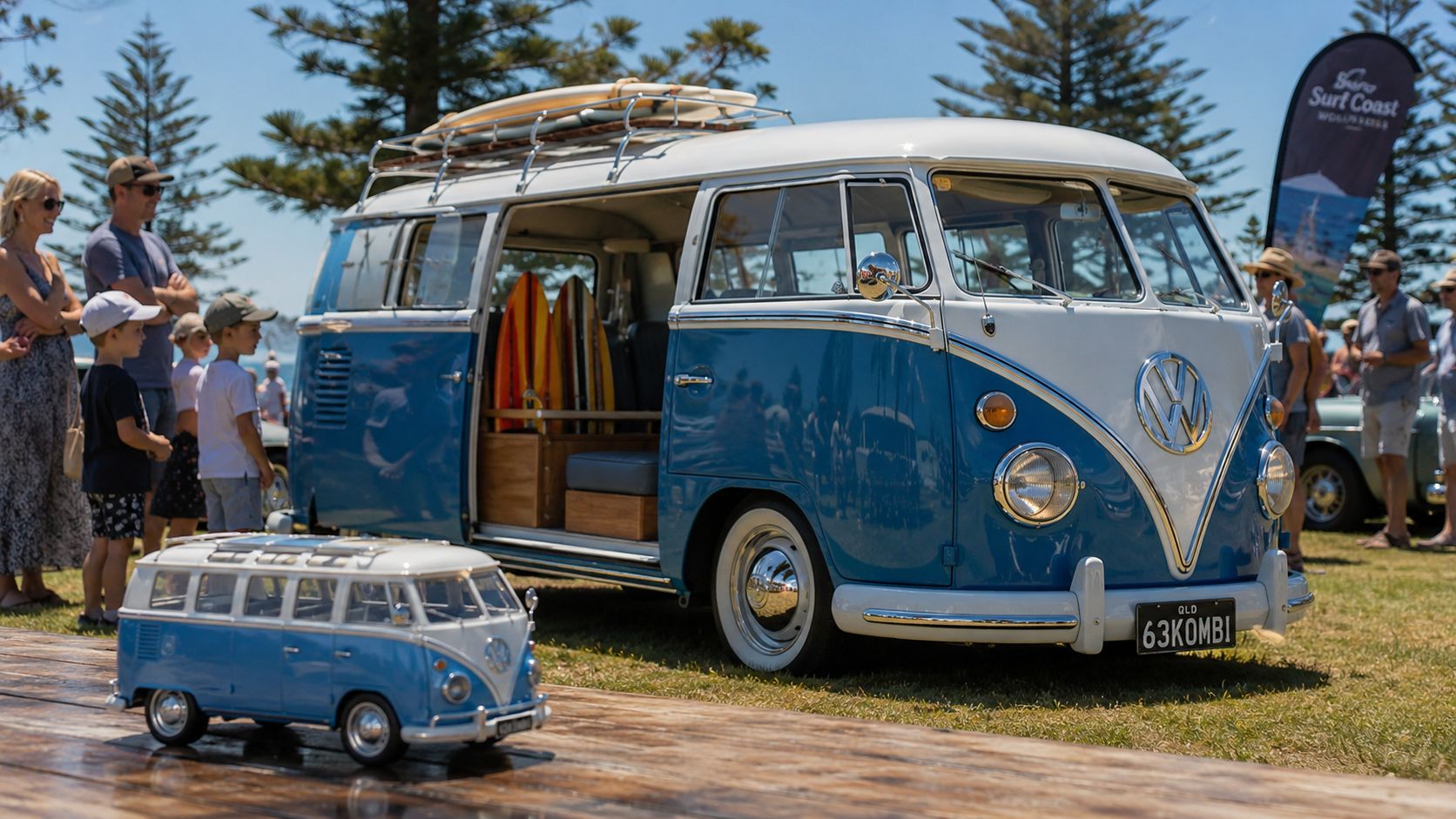
At a sunny Australian car show, a blue-and-white Kombi rolls onto the grass and gathers a crowd before the engine has even cooled. Nearby, a tiny Samba Bus sits in a collector's display case, proving that the Volkswagen Type 2 can fill a driveway, a beach road, or a bookshelf with the same generous sense of adventure.
Why the Volkswagen Type 2 Still Captures Hearts
The Volkswagen Type 2 has a way of making strangers start talking. Someone remembers family holidays near the coast. Someone else recalls a mate's camper, a surfboard strapped to the roof, or the smell of vinyl warming in the afternoon sun. At a show, the van becomes a meeting point, with owners discussing paint shades, trim, restorations and the small details that separate one era from another.
That warmth comes from the shape itself. The upright windscreen, friendly nose, split windows and generous cabin made the Kombi instantly recognisable. It looked practical rather than aggressive, yet it carried an enormous emotional load. People associated it with weekends away, music, beach life, work, freedom and the simple pleasure of travelling with room for friends.
More than a transport van
The original Type 2 began production in March 1950 and became widely recognised as Volkswagen's second vehicle after the Beetle. Carsales' Australian history of the Combi records that the model reached Australia in 1954, with 334 Transporters sold locally that year.
That early arrival matters to collectors because the Australian Kombi story developed its own character. Local assembly, changing body styles and Australian-market components created a rich trail of variants for enthusiasts to identify. A diecast model is therefore more than a miniature van. The right one can represent a particular design era, a cultural mood or a memory that never quite left the road.
Why miniatures belong in the story
A full-size Kombi needs space, maintenance and a sympathetic owner. A licensed diecast model needs a shelf, a case and a little care. That makes collecting an approachable way to celebrate the same history, whether you're a long-time owner, a first-time buyer or searching for a thoughtful gift for a VW fan.
The best collections tell a story through colour and form. A classic Samba Bus can sit beside a Beetle, a surf-inspired van or a later Transporter, creating a small garage scene that feels personal rather than mass-produced.
The Australian Story of the Volkswagen Type 2
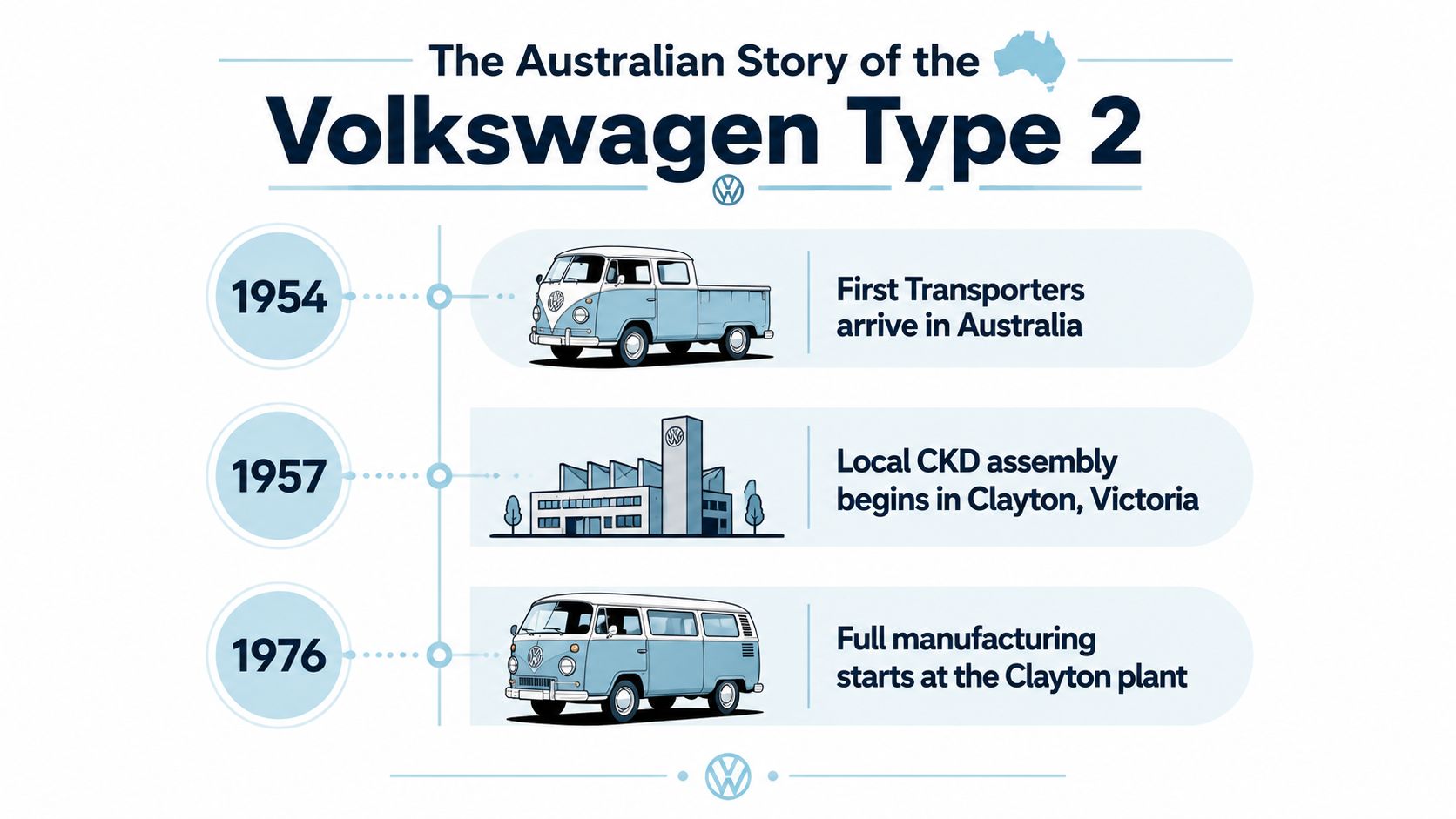
When the first Transporters reached Australia in 1954, they weren't just imported curiosities. Volkswagen quickly began building a local presence around them. The Type 2 was assembled from completely knocked down, or CKD, kits in Melbourne from June 1954, according to the Club VeeDub Australian chassis history.
The CKD approach brought German-pressed parts together with Australian fitting, trim and compliance work. For owners, that created a practical relationship with parts and servicing. For the company, it offered a way to adapt the vehicle to local conditions without replacing every part of the production system.
From kits to Australian manufacturing
Australian production grew steadily. The first Australian stampings were made in 1959, and local content reached 75% by 1964, as documented in the Club VeeDub reference. In 1961, Australia produced its 100,000th Volkswagen, a milestone that shows how quickly the brand established itself in the local market.
The production story can look slightly different depending on how historians describe assembly and manufacturing stages. CarsGuide's account of Kombi production places Clayton assembly from 1964 to 1977, mostly using CKD kits, while Club VeeDub records Transporters as locally made from 1955 to 1976 and notes that fully imported Volkswagens followed from 1977.
For a collector, those distinctions are useful rather than confusing. They remind us that an Australian Type 2 may reflect several layers of production, from German-pressed shells to locally fitted components and later imported vehicles.
The van that businesses trusted
The Kombi also earned its reputation through work. Australian historical accounts describe Type 2s in service fleets, including vehicles associated with the Postmaster-General's Department during the 1960s. By 1975, the Kombi held more than 60% of Australia's 1-tonne market, according to Club VeeDub's historical article.
That working history gives Australian collectors another way to read the vehicle. The Kombi wasn't only a holiday icon. It was a delivery van, fleet vehicle, tradesperson's companion and dependable part of everyday life. When choosing a diecast replica, think about which story you want it to carry, a polished Samba, a practical panel van or a bright surf-themed display piece.
For a closer look at the local connection, the Kombi's Australian life offers a useful companion to the production timeline.
Key Type 2 Variants and How to Identify Them
At a show, identification often starts with the windows. The body shape gives you the broad answer, but roof details, front doors, side glass and trim help narrow down the variant.
The Split Screen, often called the T1, has the distinctive divided windscreen and an unmistakable early profile. Its production run is recorded as 1950 to 1967, with 1,477,330 Split Screen vehicles built, according to Heritage Parts Centre Australia's Type 2 history. That production scale helps explain why restorers and collectors continue to encounter a wide range of parts, specifications and condition levels.
The Bay Window followed with a broader, single-piece windscreen and a more modern body design. It still carried the same cab-forward charm, but the larger glass area changed the face and improved the driver's view. In diecast form, the windscreen and front profile are usually the quickest clues.
The Samba Bus is the jewel many collectors notice first. Look for the extensive window arrangement, raised roof section and bright detailing associated with the people-moving version. A Samba replica should make those features clear rather than hiding them behind vague “retro van” styling.
Type 2 Variant Quick Reference
| Variant | Production Years | Key Identification Features | Collector Appeal |
|---|---|---|---|
| Split Screen | 1950–1967 | Divided windscreen, early upright body, period-specific window layouts | Strong historic identity and broad variant interest |
| Bay Window | Later Type 2 era | Single-piece windscreen, wider front glass, updated body profile | Practical camper and commercial-van character |
| Samba Bus | Commonly associated with early Split Screen styling | Extensive side windows, raised roof section, bright people-mover trim | Display presence and strong cultural recognition |
The Transporter Combi Van collection is a helpful place to compare the familiar van shape with the different moods created by livery, colour and body style.
Reading a diecast model carefully
Collectors should compare the miniature with reference photographs from the same era. Check the number and position of windows, the shape of the bumpers, the roof treatment and the placement of badges. A model can look charming while still representing a generic interpretation rather than a faithful licensed Type 2.
Surf Culture, Hippie Freedom, and the Kombi's Cultural Legacy
A Kombi parked near an Australian beach never looks out of place. Its roof seems ready for boards, its cabin suggests a day's worth of towels and picnic gear, and its broad sides invite a hand-painted logo or a burst of colour. That visual language helped connect the Volkswagen Type 2 with surf culture and the wider idea of travelling light.
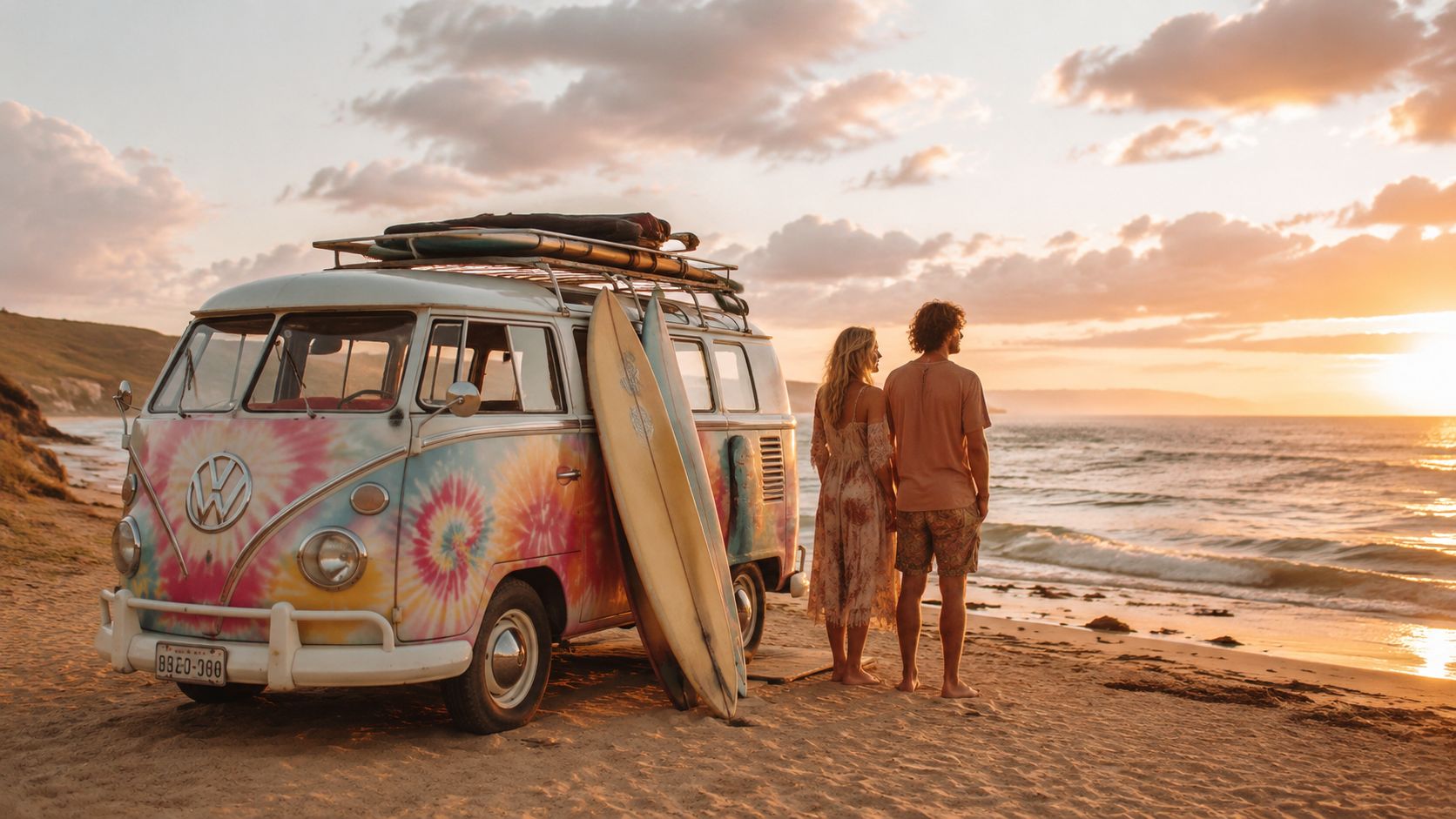
The van's cultural role grew because it made shared travel feel possible. Friends could load boards, guitars, camping gear and a chilly bin, then head towards the coast without needing everything to be perfectly organised. That sense of possibility turned the Kombi into a symbol, not merely a body style.
Colour became part of the message
Flower Power graphics, tie-dye finishes and surf imagery gave each van a personality. Some owners wanted a calm coastal look. Others preferred bold graphics that made the vehicle feel like a moving poster from another era. The same visual choices now shape memorabilia collecting, especially when a diecast model captures a period-inspired livery.
A 1962 Samba Bus with Flower Power decoration tells a different story from a plain commercial van. A 1967 Beetle with a surfboard brings the same coastal conversation into a smaller silhouette. These pieces work because they connect a vehicle to a setting, a soundtrack and a way of spending time.
A miniature can sit on a desk, but it can still suggest a long drive, a sandy car park or a sunset beside the water. The VW travel van range reflects that broader travel and lifestyle connection.
The following visual adds atmosphere to the history, especially for collectors building a display around surf and road-trip themes.
For many enthusiasts, that's the appeal. They aren't collecting a shape in isolation. They're keeping a little piece of beach culture, shared adventure and relaxed Australian optimism within reach.
Building Your Volkswagen Diecast Collection
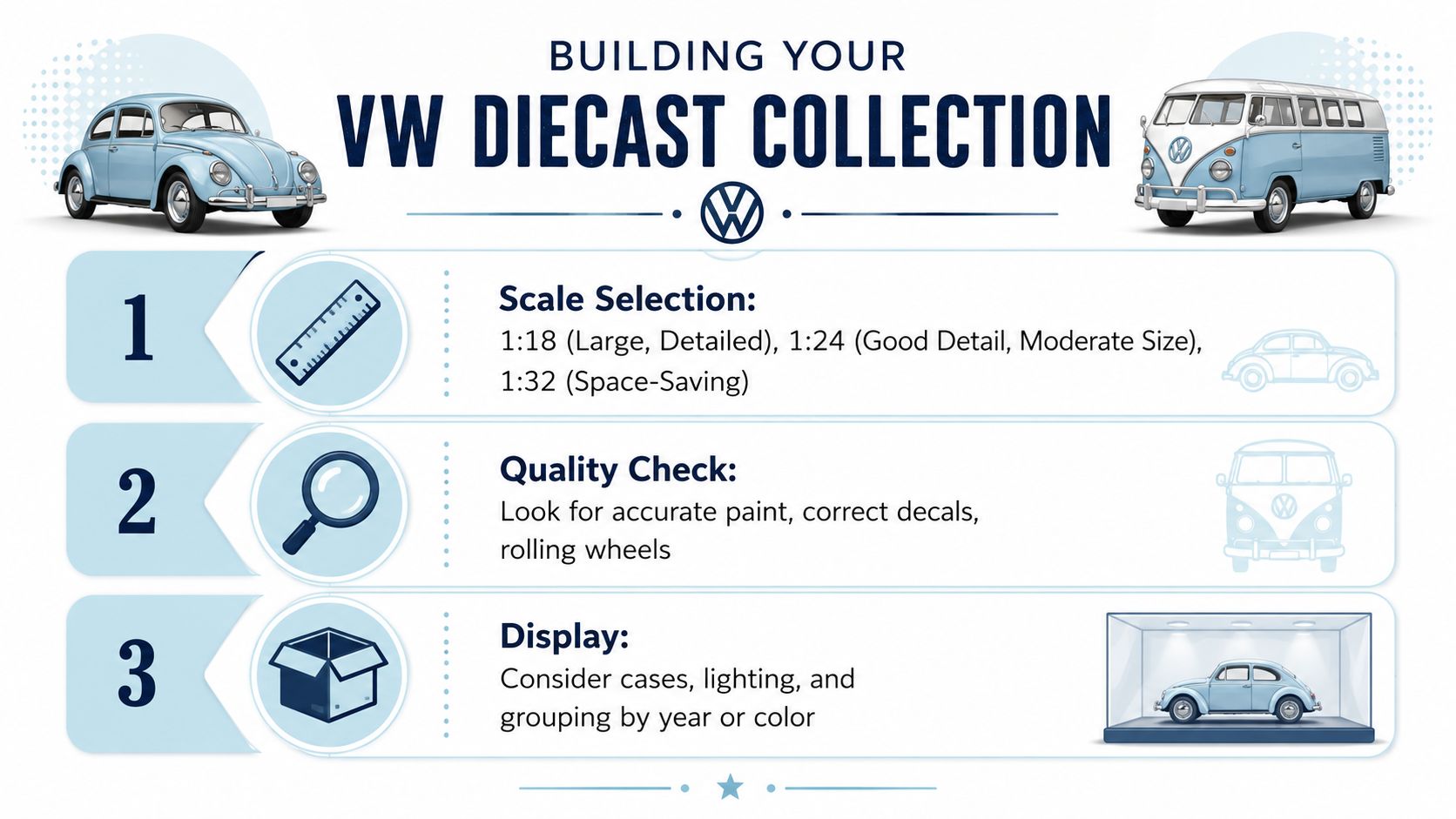
A good collection usually starts with a question rather than a shopping list. Do you want to follow the Type 2 through its body changes, gather colourful lifestyle vans, pair Kombis with Beetles, or build a display around Australian coastal culture? Once you know the story, scale and quality become much easier to judge.
Start with scale
Scale controls how much visual impact a model has and how easily it fits into your home.
- 1:18: Choose this when the model is intended to be the centrepiece. It gives body lines, trim and interior details room to stand out, but it needs more shelf depth and display space.
- 1:24: This is a useful middle ground for collectors who want visible detail without giving an entire cabinet to one vehicle.
- 1:32: Pick it for a growing scene, a compact shelf or a collection that groups several vehicles together.
Don't mix scales accidentally if you're building a realistic garage display. A large Samba beside a much smaller Beetle can look intentional when the arrangement is clearly styled, but it can also make proportions feel wrong if the models are meant to represent the same scene.
Check the model before you buy
A licensed Volkswagen diecast model should communicate the design with care. Look closely at the paint coverage, badge placement, window surrounds, decals and wheel design. Rolling wheels are useful for handling and play, while opening doors or a pull-back mechanism may add interaction, depending on the model's intended style.
Collector's rule: Buy the version that represents the era and personality you love, not simply the first van with a familiar silhouette.
Packaging also matters, especially if you're buying a gift or keeping the item as a long-term collectible. Inspect the box for the Volkswagen branding and product details, then check that the model's proportions and livery match the description. Generic replicas can borrow the visual language of a Kombi, while licensed products are made to represent the brand more directly.
Protect the display
Dust and strong sunlight are the enemies of a tidy collection. A glass cabinet, acrylic case or enclosed shelf makes cleaning easier and reduces handling. Keep models away from hot windows, rotate the arrangement when you dust and retain the original packaging if storage or gifting matters to you.
Group models by era, colour, body style or story. A Samba beside a Beetle creates a classic pairing. A surf van with coastal décor gives a room a relaxed holiday feel. The strongest display isn't always the largest one. It's the one that makes visitors ask why each model is there.
VW Memorabilia Beyond Diecast Models
A miniature Kombi can anchor a collection, but it doesn't have to stand alone. Volkswagen memorabilia works especially well when the surrounding objects reinforce the same mood, whether that's coastal living, retro motoring, workshop style or relaxed road travel.
Metal van décor can add shape to a wall without needing the cabinet space required by a larger model. A framed print or photo frame can introduce colour, while fridge magnets offer a small, affordable way to mark a favourite vehicle or holiday memory. These pieces suit collectors who want their enthusiasm visible in everyday rooms rather than confined to a display case.
Building a themed corner
A coastal living room might combine a blue-and-white van motif with nautical accents, starfish, seashell pieces and simple white décor. A study or garage could lean towards vintage signage, Beetle imagery and a row of diecast vehicles grouped by colour. A man cave can handle bolder graphics, while a quieter display may suit a single Samba Bus beside a carefully chosen piece of wall art.
Seasonal decorations broaden the gift possibilities. A VW-themed Christmas piece can appeal to someone who already owns plenty of car models, while a small magnet or centrepiece suits a friend who loves the brand but has limited display space.
The important point is balance. Don't fill every surface with unrelated pieces. Choose one central vehicle, then add supporting items that echo its colours, era or travel story. That approach makes a collection feel organised and personal.
For gift buyers, match the object to the recipient's habits. A serious collector may appreciate a carefully detailed licensed model. Someone who loves beach style might prefer metal van décor or a coastal accent. A new enthusiast can start with a compact Beetle or Kombi and grow the display over time.
Where to Find Licensed Volkswagen Collectibles in Australia
The best collecting decisions begin with accurate identification. Know whether you're drawn to a Split Screen, Bay Window, Samba Bus, commercial van or a Beetle companion. Then choose a scale that suits your space, inspect the paint and decals, and decide whether the model belongs in a cabinet, a themed room or a thoughtful gift box.
Buying locally also makes practical sense for Australian collectors. An Australian importer can offer local stock, faster shipping and friendly support, which helps when you're buying a present, checking availability or trying to avoid the uncertainty of an overseas order. Local assistance is particularly welcome when a collection includes several scales, mixed packs or décor pieces that need to arrive safely.
A focused shop can also make browsing easier. Look for clear categories covering Kombi Samba Bus diecast models, Volkswagen Beetle models, vans, cars, wall décor and coastal gifts. The right range lets you compare a heritage vehicle with a surf-inspired variant without losing sight of the story behind each design.
Collecting a Volkswagen Type 2 model is a small act of preservation. It keeps Australian assembly history, surf culture, family travel and the friendly shape of the Kombi present in a form you can enjoy every day. Whether you're adding your first licensed replica or refining a display built over years, choose pieces that give the shelf a story.
Volkswagen Memorabilia offers licensed Volkswagen diecast models, including Kombi Samba Bus and Beetle designs, alongside VW-themed gifts and coastal home décor. Visit Volkswagen Memorabilia to find a meaningful piece for your display, your home or the VW enthusiast who still dreams of the next open-road adventure.