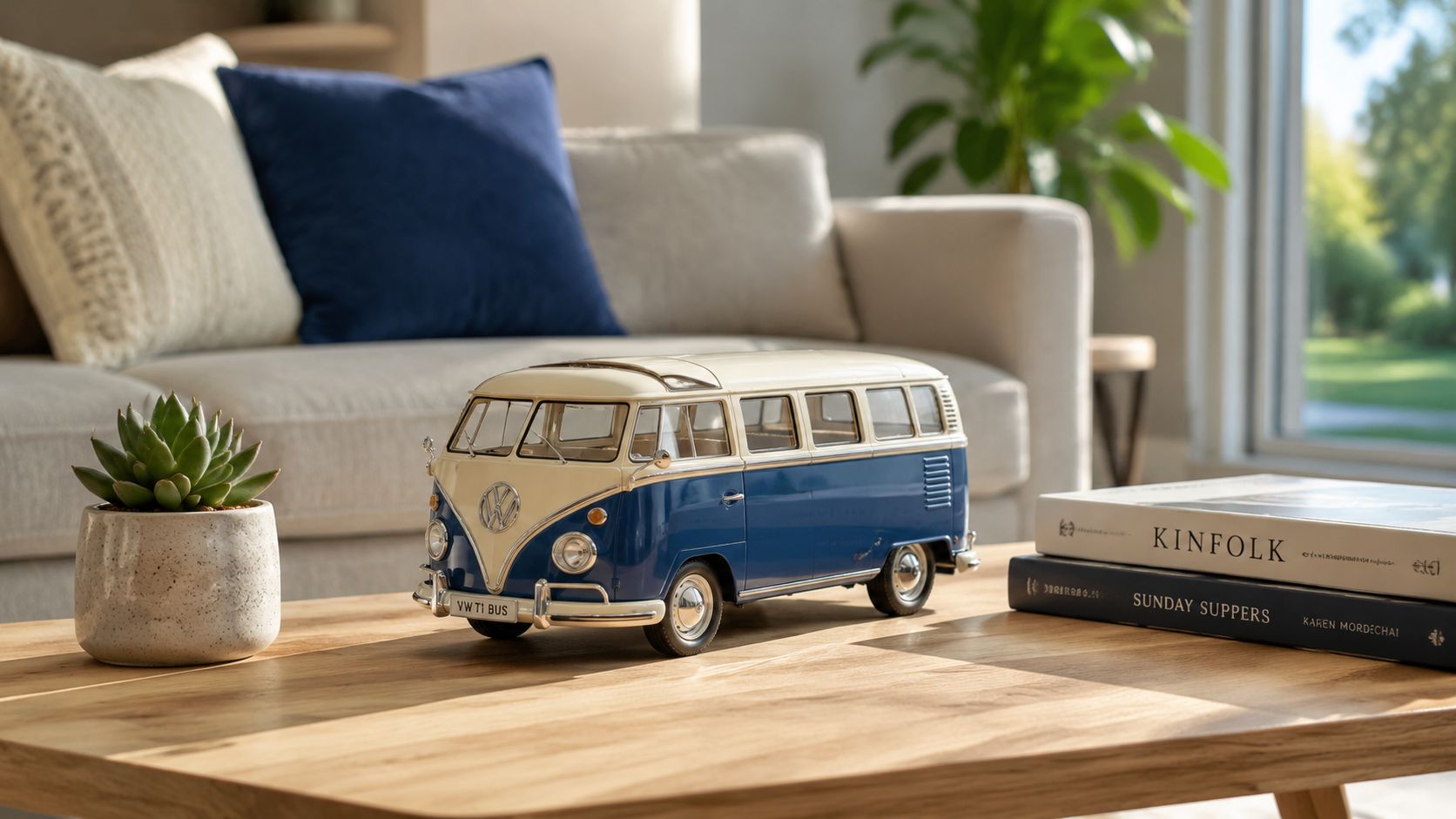

Ceramic Photo Frame: Styling, Care and VW Display Ideas

You've got the shelf sorted at last. A 1:24 Kombi Samba Bus sits beside a faded photo from your first Beetle meet, but the old plastic frame looks out of place against the model's bright paint and the shell collection from last summer's coastal trip. A ceramic photo frame changes the whole scene. It adds weight, texture and a little handmade character, turning a row of VW memorabilia into a story about family, road trips and relaxed Australian living.

That pairing feels especially natural in Australia, where the Type 2 carries local history as well as surf culture. The Kombi first reached Australian buyers in 1954, and Volkswagen assembled it at the Clayton factory in Melbourne from 1964 to 1977, according to Australian Kombi history documented by CarsGuide. A ceramic frame holding a show-day snapshot or beach photograph gives that heritage a place beside your diecast collection, rather than leaving it tucked away in a drawer.

Why Ceramic Photo Frames Belong on Every VW Display Shelf

A ceramic frame has the same appeal as a well-finished diecast model. You notice its weight when you lift it, the surface catches the light differently from plastic, and small variations in glaze can make the piece feel personal. Place one beside a red-and-white Kombi, and the display gains a tactile accent that echoes the rounded bodywork and cheerful colours of classic Volkswagen design.
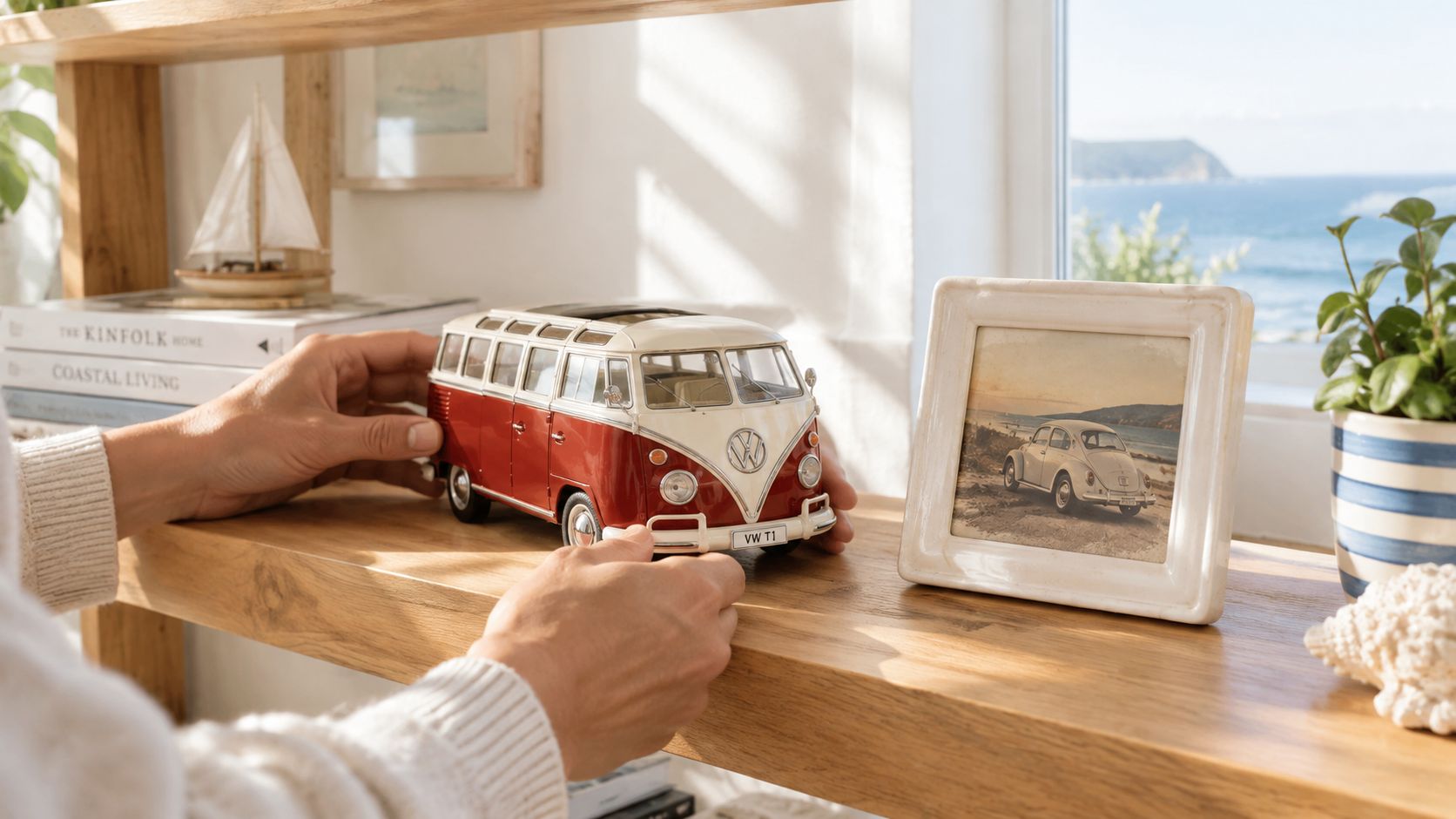
A person placing a red and white Volkswagen T1 toy bus model on a rustic wooden shelf.

The frame also gives the eye somewhere to rest. A shelf filled only with models can look like a catalogue. Add a ceramic photo frame with a family road-trip image, a Volksfest moment or a coastal sunset, and the display starts to feel lived in. The Kombi becomes part of a memory rather than another object in a collection.

A natural fit for coastal styling

White, pale blue and sandy neutral finishes work beautifully with shells, timber, woven baskets and nautical accents. A glossy blue ceramic frame can pick up the colour of a Samba Bus, while a matte white frame lets a brightly painted Beetle remain the star. The result suits a beach house, a home office or a garage display without making the room feel like a showroom.

Practical rule: Give every model a companion object that explains why you collect it. A photo, ticket, map or small ceramic accent can tell the story better than another vehicle.

Ceramic also makes a thoughtful gift for someone who already owns plenty of Volkswagen diecast. A model celebrates the car, while the frame creates space for the owner's own memories. That combination is why ceramic photo frames sit comfortably between VW memorabilia collectibles and home décor.

Understanding Ceramic Frame Materials and Finishes

Ceramic photo frames usually begin with fired clay or porcelain. Clay tends to offer a more earthy, substantial appearance, while porcelain can produce a smoother, finer surface. Neither choice automatically guarantees quality. The frame's finish, edges, backing and firing quality matter just as much.
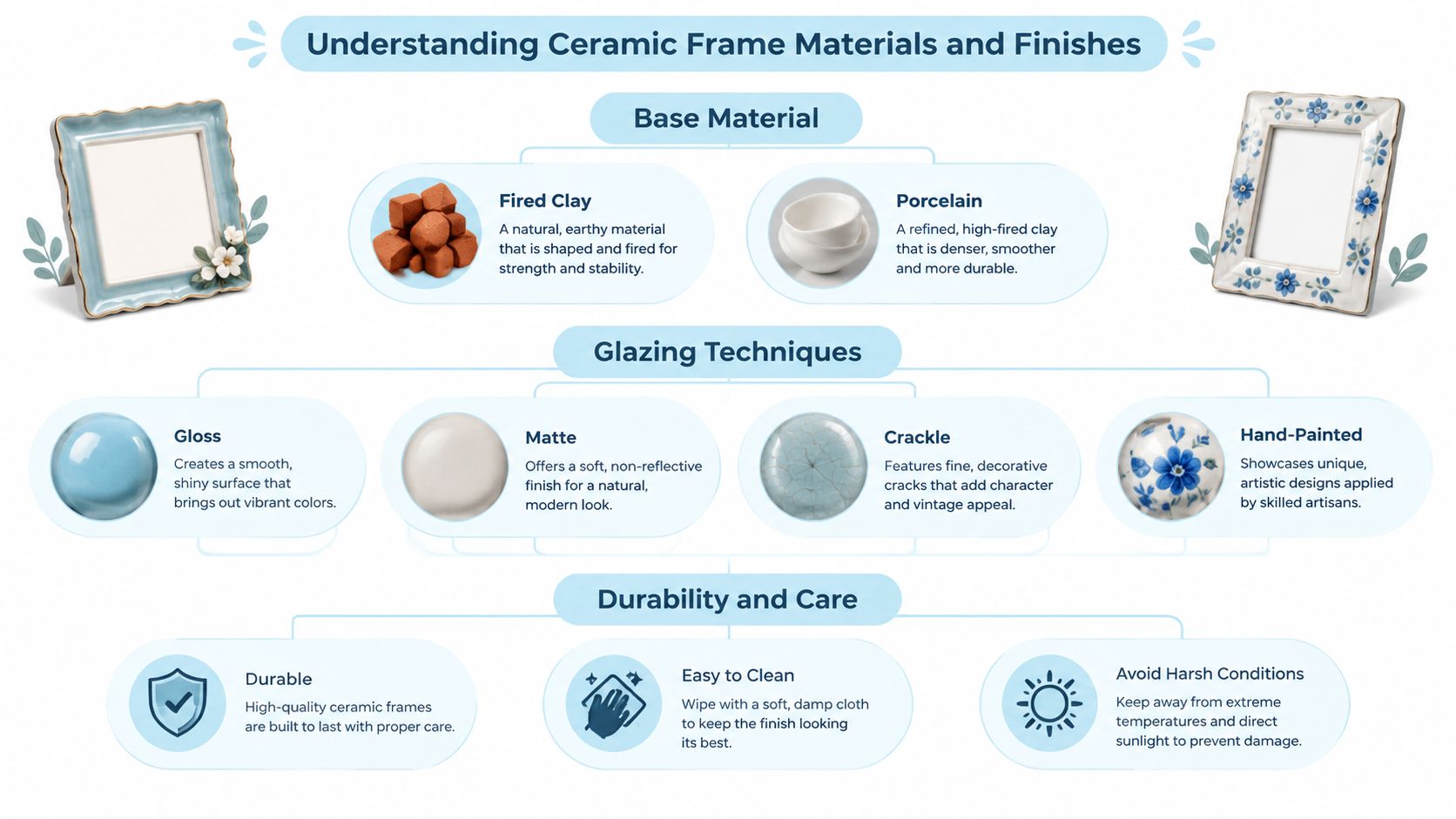
An infographic titled Understanding Ceramic Frame Materials and Finishes, detailing base materials, glazing techniques, and care instructions.

Read the surface before you buy

A gloss glaze reflects light and makes bold colours pop, which suits a colourful Flower Power Beetle or a display with polished metal details. Matte glaze feels quieter and more contemporary, particularly beside pale timber and linen. Crackle finishes introduce fine lines across the glaze for an aged, vintage look, while hand-painted surfaces can bring stronger personality through brush marks and irregular colour.

Kiln-firing hardens the ceramic body and fixes the glaze to the surface. For photo-ceramic imagery, the image can be glaze-sealed, which makes the finished surface highly durable and resistant to fading. Western Australian Museum conservation guidance still recommends limiting light exposure to 50 lux or less, excluding ultraviolet light where possible, and maintaining display conditions around 16 to 20 °C with 30 to 40% relative humidity for photographic materials.

Quality checks for online and market buying

Run through these checks before choosing a frame:

  • Glaze coverage: Look for an even surface without bare patches, unexpected pinholes or rough pools around the edges.
  • Edge finishing: The photo opening should feel smooth, with no sharp ceramic lip that could catch paper or fingertips.
  • Backing strength: The easel or wall fitting should sit firmly rather than wobble under the frame's weight.
  • Craft character: Hand-finished pieces may show small variations. Those differences can be attractive, but they shouldn't hide cracks or structural flaws.

Compared with a composite frame, ceramic feels more substantial and decorative. Timber brings warmth and grain, while metal offers a crisp industrial edge. Ceramic occupies the middle ground, with enough visual softness for a family photograph and enough presence to stand beside a carefully chosen Volkswagen diecast model.

Ceramic vs Timber vs Metal Frames for Collectors

Collectors usually make this decision with the shelf in mind. A light acrylic frame may be easy to move, but it can look less grounded beside a model. A heavy ceramic frame can anchor a small vignette, though you'll want to check the shelf depth and protect the surface underneath.

Criteria Ceramic Timber Metal Acrylic
Shelf stability Weighty and steady Usually stable, depending on construction Stable, often with a slim profile Light and easy to shift
Visual character Tactile, glazed, decorative Warm, natural and familiar Clean, industrial or modern Minimal and unobtrusive
Moisture considerations Glaze resists surface moisture, but protect the backing Can respond to damp conditions and finish wear May suit practical spaces, with attention to corrosion Handles casual wiping but can scratch
Customisation Glaze colour, shape and painted detail Stain, paint, carving and profile Powder coat, brushed or polished finishes Clear or coloured options
Sustainability conversation Durable object with long use potential Reclaimed or responsibly sourced timber can be appealing Longevity depends on construction and finish Material choice and lifespan need careful consideration

Match the material to the room

Choose ceramic for a display that needs a decorative focal point, especially in a coastal or retro setting. Timber suits a restoration-inspired garage, where natural grain complements tools, old signs and warm lighting. Metal works well with industrial shelving and larger vehicle displays, while acrylic is useful when the photograph should remain visually quiet.

Sustainability deserves a thoughtful answer rather than a blanket label. Australian and Asia-Pacific buyers are showing interest in FSC-certified timber, recycled materials, low-VOC finishes, bamboo and reclaimed wood, and some segments support a premium of roughly 10 to 20% for eco-friendly frame materials, as discussed in the Australia gallery-wall frame market analysis. Ceramic can be a sensible choice when you value durability and intend to keep the piece for years, but recycled or reclaimed alternatives may better suit buyers whose first priority is material sourcing.

How to Choose the Right Ceramic Photo Frame

Start with the photograph, not the décor. Australian print sizes commonly include 4×6, 5×7 and 8×10, so check the frame's stated image opening rather than relying only on its outside dimensions. A wide beach scene usually needs horizontal orientation, while a portrait of a family member or a front-on Beetle photograph often looks stronger vertically.
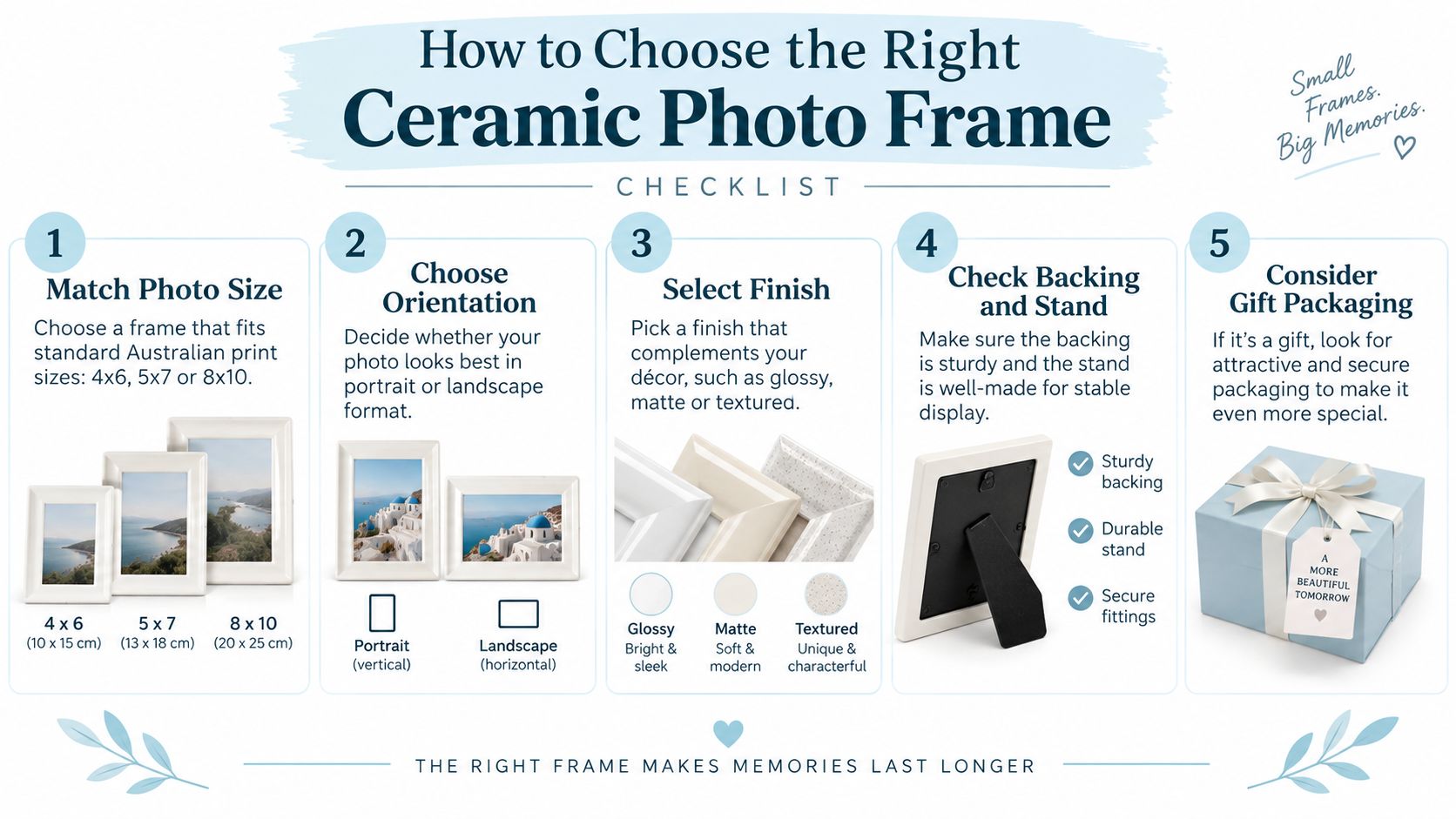
A five-step checklist infographic illustrating how to select the perfect ceramic photo frame for your pictures.

Work through the practical details

  1. Measure the print: Confirm the visible photo area and allow for any overlap beneath the frame lip.
  2. Choose the orientation: Check whether the backing supports portrait, horizontal, or both.
  3. Match the finish: Blue and white glazing suits coastal décor, while cream, red or distressed finishes can complement a retro garage.
  4. Inspect the backing: An easel stand suits shelves and mantelpieces. Wall fittings help with gallery arrangements. Dual-purpose designs give you both options.
  5. Check the packaging: Ceramic needs protective wrapping and a firm outer carton for safe Australian delivery.

Glazing affects how the photograph appears. A clear, even surface should preserve colour without creating distracting reflections from a nearby window or display light. If you're buying online, read the product description carefully for the photo opening, backing style and finish. If those details aren't listed, ask before ordering.

For a diecast shelf, the frame should also relate to the model's scale. A 1:18 model is typically around 25 to 30 centimetres long, while a 1:24 model is generally around 16 to 20 centimetres, according to this Australian diecast collecting guide. A compact frame can sit comfortably beside a 1:24 Kombi, while a larger frame may need more breathing room beside a 1:18 display.

If your shelf needs a more secure presentation, browse practical display cases for models and plan the frame as a separate visual layer rather than squeezing everything into one enclosure.

Styling Your Ceramic Frames with VW Diecast and Coastal Décor

A small shelf can carry a surprising amount of personality. Set a 1:24 Kombi Samba Bus at a slight angle, place a white ceramic frame behind its rear quarter, and fill the frame with a faded beach photograph. Add a small shell dish and a piece of driftwood, but leave enough open space for the model's silhouette to read clearly.
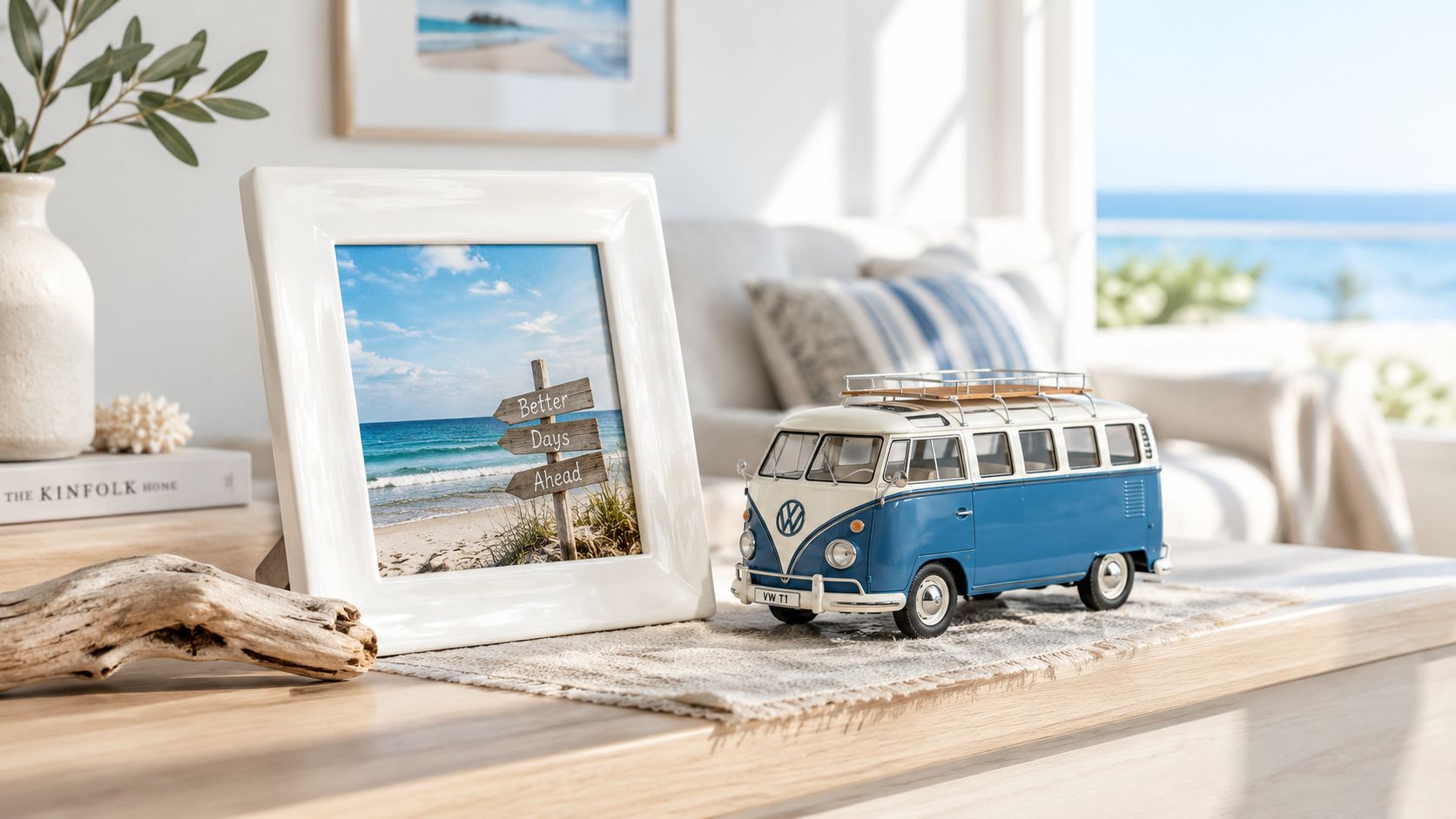
A coastal themed display with a white ceramic photo frame and a blue Volkswagen van model on a wooden table.

Build the display around one hero model

Start with the largest or most meaningful item. A Samba Bus, a Volkswagen Beetle model or a surf-themed van should hold the visual centre. Place the ceramic frame slightly behind or beside it, then add one low coastal object, such as a shell or small piece of pale timber, to balance the height.

A mantelpiece arrangement can tell a broader family story. Put a Beetle model at one end, two ceramic frames with road-trip photographs near the centre, and white shell décor at the other end. Vary portrait and horizontal images so the arrangement doesn't become a rigid row.

For more ideas involving shells, nautical accents and relaxed beach styling, explore coastal home décor ideas.

Let the memories change with the season

Swap the photograph when the display needs a fresh note. A summer surf image works with blue-and-white ceramic, while a family Christmas photograph can sit in a festive frame during December. The model doesn't need to change. A new photograph can make the familiar Kombi feel connected to a different chapter.

Keep colours linked rather than identical. A red detail in the photograph can echo a red Beetle, while sandy neutrals can soften a bright diecast van. The best displays feel collected over time, not assembled from one matching set.

Caring for and Cleaning Your Ceramic Photo Frame

Dust the frame with a soft, dry microfibre cloth. Support the piece from underneath as you wipe, especially when the frame has a projecting ornament, uneven base or delicate hand-painted detail.

For marks, use a lightly damp cloth with mild soap, then wipe away residue and dry the surface. Avoid abrasive powders, rough sponges and strong chemical cleaners, which can dull a glaze or damage painted areas. Don't spray liquid directly onto the frame because moisture can reach the backing, print or easel mechanism.

Remove the photograph carefully when changing images. Lay the frame face down on a folded towel, release the backing gently and keep fingers away from the ceramic opening. If the frame feels tight, don't force the print through. Trim or replace the photograph rather than risking a chipped edge.

Bright Australian sunlight deserves attention, particularly in coastal homes with large windows. Keep the frame away from direct sun, and in tropical regions avoid persistently damp areas where humidity can affect paper, backing materials and photographs. Glaze-sealed photo imagery is durable, but sensible light and moisture control will protect the whole display.

Gift Ideas and Sourcing Ceramic Frames in Australia

A ceramic frame makes a thoughtful present for a VW enthusiast who already has shelves full of models. Pair one with a 1962 Kombi Samba Bus or a Flower Power Beetle, then add a printed family photograph so the gift feels personal rather than generic. It works for birthdays, Father's Day and Christmas, especially when the recipient enjoys both classic cars and coastal décor.

A shell-themed design can suit someone who prefers beach styling, while a colourful retro finish belongs beside a garage sign or restored Beetle photograph. For a complementary option, consider a shell photo frame that carries the coastal theme through with a lighter, nautical feel.

Australian-based importers offer practical advantages for fragile décor and collector gifts, including local stock, faster shipping and support within Australian business hours. Australia's picture-frame market was valued at USD 268 million in 2025 and is projected to reach USD 285.42 million in 2026, then USD 472.37 million by 2034, with a projected 6.5% CAGR from 2026 to 2034, according to the Australia picture-frame market benchmark. Ceramic frames sit within that broader decorative framing category, alongside the diecast and gift pieces that make a VW display feel complete.


Browse Volkswagen Memorabilia for licensed Volkswagen diecast models, Kombi Samba Buses, Beetles, coastal décor and gift-ready photo frames. Choose a ceramic accent for your display, pair it with a favourite VW model, and give an old road-trip memory the shelf space it deserves.
Volkswagen Van Wall Art That Turns Any Room Into a Classic

You've just walked into a room that feels a little too ordinary. The walls are clean, the furniture works, but something's missing. Then you spot a vintage Kombi print above the console, and suddenly the room has a destination. The faded colour, rounded roofline and familiar split-window shape bring back beach holidays, roadside stops and sunny Sunday car meets without taking up a single shelf.

That's the charm of Volkswagen van wall art. It isn't just a picture of a vehicle. Done well, it becomes a piece of Australian motoring culture, a conversation starter and a practical way to give a coastal, retro or garage-inspired room some personality.

Walking Into a Room That Greets You with a Kombi

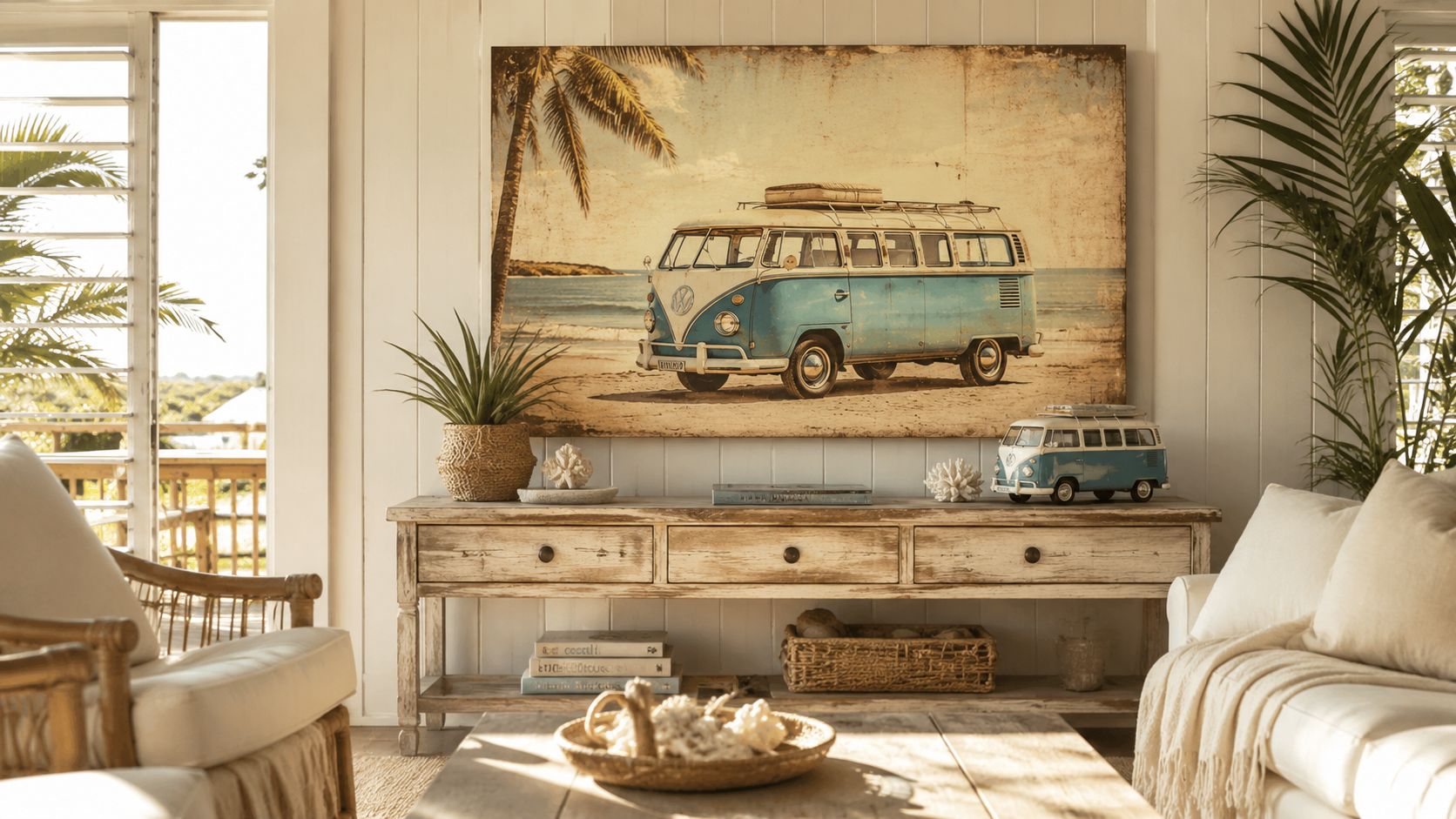
The light is warm in a Queensland beach shack. Sand has found its way across the floorboards, faded teal cushions sit slightly crooked on a linen sofa, and a weathered timber console holds a stack of old travel books. Above it hangs a vintage Volkswagen van, its rounded silhouette glowing against a simple background.

A visitor slows before reaching the room. Their eyes lift, their smile arrives first, and then comes the story. Someone remembers a family road trip. Someone else talks about a Kombi spotted at a coastal car show. The artwork has done more than fill blank plaster. It has given the room a shared memory.

A rustic coastal living room featuring a large vintage Volkswagen van wall art piece above a wooden console table.

That emotional pull has deep roots in Australia. The first Type 2 Volkswagens reached Australia in 1954, with kits from Germany assembled at Clayton South. Volkswagen took over local assembly in 1958, and Australian Kombi production continued at the Melbourne Clayton factory from 1964 to 1977, as recorded by Club VeeDub's Australian Volkswagen history.

The Kombi's visibility wasn't limited to weekend adventures. In 1975, Australian buyers purchased 8,974 Kombis, representing 43% of the Australian 1-tonne van market, according to the same historical record. That combination of workhorse usefulness, local production and surf-culture nostalgia explains why a van image feels especially at home in an Australian interior.

The Main Formats That Bring a Van to Life on Your Wall

A Kombi can feel completely different depending on the surface carrying it. A pressed metal sign gives the van a garage character, while a soft canvas print makes the same shape feel relaxed enough for a living room.

Format Material Best Room Durability Mounting Need
Embossed metal sign Powder-coated or printed steel Garage, study, man cave Strong and easy to wipe Suitable fixings for the weight and wall type
Gallery-wrapped canvas Cotton canvas with printed inks Living room, bedroom, beach house Good with sensible light protection Hooks, wire or a cleat for larger pieces
Framed print or poster Paper print with timber or metal frame Hallway, office, contemporary room Depends on glazing and print finish Picture hook or wall anchor
Vinyl decal or mural Adhesive vinyl Rental, children's room, feature wall Flexible but surface-dependent Clean, smooth wall, usually no drilling

Embossed metal suits spaces where texture matters. Light catches the raised lettering and edges, and the piece can sit comfortably beside tools, surfboards, enamel badges or workshop memorabilia. It's the natural choice for someone who wants a durable, slightly industrial finish.

Canvas brings warmth. Its texture softens the hard mechanical subject, especially when the surrounding room uses linen, timber, rattan or woven rugs. A gallery-wrapped edge also avoids the visual weight of a traditional frame.

Framed prints offer the neatest, most polished presentation. They work well in a hallway or modern home where the artwork needs to feel intentional rather than themed. For a broader Volkswagen collection, a VW Beetle wall art selection can help balance a van image with the Beetle's unmistakable rounded form.

Decals and murals are the flexible option. They're useful for renters or anyone testing a bold idea before committing to a framed piece.

Practical rule: Choose metal for durability and authenticity, canvas for warmth, framed prints for refinement and decals for flexibility.

Sizing and Hanging the Piece So It Actually Fits the Room

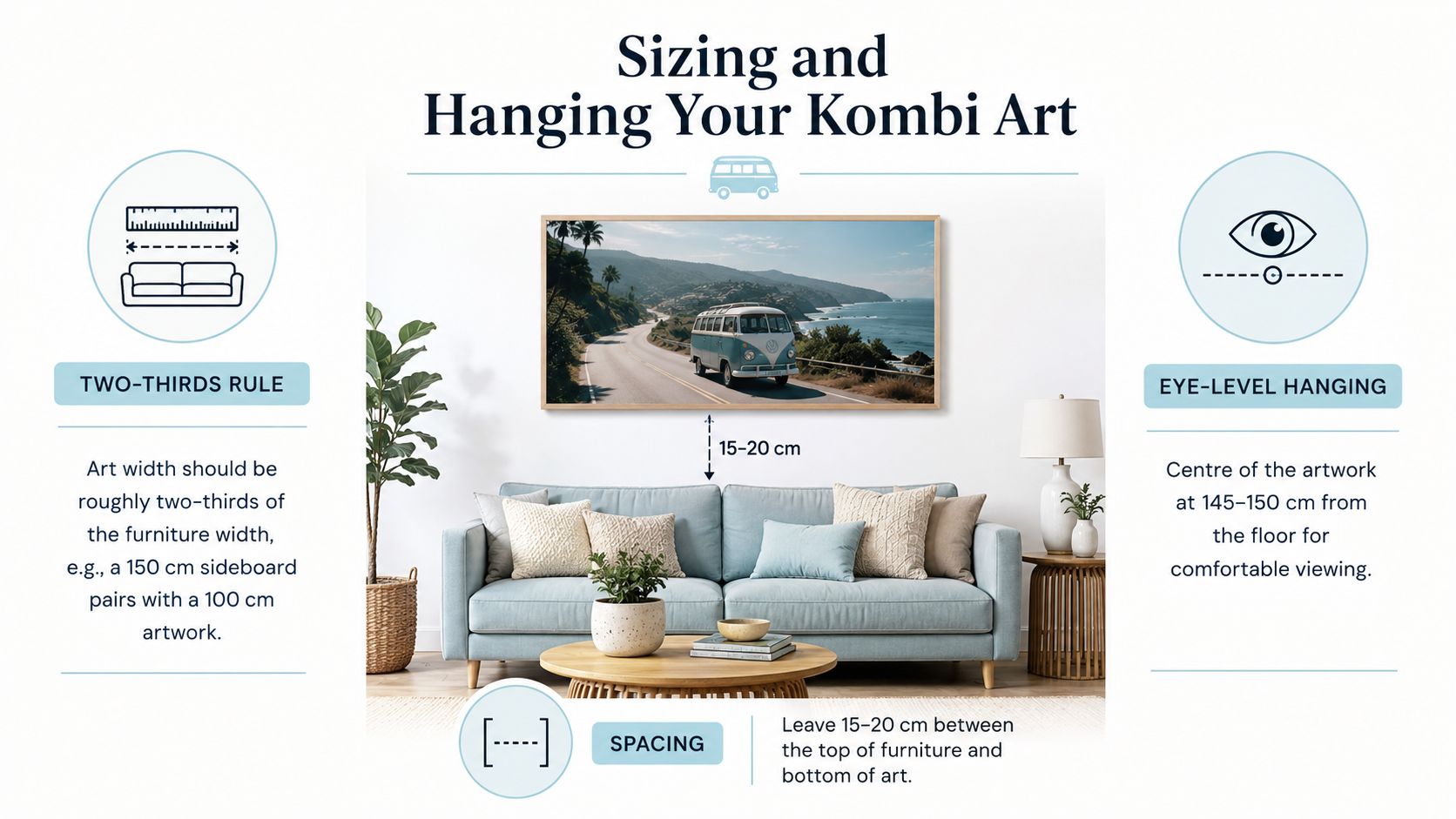
A wide Kombi print needs breathing room, but it also needs enough presence to anchor the furniture below it. Start with the width of the sideboard, console or sofa. Artwork usually looks most settled at roughly two-thirds to three-quarters of the furniture width, a proportion also recommended in Australian wall-art hanging guidance from Canvas Art Prints Australia.

For a 150 cm sideboard, a piece around 90 to 100 cm wide gives the van enough visual weight without making the arrangement feel crowded. Measure the artwork's final outer dimensions, not just the nominal print size, because a frame adds to both width and height.

Keep the lower edge of the artwork about 15 to 25 cm above furniture, particularly when the piece is wide. For a single artwork on an open wall, aim for the centre to sit about 152 cm from the floor, a benchmark based on average eye level in the same Australian guide.

Orientation matters too:

  • A wide panoramic Kombi suits a sofa, bedhead or long sideboard.
  • A tall single-van portrait works beside a doorway, in a stairwell or above a narrow hall table.
  • A group of smaller pieces needs consistent spacing, aligned centres or a clear shared baseline.

A helpful infographic demonstrating the recommended sizing and hanging placement for wall art above a sofa.

Before drilling, cut a newspaper template to the artwork's exact size and tape it to the wall. Step back from the doorway, sofa and adjacent furniture. A stud finder helps locate solid timber, while suitable wall plugs or plasterboard anchors prevent a heavy sign or framed piece from pulling loose.

The final check is simple. Does the van look connected to the furniture, or does it appear to float above it? If it floats, lower it or increase the artwork size.

Styling Volkswagen Van Wall Art in Coastal and Retro Spaces

Coastal and surf-inspired rooms already speak the Kombi's language. They use relaxed materials, sun-washed colours and objects that suggest travel, so a van artwork feels connected rather than added as an afterthought.

Over a linen sofa, try a pastel Kombi against bleached timber, neutral cushions and a woven jute rug. Let the vehicle supply the colour. You don't need every cushion, vase and print to match the van, because a small echo in a throw or ceramic accent is enough.

A retro diner corner can take a bolder approach. Pair a framed van print with red vinyl bar stools, chrome details, a jukebox image and a small neon sign. The result nods towards beach culture without turning the room into a museum display.

For a Scandi-coastal home, choose a slim black-framed canvas. Flax linen drapes, potted palms and a rattan pendant keep the composition calm, while the Kombi introduces a little road-trip character.

Interior Style Best Art Format Classic Pairings
Coastal Canvas or framed print Linen, bleached timber, jute and soft teal
Retro diner Framed print or metal sign Red vinyl, chrome, neon and checker details
Scandi-coastal Slim black-framed canvas Flax, palms, rattan and pale timber
Garage or man cave Large metal sign Exposed brick, surfboards, badges and motorsport photos
Eclectic hallway Framed print Globetrotter trunks, travel books and vintage lamps

A hallway console topped with old travel trunks makes an excellent unexpected setting. In a bathroom, a properly protected canvas can work with subway tiles, provided the room's moisture and ventilation suit the material. For more coastal decorating ideas, the coastal living room collection offers useful visual direction.

Wall Art Versus Diecast Models and Other VW Memorabilia

At a sunny Australian car meet, a full-size Kombi catches your eye from across the oval. A carefully detailed diecast bus earns attention differently. You pick it up, study the badges, paint, wheels and tiny interior, then place it back among the rest of the collection. Volkswagen van wall art and models create different kinds of connection.

A licensed model belongs on a shelf, desk or inside a glass cabinet. A Volkswagen model car collection gives a collector something tactile to handle, compare and arrange. Wall art belongs above the sofa, beside the workbench or at the end of a hallway, where its shape and colour can welcome guests before they notice smaller treasures.

The right choice depends on how you want the room to work:

  • Wall art suits someone who wants daily visual impact without adding display furniture.
  • Diecast models suit collectors who enjoy scale, detail and careful arrangement.
  • A paired display gives the room broad atmosphere and a focal object to inspect.

Scale helps with the practical decision. A 1:18 model is roughly 23 cm long, while a 1:24 model is about 16.5 cm long, according to the diecast car scale guide from Axis Frames. The larger format shows more detail, while the smaller one leaves room for several vehicles on a shelf.

A collector's diecast Kombi beneath a matching print creates a clear visual relationship. In a coastal study, framed art can carry the room's road-trip mood, while replicas on a nearby cabinet reward a closer look. A metal sign near the entry can introduce the theme before visitors reach shelves of 1:18 and 1:43 buses.

Both forms honour Volkswagen heritage. One tells the story at a glance. The other invites you to stay awhile.

Care, Mounting and Sun Protection for Australian Homes

Australian light can be beautiful and unforgiving. Keep metal signs, canvas and framed prints away from strong direct sun, especially on western walls where afternoon heat and glare can stress printed surfaces and coloured finishes.

For framed work, UV-blocking acrylic or museum-grade glass adds protection. If a canvas begins to show uneven fading, moving or rotating it can reduce its exposure pattern. Don't spray cleaner onto the artwork. A soft microfibre cloth is safer for dust, and it should be used gently.

Coastal homes need a little extra thought. Small rubber or felt standoffs behind a metal sign can create airflow between the wall and the back edge, helping reduce trapped moisture and contact with salty air. The wall itself also dictates the fixing:

  • Masonry: Use suitable wall plugs and screws.
  • Plasterboard: Use solid anchors rated for the artwork's weight.
  • Heavier canvas: A French cleat can improve support and levelling.
  • Timber frames: Check hanging points periodically as humidity changes.

Mounting habit: Check the fixings once a year, particularly in coastal rooms or spaces where the artwork is moved during cleaning.

Framing dimensions and weight deserve attention before installation. Australian framing guidance notes that a frame profile can add about 30 mm to the print's width and height, while some framed-print listings report weights from about 1.15 kg for A3 to 5.8 kg for A0. The Australian framing guide from Creative Hardt provides those metric examples for planning the final wall position and fixing strength.

Choosing the Right Piece or Gift and Bringing It Home

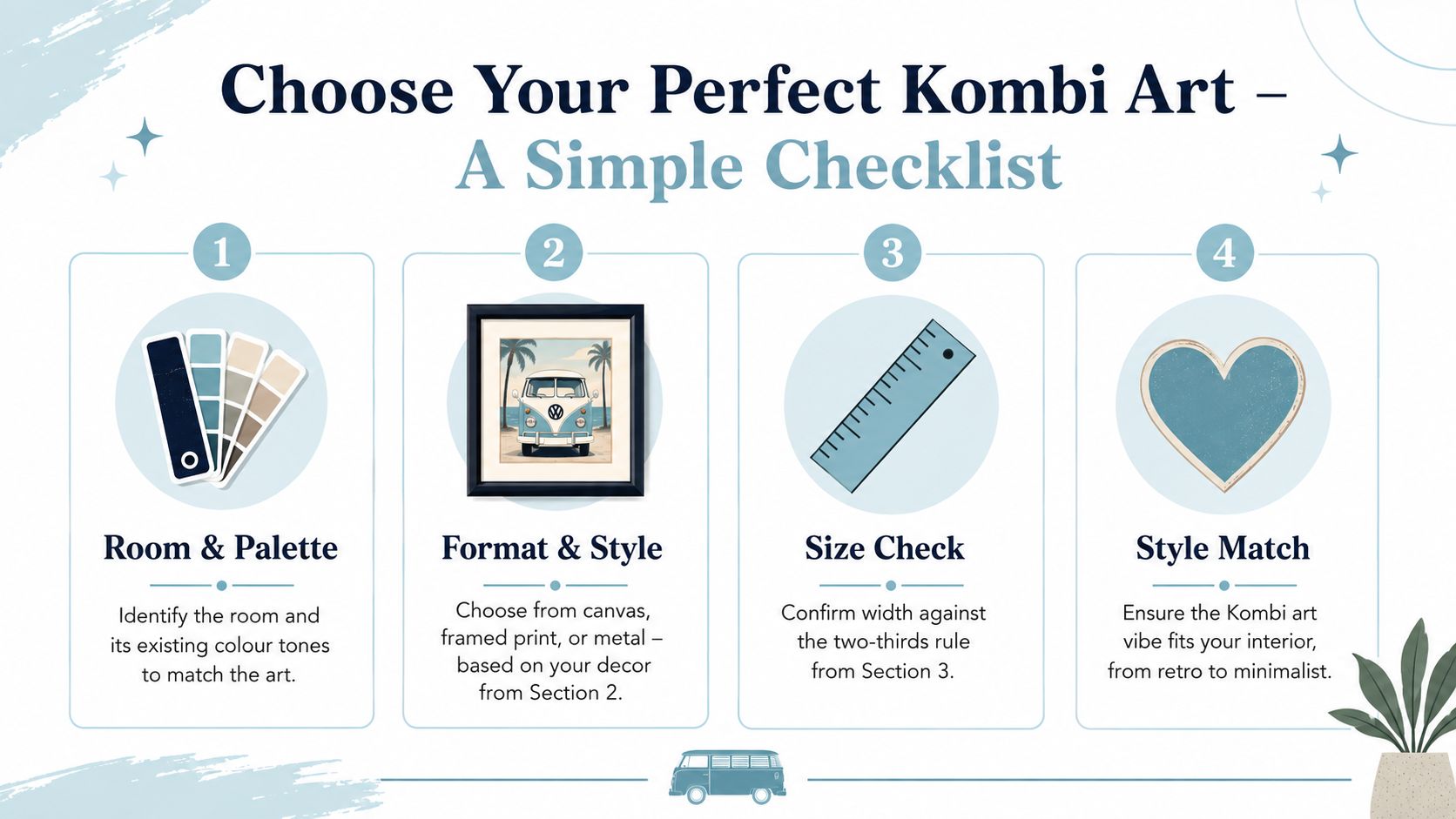
Start with the room, not the vehicle. A pale coastal space may suit a muted canvas, while a dark garage can handle the contrast and texture of a metal sign. Once you know the palette, confirm the available wall width and use the furniture ratio before falling for a design that's too small.

A four-step checklist infographic for choosing perfect Volkswagen Kombi van wall art for home decor.

A useful buying checklist looks like this:

  1. Room and palette: Note the existing paint, timber, upholstery and natural light.
  2. Format and style: Select canvas, framed print, metal or decal according to the room's character.
  3. Size check: Measure the furniture below it and keep the two-thirds rule in mind.
  4. Style match: Decide whether the piece belongs with coastal calm, retro colour, garage grit or a cleaner contemporary scheme.

For gifting, wall art works beautifully for a housewarming, birthday or retirement present for a Kombi lover. It gives the recipient something they can enjoy every day, even if they don't have room for another vehicle or display cabinet. Pairing a wall piece with a licensed 1:18 or 1:24 diecast model adds a shelf hero to the visual statement.

Before checkout, verify the product dimensions in centimetres, confirm whether hanging hardware is included and read the return policy. Check that the item is officially licensed if authenticity matters to the recipient, particularly when buying a Volkswagen Beetle model or a detailed Kombi replica.

Australian buyers also benefit from checking local availability and delivery arrangements. Local stock and fast shipping can make a difference when the artwork is a gift, a room makeover is already underway or you're preparing a display for a VW gathering. A specialist Australian importer can also make support more straightforward when you need help with product details, dimensions or a suitable pairing.

Whether you're refreshing a beach house, adding warmth to a study or building a display around licensed VW memorabilia collectibles, choose the piece that gives the room a story and gives you a reason to smile every time you walk past it.


Volkswagen Memorabilia brings together licensed VW diecast models, Kombi Samba Bus pieces, Beetle collectibles and coastal home décor for Australian enthusiasts and gift buyers. Visit Volkswagen Memorabilia to find a wall-worthy van design, pair it with a detailed model and turn your next room into a small celebration of classic Volkswagen life.

Beach House Gifts: Stylish Coastal Decor for 2026

You're standing in a coastal gift shop with sand still on your thongs, looking at another anchor plaque, another shell-covered frame, and another sign telling everyone to relax. Or you're scrolling online before a housewarming, birthday or Christmas visit, trying to find something that feels personal rather than pulled from the same beach-themed display.

The better answer is to choose a gift with a story. A classic Volkswagen model brings design heritage, surf culture and a sense of travel into the room, while modern coastal styling keeps the result calm, useful and distinctly Australian. The best beach house gifts don't shout “seaside”. They suggest freedom, salt air and weekends spent chasing the next good road.

Finding Beach House Gifts That Actually Feel Special

A friend recently asked me to help find a present for a beach house owned by a lifelong VW fan. The obvious options were easy to find, but none felt right. A basket of shells would have suited the room, yet said nothing about the owner. A novelty anchor sign might have earned a laugh, but it would have added clutter rather than character.

The winning idea was a licensed Volkswagen diecast model, chosen to echo the recipient's real interests. A Kombi Samba Bus made sense for someone who associates the coast with surfboards, road trips and open tailgates. A Beetle would have worked just as well for a collector drawn to compact, unmistakable design. Either piece could sit on a shelf as décor, then become the starting point for a conversation when guests arrive.

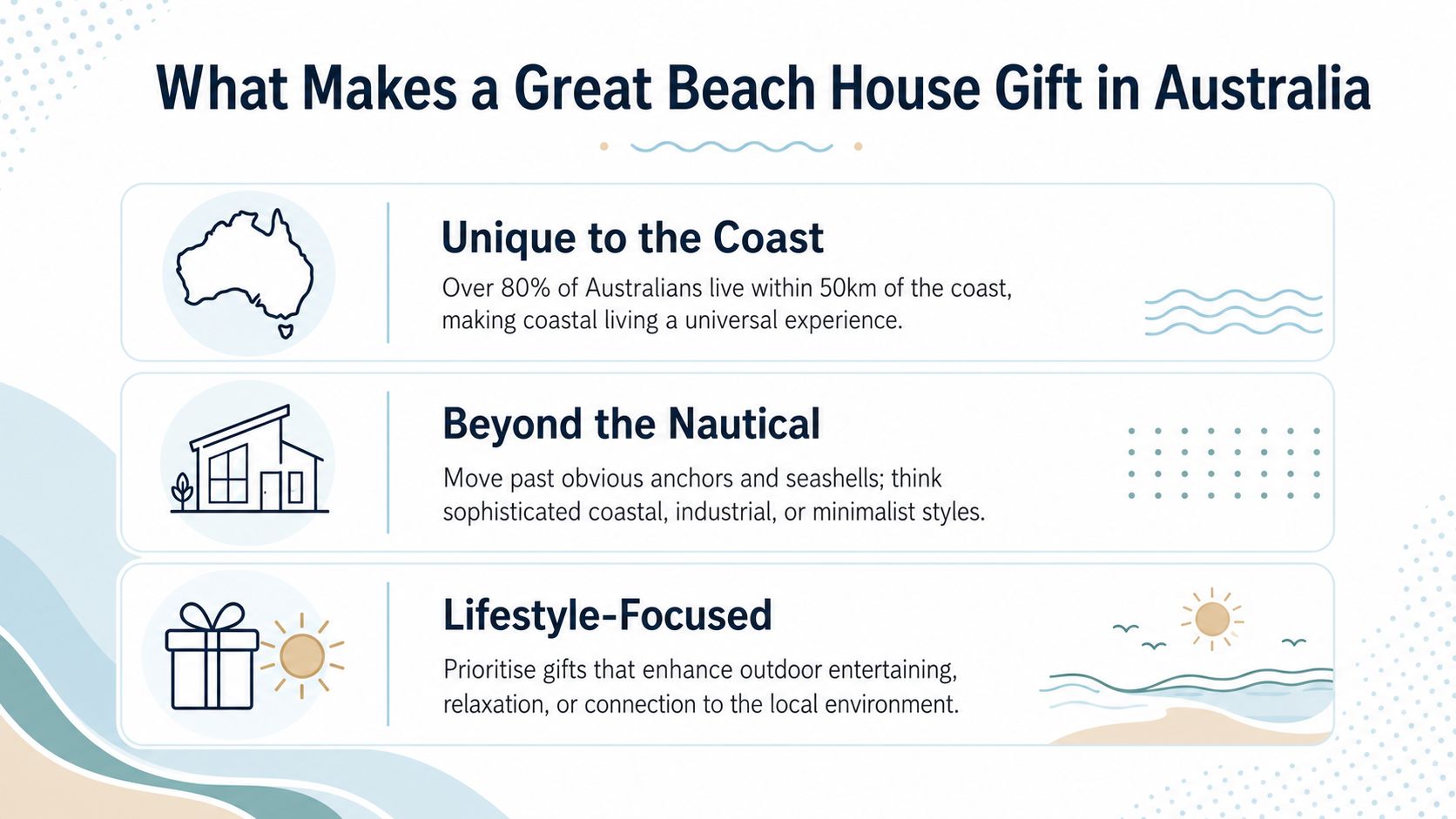
Australian coastal living gives this approach broad relevance. About 87% of Australians live within 50 kilometres of the coast, according to That Beach Shop's Australian coastal living overview, so seaside-inspired styling isn't limited to people who own holiday homes. Coastal references connect with everyday Australian homes, shopping habits and memories across the country.

My rule for beach house gifts: choose something that reflects the person first, then let the coastal setting shape the colour, material and presentation.

That's why I favour gifts combining practical longevity with genuine personality. A well-made model car, a restrained piece of wall art or a useful serving object can fit a beach house without turning it into a themed souvenir shop. The strongest choices also avoid fragile finishes and untreated materials that struggle with salt-laden air.

For VW lovers, the Kombi and Beetle offer a particularly good shortcut to that balance. They carry real heritage, but their rounded forms and cheerful colours also sit naturally beside linen, timber, woven textures and relaxed summer interiors.

What Makes a Great Beach House Gift in Australia

A smart coastal gift has to pass three tests. It should suit the recipient, work with contemporary Australian interiors and survive the practical demands of a humid, salt-prone environment.

An infographic titled What Makes a Great Beach House Gift in Australia outlining three key gift-giving tips.

Start with the home's actual style

Modern coastal rooms have moved well beyond a pile of shells, anchors and navy stripes. Australian design coverage now points towards seafoam greens, sandy neutrals, driftwood tones, linen, jute and pale timber, with marine references used more subtly. Homes to Love's guide to modern coastal décor is a useful reference when you're trying to choose something current rather than kitschy.

A turquoise Kombi can bring a lively accent to a neutral shelf. A white Beetle can reinforce a soft, pared-back palette. A darker model may suit a room with charcoal joinery, aged leather or industrial details. Match the gift to the home's existing mood instead of forcing a beach theme.

Check the materials before you buy

Salt-laden air accelerates corrosion on exposed metals. Technical guidance treats locations within about 1 kilometre of surf beaches as high-corrosivity environments, so frames, fixings and hardware should favour marine-grade aluminium, 316 stainless steel or powder-coated non-ferrous components, as explained in this Australian coastal corrosion guide.

For broader décor, sealed hardwoods, fibre cement, marine fabrics and stainless or galvanised fasteners are safer choices than untreated timber or basic steel. Drainage and drying gaps matter too, particularly for pieces used on balconies, verandahs or outdoor entertaining areas. Landmark Pro's coastal material guidance explains why stable, moisture-resistant materials reduce swelling, corrosion and maintenance.

Choose a gift that earns its place

The strongest beach house gifts support real life. Think about a model for a bookshelf, a framed piece for an entryway, or décor that can sit comfortably near an alfresco dining area without getting in the way. Australian coastal design is closely tied to summer entertaining and indoor-outdoor living, so a useful or display-friendly gift will usually beat a novelty object.

A good shortcut is to browse coastal home accessories with the recipient's routines in mind. Do they host friends? Collect automotive pieces? Prefer white décor, retro colour or natural texture? The answer will point you towards a gift that feels chosen, not generic.

Volkswagen Diecast Models as Unique Coastal Gifts

A VW diecast model works because it brings two kinds of nostalgia together. The Kombi Samba Bus evokes surf trips, campgrounds and the easy optimism of the road. The Volkswagen Beetle model adds a smaller, more sculptural note, with a shape recognised even by people who aren't serious collectors.

Scale is the first practical decision. The most popular diecast scales include 1:12, 1:18 and 1:24, with models commonly measuring about 16 centimetres to 33 centimetres in length. Australian diecast collecting guidance explains why this range works well: the models remain display-friendly while retaining room for fine detailing.

For a beach house shelf, I'd usually favour a compact scale that doesn't dominate the room. A larger model suits a dedicated display cabinet or collector's study. A Flower Power Kombi with surfboards brings more visual energy, while a classic two-tone Samba Bus looks polished beside books, ceramics and framed coastal photography.

Exact prices depend on the current model, finish, licensing and availability, so it's better to compare the specification and presentation than chase the cheapest box. Use this guide to narrow the choice:

Recipient Type Recommended Model Scale Price Range Best For
Casual VW admirer Classic Beetle 1:24 Check current listing Shelf décor and first-time gifting
Dedicated Kombi fan Samba Bus 1:24 or 1:18 Check current listing Collectors and beach-house displays
Surf and retro enthusiast Flower Power Kombi with surfboards Compact display scale Check current listing Colourful coastal interiors
Experienced collector Detailed Beetle or Samba Bus 1:18 Check current listing Display cabinets and established collections

The key is buying from a range that clearly identifies licensed Volkswagen diecast models. Look for clean paint, crisp badges, accurate body proportions, neatly fitted glazing and packaging that protects the model. A model should feel like a considered collectible, not a flimsy novelty.

You'll find the widest choice by comparing Volkswagen model cars by body style, colour and scale. For someone who already owns one iconic VW, a complementary model often makes a better present than an attempted duplicate.

Blending VW Memorabilia with Modern Coastal Styling

The trick is to style a VW model as an object with history, not as proof that the room has a theme. Give it breathing space, pair it with natural materials and let the shape do the talking.

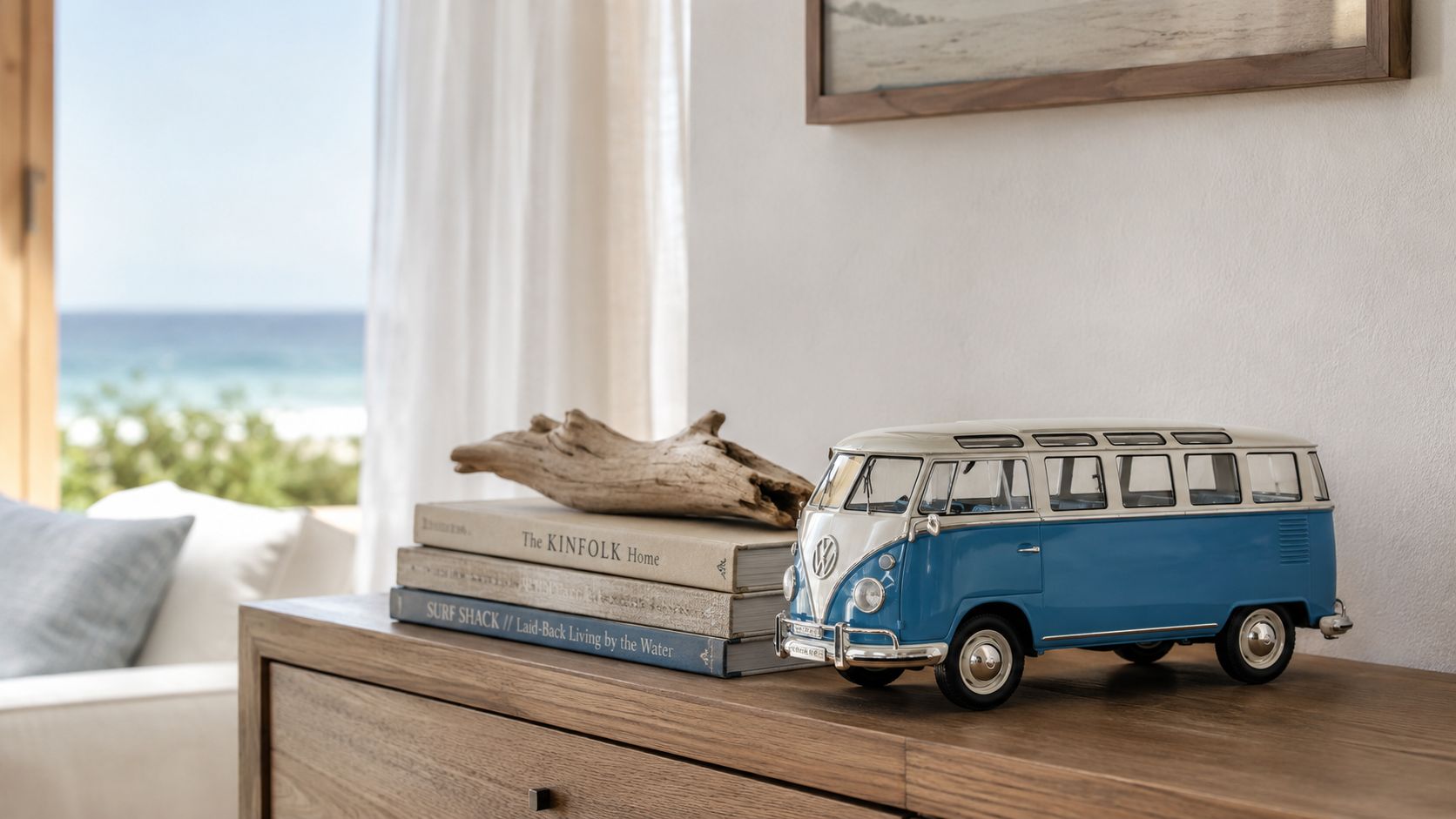
A classic blue and white toy Volkswagen bus sits on a wooden shelf next to books.

A 1962 Kombi Samba Bus looks right at home on a floating timber shelf beside a stack of travel books and a piece of beach photography. Keep the surrounding objects restrained. Driftwood, linen-covered books, a small ceramic vessel and a pale frame can connect the model to the room without competing with it.

For a different vignette, group Beetle models with vintage surf magazines or a simple woven tray. The Beetle's compact profile works particularly well on a console, where it can add a flash of colour without blocking the view. A Flower Power version can be the one bright note in an otherwise sandy, white and seafoam palette.

Build a story, not a display pile

A strong arrangement usually has one main object, a few supporting textures and a clear sense of direction. Place the Kombi facing towards an open section of shelf, as if it's ready to leave for the next coastal stop. Use books or a low box to create height, then soften the grouping with jute, timber or stoneware.

Display idea: Pair automotive colour with coastal texture. Let the model provide the personality, while linen, jute, pale timber and glazed ceramics keep the setting relaxed.

Wall art follows the same principle. A VW print can sit beside an abstract coastal painting, a muted horizon photograph or simple linework. Avoid matching every item to the vehicle. Contrast makes the arrangement feel collected over time.

This short visual reference also shows how effectively a classic bus can sit among books and timber rather than shells and anchors.

A beach house doesn't need to look like a showroom, either. One carefully positioned model near the entry, living room or reading nook often says more than a crowded shelf of matching ornaments. The result feels authentic because the objects point towards travel, freedom and Australian coastal life without spelling out the message.

Caring for Beach House Gifts in Coastal Conditions

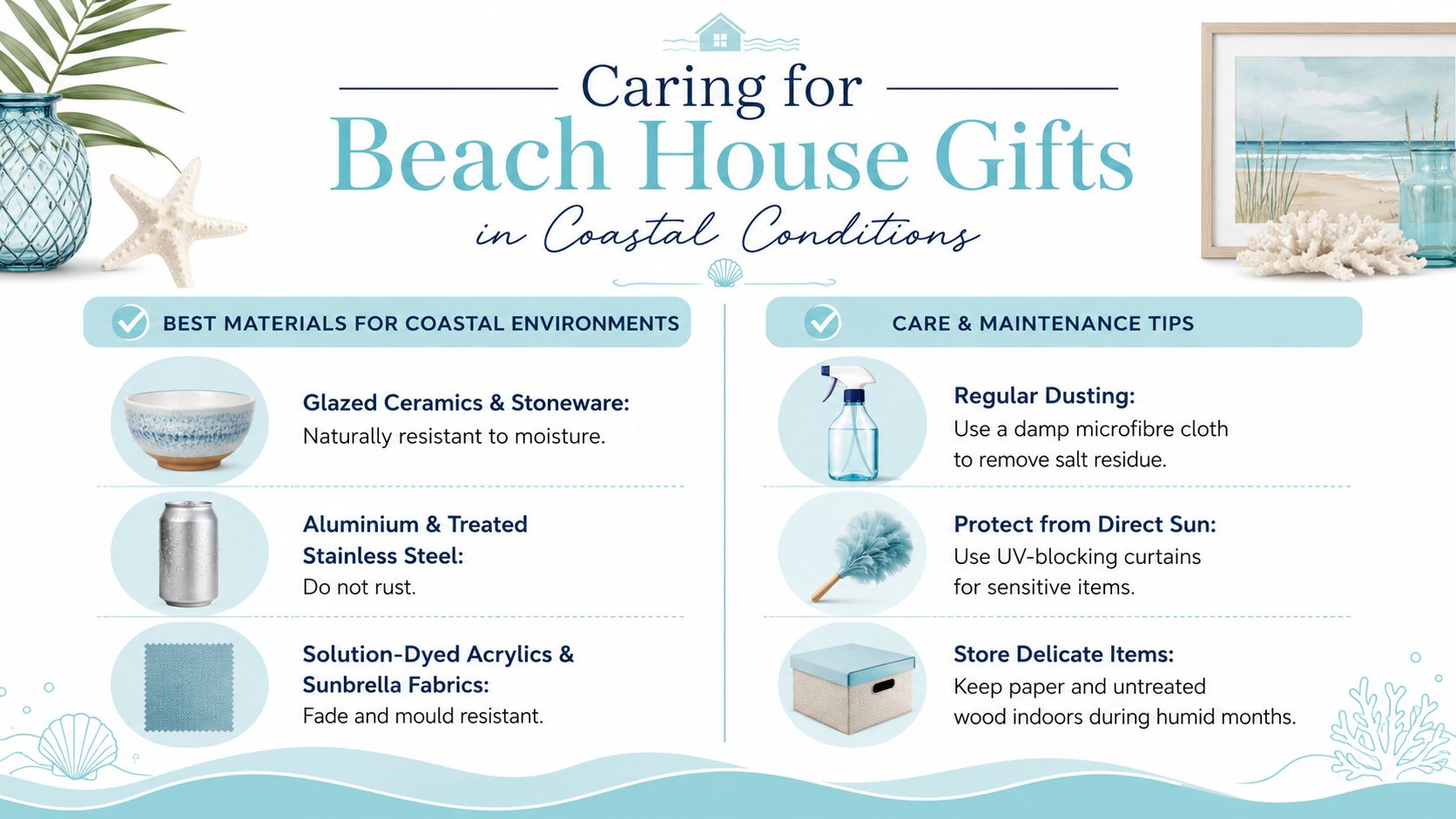
Coastal air is beautiful, but it's hard on exposed finishes. Salt residue settles on surfaces, humidity affects paper and untreated timber, and direct sun can fade paint over time. A thoughtful gift lasts longer when the recipient can display it in the right place and clean it without damaging the finish.

An infographic titled Caring for Beach House Gifts in Coastal Conditions featuring material and maintenance tips.

Protect the model first

Keep diecast models inside a display case where possible. A case limits dust and salt residue, reduces handling and adds a barrier against accidental knocks. Display cases for models are especially useful for collectors who want to keep packaging, accessories and the model itself in good condition.

Dust regularly with a soft brush or damp microfibre cloth. Don't spray cleaner directly onto the model, and don't soak painted surfaces. Direct sunlight deserves equal attention. Position the display away from strong windows, or use UV-blocking curtains when the room receives harsh afternoon light.

Choose coastal-ready supporting pieces

Glazed ceramics and stoneware are sensible choices for moisture-prone rooms. Aluminium, treated stainless steel and powder-coated finishes handle coastal exposure better than untreated steel. Solution-dyed acrylic and Sunbrella fabrics are useful around outdoor entertaining areas because they're designed to resist fading and mould.

Paper prints, cardboard packaging and untreated timber need more protection. Store delicate items indoors during humid periods, keep frames away from damp walls and allow air to circulate behind wall art. These small decisions prevent a beautiful beach house gift from becoming a maintenance job.

Why VW Gifts Resonate with Australian Collectors

The Beetle and Kombi aren't just retro shapes. They're part of Australia's motoring memory. Volkswagen formally introduced the Beetle here in 1953, began local assembly at Clayton, Victoria, in 1954, and reached nearly 95% Australian content by the early 1970s. The final Australian-assembled Beetle left the line in July 1976, as recorded in the Volkswagen Beetle history reference.

The Kombi has an equally strong local connection. Volkswagen sold 4.5 million Kombis worldwide since 1950, and the Microbus launched in 1954 accounted for more than one million of those sales. The first Type 2 vehicles were made in September 1952, sold in Australia from 1954, and the T2 arrived here in 1968, with German imports continuing after Australian assembly ended, according to Club VeeDub's Kombi history.

That heritage explains why a VW gift feels more personal than generic coastal filler. It can recall a family car, a surf trip, a restoration project or a long-held dream of owning a Samba Bus.

Australian events keep that community spirit visible. Volksfest Australia publishes its venue at 1 Dobinson Drive, Swansea NSW 2281, giving collectors a real gathering point for the culture, while VW Nationals and local Show and Shine events bring cars, owners and stories together. A diecast model fits naturally into that world. It's a compact way to celebrate the full-size cars, even when the beach house has no garage.

Wrapping and Presenting Beach House Gifts

Presentation should feel relaxed, tactile and easy to open. Use kraft paper, jute twine and a small dried flower or shell as an accent. Keep the decoration restrained, so the wrapping suggests the coast without repeating the same novelty motifs you were trying to avoid.

For a diecast model, leave the original display box intact and make it part of the presentation. Add a handwritten note explaining why you chose the Beetle, Samba Bus or Flower Power variant. If you're giving a housewarming present, pair the model with a small coastal accessory. For a birthday, build the bundle around the recipient's collecting interests. At Christmas, a model with a simple timber or linen accent makes a memorable display piece after the wrapping comes off.

Buying from an Australian importer also makes sense for collectors who value local stock, fast shipping and authentic licensed products. Check the current model details before ordering, especially when the gift needs to arrive for a specific gathering.


Volkswagen Memorabilia brings together licensed VW diecast models, Kombi Samba Bus and Beetle collectibles, surf-inspired pieces and coastal home décor for gifts with genuine character. Visit Volkswagen Memorabilia to find a beach house gift that celebrates Australian coastal living and the unmistakable spirit of classic Volkswagens.

Unique Beach Themed Gifts: Coastal & Surf Styles

You're standing in the driveway with the Kombi idling, the late sun bouncing off the chrome, and someone's asking what to bring to the weekend barbecue in Noosa. A towel feels ordinary. A candle gets forgotten. But a beach themed gift that carries the same easygoing charm as a classic VW, that's the sort of present people keep on the shelf, in the lounge, or in the cab corner of the van and smile at every time they pass it.

That's why the best coastal gifts aren't just “beachy”. They feel like a memory from a road trip, a day parked near the dunes, or a summer run down the coast with the windows cracked and the radio low. For VW lovers, the sweet spot is simple, a gift that can live happily beside a Volkswagen Beetle model, a Kombi Samba Bus diecast, or a bit of sun-washed décor and still feel right at home.

Capturing the Endless Summer Feeling

A mate once told me the hardest part of buying for a beach-loving VW fan isn't the budget, it's the feeling. He didn't want another throwaway trinket. He wanted something that brought back childhood holidays, surfboard wax in the back of the van, and those long, lazy afternoons when the Kombi became the family base camp.

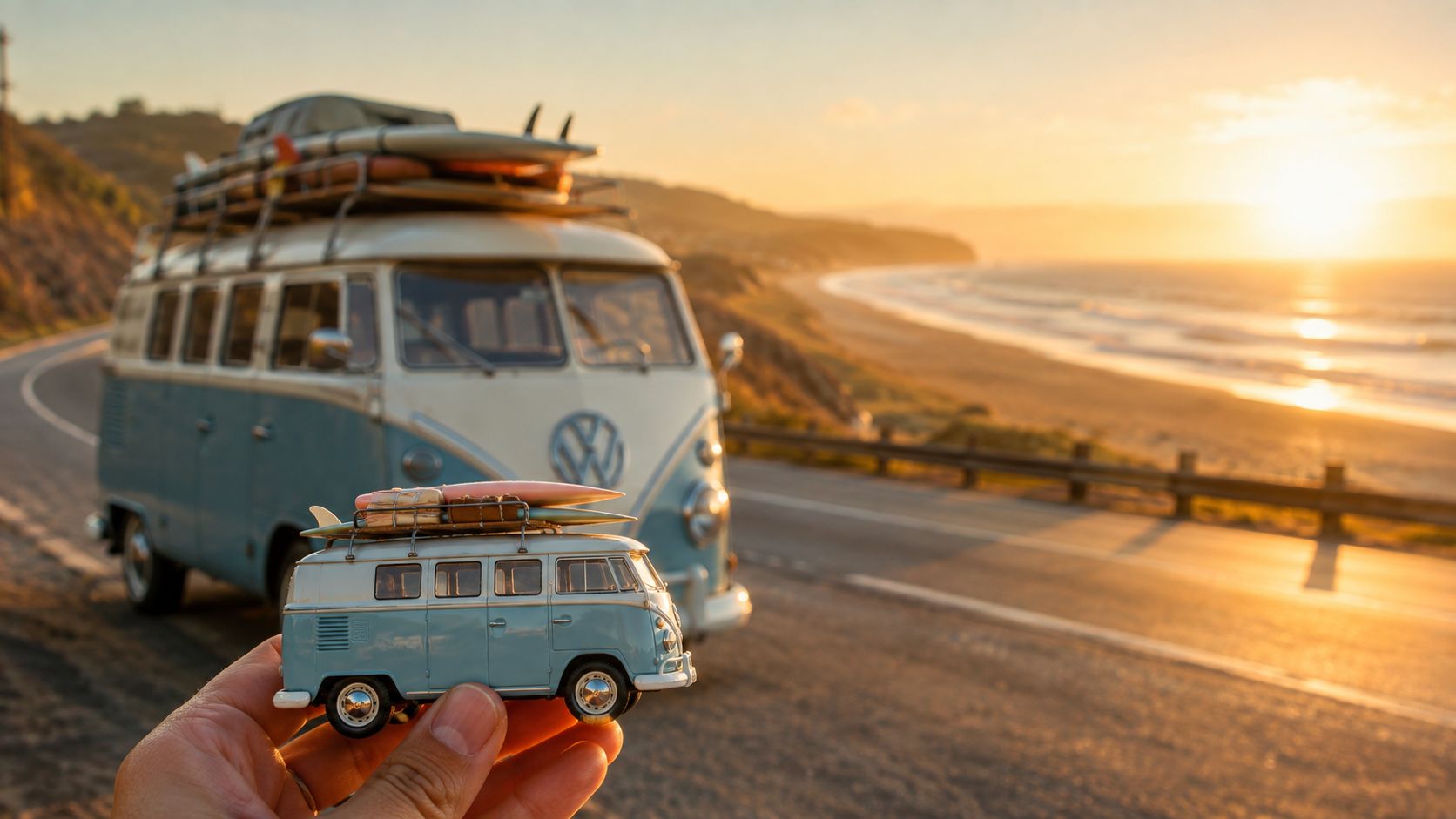
A hand holds a miniature vintage Volkswagen camper van against a full-sized van on a beach road.

That's the magic with beach themed gifts, the best ones bottle up a scene. A diecast Kombi on a desk does it instantly, because it carries the same road-trip spirit as the full-size van parked by the esky. A shell-inspired accent or a nautical print does something similar, it shifts a room from plain to personal without trying too hard.

Practical rule: if a gift makes someone tell a story the moment they unwrap it, you've probably picked well.

A good coastal gift also holds its own in the house, not just in the car or the caravan. A piece with a weathered finish, a familiar VW shape, or a bit of seaside character can sit beside family photos and still feel like it belongs. For the right person, that is what turns a simple present into a keepsake, something they'll place on a shelf and point to years later while talking about the trip that first brought it home.

More Than Just Sand and Shells

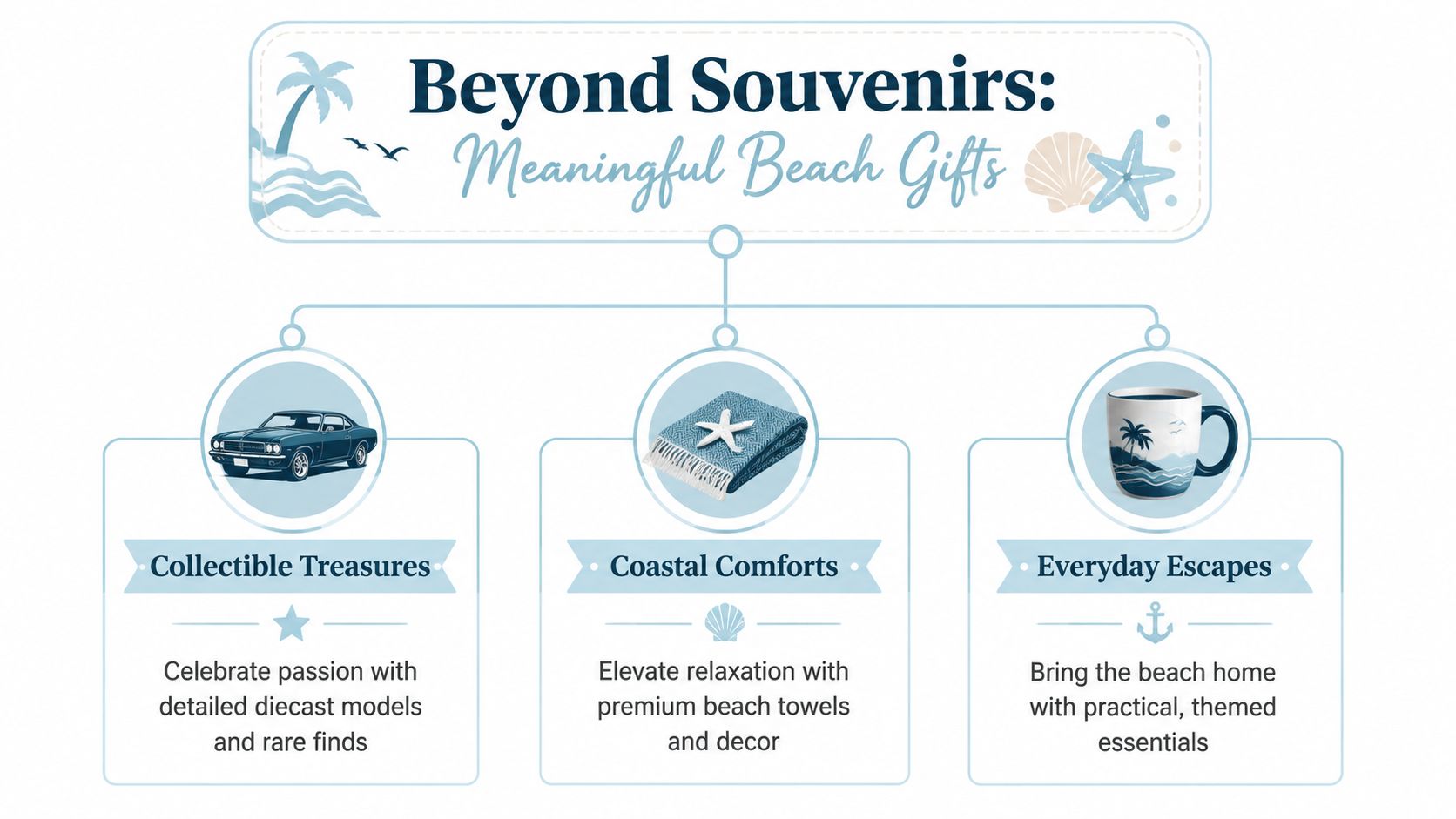
There's a big difference between a souvenir and a keepsake. A souvenir says, “I was there.” A keepsake says, “This mattered.” That's the line beach lovers and VW people both understand, because both worlds are built on memory, movement, and a bit of personality.

An infographic titled Beyond Souvenirs presenting gift categories: collectible treasures, coastal comforts, and everyday escapes for beach lovers.

What makes the gift feel personal

For a lot of Australian shoppers, the sweet spot is something that feels local and specific rather than generic. Independent gift guides show strong demand for beach gifts and coastal décor, but they don't always help with housewarming presents, caravan trips, or gifts that belong in a home rather than a beach bag (Bella Coastal Decor). That's where collectible pieces and styled décor start to make sense.

A licensed diecast VW lands as a collectible treasure because it gives the recipient a tiny, well-made version of something they already love. Coastal home accents do the same job in a different way, they turn a mantel, shelf, or entry table into a little seaside scene. The point isn't to buy more stuff, it's to choose something with staying power.

Why coastal décor belongs in the same conversation

Australia's 25,760 km of coastline explains a lot about our décor habits, because nautical styling keeps showing up in gifts and interiors, from wall art to photo frames and decorative accents (About Darwin). That's not a trend in the flimsy sense, it's a recurring visual language that feels familiar to a lot of homes.

A good beach gift should look at home beside a Kombi on the shelf, not fight for attention with it.

For a practical touch, shell and wind chime pieces can work beautifully when you want something relaxed, coastal, and a little nostalgic. If you're leaning into that soft seaside look, start with a curated piece like this shell wind chime and let the rest of the room follow its lead.

Gift Ideas for Every Beach and VW Lover

A good gift gets easier when you stop thinking about categories and start thinking about people. The diecast collector, the coastal home stylist, and the weekend wanderer all want something different, even if they'll all smile at a Kombi badge or a beachy colour palette.

Screenshot from https://vwmemorabilia.com.au/shop/

The diecast collector

This is the person who notices panel lines, mirror placement, and whether the paint finish feels true to the original. A Kombi Samba Bus diecast or a Volkswagen Beetle model makes sense here because the joy is in the detail, the silhouette, and the authenticity of the miniature.

Scale matters too. A larger model like 1:18 gives more presence on a desk or display cabinet, while 1:24 usually hits a nice balance between detail and space. Smaller formats suit mixed collections, especially if the recipient already has a few models lined up together.

The coastal home stylist

This buyer wants pieces that feel relaxed, light, and easy to place in the home. Think nautical photo frames, wall art, or a decorative accent that works with timber, white, blue, and sand-toned rooms. In Australian homes, those pieces often end up on a console near the entry or on a shelf in the living room.

The draw here is less about “beach kit” and more about atmosphere. A coastal ornament or a styled accent can soften a room the same way a Kombi softens a car park, it changes the feel without shouting.

The weekend wanderer

This is the friend who's always planning the next escape. They're the ones who love practical gifts with character, something that belongs in the van, the caravan, or the holiday house. A surfy VW model, a playful magnet, or a small display piece can all work because they're easy to enjoy without needing much space.

A lot of beach gifts fail because they look good for one day and then vanish into a drawer. The better ones earn a permanent spot on a shelf, which is exactly what a collector or nostalgic traveller wants.

Good gift test: if it would still make sense in a beach house, a study, and a garage, it's probably a strong pick.

For a broader browse of themed ideas, the gifts for the beach collection is a handy place to start when you're matching personality to present.

For a quick visual guide, the right item usually falls into one of these lanes:

  • Collector lane: licensed model, true-to-era styling, display value.
  • Decorator lane: coastal colours, easy styling, shelf-friendly proportions.
  • Travel lane: compact, personal, and tied to road trip memory.

The best part is that these choices don't compete with each other. A diecast Kombi can sit beside a framed print or a shell-inspired accent and still feel cohesive, especially in a home that already leans into relaxed Aussie coastal style.

Choosing the Right Piece of Paradise

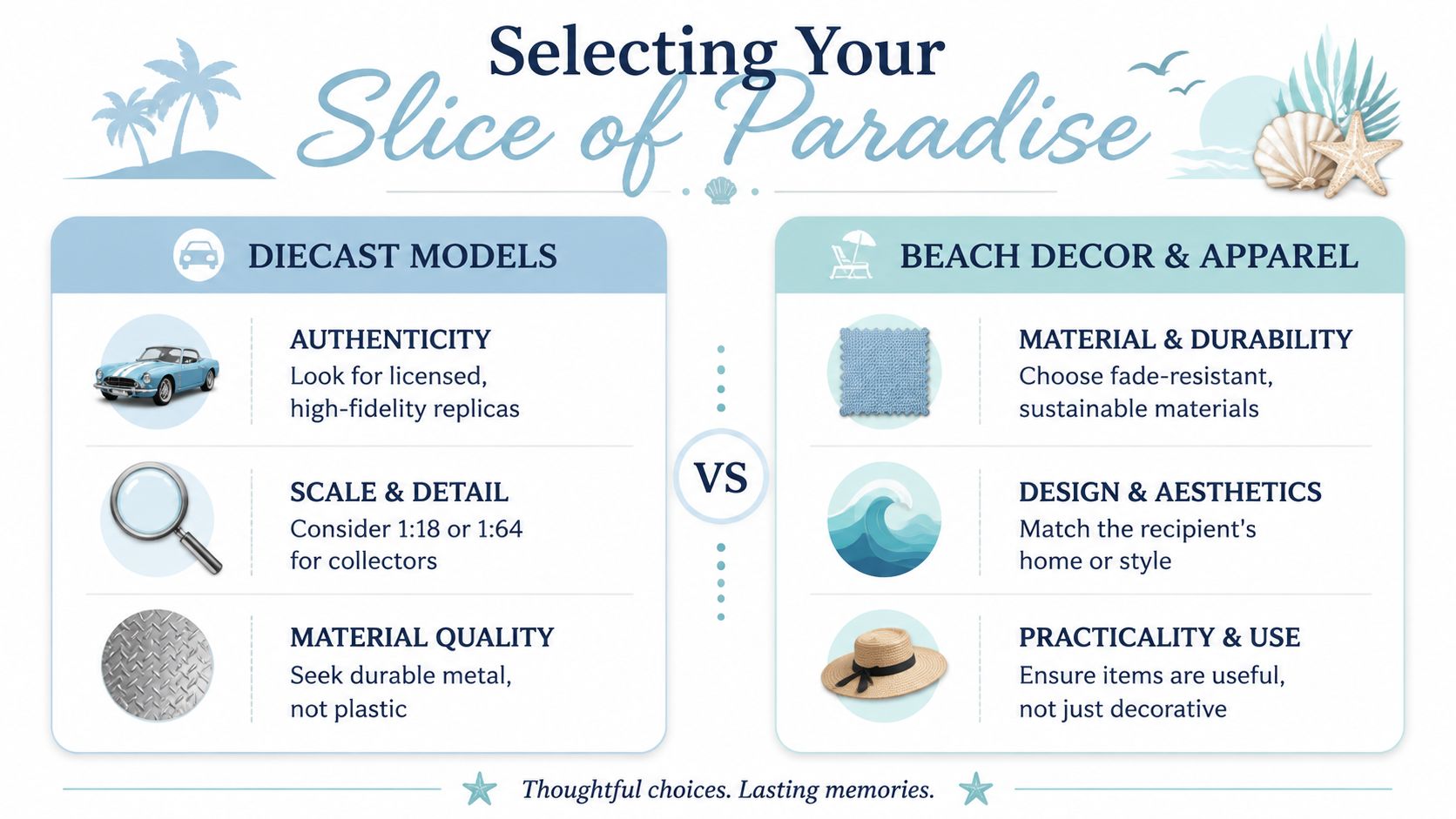
A thoughtful gift starts with fit, not just flair. The first question is whether the recipient wants something to display, use, or collect, because that decides everything from size to material to finish. A display piece can lean decorative, but a collectible needs authenticity and a sense of proportion that feels true to the original vehicle.

Diecast details that matter

For VW collectors, officially licensed models carry real weight because they signal fidelity, not guesswork. That matters when the gift is meant to celebrate a specific Kombi or Beetle rather than just nod at the shape of one. The closer the model stays to the actual vehicle, the more satisfying it feels to the person receiving it.

Scale is the other decision point. 1:18 models command attention and suit a feature shelf. 1:24 models are easier to work into an existing display without taking over the room. If the recipient already collects, matching scale to the rest of the shelf usually matters more than chasing the biggest box.

Beach décor and practicality

For coastal décor, material and finish matter just as much. A pale timber accent, a metal wall piece, or a framed print needs to sit comfortably with the home's palette, not clash with it. The safest route is to think in textures, timber, linen, metal, glass, and matte finishes tend to sit well in beach-style spaces.

Australian conditions add another layer. Many parts of the country regularly experience very high to extreme UV levels, so gifts that live near windows or spend time outdoors should be chosen with that in mind (GiftLab). That makes durability and placement worth thinking through before you buy.

Selection rule: if it's for a bright room, a beach house, or a sunlit display cabinet, choose a finish that still looks good after the afternoon light shifts.

A useful way to decide is simple.

  • Choose licensed diecast when the gift is for a collector or VW devotee.
  • Choose coastal décor when the recipient wants the beach feeling in the home.
  • Choose compact display pieces when space is tight but sentiment still matters.

The right piece feels deliberate. That's what separates a present from a placeholder.

An infographic comparing selection tips for diecast car models versus beach-themed home decor and apparel gifts.

Styling Your Coastal and VW Treasures

A gift really lands when it finds its place in the home. A Kombi model on its own is lovely. A Kombi model on a timber shelf with a framed surf photo and a small coastal accent turns into a story corner.

Start with one focal point. A road trip shelf works well for VW memorabilia, especially if the recipient already has a few models or keeps small travel keepsakes. Put the diecast in front, then build around it with a framed print, a map, or a small decorative piece that echoes the colour of the vehicle.

Make the room do the work

In a living room, coastal décor works best when it's grouped rather than scattered. A shell piece, a photo frame, and a neutral-toned accent will usually feel more considered than three unrelated items placed across the room. The goal is a calm, beach-house feel, not a souvenir shop.

For a study or home office, a single Beetle model can do more than a full shelf of clutter. It gives the space personality without crowding the desk, which is ideal for anyone who wants a nod to their VW side without turning the room into a garage display.

A few practical display ideas help:

  • Use height changes: place the model on a book or plinth so it sits above flat décor.
  • Repeat one colour: echo the Kombi's colour in a frame, cushion, or art print.
  • Leave breathing room: a small group looks more deliberate than a crowded shelf.
  • Keep direct sun in mind: bright light can be lovely, but it's not kind to every finish.

The beauty of this style is that it grows naturally. One gift becomes the start of a corner, then a shelf, then a whole room that feels like summer and road trips at once.

Your Go-To Aussie Shop for VW Memorabilia

A Kombi model on a shelf, a weathered map from a family trip, or a piece of beach-inspired home décor can carry the same feeling. It brings back the sort of day you still talk about later, the one where the windows were down, the esky was packed, and the coast kept appearing around the next bend. That is why the best beach themed gifts often end up being the ones with a story attached.

I have seen that at car shows and in living rooms alike. A collector sets a VW diecast beside a framed coastal print, and the whole corner starts to feel lived in, not staged. A decorator places a small Kombi next to timber, linen, and a pale blue accent, and the room suddenly feels like a holiday house that has been loved for years.

If you want a gift that feels local and personal, Volkswagen Memorabilia is a strong place to begin. The range suits the person who loves a clean display as much as the one who wants a reminder of summer drives, surf stops, and old-school motoring charm. You can browse beach-inspired home décor alongside VW diecast and other pieces that sit naturally in a collector's room or a coastal home.

A good gift does not need to shout. It just needs to land in the right hands, on the right shelf, in a room where the owner will spot it each morning and think of a Kombi by the water, a packed road trip, or a favourite stretch of coast. That is the kind of piece worth choosing from Volkswagen Memorabilia, especially if you want something that feels at home with Kombi nostalgia, beach style, and a proper Aussie road-trip spirit.

Home Decor Presents for the Ultimate VW Fan

You're probably in that all-too-familiar spot right now. Birthday coming up, housewarming on the calendar, maybe Christmas creeping closer than you'd like, and the person you're buying for already seems to have every tool, every shirt, and every “practical” thing under the sun. But they light up the second they spot a tidy old Beetle, a two-tone Kombi, or a Samba Bus parked on the grass at a local show.

That's when ordinary gifts fall flat.

For a VW fan, the best home decor presents aren't random fillers for a shelf. They're reminders of road trips, panel vans by the beach, family photos with a Beetle in the driveway, or that one Sunday spent walking row after row of polished classics with a coffee in hand. A well-chosen Volkswagen piece can sit in a lounge room, office, or hallway and subtly say, “I know what you love.”

More Than a Gift It Is a Piece of History

A mate of mine once spent weeks trying to buy a present for his dad. The bloke had restored cars, owned shelves full of manuals, and could spot the difference between a Beetle bumper and a Superbug bumper from half a car park away. Socks were out. Bunnings voucher was too lazy. Another mug was never going to cut it.

What worked was a vintage-style Volkswagen model for the study. Not because it filled a gap on a shelf, but because it brought a story back into the room. His dad saw it and started talking about the first VW he remembered in Australia, the shape of the guards, the simple lines, the feeling those cars gave people. That's the magic with the right home decor presents. They don't just decorate a room. They start conversations.

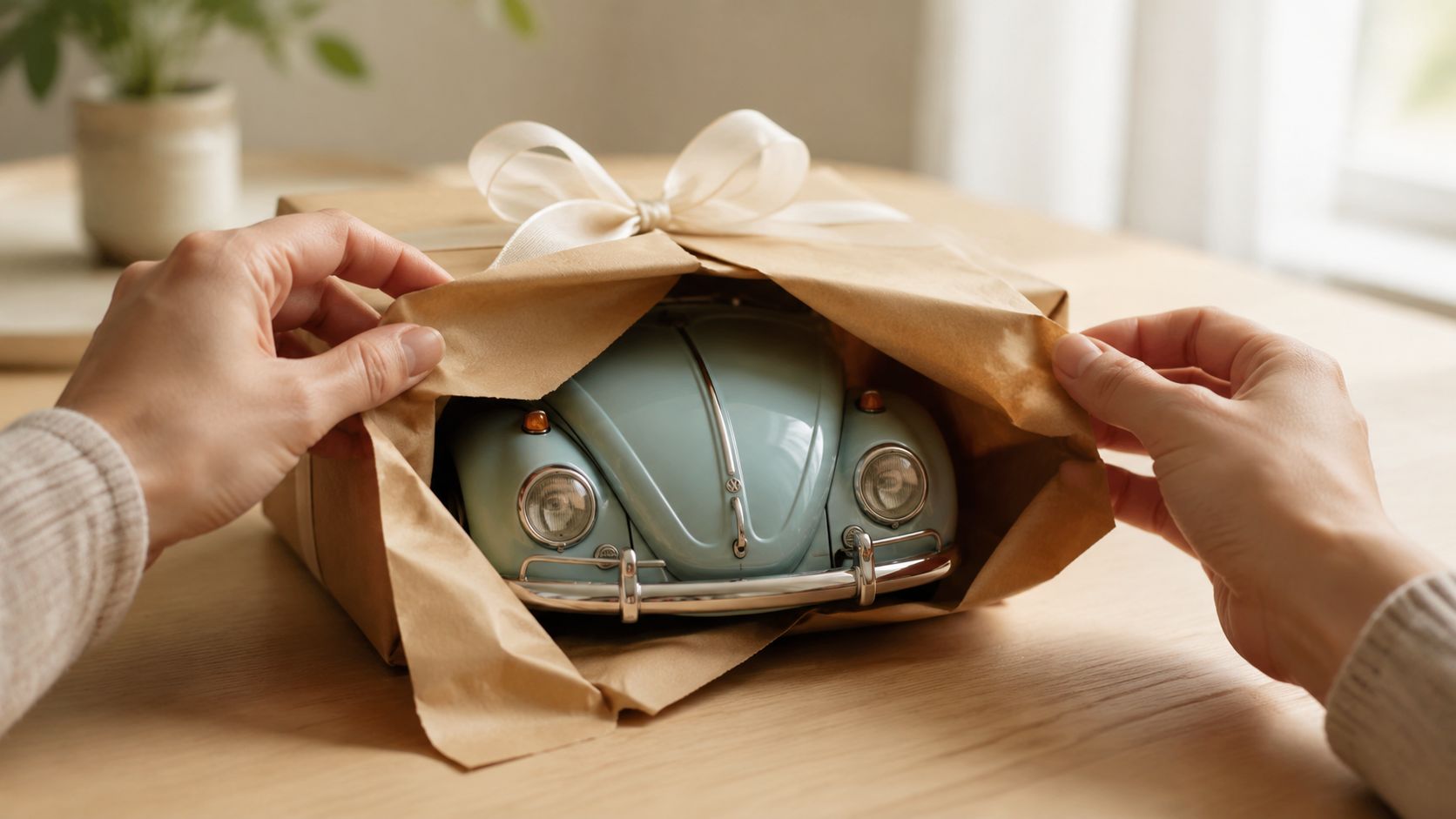
A person unwrapping a gift box containing a miniature light blue vintage Volkswagen Beetle car model.

The wider category is growing too. The Australian home decor market reached USD 16.1 Million in 2025 and is projected to reach USD 21.6 Million by 2034, according to IMARC Group's Australia home decor market outlook. That tells you plenty of Australians are choosing gifts and keepsakes that belong in the home, not just in a drawer.

Why VW pieces land differently

Some gifts say “that'll do.” Volkswagen-themed decor says something more personal.

  • It carries design history. A Beetle silhouette is recognisable in a heartbeat.
  • It suits lived-in spaces. A Kombi model works in a study, lounge, hallway console, or coastal holiday house.
  • It bridges hobby and home. That's why so many people gravitate to vintage home accessories with a story behind them.

A good gift doesn't interrupt someone's home. It settles into it and makes the room feel more like theirs.

Decoding the VW Fan Your Guide to Gifting

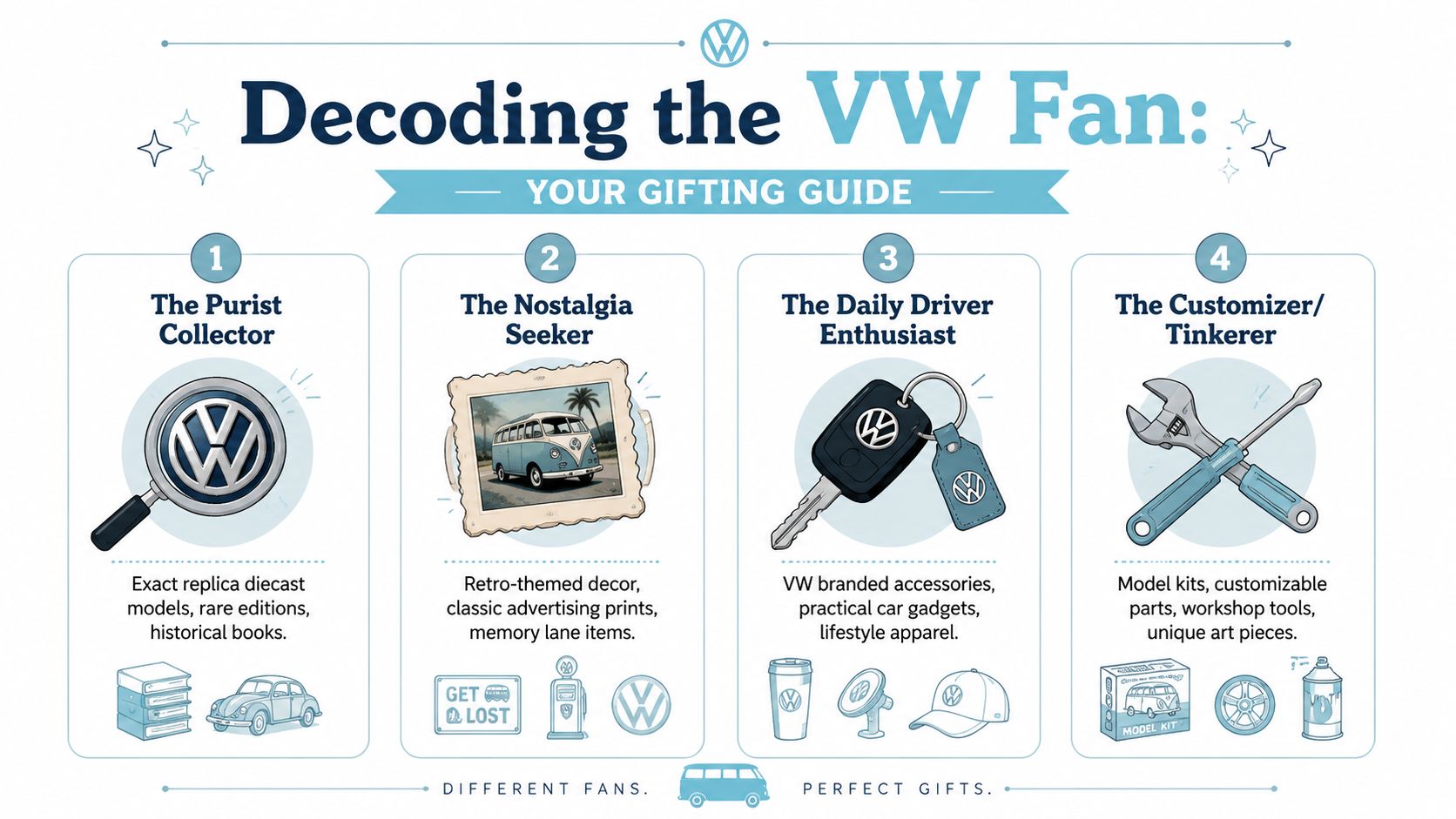
Not every Volkswagen lover wants the same thing. One person wants exact trim detail and authentic lines. Another wants a reminder of beach runs, old family cars, or the carefree look of a bright Kombi parked by the water. Getting the gift right starts with knowing which kind of fan you're buying for.

The connection runs deep in Australia. The Volkswagen Beetle was formally introduced to the Australian market in 1953, with local assembly beginning at Clayton in Victoria the following year, as noted in the Volkswagen Beetle history entry. That long local history is part of why VW gifts can feel so personal here. These aren't foreign curiosities. They're woven into Australian motoring memory.

A Volkswagen gifting guide infographic categorizing VW fans into four types with recommended gift ideas for each.

The four VW gift personalities

Fan type What they care about Home decor present that fits
The Purist Collector Accurate proportions, licensing, historic models A detailed Beetle or Kombi diecast displayed in a study or cabinet
The Nostalgia Seeker Memories, retro charm, old-school design VW wall art, framed pieces, retro-style decor accents
The Daily Driver Enthusiast Everyday VW identity, subtle style Desk accessories, smaller display models, practical memorabilia
The Customizer or Tinkerer Workshop spirit, individuality, model details Model kits, metal decor, unusual display pieces

How to read the clues

If they stop at every diecast table during a show, they're probably the Purist Collector. They'll notice scale, body shape, badging, windows, trim, and whether the model feels true to the original car.

If they tell stories that start with “we used to pile into Dad's Kombi”, that's the Nostalgia Seeker. They usually love gifts that feel warm and familiar, not clinical or overly technical.

Then there's the Daily Driver Enthusiast. This person might own a modern VW, still wave at old Kombis, and likes the brand as part of daily life. Their ideal gift often works best on a desk, a bookshelf, or a sideboard.

Finally, the Customizer or Tinkerer enjoys personality. They appreciate quirky colourways, surf styling, workshop-inspired displays, and pieces that don't feel too formal.

Collector's rule: If the recipient talks about “licensed” models, don't guess. Quality and authenticity matter more than size.

Choosing the Perfect Volkswagen Model

Plenty of gift buyers get stuck at this point. The model looks good in the photo, but is it too big, too small, too playful, or too serious for the person receiving it? The easiest way to sort it is to look at three things. Scale, licensing, and theme.

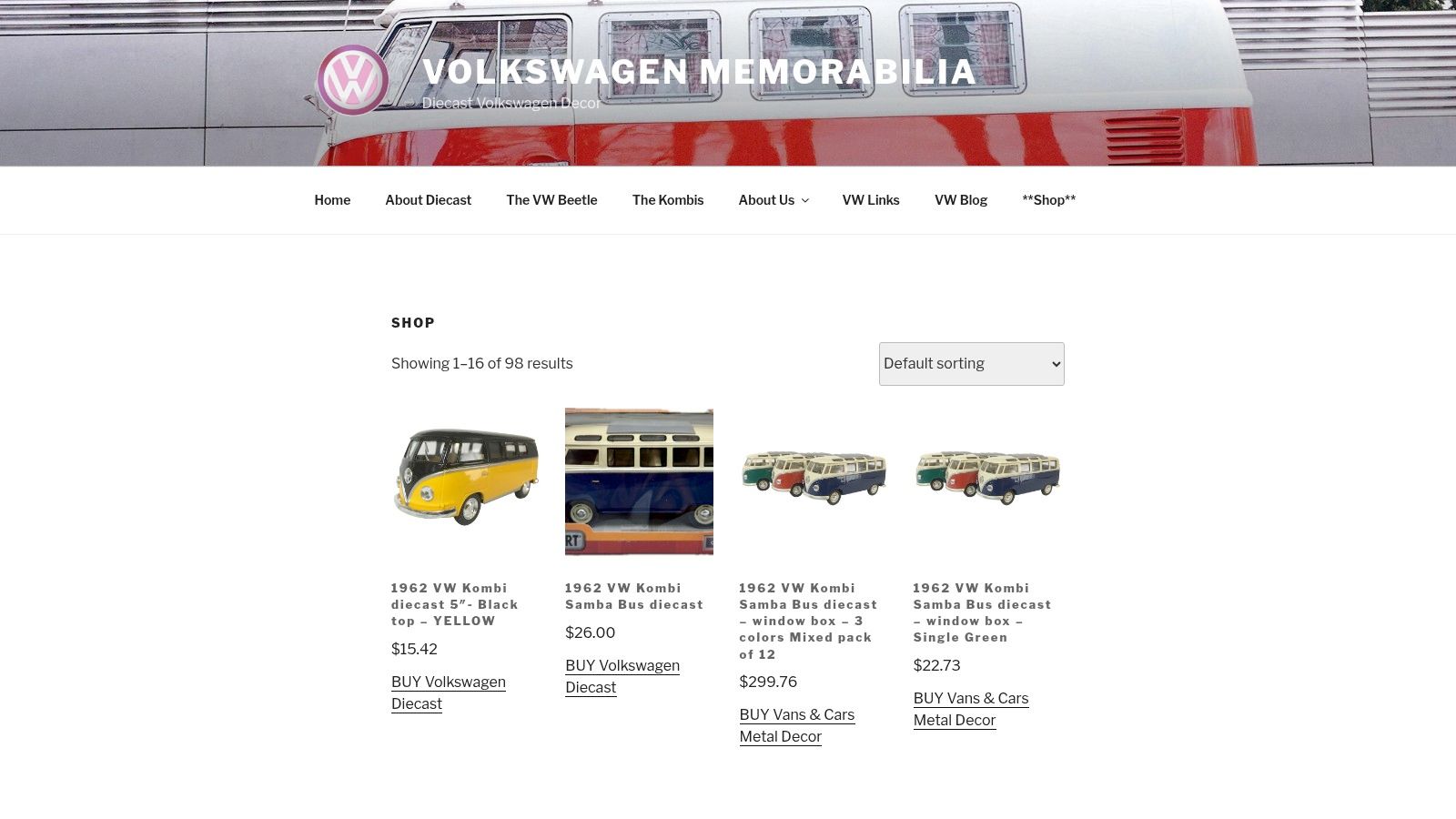
Screenshot from https://vwmemorabilia.com.au/shop/

Start with scale

Scale changes how a gift lives in the home.

  • 1:18 scale suits the fan who wants presence and detail. It works beautifully on a cabinet, desk, or dedicated display shelf.
  • 1:24 scale is a sweet spot for many homes. Big enough to admire, small enough to style easily.
  • 1:32 scale is ideal when you want a tasteful accent for a bookshelf, office, or bedside table.

If you're buying a VW Kombi diecast Australia collectors would happily display, scale isn't just a measurement. It shapes the whole feel of the gift.

Only buy licensed when detail matters

Officially licensed pieces tend to feel more satisfying in the hand and more convincing in a room. The shape is cleaner, the finish feels intentional, and the model usually stands up better as a decor piece instead of reading like a toy.

That matters with iconic vehicles. A Volkswagen Beetle earned its reputation for toughness far beyond suburban streets. In 1963, a Beetle donated by the manufacturer became the first production car to operate in Antarctica, where its air-cooled engine handled the extreme cold, according to the Old Antarctic Explorers post on the 1963 Beetle. When a car carries that kind of legend, a flimsy imitation feels a bit off.

Match the model to the room

Some quick pairings help:

  • Classic Beetle model for retro studies, home offices, and reading nooks
  • 1962 Kombi Samba Bus for relaxed coastal rooms and holiday homes
  • Flower Power Kombi for colourful interiors with a bit of fun
  • Black Top or neutral-toned vans for cleaner, minimalist styling

If you're shopping for a Volkswagen Beetle model or want to buy diecast Kombi pieces as home decor presents, pick the one that already looks like it belongs in their house.

Styling VW Decor Beyond the Bookshelf

The best VW decor doesn't need a glass cabinet and a “do not touch” sign. It can sit naturally in the home and still feel special. That's the difference between a collectible that stays boxed and one that becomes part of everyday life.

A classic blue and cream toy Volkswagen T1 bus model sits on a wooden coffee table near books.

Research into the Psychology of Home notes that surrounding yourself with personal objects such as photos and cherished mementos offers emotional grounding and can ease isolation, as discussed in Suzie Anderson Home's piece on cosy Australian winter decor. That's a strong reason to treat VW memorabilia as more than filler. The right object can make a room feel familiar, owned, and loved.

Coastal homes and Kombi spirit

A cream-and-blue Kombi model on a coffee table has a way of softening a room. Set it near stacked books, a timber tray, and a few beachy textures, and it feels right at home. In spaces with light timber, whites, sandy tones, or sea-inspired accents, a bus model brings personality without breaking the calm.

That's why coastal styling works so well with VW wall accents for the living room. The old bus shape already carries beach culture, road trips, and easy weekends.

Retro rooms and Beetle charm

A Beetle model belongs in retro spaces almost automatically. Think sideboard, record player nearby, framed print above, maybe a warm lamp in the corner. You don't need a huge collection. One well-placed piece can do the job.

Try this arrangement:

  • On a hallway console with a small bowl for keys and a framed family photo
  • In a home office as a desk accent beside notebooks and a vintage-style lamp
  • On open shelving mixed with books, a small plant, and one other nostalgic object

Personal objects work best when they're visible in daily life, not hidden away where nobody sees them.

Minimalist spaces still have room for VW character

A minimalist home doesn't mean empty shelves and zero personality. It just means every piece has to earn its place. A single black, white, or muted-tone Volkswagen model can add shape and story without cluttering the room.

For the recipient who likes cleaner interiors, choose:

Interior style Best VW decor choice Why it works
Coastal Two-tone Kombi or Samba Bus Echoes beach culture and relaxed colour palettes
Retro Bright Beetle or Flower Power bus Picks up vintage colour and nostalgia
Minimalist Neutral Beetle or dark-finish van Adds sculptural form without visual noise

The Finishing Touches Budget and Presentation

A thoughtful VW gift doesn't have to be the biggest box under the tree. Some of the most successful home decor presents are smaller pieces chosen with care and wrapped like they matter.

The trick is to match the scale of the gift to the way the person lives. Someone in a unit or apartment may love a compact model for a shelf or desk. Someone with a garage bar, home office, or dedicated display area might enjoy a larger feature piece.

Build a gift that feels curated

A diecast model on its own can be excellent. Paired well, it feels even more considered.

A few combinations work nicely:

  • For a coastal VW fan. Pair a Kombi model with a nautical accent or beach-inspired fridge magnet.
  • For a home office. Match a Beetle model with a photo frame or tidy desk accessory.
  • For a nostalgic gift. Add a handwritten note about a shared road trip, family car, or favourite show memory.

That last bit matters. The object is the anchor, but the story gives it weight.

Wrap it in a way they'll keep

Presentation is part of the gift, especially for decor pieces. A reusable bag, a neat gift box, or a tray they can keep is often better than layers of throwaway wrap.

A 2024 Australia Institute survey found that 65% of Australians re-use gift bags, which makes reusable presentation a practical choice as well as a sustainable one, according to the Australia Institute's Christmas gift survey article.

Presentation tip: If the packaging can become part of the home, it stops being waste and starts being part of the gift.

Quick questions people ask

Is a smaller model less impressive?
Not at all. In many homes, a smaller piece is easier to style and enjoy every day.

Should I choose a Beetle or a Kombi?
Pick the one that matches their personality and interior style. Beetles suit retro and classic spaces. Kombis lean naturally coastal and relaxed.

Do home decor presents need to match the room exactly?
Close is good enough. The best gifts bring a bit of the person into the room, not just the room into the gift.

Your Go-To for VW Gifts in Australia

When you boil it down, the strongest home decor presents do two jobs at once. They look good in the home, and they mean something to the person who receives them. Volkswagen memorabilia does that beautifully because it carries design, memory, and identity in one tidy package.

That's especially true for Australian buyers. Buying locally means you can choose gifts with confidence, avoid the drag of long overseas waits, and pick from stock that's already here. For collectors and gift buyers alike, local stock and fast shipping can make all the difference when an occasion sneaks up on you.

If you're looking for Volkswagen diecast models for sale, classic Beetle pieces, coastal accents, or VW memorabilia collectibles that feel at home in an Australian lounge room, study, or beach house, it helps to start with a specialist range rather than trawling generic marketplaces. A focused collection makes it easier to find something that suits the recipient's style, whether that's retro, coastal, or pared-back.

For those hunting a present with real personality, unique VW gifts in Australia make the search a lot more enjoyable. You're not just buying an object. You're giving a nod to a passion that's lasted generations.


If you're ready to find a gift that feels personal, practical, and full of VW character, have a look through Volkswagen Memorabilia. You'll find licensed diecast models, Kombi and Beetle favourites, and home-friendly pieces that suit coastal, retro, and minimalist spaces, all backed by local Australian stock, fast shipping, and people who get the VW community.