


You're at the counter of a coastal market, or halfway through an online scroll, and a shell photo frame catches your eye. For a second, it looks perfect. Then the nagging question lands, will this feel like coastal chic in a modern room, or will it look like a tired beach house relic from the 90s?
That hesitation is fair. Shell frames can go either way, and the difference comes down to construction, scale, and styling, not some vague rule about whether shells are “in” or “out”. In Australia, they also carry real cultural weight through the La Perouse shellworking tradition, which gives the best pieces more depth than souvenir-shop tat. The frames worth buying today sit right where heritage texture meets clean, current interiors.
Here's the practical bit. A good shell frame has to do four jobs: look intentional in a modern home, be built well enough for coastal conditions, suit the photo and the room, and style out without screaming “holiday gift shop”. If it fails any one of those, skip it.
Why a Shell Photo Frame Still Belongs in a Modern Home
A shell frame belongs in a modern room when it is treated like a proper decorative object, not a souvenir left to fend for itself. Put one on a pale oak console beside linen lamps and a simple print, and it can look crisp. Bury it under yellow light with fake driftwood and a starfish, and it slides straight into tacky territory.
Why it still works
The reason shell frames still earn their place is texture. Current Australian coastal interiors favour softer, grounded materials, and coverage has pointed to neutral styles, coastal preferences, and cleaner frame choices, including floating frames, slim textured mouldings, and premium natural finishes Australian Design Review. That gives shell work room to sit comfortably, as long as the rest of the room keeps its palette calm.
The best shell frames do not try to be novelty pieces. They read as organic surface, not as a gimmick. That is the difference between a frame you keep in the main living area and one you banish to the spare room after one holiday season.
Practical rule: if the frame sits naturally with timber, linen, stone, or woven fibres, it still works. If it only makes sense beside beach props, it does not.
There is also the craft side. Shellwork tied to La Perouse has been documented for more than a century, which gives the form real standing in Australian decorative culture and keeps it from feeling like pure tourist kit Sydney Morning Herald. That history is why a well-made shell frame can feel collected, not cheesy.
For more styling references, browse coastal wall styling ideas.
What a Shell Photo Frame Is Actually Made Of
A shell frame isn't one thing, it's a stack of decisions. If you can read those layers, you'll spot quality fast and avoid the brittle souvenir jobs that won't hold up in a real house near salt air.
The structure under the shells
The most important part is the substrate, the base the shells sit on. In better frames, that base is usually wood or a wood-based composite, because the frame needs enough stability to stay flat and keep the front square. The shell layer itself is decorative, not structural, and in Australian marketplace listings the construction is typically described as natural seashells bonded to a wooden frame with a glass front Etsy listing. That matters because the shells can chip, lift, or crack if the frame is treated roughly.
Cheaper frames often cut corners with thin board, sloppy glue, or a resin-coated backing that doesn't love humidity. Premium pieces usually feel tighter at the edges, with cleaner shell placement and a backing that doesn't flex when you pick it up.
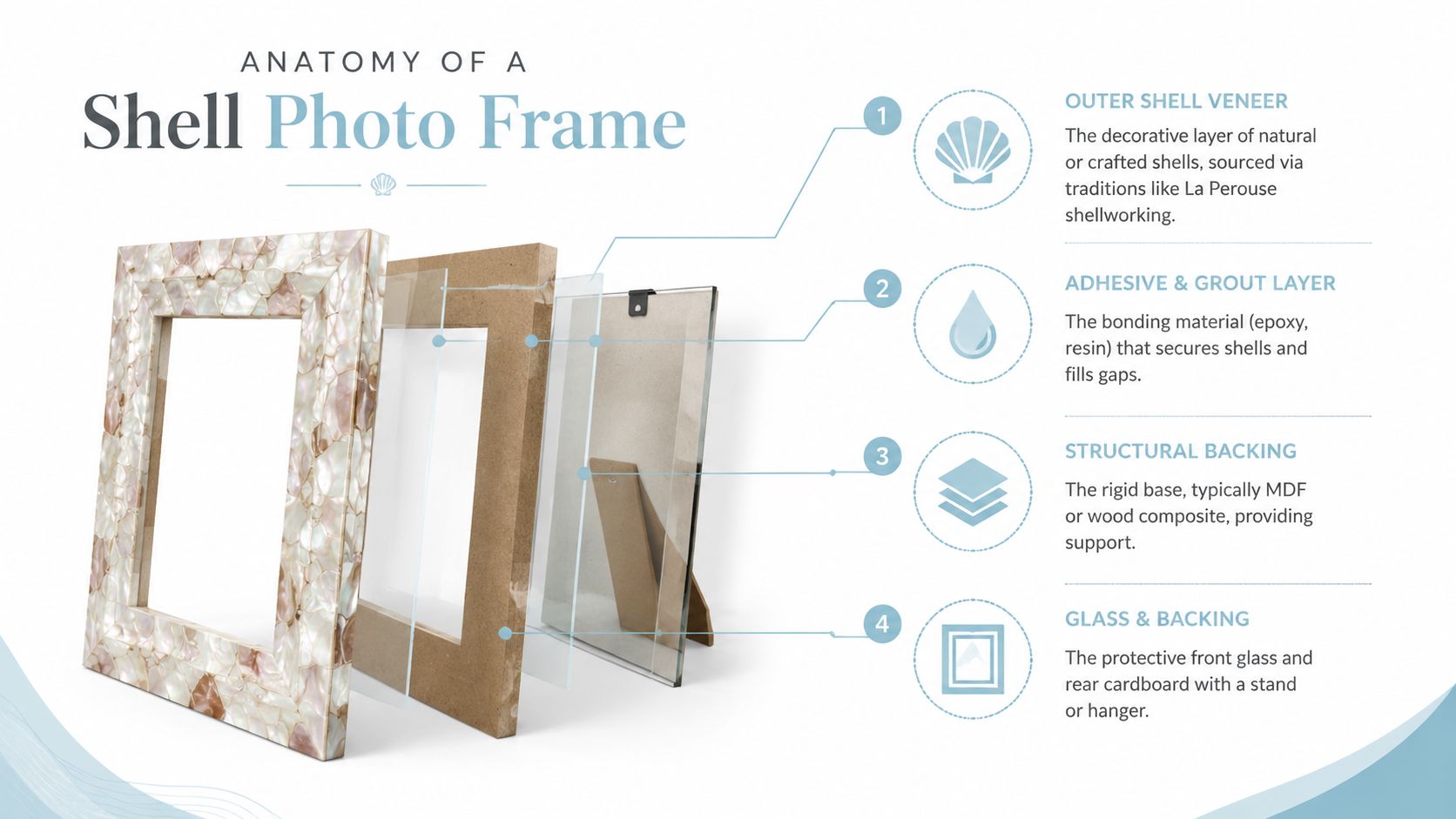
What each layer does
The outer layer is the shell veneer. That can be whole shells, cut pieces, or shell fragments set into a pattern. Whole shells give you chunkier texture, cut pieces look neater, and crushed shell in resin is the budget end of the market.
Beneath that is the adhesive layer, usually glue or resin. A lot of cheap frames fail, because if the adhesive is sloppy, shells don't sit cleanly and edges catch dust or moisture.
The backing is the support layer, usually hardboard or MDF, sometimes with a kickstand or D-rings. The front can be glass, acrylic, or, on some decorative pieces, no glazing at all. In a coastal home, sealed backing and decent hardware matter more than people realise, especially if the frame is going anywhere near sea air or a breezy open-plan room.
See seashell craft inspiration
Styles and Sizes Worth Knowing
Shell frames aren't one category, they're a few very different looks pretending to be the same thing. If you know which family you're looking at, you'll stop buying the wrong frame for the wrong room.
Shell Frame Style Families at a Glance
| Style | Typical Sizes | Best Room | 2026 Verdict |
|---|---|---|---|
| Classic scallop mosaic in a square timber frame | Small to medium | Hall tables, bedside tables | Current if the rest of the room is restrained |
| Slim floating frame with shell inlay | Small to medium, sometimes larger | Living rooms, home offices | Very current with Scandi-coastal styling |
| Chunky statement frame covered in whole shells | Medium to large | Holiday homes, casual informal spaces | Risky, can go kitschy fast |
| Beach keepsake shadowbox with shells over sand | Medium | Bedrooms, entryways, memory corners | Niche but workable if edited well |
| Petite 4×6 tabletop style | Small | Shelves, desks, gift displays | Safe, but not much presence on a wall |
How the styles behave in real homes
The classic scallop mosaic is the easiest to live with because it usually reads as texture first, theme second. A slim timber border keeps it from feeling overworked. I'd use it on a console, not as the centrepiece of a giant gallery wall.
The floating shell inlay is the one that feels the most 2026. It suits cleaner interiors and sits comfortably beside linen, oak, and pale stone. If you want a shell frame that doesn't shout, this is the one.
The chunky whole-shell frame is the one to watch. It can be fun in a beach shack or a relaxed family room, but it's the quickest route to kitsch if you crowd it with other seaside objects.
The bigger the frame, the more the quality shows. Anything around A3 and above needs tidy shell placement, because every uneven edge is on display. If the craftsmanship is sloppy at that size, there's nowhere to hide it.
Explore boho-inspired wall pieces
How to Choose the Right Shell Photo Frame
Buy the frame like you'd buy a chair, by checking the bones first. The prettiest shell work in the world won't save a frame that's the wrong size, badly finished, or built for a house with no humidity.
Start with scale and shell density
Match the frame to the photo and the wall. A tiny frame on a big wall just disappears, while an oversized shell frame can look shouty if the room is already busy. Then look at shell density. Sparse shell work feels cleaner and more modern, while tight coverage feels heavier and more decorative.
If you're buying for a modern Australian coastal room, choose less shell, better spacing, cleaner edges.
Check the build before the shine
Look at the moulding depth next. A frame with enough depth usually feels more substantial and tends to handle glazing better. Check the colour too. White, bone, soft sand, and pale timber are easier to style than yellowed cream or harsh glossy finishes.
Then check the front. Glass is better than flimsy plastic if you want a more polished result, while acrylic can make sense for lighter hanging. The backing should feel firm, not bendy. If it's soft board or warped MDF, walk away, especially in a coastal home where humidity can make a cheap backing misbehave.
Don't ignore the hardware
A frame can look lovely and still be a pain to hang. Flip it over and check the hanging points, stand, and closures. Cheap souvenir frames often have rough internal edges or weak hardware, and that's where the disappointment starts.
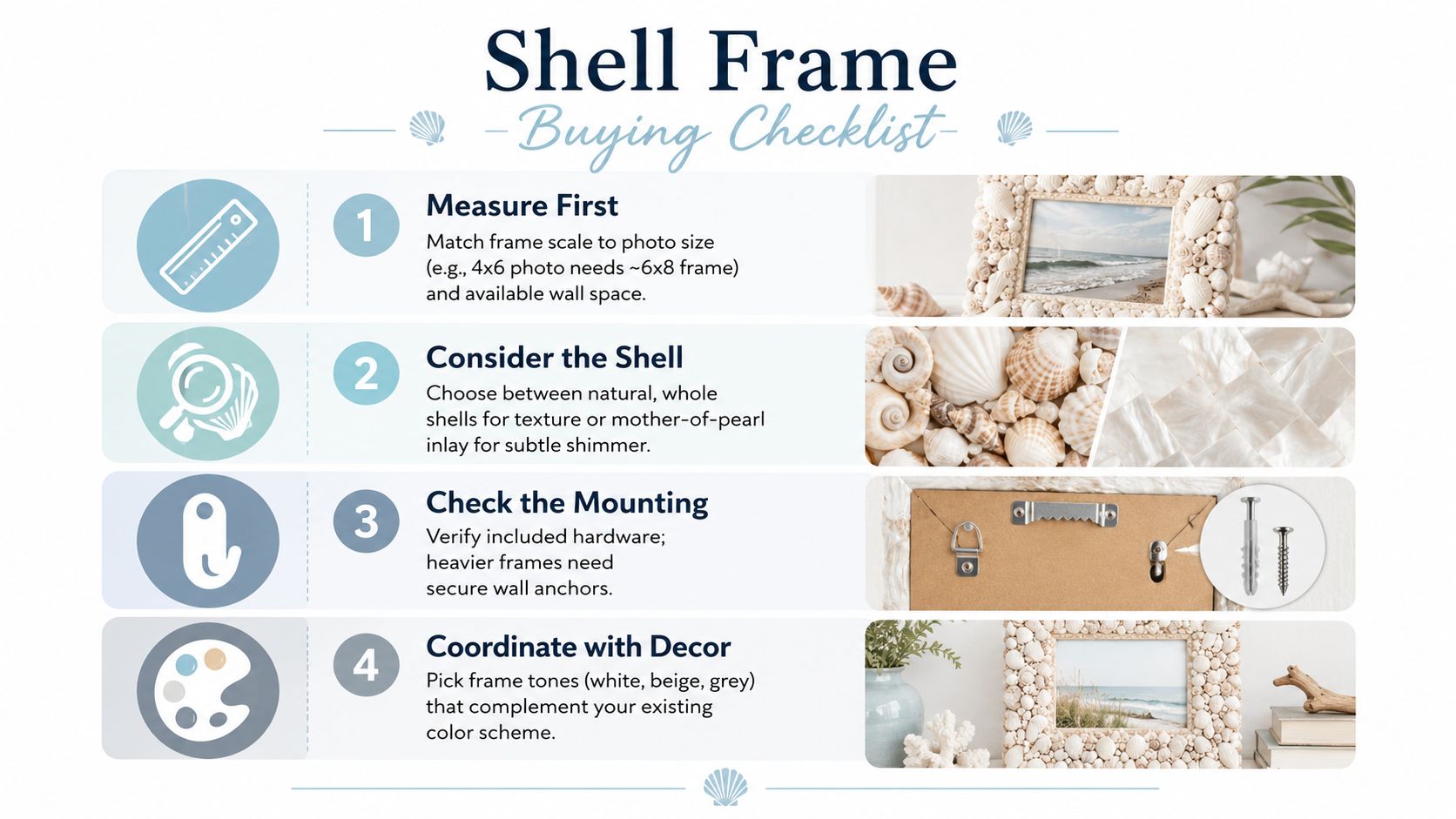
- Measure first. Make sure the frame suits both the photo and the furniture or wall space.
- Check shell placement. If the pieces are uneven, lifted, or gappy, you'll notice it every day.
- Inspect the back. A sturdy backboard and solid hanging hardware matter more than a flashy front.
- Ask yourself one question. Will this still look right in five years, or will it date itself to the moment you bought it?
Styling Shell Frames the 2026 Way
A shell frame isn't the problem. Bad styling is. Put it in the wrong company and it turns novelty fast. Put it with cleaner materials and it starts reading as coastal texture instead of souvenir clutter.
What makes it feel current
Australian coastal style now leans calmer, with neutral palettes, natural materials, and more restrained surface detail Australian Design Review. That means shell frames work best when they sit inside a quiet composition. Keep the nearby objects simple, let the shells be the texture hit, and stop there.
The easiest fix is tonal pairing. Raw oak, blackbutt, linen, ceramic, and jute all make shell work feel grounded. A dense shell frame on a pale timber console looks deliberate. The same frame next to turquoise candles and faux coral looks lost in time.
What to avoid
Don't pair shell frames with too many literal beach references. Starfish, rope knots, fisher-buoy colours, and yellowed matboard drag the whole look back into the past. If the room already has a strong print, too many small decorative objects, or shiny finishes, the shell frame will feel busier than it should.
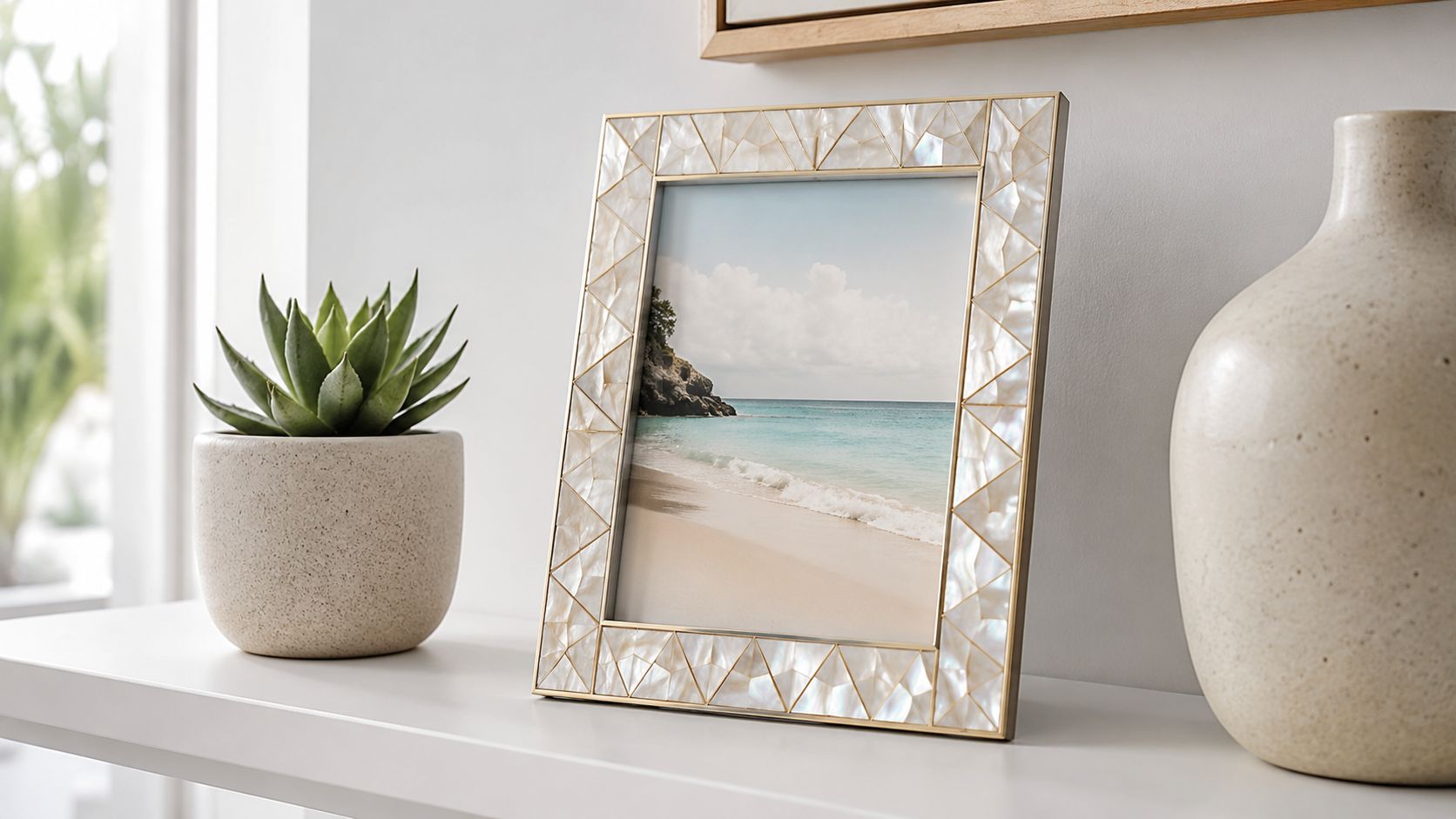
A better move is to give it breathing room. One shell frame, one stack of books, one ceramic vessel, done. That's enough.
A matte white or natural linen mat also sharpens the look instantly. If the frame is heavy and textured, keep the rest of the arrangement lighter. If the shell coverage is sparse, you can lean a little harder into texture around it, but don't overdo it.
Where to Place Them in Real Rooms
A shell frame doesn't need a beach-themed room. It needs the right room and the right scale. The best placements feel calm, not obvious.
Entry, living room, bedroom, bathroom, office
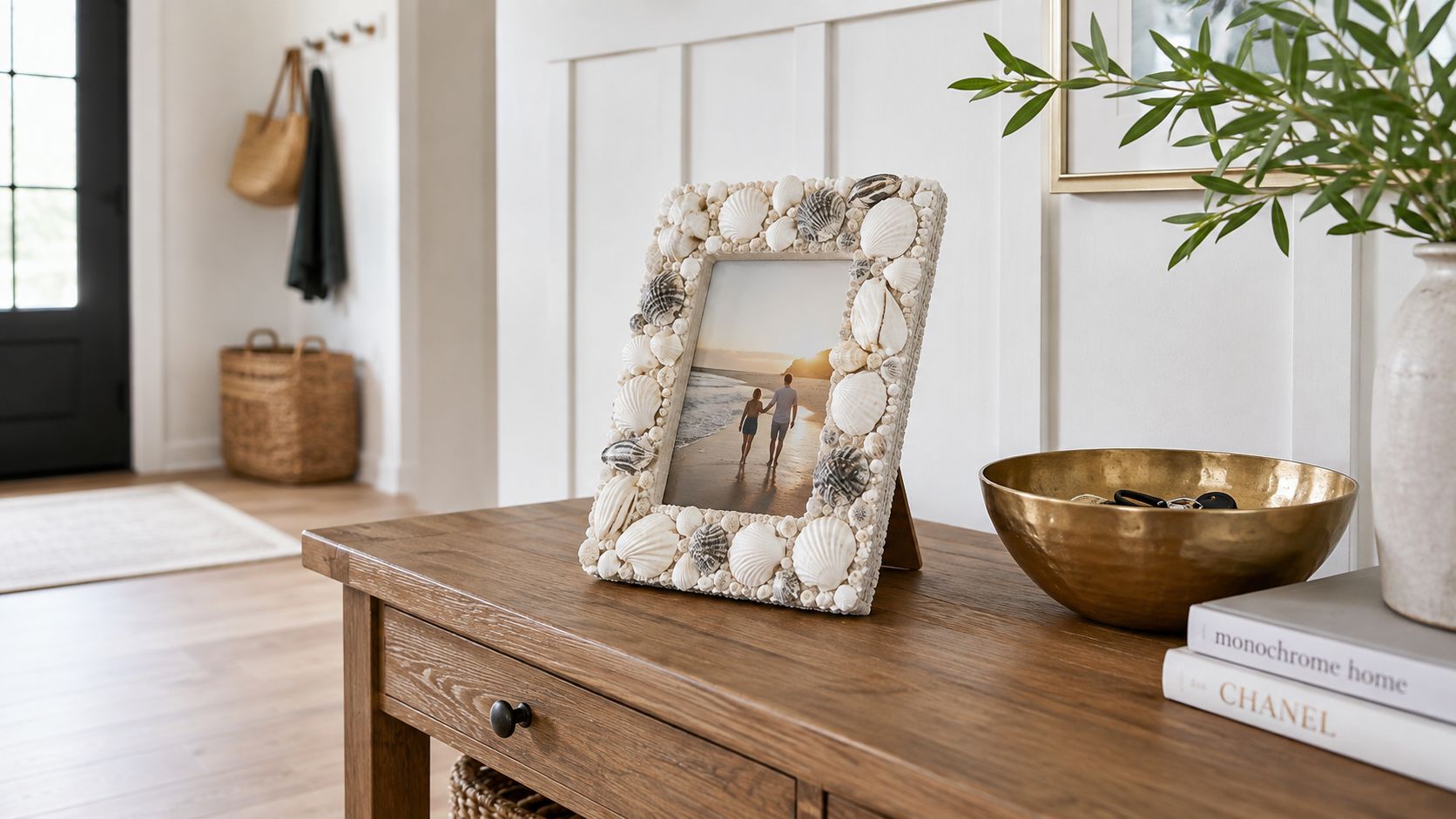
On an entryway console, use one stronger frame as the hero piece. Pair it with a bowl, a lamp, or a small stack of books. That's the quickest way to make it feel considered.
In the living room, a shell frame works best as part of a mixed gallery wall rather than on its own in a large blank space. Mix it with prints, a small mirror, or a shadowbox so the texture variation feels intentional.
On a bedroom dresser, a medium frame suits best. Keep the light soft and the nearby colours quiet. Shell can look lovely in a bedroom because it has that slightly nostalgic, memory-filled feel.
The bathroom is the tricky one. It can work if the room is well-ventilated and the frame has a sealed back and decent hardware, but I wouldn't put a delicate piece directly in the splash zone. Humidity is not kind to bargain frames.
A home office is a good place for a small shell frame if you want a softer, more personal object among all the hard edges and screens. It works especially well beside a plant or a pale timber desk.
Avoid direct sun, radiators, and damp corners. Those are the places where cheap finishes age badly and shells start looking tired.
The two easiest arrangement patterns are a single hero frame on a console and a coastal gallery wall with prints, shell pieces, and one or two shadow boxes. Keep the spacing generous. Crowding kills the look.
Price, Quality and When Premium Is Worth It
Shell frames split into three honest camps, and the price usually tells you what kind of object you're getting. The market for picture frames more broadly is also splitting between mass and premium buying, with more attention on FSC-certified timber, recycled materials, and custom sizing IndexBox.
Shell Photo Frame Price Bands Compared
| Price Band | Shell Quality | Frame Material | Glass Glazing | Best Use |
|---|---|---|---|---|
| Under $25 | Often moulded or lightly applied shell look | Thin board or basic composite | Usually simple glass or acrylic | Holiday snaps, casual gifts, low-stakes spots |
| $40 to $90 | Better shell coverage, cleaner finish | Better wood or wood composite | Glass more likely | Everyday display, entry tables, relaxed living rooms |
| $120+ | Hand-applied or more refined shell work | Better timber, sometimes FSC-certified | Better glazing, sometimes UV-protective | Wedding photos, family portraits, statement interiors |
The cheapest frames are fine when you don't need longevity. A holiday photo in a beach shack laundry? No one needs to overthink that. A wedding portrait in a polished coastal living room? Spend more.
The premium tier earns its keep when the finish is cleaner, the backing is sturdier, and the timber choice feels intentional. It also makes sense when you want the frame to behave like a design object, not just a holder for a snapshot. The La Perouse craft tradition is the benchmark here, because hand-applied shell work has a real heritage of careful making behind it Sydney Morning Herald.
Care, Gifting and DIY Alternatives
Shell frames don't need fussy care, they need sensible care. Dust them with a soft brush or a dry microfibre cloth, keep them out of direct sun, and don't park them in a steamy bathroom unless they're properly sealed. Skip oils and silicone sprays, because they can make the finish cloudy or attract grime.
For gifting, shell frames work best when the recipient already likes coastal decor, family photos, or sentimental objects. A small tabletop frame is an easy housewarming choice. A cleaner, better-made frame suits a wedding or anniversary gift because it feels more permanent and less novelty-driven.
If you want to make your own, there are two straightforward routes. The fast version is a plain timber frame, collected shells, and careful glue placement around the edge. The more ambitious version is a shadow box with proper timber moulding, removable backing, and glazing, which looks far more polished if you've got the patience.
If you'd rather skip the trial-and-error and start with curated pieces that already suit a relaxed Australian home, Volkswagen Memorabilia has coastal décor and nostalgic pieces that make it easy to get the look without the weekend craft fallout.