

You've brought home a bundle of dried palm leaves, set them in a vase, and wondered why the arrangement looks more like a florist's leftover stock than a relaxed beach-house feature. The fix usually isn't another decorative object. It's choosing the right frond, giving it enough breathing room, and placing it where Australian light and humidity won't undo the effect.
Dried palm leaves can bring the shape of the shoreline indoors, from the soft fan of a Livistona to the clean line of a palm spear. They're also a practical material, but they need more care than their easy-going appearance suggests. In bushfire-prone parts of Australia, fully dry palm material can act as fine fuel, so attractive styling and sensible handling must sit side by side.
Why Dried Palm Leaves Suit Coastal Homes
In a Noosa beach house, a dried palm display can quickly look too themed if every piece is pale, smooth and predictable. The better approach is to use the frond as a natural line, then balance it with materials that feel cooler, rougher or softer. For more ideas on combining coastal colour palettes, timber and textured ceramics, explore these coastal home decor ideas.
Palm leaves suit this setting because their dried structure brings both colour and shape. Straw, wheat and warm tan tones sit comfortably beside bleached timber, linen, cane and textured ceramics. Their forms also echo wind-shaped vegetation, giving a room an Australian coastal character without turning it into a beach souvenir display.
Start by choosing the outline. A broad fan spreads across a room like a small canopy, while a feathered frond creates movement from its central stem. A narrow spear draws the eye upward and gives a stronger vertical accent. Decide on that mood before choosing the vase, because the vessel should support the leaf rather than compete with it.
Let texture do the decorating
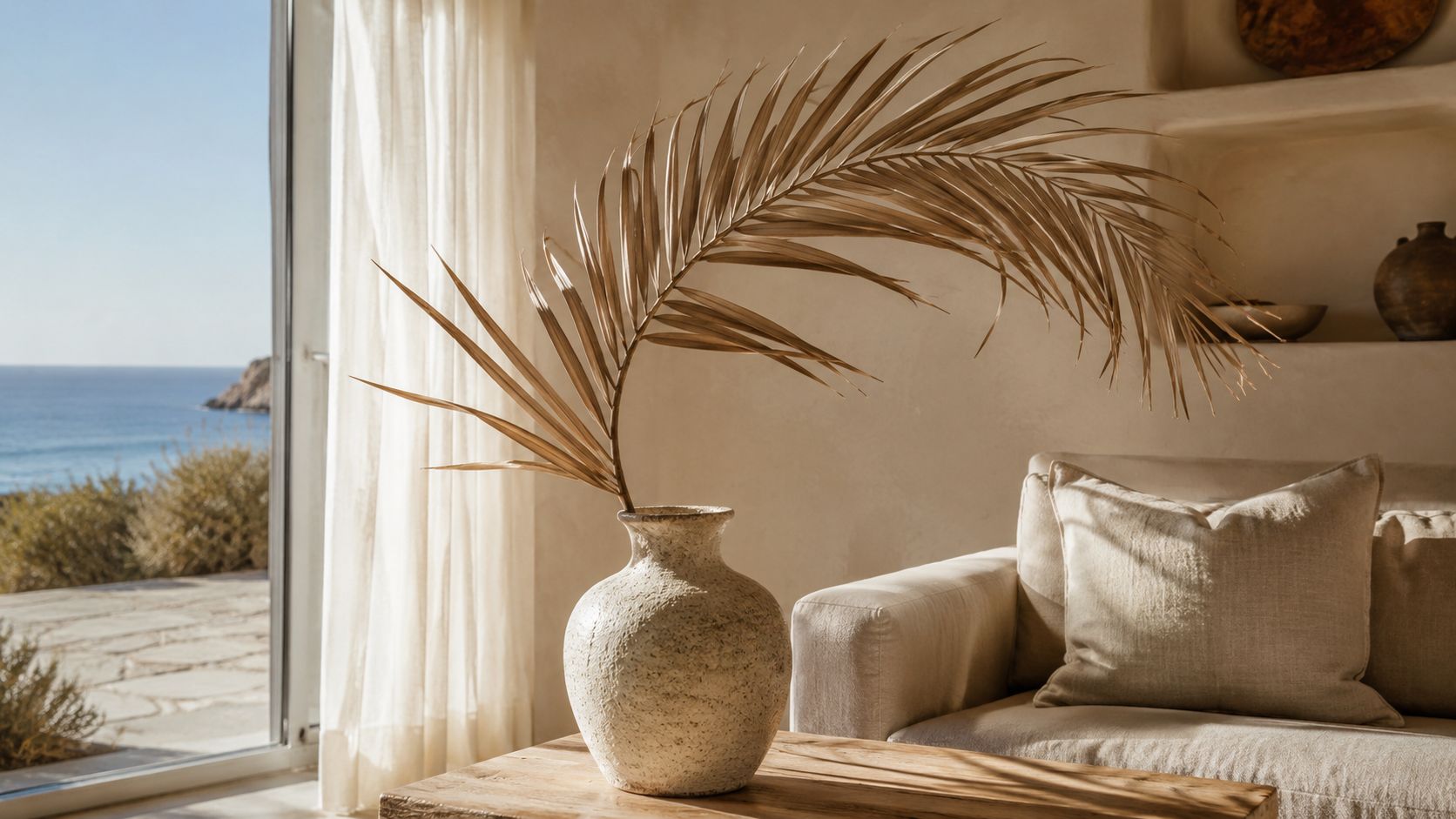
A coastal room can feel finished without heavy colour. The frond's surface provides the contrast. Smooth ceramic feels cooler beside a ribbed fan, while a feathery leaf softens the firm edge of a timber console.
Use this sequence:
- Choose the dominant silhouette: Select a fan for width, a feathered frond for movement, or a spear for height.
- Match the vessel to the texture: Rough stoneware keeps the arrangement relaxed. A slim neutral vase makes a spear look architectural.
- Leave visible air: Open space keeps the display breezy instead of crowded.
- Repeat one natural material: A jute runner, cane tray or linen cushion connects the arrangement with the room.
Australian horticultural advice has also treated fallen palm fronds as useful organic material. A Burke's Backyard landscaping example notes that dry fronds are easier to mulch, can be processed with a commercial chipper, and were used as a 50–60 mm mulch layer to support re-planting.
Decorative fronds still need sensible handling, particularly because fully dry plant material can burn readily in bushfire-prone areas. Once a leaf no longer suits the room, reuse or green-waste disposal gives it a practical second life instead of making it an instant throwaway.
The Main Types and What to Recognise
At a flower market, two bundles can both be labelled “dried palm” and still create completely different arrangements. One may open like a handheld fan, another may form a narrow spear, and a third may have a heavy, sculptural curve. The label matters less than the silhouette in your hand.
Areca fronds usually have a light, feathered appearance and a relaxed arch. They're useful when you want softness behind a sofa or in a tall floor vase. Fan palms, including Livistona and palmetto forms, make a broader statement, with segmented surfaces that catch light across the leaf.
Coconut palm material tends to feel more tropical and irregular. It can work beautifully in a breezy verandah, especially when paired with plain linen and pale timber, but too much of it may push a room towards a resort look. Date palm fronds often have a fuller, more structured texture and can bring deeper bronze or caramel notes into a neutral scheme.
| Palm Type | Shape & Length | Dried Colour | Best Use |
|---|---|---|---|
| Areca | Feathered, arching frond with fine leaflets | Straw to warm gold | Tall vases, relaxed corners and layered arrangements |
| Fan, Livistona or palmetto | Broad, segmented fan with a strong spread | Pale wheat to bronze | Wall accents, consoles and statement vessels |
| Coconut | Long, curved and naturally irregular | Golden tan to deeper brown | Verandahs, entryways and tropical-coastal groupings |
| Date | Fuller, denser frond with a pronounced central stem | Honey, caramel or bronze | Floor arrangements and textural focal points |
Natural or treated
Naturally dried leaves usually show small variations in tone, edge shape and curl. Those irregularities are helpful in a beach-house interior because they prevent the arrangement from looking manufactured. Bleached leaves have a more uniform pale finish, while dyed spears can deliver stronger colour but may feel less connected to a calm neutral palette.
Look closely at the tips. An intact spear has a tight, pointed form, whereas segmented pieces may have been cut from a wider frond. Palm can also be confused with dried banana leaves or ferns. Banana leaves tend to look broader and more ribbon-like, while fern material usually has a finer, more delicate branching pattern.
For transport, choose fronds with firm stems, attached leaflets and minimal loose debris. A low-shed specimen will survive the trip from the market to your mantel more gracefully than a brittle bundle that leaves fragments across the car boot.
Sourcing and Preparing Your Fronds
The cheapest bundle isn't always the best value. A frond that snaps while you're arranging it costs more in frustration than a sound stem sourced from a florist, flower market, specialty wholesaler, sustainable plantation or established Australian online retailer.
Compare sellers by condition rather than by colour alone. Ask whether the leaves are naturally dried, bleached or dyed, and check how they're packaged for delivery. A long, open fan needs protection from crushing, while a narrow spear needs particular care around its tip.
What to inspect
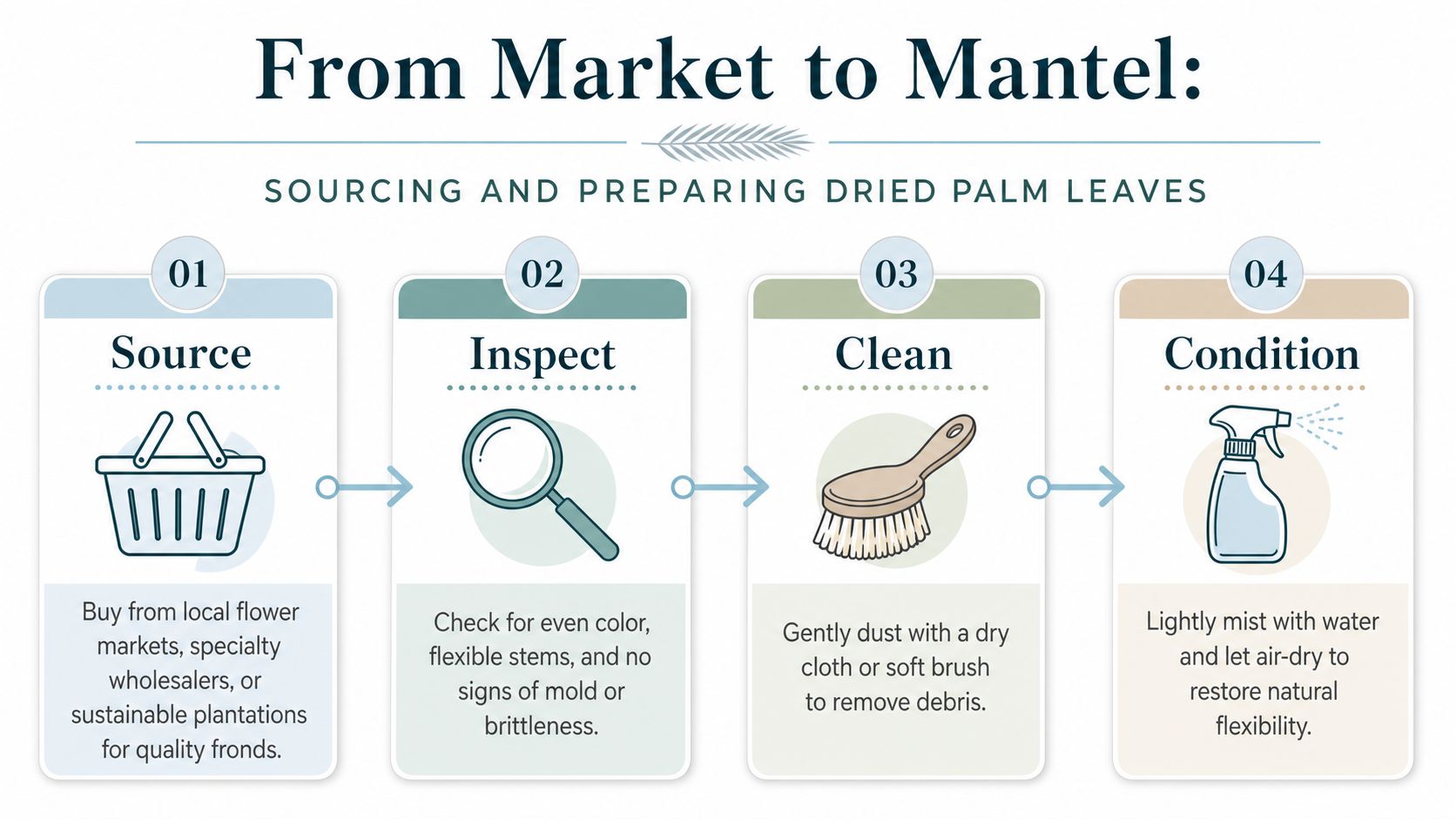
When your order arrives, place the leaves on a clean surface and check them before putting them into a vase.
- Tips: Avoid widespread splitting, crushed ends or powdery edges.
- Colour: Natural variation is fine, but dark damp patches may indicate poor storage.
- Stem flexibility: The stem should bend slightly rather than break instantly.
- Surface condition: A little dust is normal. Webbing, mould or a musty smell isn't.
- Shedding: Minor fragments can occur, but excessive leaf drop suggests brittleness.
Clean the bundle with a soft, dry brush or cloth. Don't soak it. If a stem is awkwardly long, trim the base at an angle with sharp secateurs so it sits securely in the vessel.
A very light mist can help a curled frond relax, but use restraint. The aim is gentle pliability, not saturation. If the leaf remains tightly folded, low-heat steam held at a safe distance may soften it, provided you keep the process brief and let the material dry fully afterwards.
Allow new fronds to settle in the room where they'll be displayed before you build the final arrangement. This gives the material time to adjust to local conditions and reduces surprises such as sudden curling or cracking. Keep leftover stems flat or upright in a dry, ventilated cupboard, separated with tissue or kraft paper rather than compressed in a plastic bag.
Care and Preservation That Lasts
Dried palm leaves suit a calm coastal room, yet Australian conditions can test them. Humid air, salt exposure, strong sunlight, and shifts between open windows and air conditioning all affect brittle plant material. Treat the fronds like timber near the sea: give them a dry, stable position and limit unnecessary exposure.
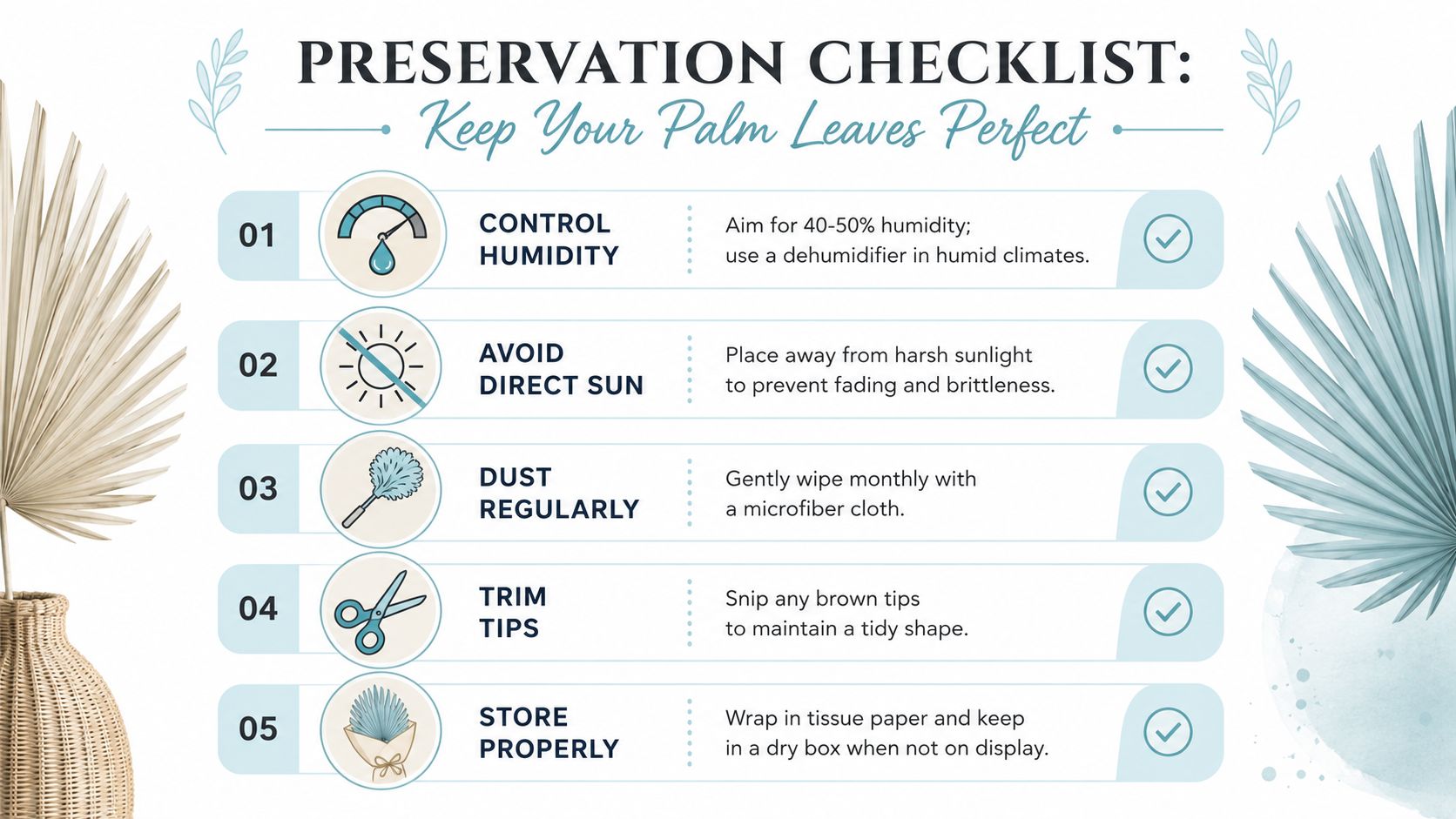
Start with placement. Keep arrangements away from bathrooms, wet kitchens, condensation, and steamy windows. The preservation checklist recommends 40–50% humidity, with a dehumidifier in humid climates. Use that range as a practical guide for a controlled interior, rather than placing the vase beside a moisture source.
A gentle maintenance routine
Dust gathers in the ribs and folds of fan leaves. Rough cleaning can break those delicate structures, much like scrubbing woven straw can pull it out of shape.
- Use a microfiber cloth: Sweep lightly along the surface instead of rubbing across the leaflets.
- Try cool moving air: A hair dryer on its lowest, coolest setting can lift loose dust from a distance.
- Shake outdoors: Hold the stems firmly and give the arrangement a gentle shake in a sheltered area.
- Avoid wet washing: Water can soften, stain, or distort dried plant material.
- Rotate the display: Move the arrangement occasionally so one side does not fade or curl faster.
A matte sealant spray can add a surface barrier in a high-traffic room. Test it on an inconspicuous section first, then apply it outdoors according to the product label. Heavy glossy coatings usually work against the relaxed, natural finish that suits an Australian beach-house interior.
Fire safety needs a separate rule. Australia's fuel moisture guidance defines vegetation fuel moisture content as the water mass in vegetation relative to its dry mass, and identifies material below 20% as readily ignitable. Dried palm leaves should therefore stay away from candles, open fireplaces, radiant heaters, and cooking areas.
CSIRO advises avoiding very fine mulch under about 0.5 cm because it can be highly flammable, while NSW guidance favours coarse woodchips over finer leaf mulches. Its bushfire landscaping guidance reinforces the wider point: dead plant material is fuel. Keep arrangements on non-combustible surfaces, and remove them from rooms during periods of heightened fire danger if their position cannot be made safe.
Styling Ideas for Vases and Wall Accents
A single frond can look intentional when the room gives it enough space. In a relaxed entryway, one fan palm in a chalky ceramic vessel can sit beside a timber bowl, a woven tray and nothing else competing for attention.
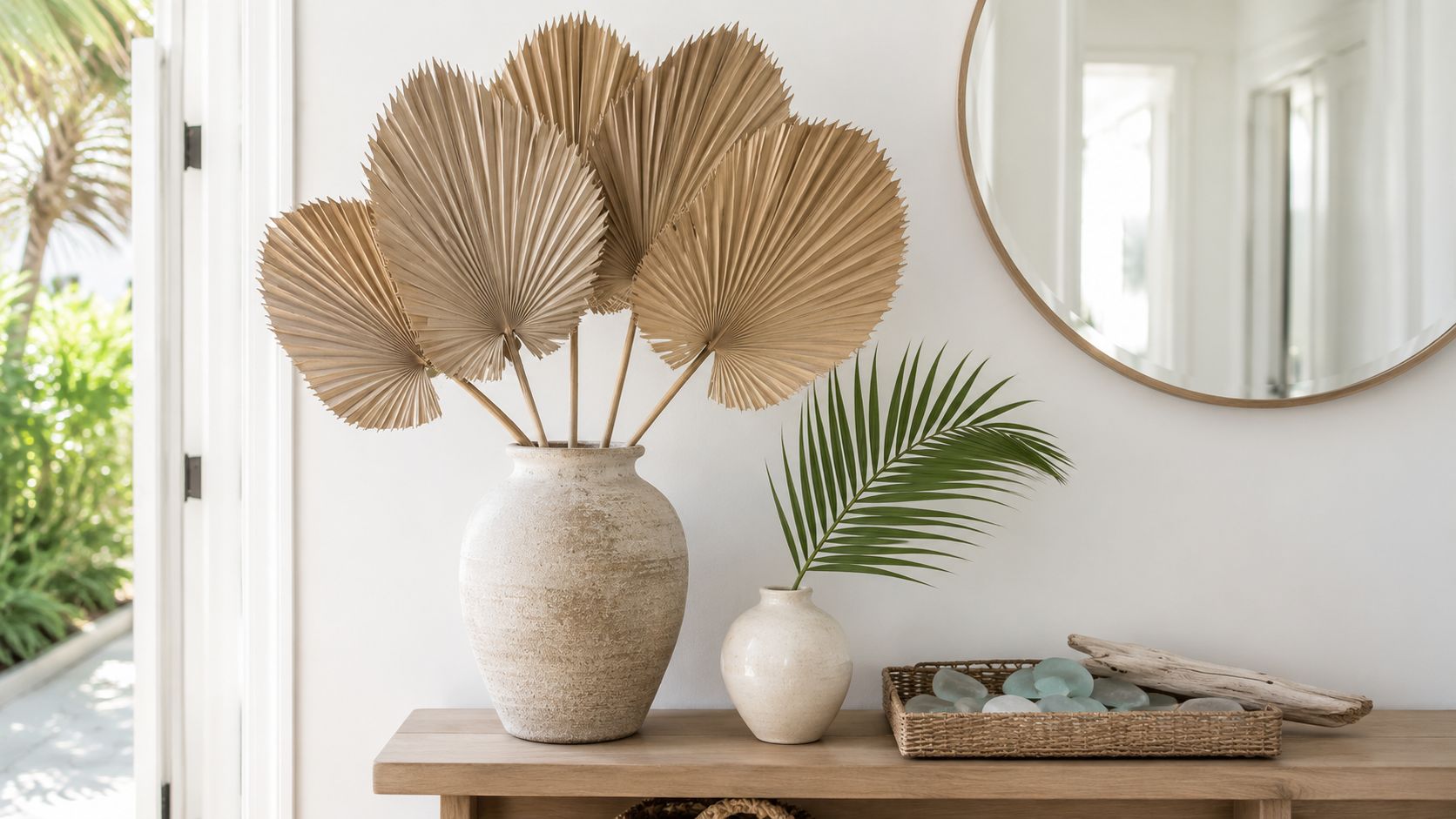
For a larger living room, use three to five areca or coconut stems in a floor vessel behind a sofa. Vary their heights and angles, but keep the colour family close. The result should feel like a breeze has arranged them, not like every stem has been measured into position.
A sideboard benefits from a narrower gesture. Place one sun-palm spear in a slim pedestal vase, then balance it with a low ceramic object on the opposite side. On a dining table, clustered bud vases can hold short palm pieces, but leave enough room for plates, conversation and candle-free entertaining.
Take the arrangement onto the wall
Wall styling changes the scale of the material. A single frond on a linen mount becomes quiet botanical art, while a symmetrical fan display above a bed creates a more graphic focal point. Woven cane frames add a second layer of texture without introducing a new colour.
Use linen, jute, unglazed ceramics and bleached timber as the supporting cast. If the frond is visually busy, keep the frame and wall behind it plain. Renters can lean larger pieces on shelves or consoles, and lighter fronds may suit removable adhesive strips when the wall surface and product instructions allow it.
A shell-inspired accent can provide the same shoreline reference without adding more foliage. Explore shell wall art as a companion piece, then let the palm remain the taller, airier element.
The video below is useful for observing how fan-shaped forms can be arranged and balanced in a decorative composition.
Seasonal Uses Through the Year
Dried palm leaves don't belong only to summer. Their neutral colour and structural shape can shift with the surrounding materials, which makes them useful across an Australian coastal calendar.
In summer, keep the display light. Pair pale fronds with linen, rattan and open-weave baskets, particularly in rooms that already receive plenty of daylight. January suits a single restrained spear or a sparse fan arrangement, with clear surfaces and plenty of visual breathing room.
Autumn brings a warmer register. Move the leaves into a terracotta vessel, add a soft throw and introduce a little timber or woven texture. The fronds stay the same, but the room feels less like a holiday rental and more like a comfortable home.
A simple seasonal rhythm
| Time of year | Styling direction | Easy adjustment |
|---|---|---|
| Late December | Entertaining and bright | Use a broad fan in an entry or dining area |
| January | Breezy minimalism | Remove supporting pieces and keep one sculptural stem |
| April | Transitional warmth | Add terracotta, jute or a soft neutral throw |
| July | Cosy retreat | Pair carefully placed fronds with wool and warm timber |
| Spring | Fresh renewal | Swap heavier stems for slender spears beside pale ceramics |
Winter arrangements need extra care around fireplaces and heaters. A palm display can sit in the same broad visual zone as a hearth, but it must remain well away from heat and ignition sources. Choose a non-combustible plinth or console and keep the composition decorative rather than densely packed with dry material.
Spring is the moment to edit. Replace darker, fuller stems with finer spear forms, then let pastel ceramics or fresh seasonal flowers provide the change. This rotation extends the usefulness of the collection and prevents the room from feeling fixed in one holiday mood.
Common Mistakes and Smart Fixes
A dried palm arrangement can look sturdy enough for any room, yet it still responds to Australian conditions. Heat, humidity, ultraviolet light and rough handling gradually shorten its useful life, much as salty air wears outdoor timber over time.
Direct sunlight may bleach one side of a frond while the other remains darker. Set the arrangement slightly back from the window, rotate it regularly and choose filtered light where possible. If the colour has already shifted, keep the stem and treat the variation as part of a weathered coastal palette.
Crowding causes another problem. Stems packed tightly into a narrow vase restrict airflow, allowing damp pockets to form. Choose a wider vessel, remove a few stems or divide the bundle between two arrangements. The leaves need breathing room, just like wet swimwear needs airflow before it dries properly.
Diagnose before replacing
- Drooping: Check whether humidity has softened the stem. Move it to a drier room and support it with a wider vessel.
- Dust buildup: Use a microfiber cloth, cool air or gentle outdoor shaking. Do not wash the leaf.
- Cracked tips: Trim only the damaged section if the remaining silhouette still works.
- Mould or musty odour: Isolate the affected material and discard it when the problem is widespread.
- Insect presence: Remove the frond from indoor displays and inspect nearby organic materials before deciding whether it can be safely retained.
Dyed spears can add a strong accent, although artificial colour may fight the sun-washed look of an Australian beach house. Scratched surfaces can also reveal pigment more clearly. Naturally dried specimens usually provide more convincing tonal variation. In a busy household, a light matte sealant may reduce surface wear, but it cannot make palm material fireproof.
Safety first: Keep dried palm leaves away from candles, heaters and open flames. Never use fine, dry palm material as a casual substitute for fire-safe garden mulch.
If the display feels flat, adding more leaves is rarely the best first move. Combine one or two stems with raffia, beaded grass or a coarse woven object, then restore clear space around the main silhouette. That balance lets the fronds feel relaxed rather than crowded.
Bringing Coastal Calm Into Your Space
The strongest coastal arrangements make one clear decision and leave room around it. They don't rely on a crowded collection of shells, blue accessories and tropical foliage. Instead, they combine a considered botanical shape with a vessel and a few tactile materials that echo the shoreline.
Try a signature vignette on a linen-clad console. Start with a neutral stoneware vase holding three sun-palm spears. Lean a bleached pandanus wall piece behind it, then place a single coconut husk bowl to one side.
The contrast creates the depth. Rough husk sits against smooth ceramic, while the feathery or pointed leaf introduces movement without adding a strong colour. Keep the wall and console quiet so the arrangement can read as a small, cohesive scene rather than a collection of objects.
Edit it through the seasons
Photograph the arrangement when it feels balanced. That image becomes a useful reference when you rotate stems later, especially if you're working with several similar fronds. Swap the dominant stems quarterly, but don't discard every supporting piece. A change in one silhouette can refresh the whole display.
For another tactile layer, boho wall art can sit nearby when the room needs a softer woven note. Keep the piece secondary, and resist filling every blank patch of wall. Coastal calm comes from intentional simplicity, natural materials and the space between them.
Dried palm leaves are at their best when they look as though they belong to the house, not as though they've been added to prove a theme. Start with one frond, watch how the light moves across it, and build only when the room asks for more.
If you love relaxed coastal styling with a nostalgic Australian feel, Volkswagen Memorabilia offers beach-inspired home décor alongside licensed Volkswagen diecast collectibles, including classic Kombi Samba Bus and Beetle models. Visit the shop to find a thoughtful piece for your console, shelf or gift list, with local Australian support and convenient shipping.