


A mate once dragged me over to a sun-faded Kombi at a country swap meet, pointed at the rust bubbles and said, “She's rough, but can't you already see the road trips?” He was right. A classic VW doesn't ask for a quick fit-out. It asks for patience, taste, and a bit of stubborn affection.
Dreaming of the Open Road in Your Classic VW
There's something different about planning a van fit out in a classic Volkswagen. A modern van can feel like a blank shell. A Kombi already has a personality before you pick up a tape measure. The curved panels, the smell of old trim, the view through that split-style glass. It all pushes you toward a build that feels less like manufacturing and more like stewardship.
Aussies haven't fallen out of love with these old buses either. By 2024, over 2,800 restored and converted VW Kombis are actively registered in Australia, and the average price for a fully fitted-out vintage model has risen to AUD $85,000 according to Volkswagen Memorabilia's VW collection and reference page. That tells you plenty. People aren't just preserving them for Sunday shows. They're building them to use, to travel, and to keep a bit of the old surf-touring spirit alive.
Why a Kombi fit-out feels different
A classic VW build rewards restraint. What works in a tall modern cargo van often looks clumsy in a Kombi. Heavy overhead lockers, chunky square cabinetry, or oversized appliances can rob the cabin of the very charm that made you buy the van in the first place.
A good vintage-focused van fit out usually leans on three things:
- Light touch design that respects the original lines
- Practical comfort for weekends, coastal runs, and short touring
- Period character with modern reliability subtly incorporated
A Kombi looks happiest when the fit-out feels like it belongs there, not like it's been forced into submission by a kitchen catalogue.
The romance is real, but so is the work
Plenty of people start with the dream of striped canvas chairs, enamel mugs, and a sunrise at Crescent Head. That's the fun bit. The true craft sits underneath. You've got to think about access to the engine bay, airflow in hot weather, compact storage, and how every added piece changes the way an old VW drives.
That's why the best van fit out projects begin with honesty. Be honest about how you'll use it. Be honest about how much work you can do yourself. And be honest about whether you're building a showpiece, a weekender, or a proper little tourer with some red dust in its future.
The Heart of the Matter Planning Your Perfect Layout
The smartest van fit out decisions happen before the first cut. In a classic VW, layout planning isn't just about comfort. It decides whether the van feels airy and nimble, or cramped and awkward.
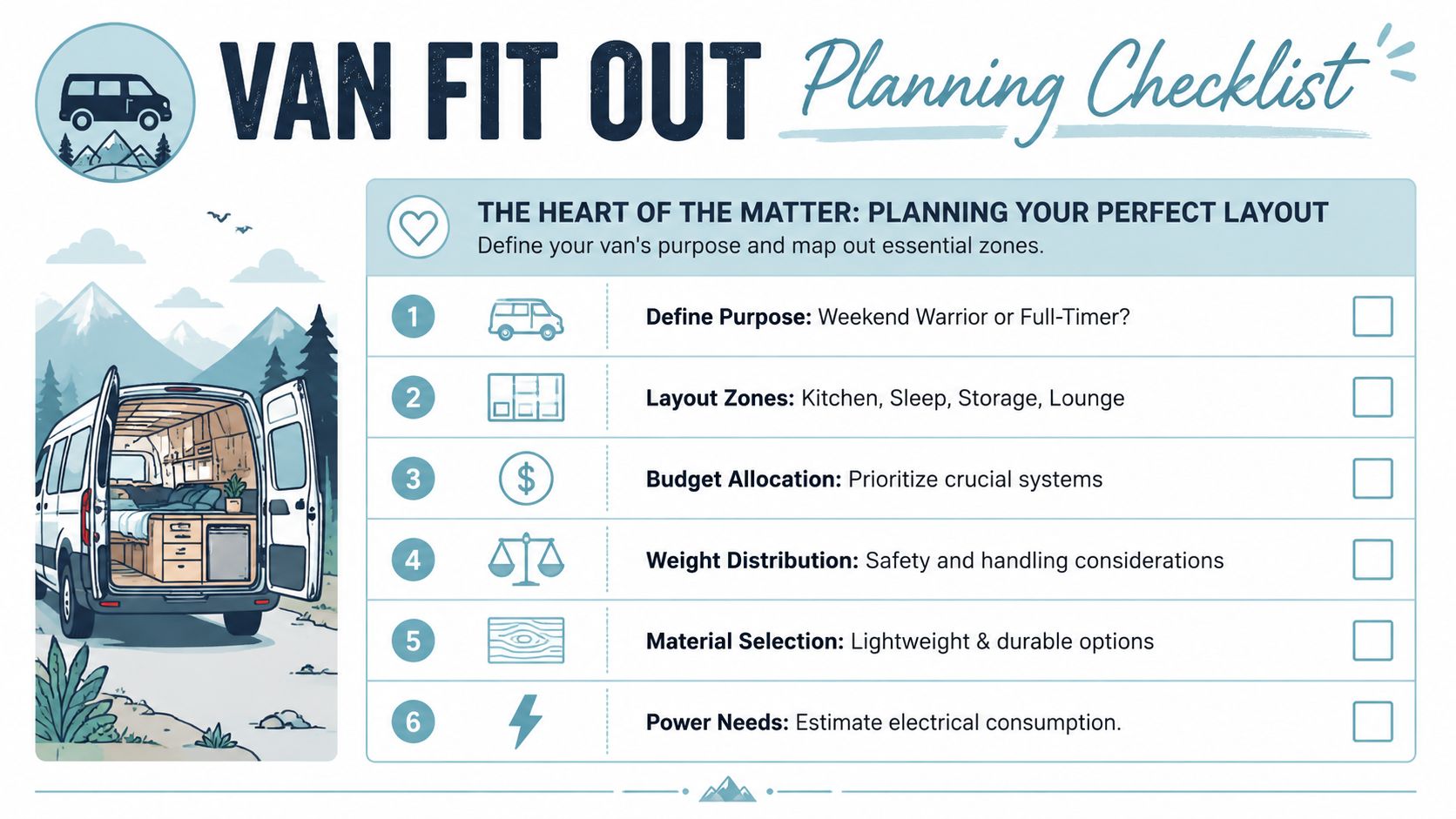
If you're pricing the job in Australia, brace yourself early. The median fit-out cost is AUD $45,000 for a full DIY build and up to AUD $95,000 for professional installations, as noted in this Australian VW reference page. That doesn't mean every build has to hit those numbers, but it does mean “I'll just throw a simple camper interior in” often turns out to be optimistic.
Start with use, not furniture
Ask the van a blunt question. What is it for?
| Use case | What matters most | What usually gets sacrificed |
|---|---|---|
| Weekend beach trips | Fast setup, easy bedding, simple storage | Full kitchen complexity |
| Show-and-shine cruiser | Period-correct materials, neat finishing | Maximum utility |
| Touring weekender | Power, water, organised gear access | Open floor space |
In a Kombi, every decision multiplies. A wider bed can steal walkway space. A fixed cabinet can make engine access annoying. Tall storage can make the cabin feel lower than it already is.
Sketch with real limits in mind
Classic VWs don't forgive sloppy measuring. The walls curve. The corners taper. The floor isn't always as true as you'd like. Cardboard templates help, painter's tape on the floor helps even more, and a scale model can be a surprisingly handy way to think through proportions before you commit to timber.
A useful planning checklist looks like this:
- Decide the sleeping setup. Rock-and-roll bed, fold-out platform, or simple bench-bed.
- Protect service access. Don't trap yourself with a pretty cabinet you have to remove for routine maintenance.
- Map heavy items low. Batteries, water, and dense gear should stay down low and close to the centre.
- Leave breathing room. A Kombi with a little open space feels twice as pleasant as one packed to the roof.
Practical rule: If a layout looks brilliant on paper but makes it hard to open, service, or clean the van, it's not brilliant yet.
Budget and payload need to talk to each other
Cost and weight are tied together more than most first-time builders realise. Premium finishes can still be heavy. Budget materials can also be heavy. The best result usually comes from choosing fewer things, but choosing them well.
Many van fit out plans go off track. Builders think in features instead of trade-offs. A second battery sounds great. So does a bigger water tank. So does extra storage. Before long, the van carries too much gear for the way it was meant to move.
Building the Bones Insulation Panelling and Flooring
Once the layout is settled, the shell work begins. This stage doesn't get the glamour of cabinetry or the buzz of wiring up lights, but it shapes how the van feels every single day.
In Australia, heat control matters. A classic VW has plenty of glass, plenty of metal, and not much mercy on a hot day. The goal with insulation isn't to turn the van into a thermos. It's to reduce radiant heat, soften temperature swings, and cut a bit of road noise without piling in unnecessary weight.
Insulation that suits an old VW
Keep it light and keep it tidy. Bulky layers can fight the Kombi's curves and make panel fitment frustrating. Thin, well-fitted insulation works better than stuffing every void with material that traps moisture or pushes trim out of shape.
Focus on these habits:
- Clean and treat metal first. Surface rust hidden behind insulation only gets uglier with time.
- Fit to the body shape. Small neat sections usually sit better than oversized pieces forced into corners.
- Avoid overbuilding. Extra layers sound clever until they cost space and add weight.
A classic bus rewards neatness more than excess.
Panelling that respects the curve
Thin timber veneers can look brilliant in a Kombi, especially if you're chasing that warm, retro cabin feel. Modern lightweight boards can also work well if you want a cleaner finish and easier maintenance. Either way, template everything first. Old VW interiors rarely match side to side as neatly as you hope.
If you're choosing materials, insulation ideas for van projects can help spark finish direction, especially if you like that balance of practicality and nostalgia.
Flooring that doesn't fight the build
Flooring cops sand, wet thongs, muddy shoes, and cooking spills. It needs to be tough, easy to wipe down, and not too thick. In a Kombi, every millimetre of floor build-up affects headroom and the fit of cabinetry.
A simple comparison helps:
- Vinyl flooring is easy to clean and suits practical touring builds.
- Timber-look finishes bring warmth but need careful sealing.
- Rubber-style surfaces are handy in harder-use vans, though they can feel less vintage.
The best floor is usually the one you don't worry about. If you're constantly babying it, it's probably the wrong choice for a road-going van.
The Big Three Electrics Plumbing and Gas
This is the part that scares people, and fair enough. Electrics, plumbing, and gas are where a van fit out stops being decorative and starts becoming a working system.
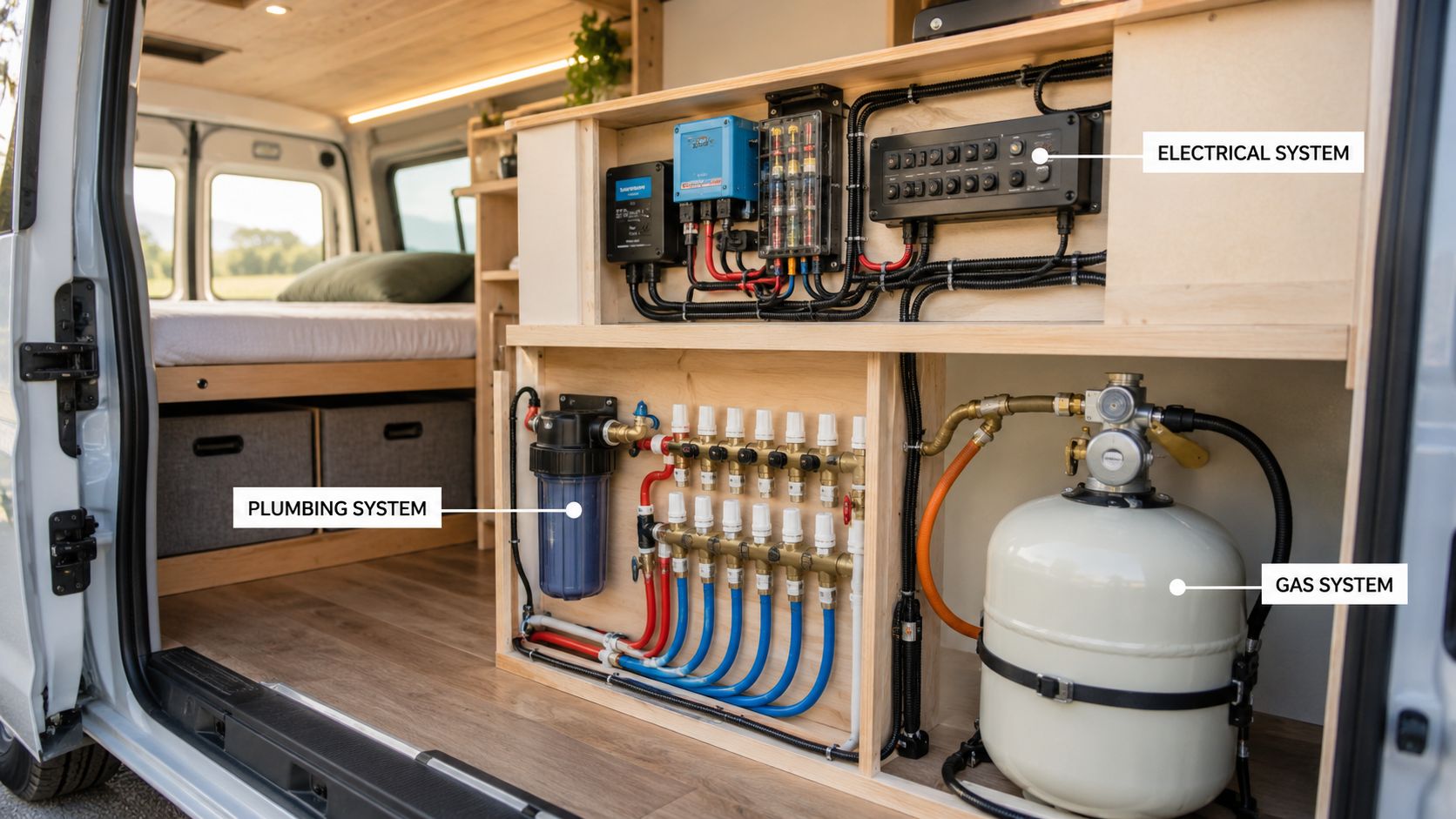
The best habit here is simple. Build in stages and test each stage before you hide it. According to this build-order guide for van conversions, a key benchmark is to run electrical cabling with proper wire sizing and protection after installing windows but before closing up panels. The same guide notes that small conductors are typically 1.5–6 mm², medium 10–35 mm², and large 50 mm²+. It also recommends copper pipe with brass compression fittings for gas systems, plus leak testing before use.
Electrics that stay simple and serviceable
A classic VW doesn't need a spaceship control panel. Most owners are better served by a modest, tidy setup that supports lighting, charging, a fridge if fitted, and maybe a fan or pump.
A few practical truths:
- Run wires before panelling goes on. Retrofitting later is miserable.
- Protect every connection. Proper crimps, heat-shrink, and strain relief matter.
- Label circuits while you can still see them. Future-you will be grateful.
- Keep heavy electrical gear low. That helps both access and vehicle balance.
If you're comparing storage and power options, a slimline lithium battery setup shows the kind of compact form factor many builders like for tight spaces.
Poor electrical work rarely announces itself on day one. It turns up later as voltage drop, hot connections, and maddening faults hidden behind finished walls.
Plumbing that matches the van
Plumbing in a Kombi works best when it's simple. Small tanks, short hose runs, easy drain access, and components you can reach without dismantling half the interior. Fancy systems often create more trouble than comfort in a compact vintage bus.
Good plumbing design usually means:
- Fresh and grey water are easy to remove
- The pump is accessible
- The sink depth suits the cabinet below
- Nothing blocks routine cleaning
That's the difference between a van you use often and a van you avoid because every little job feels fiddly.
A visual walkthrough helps when you're mapping services behind cabinets and panels:
Gas needs a stricter mindset
Gas is where cheerful DIY confidence needs a leash. If you're fitting a cooker or heater, treat the system like a regulated installation, not a casual weekend add-on. Copper pipe, brass compression fittings, proper support, and leak testing are the baseline, not the deluxe version.
The common failure isn't usually one dramatic blunder. It's a chain of smaller workmanship errors. A poor crimp here, a chafed wire there, an untested joint tucked behind a cupboard. That's why the cleanest van fit out builds tend to look almost boring behind the panels. Everything is sized, clipped, protected, and checked.
Staying Safe and Legal on Aussie Roads
A beautiful van that can't stay registered or insured is a very expensive shed ornament. That's why legal compliance has to sit inside the build from day one, not get bolted on later as paperwork.
In Australia, the practical gap isn't enthusiasm. It's understanding how modifications affect road legality. Seating changes, electrical installs, gas work, weight, anchorage points, and structural changes all interact with rules that can affect whether the vehicle remains roadworthy and insurable. The broader compliance discussion around VSB 14 and state or territory registration rules is often skipped in mainstream van content, even though it directly shapes what you can legally drive.
Weight is not a rough estimate
For Australian builds, one rule stands above the rest. A van fit out must comply with the manufacturer's weight ratings, including GVWR and GAWR, and builders should weigh the vehicle before and after conversion to ensure it remains registrable and insurable, as explained in this weight compliance guide.
That process matters because the final load includes more than cabinetry. It includes fluids, occupants, fixed equipment, and whatever gear you throw in for the trip. The same guide gives a practical benchmark of a 5,500 lb curb-weight van with about 1,800 lb of conversion payload, which shows how quickly available carrying capacity can disappear before water, fuel, passengers, and luggage are added.
The legal mindset that saves projects
You don't need to become an engineer overnight. You do need to stop thinking of payload and compliance as background admin.
Use this approach:
- Check ratings early. Read the plate and understand the limits before buying materials.
- Track additions as you build. Batteries, water, cabinetry, roof loads, and storage all add up.
- Think about axle loads, not just total mass. Poor distribution can ruin handling.
- Ask legal questions before cutting metal. Reversing a bad modification is far harder than planning properly.
The roadworthy van isn't the one with the most features. It's the one you can confidently register, insure, and drive across the country without a knot in your stomach.
The Fun Part Furniture Finishing and Nostalgic Styling
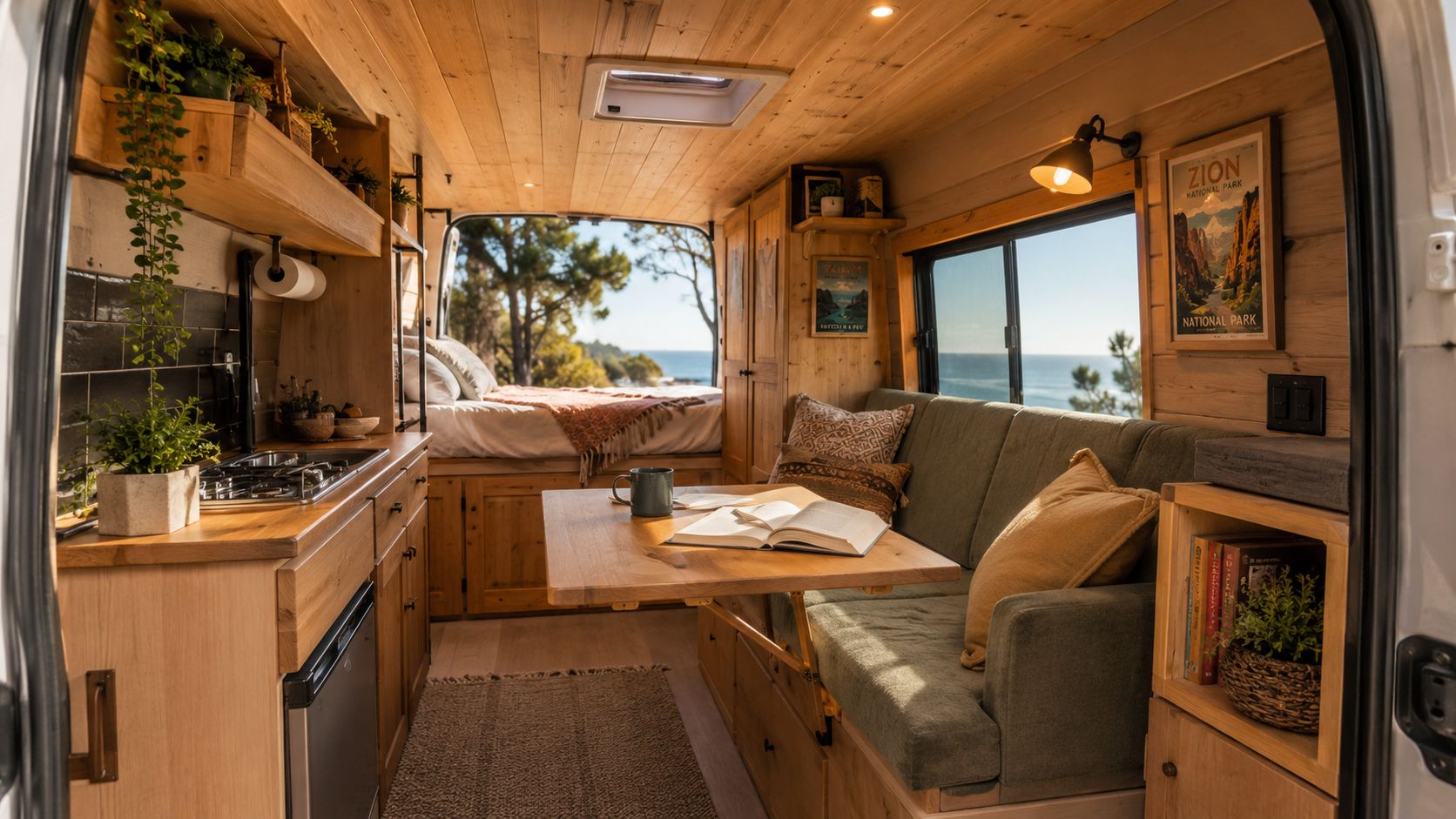
After the measuring, wiring, sealing, and legal homework, the soul goes in. Furniture gives the van its rhythm. The finishing touches give it its memory.
A well-sorted Kombi interior doesn't need much. A lightweight bench that doubles as storage, a bed base that's easy to lift, a small table that stows neatly, and joinery that doesn't shout over the van's original charm. Rounded edges always seem to suit these buses better than hard square forms.
Styling that feels right in a VW
The nicest classic interiors usually borrow from beach houses, old surf wagons, and honest camping gear. Think warm timber tones, muted colours, tidy curtains, simple hardware, and materials that age gracefully instead of trying to look perfect forever.
A few touches work especially well:
- A small feature shelf for favourite VW diecast pieces or travel keepsakes
- Vintage-style metal signs used sparingly, not plastered on every wall
- Striped or canvas textiles that nod to old coastal camping
- Soft warm lighting instead of harsh blue-white LEDs
Keep the furniture lighter than your ambitions
Many lovely plans tend to accumulate too much weight. Thick timber, oversized drawers, and household-style fittings can turn a nimble old bus into a sluggish one. Build furniture like boat joinery, not suburban kitchen cabinetry. Light, strong, multi-use, and easy to service.
The best part of a classic VW van fit out is that it doesn't need to be perfect to feel special. It just needs to feel lived in, cared for, and ready for another dawn run up the coast.
If you love the look and history of classic Volkswagens, Volkswagen Memorabilia is a lovely place to keep that passion going off the road as well as on it. You'll find VW memorabilia collectibles, nostalgic gifts, and display-worthy pieces for enthusiasts who adore the brand's heritage, including options that suit those seeking VW Kombi diecast Australia, a Volkswagen Beetle model, or a place to buy diecast Kombi favourites with local Australian stock and fast shipping.