

A quality mother-of-pearl photo frame needs controlled conditions, ideally 15–25 °C, 40–60% relative humidity, no more than 200 lux, and ultraviolet exposure below 75 µW/lumen. With that care, it becomes a stunning coastal keepsake, especially beside the colours and stories of classic Australian Volkswagens.
You've come home from a coastal drive, perhaps with salt on the Kombi and a camera roll full of beach light, friends and old-car memories. The right frame gives those photographs a fitting home. Its surface catches the light like shallow water, while the image inside preserves the day itself.
For VW enthusiasts, that combination has real charm. A shell frame can sit beside a Beetle or Samba Bus model and create a display that feels collected rather than just decorated. It brings together Australia's maritime character, relaxed coastal living and the optimism built into classic Volkswagen design.
Why Mother of Pearl Makes the Perfect Coastal Keepsake
A genuine mother-of-pearl photo frame has a quality that printed shell patterns can't reproduce. Its nacre is naturally layered, so the surface changes as you move around it. White and cream may give way to pink, green or blue reflections, creating the same shifting effect you notice on wet sand, a calm inlet or a shell held in afternoon sun.
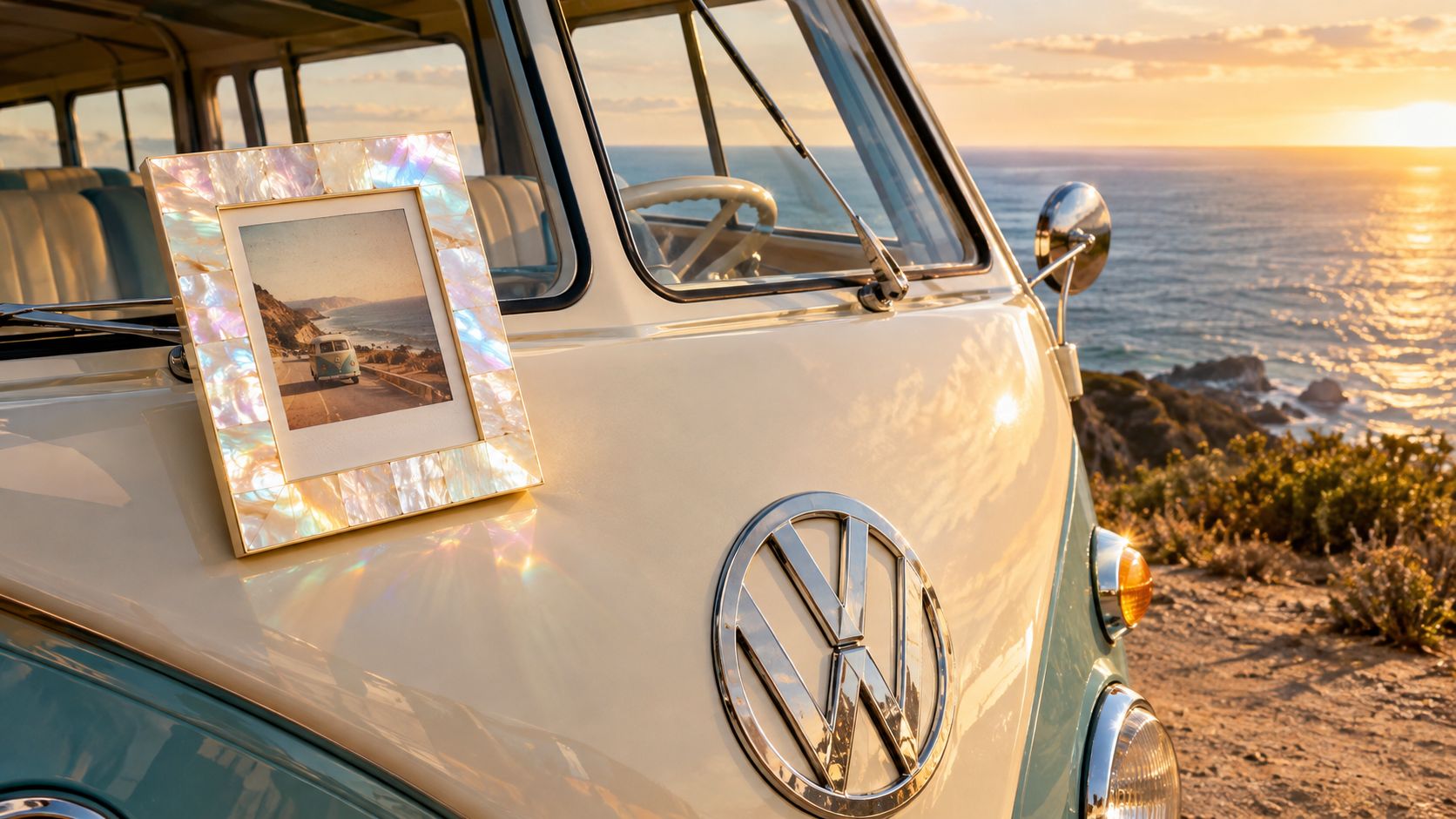
That movement makes the frame especially effective with photographs taken outdoors. A beach portrait, a family holiday, a surf trip or a classic-car meet can all benefit from the material's soft highlights. The frame adds atmosphere without overpowering the photograph.
A natural companion for VW displays
Classic Volkswagens already carry a strong visual language. Rounded Beetle wings, split-window silhouettes and bright Kombi paintwork look at home with natural textures, timber, canvas and shell. A nacre frame adds a finer, more reflective note beside a diecast model, helping a shelf tell a broader story about road trips and the coast.
The pairing also works beautifully as a gift. A shell accessory such as a gold shell necklace can sit alongside a framed photograph for someone who loves beach holidays, while a VW model completes the connection for a collector.
Practical rule: Let the frame support the memory, not compete with it. Choose a photograph with open light, visible sky or water, and keep the surrounding display calm.
Mother-of-pearl is more than a generic beach motif in Australia. Its heritage is tied to a significant pearl-shell trade, which gives a well-made frame a stronger story than a mass-produced imitation. That background matters when you're buying a keepsake intended to last.
Understanding Australian Pearl Shell Heritage
Australia's mother-of-pearl story begins long before decorative homewares. Indigenous Australians harvested and traded pearl shell for more than 20,000 years, while the first recorded commercial collection at Shark Bay began in 1850. Commercial activity expanded rapidly after large Pinctada maxima shells were found near Nickol Bay in 1861, and by 1868 the industry was regarded as a major enterprise on Australia's northwest coast, as documented by the Western Australian Museum's pearl-shell history.
Broome later became central to the global trade. By 1914, it supplied approximately 80% of the world's pearl shell, making Australia a major source of the nacre used in buttons, ornaments, inlay and decorative objects. A framed shell artwork therefore connects with Indigenous exchange networks, colonial commerce and international manufacturing rather than borrowing a coastal appearance alone.
Why the trade history changes how you buy
Customs records show that Australia exported 5,633 tons of mother-of-pearl shell between 1896 and 1900, at an average stated value of approximately £110 per ton. Between 1909 and 1913, exports fell to 2,431 tons, about 56.8% lower, while the average value rose to roughly £181 per ton, according to the historical trade record published by Anglican History.
Those figures point to a material that became scarcer and more valuable, not an endlessly available beach decoration. Queensland Museum research also records 91 tonnes of pearl shell shipped to Sydney in 1813, rising to more than 150 tons in 1814, with the annual harvest valued at £25,000 by 1871.
Plastic replaced pearl shell in button production during the 1950s, and surviving shell-based traditions consequently carry added heritage significance. When assessing a frame, ask whether the seller can explain the shell, its origin and its construction. A convincing iridescent surface is a good start, but provenance gives the object its deeper Australian character.
Caring for Your Shell Frame in Australian Climate
Mother-of-pearl should be treated as an acid-sensitive shell object, not ordinary painted décor. The Western Australian Museum recommends 15–25 °C, 40–60% relative humidity, no more than 200 lux, and ultraviolet exposure below 75 µW/lumen for display. The same temperature and humidity limits apply in storage, but stored pieces should be kept away from light, as outlined in the museum's conservation guidance for shell and mother-of-pearl.
Choose the position before you clean
The most effective protection is placement. Keep the frame away from direct Australian sun, skylights, heaters, air-conditioner outlets, bathrooms and damp external walls. A coastal style may suggest putting the frame beside an open window, but salt air, humidity, sand and strong light can shorten the life of both the shell finish and the photograph.
For tropical or coastal homes, use a stable indoor position with gentle airflow. If an enclosed display cabinet reaches humidity above 65%, silica gel inside the cabinet can help manage moisture. It shouldn't touch the frame, and it needs checking and replacing or regenerating according to the product instructions.
Use gentle cleaning habits
- Shell surface: Wipe with a soft, slightly damp cloth. Avoid acidic products, abrasive creams and rough paper towels.
- Glass: Spray glass cleaner onto a separate cloth, never directly onto the frame. Liquid can seep into backing materials, joints or metal fittings.
- Photograph: Remove dust carefully and keep the image away from prolonged direct sunlight. Photographs can discolour even when the shell still looks bright.
- Hardware: Inspect metal fittings in coastal areas, where salt air can encourage corrosion. A dry cloth is safer than saturating the joints.
A useful companion for a beach-themed craft or display project is a selection of seashells for crafts, but don't assume every shell object can be cared for in exactly the same way. Nacre needs stable conditions because humidity cycling creates chemical and dimensional stress.
“Beach style” isn't the same as “beach-proof.” Display the frame indoors, out of the harshest exposure, and it'll reward you with a much longer life.
Pairing Shell Frames with VW Memorabilia
The strongest displays combine objects that share a story. A mother-of-pearl frame holding a coastal photograph can sit behind a 1962 Kombi Samba Bus model, while a Beetle model adds a smaller, more compact counterpoint. The shell's pink, green and blue reflections can echo period Volkswagen colours without requiring an exact paint match.
A Flower Power Beetle or Kombi works particularly well for a relaxed, nostalgic arrangement. For a quieter desk, choose a classic Volkswagen Beetle model, a black-and-white photograph and a restrained timber or white backdrop. The frame provides the organic texture, while the diecast supplies precise lines, chrome details and familiar VW character.
Perfect pairings for a considered display
| Shell Frame Colours | Complementary VW Models | Display Setting |
|---|---|---|
| White and cream | Classic Beetle model | Desk, bookshelf or study |
| Pink and green reflections | Flower Power Kombi or Beetle | Coastal shelf or holiday room |
| Blue and pearl highlights | 1962 Kombi Samba Bus | Entry console or living-room cabinet |
| Mixed iridescent tones | Samba Bus with a beach photograph | Gift arrangement or collector shelf |
Keep scale in mind. A larger model needs visual breathing room, while a small diecast car can share a shelf with the frame and a modest accessory. Avoid placing the frame directly behind a highly reflective model if both surfaces catch the same window glare.
For more ideas, browse a curated selection of vintage home accessories and look for a common thread, such as white décor, nautical texture or retro colour. The best gift combination feels personal: a framed road-trip image for a Kombi owner, or a shell frame with a Beetle model for someone who loves both coastal travel and classic design.
Verifying Genuine Mother of Pearl Quality
Not every frame with a pearly finish contains genuine nacre. Some products use printed laminate, painted resin or a thin shell-look coating. These alternatives may suit a tight budget, but they won't offer the same layered reflection, tactile variation or material history.
Start with the seller's description, then ask direct questions. A reliable answer should distinguish genuine pearl-oyster nacre from generic shell material and should explain how the shell was obtained.
Questions worth asking before purchase
- What is the shell? Confirm whether the frame uses pearl-oyster nacre, rather than a printed or synthetic surface.
- What is the provenance? Ask whether the nacre is a by-product of pearl cultivation, reclaimed material or wild shell. “Natural shell” alone doesn't answer that question.
- What else is in the frame? Check the backing, adhesives, glass, fittings and packaging. These components affect durability and environmental impact.
- Can the maker substantiate sustainability claims? Look for independent certification or clear documentation rather than broad language about being eco-friendly.
- Where was it made? Country of manufacture and shipping route help you understand the complete product story.
The sustainability question deserves care. Australian retail commentary cites Roy Morgan research showing that 95% of Australians are committed to buying Australian products, while sustainability and ethical production remain important selling points, as discussed in this Australian retail trends report. That interest makes honest disclosure more valuable, not less.
Pearl-oyster nacre can be repurposed into materials such as PearlBone, demonstrating that shell reuse is technically feasible. It doesn't prove that every decorative frame uses recovered shell. A durable frame with transparent sourcing is a better choice than a cheaper item making vague environmental promises.
Creating Stylish Coastal VW Displays
A beach-house mantel can look superb with a shell frame slightly off-centre, a Flower Power Kombi diecast nearby and a low ceramic object balancing the opposite side. Use soft ambient light rather than a spotlight aimed directly at the nacre. The shell will still shimmer, but the photograph remains easy to view.
For a desk, place a mother-of-pearl frame behind a classic Beetle model at a shallow angle. The Beetle becomes the foreground subject, while the photograph supplies depth. A small timber tray or neutral linen mat can connect the two pieces without adding more reflective surfaces.
Three arrangements that work
The coastal road-trip shelf: Use a photograph from a beach drive, a 1962 Samba Bus model and one understated nautical accent. Leave space around each object so the shell pattern and vehicle silhouette remain clear.
The enthusiast's workbench: Pair a smaller frame with a Beetle model, restoration notes or a framed event pass. Keep the arrangement away from workshop dust, direct sun and heat from tools or equipment.
The thoughtful gift set: Choose a photograph with personal meaning, add a VW model that reflects the recipient's favourite era, and wrap the pieces separately so the frame doesn't rub against diecast paint or chrome.
Australian-assembled Volkswagen history can add another layer to the display. The first vehicles arrived in late 1953, official sales began in early 1954, and Completely Knocked Down kits were assembled at Volkswagen's Clayton, Victoria, factory. The final Australian-assembled Beetle left the line in July 1976, while Kombi, Golf and Passat assembly ended in February 1977, after which Volkswagens sold in Australia were fully imported, according to the Club VeeDub Australian Volkswagen history.
For collectors, a compliance plate behind the driver's seat on Australian-assembled vehicles from 1970 onwards can record chassis details and the month and year the vehicle left the Melbourne factory, such as 11/74, as explained in this Kombi identification guide. Those details can inspire a display caption, but the frame itself should stay protected from strong light and changing humidity.
The Kombi was also a practical Australian workhorse. In 1975, its strongest Australian sales year, 8,974 Kombis, including Microbus variants, were sold, representing 43% of Australia's one-tonne van market, according to Club VeeDub's Kombi history. That context makes a shell frame and Kombi model more than a colour-coordinated pairing. Together, they celebrate travel, trade, family holidays and the coastal freedom that keeps these vehicles beloved.
Volkswagen Memorabilia brings together licensed VW diecast models, Kombi Samba Bus and Beetle collectibles, and coastal home décor for displays with genuine character. Visit Volkswagen Memorabilia to find a thoughtful companion for your mother-of-pearl photo frame, with local stock and fast Australian shipping helping your next gift or display come together smoothly.