


The sun had just dropped behind the scrub when an old Kombi rolled into camp, red dust up the flanks and a kettle rattling somewhere in the back. One look at that silhouette against the glowing horizon, and every bloke and sheila by the fire knew the same thing. Some vehicles suit the Outback, but a classic Volkswagen belongs to the dream of it.
The Call of the Red Dirt Your VW Outback Dream
There's a particular kind of longing that hits VW people harder than most. It starts with a photo from years ago, maybe a faded family slide of a Beetle outside a roadhouse, or a memory of a Kombi parked near the beach with boards on top and half a life packed inside. Then one day the dream shifts inland, past the coast, towards that huge red heart of the country.

I've met VW owners who talk about the Outback the way others talk about the ocean. Almost reverently. One keeps a notebook in his glovebox filled with route ideas from Adelaide northward. Another has never driven beyond the ranges, but he's already chosen the dashboard mascot for the trip and knows exactly where he wants to pull up for his first camp under the stars.
That's the pull of trying to map the Australian Outback as a Volkswagen pilgrimage rather than a mere holiday. It isn't just about getting from one pin on a map to another. It's about that slow, mechanical rhythm of an air-cooled classic, the smell of warm dust at dusk, and the way a long road strips life back to simple things.
Why the dream sticks
For VW enthusiasts, the Outback speaks the same language as an old Kombi. It values patience, character, and a bit of cheerful stubbornness. You don't rush either one. You settle in, listen closely, and enjoy the journey for what it is.
The best classic VW trips aren't measured by speed. They're measured by the stories you tell when you get home.
The Outback and the Kombi A Legendary Pairing
A classic Kombi and the Outback make sense together because both sit deep in the Australian imagination. One is humble, practical and full of charm. The other is vast, remote and impossible to forget. Put them together and the trip becomes more than transport. It becomes folklore in motion.
The Outback is about 5.6 million square kilometres, which is over two-thirds of the continent, and it's home to only around 700,000 people according to EBSCO's overview of the Australian Outback. That scale changes how you think about a drive. In a modern car, you can be tempted to tick off distances. In a Kombi, you naturally lean into the land and let the country set the pace.
Why a Kombi fits the mood
A Kombi doesn't pretend to be a luxury tourer. That's part of the appeal. It invites you to travel lighter, notice more, and enjoy every servo stop, every waving local, every long sunrise start.
The old VW spirit also suits the social side of Outback travel. People walk over when they see one. They ask what year it is. They tell you about the Beetle their mum had, or the Kombi they took up north in their twenties. The vehicle opens conversations before the billy even boils.
For many fans, that sense of lifestyle is already part of the appeal of Kombi life in Australia. The Outback turns that lifestyle up to full volume.
Solitude with soul
This is the other reason the pairing works. The Outback offers genuine space. Not curated quiet. Real quiet. Long gaps between towns, wide skies, and roads where your thoughts finally catch up with you.
A Kombi belongs in that setting because it has personality. It feels companionable. You don't just drive it. You share the road with it.
Charting Your Course Understanding the Outback Map
The first mistake people make when they search for a map Australian Outback journey is assuming the Outback is one big red blob in the middle. It isn't. The term is geographically fuzzy, stretching across tropical, semi-arid and arid areas and covering roughly 70% of the Australian continent, as explained by Students of History's Australian Outback geography summary.

That matters because the map you carry in your head shapes the trip you plan. If you think it's all desert, you'll miss the variety. If you understand it as a broad inland region with different personalities, route planning gets easier and far more exciting.
Read the map by region, not stereotype
A better way to map the Australian Outback is to sort it by feel.
| Region type | What it feels like on the road | Why it matters for planning |
|---|---|---|
| Red Centre | Big horizons, red earth, iconic inland scenery | Best for travellers chasing classic postcard Outback country |
| Top End | Tropical atmosphere, changing seasons, greener country | Conditions can shift quickly, so route timing matters |
| Channel Country | Open plains, cattle country, remote roads | Distances and service gaps shape each day's run |
| Flinders and ranges country | Ancient landforms, dramatic ridges, historic tracks | Great for scenic detours and slower touring |
| Mining and station corridors | Workhorse roads linking practical destinations | Fuel, road surface, and closures become key map details |
Anchor towns make the huge country feel manageable
When a map feels overwhelming, I like to think in anchor points rather than whole regions. Alice Springs is one of those. Coober Pedy is another, with its famous underground character and mining history. Birdsville has that mythic ring road-trippers love, even before you've seen the pub or the dust coming off the track into town.
Practical rule: Don't plan an Outback route as one heroic line. Plan it as a string of reliable anchor points with sensible daily decisions in between.
That's also why so many Australian road-trippers fall for van life in Australia. The map becomes less intimidating when you break it into places with their own stories, fuel, food, camps and character.
Iconic Outback Journeys Fit for a Classic VW
The best Outback drives feel like chapters in one long campfire yarn. You remember them by colour, by sound, by the state of the tea towel on the dashboard, and by the way the road changed your mood.
Australia's settlement has long hugged the shoreline. The National Archives of Australia notes that almost 90% of Australians live within 50 kilometres of the sea. Inland, the roads connect a much sparser chain of mining towns, pastoral stations and remote Indigenous communities. That's why these routes feel so different from a coastal cruise.
The Stuart Highway run
This is the grand spine. The sort of route that makes even a short stretch feel epic. In a classic VW, the Stuart isn't about hammering north. It's about watching the country unfold from dry southern country towards the centre and beyond.
The beauty of the Stuart is its rhythm. Roadhouse, long straight, mirage, fuel stop, another stretch of horizon. If you've ever wanted the full meditative side of Kombi travel, it comes alive along the Stuart.
The road to Coober Pedy
Some towns feel invented by dreamers and survivors. Coober Pedy is one of them. Driving in, you get that marvellous sense that the country has toughened everyone who stayed.
For a VW enthusiast, this route has a lovely contrast. Your old van carries its own oddball history, then suddenly it's parked in a place where dugouts, opal stories and red dirt all look perfectly normal together.
The Birdsville kind of dream
Even people who haven't done it talk about Birdsville as if they nearly have. That's the charm. It represents the edge of remoteness in the Australian imagination.
A run towards Birdsville suits travellers who enjoy preparing carefully, reading the road, and respecting the country. It feels less like ordinary touring and more like joining a long tradition of inland wanderers.
Your Adventure Toolkit Maps Tech and Kombi Prep
The romantic version of an Outback trip is stars, dust and camp ovens. The practical version is map layers, backup systems and checking the old VW before you leave the driveway. You need both.
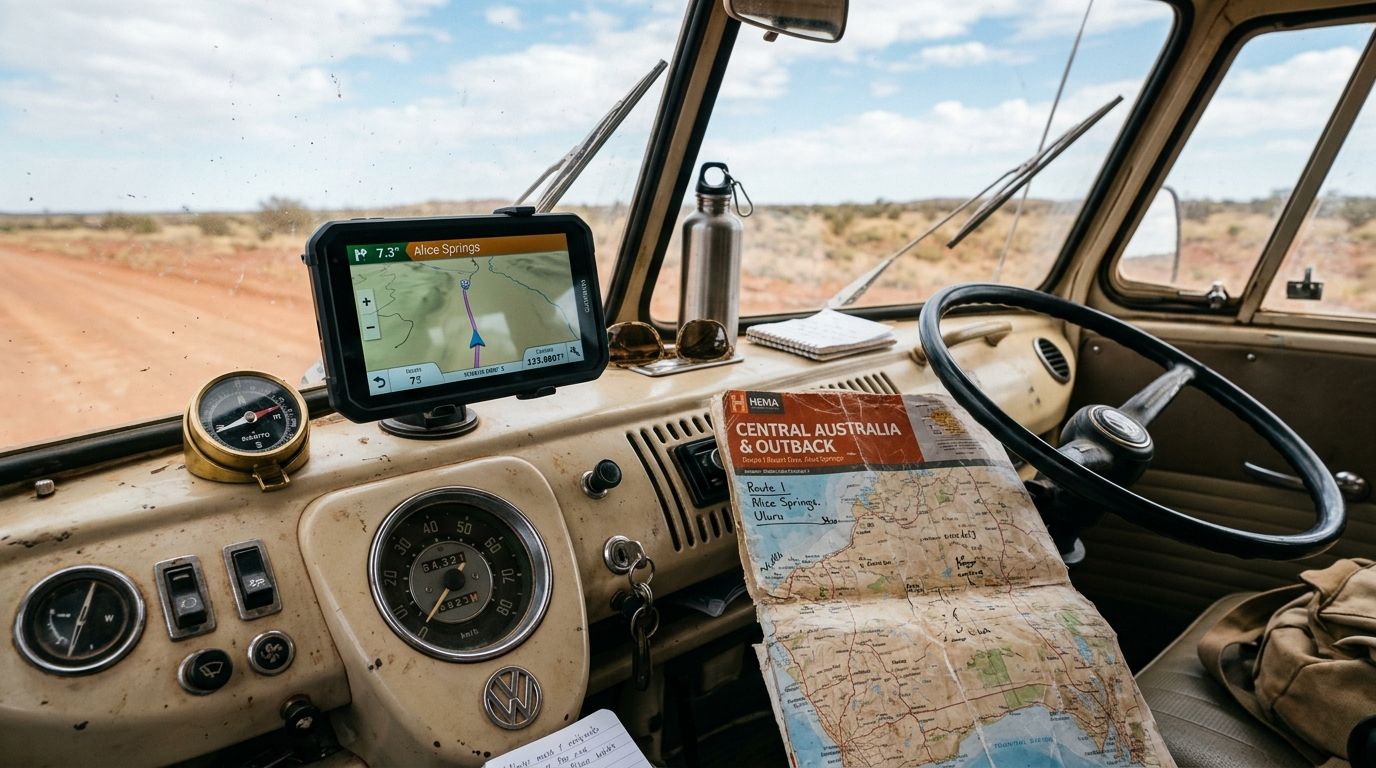
Map quality changes sharply once you leave the well-travelled corridors. HERE notes that seasoned travellers rely on specialist Outback maps showing fuel stops, sealed versus unsealed roads, and seasonal closures. That kind of detail isn't a nice extra. It's part of staying safe.
Build a navigation stack
If I were setting up a classic VW for a proper Outback run, I wouldn't trust a single app or one folded map in the door pocket.
- Paper overview map: Gives you the big picture fast when phone screens feel too small.
- Specialist Outback map: Better for road surface changes, fuel planning and closure awareness.
- Offline digital mapping: Handy when reception disappears and you still need bearings.
- Written trip notes: Old-school, but brilliant. Distances blur when you're tired.
A lot of VW owners also fit touring gear for longer stops and self-sufficiency. If your setup includes auxiliary power for camp lighting or charging essentials, something like a Slimline Lithium Battery 200 Ah fits the practical touring side of the adventure.
Prep the Kombi for reliability, not bravado
You don't need to turn a Kombi into a desert racer. You need to make it dependable.
Check the basics properly before any remote drive:
- Cooling and engine health: Listen for what's changed, not just what's broken.
- Tyres and spares: Outback roads punish neglected rubber.
- Fuel planning: Know your stops before you're hoping for one.
- Tools and belts: Carry the bits old Volkswagens are known to ask for.
- Brakes and steering: Confidence matters more than speed out there.
Bring redundancy. One map system can fail. One part can rattle loose. One assumption can ruin the day.
For a bit of inspiration before the wheels start rolling, this old-school driving footage captures the mood nicely.
Small touches make the trip feel personal
I know more than one traveller who brings a diecast Kombi for the dashboard or camp table photo at each stop. It sounds silly until you see the picture later. Then it becomes part of the ritual. Tiny van, huge country, same grin every time.
Keep the Adventure Alive Your VW Memorabilia Collection
The funny thing about a great road trip is that it keeps travelling with you after you've unpacked. A bit of red dust hides in the floor mats. A fuel receipt turns up in a jacket pocket. Someone asks about the trip and suddenly you're back there, talking about dawn starts and the colour of the sky outside camp.
That's why memorabilia feels right for Volkswagen people. It isn't clutter when it connects to a memory. A VW Kombi diecast Australia display can bring back a camp near the centre. A Volkswagen Beetle model on the shelf can remind you of the first classic you ever loved.

What to collect after the trip
Some enthusiasts like to mark a journey with one special piece. Others build a little display that tells the whole story.
- A Kombi Samba Bus diecast: Perfect if the dream vehicle was a bus, even if your real trip happened in something else.
- A Beetle model: Great for collectors with older family memories tied to VW road travel.
- Mixed display pieces: Ideal if you like a shelf that feels more like a scene than a lineup.
The best collections work like a good route map. They don't just show objects. They show where you've been.
Frequently Asked Questions About VW Outback Adventures
Can you take a classic Kombi into the Outback
Yes, but only if you're honest about the vehicle's condition and your route. Some roads suit a carefully prepared classic far better than others. A sealed or well-known touring corridor is a very different proposition from a rough remote track. The smart move is to match the dream to the Kombi you have.
Is a paper map still worth carrying
Absolutely. Screens are brilliant until they aren't. A paper map helps with the big picture, route alternatives and quick discussions around a camp table. For anyone trying to map the Australian Outback properly, paper is still part of the toolkit.
What matters most on an Outback map
Look for the details that affect decisions on the day. Fuel stops, whether roads are sealed or unsealed, possible closures, and the distance between useful services all matter more than decorative landmark icons.
Is the Outback all one kind of landscape
No. That's one of the biggest misunderstandings. Different inland regions have different climates, road conditions and travel rhythms, so route planning should reflect the country you'll cross, not the postcard version of it.
What should a VW enthusiast pack besides the obvious mechanical gear
A decent torch, good trip notes, plenty of patience, and something that makes the trip feel like yours. For some people that's a camera. For others it's a camp mug that's been on every run for years. If you're one of us, it might also be a little diecast Kombi riding shotgun on the dash.
If the road-trip bug has bitten and you'd like something to keep that VW spirit alive at home, have a wander through Volkswagen Memorabilia. It's a lovely spot to find Volkswagen diecast models for sale, from Kombi and Samba favourites to classic Beetle pieces, with local Australian stock and friendly service that suits collectors, gift buyers and lifelong VW fans alike.