
Karmann Ghia Models: A Collector’s Guide to Types and Values

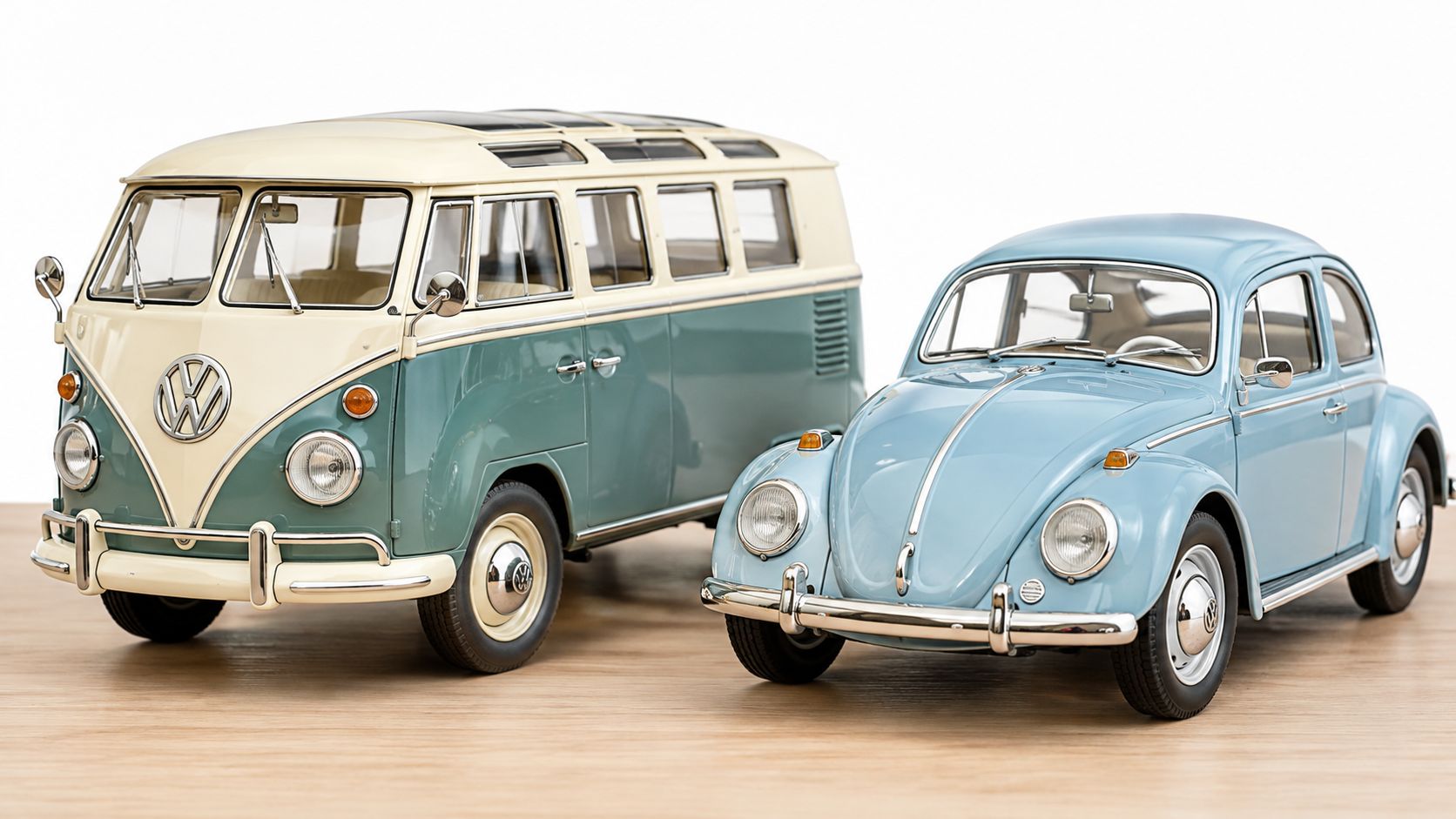
At a sunny Australian car meet, a Karmann Ghia can stop conversation without making a sound. Parked beside a Beetle, its low nose, flowing guards and crisp chrome look like the Beetle dressed for a night out.

The Story Behind the Karmann Ghia Name

The Karmann Ghia has always carried two identities. Underneath, the familiar Type 14 used the Beetle's mechanical foundation. Above it, coachbuilder Karmann shaped the body, while Italian design house Ghia gave the car its elegant lines. That combination explains why the Ghia feels related to a Beetle but looks entirely different.

Karmann's role matters because this wasn't a Beetle with a new badge. The body required its own panels, trim, glass and finishing details. For collectors, that distinction is still important. A model catalogue may list a Karmann Ghia beside a Beetle, yet the two miniatures can represent very different body shapes and production details.

Collector's eye: Treat the Karmann Ghia as a Volkswagen with shared mechanical DNA and a separate visual personality.

Australians encountered the Ghia as a stylish alternative to the more practical Volkswagens already becoming familiar on local roads. Its low roof and sculpted sides suggested European glamour, while its Volkswagen underpinnings kept it connected to the dependable Beetle family.

That blend gives the car lasting appeal at shows. A Beetle celebrates honest simplicity. A Kombi recalls travel, surf trips and open-air adventure. The Karmann Ghia adds a touch of grand-touring elegance, which makes it a terrific subject for licensed Volkswagen diecast models and display collections.

Type 14 and Type 34 Side by Side

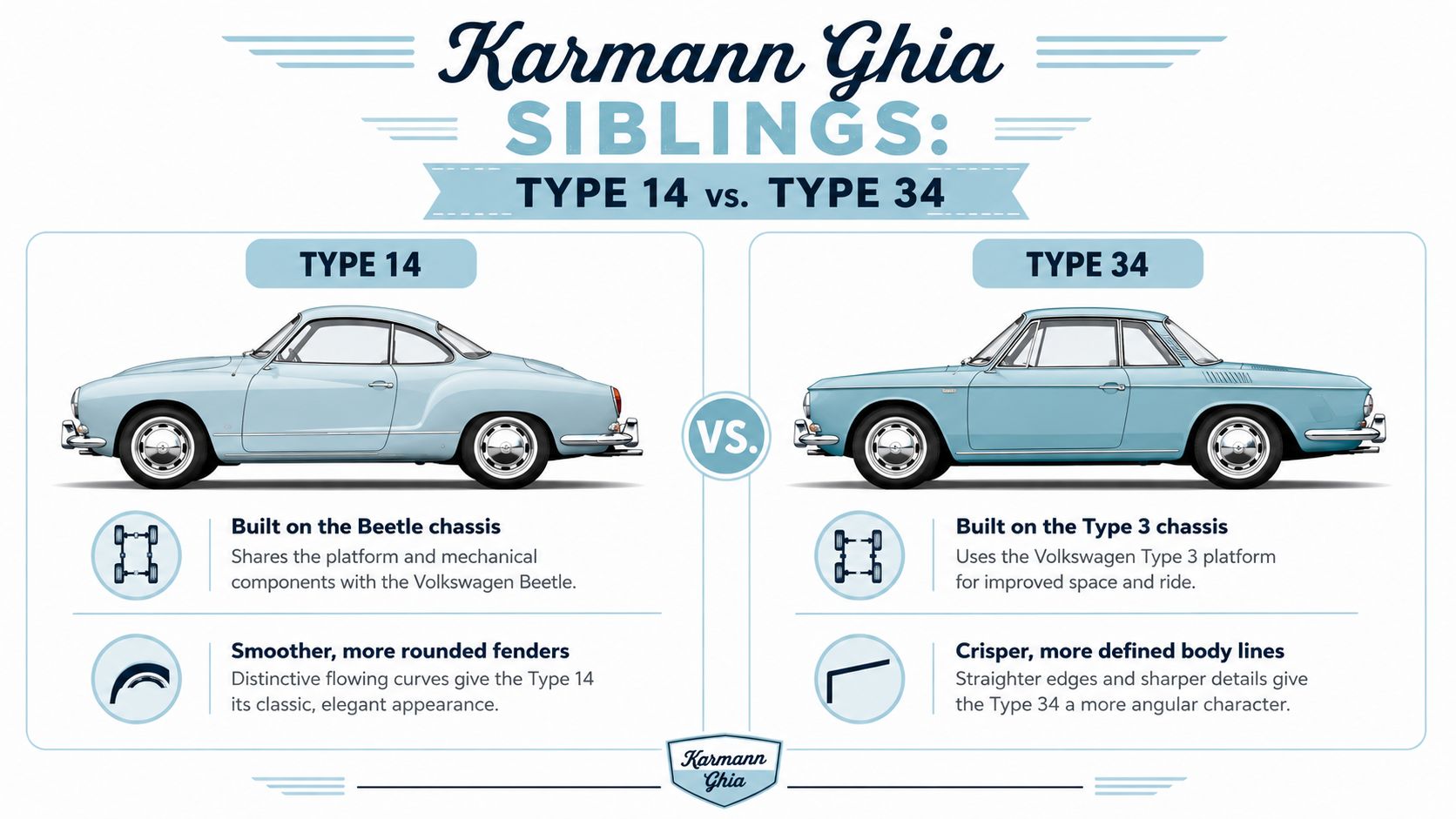
Think of the two main Karmann Ghia models as siblings. The Type 14 is the rounded, familiar sibling, while the Type 34 is sharper, larger-looking and more angular. Both wear the Karmann Ghia name, but they don't share the same platform or visual language.

Type 14

The Type 14 is the classic coupe that many picture first. It was built on the Beetle chassis, with smooth, rounded fenders and a low, flowing roofline. It was also offered as a convertible, giving the design an even stronger connection with relaxed cruising and sunny coastal motoring.

Its mechanical relationship with the Beetle helps owners understand parts sourcing, although the body, trim and many exterior fittings remain specific to the Ghia. In miniature, a Type 14 usually has the soft curves, rounded nose and graceful rear haunches that make the full-size car so recognisable.

Type 34

The Type 34 used the Type 3 chassis, not the Beetle platform. Its styling is crisper, with more defined body lines, a squarer roof and a more formal fastback or notchback character. The windows, dashboard treatment and interior layout also give it a different feel from the Type 14.

The engine story follows the platform. Type 14 cars are closely associated with Beetle-based mechanical components, while Type 34 parts align more closely with Type 3 engineering. That difference matters when reading restoration guides or checking whether a diecast listing represents the right car.

A comparison infographic featuring the classic Volkswagen Karmann Ghia Type 14 and the angular Type 34 models.

For a quick identification, start with the silhouette. A rounded coupe or convertible points towards the Type 14. A squarer, more angular car with a larger-looking cabin suggests the Type 34. Catalogues sometimes use the type code because “Karmann Ghia” alone isn't precise enough for collectors ordering parts or choosing a miniature.

Why Australia Got So Few Karmann Ghia Models

Australia's local Karmann Ghia story is unusually scarce. Volkswagen Australasia introduced the model here in 1959 as a fully imported luxury coupe, and it remained on sale until 1968, according to Club VeeDub's Australian Karmann Ghia history.

The early sales record shows why Australian-delivered cars attract so much attention. Only about 800 Karmann Ghias were officially sold in Australia across that ten-year span. The first three recorded years were especially small, with 13 units in 1959, 264 in 1960 and 284 in 1961.

Year Units Sold
1959 13
1960 264
1961 284

Those figures don't tell you the condition or history of any individual car, but they do explain the emotional response when a genuine Australian-delivered Ghia appears at a display day. The local population was never large, so surviving examples sit in a very different context from imported cars sourced from markets where the model was more common.

Local car or private import

Paperwork is the starting point. Ask for registration history, import documentation, chassis information and restoration invoices. A seller who can explain where the car came from and which work was performed gives you a stronger basis for judging originality, parts choices and future maintenance.

A private import isn't automatically a poor purchase. It needs to be assessed as its own category, with attention to market specification, replacement panels and compliance work. Local scarcity also means an owner may depend on specialist suppliers and mixed sourcing rather than finding every item on one Australian shelf.

Spotting the Year on a Real Car

Model-year identification is best treated like reading clues at a crime scene. Don't rely on a badge, a sales description or one shiny replacement part. Walk around the car and compare several body details together.

Start at the front

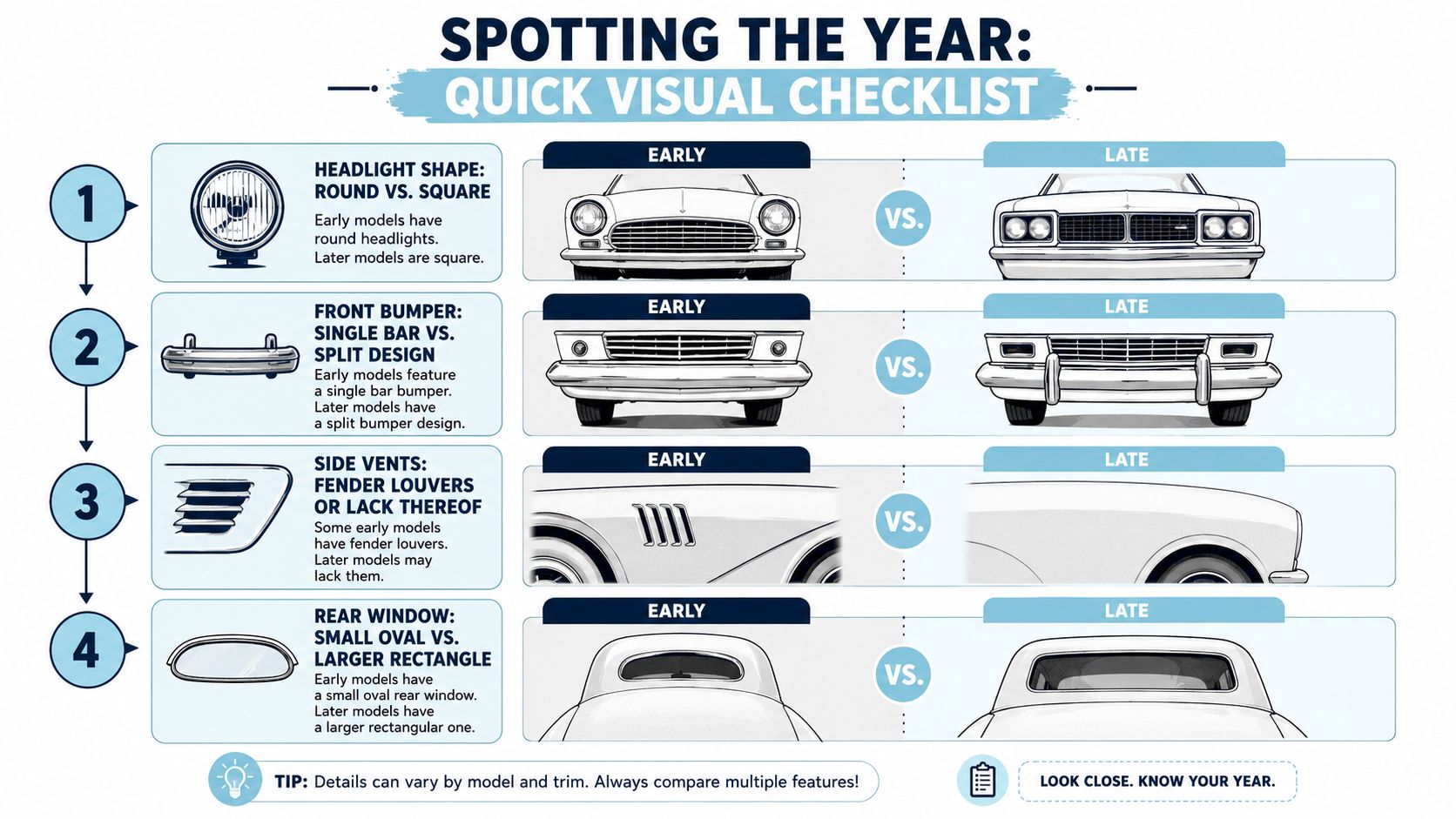
Early cars are associated with lower-set, round headlights and smaller bumpers. Later styling brought altered headlight positions, revised grilles and more substantial bumper treatments. A car with replacement guards can confuse the picture, so inspect mounting points, inner panels and the consistency of the brightwork rather than judging a single lamp.

Move along the sides and rear

Side vents, fender louvers, window proportions and rear glass shape can help narrow the era. Taillights changed as the design developed, and later cars generally present a more substantial lighting treatment than the earliest examples. The rear window is another useful clue, but it should support the rest of your observations, not decide the year by itself.

A visual guide comparing early and late model Karmann Ghia design features like headlights, bumpers, vents, and windows.

Use this simple order when inspecting a car:

  1. Check the headlights: Compare round early shapes with later positioning and treatment.
  2. Inspect the bumpers: Look for the car's original style, not merely what has been fitted during restoration.
  3. Study the side vents: Fender louvers and their absence can separate different styling periods.
  4. Confirm the rear window: A smaller oval appearance and a larger rectangular treatment point to different eras.
  5. Match the details: Make sure lights, trim, glass and interior choices belong together.

For a visual walk-through before visiting a show or seller, watch this Karmann Ghia identification video. It's still wise to verify chassis information and documentation before making a restoration or purchase decision.

Karmann Ghia Diecast Scales and Makers

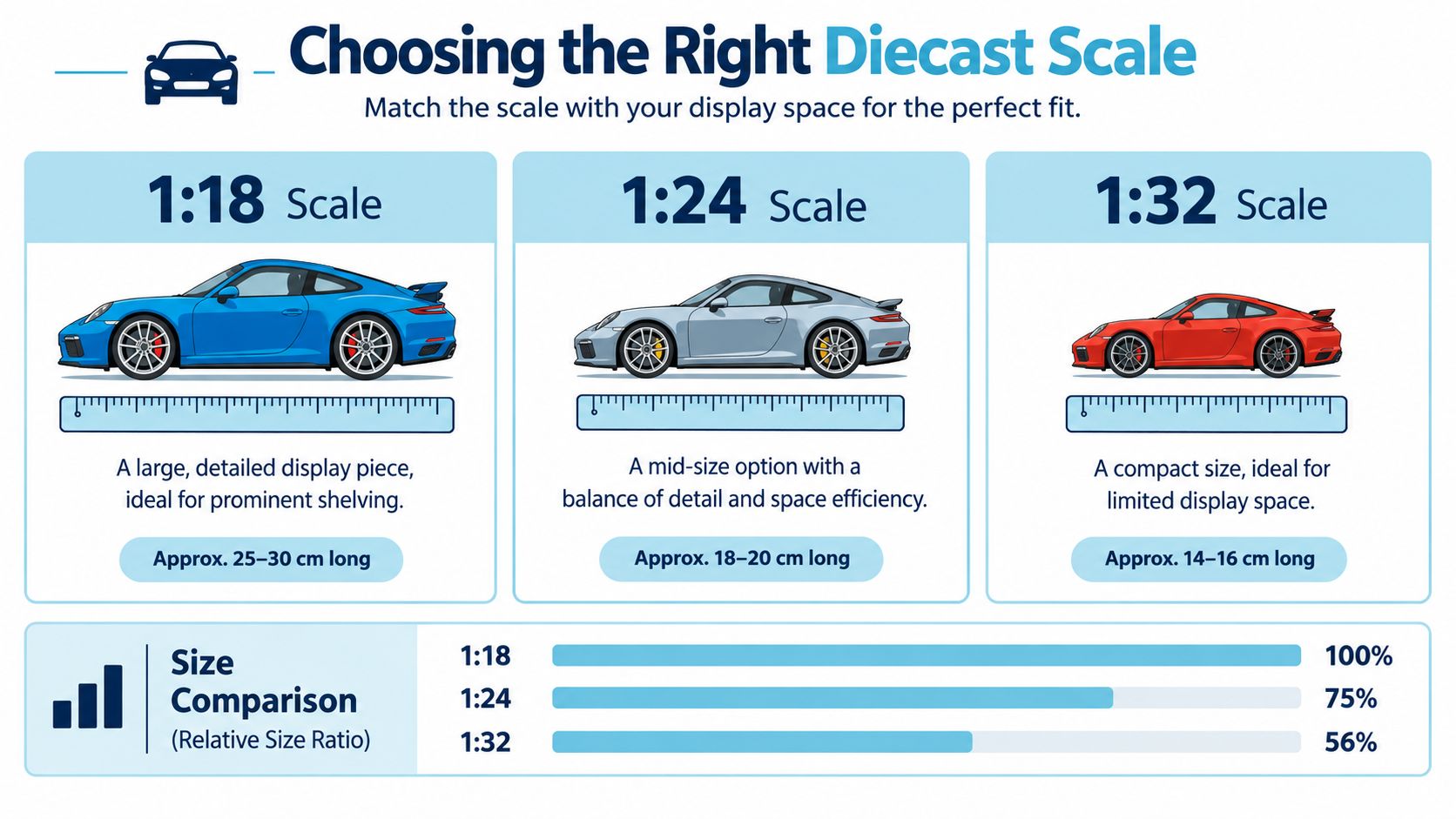
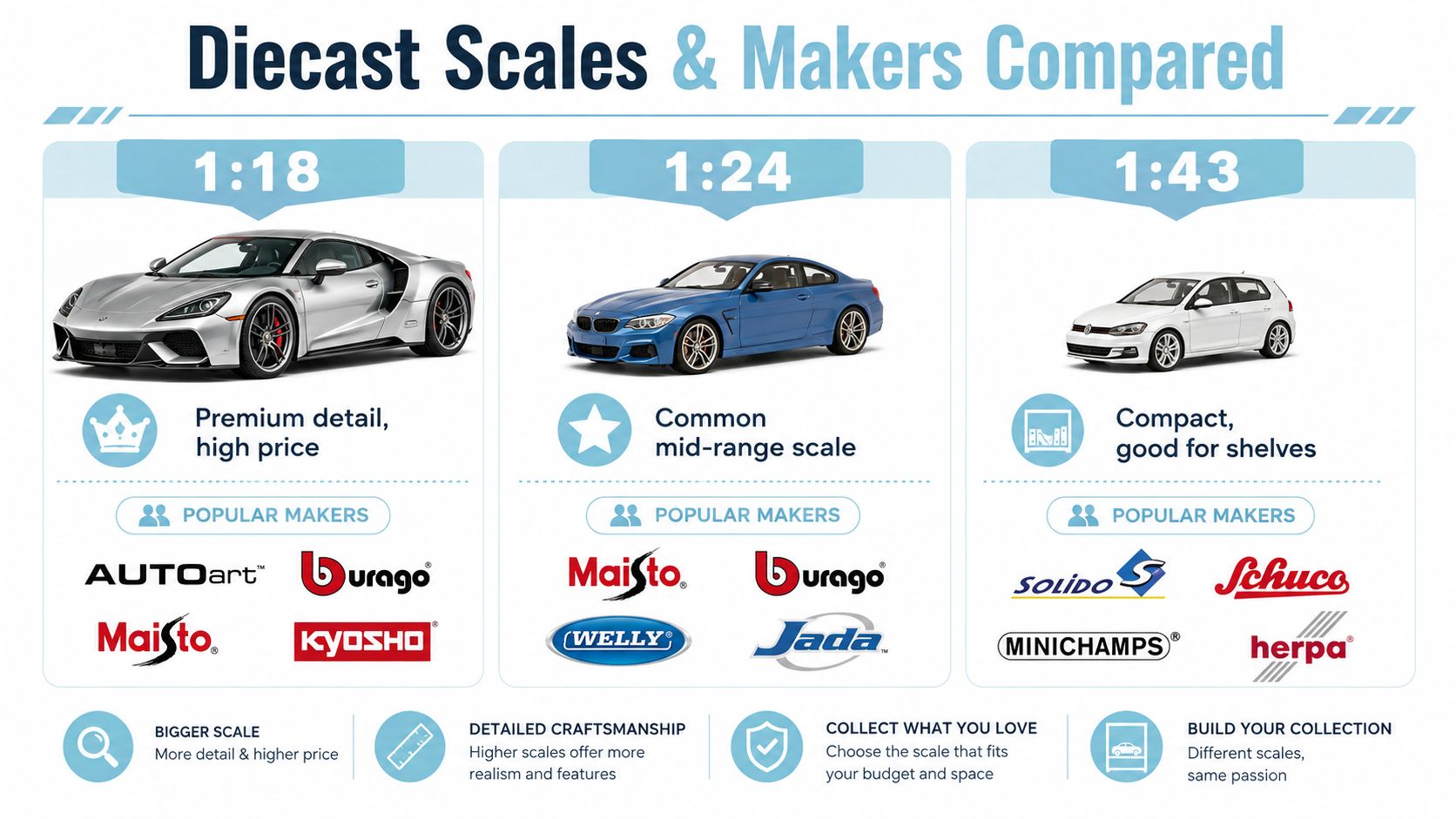
Diecast scale tells you how large the miniature is compared with the full-size car. A 1:18 Karmann Ghia is a substantial display piece with room for stronger body detail, while a 1:24 model takes up less shelf space and usually sits at a more accessible price point. A 1:43 model works well when you want a whole street scene or a broad Volkswagen collection.

An Australian diecast retailer lists 1:18 models at $110 and 1:24 models at $45, giving collectors a useful local comparison between scale and price. These figures are a guide to listed retail pricing, not a universal valuation, as maker, edition, condition and availability still matter. See the Australian diecast models guide for more collecting context.

An infographic comparing three common diecast car model scales, including 1:18, 1:24, and 1:43 ratios.

Choosing the right shelf companion

Look for a model with clean proportions, correctly shaped lights and a finish that matches the era it claims to represent. Recognised makers such as AutoArt and Bburago are familiar names in larger-scale collecting, while other licensed releases may prioritise affordability, playful decoration or compact display size.

A Ghia looks especially good beside a Beetle or a Flower Power Samba Bus. The Ghia brings the polished coupe profile, the Beetle supplies the unmistakable rounded family connection, and the Samba Bus adds the unmistakable travel story. Free-wheeling wheels, opening doors and pull-back action can be enjoyable, but collectors should decide whether they want a display model, a play-oriented piece or a mixture of both.

Buying Tips for New Collectors

A good first purchase starts with condition, not excitement. A rare-looking colour or dramatic box can catch your eye, but the miniature still needs straight panels, even paint and tidy detailing.

Four checks before paying

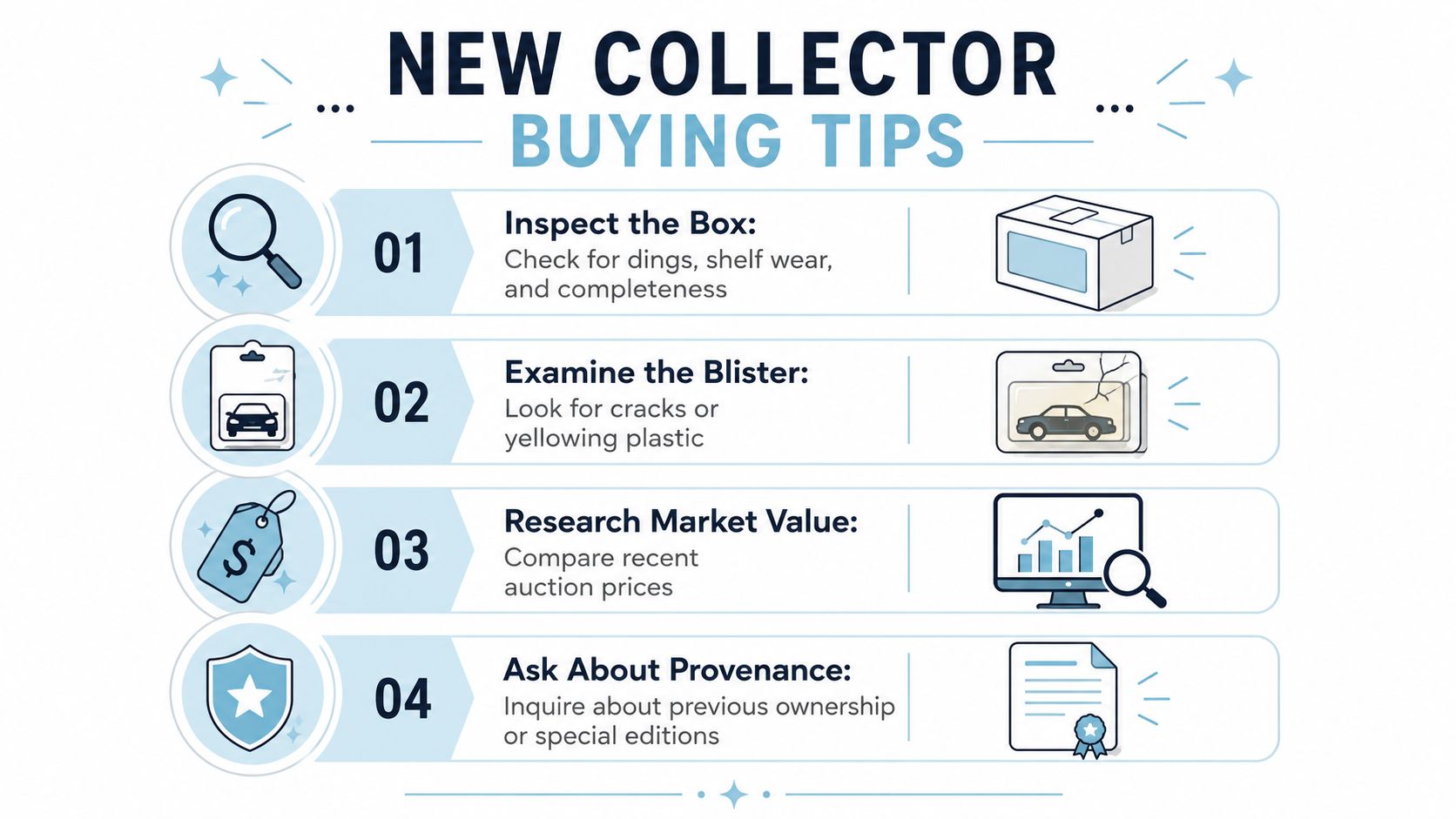
  • Inspect the box: Look for shelf wear, crushed corners, missing inserts and complete labelling. Packaging can matter to collectors who plan to keep the piece boxed.
  • Examine the blister: Cracks, clouding or yellowing plastic may affect presentation, especially when the model is intended as a gift.
  • Study the miniature: Check for paint chips, loose parts, uneven badges, crooked wheels and fingerprints under clear finishes.
  • Confirm the licence and provenance: Ask whether the model is an officially licensed Volkswagen product and whether the seller can explain its edition, previous ownership or special release status.

Licensing matters because it connects the miniature to the manufacturer's identity and gives buyers clearer expectations about the design. It doesn't guarantee perfect condition or future resale value, so keep your receipt, photograph the model when it arrives and store the packaging carefully.

Buying from an Australian importer or local seller can simplify the experience. Local stock, faster domestic shipping and accessible after-sales support are practical advantages over waiting on an international hobby shipment, particularly when you're buying a gift or trying to complete a display before a club event.

An infographic titled New Collector Buying Tips with four numbered steps for evaluating collectible car models.

Display Ideas for Cars and Diecast Together

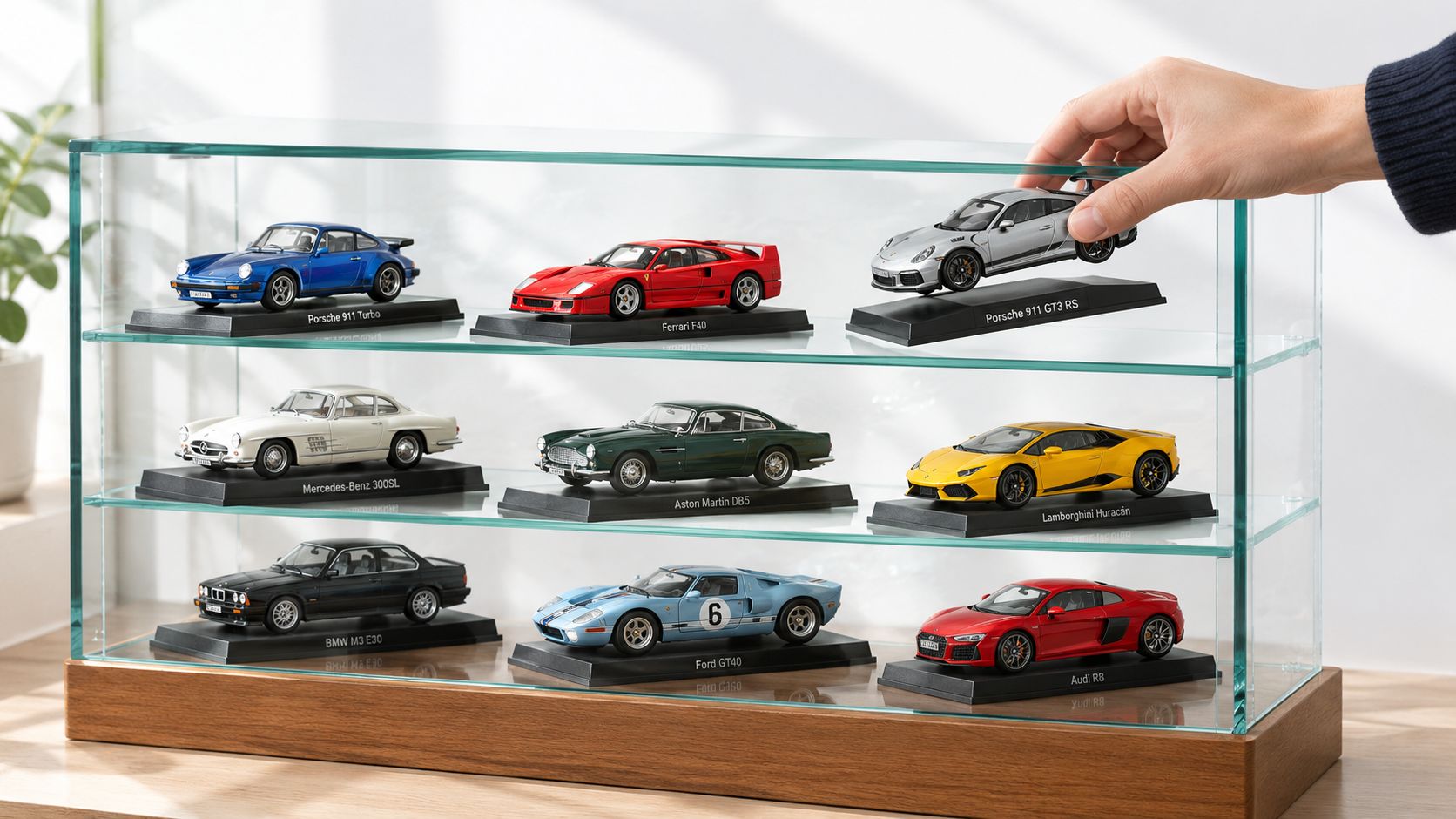
A Karmann Ghia miniature doesn't need to sit alone in a glass box. Try building a small coastal scene with the coupe at the centre, a licensed Samba Bus behind it and a Flower Power Beetle angled as though the group has just arrived at the beach. Surfboards, starfish accents and pale timber tones can reinforce the relaxed Australian character without distracting from the cars.

Another approach is a family display. Put a Beetle beside the Type 14 to show their shared visual heritage, then add a Kombi to represent the travelling side of Volkswagen culture. Keep the arrangement at eye level, leave enough space between vehicles to see their profiles and avoid crowding several large models onto one narrow shelf.

The care routine is simple:

  • Control sunlight: Direct sun can fade paint and packaging over time.
  • Use a soft brush: A clean, fine brush lifts dust from grilles, badges and wheel arches without rubbing the finish.
  • Protect the boxes: Store packaging flat where possible, away from damp areas and heavy objects.
  • Handle by the base: Holding the miniature by its base or sturdy underside reduces fingerprints and pressure on mirrors or trim.

For a more formal setup, display cases for model cars can keep dust away while letting the details remain visible.

Australian FAQs and Where to Shop

Which parts are Karmann Ghia specific?

The Beetle-based Type 14 shares important mechanical foundations with the Beetle, so some brakes, suspension and engine-related components may be sourced through the wider air-cooled Volkswagen network. The body is another matter. Ghia panels, exterior trim, glass, seals, lights and bumpers can be model-specific, and Type 34 parts follow the Type 3 platform rather than the Beetle.

Australian owners face a practical supply challenge because the local population is small. Karmann Ghia Australia shows that specialist parts and services exist locally, while broader Australian air-cooled VW suppliers support mixed sourcing. Owners may still need to combine local specialist help, compatible Beetle-based components and private imports.

What Australian events help collectors connect?

The VW Nationals 2025 was scheduled for Sunday 25 May at Fairfield Showgrounds in Prairiewood, while the announced 2026 Nationals included a Saturday 25 May VW Cruise and Sunday 26 May Car Show, as listed by Volkswagen Australia's Kombi information. Check event details before travelling, especially where a schedule refers to a future event.

What makes a useful gift?

A Volkswagen Beetle model suits someone who loves the original people's car. A Samba Bus miniature works for a surfer, traveller or Kombi admirer, while a Karmann Ghia model makes a thoughtful choice for someone drawn to elegant coachwork and less common VW history. Mixed packs can also help a new collector discover which scale and style they prefer.

For a focused browse, explore Karmann Ghia models for sale and compare the shape, scale and finish before choosing.


Volkswagen Memorabilia brings together licensed VW diecast, including Beetles, Kombi Samba Buses and playful Flower Power pieces, alongside coastal décor for a relaxed display. Visit Volkswagen Memorabilia to find a Karmann Ghia companion, build a classic VW shelf or choose a thoughtful gift for the enthusiast who never walks past a Volkswagen without taking a second look.

VW Type 3: A Collector’s Guide to Variants and Memorabilia

At a car show in Melbourne, a beige Squareback sat between a tidy Beetle and a Kombi with surf racks, and the Type 3 was the one people kept circling back to. It had that low, calm stance that made it look like a proper family car with a bit more class, and a few old VW hands were already swapping stories about parts, rust, and the one that got away.

The VW Type 3 has always had that effect. It doesn't shout like a Beetle or wear the beach-party badge of a Kombi, but it carries a confident shape and a proper piece of Volkswagen history that still feels fresh on Australian roads and in collectors' living rooms alike.

Why the VW Type 3 Still Turns Heads Down Under

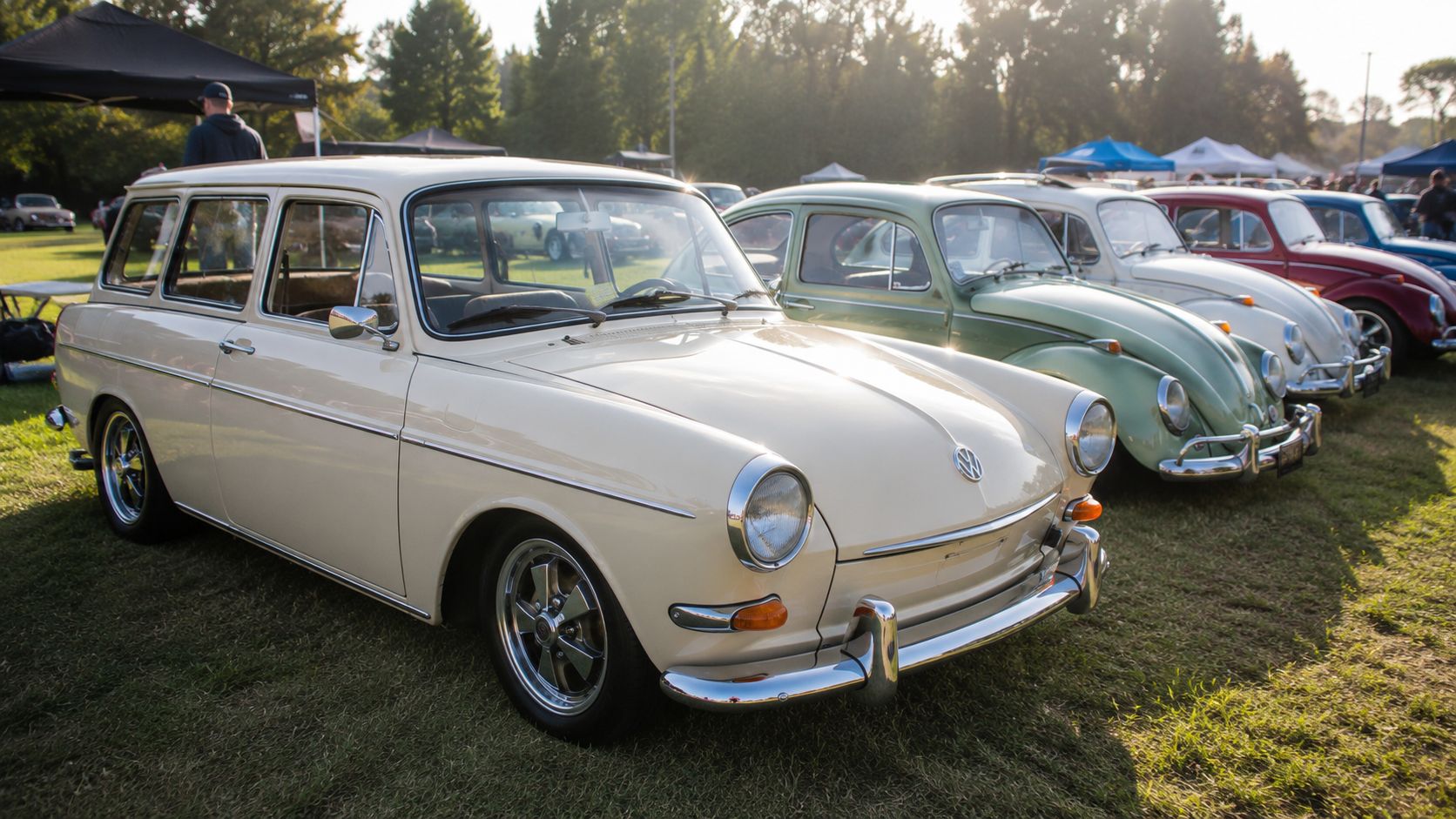
A cream-coloured Squareback easing past a line of Beetles at Volksfest gets the same reaction every time. People lean in, smile, and ask the same question, what is that one? The answer usually comes with a grin, because the VW Type 3 is one of those cars that rewards anyone who looks a little closer.

A beige Volkswagen Type 3 Squareback parked on a grassy field at an outdoor vintage car show.

A Volkswagen with a more grown-up presence

The Type 3 has a shape that feels lower, longer, and more settled than the Beetle. That's part of the charm. It looked like the practical Volkswagen for people who'd outgrown the tiny back seat but still wanted the same air-cooled honesty and easygoing character.

Australian enthusiasts have long responded to that balance. The model stayed in local output until 1974, which gives it a longer regional life than many people realise, and Australian buyer's-guide coverage notes that more than 2.5 million Type 3s were built globally across 13 years. Volkswagen's own record puts the total at 2,587,989 units from the start of production to the 1973 model change, which says a lot about how seriously the car was taken in its day. Those figures help explain why surviving Australian examples feel more than just quirky leftovers, they feel like part of the country's VW story.

Why it still works at shows and in collections

The Type 3 stands out because it doesn't rely on novelty alone. Its silhouette, practical proportions, and family-friendly packaging give it real presence next to Beetles and Kombis, especially when it's cleaned up and sitting on period wheels. You can see why collectors keep hunting for tidy examples, and why memorabilia buyers keep reaching for diecast versions that capture the same shape on a shelf.

Practical rule: if a classic Volkswagen gets attention from both longtime owners and first-time showgoers, it usually has something genuinely distinctive going on. The Type 3 absolutely does.

For Australian collectors, that distinctiveness matters. It's a car with enough production scale to support restoration interest, parts interest, and memorabilia interest, but enough individuality to feel special in a crowded VW scene.

How the Type 3 Came to Life

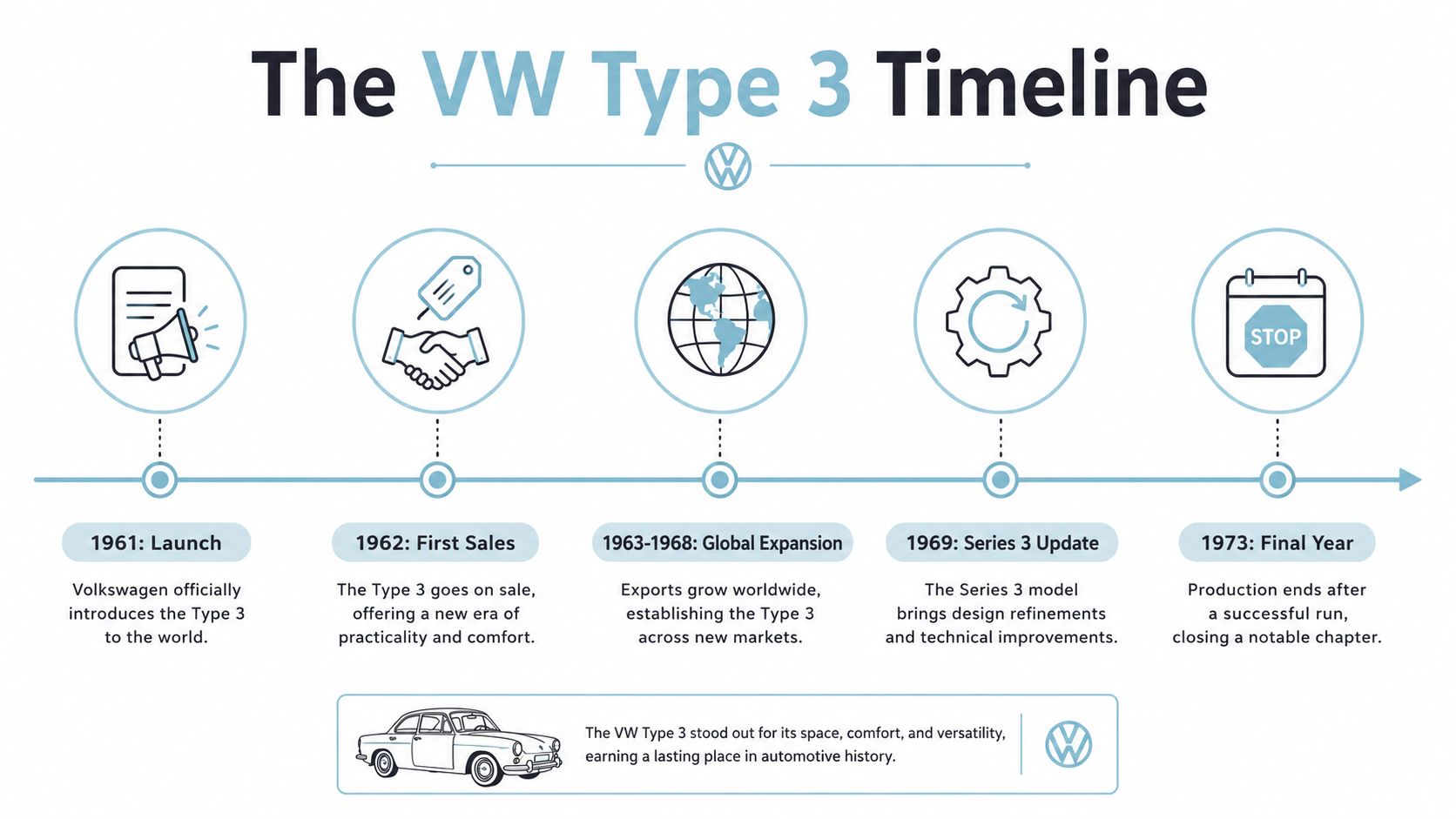
Volkswagen launched the VW Type 3 in 1961 as a more spacious, more practical step beyond the Beetle, while still keeping the rear-engine, air-cooled formula that made the brand famous. The car was sold in three main body styles, the notchback, the fastback, and the station wagon or estate version that many markets knew as the Squareback or Variant. Volkswagen's newsroom notes that the estate arrived in February 1962, with the fastback TL following later, so the range built out quickly once the model was underway. Volkswagen's Type 3 history page captures that launch sequence clearly.

From one new idea to a broad family of cars

That timing matters because it shows the Type 3 wasn't just a single niche sedan. Volkswagen was building a family of cars that could serve different buyers at once, from more conservative saloon customers to families wanting estate practicality. The Australian market felt that practicality strongly, especially because the model kept rolling locally until 1974, extending its presence beyond the global run.

The production numbers tell the rest of the story. Volkswagen's own newsroom says the model reached more than 2.6 million units overall, while another official summary describes more than 1.4 million saloon cars and 1.2 million Variant models. That split is useful for collectors because it shows the Type 3's market identity was firmly rooted in usable body styles, not just a sporty offshoot. Volkswagen newsroom production summary

A car that bridged the old and the new

The Type 3 mattered because it sat in the middle of Volkswagen's air-cooled era. It still had the familiar mechanical family resemblance, but it brought a more modern body, more room, and a calmer road presence. That combination explains why the model has never felt like an odd side project to serious VW people.

A timeline graphic showing the history of the Volkswagen Type 3 from its 1961 launch until 1973.

By the time the 1973 model change arrived globally, the Type 3 had already built a strong legacy. In Australian terms, that longer local life helped cement it as a car people remembered on the street, not just in a brochure.

The Three Body Styles Worth Knowing

The Type 3 story really comes alive once you stand beside all three body styles. Each one has a different personality, and each one appeals to a different kind of buyer or collector. The production mix also makes the picture clearer, because Volkswagen records show that out of 2,587,989 Type 3s built worldwide, about 1,339,124 were saloons or notchbacks and fastbacks, while 1,202,935 were Variant estates. That works out to roughly 52% sedan-type bodywork and about 47% wagon-type bodywork, which is a handy guide to how Volkswagen positioned the range. Type 3 production figures

Type 3 Body Styles at a Glance

Body Style Also Known As Global Share Best For
Notchback saloon Two-door saloon About 52% of total output across saloon-type cars Drivers who like the cleanest classic sedan look
Fastback TL in some markets Included in the saloon-type production total Buyers who want a sleeker, slightly sportier profile
Squareback estate Variant in many markets About 47% of total output Families, practicality fans, and display pieces with strong visual balance

The notchback brings the classic sedan feel

The notchback is the easiest place to start if you're drawn to tidy lines and a more formal Volkswagen shape. It looks honest and upright, with enough character to stand apart from the Beetle without trying too hard. In collection terms, it appeals to people who like the purest expression of the Type 3 body language.

The fastback adds a bit of drama

The fastback gives the range a more flowing profile. It keeps the same core Type 3 idea, but the rear treatment makes it feel slightly more athletic and a little less traditional. If you've got a shelf full of diecast VWs, the fastback is the one that often adds contrast and motion to the row.

The Squareback is the practical favourite

The Squareback, or Variant, is the shape many Australian enthusiasts remember most fondly. It suits the Type 3's family-car brief perfectly, and that's why it still resonates with collectors today. It's also the version that tends to connect most naturally with memorabilia buyers, because it looks great in both outdoor scenes and home displays.

The body style you choose usually says more about how you want to enjoy the car than about which one is “best”. That's the fun of it.

Engineering Differences from the Beetle and Kombi

Under the skin, the Type 3 is where Volkswagen started showing how far the air-cooled formula could be stretched. It still shared the rear-engine family DNA, but it packaged that hardware in a way that made the car more usable day to day. Australian road-test coverage recorded fuel consumption averaging 9.4 L/100 km, with automatics using 10% more fuel, which gives a solid local benchmark for how the model was judged in its period. Australian Type 3 buyer's guide

The Type 3 was built for better everyday use

The biggest difference came from packaging. Volkswagen reworked the engine layout into a low-profile arrangement that created a more practical rear cargo area, while the body itself offered a more conventional car shape than the Beetle. That's why Type 3 owners often talk about it as the Volkswagen that felt a bit more grown-up, a bit more civilised, and a lot easier to live with.

Compared with the Beetle, the Type 3 gives you a broader sense of space and a more composed stance. Compared with the Kombi, it's lower and more car-like, so it feels less like a van and more like a proper family machine. For people who want classic VW character without the towering driving position or the Beetle's compact packaging, the Type 3 lands in a very sweet spot.

Why parts knowledge matters

The Type 3's engineering story becomes useful for owners and restorers. The car's mechanical family links make some jobs familiar to long-time VW hands, but the model also has its own details that deserve respect. If you're already comfortable with Type 1 thinking, this VW Type 1 parts reference is a good reminder of what carries over and what doesn't.

The local road-test angle

That 9.4 L/100 km figure matters because it shows the Type 3 was being judged as a real-world car, not just a curiosity. The 10% fuel penalty for automatics also tells you how closely buyers and testers watched running costs in Australia. Those numbers don't turn the Type 3 into a modern economy car, but they do explain why it appealed to people who wanted a bit more substance than the Beetle without giving up the familiar VW ownership rhythm.

Buying and Restoring a Type 3 in Australia

A good Type 3 can still make a brilliant Australian classic, but the buying process rewards patience. The cars that survive well usually did so because someone cared, and the ones that need major work often hide their problems in the places you can't see from three steps away. That's where a careful inspection saves real grief.

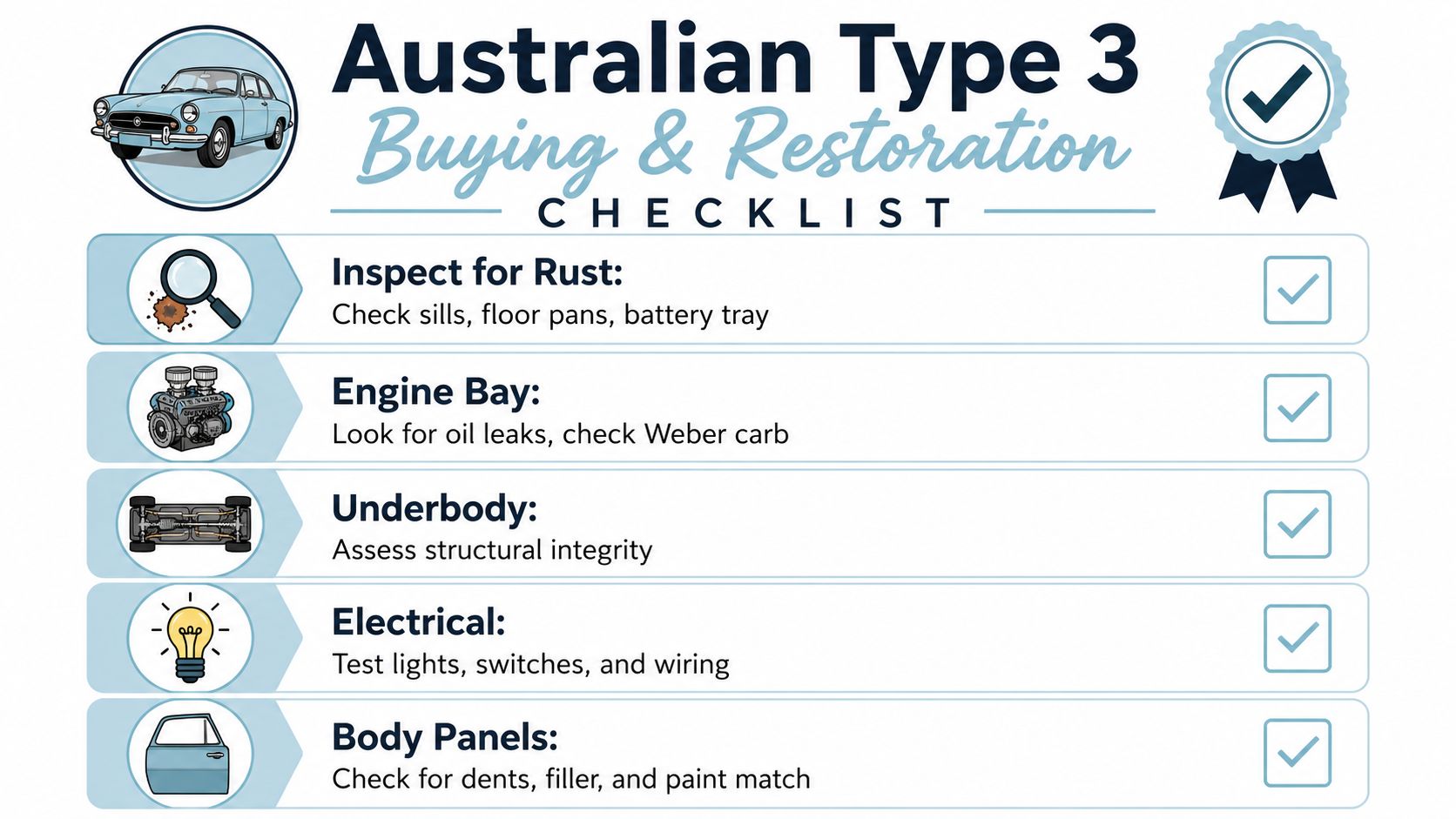
An infographic checklist for buying and restoring an Australian VW Type 3 car featuring five key inspection areas.

Start with the body, not the polish

Rust, accident damage, and filler work tell you far more than a shiny respray ever will. The Type 3's body lines are subtle, so poor repairs can disappear at a glance and then become expensive later. Stand back, crouch down, and look for symmetry in the panels before you get distracted by trim or wheel choice.

Buyer's rule: a tidy interior can hide a tired shell, but a straight shell gives you a fighting chance.

What to inspect on site

  • Rust-prone areas: check sills, floor pans, and the battery tray carefully, because those are the kinds of places that can turn a cheap car into a long project.
  • Engine bay clues: look for oil leaks and make sure the carburetion setup has been handled neatly if the car has been modified.
  • Underbody condition: assess structural integrity first, especially if the car has spent time near the coast or in damp storage.
  • Electrical health: test lights, switches, and wiring rather than assuming old age is the only issue.
  • Body panel fit: look for dents, filler, and mismatched paint that might point to hidden repair work.

Restoration priorities that save time

Originality is lovely, but drivability matters too. A Type 3 with complete trim, tidy glass, and a presentable interior often makes a much smarter starting point than a shiny shell missing half its details. The Australian market also tends to reward honest cars that haven't been over-restored into something unrecognisable.

For parts, local VW circles can often help with the common wear items, while rarer Type 3-specific pieces may need more searching. That's part of the charm, because it turns ownership into a conversation with other enthusiasts rather than a solo project. When the right car turns up, the best move is to buy on condition and completeness, not just on colour or excitement.

Diecast Models and Type 3-Inspired Home Decor

Not every Type 3 fan has room for a full-size project in the shed, and that's where diecast and home styling come in. A well-made model on a shelf can carry the same lines, stance, and memory trigger as the actual car, especially when it sits alongside Beetle and Kombi pieces. That's why the Type 3 works so well as a collectible, it feels like a small sculpture of a very usable car.

A display can tell the same story as a driveway

A collector I spoke to had a Squareback diecast set beside a framed beach photo, a Kombi model on the other side, and a whitewashed shelf that felt straight out of a coastal holiday house. The effect was simple and smart. The cars weren't just toys or props, they were a visual shorthand for Volkswagen history, surf culture, and relaxed Australian living.

The Type 3's shape suits that kind of display because it has clean surfaces and a calm profile. It doesn't fight for attention, so it works beautifully with timber, linen, white ceramic, and soft blue accents. That makes it a natural fit for coastal-themed interiors where people want nostalgia without clutter.

What to look for in a quality model

For collectors, the best Volkswagen diecast models for sale usually feel solid in the hand, with clean paint, accurate badging, and believable proportions. A Volkswagen Beetle model and a VW Kombi diecast Australia piece often make perfect companions to a Type 3 because they complete the family story on one shelf. If you're building a display, mixed scale can work, but matching finishes and themes usually looks cleaner than forcing every model into the same slot.

Display idea: place the Type 3 between a Beetle and a Kombi, then use one framed surf print or shell accent to tie the whole shelf into a coastal room.

For browseable inspiration, the Volkswagen model cars collection is the kind of category collectors like because it keeps the search focused on licensed pieces rather than random lookalikes. The same goes for anyone trying to buy diecast Kombi pieces or build a small, giftable VW corner without needing a full garage to enjoy it.

Common Misconceptions and Where to Go Next

The Type 3 isn't just a stretched Beetle, it's a different answer to a different brief. It also isn't rare in Australia in the sense that it vanished without a trace, because local output continued until 1974 and left enough of a footprint to build a real enthusiast following. And no, licensed VW memorabilia isn't hard to find locally if you know where to look, especially when you're after pieces that fit both the car culture and the coastal home style.

The bigger myth is that the Type 3 only matters to hardcore historians. It sits right where nostalgia, practicality, and design meet, which is why it still works for owners, collectors, and gift-buyers alike. If you want to keep the story going in your home, office, or display cabinet, the best next stop is a trusted source of VW memorabilia collectibles and licensed pieces that feel right in an Australian setting. Start with the vintage Volkswagen memorabilia collection and see what catches your eye.


If the Type 3 has you daydreaming about a clean shelf display, a gift for a VW mate, or a coastal-themed room with a proper air-cooled touch, have a look at Volkswagen Memorabilia. You'll find licensed Volkswagen diecast models, Kombi and Beetle favourites, and home décor pieces that suit Australian collectors who want the authentic thing, with local-friendly service and fast shipping.