

A sun-faded Kombi sits outside a coastal café, boards tucked behind the front seats and a tiny diecast version of the same van resting on the dashboard. That mix of practical transport and beach-day character explains why VW van models still bring a grin at Australian shows, whether they're full-size classics or carefully made collectibles.
The Iconic Volkswagen Van Legacy
The Volkswagen van has always carried more than camping gear. Along Australia's east and west coasts, the Kombi became part of the surfing story, carrying boards, mates and the loose sense of adventure that belongs to a good road trip. Volkswagen's own history of the model connects the Kombi with Australian surf culture during the 1970s, when the vehicle's roomy cabin and relaxed shape suited beach travel particularly well. Volkswagen's Kombi history also traces the wider journey from useful commercial vehicle to cultural icon.
That dual identity is what makes collecting so enjoyable. A T1 split-window Microbus has a very different presence from a T2 Bay Window, while a later Transporter or Caravelle feels more purposeful and road-ready. Modern choices extend from compact vans for city work to the heavy-duty Crafter, so “which VW van?” is no longer just a lifestyle question. It's also a question of space, payload, passengers and the kind of work the vehicle must handle.
For collectors, the same thinking applies in miniature. You might choose a Kombi Samba Bus diecast for its windows and beach character, a Flower Power van for a colourful shelf, or a Transporter replica to represent the practical side of the Volkswagen story. The strongest displays don't just gather random models. They show a journey through design, Australian motoring and the easy-going spirit that made these vans memorable.
Exploring the Classic T1 and T2 Eras
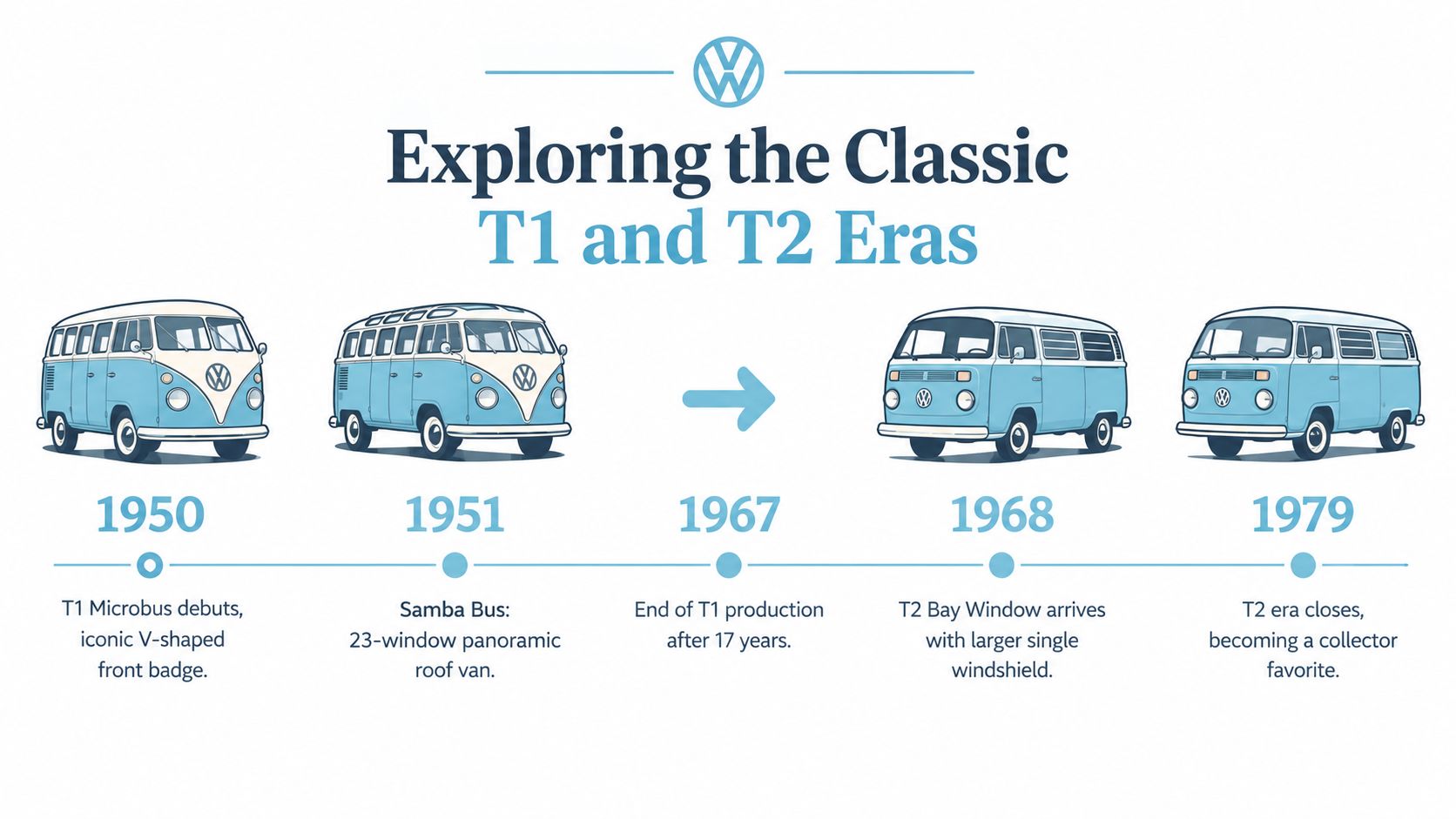
At a coastal car show, a T1 usually draws attention before anyone notices the newer vans. Its split windscreen, V-shaped front and cheerful proportions read clearly even at diecast scale. The T2 has a broader, more practical stance, yet carries the same beach-road character. For a collection shaped by Australian surf culture, these two generations connect full-size utility with the nostalgia of boards, road trips and simple coastal travel.
The T1 and T2 remain the core of many Volkswagen van collections because their silhouettes are so recognisable. A Samba Bus adds panoramic windows and a more detailed passenger-van feel, making it a natural centrepiece. A plain panel van tells a different story, focused on work rather than weekends away.
Volkswagen's Transporter story began in 1949, when Dutch businessman Ben Pon sketched a van influenced by the Beetle's mechanical layout, but built around more usable interior space. A collector's guide to starting a diecast collection explains the design's lasting appeal. Its practical shape suited work and travel while leaving room for personal expression.
The supplied timeline places the T1 from 1950 to 1967 and the T2 from 1968 to 1979. Those dates provide a useful first check when matching a diecast model to its claimed era. Look for these details:
- T1 Microbus: Split windscreen, rounded nose and distinctive front badge treatment.
- Samba Bus: Multiple small windows and a decorative passenger-van appearance.
- T2 Bay Window: A larger single windscreen, smoother front profile and more interior space.
- Australian T2 details: The second-generation model arrived locally in 1968 with a 1,600 cc engine, improved safety features, double-joint rear axles and a panoramic windscreen, according to the Volkswagen Club of Australia's model history.
Why collectors favour these generations
A convincing T1 or T2 diecast model depends on more than its outline. Window count, door placement, bumpers, lights and roof details establish the period. Check those features before choosing a model for a display, particularly when a Samba Bus and a panel van share the same basic body.
The T2 has particular value for collectors following Australian history. Volkswagen updated the local version in 1973 with higher front indicators, larger tail lights and further safety improvements. By 1976, buyers could choose a Type 4 engine that increased displacement from 1,800 cc to 2,000 cc, while German imports continued after Australian T2 production ended through 1979. The Volkswagen Transporter T2 model suits a display focused on that familiar Bay Window shape.
Collector's rule: Count the windows, study the front end and confirm the generation before buying. A model can look “Kombi-like” while representing a different Volkswagen van.
Pair the model with a Beetle, surf photograph or period-style travel poster. That small combination gives the shelf a stronger Australian beach story than a lone retro van.
From Kombi to Crafter, Understanding Modern VW Vans
Australian Volkswagen van history continues beyond the T2. The T3 brought a different naming pattern to local buyers. The basic commercial van was sold as the Transporter, while the more comfortable passenger version carried the Caravelle name. That distinction still matters at a car show or swap meet. “Kombi” may describe the family broadly, while Transporter and Caravelle identify different generations, layouts and jobs.
A Caravelle suits people, touring and family travel. A Crafter serves operators who need cargo space, payload and room for a body conversion. For an Australian collector, that is the useful dividing line between a beach-trip people mover and a modern workhorse.
Volkswagen Australia lists the Crafter with a load length of 3,450 to 4,855 mm, cargo volume of 9.3 to 18.4 m³ and payload from 957 to 2,976 kg, as shown in the official Crafter specifications.
| Requirement | More suitable direction |
|---|---|
| Easier access and lower-floor packaging | Front-wheel drive |
| Sustained heavy loading | Rear-wheel drive |
| Maximum listed GVM | Rear-wheel drive, up to 5.5 tonnes |
| Selected all-weather applications | 4Motion configurations |
The Crafter's 2.0-litre twin-turbo diesel offers TDI360 and TDI410 outputs with an eight-speed automatic transmission. Roof loading reaches 150 kg, though that capacity is separate from usable payload. Passengers, shelving, water tanks, tools and a camper fit-out all consume carrying capacity.
For a business, check the legal payload after the planned fit-out, not just the brochure's maximum figures. A compact van can be easier around town, while the Crafter makes more sense when volume and weight take priority over a low step-in height.
Collectors can show that shift without giving up the coastal character of a Volkswagen display. A Volkswagen Crafter camper model represents modern touring beside a classic Kombi, linking practical full-size utility with diecast nostalgia. It also gives a beach-themed shelf a newer chapter, rather than stopping with split screens and Bay Windows.
Diecast Collecting, Choosing the Right Scale
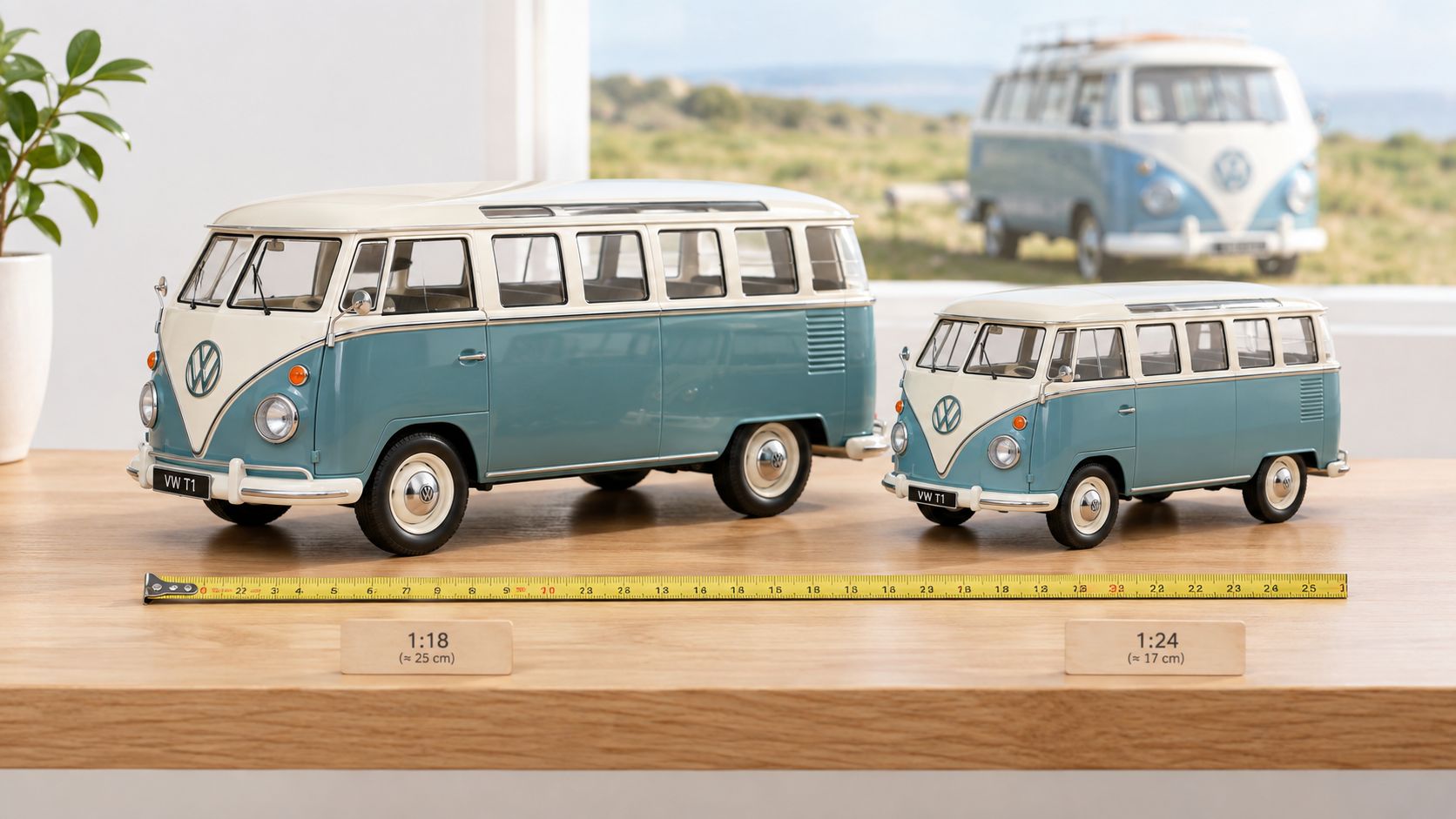
The right scale depends on the story you want your shelf to tell. A 1:18 model gives a Kombi enough presence to stand in for the full-size van that carried boards, towels and mates to the beach. A 1:24 model takes up less room, making it easier to build a broader line-up of Volkswagen vans without turning the shelf into a traffic jam.
A larger model shows body contours, trim and cabin details more clearly, but it also demands more shelf depth and clearance. That matters when doors, bonnets or tailgates open. Smaller models suit collectors who want several colours, body styles and beach-era variations in one arrangement.
Match the scale to the job
Choose 1:18 for a hero vehicle, such as a Samba Bus or a favourite split-screen Kombi. Its larger footprint suits close inspection and gives distinctive paintwork, windows and interior trim more visual weight.
Choose 1:24 for a collection with range. It leaves room for Beetles, surf vans and several Volkswagen diecast models for sale, while keeping the proportions of the display consistent. That makes it a practical choice for collectors who want to map the journey from weekend beach transport to modern touring without giving every model its own cabinet.
Before ordering:
- Measure shelf width and depth. Scale ratios do not show the clearance needed for opening parts.
- Choose detail or variety. A 1:18 model has stronger presence, while 1:24 supports a wider fleet.
- Keep the main display consistent. Similar footprints make mixed models look deliberate.
- Leave room for another purchase. One Kombi often leads to another.
The 1:18 Volkswagen diecast range suits collectors looking for a larger focal piece. For a gift, check whether the recipient values fine detail, a matching scale or the freedom to build a wider fleet.
Displaying VW Heritage in Your Home
A diecast van earns its place when the display gives it context. On a coastal shelf, pair a Kombi with a framed surf photograph, pale timber, travel books or beach-toned décor. In a retro room, warm wood and period colours highlight the rounded bodywork while keeping the arrangement grounded rather than toy-like.
Flower Power variants add colour without needing a crowded shelf. Set one bright van against a neutral wall, or build a broader scene around a Samba Bus, Beetle and a few coastal details. Leave breathing room between vehicles so each model remains easy to inspect.
A model looks more valuable when the space around it gives the eye somewhere to rest.
Australian VW culture gives these displays a personal edge. The Australian VW Nationals began in 1988 at Hawkesbury Agricultural College during Easter, with more than 500 Volkswagens attending despite torrential rain, according to the documented Nationals history. A model can represent a favourite show car, a family road trip or the first Kombi spotted at a local meet.
Keep the collection away from harsh direct sunlight. Dust each vehicle with a soft brush, and check the shelf before opening doors, tailgates or other moving parts. Leave enough clearance to show those details without knocking the van beside it. That small bit of planning helps a beach-inspired display feel like a considered slice of Australian VW life.
Start Your Collection Today
Start with the story you want your shelf to tell. A Volkswagen Beetle model pairs naturally with a T1 or T2 van, while a Samba Bus gives the display an immediate coastal focus. If you're buying for a mate, a Flower Power van or a classic Kombi is an easy choice for someone who loves surf culture, camping or old Volkswagens.
For a first purchase, check four things:
- Generation: Decide whether you want the split-window T1 character or the broader T2 Bay Window shape.
- Scale: Measure the display space before choosing 1:18 or 1:24.
- Finish: Match the colour and style to the recipient's car, room or existing collection.
- Licensing and detail: Look for a properly presented licensed model with accurate trim and body features.
A local Australian importer can also make the buying experience simpler. Local stock and fast shipping matter when a model is a birthday gift, a show-day surprise or the final piece needed for a display. Volkswagen Memorabilia offers VW-themed diecast, gifts and coastal home décor, including Kombi and Samba Bus pieces, so it's a practical place to compare options without losing the nostalgic side of collecting.
You don't need a cabinet full of rare vehicles to begin. Choose one van that means something, give it a clear spot, and let the collection grow around genuine memories rather than impulse buys.
Explore Volkswagen Memorabilia for licensed Volkswagen diecast, Kombi Samba Bus models, Beetles and coastal décor made for collectors and thoughtful gifts. Browse the shop for a van that suits your shelf, your mate's garage or the next sunny Australian road-trip display.