
VW Campervans for Sale: An Aussie Buyer’s Guide to Finding Your Dream Ride

Picture this, mate: you're cruising down the coast, sun on your face, windows down, with nothing but the open road ahead. That's the great Aussie dream, and for so many of us, it has that iconic VW badge right on the front. If you've ever found yourself daydreaming about a classic Kombi, this guide is for you. It's like having a chat with a fellow enthusiast at a sunny car show, all about turning that dream into a reality that's parked right in your driveway.

Let's walk through everything you need to know about finding VW campervans for sale, from a classic Splittie to a modern weekender.

Your Adventure Starts With the Right VW Campervan

The love for the Kombi runs deep in our Aussie blood. It’s more than just a van; it’s a symbol of freedom, salty coastal drives, and a way of life that brings a massive community together at events like Volksfest and the VW Nationals. It’s a feeling of pure, unadulterated joy.

Before you dive headfirst into the classifieds, it’s worth taking a moment to really soak in the heritage. A brilliant way to do that is to get your hands on some proper VW memorabilia collectibles. Holding a classic Kombi Samba Bus diecast model in your hands… it really connects you to the history and the beautiful, timeless design you’re about to become a part of. It’s like holding a tiny piece of the dream.

Why Is Now a Great Time to Look?

If you feel like you're seeing more classic VWs on the road lately, you're not wrong! The market for VW campervans in Australia has been absolutely humming for the last few years, fired up by a huge swing back to local travel as we all started exploring our own incredible backyard again.

This rediscovery of the Aussie road trip has really shaken up the market in the best way.

  • Soaring Demand: Back in 2020, as folks looked for new ways to holiday at home, campervan sales more than doubled in just a year.
  • A Healthy Market: Fast forward to 2026, and you’ll find online marketplaces buzzing with used VW Transporter and California models. It’s not uncommon to see well over a thousand VW campers for sale at any one time.
  • Prices for Everyone: This means there's a van for almost any budget, with prices starting around $25,000 for a solid T3 project and heading north of $120,000 for a perfectly restored T2 Splittie that’ll make you weep with joy.

All this energy makes it a fantastic time to find VW campervans for sale. The market is buzzing with options that tap right into that classic, adventurous spirit—the same spirit captured in collectibles like the timeless 1962 VW Kombi diecast models.

Getting to Know the VW Campervan Family

Choosing a VW camper is a bit like picking a favourite band—every era has its own unique character and a legion of devoted fans. When you start looking at VW campervans for sale, you'll quickly realise you're not just buying a vehicle; you're buying into a piece of living history. From the iconic first generation to the comforts of today, let's meet the family.

Getting a feel for this evolution is part of the fun. A great way to appreciate the history is by exploring the details on a smaller scale, like with a classic 1:18 scale Kombi Samba Bus. It’s a fantastic way to connect with the lineage before you find your own life-sized adventure wagon.

The Icon: T1 Transporter 'Splittie' (1950–1967)

This is it. The one that started a global movement. The T1 is the undisputed king of cool, instantly recognisable by its split front windscreen and that big, friendly VW badge. It’s pure 1960s nostalgia on four wheels.

If you find a T1 for sale in Australia, you're looking at a genuine piece of automotive history. Their rarity and timeless appeal mean they command high prices. Owning one is less about getting somewhere fast and more about enjoying every single kilometre with a massive smile on your face.

The "Splittie" isn't just a van; it's a statement. It represents a simpler time of peace, love, and open-road freedom that still resonates with enthusiasts today. It’s the origin story of the entire van life movement.

The Surfer's Favourite: T2 Transporter 'Bay Window' (1967–1979)

When the Splittie passed the baton, the T2—or "Bay Window"—ran with it, becoming the go-to surf bus of the 70s. It traded the split screen for a single, curved panoramic windscreen (the 'bay'), giving drivers a better view and a more modern look for the time.

You only have to look at the sales figures to see how much Aussies fell in love with this model. After the T1, demand for the T2 absolutely exploded. Imports surged by a massive 200% to over 20,000 units a year as our surf culture boomed, cementing the Bay's place in our coastal identity.

For many, the T2 is the perfect sweet spot. It’s more affordable and easier to drive than a T1, but it still has all the vintage charm you could ever want for a weekend away or a local Show & Shine.

The Practical Classic: T3 Transporter 'Wedge' (1979–1992)

As the 80s rolled in, so did the T3. Affectionately nicknamed the "Wedge" for its sharper, more angular lines, this van was a huge leap forward in space and comfort. It was the last of the rear-engine VWs, cleverly bridging the gap between the old air-cooled classics and the water-cooled vans that followed.

T3s are known for their roomy interiors and smoother ride, making them a fantastic and often affordable entry point into VW camper ownership. They're incredibly versatile, and the many Syncro (4WD) models still out there prove their mettle on rugged Aussie tracks to this day.

The Modern Adventurers: T4, T5, and T6 (1990–Present)

From the T4 onwards, Volkswagen moved the engine to the front. This change created the reliable workhorses and comfortable, capable campers we know today. These models deliver modern performance, safety, and reliability that make long-distance touring an absolute pleasure.

If you want a van that can pull double duty as a daily driver during the week and an adventure machine on the weekends, this is the era you'll be exploring.

The whole campervan market, from classic to modern, has seen a huge surge in interest recently. This is driven by a new generation of adventurers who appreciate both nostalgia and reliability.

Timeline illustrating global campervan sales trends, from niche market in 2019 to projected growth by 2026.

This trend shows that prices are on the rise across the board. No matter which model captures your heart, it’s an investment in a lifestyle. You can find more tips on looking after your pride and joy in our dedicated guide for the Volkswagen Transporter camper.

VW Campervan Generations At a Glance

Feeling a bit overwhelmed by the choices? Don't be, mate. Here's a quick cheat sheet to help you tell your Splitties from your Wedges at a glance.

Model (Nickname) Production Years Key Feature Best For
T1 (Splittie) 1950–1967 Split front windscreen The purist wanting the ultimate classic icon
T2 (Bay Window) 1967–1979 Single curved windscreen Vintage charm with better drivability
T3 (Wedge) 1979–1992 Angular, '80s boxy shape An affordable and practical entry into classic VW life
T4/T5/T6 1990–Present Modern front-engine design Reliability and comfort for daily driving and touring

Each generation has its own story to tell. The fun part is deciding which one you want to be a part of.

Understanding VW Campervan Prices in Australia

Alright, let's talk money. Dreaming of a classic Kombi is one thing, but setting a realistic budget is how you actually get the keys in your hand. The price for a VW campervan for sale in Australia can vary dramatically, and it all comes down to a few key factors: the model, its age, condition, and the interior fit-out.

Much like a rare piece of Volkswagen memorabilia, say a stunning Volkswagen Beetle model, the value is tied directly to its history and how well it's been preserved. A perfect, all-original camper will always fetch a premium, but there are plenty of great vans out there that won't break the bank.

What Shapes the Price Tag?

As you start your search, you'll notice a massive spread in asking prices. It really helps to know exactly what you’re paying for.

  • Model & Rarity: A T1 'Splittie', particularly a sought-after 21- or 23-window Samba model, is the peak for collectors and commands a top-tier price. A T2 'Bay Window' is generally more affordable, and a T3 'Wedge' can be a brilliant, budget-friendly way into the classic VW world.
  • Condition: This is the big one. A van that needs a complete, bare-metal restoration might seem cheap upfront, but it will require a huge investment in both time and cash. At the other end, a fully restored, rust-free van ready for a car show will have the highest price tag.
  • Interior Fit-Out: Is it an empty van ready for you to customise, or does it have a complete camper setup with a pop-top roof, kitchenette, and bed? A quality, professional fit-out from a known brand like Westfalia adds serious value.

A Realistic Look at Aussie Market Prices

To give you a general idea, here’s a rough guide to what you can expect to pay for VW campervans for sale in Australia. Remember, these are just ballpark figures, so always do your own research.

  • Project Vans ($5,000 – $20,000): These are vans that need a lot of work. They’re a great choice if you know your way around a welder and want the satisfaction of a full restoration project.
  • Running & Roadworthy ($20,000 – $45,000): In this price range, you’ll find vans that are mechanically solid and ready for the road, though they might have a few cosmetic issues or an older interior. You can often find a good T3 or a tidy T2 here.
  • Excellent Condition ($45,000 – $80,000+): These are the turn-key adventurers. They have usually had major restoration work, feature a great interior, and are ready for a big trip tomorrow.
  • Show-Stoppers & Rare Models ($80,000 – $150,000+): This is the territory of immaculate, professionally restored Splitties and other rare, collectible models that are genuine investments.

An Investment in Adventure

One of the best things about owning a VW camper is how well they hold their value. A normal car starts losing money the second you drive it away, but a well-kept classic VW is a completely different beast. It's heart, not just metal.

Value retention is a huge benefit of VW campers. Data from the Australian market shows a modern VW California can hold onto 95% of its value after one year and still be worth 82% of its original price after three years—far outperforming typical SUVs. You can discover more on VW campervan value retention here.

This strong value retention, coupled with a growing national demand, means finding a good camper isn't just buying a vehicle—it's an investment in future adventures that’s likely to pay you back. As you can see, the value of these vans is tied to a rich history, which you can explore further in our guide to the Volkswagen bus camper for sale.

Your Essential Pre-Purchase Inspection Checklist

Alright, you’ve found a promising VW campervan for sale, and it looks like a pearler in the photos. Now for the moment of truth: getting up close and personal. This is more than just kicking the tyres; it's about knowing exactly what to look for past the shiny paint and groovy curtains.

Don't feel out of your depth! We'll walk you through a simple checklist, focusing on the big three: Rust, Mechanicals, and Electrics. With a bit of know-how, you can inspect a van with confidence and dodge any nasty surprises down the road.
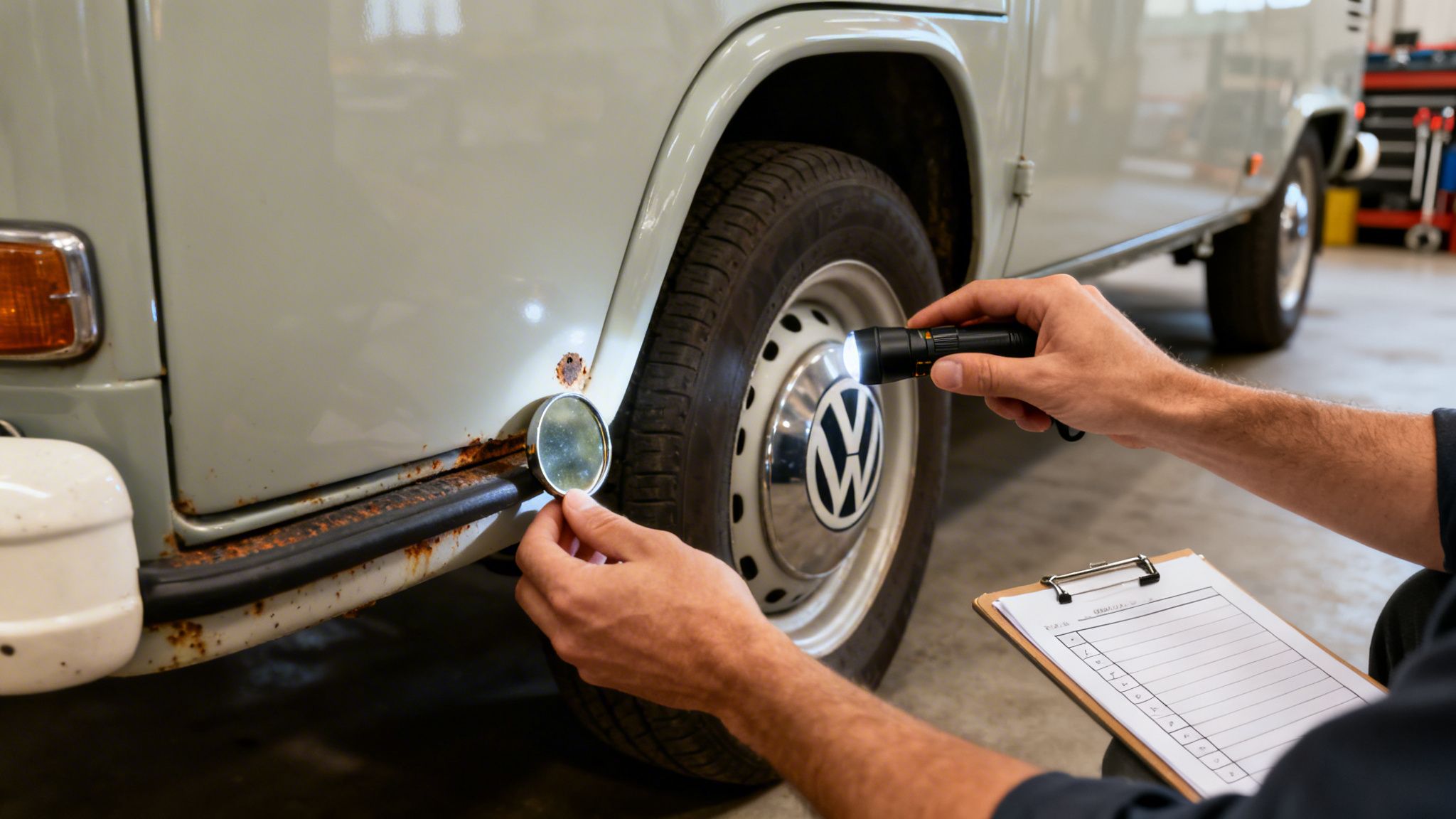
A mechanic meticulously inspects a vintage VW campervan for rust using a flashlight and mirror.

Bodywork and the Hunt for Rust

Rust is the arch-nemesis of any classic vehicle, especially one that’s spent its life cruising the Aussie coast. A fresh lick of paint can hide a world of hurt, so it’s time to play detective. Be sure to bring a small magnet and a torch.

  • Gutters: Carefully run your fingers along the roof gutters. This is a classic spot for water to pool and for rust to take hold.
  • Wheel Arches: Check the inner and outer lips of all the wheel arches. You’re feeling for any bubbling or roughness under the paint.
  • Sills: The long panels right below the doors are prime real estate for rust. Use your magnet here—if it doesn't stick firmly, it’s probably because it’s sitting on a thick layer of body filler, not steel.
  • Window Seals: Gently press around the windscreen and rear window seals. Any soft spots or visible rust can signal a tricky and expensive repair job.

Pro Tip: Don't be shy about getting on your hands and knees. Slide underneath and point your torch at the chassis rails and floor pans. A bit of surface rust is often part of the territory, but any actual holes or flaky, crumbling metal are massive red flags.

Engine and Gearbox Check

You don't need to be a qualified mechanic, but you do need to trust your senses. A healthy VW engine has a personality and a sound all its own.

Before you even turn the key, have a good look in the engine bay for any obvious oil leaks. A bit of road grime on an old motor is completely normal, but fresh, dark drips on the ground beneath it point to active leaks that will need fixing.

When you start the engine from cold, just listen.

  • Does it fire up easily, or does it cough and splutter into life?
  • Listen for any loud, rhythmic knocking or rattling sounds coming from the engine.
  • Let it idle for a few minutes and watch the exhaust. A little puff of smoke on start-up is usually fine, but a continuous stream of blue smoke (burning oil) or white smoke (coolant) points to much bigger problems.

On the test drive, get a feel for the gearbox. Shifting gears should be relatively smooth, without any loud grinding or the shifter popping out of gear on its own.

Interior and Electrics

Now for the fun bit—flicking all the switches and seeing how the living space actually works. Systematically go through and test every single thing you can find.

  1. Lights: Check the headlights (both high and low beam), indicators, brake lights, and all the interior lights.
  2. Wipers and Horn: They seem simple, but they’re non-negotiable for a roadworthy certificate.
  3. Gauges: Watch the fuel gauge and speedometer on your test drive to make sure they’re giving a sensible reading.
  4. Camping Gear: If it has a pop-top, get the owner to show you how it works. Test the fridge, flick on the water pump, and plug something into the 12V outlets.

This is also your chance to judge the quality of the camper fit-out. Open and shut every cupboard door. Lie down on the bed. Does it all feel solid and well-made, or a bit flimsy and tacked together? The condition of the interior speaks volumes about how the van has been loved over the years.

Paperwork and History

Never, ever underestimate the power of a well-kept folder of receipts. Ask the owner if you can see the vehicle's service history. A big stack of invoices showing regular maintenance is a fantastic sign of a cherished van.

  • Check that the Vehicle Identification Number (VIN) stamped on the van matches the number on the registration papers.
  • Do the same for the engine number; make sure it matches what’s listed on the rego.
  • Ask about the current registration status and when it was last issued with a Roadworthy Certificate (RWC).

A seller who has kept meticulous records is almost always someone who has taken great care of their vehicle. Following this checklist will give you the confidence to make a smart decision and get you one step closer to that dream Aussie road trip.

Project Van or Ready-to-Roll Camper?

It’s the first big question every would-be VW owner asks themselves when looking at VW campervans for sale: Do I find a pristine, ready-to-go camper, or do I take on a promising project? Both paths lead to adventure, but they offer completely different journeys to get there. The right choice depends entirely on your personality, your skills, and what you truly want out of the experience.

This crossroads is a familiar one in our world. It's like choosing between a perfect, out-of-the-box Volkswagen diecast model and the rewarding task of restoring a vintage find. Both are born from the same passion, just expressed in different ways.
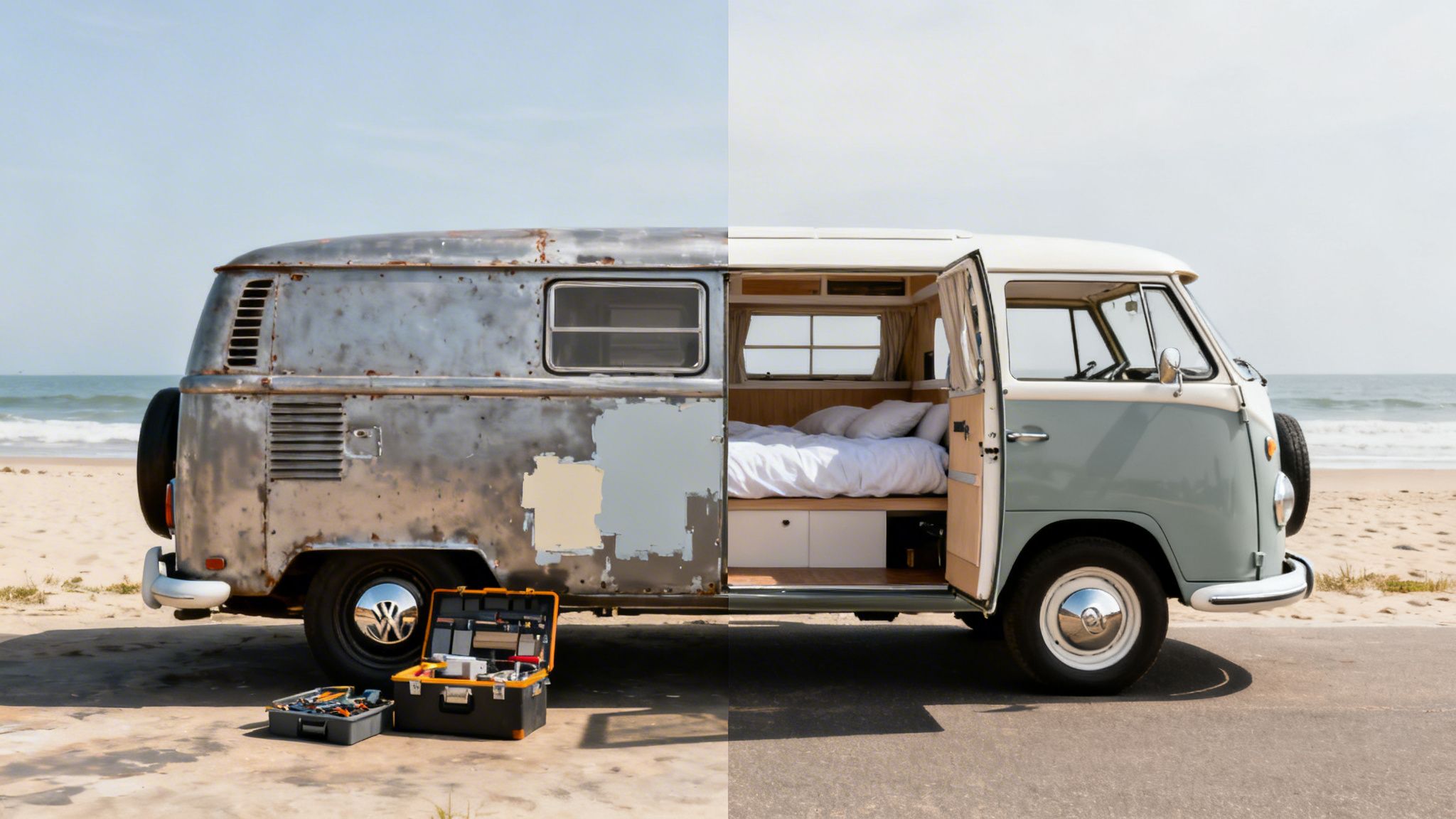
Before and after renovation of a rusty Volkswagen campervan on a beach, with tools and a cozy interior.

The Appeal of the Ready-to-Roll Camper

A turn-key van is all about one thing: instant freedom. You can literally pick up the keys on a Friday morning and be watching the sunset from a new postcode by Saturday. This is the way to go if your time is precious and your main goal is to start exploring right away.

Here’s what you get with a ready-to-roll van:

  • Immediate Use: Forget about long waits at the mechanic or weekends spent covered in grease. Your adventures start the moment you drive away.
  • Predictable Costs: The upfront cost is higher, no doubt. But you have a much clearer idea of your total investment, without the worry of surprise repair bills lurking down the road.
  • Proven Setup: The interior is already built, tested, and ready for life on the road. You’re buying a layout that works, avoiding the trial and error of a custom build.

The Romance of the Project Van

And then there's the project van. It might be a bit rusty and unloved, but it’s brimming with potential. This is the path for the dreamers, the tinkerers, and anyone who wants a van that is 100% theirs, inside and out.

The pull of a project is hard to resist:

  • Lower Initial Cost: A van needing work will always be cheaper to buy upfront. This makes ownership much more accessible if you’re working with a smaller initial budget.
  • Total Customisation: Every single choice is yours. From the paint colour to the kitchen layout and the fabric on the cushions, you can build the exact camper you've always pictured.
  • Deeper Connection: The blood, sweat, and maybe a few tears you pour into a restoration forges a bond like no other. It stops being just a van; it becomes your van.

Choosing a project van is a commitment not just to a vehicle, but to a journey of learning and creation. The skills you'll pick up and the stories you'll tell will last a lifetime, long after the last coat of paint has dried.

Ultimately, the best choice comes down to your budget, your timeline, and how hands-on you want to be. If you're leaning towards a full restoration, checking out a bare-bones van for conversion can give you a great starting point for inspiration. Whether you buy it done or build it yourself, the destination is the same: unforgettable adventures on the open road.

You've Bought It! Now, Let's Hit the Road

Right, you’ve done it. You’ve poked and prodded, done the deal, and now you’re standing in front of your very own VW camper. The feeling is electric, isn't it? But before you chuck the surfboard in and set the GPS for the coast, there are a few final bits of paperwork to sort out to make it officially yours.

Getting the admin right from the get-go is the key to a stress-free first journey. Trust me, it’s worth the small effort now to ensure your first drive is all smiles.

Making It Official, Aussie-Style

The last hurdle in buying any vehicle down under is the ownership transfer. The exact process changes a bit from state to state, so your first port of call should always be your local transport authority’s website for the latest rules.

Generally speaking, here’s what you’ll be dealing with:

  • Registration (Rego) Transfer: The seller will give you the signed transfer forms. It’s then on you to get them lodged, pay the transfer fee, and cover the stamp duty.
  • Roadworthy Certificate (RWC): In most states, it’s the seller’s job to supply a current RWC (or a Safety Certificate) to prove the van is safe. Unless you're tackling a ground-up restoration project, you really don't want to buy a van without one.
  • Proof of Purchase: Make sure you get a proper receipt. It doesn't have to be fancy, but it absolutely must have the date, the final price, the van's details (VIN and rego number), plus the names and signatures of both you and the seller.

Once those forms are in and the keys are in your hand, that’s it—welcome to the club! It’s a moment worth savouring. You're not just a vehicle owner; you're the custodian of a legend.

Your First Weekend of Freedom

With the serious stuff out of the way, the real fun begins. That first trip, no matter how small, is something you’ll never forget.

Here’s how to make it a great one:

  1. Plan a "Shakedown" Trip: Don't go halfway across the country just yet. Pick a local caravan park or a favourite nearby spot for a night or two. This is your chance to test everything—the pop-top, the fridge, how the bed sets up—without the pressure of being miles from home. It's all about learning your new rig.
  2. Join the Community: Hop onto social media and find your local VW club. Honestly, this is the single best resource for brilliant advice, finding parts, and hearing about upcoming shows and coffee runs with people who just get it.
  3. Make It Your Own: Now’s the time to add those personal touches. A cool, retro metal decor sign for the interior? Or maybe a little Volkswagen Beetle model on the dash for good luck? It’s these little things that start turning your van into a proper travel companion for the adventures ahead.

FAQ: Your Top VW Camper Questions Answered

Got questions? You're not alone. Buying a VW camper is a big step, and it's natural to have a few things you're wondering about. Here are some of the most common questions we get from people looking at VW campervans for sale in Australia.

How Much Does It Cost to Insure a Classic VW Campervan in Australia?

Insurance costs can vary quite a bit, mate. It really comes down to the model, its agreed value, your driving record, and even your postcode. For the classics (anything made before 1990), you'll almost always find the best rates with a specialist classic car insurer.

As a ballpark figure, you could be looking at annual premiums anywhere from $500 to $1,500. The best thing you can do is get a few quotes before you even think about buying a van. That way, you can build the real cost into your budget without any nasty surprises.

Can I Use a VW Campervan As My Daily Driver?

You absolutely can, but just know it's a lifestyle choice! A modern T5 or T6 drives much like a car and can handle the daily school run or commute without a fuss.

An older air-cooled van like a Splitty or a Bay Window is a whole different beast. It's a more… authentic experience. We’re talking no power steering, a slower pace, and a genuine feel for the road. Plenty of die-hards drive them every day, but we seriously recommend test-driving one in your usual traffic to see if that vintage charm works for your daily grind.

What Are the Most Common Mechanical Issues to Look Out For?

With the classic air-cooled vans (T1, T2, and early T3s), you'll often be dealing with little oil leaks and keeping the carburettor tuned. But the real enemy, hands down, is rust. Always, always check the wheel arches, sills, and that spot right under the windscreen seal—they're notorious trouble spots.

For the later water-cooled T4s and T5s, you need to see solid proof that the timing belt and water pump have been serviced on schedule. That's a critical job you simply can't afford to have fail on you.

Is It Better to Buy a Pop-Top or a Tin-Top Camper?

This one is all about how you see yourself using the van. A pop-top roof is fantastic for that extra headroom to stand up and cook. Plus, it usually adds an extra bed up top, which is a massive win for families. The trade-off? You've got canvas and lifting gear that need looking after.

A "tin-top"—a van with a standard solid roof—is simpler, more discreet, and has fewer places to spring a leak. They can feel a bit more compact inside, but they're a great, no-fuss option. Just think about how often you'll really need to stand up straight inside the van before you make the call.

Your campervan is your personal space for adventure, and getting the layout right is key. Whether you're a pop-top enthusiast or a tin-top purist, the goal is the same: creating a comfortable basecamp for making memories on the road.

Choosing between them is a classic debate in the VW community, and honestly, there's no right answer—only what’s right for you.


At vwmemorabilia.com.au, we're here for every part of your VW journey. We live and breathe this stuff. While you're on the hunt for the real deal, why not get inspired by browsing our massive collection of perfectly detailed VW Kombi diecast Australia models? As Australia's go-to importer, we've got a fantastic range in stock and ready for fast local shipping. They’re a brilliant way to keep the dream alive on your desk or shelf, and a perfect gift for the VW lover in your life. Happy hunting
Your Guide to the Volkswagen Transporter Camper

G'day, mate! Picture this: the open road, the sun glinting off your dashboard as you cruise Australia’s stunning coastline or venture deep into the rugged outback. For decades, one vehicle has been the ultimate symbol of this freedom—the Volkswagen Transporter camper. This guide is for all of us who get a little buzz seeing one on the road, a deep dive into what makes the Transporter a true Aussie icon, a classic piece of rolling history that’s both your home and your adventure vehicle.

The Enduring Legend of the Volkswagen Transporter Camper

There's a unique magic to the Volkswagen Transporter camper, isn't there? It’s more than just a van; it's a promise of adventure, a canvas for your personality, and a connection to a community that spans generations. Here in Australia, it’s a core part of our culture, right up there with beach days and backyard barbies.

Think of this guide as your starting point, like chatting with a mate at Volksfest. We're here to explore its incredible journey from a humble workhorse to the ultimate symbol of freedom for today’s van life enthusiast.

From Humble Beginnings to Aussie Icon

The story began with a beautifully simple concept in the late 1940s. The original Type 2, which we all affectionately call the 'Splittie' for its split windscreen, was first designed as a practical and reliable work van. It wasn't long, however, before clever folks realised its true potential. With a bit of creative thinking, this box on wheels could be turned into a mobile home.

Today, that spirit of ingenuity is still alive and kicking, even as the technology has leapt ahead. The Transporter is still the go-to for those who hear the call of the open road. It's a vehicle that connects generations, from the surf trips of the 1960s to modern off-grid adventures powered by solar.

The Transporter's special appeal comes from its unique blend of practicality and personality. You can use it for daily tasks during the week and escape to a remote national park on the weekend. This versatility is what has cemented its status as an enduring legend.

More Than a Vehicle, A Way of Life

Owning a Volkswagen Transporter camper gives you a backstage pass to a passionate and welcoming community. It means swapping stories at a VW car show, sharing a knowing nod with another Transporter owner on the highway, and trading tips on the best hidden campsites.

This guide will cover everything you need to know about the Transporter experience.

  • The Model History: A nostalgic journey through the generations, from the iconic T1 to the modern T6.
  • Buying and Building: An exploration of your options, from purchasing a pre-built camper to starting a DIY conversion.
  • Essential Features: A breakdown of typical layouts and must-have components for life on the road.
  • Styling Your Ride: Inspiration and ideas for personalising your camper, including celebrating its heritage with classic VW memorabilia collectibles.

A Trip Through Time: The Generations of the Transporter

Every great family has a story, and the Volkswagen Transporter family tree is an absolute ripper. It’s a tale filled with classic designs, clever engineering, and a whole lot of Aussie spirit. So, let's wind back the clock for a nostalgic road trip through the generations of this incredible Volkswagen Transporter camper.

Each model brought something new to the party, building on the legacy of its predecessor while carving out its own place in our hearts and on our roads. From the original icon to the modern workhorse, this is the story of how a humble van became a legend.

The T1 ‘Splittie’ (1950–1967): The Original Icon

This is the one that started it all. Affectionately known as the 'Splittie' for its split front windscreen, the T1 is the unmistakable face of the 1960s counter-culture. With its charming, almost-smiling V-shaped front and that classic air-cooled engine chugging away in the back, it was the ultimate symbol of freedom and adventure.

Its bare-bones interior was a blank canvas, just waiting for owners to create their own rolling homes. For many Aussies, the Splittie wasn't just a vehicle; it was a ticket to explore our stunning coastlines, a key part of the booming surf scene, and a truly beloved member of the family. Its simple mechanics meant you could often fix it on the side of the road with a basic toolkit and a bit of know-how.

The T2 ‘Bay Window’ (1967–1979): A Roomier Ride

As the swinging sixties gave way to the seventies, the Transporter evolved. The T2, or 'Bay Window', swapped the split screen for a large, single curved windscreen, which gave you a much better view of the road ahead. It was a bit bigger, a touch more powerful, and a whole lot more comfortable than its older sibling.

The Bay also introduced creature comforts like improved suspension and the option of an automatic gearbox, making it a far more capable tourer for those long Aussie road trips. It quickly became a fixture at campsites and surf breaks from Bells Beach to Byron Bay, cementing the Volkswagen Transporter camper as the go-to ride for a generation of adventurers.

The T3 ‘Vanagon’ (1979–1992): The Boxy But Brilliant Classic

The T3, also known as the Vanagon in some markets, marked a real design shift. It traded the classic curves for a distinctly boxier, more angular shape, which meant heaps more interior space. This was a game-changer for camper conversions, allowing for more ambitious and comfortable layouts than ever before.

Early T3s kept the air-cooled engine, but later models introduced water-cooled engines, offering better performance and reliability for tackling Australia’s vast distances. It was a brilliant bridge between the classic era and the modern Transporters we know today, still loved for its rugged charm and practicality.

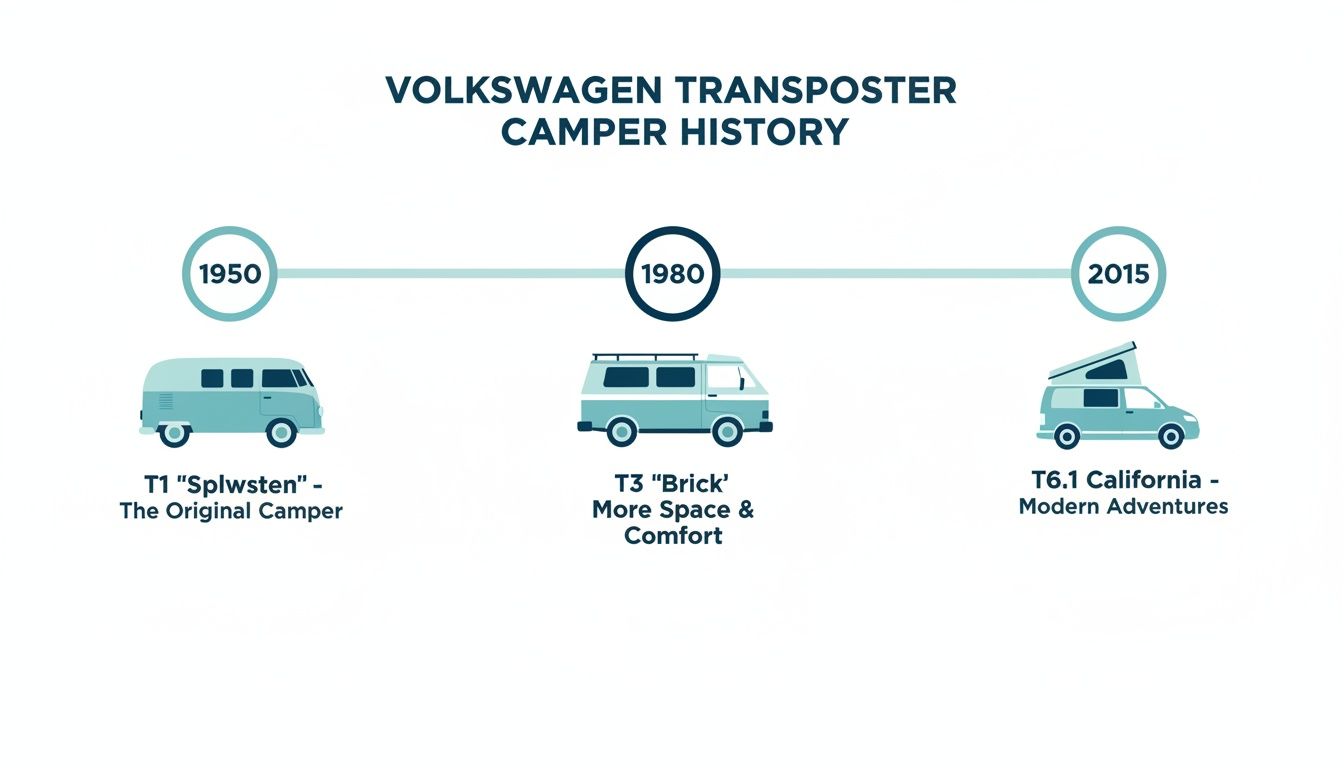
For a quick look at how these vans stack up over the years, check out the table below.

Volkswagen Transporter Generations at a Glance

Generation (Nickname) Production Years Key Feature Aussie Cultural Impact
T1 (Splittie) 1950–1967 Iconic split windscreen The original surf bus and symbol of 60s freedom.
T2 (Bay Window) 1967–1979 Single curved windscreen A more comfortable tourer that dominated coastal campsites.
T3 (Vanagon) 1979–1992 Boxy shape, more space The practical choice that opened up bigger conversion potential.
T4 1990–2003 Front-engine, FWD design Revolutionised interior layouts with its flat floor.
T5 2003–2015 Efficient TDI engines The modern van-lifer's choice for reliability and comfort.
T6 / T6.1 2015–Present Advanced tech & driver aids A refined, car-like experience with classic van DNA.

Each model clearly builds on the last, adding new features while keeping that essential Transporter spirit alive and well.

Timeline graphic showing the evolution of Volkswagen Transporter camper vans from 1950 to 2015.

The T4, T5, and T6: The Modern Era

The T4 (1990–2003) was a massive leap forward. Volkswagen moved the engine to the front and switched to front-wheel drive, a move that created a completely flat floor throughout the van and totally revolutionised campervan design possibilities.

The T5 (2003–2015) refined this winning formula. It introduced powerful and efficient TDI diesel engines, advanced safety features, and a much more car-like driving experience. It quickly became the darling of the modern van life movement in Australia, offering the perfect blend of reliability and comfort for DIY builders and professional converters alike.

The T6 and T6.1 (2015–present) have continued this evolution, packing in the latest technology, driver aids, and even more refinement. They are sophisticated, comfortable, and incredibly capable, yet they still carry that unmistakable Transporter DNA.

The love for these vans has deep roots down under. In 1954, the Volkswagen Transporter debuted in Australia, winning us over with its ruggedness—perfect for our outback roads and coastal adventures. While its UK launch that same year saw only 786 units sold, our passion for practical, versatile vehicles meant our love affair with the Kombi was a story of steady growth. Thousands were exported here by the early 1960s to meet the demand from our farmers, surfers, and budding campervan converters. You can dive deeper into the early days and read more about the VW camper van's history on justkampers.com.

Each generation tells a part of a larger story—one of freedom, travel, and community. Whether you're drawn to the vintage appeal of a Splittie or the modern comforts of a T6, you’re part of a legacy that has been roaming Australia’s highways and backroads for over 70 years.

Finding or Building Your Dream Transporter Camper

So, you've decided a Volkswagen Transporter camper is for you. Good on ya! The next big choice is how to get one. You have two main paths: buying a pre-converted camper that's ready to go, or building your own from a base van.

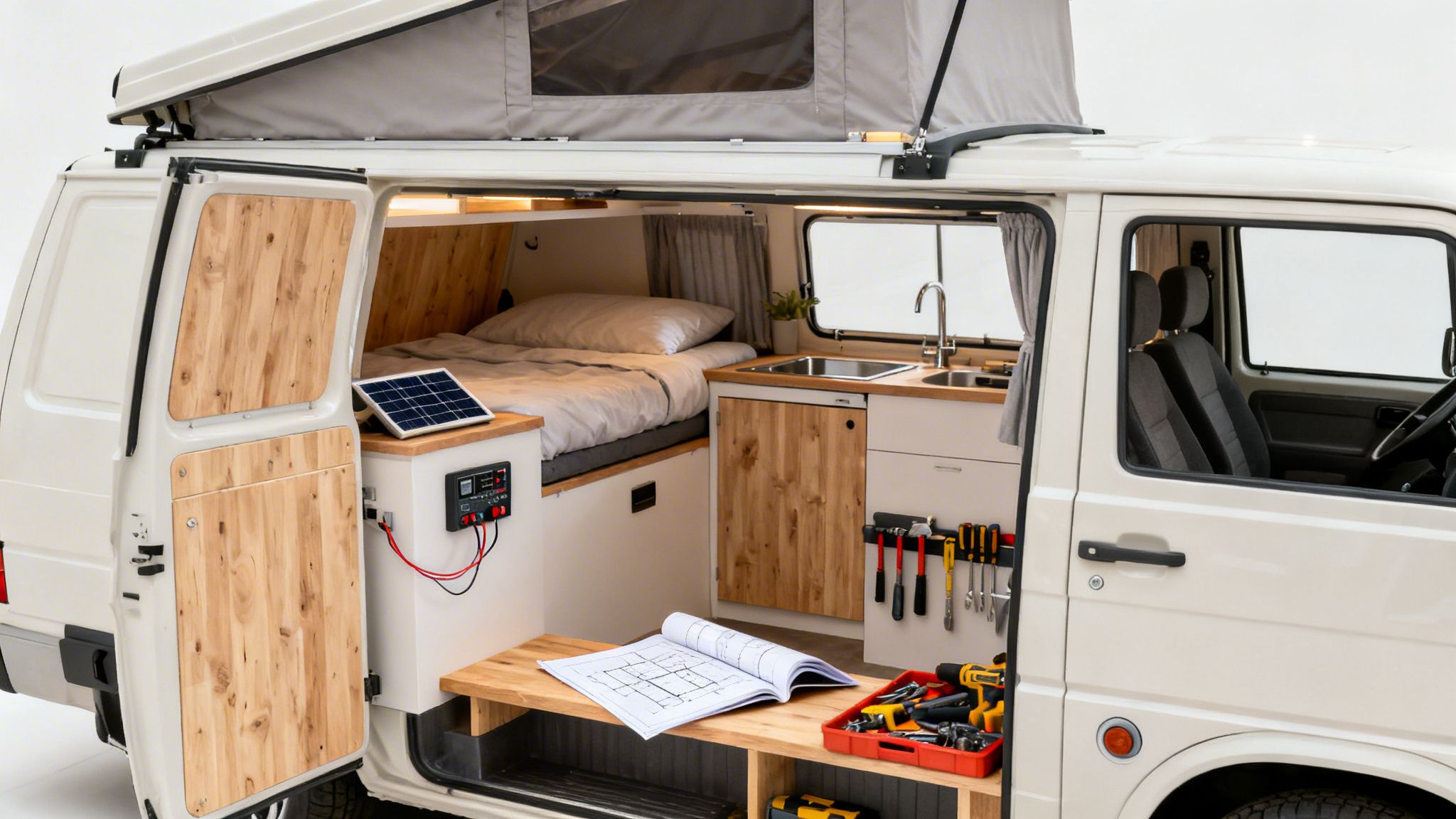
Detailed interior view of a custom-built Volkswagen Transporter camper van with sleeping and cooking areas.

Buying a finished camper is the fast-track option. It’s professionally built and ready for immediate adventures. Building your own is a custom project where you control every detail, creating a van that is uniquely yours.

Both options have their merits, depending on your budget, timeframe, and how hands-on you want to be.

The Turn-Key Option: Buying a Pre-Converted Camper

A professionally converted camper offers the massive benefit of being adventure-ready from day one. Here in Australia, the market includes factory-built models and brilliant custom versions from local specialists.

  • Factory-Built (e.g., VW California): The premium option, built by Volkswagen themselves. The fit and finish are exceptional, with all components designed to work together seamlessly. Expect a higher price tag.
  • Professional Australian Converters (e.g., Trakka): These local companies have decades of experience building campers for Aussie conditions. Their vans are tough, practical, and often feature incredibly smart layouts.

When inspecting a used camper, check the fundamentals. Review the service history, inspect for rust around wheel arches and window seals, and test drive it to check the engine and gearbox. Test every single camper component, including the pop-top roof, fridge, water pump, and all electricals.

The DIY Adventure: Building Your Own

Building a Volkswagen Transporter camper yourself is a seriously rewarding project that gives you total creative control over the final layout. The first step is to choose a good quality base van.

The T5 generation (2003–2015) is a super popular choice for conversions in Australia. It was a bestseller, with over 150,000 units registered locally by 2020. During this time, the VW California model became a huge hit, making up 25% of all campervan sales in 2010. Many T5s were fitted out by Aussie converters like Trakka, adding pop-top roofs, kitchens, and solar systems ideal for touring.

Your choice of base van is a key decision. A high-roof "hi-top" gives you permanent standing height. A standard van with a pop-top is more discreet and can access underground parking.

With your van sourced, the conversion involves several key stages:

  • Insulation and Sound Deadening: Essential for comfort in Australia’s climate and for reducing road noise.
  • Pop-Top Roof: A major upgrade that adds a second bed and valuable headroom.
  • Layout and Cabinetry: This is your chance to design the interior, from a classic side-kitchen layout to a fully custom setup.
  • 12V Electrical System: The heart of your off-grid capability, powering lights, the fridge, and charging points. A solid system is crucial for freedom on the road.

Whether you buy or build, you're joining a great community of VW camper enthusiasts. For more tips on finding a vehicle, check our guide on what to look for when a Volkswagen bus camper is for sale.

Keeping Your Transporter Ready for Adventure

Owning a Volkswagen Transporter camper is a real labour of love. Like any good relationship, it needs a bit of attention to keep it happy. The good news is, a bit of regular care is all it takes to make sure your van is always ready for that next trip up the coast or out into the bush.

Whether you've got a classic air-cooled Kombi or a modern TDI, you need to understand its unique needs. These vans are more than just vehicles; they have their own personalities and quirks.

Classic vs Modern Maintenance

The work needed to keep a classic T1, T2, or T3 running is worlds apart from a modern T5 or T6. Think of them as different generations of the same family—they share a bloodline, but have completely different needs.

An older air-cooled Transporter, for example, is a much simpler machine. You’ll get to know these jobs pretty well:

  • Regular Oil Checks: The old engines are famous for leaving their mark. Checking oil levels often isn't just a suggestion, it's essential.
  • Carburettor Tuning: A well-tuned carby is the secret to a happy engine. It's a rewarding skill to learn how to dial it in just right.
  • Valve Adjustments: This is a routine job that keeps the engine running smoothly and is a key part of classic VW ownership.

The modern TDI Transporters (T4, T5, and T6) are far more complex. They’re incredibly reliable, but they come with service needs that often require specialist tools and diagnostic gear.

A few things to keep on your radar include:

  • EGR Valves: These emissions parts can get clogged with carbon over time. They'll need a clean or a replacement to keep the engine breathing properly.
  • Dual-Mass Flywheels (DMFs): If you've got a manual, the DMF can wear out. You’ll notice it as a rattle or vibration when using the clutch.
  • Timing Belt/Water Pump: This is non-negotiable. Stick to the replacement schedule (usually around 100,000 km) to avoid catastrophic engine failure.

Finding a Mechanic You Trust

While you can do plenty of checks yourself, every Transporter owner needs a good mechanic. The best you can find is a specialist who lives and breathes VWs. They know the quirks of each generation and can spot a problem long before it becomes a major headache.

A good VW mechanic doesn't just fix what’s broken—they help you look after your van for the long haul. They get the history and will work with you to keep it safe and on the road.

Don’t just head to any old workshop. Your best bet is to ask for recommendations from local VW clubs or online forums. That community connection is one of the best investments you can make for your van's health.

Pre-Trip Checks for Peace of Mind

Before any big trip, a quick "pre-flight" check can save you a world of hassle. It only takes five minutes and gives you the confidence that your van is as ready as you are.

  1. Fluids: Check your engine oil, coolant, and windscreen washer fluid.
  2. Tyres: Look at the pressure (don't forget the spare!) and check for wear or damage.
  3. Lights: Do a quick walk-around. Are all your headlights, taillights, and indicators working?
  4. Wipers: Make sure the blades are in good nick and clear the screen without smearing.
  5. Listen: When you first start it up, just listen. Any new or strange noises are worth a quick look before you hit the highway.

This simple routine is a great way to stay in tune with your Volkswagen Transporter camper and make sure the only thing you have to worry about is the beautiful Aussie road ahead.

Styling Your Rolling Home with VW Memorabilia

Alright, you’ve got the van sorted. Now for the fun bit—making it feel like yours. Your Volkswagen Transporter camper isn't just a way to get from A to B; it's your home on wheels, a blank canvas waiting for a splash of personality.

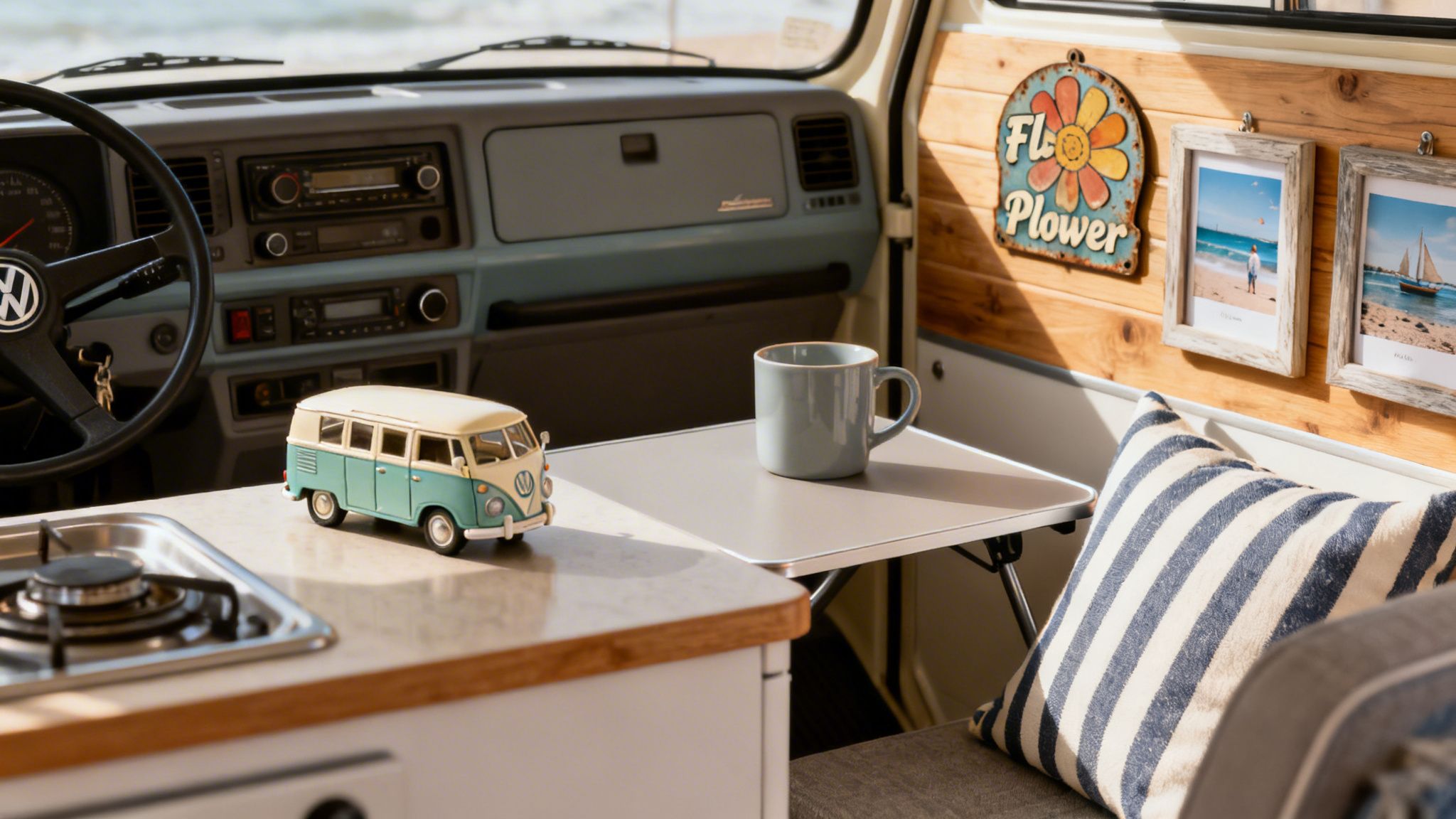
Cozy interior of a Volkswagen camper van, featuring a mini van, mug, and seaside decor.

This is about more than just chucking a few cushions in. It’s about creating a space that captures the spirit of the VW legacy and your own love for the open road. It's that feeling you get when you slide the door open to a view of the beach, and the inside of your van feels just as good as the outside.

Celebrate the Heritage with Diecast Models

A brilliant way to honour the brand's history is with a few well-placed diecast models. These aren't just toys; they’re little metal tributes to decades of iconic design.

Think about a classic 1:24 scale 1962 Kombi diecast model sitting on the dash, its bright colour catching the sunrise. Or maybe a few tiny Beetles arranged on a shelf above the bed. They’re fantastic conversation starters and a cool, constant nod to the history you’re now a part of.

These models are more than just decoration. They’re a tribute to the road-tripping soul of Volkswagen. A miniature Samba Bus on your kitchenette bench is the perfect homage.

They neatly connect your modern T6 to the pioneering spirit of the original Splitties that first forged the tracks for adventurers like us.

Create a Coastal Vibe

For so many of us in Australia, van life and the coast go hand in hand. Bringing that laid-back, beach shack vibe inside your Transporter is a great way to keep that holiday feeling rolling, no matter where you've parked up for the night. The look is light, breezy, and full of character.

Here are a few simple ideas to get you going:

  • Nautical Photo Frames: What better way to display your favourite travel snaps? It’s a great method for keeping those top memories in sight.
  • Quirky Fridge Magnets: That 12V fridge door is prime real estate! Cover it in fun VW or beach-themed magnets to stick up postcards and reminders.
  • Vintage-Style Metal Signs: A retro surf sign or a ‘Flower Power’ plaque screwed to a cabinet door adds an instant hit of nostalgic charm.

You can find all sorts of affordable bits and pieces to build a look that’s all you. For a bit more inspiration, have a look at our collection of vintage home accessories, which are perfect for adding character to a small space.

At the end of the day, styling your Volkswagen Transporter camper is about filling it with things that make you happy. It’s about weaving together the story of your van, your adventures, and your place in the VW community into a space that feels perfectly, and uniquely, you.

Why the Transporter Remains Australia's Favourite Campervan

What makes the Volkswagen Transporter the absolute go-to for Aussie adventurers? It’s not just a van. From coastal highways to the red dirt of the outback, it’s a true cultural icon and a rolling ticket to freedom.

It's the ultimate all-rounder. Use it for the school run and weekly shops, then come Friday afternoon, it’s your escape pod for a weekend away. That do-it-all nature is what makes the Volkswagen Transporter camper such a special part of our motoring history, connecting generations of Aussies with the great outdoors.

An Unbeatable Legacy Down Under

The numbers don't lie. Since the 70s, these vans have defined Aussie camper culture. There are over 300,000 registered across the country, making up a massive 35% of all camper conversions.

Even back in the T3 era during the mid-80s surfing boom, sales were through the roof. Today, pre-loved Transporters still outsell their closest rivals by a huge 2:1 margin. This deep-rooted history is why they’re still the undisputed choice for any adventure. You can read more about the rich history of the VW van on rvshare.com.

This legacy goes beyond sales figures; it’s about a shared spirit. It’s that feeling you get when you see another VW on the road and exchange a friendly wave. To dive deeper into this culture, check out our guide on the essence of van life in Australia.

It’s a connection forged over decades of shared adventures, passed down from one generation to the next. The Transporter isn't just a van; it’s a cherished member of the family.

Your passion for this iconic vehicle deserves to be celebrated. As Australia’s premier destination for officially licensed Volkswagen memorabilia, we invite you to explore our incredible collection. We’re Aussie importers with local stock, so you can find the perfect piece of VW history for your own collection and get it shipped fast. It’s the ideal way to keep that spirit of adventure alive, even when you’re not on the road.

Volkswagen Transporter Camper FAQ

Got a few questions about kicking off your Volkswagen Transporter camper journey? You're not the only one! It's a big, exciting world out there. Here are some quick, clear answers to the most common queries we get from fellow enthusiasts.

What is the Best Transporter Model for a First-Time Camper Owner?

That’s a great question, mate! For first-time owners after a sweet spot between modern reliability, comfort, and a reasonable budget, the T5 generation (2003–2015) is hard to go past.

These vans have tough, efficient TDI engines, a car-like feel on the road, and a massive community for parts and advice. They are modern enough to be dependable for long trips, but they’ve been around long enough that good, pre-loved examples are accessible. Plus, their flat-floor design makes them a fantastic base for a DIY conversion if you go down that track.

How Much Should I Budget for a Decent DIY Camper Conversion?

The cost of a DIY camper conversion can vary wildly, a bit like asking, "how long is a piece of string?" Still, you can definitely make a solid plan. A basic setup with a bed, some storage, and simple electrics might start from $5,000 to $10,000, assuming you already have the van.

A more comprehensive build with insulation, a pop-top roof, a quality 12V system with a fridge, and custom cabinetry can quickly climb to $20,000–$40,000+.

Our best tip? Budget for each stage of the build separately (electrics, insulation, cabinetry, plumbing) and always add a 10-15% contingency. Unexpected costs always pop up!

Are Older Air-Cooled VW Campers Reliable for Long Trips Around Australia?

Absolutely, with a bit of a reality check! An air-cooled classic like a Splittie or Bay Window can definitely tackle a lap of Australia—plenty have done it. It’s just a different kind of travel.

  • Pace: You won’t be doing 110 km/h up hills. These trips are all about taking it slow and savouring the journey.
  • Maintenance: You need to be comfortable with basic mechanics or have a good budget for specialist repairs. Regular checks for oil and tuning are part of the deal.
  • Simplicity: Their simple design is a huge plus. Many issues can be fixed on the roadside with a basic toolkit and a little know-how.

With proper preparation and a go-slow attitude, a classic VW camper makes for an unforgettable adventure.

What Are the Key Differences Between a Transporter, a Caravelle, and a Multivan?

This often confuses people! They all share the same base van but are kitted out for different jobs:

  • Transporter: This is the workhorse. It’s the base commercial panel van, perfect for tradies or as a blank canvas for a custom Volkswagen Transporter camper conversion.
  • Caravelle: Think of this as a people-mover or minibus. It's designed to carry up to nine people in comfort, with more windows and interior trim than a Transporter.
  • Multivan: This is the luxury version. It has a premium interior with features like swivelling seats, a fold-out table, and high-end finishes, designed as a versatile family vehicle.

At vwmemorabilia.com.au, we share your passion for the entire Volkswagen family, from the hard-working Transporter to the iconic Beetle. As proud Aussie importers with local stock and fast shipping, we’re the best place to find your next treasure. Find the perfect VW Kombi diecast model in Australia to complement your van or home, and keep the spirit of the road alive.

Your Guide to Finding a Volkswagen Bus Camper for Sale in Australia

So, you've got the bug. The dream of owning a classic Volkswagen bus camper is a powerful one, and if you're here, you're already on the right track. Finding the perfect bus is all about knowing which models suit your style, where to look beyond the usual suspects, and what to check for before you hand over your hard-earned cash.

Chasing the Dream of a VW Camper

That iconic image of a classic VW Bus parked up at a sun-drenched Aussie beach? It’s a feeling we all know. It’s not just a van; it’s a symbol of freedom, of adventure, and of a life less ordinary that still pulls on our heartstrings.

For years, these campers have been a core part of the Australian story. They’ve carried us on surf trips down the coast, taken our families on unforgettable holidays, and become a ticket to escape the daily grind. It's always been about the journey itself, the stories you gather, and the memories you create. This shared love has created one of the best enthusiast communities you could ever hope to join.

A National Passion That's Still Growing

And that love affair is only getting stronger. The dream of hitting the open road has never been bigger in Australia. The number of registered campervans skyrocketed from 55,757 in 2014 to an incredible 97,701 by 2024. That's a 75.2% jump, and it’s put these iconic buses right back in the spotlight.

This boom is part of a huge national movement. The whole recreational vehicle scene was valued at $27.1 billion by 2022, and the classic VW camper holds a special, nostalgic place for anyone who loves our coasts. The growing popularity means it’s a fantastic time to begin your search, with a thriving community and more resources than ever before. The spirit of adventure is well and truly alive.

For so many of us, owning a VW Bus is that ultimate pipe dream. It’s the simple idea of packing a bag, turning the key, and just seeing where the road takes you, flower power curtains and all.

Getting there is an adventure in itself. You'll need to:

  • Get to know the different models and their unique quirks.
  • Figure out where to find well-loved campers from people you can trust.
  • Learn what to look for so you don't end up with a money pit.

Think of this guide as your friendly co-pilot. We're here to help you navigate the whole process with the confidence of someone who's been there and done that. We’ll cover everything you need to find, inspect, and finally buy your own piece of automotive history. To get in the right headspace, check out our piece on the soul of van life in Australia and what makes it so special.

Choosing the Right VW Bus Generation for Your Adventure

So, you've decided to take the plunge. Fantastic. But which Volkswagen bus is the one for you? It's a bit like picking a travel mate for a trip up the coast—each one has its own vibe, its own strengths, and its own set of lovable quirks.

Let’s run through the main players. Think of this as a quick chat at a car show, helping you figure out which classic VW camper best fits your dream. Picking the right one is the very first step, and honestly, it’s one of the most exciting parts of the whole journey.

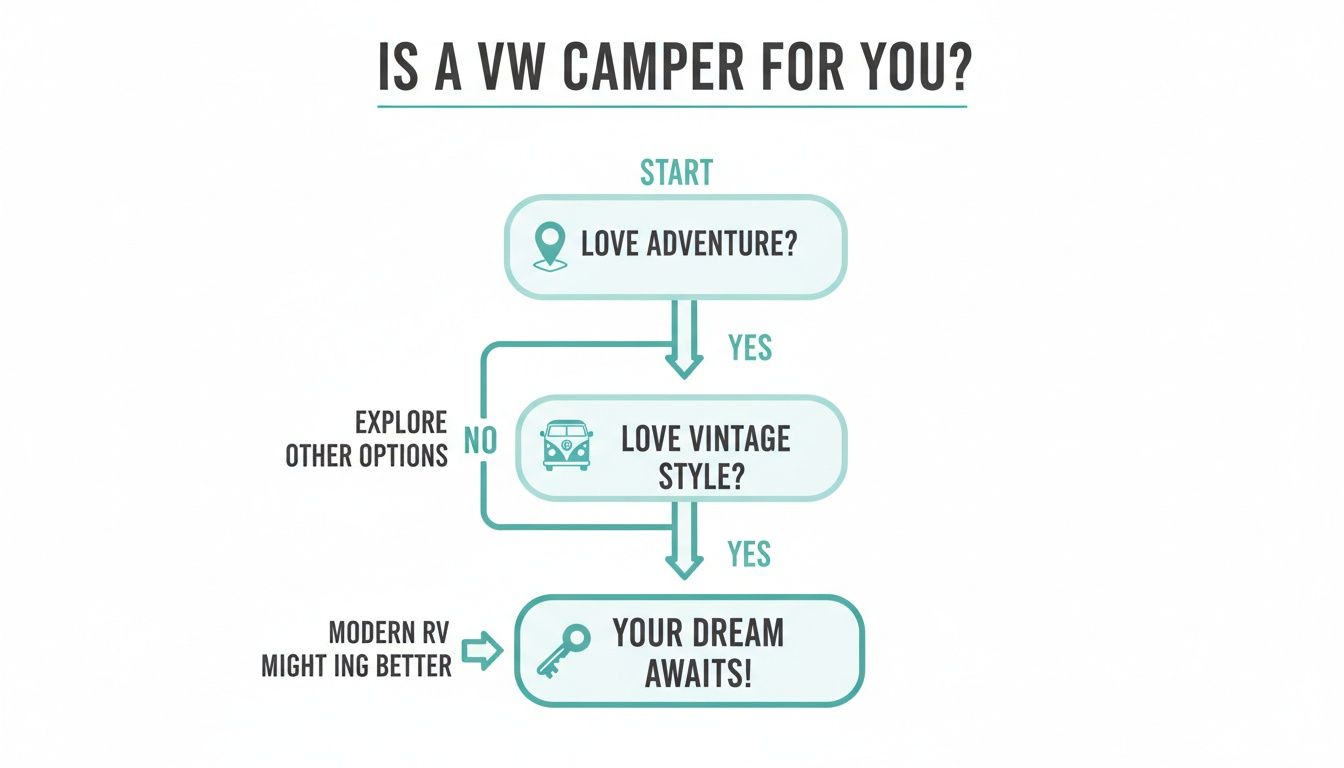
This flowchart gets right to the heart of it. If you’ve got a love for adventure and that timeless vintage style, then a classic camper is already calling your name.

Flowchart helping decide if a vintage VW camper is right for you, based on adventure and style preferences.

As you can see, if that sounds like you, you're in the right place. Now, let’s find your perfect match.

To give you a quick overview, here's a look at the most popular generations side-by-side.

VW Bus Generations At a Glance

Generation Nickname Production Years Key Features Best For
T1 Splittie 1950–1967 Split front windscreen, large VW badge, iconic V-shape front. Collectors, weekend shows, and die-hard enthusiasts.
T2 Bay Window 1967–1979 Single curved windscreen, more interior space, improved engine. Classic road-trips, family adventures, and usable vintage charm.
T3 Vanagon 1979–1992 Boxy '80s design, water-cooled engine options, spacious interior. Long-distance touring, practical camping, and first-time owners.

Each of these has a dedicated following, and for good reason. Now let's get into the details of what makes each one special.

The T1 'Splittie' (1950–1967): The Icon

When you close your eyes and picture a classic VW Bus, this is almost certainly it. The T1 Type 2, or the 'Splittie' as it’s universally known, is defined by its split front windscreen and that massive VW emblem on the nose. It's the original surf bus, the poster child for a whole generation, and a guaranteed head-turner.

Owning a Splittie is a true labour of love. They ooze vintage charm like nothing else and easily command the highest prices, especially the famous 21-window Samba models.

  • Pros: Unbeatable retro style, highest collector value, the absolute heart of VW culture.
  • Cons: The most expensive to buy and restore, slower on the road, and their simple mechanics demand a more hands-on approach.
  • Price Guide: A project bus can start around $25,000, but a fully restored, show-quality Splittie can soar well past $100,000.

A Splittie is for the dedicated purist—someone who wants a prized collector's item for weekend cruises and car shows. It’s less about doing a lap of Australia and more about owning and preserving a beautiful piece of motoring history.

The T2 'Bay Window' (1967–1979): The Reliable Road-Tripper

Next in line is the T2, nicknamed the 'Bay Window' because it swapped the split screen for a large, single, curved windscreen. This is the model that truly brought the campervan dream to the masses. It’s noticeably more practical than a Splittie, with a bit more power, better brakes, and a comfier ride.

The T2 really hits the sweet spot between classic looks and genuine usability. It’s the go-to choice for so many adventurers and families who want to actually get out there and explore.

The Bay Window is the quintessential Aussie road-trip machine. It has enough of that old-school cool to turn heads, but it’s reliable enough to take you from Byron Bay to the Great Ocean Road without too much fuss.

You'll find two main versions. The 'Early Bay' (1967-1971) has its low front indicators and rounded bumpers, while the 'Late Bay' (1972-1979) sits a bit higher and features a more modern engine layout, making it slightly easier to work on.

The T3 'Vanagon' (1979–1992): The Modern Classic

Enter the T3, or Vanagon. This generation marked a shift to a more modern, angular, and boxy design. While it might lack some of the rounded charm of its predecessors, it more than makes up for it in sheer practicality and comfort. These were the first buses to offer options like water-cooled engines, power steering, and even all-wheel drive on the legendary 'Syncro' models.

For many, the T3 is a brilliant and affordable gateway into VW camper ownership. It’s roomier, more comfortable on long drives, and generally easier to live with. Don’t let the '80s styling fool you; these vans are incredibly capable and have a fiercely loyal following.

  • Pros: More affordable, spacious, and comfortable for long-distance travel. Parts are generally easy to find and well-supported.
  • Cons: The boxy aesthetic isn't for every classic purist, and they don't have the same iconic look as a Splittie or Bay.
  • Price Guide: You can find a T3 project for under $10,000, with good, road-ready campers typically sitting in the $20,000 to $40,000 range.

Ultimately, choosing your bus comes down to you. It's about finding the one that speaks to your sense of adventure and fits how you plan to use it. And while you’re planning the big purchase, you can always start small. A beautifully crafted VW Kombi Samba Bus diecast model on your desk is the perfect bit of inspiration to keep the dream alive.

Where to Find Your Dream Volkswagen Bus Camper for Sale

You’ve decided on the generation, and now the search begins. Finding a quality Volkswagen bus camper for sale requires looking in the right places, and the best ones are not always the most obvious.

While standard online classifieds are a starting point, the most sought-after buses are often found within the dedicated VW enthusiast community. Here is where to focus your search efforts.

Online Marketplaces: The Starting Line

The major Australian online classifieds offer the widest initial selection. These platforms provide a national overview of what is available, from restoration projects to immaculate, road-ready campers.

  • Carsales: As Australia’s largest vehicle marketplace, it’s a reliable place to gauge the market. We recommend setting up alerts for specific models like "VW Kombi" or "T3 camper" to receive notifications for new listings.
  • Gumtree: A great source for private sales where you can uncover genuine bargains. Gumtree is also a good spot to find project buses and unique owner-built conversions not always listed on mainstream sites.
  • Facebook Marketplace: Now a major centre for classic car sales. The volume is significant, so you will need to be methodical in your search to filter through the listings.

When using these sites, prioritise listings with extensive photos and clear, detailed descriptions. Vague advertisements are a potential warning sign. A passionate owner will be proud of their bus and will provide a thorough history of the work completed.

Community Hubs: Where the Best Buses Hide

Here is an insider tip: the best-maintained campers frequently change hands privately within the VW community, never reaching the open market. This is where you find buses with well-documented histories from owners who truly understand them.

Tapping into the VW club scene is like getting a backstage pass. You'll hear about campers for sale before anyone else, get honest advice from seasoned owners, and connect with people who share your passion.

Consider these community-focused avenues:

  • Dedicated VW Forums: Websites like The DUB GUM and Aussie Vee Dubbers are invaluable resources. Their "For Sale" sections are monitored by the community, which holds sellers to a high standard of transparency.
  • Owner Clubs and Social Media Groups: Search Facebook for groups such as "Kombi Club Australia" or "VW T3 Australia". Owners often post their buses for sale to fellow members first before advertising elsewhere.
  • VW Shows and 'Show & Shine' Events: Nothing replaces an in-person inspection. Events like Volksfest, the VW Nationals, or local club meetings are ideal for networking. Owners often place a "For Sale" sign in the window, allowing you to discuss the vehicle directly and inspect it on the spot.

Engaging with the community is about more than just a transaction; it's an entry into a network of knowledgeable enthusiasts. If you are thinking about a custom build, our guide on selecting a van for conversion offers additional expert advice.

Your Essential Pre-Purchase Inspection Checklist

Alright, this is where the rubber really meets the road. It’s incredibly easy to get swept up in the romance of a classic Kombi, but a smart buy is one you make with your head, not just your heart. Think of this as a checklist from a mate who's been there, helping you figure out if that Volkswagen bus camper for sale is your dream ride or a money pit in disguise.

Working through a bus systematically gives you the power to either confidently walk away from a dud or put in a fair offer on a gem. We’ll go over the non-negotiable checks to help you sidestep those nasty, expensive surprises down the track.

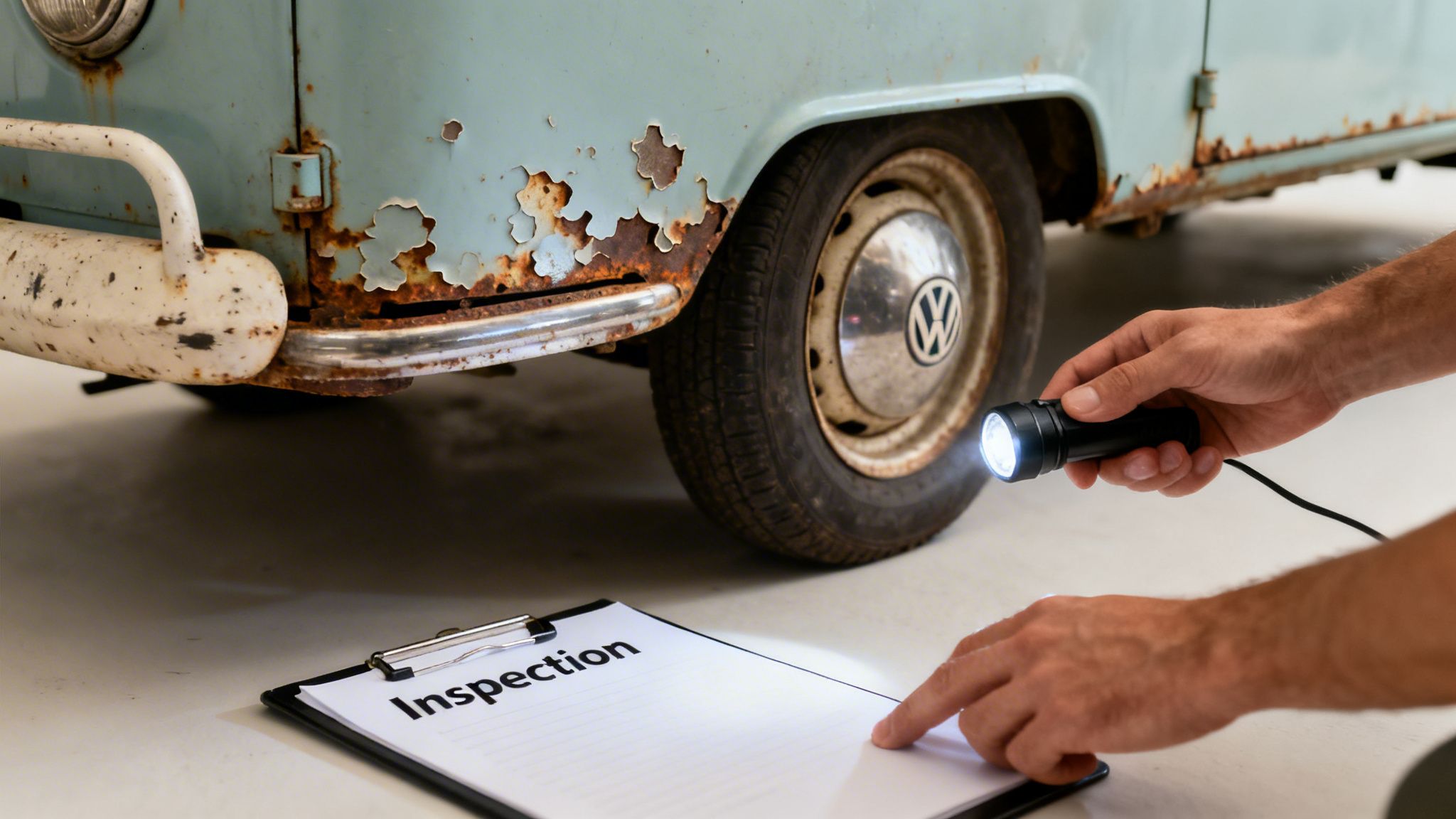
Person inspecting a rusty vintage Volkswagen bus with a flashlight and a clipboard.

Step 1: Hunt for Rust, the Silent Killer

Before you even pop the engine lid, you need to become a rust detective. Hands down, rust is the number one enemy of these old VWs and the most expensive problem you can face. A quick, cheap paint job can hide a world of hurt, so it’s on you to look deeper.

Be sure to bring a small torch and a magnet. Slide the magnet over all the usual trouble spots; if it suddenly loses its grip, you’ve likely found a thick patch of body filler covering up some dodgy repair work.

Here’s where you need to focus your attention:

  • Under the Mats: Don't be shy. Pull up every single floor mat, both in the driver's cab and throughout the living space. You’re looking for any sign of corrosion, dampness, or questionable repairs on the floor pans.
  • Wheel Arches & Sills: These areas get pelted with road grime and water. Get right down on the ground and have a good, long look at them from every angle.
  • Gutters: Those rain gutters running along the roofline are notorious for trapping moisture and rusting out from the inside. Keep an eye out for bubbling paint or any tell-tale brown streaks.
  • Window and Door Seals: Carefully peel back the rubber seals around the windows and doors to inspect the metal underneath. Water loves to pool here and start its dirty work.
  • Battery Tray: Over the years, a leaky battery can easily chew through the metal tray and the floor beneath it. Give this area a very thorough inspection.

Don’t get distracted by a fresh coat of shiny paint. Look closely for tiny bubbles or a ‘crinkly’ texture, particularly along the bottom 15 centimetres of the van. That’s a classic sign of rust brewing just below the surface.

Step 2: Get a Feel for the Engine and Mechanicals

Now it’s time to check the heart of the machine. You don’t need to be a qualified mechanic, but knowing the basic things to look and listen for is crucial. The air-cooled engines in these buses have their own unique character and sound.

If you can, try to start the bus from cold. A healthy engine should kick over without too much fuss. Let it idle and listen carefully for any loud knocking or rattling. A bit of tappet noise is pretty standard for these motors, but anything more dramatic is a serious red flag.

With the engine running, have a look for:

  • Oil Leaks: A few drips are part of the charm with these old girls, but if you see significant pools forming on the ground, it points to worn seals that will definitely need sorting.
  • Exhaust Smoke: Take a look at what’s coming out of the exhaust. A little puff of black smoke when it first fires up is generally fine, but constant blue smoke is bad news—it means the engine is burning oil, a sign of expensive internal wear.
  • Gearbox: On your test drive, pay close attention to the gear changes. It should shift smoothly without any awful crunching sounds. If it’s hard to find a gear, you could be looking at anything from worn linkages to a major gearbox problem.

Step 3: Check the Electrics and Camper Interior

Hop inside and start flicking every switch you can find. The electrical systems are fairly basic, but you’ll want to make sure the essentials are working. Check the headlights, indicators, windscreen wipers, and of course, the horn.

Next, turn your focus to the camper-specific gear. The condition of the interior tells you a huge amount about how the bus has been treated over its life.

  • Pop-Top Roof: If it has one, make sure you operate it. Does it go up and down without a fight? Check the canvas for any mould, mildew, or rips. A new pop-top canvas can be a surprisingly pricey job.
  • Cabinetry and Upholstery: Open every cupboard and drawer. See how the original fit-out has held up. Is the upholstery badly torn or stained? While it might seem cosmetic, a full re-trim can really blow the budget.
  • Appliances: If the bus is kitted out with a fridge, sink, or stove, ask the owner if they’re in working order. If possible, test them yourself.

And finally, always, always ask to see the paperwork. Double-check that the Vehicle Identification Number (VIN) on the registration papers matches the number stamped on the van’s chassis. This simple check confirms you’re looking at the right vehicle and can save you from a world of bureaucratic pain. Taking your time here will ensure your VW adventure gets off to a dream start, not a nightmarish one.

Budgeting for a Bus: The Real Costs of Ownership

Alright, you’ve found the one. It’s got the right look, the right feel, and you can already picture yourself cruising down the coast. Before you get swept away, let's have a real yarn about what happens after you’ve paid for it. The price tag on a Volkswagen bus camper for sale is just the start of your journey, not the whole road trip.

Getting your head around the full financial picture is the best way to make sure your dream of hitting the open road stays a dream, and doesn't turn into a financial headache. Let's pull back the curtain on the real costs of owning one of these classic beauties here in Australia, so you can plan properly.

The Upfront Costs Beyond the Purchase Price

That moment you shake hands on a price is a massive buzz, but that number isn't the final one to leave your bank account. A few other immediate costs will pop up straight away.

  • Stamp Duty: This is the government's slice of the pie, a tax on the vehicle's sale price. How much you pay depends on your state and the bus's value, but there’s no getting around it.
  • Registration: You can't legally drive your new home on wheels without it being registered. This is an annual fee that gets you your plates and keeps you on the right side of the law.
  • Specialised Insurance: Forget a standard car policy; it simply won't do. You need specialised classic vehicle insurance. These policies usually work on an "agreed value," where you and the insurer decide on the bus's true worth. It’s peace of mind, ensuring you're properly covered if something goes wrong.

These initial bits and pieces can easily add a few thousand dollars to your purchase, so make sure you’ve got that cash ready to go.

Ongoing Running and Maintenance Costs

Once the bus is officially yours, a new set of costs roll in—the ones that keep it humming along happily. These aren't one-offs, but the regular rhythm of keeping a vintage machine on the road.

First up, fuel. Let's be blunt: these old air-cooled engines were never built for today’s fuel economy. They’re thirsty beasts, no doubt about it. But the smiles-per-gallon are completely off the charts.

Then there’s the upkeep. A classic VW needs a bit more regular TLC than your modern daily driver. You'll want to budget for:

  • Regular Servicing: Get ready for more frequent oil changes and check-ups. It pays to find a mechanic who really knows their way around air-cooled VWs.
  • The "Just in Case" Fund: Old cars have character, and sometimes that character includes a few unexpected hiccups. Tucking away a couple of thousand dollars in a repair fund is one of the smartest things you can do.

Think of it like this: you’re not just buying a van; you’re becoming the caretaker of a little piece of history. A bit of ongoing love and money is what keeps that history alive and rolling.

The Big One: Restoration Costs

Finally, we need to talk about restoration. A lot of the buses you'll see for sale are rolling projects, and how much you spend here can vary wildly. It all comes down to how much work is needed and how perfect you want the end result to be.

  • Mechanical Refresh ($5,000 – $15,000): This sort of money will get the engine, brakes, and suspension solid and dependable. It’s about making it a reliable driver, not a show winner.
  • Cosmetic & Mechanical ($20,000 – $40,000): Here you’re covering the mechanical work plus tackling rust, laying down a fresh coat of paint, and giving the interior a proper tidy-up.
  • Full Nut-and-Bolt Restoration ($50,000+): This is the whole shebang. The bus is stripped back to bare metal for a finish that’s often better than when it left the factory. It's a massive undertaking, but the final product is a genuine masterpiece.

Knowing these costs doesn't take any of the magic away. It just makes you a smarter, more prepared owner. It means your VW adventure can kick off with pure excitement, not a surprise bill.

Celebrating the VW Icon Through Collectible Memorabilia

Owning a full-sized Volkswagen bus is the big dream, but it's not always a practical one. That doesn't mean the passion has to sit on the back burner. The spirit of the VW bus is just as much about celebrating its iconic design as it is about hitting the open road.

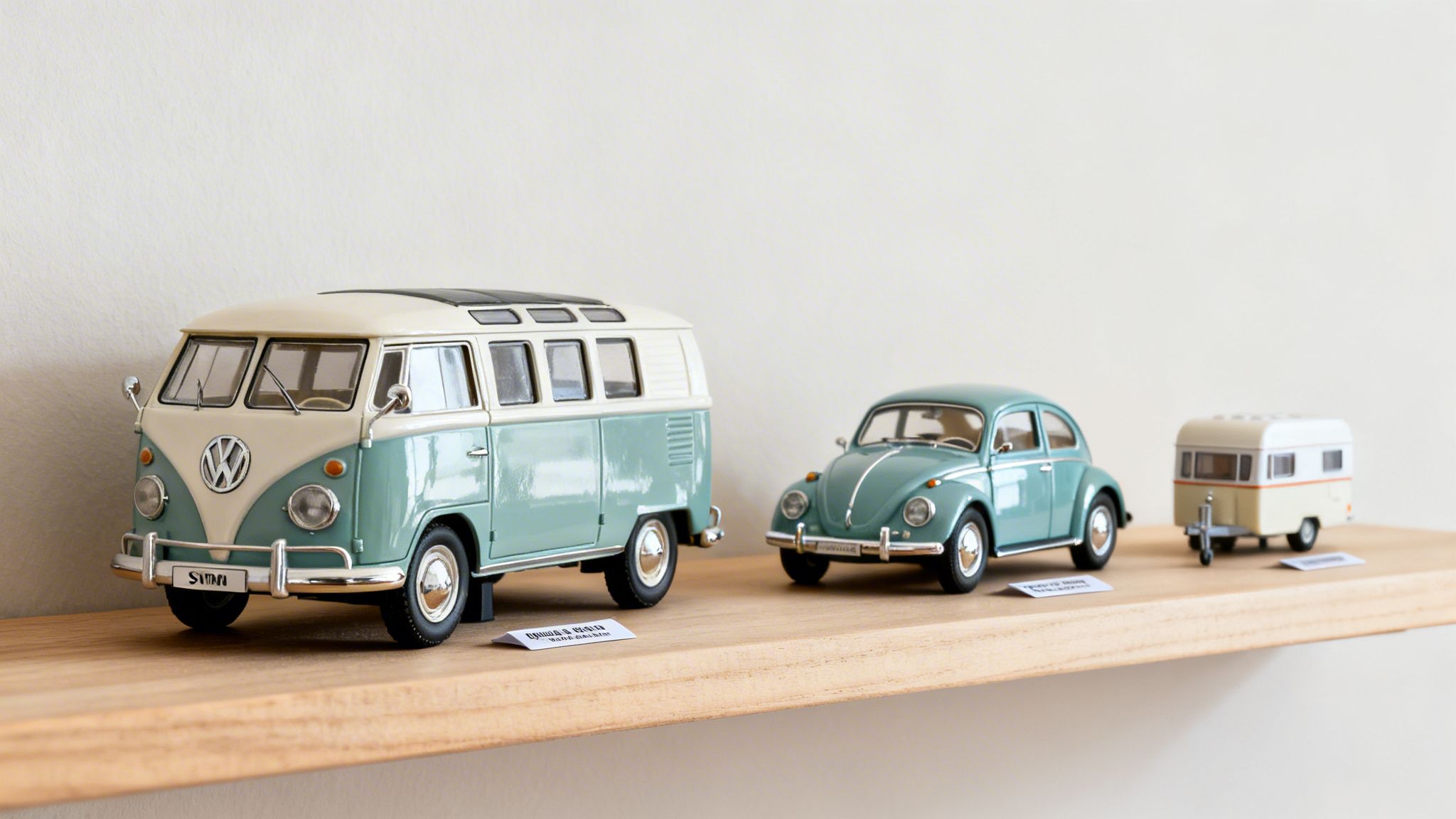
This is where collecting comes in. For many enthusiasts, a perfectly detailed diecast model is the next best thing. It’s a way to appreciate the classic lines and heritage of these vehicles right on your own shelf, keeping the dream alive with a colourful reminder of the VW community.

Miniature models of a teal and cream Volkswagen bus, Beetle car, and camper trailer on a shelf.

Your Home for VW Memorabilia in Australia

We get it because we're enthusiasts, too. Here at vwmemorabilia.com.au, we've sourced a huge range of collectibles for fellow VW fans. As a local Australian importer, we stock officially licensed VW memorabilia collectibles right here, so you get your gear quickly without the long international shipping delays.

Our online shop is a treasure trove for anyone looking to add to their collection or find the perfect gift. We have everything from stunning, highly detailed 1:18 scale models to the more compact 1:24 scale versions that are perfect for starting out. These aren't just toys; they’re miniature pieces of VW history. You'll find everything from the legendary VW Kombi Samba Bus diecast models to classic Beetle replicas that capture the feel of the originals.

Collecting diecast models is about more than just owning tiny cars. It's about building a personal display of automotive art that tells a story. Each model represents a piece of the VW legacy you can hold in your hand.

Tips for Starting Your VW Collection

Building a collection is a great way to stay connected to the VW culture, especially when you're between road trips. If you're looking to get started, here are a few simple tips:

  • Find Your Focus: Decide which models you love most. Are you a fan of the classic Split-Screen Kombi, or do you prefer the timeless Beetle? Focusing on a specific model, colour, or era can give your collection a great, cohesive look.
  • Create a Great Display: Don't hide your models away. A dedicated shelf, a glass cabinet, or even a simple diorama can turn your collection into a fantastic feature for your home or office.
  • The Perfect Gift: If you're searching for a gift for a VW lover, a high-quality diecast model is a personal and thoughtful present that's guaranteed to be a hit.

Diving into the world of Volkswagen diecast models for sale is a brilliant way to keep your passion for these vehicles burning bright. It’s a hobby that brings a lot of joy and celebrates the enduring magic of the VW brand every single day.

A Few Common Questions About Buying a VW Camper

Jumping into the world of classic VWs is an absolute thrill, but it's totally normal to have a few questions buzzing around. We get asked these all the time, so here are some straight-up answers to help you on your journey.

What’s the Go with Insuring a Classic VW Camper in Australia?

The cost of insuring a classic VW camper can be a bit of a "how long is a piece of string" question. It really hinges on the agreed value you and the insurer decide on for your bus, your own driving record, and even where you park it at night. Generally, you can expect to budget anywhere from $400 to over $1,000 a year for a proper classic car policy. It's well worth it, as these policies protect your investment with an agreed value, which is miles better than a standard car policy.

Can I Actually Use a VW Bus as My Daily Car?

Ah, the dream! While it sounds brilliant, using a vintage Kombi for the daily grind isn't the most practical idea. These old beauties lack modern safety features, the air conditioning is a wound-down window, and power steering is, well, you. They thrive on a bit of hands-on care and are far better suited for creating memories on weekend escapes and epic road trips, not so much the stop-start traffic on the way to work.

What's the Difference Between a Kombi and a Samba?

Great question, and one that gets to the heart of VW lore! Think of 'Kombi' as the family name for the entire VW Type 2 lineup. The 'Samba Bus', however, is a very specific, top-of-the-line model that truly gets collectors' hearts racing.

You'll know a Samba when you see one. They're famous for their incredible 21 or 23 windows, including the iconic little skylight windows that line the roof, and a massive canvas sunroof perfect for sunny days. It’s this distinctive look that makes them one of the most sought-after and valuable VWs on the planet.

Are Parts for Old VW Buses Hard to Find in Australia?

You’d be surprised! Thanks to an incredible global community and some brilliant specialist suppliers right here in Australia, getting parts is easier than you might think. Of course, tracking down a super-rare piece of original trim for a 1950s Splittie can be a bit of a treasure hunt. But for most of the crucial mechanical bits for T1 and T2 buses, the parts are out there. This fantastic support network is what keeps these classic campers on the road for us all to enjoy.


Here at VW Memorabilia, we're just as passionate about these amazing vans as you are. Whether you're chasing the real deal or starting a collection of your own, we’re here to help you celebrate the VW spirit. Check out our full range of officially licensed diecast models and memorabilia to bring a bit of that magic home.