


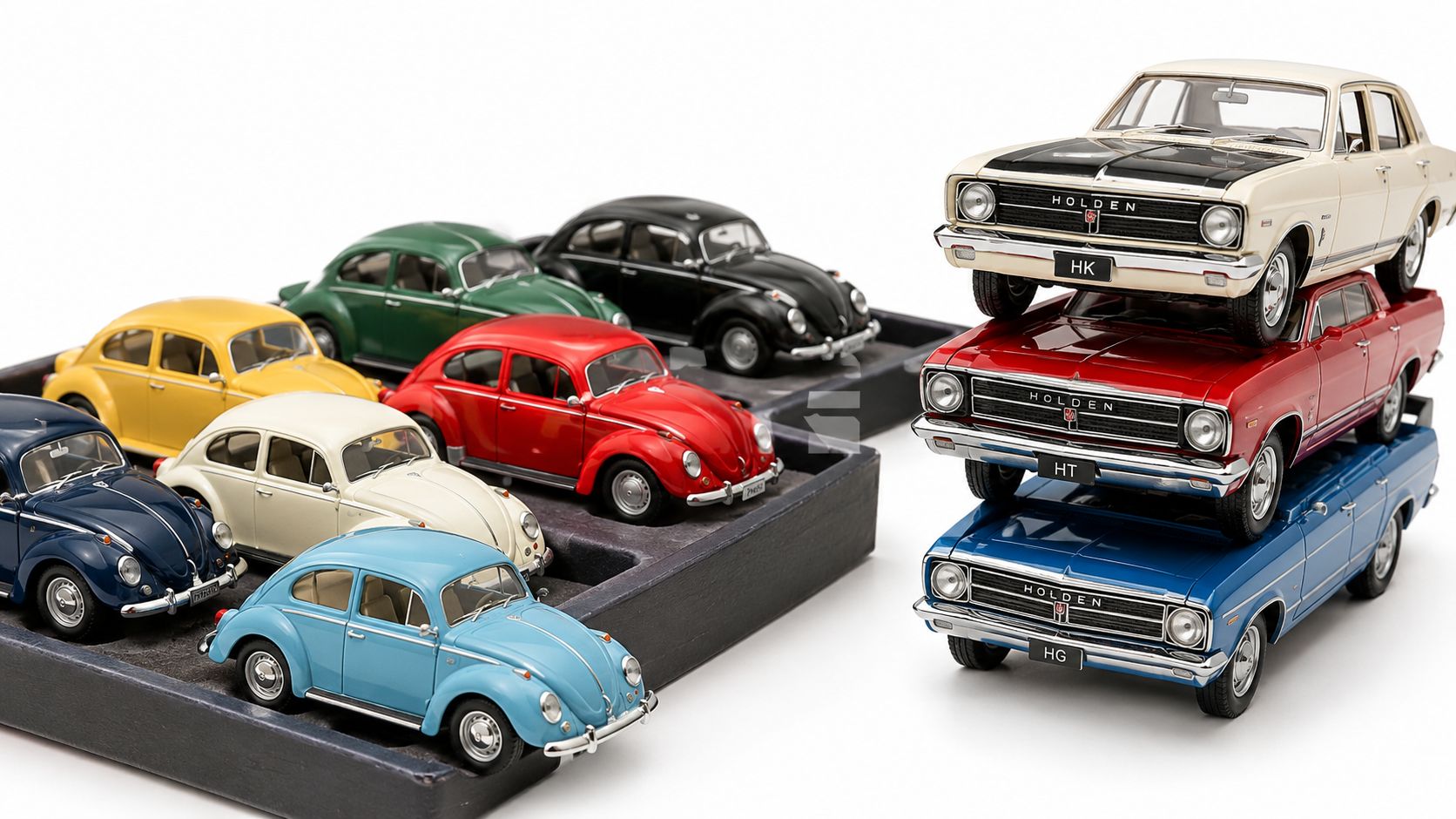
You're standing at a weekend swap meet, coffee in one hand and a tray of VW Beetle diecast model cars in the other. Beside the Beetles sits a stack of classic Holdens, yet your eye keeps returning to the little Volkswagen with its round roof, upright windscreen and cheeky stance. That reaction is familiar to Australian collectors. A Beetle doesn't need a racing pedigree or a massive engine to earn shelf space. It carries memories of family trips, coastal roads, old school car parks and sunny Volksfests.
The best model isn't always the biggest or most expensive one. For Australian buyers, scale, steering position, body era, trim and local history matter just as much as a glossy finish. Here's how to choose a Volkswagen Beetle model that feels right on the shelf, whether you're starting with a single 1:32 replica or building a display around a detailed 1:18.
Why the VW Beetle Still Lives on Aussie Shelves
A Beetle still earns shelf space in Australia because its local story is unusually strong. The military brought the first Beetles here in 1945, formal market availability followed in 1953, and local assembly began in 1954. Volkswagen Australia formed in 1957, locally manufactured body panels were in use by 1960, and Australian Beetle production continued until 1976, according to Volkswagen Australia's Beetle history.
For collectors, those milestones create several worthwhile Australian references. An early imported car, a Clayton-assembled Beetle and a later locally adapted version can differ in badges, trim, body details and steering position. A diecast that reflects those distinctions has genuine shelf appeal. It represents the cars Australians saw and drove, rather than a generic export-market replica.
The local story adds real character
The Beetle became a familiar part of Australian motoring. In 1960, 24,388 VW 1200 Beetles were sold in Australia, putting it behind the FB Holden as the country's second-best-selling individual car model. Museum Victoria's Australian Volkswagen history also records the local production story, including Melbourne-based Regent Motors importing the first Beetles in late 1953 and Volkswagen Australia later assembling CKD kits at Clayton.
Clayton production began in 1959 and ended in 1968, with just over 260,000 Beetles made in Australia. That history gives Australian buyers a practical collecting filter. Look for a right-hand-drive Sedan, locally familiar colours and trim associated with the cars sold here. Those details matter more than a shiny finish on a model with no Australian connection.
Collector's rule: Choose the Australian-delivered character first. A faithful right-hand-drive model beats a bland replica every time.
An early oval-window style can also add interest, especially beside a later Sedan. The same approach works with Kombi and Samba Bus models. Place a cheerful Type 2 beside the Beetle and the display immediately feels tied to Australian Volkswagen culture, from everyday family transport to the cars seen at local shows.
Understanding Beetle Diecast Scales and Sizes
Scale is the first decision to make because it controls almost everything else, from display space to detail and price. A 1:18 Beetle is a substantial centrepiece, typically around 25 to 30 centimetres long, while a 1:24 model is generally around 16 to 20 centimetres, according to Australian diecast scale guidance.
A 1:18 suits a cabinet, office shelf or dedicated display plinth. It has room for features such as opening doors, a bonnet, an engine lid and more carefully rendered interior trim. It also needs breathing space around it. Push too many large models together and the details disappear into a crowded row.
A 1:24 is the practical middle ground. It still looks substantial, but it's easier to fit alongside a Kombi, a Holden or a small diorama. For many collectors, this is the ideal first serious Volkswagen diecast model because it offers visual presence without taking over the room.
Match the scale to the way you collect
| Scale | Approx. Length | Detail Level | Best For |
|---|---|---|---|
| 1:18 | About 25–30 cm | High, often with opening features | Display centrepieces |
| 1:24 | About 16–20 cm | Strong detail with manageable size | General collecting and gifts |
| 1:32 | Compact | Useful detail in a smaller footprint | Growing a varied shelf |
| 1:50 | Compact | More limited, often suited to themed displays | Small collections and scenes |
| 1:64 | Small | Basic to moderate, depending on maker | Dioramas and budget collecting |
| 1:87 | Very small | Best for scene-building | Layouts and miniature displays |
Australian listings show Beetles across 1:18, 1:24 and 1:64, including a 1966 Beetle in 1:24 and a 1953 Beetle Deluxe USA model in 1:64, as seen in the Australian Volkswagen memorabilia market. The variety is useful because you can build a coherent display without committing every model to the same footprint.
For a first purchase, I'd choose 1:24 for a balanced shelf or 1:18 if the Beetle is the star of the cabinet. Choose 1:64 or 1:87 when you're building a broader scene, adding a Beetle to a Kombi display or collecting several eras without needing a larger cabinet. Browse the Volkswagen model car range with that decision already made.
Popular Beetle Variants Worth Collecting
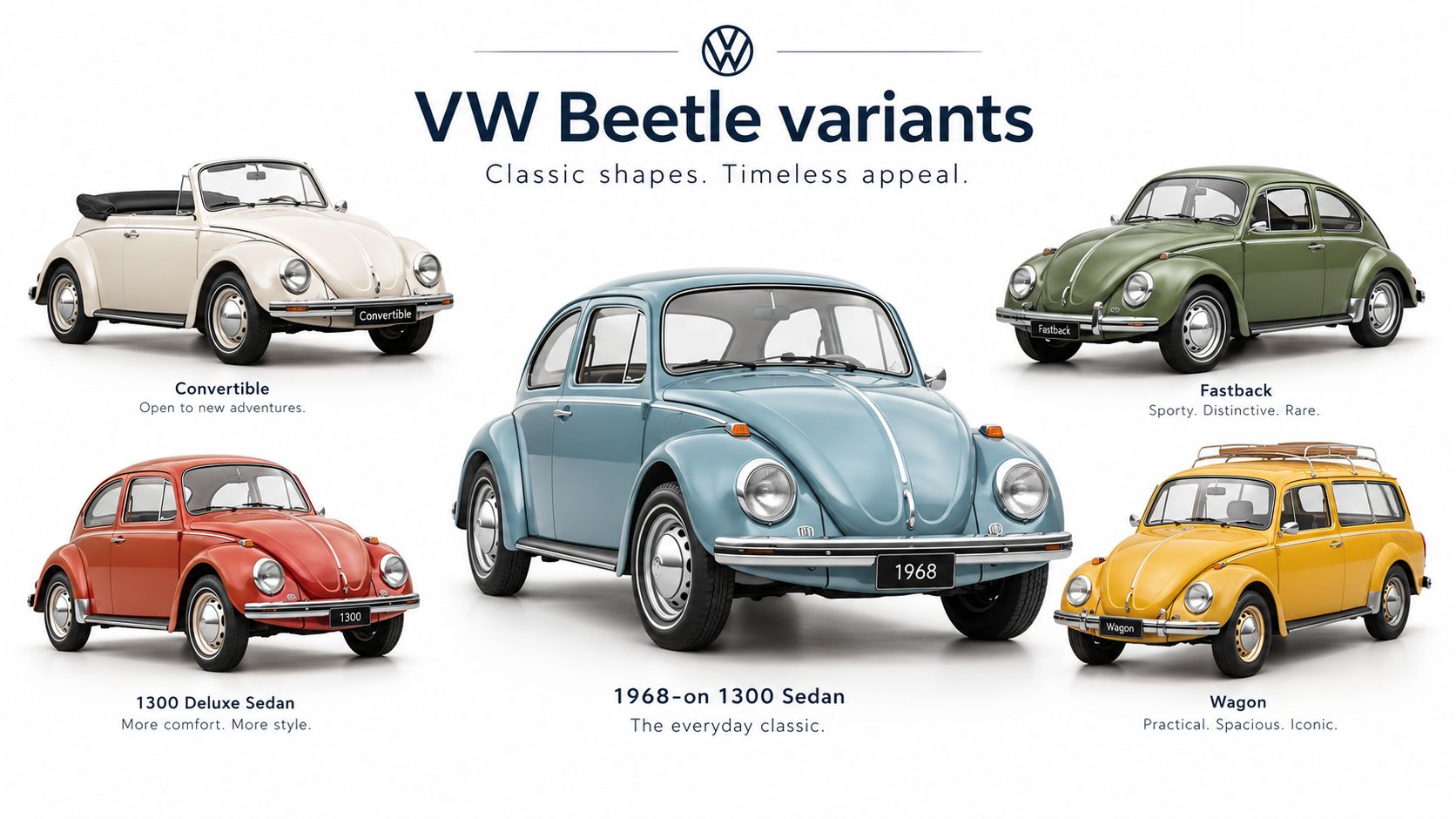
Not every Beetle model tells the same story. A plain Sedan is the strongest starting point for an authenticity-led collection, while a Herbie or Flower Power edition brings instant personality. Australian buyers should decide whether they're collecting history, styling, film nostalgia or a bit of everything.
The standard Sedan is the dependable foundation. Look for a clean body profile, correctly shaped guards and a period-appropriate interior. A 1300-style car works especially well in a local collection because it reflects the familiar family Beetle rather than an exaggerated custom interpretation.
The 1303 Super Beetle has a different presence, with its curved windscreen and revised front-end design. It's a good choice when you want a clear visual contrast beside an earlier rounded-window car. The Cabriolet adds open-air charm and usually becomes the attention-grabber in a mixed display.
Authenticity versus fun
Early oval-window Beetles appeal to collectors who enjoy subtle historical differences. Australian collector guidance also highlights the appeal of earlier Beetles and oval-window examples, while local listings point to interest in right-hand-drive cars and themed executions. You can explore period-focused options in the 1970s Volkswagen Beetle collection.
For a useful shelf lineup, I'd rank the choices this way:
- Best first buy: A well-proportioned Sedan in a restrained factory-style colour.
- Best Australian angle: A right-hand-drive Beetle with convincing steering position and local-market trim.
- Best display contrast: A Cabriolet or Super Beetle beside a standard Sedan.
- Best nostalgia piece: Herbie, Hippie Peace & Love, Pink/White, Mooneyes or a taxi-themed model.
- Best novelty addition: A Baja Bug, especially if your display already includes stock-bodied cars.
AU retail listings show detailed 1:18 and 1:32 Beetles, including right-hand-drive 1967 variants and colour-led editions such as Pink/White and Hippie Peace & Love, as documented in Australian Volkswagen diecast listings. That mix tells you something important. Collectors aren't choosing only one definition of authenticity. They want correct local details, but they also enjoy the playful side of VW culture.
The video below is useful for collectors comparing the visual character of different Beetle shapes and finishes.
How to Spot a Quality Licensed Diecast
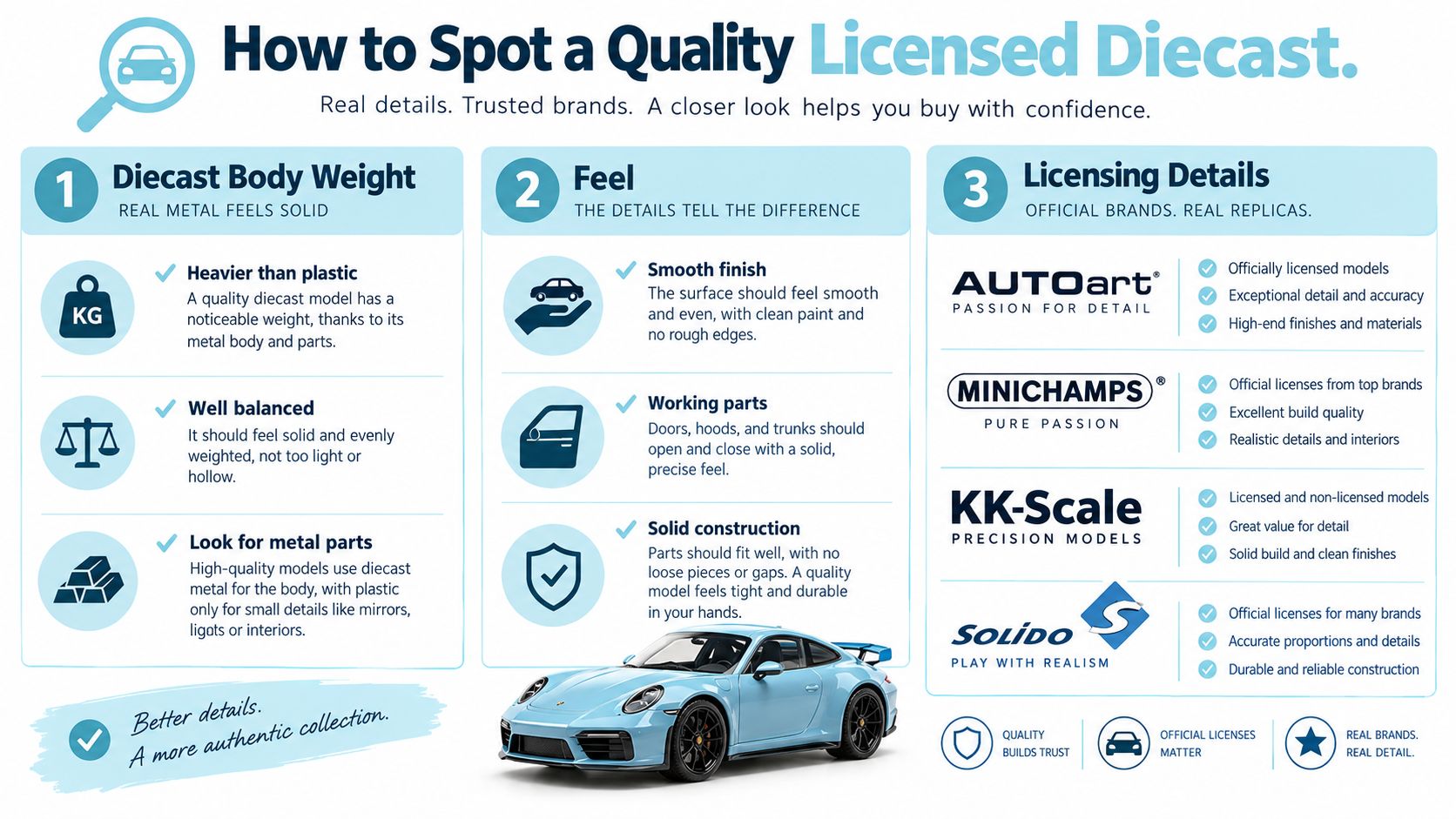
A good licensed model feels right before you inspect it closely. Pick it up, compare the weight with a similar-sized replica and look at the stance from several angles. Brands such as AUTOart, Minichamps, KK-Scale and Solido are familiar names among collectors, but the badge on the box isn't enough by itself. The model must also show careful execution.
Run this quick shelf-side checklist
- Body and proportions: The roof should have the right arch, the guards should look balanced and the wheels shouldn't appear lost inside the arches.
- Opening features: On a larger model, opening doors, bonnet and rear engine lid should sit cleanly and close without awkward gaps.
- Steering detail: A 1:18 right-hand-drive Beetle should place the steering wheel correctly and represent the dashboard in a believable way.
- Badges and trim: VW roundels, Wolfsburg crests, bumpers and lights should look crisp rather than blurred or crudely painted.
- Interior finish: Ribbed seats, dashboard knobs and headlight treatment add more realism than a shiny exterior alone.
- Chassis work: Turn the model over. A detailed underside and properly seated wheels usually indicate a more considered replica.
Cheap unlicensed copies often give themselves away with squashed proportions, uneven wheel placement, painted-on chrome and a hollow plastic feel. The most obvious flaw may only appear when you place two models side by side. One will have clean shut lines and a convincing stance. The other will look like a Beetle from memory rather than a carefully measured car.
Put two models next to each other and inspect the roofline, wheel arches and windscreen. The quality gap usually appears before you notice the tiny details.
Licensing matters because it signals that the manufacturer has worked from the Volkswagen design rather than producing a loose interpretation. Still, don't buy blindly. Check the body, interior, trim and packaging together, then choose the model that looks right from normal viewing distance.
Caring for Your Collection in Australian Conditions
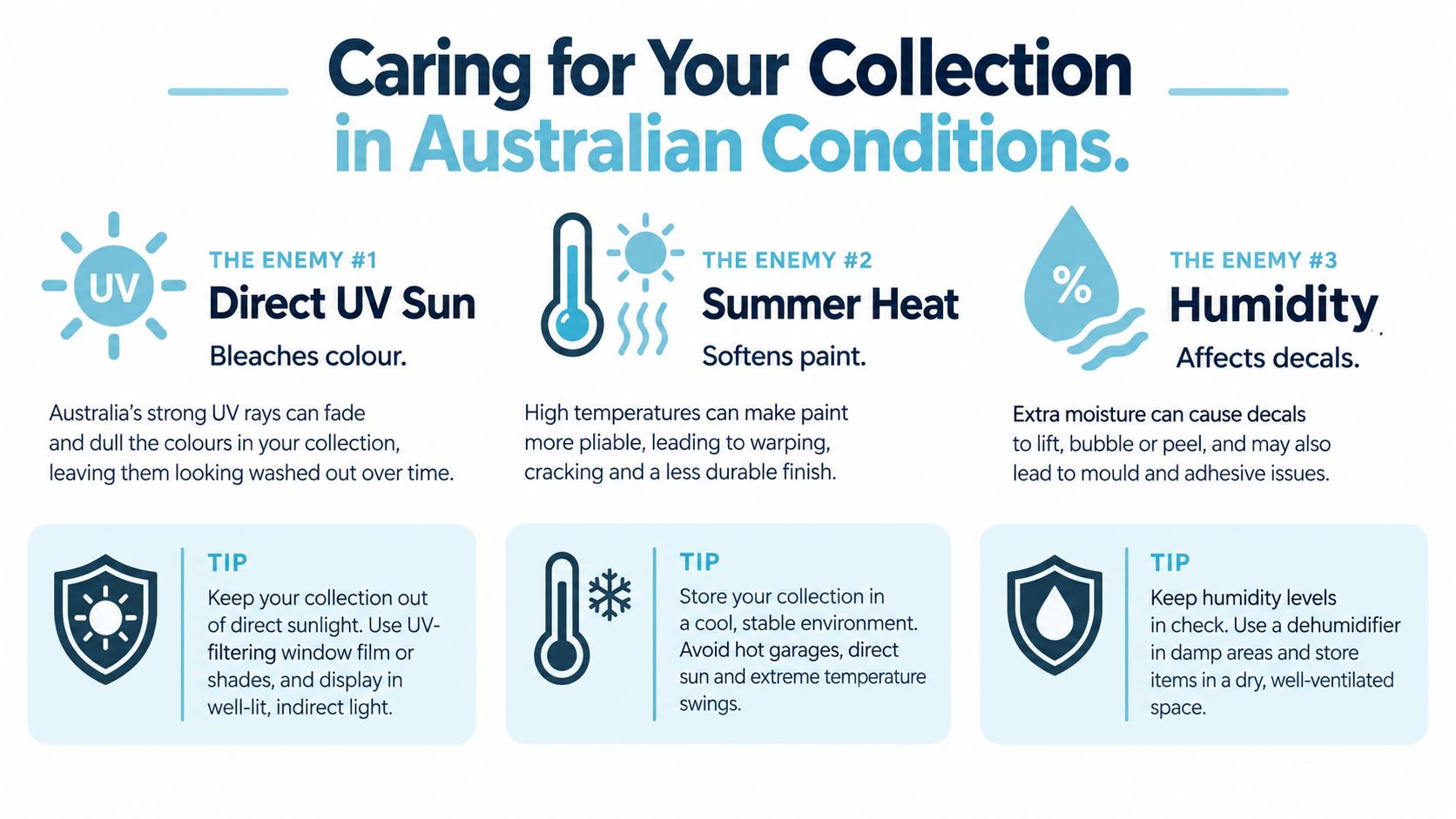
Australian display conditions can be rough on diecast. Direct sunlight fades paint and decals, summer heat can soften plastic bases and tyres, and coastal humidity can encourage corrosion or diecast rash on exposed metal. The safest display is a stable, shaded cabinet away from windows and heating sources.
UV-filtering glass or acrylic is a sensible upgrade for a collection you plan to keep on display. In humid coastal areas, place silica gel packs inside the cabinet, but keep them away from loose parts and replace them when they're no longer effective.
Dust carefully. A soft makeup brush works well around window frames, vents and engine grilles, while a wet cloth can push moisture into joints and seams. Household polishes are a poor choice because they may strip or haze the model's lacquer.
For 1:18 models with opening panels, use only a tiny amount of light silicone lubricant on stiff hinges. Don't force a bonnet or engine lid that feels stuck. The hinge is easier to protect than to replace. A proper display case for model cars also keeps handling and dust under control.
Practical rule: If the sun can reach it, move it.
Value, Rarity, and Building a Smart Collection
Value comes from the combination of desirability, condition and scarcity, not age alone. A limited, factory-licensed model in a discontinued colour is more interesting to serious collectors than a common replica that has been handled heavily. Right-hand-drive Beetles, early styling, Cabriolets in original-looking colours and liveries connected to local events or dealers can add extra appeal in an Australian collection.
Keep the packaging if you can. The box, paperwork and clean presentation help establish what the model is and how it was originally sold. A model with a cracked blister, missing mirror or faded paint should be treated as a display piece rather than a pristine investment.
| Factor | Low Impact | High Impact |
|---|---|---|
| Rarity | Common colour and widely available body style | Limited or out-of-production variant |
| Local relevance | Generic left-hand-drive execution | Convincing right-hand-drive Australian-market detail |
| Condition | Dust, paint marks or missing parts | Clean model with intact trim |
| Packaging | Damaged or incomplete box | Original box and paperwork |
| Theme | Plain stock version | Strongly recognised livery or special edition |
My preferred collection has three layers. Start with a couple of premium display pieces, add mid-range models that fill out different Beetle eras, then keep a few affordable daily-handlers that you can pick up without worry. That mix makes the hobby enjoyable now, rather than turning every model into something you're afraid to touch.
Start or Grow Your Beetle Collection
Choose the model that gives your shelf a clear direction. A 1:32 Herbie brings instant character, a 1:18 right-hand-drive Australian-spec Beetle becomes the centrepiece, and a small 1:87 Beetle can finish a diorama without competing with larger cars.
Before buying, check the scale, body era, steering position, opening features and box condition. Then browse the Volkswagen diecast shop and compare the available Beetle models with the Kombi and Samba Bus pieces that might sit beside them.
An Australian importer is worth using when you want local stock, faster shipping and practical advice about a particular variant. A quick conversation can save you from ordering the wrong scale or a left-hand-drive version when your display is built around Australian cars. Follow new arrivals and restocks, keep your collection organised and leave room for the next Beetle that catches your eye at Volksfest.
Volkswagen Memorabilia offers VW diecast models, including Beetles and Kombi Samba Bus pieces, alongside other VW memorabilia collectibles for enthusiasts and gift buyers. Visit Volkswagen Memorabilia to browse the range, find local stock and choose the next Volkswagen diecast model for your shelf.