

You’re probably in that familiar spot right now. The shed door is open, the kettle’s gone lukewarm, and your Volkswagen is sitting there with one missing piece between “nearly done” and “back on the road”. Maybe it’s a Beetle waiting on a trim clip that nobody seems to list properly. Maybe it’s a Kombi with a door handle that looks right in the photo and turns out wrong in the hand. Maybe it’s a newer Amarok that needs the correct service parts without the usual guesswork.
That’s the core of volkswagen parts australia. It isn’t just buying bits. It’s the hunt, the decoding, the yarns swapped at club meets, and the little win you get when the right part finally clicks into place.
For a lot of us, that hunt doesn’t stop with the full-size car. It follows us onto workshop shelves, office desks, and lounge room displays too. The same eye that notices the proper mirror shape on a Splitty also notices when a diecast Samba Bus gets the stance just right. That’s part of the Volkswagen story in Australia. We keep them running, and we keep their spirit close.
That Unmistakable Feeling of Owning a VW
A mate of mine once spent half a Saturday chasing a rattly interior noise in an old Beetle. He was convinced the whole dash had to come out. Turned out to be one tiny loose fitting behind the trim, but by then the radio was on, the garage smelled of polish and old rubber, and three neighbours had wandered over for a stickybeak. That’s owning a VW in Australia. Even the small jobs become stories.
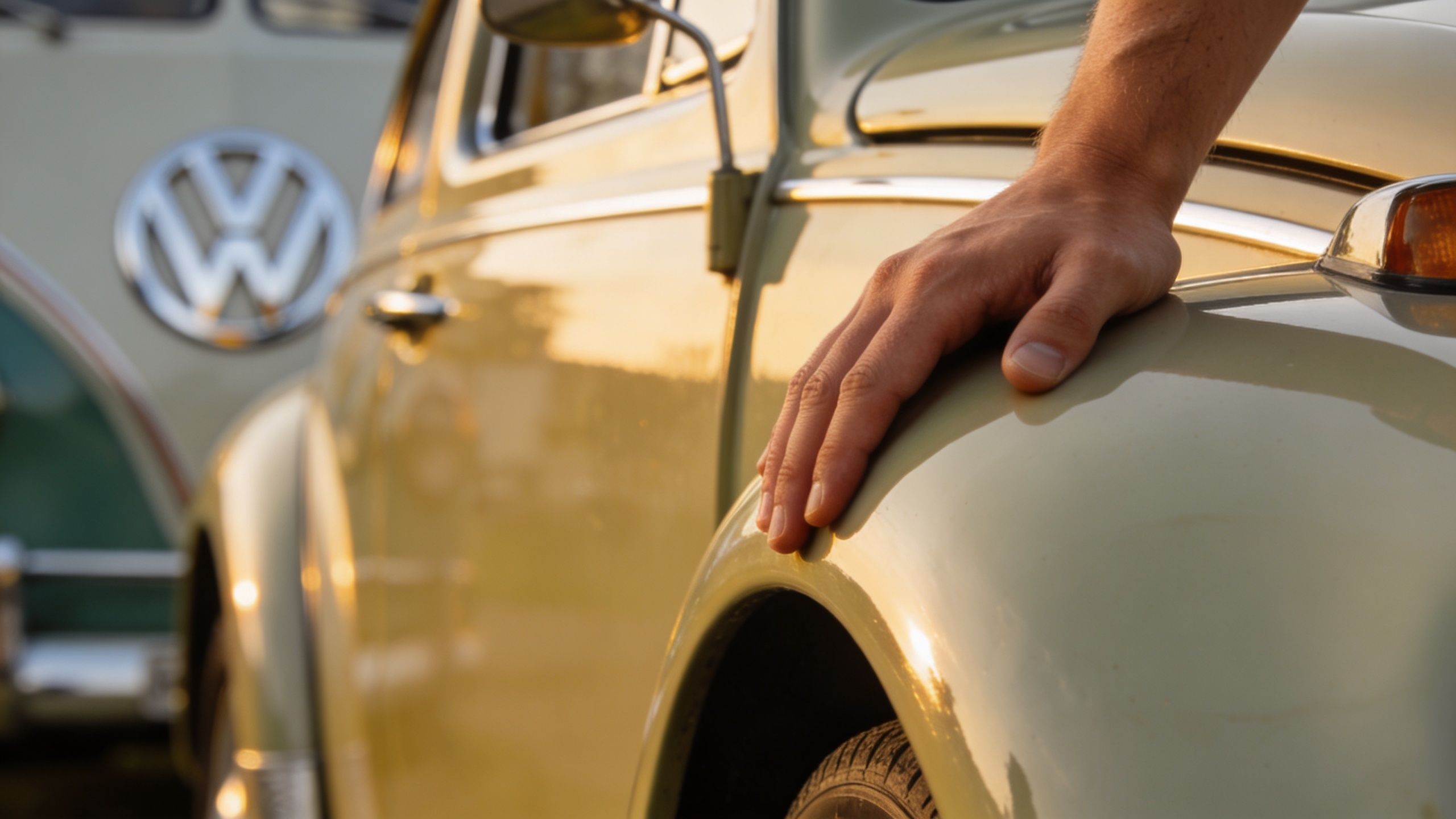
There’s a particular feeling you get with these cars. A Kombi parked nose-first to the beach. A Beetle cooling in the driveway after a Sunday run. A Golf GTI with that tidy, no-fuss solidity only a Volkswagen seems to do properly. They all feel like characters. They’ve got habits, quirks, and a way of getting under your skin.
The parts hunt is part of the romance
Nobody falls for a VW because it’s anonymous. You fall for the shape, the sound, the memories, and the way strangers start conversations at servo stops. Then the practical side arrives. You need a seal, a switch, a badge, a hinge, or the exact bit of trim that matches what the factory intended.
That’s when experience starts to matter.
Old Volkswagens reward patience. Rush the parts search and you usually buy the same thing twice.
In Australia, that search has its own flavour. Coastal air is hard on metal. Country miles are hard on wear items. Sun is hard on rubber, vinyl, and plastics. The right part isn’t just about fit. It’s about how that part will live in Australian conditions once you bolt it on.
The garage and the display shelf aren’t far apart
If you’ve ever restored a Kombi, you’ll know how often you pause to study details. Where the trim line sits. How the wheel finish should look. Whether the dash knobs are right for the era. That same instinct is why so many owners end up collecting VW pieces beyond the car itself.
A good model Beetle or Samba Bus isn’t separate from the hobby. It’s an extension of it. It keeps the story going when the tools are packed away and the garage light’s off.
How to Speak Fluent Volkswagen Part Numbers
If VW part numbers have ever looked like secret code, don’t worry. They’re not random. Think of them like a postcode for car parts. Each section narrows the part down until you’re looking at one exact item, not a rough guess.
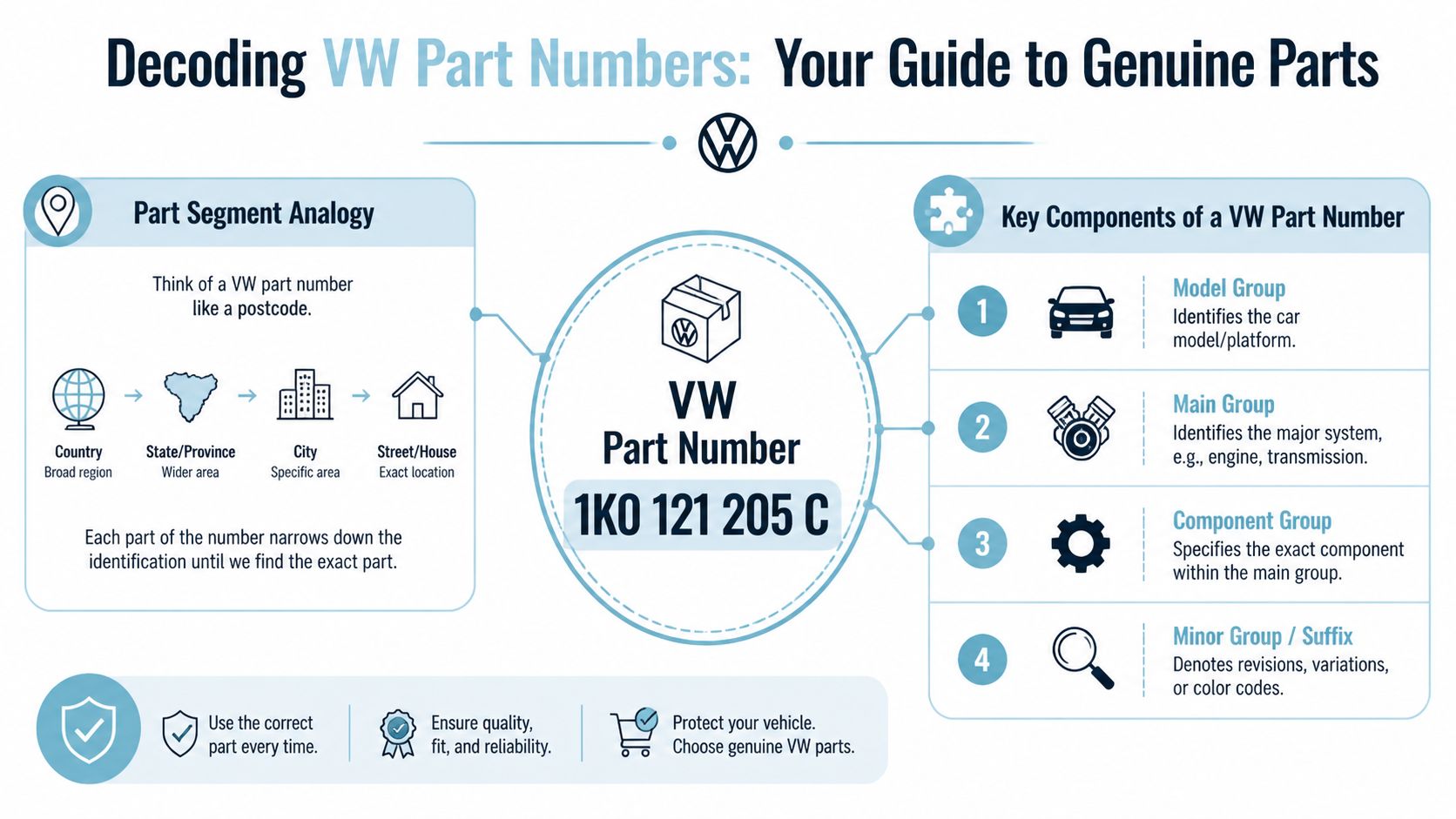
The basics are well established in the Club VeeDub guide to VW part numbers. Volkswagen uses a standardised 9 to 10 digit format, such as 171 819 047A. The first three digits identify the model, the fourth digit marks the main group, and the ending can show a revision or modification.
Breaking down the code
Here’s the easy way to read one:
| Part number section | What it usually tells you | Why it matters |
|---|---|---|
| First three digits | Model or unit code | Helps match the part to the right vehicle family |
| Fourth digit | Main group | Tells you the major area, such as body or interior |
| Fifth and sixth digits | Subgroup | Narrows the search to a specific assembly |
| Last digits | Consecutive part number | Identifies the exact part itself |
| Final letter | Modification code | Can show a revision or update |
That fourth digit matters more than many people realise. In the example from Club VeeDub, “8” indicates Body and Interior. If you’re searching trim, handles, seals, dash parts, or panels, this helps you stop wandering through the wrong catalogue section.
Left and right can catch you out
One of the handiest tricks is knowing that the consecutive numbers can indicate left or right-hand fitment. In Australia, that matters even more because we’re dealing with right-hand-drive cars and all the little fitment differences that come with them.
A mirror, hinge, or trim piece might look identical in a listing photo. It often isn’t.
Practical rule: Never order a left or right-specific VW part by appearance alone. Check the number first, then check the car.
Why suffix letters deserve respect
That final letter can seem small, but it can save a headache. The optional tenth character often shows a modification. That might mean a later revision, a slight design tweak, or a different finish. If you’re restoring a classic, that suffix can be the difference between “close enough” and “spot on”.
For Australian owners, this matters with anything exposed to salt air, sun, or repeated use. A later version of a part often exists because the earlier one had a weakness.
A quick workshop habit worth keeping
Before you order anything, write down:
- The full part number from the old part if it’s legible
- The model and year of the vehicle
- Which side the part belongs on
- Any suffix letter at the end
- A photo of the mounting points for your own reference
That little checklist beats memory every time.
Your Go-To Map for VW Parts Across Australia
A mate of mine in Newcastle spent three weekends chasing a sliding-door roller for his Bay Window. The first seller swore it would fit. The second sent one from a different year. The third was an old club bloke who said, “Bring the busted one over.” Ten minutes in his shed, with a coffee going cold on the bench, the right part turned up in a tobacco tin beside a pile of old rego labels and a 1:64 Kombi model still in its blister pack. That is how VW parts hunting often works in Australia. Half detective work, half community, and a little bit of nostalgia every time.
Finding good volkswagen parts australia sources comes down to knowing which door to knock on for which job. A service item for a Golf, a proper German Beetle trim ring, and a Kombi latch with the right wear and stampings usually live in three different worlds.
Dealership parts counters
For newer Volkswagens, the dealer parts counter still earns its place. You walk in with the VIN, the part gets traced through the local catalogue, and you leave with far less guesswork than you would from a generic listing online. That scale translates to better support.
Best for:
- Modern Volkswagens needing exact replacement parts
- Warranty-sensitive jobs
- Owners who want OE fit and finish
Less ideal for:
- obscure used trim
- bargain hunting
- some niche classic odds and ends
Specialist VW parts suppliers
The specialist shops are where experience saves money. These suppliers know the little production changes that trip people up. They know which Beetle seal sits correctly, which Type 3 switch is close but wrong, and which “fits all” listing belongs in the bin.
You hear it in the language straight away. “Is it German-built?” “Early or late?” “Push-button or trigger handle?” Those questions can save you from buying the same part twice.
For air-cooled owners, these businesses often feel like part workshop, part archive. They keep cars on the road, but they also keep stories alive. The same owner chasing bonnet hinges for a Squareback is often the one collecting dealer brochures, enamel signs, or a little fleet of diecast buses at home. It is all the same instinct. Preserve the shape, the details, the feeling.
Wreckers and donor cars
A wrecking yard can still hand you the best find of the month. Used original German parts often beat shiny reproductions for fit, finish, and character. Handles, brackets, seat frames, vents, and odd bits of interior trim are classic wreckers territory.
Go in prepared:
- Take your tools so you can compare old and new on the spot
- Inspect mounting points for cracks, rust, and old repairs
- Look past dirt but don’t ignore distortion
- Check whether the part has been modified by a previous owner
The best donor parts feel right in your hand. You can see the age, the weight, the way the stamping was done. Anyone who has matched a survivor part to an old diecast model on the shelf knows the satisfaction. The tiny details are the whole point.
Online marketplaces
eBay, Gumtree, forums, and enthusiast classifieds can reward patience. They can also drain it. Good sellers show the part number, clear photos, and the car it came from. Rough sellers give you one blurry photo and a sentence like “should fit most VW.”
Ask for:
- the full part number
- clear close-up photos
- confirmation of the model it came from
- details of any repairs or damage
If the seller dodges those questions, keep scrolling.
Clubs and the VW community
The best parts in Australia often move privately through club circles, swap meets, and late-night messages between owners. Someone knows a bloke in Ballarat breaking a Superbug. Someone else has a shelf of early Kombi hardware wrapped in newspaper from 1998. Many coveted finds never reach public listings.
That community side is part of what makes the hobby stick. One person is hunting a fuel flap hinge. Another is chasing an old service sign or adding a Volkswagen bus camper inspiration piece to the collection in the shed. Mechanical parts and memorabilia feed the same obsession. You are not only keeping a VW alive. You are keeping its world intact.
The best VW parts source in Australia is often a person with a good memory, a crowded shed, and a shelf full of stories.
Genuine vs Aftermarket The Great VW Parts Debate
There’s no single right answer here. The right choice depends on the car, the job, and what sort of owner you are. A concours Beetle, a beach-run Kombi, and a hard-working daily driver won’t all make the same call.
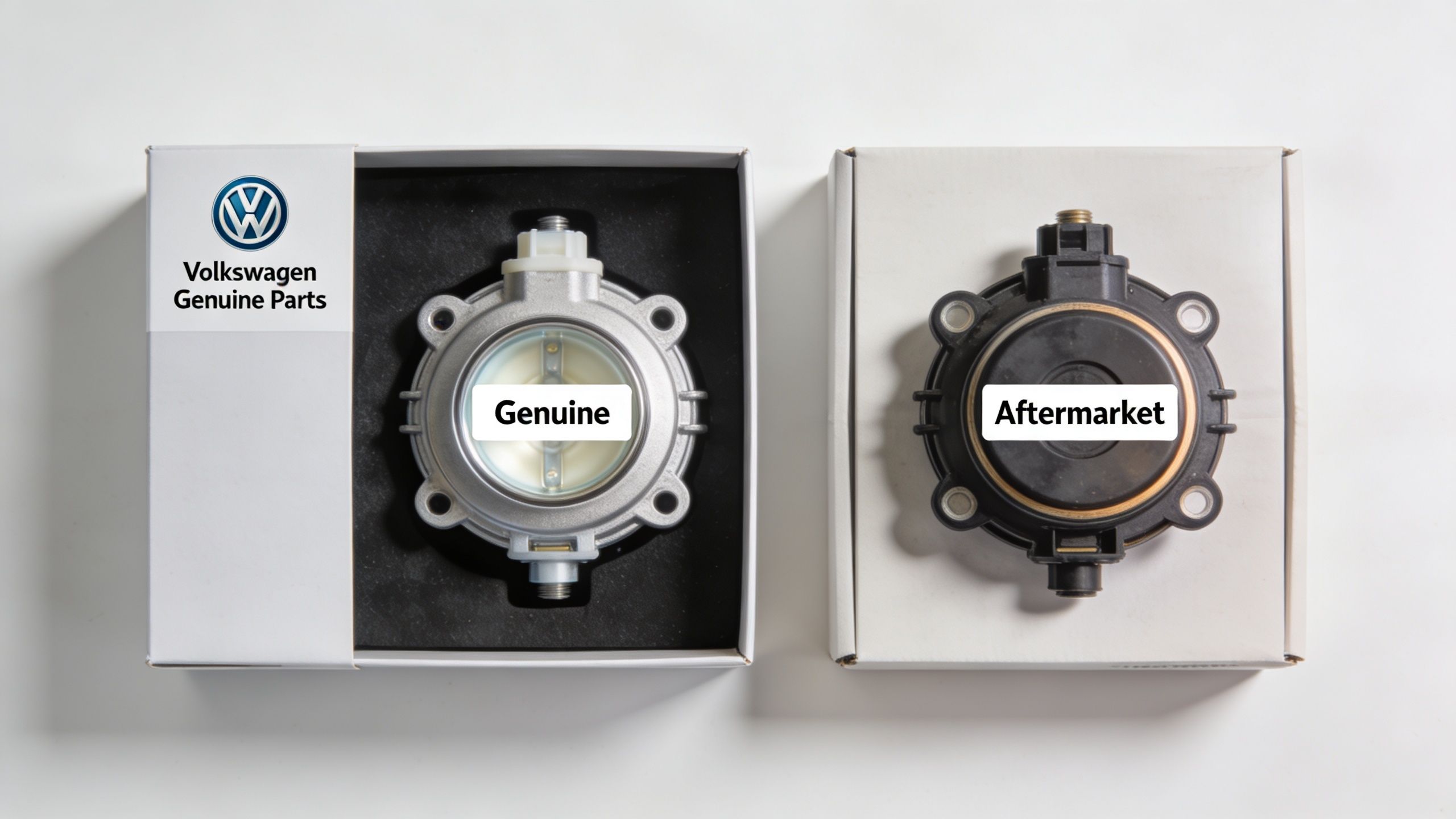
Volkswagen’s own genuine parts offering in Australia comes with a clear advantage. According to Volkswagen Australia Genuine Parts information, Volkswagen Genuine Parts® carry a 2-year unlimited kilometre warranty when installed by an authorised technician.
When genuine makes the most sense
Use genuine parts when failure would ruin your weekend or your engine. That includes core mechanical items, sensitive sensors, major cooling parts, and anything that affects safety or proper system operation.
For newer cars, genuine often saves time. The fit is right, the catalogue trail is clear, and if something goes wrong you’ve got a cleaner path to support.
When aftermarket earns its keep
A quality aftermarket part can be perfectly sensible. Plenty of owners use aftermarket for consumables, cosmetic items, and non-critical bits where originality isn’t the top priority. If the supplier is reputable and the part is known to fit properly, it can be a smart move.
That’s especially true on daily drivers. Not every old Golf or Beetle needs concours-correct everything.
A simple comparison helps:
| Option | Best for | Watch-outs |
|---|---|---|
| Genuine | Newer cars, critical systems, factory correctness | Higher cost |
| Aftermarket | Budget-conscious repairs, non-critical items | Quality varies a lot |
| Used original | Hard-to-find classics, period-correct restorations | Wear, age, hidden damage |
For a visual rundown of the thinking behind parts choices, this video is worth a look:
The sensible enthusiast approach
Most seasoned VW owners don’t live at one extreme. They mix and match.
- Engine and safety first: Buy the best part you can justify.
- Trim and nice-to-haves second: Balance budget with originality.
- Rare old parts: If you find a solid used original, grab it.
Buy cheap twice and you usually spend more than buying right once.
Restoration Gold for Classic Beetles and Kombis
You see it at swap meets all the time. One Beetle rolls in wearing thin original paint, stone chips on the nose, and a driver’s seat that has carried three generations. Another arrives fresh from a full rebuild, every rubber replaced, every trim piece sitting straight. Both can stop you in your tracks if the work feels honest to the car.
A mate of mine spent half a winter sorting a Kombi rear hatch. He could have lived with a gap that looked fine from five metres away. He didn’t. He kept adjusting hinges, seals, and latch position until it shut with that familiar VW thunk. The first time it clicked home properly, the whole bus felt right again. That is the sort of victory classic Volkswagen people remember.
Start with the parts already telling the story
Before you fill a cart with replacements, pull the original bits off carefully and inspect them like artefacts. Old German handles, seat frames, latches, screws, catches, and trim often respond well to cleaning, plating, straightening, or a patient afternoon at the bench.
You save money, yes, but that is only part of it.
You also keep the car’s memory intact. A worn window winder or an original latch carries the same quiet charm as an old dealership brochure or a diecast Beetle on the garage shelf. The parts hunt and the collecting habit come from the same place. Respect for the details.
Use Australia’s VW network to your advantage
As noted earlier, Volkswagen has a serious footprint in Australia. For classic owners, that does not mean every air-cooled bracket or early Kombi trim clip is waiting in a local warehouse. It does mean the brand has a substantial local infrastructure around it, and that infrastructure is valuable when chasing parts pathways, references, old dealer knowledge, and compatible later pieces.
If your project is a Beetle and you are sorting through what is correct for a Type 1, these VW Type 1 parts references are handy for training your eye before you buy.
That matters most when a car has been “fixed” by five previous owners. A 1960s Beetle can pick up later lights, mixed fasteners, the wrong switches, and trim from entirely different years. Good restoration work often starts by spotting what should not be there.
The details that lift a restoration
Some choices shape the whole character of the car:
Patina or repaint
Honest paint with good metal underneath can suit a Beetle or Kombi better than a glossy finish that erases its life.Interior finishes
Vinyl grain, seat piping, door cards, and colour tone decide whether the cabin feels period-correct or vaguely off.Brightwork and trim
Chrome needs restraint. Too perfect can look colder than the rest of the vehicle.Hardware and fasteners
Simple Volkswagens leave nowhere to hide. Wrong screws and odd clips stand out fast.
A classic Volkswagen does not need perfection. It needs the right feel.
Keep a reference on the shelf as well as the bench
Plenty of owners do this without making a fuss about it. A well-made Beetle or Kombi model sits near the tools while the actual car is in pieces. One glance can settle an argument in your own head about stance, wheel style, trim layout, or how much visual weight a bumper should carry.
That little model is not a substitute for factory literature. It is a reminder of what made you fall for the shape in the first place. In a proper VW garage, the spares shelf and the memorabilia shelf usually belong to the same story.
From Car Parts to Collectibles The Enthusiast's Corner
There comes a point in every VW obsession where the parts shelf stops being enough. You want something that celebrates the shape, not just the spanner work. That’s where collectibles step in.
Australia’s VW parts scene mostly serves the mechanical side. According to this look at the gap in the local market from V Dubs R Us, suppliers heavily focus on functional spares, while memorabilia and collectible parts remain underserved. That rings true for anyone who’s searched for proper display pieces, retro accessories, or a faithful little Kombi for the bookshelf and ended up knee-deep in mechanical listings.
Why collectors and restorers often become the same person
It makes sense, really. The same owner who cares about the right hubcap profile on a real Beetle will care about the right window layout on a model Samba Bus. Collecting isn’t a separate hobby for a lot of VW people. It’s another expression of the same affection.
A few collectible categories fit naturally beside restoration life:
- Diecast Beetles and Kombis for desk, garage, or study displays
- Workshop-inspired decor that keeps the VW mood alive indoors
- Gift pieces for birthdays, Father’s Day, retirements, or club prizes
- Beachy VW items that suit the surf-and-coast side of Kombi culture
For people who love that crossover between motoring nostalgia and home style, pieces like Volkswagen-themed dashboard cover decor show how the visual language of old VWs can carry into everyday spaces.
A few display ideas that work
| Space | What suits it |
|---|---|
| Garage shelf | Kombi diecast, old manuals, cleaned original parts |
| Home office | Beetle model, framed event photo, subtle VW accent |
| Living room | Coastal VW decor, Samba Bus piece, understated retro touches |
The nice thing about collectibles is that they hold the feeling of the car even when the car’s under a cover, waiting on the next job.
Your VW Parts Questions Answered
Can I still get parts for newer Volkswagens in Australia?
Yes. Volkswagen Australia’s parts network supports current models as well as enthusiast favourites. Commercial vehicles are part of that picture too, not just passenger cars.
What about Amarok parts specifically?
They’re well supported within the same broader network. The Amarok reached 8,400 units in 2024, and that demand sits behind the same catalogue of nearly 300,000 Genuine Parts, as reported by GoAuto’s market insight on Volkswagen Australia.
Are VW clubs worth joining just for parts?
Absolutely. Even if you never buy a part directly through a club member, the advice alone is worth it. Clubs help you avoid bad buys, identify correct pieces, and meet the people who know where the hidden stock lives.
Should I restore with all genuine parts?
Not always. For critical components, genuine often makes sense. For trim, older used parts, or budget-minded jobs, a careful mix can be the smarter path.
Owning a Volkswagen in Australia has never been just about transport. It’s about memory, identity, community, and the quiet satisfaction of getting the details right. Whether you’re chasing a genuine replacement part, reviving a tired Beetle, keeping a Kombi honest, or looking for something that captures the old VW magic, you’re part of a bigger story every time you go searching.
If that VW feeling follows you out of the garage and into the rest of your life, have a look at Volkswagen Memorabilia. It’s a warm, distinctly Australian shop for VW-themed gifts, diecast models, and coastal decor, with plenty to delight Beetle lovers, Kombi fans, collectors, and gift buyers who want something with real character.