

You're at Volksfest, coffee in hand, and someone passes over a tidy little Kombi diecast. You turn it in the sun, admire the paint, the stance, the tiny bumper details, and then your eye lands on the badge. Just a circle and two letters. Simple enough. But for a VW fan, that little emblem can tell you a surprising amount about the era, the mood, and sometimes even whether the piece in your hand makes sense for the model it's meant to represent.
That's the joy of Volkswagen logo history. It isn't just a design timeline for brand buffs. For collectors, restorers, and anyone who's ever lined up a Beetle, Kombi, or Samba Bus on a shelf, the logo is a shortcut to the story. It helps you read a diecast model more carefully. It helps you spot when a sign, tin plate, or garage piece feels right for a certain period. And in Australia, it has its own local clues too.
More Than a Badge A Symbol of Freedom
A good VW badge has a way of pulling memories out of people.
You'll see it on the nose of a Beetle model and suddenly someone's talking about their uncle's car in Bondi. Spot it on a Kombi and the conversation shifts to surfboards, road trips, and the kind of summer arvo that seems to go on forever. That's why the badge matters more than many collectors first realise. It isn't decoration. It's one of the quickest ways to place a piece of memorabilia in the broader Volkswagen story.
For diecast collectors, this gets practical fast. A bright, beachy Samba Bus with a friendlier blue-era logo gives off a very different feel from an early black-badge piece. A modern VW model with a flat, pared-back emblem belongs to a completely different chapter again. Same marque. Different mood.
Collector's rule: When you're judging a VW piece, don't look at the paint first. Look at the badge, then ask whether the rest of the item matches the period that badge belongs to.
That's where Volkswagen logo history becomes handy. Every tweak in colour, depth, and shape reflects a shift in how the brand wanted to be seen. For us in the hobby, those changes make collecting more interesting. You're not only buying a miniature car or a wall sign. You're holding a tiny slice of the brand's timeline.
The Original 1937 Cogwheel Emblem
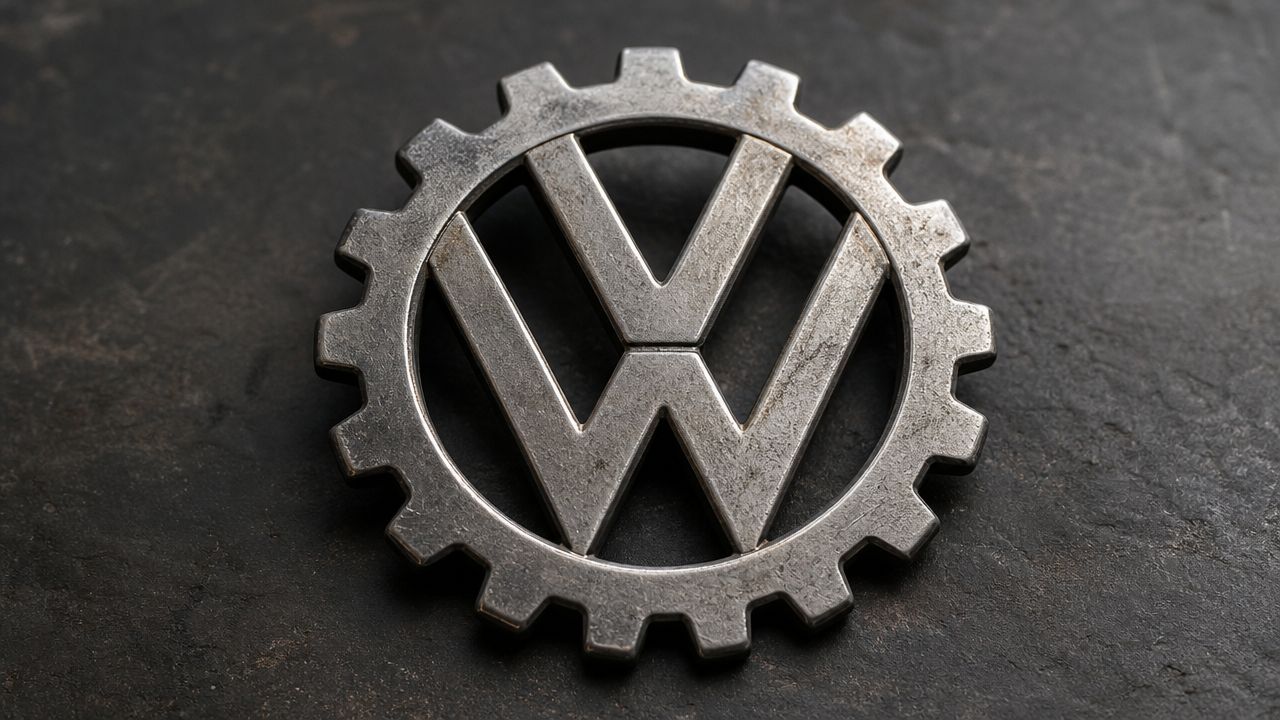
Before the cleaner badge most of us know by heart, Volkswagen began with a far more industrial-looking emblem. The earliest design used the familiar V over W, but it sat within a more ornamental, gear-like arrangement. It looked mechanical, rigid, and very much of its time.
Why it looked so different
That first emblem belongs to Volkswagen's pre-war context. The design carried an industrial feel, and that matters because the badge wasn't yet the friendly, universal symbol that later sat on Beetles and Kombis around the world. It came from a very different environment, one tied to early state-backed production and a harder visual language.
For collectors, the lesson is straightforward. If you ever see a VW piece using a gear-like outer motif, you're looking at the very earliest visual chapter of the brand. It's historically important, but it's also distinct from the post-war identity most enthusiasts connect with road trips, camping, and family memories.
What collectors should notice
When you compare that early emblem to later VW badges, three things stand out:
- The outer form: It's not just a neat circle. The badge has a more ornamental, machinery-inspired frame.
- The overall tone: It feels industrial rather than welcoming.
- The collecting context: This style belongs to the beginning of the story, not the era most classic Australian VW memorabilia celebrates.
Early VW branding looked built for industry. Later VW branding looked built for people.
That shift is why the logo's evolution is so satisfying to follow. You can see the brand gradually move from something severe and mechanical to something cleaner, calmer, and far more at home on a Beetle bonnet or the front of a cheerful diecast Kombi.
Post-War Rebirth and Arrival in Australia
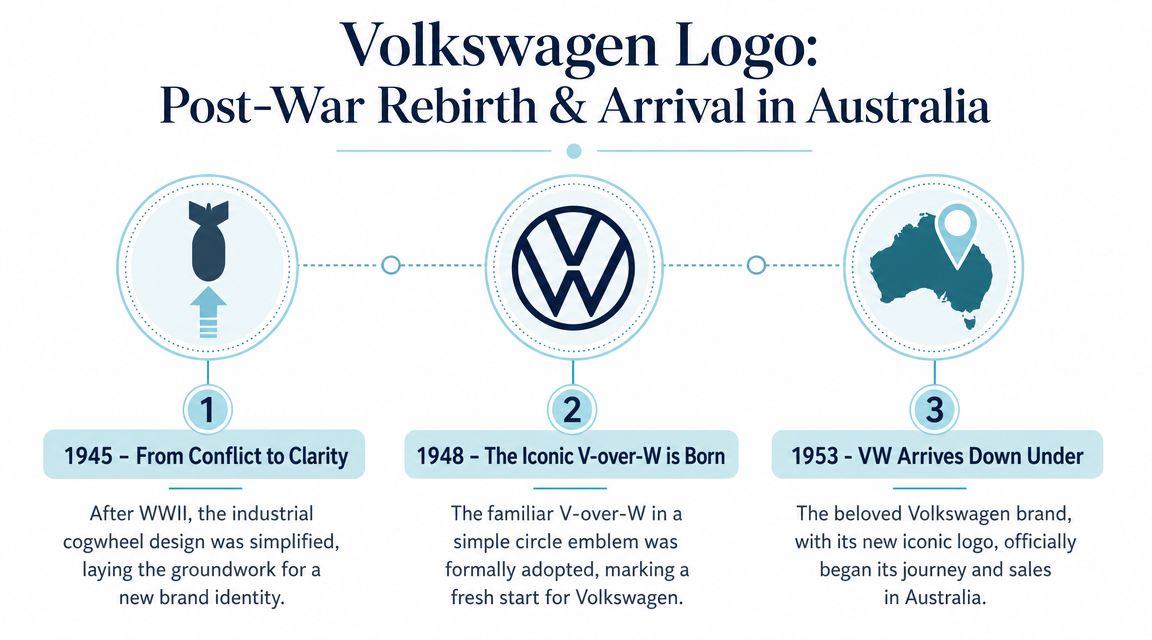
A bloke at a swap meet in Ballarat once handed me a tiny diecast Beetle with a worn box and asked, “Early Aussie issue, you reckon?” The fastest clue wasn't the paint or the wheels. It was the badge style. By the post-war years, Volkswagen had stripped the old industrial fuss away and settled on the clean V-over-W in a circle that most of us know on sight.
That simpler mark arrived here with the cars themselves. It turned up on showroom paperwork, service items, enamel signs, hubcaps, toy boxes, and the sort of dealer bits that now disappear from market stalls in a flash. If you collect in Australia, this is the point where the logo stops being a distant European design exercise and starts becoming a proper local trail to follow.
The early Australian clue
For local collectors, the handy tell is colour. Early Australian-associated VW material commonly used the black VW inscription inside a black circle, before the friendlier blue treatments of later decades took over.
That's gold for local collectors.
Say you've got a diecast that claims to echo an early Beetle sold here, or a repro garage sign meant to look period-correct for an Australian workshop. A black badge usually makes more sense for that earlier chapter than a pale blue one. It will not date an item down to the exact year on its own, but it can quickly tell you whether the piece is aiming at post-war Australia or a later, more relaxed era of VW branding.
Why collectors keep coming back to this period
This is the chapter where the logo starts living on everyday objects people used. In Australia, that meant Beetles parked in suburban driveways, Kombis heading for the coast, and dealership ephemera tucked into gloveboxes, sheds, and biscuit tins for decades.
If you're holding a model or a memorabilia piece from this vein, look for a few plain clues:
- Black circle with black VW letters: a strong fit for early post-war and early Australian-themed material
- Simple round badge: the reborn Volkswagen identity is now in place
- Cleaner lines and less decoration: a sign the piece belongs to the practical, people-focused VW era collectors usually love most
For many of us, the badge starts to feel personal in situations like these. You can see it on the sort of VW that got repaired in the shed on a Sunday arvo, loaded up for a camping trip, or passed down in family stories along with an old brochure, a keyring, or a much-played-with diecast Beetle.
Colourful Logos for a Colourful Era
You see it all the time at swap meets. Someone picks up a Kombi tin sign or a diecast Microbus in bright two-tone paint, spots the pale blue roundel, and asks, “Righto, what period is this meant to be?” That softer badge is one of the quickest clues you can get. As noted earlier, Volkswagen shifted from the stricter black look into blue-toned versions across the late sixties, seventies, and beyond, while keeping the basic VW circle familiar enough that no one would mistake it for anything else.
That change suited the VWs people fell in love with in this era. Beetles were still everywhere, but the badge now lived on campers, surfers' vans, dealer stickers, picnic hampers, toy buses, and all the cheerful gear that turned Volkswagen from a practical car brand into part of a lifestyle. In Australia, that matters to collectors because so much sought-after memorabilia borrows the mood of this period. Easygoing, sunny, and made for the coast.

When the badge started to feel relaxed
A blue VW badge changes the whole feel of an item in your hand. On a diecast Kombi with cream-over-turquoise paint, it reads like weekends away, foam boards on the roof, and salt in the air. On a repro service sign or an old brochure cover, it usually points to a later, friendlier chapter than the sterner post-war black emblem.
Collectors notice that straight away.
The useful bit is that the shape stayed steady while the colour styling shifted. So if you are sorting a shelf full of Beetles and buses, the logo helps you separate early-inspired pieces from those made to echo the brighter, more carefree VW years. A model with a light blue treatment usually fits that late sixties to seventies feel far better than a black-badged version, even before you check the wheels, trim, or body shape.
What the colour tells you about the model
If you collect diecasts or garage memorabilia, use the badge as a practical dating clue:
- Light blue logo treatment: usually suits items styled after the late sixties and much of the seventies
- White VW letters on a blue background: often points to later seventies-inspired branding and newer retro pieces drawing from that look
- Same circular VW form: helps confirm the item belongs to the long-running classic badge family, even if the colours have been refreshed
That is handy with modern collectibles too. Plenty of newer pieces borrow the cheerful visual language of classic Volkswagens, even when the vehicle itself is much newer, as you can see with Volkswagen ID.4 memorabilia and model inspiration. For collectors, that means the logo is not just decoration. It tells you whether the maker was aiming for early austerity, beach-era nostalgia, or a modern nod to VW's most beloved chapter.
Some badges give you a date range. This one also gives you the vibe.
That is why this era lands so well in Australian collections. The blue badge sits naturally on shelf displays filled with Kombis, Beetles, enamel signs, stubby holders, and surf-flavoured workshop art. If the logo feels lighter and the whole piece looks ready for a run up the coast, you are usually looking at Volkswagen memorabilia inspired by its most colourful years.
Modernisation for the Digital Age
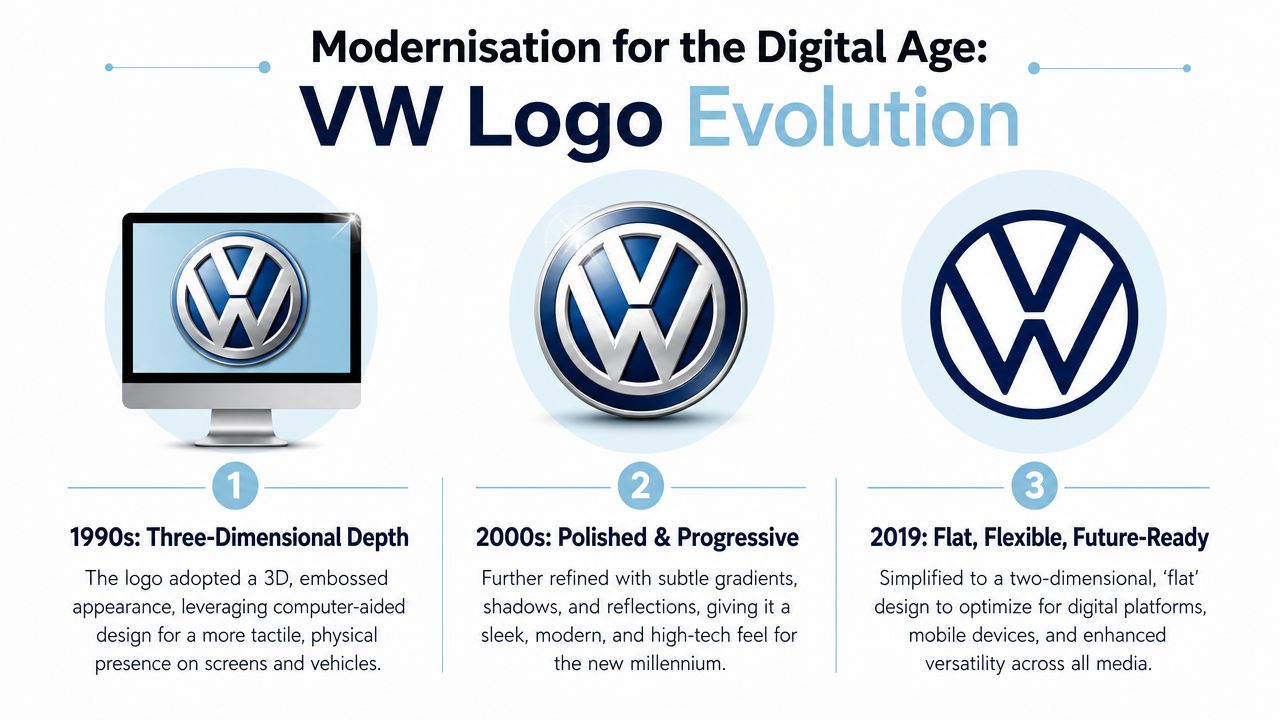
By the nineties and early 2000s, the Volkswagen badge picked up more visual polish. The blue deepened, surfaces looked glossier, and the logo gained a dimensional feel that suited grilles, steering wheels, brochures, and showroom graphics. It had presence. On a bonnet, it looked substantial.
Then the digital world changed the brief.
From glossy badge to flat symbol
A useful summary from Citton Cars' look at the Volkswagen badge evolution is that the logo moved from an ornamental, gear-like emblem in 1937 to a flat two-dimensional mark in 2019, with the newer redesign tied to Volkswagen's electric-mobility transition. The same source notes that the 2019 redesign shifted away from a 3D badge effect to simplified flat geometry with thinner strokes, improving legibility across digital interfaces such as in-car displays and app icons.
That last point matters more than it first appears. A shiny, embossed badge can look terrific on metal, but tiny screens demand cleaner shapes. The flat mark reads faster and stays clearer at small sizes.
Why collectors should care
This isn't only branding theory. It affects how modern memorabilia feels in the hand.
A newer model, especially one tied to the electric era, should look comfortable with that flatter emblem. If you're browsing pieces inspired by contemporary VW design, including vehicles such as the VW ID.4 collectible inspiration, the simplified badge belongs to that digital-first chapter.
A quick rule of thumb helps here:
- Glossy, embossed look: Modern, but pre-flat-design feel.
- Thin, flat geometry: Suits the newer electric-era visual language.
- Tiny screen compatibility: A clue that the logo was designed for dashboards, apps, and digital touchpoints, not just chrome badges.
The badge didn't become simpler because the brand had less to say. It became simpler because it had to work everywhere.
How to Date Your VW Memorabilia Using the Logo
The badge's utility becomes clear. If you're standing at a swap meet, checking a diecast online, or sorting through old garage pieces, the logo can act like a quick dating tool. It won't answer every question on its own, but it gives you a solid starting point.
The trick is to read the badge as part of the item, not in isolation. A logo style, body shape, paint treatment, and packaging design should all feel like they belong in the same era.
VW Logo Quick Reference Guide for Collectors
| Logo Style | Era | Key Features |
|---|---|---|
| Gear-like emblem | Pre-1945 | Ornamental, industrial look with a machinery-inspired outer form |
| Black VW in black circle | Early Australian-market identity | Simple circular badge, dark treatment noted by Volkswagen Australia for earliest logos seen locally |
| Light blue VW treatment | 1967 to 1978 | Friendlier global image with blue replacing black |
| White VW letters on light blue background | From 1978 | Inverted colour treatment, still clearly within the classic circular format |
| Deeper blue versions and later polished treatments | From 1995 onward | Darker blue, followed by more dimensional and glossy looks in later applications |
| Flat 2D mark with thinner strokes | From 2019 rebrand | Simplified geometry, no embossed shading, designed for digital legibility |
A collector's checklist
When you're trying to date a piece, work through these questions:
- Start with the badge shape: Is it gear-like, plain circular, glossy, or flat?
- Check the colour logic: Black, light blue, white-on-blue, and deeper blue each point to a different chapter.
- Match it to the item itself: A sixties-style Kombi with a fully modern flat badge may be a design mash-up rather than a period-accurate collectible.
- Look for regional timing: Global logo changes didn't always appear everywhere at once.
That last one is especially worth remembering. The Logos Wiki entry for Volkswagen notes that the 2019 flat-design rebrand was introduced in Europe first, then Asia, and was fully adopted in the U.S. on 8 April 2020, showing that rollout happened in stages rather than all at once. For Australian collectors, that means locally relevant models, dealer items, or merchandise may not align perfectly with the first global reveal.
If a logo change feels slightly late on an Australian item, that doesn't automatically mean it's wrong. Regional rollout timing can explain the gap.
For badge-focused collecting, it's also worth browsing examples of the old VW badge style so you can train your eye. Once you've seen a few eras side by side, the differences jump out quickly.
Find Your Piece of Volkswagen History
The lovely thing about Volkswagen logo history is that it never feels like dry design trivia once you've spent time around the cars and the people who love them. That little roundel carries a lot. It carries the brand's reinvention, its long continuity, its move through changing decades, and the memories people attach to Beetles, Kombis, and every shelf-sized model that keeps those memories close.
For collectors, the badge is one of the most useful clues on any piece. It can help you date a diecast, judge whether a sign suits a certain era, or appreciate why one model feels playful while another feels crisp and modern. It turns collecting from simple buying into proper noticing.
If you enjoy the stories behind the pieces as much as the pieces themselves, the ultimate guide to vintage VW memorabilia is a great next read. It pairs beautifully with the badge knowledge you've just sharpened.
The best collections aren't always the biggest ones. They're the ones where every item means something, and where even the smallest badge can spark a yarn.
If you're keen to add a bit of that story to your shelf, garage, or gift list, have a wander through Volkswagen Memorabilia. You'll find licensed Volkswagen diecast models, Kombi and Beetle favourites, and VW memorabilia collectibles with local Australian stock and fast shipping, which makes it easier to bring home a piece of the marque's history without the long wait.