Volkswagen ID. Buzz: Australia Guide 2026

A bloke rolled into a sunny VW meet in a faded Bay Window, and two spaces over sat a bright ID. Buzz with kids climbing in and out like it was already part of the family. That's the moment the penny drops. The story never stopped, it just changed soundtrack.

The Electric Kombi We Have All Been Waiting For

If you grew up around Volkswagens in Australia, you already know the silhouette. A Kombi parked near the surf. A Beetle tucked under a gum tree at a country show. A Samba Bus on a poster wall, promising a freer sort of life than the Monday morning commute.

The reason the Volkswagen ID. Buzz lands so warmly here isn't just that it's new. It's that plenty of us have spent years hoping Volkswagen would build a proper spiritual successor to the old bus. Not a cold appliance. Not a cynical retro badge. Something with the same generous face, the same sense of occasion, and the same invitation to gather your mates, your family, or your dogs and just head for the coast.

At Aussie shows, that feeling is easy to spot. The classic owners lean in for a proper look. The younger crowd realise they're seeing a van that speaks both languages at once. One is memory. The other is tomorrow.

The ID. Buzz feels less like a replacement for the Kombi and more like a reunion with an old friend who's learned a few new tricks.

That's why the buzz around the Buzz matters. It's not only a car launch. It's a cultural handover from split screens and air-cooled fan shrouds to batteries, silent cruising, and a fresh generation of Volkswagen fans who'll collect this chapter just as lovingly as the old ones.

A Legend Reimagined The Story Behind the ID Buzz

Volkswagen's place in Australia goes back further than plenty of people realise. Volkswagens were first imported to Australia in late 1953 and commenced official sales in early 1954, which marked the brand's formal local arrival before assembly began, as noted in Australian Volkswagen history records.

That matters because the Kombi didn't become beloved here by accident. It became part of the furniture. It hauled boards, tools, camping gear, market stock, and whole friend groups. It wasn't precious. It was useful, cheerful and unmistakably Volkswagen.
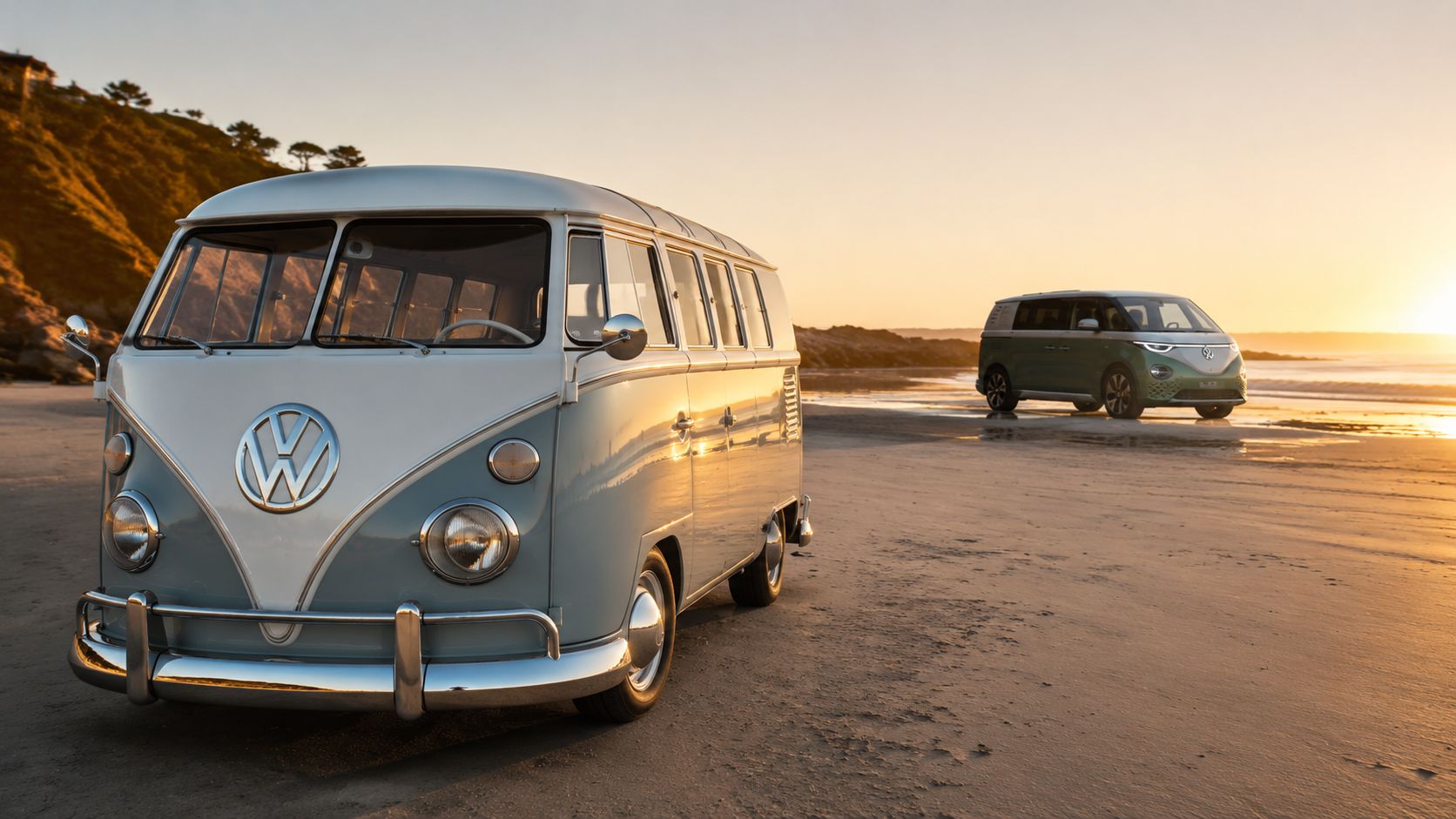
A vintage light blue Volkswagen bus parked on a beach with a modern green ID Buzz behind it.

The design cues old fans spot straight away

Stand in front of an ID. Buzz and the family resemblance jumps out before anyone mentions platforms or battery packs. The friendly face is there. The broad stance is there. So is that visual lightness people love in the old vans.

A few touches do the heavy lifting:

  • The V-shaped front recalls the classic Type 2 nose without pretending it's still the 1960s.
  • Two-tone colour schemes bring back the playful spirit that made old Kombis feel more like companions than transport.
  • The cab-forward look keeps that sense of sitting up front, looking out at the world rather than being buried in it.

More evolution than imitation

That's why the ID. Buzz works. It doesn't copy the old van panel by panel. It translates the idea. The old Kombi was honest about its era, and the ID. Buzz is honest about this one.

You can sense that long thread of intent in the shape. It feels like Volkswagen finally stopped flirting with the notion of a reborn Kombi and built one capable of a real Australian life, from suburban school runs to coast road weekends.

The Electric Heartbeat ID Buzz Specs and Performance

The clever bit about the Volkswagen ID. Buzz is that its tech doesn't need to feel intimidating. Think of it the same way you'd think about the old Kombi's mechanical personality. Back then, enthusiasts learned the engine note and the rhythm of the gearbox. Now, you learn battery range, charging habits, and how beautifully smooth an electric motor feels in traffic.

For Australia, the core numbers are straightforward. The ID. Buzz uses a 77kWh lithium-ion battery, sends 150kW to a rear-mounted electric motor, offers a WLTP-tested range of up to 450km, and comes with Volkswagen Australia's 5-year, unlimited kilometre warranty, according to the official Volkswagen Australia ID. Buzz model page. If you want a broader local look at the electric van conversation, this guide to electric van Australia adds useful context.
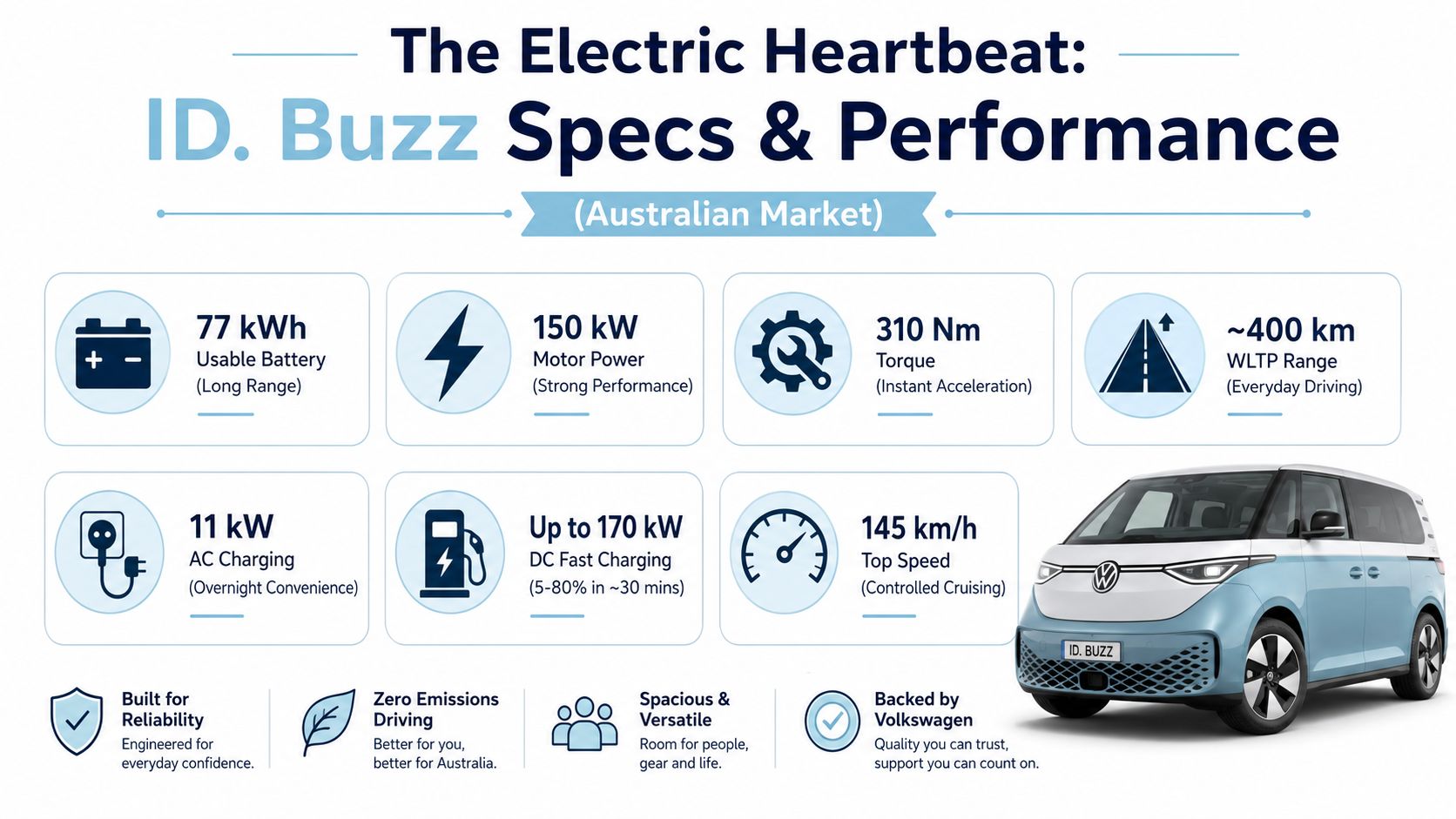
An infographic detailing the technical specifications and performance features of the Volkswagen ID. Buzz electric vehicle.

What those numbers feel like on the road

The easiest way to understand 150kW is this. You press the pedal, and the van moves with clean, immediate shove rather than building power with revs and noise. Around town, that suits the ID. Buzz brilliantly. Pulling away from lights feels effortless, and the quietness changes the whole mood in the cabin.

The up to 450km WLTP range is equally easy to frame in real life. For many owners, that's the kind of figure that covers daily driving for days at a time, then asks for a recharge when it suits your routine rather than when the vehicle starts nagging you every afternoon.

Practical rule: Treat battery size like a fuel tank and range like the distance you can expect in the right conditions. Driving style, load, weather, and road speed all shape the real outcome.

Why the warranty matters

Volkswagen's 5-year, unlimited kilometre warranty brings the sort of reassurance family buyers and long-distance drivers want. It takes some of the unknowns out of the shift from combustion to electric. If you're keen on the idea but wary of making the jump, that warranty is one of the friendliest parts of the whole package.

The result is a van that feels less like a gadget and more like a modern touring companion. It's easy to operate, easy to understand, and still has enough character to feel special every time you walk up to it.

Find Your Perfect Buzz Australian Models and Pricing

The local line-up makes decent sense. Australian buyers can choose a five-seat short-wheelbase version or a seven-seat long-wheelbase version, which means the ID. Buzz can lean either family runabout or people-mover depending on how you want to use it.

Pricing changed the conversation in a big way. Following price cuts of up to $12,000, the five-seat ID. Buzz Pro now starts at $79,990 drive-away and the seven-seat LWB sits at $84,990 drive-away, and that shift helped triple interest and lift December 2025 sales to 108 units, according to Drive's Australian ID. Buzz sales report. Buyers comparing local offers may also find this breakdown of Volkswagen ID. Buzz Australia price handy.

Volkswagen ID. Buzz Australian Models at a Glance (2026)

Feature ID. Buzz Pro (SWB) ID. Buzz Pro (LWB)
Seating 5 seats 7 seats
Wheelbase Short-wheelbase Long-wheelbase
Drive-away price $79,990 $84,990
Best suited to Smaller families, urban use, weekend touring Larger families, extra passenger flexibility

Why the pricing shift matters

This isn't only about shaving money off the sticker. It changes who can realistically consider one. The ID. Buzz went from being something people admired from a distance to something more buyers could pencil into the family spreadsheet.

And the sales movement gives that story some weight. A model that recorded 108 unit sales in December 2025, after a slower start earlier in the year, looks like a vehicle finding its audience rather than fading as a curiosity. That matters if you're the sort of buyer who likes knowing your quirky choice is also gaining local traction.

A simple way to think about it is this:

  • Choose SWB if you want the tidier footprint and don't regularly need the extra row.
  • Choose LWB if your life involves more passengers, more flexibility, or a bit more people-moving duty.
  • Watch the market closely because the recent adjustment shows Volkswagen is serious about giving the model a stronger foothold here.

Old Soul New Body ID Buzz vs Classic Kombis
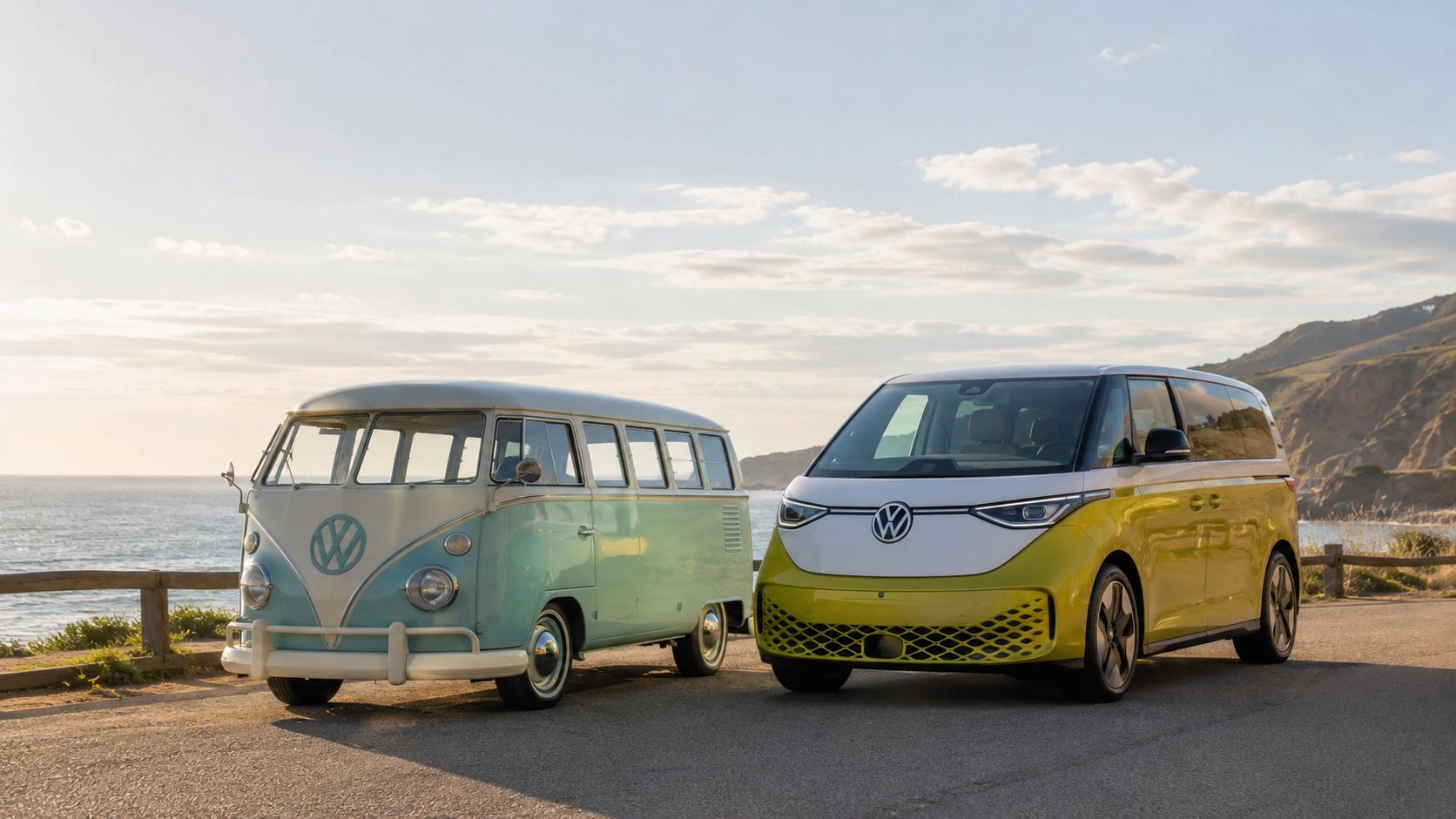
A classic light blue and white Volkswagen van parked next to a modern yellow and white ID. Buzz electric van.

No one who loves old Volkswagens needs to be told that a classic Kombi has its own heartbeat. The steering talks back. The cabin smells like old vinyl, warm metal and adventure. The engine doesn't hum politely. It chatters and works for its living.

The historical line is part of that affection. The second-generation Volkswagen Kombi entered production in 1967, the third-generation followed in 1979, and later the line gave way to the Transporter and Caravelle in Australia, as outlined in this history of the Volkswagen Kombi van.

Same spirit, different soundtrack

The ID. Buzz doesn't try to recreate the mechanical theatre of an old bus. It captures the social side instead. You still sit high. You still get that broad, airy view. You still feel like the vehicle wants to be part of a trip rather than merely complete one.

That's the true bridge between generations. A classic Kombi makes every drive feel slightly ceremonial because it asks something of you. The ID. Buzz makes every drive feel easy, but still memorable, because it keeps that warm, open-hearted sense of occasion.

For a moving side-by-side impression, this clip shows the family connection from another angle.

A Splitty, a Bay, and an ID. Buzz all answer the same question in different accents: how do you make travel feel cheerful?

If you're a purist, you won't confuse them. You shouldn't. But if you love what Kombis have always represented, freedom, friendliness, and a touch of playfulness, the lineage is easy to see.

Living the Dream What to Expect Owning an ID Buzz

Owning an ID. Buzz in Australia looks best when you're realistic from day one. Home charging is the quiet hero because it turns the van into something you top up while you sleep or while the house is already switched on and humming along. Public charging is still useful, especially on longer runs, but the easiest ownership rhythm starts at home.

The most useful reality check comes from other owners. Australian owners have reported that real-world range can fall to around 300 km in cold weather, especially if they're sticking to the recommended 80% daily charging limit, which is worth remembering in southern-state winters compared with the official range figure, based on owner discussion in this Australian ID. Buzz community post. If you like the idea of eventually turning the modern van dream into a touring lifestyle, the idea-rich world of the ID Buzz camper is easy to get lost in.

Everyday habits that make ownership easier

A few habits help quickly:

  • Charge around your week rather than waiting for the battery to get low.
  • Expect winter variation if you live in Melbourne, Canberra, Hobart, or colder inland pockets.
  • Use the official service rhythm to keep ownership simple. Volkswagen Australia specifies service intervals every 30,000km or 24 months on the local ID. Buzz range, as noted earlier from the official model information.

Honest expectations make happy owners

The ID. Buzz establishes trust because it doesn't need fantasy to be appealing. For many households, a realistic winter estimate and a simple home-charging routine are enough to make the van feel easy.

In mild conditions, range worries fade quickly. In colder weather, planning matters more than optimism.

That sort of honesty is good for buyers and good for the broader VW community. The old Kombi crowd has always respected practical knowledge, and the electric era deserves the same straight talk.

Start Your Collection The ID Buzz and VW Memorabilia

Every time Volkswagen launches a vehicle that stirs emotion, collectors respond almost instinctively. The ID. Buzz feels made for that response because it sits at such a lovely meeting point. It's recognisably linked to the classic vans people already treasure, yet distinct enough to deserve its own place in a display cabinet.

For collectors, that opens up a fun way to tell the whole Volkswagen story on a shelf. You might line up a classic Beetle model beside a 1962-style Samba Bus diecast, then finish the row with an ID. Buzz to show how the design language travelled from rear-engine simplicity to electric modernism.
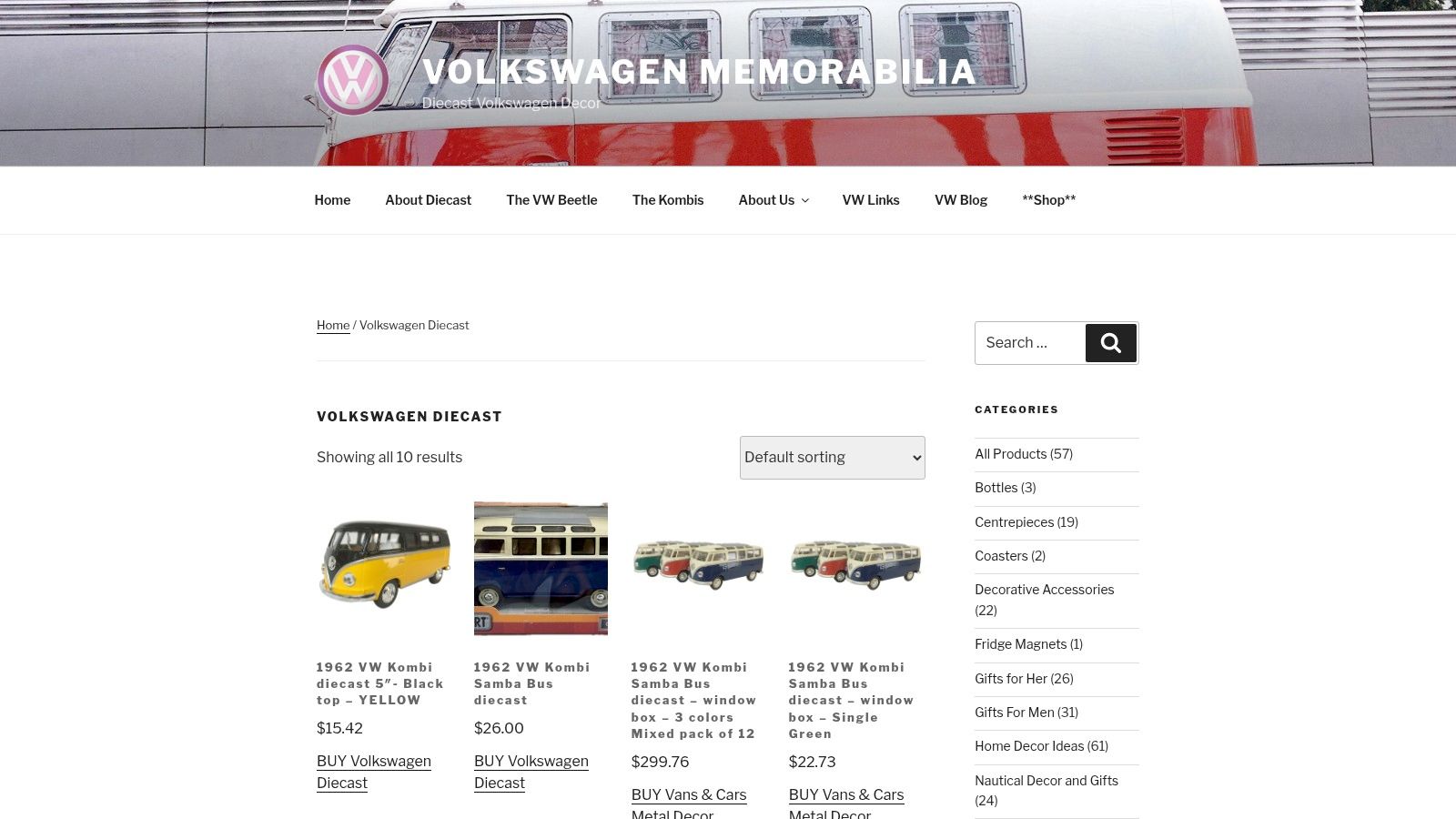
Screenshot from https://vwmemorabilia.com.au/product-category/volkswagen-diecast/

Display ideas that feel personal

Collectors don't need giant rooms or museum budgets. A strong display usually comes down to theme.

  • Timeline shelf with Beetle, early Kombi, Bay Window and ID. Buzz in order.
  • Beachy corner display using surf-themed VW pieces, pale timber shelving and coastal décor.
  • Gift pairing where a licensed Volkswagen Beetle model sits with a Kombi diecast for a birthday or Father's Day present.

What to look for when buying

If you're shopping for VW Kombi diecast Australia, Volkswagen Beetle model pieces, or newer Volkswagen diecast models for sale, a few basics matter most:

  • Licensed branding matters because it gives the piece proper credibility for long-term collecting.
  • Finish and paint detail can make a modestly sized model feel premium.
  • Local stock is a genuine advantage for Australian buyers who want faster shipping and easier support.
  • A balanced collection often looks better than chasing one era only. Old and new Volkswagens play brilliantly together.

That's the charming twist with the ID. Buzz. It isn't only a new car. It's already part of the memorabilia story, joining the Beetles and Kombis that have filled cabinets, workshops and study shelves for years.

FAQ

Is the Volkswagen ID. Buzz sold in more than one Australian body style?

Yes. Australian buyers can choose a five-seat short-wheelbase version and a seven-seat long-wheelbase version, as covered in the local pricing section above.

What's the official Australian range figure for the ID. Buzz?

Volkswagen Australia lists the ID. Buzz with a WLTP-tested maximum range of up to 450km on the official local model page linked earlier.

Does real-world range always match the WLTP figure?

Not always. Owner reports in Australia suggest colder weather and an 80% daily charging limit can bring practical range closer to around 300 km in winter conditions.

How often does the ID. Buzz need servicing in Australia?

Volkswagen Australia specifies 30,000km or 24 months service intervals for the local ID. Buzz range.

Why does the ID. Buzz matter to collectors?

Because it bridges eras beautifully. It gives collectors a modern electric chapter that still belongs naturally beside classic Kombi and Beetle memorabilia.


If the Volkswagen ID. Buzz has you feeling keen to celebrate both the old-school classics and the electric future, have a wander through Volkswagen Memorabilia. It's a terrific Australian source for licensed VW memorabilia collectibles, from Kombi Samba Bus diecast and Beetle models to gift-worthy display pieces, with the local-stock advantage of fast shipping and friendly support for Aussie collectors.

Volkswagen Kombi 2024: New Volkswagen Kombi 2026: ID. Buzz

You're probably here because someone at a cars-and-coffee, swap meet, or local VW show mentioned a “volkswagen kombi 2024” and the conversation immediately went sideways. One person meant the electric ID. Buzz. Another meant the latest Transporter. Someone else was talking about a diecast release. And the old-school purist in the corner was hoping for an air-cooled miracle.

That mix-up is completely fair. In Australia, “Kombi” still means much more than one exact badge. It means road trips, surfboards, family memories, trade vans, camping weekends, and that unmistakable shape that makes people smile before they even know why.

So let's sort it out properly, in plain English, with an Aussie enthusiast's eye. The Kombi story in 2024 isn't about one single van. It's about how the badge's spirit now lives across modern Volkswagen vans, electric nostalgia, and the collectibles that keep the legend close at hand.

The Great Kombi Comeback or Just a Rumour Mill?

At any decent VW gathering, this topic comes up fast. Someone says, “Have you seen the new Kombi?” and suddenly half the group is picturing split screens, safari windows and two-tone paint, while the other half is thinking batteries, touchscreens and LED lights.

Two men standing in front of a classic teal and white Volkswagen Kombi van at a car show.

That's the heart of the confusion. In Australia, people often use Kombi as a broad, affectionate label for Volkswagen's van family. The historic original is one thing. The current showroom reality is another. In 2024, Volkswagen Commercial Vehicles reported 404,412 global deliveries, down 4.3% year on year, while the wider Brand Group Core reported 88.26 billion euros in sales revenue and an operating result of 2.59 billion euros after restructuring pressures, according to Volkswagen's 2024 Brand Group Core results.

Why Aussies keep saying Kombi anyway

For local enthusiasts, the word isn't just about badge accuracy. It's shorthand for a whole style of VW motoring.

  • Classic fans still mean the original Type 2 and all its charm.
  • Modern buyers often mean the current van line that carries the same practical spirit.
  • Collectors might mean the models, art, and replicas that keep the old look alive.

The Kombi never really disappeared from conversation in Australia. The meaning just widened.

If you're drawn to the modern electric take on the idea, a VW ID. Buzz camper-inspired collectible shows how strongly that shape still connects old memories with new design.

The rumour versus the reality

There wasn't a surprise return of the old air-cooled Kombi in 2024. What did happen is more interesting. Volkswagen pushed the van lineage forward in two directions. One is retro-flavoured and electric. The other is practical, load-focused and work-ready. Both matter if you care about what “Kombi” means now.

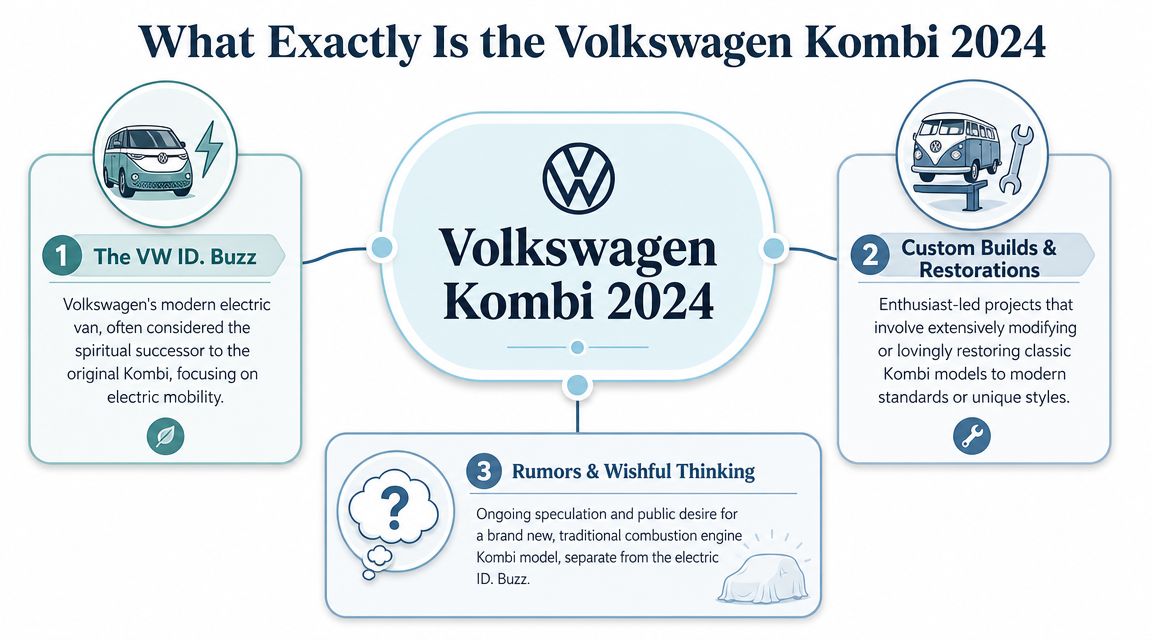
What Exactly Is the Volkswagen Kombi 2024

The cleanest way to understand volkswagen kombi 2024 is to split it into three meanings people commonly use. Once you do that, the fog lifts pretty quickly.

An infographic titled What Exactly Is the Volkswagen Kombi 2024 explaining the ID. Buzz, restorations, and rumors.

Meaning one, the ID. Buzz

This is the one that grabs attention first. The ID. Buzz is the emotional heir. It looks back to the old bus shape, but it does it with a modern electric platform and a much more family-focused brief.

A key point for Australian families is usability, not just style. Volkswagen's launch material says the long-wheelbase Pro S has a second-row bench and seats up to seven passengers, while the 1st Edition AWD uses captain's chairs and seats six, according to Volkswagen's ID. Buzz launch material. The same material lists range figures of 234 miles for the rear-wheel-drive Pro S and 231 miles for the 4Motion AWD.

That sounds clear enough until you start asking real-life questions. Can it take school bags, sports gear and a pram without becoming a game of interior Tetris? That's where many headlines stop short.

Meaning two, the latest Transporter family

If you're thinking less about nostalgia and more about the direct continuation of the old Kombi's practical role, the Transporter is the direct descendant. It sits in the same workhorse-meets-lifestyle territory that Australians have long associated with the Kombi name.

A major 2024 milestone was the seventh-generation Transporter reveal at IAA Transportation 2024, detailed in Volkswagen's IAA Transporter announcement. Volkswagen said the long-wheelbase version can fit three Euro pallets, and the maximum trailer weight rises to 2.8 tonnes, up from 2.5 tonnes previously. It also added a plug-in hybrid eHybrid producing 171 kW, plus diesel engines with 310 Nm and 360 Nm torque outputs, with more torque in higher-output variants.

Meaning three, the collectible world

For plenty of enthusiasts, “Kombi 2024” doesn't mean a showroom vehicle at all. It means the latest crop of model vans, display pieces and giftable memorabilia inspired by the classic buses we all know.

That's not a lesser form of enthusiasm. For many people, it's the most realistic way to enjoy the shape, colour and heritage every day.

What people say What they usually mean
“New Kombi” The ID. Buzz
“Kombi van for work” The Transporter or Kombi/Crew Cab format
“2024 Kombi model” A diecast or memorabilia release
“I wish VW made the old one again” Rumour and wishful thinking

Practical rule: Before you judge the “new Kombi”, ask which Kombi people are actually talking about.

Meet the New Generation Vans for Aussie Roads

For Australian buyers, the choice isn't old versus new. It's which kind of new VW van suits your life.

The Transporter as the true do-everything van

The Australian-spec Transporter Kombi/Crew Cab is still the clearest modern version of the old mixed-use Kombi idea. Volkswagen Vans lists it with seating for up to 6 people, payload up to 1,078 kg, and load length up to 2,032 mm, according to Volkswagen Vans Transporter Kombi specifications.

That tells you a lot straight away. It's not pretending to be a soft lifestyle van. It's built for people who need to carry humans and gear in the same vehicle without compromise becoming the whole story.

The next-generation Transporter also launched with up to 1.33 tonnes payload, up to 2.8 tonnes towing capacity, and three new 2.0-litre TDI outputs of 81 kW, 110 kW and 125 kW, as outlined in the earlier 2024 Volkswagen commercial vehicle reporting. For Aussie use, that matters if your weekends involve a trailer, a camper, tools, boards, or a long haul where diesel practicality still makes sense.

If that modern van lane interests you, the broader idea is nicely reflected in this look at the electric van trend in Australia.

The ID. Buzz as the style-first family mover

The ID. Buzz takes a different path. It's the van for the person who loves the old bus silhouette but wants an EV with flexible seating and a more premium family feel.

An Australian review noted that the ID. Buzz includes radar cruise, lane-keeping, blind-spot warning, rear cross-traffic alert and parking sensors, but also flagged missing items such as a 360-degree camera and rear autonomous emergency braking. The same review says the ID. Buzz starts at A$59,995 before on-road costs, with destination at A$1,550, and an AWD 1st Edition at A$69,995, according to Drive's 2024 Volkswagen ID. Buzz review.

That's why Aussie buyers keep asking whether it's a true people-mover substitute or more of a design-led family EV.

A simple Aussie-minded comparison

  • Choose the Transporter if your first question is “What can it carry or tow?”
  • Choose the ID. Buzz if your first question is “Will my family love living with it every day?”
  • Choose carefully if you want one vehicle to be both a heavy-duty work van and a premium EV people mover. Those goals don't always line up neatly.

For Collectors The Best VW Diecast Models

Not everyone can bring home a full-sized van. Plenty of us scratch the itch by collecting the next best thing. And a well-made VW model can deliver a lot of joy for a lot less shed space.

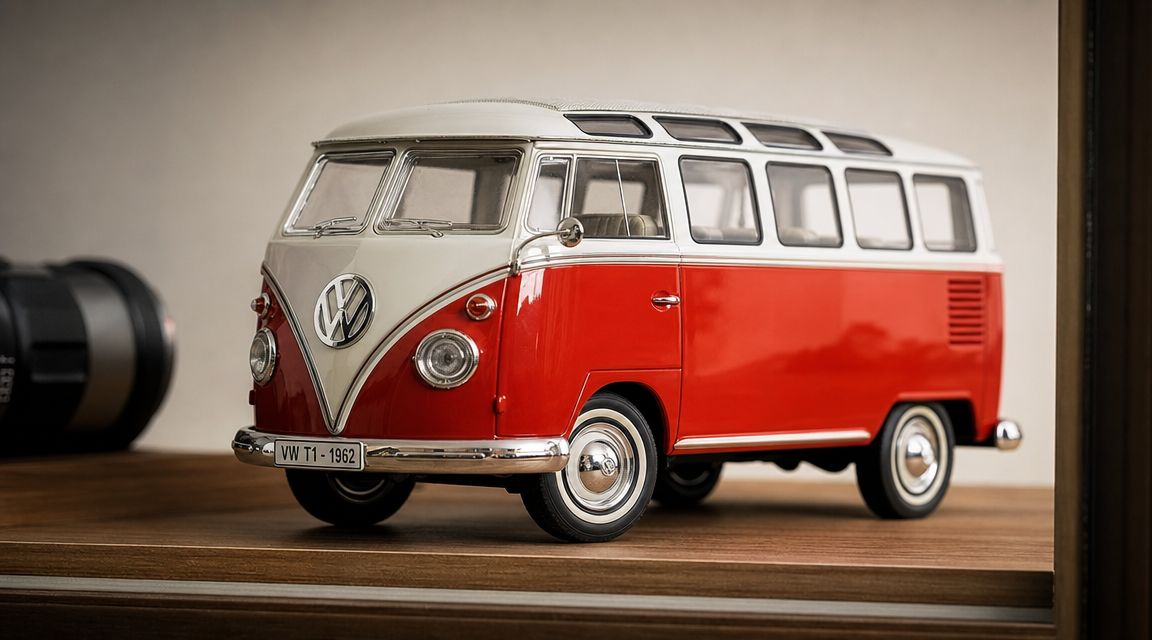
A detailed model of a red and white 1962 Volkswagen T1 camper van on a wooden surface.

The beauty of diecast is that it lets you enjoy the most loved eras of VW history side by side. A split-window Samba. A cheerful Beetle. A surfy camper. Even a modern-inspired van can sit in the same display and still feel part of the same story.

What makes a Kombi model worth collecting

Collectors usually care about a few things more than flashy packaging.

  • Body shape accuracy matters first. If the roofline or window layout looks wrong, you'll spot it from across the room.
  • Licensed detailing gives a model that proper Volkswagen feel.
  • Colour and theme often decide whether a piece feels factory-clean, surf-culture fun, or properly nostalgic.
  • Display fit is practical. Some collectors want a hero piece. Others want a shelf full of mixed scales.

A good place to browse that style range is Volkswagen model cars in different themes and formats, especially if you enjoy classic Kombi and Beetle designs more than generic toy-shop pieces.

Classic shapes still win hearts

The reason Kombi diecast remains popular is simple. The old van shape has warmth. It feels friendly on a shelf in a way few vehicles do. The 23-window Samba Bus style, in particular, still has that instant “stop and have a look” quality.

A detailed VW model works best when it does more than copy a vehicle. It should bring back a memory, a road trip, or a person.

If you enjoy watching collector-style walkarounds and model appreciation, this clip suits the mood nicely.

Good collecting habits beat impulse buying

A smart collection usually grows around a theme. That theme might be classic buses, beach colours, Beetles, or a mix of old and new VW design.

Try one of these approaches:

  1. The heritage shelf
    Focus on classic Kombis and Beetles only.

  2. The coastal look
    Pick surf-inspired colours, campers and playful flower-power pieces.

  3. The timeline display
    Put early bus designs beside later interpretations so the evolution is easy to see.

  4. The giftable collection
    Smaller models, magnets and decor pieces that are easy to wrap and fun to receive.

Styling Your Life with That Kombi Cool

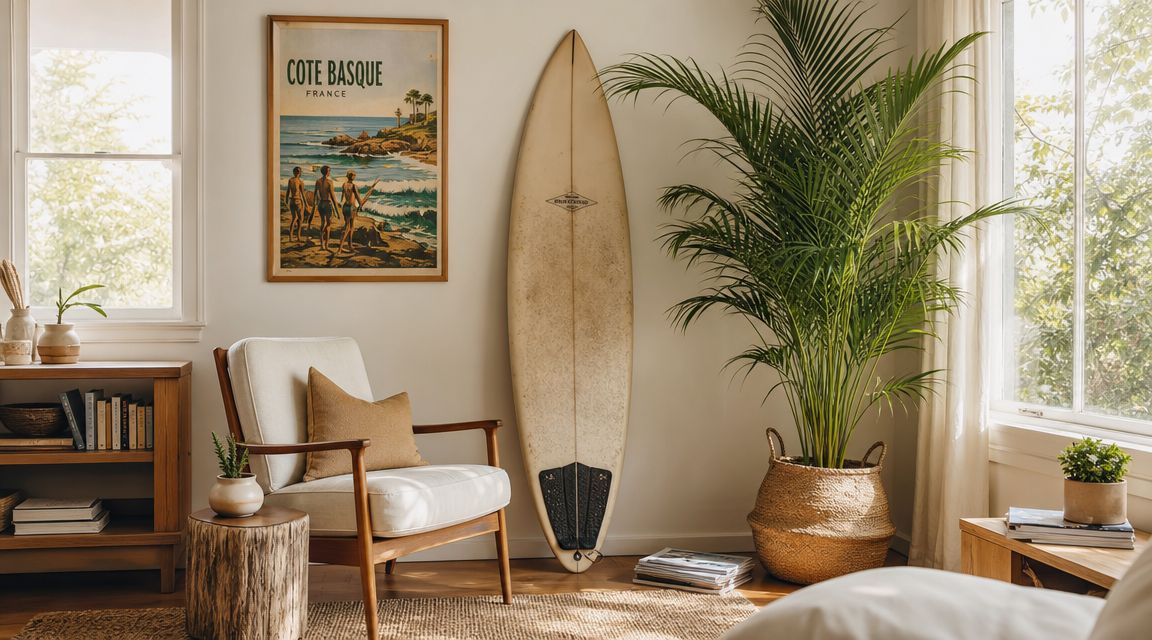
The Kombi has always been bigger than the vehicle itself. It's a mood. Relaxed, colourful, adventurous, a little nostalgic, and very at home in Australian coastal style.

A coastal-inspired living room with a surfboard, a cozy armchair, and a large indoor palm plant.

Easy ways to bring that feeling home

You don't need a garage queen or a full display room to enjoy VW style at home. A few well-chosen pieces can do the job.

  • Start with one focal piece such as a Kombi model or metal van decor item on a shelf or console.
  • Build around colour. Teal, cream, red, pastel tones and beachy neutrals all suit VW-inspired spaces.
  • Mix memories with memorabilia by pairing model vans with travel photos, old rally snaps or family beach shots.
  • Keep it breathable. Kombi styling works best when it feels relaxed, not crowded.

Where it works best

A Kombi-inspired look can suit more rooms than people realise.

Space What works well
Living room Statement model, framed coastal prints, subtle VW decor
Home office A neat diecast lineup and one conversation-starting hero piece
Kids' room or rumpus Colourful Beetle and Kombi models with surfy accents
Gift corner Small collectables ready for birthdays, Father's Day or Christmas

A good display feels lived-in, not staged. That's very Kombi. A bit of sunshine, a bit of colour, and something with a story behind it.

Keeping the Unstoppable Kombi Spirit Alive

So what is volkswagen kombi 2024 for an Australian enthusiast? It's not one single answer, and that's the beauty of it.

For some, it's the ID. Buzz, carrying the old bus silhouette into the electric age. For others, it's the Transporter, still doing the hard yards as a proper van with modern capability. And for plenty of us, it's also the world of collectibles and display pieces that lets the legend live on without needing a second car space at home.

That's why the Kombi still matters. It connects generations of VW fans who don't all want the same thing, but who recognise the same spirit when they see it. Freedom. Practicality. Personality. Community.

You can hear it in the chat around a show field. You can see it in a family loading up for a weekend away. And you can feel it when a tiny diecast bus on a shelf somehow brings back a whole era.

Quick answers enthusiasts often ask

Is there a brand-new old-school Kombi in 2024?

No. The modern conversation is really about the ID. Buzz and the latest Transporter family, not a revived air-cooled original.

Which modern VW is closest to the old Kombi idea?

If you mean practical, mixed-use van duty, it's the Transporter. If you mean nostalgic design with a modern electric twist, it's the ID. Buzz.

Is the ID. Buzz the better family choice?

It depends on what your family needs most. The styling and seating flexibility are attractive, but many buyers also want to weigh missing convenience and safety items noted in local review coverage.

Why do collectors still love the classic Kombi most?

Because the original shape has charm that's hard to beat. It's playful, recognisable, and tied to decades of memories.


If you'd like to bring that VW spirit home, have a look through Volkswagen Memorabilia. It's a terrific local spot for VW Kombi diecast Australia shoppers, gift buyers, and anyone chasing Volkswagen diecast models for sale, classic Beetle pieces, or coastal VW-inspired decor. With local stock and fast Australian shipping, it's an easy way to find a Kombi or Beetle collectible that feels right at home on your shelf, desk or gift table.