


You've got a piece of driftwood by the back door, a jar of shells from the last beach walk and a rope coil that's been waiting for a purpose. The temptation is to throw them on a shelf, add a blue cushion and call the room coastal. That works for a season, but salt air, harsh sun, damp corners and unsuitable fixings can turn a charming display into a faded, rusty mess.
The best DIY nautical decor ideas for Australian homes balance maritime character with material performance. Reclaimed timber, harbour maps, natural rope, shells and lantern-style details can feel relaxed and nostalgic, but they need to suit the room, the local exposure and the way your household lives.
Why Nautical Decor Fits the Australian Coastal Lifestyle
Australia's relationship with the coast is more than a decorating trend. More than 80% of Australians live within the coastal zone, according to Geoscience Australia's coastal population research. The same source records approximately 700,000 residences within 3 kilometres of the shoreline and less than 5 metres above mean sea level.
That helps explain why nautical styling works in a compact suburban flat, a harbour townhouse or a weatherboard beach house. You don't need a huge verandah or uninterrupted ocean views. A framed map above a console, a wall-mounted oar in a hallway or blue-and-white textiles on a sofa can establish a coastal mood without taking up floor space.
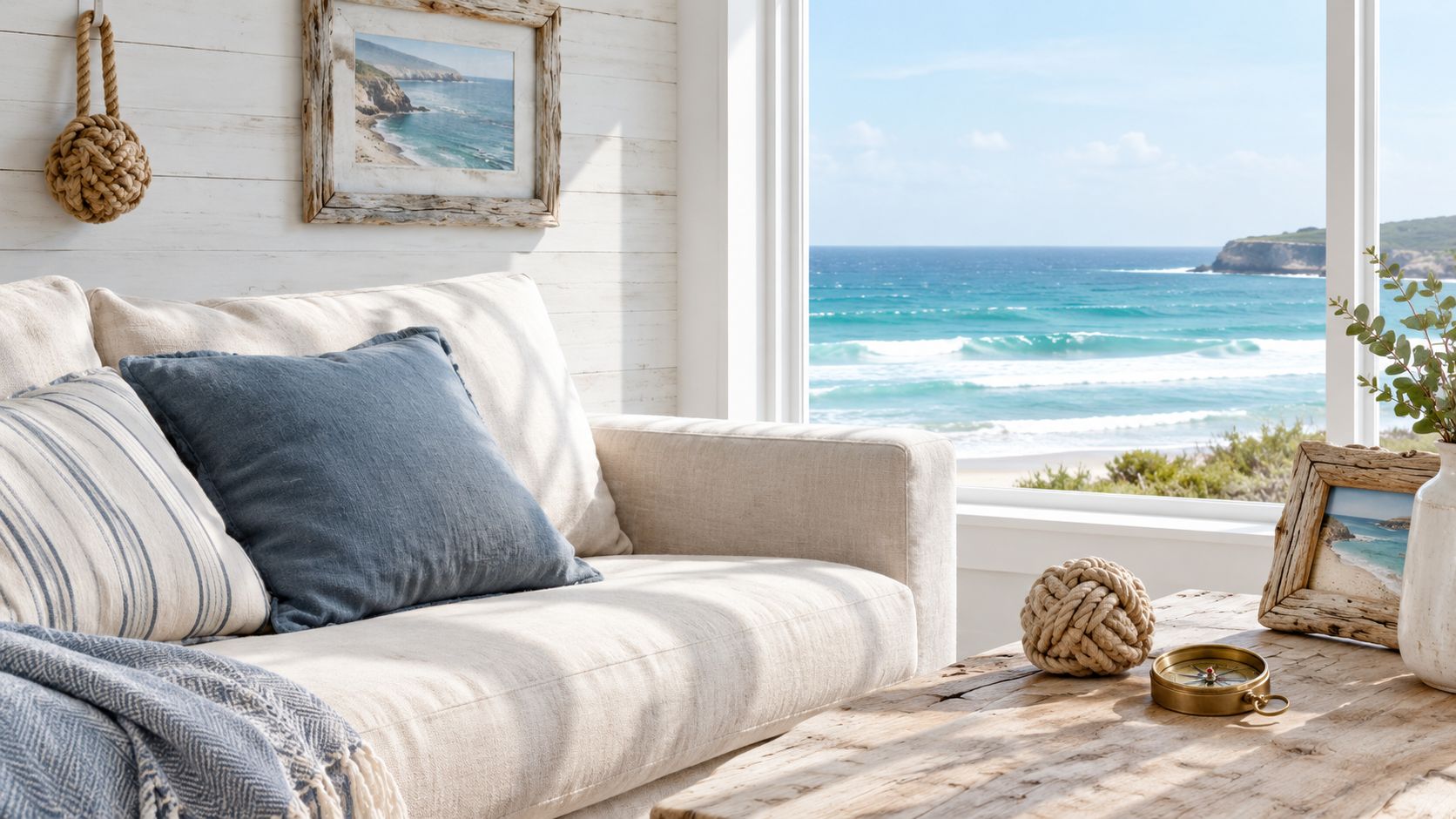
Build a local story into the room
A generic anchor motif can look pleasant, but Australian nautical decor becomes far more engaging when it reflects the places and stories around you. Surf culture, fishing communities, working harbours, river transport and lighthouse towns all offer visual references that feel familiar rather than imported.
Australia's maritime history gives you plenty to draw from. A National Maritime Museum research publication documents 71 designated maritime museums and collections, along with 232 sites or associations preserving maritime heritage across the country. Its records include connections to ports, navigation, shipbuilding, fishing and river transport, so a handmade display can reference much more than shells and sand.
A Queensland-inspired arrangement might use sun-washed timber, tropical ocean colours and a small sailing motif. A display influenced by a Victorian or New South Wales harbour could lean towards navigation charts, darker timber and working-vessel details. Even a simple signal-flag panel can give a wall display a sense of purpose.
Design principle: Choose one local reference, one natural material and one practical object. The result usually feels more authentic than filling a room with matching beach ornaments.
For a relaxed room with a surf-and-road-trip sensibility, these coastal home decor ideas can help you combine nautical details with nostalgic Australian styling. Keep the palette restrained, then let one or two handmade pieces carry the personality.
Choosing Materials That Survive Salt Air and UV Exposure
A material that looks weathered in a shop isn't necessarily weather-resistant. Near the coast, salt-laden air, humidity and ultraviolet exposure can attack timber coatings, adhesives, rope, paper, painted surfaces and ordinary metal hardware.
Start by classifying the installation site. The Western Australian Government's corrosion protection guidance recommends assessing corrosivity under AS 4312. Locations within 5 kilometres of a coast, tidal river, wetland or industrial area may need stronger corrosion protection than an inland room.
Match the build to the exposure
For an indoor wall away from open windows, a sealed hardwood frame and quality picture hardware may be sufficient. A bright bathroom, enclosed balcony or covered alfresco area needs more care. Use the following as a practical starting point:
- Choose sealed hardwood or a corrosion-resistant substrate: Seal end grain before assembly, because exposed end grain absorbs moisture quickly.
- Use 316 stainless-steel fixings: Screws, D-rings and hanging hardware made from 316 stainless steel are better suited to salt-exposed rooms than ordinary mild steel.
- Close every penetration: Seal drilled holes and cut edges so moisture can't travel behind the finish.
- Allow air to move: Don't trap condensation behind shells, rope, metal ornaments or a frame pressed tightly against a damp wall.
- Inspect seasonally: Wipe salt from sheltered hardware with fresh water, then dry it thoroughly. Salt often remains on protected surfaces that rain doesn't wash clean.
Dissimilar metals create another avoidable problem. Decorative brass paired with mild-steel fasteners and aluminium components can accelerate galvanic corrosion in salty, damp conditions. Keep metal combinations deliberate, and follow the coating requirements supplied by the product manufacturer.
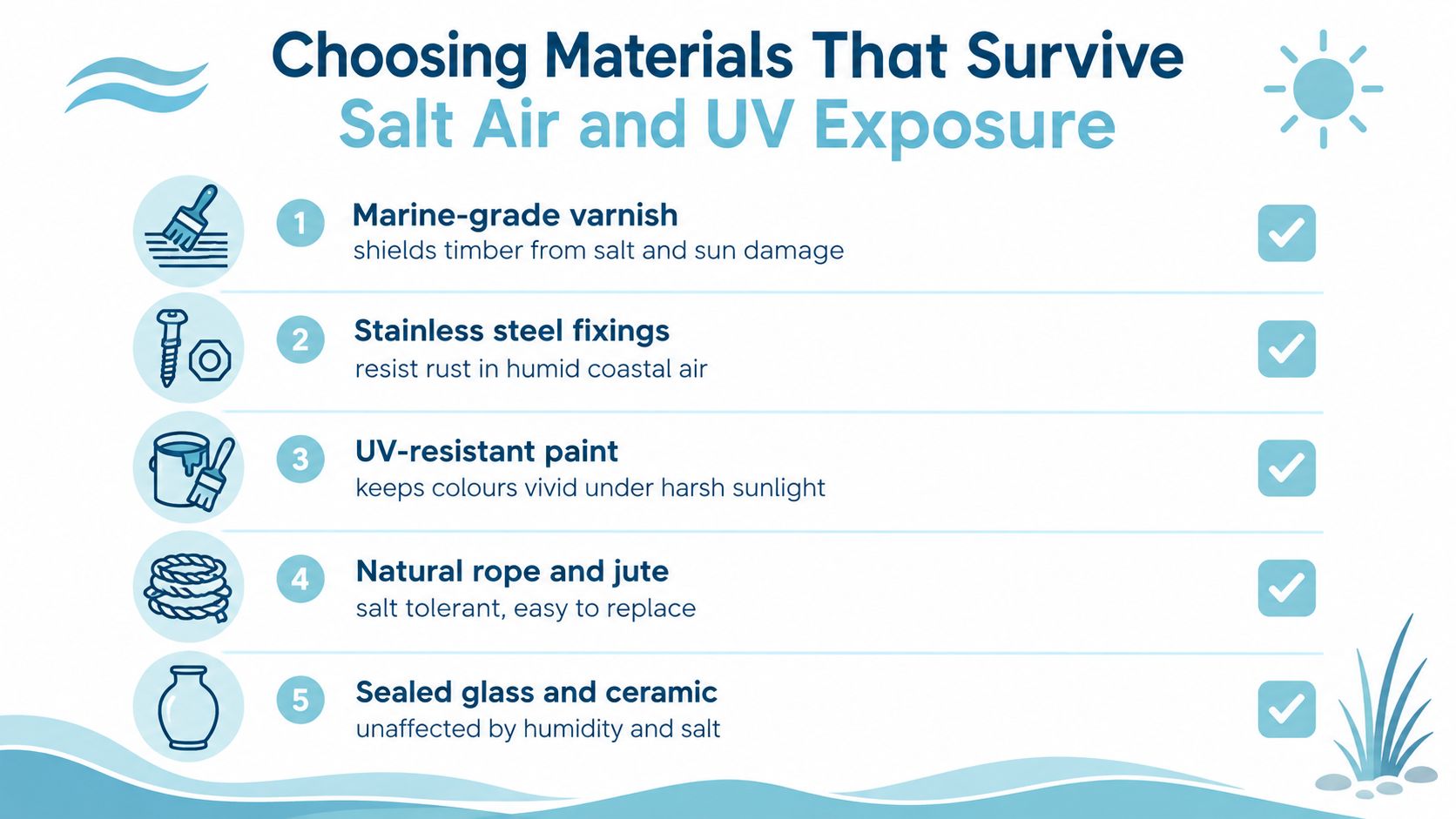
UV deserves equal attention. Paper charts can fade near a sunny window, ordinary paint can chalk and fabric rope can become brittle. Keep vulnerable materials indoors where possible, use a suitable clear protective coating and make exposed pieces removable so you can bring them inside during severe weather or rotate them away from direct sun. For smaller decorative pieces, nautical wall art for bathrooms can inspire moisture-conscious arrangements, but the same material checks still apply.
Three Practical DIY Nautical Projects for Every Room
The strongest nautical pieces usually have a reason to exist. A harbour chart can recall a favourite port, a rope mirror can suit an entryway and a shell arrangement can preserve the feeling of a beach walk without turning the room into a souvenir shop.
Wood is particularly effective because it connects directly with boatbuilding history. Before industrial manufacturing moved towards iron and later steel, ships were predominantly built from timber. The Maritime Heritage Association's discussion of wooden boatbuilding explains why reclaimed timber can suggest genuine maritime tradition rather than merely looking old.
Reclaimed timber harbour display
Use a clean reclaimed board, a printed harbour map, a small vessel model, natural rope, stainless-steel D-rings, fine sandpaper, a drill and a suitable timber sealer. Check the board for mould, pests, splinters and old coatings before sanding. If you can't identify the coating, don't aggressively sand it until you've established that it's safe to disturb.
Cut the board to a manageable size, soften the edges and seal every face, including the ends. Mount the map on a removable backing rather than gluing it permanently to the timber. Add a vessel model or a small navigation detail, then finish with a short rope loop or a restrained metal accent.
The Port Adelaide Nautical Institute offers a useful historical reference. It began in 1851 as a subscription library and started building a museum collection in 1872, as recorded in this National Maritime Museum publication on the institute's history. A small caption naming the port can give your display more meaning.
Rope-wrapped mirror
Start with a plain mirror, natural jute or hemp rope, a sharp utility knife, a low-odour adhesive suited to the frame material and a small brass-look compass or signal-flag detail. Lay the rope out first and test the pattern. A neat, tight wrap works better than a loose bundle, particularly in a bathroom where dust and moisture can collect between strands.
Apply adhesive in short sections, keeping the rope aligned as you work. Don't cover ventilation gaps or create a thick rear edge that prevents the mirror from sitting flat. Finish with one small maritime accent rather than several competing ornaments. For a coastal entryway, add a concealed hanging point and keep the mirror light enough for a secure wall fixing.
Shell and driftwood centrepiece
Use a sealed timber plinth, cleaned shells, a small lantern-style ornament and a piece of sound driftwood. Avoid placing shells where water can sit underneath them, and use removable museum putty or discreet mechanical retainers if the arrangement needs to travel.
A lantern can suggest lighthouse history without wiring anything into the house. Keep the feature purely decorative unless a licensed electrician handles any electrical modification. The finished centrepiece belongs on a console, coffee table or covered outdoor setting, but natural materials should come inside during prolonged wet weather.
For a lighter wall arrangement, shell wall art shows how shells can become a focused feature rather than loose clutter. The same principle applies to handmade work. Give each object breathing room, use one dominant shape and make maintenance straightforward.
Making Nautical Decor Low-Waste and Environmentally Smart
A beach-themed room can celebrate the ocean while relying heavily on disposable plastic. That contradiction deserves more attention. About three-quarters of rubbish on Australian coastlines is plastic, and Australian Parliament material summarising CSIRO findings notes that debris is concentrated near urban areas and largely comes from domestic, land-based sources.
That doesn't mean every synthetic material has an immediate alternative, but it does mean you should question decorative pieces that are designed to be replaced rather than repaired.
A practical material-impact check
Before buying supplies, ask:
- Can I source it second-hand? Look for timber offcuts, old frames, used mirrors, metal trays and retired boating hardware.
- Can I repair it? Choose screws, knots and removable mounts over permanent glue where practical.
- Will it shed or degrade? Avoid glitter, PVC ornaments, disposable plastic shells and poorly sealed foam.
- What happens to the offcuts? Separate timber, metal, glass and general waste so usable materials can be stored or recycled appropriately.
- Does the coating suit the room? Check paint, varnish and adhesive labels before applying them indoors or near moisture.
Natural rope, recycled glass, second-hand metal and responsibly sourced timber can provide plenty of texture without adding more plastic ocean imagery. Reclaimed boards also bring marks and variation that manufactured “distressed” finishes often imitate poorly.
Design for removal and repair
A removable wall panel is more sustainable than permanently bonding shells to plaster or timber. Use a backing board, mechanical clips or reversible hanging points so you can replace a faded map, repair a broken rope section or rearrange the display when you move house.
The same approach works for a centrepiece. Keep shells in a shallow tray or on a sealed plinth, rather than gluing every piece into a fixed sculpture. If a component fails, you can replace that part without throwing away the whole project.
A coastal aesthetic should remind you of the ocean, not reproduce the waste problem found along its edges.
Buy-used-first sourcing also makes the work more personal. A second-hand timber frame from a local shop, an old metal object from a working harbour or a found piece of sound driftwood can tell a better story than a shelf of identical plastic anchors.
Safe Installation Practices for Coastal Home DIY
Beautiful materials won't compensate for a weak fixing. Before hanging an oar, model boat, rope installation or glass-filled display, weigh the complete object, including shells, backing boards and hardware. Choose a fixing rated substantially above that total load, then anchor into a stud or suitable masonry plug rather than relying on plasterboard alone.
Add a secondary retention cord where a falling object could injure someone. This is especially useful above seating, beds, stairs and children's areas. Keep the construction reversible where possible, so you can inspect the wall, replace corroded hardware or remove the display before a storm.
Use the right fixing for the wall
- Stud-mounted displays: Use a screw long enough to achieve a solid bite into the timber, while avoiding hidden services.
- Masonry walls: Select a masonry plug and screw combination matched to the wall material, then drill cleanly and remove dust from the hole.
- Plasterboard-only locations: Use a load-rated cavity fixing for very light pieces, but don't hang a heavy vessel or glass arrangement from plasterboard alone.
- Balconies and alfresco areas: Account for wind movement, not just static weight. A loose rope loop can become a hazard when the air picks up.
Electrical improvisation is another serious risk. Australian guidance says rewiring, installing power points and changing light switches are generally illegal for unlicensed DIYers. If you want a lantern, sign or nautical feature to illuminate, use a licensed electrician for any modification rather than joining wires inside a decorative object.
Drilling and sanding older Australian homes also require asbestos awareness. A national DIY renovation study found that only 5% of respondents identified asbestos as a potential DIY risk, compared with 22% who identified electrical work, according to this Australian DIY safety guidance. That gap matters because suspect fibre-cement, textured coatings or unknown insulation can be disturbed during an apparently simple wall project.
Check the building's age and renovation history before drilling. Wear eye protection and a suitable dust mask, don't disturb suspect sheeting and stop immediately if you uncover unknown material. The most common serious failures in a nautical installation aren't the decorative details. They're under-rated anchors, concealed asbestos and improvised electrical connections.
Volkswagen Memorabilia brings together licensed Volkswagen diecast models, including Kombi Samba Bus and Beetle pieces, alongside coastal home décor for displays that capture Australia's relaxed beach-and-road culture. Visit Volkswagen Memorabilia to browse local stock, practical gift ideas and fast Australian shipping, then choose a piece that gives your handmade nautical display a little more character.