
Cool Your Kombi: How to Install a Fan in Roof

The day usually starts beautifully. Boards on the roof, kettle rattling in the back, salt still drying on your shoulders after a morning swim. Then the sun climbs, the breeze drops off, and your classic VW turns into a shiny little pizza oven. You slide the Kombi door open hoping for relief, and all you get is a face full of trapped heat and that familiar warm-vinyl whiff every old bus owner knows by heart.

That's the moment a lot of us start thinking about a fan in roof setup. Not because we want to modernise the soul out of an old Dub, but because we want to use it more. Longer weekends. Better sleep at the beach. Less of that sticky, restless feeling when the van should be your retreat, not your punishment.

A well-chosen roof fan can feel less like a modification and more like good stewardship. Same old Volkswagen spirit. Same freedom. Just a bit more airflow and a lot less sweating through your singlet.

That Feeling of a Hot Tin Roof

Last summer at a coastal meet, a mate parked his bay-window Kombi under what looked like decent shade. By lunchtime, the shade had shifted, the metal roof had soaked up the heat, and stepping inside felt like opening an oven door. His little pedestal fan barely moved the air. Another bloke nearby had a subtle roof vent and fan setup in his camper, and when he cracked the side window, you could feel the stale air leave.

That difference sticks with you.

A classic VW doesn't hide much. Thin panels, broad glass, plenty of sunshine pouring in. That's part of the charm. It's also why a warm afternoon can turn the cabin into a sweatbox, especially if you're camped up, making a cuppa, or trying to kip after a dawn patrol.

A person with short hair sitting in a vintage van holding a small handheld folding paper fan.

When comfort changes the trip

The best upgrades in an old Volkswagen are the ones that help you stay on the road without changing why you bought it in the first place. A fan in roof setup does exactly that. It doesn't turn your Kombi into a modern motorhome. It just gives the van a way to breathe when the air inside feels tired and heavy.

You notice it in small moments:

  • After a surf your towel dries instead of going musty in a corner.
  • At bedtime the cabin feels liveable instead of stale.
  • At sunrise you wake up fresher, not damp and grumpy.

Some upgrades are about horsepower. This one's about staying one more night by the water.

That's why roof fans have earned such a loyal following among campers and tourers. They help the van work with the weather instead of copping it square in the face.

Why Your Classic Dub Needs to Breathe

Heat is only half the story. The bigger reason many old VW owners look into a fan in roof setup is preservation.

Every classic Dub carries its age in quiet places. Under trim. Around window rubbers. In timber cabinetry. Behind wall linings. Warm air and trapped moisture love those hidden spots, and they don't care how tidy your restoration is.

Heat, moisture and the old metal box problem

A metal-bodied camper parked in Australian conditions can hold heat long after the sun drops. Add two people sleeping inside, maybe a kettle on in the morning, maybe wet bathers hanging from a hook, and the air gets muggy fast. That moisture settles where you don't want it.

Condensation isn't just annoying on glass. Over time, it can encourage mouldy smells, damp fabrics and the kind of creeping corrosion that makes old-vehicle ownership more expensive and less fun.

If you've already worked on van insulation ideas for campers, you'll know insulation and ventilation belong in the same conversation. One helps slow heat transfer. The other helps move stale, damp air out before it hangs around too long.

A fan isn't the whole answer

Ventilation has long been treated as a measurable part of building design, not a decorative extra. Historic standards discussed roof-space ventilation in terms like 1/300 of roof area, and modern code guidance still works within measurable ranges such as 1/150 to 1/600, with the 2021 International Residential Code recommending 1/150 as a minimum, as outlined in this attic ventilation history and code overview. The useful lesson for a van owner is simple. Airflow works best when it's planned, not guessed.

That same logic applies to a Kombi or camper conversion. A roof fan only shines when fresh air has a sensible path in and stale air has a clear path out.

What good airflow protects

Concern What poor ventilation does What better airflow helps with
Cabin comfort Traps hot, heavy air Clears built-up warmth
Overnight camping Leaves windows wet by morning Helps reduce lingering condensation
Interior materials Holds dampness in fabrics and timber Keeps the cabin drier
Long-term care Encourages musty smells in hidden corners Supports a healthier interior environment

Choosing the Right Fan for Your Vee-Dub

Not every fan suits every Volkswagen. A split-screen weekend cruiser, a pop-top camper and a Beetle-based custom all ask for different things. What looks tidy on one roof can look like a backyard afterthought on another.

That's why choosing a fan in roof setup is part practical decision, part visual judgement.
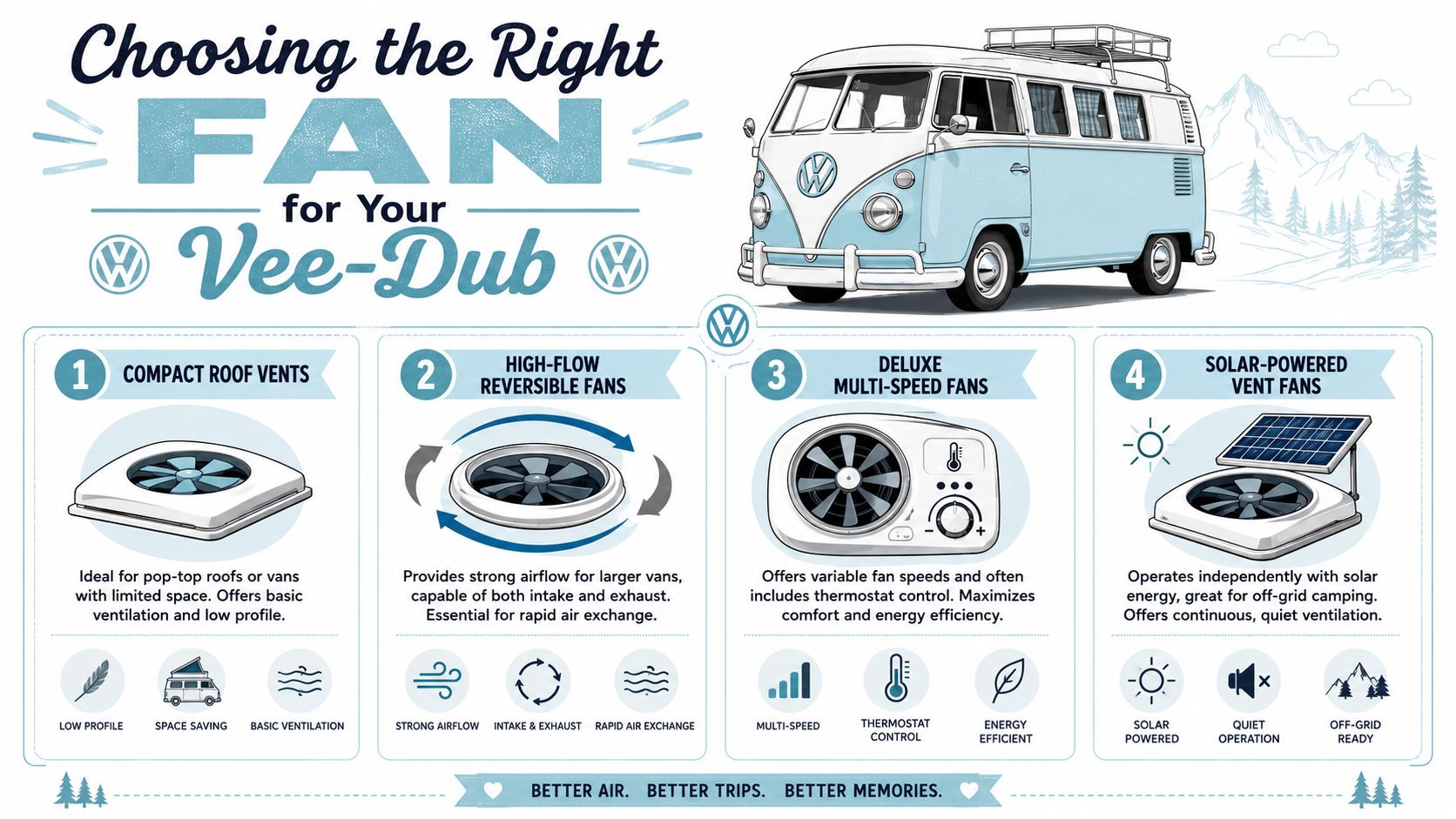
An infographic showing four different types of roof fans for Volkswagen camper vans to improve air circulation.

The main fan styles

Some owners want simple airflow and barely any visual fuss. Others want stronger extraction for sleeping, cooking and humid nights. If you've ever looked at a modern 12 volt air conditioner for camper setups, you'll know how quickly power use and hardware bulk can escalate. Roof fans sit in a much friendlier middle ground.

Here's the practical comparison.

Fan type Best for What VW owners usually like Watch-outs
Compact roof vent Smaller campers, subtle builds Low profile, simple look Modest airflow
High-flow reversible fan Full camper interiors Can pull air out or bring air in More visible on the roof
Multi-speed electric fan Frequent overnighters Better control over noise and comfort Needs thoughtful wiring
Solar vent fan Daytime passive-style use Appeals to off-grid campers Depends on sun and placement
Wind-driven vent Vintage-minded owners No draw on electrics, simple idea Limited control

What matters more than the brochure

Noise matters. If the fan sounds like an old workshop extractor, it'll spoil the mood faster than mosquitoes. You want enough movement to clear the cabin, but not so much racket that you can't hear the surf or the rain on the roof.

Looks matter too. A clean bay-window roofline is part of the whole romance. On some buses, a low-profile vent suits the shape beautifully. On others, a chunky lid can feel out of character.

Practical rule: If you hesitate every time you look at the fan from ten metres away, it's probably the wrong one for your van.

A note on airflow and size

For powered roof and attic fans, one engineering rule used in building science is 0.5 CFM per square foot of attic space for every 2 feet of peak attic height, which is described as enough for at least 15 complete air exchanges per hour. The same guidance gives an example of a 1,500 ft² attic with 4 ft peak height needing about 1,500 CFM, as explained in this fan sizing guide.

You wouldn't copy those attic numbers straight onto a Kombi roof. It's still a handy reminder that fan size should match volume. Too small and the air never really turns over. Too big and you can end up with unnecessary noise, more electrical demand and a roof unit that looks oversized for a compact classic.

Planning Your Fan in Roof Installation

Cutting into a classic VW roof can make even seasoned tinkerers go quiet for a minute. Fair enough too. You're not drilling a shelf in the shed. You're altering one of the most visible panels on the whole vehicle.

That's why planning matters more than bravado.
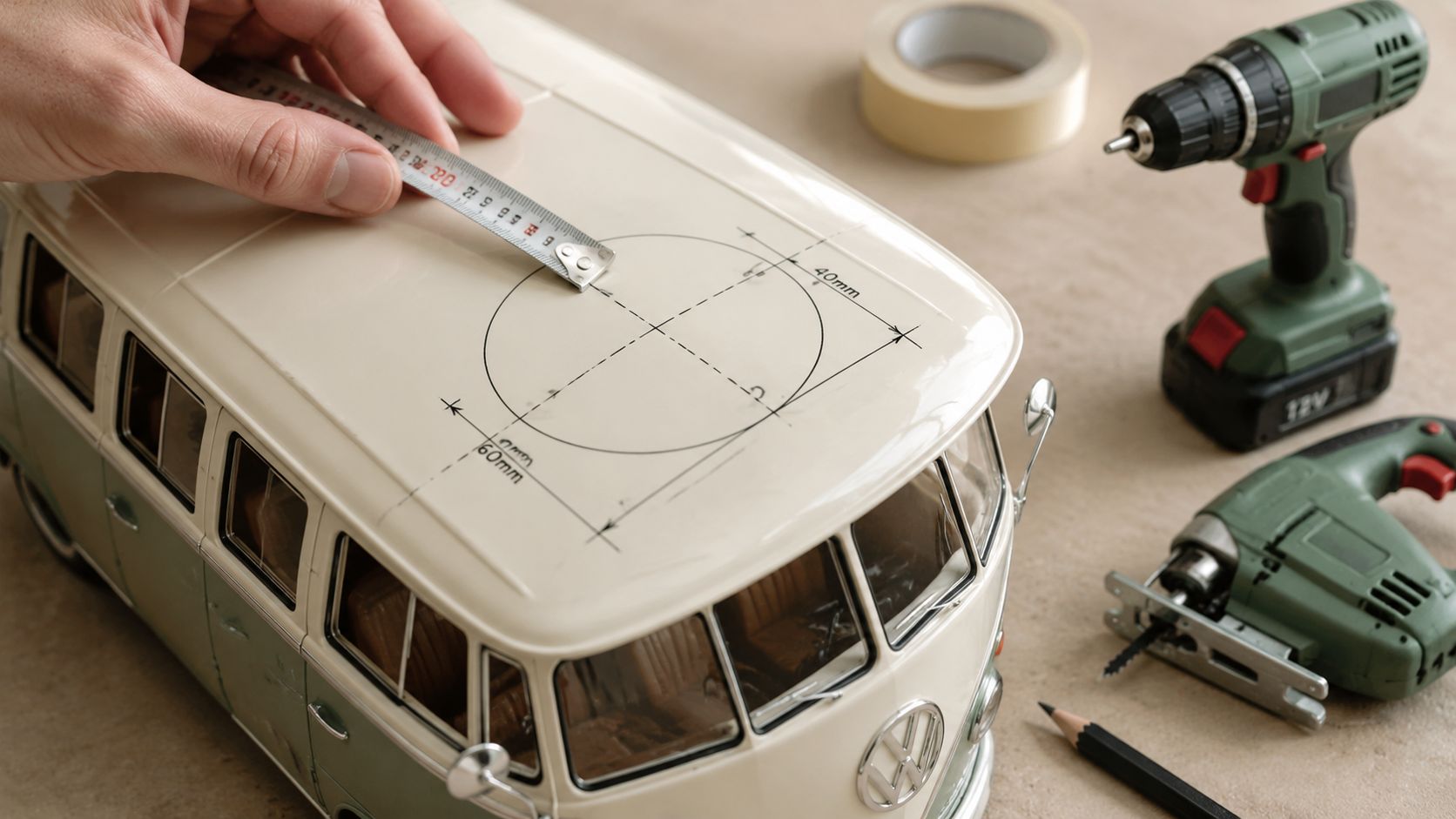
A person measuring a circle drawn on the roof of a vintage Volkswagen bus toy model.

Start with placement, not tools

On a Kombi, the best location is usually the spot that gives clear airflow through the cabin without interfering with structural ribs, pop-top hardware, roof racks or interior cabinetry. On a camper fit-out, think about where heat and moisture collect. Above the sleeping area and galley often makes sense, but only if the roof section can support the fan and seal properly.

If your van has a camper van pop top layout, placement becomes even more specific. You need room for lift mechanisms, canvas movement and whatever bed base or trim lives underneath.

A good checklist before any cutting starts:

  • Map the roof shape. Find ribs, crown, seams and any existing fittings.
  • Check inside first. Cupboards, lights and wiring can kill a good plan fast.
  • Think about use. Sleeping airflow, cooking extraction and wet gear drying don't always need the same position.

Balanced airflow matters

A fan can't pull out air properly if replacement air has nowhere sensible to come from. Building-science guidance is blunt on this point. If an exhaust fan runs without enough intake vent area, it can create negative pressure, struggle to work efficiently, and pull air from places you don't want, as noted in this ventilation guidance from PNNL.

For a van, that usually means one simple habit. Crack a window or create a planned low-level inlet so the fan isn't fighting a sealed metal box.

Open path in, open path out. That's the whole game.

The same guidance also warns that fan performance depends on intake and exhaust being balanced, and discusses moisture control targets in roof assemblies. Again, a house roof isn't a Kombi, but the principle carries over beautifully. Don't just install extraction. Design airflow.

Wiring and weatherproofing

A roof fan on a classic VW should respect the electrical system it's joining. If you've got a leisure battery or house battery setup, that's usually the cleanest home for it. Keep wiring tidy, fused correctly and routed where vibration and sharp edges won't chew through insulation over time.

Waterproofing is the other place you don't take shortcuts. The seal has to cope with sun, movement, rain and age. Good preparation, correct sealant for automotive use and careful fastening matter more than speed.

A short visual walk-through can help you picture the job before you commit:

Know when to hand it over

Some owners are brilliant with timber cabinetry, 12V wiring and tidy trim work. Some would rather drive to the next swap meet than cut steel overhead with a jigsaw. Both approaches are fine.

Call a professional if any of these ring true:

  • Your roof is rare or freshly restored and you can't stomach the risk of a mistake.
  • You're unsure about sealing around curves, ribs or a pop-top opening.
  • Your wiring is already crowded and you don't want electrical gremlins before your next trip.

More Than a Fan It Is a Lifestyle

Once the fan's in and working properly, the change doesn't feel dramatic in a flashy way. It feels generous. The van stays pleasant for longer. The cabin air feels fresher in the morning. That hidden little beach camp suddenly seems like a place you can linger.

And that's what makes the upgrade so VW in spirit.

Classic Volkswagen ownership has always been about thoughtful compromises. You accept the quirks because they're part of the charm, then you make careful improvements that let you enjoy the machine more often. A fan in roof setup fits that tradition nicely. It respects the old bus while making room for modern comfort.

The history behind the idea

Roof-mounted ventilation didn't begin as a lifestyle accessory. Ventilation history includes a manually cranked wooden fan called a blowing wheel in the House of Commons in London, noted as just over two metres in diameter, and later electrically driven extract-air fans in a Stockholm apartment block in 1931. The same history says mechanical ventilation had its real breakthrough in apartment blocks just over 20 years later, especially those three or more storeys high, according to Swegon's history of ventilation technology. That progression explains why roof fans are usually best thought of as part of a whole airflow plan, not just a spinning gadget bolted up top.

That same mentality suits a classic VW beautifully. Consider the whole cabin. How air enters. How it exits. How the van feels after a long day on the road.
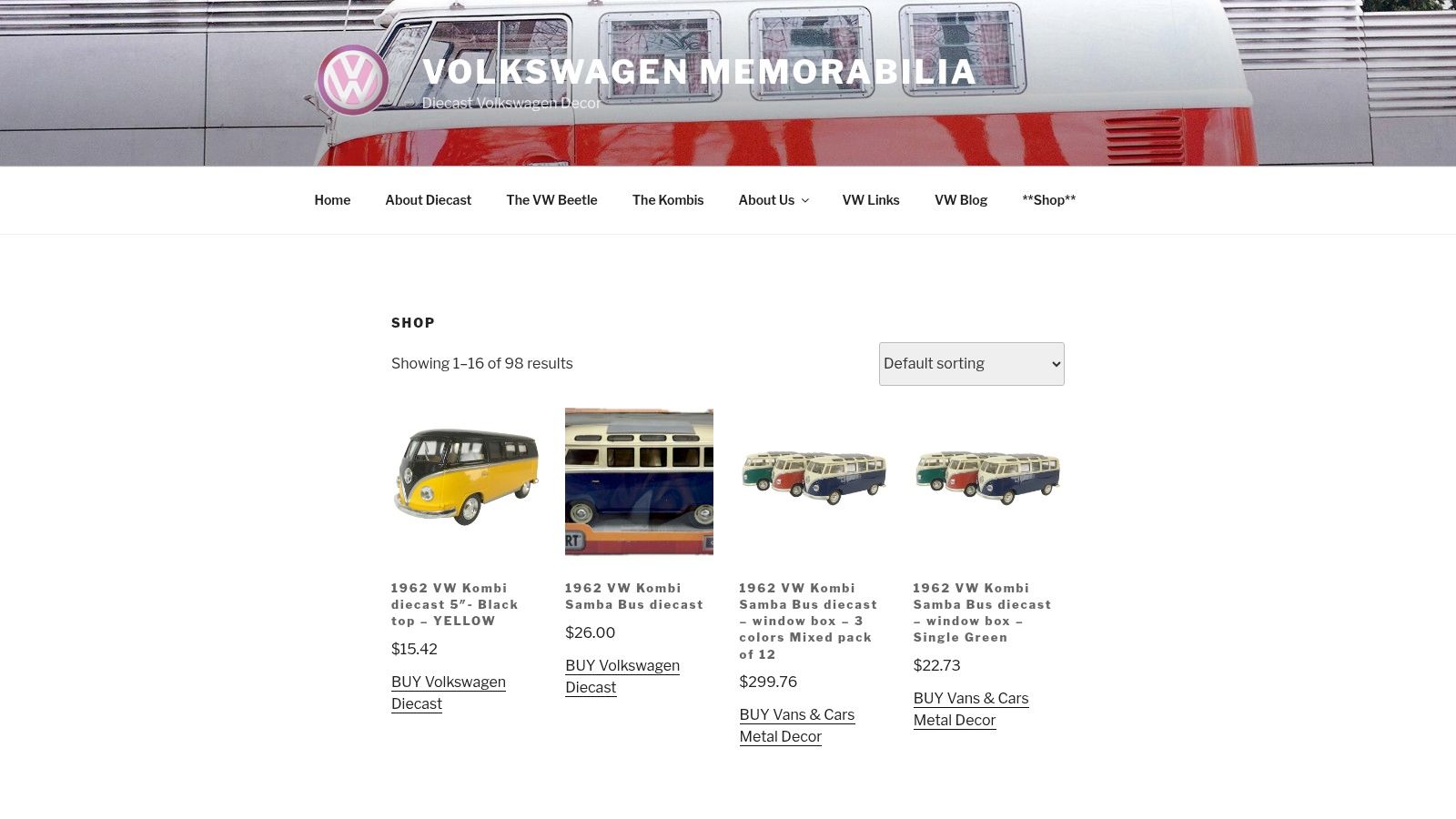
Screenshot from https://vwmemorabilia.com.au/shop/

Why these little upgrades matter

Some people personalise their Dub with wheels and stance. Some do it with plaid curtains, timber shelving or a better camp kitchen. Ventilation belongs in the same family of choices. It's practical, yes, but it also says something about how you use the van. Not as a museum piece. As a companion.

Your Top Questions Answered

Will a roof fan hurt originality or resale

It depends on the vehicle and the buyer. If you've got a highly original survivor, any roof cut is a serious decision. If you've got a camper that already wears thoughtful touring upgrades, a neat and well-finished fan can feel consistent with the van's purpose. Clean workmanship matters more than the idea itself.

If originality keeps you up at night, look hard at reversible ventilation options first. If you do go ahead, keep documentation, parts notes and photos of the work.

Can I run a roof fan overnight

Usually, yes, if your electrical setup is planned properly. The key isn't bravado. It's knowing what battery supports the fan and how the van is used. Many classic VW owners prefer to run camping accessories from a separate leisure battery rather than lean on the starting battery.

The smartest setup is the one that leaves you with airflow at midnight and confidence at dawn.

Do I still need to crack a window

Yes, in most cases that's the sensible move. Public advice often focuses on putting the fan near the highest point and making sure intake ventilation exists, but the more nuanced question is whether a powered fan should be used at all in a given climate and build style. Some installer guidance prefers ridge-style passive ventilation unless a fan is needed, and warns that powered solutions can create moisture problems if the broader assembly is already insulated and sealed, as discussed in this commentary on powered attic fans and climate context.

For a camper, the lesson is straightforward. Don't assume more hardware automatically means better camping. Match the fan to how your van breathes.

Are solar or thermostat-controlled fans worth considering

Sometimes they are. One gap in a lot of roof-fan advice is the lack of discussion around operating cost, maintenance and how often controlled fans run. Some installer guidance notes that certain units include thermostat and humidistat controls, which shifts the primary question from “can I fit one?” to “how will it behave over time?”, as raised in this discussion about roof-fan cost and control trade-offs.

That's especially relevant in Australia, where conditions swing from dry inland heat to humid coastal nights. The best choice isn't always the biggest fan or the fanciest one. It's the one that suits your camping habits, roof layout and tolerance for maintenance.

Is a giant RV fan overkill for a Kombi

Often, yes. A Kombi's cabin is compact compared with a large modern RV. Big hardware can look clumsy, draw more power and dominate the roofline. Most classic VW owners are happier with a unit that matches the van's scale and keeps the silhouette tidy.


If your love of Volkswagens extends from the driveway to the display shelf, have a look at Volkswagen Memorabilia. It's a ripper spot for officially inspired VW gifts, coastal-style collectibles and diecast favourites that celebrate the same Kombi and Beetle spirit we chase on the road. Whether you're after a shelf-worthy Samba Bus, a thoughtful present for a VW tragic, or locally stocked pieces with fast Australian shipping, you'll find plenty to like in the shop.


VW Campervans for Sale: An Aussie Buyer’s Guide to Finding Your Dream Ride

Picture this, mate: you're cruising down the coast, sun on your face, windows down, with nothing but the open road ahead. That's the great Aussie dream, and for so many of us, it has that iconic VW badge right on the front. If you've ever found yourself daydreaming about a classic Kombi, this guide is for you. It's like having a chat with a fellow enthusiast at a sunny car show, all about turning that dream into a reality that's parked right in your driveway.

Let's walk through everything you need to know about finding VW campervans for sale, from a classic Splittie to a modern weekender.

Your Adventure Starts With the Right VW Campervan

The love for the Kombi runs deep in our Aussie blood. It’s more than just a van; it’s a symbol of freedom, salty coastal drives, and a way of life that brings a massive community together at events like Volksfest and the VW Nationals. It’s a feeling of pure, unadulterated joy.

Before you dive headfirst into the classifieds, it’s worth taking a moment to really soak in the heritage. A brilliant way to do that is to get your hands on some proper VW memorabilia collectibles. Holding a classic Kombi Samba Bus diecast model in your hands… it really connects you to the history and the beautiful, timeless design you’re about to become a part of. It’s like holding a tiny piece of the dream.

Why Is Now a Great Time to Look?

If you feel like you're seeing more classic VWs on the road lately, you're not wrong! The market for VW campervans in Australia has been absolutely humming for the last few years, fired up by a huge swing back to local travel as we all started exploring our own incredible backyard again.

This rediscovery of the Aussie road trip has really shaken up the market in the best way.

  • Soaring Demand: Back in 2020, as folks looked for new ways to holiday at home, campervan sales more than doubled in just a year.
  • A Healthy Market: Fast forward to 2026, and you’ll find online marketplaces buzzing with used VW Transporter and California models. It’s not uncommon to see well over a thousand VW campers for sale at any one time.
  • Prices for Everyone: This means there's a van for almost any budget, with prices starting around $25,000 for a solid T3 project and heading north of $120,000 for a perfectly restored T2 Splittie that’ll make you weep with joy.

All this energy makes it a fantastic time to find VW campervans for sale. The market is buzzing with options that tap right into that classic, adventurous spirit—the same spirit captured in collectibles like the timeless 1962 VW Kombi diecast models.

Getting to Know the VW Campervan Family

Choosing a VW camper is a bit like picking a favourite band—every era has its own unique character and a legion of devoted fans. When you start looking at VW campervans for sale, you'll quickly realise you're not just buying a vehicle; you're buying into a piece of living history. From the iconic first generation to the comforts of today, let's meet the family.

Getting a feel for this evolution is part of the fun. A great way to appreciate the history is by exploring the details on a smaller scale, like with a classic 1:18 scale Kombi Samba Bus. It’s a fantastic way to connect with the lineage before you find your own life-sized adventure wagon.

The Icon: T1 Transporter 'Splittie' (1950–1967)

This is it. The one that started a global movement. The T1 is the undisputed king of cool, instantly recognisable by its split front windscreen and that big, friendly VW badge. It’s pure 1960s nostalgia on four wheels.

If you find a T1 for sale in Australia, you're looking at a genuine piece of automotive history. Their rarity and timeless appeal mean they command high prices. Owning one is less about getting somewhere fast and more about enjoying every single kilometre with a massive smile on your face.

The "Splittie" isn't just a van; it's a statement. It represents a simpler time of peace, love, and open-road freedom that still resonates with enthusiasts today. It’s the origin story of the entire van life movement.

The Surfer's Favourite: T2 Transporter 'Bay Window' (1967–1979)

When the Splittie passed the baton, the T2—or "Bay Window"—ran with it, becoming the go-to surf bus of the 70s. It traded the split screen for a single, curved panoramic windscreen (the 'bay'), giving drivers a better view and a more modern look for the time.

You only have to look at the sales figures to see how much Aussies fell in love with this model. After the T1, demand for the T2 absolutely exploded. Imports surged by a massive 200% to over 20,000 units a year as our surf culture boomed, cementing the Bay's place in our coastal identity.

For many, the T2 is the perfect sweet spot. It’s more affordable and easier to drive than a T1, but it still has all the vintage charm you could ever want for a weekend away or a local Show & Shine.

The Practical Classic: T3 Transporter 'Wedge' (1979–1992)

As the 80s rolled in, so did the T3. Affectionately nicknamed the "Wedge" for its sharper, more angular lines, this van was a huge leap forward in space and comfort. It was the last of the rear-engine VWs, cleverly bridging the gap between the old air-cooled classics and the water-cooled vans that followed.

T3s are known for their roomy interiors and smoother ride, making them a fantastic and often affordable entry point into VW camper ownership. They're incredibly versatile, and the many Syncro (4WD) models still out there prove their mettle on rugged Aussie tracks to this day.

The Modern Adventurers: T4, T5, and T6 (1990–Present)

From the T4 onwards, Volkswagen moved the engine to the front. This change created the reliable workhorses and comfortable, capable campers we know today. These models deliver modern performance, safety, and reliability that make long-distance touring an absolute pleasure.

If you want a van that can pull double duty as a daily driver during the week and an adventure machine on the weekends, this is the era you'll be exploring.

The whole campervan market, from classic to modern, has seen a huge surge in interest recently. This is driven by a new generation of adventurers who appreciate both nostalgia and reliability.

Timeline illustrating global campervan sales trends, from niche market in 2019 to projected growth by 2026.

This trend shows that prices are on the rise across the board. No matter which model captures your heart, it’s an investment in a lifestyle. You can find more tips on looking after your pride and joy in our dedicated guide for the Volkswagen Transporter camper.

VW Campervan Generations At a Glance

Feeling a bit overwhelmed by the choices? Don't be, mate. Here's a quick cheat sheet to help you tell your Splitties from your Wedges at a glance.

Model (Nickname) Production Years Key Feature Best For
T1 (Splittie) 1950–1967 Split front windscreen The purist wanting the ultimate classic icon
T2 (Bay Window) 1967–1979 Single curved windscreen Vintage charm with better drivability
T3 (Wedge) 1979–1992 Angular, '80s boxy shape An affordable and practical entry into classic VW life
T4/T5/T6 1990–Present Modern front-engine design Reliability and comfort for daily driving and touring

Each generation has its own story to tell. The fun part is deciding which one you want to be a part of.

Understanding VW Campervan Prices in Australia

Alright, let's talk money. Dreaming of a classic Kombi is one thing, but setting a realistic budget is how you actually get the keys in your hand. The price for a VW campervan for sale in Australia can vary dramatically, and it all comes down to a few key factors: the model, its age, condition, and the interior fit-out.

Much like a rare piece of Volkswagen memorabilia, say a stunning Volkswagen Beetle model, the value is tied directly to its history and how well it's been preserved. A perfect, all-original camper will always fetch a premium, but there are plenty of great vans out there that won't break the bank.

What Shapes the Price Tag?

As you start your search, you'll notice a massive spread in asking prices. It really helps to know exactly what you’re paying for.

  • Model & Rarity: A T1 'Splittie', particularly a sought-after 21- or 23-window Samba model, is the peak for collectors and commands a top-tier price. A T2 'Bay Window' is generally more affordable, and a T3 'Wedge' can be a brilliant, budget-friendly way into the classic VW world.
  • Condition: This is the big one. A van that needs a complete, bare-metal restoration might seem cheap upfront, but it will require a huge investment in both time and cash. At the other end, a fully restored, rust-free van ready for a car show will have the highest price tag.
  • Interior Fit-Out: Is it an empty van ready for you to customise, or does it have a complete camper setup with a pop-top roof, kitchenette, and bed? A quality, professional fit-out from a known brand like Westfalia adds serious value.

A Realistic Look at Aussie Market Prices

To give you a general idea, here’s a rough guide to what you can expect to pay for VW campervans for sale in Australia. Remember, these are just ballpark figures, so always do your own research.

  • Project Vans ($5,000 – $20,000): These are vans that need a lot of work. They’re a great choice if you know your way around a welder and want the satisfaction of a full restoration project.
  • Running & Roadworthy ($20,000 – $45,000): In this price range, you’ll find vans that are mechanically solid and ready for the road, though they might have a few cosmetic issues or an older interior. You can often find a good T3 or a tidy T2 here.
  • Excellent Condition ($45,000 – $80,000+): These are the turn-key adventurers. They have usually had major restoration work, feature a great interior, and are ready for a big trip tomorrow.
  • Show-Stoppers & Rare Models ($80,000 – $150,000+): This is the territory of immaculate, professionally restored Splitties and other rare, collectible models that are genuine investments.

An Investment in Adventure

One of the best things about owning a VW camper is how well they hold their value. A normal car starts losing money the second you drive it away, but a well-kept classic VW is a completely different beast. It's heart, not just metal.

Value retention is a huge benefit of VW campers. Data from the Australian market shows a modern VW California can hold onto 95% of its value after one year and still be worth 82% of its original price after three years—far outperforming typical SUVs. You can discover more on VW campervan value retention here.

This strong value retention, coupled with a growing national demand, means finding a good camper isn't just buying a vehicle—it's an investment in future adventures that’s likely to pay you back. As you can see, the value of these vans is tied to a rich history, which you can explore further in our guide to the Volkswagen bus camper for sale.

Your Essential Pre-Purchase Inspection Checklist

Alright, you’ve found a promising VW campervan for sale, and it looks like a pearler in the photos. Now for the moment of truth: getting up close and personal. This is more than just kicking the tyres; it's about knowing exactly what to look for past the shiny paint and groovy curtains.

Don't feel out of your depth! We'll walk you through a simple checklist, focusing on the big three: Rust, Mechanicals, and Electrics. With a bit of know-how, you can inspect a van with confidence and dodge any nasty surprises down the road.

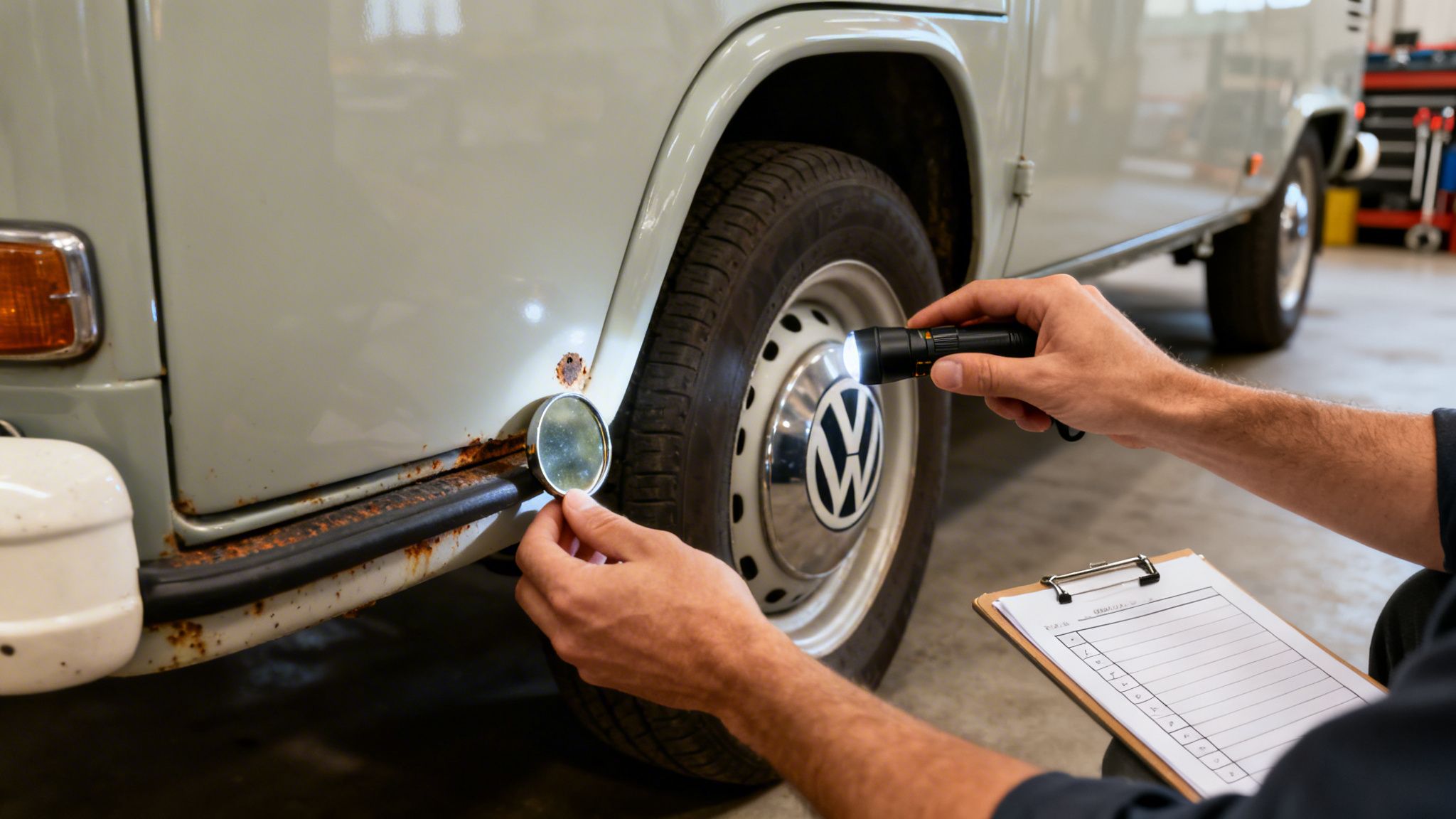
A mechanic meticulously inspects a vintage VW campervan for rust using a flashlight and mirror.

Bodywork and the Hunt for Rust

Rust is the arch-nemesis of any classic vehicle, especially one that’s spent its life cruising the Aussie coast. A fresh lick of paint can hide a world of hurt, so it’s time to play detective. Be sure to bring a small magnet and a torch.

  • Gutters: Carefully run your fingers along the roof gutters. This is a classic spot for water to pool and for rust to take hold.
  • Wheel Arches: Check the inner and outer lips of all the wheel arches. You’re feeling for any bubbling or roughness under the paint.
  • Sills: The long panels right below the doors are prime real estate for rust. Use your magnet here—if it doesn't stick firmly, it’s probably because it’s sitting on a thick layer of body filler, not steel.
  • Window Seals: Gently press around the windscreen and rear window seals. Any soft spots or visible rust can signal a tricky and expensive repair job.

Pro Tip: Don't be shy about getting on your hands and knees. Slide underneath and point your torch at the chassis rails and floor pans. A bit of surface rust is often part of the territory, but any actual holes or flaky, crumbling metal are massive red flags.

Engine and Gearbox Check

You don't need to be a qualified mechanic, but you do need to trust your senses. A healthy VW engine has a personality and a sound all its own.

Before you even turn the key, have a good look in the engine bay for any obvious oil leaks. A bit of road grime on an old motor is completely normal, but fresh, dark drips on the ground beneath it point to active leaks that will need fixing.

When you start the engine from cold, just listen.

  • Does it fire up easily, or does it cough and splutter into life?
  • Listen for any loud, rhythmic knocking or rattling sounds coming from the engine.
  • Let it idle for a few minutes and watch the exhaust. A little puff of smoke on start-up is usually fine, but a continuous stream of blue smoke (burning oil) or white smoke (coolant) points to much bigger problems.

On the test drive, get a feel for the gearbox. Shifting gears should be relatively smooth, without any loud grinding or the shifter popping out of gear on its own.

Interior and Electrics

Now for the fun bit—flicking all the switches and seeing how the living space actually works. Systematically go through and test every single thing you can find.

  1. Lights: Check the headlights (both high and low beam), indicators, brake lights, and all the interior lights.
  2. Wipers and Horn: They seem simple, but they’re non-negotiable for a roadworthy certificate.
  3. Gauges: Watch the fuel gauge and speedometer on your test drive to make sure they’re giving a sensible reading.
  4. Camping Gear: If it has a pop-top, get the owner to show you how it works. Test the fridge, flick on the water pump, and plug something into the 12V outlets.

This is also your chance to judge the quality of the camper fit-out. Open and shut every cupboard door. Lie down on the bed. Does it all feel solid and well-made, or a bit flimsy and tacked together? The condition of the interior speaks volumes about how the van has been loved over the years.

Paperwork and History

Never, ever underestimate the power of a well-kept folder of receipts. Ask the owner if you can see the vehicle's service history. A big stack of invoices showing regular maintenance is a fantastic sign of a cherished van.

  • Check that the Vehicle Identification Number (VIN) stamped on the van matches the number on the registration papers.
  • Do the same for the engine number; make sure it matches what’s listed on the rego.
  • Ask about the current registration status and when it was last issued with a Roadworthy Certificate (RWC).

A seller who has kept meticulous records is almost always someone who has taken great care of their vehicle. Following this checklist will give you the confidence to make a smart decision and get you one step closer to that dream Aussie road trip.

Project Van or Ready-to-Roll Camper?

It’s the first big question every would-be VW owner asks themselves when looking at VW campervans for sale: Do I find a pristine, ready-to-go camper, or do I take on a promising project? Both paths lead to adventure, but they offer completely different journeys to get there. The right choice depends entirely on your personality, your skills, and what you truly want out of the experience.

This crossroads is a familiar one in our world. It's like choosing between a perfect, out-of-the-box Volkswagen diecast model and the rewarding task of restoring a vintage find. Both are born from the same passion, just expressed in different ways.

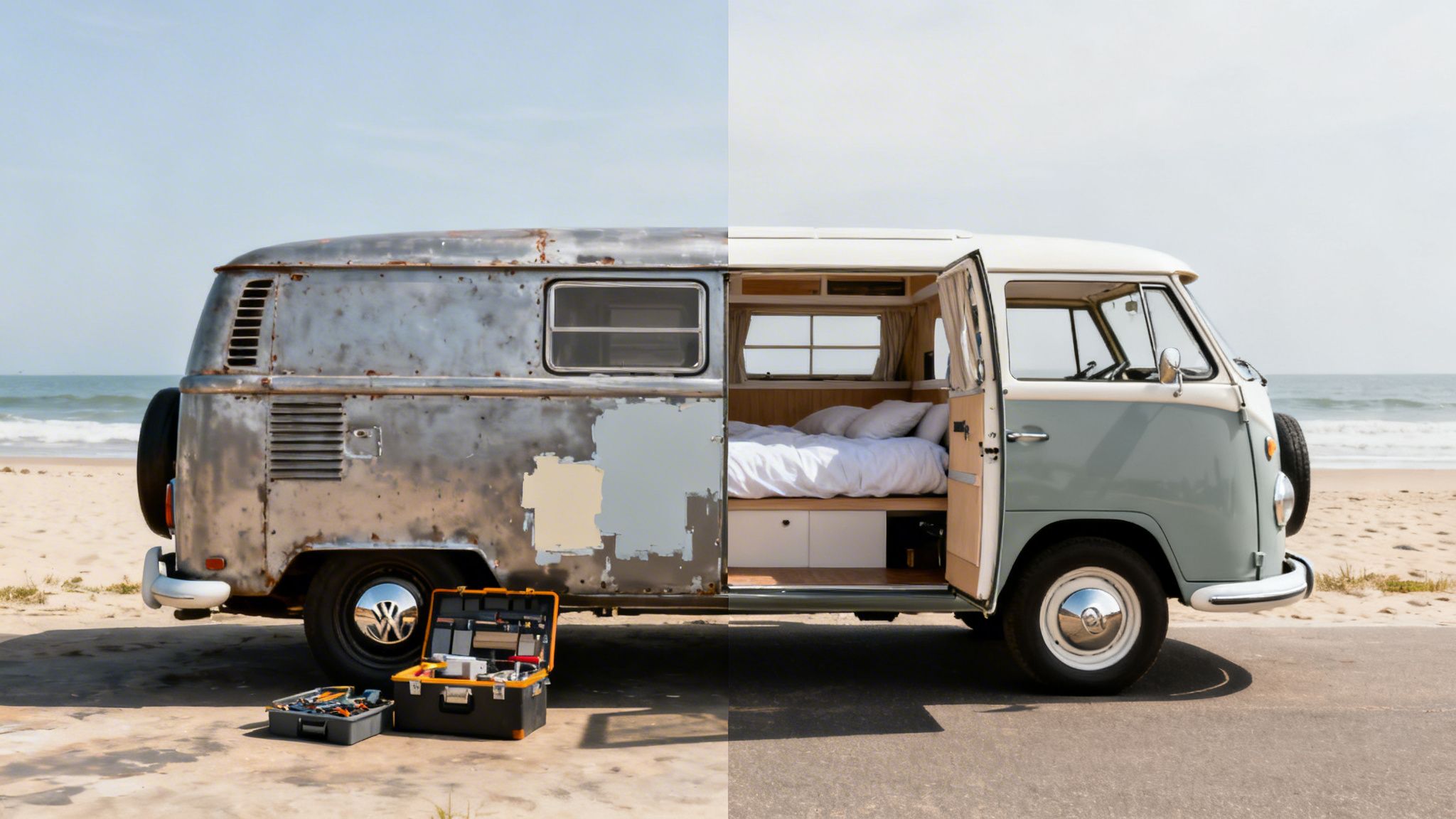
Before and after renovation of a rusty Volkswagen campervan on a beach, with tools and a cozy interior.

The Appeal of the Ready-to-Roll Camper

A turn-key van is all about one thing: instant freedom. You can literally pick up the keys on a Friday morning and be watching the sunset from a new postcode by Saturday. This is the way to go if your time is precious and your main goal is to start exploring right away.

Here’s what you get with a ready-to-roll van:

  • Immediate Use: Forget about long waits at the mechanic or weekends spent covered in grease. Your adventures start the moment you drive away.
  • Predictable Costs: The upfront cost is higher, no doubt. But you have a much clearer idea of your total investment, without the worry of surprise repair bills lurking down the road.
  • Proven Setup: The interior is already built, tested, and ready for life on the road. You’re buying a layout that works, avoiding the trial and error of a custom build.

The Romance of the Project Van

And then there's the project van. It might be a bit rusty and unloved, but it’s brimming with potential. This is the path for the dreamers, the tinkerers, and anyone who wants a van that is 100% theirs, inside and out.

The pull of a project is hard to resist:

  • Lower Initial Cost: A van needing work will always be cheaper to buy upfront. This makes ownership much more accessible if you’re working with a smaller initial budget.
  • Total Customisation: Every single choice is yours. From the paint colour to the kitchen layout and the fabric on the cushions, you can build the exact camper you've always pictured.
  • Deeper Connection: The blood, sweat, and maybe a few tears you pour into a restoration forges a bond like no other. It stops being just a van; it becomes your van.

Choosing a project van is a commitment not just to a vehicle, but to a journey of learning and creation. The skills you'll pick up and the stories you'll tell will last a lifetime, long after the last coat of paint has dried.

Ultimately, the best choice comes down to your budget, your timeline, and how hands-on you want to be. If you're leaning towards a full restoration, checking out a bare-bones van for conversion can give you a great starting point for inspiration. Whether you buy it done or build it yourself, the destination is the same: unforgettable adventures on the open road.

You've Bought It! Now, Let's Hit the Road

Right, you’ve done it. You’ve poked and prodded, done the deal, and now you’re standing in front of your very own VW camper. The feeling is electric, isn't it? But before you chuck the surfboard in and set the GPS for the coast, there are a few final bits of paperwork to sort out to make it officially yours.

Getting the admin right from the get-go is the key to a stress-free first journey. Trust me, it’s worth the small effort now to ensure your first drive is all smiles.

Making It Official, Aussie-Style

The last hurdle in buying any vehicle down under is the ownership transfer. The exact process changes a bit from state to state, so your first port of call should always be your local transport authority’s website for the latest rules.

Generally speaking, here’s what you’ll be dealing with:

  • Registration (Rego) Transfer: The seller will give you the signed transfer forms. It’s then on you to get them lodged, pay the transfer fee, and cover the stamp duty.
  • Roadworthy Certificate (RWC): In most states, it’s the seller’s job to supply a current RWC (or a Safety Certificate) to prove the van is safe. Unless you're tackling a ground-up restoration project, you really don't want to buy a van without one.
  • Proof of Purchase: Make sure you get a proper receipt. It doesn't have to be fancy, but it absolutely must have the date, the final price, the van's details (VIN and rego number), plus the names and signatures of both you and the seller.

Once those forms are in and the keys are in your hand, that’s it—welcome to the club! It’s a moment worth savouring. You're not just a vehicle owner; you're the custodian of a legend.

Your First Weekend of Freedom

With the serious stuff out of the way, the real fun begins. That first trip, no matter how small, is something you’ll never forget.

Here’s how to make it a great one:

  1. Plan a "Shakedown" Trip: Don't go halfway across the country just yet. Pick a local caravan park or a favourite nearby spot for a night or two. This is your chance to test everything—the pop-top, the fridge, how the bed sets up—without the pressure of being miles from home. It's all about learning your new rig.
  2. Join the Community: Hop onto social media and find your local VW club. Honestly, this is the single best resource for brilliant advice, finding parts, and hearing about upcoming shows and coffee runs with people who just get it.
  3. Make It Your Own: Now’s the time to add those personal touches. A cool, retro metal decor sign for the interior? Or maybe a little Volkswagen Beetle model on the dash for good luck? It’s these little things that start turning your van into a proper travel companion for the adventures ahead.

FAQ: Your Top VW Camper Questions Answered

Got questions? You're not alone. Buying a VW camper is a big step, and it's natural to have a few things you're wondering about. Here are some of the most common questions we get from people looking at VW campervans for sale in Australia.

How Much Does It Cost to Insure a Classic VW Campervan in Australia?

Insurance costs can vary quite a bit, mate. It really comes down to the model, its agreed value, your driving record, and even your postcode. For the classics (anything made before 1990), you'll almost always find the best rates with a specialist classic car insurer.

As a ballpark figure, you could be looking at annual premiums anywhere from $500 to $1,500. The best thing you can do is get a few quotes before you even think about buying a van. That way, you can build the real cost into your budget without any nasty surprises.

Can I Use a VW Campervan As My Daily Driver?

You absolutely can, but just know it's a lifestyle choice! A modern T5 or T6 drives much like a car and can handle the daily school run or commute without a fuss.

An older air-cooled van like a Splitty or a Bay Window is a whole different beast. It's a more… authentic experience. We’re talking no power steering, a slower pace, and a genuine feel for the road. Plenty of die-hards drive them every day, but we seriously recommend test-driving one in your usual traffic to see if that vintage charm works for your daily grind.

What Are the Most Common Mechanical Issues to Look Out For?

With the classic air-cooled vans (T1, T2, and early T3s), you'll often be dealing with little oil leaks and keeping the carburettor tuned. But the real enemy, hands down, is rust. Always, always check the wheel arches, sills, and that spot right under the windscreen seal—they're notorious trouble spots.

For the later water-cooled T4s and T5s, you need to see solid proof that the timing belt and water pump have been serviced on schedule. That's a critical job you simply can't afford to have fail on you.

Is It Better to Buy a Pop-Top or a Tin-Top Camper?

This one is all about how you see yourself using the van. A pop-top roof is fantastic for that extra headroom to stand up and cook. Plus, it usually adds an extra bed up top, which is a massive win for families. The trade-off? You've got canvas and lifting gear that need looking after.

A "tin-top"—a van with a standard solid roof—is simpler, more discreet, and has fewer places to spring a leak. They can feel a bit more compact inside, but they're a great, no-fuss option. Just think about how often you'll really need to stand up straight inside the van before you make the call.

Your campervan is your personal space for adventure, and getting the layout right is key. Whether you're a pop-top enthusiast or a tin-top purist, the goal is the same: creating a comfortable basecamp for making memories on the road.

Choosing between them is a classic debate in the VW community, and honestly, there's no right answer—only what’s right for you.


At vwmemorabilia.com.au, we're here for every part of your VW journey. We live and breathe this stuff. While you're on the hunt for the real deal, why not get inspired by browsing our massive collection of perfectly detailed VW Kombi diecast Australia models? As Australia's go-to importer, we've got a fantastic range in stock and ready for fast local shipping. They’re a brilliant way to keep the dream alive on your desk or shelf, and a perfect gift for the VW lover in your life. Happy hunting