
Wall Art Hangings Guide to Style Size and Display

You're standing in the lounge with a new canvas under one arm, a small Beetle model on the shelf and a blank wall that still feels like it belongs to someone else. The sofa is in place, the coastal cushions look cheerful, yet the room hasn't found its story. That's where wall art hangings can change everything. A woven textile adds softness, a framed print brings focus, and a carefully placed Kombi or Beetle display gives the space that familiar sense of freedom, travel and sunny Australian weekends.

Wall art hangings include far more than framed paper prints. You can work with canvas, timber, metal, woven fibres, textile pieces and mixed-media arrangements, then balance them with shelves, diecast models and beach-inspired accents. The trick is to choose the right material, get the scale comfortable and use fixings that suit the wall behind it.
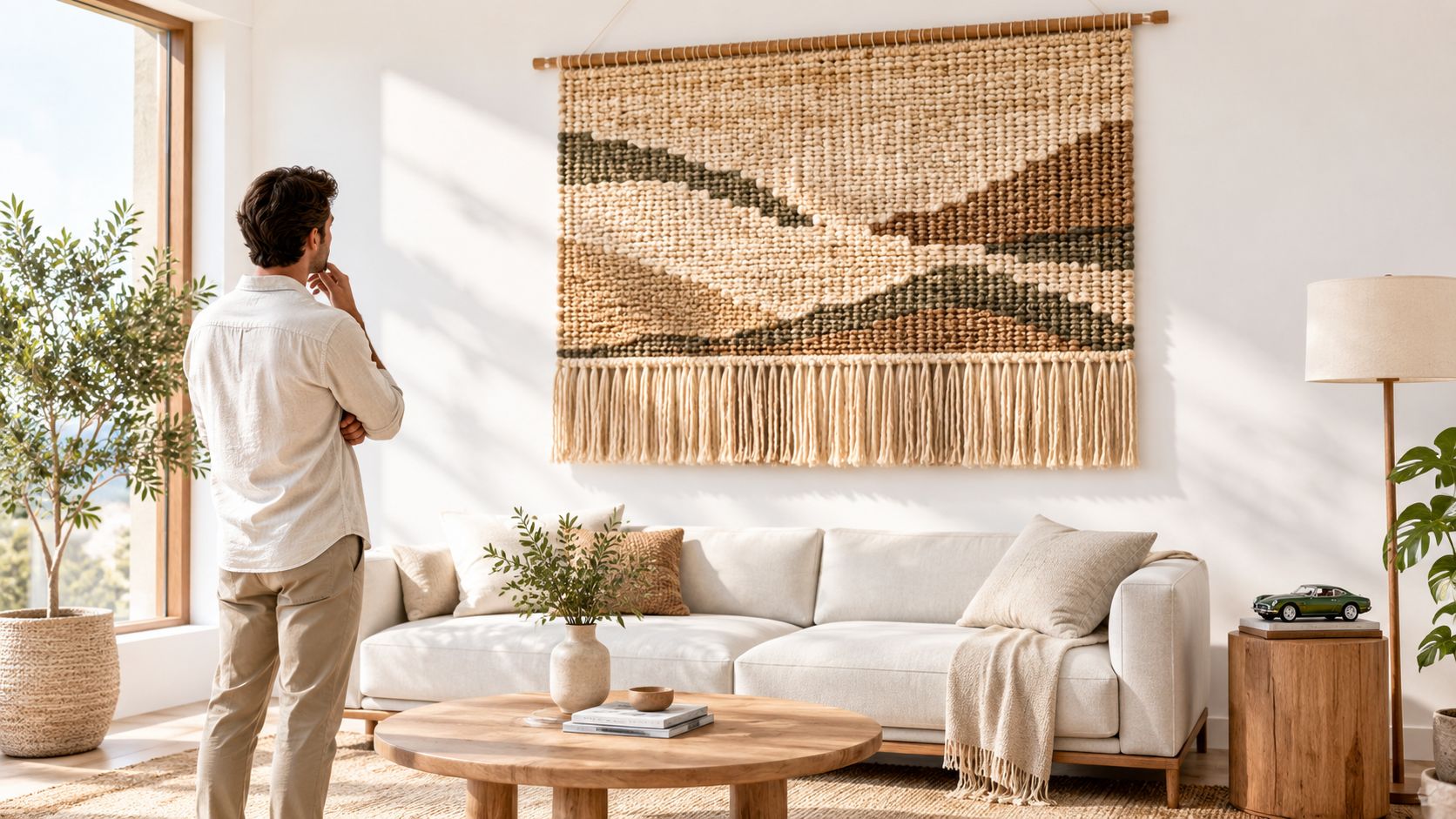
A man standing in a modern living room looking at a large woven bohemian tapestry wall hanging.

This guide will help you move from a bare wall to a relaxed, cohesive display. You'll learn how each material behaves, how to measure above furniture, how to hang art safely on plasterboard or brick, and how to combine retro Volkswagen character with coastal colour. For more inspiration before you pick up the tape measure, browse these wall decoration ideas, then return to the practical details that make a display work in everyday life.

Introduction to Wall Art Hangings That Transform Your Space

A blank wall can feel oddly loud. It catches your eye every time you walk past, especially in an open-plan Australian home where the lounge, dining area and entry need to feel connected. Many people leave art leaning against the wall because choosing the first piece feels permanent. In reality, a good display can evolve just like a well-loved Kombi, with small changes that add character rather than erase it.

Think of a wall as the backdrop behind a favourite story. A large canvas might recall a coastal drive, a woven hanging can soften a room filled with timber and glass, and a metal sign can bring the cheerful garage-and-beach feeling associated with classic Volkswagens. A licensed diecast model on a nearby shelf then works like a tiny piece of sculpture. It doesn't need to dominate the room. It gives the eye a detail worth discovering.

A useful starting point: choose one anchor piece, then let the surrounding objects support its colour, shape or mood.

Australia has a long relationship with decorative wall hangings. The National Museum of Australia's collection holds 250,000 objects, while Museum Victoria's textile collection documents 1970s wall hangings as part of post-war domestic design. The Australian Bureau of Statistics also recorded that over 80% of purchased art items were Australian-made, worth $137.9 million, with paintings accounting for $84.2 million, a useful reminder that locally made art has held an important place in Australian decorative buying. Those figures come from the historical context provided by the museum and ABS material, not from a rule about how your own home should look.

The best result usually feels collected, not assembled in one afternoon. Start with the wall's size and the furniture below it. Add a material that suits the room, leave enough breathing space around the art, and bring in VW memorabilia or coastal touches where they feel natural. A bright Samba Bus, a muted Beetle model or a woven piece in sandy tones can all belong in the same room when the palette and spacing are doing the quiet organising.

Understanding Wall Art Hangings Types and Materials

Material changes the mood of a room before you've considered the picture itself. Canvas feels relaxed and forgiving, metal adds a sharper graphic note, while woven pieces introduce texture that flat artwork can't provide. Australian industry reporting describes the market as structurally import-dependent, with 70–80% of finished products sourced from China and Vietnam, and estimates that framed canvas prints and multi-panel sets account for 55–65% of unit volume. The same industry market analysis projects nominal Australian-dollar growth of roughly 4–6% annually from 2026 to 2035, so ready-to-hang formats are likely to remain familiar choices for homes and hospitality spaces.

Canvas and framed prints

Canvas prints suit a casual lounge, hallway or beach-house bedroom because their surfaces soften an image and avoid the reflective glare that can come from glass. They work particularly well beside timber furniture, linen upholstery and a small row of diecast vans. A multi-panel canvas can stretch across a broad wall, but treat the panels as one composition when measuring the overall width.

Framed prints bring clearer edges and a more finished feel. Black frames can echo tyres, window seals and steel trim on a Volkswagen, while light timber frames sit comfortably with rattan, pale floors and coastal accessories. Glass adds weight and requires careful handling, so don't choose the fixing by looking only at the print size.

Metal and timber

Metal wall art has a natural connection with motoring spaces. It can look at home above a workbench, in a games room or near a display cabinet, especially when the design references a Kombi, Beetle, surfboard or old service station. Metal often has a crisp silhouette, so pair it with a softer woven item or canvas rather than filling the whole wall with hard surfaces.

Timber signs and carved pieces bring warmth and depth. They're useful for a narrow entry or a wall that already contains polished metal, because wood stops the arrangement feeling too cold. Check the back of the piece before mounting. A keyhole slot, sawtooth hanger or D-ring each calls for a slightly different positioning method.

Woven and mixed media

Woven wall hangings include macramé, tapestry, fibre art and textile panels. They're excellent for bedrooms, reading corners and relaxed coastal interiors, where movement and texture matter as much as colour. Keep them away from areas where they'll brush against lamps, fans or busy walkways.

Mixed-media walls combine materials rather than asking one item to do all the work. Try a canvas painting, a small metal VW sign, a timber piece and a textile accent, then repeat one or two colours across the group. This gives a display the variety of a car show lineup without making the wall look like a storage area.
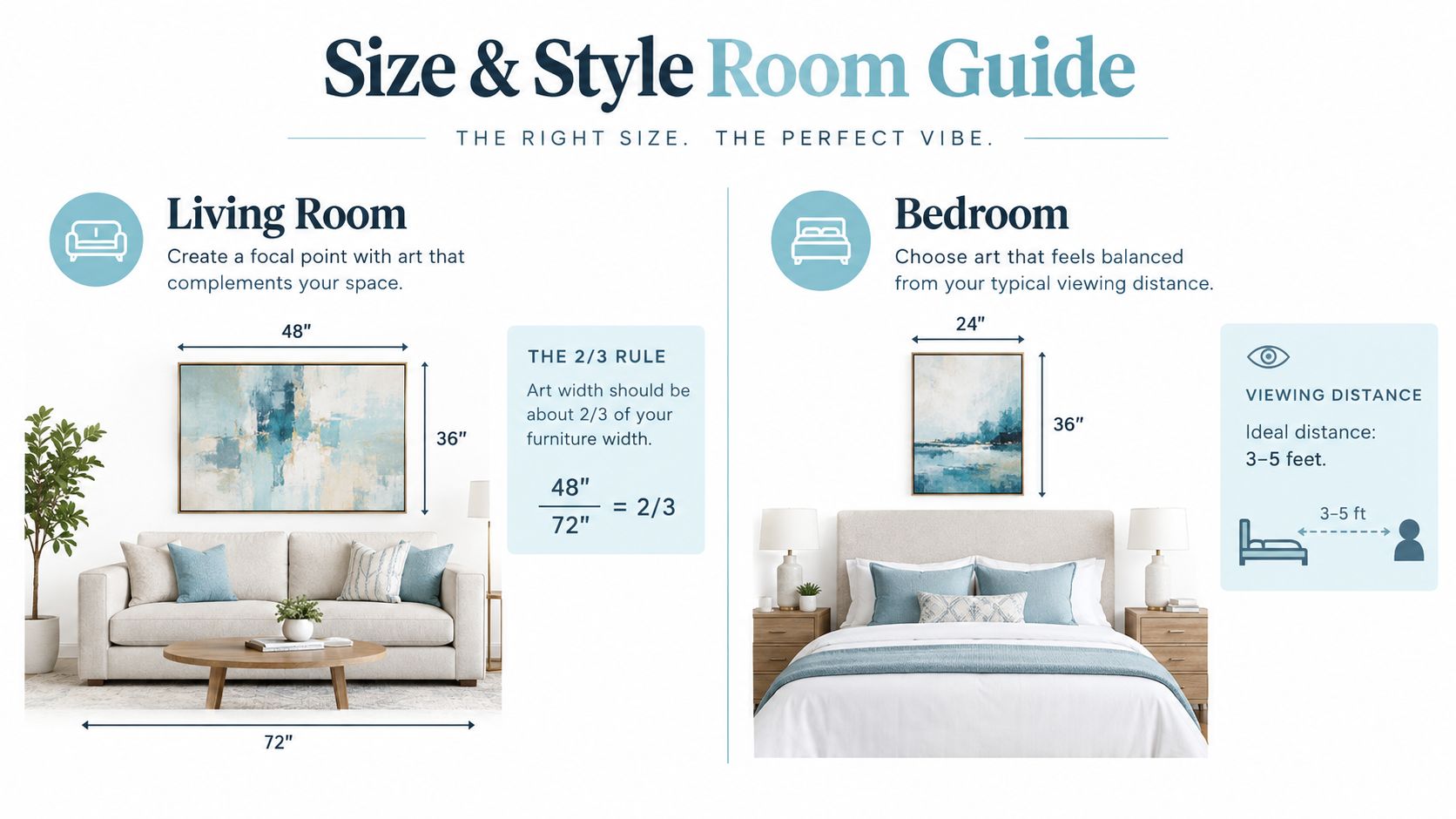
An infographic showing guidelines for sizing and hanging wall art above a living room sofa and bedroom bed.

How to Choose the Right Size and Style for Every Room

A wall can feel unfinished when a small print floats above a generous sofa. The opposite happens in a narrow passage, where an oversized canvas makes the walkway feel tight. Start with the furniture, then choose artwork that belongs to its available wall area. Measure the sofa, console, bedhead or sideboard, along with the clear space above it.

For everyday placement, centre the artwork at 145–150 cm from the floor and leave 20–30 cm above furniture. Treat these as useful starting points, not strict rules. A low seat, tall sideboard or high ceiling may need a small adjustment. The centre should sit where people can enjoy the piece comfortably, without craning their necks.

Match the mood to the room

A lounge can carry a confident coastal photograph, a wide canvas or a gallery wall with one strong centrepiece. Bedrooms usually suit quieter contrast, tactile textiles and softer edges. In a hallway, narrow vertical pieces guide the eye along the space. A dining area may work well with graphic metal art that sits comfortably beside timber and warm lighting.

For a VW coastal room, settle the palette before adding the playful details. Sea blue, cream, sand, faded red and sun-washed yellow can connect a canvas with a Flower Power Kombi or classic Beetle display without making every object identical. Surfboard shapes, Australian scenery and old travel motifs bring the retro character naturally. A logo on every surface would make the room feel more like a showroom than a home.

Choose one large piece or a gallery wall

Decision Factor Single Oversized Canvas Gallery Wall Mix
Visual effect Creates one calm focal point with less visual noise. Builds a layered story from prints, textiles, signs and objects.
Best location Wide sofa walls, open dining areas and rooms needing a clear anchor. Stairwells, hallways and larger walls where varied shapes can fill space.
VW styling Pair with one carefully chosen Kombi or Beetle display nearby. Add a metal sign, coastal print and small diecast model within the group.
Installation Fewer fixing points, but the main piece needs solid support. More measuring, with each item aligned to the overall composition.
Future changes Easy to understand, but changing the focal image changes the whole mood. Flexible, because you can rotate smaller pieces over time.

A single oversized canvas suits a broad wall that needs one clear anchor. A gallery wall behaves more like a well-arranged VW meet, with each piece contributing to the full view. Mix a canvas, metal sign, woven accent and small diecast Kombi or Beetle, then repeat a colour so the display feels connected rather than crowded.

Lay the proposed gallery wall on the floor before making holes. Paper templates or masking tape can show the outer boundary, while a photograph lets you review the arrangement from a distance. Start with the largest piece, place the second substantial item away from it, and fill the remaining gaps with smaller vertical and horizontal works. Consistent colour usually matters more than identical frames.
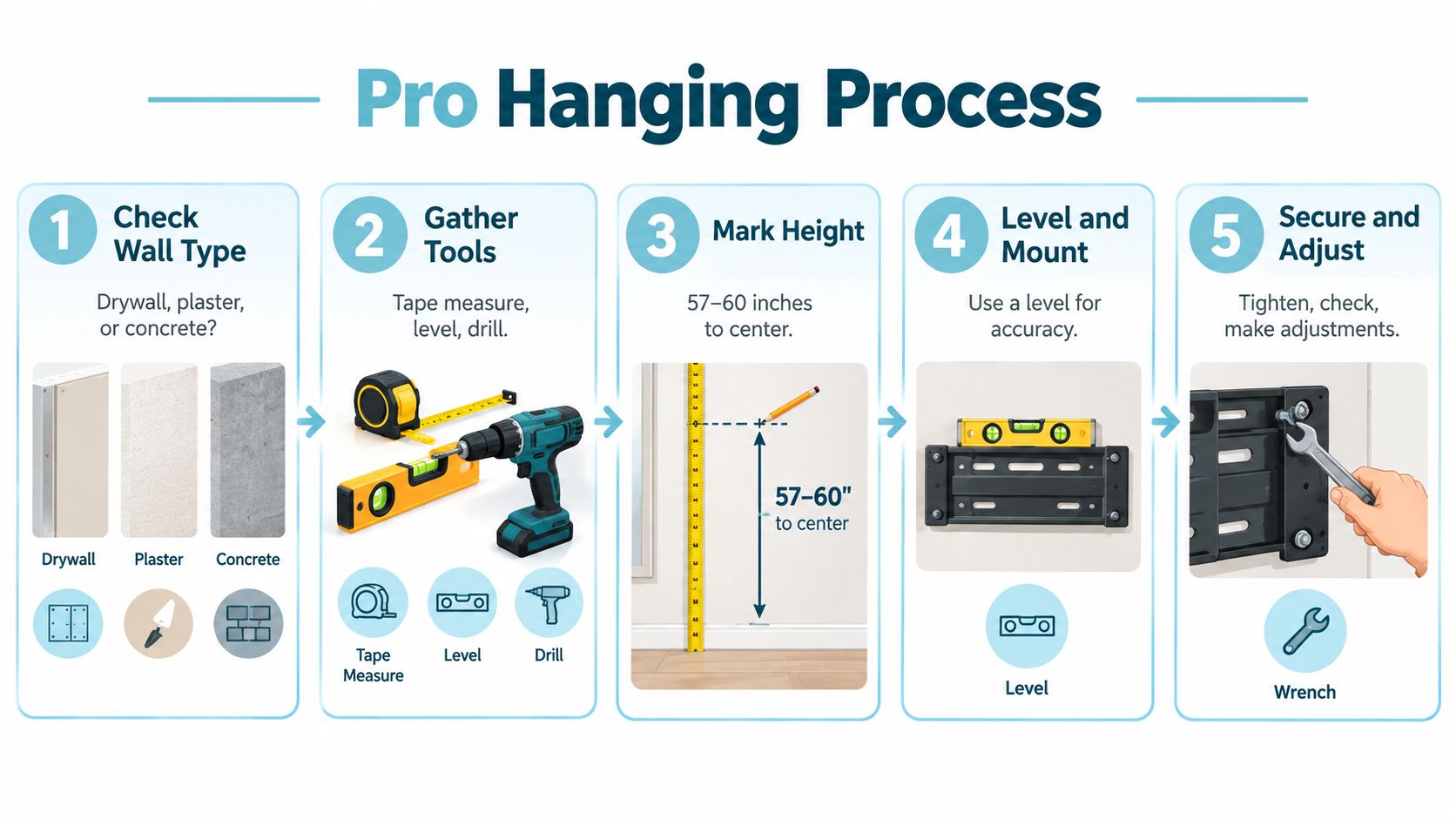
A five-step infographic showing the pro hanging process for wall art including wall type, tools, height, mounting, and adjustment.

A short visual demonstration suits hands-on learners. Use it alongside your measurements, and still check the fixing instructions supplied with your hardware.

Hanging Wall Art Like a Pro From Marking to Mounting

The safest hanging job begins before the drill comes out. Identify the wall substrate, check the artwork's hanging points and consider how the piece will behave once it's on the wall. A wide canvas may be light but still rotate or wobble if it hangs from one off-centre point.
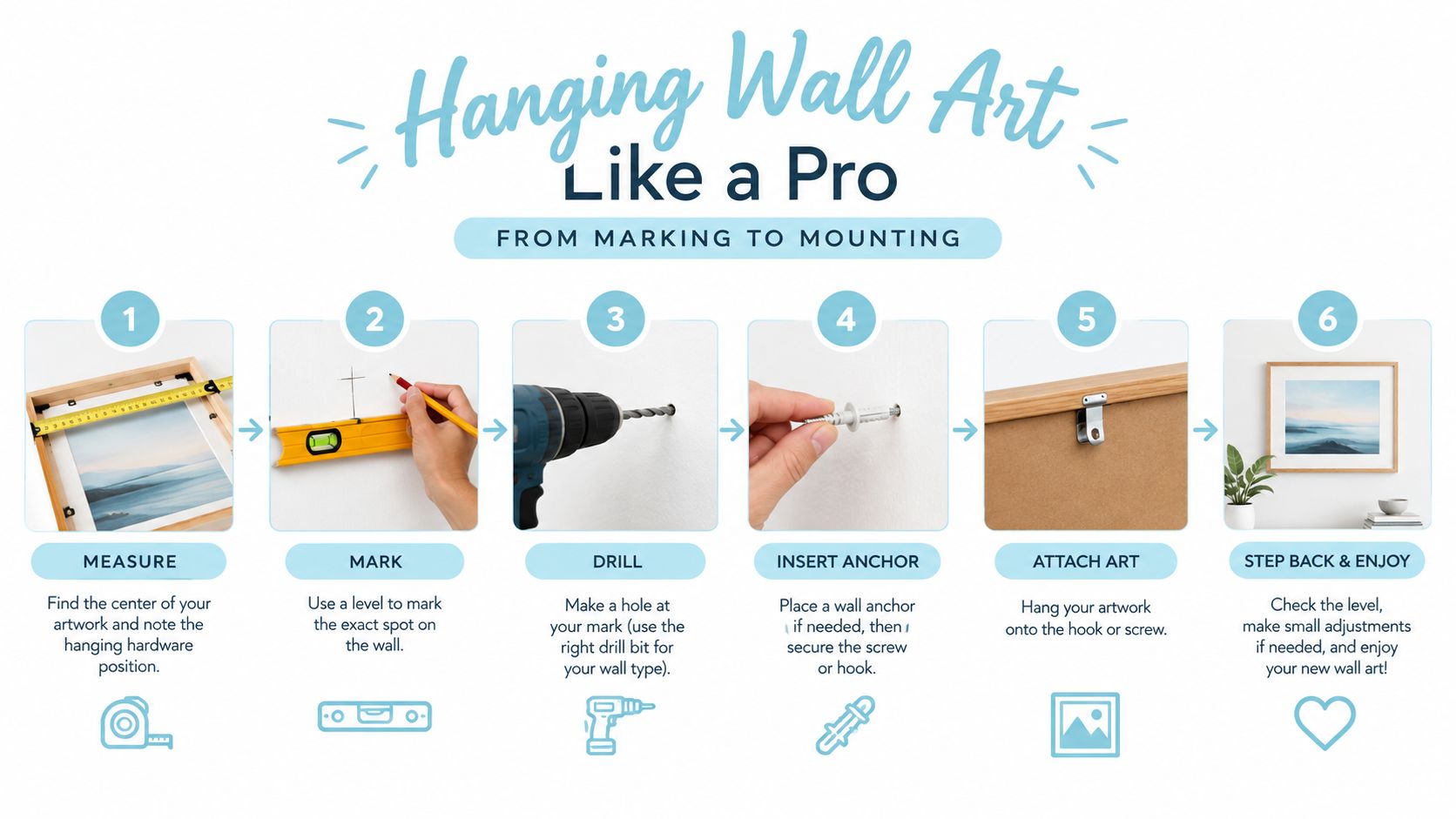
A six-step infographic guide demonstrating how to properly measure, mark, drill, and hang wall art.

Follow the wall before choosing the hook

Plasterboard is commonly the limiting surface in Australian homes. Practical guidance treats a single picture hook in plasterboard as suitable up to about 5 kg, while a dual-hook and wire setup can raise the working range to around 12 kg for a canvas measuring about 120 × 80 cm. On brick, red masonry plugs are cited at roughly 25 kg, which shows why the same frame can need different hardware in different rooms. See the Australian canvas hanging guidance for the substrate-specific examples.

Use a stud where practical, or select a fixing designed for the actual wall type. Don't rely on a generic nail for a framed print because the item feels manageable in your hands. Weight shifts when the artwork moves, and a failed fixing can damage both the wall and the piece.

Mark, mount and test

  1. Measure the artwork. Record its height, width and the distance from the top edge to the hanging wire or bracket.
  2. Mark the centre line. Use the intended centre height, then work backwards from the hanging point rather than guessing where the frame top will land.
  3. Check the fixing. Confirm the hook, plug, anchor or screw suits the wall and the load.
  4. Use two points for width. Two hangers spread the load and reduce rotation. Keep them level, then place the wire under gentle, even tension.
  5. Lift with care. Have another person help with large glass-fronted pieces or metal panels.
  6. Check the result. Step back, use a spirit level and press the lower corners gently to test for movement.

Practical rule: measure twice, make one mark, then test the wall fixing before trusting it with a treasured piece.

For specialist hanging systems, think in terms of the complete arrangement. One Australian supplier lists combinations as light under 10 kg, medium under 20 kg and heavy under 40 kg, while individual hook and wire pairings range from 5 kg on 1 mm Perlon wire to 20 kg on 2 mm wire. The hanging-system load guidance also recommends two hangers for better stability. That approach makes sense for a large wall display beside a prized Kombi model. The frame, wire, hooks and wall must work together.

For a VW-focused installation, this Volkswagen van wall-art hanging guide can sit alongside the general safety checks above. The cheerful part is choosing the position. The serious part is ensuring the artwork stays there.

Renter Friendly and Heavy Art Solutions for Australian Homes

Renters need to plan the wall before choosing the artwork. Check whether the lease permits hooks or adhesive products, whether the surface can support the fixing, and whether the wall can be returned to good condition. A rental-friendly VW coastal display might pair a lightweight canvas with a small woven piece and a diecast Kombi on a shelf, rather than placing heavy metal art above a sofa.

Australian renter guidance commonly discusses Command strips for canvases up to about 2 kg and picture hooks for frames around 5–7 kg. Suitability still depends on the product, wall finish and installation instructions. Read the bond-friendly renter guidance before applying anything to painted plasterboard or wallpaper.

A safer rental routine

  • Read the lease first. Some agreements set conditions for hooks, adhesive products and wall alterations.
  • Check the surface. Dust, fresh paint, textured finishes and wallpaper can change how adhesive behaves.
  • Keep the load modest. Adhesive products suit lighter canvases, not heavy glass frames or substantial metal pieces.
  • Photograph the wall. Take clear before-and-after photos to record its condition.
  • Plan the make-good. Keep the original packaging and follow removal instructions slowly, without pulling adhesive away from the paint.
  • Avoid risky locations. Do not place a poorly supported piece above a bed, cot, desk or busy walkway.

Heavy artwork needs a different plan. Australian trend reporting describes interest in oversized canvases, layered textures, woven hangings, metal art and mixed-media walls. One Australian source reports that its median order size moved from 60 × 80 cm to about 90 × 120 cm in 2026. Treat this as a market observation, not a rule for every Australian home. The Australian picture-hanging trends report also links current interest with Australian photography and Indigenous-owned or licensed works, where provenance deserves careful attention.

A broad canvas can wobble because its corners flex and its hanging point sits away from the wall. Two hangers reduce twisting, while suitable wire thickness helps carry the load. For heavier framed or metal work, choose a rated system instead of matching random hooks until one appears suitable. If the wall is uncertain or the piece is valuable, a professional installer is a sensible investment. In a retro-beach room, secure the artwork first, then let the canvas, metal and woven textures support the Kombi and Beetle display.

Creative Display Ideas for Gallery Walls and VW Coastal Mixes

A successful VW coastal wall feels like a memory board from a long road trip. It might combine a faded ocean photograph, a woven fibre panel, a small metal sign and a shelf holding a bright diecast Kombi. The collection works because each item shares a mood, not because every object comes from the same range.

Build around one travelling story

Start with a visual anchor. A framed Australian or surf image can establish the blue-and-sand palette, while a 1962 Kombi Samba Bus diecast model adds the unmistakable retro note on a shelf below or beside it. A Beetle model can sit slightly apart, giving the display a second shape and stopping the vans from forming a repetitive row.

Flower Power variants suit warmer palettes, especially cream, orange, yellow and faded red. A surfy van works with woven textures and pale timber. Keep the smaller models on a ledge or cabinet rather than attaching them to the wall, and give each one enough room to read as a miniature vehicle rather than a loose ornament.

Use a repeatable arrangement

Try one of these formulas:

  • Anchor and satellites: Hang one broad canvas, then place a small woven piece and metal accent on either side. Repeat one colour in the diecast display.
  • Tactile ladder: Arrange textile, canvas, timber and metal from largest to smallest as the eye travels up a narrow wall.
  • Shelf-backed gallery: Install a slim picture ledge, lean framed pieces against the wall and place a Kombi model in front. Secure items if the shelf is in a busy passage.
  • Asymmetrical cluster: Put the largest item slightly off-centre, then balance its visual weight with two smaller pieces, a circular object or a Beetle model below.

Leave comfortable gaps between pieces and keep the outer boundary deliberate. A gallery wall should look connected from a distance, then reward a closer look with details such as a licence-plate-style sign, woven knots or a tiny surfboard motif.

Lighting matters just as much as spacing. Avoid placing delicate textiles in harsh direct sun, and use warm, directional light to pick up the texture of canvas and metal. If your room already has several small objects, choose one stronger artwork instead of adding more pieces. The living-room wall accent ideas can inspire combinations, but your own collection should remain the deciding voice.

Caring for Your Wall Art and Styling Your Next Steps

Dust is the quiet enemy of a display. Use a soft, dry microfibre cloth on frames, timber and metal, and clean glass with the cloth rather than spraying liquid near the artwork. For canvas, brush gently with a clean, dry, soft brush. Don't press into the surface, especially if the print has raised texture.

Textile and woven pieces need a little breathing room. Keep them away from persistent humidity, steam and areas where they'll catch on bags or clothing. Coastal homes often have open windows and salty air, so inspect metal surfaces occasionally for residue and wipe them according to the maker's care guidance. Direct sunlight can fade prints and fabrics, so use blinds, curtains or a better position when the light is strong.

Keep the fixing part of the care routine

Check the top edge of every hanging when you dust. Look for a slipping wire, a hook that has shifted, a frame leaning forward or a canvas that has started to rotate. Large pieces deserve extra attention after moving furniture, cleaning walls or experiencing strong household vibration.

Let the collection evolve

A wall doesn't need to be finished forever. Rotate seasonal coastal accents, move a Beetle model from a shelf to a cabinet and let a new woven piece change the balance of an older gallery wall. Keep the main palette steady, then allow the details to carry the nostalgia.

Volkswagen's Australian story gives that styling a strong foundation. Volkswagen's official history describes German migrant Karl Regel arriving in Sydney with a right-hand-drive Beetle built in Stuttgart, which became one of the first Volkswagens registered in New South Wales. Full Beetle manufacture later ceased after a 6-year run at the Clayton plant, according to Volkswagen Australia's Beetle history. Museum Victoria records that the first Beetles were imported in late 1953, local production began at Martin & King in Clayton in 1959, and Australian production ended in 1968, with just over 260,000 Beetles made locally. Its collection history of the Australian Beetle preserves those details.

The story continued beyond the original car. Carsales records local content reaching 80% by 1962 and 95% in the mid-1960s, while Drive describes original Beetle production lasting 65 years from 1938 to 2003 and reports 9,848 new-generation Beetles sold in Australia from 2000 to 2017. Those Australian details are outlined in Carsales' Beetle history and Drive's account of the model's production. They're a lovely reminder that a small model on a shelf can carry a much bigger journey.

Visit Volkswagen Memorabilia to explore licensed Volkswagen diecast models, Kombi Samba Bus and Beetle collectibles, Vans and Cars Metal Decor, and coastal home accents that suit a thoughtfully hung display. With local stock, fast shipping and friendly Australian support, it's an easy place to find the next piece for your retro-beach wall or a gift for the VW fan who already has a favourite road-trip story.

Metal Car Wall Decor: A Styling Guide for Aussie Homes

You've finished polishing the Kombi in the garage, stepped inside for a cold drink, and noticed the wall above the sofa is still completely bare. The car has character, the room has good bones, but the display stops at the driveway. Metal car wall decor closes that gap, bringing the curves, colours and memories of classic motoring into the everyday parts of an Australian home.

A well-chosen piece can feel like more than decoration. It might recall a first road trip, a family Beetle, a beach-bound Kombi or a sunny afternoon at Volksfest. The trick is choosing the right style, finish, scale and location, especially when Australian sun, humidity and salt air enter the picture.

Why Metal Car Wall Decor Is Having a Moment

Generic wall art can make a room look finished, but automotive pieces give it a point of view. A vintage Volkswagen sign above a workbench, a flat Kombi silhouette beside a record player or a layered Beetle panel in a hallway tells visitors what matters to you before anyone says a word.

The appeal also fits naturally with Australian interiors. Coastal rooms often use bleached timber, woven texture and relaxed colour, while retro and industrial spaces welcome painted steel, aged surfaces and strong graphic shapes. Reflective metals are returning to Australian decorating, but current styling favours balancing them with stone, texture and softer organic forms rather than filling a room with hard shine. Australian decor coverage on 2026 styling reflects that warmer approach.

Collector's view: The best wall piece should look at home in the room, but still make a VW fan stop mid-sentence.

The wider wall-art channel is healthy too. Australian wall-art imports increased 0.84% from 2023 to 2024, with a 2.49% CAGR from 2020 to 2024, according to Australia wall art market data. That doesn't make every metal sign a guaranteed investment, but it does show that decorative wall products sit inside an established homewares ecosystem, not an isolated collector niche.

For VW enthusiasts, the nostalgia has real Australian roots. Beetles first arrived here in 1953, local assembly began in 1954, Volkswagen Australia formed in 1957, and Clayton production continued until 1976, as documented by Museum Victoria's Beetle history. A wall display can therefore celebrate both the shape of the car and the story behind it.

The Main Types of Metal Car Wall Decor

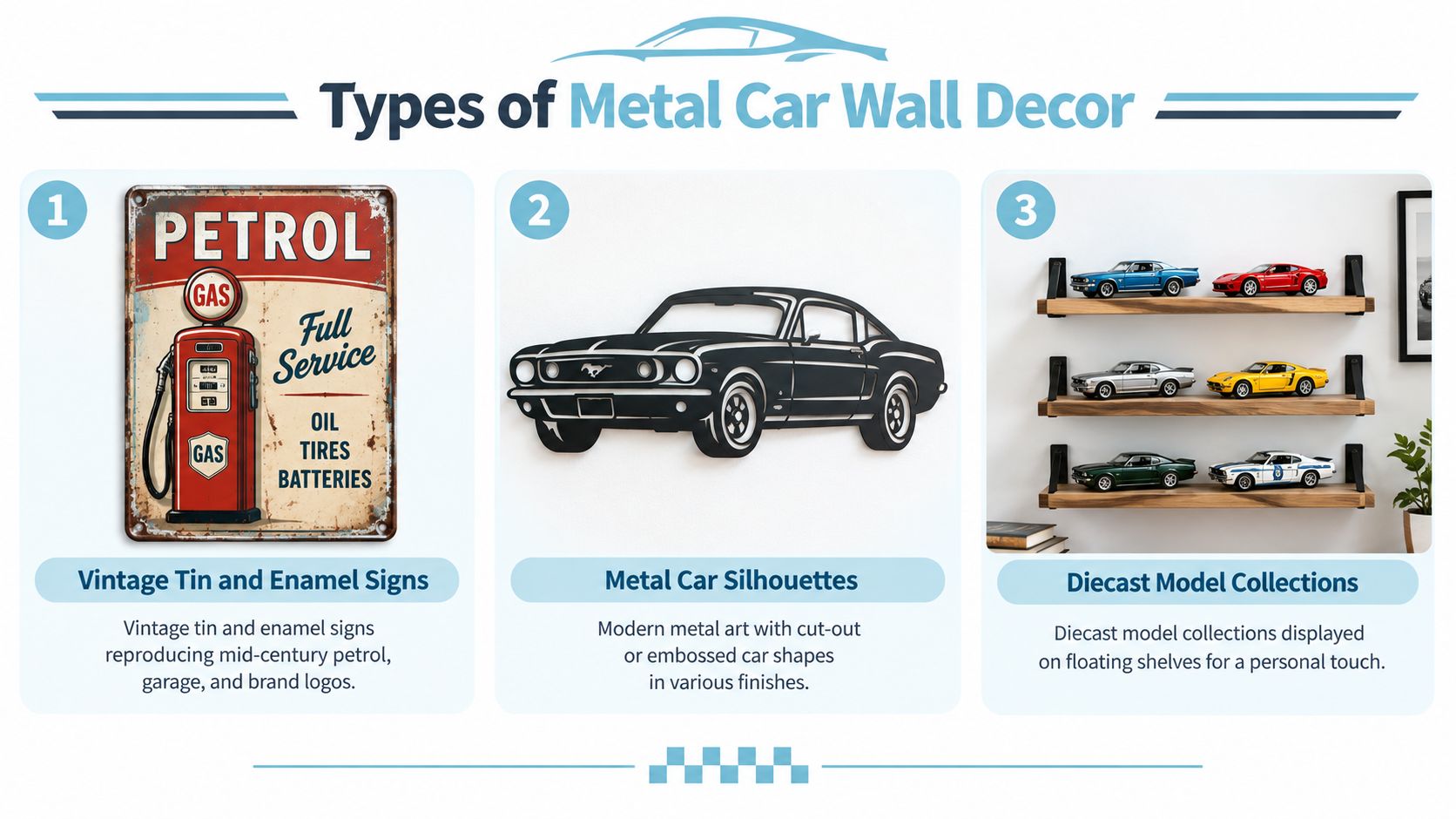
Before buying, identify the kind of object you want on the wall. Most metal car wall decor falls into three useful groups, and each creates a different visual effect.

A graphic illustration detailing three different types of metal car wall decor including signs, silhouettes, and models.

Vintage signs

Tin and enamel-style signs reproduce the language of old petrol stations, garages and motoring brands. Their rolled edges, bold lettering and glossy faces bring instant period charm. A rectangular sign suits a garage, workshop or rumpus room, while a smaller plaque can sit comfortably in a hallway or beside a display cabinet.

These pieces work particularly well when you want nostalgia without adding much depth. They're easy to combine with timber shelving, framed photographs and restored tools.

Flat metal art

Laser-cut and plasma-cut silhouettes offer a cleaner, more contemporary look. A Beetle profile, Kombi outline or simplified wheel design can sit against a pale wall without overwhelming the furniture. Cut-out shapes also create changing shadows as daylight moves across the room, which gives a simple design extra life.

For a coastal interior, a muted blue, white or weathered finish can connect the car theme with surf culture. In a darker man cave, black steel creates a sharper workshop feel.

Dimensional displays

Embossed panels, layered cut-outs, relief designs and wall-mounted diecast arrangements project from the surface. They catch light from different angles and become stronger focal points than a flat sign.

A Kombi Samba Bus diecast displayed on a shallow floating shelf is a good example. It adds genuine three-dimensional detail while leaving the wall itself relatively uncluttered. For classic Beetle references, VW Beetle wall art can provide the visual anchor around which a larger display grows.

Choosing the Right Finish for Your Space

Finish affects appearance, cleaning and service life. A raw steel piece may develop a pleasing rust tone in a dry indoor garage, but that same finish needs more caution near the coast. Powder coating, chrome and printed surfaces each solve a different styling problem.

Australian conditions make the environment especially important. Guidance classifies atmospheric corrosivity from C1, very low, with less than 1.3 micrometres per year of mild-steel corrosion, through to C5 marine, very high, with 80 to 200 micrometres per year in sea-shore or surf exposure. The Australian powder-coating guidance explains why a piece indoors won't face the same conditions as one exposed to salty air.

Finish Durability Coastal suitability Best room
Raw steel Develops patina and needs protection Limited unless sealed and sheltered Indoor garage or industrial room
Powder coat Tough, wipeable and available in many colours Stronger choice when the coating system matches the environment Living room, garage or covered coastal area
Chrome Bright and reflective, but shows marks Better protected indoors, away from salt spray Retro lounge or display room
Printed metal Crisp graphics under a protective surface Depends on substrate and coating quality Kitchen, hallway, office or themed room

The technical detail matters more than a product description that says “rust resistant”. AS 4506-2005 covers powder-coating test procedures and performance requirements involving adhesion, gloss, impact, weathering, corrosion and chemical attack, as shown in the AS 4506-2005 standard preview.

Where to Hang Metal Car Wall Decor in Your Home

Start with the room's job. A living room needs balance and conversation, a garage needs clearance around tools and movement, and a coastal space needs protection from direct salty airflow.

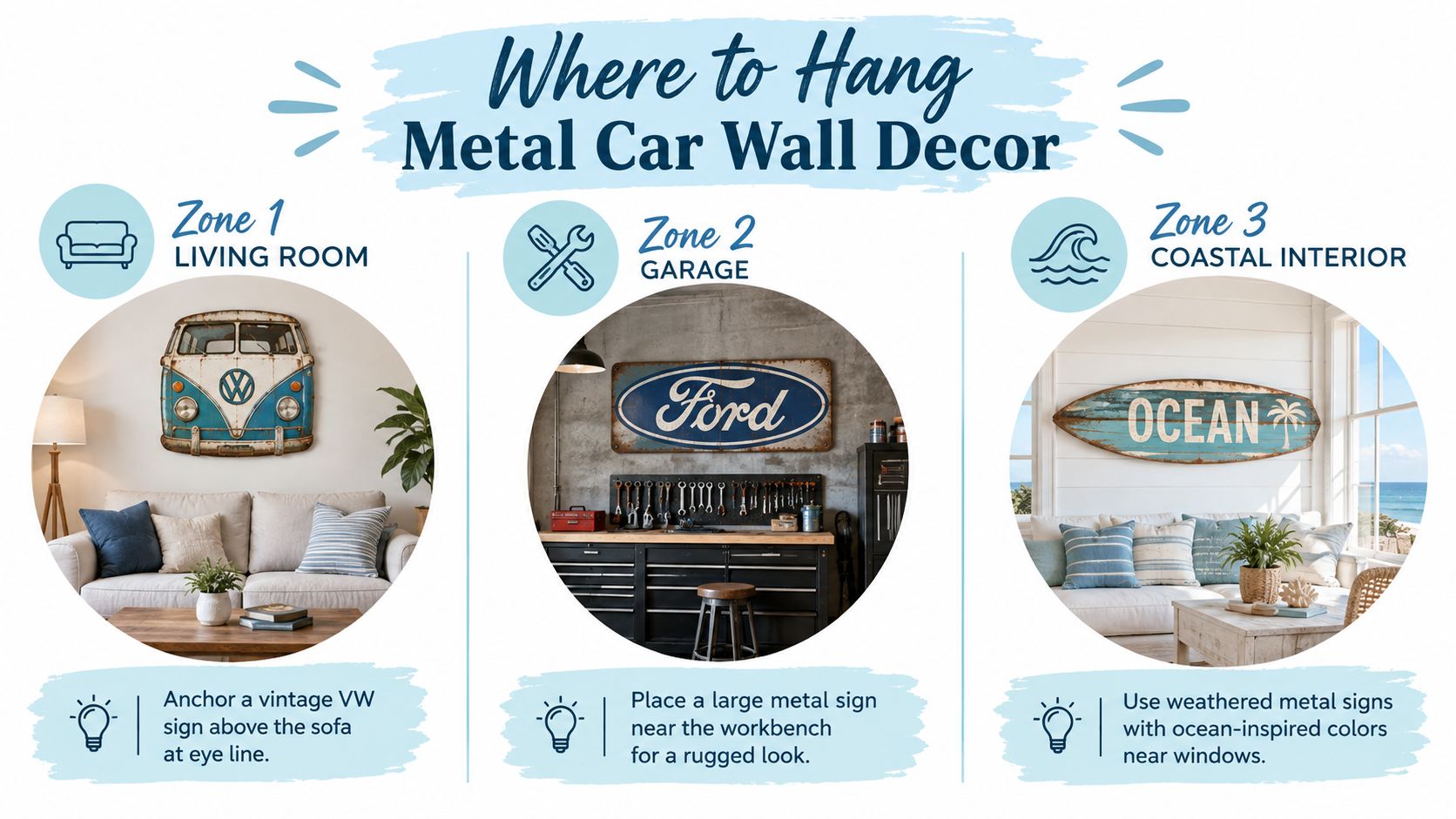
In the living room, place a vintage VW sign above the sofa with its centre close to eye level. Floating shelves underneath can hold a few diecast models, while matching pieces on either side of a television or fireplace create a calm, symmetrical arrangement. Don't let every item compete for attention. One hero design should lead, and the smaller objects should support it.

An infographic showing three interior design zones for displaying vintage metal car and ocean themed wall decor.

A garage or man cave gives you more freedom. Cluster signs near the workbench, above tool cabinets or beside a parts-cleaning area, but check door swings, shelves and overhead lights before drilling. A large Volkswagen van wall-art display can provide a strong vertical or horizontal counterpoint to a workbench.

For coastal rooms, choose a sheltered interior wall rather than a position where sea breezes hit the surface. Weathered metal looks excellent with white-painted boards, bleached timber and woven baskets, but the harder material benefits from those softer companions.

Grouping without visual clutter

Odd-numbered groupings often feel more relaxed than rigid rows. Mix a flat sign with a dimensional piece or a small diecast shelf, and leave 5 to 10 centimetres between items so each shape can breathe. Keep the bottom edge clear of skirting boards, switches and furniture backs.

Placement rule: Hang the display where you can enjoy the story, not where passing traffic will catch a shoulder or knock a model.

Getting the Size and Scale Just Right

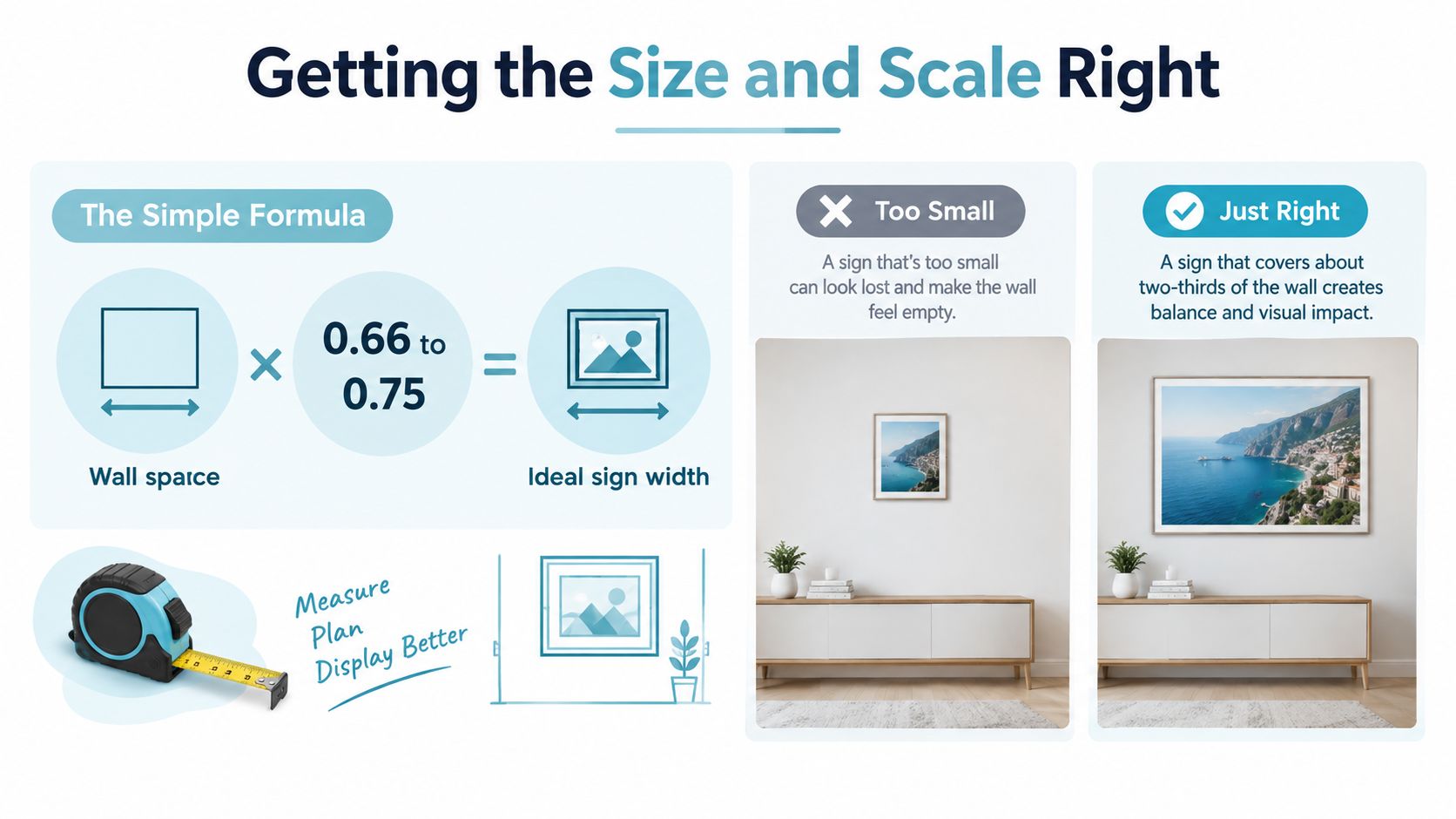
A wall piece can be beautifully made and still look wrong if it's undersized. Measure the usable wall area, not the entire wall, then compare that width with the sofa, bed, workbench or cabinet below it.

For a broad furniture run, aim for art covering roughly two-thirds to three-quarters of the available width. A simple guide is to multiply the usable wall width by 0.66 to 0.75. A larger statement sign in the 60 to 90 centimetre range can suit an open living area, while a 20 to 40 centimetre plaque may work better in a hallway or layered cluster.

An infographic showing a formula to determine the ideal size of wall decor for proper balance.

Centre the artwork around 145 to 155 centimetres from the floor to the middle of the piece, then adjust for seating and ceiling height. Horizontal signs echo the length of a sofa or bench. Vertical silhouettes suit narrow walls, corners and spaces beside doors.

Collectors also need to separate wall-art scale from diecast scale. Australian guidance places a 1:18 model at approximately 25 to 30 centimetres long, a 1:24 model at 16 to 20 centimetres, and a 1:43 model at 10 to 12 centimetres, with other comparisons available in this Australian diecast size guide. Tape a paper template to the wall first. It's far easier than filling an unnecessary drill hole.

A Quick Buying Checklist Before You Commit

A confident purchase starts before the checkout. Take a photo of the wall, mark the furniture below it and use paper templates to test the arrangement in daylight and evening light.

An infographic titled Quick Buying Checklist showing three steps to prepare for wall decor installation.

Run through these checks:

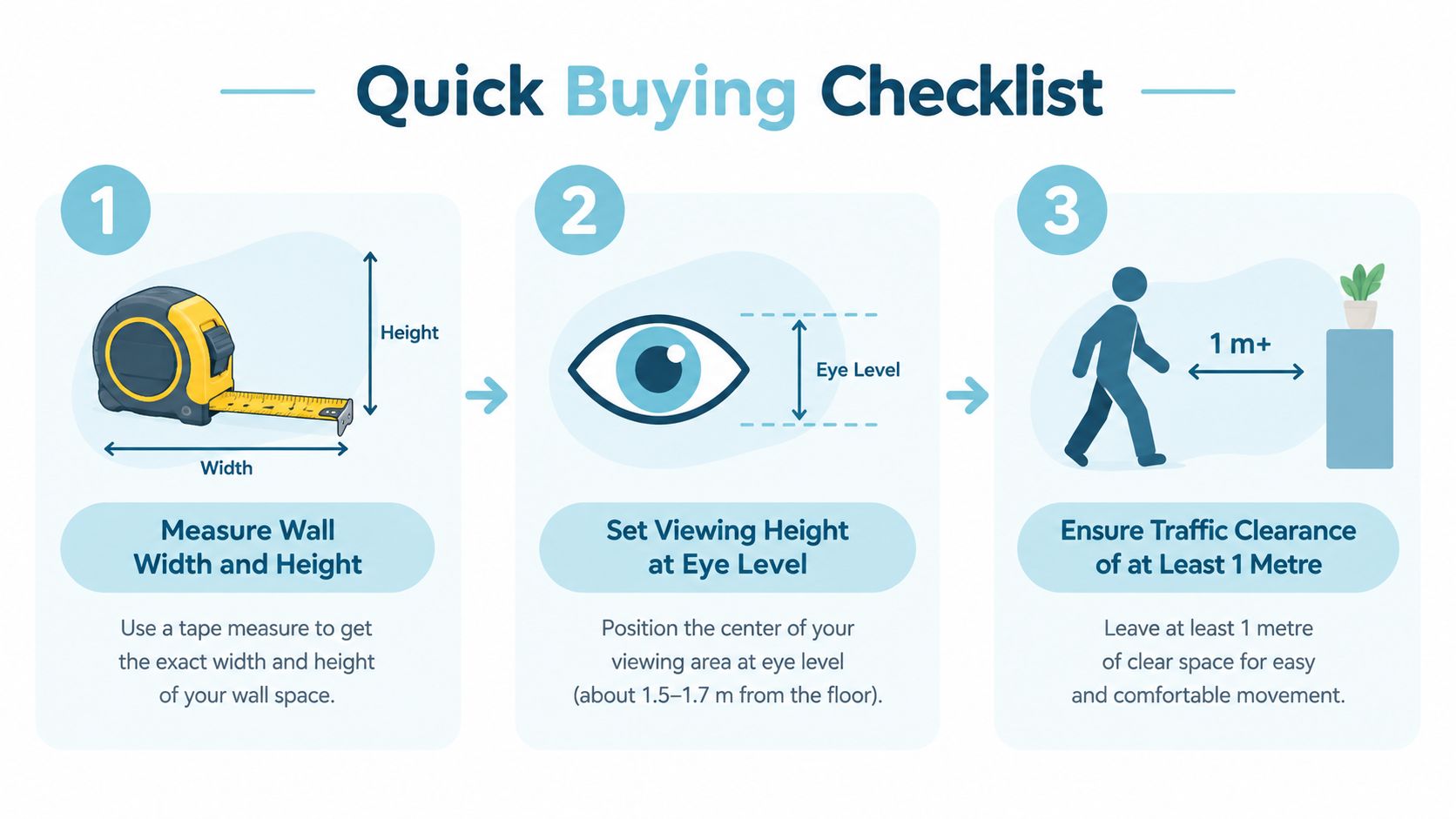
  • Measure the space: Record width, height and the distance to skirting boards, switches, door frames and furniture.
  • Check the viewing height: Centre the design around your normal eye line, then lower it slightly if people will mostly see it while seated.
  • Allow traffic clearance: Keep busy walkways clear, including the infographic's practical 1 metre clearance reminder.
  • Match the finish: Choose a protected coating for humid or coastal conditions, and reserve easily weathered raw steel for suitable indoor locations.
  • Confirm the mounting surface: Plasterboard, brick and masonry need different fixings, and the hardware must support the item's actual weight.
  • Check authenticity: Collectors seeking genuine VW memorabilia should look for officially licensed Volkswagen products rather than generic car imagery.

This short process prevents the common mistakes: a sign that's too small, a finish unsuited to the room or a display mounted where it gets bumped every day.

Caring for Metal Wall Art in Australian Conditions

Dust is the easy part. Salt air, humidity and strong UV exposure create the true test, especially for pieces displayed on verandas, in open garages or near coastal windows.

Indoors, wipe the surface with a clean microfibre cloth as part of your regular housework. If the piece needs more than dusting, use a mild solution and a soft cloth, then dry it thoroughly. Avoid abrasive pads, strong solvents and harsh chemical cleaners because they can dull printed surfaces or damage protective coatings.

Look closely at corners, mounting points and cut edges. Early pitting, bubbling or exposed steel is easier to manage than a large area of corrosion. Chrome needs particular attention because fingerprints and salt residue show quickly, while powder-coated surfaces should be checked for chips that expose the substrate.

A simple care rhythm

  • Every quarter indoors: Dust and wipe the surface, then inspect the face and edges.
  • Every six months: Check screws, brackets, shelves and wall anchors for movement.
  • Each year outdoors or semi-outdoors: Review the clear protective finish and refresh it only with a product compatible with the existing coating.

For coastal homes, a sheltered wall with good airflow is preferable to an exposed exterior facade. AS 4312 helps determine the corrosivity zone, while AS/NZS 2312.1 guides protective coating selection, as outlined in the Australian coating guidance linked earlier. In other words, a good finish starts with the location, not just the colour you like.

Start Your Collection with Volkswagen Memorabilia

A strong display doesn't need to arrive all at once. Start with one piece that carries the most meaning, perhaps a Beetle silhouette, a Kombi sign or a Samba Bus model, then add supporting items as the room reveals what it needs.

The Beetle has a particularly rich Australian story. Clayton-assembled cars reached 80 per cent local content by 1962 and about 95 per cent in the mid-1960s, while the model's market share rose from a little over 1 per cent in 1954 to second only to Holden by 1961, according to the Australian Beetle history recorded by Carsales. ClubVW records that 1960 was the Beetle's most successful Australian year, with 24,388 units sold, and that it ranked as Australia's second-best-selling individual car model behind the FB Holden that year, as detailed in the ClubVW reference timeline.

That heritage gives a wall display its emotional weight. A licensed Volkswagen sign or diecast model isn't just a colour match for the sofa. It connects the room with Australian roads, surf trips, family memories and the community spirit found at events such as Volksfest, VW Nationals and Surf Show & Shine.

For complementary pieces, browse vintage home accessories and build around a single hero item. The right finish, size and placement can turn a blank wall into a small personal museum, without making the room feel like a showroom.


Volkswagen Memorabilia offers licensed VW diecast models, Kombi Samba Bus collectibles, Beetle pieces and coastal-inspired metal decor for homes, garages and thoughtful gifts. Visit Volkswagen Memorabilia to choose a hero piece for your wall, then grow a display that celebrates the Volkswagen stories you've carried for years.

Ceramic Photo Frame: Styling, Care and VW Display Ideas

You've got the shelf sorted at last. A 1:24 Kombi Samba Bus sits beside a faded photo from your first Beetle meet, but the old plastic frame looks out of place against the model's bright paint and the shell collection from last summer's coastal trip. A ceramic photo frame changes the whole scene. It adds weight, texture and a little handmade character, turning a row of VW memorabilia into a story about family, road trips and relaxed Australian living.

That pairing feels especially natural in Australia, where the Type 2 carries local history as well as surf culture. The Kombi first reached Australian buyers in 1954, and Volkswagen assembled it at the Clayton factory in Melbourne from 1964 to 1977, according to Australian Kombi history documented by CarsGuide. A ceramic frame holding a show-day snapshot or beach photograph gives that heritage a place beside your diecast collection, rather than leaving it tucked away in a drawer.

Why Ceramic Photo Frames Belong on Every VW Display Shelf

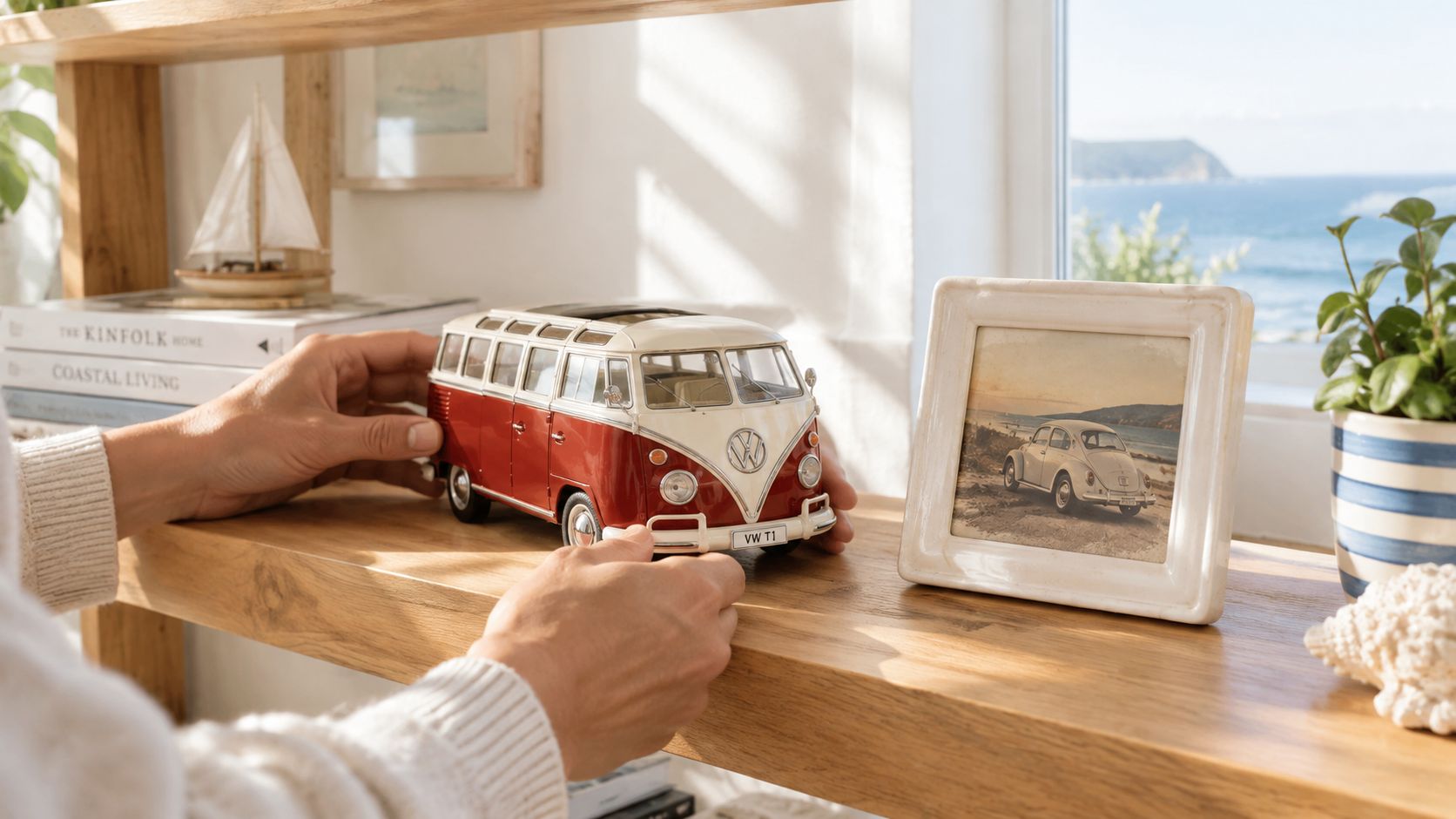
A ceramic frame has the same appeal as a well-finished diecast model. You notice its weight when you lift it, the surface catches the light differently from plastic, and small variations in glaze can make the piece feel personal. Place one beside a red-and-white Kombi, and the display gains a tactile accent that echoes the rounded bodywork and cheerful colours of classic Volkswagen design.

A person placing a red and white Volkswagen T1 toy bus model on a rustic wooden shelf.

The frame also gives the eye somewhere to rest. A shelf filled only with models can look like a catalogue. Add a ceramic photo frame with a family road-trip image, a Volksfest moment or a coastal sunset, and the display starts to feel lived in. The Kombi becomes part of a memory rather than another object in a collection.

A natural fit for coastal styling

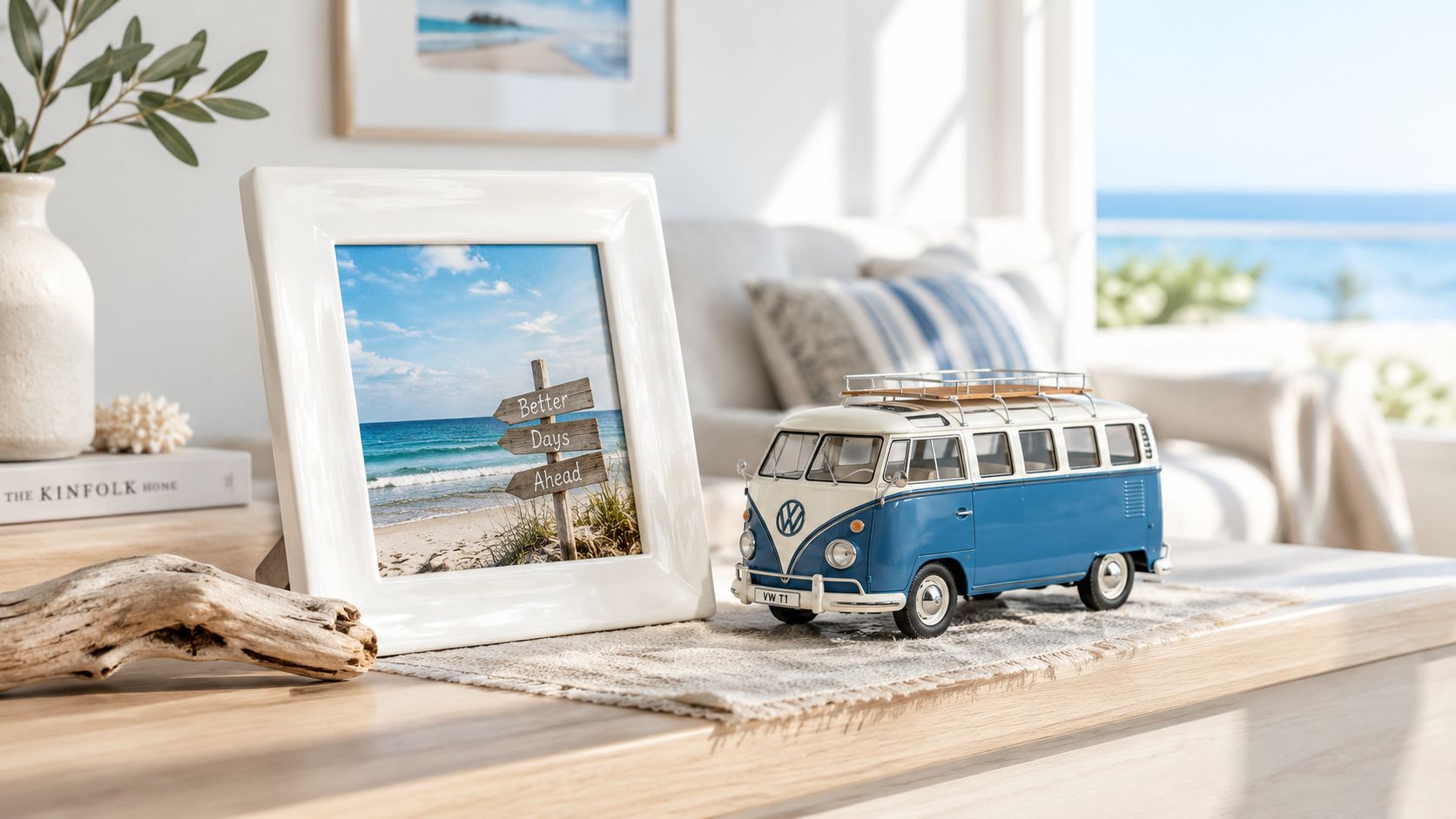
White, pale blue and sandy neutral finishes work beautifully with shells, timber, woven baskets and nautical accents. A glossy blue ceramic frame can pick up the colour of a Samba Bus, while a matte white frame lets a brightly painted Beetle remain the star. The result suits a beach house, a home office or a garage display without making the room feel like a showroom.

Practical rule: Give every model a companion object that explains why you collect it. A photo, ticket, map or small ceramic accent can tell the story better than another vehicle.

Ceramic also makes a thoughtful gift for someone who already owns plenty of Volkswagen diecast. A model celebrates the car, while the frame creates space for the owner's own memories. That combination is why ceramic photo frames sit comfortably between VW memorabilia collectibles and home décor.

Understanding Ceramic Frame Materials and Finishes

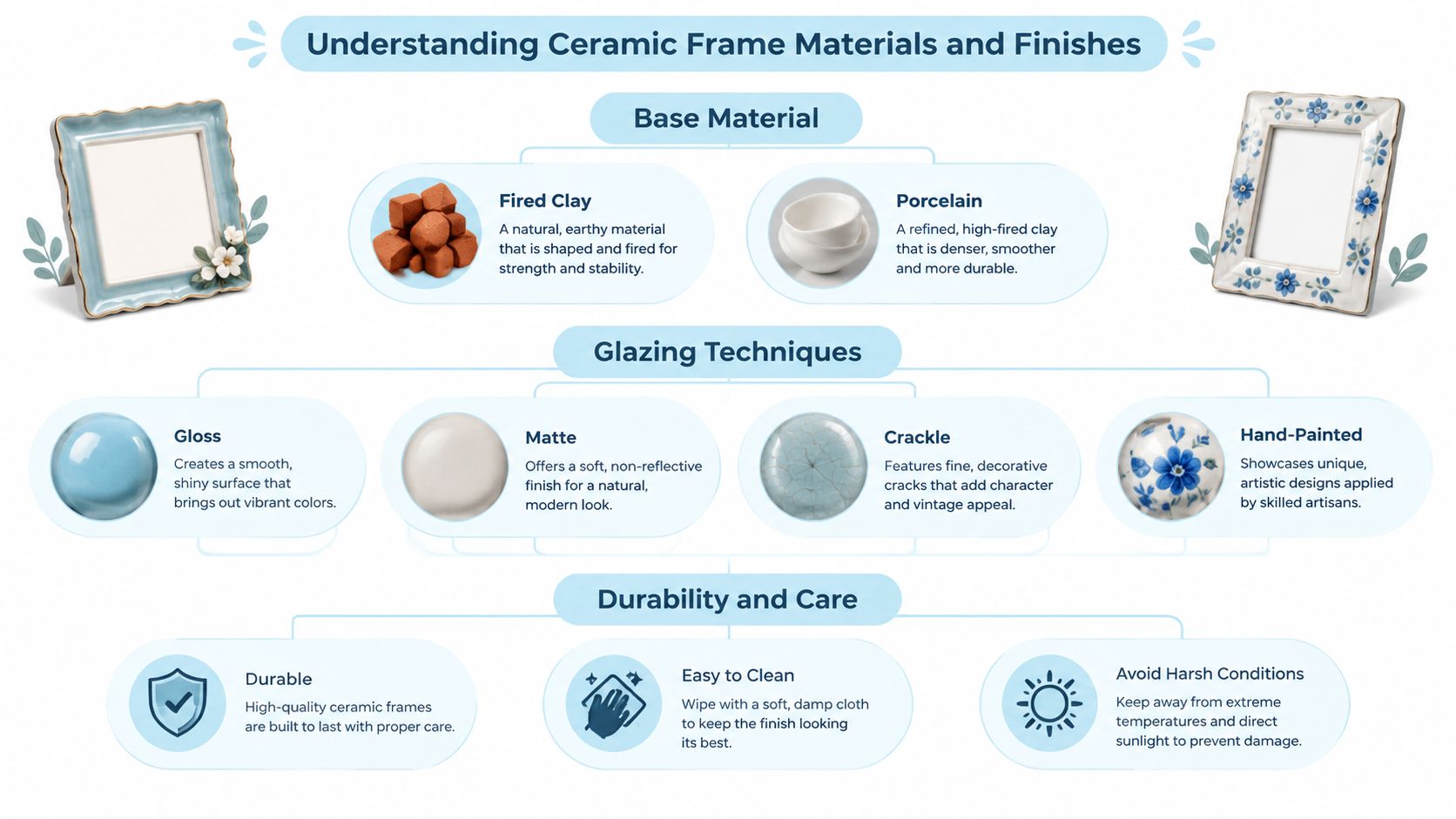
Ceramic photo frames usually begin with fired clay or porcelain. Clay tends to offer a more earthy, substantial appearance, while porcelain can produce a smoother, finer surface. Neither choice automatically guarantees quality. The frame's finish, edges, backing and firing quality matter just as much.

An infographic titled Understanding Ceramic Frame Materials and Finishes, detailing base materials, glazing techniques, and care instructions.

Read the surface before you buy

A gloss glaze reflects light and makes bold colours pop, which suits a colourful Flower Power Beetle or a display with polished metal details. Matte glaze feels quieter and more contemporary, particularly beside pale timber and linen. Crackle finishes introduce fine lines across the glaze for an aged, vintage look, while hand-painted surfaces can bring stronger personality through brush marks and irregular colour.

Kiln-firing hardens the ceramic body and fixes the glaze to the surface. For photo-ceramic imagery, the image can be glaze-sealed, which makes the finished surface highly durable and resistant to fading. Western Australian Museum conservation guidance still recommends limiting light exposure to 50 lux or less, excluding ultraviolet light where possible, and maintaining display conditions around 16 to 20 °C with 30 to 40% relative humidity for photographic materials.

Quality checks for online and market buying

Run through these checks before choosing a frame:

  • Glaze coverage: Look for an even surface without bare patches, unexpected pinholes or rough pools around the edges.
  • Edge finishing: The photo opening should feel smooth, with no sharp ceramic lip that could catch paper or fingertips.
  • Backing strength: The easel or wall fitting should sit firmly rather than wobble under the frame's weight.
  • Craft character: Hand-finished pieces may show small variations. Those differences can be attractive, but they shouldn't hide cracks or structural flaws.

Compared with a composite frame, ceramic feels more substantial and decorative. Timber brings warmth and grain, while metal offers a crisp industrial edge. Ceramic occupies the middle ground, with enough visual softness for a family photograph and enough presence to stand beside a carefully chosen Volkswagen diecast model.

Ceramic vs Timber vs Metal Frames for Collectors

Collectors usually make this decision with the shelf in mind. A light acrylic frame may be easy to move, but it can look less grounded beside a model. A heavy ceramic frame can anchor a small vignette, though you'll want to check the shelf depth and protect the surface underneath.

Criteria Ceramic Timber Metal Acrylic
Shelf stability Weighty and steady Usually stable, depending on construction Stable, often with a slim profile Light and easy to shift
Visual character Tactile, glazed, decorative Warm, natural and familiar Clean, industrial or modern Minimal and unobtrusive
Moisture considerations Glaze resists surface moisture, but protect the backing Can respond to damp conditions and finish wear May suit practical spaces, with attention to corrosion Handles casual wiping but can scratch
Customisation Glaze colour, shape and painted detail Stain, paint, carving and profile Powder coat, brushed or polished finishes Clear or coloured options
Sustainability conversation Durable object with long use potential Reclaimed or responsibly sourced timber can be appealing Longevity depends on construction and finish Material choice and lifespan need careful consideration

Match the material to the room

Choose ceramic for a display that needs a decorative focal point, especially in a coastal or retro setting. Timber suits a restoration-inspired garage, where natural grain complements tools, old signs and warm lighting. Metal works well with industrial shelving and larger vehicle displays, while acrylic is useful when the photograph should remain visually quiet.

Sustainability deserves a thoughtful answer rather than a blanket label. Australian and Asia-Pacific buyers are showing interest in FSC-certified timber, recycled materials, low-VOC finishes, bamboo and reclaimed wood, and some segments support a premium of roughly 10 to 20% for eco-friendly frame materials, as discussed in the Australia gallery-wall frame market analysis. Ceramic can be a sensible choice when you value durability and intend to keep the piece for years, but recycled or reclaimed alternatives may better suit buyers whose first priority is material sourcing.

How to Choose the Right Ceramic Photo Frame

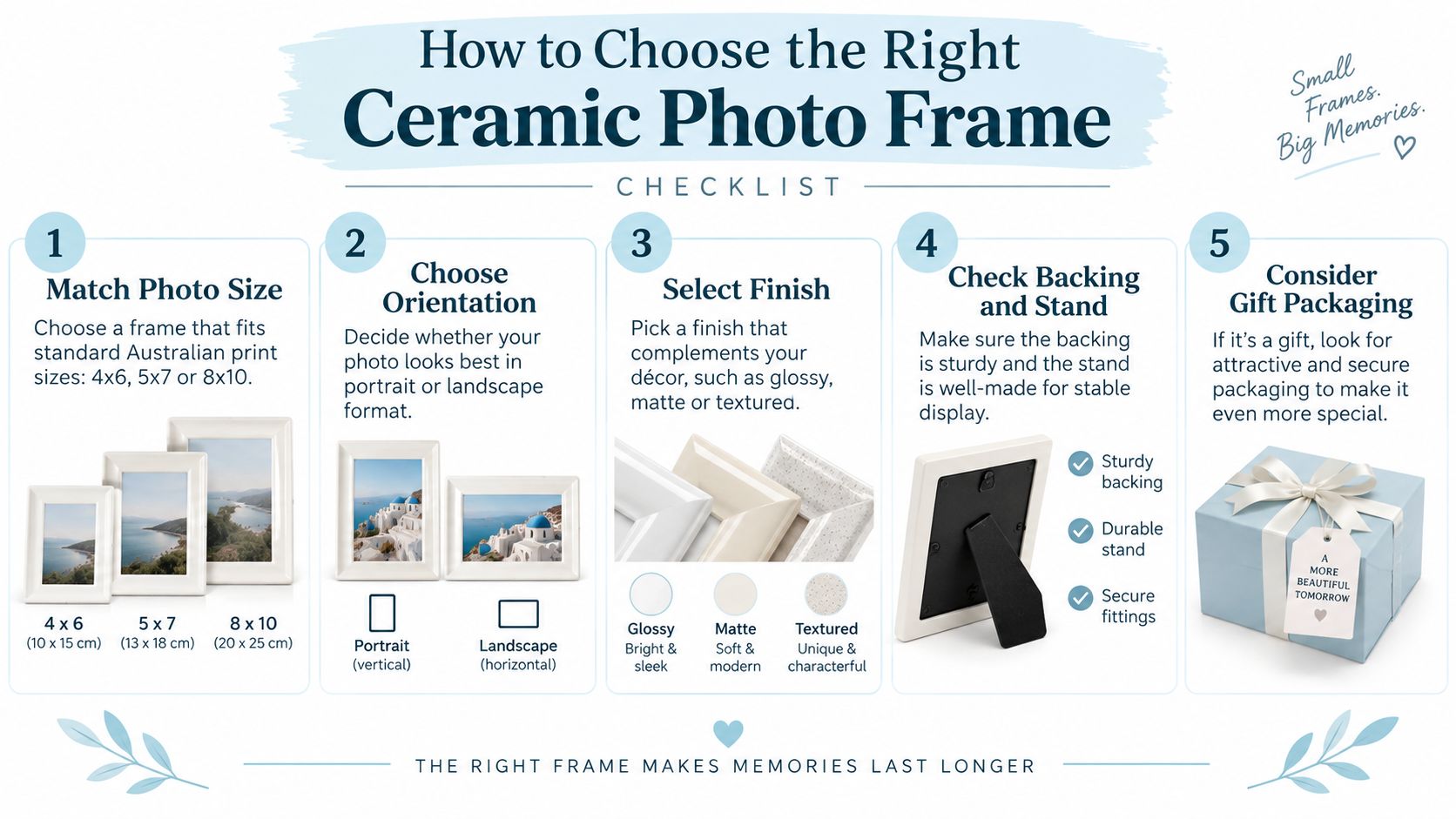
Start with the photograph, not the décor. Australian print sizes commonly include 4×6, 5×7 and 8×10, so check the frame's stated image opening rather than relying only on its outside dimensions. A wide beach scene usually needs horizontal orientation, while a portrait of a family member or a front-on Beetle photograph often looks stronger vertically.

A five-step checklist infographic illustrating how to select the perfect ceramic photo frame for your pictures.

Work through the practical details

  1. Measure the print: Confirm the visible photo area and allow for any overlap beneath the frame lip.
  2. Choose the orientation: Check whether the backing supports portrait, horizontal, or both.
  3. Match the finish: Blue and white glazing suits coastal décor, while cream, red or distressed finishes can complement a retro garage.
  4. Inspect the backing: An easel stand suits shelves and mantelpieces. Wall fittings help with gallery arrangements. Dual-purpose designs give you both options.
  5. Check the packaging: Ceramic needs protective wrapping and a firm outer carton for safe Australian delivery.

Glazing affects how the photograph appears. A clear, even surface should preserve colour without creating distracting reflections from a nearby window or display light. If you're buying online, read the product description carefully for the photo opening, backing style and finish. If those details aren't listed, ask before ordering.

For a diecast shelf, the frame should also relate to the model's scale. A 1:18 model is typically around 25 to 30 centimetres long, while a 1:24 model is generally around 16 to 20 centimetres, according to this Australian diecast collecting guide. A compact frame can sit comfortably beside a 1:24 Kombi, while a larger frame may need more breathing room beside a 1:18 display.

If your shelf needs a more secure presentation, browse practical display cases for models and plan the frame as a separate visual layer rather than squeezing everything into one enclosure.

Styling Your Ceramic Frames with VW Diecast and Coastal Décor

A small shelf can carry a surprising amount of personality. Set a 1:24 Kombi Samba Bus at a slight angle, place a white ceramic frame behind its rear quarter, and fill the frame with a faded beach photograph. Add a small shell dish and a piece of driftwood, but leave enough open space for the model's silhouette to read clearly.

A coastal themed display with a white ceramic photo frame and a blue Volkswagen van model on a wooden table.

Build the display around one hero model

Start with the largest or most meaningful item. A Samba Bus, a Volkswagen Beetle model or a surf-themed van should hold the visual centre. Place the ceramic frame slightly behind or beside it, then add one low coastal object, such as a shell or small piece of pale timber, to balance the height.

A mantelpiece arrangement can tell a broader family story. Put a Beetle model at one end, two ceramic frames with road-trip photographs near the centre, and white shell décor at the other end. Vary portrait and horizontal images so the arrangement doesn't become a rigid row.

For more ideas involving shells, nautical accents and relaxed beach styling, explore coastal home décor ideas.

Let the memories change with the season

Swap the photograph when the display needs a fresh note. A summer surf image works with blue-and-white ceramic, while a family Christmas photograph can sit in a festive frame during December. The model doesn't need to change. A new photograph can make the familiar Kombi feel connected to a different chapter.

Keep colours linked rather than identical. A red detail in the photograph can echo a red Beetle, while sandy neutrals can soften a bright diecast van. The best displays feel collected over time, not assembled from one matching set.

Caring for and Cleaning Your Ceramic Photo Frame

Dust the frame with a soft, dry microfibre cloth. Support the piece from underneath as you wipe, especially when the frame has a projecting ornament, uneven base or delicate hand-painted detail.

For marks, use a lightly damp cloth with mild soap, then wipe away residue and dry the surface. Avoid abrasive powders, rough sponges and strong chemical cleaners, which can dull a glaze or damage painted areas. Don't spray liquid directly onto the frame because moisture can reach the backing, print or easel mechanism.

Remove the photograph carefully when changing images. Lay the frame face down on a folded towel, release the backing gently and keep fingers away from the ceramic opening. If the frame feels tight, don't force the print through. Trim or replace the photograph rather than risking a chipped edge.

Bright Australian sunlight deserves attention, particularly in coastal homes with large windows. Keep the frame away from direct sun, and in tropical regions avoid persistently damp areas where humidity can affect paper, backing materials and photographs. Glaze-sealed photo imagery is durable, but sensible light and moisture control will protect the whole display.

Gift Ideas and Sourcing Ceramic Frames in Australia

A ceramic frame makes a thoughtful present for a VW enthusiast who already has shelves full of models. Pair one with a 1962 Kombi Samba Bus or a Flower Power Beetle, then add a printed family photograph so the gift feels personal rather than generic. It works for birthdays, Father's Day and Christmas, especially when the recipient enjoys both classic cars and coastal décor.

A shell-themed design can suit someone who prefers beach styling, while a colourful retro finish belongs beside a garage sign or restored Beetle photograph. For a complementary option, consider a shell photo frame that carries the coastal theme through with a lighter, nautical feel.

Australian-based importers offer practical advantages for fragile décor and collector gifts, including local stock, faster shipping and support within Australian business hours. Australia's picture-frame market was valued at USD 268 million in 2025 and is projected to reach USD 285.42 million in 2026, then USD 472.37 million by 2034, with a projected 6.5% CAGR from 2026 to 2034, according to the Australia picture-frame market benchmark. Ceramic frames sit within that broader decorative framing category, alongside the diecast and gift pieces that make a VW display feel complete.


Browse Volkswagen Memorabilia for licensed Volkswagen diecast models, Kombi Samba Buses, Beetles, coastal décor and gift-ready photo frames. Choose a ceramic accent for your display, pair it with a favourite VW model, and give an old road-trip memory the shelf space it deserves.

7 Wall Decoration Ideas for VW and Coastal Homes (2026)

Salt air, a half-open Kombi door, and a wall that's still blank after the weekend tidy-up. That's the sort of moment where wall decoration ideas stop being abstract and start feeling personal, especially in an Aussie beach house, surf shed, or garage full of VW memories. The best pieces don't just fill space, they carry the road trips, the show days, and the easygoing spirit that makes a Volkswagen feel like part of the family.

In Australia, wall styling sits inside a big home-furnishings market, and the broader décor world gives the category real weight, with wall art and decorative pieces treated as part of the room's identity rather than an afterthought (home furnishings and wall décor market research, wall décor market research). That matters for VW lovers because a Beetle silhouette, a Kombi print, or a tidy diecast shelf can do the same job a glossy magazine room does, only with more personality and a lot more grin factor.

1. VW Beetle Wall Art for Aussie Collectors

A Beetle wall piece earns its keep fast because the shape does half the work for you. The classic roofline is instantly recognisable, and the Beetle's long run from 1938 to 2003 gives it the kind of heritage that feels right at home above a bench, behind a sofa, or in a garage shrine built around surf days and Sunday drives. Volkswagen Memorabilia's VW Beetle wall art range leans into that nostalgia with metal wall art, vintage-style prints, and coastal-ready pieces that suit Aussie homes without trying too hard.

How to style the silhouette without overdoing it

The cleanest look is to let the Beetle be the anchor, then build around it with a few softer textures. A linen sofa, a timber side table, or a weathered shelf gives the piece room to breathe, while coastal accessories keep the mood relaxed rather than theme-park loud. For a living room or beach shack, a single bold Beetle outline often works better than a crowded cluster, especially when the wall already has busy windows or rattan furniture.

Practical rule: use one strong VW focal point, then keep the rest of the wall quieter so the shape can do the talking.

The other win here is material choice. Metal suits garages and breezy covered spaces, framed prints feel easy in living rooms, and lighter finishes are the safer pick in humid or seaside settings. If you're shopping for a mate, this is the sort of piece that feels thoughtful without needing a massive budget or a huge wall.

The wall accents for living rooms category is worth a look if you want the Beetle to sit alongside other pieces instead of standing alone. It's a neat way to build a display that looks curated rather than collected by accident.

2. Temple & Webster for Flexible Wall Prints

A blank wall can feel a bit like a half-finished Kombi conversion, close, but not quite ready for the road. Temple & Webster is handy when you want to sort that problem quickly, with framed prints, canvases, diptychs, triptychs, and photographic wall art that work across coastal, retro, abstract, and more polished looks. Their Wall Art Prints collection suits a hallway, an open-plan lounge, or a rental where you want the room to feel settled without touching the paintbrush.

For VW and coastal homes, this retailer works best when you need scale choices and a quick visual test. A large print above a low sofa can carry the same easy confidence as a Kombi parked near the surf, while a multi-piece set can fill a wide wall without leaving the space feeling sparse. The mix also helps when you're cross-checking style, size, and colour before you commit, which matters in homes where the wall has to sit alongside timber, rattan, and salty daylight. For more styling angles that suit that relaxed beach-house feel, have a look at our guide to coastal home decor ideas.

Why it works for quick room refreshes

The strength here is choice without much fuss. If your wall is awkwardly shaped, a multi-panel set can balance it out, and if you're styling a rental, a framed print is easy to take with you later. The selection also suits buyers who like to compare looks side by side before they commit, especially when the sofa, rug, and colour palette are already doing some of the heavy lifting.

A broad catalogue helps when the room is still coming together, because you can pick the artwork after the main pieces are in place.

Print quality and materials can vary across suppliers, so it pays to check the product details before you buy. For a coastal home, calmer imagery usually sits better than anything fussy, because the wall should feel like part of the view rather than competing with it.

3. Adairs for Fast Coastal Makeovers

Adairs is ideal when the wall needs a lift before the next open home, family visit, or show weekend. The retailer sells ready-to-hang canvases, framed prints, embroidered pieces, and beaded wall art, which gives you more texture than a basic poster wall and a faster path to a finished room than custom framing. Their wall art and mirrors range is especially handy for coastal bedrooms, breezy living rooms, and entryways that need a friendly first impression.

What makes Adairs useful for VW-inspired homes is the mix of approachable style and easy turnover. You'll often find beach, botanical, and abstract pieces that sit comfortably beside timber, rattan, and the sort of soft neutrals that make a Kombi print feel right at home. The sizes also tend to suit standard wall zones, which helps when you're trying to avoid art that feels either postage-stamp small or overpowering.

Best use cases in Aussie homes

  • Rental living rooms: Pick a ready-to-hang canvas so you can update the wall without a huge commitment.
  • Beach-house bedrooms: Choose quieter colour palettes that echo sand, shell, and sky.
  • Entryways and narrow halls: Use a vertical frame or narrow piece so the wall feels intentional.

The downside is that stock moves quickly, so if you spot a piece that fits your mood, don't leave it sitting in your cart for a week. Product specs also vary by SKU, so it's worth checking glazing, paper, and finish before you buy.

Adairs

A good Adairs wall can be the visual equivalent of a freshly polished Beetle at sunrise, easy on the eye and ready for the day.

4. Urban Road for Designer-Led Statements

Urban Road suits the collector who wants the wall to feel considered rather than merely decorated. Their made-to-order prints and canvases come in abstract, scenic, and floral styles, and the collaborations with names like Shaynna Blaze and Darren Palmer give the collection a more design-forward edge. If your VW space leans coastal-modern instead of retro-kitsch, this is the sort of retailer that helps the room feel pulled together.

The made-to-order setup matters because scale and finish become part of the decision, not afterthoughts. You can choose a size that sits properly above a sideboard, or go larger so the artwork has the same presence as a Kombi parked front and centre at a car show. The product photography is also useful for judging proportion, which saves a lot of guesswork when you're styling a big wall in an open-plan living area.

Where Urban Road fits best

  • Contemporary coastal lounges: Use soft-toned scenes or abstract works to echo sea and sky.
  • Bedrooms with restraint: A single framed canvas can keep things calm and uncluttered.
  • Feature walls: Bigger pieces work well where the wall needs a real anchor.

The trade-off is lead time, since made-to-order production isn't instant. Premium frames and larger canvases can also lift the final cost, so it's the better pick when you're happy to wait for a specific look rather than buying on the spot.

Urban Road

If you want a polished finish that still feels warm, Urban Road gives you that middle ground between showroom clean and lived-in coastal charm.

5. Desenio Australia for Budget-Friendly Gallery Walls

Desenio Australia is the easy answer when you want to build a gallery wall without making it a huge project. Their poster packs and matching frames are made for people who want the layout sorted in one hit, which is handy for renters, first homes, and beach cottages where you want cohesion more than one-off drama. Their poster and frame collection makes it simple to mix typography, coastal prints, and vintage-inspired pieces into one tidy wall.

For VW lovers, that's useful because a gallery wall can echo the rhythm of a car meet, a few standout pieces with supporting characters around them. You might hang one Kombi image as the centrepiece, then build around it with softer shapes, beach tones, or simple graphics. The result feels collected over time even when you bought it in one afternoon.

A smart fit for smaller walls

Desenio's strength is accessibility. The packs lower the barrier to starting, and the wide size matrix makes it easier to fill a wall above a sofa, a desk, or a hallway console. That's particularly handy in apartments or compact homes where every metre needs to earn its place.

Keep the palette tight and the frame finishes consistent, and even a budget wall can look deliberate.

One thing to watch is that the lighter frames can feel more basic, and open-edition prints won't have the uniqueness of originals. Still, for a cohesive wall that doesn't blow the budget, it's one of the simplest ways to get a polished result.

Boho wall art ideas from Volkswagen Memorabilia can sit nicely beside this style if you want a softer, more relaxed VW look.

6. The Print Emporium for Made-to-Order Calm

The Print Emporium works well when you want your wall to feel settled, not loud. The brand makes its wall art to order in Australia, with framed and unframed options across abstracts, botanicals, and scenic views. Their wall art collection is a strong fit for coastal homes that need a calm backdrop for a Kombi model, a surfboard, or a dining room that doubles as a memory wall.

The appeal is consistency. Local production gives you a clearer handle on finish and fit, and the catalogue photography makes it easier to imagine how a piece will sit in a real room. That matters for buyers who'd rather choose carefully once than chase a few cheaper options that never quite land.

When this kind of wall art shines

The Print Emporium suits quiet walls that still need personality. A soft vista above a bed, a framed canvas in an entry, or a muted botanical in a sunroom can all carry the room without making it feel crowded. For coastal styling, it also pairs well with pale timber, white walls, and the sort of natural textures that don't fight for attention.

A small caution, though. Production takes time, so this isn't the shop for a last-minute weekend refresh. It's the better choice if you're happy to wait for a piece that feels more resolved and less disposable.

The Print Emporium

If your goal is a wall that feels like a long, relaxed drive home rather than a loud showroom display, this retailer has the right temperament.

7. Gioia Wall Art for Coastal Personality

Gioia Wall Art brings a more playful, beach-friendly edge to the mix. The range includes posters, framed prints, framed canvases, hand-painted canvases, and custom wallpaper, so there's enough variety to suit both simple styling jobs and more distinctive feature walls. Their wall art store is especially handy if you want something coastal or nature-forward that still feels a bit more individual than a generic print shop pick.

The best thing here is choice across substrates. A framed canvas can sit comfortably in a casual living room, while hand-painted options bring a bit more soul if you're styling a holiday home, garage lounge, or gift wall for a VW enthusiast. The free Australia-wide shipping callout on many products is another practical plus for buyers who'd rather keep the whole process simple.

Use it for character, not clutter

Gioia works best when the wall needs one or two strong notes rather than a crowded arrangement. A coastal image in a beach shack or a layered set of nature-inspired prints can echo the same easygoing feeling you get from a Kombi at a surf club car park. It also suits buyers who want something a little less expected than a standard framed print.

The trade-off is that some pieces are made to order, so timing still matters. Frame specs can vary too, which means it pays to read the product page carefully before settling on a piece.

Gioia Wall Art

For a coastal wall with a bit more warmth and personality, Gioia gives you a nice balance of ease and character.

Wall Decoration Ideas: 7-Item Comparison

Item Implementation complexity 🔄 Resource requirements ⚡ Expected outcomes ⭐📊 Ideal use cases 💡 Key advantages ⭐
VW Beetle Wall Art: A Guide for Aussie Collectors Low, straightforward selection & styling 🔄 Low, budget-friendly options, local shop support ⚡ High, strong nostalgic impact and mood anchoring ⭐📊 Collectors, VW fans, coastal/garage styling 💡 Curated VW-focused range with Aussie styling tips ⭐
Temple & Webster Medium, large catalog needs filtering 🔄 Medium, wide price range; in-stock & premium items ⚡ Medium–High, variety enables quick finds & trial at home ⭐📊 Shoppers wanting broad choice and home trials 💡 Extensive range, reviews and 30-day returns ⭐
Adairs Low–Medium, ready-to-hang convenience 🔄 Low–Medium, mid-range pricing, store pickup available ⚡ Medium, fast room updates with seasonal pieces ⭐📊 Quick makeovers and seasonal refreshes 💡 Regular promotions and standard-size fit for frames ⭐
Urban Road Medium, made-to-order options require decisions 🔄 Medium–High, custom sizes/frames and lead time ⚡ High, consistent design-led finish and cohesive collections ⭐📊 Design-focused rooms and coordinated whole-room looks 💡 Made-to-order quality and designer collaborations ⭐
Desenio Australia Low, plug-and-play poster packs 🔄 Low, budget posters and matching frames ⚡ Medium, cost-effective gallery walls with visual cohesion ⭐📊 Affordable gallery walls and trend-driven styling 💡 Curated poster packs, fast delivery, low barrier to entry ⭐
The Print Emporium Medium, bespoke ordering with timelines 🔄 Medium, Australian production, predictable framing ⚡ High, reliable quality and accurate sizing ⭐📊 Coastal/neutral interiors seeking consistent finishes 💡 Local made-to-order production and clear guidance ⭐
Gioia Wall Art Medium, mix of ready-stock and custom work 🔄 Medium, free shipping options; custom lead times ⚡ Medium–High, unique hand-painted and custom outcomes ⭐📊 Coastal/nature themes and bespoke feature walls 💡 Hand-painted, custom wallpaper and good value framed canvases ⭐

Time to Hang the Heritage

Pick one idea, not all seven. The strongest walls usually start with a single anchor, a metal Beetle silhouette, a Kombi print, or a diecast shelf, then grow naturally as you find the right pieces. Measure twice, hang once, and give the wall a bit of breathing room so the room feels lived in rather than crammed.

For VW lovers who want that unmistakable mix of heritage and coastal ease, Volkswagen Memorabilia brings the right pieces together in one Aussie-friendly store. You'll find licensed diecast models, including the 1962 Kombi Samba Bus and Flowered Beetle lines, plus metal wall decor, photo frames, nautical accents, and gift-ready pieces that suit garages, beach houses, and relaxed living rooms.


If you're ready to turn a blank wall into something with a proper story, visit Volkswagen Memorabilia and start with a piece that feels like your own bit of VW history. It's a handy way to find licensed collectibles and coastal décor in one place, with local support and easy browsing for the next garage, shack, or lounge-room refresh.

Shadow Box Shelves for Your VW Model Collection

You've got a Beetle on one shelf, a Kombi on the TV unit, and a Samba Bus still sitting in its box because you haven't found the right home for it yet. That's the usual sign the collection's grown past casual storage and needs a proper display with a bit of theatre. Shadow box shelves solve that problem neatly, because they give your models depth, protection, and a framed stage that feels worthy of a sunny Aussie car show.

A shadow box is a display case or vitrine, a framed enclosure with a transparent front and enough depth to hold three-dimensional pieces, not just flat photos or paperwork Display case definition and use. That depth is the whole trick. A Volkswagen model, especially a chunky Kombi or a curvy Beetle, looks far better when it's presented as an object in space rather than lined up like stock on a regular shelf.

From the Mantelpiece to a Masterpiece Display

A lot of collectors start the same way. One model becomes three, then five, then a few “temporary” spots around the house turn into a scattered little museum of VW life. The trouble is that ordinary shelves don't frame the story, and a flat picture frame can't handle the physical presence of a diecast Kombi or Beetle.

A shadow box is built for that job. Independent product guidance describes shadow boxes as framed display cases made to showcase three-dimensional objects and memorabilia, which is why they work so well for a Volkswagen Beetle model or a VW Kombi diecast Australia favourite What a shadowbox frame is. The transparent front protects the model while still letting the colour, shape, and trim details breathe.

Why depth matters for VW models

The depth turns a model from a thing you own into a thing you've curated. A shallow shelf can hold a car, but a proper shadow box shelf gives the bonnet line, roof curve, mirrors, and surfy roof racks room to read cleanly from the room. That matters if you're displaying a Flower Power Kombi, a split-window Bus, or a classic Beetle in a way that tells a story.

Practical rule: if the model looks crowded from the side, the box is too shallow for the job.

For VW lovers, the payoff is visual as much as practical. You get a tidy display that feels closer to a gallery than a storage solution, and that suits the heritage of these cars. The Beetle and Kombi already carry nostalgia, so the display should lean into that rather than hide it.

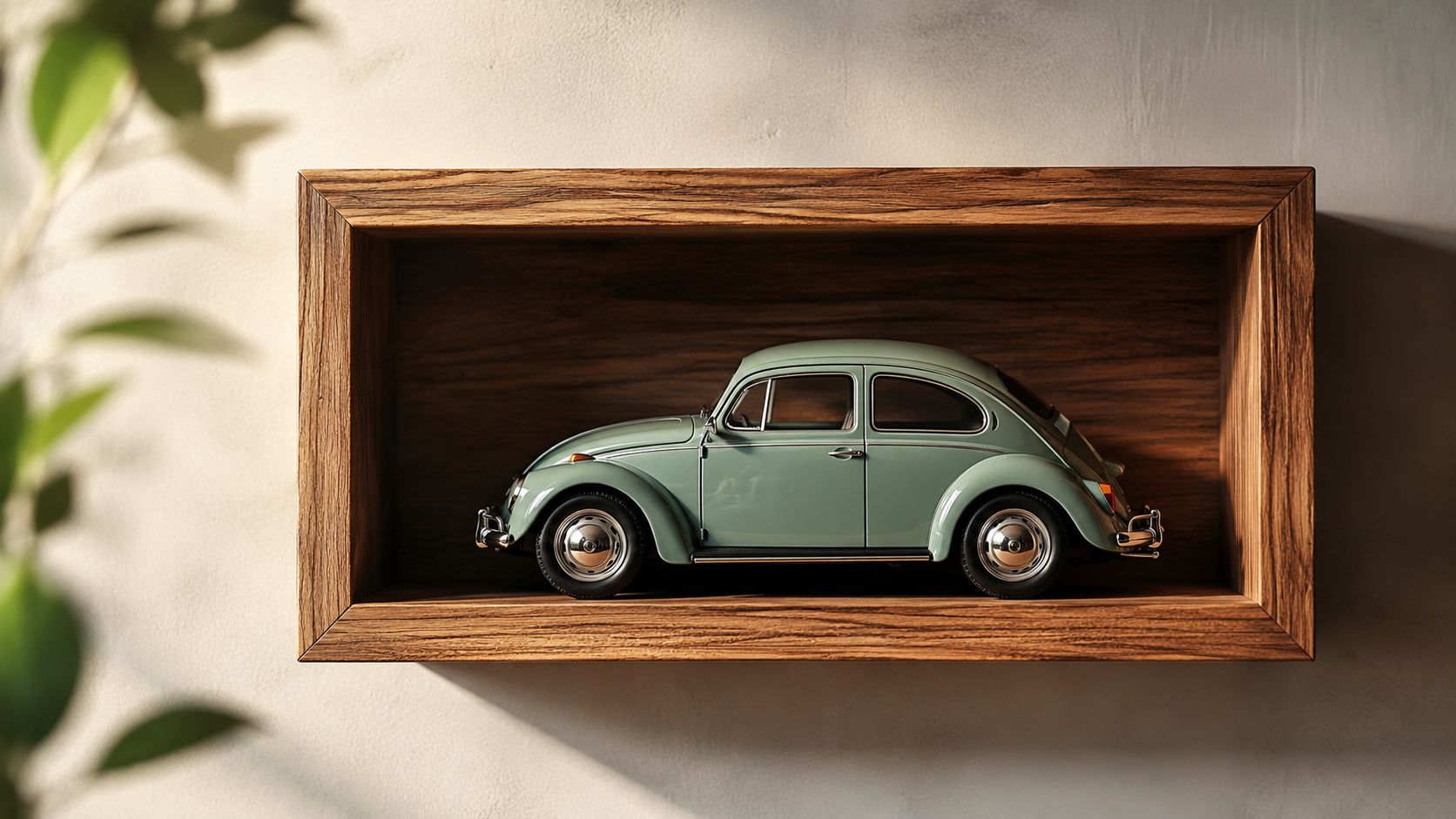
A miniature sage green vintage Volkswagen Beetle toy car displayed inside a simple wooden shadow box shelf.

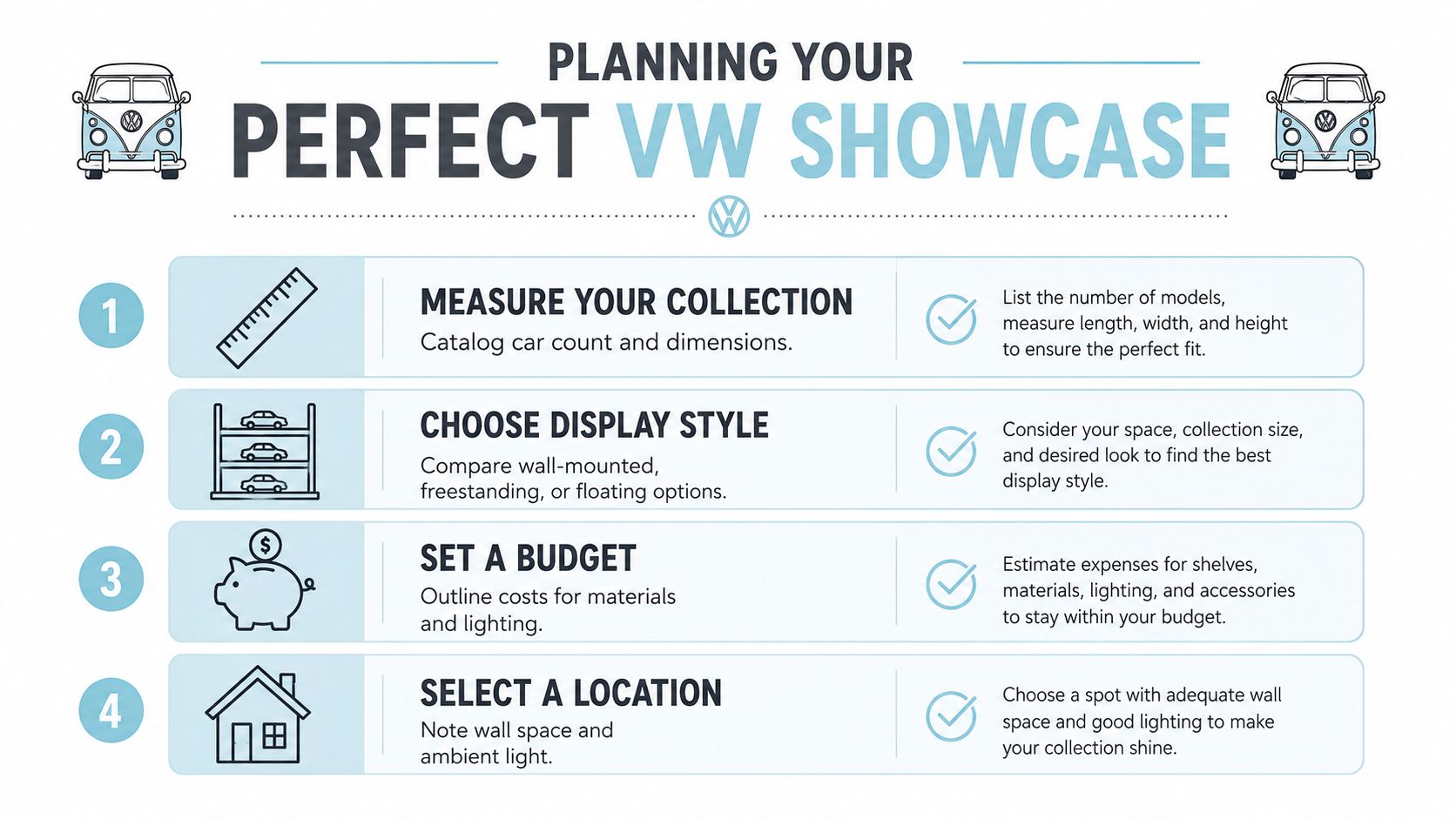
Planning Your Perfect VW Showcase

Before you buy timber or click through to a ready-made unit, measure the actual models you want to show off. A bigger 1:18 scale Samba Bus needs more breathing room than a tighter 1:24 scale Beetle, and the display should suit the tallest object, not the average one. That one step saves a lot of frustration later, especially when roof racks, mirrors, or surf accessories push past the line you thought you had.

Measure first, then choose the wall

Start with the collection, not the wall. Lay out the models you want together and note the widest, tallest, and deepest pieces. If you're planning a mixed display, include anything with extra thickness, such as accessories, stands, or boxed extras you want to keep nearby.

The next question is location. A wall near natural light can look brilliant, but bright sun can be harsh on finishes and plastics, especially in coastal homes. The available guidance for Australian conditions points to the same common-sense idea, treat the display as a micro-climate decision, because moisture, UV, and placement affect how long the materials stay looking sharp Material choice for Australian conditions.

A four-step infographic guide on how to plan and display a Volkswagen model car collection.

Material choices that suit Australian homes

For most collectors, the trade-off is between looks, weight, and durability. MDF can be neat and paintable, plywood can be sturdy, solid timber brings warmth, and acrylic fronts can feel lighter than glass. The right answer depends on where the display sits and whether you're building for a dry lounge room, a humid coastal space, or a brighter area that sees plenty of sun.

A sensible approach is to think like a restorer. The finish should suit the room, not just the car. If the display is going near a beachy interior, sealed timber and careful coating choices often make more sense than an unfinished craft look.

A good display starts with a place, then a size, then a finish. Reverse that order and you usually end up compromising on all three.

For model selection and display inspiration, it helps to browse a focused range of Volkswagen model cars and compare how different scales sit together: Volkswagen model cars.

Choosing Your Shadow Box Style

The biggest decision is simple. Do you buy a ready-made shadow box or build one yourself? Both paths can produce a great VW display, but they suit different people. A bought unit is quicker and usually cleaner out of the gate, while a DIY build gives you more control over depth, finish, and character.

Buying ready-made

A good pre-made unit should feel solid, square, and purposeful. Look for a strong frame, a clear front, and enough internal depth that your model doesn't press against the glazing. The source material also points to framed cases being selected first by width, height, and depth, then by back style, then by whether shelves are added later if the case is drilled for them Shadow-box supplier workflow.

That order matters. If you need multiple cars in one display, the back style becomes part of the plan, not an afterthought. A solid back suits single hero pieces, while a pegboard-style back helps when you want to wire objects in place or move them around.

Building your own

DIY makes sense if you want the box to echo the mood of the collection. A retro paint finish, a weathered timber look, or a clean painted frame can all work beautifully with VW memorabilia. The trade-off is time and accuracy. You need clean cuts, square joints, and a clear sense of what the box is meant to hold.

A custom build also lets you match the display to the actual model rather than the other way around. That's especially handy if your collection includes a taller Kombi, a low Beetle, or a mix of both. If you're building for a surf-style room, a slightly rustic finish often feels right, because it echoes the relaxed colour palette of coastal VW culture.

Building Your Own VW Shadow Box Shelf

A simple DIY build starts with a cut list, a square frame, and patience with the finish. The most useful guide from practical woodworking is to size the case first, then decide on the back, then add shelves only if the frame is drilled for them Shadow-box supplier workflow. That keeps the structure honest and avoids trying to force components into a frame that was never meant to hold them.

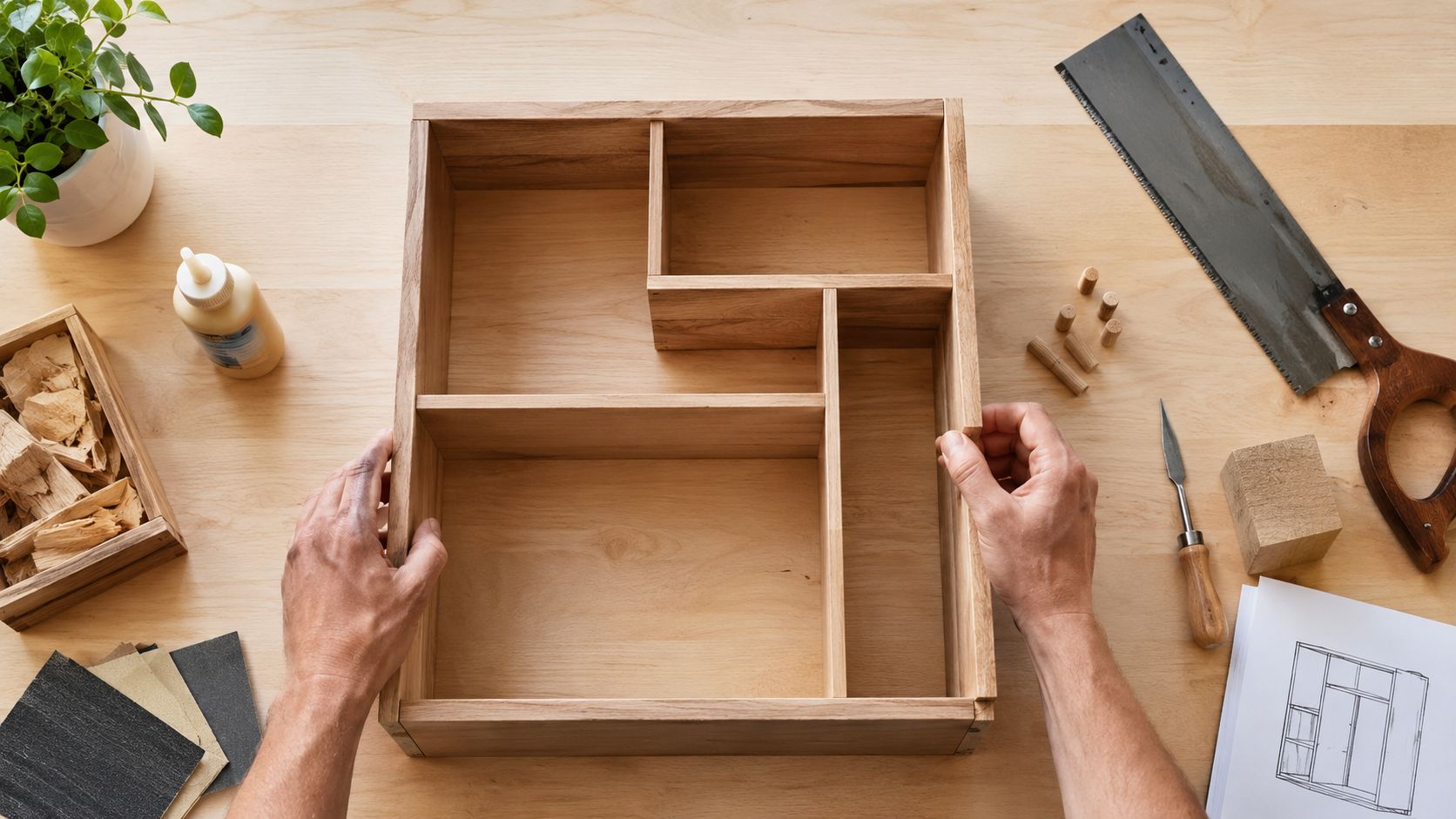
A woodworker assembling custom wooden shadow box shelves on a desk with various tools and supplies nearby.

Tools and materials that actually help

You don't need a full workshop to do this well, but accuracy matters. A measuring tape, saw, wood glue, painter's tape, finish nails, a square, and a level will get most hobbyists a long way. The build method documented by experienced woodworkers stresses exact cuts, taped joints, and finish nails while the glue cures, plus proper wall anchoring once the shelf is ready How to make shadow box shelves.

The build sequence that keeps the frame clean

A proven workflow is to cut the frame parts to length, dry fit everything, and make sure the corners close flush before glue ever touches the timber. One build example used 45-degree corners and cut the frame sides 1/2 inch wider than the shelves to make room for a back panel, with shelf slots placed four inches from each end Example build dimensions. Those details matter because they control whether the internal parts fit neatly and whether the display finishes square.

The practical part is not fancy, it's disciplined. Tape the joints so they don't creep, glue them carefully, and add nails only as support while the adhesive sets. A common mistake is overdriving fasteners or mis-cutting the pieces, which stops the corners closing properly How to make shadow box shelves.

Useful workshop rule: if the dry fit isn't clean, the glued version won't magically improve.

For collectors who want a display that feels more like a proper cabinet than a craft project, that clean assembly is what separates a tidy VW wall from a wobbly one. If you want a display base for a car and a few accessories, explore display cases for models.

Installation and Lighting Done Right

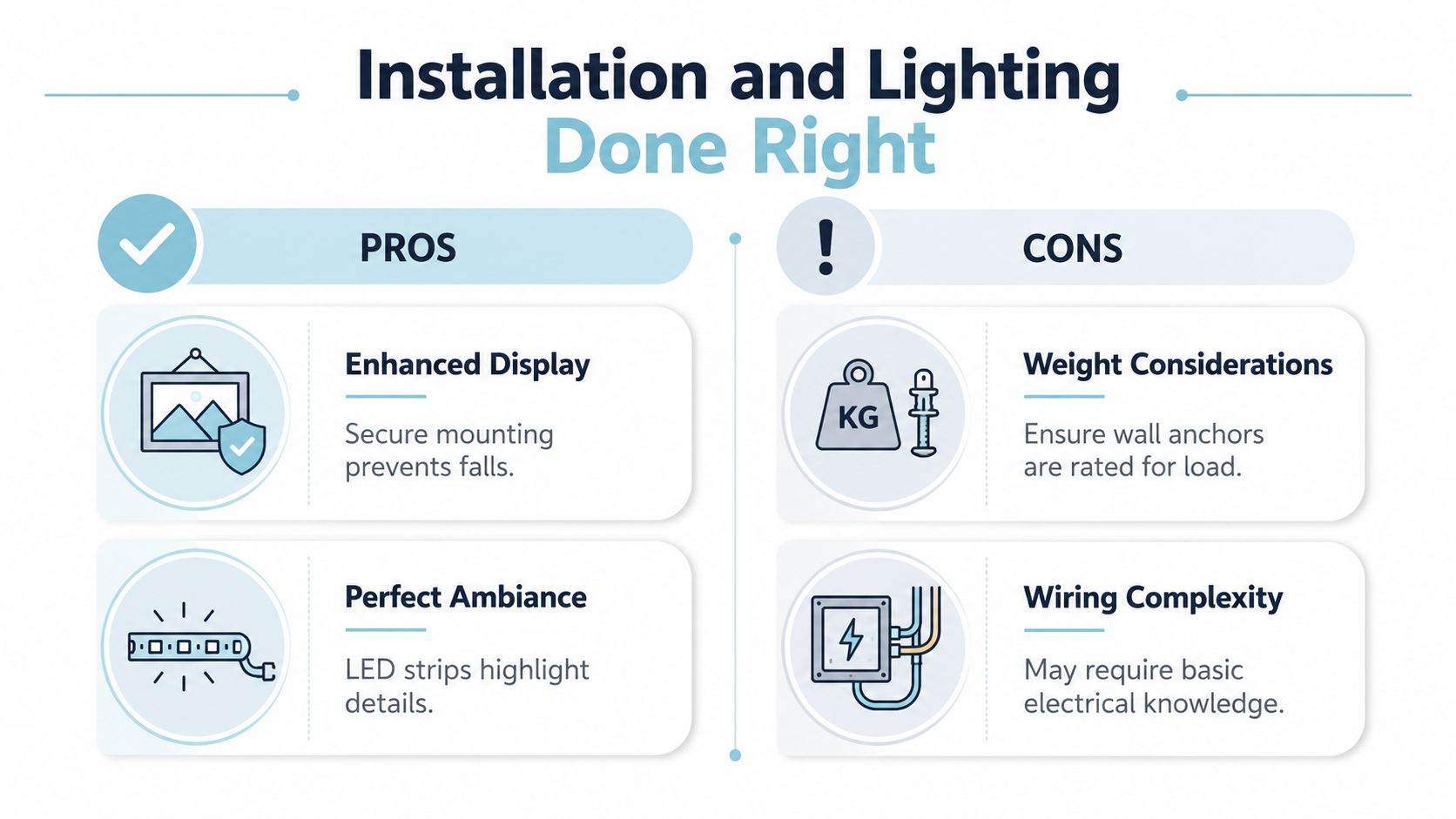
Mounting is where a nice-looking shelf becomes a serious display. Most DIY content spends plenty of time on the build and not enough on how to hang the finished unit safely, yet that's the part that protects the models and the wall. A loaded shadow box shelf should be treated like furniture, not just decoration, especially once metal diecast pieces and mixed memorabilia are inside.

An infographic comparing the pros and cons of installation and lighting for shadow box shelves.

Safety first on the wall

Find the studs where you can, use the right anchors where you can't, and level the shelf before you tighten anything fully. The practical advice in the source material makes the point clearly, wall anchoring and wall-type-matched hardware are essential, and the fitter should use a level rather than trusting the eye How to make shadow box shelves. That's especially true in typical Australian plasterboard walls, where the substrate matters as much as the shelf itself.

A crooked display distracts from the models, and a weak fixing can turn a prized Kombi into floor scrap. The better habit is to test the weight path before the collection goes in. If the shelf feels marginal empty, it won't improve once the cars are loaded.

Lighting that suits the models

Lighting should flatter details, not blast them. LED strips give a clean gallery feel, while small puck lights can highlight a single hero vehicle or a focused corner of the display. The point is to bring out paint, chrome, and glass without creating reflections that make the front look busy.

Secure mounting first, lighting second. If the shelf isn't solid, no amount of glow makes it better.

For a wall display that sits near living areas, discreet lighting usually works best. It keeps the silhouette clean and lets the vehicles remain the star, which is exactly what you want with a well-kept Beetle or a bright Kombi Samba Bus. If the room already has strong ambient light, use the LEDs sparingly so the display still feels relaxed rather than overdone.

Styling Your Display Like a True Enthusiast

Once the shelf is up and lit, the fun part starts. A shadow box display looks best when it tells a small story, not when it holds objects. That might mean a Flower Power Kombi with a tiny surfboard beside it, or a Beetle line-up that tracks different eras of VW design in a tidy visual rhythm.

Build a scene, not just a row

A beach-day setup works beautifully for Australian VW culture. Put the Kombi at the centre, angle a smaller model beside it, and leave a little breathing space so the eye can move across the frame. Add a shell, a miniature sign, or another understated piece from your memorabilia stash, but keep the scene restrained so the cars stay dominant.

You can also theme by memory. One shelf might hold the model that reminds you of your first Volksfest run. Another might feel more like a Kombi-and-coastline tribute, with softer colours and a relaxed layout that suits a room with surf style. For more wall-friendly pieces that echo that look, browse wall accents for the living room.

Keep the rotation fresh

Seasonal styling works well with VW displays because the models themselves carry so much personality. A Christmas touch can be as simple as a small red accent or a festive background card, then back to a clean summer look once the holidays pass. That keeps the shelf feeling alive without turning it into clutter.

The strongest displays usually have one thing in common. They reflect the owner's taste, not a generic showroom. If your collection leans toward licensed diecast Kombis, Beetles, and surfy VW pieces, let the colour palette and props nod to that heritage rather than fighting it.


Volkswagen Memorabilia has a strong range of VW-themed gifts, diecast models, and coastal décor that fits this kind of display beautifully. If you're ready to build a proper home for your VW memorabilia collectibles, visit Volkswagen Memorabilia and start turning your favourite models into a display worth showing off at the next car meet.