

You spot it in a shop window, a red-and-white Samba Bus no longer than your hand, sitting beneath the warm lights like it's waiting for a trip down the coast. You stop, lean closer and notice the little details, the split windscreen, bright paintwork and familiar rounded roof. Then comes the dangerous thought: “That would look good beside the Beetle.”
That's often how a diecast car collection begins. Not with a spreadsheet or a cabinet, but with one model that brings back a road trip, a family car, a surf break or the smell of an old garage. A good collection isn't about owning everything. It's about choosing pieces that tell a story, whether that story is Volkswagen heritage, Australian motorsport or relaxed beach-house nostalgia.
Australia has a long model-car tradition. ABC reported in 2024 that collecting here stretches back to the 1930s, with model cars available across brands, scales and price points from about $2 to $200. The same report describes adults returning to Matchbox collecting in the 1980s, now with more disposable income and an appetite for limited-edition diecast made for serious collectors. Read the history in ABC's report on Australian model-car collecting.
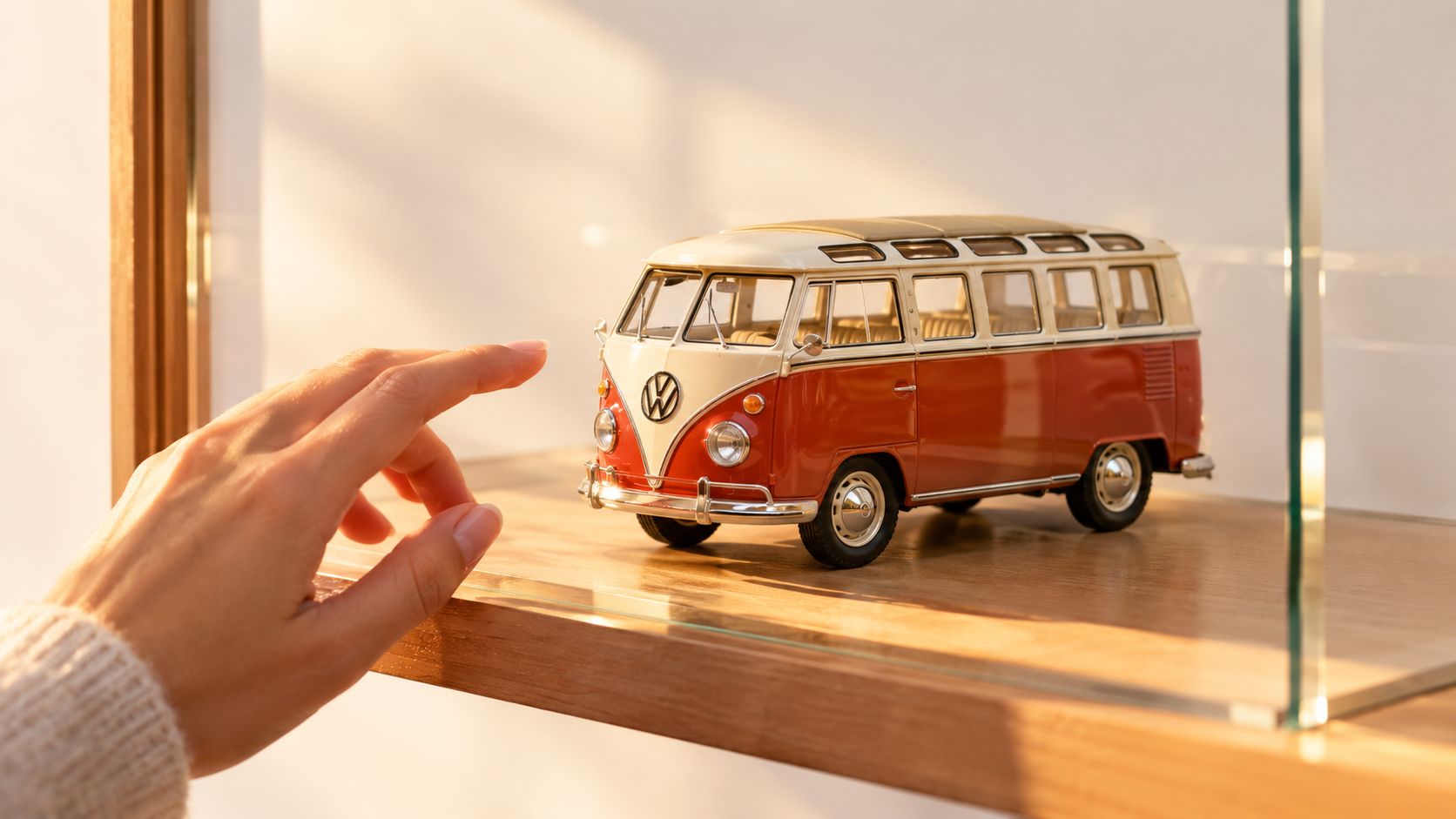
The trick is to turn that first spark into a collection you'll still enjoy years from now. That means setting a theme, choosing a budget, understanding scale, checking quality, buying through the right channels, keeping useful records and creating a display that feels like your own little car show.
Why Every Great Collection Starts With One Special Model
A first model usually carries more meaning than its price suggests. Perhaps it's a Volkswagen Beetle model that reminds you of the car parked outside your grandparents' house. Maybe it's a Kombi that takes you back to beach holidays, or a Samba Bus that feels like a miniature version of the one you still hope to own.
That emotional connection matters because collecting works best when each purchase has a reason. A shelf of unrelated cars can look busy, while a carefully chosen line-up can feel like a visual biography. A row of classic Volkswagens in complementary colours tells one story. A display of Australian racing icons tells another. Neither approach is wrong, but a theme helps you decide what belongs and what can wait.
Start with the story, not the shopping cart
Before buying a second or third model, ask what you want the collection to say. “Volkswagen” is a broad starting point, so you might narrow it to air-cooled classics, Beetles and Kombis, split-window vans, surf culture or one consistent scale. You could even build around colour, such as cream, red and blue models that work with your home décor.
The Australian tradition supports both casual nostalgia and serious collecting. The Powerhouse Collection, for example, includes a Franklin Mint set of 41 precision model cars, assembled by Queensland collectors Michael and Jan Whiffen from 1983 to 2009 and donated in 2010. That collection shows how childhood memories can grow into a considered adult hobby.
A focused collection also makes events more rewarding. At a VW show, a small display of Kombis can start conversations with owners who know the difference between a standard Transporter and a Samba Bus. At home, a themed shelf gives every model a place instead of leaving new arrivals scattered across the desk.
A focused collection always beats a scattered one.
Setting Goals and a Budget That Keeps the Fun Alive
A collection stays enjoyable when the spending feels deliberate. The simplest system is to choose a theme, set a fixed monthly budget and keep a short list of target pieces. An Australia-based collector guide recommends this approach, along with watching sales, second-hand lots and local collector events before expanding. It also suggests using online communities and swap meets to reduce impulse buying, as outlined in this Australian guide to starting a diecast collection without overspending.
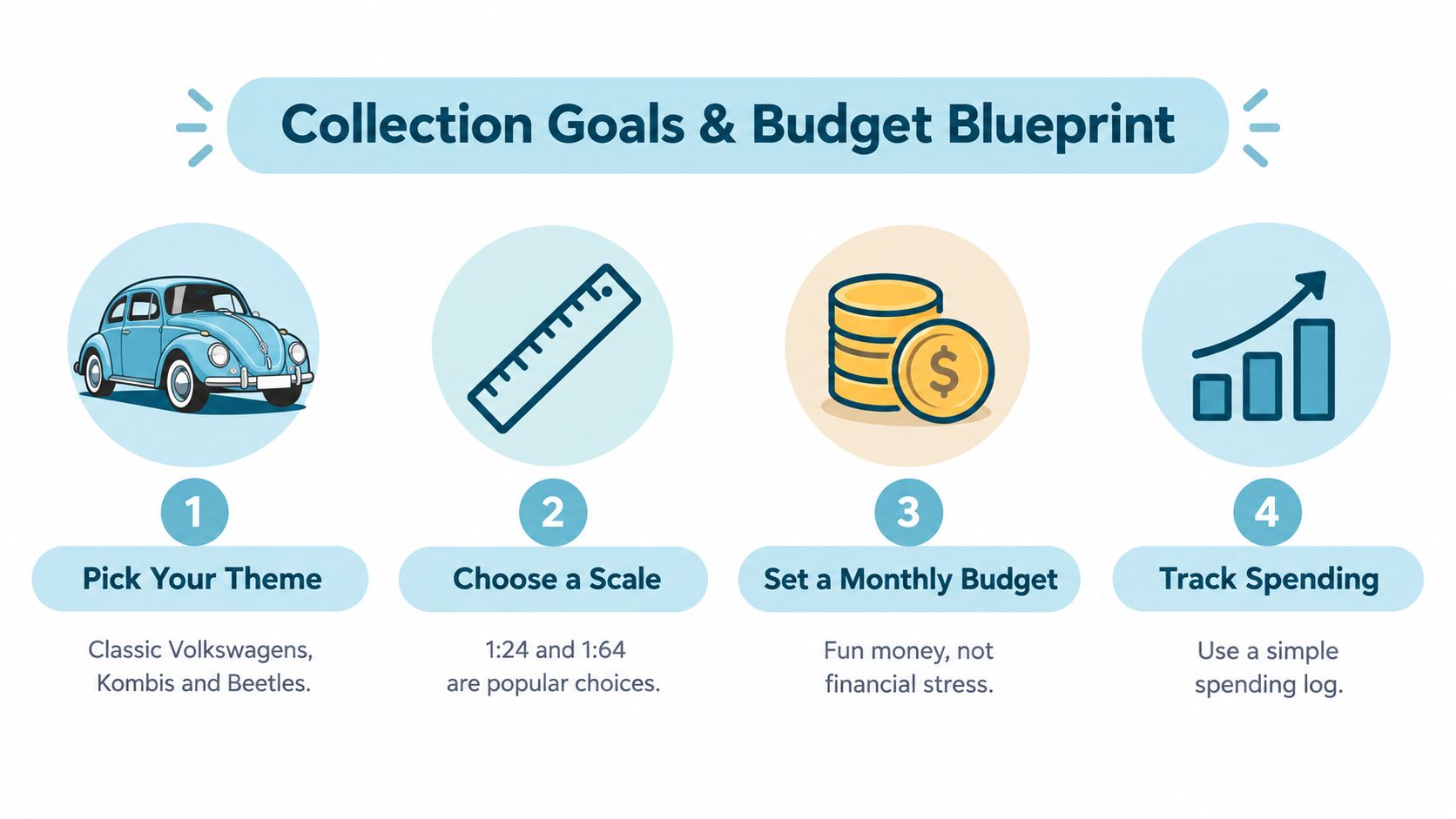
Choose a theme that gives every purchase a job
A useful theme has boundaries. “Classic Volkswagens” gives you room for Beetles, Kombis and related variants, while “1:24 Samba Buses” creates a much tighter display. You might collect:
- One marque: Focus on Volkswagen heritage, from Beetles to Kombis.
- One body style: Build around vans, convertibles or racing cars.
- One scale: Keep every model visually consistent on the same shelf.
- One mood: Choose surf, Flower Power, motorsport or nostalgic family cars.
- One colour story: Select models that sit naturally together in your home.
A narrow theme doesn't make a collection smaller in spirit. It makes each new purchase easier to assess. If a model doesn't fit, you can enjoy it without automatically adding it to the main display.
Use a wishlist before you use your wallet
Write down the model, scale, colour, condition you'll accept and the maximum you're comfortable paying. That last point matters at swap meets, where a seller's enthusiasm can make an ordinary model feel like a once-only opportunity.
One collector I know learned this after spending three months of planned collecting money on impulse buys at separate events. None of the models was terrible, but they didn't form a coherent display, and the pieces he really wanted had to wait. His solution was simple: a short wishlist, a spending log and a cooling-off period before buying anything outside the theme.
The goal isn't to remove spontaneity. It's to make room for the occasional surprise without letting every shiny model take over the plan.
Ask yourself these questions before you buy:
- What story am I building? A marque, era, colour or lifestyle theme?
- Where will this model live? Measure the shelf before choosing a larger scale.
- Does it fit my budget? Use collecting money, not money needed for essentials.
- What condition is acceptable? Decide whether opened or imperfect examples belong.
- Will I still want it tomorrow? A pause can separate a genuine target from an impulse.
Choosing the Right Scale and Spotting Quality
Scale tells you how a model compares with the full-size vehicle. A 1:18 model is 18 times smaller than the full-size car, while a larger denominator produces a smaller miniature. That sounds straightforward, but scale affects everything from shelf depth to how clearly you can see hinges, badges, interiors and wheel details.
The popular collector scales each suit a different type of display. 1:18 models make a strong centrepiece and reveal plenty of detail, but they need generous space. 1:24 offers an appealing balance, while smaller formats let you build a broader scene without giving up an entire cabinet.
The 1:18 Volkswagen diecast range is useful for collectors who want a prominent display model and have room to show it properly.
Compare the practical trade-offs
| Scale | Approx. Length | Detail Level | Best For |
|---|---|---|---|
| 1:18 | About 11 inches | Highest visual impact and strong detail | Feature models and dedicated cabinets |
| 1:24 | About 8 inches | Can carry detail comparable to 1:18 | Balanced shelves and themed displays |
| 1:32 | Smaller than 1:24 | Good detail in a compact format | Limited space and broader collections |
The measurements and storage trade-offs are covered in the diecast scale information on the Volkswagen Beetle page. A 1:24 model can deliver a surprisingly satisfying display without the storage demands of a larger piece. A 1:18 Kombi, on the other hand, has the presence of a proper centrepiece and gives you more room to appreciate the cabin and exterior trim.
Condition deserves an honest look
Collector grading commonly separates model and box condition into 1.0 to 5.0 tiers. Near-mint or mint examples may still show minor casting marks, small chips or minimal edge wear, so don't confuse a grading scale with the promise of absolute perfection. The Hobbyco collector glossary explains the condition language used in the hobby.
Before buying second-hand, inspect photographs closely and ask direct questions. Look for:
- Touch-ins: Poorly described paint repairs can be obvious under bright light.
- Broken parts: Check mirrors, aerials, wheels, doors and glazing.
- Repaints: A fresh colour may hide an altered or modified model.
- Residue: Tape, adhesive and grime can reduce presentation quality.
- Graffiti or marks: These may be permanent rather than removable.
- Packaging damage: Crushed corners and torn windows affect boxed displays.
Official licensing also matters. Licensed models are made with permission to reproduce the marque and its design details, which gives buyers greater confidence in authenticity. It doesn't guarantee that every model will become valuable, but it does help you build a collection based on genuine Volkswagen identity rather than a vague lookalike.
Where to Buy Your Diecast Models in Australia
Australian collectors have plenty of ways to find models, and each channel has a different balance of price, convenience and certainty. Online specialist retailers are usually the easiest choice when you want local stock, fast shipping and clear product information. Buying from an Australian importer can also mean avoiding customs delays, dealing with straightforward local returns and speaking to someone during Australian business hours if a question comes up.
A specialist catalogue is especially useful for a VW Kombi diecast Australia search because it lets you compare related models without wading through unrelated listings. Browse the Australian diecast models collection when you want a local starting point.
Know what each buying channel does best
Specialist retailers suit collectors who want predictable condition, product photographs and licensed ranges. You'll often pay for that certainty, but the trade-off is less risk and less time spent checking vague descriptions.
eBay Australia offers enormous choice. Its Australian marketplace lists over 4.1 million contemporary diecast results and over 1,000 Australian diecast-car results, according to the Australian diecast listings page on eBay. That scale gives you access to discontinued pieces and unusual variants, though listing quality varies sharply.
Local classifieds can be worthwhile for mixed collections and inexpensive starter models, with listings from about A$5 upward. The bargain may be genuine, but you'll need to check condition, completeness and whether the seller has described the model accurately.
Swap meets and VW events offer something online can't. At Volksfest, the VW Nationals or a local Show & Shine, you can handle the model, inspect the box and talk with people who understand the subject. The downside is that choice is unpredictable, and enthusiasm can make it easy to buy outside your plan.
Wherever you shop, check the scale, licensing, condition, return terms and delivery details. A clear photograph of the base, packaging and model markings is worth more than a long sales description.
Cataloguing Your Collection and Display Ideas Worth Showing Off
A catalogue doesn't need to feel like office work. A simple notebook works, but a spreadsheet makes it easier to sort by scale, model type, colour, purchase date or display location. Record the model name, item number, brand, scale, purchase price, condition and shelf position. Add photographs of the model and box, especially for pieces you may later insure, trade or sell.
That small habit prevents the common collector problem of buying a model twice because the packaging looks different. It also gives you a clear picture of the collection's direction, which is helpful when a new release tempts you away from the theme.
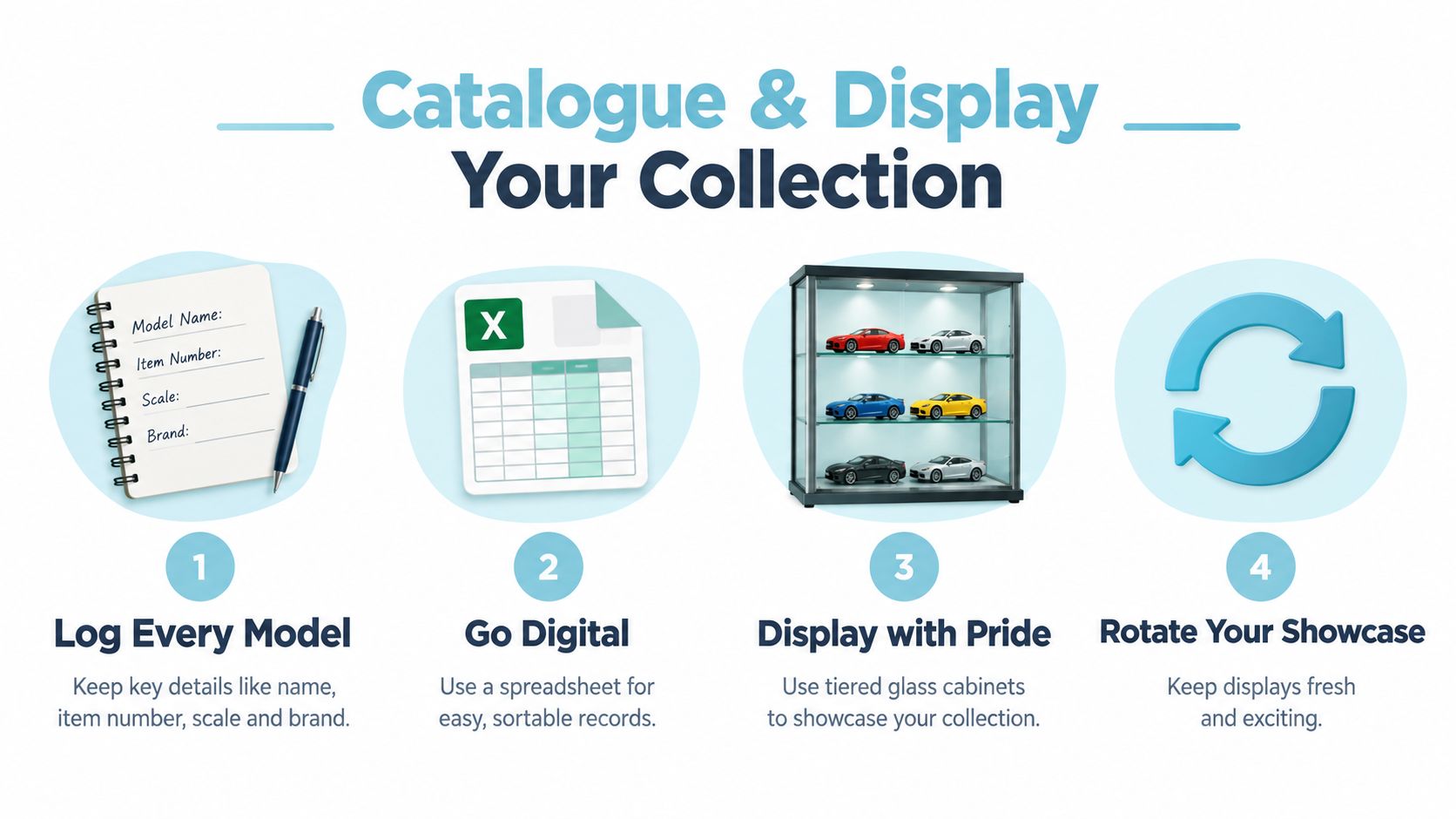
Build a display with a point of view
A strong display has a centrepiece, supporting models and a little breathing room. A 1962 Kombi Samba Bus in 1:24 works beautifully as the star of a VW shelf because that scale is about 8 inches long and can carry detail comparable to a 1:18 model. You can place smaller related cars around it, then use a simple background colour to let the paintwork stand out.
For a more relaxed coastal arrangement, pair surfy vans with starfish, shells, nautical décor or a pale timber shelf. The result feels like a beach house rather than a toy cupboard. Keep the decorative pieces subordinate to the cars, and repeat a colour from the models in the surrounding objects.
Mixed packs can help create a themed display without hunting for every model separately. They're particularly useful when you want a small scene, such as several colourful vans gathered around one larger Samba Bus.
Protect the view as well as the model
The best display position is away from direct sunlight, heaters, damp areas and heavy household traffic. Sun can fade paint and decals over time, while dust settles into trim and glazing. A glass-fronted cabinet or purpose-built display case for model cars makes cleaning easier and protects models from curious fingers.
Leave space between vehicles so each one can be seen from the front and side. If the shelf becomes crowded, rotate the display rather than adding another layer in front. A seasonal beach scene in summer and a more heritage-focused VW line-up later keeps familiar models feeling fresh.
Display less, but display it better.
Keeping Your Models Pristine and Growing With Purpose
Use a soft brush or microfibre cloth for routine dusting. Avoid harsh chemicals, which can affect paint, decals and plastic parts, and handle models with clean hands or suitable gloves when you're working on delicate areas. Keep spare pieces in their original boxes and store them in a stable, dry place rather than a hot shed or damp garage.
Direct sunlight is the enemy of a bright display. Position cabinets away from strong windows, and check models occasionally for dust, loose parts or colour changes. If a model has moving components, don't force them. A gentle inspection is safer than turning a small fault into a broken hinge.
Growing with purpose means revisiting your theme when it starts to drift. You might decide to complete a Samba Bus colour set, add only Australian-market icons or concentrate on one scale for a new cabinet. Sharing the collection at a show, swap meet or online community can be just as rewarding as finding the next model.
The Beetle offers a powerful collecting story. Volkswagen's official history records an 80-year run, series production beginning in 1945, and more than 23 million Beetles sold worldwide, making it the most-produced car on a single platform. Explore that heritage through Volkswagen's official Beetle history.
Browse the licensed Volkswagen diecast range at Volkswagen Memorabilia to find Kombi Samba Bus models, Beetles and themed VW memorabilia for your collection or a thoughtful gift. With local stock and friendly weekday support, it's a practical place to choose a model that fits your story, your shelf and your love of classic Volkswagens.