Rattan Wall Art for Coastal and Retro Rooms in Australia

The usual advice to put rattan wall art anywhere you want a coastal feel misses the most important detail: a beachy look isn't a moisture rating. That lovely woven disc might suit your Kombi-inspired lounge perfectly, yet struggle on a steamy bathroom wall.

Choose the room before the decoration. Then check the material, construction and mounting, so your display feels like a relaxed summer road trip rather than another maintenance job.

Rattan Wall Art Styles at a Glance

Rattan wall art is decorative woven or shaped cane, made from climbing palm stems like those used in rattan furniture. It's mounted for display rather than built for sitting on or carrying things.

Rattan wall art styles and where they suit

Style How It Is Made Where It Suits Look
Woven wall plate Tightly woven round or oval cane on a rigid base Entryways and living rooms Clean and textured
Woven disc or sunburst Radial spokes with an open weave around a centre Feature wall above a sofa or bed Retro and boho
Geometric panel Cane strips woven into hexagonal or star patterns Gallery walls and bedrooms Modern retro
Framed rattan Woven insert set in a timber or metal frame Hallways and dining rooms Tidy and gallery-style
Sculptural hanging Bent cane shaped into arcs or loops Corners and wide plain walls Coastal and playful
Resin look-alike Moulded plastic imitating the rattan weave Budget displays; check the spec for damp rooms Glossy and uniform

Natural cane shows small differences in colour and thickness. Resin alternatives tend to look more uniform and glossy, although appearance alone won't confirm the material.

Woven geometry has a deeper history than the latest coastal makeover. The Western Australian Museum's Intertwined exhibition documents rattan cane used in plaited hexagonal and star patterns.

Pick the style you like before comparing prices or room options.

Which Rooms Suit Rattan Wall Art

Room suitability for rattan wall art

Location Moisture Risk Suitability Key Condition
Dry bedroom Low Ideal Keep away from heaters and sun-facing windows
Living room Low Ideal Keep clear of air-conditioning outlets
Hallway or entry Low to moderate Suitable Clear of door swings and traffic
Ventilated bathroom Moderate to high Use with caution Outside the shower spray line and clear of steam
Laundry High Avoid Splashing and steam can recur
Covered patio or balcony High Avoid Salt air, rain and condensation
Exposed outdoor wall Very high Not recommended Unless the manufacturer gives a validated exterior rating
Beach or salt-air home interior Moderate to high Suitable with airflow Ventilate the wall and check monthly

Natural doesn't automatically mean low-maintenance, and rattan's tropical appearance can tempt you to hang it exactly where moisture exposure is highest.

The coastal appeal described in Wallsauce's rattan styling guide is easy to understand. But decorative wall art isn't a functional basket designed for wet contents, and a bathroom styling suggestion doesn't establish suitability for persistent condensation.

Keep borderline placements away from basin splashes, shower spray and cooktop steam. In seaside homes, assess salt-air exposure; on cold external walls, look for winter condensation behind the piece.

Placement rule: If the spot regularly gets wet, steamy or salt-laden, choose another wall or a piece explicitly rated for that exposure.

Use coastal home décor ideas for the visual direction, then let the room conditions decide what belongs there.

How to Judge Quality Before You Buy

Before clicking buy, test the artwork's footprint with painter's tape. Include its outer frame or projecting loops, not just the woven centre, and stand back to judge it against the furniture.
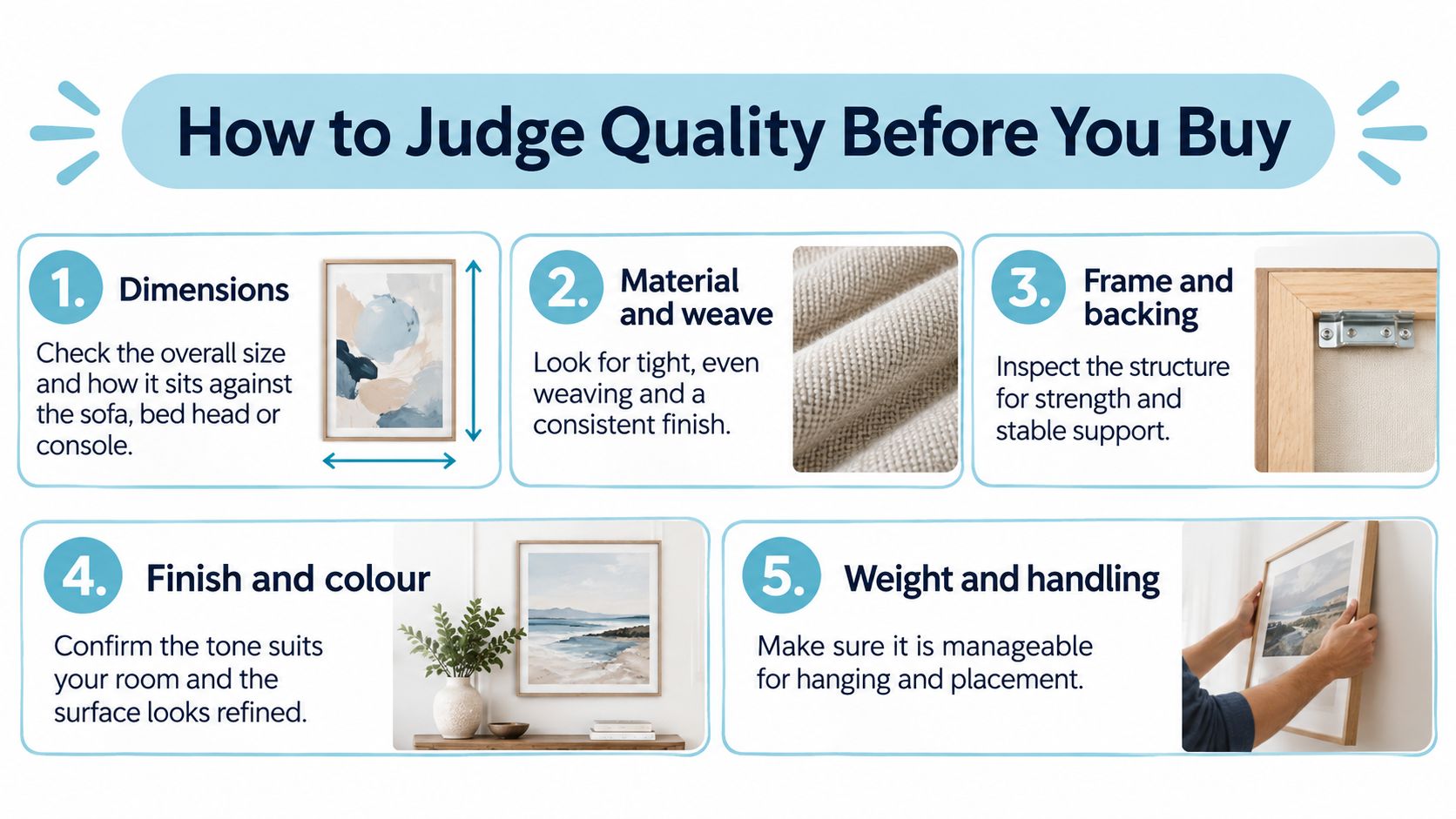
An infographic titled How to Judge Quality Before You Buy, listing five tips for choosing wall art.

A sustainability claim needs more substance than a natural-looking photograph. Ask where the cane comes from, what finish has been applied, whether bindings can be repaired and how the item is packaged, practical questions that sit behind the natural-fibre direction discussed by Home Beautiful's style forecast.

A checklist worth saving

  • Dimensions: Confirm overall width, height and projection. A deep sculptural hanging can obstruct a narrow hallway.
  • Material and weave: Look for even tension, secure ends and clear identification of natural cane, synthetic weave or mixed materials.
  • Frame and backing: Bindings should sit securely, and the base shouldn't flex readily under light pressure.
  • Finish and colour: Request close-ups showing edges and joints, not just a styled room photograph.
  • Weight and hardware: Get the actual weight and hanging arrangement. Plasterboard needs different fixings from masonry, even for the same artwork.

Choose fewer, better-made pieces rather than several seasonal fillers. When comparing collectible display standards, the Kombi Samba Bus and Beetle diecast listings also provide a useful prompt to examine finish details and explicit licensing information rather than relying on appearance.

How to Hang Rattan Wall Art Without Damaging Walls

Conditioning comes before drilling. Rattan absorbs and releases water vapour, so changing indoor humidity can alter its shape and loosen connections.
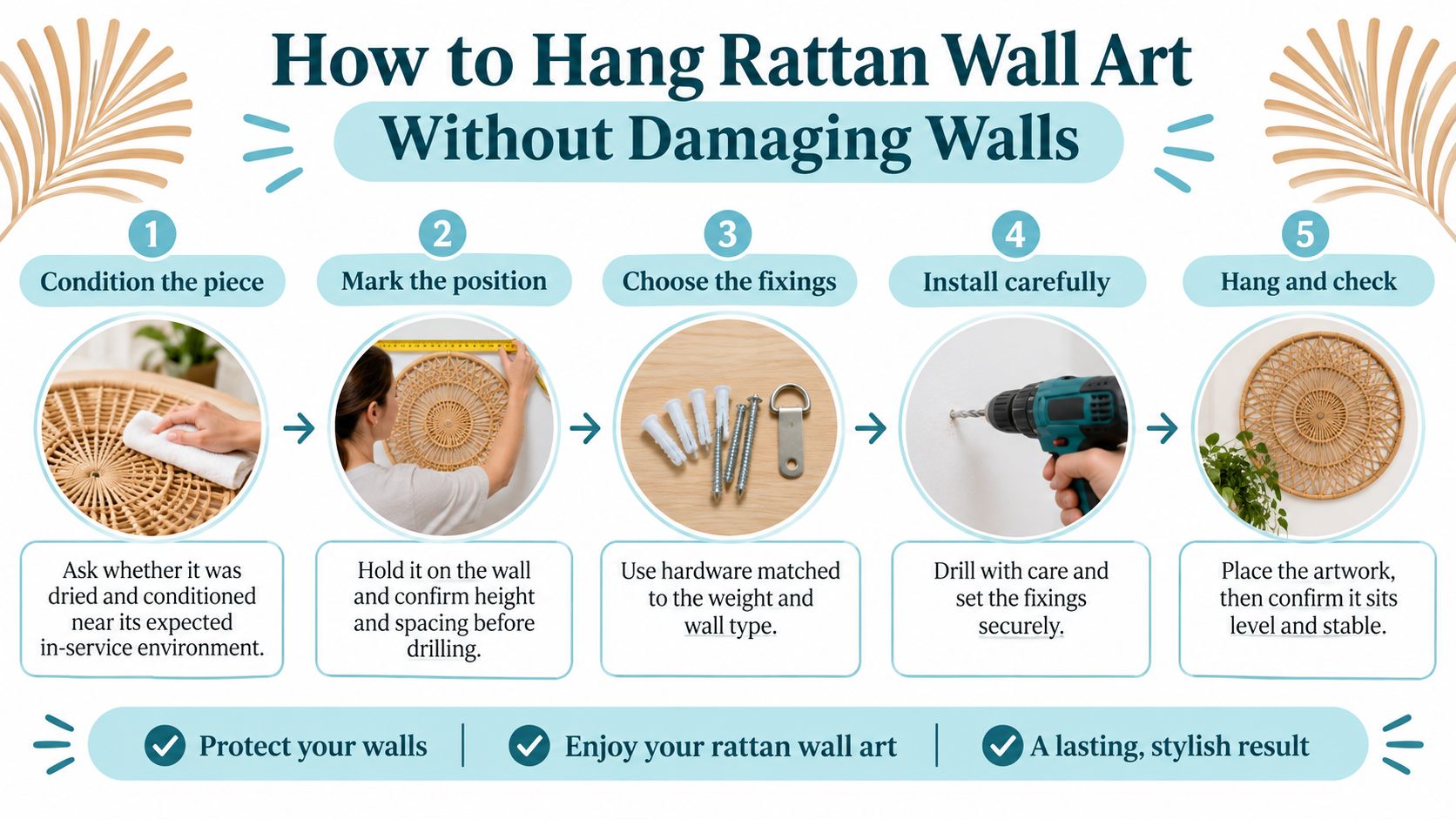
An instructional infographic demonstrating five simple steps to hang rattan wall art securely without damaging walls.

  1. Let it adjust. Ask whether the cane was dried and conditioned for indoor service. WoodSolutions' moisture guide gives typical interior timber equilibrium moisture content as approximately 8–14%, a useful reference rather than a rattan-specific guarantee.
  2. Mark the clearances. Check door swings, heaters, air-conditioning outlets, evaporative coolers and steam pathways before choosing the final position.
  3. Fit the right hardware. Use fixings matched to the verified weight and wall construction. Preserve a ventilation gap instead of clamping the weave against masonry or a damp surface.
  4. Set a comfortable height. Start at eye level, then adjust to the sofa, console or bed beneath it. Check for concealed services before drilling.
  5. Hang and recheck. Confirm level, secure engagement and even clearance. Revisit the fixings after the piece settles and after seasonal humidity changes.

For rentals, check your lease and the removable hook's surface requirements and weight rating. Removable doesn't mean damage-free, especially on fragile paint.

When comparing wall art and hangings, favour accessible mounting points. A sound installation sits level without rocking, lifting or creaking.

Caring for Rattan Wall Art in Humid Air

Keep absorbed moisture from lingering. WoodSolutions' Wood Construction Systems guide states that timber below 20% moisture content does not decay and recommends shielding, drainage and ventilation to control moisture.

Rattan isn't structurally identical to timber, so that isn't a product warranty or a household test threshold. The useful principle is allowing plant-based material to dry.

Rattan wall art care schedule

Task How Often How to Do It
Dust the weave Every two weeks in coastal homes, monthly elsewhere Soft brush or dry cloth along the weave
Wipe the surface Monthly Dry cloth, or a lightly damp cloth wrung almost dry; never saturate the weave
Dry after any splash Immediately Blot, then ventilate until fully dry
Check airflow Every three months Confirm the rear gap remains unobstructed
Inspect for mould and damage Monthly in humid rooms Look for spotting, darkening, softening or loose bindings
Take down and reassess When spots or softening persist Air dry away from the wall and review placement

Treat this as a conservative maintenance routine, not a guarantee against mould. Softening, fungal spotting and loosened bindings warrant taking the piece down rather than wiping it repeatedly in place.

Salt-laden air and condensation can affect finishes even under cover. Don't soak the weave or apply a heavy coating to conceal deterioration.

Styling Rattan Beside a Retro VW Display

The Kombi's coastal connection isn't just a decorating invention. Volkswagen Australia's Kombi history describes how enthusiasts strapped boards to their roofs as surfing expanded along Australia's east and west coasts during the 1970s.

A vintage Volkswagen bus parked next to a modern sideboard featuring surf-themed decor and rattan wall art.

For a typical lounge display, anchor the wall with a substantial woven plate or geometric panel. Place a Kombi or Samba Bus model on the console beneath it, leaving breathing room around the vehicle so its curved roof and cheerful colour remain visible.

Keep the palette to sand, sea blue and natural cane. An odd-numbered grouping of smaller accents can feel relaxed without turning the shelf into a souvenir stand.

Let the woven piece supply texture and the Volkswagen supply the story.

Keep diecast away from direct sun and damp spots. For model selection, browse Kombi Samba Bus diecast and Beetle models with shelf depth and viewing angle in mind.

Complementary Volkswagen van wall art can work nearby, but don't make every object compete for attention. Sketch the wall and shelf on paper before buying anything.

DIY and Upcycle Ideas for Rattan Wall Decor

Start with a framed placemat. A flat cane placemat or sound woven basket panel mounted to a lightweight timber backing is an approachable first project. Secure the structure rather than relying on glue attached to loose fibres.
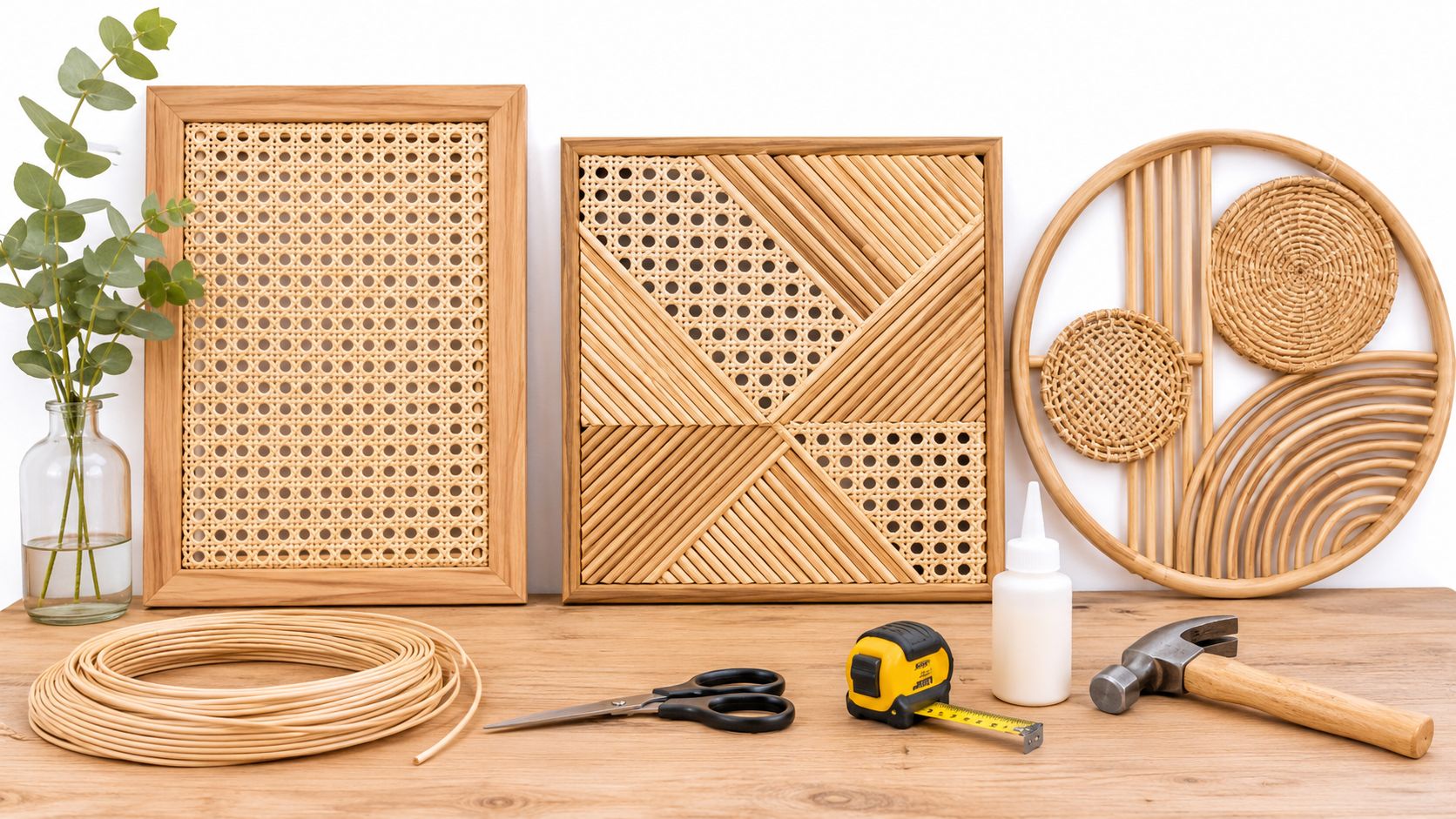
Various handcrafted rattan wall art pieces arranged on a wooden table with DIY craft tools.

A geometric panel takes more patience. Draw a hexagonal or star layout on paper, dry-fit cane strips, then secure the intersections to a stable frame before adding hanging hardware.

For an upcycled wall disc, choose a shallow thrifted basket with a sound base. Remove the handle only if it isn't holding the rim together; otherwise, choose another basket rather than weakening it.

  • Test the finish: Try a compatible thin, permeable protective finish on an offcut first.
  • Keep it light: Use rigid backing without adding unnecessary bulk.
  • Avoid saturation: Don't soak cane during cleaning or adhesive application.

A matching diecast Kombi on the shelf below can connect the handmade texture to your coastal theme. This weekend, choose a project, gather the backing and finish, and make a small test panel before committing the best material.

Frequently Asked Questions

What scale suits a shelf beneath rattan wall art?

A 1:24 model is a sensible starting point for a modest shelf, while 1:18 offers more presence on a broad console. Scale isn't a shelf dimension, though: measure the actual model's length and width, including mirrors or surfboards, before choosing.

Is rattan wall art a sustainable choice?

Not automatically. Material provenance, finish, repairability and packaging matter more than a natural colour. Use the buying checklist to compare specific products, and favour something you'll keep rather than a disposable seasonal accent.

Does a resin look-alike last in a damp room?

Don't assume it will. Check the declared material, the backing and hardware, and an explicit suitability statement for damp-room use. A plastic face doesn't protect an unsuitable timber backing or metal hanger, and a uniform weave isn't proof of durability.

Pick Your Piece and Plan the Wall

Natural texture still needs practical planning. Choose the wall before the woven piece: a dry, ventilated spot is a better fit than a damp room, and the right position depends on the wall, the artwork's weight and its mounting method.

Measure the wall and nearby furniture, then leave enough room for the art to sit comfortably without crowding a shelf or display. A coastal woven plate and a retro geometric panel can both work, provided their construction and mounting suit the space.

Buy for the room you have, not the beach-house photograph you admire. A piece you can maintain is a better long-term choice than a cheap decoration you'll replace when the season changes.

Volkswagen Memorabilia sells VW memorabilia, coastal décor and diecast Volkswagen décor. Browse the Kombi and Beetle diecast range to choose a model for a planned shelf display. A Kombi also makes a cheerful retro men's gift or a playful accent for a kids' or boys' room; place it safely out of reach where appropriate.

For Australian purchases, check the listing for current stock and dispatch details rather than assuming every item is locally held or immediately available. Plan the arrangement first. There's no need to fill every blank space.

Which dry, well-ventilated wall would suit a little woven texture and Volkswagen character?

Volkswagen Memorabilia offers VW-themed gifts, diecast models and coastal décor for displays with a relaxed, nostalgic feel. Visit Volkswagen Memorabilia to choose a Kombi or Beetle companion for your planned wall and shelf arrangement.
How to Hang and Care for a Seagrass Wall Hanging

About 80% of Oyster Harbour's seagrass was lost in 1988, following poor water clarity and excess nutrients, according to Western Australia's Oyster Harbour seagrass snapshot. That's a useful reset before buying a seagrass wall hanging: this isn't just a beachy texture, it's material associated with a living coastal habitat.

Choose it with care, keep it dry and support its weight properly. Add a thoughtfully placed Kombi or Beetle model and you can capture that relaxed Australian surf-trip feeling without turning the lounge into a souvenir shop.

Check Batch Traceability Before You Buy

Ask for the collection location, quantity and processing history before you buy. For genuine seagrass, favour legally sourced, beach-cast material with records that connect the finished piece to its collection batch. A natural-looking weave alone tells you nothing about its origin.

The South Australian ecological assessment of beach-cast seagrass harvesting describes primarily cellulose-based material that can take 3–5 years to fully decompose, and finds no research basis for universally sustainable wrack-harvest levels. That decomposition period isn't an indoor product lifespan or warranty.

South Australian controls use licence limits, approved areas and monthly logbook monitoring. Beach wrack also provides food and shelter for organisms, so washed ashore doesn't automatically mean free of ecological consequences.

What good preparation looks like

A useful processing record should follow a clear sequence:

  1. Sort the material. Remove live fauna and sand before processing.
  2. Record the batch. Retain its weight, collection source and relevant collection documentation.
  3. Dry it completely. Use a covered space with strong ventilation, not a sealed bag or damp shed.
  4. Reject weak strands. Remove brittle or contaminated fibres before weaving onto a mechanically stable backing.

Check the finished hanging's reverse as carefully as its face. Look for secure knots, supported edges and mounting points attached to the backing rather than a few decorative strands.

Buying rule: Traceable material and sound construction matter more than an unsupported sustainable label.

There's no honest universal answer to how long a seagrass wall hanging lasts indoors. Expect some gradual shedding, but reject persistent dampness, mould, salt crusts, insect activity or odour after conditioning. Persistent smells or soft, crumbling sections mean replacement, not another layer of glue.

Where Seagrass Holds Up in Australian Humidity and How to Care for It

Mould can grow at indoor relative humidity as low as 60%, while Darwin's average annual relative humidity ranged from 66% to 77% in a ten-year climate analysis discussed in Western Australia's indoor-mould guidance. Seagrass is a plant fibre, so persistent dampness can affect it even when the weave looks sound.

Check the room with a hygrometer rather than judging by suburb or distance from the beach. Use these readings as a placement guide, not a guarantee against mould.

Setting Humidity signal Suitability What to do
Dry, ventilated living room Below 60% Suitable Hang on an internal wall and dust monthly
Bathroom or poorly ventilated laundry Persistent condensation Avoid Keep the piece out of the room
Damp coastal wall Condensation, mustiness or damp patches Use caution Keep the piece off the wall and inspect for spotting
Darwin and tropical north 66% to 77% average annual relative humidity Use with caution Use humidity control and choose an inner wall

Placement matters more than price. A damp wall can compromise even a carefully woven hanging. Dried palm leaves are also plant material, not moisture-proof alternatives; keep dried palm leaves away from persistently damp spots too.

A gentle care routine

  1. Dust monthly with a soft brush. Support the weave with your free hand to avoid tugging the knots.
  2. Use a vacuum's lowest suction and brush attachment, held clear of loose fibres. Avoid saturating the piece.
  3. Blot surface marks with a dry cloth. Don't scrub or use bleach and household sprays.
  4. Check every few months for softening, odour, spotting, loose knots and heat damage near lights or heaters.
  5. Remove it before decorating. Paint mist and renovation dust are difficult to lift from an open weave.

If the room feels clammy, move the hanging to a drier space. Repeated cleaning won't solve exposure to persistent dampness.

Choose a Hanging Method That Suits Your Wall

Match the fixing to the wall, backing and finished weight, not the hanging's diameter. A broad, airy weave can be lighter than a smaller piece mounted on dense board.

Method Best for Wall types Watch for
Single screw and wall plug Lightweight pieces Brick, concrete, plaster over masonry Wall plug must match the screw size
Picture rail or hook rail Renters and frequent rehanging Any wall with a rail fitted Rail must be rated for the piece
Timber batten with cleats Large or heavy pieces Plasterboard with studs or noggins Fixings must hit framing
Two-point D-ring and wire Wide pieces needing level balance Any solid wall Wire can scratch the fibre if it rubs

A masonry plug belongs in sound masonry, not just the plaster skim covering it. On plasterboard, a heavy hanging needs a load path into suitable framing; an ordinary picture hook isn't a substitute.

Attach D-rings to a structural frame or backing. Wire should carry the load without sawing across the weave, and a cleat must engage fully rather than catching only along an edge.

Weigh the complete piece, including its backing, before choosing hardware.

Australia's connection to the material goes beyond coastal styling: approximately 40% of the world's seagrass species occur in Australian waters, according to the State of the Environment coastal ecosystems assessment. That's reason to choose a well-made piece worth maintaining, not to assume every woven product has Australian origins.

When comparing wall art and hangings, inspect the reverse and mounting arrangement alongside the appearance. Decide on the hanging method before drilling, and leave enough access to lift the piece off for inspection.

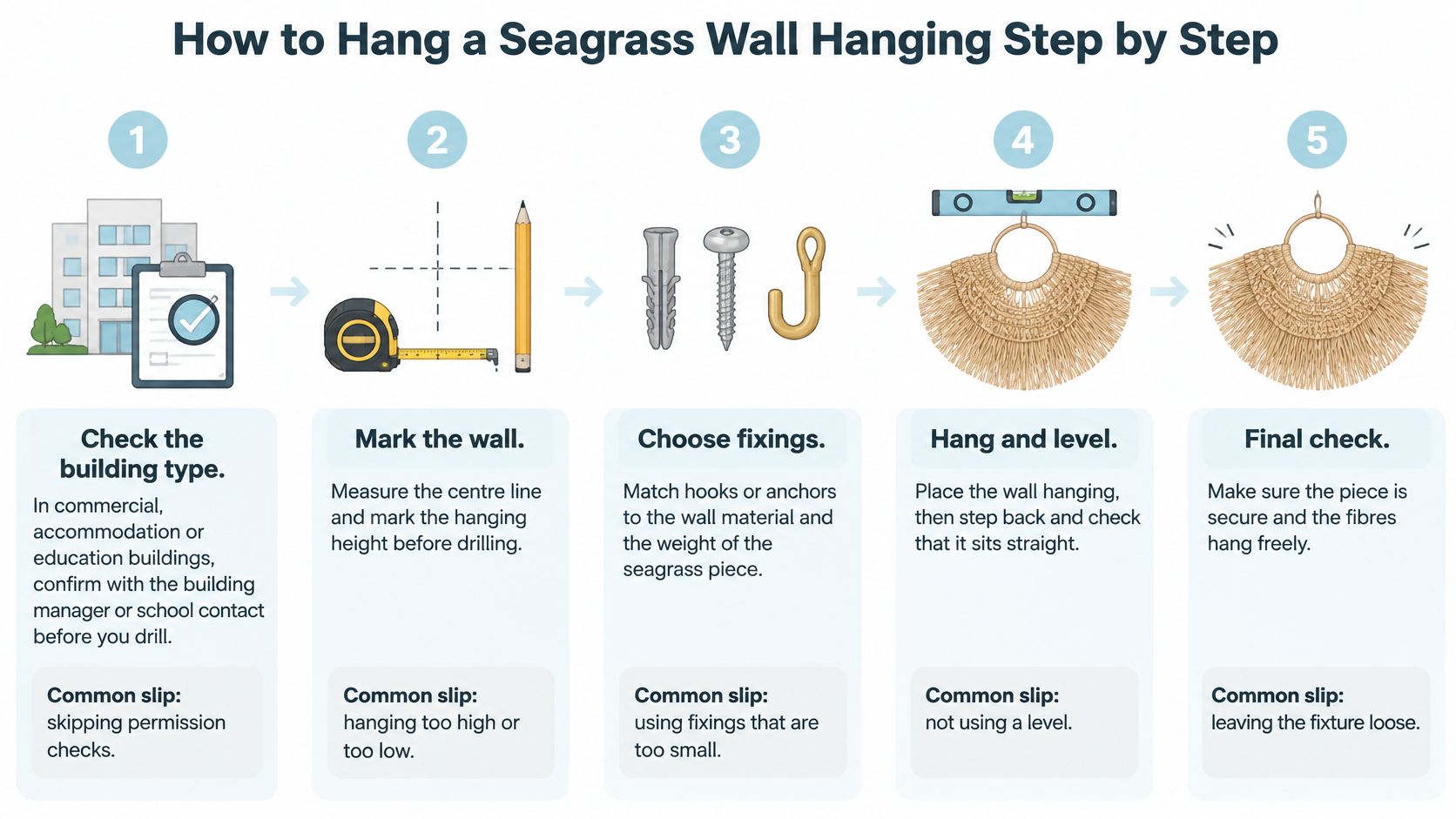
How to Hang a Seagrass Wall Hanging Step by Step

Gather a tape measure, pencil, spirit level, suitable detector, drill and fixings selected for the substrate. Keep the packaging or construction details with your installation notes.

  1. Check the building type. In commercial, accommodation or education settings, ask the building certifier whether the piece is artwork, an attachment or a lining. The National Construction Code's fire-resistance provisions address internal lining fire hazards and classification testing to AS 5637.1; untreated plant fibre can't be assumed non-combustible.
  2. Find a sound fixing location. Locate framing or suitable masonry and check for concealed services before drilling. Don't mistake a detector reading for certainty about everything inside the wall.
  3. Mark the position. Hold a paper template against the wall and assess it from the doorway and seated position. Mark the fixing locations from the actual mounting hardware, not just the outline.
  4. Fit rated hardware. Check the fixing manufacturer's load rating for your wall material. A larger screw won't rescue a crumbling hole or an unsuitable anchor.
  5. Hang and level. Leave an airflow gap without compromising the mounting system. Check with a spirit level, then ensure the backing carries the weight rather than the decorative fibres.
  6. Recheck after settling. Look for sagging, slipping hardware or strands dragging across the hook. Remove and correct a loose fitting rather than tightening it while the hanging remains loaded.

Use this visual checklist alongside the installation details.

A five-step infographic showing how to safely hang a decorative seagrass wall piece.

Keep the complete assembly consistent

A generic fibre certificate or an unverified fire-retardant spray doesn't establish the performance of the finished assembly. Where classification is required, document the fibre, backing, finish and construction, and obtain appropriate laboratory documentation.

Success means a secure, level hanging with freely suspended fibres, away from ignition sources and clear of exit paths.

Styling VW Accents Without a Beach-Shop Look

A seagrass hanging has a strong natural texture, so keep the VW accents few and deliberate. A Kombi Samba Bus diecast on a timber shelf below the weave adds a note of road-trip nostalgia without turning the room into a collection of beach motifs.

Volkswagen's Kombi history in Australia links the van with surfing, camping and road trips. Bring that easygoing spirit indoors with one well-chosen model and a calm backdrop.

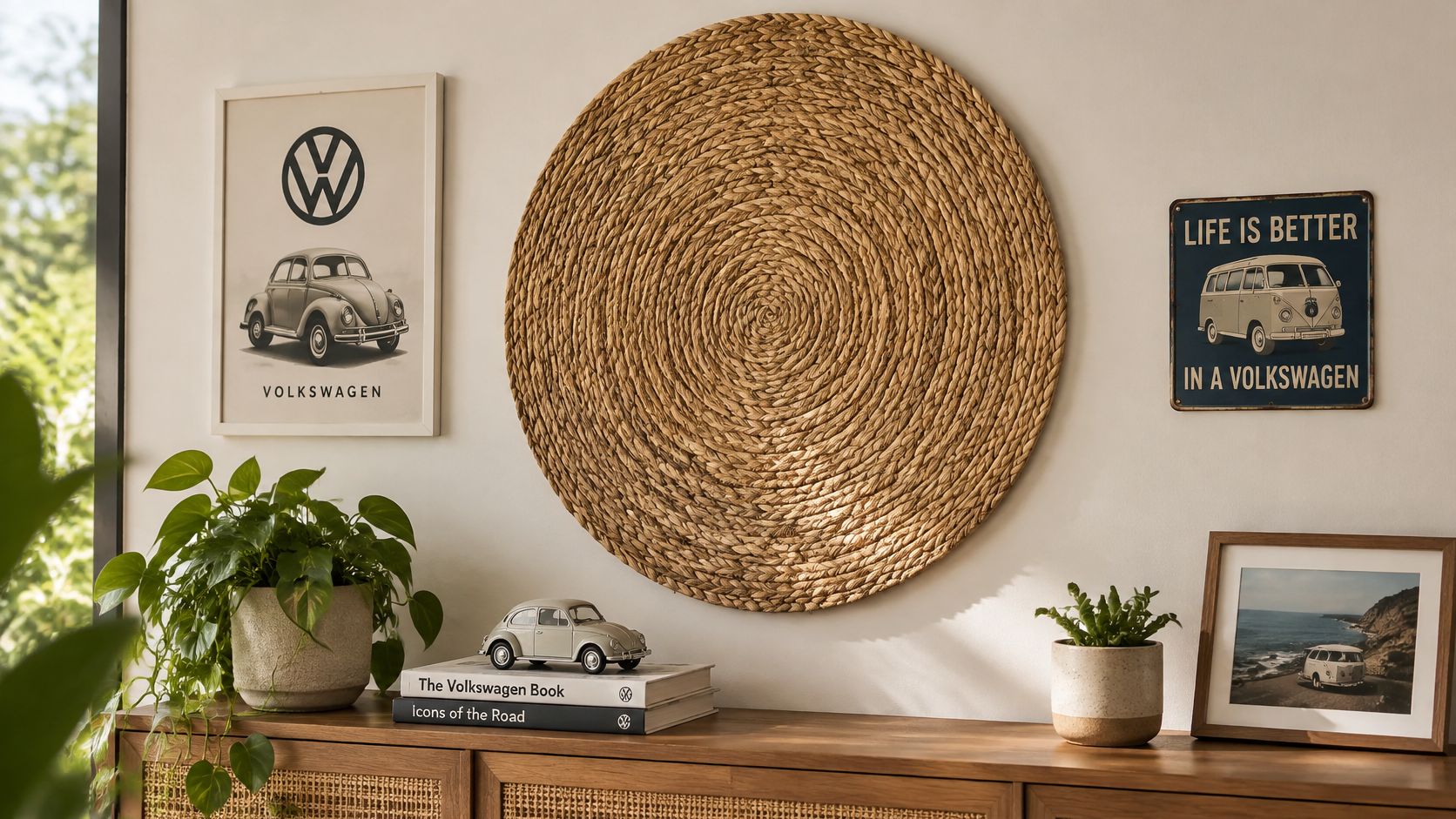
A rustic interior featuring a large round seagrass wall hanging above a wooden sideboard with Volkswagen decor.

Choose scale before colour

Diecast length varies sharply by scale. Compare each listing's dimensions with your shelf depth and width, allowing room for projecting mirrors and accessories.

A larger Beetle model can anchor a feature shelf; smaller models suit a compact ledge. Beside a hypothetical 40-centimetre hanging, a medium-sized model can provide balance without competing for attention.

Pair the woven fibre with smooth white walls, aged timber, muted blue, eucalyptus green or warm ochre. The Surf Board Welcome Sign measures 40cm and features a beach scene with an old Hippie Van. The 5.5cm White Car Miniature with Surfboards is from CoastalDesigns Decor. Choose one accent so the seagrass remains the focal point.

For more restrained ideas, browse coastal boho wall art. From the doorway, check that your eye settles first on the hanging, not a cluster of competing decorations.

Finish the Look and Shop Local

Let the finished display feel collected, not crowded.

A rustic wooden console table decorated with Volkswagen-themed decor, including a woven wall hanging and vintage bus models.

One focal piece, a small number of VW accents at the right scale, and a care date in the calendar.

Choose the available display space first, then the model. For officially licensed collectibles, check the individual listing and packaging for licensing information, scale and manufacturer details rather than assuming every VW-shaped ornament is a licensed diecast.

Our Sealife Wall Hooks Starfish are 19cm, sold in a pack of 12, while the Fabric Hanger Starfish measures 14x15cm. Decorative hooks still need a confirmed load rating before supporting a hanging; appearance isn't evidence of structural capacity.

For a little more VW inspiration, enjoy the video below.

When you're ready to compare Volkswagen diecast models for sale, browse the online shop for Kombi Samba Bus and Beetle options. For Australian buyers, confirmed local stock and fast domestic shipping are useful advantages to check before ordering, especially for a gift deadline.

Settle the wall, humidity and scale first. Then choose a piece you'll enjoy caring for alongside the VW models on the shelf.


Volkswagen Memorabilia offers VW-themed gifts, diecast models and coastal décor for displays with a personal connection to beach life and classic cars. Visit Volkswagen Memorabilia to find a Kombi, Beetle or coastal accent that suits your measured space, and check the listing's scale and licensing details before choosing.

Capiz Shell Wall Art: Coastal Decor Ideas for 2026

You're standing in front of a blank wall above a beachy console, holding a watery blue paint swatch in one hand and wondering whether seashell décor will look charming or straight out of a dated holiday unit. That hesitation makes sense. The best capiz shell wall art doesn't shout “beach theme”. It adds a soft glimmer, organic texture and a little movement, much like the polished details on a classic VW parked outside a coastal café.

Australian coastal interiors are heading towards warmer neutrals, natural textures and quieter references rather than literal nautical motifs, according to this Australian coastal style guide. That makes capiz a useful bridge between relaxed beach living and a more considered home, particularly when it sits beside timber, linen, rattan or a carefully chosen piece of Volkswagen memorabilia.

Why a Piece of Capiz Shell Wall Art Might Be the Coastal Touch Your Wall Is Missing

You have a blank wall above a console, a surf-coloured Beetle model nearby and a room that feels almost finished. A small shell sunburst can supply the missing detail, catching afternoon light and shifting as you move. It gives the wall depth without adding another strong pattern.

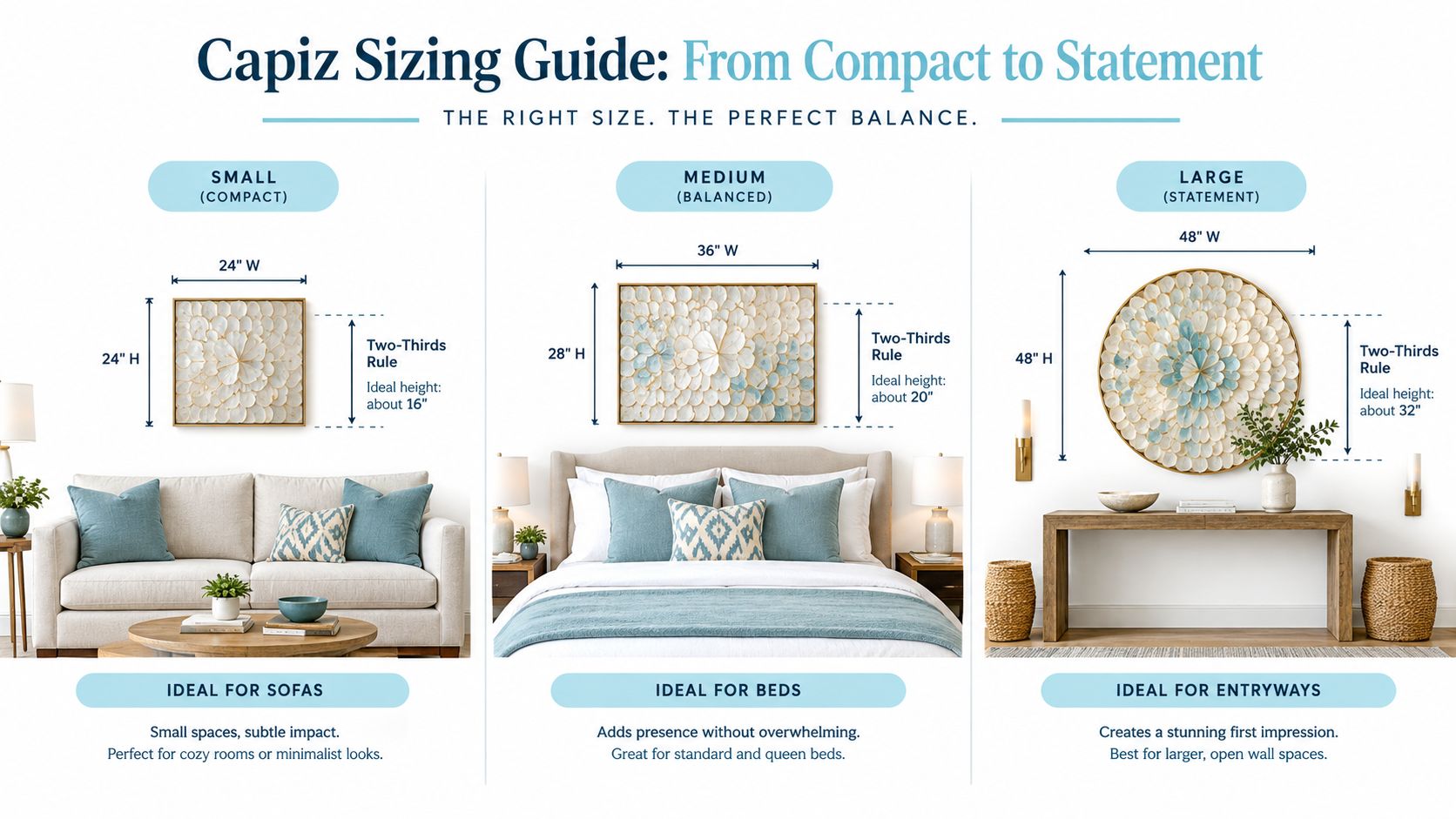
For a restrained result, choose one pearl-toned piece sized to roughly two-thirds of the console width. Keep the surrounding display to two supporting textures, such as timber and linen. Several brightly coloured shells beside anchors, ropes and oversized signs can push the room towards dated, theme-park beach style.

The useful test: If the artwork suggests the coast through texture and light, rather than spelling it out with obvious motifs, it's more likely to feel current.

That balance suits the VW-and-coastal-living mix especially well. Pair one luminous shell design with a vintage-style enamel sign and a small Beetle or Kombi model. The arrangement recalls road trips, beach towns and open-air weekends, while the warmer, quieter direction of Australian coastal design keeps the room contemporary.

Capiz also suits renters and collectors who regularly refresh a display. Its light visual presence helps a room feel open, while a round design can soften a boxy console or echo a Kombi wheel. Check the wall measurements, artwork proportions and hanging method before buying, then consider how daylight will pass across the shell.

What Capiz Shell Actually Is and Why It Shows Up on So Many Walls

Capiz shell comes from the windowpane oyster, Placuna placenta, a translucent shell associated with the Philippines. Its thin, layered structure allows light to pass through softly, which is why artisans have long used it for decorative objects that benefit from a gentle glow.

A historical IUCN review of capiz shell trade records its use as a glass substitute and names lampshades, wind chimes, boxes and other ornamental articles among its established applications. The review also notes that exports of worked capiz shells rose from just over 1 million units in 1976 to nearly 3.5 million in 1979, showing how quickly shellcraft expanded during the late 1970s.

That history explains the material's familiar look. Craftspeople press and overlap thin shell pieces to create panels, petals, rays and layered motifs. The result is a pearl-like lustre that can look milky in shade, warm in lamplight and almost watery when daylight moves across it.

Why designers keep coming back to it

Capiz offers a useful mix of qualities:

  • Filtered translucency: Light reaches the shell layers without making the artwork look harsh.
  • Natural variation: Subtle shifts in tone stop a pale piece from feeling completely flat or manufactured.
  • Low mass: Thin shell layers can cover plenty of visual area without the density of heavy framed décor.
  • Flexible colour: Pearl, cream, champagne and softly tinted finishes sit comfortably with sand, warm white, timber and sea tones.

If responsible sourcing matters to you, ask how the shell was obtained, whether it's a food-industry by-product and how the maker handles production. You can also compare the material with other coastal craft options through this guide to seashells for crafts.

Popular Styles, Shapes and Finishes to Know Before You Browse

Shopping becomes much easier once you know what each format does to a wall. A sunburst creates direction and a clear focal point. A panel behaves more like abstract art. A mobile introduces movement rather than a fixed visual block.

Style Common Finishes Best Wall or Room
Sunburst or starburst Natural pearl, champagne, gold-backed Above a console, bedhead or round mirror
Floral or blossom cluster Pale shell, blush, silver-backed Bedroom, Hamptons-style room or soft coastal nook
Panel or framed tile Matte white, charcoal, navy, metallic backing Minimalist living room, hallway or dining area
Lantern or mobile Natural pearl, high-gloss, mixed tones Covered outdoor area, entryway or room needing movement

Radial shapes for a strong centre

Sunbursts and starbursts send the eye outwards, so they're handy above furniture that already has a clear centre. A round design can soften a rectangular buffet, square artwork or straight-lined bench. It also pairs naturally with a circular mirror, tray or clock.

Softer designs for relaxed rooms

Floral and blossom clusters feel less architectural. Their irregular edges work well where you want a bedroom or reading corner to feel gentle rather than formal. Pale finishes keep the look quiet, while blush or muted colour can pick up cushions and ceramics.

Panels for a cleaner interior

Framed tiles and geometric panels suit a minimalist wall because their boundaries are easy to align. Matte shell tends to look calmer in bright rooms. High-gloss shell throws more light around, which can help a darker wall feel livelier, although it may compete with other reflective surfaces.

Lanterns and mobiles are a different proposition. They add a little motion and, where the design includes lighting, a filtered glow. Treat them as a feature rather than stacking them with several other statement objects.

Choosing the Right Size and Shape for Your Wall

Size can make a beautiful piece look intentional or stranded. Start by measuring the available wall above the sofa, bed or console, then consider artwork that occupies roughly two-thirds to three-quarters of that width. This proportion usually gives the furniture and artwork a visual relationship without making the wall feel crowded.

A petite sunburst may disappear above a large sofa or on a tall stairwell wall. In contrast, a broad floral panel can overwhelm a narrow hallway. The same design may feel perfectly balanced above a low entry table, so judge the piece against the furniture beneath it, not the wall alone.

A sizing guide infographic showing how to select the perfect capiz shell wall art for various rooms.

Match the geometry to the room

Use a rounded sunburst where the furniture feels angular or where a nearby mirror already introduces circular forms. Choose a rectangular panel for a buffet, a long console or a narrow section between windows, where its edges can reinforce the architecture.

For a wide wall, an asymmetrical cluster of two or three smaller pieces can feel more relaxed than one oversized design. Keep a consistent visual thread, such as the same shell colour or backing finish, so the arrangement looks deliberate rather than collected by accident.

Colour matters as much as dimensions. Whitewashed shells can blend into a bright white wall, while champagne, mother-of-pearl or bronze backing gives a pale room clearer definition. Hold a sample, cushion or timber finish nearby before ordering. Capiz changes character with daylight, so a colour that looks subtle online may become more noticeable beside a window.

Hanging and Caring for Capiz Shell Wall Art the Easy Way

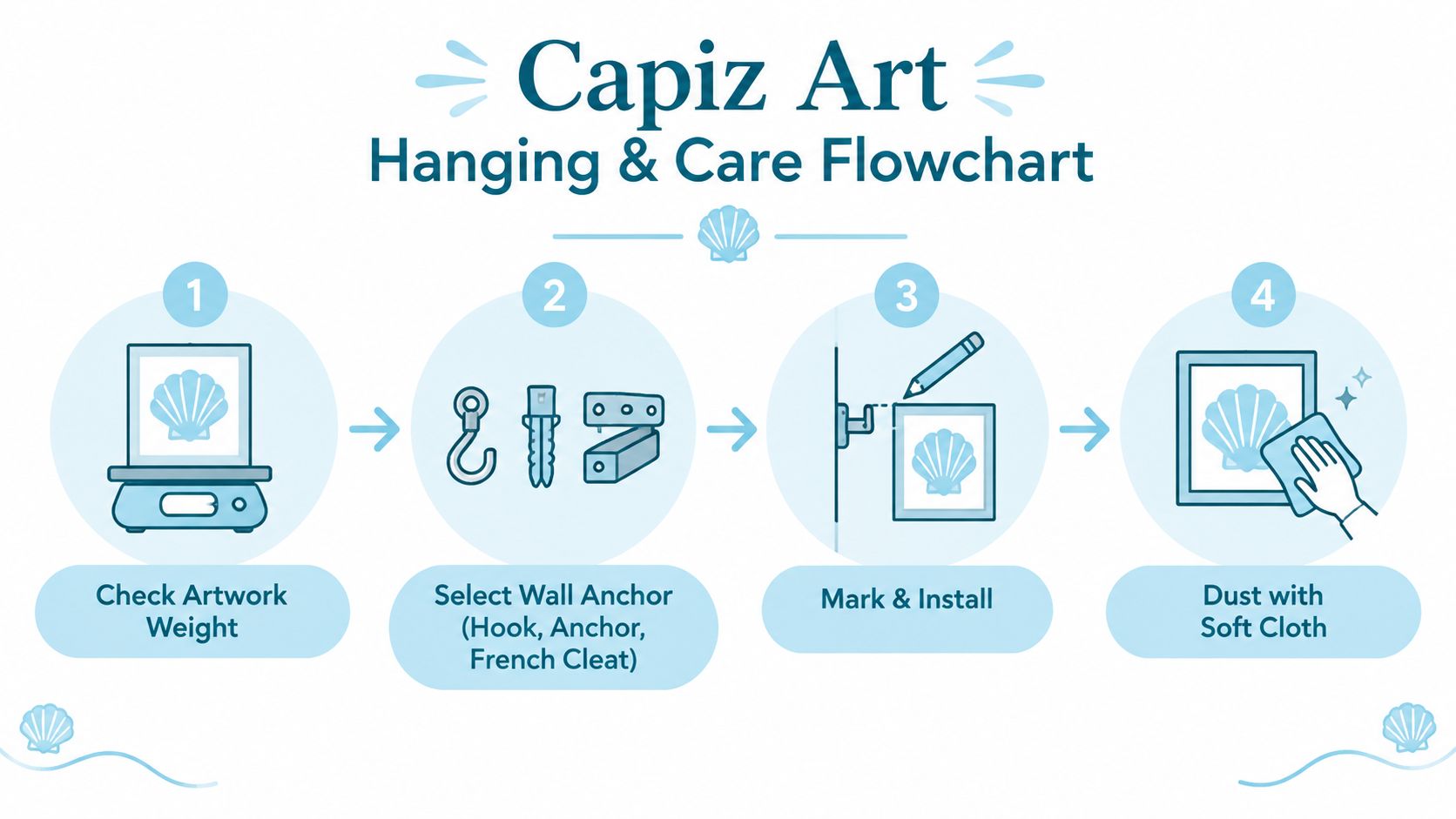
Capiz may look fragile, but a well-mounted piece can be surprisingly practical. The important detail is the backing and hanging hardware, not just the shell. Check the artwork's weight, inspect the fixing point and choose an anchor suited to the wall beneath it.

Plasterboard needs a suitable wall plug or rated hollow-wall anchor. Masonry generally calls for a solid screw and rawlplug. Larger or heavier panels may benefit from a French cleat, particularly if the backing has a broad, stable surface.

A simple hanging routine

  1. Check the artwork: Look for the fixing point, backing condition and stated weight.
  2. Choose the anchor: Match the hook, screw, plug or cleat to the wall type and load.
  3. Mark the centre: Hang the piece around eye level, with the centre commonly sitting near 145 to 155 centimetres from the floor.
  4. Check the line: Use a small spirit level before tightening everything.

For lightweight pieces, some makers recommend a tiny nail on suitable walls, while smaller capiz decorations may suit removable options such as 3M Velcro or blue tack. Jones & Co describes its Australian capiz pieces as light, supplied with a rear hook and suitable for simple mounting methods where the wall allows it. Their maker notes on capiz shell construction explain how pressed and overlapped shell layers preserve translucency while keeping the hanging load down.

A four-step instructional infographic detailing how to safely hang and care for capiz shell wall art.

Dust monthly with a soft feather duster or a hairdryer on its cool setting, held well away from the surface. If grime builds up, use a barely damp microfibre cloth and a light touch. Avoid soaking, ammonia, harsh sprays, steamy bathrooms, direct sun and exposed outdoor positions. For more shell-focused display ideas, browse shell wall art.

Styling Capiz Shell Wall Art in a 2026 Coastal or VW-Inspired Home

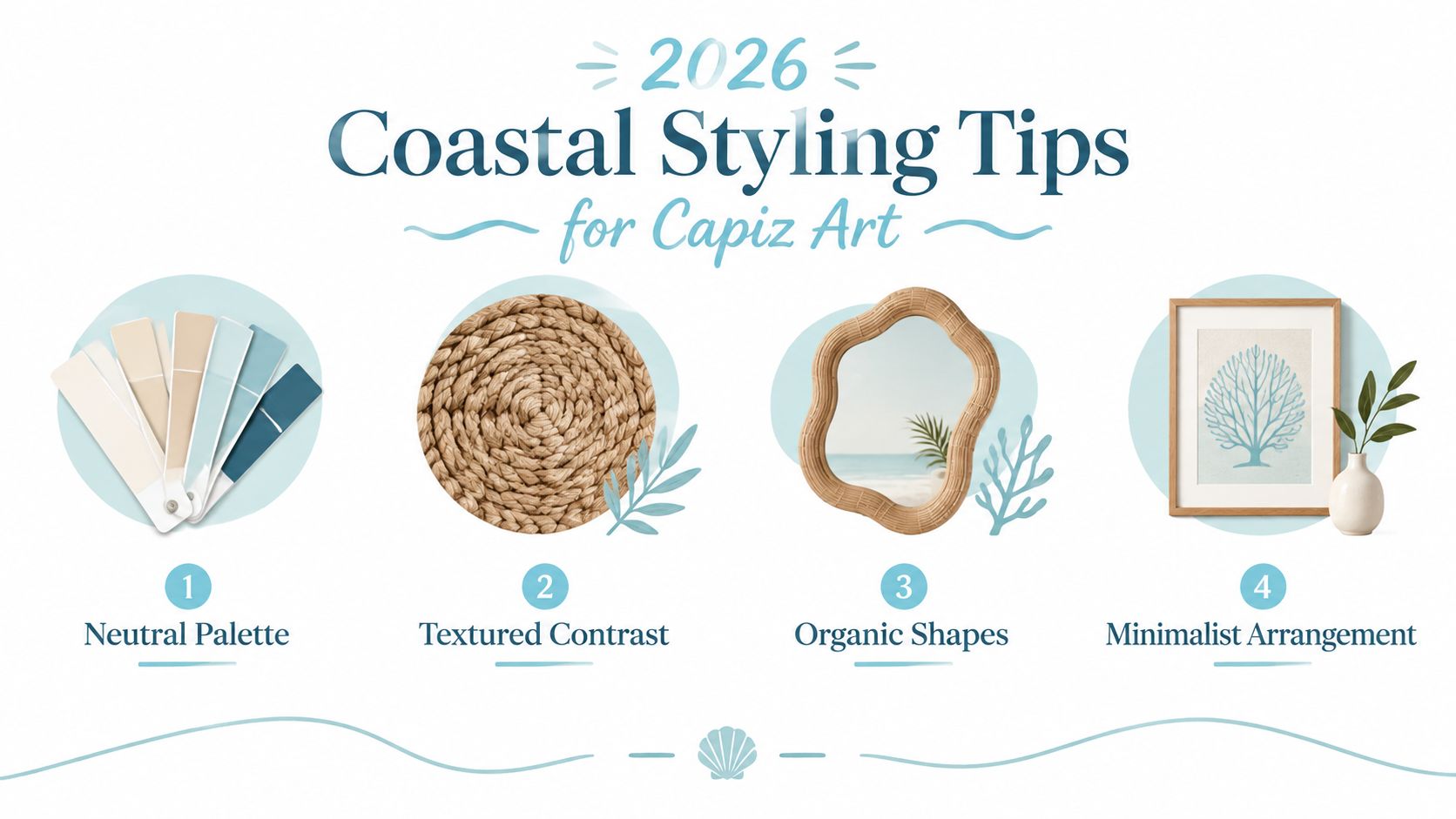
A VW-inspired coastal room works best when the references feel collected, not staged. For 2026, Australian coastal design is moving towards warm whites, sand, soft clay, deep ocean blue and muted sage. Rattan, bleached timber and brushed brass add character, while capiz brings a fine, shifting glow. Use those elements as a backdrop for the car culture and coastal memories already at home.

A pearl capiz sunburst above a low timber console can act as the quiet hero. Below it, place a compact VW model in a surf-inspired colour, a small ceramic bowl and one woven object. The car carries the nostalgia and personality. The shell contributes light and texture without competing for attention.

An infographic illustrating four coastal styling tips for capiz art, featuring color palettes and home decor.

Keep the palette confident but easy

Warm white walls suit natural pearl and pale champagne finishes. Clay-coloured cushions stop white shell from feeling too cool, while deep ocean blue gives it a clean point of contrast. Muted sage pairs with bleached timber and aged brass, creating an earthy room rather than a collection of nautical props.

Use the same restraint with VW details. A capiz panel can sit beside a vintage-style sign, provided the wall still has open space. One statement shell piece per wall is usually enough. Repeat its rounded or organic shape with a rattan tray, curved lamp or circular mirror, much like matching the curve of a classic Kombi with softer furnishings.

Layering rule: Let the capiz provide shimmer, let timber provide warmth and let the VW piece provide the story.

A boucle cushion, linen curtain or woven basket can continue the textural conversation without introducing another shell motif. The result feels like a genuine home shaped by road trips and coastal living, rather than a themed display. For more ways to combine these references, explore these coastal home décor ideas.

Buying Checklist and Smart Questions to Ask Before You Click Add to Cart

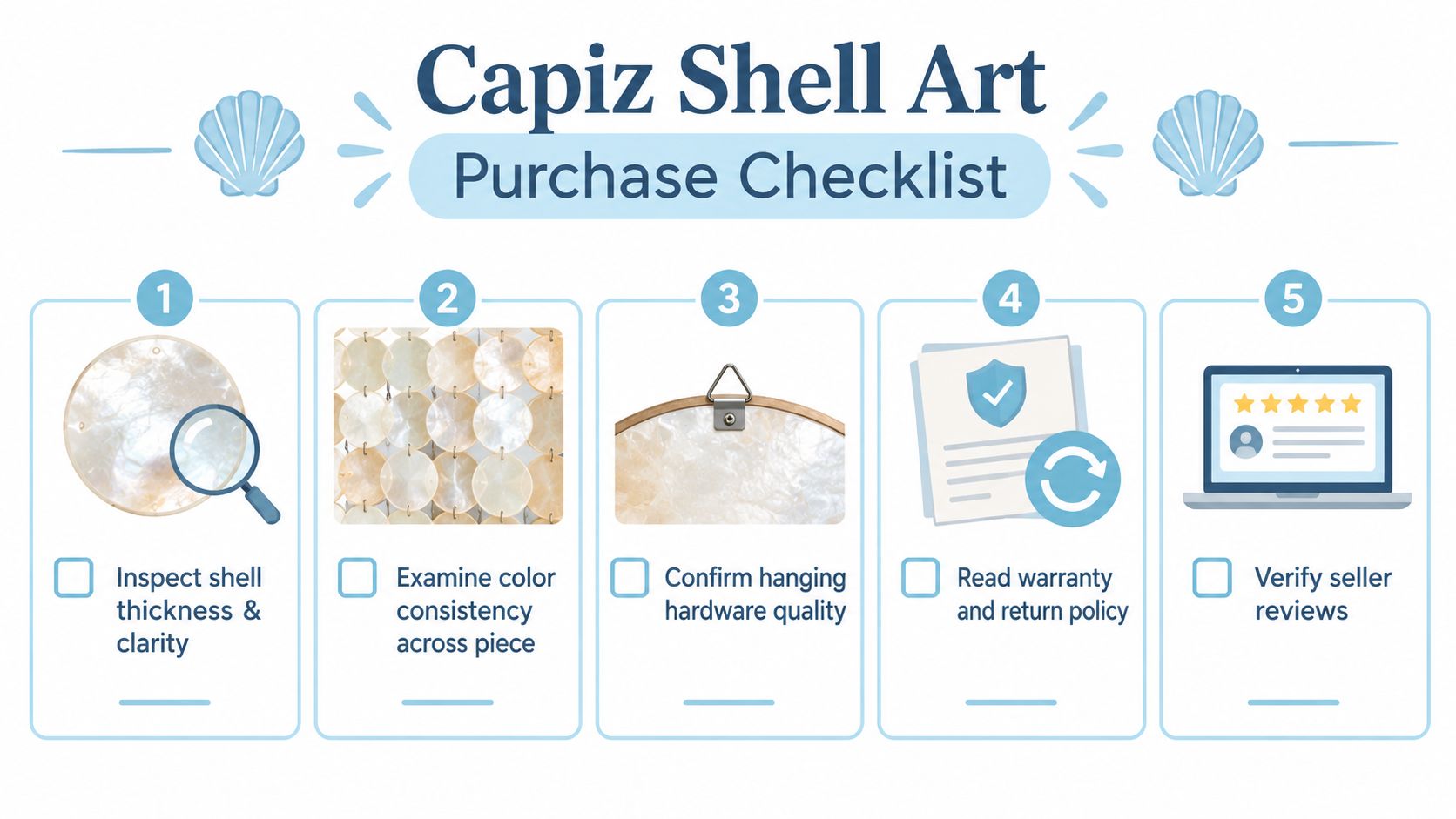
A good listing should help you understand what you're buying before the parcel arrives. Look closely at the shell clarity, thickness and consistency. Natural variation is part of the appeal, but obvious gaps, sharp edges, loose pieces or heavy reliance on surface glue can signal poor construction.

Inspect the frame and backing as carefully as the visible shell. A neat rear surface, secure fixing point and clearly stated indoor-use guidance tell you more than a glossy product photograph. If you're considering a humid room, check whether the piece is suitable for that environment rather than assuming all shell décor handles moisture well.

Questions worth asking the seller

  • What is the mounting method? Confirm whether a hook, wire, cleat or other fixing is included.
  • How much does it weigh? Match the load to your wall anchor, especially on plasterboard.
  • Where can it be installed? Ask whether the artwork is indoor-only, suitable for a covered outdoor area or appropriate for a humid room.
  • How was the shell sourced? Look for clear information about origin, responsible collection and whether the shell is a food-industry by-product.
  • How is it packed? Fragile shell needs protective packaging, internal padding and a sensible returns process.
  • What care instructions come with it? The seller should explain dusting, cleaning and light exposure.
  • What happens if it arrives damaged? Read the return and replacement policy before committing.

Capiz is also used beyond small decorative pieces. An Australian Baresque-listed capiz wallcovering reports testing to AS ISO 9705:2003 and achieved Group 2 classification, with specific extinction less than 250 m²/kg. The listing gives a 110 cm width and lineal-metre supply format, showing that shell can appear in wider decorative lining systems where substrate preparation, seams and installation method matter. Read the Capiz Bakbak product listing for the stated technical details, and don't treat a wallcovering rating as automatic approval for a separate piece of wall art.

An infographic titled Capiz Shell Art Purchase Checklist showing five key steps for buyers.

Classic VW design and capiz shell share an appealing quality. Both reward close looking. The curves, translucent layers and hand-finished details of shell décor can sit comfortably alongside the rounded optimism of a Beetle or the relaxed utility of a Kombi, provided the room has enough restraint to let each object breathe.

If you're building that atmosphere, Volkswagen Memorabilia offers licensed Volkswagen diecast models, Kombi Samba Bus pieces, Beetle models and coastal home décor for a display with genuine character. Visit the shop to find a considered addition for your console, shelf or VW collection, with Australian support and local shopping convenience.