

Picture this, mate: you're cruising down the coast, sun on your face, windows down, with nothing but the open road ahead. That's the great Aussie dream, and for so many of us, it has that iconic VW badge right on the front. If you've ever found yourself daydreaming about a classic Kombi, this guide is for you. It's like having a chat with a fellow enthusiast at a sunny car show, all about turning that dream into a reality that's parked right in your driveway.
Let's walk through everything you need to know about finding VW campervans for sale, from a classic Splittie to a modern weekender.
Your Adventure Starts With the Right VW Campervan
The love for the Kombi runs deep in our Aussie blood. It’s more than just a van; it’s a symbol of freedom, salty coastal drives, and a way of life that brings a massive community together at events like Volksfest and the VW Nationals. It’s a feeling of pure, unadulterated joy.
Before you dive headfirst into the classifieds, it’s worth taking a moment to really soak in the heritage. A brilliant way to do that is to get your hands on some proper VW memorabilia collectibles. Holding a classic Kombi Samba Bus diecast model in your hands… it really connects you to the history and the beautiful, timeless design you’re about to become a part of. It’s like holding a tiny piece of the dream.
Why Is Now a Great Time to Look?
If you feel like you're seeing more classic VWs on the road lately, you're not wrong! The market for VW campervans in Australia has been absolutely humming for the last few years, fired up by a huge swing back to local travel as we all started exploring our own incredible backyard again.
This rediscovery of the Aussie road trip has really shaken up the market in the best way.
- Soaring Demand: Back in 2020, as folks looked for new ways to holiday at home, campervan sales more than doubled in just a year.
- A Healthy Market: Fast forward to 2026, and you’ll find online marketplaces buzzing with used VW Transporter and California models. It’s not uncommon to see well over a thousand VW campers for sale at any one time.
- Prices for Everyone: This means there's a van for almost any budget, with prices starting around $25,000 for a solid T3 project and heading north of $120,000 for a perfectly restored T2 Splittie that’ll make you weep with joy.
All this energy makes it a fantastic time to find VW campervans for sale. The market is buzzing with options that tap right into that classic, adventurous spirit—the same spirit captured in collectibles like the timeless 1962 VW Kombi diecast models.
Getting to Know the VW Campervan Family
Choosing a VW camper is a bit like picking a favourite band—every era has its own unique character and a legion of devoted fans. When you start looking at VW campervans for sale, you'll quickly realise you're not just buying a vehicle; you're buying into a piece of living history. From the iconic first generation to the comforts of today, let's meet the family.
Getting a feel for this evolution is part of the fun. A great way to appreciate the history is by exploring the details on a smaller scale, like with a classic 1:18 scale Kombi Samba Bus. It’s a fantastic way to connect with the lineage before you find your own life-sized adventure wagon.
The Icon: T1 Transporter 'Splittie' (1950–1967)
This is it. The one that started a global movement. The T1 is the undisputed king of cool, instantly recognisable by its split front windscreen and that big, friendly VW badge. It’s pure 1960s nostalgia on four wheels.
If you find a T1 for sale in Australia, you're looking at a genuine piece of automotive history. Their rarity and timeless appeal mean they command high prices. Owning one is less about getting somewhere fast and more about enjoying every single kilometre with a massive smile on your face.
The "Splittie" isn't just a van; it's a statement. It represents a simpler time of peace, love, and open-road freedom that still resonates with enthusiasts today. It’s the origin story of the entire van life movement.
The Surfer's Favourite: T2 Transporter 'Bay Window' (1967–1979)
When the Splittie passed the baton, the T2—or "Bay Window"—ran with it, becoming the go-to surf bus of the 70s. It traded the split screen for a single, curved panoramic windscreen (the 'bay'), giving drivers a better view and a more modern look for the time.
You only have to look at the sales figures to see how much Aussies fell in love with this model. After the T1, demand for the T2 absolutely exploded. Imports surged by a massive 200% to over 20,000 units a year as our surf culture boomed, cementing the Bay's place in our coastal identity.
For many, the T2 is the perfect sweet spot. It’s more affordable and easier to drive than a T1, but it still has all the vintage charm you could ever want for a weekend away or a local Show & Shine.
The Practical Classic: T3 Transporter 'Wedge' (1979–1992)
As the 80s rolled in, so did the T3. Affectionately nicknamed the "Wedge" for its sharper, more angular lines, this van was a huge leap forward in space and comfort. It was the last of the rear-engine VWs, cleverly bridging the gap between the old air-cooled classics and the water-cooled vans that followed.
T3s are known for their roomy interiors and smoother ride, making them a fantastic and often affordable entry point into VW camper ownership. They're incredibly versatile, and the many Syncro (4WD) models still out there prove their mettle on rugged Aussie tracks to this day.
The Modern Adventurers: T4, T5, and T6 (1990–Present)
From the T4 onwards, Volkswagen moved the engine to the front. This change created the reliable workhorses and comfortable, capable campers we know today. These models deliver modern performance, safety, and reliability that make long-distance touring an absolute pleasure.
If you want a van that can pull double duty as a daily driver during the week and an adventure machine on the weekends, this is the era you'll be exploring.
The whole campervan market, from classic to modern, has seen a huge surge in interest recently. This is driven by a new generation of adventurers who appreciate both nostalgia and reliability.

This trend shows that prices are on the rise across the board. No matter which model captures your heart, it’s an investment in a lifestyle. You can find more tips on looking after your pride and joy in our dedicated guide for the Volkswagen Transporter camper.
VW Campervan Generations At a Glance
Feeling a bit overwhelmed by the choices? Don't be, mate. Here's a quick cheat sheet to help you tell your Splitties from your Wedges at a glance.
| Model (Nickname) | Production Years | Key Feature | Best For |
|---|---|---|---|
| T1 (Splittie) | 1950–1967 | Split front windscreen | The purist wanting the ultimate classic icon |
| T2 (Bay Window) | 1967–1979 | Single curved windscreen | Vintage charm with better drivability |
| T3 (Wedge) | 1979–1992 | Angular, '80s boxy shape | An affordable and practical entry into classic VW life |
| T4/T5/T6 | 1990–Present | Modern front-engine design | Reliability and comfort for daily driving and touring |
Each generation has its own story to tell. The fun part is deciding which one you want to be a part of.
Understanding VW Campervan Prices in Australia
Alright, let's talk money. Dreaming of a classic Kombi is one thing, but setting a realistic budget is how you actually get the keys in your hand. The price for a VW campervan for sale in Australia can vary dramatically, and it all comes down to a few key factors: the model, its age, condition, and the interior fit-out.
Much like a rare piece of Volkswagen memorabilia, say a stunning Volkswagen Beetle model, the value is tied directly to its history and how well it's been preserved. A perfect, all-original camper will always fetch a premium, but there are plenty of great vans out there that won't break the bank.
What Shapes the Price Tag?
As you start your search, you'll notice a massive spread in asking prices. It really helps to know exactly what you’re paying for.
- Model & Rarity: A T1 'Splittie', particularly a sought-after 21- or 23-window Samba model, is the peak for collectors and commands a top-tier price. A T2 'Bay Window' is generally more affordable, and a T3 'Wedge' can be a brilliant, budget-friendly way into the classic VW world.
- Condition: This is the big one. A van that needs a complete, bare-metal restoration might seem cheap upfront, but it will require a huge investment in both time and cash. At the other end, a fully restored, rust-free van ready for a car show will have the highest price tag.
- Interior Fit-Out: Is it an empty van ready for you to customise, or does it have a complete camper setup with a pop-top roof, kitchenette, and bed? A quality, professional fit-out from a known brand like Westfalia adds serious value.
A Realistic Look at Aussie Market Prices
To give you a general idea, here’s a rough guide to what you can expect to pay for VW campervans for sale in Australia. Remember, these are just ballpark figures, so always do your own research.
- Project Vans ($5,000 – $20,000): These are vans that need a lot of work. They’re a great choice if you know your way around a welder and want the satisfaction of a full restoration project.
- Running & Roadworthy ($20,000 – $45,000): In this price range, you’ll find vans that are mechanically solid and ready for the road, though they might have a few cosmetic issues or an older interior. You can often find a good T3 or a tidy T2 here.
- Excellent Condition ($45,000 – $80,000+): These are the turn-key adventurers. They have usually had major restoration work, feature a great interior, and are ready for a big trip tomorrow.
- Show-Stoppers & Rare Models ($80,000 – $150,000+): This is the territory of immaculate, professionally restored Splitties and other rare, collectible models that are genuine investments.
An Investment in Adventure
One of the best things about owning a VW camper is how well they hold their value. A normal car starts losing money the second you drive it away, but a well-kept classic VW is a completely different beast. It's heart, not just metal.
Value retention is a huge benefit of VW campers. Data from the Australian market shows a modern VW California can hold onto 95% of its value after one year and still be worth 82% of its original price after three years—far outperforming typical SUVs. You can discover more on VW campervan value retention here.
This strong value retention, coupled with a growing national demand, means finding a good camper isn't just buying a vehicle—it's an investment in future adventures that’s likely to pay you back. As you can see, the value of these vans is tied to a rich history, which you can explore further in our guide to the Volkswagen bus camper for sale.
Your Essential Pre-Purchase Inspection Checklist
Alright, you’ve found a promising VW campervan for sale, and it looks like a pearler in the photos. Now for the moment of truth: getting up close and personal. This is more than just kicking the tyres; it's about knowing exactly what to look for past the shiny paint and groovy curtains.
Don't feel out of your depth! We'll walk you through a simple checklist, focusing on the big three: Rust, Mechanicals, and Electrics. With a bit of know-how, you can inspect a van with confidence and dodge any nasty surprises down the road.
Bodywork and the Hunt for Rust
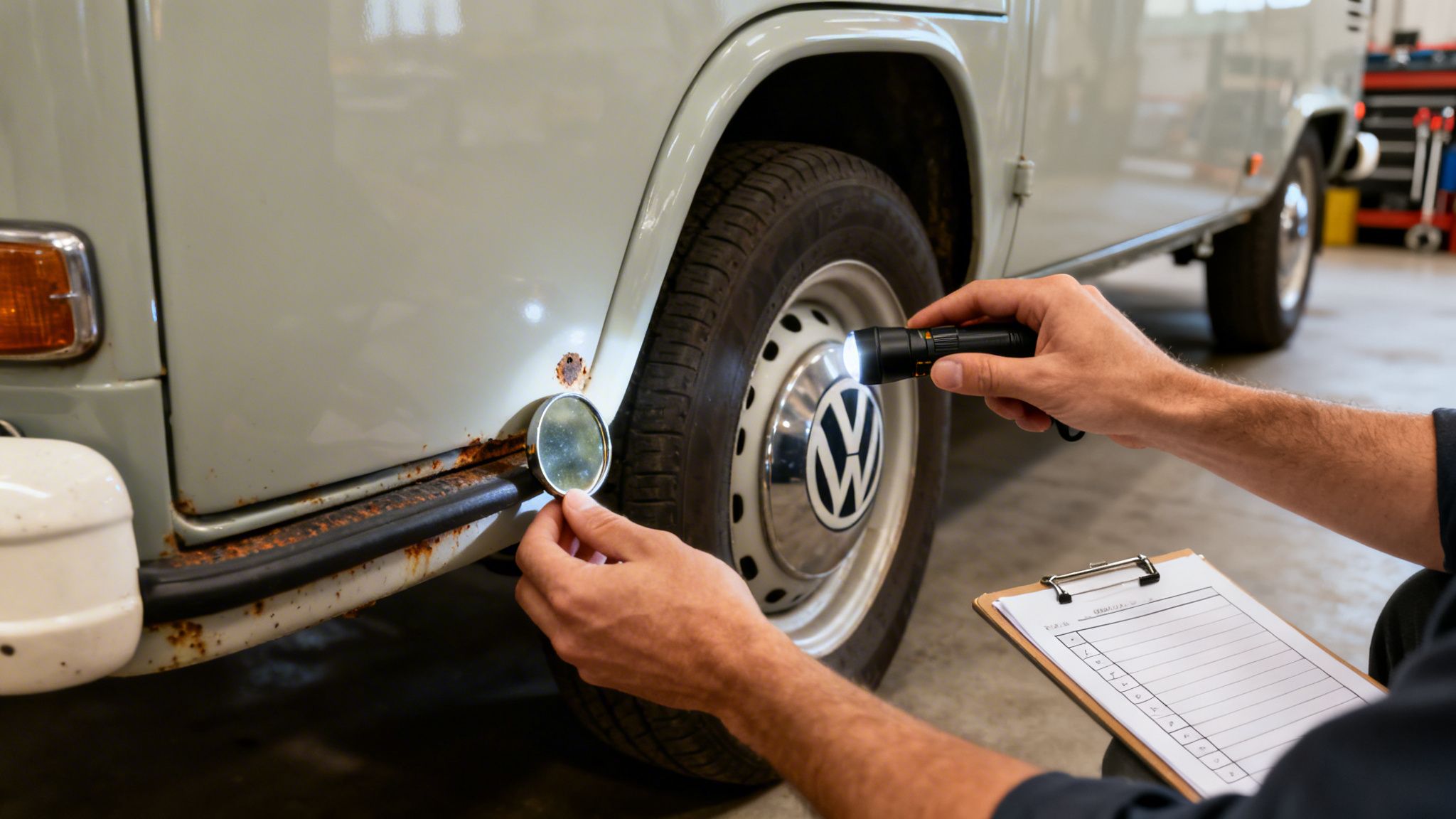
Rust is the arch-nemesis of any classic vehicle, especially one that’s spent its life cruising the Aussie coast. A fresh lick of paint can hide a world of hurt, so it’s time to play detective. Be sure to bring a small magnet and a torch.
- Gutters: Carefully run your fingers along the roof gutters. This is a classic spot for water to pool and for rust to take hold.
- Wheel Arches: Check the inner and outer lips of all the wheel arches. You’re feeling for any bubbling or roughness under the paint.
- Sills: The long panels right below the doors are prime real estate for rust. Use your magnet here—if it doesn't stick firmly, it’s probably because it’s sitting on a thick layer of body filler, not steel.
- Window Seals: Gently press around the windscreen and rear window seals. Any soft spots or visible rust can signal a tricky and expensive repair job.
Pro Tip: Don't be shy about getting on your hands and knees. Slide underneath and point your torch at the chassis rails and floor pans. A bit of surface rust is often part of the territory, but any actual holes or flaky, crumbling metal are massive red flags.
Engine and Gearbox Check
You don't need to be a qualified mechanic, but you do need to trust your senses. A healthy VW engine has a personality and a sound all its own.
Before you even turn the key, have a good look in the engine bay for any obvious oil leaks. A bit of road grime on an old motor is completely normal, but fresh, dark drips on the ground beneath it point to active leaks that will need fixing.
When you start the engine from cold, just listen.
- Does it fire up easily, or does it cough and splutter into life?
- Listen for any loud, rhythmic knocking or rattling sounds coming from the engine.
- Let it idle for a few minutes and watch the exhaust. A little puff of smoke on start-up is usually fine, but a continuous stream of blue smoke (burning oil) or white smoke (coolant) points to much bigger problems.
On the test drive, get a feel for the gearbox. Shifting gears should be relatively smooth, without any loud grinding or the shifter popping out of gear on its own.
Interior and Electrics
Now for the fun bit—flicking all the switches and seeing how the living space actually works. Systematically go through and test every single thing you can find.
- Lights: Check the headlights (both high and low beam), indicators, brake lights, and all the interior lights.
- Wipers and Horn: They seem simple, but they’re non-negotiable for a roadworthy certificate.
- Gauges: Watch the fuel gauge and speedometer on your test drive to make sure they’re giving a sensible reading.
- Camping Gear: If it has a pop-top, get the owner to show you how it works. Test the fridge, flick on the water pump, and plug something into the 12V outlets.
This is also your chance to judge the quality of the camper fit-out. Open and shut every cupboard door. Lie down on the bed. Does it all feel solid and well-made, or a bit flimsy and tacked together? The condition of the interior speaks volumes about how the van has been loved over the years.
Paperwork and History
Never, ever underestimate the power of a well-kept folder of receipts. Ask the owner if you can see the vehicle's service history. A big stack of invoices showing regular maintenance is a fantastic sign of a cherished van.
- Check that the Vehicle Identification Number (VIN) stamped on the van matches the number on the registration papers.
- Do the same for the engine number; make sure it matches what’s listed on the rego.
- Ask about the current registration status and when it was last issued with a Roadworthy Certificate (RWC).
A seller who has kept meticulous records is almost always someone who has taken great care of their vehicle. Following this checklist will give you the confidence to make a smart decision and get you one step closer to that dream Aussie road trip.
Project Van or Ready-to-Roll Camper?
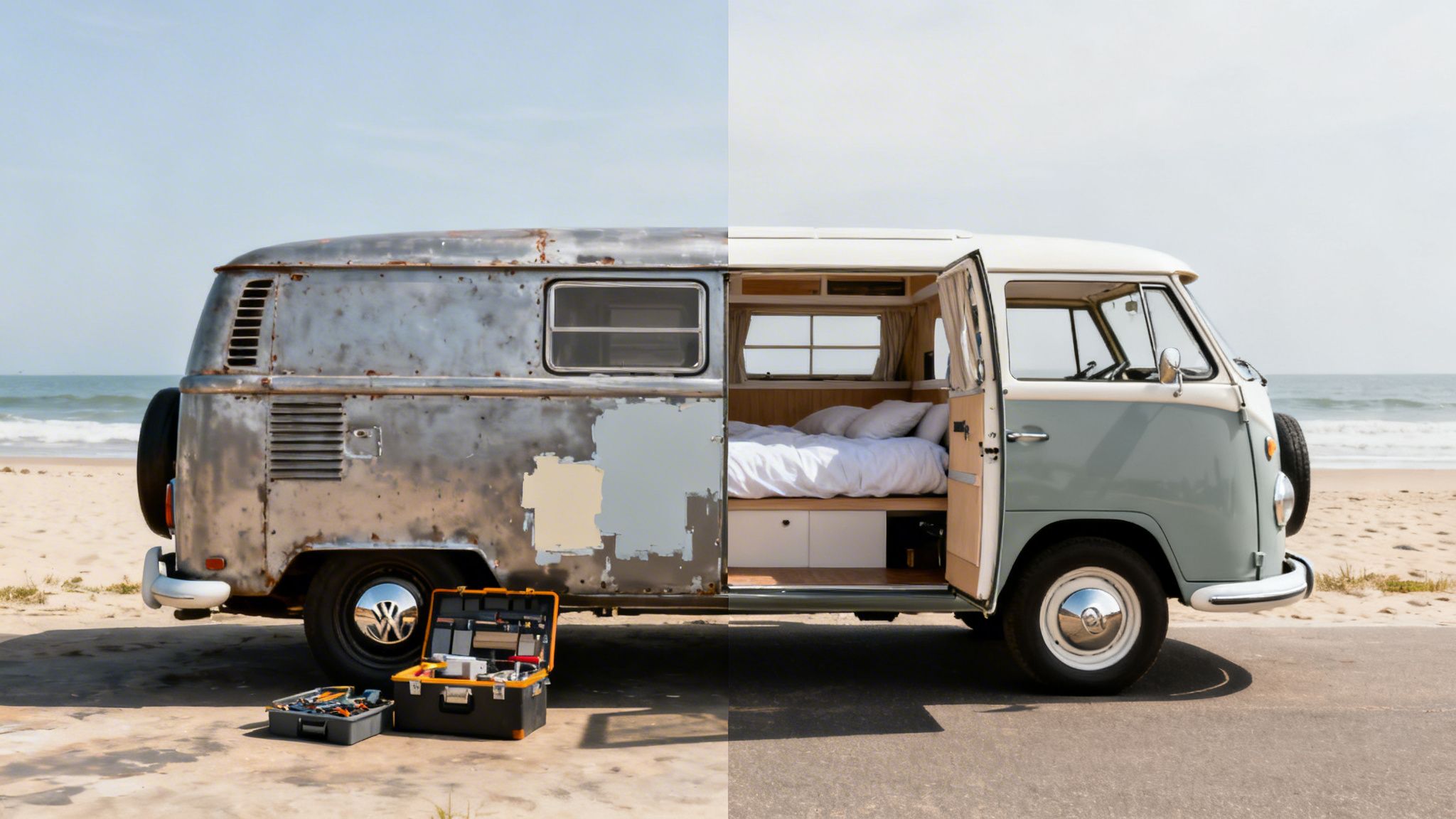
It’s the first big question every would-be VW owner asks themselves when looking at VW campervans for sale: Do I find a pristine, ready-to-go camper, or do I take on a promising project? Both paths lead to adventure, but they offer completely different journeys to get there. The right choice depends entirely on your personality, your skills, and what you truly want out of the experience.
This crossroads is a familiar one in our world. It's like choosing between a perfect, out-of-the-box Volkswagen diecast model and the rewarding task of restoring a vintage find. Both are born from the same passion, just expressed in different ways.
The Appeal of the Ready-to-Roll Camper
A turn-key van is all about one thing: instant freedom. You can literally pick up the keys on a Friday morning and be watching the sunset from a new postcode by Saturday. This is the way to go if your time is precious and your main goal is to start exploring right away.
Here’s what you get with a ready-to-roll van:
- Immediate Use: Forget about long waits at the mechanic or weekends spent covered in grease. Your adventures start the moment you drive away.
- Predictable Costs: The upfront cost is higher, no doubt. But you have a much clearer idea of your total investment, without the worry of surprise repair bills lurking down the road.
- Proven Setup: The interior is already built, tested, and ready for life on the road. You’re buying a layout that works, avoiding the trial and error of a custom build.
The Romance of the Project Van
And then there's the project van. It might be a bit rusty and unloved, but it’s brimming with potential. This is the path for the dreamers, the tinkerers, and anyone who wants a van that is 100% theirs, inside and out.
The pull of a project is hard to resist:
- Lower Initial Cost: A van needing work will always be cheaper to buy upfront. This makes ownership much more accessible if you’re working with a smaller initial budget.
- Total Customisation: Every single choice is yours. From the paint colour to the kitchen layout and the fabric on the cushions, you can build the exact camper you've always pictured.
- Deeper Connection: The blood, sweat, and maybe a few tears you pour into a restoration forges a bond like no other. It stops being just a van; it becomes your van.
Choosing a project van is a commitment not just to a vehicle, but to a journey of learning and creation. The skills you'll pick up and the stories you'll tell will last a lifetime, long after the last coat of paint has dried.
Ultimately, the best choice comes down to your budget, your timeline, and how hands-on you want to be. If you're leaning towards a full restoration, checking out a bare-bones van for conversion can give you a great starting point for inspiration. Whether you buy it done or build it yourself, the destination is the same: unforgettable adventures on the open road.
You've Bought It! Now, Let's Hit the Road
Right, you’ve done it. You’ve poked and prodded, done the deal, and now you’re standing in front of your very own VW camper. The feeling is electric, isn't it? But before you chuck the surfboard in and set the GPS for the coast, there are a few final bits of paperwork to sort out to make it officially yours.
Getting the admin right from the get-go is the key to a stress-free first journey. Trust me, it’s worth the small effort now to ensure your first drive is all smiles.
Making It Official, Aussie-Style
The last hurdle in buying any vehicle down under is the ownership transfer. The exact process changes a bit from state to state, so your first port of call should always be your local transport authority’s website for the latest rules.
Generally speaking, here’s what you’ll be dealing with:
- Registration (Rego) Transfer: The seller will give you the signed transfer forms. It’s then on you to get them lodged, pay the transfer fee, and cover the stamp duty.
- Roadworthy Certificate (RWC): In most states, it’s the seller’s job to supply a current RWC (or a Safety Certificate) to prove the van is safe. Unless you're tackling a ground-up restoration project, you really don't want to buy a van without one.
- Proof of Purchase: Make sure you get a proper receipt. It doesn't have to be fancy, but it absolutely must have the date, the final price, the van's details (VIN and rego number), plus the names and signatures of both you and the seller.
Once those forms are in and the keys are in your hand, that’s it—welcome to the club! It’s a moment worth savouring. You're not just a vehicle owner; you're the custodian of a legend.
Your First Weekend of Freedom
With the serious stuff out of the way, the real fun begins. That first trip, no matter how small, is something you’ll never forget.
Here’s how to make it a great one:
- Plan a "Shakedown" Trip: Don't go halfway across the country just yet. Pick a local caravan park or a favourite nearby spot for a night or two. This is your chance to test everything—the pop-top, the fridge, how the bed sets up—without the pressure of being miles from home. It's all about learning your new rig.
- Join the Community: Hop onto social media and find your local VW club. Honestly, this is the single best resource for brilliant advice, finding parts, and hearing about upcoming shows and coffee runs with people who just get it.
- Make It Your Own: Now’s the time to add those personal touches. A cool, retro metal decor sign for the interior? Or maybe a little Volkswagen Beetle model on the dash for good luck? It’s these little things that start turning your van into a proper travel companion for the adventures ahead.
FAQ: Your Top VW Camper Questions Answered
Got questions? You're not alone. Buying a VW camper is a big step, and it's natural to have a few things you're wondering about. Here are some of the most common questions we get from people looking at VW campervans for sale in Australia.
How Much Does It Cost to Insure a Classic VW Campervan in Australia?
Insurance costs can vary quite a bit, mate. It really comes down to the model, its agreed value, your driving record, and even your postcode. For the classics (anything made before 1990), you'll almost always find the best rates with a specialist classic car insurer.
As a ballpark figure, you could be looking at annual premiums anywhere from $500 to $1,500. The best thing you can do is get a few quotes before you even think about buying a van. That way, you can build the real cost into your budget without any nasty surprises.
Can I Use a VW Campervan As My Daily Driver?
You absolutely can, but just know it's a lifestyle choice! A modern T5 or T6 drives much like a car and can handle the daily school run or commute without a fuss.
An older air-cooled van like a Splitty or a Bay Window is a whole different beast. It's a more… authentic experience. We’re talking no power steering, a slower pace, and a genuine feel for the road. Plenty of die-hards drive them every day, but we seriously recommend test-driving one in your usual traffic to see if that vintage charm works for your daily grind.
What Are the Most Common Mechanical Issues to Look Out For?
With the classic air-cooled vans (T1, T2, and early T3s), you'll often be dealing with little oil leaks and keeping the carburettor tuned. But the real enemy, hands down, is rust. Always, always check the wheel arches, sills, and that spot right under the windscreen seal—they're notorious trouble spots.
For the later water-cooled T4s and T5s, you need to see solid proof that the timing belt and water pump have been serviced on schedule. That's a critical job you simply can't afford to have fail on you.
Is It Better to Buy a Pop-Top or a Tin-Top Camper?
This one is all about how you see yourself using the van. A pop-top roof is fantastic for that extra headroom to stand up and cook. Plus, it usually adds an extra bed up top, which is a massive win for families. The trade-off? You've got canvas and lifting gear that need looking after.
A "tin-top"—a van with a standard solid roof—is simpler, more discreet, and has fewer places to spring a leak. They can feel a bit more compact inside, but they're a great, no-fuss option. Just think about how often you'll really need to stand up straight inside the van before you make the call.
Your campervan is your personal space for adventure, and getting the layout right is key. Whether you're a pop-top enthusiast or a tin-top purist, the goal is the same: creating a comfortable basecamp for making memories on the road.
Choosing between them is a classic debate in the VW community, and honestly, there's no right answer—only what’s right for you.
At vwmemorabilia.com.au, we're here for every part of your VW journey. We live and breathe this stuff. While you're on the hunt for the real deal, why not get inspired by browsing our massive collection of perfectly detailed VW Kombi diecast Australia models? As Australia's go-to importer, we've got a fantastic range in stock and ready for fast local shipping. They’re a brilliant way to keep the dream alive on your desk or shelf, and a perfect gift for the VW lover in your life. Happy hunting