


You're probably doing what half of us did before buying our first van. Late-night scrolling, too many tabs open, one eye on a tidy Japanese import, the other on an old VW bus with enough character to ruin your financial judgement. You can already feel the first overnight stop somewhere up the coast, kettle on, rear doors open, salty air drifting in.
That dream gets its hooks in deep.
For some people, it starts with a surf trip memory. For others, it's a family holiday in a hired motorhome, or seeing an old Kombi at a Sunday meet and realising a car can feel like a time machine. Either way, once you start searching for a campervan for sale in Sydney, you're not just shopping for transport. You're trying to buy a certain kind of morning, a certain kind of freedom, and if you're anything like me, a bit of old-school charm too.
Sydney makes that dream feel close enough to touch. The city gives you dealers, private listings, ex-rental stock, quirky conversions, and the odd classic that makes your heart race before your brain has had a say. But romance alone is a dangerous co-pilot. A good campervan should stir the soul and still survive Rego, insurance, parking hassles, and the long trudge up the M1 without drama.
The Dream of the Open Road Starts in Sydney
A mate of mine spent months saying he was “just looking”. You know the type. Every weekend he'd send photos of vans parked by the beach, talk about heading north, then shrug and say maybe next year. Then he found a van in Sydney, stood inside it, looked out the side door as if he was already camped at Crescent Head, and that was that. Dream became decision in about ten minutes.
That's why Sydney matters. It's not just a place to buy. It's the place where the practical and the romantic tend to collide.
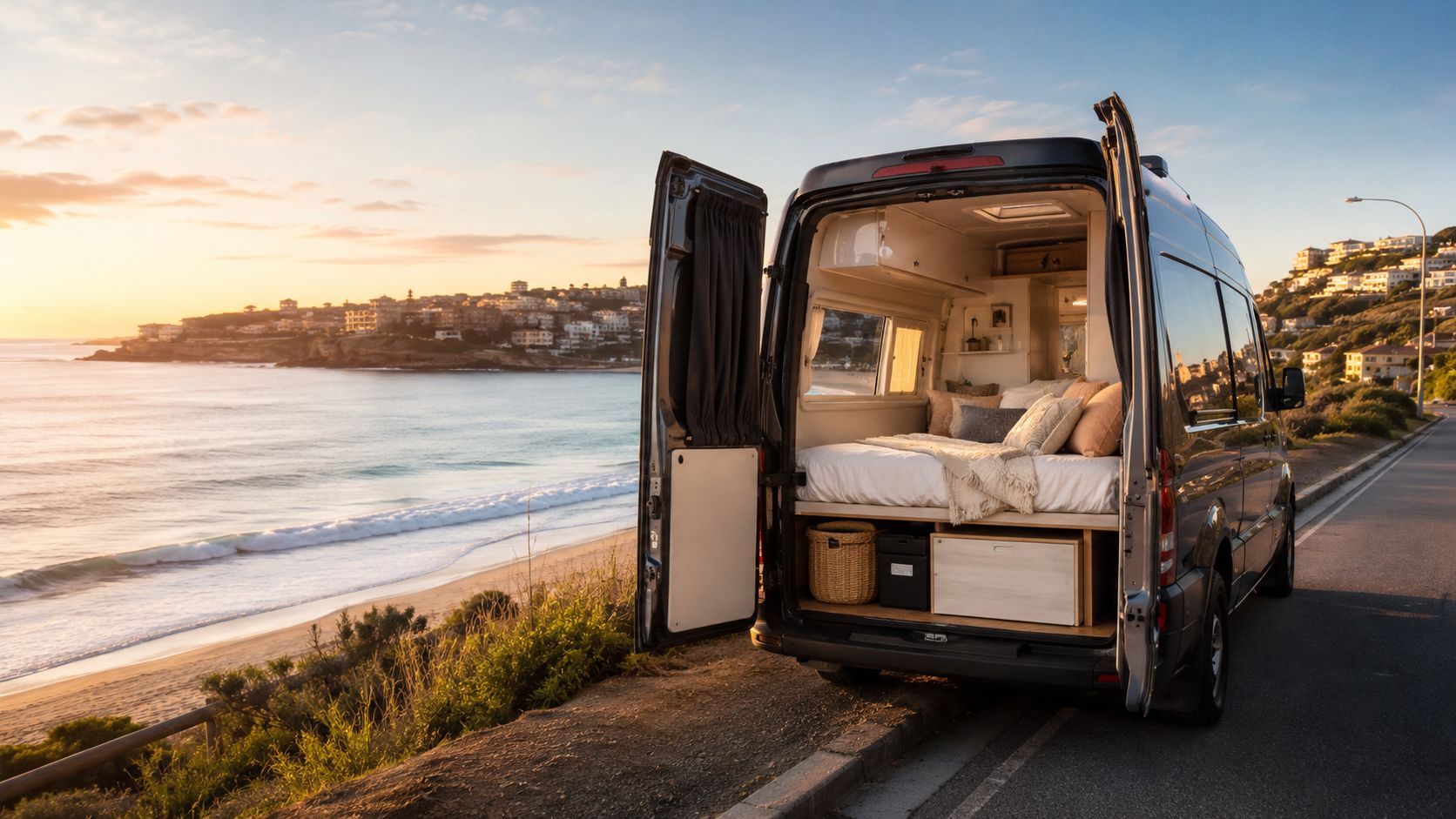
The broader market gives buyers real momentum too. Australia reached 97,701 registered campervans in 2024, up 3% from 94,811 in 2023 and 40.1% above the earlier benchmark cited by Camper Champ, according to Camper Champ's campervan ownership data. In plain English, that means more used stock, more resale movement, and a market that feels established rather than fringe.
Why that matters when you're shopping in Sydney
When a market grows to that scale, Sydney buyers benefit in a few different ways:
- More choice: You're less likely to be stuck choosing between one overpriced van and one obvious basket case.
- Clearer price context: With more stock in circulation, you can compare layouts, ages, sizes, and conversion quality more sensibly.
- Better resale confidence: If you buy carefully, there's comfort in knowing you're entering an active category rather than a forgotten niche.
Practical rule: Buy the van that suits the life you'll actually live, not the fantasy version of yourself who somehow has infinite storage, patience, and mechanical luck.
For VW tragics, that advice bites a bit. We all love a classic silhouette. A bay window Kombi can make a dull driveway feel like Byron in the seventies. But the Sydney buyer usually needs two thoughts in the same head. One is joy. The other is whether the thing fits under the apartment car park and starts on a wet Tuesday.
That tension is part of the fun. You're not killing the dream by being practical. You're giving it a fighting chance.
Where to Find Your Dream Campervan in Sydney
Saturday morning in Tempe, a bloke rolls up in a sun-faded T3 with curtains his partner sewed in 2011. By ten o'clock, three people have asked if he'd ever sell it. That is how a lot of the good Sydney vans move. Not with flashy ad copy, but through conversations, club circles, saved searches, and someone who was ready to ring first.
That is why the hunt matters almost as much as the purchase. Sydney gives you a strange, wonderful spread of options. One week you'll see a tidy ex-rental with every cupboard square and sensible. The next, a Bay Window with original handles, a hand-built fit-out, and a folder full of old receipts from road trips up the coast. One appeals to the head. The other gets under your skin.
Start wide, then get fussy
Early on, you are not choosing a van. You are learning what honest stock looks like in this city.
Spend a bit of time across the main classifieds, dealer stock, owners' groups, and enthusiast pages. Watch how sellers describe rust, mileage, conversion work, and registration. Notice which ads show the underside, which ones only show sunsets and cushions, and which owners can tell you exactly when the fuel lines were last done. After a week or two, the blurry shape of the market sharpens. You stop falling for pretty photos and start spotting care.
Sydney is especially good for this because the market mixes practical late-model campers with older character vans that still get used. That gives you a proper spread to compare. If you are chasing classic style and trying to work out what pulls at your heart before you inspect anything in person, browsing these VW campervans for sale can help you pin down whether you are really a split-screen romantic, a Bay Window dreamer, or a T3 realist.
Know where the good vans actually appear
Each channel has its own personality, and each suits a different kind of buyer.
| Channel | What you'll find | Best use |
|---|---|---|
| Major classifieds | Private sales, dealer stock, fresh market pricing | Compare asking prices, layouts, and condition notes |
| Specialist dealers | Prepared stock, trade-ins, newer conversions | Good if you want a quicker, tidier transaction |
| VW groups and forums | Kombis, T3s, enthusiast-owned campers | Best place to find history, upgrades, and owner knowledge |
| Word of mouth | Quiet sales before public listing | Strong chance of a straight story and less polished selling |
Private sellers often tell you the useful stuff without much prompting. They will mention the pop-top seal that needs doing, the second battery setup they fitted before a lap to Jervis Bay, or the awkward cupboard latch everyone in the family learned to jiggle just right. Those details matter. They tell you the van has been lived with, not just listed.
Dealer stock suits a different buyer. If you want paperwork in order, a cleaner handover, and a shorter path from viewing to driveway, a dealer can make sense. You will usually pay for that convenience, but some buyers are happy to do that if they want fewer loose ends.
The VW community sits in a category of its own. A classic bus sold inside enthusiast circles often comes with a known story, a familiar workshop name on the invoices, and an owner who can talk for twenty minutes about cylinder head temps without once checking their phone. I trust that sort of seller more than the one with perfect photos and vague answers.
The strongest listing is usually the one with plain photos, service records, clear flaws, and a seller who answers awkward questions plainly.
A search routine that keeps the dream intact
Here's the method I'd use if a mate asked me to help hunt one down.
- Write your real-world requirements first. Berths, transmission, parking height, storage, and whether you will use it around Sydney.
- Save every decent listing straight away. Good vans do not wait for long internal debates.
- Ring before you drive across town. Ask why they are selling, how long they have owned it, who did the conversion, and what currently does not work.
- Request specific photos and video. Cold start, engine bay, underside, roof gutters, door shuts, and any repair areas on older vans.
- Keep a short shortlist. Compare five solid options properly instead of half-falling in love with twenty.
One more tip from years of staring at Kombis in car parks. If a seller knows the van well, the conversation has texture. They remember the little repair in Newcastle, the water pump replacement before Easter, the way the side tent fits better if you reverse onto a slight angle. If every answer sounds borrowed from the ad, keep looking.
Finding your dream campervan in Sydney is part detective work, part restraint, part old-fashioned luck. Get the search right and you give yourself a much better chance of ending up with a van that feels like freedom, not a very expensive lesson.
The All-Important Inspection Guide
You arrive, the seller is friendly, the van's been washed, and there's a cushion arranged just so near the rear doors. Lovely. Now switch off the love story and inspect the machine.
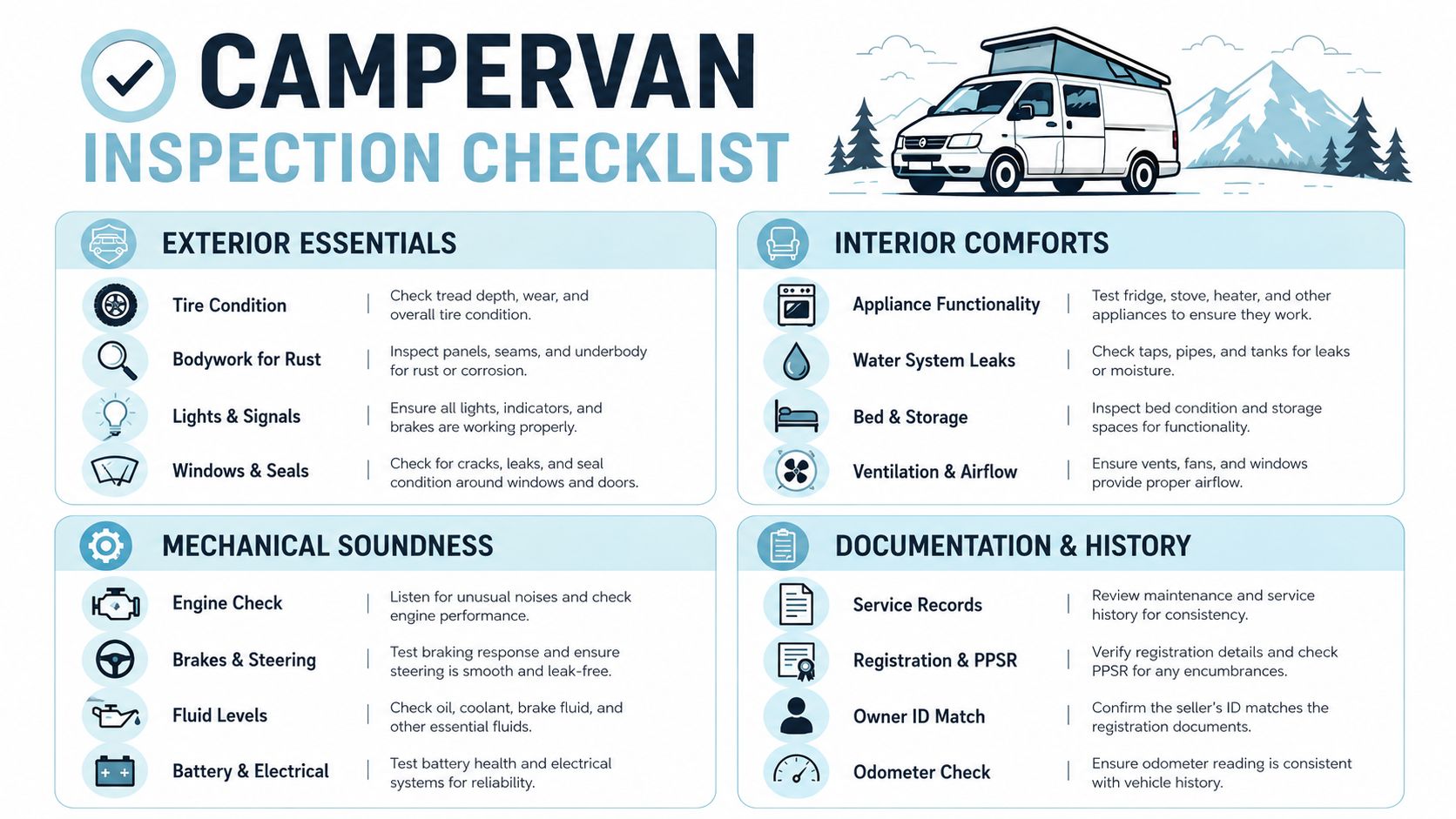
Sydney listings can help you benchmark practicality because some include full dimensions and odometer readings. Apollo RV Super Centre shows examples with data such as 6,967 mm in length and 174,312 km, which is exactly the kind of detail buyers should use when checking city usability and likely wear, as seen on Apollo's Sydney campervan inventory.
Mechanicals first and sentiment second
Start with the bits that make it move and stop.
Listen to the engine from cold. Not warm. A warm engine can hide rough starts, smoke, rattles, or battery weakness. On a test drive, pay attention to gearbox feel, brake response, steering play, and how the van tracks on an ordinary road without constant correction. A camper should feel honest, not heroic.
For a classic VW, don't expect modern-car refinement. Expect character. But there's a line between character and trouble. You want an old bus that feels sorted, not one that feels like every journey is a negotiation.
Quick mechanical checklist
- Engine behaviour: Cold start, idle stability, unusual smoke, obvious leaks.
- Transmission: Smooth changes, no crunching, no hesitation.
- Brakes and steering: Straight braking, predictable pedal feel, no wandering.
- Tyres and suspension: Even tyre wear, no clunks, no sagging corners.
If you want a companion checklist before heading out to inspect, this Volkswagen bus camper car inspection guide is a handy way to organise your thoughts.
Rust is where old dreams go to die
Classic camper buyers know this one already. Rust doesn't care how charming the curtains are.
On older vans, especially Kombis, look hard at sills, wheel arches, gutters, door bottoms, floors, battery trays, and window surrounds. Fresh paint can hide a multitude of sins. Bring a torch. Get low. Open everything. If the seller rushes you away from a particular corner, linger there.
A shiny exterior can be the cheapest part of a bad restoration.
Modern vans can rust too, just in less cinematic ways. Check under seals, around seams, under the floor, and anywhere water might have sat unnoticed. If the van smells damp inside, treat that as a clue, not an ambience choice.
The camper fit-out has to work as a system
A campervan isn't just a vehicle. It's a little house bouncing down the road. That means the conversion matters every bit as much as the chassis.
Turn everything on. Fridge, lights, water pump, cooktop, charging points, fans, pop-top latches, windows, blinds, the lot. Look for signs of DIY wiring, tired seals, water staining, and cupboards pulling away from mounting points. Poor workmanship often shows up in small details long before it becomes a roadside headache.
Here's how I view it:
| Area | What to check | Why it matters |
||—|—|
| Electricals | Battery setup, charging, switches, lights | Safety and off-grid usability |
| Water system | Pump, taps, leaks, tank smell | Hidden leaks can become expensive |
| Gas or cooking setup | Certification, condition, operation | Safety first |
| Pop-top or roof | Canvas, seals, hinges, latches | Weatherproofing and structural peace of mind |
A modern example shows how factory-built campers appeal to buyers who want fewer conversion unknowns. The 2025 LDV Deliver 9 Campervan is listed from A$89,990 drive-away with a self-contained setup including a 96-litre fridge with 20-litre freezer, microwave, toilet, induction cooktop, diesel hot-water system, double bed, and two showers, plus a 3-year/160,000 km warranty on the vehicle and separate cover for furniture and electricals, according to Carsales' report on the LDV Deliver 9 Campervan.
That doesn't mean factory-built is automatically better. It means you should know whether you're buying a known package or someone's one-off vision. One can be charming. The other can be clearer to maintain.
Navigating NSW Registration and Insurance
The paperwork side feels dull right up until it saves you from a bad buy. Then it suddenly becomes beautiful.
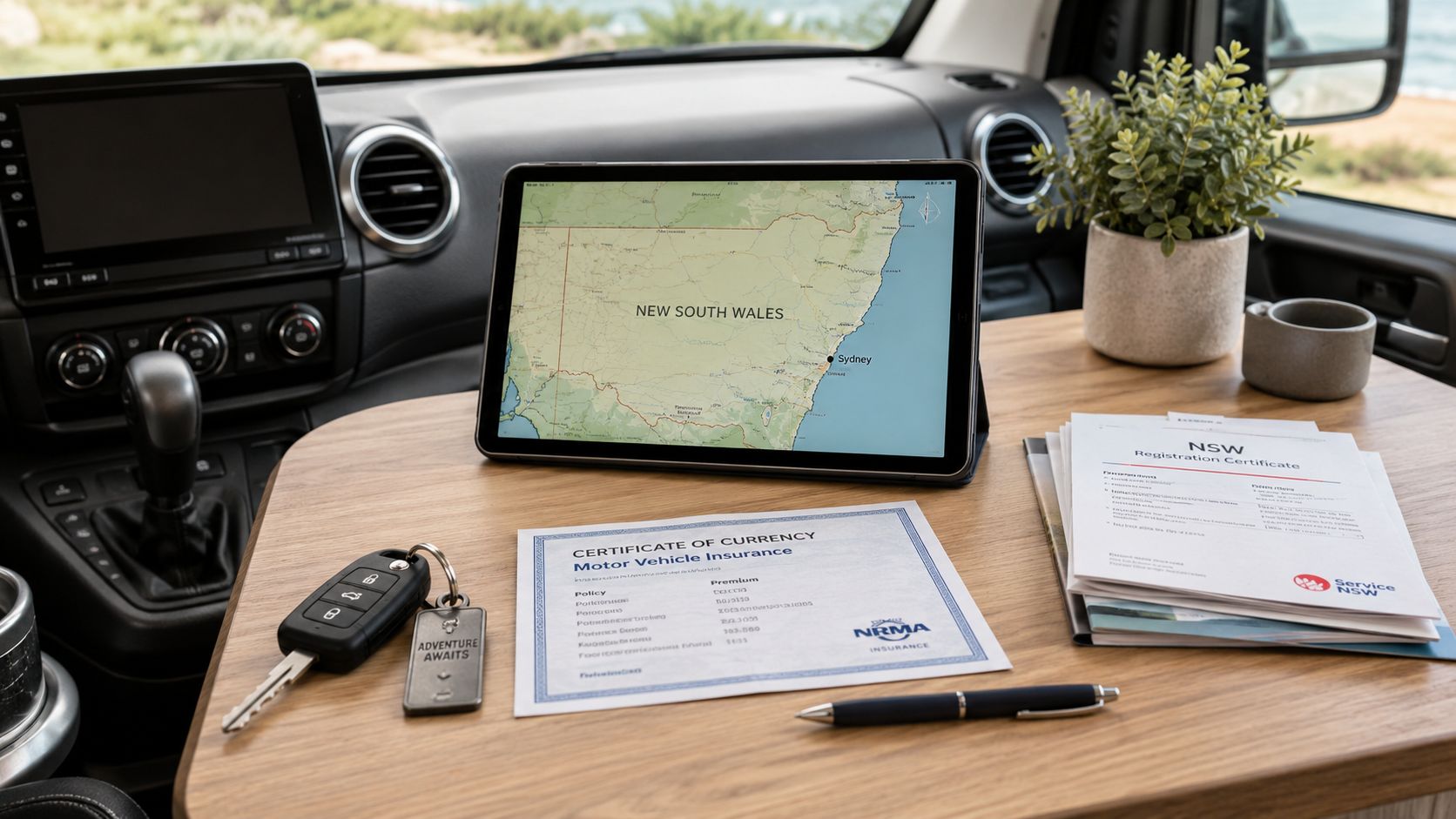
Sydney buyers, especially inner-city ones, have another layer to think about beyond forms and slips. A lot of campervan content talks about beaches and bush camps, but not enough talks about apartment parking, suburban street parking, height restrictions, or dealing with daily traffic. That gap is noted in Travelwheels' Sydney used campervan page, and it matters because legal ownership is only half the battle if the van doesn't suit your real life.
The NSW basics in plain English
You'll hear people talk about Blue Slips, Pink Slips, Green Slips, and for first-timers it sounds like a weird stationery problem.
A Pink Slip is the regular safety inspection many vehicles need for renewal. A Blue Slip is generally for vehicles with lapsed registration, interstate transfers, or situations where identity and roadworthiness need a more formal check. A Green Slip is your CTP insurance, which you need before registration can be completed.
When buying, don't just ask “is it registered?” Ask what happens next if you take ownership. Confirm what paperwork comes with the van, whether registration is current, and whether anything about the camper conversion could complicate the process.
Practical suitability matters as much as legality
Sydney itself can catch people out. A van that feels perfectly sensible in a seller's driveway can become awkward when you bring it home.
Ask yourself:
- Where will it live: Street, apartment parking, shared garage, secure storage?
- Can it clear height limits: Shopping centre car parks and some residential entries can be unforgiving.
- Will you commute in it: Some buyers do. Some swear they will, then stop after a week.
- Can you insure it properly: Especially if it's a classic, a conversion, or carries fitted gear and contents.
A short explainer can help if you want a visual walkthrough before diving into the admin side.
Don't separate registration from lifestyle. In Sydney, the van has to be legal, insurable, and practical on an ordinary Wednesday.
For insurance, many buyers start with the bare minimum and regret it later. CTP gets you on the books, but it won't cover the sort of loss that really hurts. Theft, storm damage, collision damage, and the value of fitted camper components are all worth discussing with an insurer before you hand over money.
Budgeting for Your Van Adventure
A mate of mine bought a Kombi in Marrickville for what felt like a bargain. By the second weekend, he was parked at Palm Beach with the kettle on, grinning like he'd won the lottery. By the fourth weekend, he'd paid for a battery, two tyres, a stubborn water pump, and a rubber seal that let rain creep into the rear cupboards. He still loved the van. He just wished he'd budgeted for the van he owned, not the van he thought he was buying.
That is how Sydney campervan buying usually goes. The sticker price gets all the attention. Your first year of ownership decides whether the dream feels light and free or a bit tighter than it should.
Sydney's market stretches from basic older campers at the lower end to polished late-model motorhomes with a much fatter price tag. As noted earlier, dealer listings across the city show a wide spread. That spread matters because one search for “campervan for sale in Sydney” can hide three very different stories. A simple weekender. A family tourer. A rolling project that will ask for time, money, and patience before it asks for miles.
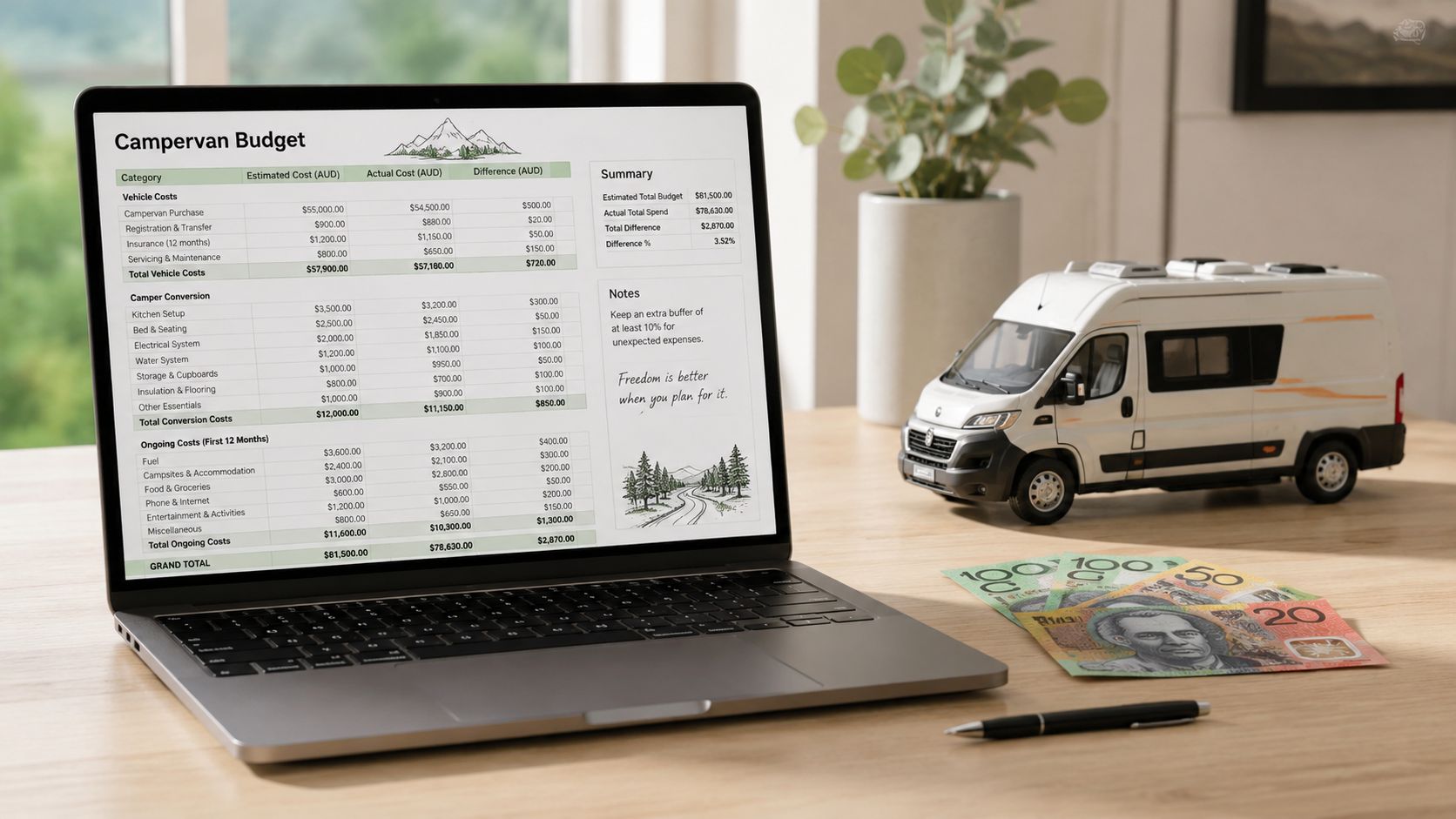
The most important budget is the one for the first year of ownership
Old vans have character. Character has invoices.
A classic camper or older conversion can look affordable on the listing, then ask for money in all the quiet places. Hoses. Brake work. Canvas repairs. Fridge checks. House battery replacement. A proper service so you know where you stand. Broader used camper listings on Caravan Camping Sales campervan category pages show how often buyers compare vehicles that look similar in photos but sit in very different states of readiness.
Use a budget with layers, not one grand total.
| Budget layer | What it includes |
|---|---|
| Buy-in cost | Purchase price and immediate transfer costs |
| Catch-up cost | Servicing, repairs, tyres, batteries, and fixes needed before a proper trip |
| Setup cost | Bedding, kitchen gear, hoses, cables, storage tubs, and the small bits you always forget |
| Protection cost | Insurance, basic security gear, and a little reserve for early surprises |
That middle section catches people out. A cheap van can swallow cash if it needs mechanical sorting, electrical work, leak tracing, or a refresh before the first night away. A more expensive van can be the better buy if the service history is tidy, the camper gear works, and the seller can show what has already been done.
Negotiation gets easier when your numbers are written down
At a Saturday inspection in Tempe, I once watched a buyer poke around a van for ten minutes, then throw out a random low offer. The seller shut down straight away. An hour later, another buyer turned up with notes. Front tyres ageing out. Pop-top canvas stitching tired. Leisure battery old. Service gap. His offer was calm, specific, and easy to follow. He drove home in the van.
That is the move.
Before you make an offer, price the obvious jobs. Ring a tyre shop. Ask your mechanic what a baseline service might cost. Check what a new battery setup or canvas repair usually runs. Then present your offer like someone who plans to care for the van, not flip it.
A simple approach works well:
- Start with what is genuinely good. Sellers can tell when you have looked properly.
- List the work you will need to pay for. Keep it factual and brief.
- Make one clean offer. No theatre, no “mate's rates” routine.
- Leave room to walk away. Another van will come along.
If you are still torn between buying a finished camper and starting with a blank van, this guide to choosing the right van for conversion can help you weigh the money against the dream.
Keep a first-month reserve
This is old-camper truth.
The first month often reveals the little jobs the ad never mentioned. A latch gives up. The sink pump sulks. A battery that seemed fine on inspection turns lazy after one cold night. You find a slow leak only after proper Sydney rain.
None of that means you bought badly. It means a campervan is a vehicle and a tiny home sharing the same body, and both parts need attention.
For enthusiasts keeping the dream alive while saving for the right full-size van, some owners also enjoy collecting garage pieces and scale models. Volkswagen Memorabilia's shop carries VW-themed diecast and décor rather than vehicles.
Buy with your heart, yes. Just bring a spreadsheet with it.
You Have the Keys What Happens Next?
The first drive home is magic. Even if traffic is ordinary and the weather's a bit average, the van feels different because it's yours. You'll park it, stand back, and stare at it longer than necessary. Completely normal behaviour.
Then real ownership begins.
Sort your support crew early
Find your mechanic before you need one. If you've bought a modern camper, a good workshop with experience on the base vehicle is a strong start. If you've bought a classic VW, find someone who understands these old buses properly. That relationship is worth its weight in gold because old Volkswagens reward care and punish guesswork.
Storage comes next. Sydney can be awkward for vans, especially if you've bought something tall, long, or wider than your daily driver habits are ready for. Some owners manage with home parking, others use secure storage, and plenty end up somewhere in between depending on the season and how often they travel.
Make it yours without wrecking its usefulness
The sweet spot is personal without being silly.
Add what improves trips first. Good bedding, thoughtful storage, simple cooking gear, decent lighting, maybe an awning if it suits the van. Leave the Instagram fantasy fit-out for later. You'll learn more from two weekends away than from twenty saved posts.
For buyers still balancing old-school VW romance against practicality, this van for conversion guide is a useful place to browse ideas and compare what kind of base vehicle suits your plans.
The right campervan doesn't just take you places. It changes the way you leave, arrive, and remember.
That's the part people rarely explain well enough. A campervan alters the texture of travel. Morning tea tastes better. Rain on the roof becomes a feature instead of a nuisance. Even a fuel stop somewhere forgettable can feel like part of the story when your own bed is waiting in the back.
And if your heart still skips a beat for the old VW shape, welcome. Plenty of us never quite recover from that.
If that classic Volkswagen spirit is part of why you're chasing life on four wheels, have a look at Volkswagen Memorabilia. The shop carries VW-themed diecast models, Kombi-inspired gifts, and coastal-style pieces that suit a garage, office, display shelf, or gift table nicely, with local Australian stock available for fast shipping.