

You're parked up with the fridge humming, the camp kettle on, and one Anderson feed already spoken for. Then the question lands, can you run a second device off the same plug without turning the whole setup into a headache? That's where an Anderson plug double adaptor earns its keep, or exposes a weak point you didn't know was there.
The appeal is obvious. One tidy lead, two outputs, less mucking around at the tow bar or in the van. The catch is that a Y-splitter is still just a passive split, so what looks simple on the outside can get messy fast once current, cable size, and charging behaviour all start doing their thing.
What an Anderson Plug Double Adaptor Actually Does
A bloke rocks up to camp, plugs the fridge into the tow vehicle, then realises the solar blanket or auxiliary charger still needs a home. That's exactly the sort of moment where an Anderson plug double adaptor makes sense. It takes one Anderson-style input and splits it into two outputs, so you can feed two accessories from a single 12V source without rewiring the vehicle on the spot.
The old Anderson family has proper backbone behind it. Anderson Power Products introduced the original Storage Battery Connector in 1953 for forklift batteries, and the SB connector line has stayed largely unchanged while becoming the base of modern DC power distribution connectors. That heritage matters in Australian 12V work because the same rugged, high-current design language now shows up across caravans, 4WDs, marine gear, and solar rigs. Anderson connector history and SB family background
Why the physical design works so well
The connector is genderless, so there's no fumbling around for a male or female end in the dirt. It's also polarity protected, which helps stop simple connection mistakes when you're half a metre from a muddy wheel arch and trying to get dinner sorted.
A good double adaptor usually uses a short lead and compact split. That keeps resistance down and stops the adaptor from becoming a long, lossy extension lead. In practice, that short construction is the whole point, it's meant to bridge a feed cleanly, not become a permanent spaghetti monster hanging off the back of the van.
Practical rule: if the adaptor is doing more than splitting one feed into two short runs, you're probably asking too much of it.
A double adaptor is best understood as a tidy bit of hardware for a simple job. It's not a smart controller, it's not a distribution hub, and it won't sort out bad load planning for you.
Common Types and Ratings for Australian Setups
In Aussie 12V gear, the 50A SB50 class is a common starting point. It suits plenty of caravan, camping, and dual-battery work because it sits in that practical middle ground where the hardware is common, tough enough for real use, and easy to source. CTALS puts the common SB50 / 50A family in the 12 to 6 AWG range, which is roughly 5.3 to 13.3 mm², so the connector size and the cable size still need to match the job. CTALS Anderson plug size guide
For a typical Australian 50A Anderson-style double adaptor, you'll often see 300 mm lead lengths and cable around 6 mm² / 8 AWG-class. That shorter split is deliberate, because it helps keep resistance down and stops the adaptor from turning into a lazy little bottleneck when it is feeding fridges, lighting, or solar loads. Typical AU twin-Anderson adaptor listing details
Anderson Plug Series and Ratings Overview
| Connector Series | Amp Rating | Wire Range (AWG) | Common Use Case |
|---|---|---|---|
| SBS Mini | 15 to 45A | Varies by series guidance | Smaller DC accessories and lighter mobile use |
| SB50 | 50A | 12 to 6 AWG | Caravans, fridges, solar inputs, dual-battery links |
| SB120 | 120A | Larger conductors than SB50 | Heavier auxiliary power and charging runs |
| SB175 | 175A | Heavy industrial and high-current cable | Serious battery and power distribution work |
| SB350 | 350A | Very large cable runs | Major DC power distribution systems |
Anderson connectors are built around the AWG system, even though Australian installers usually think in mm². CTALS places the common SB50 / 50A in the 12 to 6 AWG range, about 5.3 to 13.3 mm², and also shows the broader family from SBS Mini 15 to 45A up to SB350 350A. That matters because the adaptor only makes sense when the connector series, cable size, and intended current all line up cleanly. A neat example is a slimline lithium battery 200 Ah, where the charging demand and cable run need a bit more respect than a small weekend setup.
A lot of twin adaptors look similar at the plug, but the difference is buried in the cable and the way the load is shared. A short SB50 lead can suit a fridge and a light load without drama, yet the same basic format can become the weak point if the cable is undersized for the current being asked of it.
The Hidden Risks of Splitting One Feed Into Two
A double adaptor looks innocent, but the electrical behaviour is where the sharp edges live. The big rule is simple, the combined load must stay within the adaptor's rating. For many Australian twin-split leads, that means 50A combined, not 50A on each side. One AU product page says it plainly, “DO NOT Connect 2 Appliances that draw more than 50Amp Combined”, and “NEVER connect to an Unfused or Unprotected Circuits.” Another seller says the same thing in slightly different words, “Never connect appliances that will draw more than 50 amps by itself or combined at the same time on this adaptor.” Epic Store safety wording and Sinister Offroad 50A double adaptor listing
Why two loads can clash
The problem isn't just total current. It's what happens when two devices try to behave as if they own the feed. AU forum and guide content points out that one solar panel or one Anderson feed can't reliably charge two separate batteries at the same time, and two controllers can fight each other. That's the kind of behaviour people only notice after the system starts acting odd, with charging that seems to hunt, stall, or never settle properly. Caravaners Forum discussion on split charging limits
Back-feeding is the other gremlin. If one connected device has a higher internal voltage or a different control strategy, current can flow in a direction the owner didn't expect. That can make one appliance behave strangely, or it can stress parts of the circuit that were never meant to share duties in the first place.
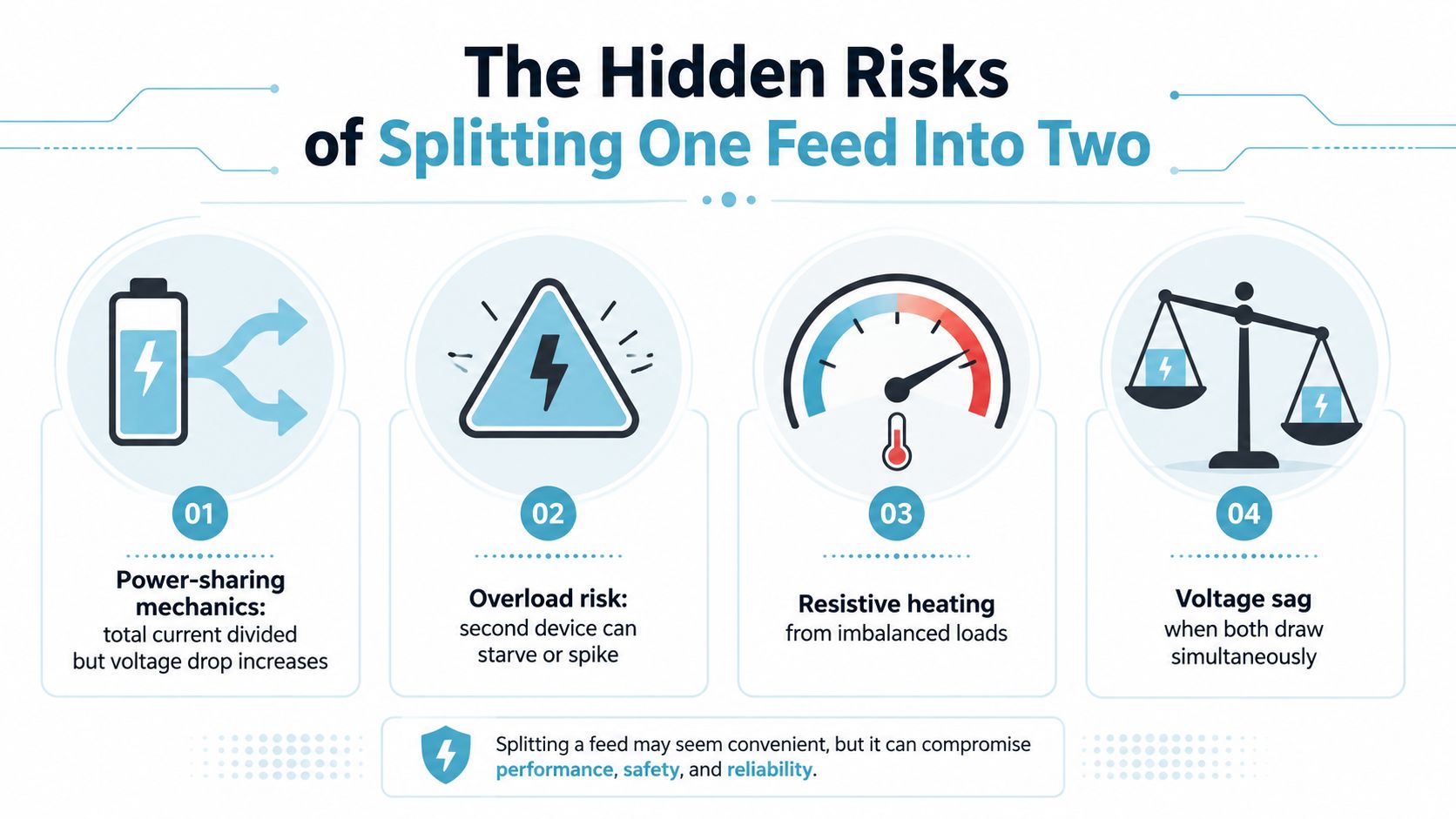
The key thing to remember is that a double adaptor is not a smart distribution hub. It doesn't balance current, prioritise loads, or isolate two batteries from each other. It just joins them at one point, and that's fine when the loads are modest and simple, but it's a pain when the setup needs proper control.
If the two devices expect to regulate power for themselves, don't assume a passive splitter will behave politely in the middle.
Wiring Safely and Getting the Termination Right
A lot of double adaptor trouble starts before the first crimp is made. If the cable is too light for the job, the run heats up, voltage sags, and the whole setup works harder than it should. With an Anderson plug double adaptor, the connector rating matters, but the cable size and the actual load matter just as much.
There is also a physical limit inside the connector body. In practice, some cable sizes do not sit right in certain Anderson-style contacts, so the adaptor is not a free pass to use whatever wire is lying around in the shed. That matters once you start building out real touring systems, especially when a van fit out utility systems setup needs clean cable runs and sensible load planning.
What good termination looks like
A proper termination starts with the right contact, the right die, and a clean crimp. The conductor needs to be fully seated, the insulation supported, and the finished joint tight enough to stay sound under vibration. In tow vehicles and caravans, poor terminations show up fast once the corrugations and heat start working on the wiring.
Practical rule: if the crimp looks crushed, loose, or lopsided, redo it before it ever sees the road.
The safety basics still apply. Do not connect a double adaptor to an unfused or unprotected circuit, and do not assume one branch fuse protects the other branch automatically. The adaptor should sit inside a system that already has proper protection, not act as the only barrier between the gear and a fault.
A clean build is easier to trust when the whole system is laid out with protection and cable choice in mind, the same way a proper van fit out utility systems setup treats the wiring as part of the job, not an afterthought.
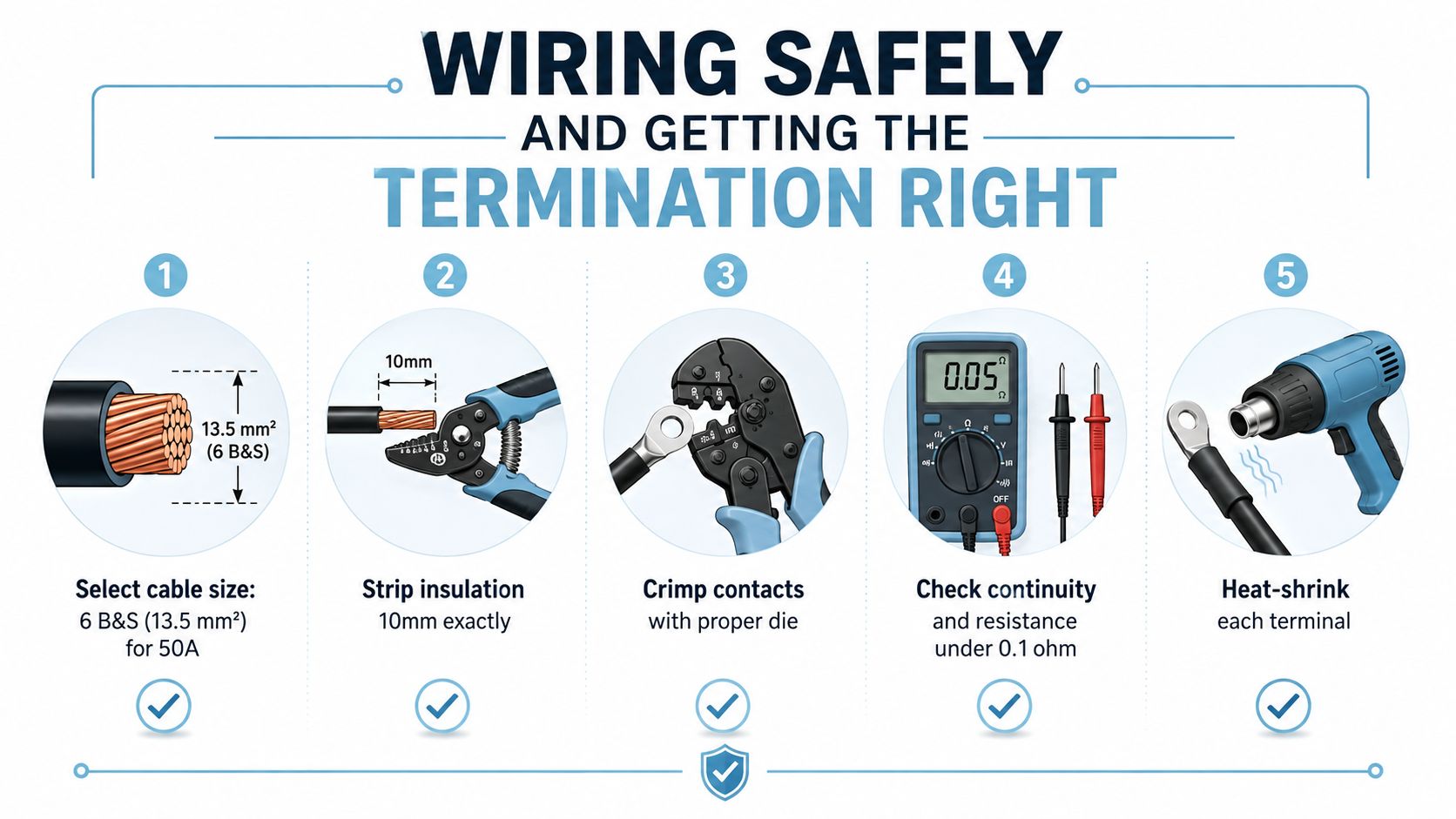
A quick field checklist helps keep it honest:
- Match the connector to the load: A 50A adaptor is still only a 50A adaptor.
- Use the right conductor size: Pick cable that suits both the current and the connector body.
- Inspect the crimp: A proper termination beats a rushed one every time.
- Protect the circuit: Fuse the feed correctly and keep protection close to the source.
- Check for heat: Warm termination points are a warning, not a character trait.
When a Double Adaptor Is Not the Right Solution
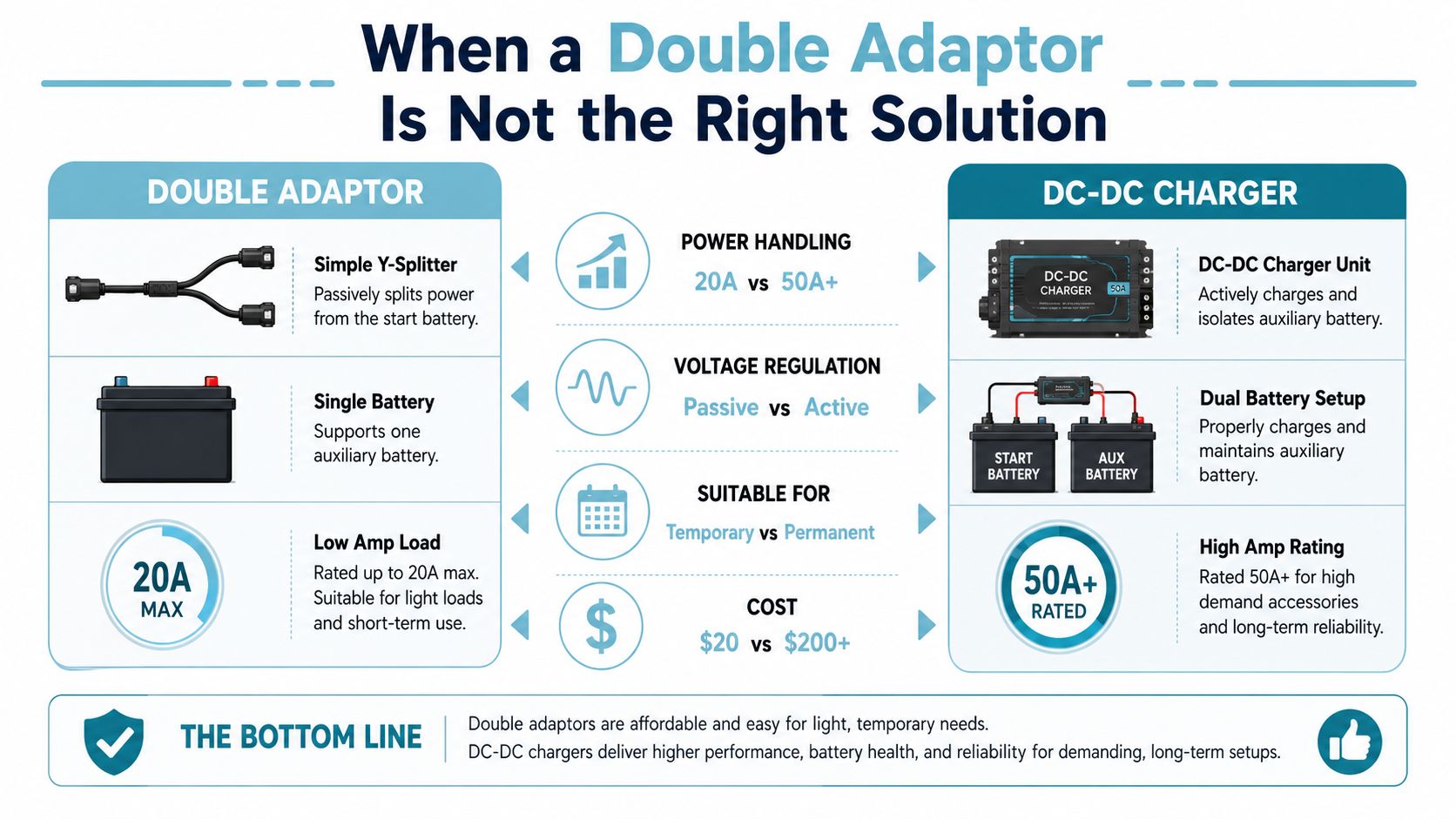
A Y-splitter is handy for temporary or light-duty use, but it stops being the right answer once the system needs independence. If you're trying to charge two separate batteries at once, or run two serious appliances from one feed, the passive split becomes the weak link. That's where a DC-DC charger, a fuse block, or a proper distribution hub starts making more sense.
The difference is control. A DC-DC charger actively manages battery charging, which is a very different job from just sharing a feed. A fuse block gives each output its own protection, which is exactly what you want when multiple accessories need to live on one supply without interfering with each other. A distribution hub does the same broader job in a more organised way, especially in caravan and touring setups.
When the splitter makes sense
Use the adaptor when the loads are modest, temporary, and clearly within the rating. That might be a fridge plus a light accessory, or a simple camp setup where one feed needs to branch without a permanent install.
When to step up
Move to a proper charging or distribution solution when the job needs:
- Independent control: Each battery or accessory needs to behave on its own.
- Better protection: Every branch deserves its own fuse and fault path.
- Higher confidence: The system is permanent, hot, vibration-prone, or expensive to repair.
- Less guesswork: You want predictable charging rather than hoping the split behaves nicely.
One practical reason people step up is cable and termination pressure. Existing how-to content also shows the same thing from another angle: the question isn't only how to crimp it, it's what cable size, contact type, and connector series keep the adaptor from becoming the bottleneck. Once the build starts pushing beyond a simple split, the sensible move is a dedicated system, not a bigger Y-lead.
Buying Smart and Maintaining Your Adaptor
A quality adaptor starts with genuine Anderson-style contacts, properly rated cable, and a lead length that suits the job. If the cable feels skinny for the rating, or the terminations look rough, walk away. Australian suppliers that stock locally are handy here because the right part shows up faster, and you've got a better chance of getting sensible support if the fit or rating doesn't match the setup.
The basic maintenance routine is simple but easy to ignore. Check for loose connectors, warmth at the terminations, damaged insulation, and any sign that the lead is being bent hard at the plug body. If the jacket is cracked or the contacts are bent, replace the lead rather than nursing it along.
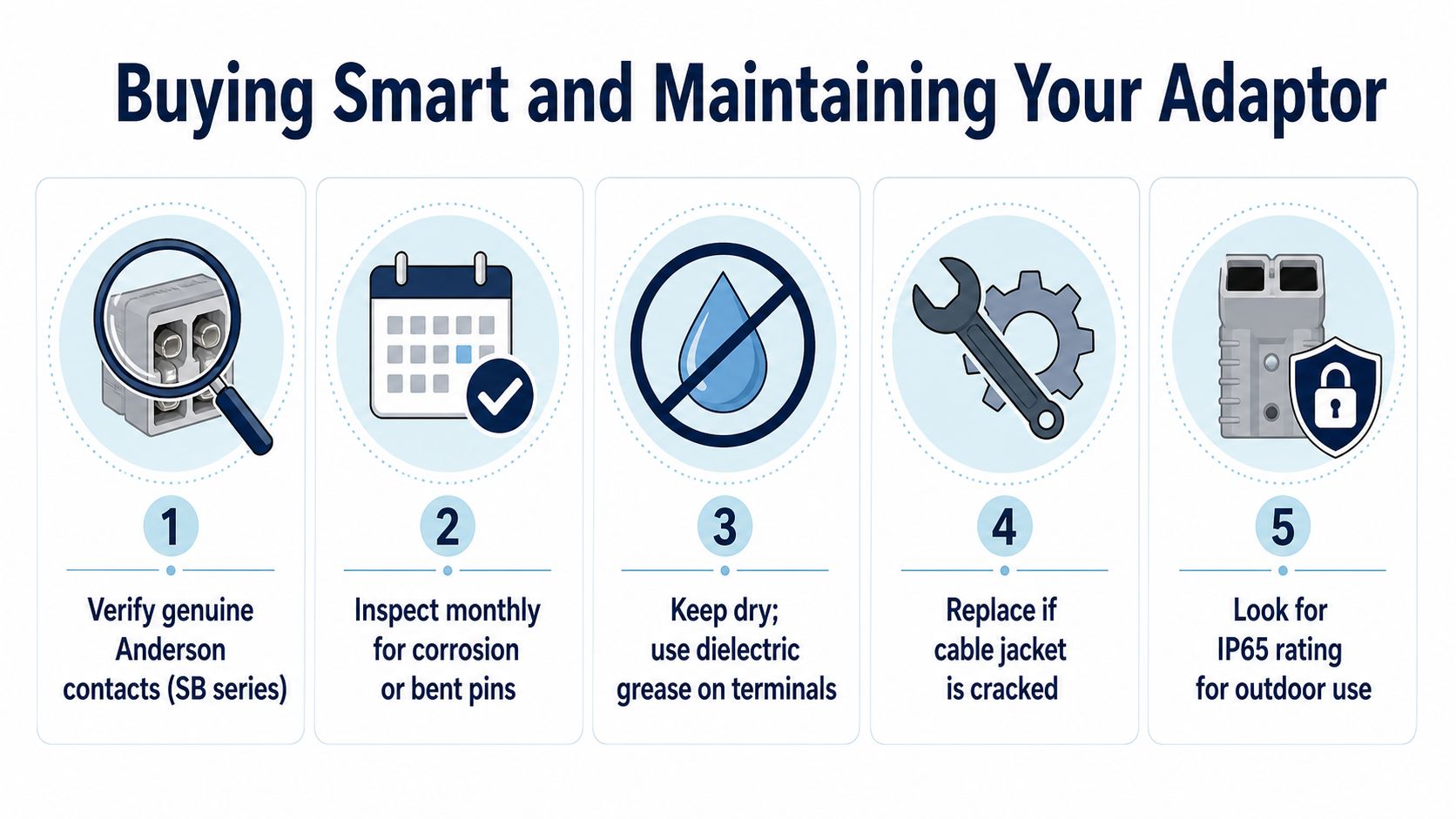
A practical upkeep checklist
- Verify the contacts: Make sure you've got genuine SB-series style hardware, not vague lookalikes.
- Inspect regularly: Look for corrosion, heat marks, or bent pins.
- Keep it dry: Moisture is the enemy, and a small amount of suitable dielectric grease can help protect terminals.
- Watch the cable jacket: Cracks or stiff sections are a sign the lead's been abused.
- Check the fuse: If the protection's blown or suspect, fix the cause before you plug in again.
If a connector starts running hot, the first suspects are nearly always the same, poor crimping, undersized cable, or a load that's too heavy for the adaptor. That's why good buying decisions and simple maintenance go hand in hand.
Hit the Road with Confidence
A well-planned 12V setup makes the trip easier. Match the cable to the connector, respect the combined load limit, fuse the circuit properly, and don't ask a passive splitter to do the job of a proper charging system. Get those basics right and your fridge, lights, and camp gear are a lot less likely to become an expensive lesson. If you've got a favourite touring or VW-inspired setup, share it with the community and keep the practical knowledge rolling. For gear that suits the lifestyle, have a look at the 12 volt air conditioner options and then browse the rest of the collection for pieces that celebrate the same road-trip spirit.
Volkswagen Memorabilia brings together VW-themed gifts, diecast models, and coastal décor that fit right alongside the kind of Aussie road trip life that starts with a Kombi dream and ends at a beach camp. If you're building a collection or hunting a gift that feels properly nostalgic, visit Volkswagen Memorabilia and explore the pieces that keep classic Volkswagen memories alive.