

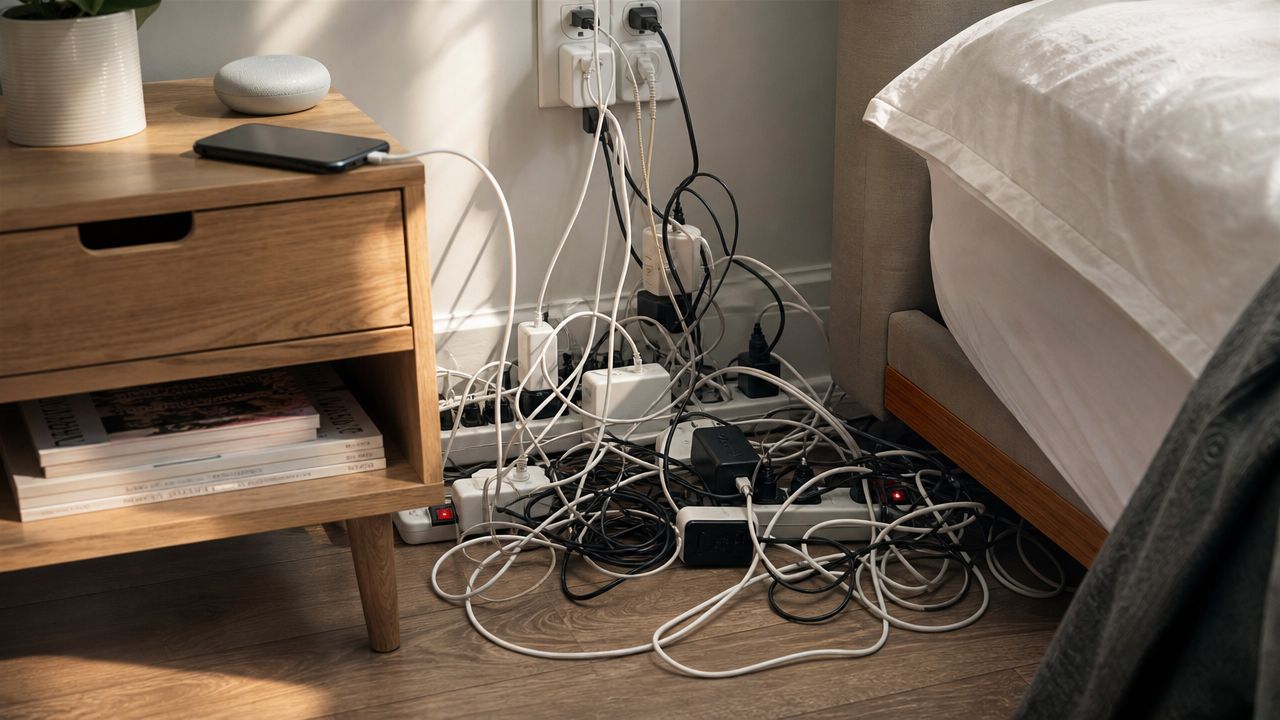
You know the spot. One corner of the kitchen bench, the bedside table, maybe the little shelf near the front door. There's a power board on the floor, two chunky phone chargers hogging the outlets, a tablet cable twisted around a smartwatch lead, and someone's borrowed adapter has gone walkabout again.
That mess is why more homeowners are asking about sockets with USB. Not because they want a flashy gadget, but because they want less clutter, fewer plug packs, and a cleaner way to charge the devices they use every day. It's a small upgrade, but in the right room it can make the house feel far more organised.
In Australia, that choice comes with an extra layer often overlooked straight away. It's not just about whether the socket looks neat or charges your phone. It's about whether the unit is suitable for Australian installation, whether it complies with the right standards, and whether the product is the sort of thing a licensed electrician would be happy to fit in their own home.
Tired of the Great Wall of Chargers
A lot of homes end up with the same workaround. One double power point. Then a power board. Then a tangle of adapters multiplying like rabbits.
By the time everyone's charging a phone, earbuds, a tablet, and maybe a handheld game console, the whole setup starts to feel clumsy. You unplug one thing to plug in another. The toaster loses its spot. The lamp gets moved. Cables slip behind furniture and collect dust.
That's where integrated USB wall sockets start to make sense. They combine the normal power outlet you already use with built-in charging ports for low-voltage devices, so you can charge your phone or tablet without sacrificing a standard outlet to a plug pack.
Why people are switching
The appeal is mostly practical.
- Less bench clutter means fewer bulky adapters sticking out of the wall.
- More usable outlets means your regular appliances still have a place to plug in.
- Cleaner everyday charging feels tidier in bedrooms, kitchens, and study nooks.
Australian buyers are clearly leaning this way. Over 70% of residents in the AU region prefer direct charging via built-in USB outlets over traditional adapters, according to USB socket outlet market data for the AU region.
A USB socket won't solve every charging problem, but it does solve one common one very neatly. Too many adapters, not enough room.
It's the kind of upgrade people often appreciate most after it's installed. Not exciting in the way a new kitchen is exciting. More like finally fixing that annoying rattle in your Kombi. Small change. Better daily life.
What Exactly Are Sockets with USB
A USB wall socket is a hybrid power point that combines the standard 230V AC outlet you already know with built-in USB charging ports on the same faceplate.
In plain terms, one part runs your everyday appliances. The other part converts mains power down to the low-voltage DC power that phones, earbuds, tablets, and similar devices need for charging. That conversion happens inside the fitting itself, which is why product quality and Australian compliance matter.
The simple version
If you look at one on the wall, a socket with USB usually includes:
- Standard AC outlets for lamps, vacuums, chargers, and other household appliances
- USB-A and/or USB-C ports for charging portable electronics
- An internal charging module that converts 230V mains power into USB charging power
That internal module is the hidden working part. A good unit does this safely and consistently. A cheap import may look similar from the front, but the electronics behind the plate can be very different. That matters in an Australian home, where the fitting has to suit local voltage, local installation rules, and local approval requirements.
What it does in daily use
Here's the practical split:
| Use around the home | Standard outlet does the job | USB port does the job |
|---|---|---|
| Bedside lamp | Yes | No |
| Phone charging | Not directly, needs adapter | Yes |
| Tablet charging | Not directly, needs adapter | Yes |
| Hair dryer | Yes | No |
That's why these sockets suit places where small devices get charged every day. Bedside tables are the obvious one. Home offices, kitchen bench areas, and family drop zones near the entry also make sense.
They can be handy in travel setups too. If you've ever tried to keep a van or weekend setup tidy, the same idea applies in a smaller space, as you'd see with a 12 volt air conditioner setup for a camper van. Fewer adapters usually means less clutter and less mucking around.
The key point is simple. This is not just a standard power point with an extra hole in it. It is a combined electrical product. In Australia, that means the outlet side and the USB charging side both need to be suitable for local installation, correctly certified, and installed by a licensed electrician.
Decoding the Tech Specs USB-A USB-C and Power Jargon
Many buyers get lost amidst the terminology. Product listings throw around terms like USB-A, USB-C, amps, watts, and Power Delivery, and before long it all sounds more complicated than it really is.
Start with the ports themselves.
USB-A and USB-C
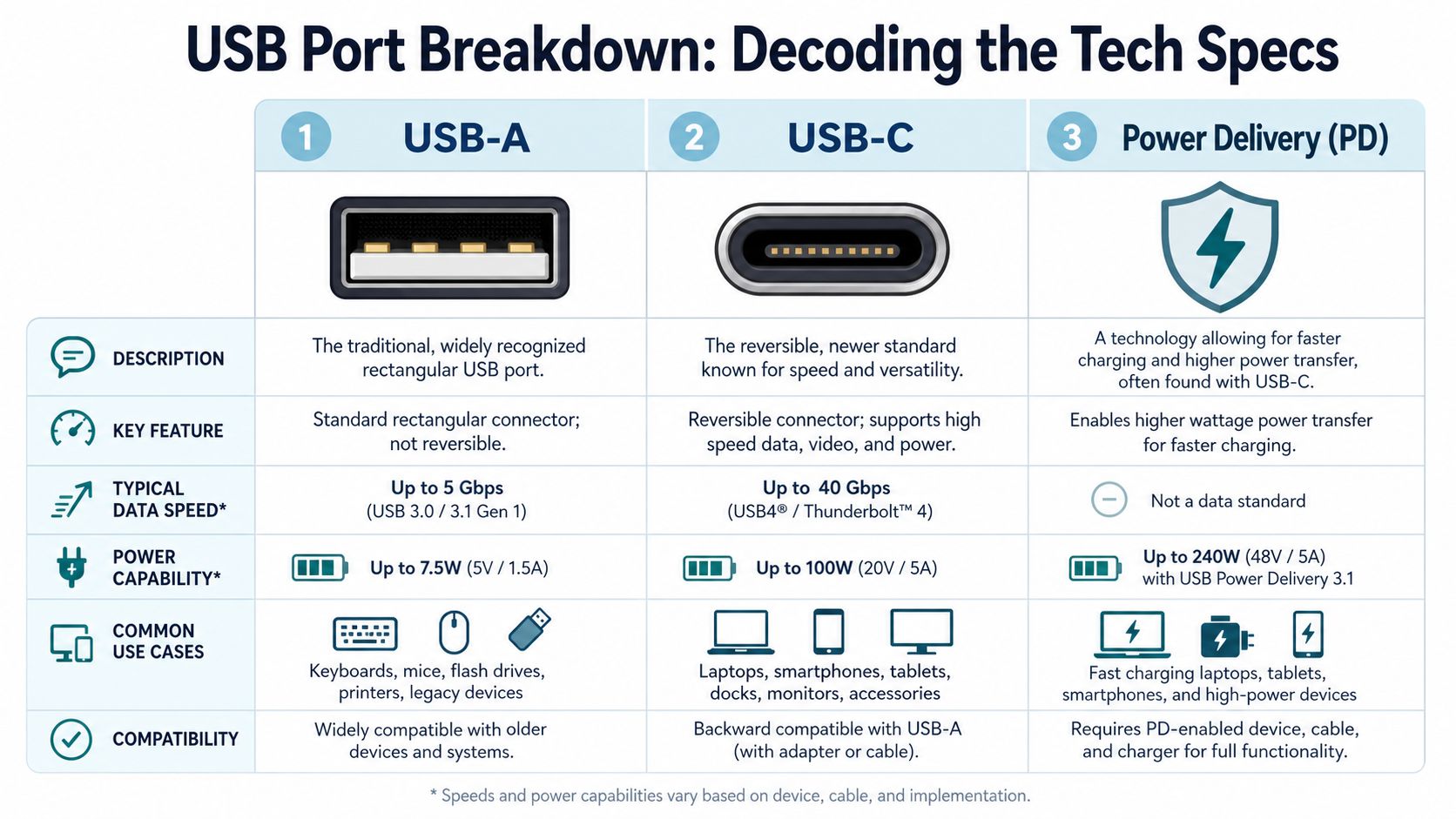
USB-A is the older rectangular port most of us know well. It works fine for plenty of cables and older devices, but it's physically larger and generally more limited.
USB-C is the newer, smaller, reversible port. You don't have to fiddle around trying to insert it the right way up, and it's become the preferred option on many newer phones, tablets, and laptops.
The physical difference is very real. A USB-C port needs an 8.34mm x 2.56mm panel cutout, while USB-A needs 12.0mm x 4.5mm. Beyond physical size, USB-C can support up to 240W Power Delivery, while older USB-A standards are much more limited, as outlined in this USB connector dimensions and capability guide.
What watts and amps mean
You don't need to be an electrician to read charging specs sensibly.
- Amps (A) tell you about current.
- Watts (W) tell you about total power.
- In plain English, more available power usually means faster charging, assuming your device can accept it.
That last part matters. Your phone, tablet, or laptop only takes what it's designed to take. So a higher-powered USB-C socket doesn't force too much power into the device. Good charging gear matches the device's needs.
Where Power Delivery fits in
Power Delivery, often shortened to PD, is the smart charging language used mainly with USB-C. It allows the charger and the device to “talk” to each other and settle on a safe, suitable charging level.
That's why USB-C with PD is the better fit if you want more flexibility for newer gear.
Practical rule: If you only charge older phones overnight, USB-A may be enough. If you want a more future-ready setup, USB-C is usually the smarter choice.
USB-A vs. USB-C at a Glance
| Feature | USB-A | USB-C |
|---|---|---|
| Shape | Larger rectangular port | Smaller reversible port |
| Ease of use | Only inserts one way | Inserts either way |
| Device compatibility | Older and legacy devices | Many newer phones, tablets, laptops |
| Power potential | More limited | Can support much higher power, including Power Delivery |
| Best for | Basic charging | Faster, more versatile charging |
If you're fitting out a caravan, camper, or mobile setup as well as your house, the same charging language pops up in plenty of 12V gear too. This camper van 12 volt air conditioner guide is a good example of how power planning and real-world device use often overlap.
Safety First Australian Standards and Installation
This is the part where it pays to be fussy.
A USB socket might look simple from the front, but it's still a fixed electrical fitting connected to your home's wiring. In Australia, that means safety and compliance are not optional extras.
What compliant actually means
One of the biggest traps for homeowners is assuming that if a product is sold online, it must be fine to install here. That's not a safe assumption.
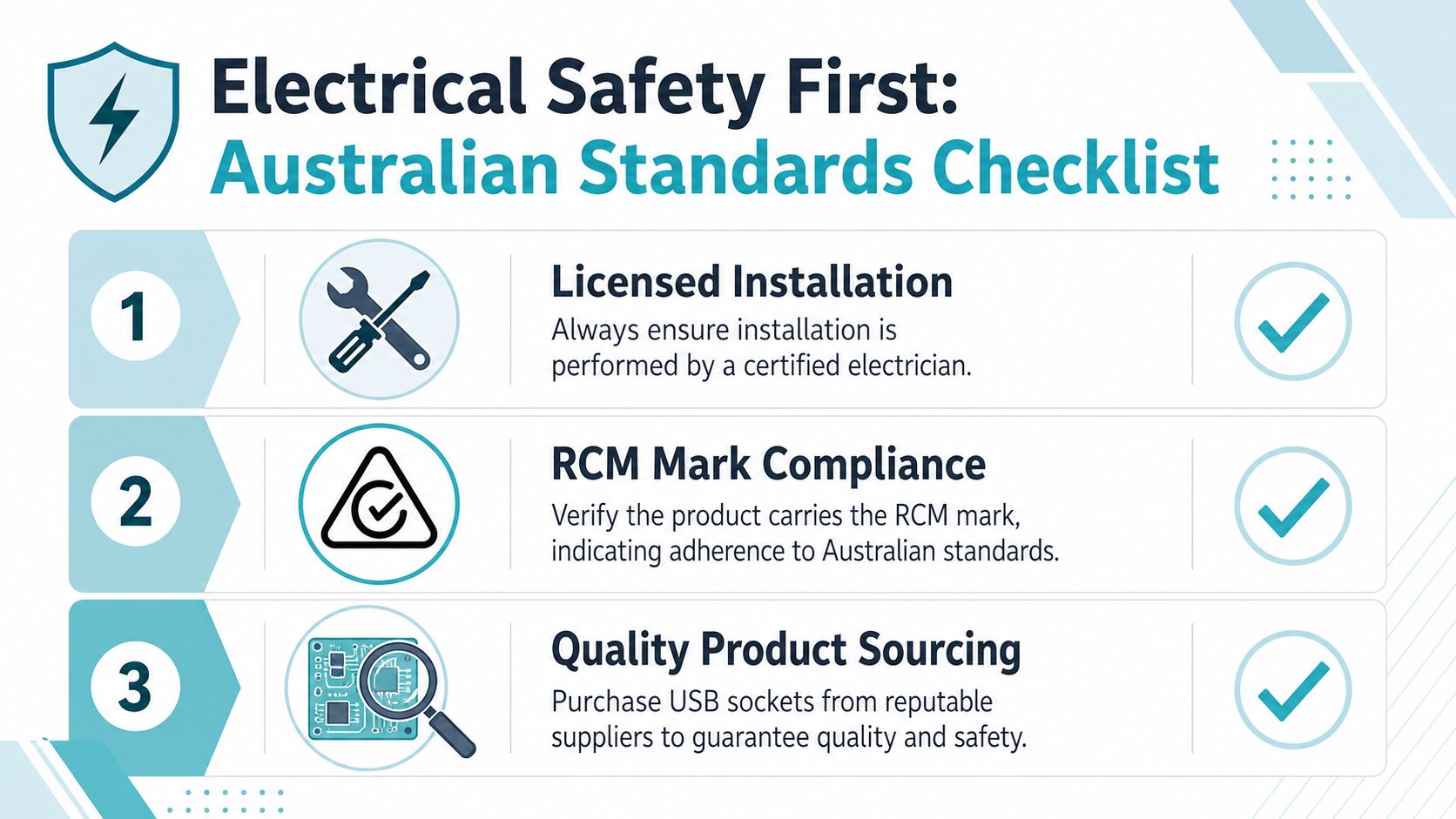
A key issue for Aussie homeowners is compliance. Only products meeting AS/NZS 3112 for the AC outlets and using properly isolated USB modules are legal and safe for installation in Australia, as noted in this Australian compliance discussion for switch and socket products.
There's also a practical product-level detail worth knowing. In AU applications, integrated wall sockets with USB charging must comply with AS/NZS 3112 for the AC outlet side, while the USB charging section needs to be correctly integrated and isolated. A product example such as the Hager Silhouette twin socket with USB-A and USB-C shows how compliant designs keep the USB charging module separate in function from the main AC circuit while maintaining overall electrical integrity.
Cheap imports versus certified local stock
The danger with bargain imports isn't just disappointing performance. It's uncertainty.
A cheap online listing may tell you the socket is “safe”, “smart”, or “premium quality”, but that wording doesn't tell you whether the unit is suitable for Australian fixed wiring, whether the AC outlet side complies locally, or whether the USB module has been properly designed for safe installation.
Look for signs of credibility before anyone touches your wall:
- Australian suitability. The product should be intended for Australian use, not just adapted from another market.
- Clear compliance details. Vague marketing copy isn't enough.
- Known electrical brands or reputable local suppliers. You want traceability if questions come up later.
Buy the socket the same way you'd choose brakes for a Beetle you actually drive. Neat appearance matters, but the hidden engineering matters much more.
Who should install it
A licensed electrician. Every time.
Replacing or installing a wall socket involves fixed 240V electrical work. That is not a DIY weekend job. A licensed electrician can check the circuit, confirm the product is suitable, fit it correctly, and test the final result.
If your project also involves a shed, van conversion, or utility setup, power planning matters just as much there. This van fit-out utility systems guide is a useful reminder that good electrical decisions always start with the right system, not just the right accessory.
How to Choose the Right USB Socket for Your Home
Not every room needs the same setup. The best socket for the kitchen might be the wrong one for a guest bedroom.
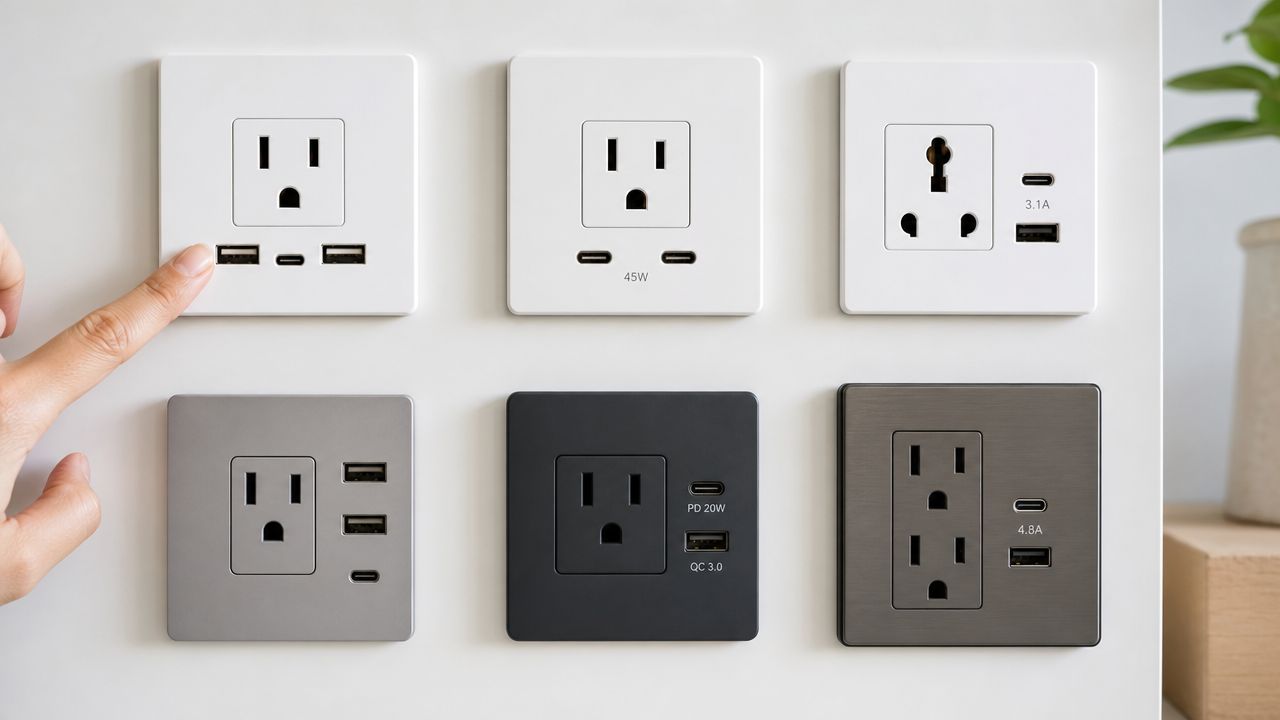
The broader shift is clear enough. The global market for these products is projected to reach $4.66 billion in 2025, reflecting how strongly integrated sockets are being adopted in modern homes and renovations, according to global market projections for sockets with USB ports.
Start with the room
Ask where the charging happens.
Bedside tables usually suit a simple combo unit. One or two standard outlets, plus USB for phones and earbuds.
Kitchen benches often need more thought. You may still want room for the kettle, toaster, or coffee machine, so built-in USB helps preserve the normal outlets.
Home offices benefit from flexibility. If you charge newer devices, USB-C becomes more appealing here.
Then think about your devices
A frequent issue is that people often buy the wrong thing.
- If you mostly charge older phones, e-readers, or accessories, a socket that includes USB-A can still be useful.
- If you charge newer phones, tablets, or USB-C gear, prioritise USB-C.
- If you want a more future-friendly choice, a mix of USB-A and USB-C is often the most practical compromise.
A lot of homeowners don't need the fanciest unit on the shelf. They need one that matches what lives in the room.
Here's a quick visual explainer before you choose:
A simple buying checklist
| Question | Why it matters | Good fit |
|---|---|---|
| Where will it go? | Charging habits differ room to room | Bedroom, kitchen, study, entry |
| What devices will use it? | Port type affects convenience | Older gear, newer USB-C gear, mixed household |
| How many devices charge there? | Prevents underestimating demand | One person, couple, family zone |
| Do you want future flexibility? | Avoids replacing too soon | Mixed USB-A and USB-C can help |
If you're comparing products for a mobile lifestyle too, this slimline 200Ah lithium battery feature guide is a handy example of how choosing electrical gear always comes back to use case, available power, and charging expectations.
Common Questions About USB Wall Sockets
Why is my phone charging slowly from the USB port
Slow charging usually comes down to a mismatch between the socket, the cable, and the phone.
A lot of built-in USB wall sockets are designed for convenient everyday charging, like topping up your phone overnight on the bedside table or keeping a tablet going in the kitchen. They are not always built to replace the fast charger that came in the box. If your device is set up for USB-C Power Delivery and the wall socket only provides basic output, charging will be slower even though the socket is working properly.
The cable matters too. A cheap or worn cable can bottleneck charging, a bit like putting a narrow garden hose on a full-pressure tap.
Can I install a USB socket myself
No.
In Australia, any fixed 240V electrical work must be done by a licensed electrician. Replacing a standard power point with a USB wall socket is not a DIY job. That matters for your safety, and it matters for compliance with Australian requirements such as AS/NZS standards and local wiring rules.
Do USB ports draw power when not in use
Some do draw a small standby amount, depending on the product design.
For most homeowners, the bigger question is whether the unit is certified for Australian use, installed correctly, and suitable for the devices charged there every day. A compliant product from a reputable local supplier is usually the safer bet than a bargain import with unclear approvals or vague specifications.
Is it worth getting USB-C if my current phone still uses USB-A
In many homes, yes.
USB-C is now common on newer phones, tablets, headphones, and other portable gear. If you are updating a room once and want the socket to stay useful for years, adding USB-C now can save you from replacing the fitting later. A combination unit with USB-A and USB-C often suits mixed households best.
If you are paying for electrical work once, it makes sense to choose something that suits both the devices you own now and the ones you are likely to buy next.
Are sockets with USB worth it
They can be. It depends on how you use the room.
If everyone in your place charges devices in the same spot each day, a USB wall socket can cut clutter and free up the regular outlets for lamps, vacuums, or other appliances. Its primary value is convenience without turning the bench or bedside into a tangle of plug packs.
Choose carefully, though. The right pick is a certified product that matches your devices and is installed by a licensed electrician. That is the difference between a neat, safe upgrade and a shortcut that can cause headaches later.
If you enjoy practical gear, classic design, and VW collectibles, have a browse through Volkswagen Memorabilia. It's a local Australian shop with licensed gifts, diecast favourites, and collectible pieces for Beetle and Kombi fans, including Volkswagen diecast models for sale.