

You're probably in the same spot plenty of classic VW owners hit sooner or later. The car's running sweet, the paint still turns heads at the servo, and a late arvo drive feels spot on until the sun drops and those old headlights start looking more charming than useful.
That's where the led H1 headlight conversation usually starts. Not because anyone wants to modernise the soul out of a Beetle or Kombi, but because using these old girls on modern Australian roads asks a bit more of the lights than it did decades ago.
The trick is doing it properly. With classic Volkswagens, especially Australian cars and long-loved restorations, the primary issue isn't just whether an H1 LED bulb fits the socket. It's whether the beam pattern stays safe, tidy, and roadworthy once it's sitting inside an old reflector housing. Get that wrong and you haven't upgraded anything. You've just made the car harder to use and more likely to attract unwanted attention.
That Dusk Cruise Feeling Just Got Brighter
There's a special kind of joy in an evening run in an air-cooled VW. Windows cracked, engine humming away behind you, and that familiar view over a Beetle bonnet or through a splitty screen. It's part machine, part memory.
Then the road gets darker.
Anyone who's driven an older VW outside the city knows the feeling. A halogen setup that seemed acceptable around town suddenly looks thin and yellow on a country road. Signs don't pop the way they should. Surface changes arrive later than you'd like. You start driving the car around the headlights instead of driving with confidence.
That's why a led H1 headlight upgrade gets so much attention among restorers and owners who use their cars. It isn't about chasing a trendy white light for the sake of it. It's about making a classic Volkswagen easier to enjoy after sunset, without taking away the character that made you fall in love with it in the first place.
Australian VW history gives that idea a bit of weight too. The last original Volkswagen Beetle was assembled in Australia in July 1976, before the Kombi, Golf, and Passat assembly lines ended in February 1977, as recorded by Club VW's Australian Volkswagen reference. Keeping those cars practical now is part of keeping the story alive.
Old VWs earn their keep when you can drive them more often, not when they only come out in perfect daylight.
A tidy lighting upgrade can sit in the same camp as better tyres, careful brake work, or sensible wiring repairs. Respect the car. Improve the drive. Keep the spirit intact.
Shining a Light on LED H1 Bulbs
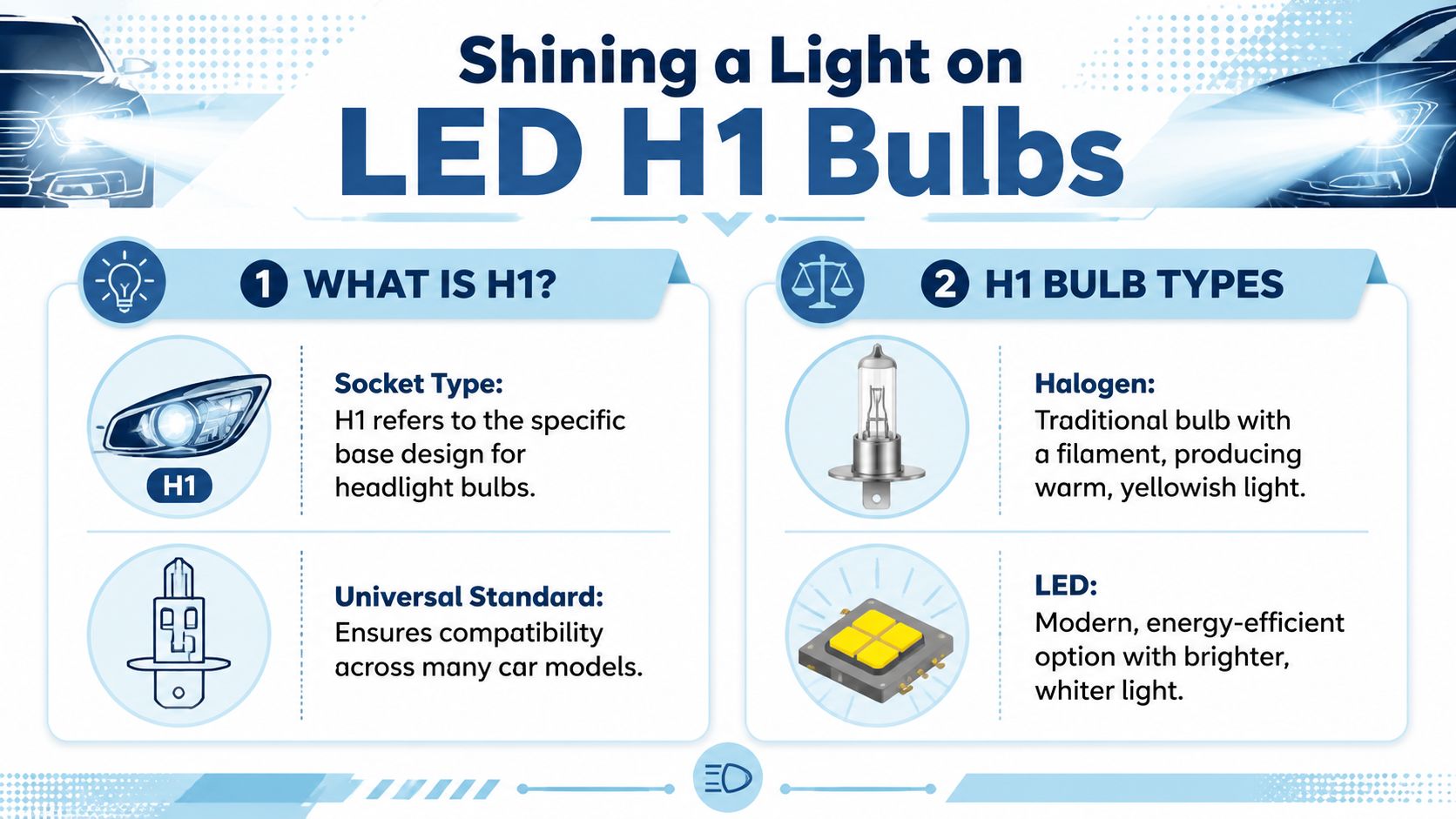
Before you buy anything, it helps to know what H1 means. It's the bulb format, not a magic performance label. In simple terms, an H1 bulb uses a P14.5s base, which is the round metal base design with a single spade connector used in many headlight applications.
What changes when you move from halogen to LED
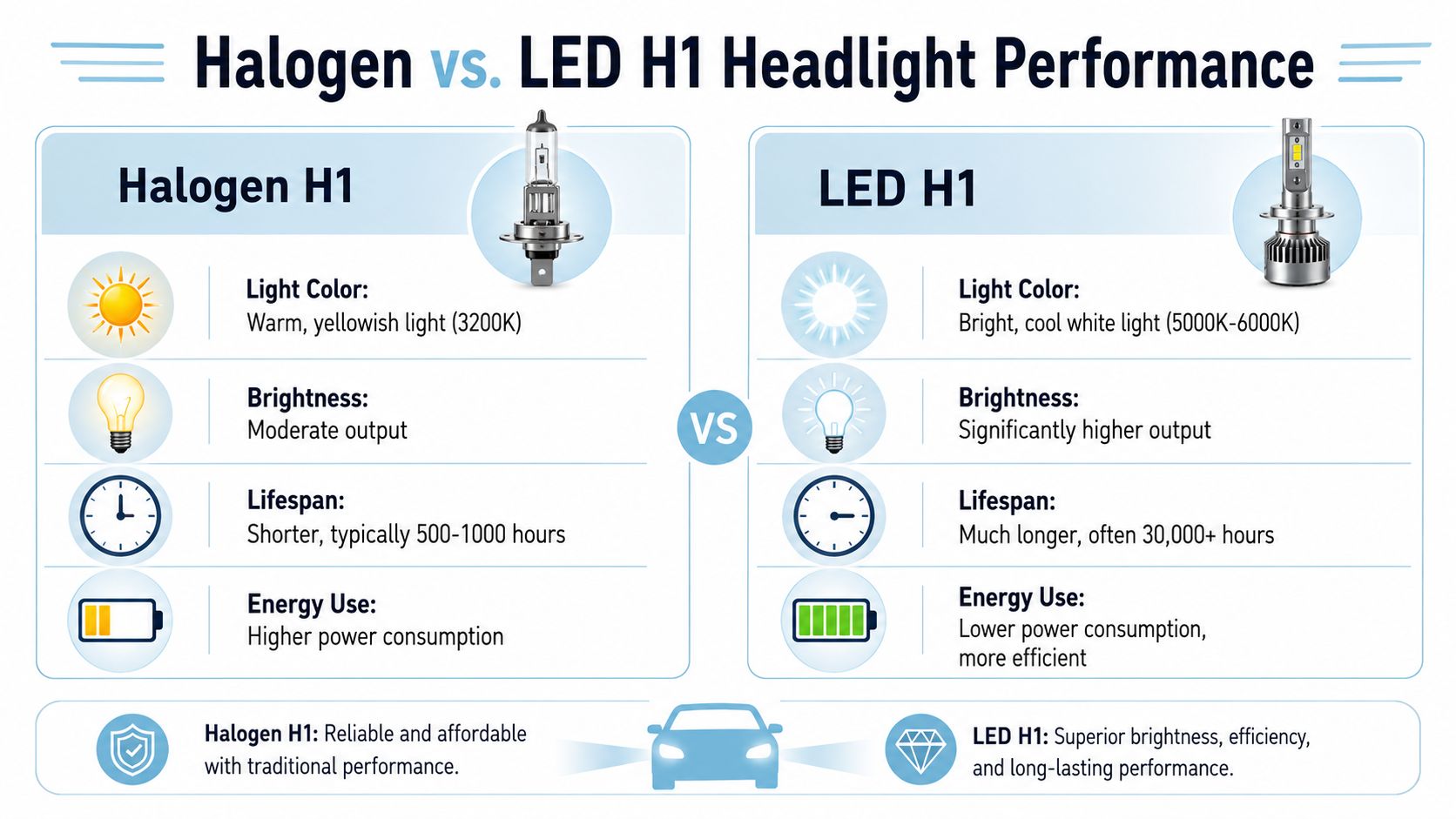
A traditional H1 halogen globe makes light with a filament. An LED version uses small light-emitting chips instead. That sounds simple enough, and in physical fitment terms it often is. According to the H1 lamp reference on Wikipedia, H1 LED headlight bulbs replace the original P14.5s base halogen globes and can produce around 2800 to 3600 lumens per bulb, compared with roughly 700 to 900 lumens for a typical H1 halogen.
That's the part that gets everyone excited. More light from the same basic socket.
But an LED bulb isn't just a halogen with a different glow. Most kits add extra hardware. You'll usually see a driver module, plus a cooling arrangement such as a fan or heatsink on the rear of the bulb. That matters a lot in a classic VW because headlight buckets don't offer endless room to play with.
The easy way to think about it
Consider the act of swapping an old torch globe for a modern LED torch insert. While both may fit the same space, they produce light differently, dissipate heat differently, and behave differently in a reflector.
Here's what to keep straight before ordering a kit:
- Socket match: H1 tells you the bulb base style.
- Light source shape: The reflector was designed around a filament, not automatically around LED chips.
- Rear clearance: Cooling hardware can foul on the back of the bucket or dust cover.
- Wiring style: Plug-and-play claims can still hide small fitment surprises.
That last point catches plenty of owners. A bulb can be marketed as easy-fit and still create real headaches once it meets old VW hardware.
Seeing the Difference Halogen vs LED Performance
The biggest practical difference between halogen and LED isn't marketing fluff. You see it on the road. A good LED setup produces a cleaner, whiter light that makes roadside detail easier to pick up, especially when your eyes are dealing with a dark stretch of road and mixed traffic.
The hard numbers that matter
The useful thing about quality H1 LED products is that some of the claims are backed by proper figures rather than pub talk. On Philips' Australian road-legal LED page, high-performance H1 LED replacements can achieve up to 2,345 Max Lux, compared with 482 Max Lux for standard halogen, and Philips says that's 238% brighter in that test. The same page notes the Philips Ultinon Pro6000 offers up to 3,000 hours of bulb life, lasting six times longer than comparable halogen globes, as shown on the Philips Ultinon Pro6000 page.
That sounds brilliant, and often it is, but there's a catch seasoned owners learn quickly. Not every LED bulb behaves the same way in every lamp.
A lot of Australian drivers also gravitate to the cool white look. Some commercial H1 LED kits sold for the local market, such as the F22 Series mentioned in the verified data, are listed at 6500K with 110W and 24,000 lumens total brightness. That sort of output can look fantastic on paper, but old reflector housings don't care about marketing. They care about where the light source sits.
Here's a quick side-by-side view.
| Feature | H1 Halogen | H1 LED |
|---|---|---|
| Light colour | Warmer, more yellow | Usually cooler, whiter |
| Output potential | Lower | Can be much stronger |
| Bulb life | Shorter | Can last much longer |
| Electrical load | Higher | Often easier on an older system |
A video walk-through helps if you want to see how beam shape changes from one bulb style to another.
What works well in a classic VW
The best result usually comes from restraint, not maximum claimed brightness.
- Choose beam control over bragging rights: A lower-output bulb with better chip placement often beats a wild-output bulb with messy scatter.
- Use white light sensibly: A crisp colour can improve clarity, but only if the beam lands where it should.
- Value longevity: Changing bulbs in a classic isn't difficult, but fewer failures are always welcome.
Practical rule: If a bulb gives you more glare than reach, it's not an upgrade.
For a Beetle, Type 3, or Kombi that sees regular use, the sweet spot is a kit that offers tidy optical performance, manageable heat, and consistent reliability. That's the kind of upgrade you appreciate every time the daylight fades.
Installation and Wiring for Your Classic VW
Classic VW fitment is where the led H1 headlight story gets interesting. Plenty of kits are sold as plug-and-play, but anyone who has wrestled with an old headlight bucket knows there's often more going on than the listing suggests.
Bucket space is the first hurdle
The rear of many LED bulbs is bulkier than the old halogen globe they replace. Cooling fans, heatsinks, and drivers all need somewhere to live. In a Beetle or Kombi with snug buckets, that can mean the bulb fits the socket but not the housing.
That's why it pays to measure before buying. Check the bucket depth, check the dust cover clearance, and check where the wiring needs to sit once the lamp is reassembled. If you're sorting other restoration jobs at the same time, it's worth looking over your broader VW Type 1 parts options so the headlight upgrade isn't being asked to hide cracked boots, tired connectors, or brittle old hardware.
Orientation matters more than people realise
This is one of the big ones. Premium H1 LED kits can feature CSP LED chips and IP68 weatherproof ratings, but enclosed headlight buckets create thermal headaches, and the bulb must sit with the LED chips on the left and right sides for proper heat dissipation and beam pattern, as noted on Lightforce Australia's H1 upgrade kit page.
If the chips point up and down, the reflector usually won't throw the beam the way you want. You can end up with a smeared pattern, extra glare, and wasted light.
Fit the bulb, then check orientation before buttoning everything up. Three and nine o'clock is the usual goal.
A practical install checklist
- Dry-fit first: Don't lock everything down until you know the fan or heatsink clears the bucket.
- Watch the connectors: Old VW wiring can be serviceable but tired. Clean terminals and inspect insulation while you're in there.
- Keep the rear sealed: If the dust cover won't go back on properly, moisture and grime will make a mess of things.
- Aim after fitting: Even a correctly installed bulb can throw poorly if the lamp aim is off.
One more thing. Heat kills LEDs faster than most owners expect. A powerful bulb trapped in a small sealed bucket can cook itself over time, especially if airflow is poor. That doesn't mean LED is a bad idea. It means the kit has to suit the housing, not just the socket.
Staying Roadworthy With Your LED Upgrade
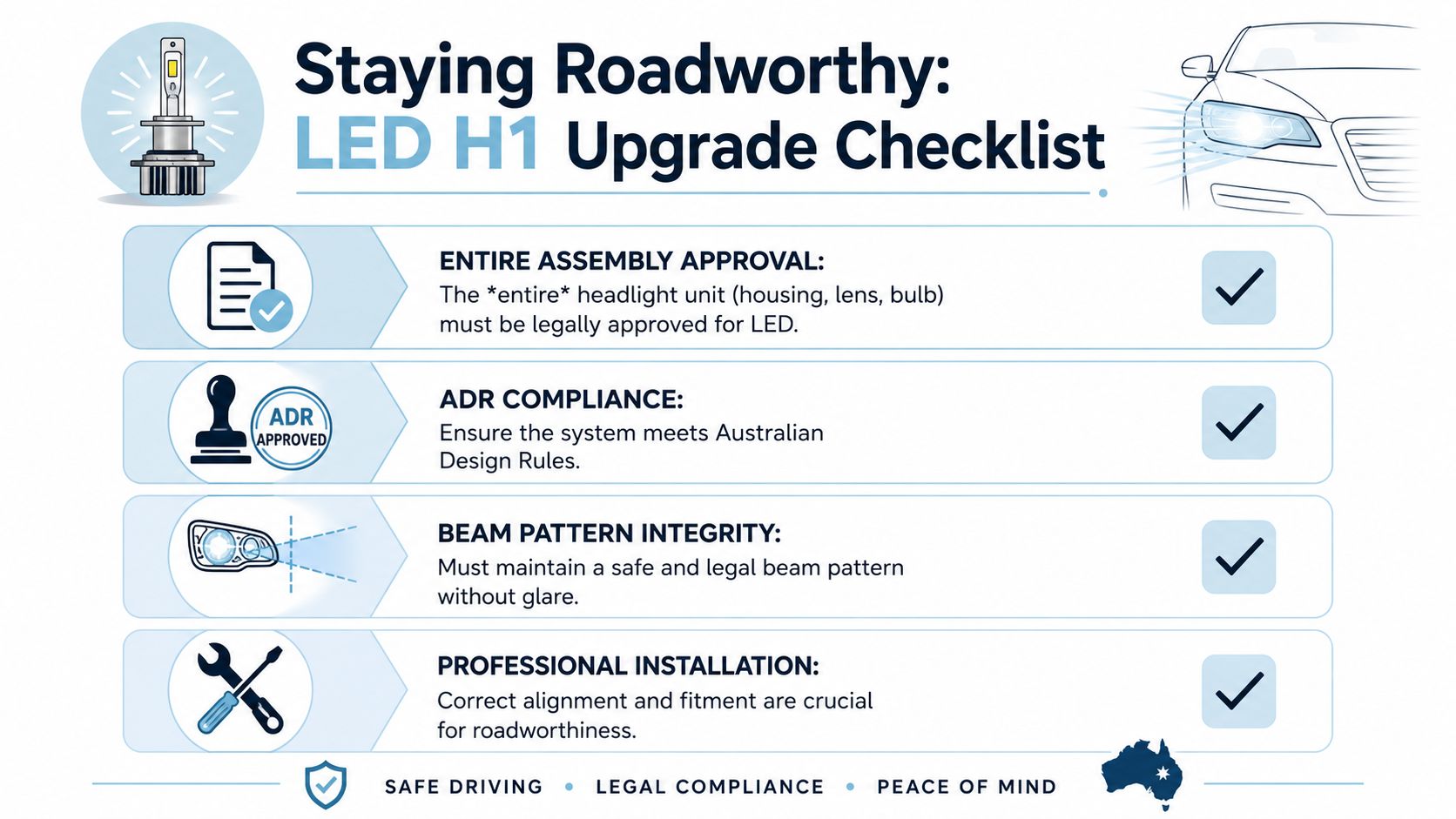
This is the bit many generic guides get wrong. In Australia, the issue isn't whether someone can sell you an LED bulb that fits an H1 socket. The issue is whether the entire headlight system remains compliant once that bulb is installed.
Legal bulb versus legal beam pattern
According to Drive's explanation of Australian headlight rules, LED headlights using the H1 format are legal only if they comply with ADR 13/00, which requires white light, intensity not exceeding 430,000 candelas, mounting height between 500mm and 1200mm, and placement not extending more than 400mm longitudinally from the vehicle. Drive also notes that non-compliance can lead to defect fines from $100 to $900, plus defect notices and a vehicle being deemed unroadworthy under enforcement, as detailed in this Drive article on LED headlight legality in Australia.
For classic VW owners, the most important part of that isn't the paperwork language. It's the beam. Old reflector housings were designed around a halogen filament shape. Swap in a flat LED chip layout and the reflector can scatter light in ways that don't show up until you test the beam against a wall or meet oncoming traffic.
That's why “ADR compliant bulb” and “ADR compliant result” are not the same thing.
Where restorers get caught out
A lot of Beetle and Kombi owners assume a plug-in globe is a legal shortcut. It often isn't.
- Reflector mismatch: The lamp may throw glare instead of a controlled cut-off.
- DIY aiming isn't enough: You can point a messy beam lower, but you can't fix bad optics with adjustment alone.
- State-level quirks exist: Some wiring requirements and inspection expectations vary, which adds another layer for enthusiasts.
If you're refreshing the front end while sorting lights, it's worth checking broader Volkswagen Beetle parts for restoration jobs so the whole system is working as it should, not just the bulb.
A legal upgrade isn't the brightest one on the shelf. It's the one that puts clean light on the road without annoying everyone coming the other way.
For some cars, the honest answer is that a projector-style conversion or a professionally assessed setup is the safer path if you want LED performance without roadworthy dramas.
Choosing Your Kit and Cruising with Confidence
Once you know the traps, buying gets much easier. You're not shopping for a miracle bulb. You're shopping for a kit that suits an old VW housing, leaves enough room for cooling, and gives you the best chance of a proper beam.
The shortlist I'd use
- Check dimensions first: If the rear hardware won't fit, stop there.
- Look for adjustable positioning: Being able to rotate the bulb helps nail that left-right chip orientation.
- Buy from an Aussie supplier who understands local fitment: That usually means better support and fewer surprises.
- Treat huge brightness claims carefully: The neatest beam wins.
A reputable local supplier also means local stock and faster shipping, which is handy when the car's apart and you don't want it sitting on stands while a mystery parcel circles the globe. If you're already deep into a bigger build, keeping an eye on your broader VW parts in Australia can save you from doing jobs twice.
For plenty of owners, the best outcome is simple. Better night vision, less strain on old electrical gear, and a classic Volkswagen that still feels like itself.
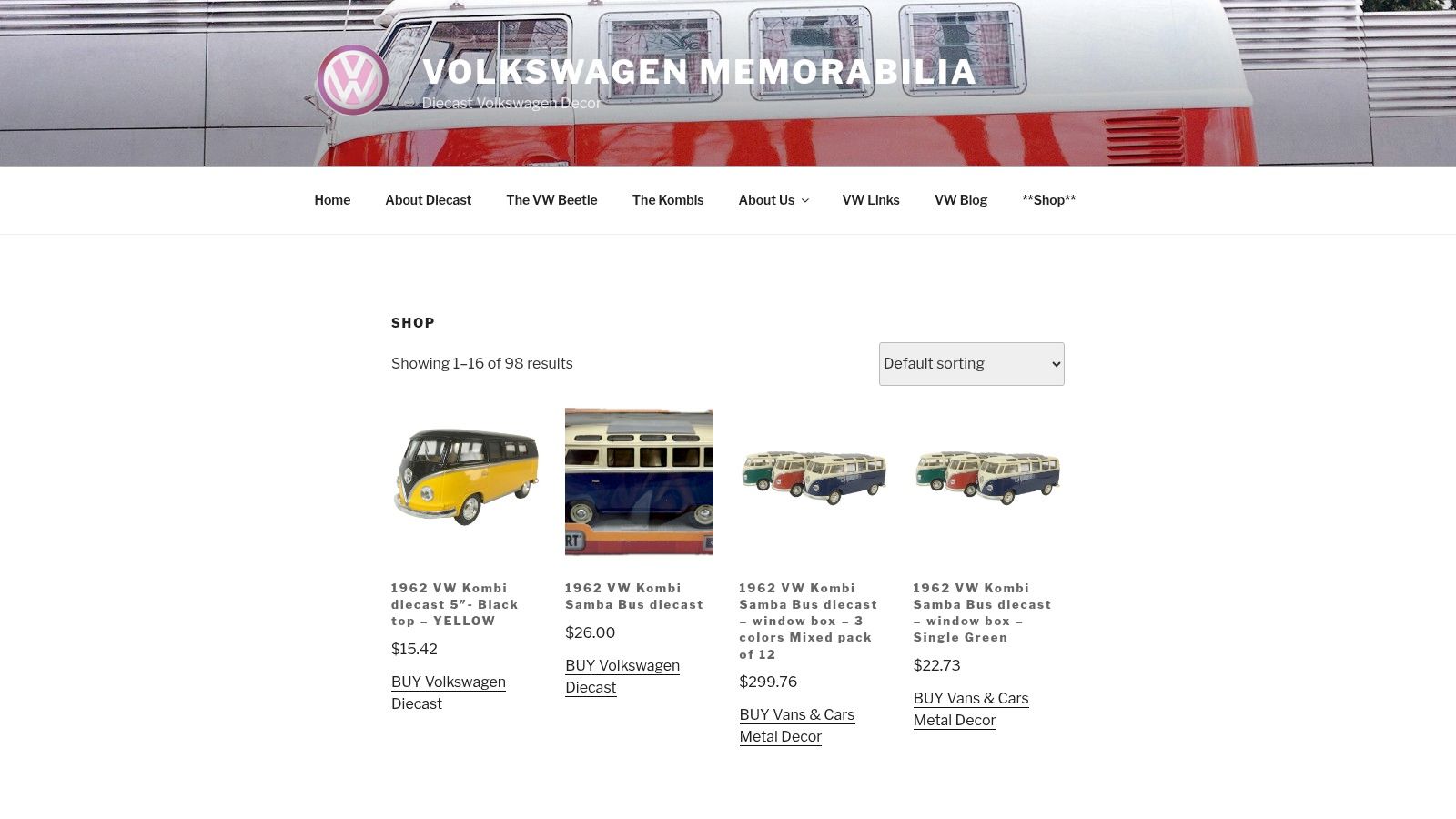
To finish on a lighter note, there's something nice about celebrating the actual car while it's in the shed getting fettled. A shelf full of classic VW pieces keeps the passion alive between drives, especially if you're into VW Kombi diecast Australia, a well-made Volkswagen Beetle model, or hunting down Volkswagen diecast models for sale with proper licensed detail.
Quick FAQ
Are H1 LED bulbs always legal in Australia?
No. The bulb fitting the socket doesn't automatically make the beam pattern legal.
Will an LED H1 bulb fit my classic VW?
Maybe. The socket may match, but rear clearance, dust cover fit, and connector style can still cause trouble.
Do I need professional help?
If you want the best shot at a compliant beam and proper aim, professional installation is the sensible move.
Are all LED kits brighter than halogen in practice? No. Output varies, and beam control matters just as much as raw brightness.
If you love cars and the stories wrapped around them, have a look through Volkswagen Memorabilia. It's a top spot for VW memorabilia collectibles, licensed Kombi and Beetle diecast pieces, and gift-worthy finds for the Volkswagen tragic in your life. Local Australian stock and fast shipping make it easy to grab a classic buy diecast Kombi piece or a beautifully finished Beetle model to keep that VW spirit going in the shed, the office, or the display cabinet.