


A swivel seat in the car world has gone from 40-degree novelty fittings in the early Chrysler era to modern powered units that can turn through 0–113° or even a 360° rotation path, depending on the mechanism. In Australia, the idea makes the most sense as an accessibility aid, because our ageing population and our love of practical vans and classic cruisers both put a premium on easier entry and exit.
If you've ever folded yourself down into a Beetle, or shuffled a hip awkwardly across a Kombi passenger seat at a showground, you already know the problem. A good auto swivel seat is a rotating base under the seat that pivots the occupant toward the door, so getting in and out takes less twisting and less grunt.
What an Auto Swivel Seat Is
The easiest way to understand an auto swivel seat is to picture a seat mount doing more than just holding the chair in place. The seat itself still looks like a seat, but underneath it has a rotating base that lets the whole assembly turn outward before you climb in or step out.
In a classic VW, that can make a low sill feel far less awkward. In a Kombi or Samba, it can turn a cramped front seat shuffle into a much calmer move, especially when you are trying not to twist your knees, shoulders, and back all at once.
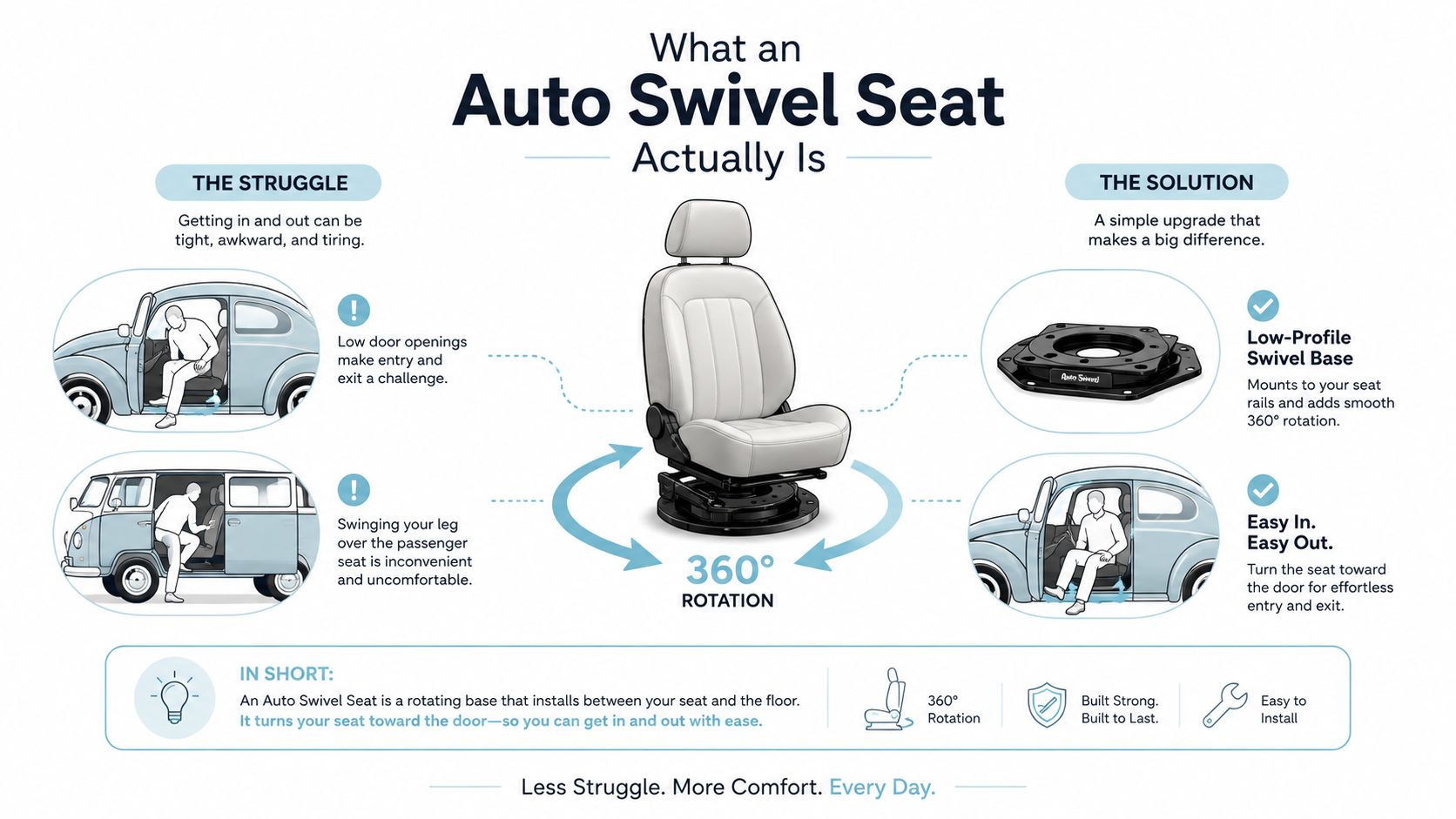
What sits under the cushion
Most systems are built from a few core parts. There is a mounting plate that fixes to the vehicle floor or seat base, a bearing ring that allows the movement, and a locking detent that keeps the seat in the right position. Some units also use a motor, so the turn happens with a switch instead of your arm.
That is why the term covers more than one product type. A simple manual turntable, a locked indexing plate, and a powered lift-and-rotate unit all count as swivel seats, even though they behave very differently in use. The manual versions are mainly about easier turning. The powered versions add easier turning plus transfer support.
For a VW owner, that difference matters. In a Beetle, the gain is often about making a low perch less awkward. In a Kombi, it can mean turning a tight front passenger step into something much easier to handle.
Practical rule: if the seat only turns but does not make the transfer easier, you may be paying for a gimmick rather than a real usability upgrade.
The three choices buyers keep facing
The first choice is manual versus powered. The second is rotation angle, because some seats only lock into a few positions while others swing much further. The third is fitment, because a mechanism that suits a roomy van may be a poor match for a compact cabin.
If you are looking at listings, start with the practical question, “Can I get in, sit down, and fasten the belt without fighting the cabin?” That is the point where the product earns its keep.
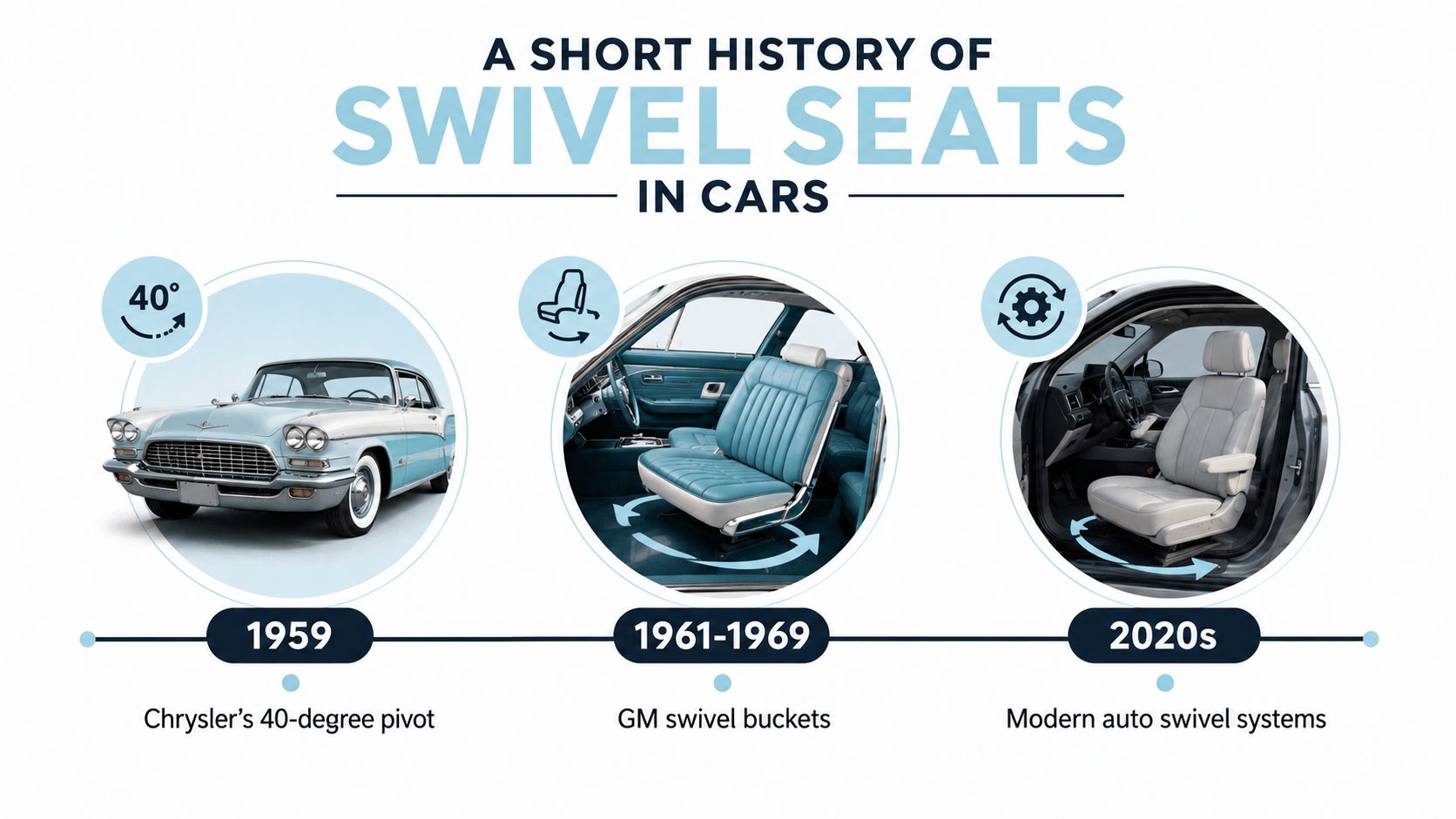
A Short History of Swivel Seats in Cars
Swivel seats aren't some modern gadget dreamed up for today's mobility market. The idea has shown up in production vehicles before, then faded, then come back in different forms when drivers needed it again. Chrysler's late-1950s and early-1960s swivel seats pivoted about 40 degrees to help with entry and exit, and GM later used swivel bucket seats in selected intermediate coupes during 1973–1977. Car Design News
Why the idea kept returning
That history tells you something useful. The feature never became a high-volume mainstream standard, but it kept proving its value in the world, especially where awkward access or limited mobility made a fixed seat annoying. It has lived on in specialty vehicles and accessibility conversions because the basic problem never went away.
For Australia, the demographic context makes the story even clearer. The ABS says that in the 2021 Census, people aged 65 years and over numbered 4.2 million, which was 16.6% of the population, up from 15.8% in 2016. Australian Bureau of Statistics
That doesn't automatically mean every older driver wants a swivel seat. It does mean the market for easier ingress and egress is real, and growing. A classic VW community understands this instinctively, because plenty of owners love the car but don't love the yoga move needed to get into it after a long day at a show.
The best automotive ideas often come back not because they're clever, but because they solve the same old problem better than the alternatives.
Why VW enthusiasts should care
In a vintage scene full of restoration purists and practical modifiers, swivel seating sits in an interesting middle ground. It doesn't change the soul of a Kombi or Beetle, but it can make the thing more usable for a partner, parent, or mate who finds the original layout awkward. That's why it belongs in the conversation alongside seat runners, step plates, and other comfort-driven upgrades.
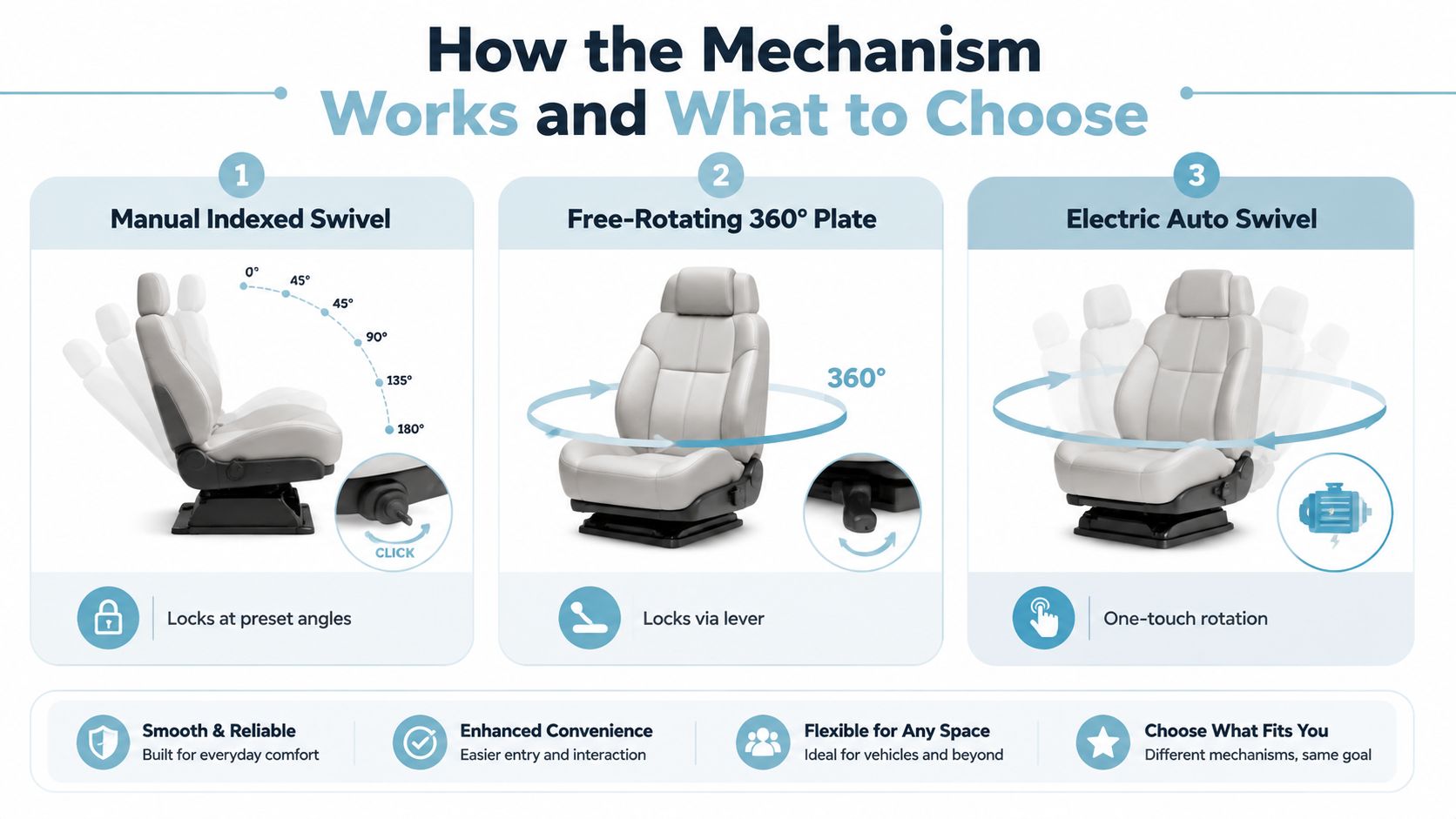
How the Mechanism Works and What to Choose
The part that separates a useful auto swivel seat from an expensive mismatch is the motion itself. A good setup matches how you get in, how you turn, and how much room the cabin gives you. For a Kombi or Samba owner, that matters because the charm of these vans often comes with a front seat position that is awkward to work around.
Manual, free-rotating, and powered
A manual indexed swivel is the simplest version. It turns to preset positions and locks there, which makes it useful when you only need a controlled turn for entry and exit. In a tight Beetle, that can be enough, because you often only need the seat moved outward rather than spun around like a lounge chair.
A free-rotating 360° plate gives more choice in how the seat sits, but that freedom comes with more packaging and safety questions. The seat still has to lock positively for road use, and the assembly has to stay stiff under load so it does not feel loose or flexy. One automotive-grade example, the YSR-P034 mechanism, is listed at 390 × 360 × 100 mm and 14.02 kg. YSR Seating
A powered lift-and-swivel unit is the most specialised option. Technical product data for accessible-vehicle use commonly shows 12 VDC power, around 120 W drive load, support for up to 150 kg, and rotation ranges such as 0–113° with transfer travel near 390–395 mm. Xinder Mobility SLIFT Pro V2
How to read the listing without guessing
A listing that mentions 90° is usually pointing to a basic swivel motion for getting in and out. 180° means the seat can turn further, which can help when you want a more comfortable exit position. 360° needs a closer look, because that figure can describe either free movement or a controlled system with proper locking.
The easiest way to choose is to match the mechanism to the job. If the vehicle is narrow and the goal is easier access, a plain turntable is usually enough. If the user needs help moving outside the door opening before lowering, a powered lift-and-swivel unit makes more sense than a basic rotating base. For anyone sorting seat rails, trim, or related conversion parts, Volkswagen interior access accessories are a sensible place to compare the broader setup.
Fitting a Swivel Seat to a Classic or Modern VW
A Beetle, a Kombi, and a modern Transporter don't ask the same thing of a swivel seat, so don't buy them the same way. In a Beetle, space is tight, the roofline is low, and the seat position is already part of the car's charm and challenge. Even a modest turn can make that perch easier to live with.
A Kombi or Samba Bus is a better fit for the idea because the front passenger area is where the awkwardness shows up most clearly. The cab layout suits a front-seat swivel far more naturally than a small hatch, and Aussie owners often think about the passenger side first for that reason. A modern van usually gives you a simpler install and more door clearance, but the improvement can feel less dramatic because the original entry is already friendlier.
For VW readers, the question is not whether swivel seats are cool. It's whether they suit the body style you own.
- Beetle: Best if you need a cleaner entry motion, but space constraints mean you should keep expectations modest.
- Kombi or Samba Bus: Often the sweet spot, especially on the front passenger side where the seat change feels immediately useful.
- T3, Multivan, Transporter: Usually the easiest candidates for fitment, though the practical gain depends on the trim and seating layout.
One useful place to start is the general range of interior-access parts, especially if you're also weighing seat rails, trim, or related conversion pieces. Volkswagen Memorabilia vehicle interior accessories
A clean way to judge suitability is to sit in the car and rehearse the motion before you buy. If you can already see the knee, handbrake, or B-pillar getting in the way, that's your answer. A swivel seat helps, but it doesn't change the shape of the cabin.
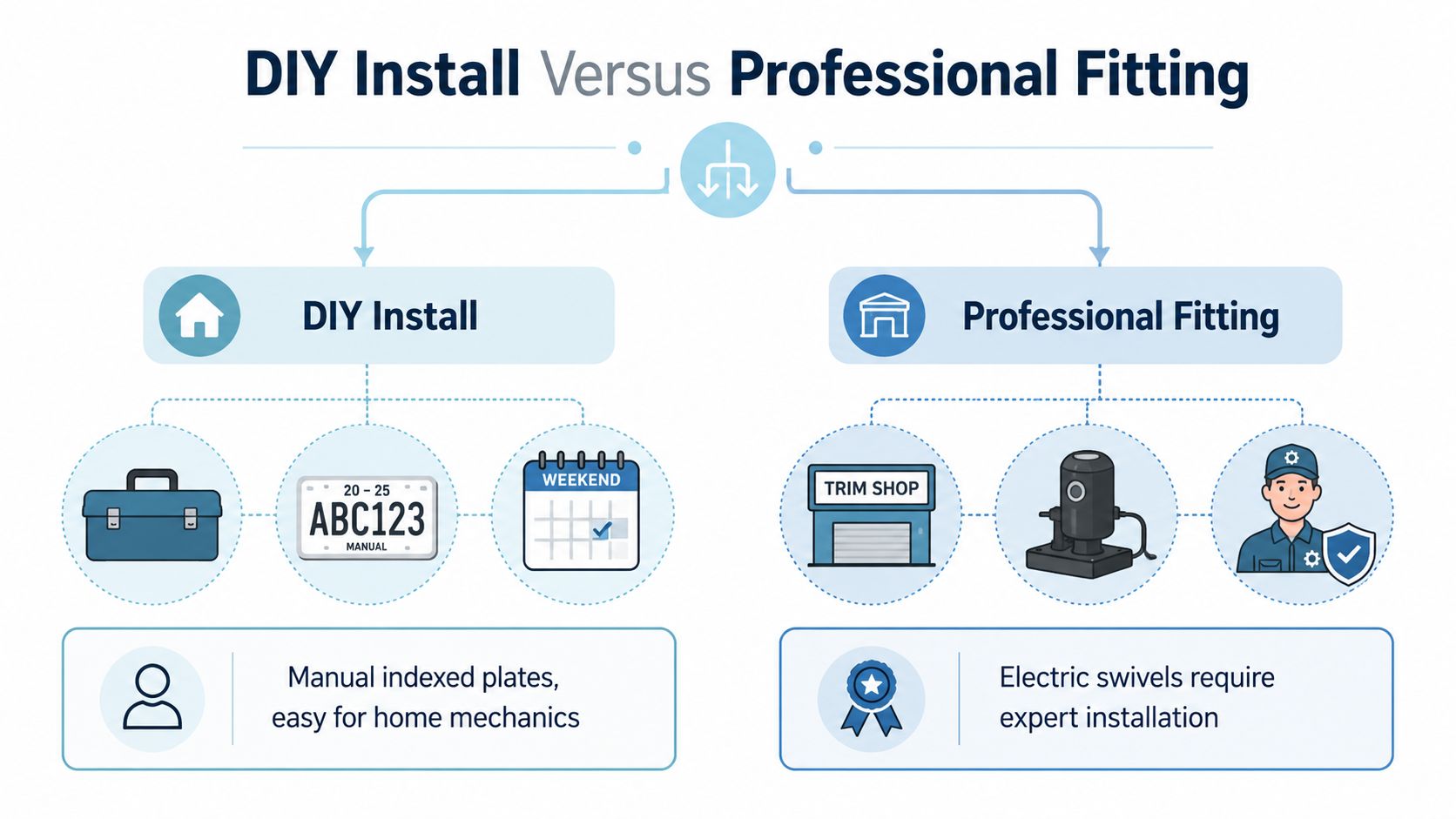
DIY Install Versus Professional Fitting
A neat swivel-seat install can be done at home, but the work is not all equal. A manual indexed plate is usually the friendliest place to start, because once the seat is out, the job comes down to aligning brackets, tightening bolts, and checking that the seat still clears the rails and trim. Powered units need more care, because they bring wiring, load demands, and a bigger consequence if something is fitted poorly.
What a home install can realistically cover
For a manual kit, a weekend DIY approach often makes sense. You still need to keep an eye on the seatbelt anchor points, the handbrake in older Beetles, and the way the seat base swings through its arc. A bad fit does not always look wrong on day one, it often turns up when the seat starts rubbing or binding where it should not.
Powered lift-and-swivel systems are better left to a fitter who understands vehicle electrics. The product details for these units point to 12 VDC and around 120 W drive load, so the system is more than a simple bolt-in swap. A proper auto-electrician can set up the fuse protection, relays, and cable routing in a way that suits the seat and the vehicle, and if you are weighing a broader conversion plan, the Volkswagen van fit-out guide is a useful place to compare how seating changes sit alongside the rest of the cabin work.
The mistakes that cause trouble
- Seat-rail clearance: The seat can look fine in the shed and then bind against the floor or trim once installed.
- Seatbelt geometry: If the belt no longer anchors or tensions correctly, the mod has failed the basics.
- Handbrake interference: Older Beetles are notorious for tight packaging near the front seating area.
- Wrong rotation side: Some powered seats come in separate left-hand and right-hand versions, so the side has to match the vehicle and the user flow.
If the installer cannot explain how the seat locks, how the belt works, and where the wiring lives, keep asking questions.
A professional fit also gives you a clearer paper trail for warranty and peace of mind. The more the system changes the seat's movement or electrical load, the more sensible it is to have the work documented properly.
Safety and Legal Considerations in Australia
The safety question is the one people sometimes hesitate to ask out loud. A swivel seat feels helpful, but any change that alters how the occupant sits and belts in needs proper restraint logic and proper locking. In the United States, NHTSA says swivel seats are not prohibited by Federal Motor Vehicle Safety Standard No. 207, but a front outboard swivel seat must have lap-and-upper-torso restraints that fit the occupant in any position the seat can occupy while the vehicle is moving, including rearward-facing. NHTSA interpretation
What that means in plain English
The seat can't just spin and hope for the best. It has to lock positively for travel, and the belt has to work with the seat position rather than fighting it. That principle matters in Australia because the spirit of the rule is the same, even when you're dealing with local compliance pathways, engineering sign-off, or an insurer checking the vehicle after a crash.
A useful mental checklist is simple. The seat should lock firmly in the forward-facing position, the belt should still anchor and tension correctly, and the installation should look like a proper vehicle modification rather than a home-made bracket job. If any of those three looks flimsy, stop there.
The crash-safety side is still an active conversation. A 2023 Frontiers study evaluated an integrated safety system for swivel-seat arrangements in a frontal crash, which is a reminder that convenience alone doesn't settle the safety question. Frontiers study
The sensible Australian approach
For Aussie VW owners, that means treating the seat like a structural change, not a comfort accessory. If you're fitting one to a Kombi or Beetle, check that the installer understands restraint alignment, and ask how the mechanism behaves if the vehicle is moving. If the answer sounds vague, that's your warning sign.
For anyone planning a fit-out in a van or specialist vehicle, the same discipline applies. VW van fit-out guidance makes more sense when you think about the seat as part of the whole cabin, not a standalone bolt-on.
Buying Guide and Common Questions
A decent buying checklist keeps you from getting seduced by the shiny bits. Start with load rating, because commercial units are specified for real-world occupants, and one verifiable example is the BraunAbility Turny Evo swivel car seat at 370 lb, while a related BraunAbility Turny swivel car seat listing shows 330 lb for the standard model. BraunAbility Turny listings That tells you how seriously the market treats capacity differences.
What to check before you buy
- Rotation angle: Match the turn to the doorway and cabin space, not to the biggest number in the brochure.
- Manual or powered: Manual suits simple access help, powered suits transfer support and reduced physical effort.
- Left or right hand: Some units are built for one side only, so the side matters.
- Seat pattern: Make sure the kit matches your donor seat and vehicle base.
- Locking behaviour: A good seat should feel solid when it's supposed to be driving position solid.
Quick answers people usually want
A cleanly installed swivel seat usually doesn't hurt resale on a classic Beetle, especially if the original parts are kept and the work is reversible. Factory seatbelts can still work, but only if the anchor points and belt path stay correct. Child seats on the swivelling side are often a bad idea, because the rotating position and the child-seat installation don't always play nicely together.
Best buying habit: choose the seat for the person and the car together, not for the spec sheet alone.
If you're still weighing whether the upgrade fits your VW life, think about the use case. A Kombi owner who hauls grandparents to club runs needs something different from a Beetle owner who just wants easier Sunday drives. That's where a measured, honest approach beats a flashy one every time.
For collectors and enthusiasts who like their VW world to stay personal, it's also worth browsing a proper range of VW parts Australia options before locking in the seat project. VW parts Australia
If you're building a classic VW space around comfort, heritage, and the right sort of detail, Volkswagen Memorabilia has a lovely range of VW-themed pieces that suit a Kombi bench, a Beetle shelf, or a workshop wall. Visit Volkswagen Memorabilia to browse diecast models, gifts, and display pieces that match the same old-school charm as the cars themselves.