

You're heading off for a decent run. Maybe it's the coast, maybe it's a club meet, maybe it's just the school drop followed by work and a coffee. Then an orange symbol lights up on the dash and suddenly the whole drive feels a bit less carefree.
If you grew up loving old Volkswagens, this sort of warning can feel especially rude. A Beetle with an air-cooled flat-four never tried to talk to you with dashboard hieroglyphics. It rattled, hummed, smelt faintly of warm oil, and got on with it. Modern diesel VWs are a different beast. They're cleaner, cleverer, and a fair bit fussier.
That doesn't mean the DPF warning light is a disaster. Most of the time it's your car asking for the right kind of driving or the right kind of diagnosis. If you know what it means, you can often sort it before it turns into a proper wallet-bruiser. Keep your cool, think methodically, and treat it like advice from an old club mate who's seen a few things before.
That Unwanted Light on Your VWs Dash
One of the most common stories goes like this. The car's been doing short trips all week. Shops, traffic lights, school zones, stop-start suburban stuff. Then on Friday or Saturday, the warning pops up just as you finally point the nose toward a better road.
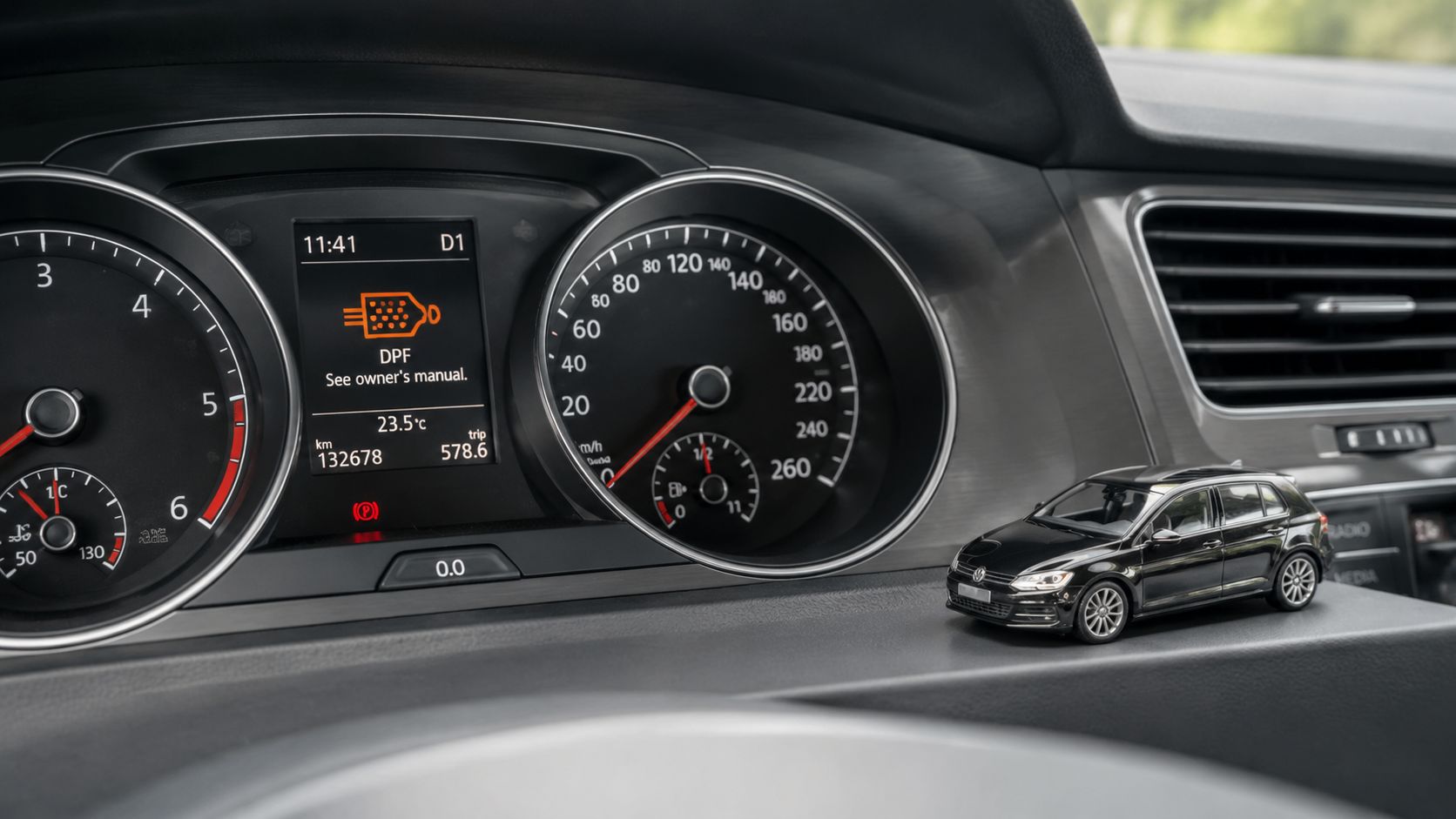
That catches plenty of VW owners off guard because the car may still feel normal. It starts, drives, and idles. No smoke show, no mechanical racket, no drama. But the dash is telling you the diesel particulate filter needs attention, and it's best handled sooner rather than later.
Why it feels more alarming than it is
Classic VW people are used to faults you can feel. Loose cable. Sticky carb. Valve noise. A DPF issue is different because it begins as a system problem, not a sensation problem. The car often gives you a warning before it gives you a symptom.
Practical rule: If the vehicle still drives normally and the light is steady, don't panic. Start with the basics and give the car the conditions it needs before assuming the worst.
The DPF itself is part of the emissions setup on modern diesel Volkswagens. It traps soot from the exhaust and then burns that soot off when the conditions are right. When those conditions never arrive, usually because the car lives on short urban trips, the filter starts loading up.
The modern VW problem in plain English
Think of it this way. An old Beetle liked being driven. A modern diesel VW also likes being driven, but in a very specific way every so often. It needs heat, load, and time. Without that, soot hangs around longer than it should.
If you keep service records in the glovebox, it's worth treating them with the same respect as a Volkswagen service book. Patterns matter. How the car is used matters. When the warning appeared matters. That little bit of context helps you decide whether the fix is a solid road run or a booking with the workshop.
What Your Diesel VW Is Trying to Tell You
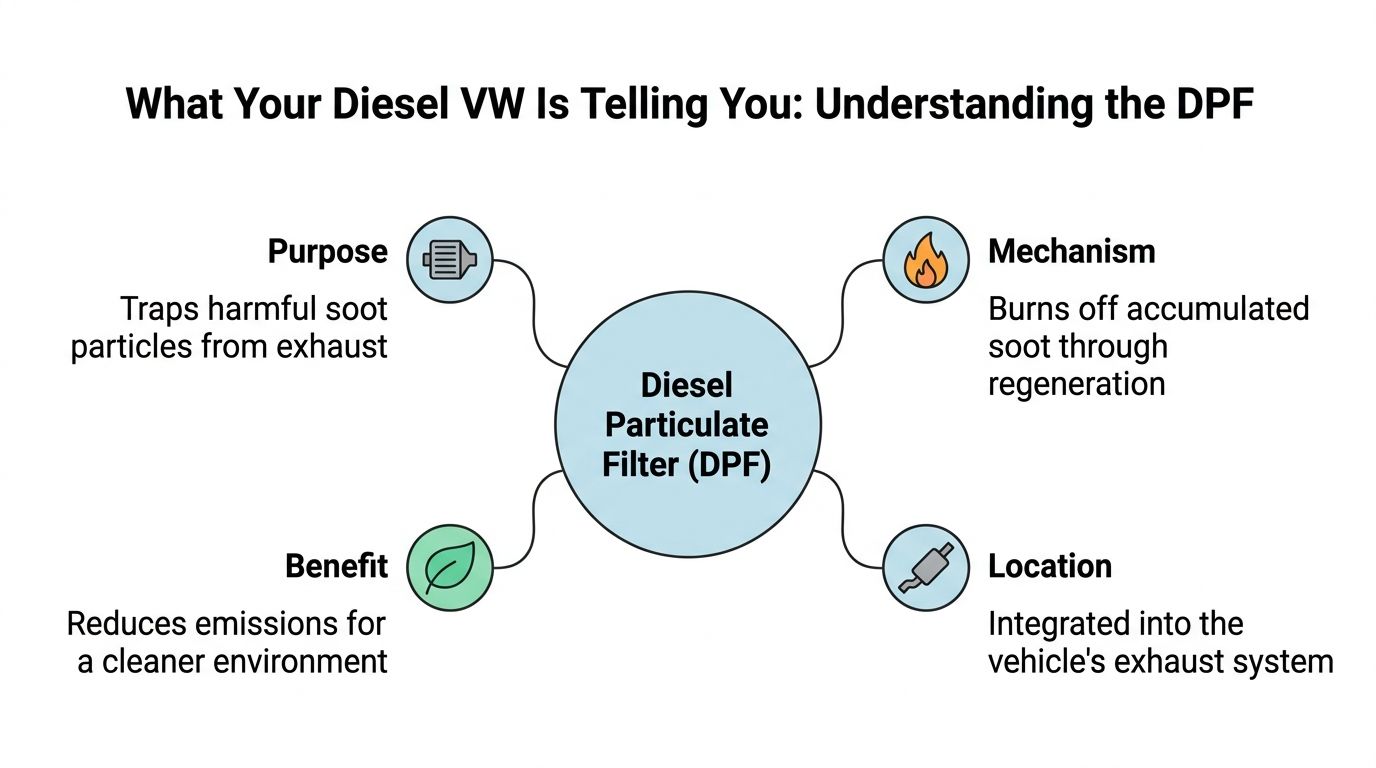
The Diesel Particulate Filter, or DPF, is basically a self-cleaning soot trap in the exhaust. It catches the dirty particles a diesel makes, then burns them off during regeneration when the exhaust gets hot enough. Clever bit of engineering. Slightly needy bit of engineering too.
According to Volkswagen Australia's DPF guidance, the DPF warning light illuminates when the filter is approximately 45% full of soot. That's the car telling you regeneration is required. It isn't saying the filter is ruined. It's saying the car hasn't been able to finish the clean-out process by itself.
Steady light versus flashing light
Owners save themselves a lot of grief by reading the signal properly.
| Warning state | What it usually means | Your next move |
|---|---|---|
| Steady DPF light | The filter is loaded with soot and wants a proper regeneration | Give it the correct driving conditions promptly |
| Flashing DPF light | The situation is more urgent and may involve faults beyond normal soot build-up | Stop guessing and get it checked professionally |
A steady light is often a request. A flashing light is closer to a complaint.
The mistake I see most often is treating every DPF warning the same. They aren't the same, and the dash is trying to tell you that.
Why this matters for VW owners
A modern diesel VW is happiest when it gets a regular open-road stretch. If your daily routine is mostly crawling through suburbs, idling in traffic, or short cold starts, the car may never get the chance to complete regeneration properly.
That's why it helps to understand the system, not just the symbol. If you want a plain-language explainer on the hardware itself, a diesel particle filter overview makes the jargon easier to follow before you start chasing faults that may not even be there.
How to Safely Clear the DPF Warning Light Yourself
If the light is steady, the first move is usually a proper regeneration drive. This is not a quick lap around the block. It's a deliberate run to give the exhaust enough heat and time to burn the soot off.
Volkswagen's own guidance is specific. The driver must operate the vehicle above 60 km/h under a higher engine load of 2,500 to 3,000 RPM for approximately 25 to 30 minutes, and regeneration won't activate if the fuel tank is less than one-quarter full. Those details matter because guesswork often fails where a disciplined run succeeds.
The right way to do the regeneration run
Use an open road where you can drive legally and steadily. This job doesn't suit dense city traffic, a school-zone crawl, or a quick errand.
- Check fuel first. If the tank is under a quarter, fill up before you try. The car may refuse to start regeneration otherwise.
- Pick the right road. You want a sustained stretch, not a route broken by traffic lights and roundabouts every few hundred metres.
- Hold the revs where they need to be. Keep the engine in that 2,500 to 3,000 RPM band rather than lugging along in a tall gear.
- Give it enough time. Stay at it for 25 to 30 minutes. Cutting the run short can leave the job unfinished.
What works and what usually doesn't
A lot of owners lose time by doing the almost-right version.
- Works well: A clean highway or regional road run where speed and engine load stay consistent.
- Usually fails: City driving that occasionally touches the right speed but never holds it long enough.
- Also fails: Turning around halfway through because the light hasn't disappeared yet.
Here's a useful visual rundown before you try it:
Workshop reality: If the light clears after a proper run, great. If it comes straight back, don't keep repeating the same trick forever. At that point you're no longer testing the simple fix. You're delaying diagnosis.
When Your DPF Light Is Flashing or Just Wont Go Away
A flashing DPF warning light is a different conversation. Auto Expert Australia notes that a flashing orange DPF light means the filter is over-capacity and needs immediate attention, often because of upstream faults such as injector issues, EGR failures, or excessive ash accumulation from long use. You can read that directly in their explanation of DPF warning light faults.
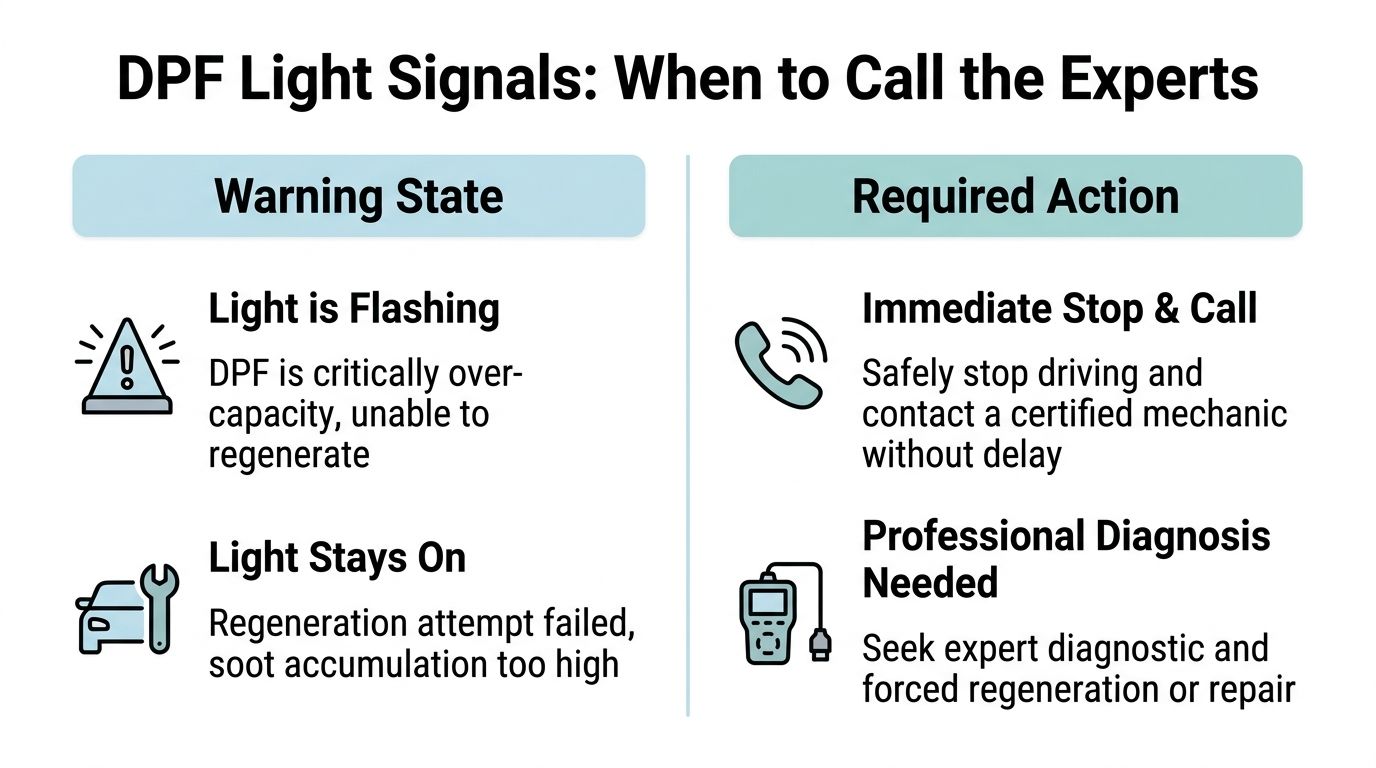
If you've already done the proper road run and the light stays on, treat that as a sign the car needs more than enthusiasm. It may need a scan, a forced regeneration in the workshop, or repair of the fault that caused the DPF problem in the first place.
What a mechanic should check before talking replacement
A good technician won't jump straight to “new filter.” They'll look at the reason the filter can't clear.
- Driving pattern: Lots of short trips and idling can stop normal regeneration from finishing.
- Upstream engine faults: Injectors, EGR problems, or air leaks can increase soot production.
- Oil level issues: Some vehicles can also flag DPF trouble when the oil level is too high.
- Sensor trouble: The pressure sensor and its wiring can send the whole system astray if they're not reading properly.
That last point matters more than many guides admit.
The overlooked Australian angle
In coastal parts of Australia, sensor connections can suffer from corrosion and terminal oxidation. That means some cars show repeat DPF lights not because the filter is hopelessly blocked, but because the sensor side of the system is giving poor information.
That's why I'd always want a mechanic to inspect the pressure sensor circuit and connector condition before signing off on a major parts bill. A simple connection issue can send owners chasing an expensive answer to the wrong question.
If the warning is flashing, or if a steady light survives a proper regeneration run, the smartest money is spent on diagnosis first and replacement talk second.
Looking After Your VWs DPF and Your Wallet
Prevention is cheaper, simpler, and far less annoying than dealing with a blocked DPF after the car has had enough. The broad pattern is familiar across brands. Diesel vehicles that miss out on regular open-road running tend to build soot more quickly, while those that get a decent stretch cope much better.
For a lot of owners, the practical answer is to build one proper drive into the routine. Not a heroic blast. Just a regular, sensible road run that lets the car get fully warm and stay there.
Habits that help
- Give it open-road time: Short urban trips are hard on a diesel DPF. A regular longer drive gives the system a better chance to look after itself.
- Use the correct oil: The wrong oil can leave ash the DPF can't burn away. Always stick to the specification the vehicle calls for.
- Act on warning signs early: A workshop regeneration or inspection is usually kinder to the budget than waiting until the car is sulking in reduced-power mode.
Some Australian vehicles add another wrinkle. A flashing DPF light can indicate oil dilution exceeding 10%, which means the oil needs replacing straight away rather than trying another regeneration drive, as discussed in this Australian video on DPF light and oil dilution.
The expensive mistake to avoid
Owners often assume every DPF light means “take it for a flog and she'll be right.” Sometimes that works. Sometimes it absolutely doesn't. If the issue is oil dilution, a faulty sensor, or another supporting fault, driving harder won't fix the root cause.
That's where sensible maintenance pays off. If you're already tracking service items and sourcing bits for the car, it helps to stay organised with dependable VW parts options in Australia. Keeping the right consumables and service habits in mind is far cheaper than turning neglect into a major repair.
Back to Simpler Times A True VW Legacy
There's comfort in knowing this modern nuisance still responds to the same old-fashioned approach VW owners have always valued. Listen to the vehicle. Don't panic. Do the simple checks first. Then get the right expert involved if the simple path doesn't work.
That may sound a long way from air-cooled motoring, but the spirit is familiar. Australians have been living with Volkswagens for generations, and our connection runs deep. Volkswagen Australia assembled Knocked Down Beetle kits at Clayton, Victoria from 1954 until 1976, creating a distinctly local chapter in the marque's story, as noted in this reference to Clayton Beetle assembly.
The old Beetles and Kombis were simpler. No argument there. But the reason people still love the badge is bigger than carbies versus computers. It's the shape, the memories, the road trips, the club chats, the thumbs-up from strangers, and the feeling that every VW has a bit of personality. Sort the DPF properly, keep the modern daily driver happy, and you can get back to enjoying the broader Volkswagen story without the panic.
If you'd like to celebrate that VW heritage once the dashboard drama is sorted, have a look at Volkswagen Memorabilia. It's a local Australian shop with licensed Volkswagen-themed gifts, diecast models, Kombi and Beetle pieces, local stock, and fast shipping that suits collectors, gift buyers, and anyone who still smiles at the sight of a classic Vee-Dub.